Sunday, December 15, 2019

The Drums of Cyberwar

In mid-October, a cybersecurity researcher in the Netherlands demonstrated, online, as a warning, the easy availability of the Internet protocol address and open, unsecured access points of the industrial control system—the ICS—of a wastewater treatment plant not far from my home in Vermont. Industrial control systems may sound inconsequential, but as the investigative journalist Andy Greenberg illustrates persuasively in Sandworm: A New Era of Cyberwar and the Hunt for the Kremlin’s Most Dangerous Hackers, they have become the preferred target of malicious actors aiming to undermine civil society. A wastewater plant, for example, removes contaminants from the water supply; if its controls were to be compromised, public health would be, too.

That Vermont water treatment plant’s industrial control system is just one of 26,000 ICS’s across the United States, identified and mapped by the Dutch researcher, whose Internet configurations leave them susceptible to hacking. Health care, transportation, agriculture, defense—no system is exempt. Indeed, all the critical infrastructure that undergirds much of our lives, from the water we drink to the electricity that keeps the lights on, is at risk of being held hostage or decimated by hackers working on their own or at the behest of an adversarial nation. According to a study of the United States by the insurance company Lloyd’s of London and the University of Cambridge’s Centre for Risk Studies, if hackers were to take down the electric grid in just fifteen states and Washington, D.C., 93 million people would be without power, quickly leading to a “rise in mortality rates as health and safety systems fail; a decline in trade as ports shut down; disruption to water supplies as electric pumps fail and chaos to transport networks as infrastructure collapses.” The cost to the economy, the study reported, would be astronomical: anywhere from $243 billion to $1 trillion. Sabotaging critical infrastructure may not be as great an existential threat as climate change or nuclear war, but it has imperiled entire populations already and remains a persistent probability.

Vladimir Putin; drawing by Tom BachtellFrom 2011 to 2013 Iranian hackers breached the control system of a small dam outside of New York City. Around the same time, they also broke into the servers of banks and financial firms, including JPMorgan Chase, American Express, and Wells Fargo, and besieged them for 144 days. The attacks were in retaliation for the Stuxnet virus, unleashed in 2010, which caused the destruction of nearly a thousand centrifuges at Iran’s largest uranium enrichment facility. Though neither the United States nor Israel took credit for the attack, both countries are widely believed to have created and deployed the malware that took over the facility’s automated controllers and caused the centrifuges to self-destruct. The attack was intended to be a deterrent—a way to slow down Iran’s nuclear development program and force the country to the negotiating table.

If it hadn’t worked, a more powerful cyberweapon, Nitro Zeus, was being held in reserve, apparently by the US, primed to shut down parts of the Iranian power grid, as well as its communications systems and air defenses. Had it been deployed, Nitro Zeus could have crippled the entire country with a cascading series of catastrophes: hospitals could not have been able to function, banks could have been shuttered and ATMs could have ceased to work, transportation could have come to a standstill. Without money, people might not have been able to buy food. Without a functioning supply chain, there would have been no food to buy. The many disaster scenarios that could have followed are not hard to imagine and can be summed up in just a few words: people would have died.

When government officials like the director of the US Defense Intelligence Agency, Lieutenant General Robert Ashley, say they are kept up at night by the prospect of cyberwarfare, the vulnerability of industrial control systems is likely not far from mind. In 2017 Russian hackers found their way into the systems of one hundred American nuclear and other power plants. According to sources at the Department of Homeland Security, as reported in The New York Times, Russia’s military intelligence agency, in theory, is now in a position “to take control of parts of the grid by remote control.”

More recently, it was discovered that the same hacking group that disabled the safety controls at a Saudi Arabian oil refinery in 2017 was searching for ways to infiltrate the US power grid. Dragos, the critical infrastructure security firm that has been tracking the group, calls it “easily the most dangerous threat publicly known.” Even so, a new review of the US electrical grid by the Government Accountability Office (GAO) found that the Department of Energy has so far failed to “fully analyze grid cybersecurity risks.” China and Russia, the GAO report states, pose the greatest threat, though terrorist groups, cybercriminals, and rogue hackers “can potentially cause harm through destruction, disclosure, modification of data, or denial of service.” Russia alone is spending around $300 million a year on its cybersecurity and, in the estimation of scholars affiliated with the New America think tank, has the capacity to “go from benign to malicious rapidly, and…rapidly escalate its actions to cyber warfare.”

It’s not just Russia. North Korea, Iran, and China all have sophisticated cyberwarfare units. So, too, the United States, which by one account spends $7 billion a year on cyber offense and defense. That the United States has not advocated for a ban on cyberattacks on critical infrastructure, the Obama administration’s top cybersecurity official, J. Michael Daniel, tells Greenberg in Sandworm, may be because it wants to reserve that option itself. In June David Sanger and Nicole Perlroth reported in The New York Times that the United States had increased its incursions into the Russian power grid.

There are no rules of engagement in cyberspace. Like cyberspace itself, cyberwarfare is a relatively new concept, and one that is ill-defined. Greenberg appears to interpret it liberally, suggesting that it is a state-sponsored attack using malware or other malicious software, even if there is no direct retaliation, escalation, or loss of life. It may seem like a small semantic distinction, but cyberwarfare is not the same as cyberwar. The first is a tactic, the second is either a consequence of that tactic, or an accessory to conventional armed conflicts. (The military calls these kinetic combat.) This past June, when the United States launched a cyberattack on Iran after it shot down an American drone patrolling the Strait of Hormuz, the goal was to forestall or prevent an all-out kinetic war. Responding to a physical attack with a cyberattack was a risk because, as Amy Zegart of Stanford’s Hoover Institute told me shortly afterward, we don’t yet understand escalation in cyberspace.

Absent rules of engagement, nation-states have a tremendous amount of leeway in how they use cyberweapons. In the case of Russia, cyberwarfare has enabled an economically weak country to pursue its ambitious geopolitical agenda with impunity. It has used cyberattacks on industrial control systems to cripple independent states that had been part of the Soviet Union in an effort to get them back into the fold, while sending a message to established Western democracies to stay out of its way.

As Russia has attacked, Greenberg has not been far behind, reporting on these incursions in Wired while searching for their perpetrators. Like the best true-crime writing, his narrative is both perversely entertaining and terrifying.

by Sue Halpern, NYRB |  Read more:
Image: Vladimir Putin; drawing by Tom Bachtell

Bob Dylan & Johnny Cash


[ed. I like that they went with the imperfect version.]

Chrome 79 Will Continuously Scan Your Passwords Against Public Data Breaches

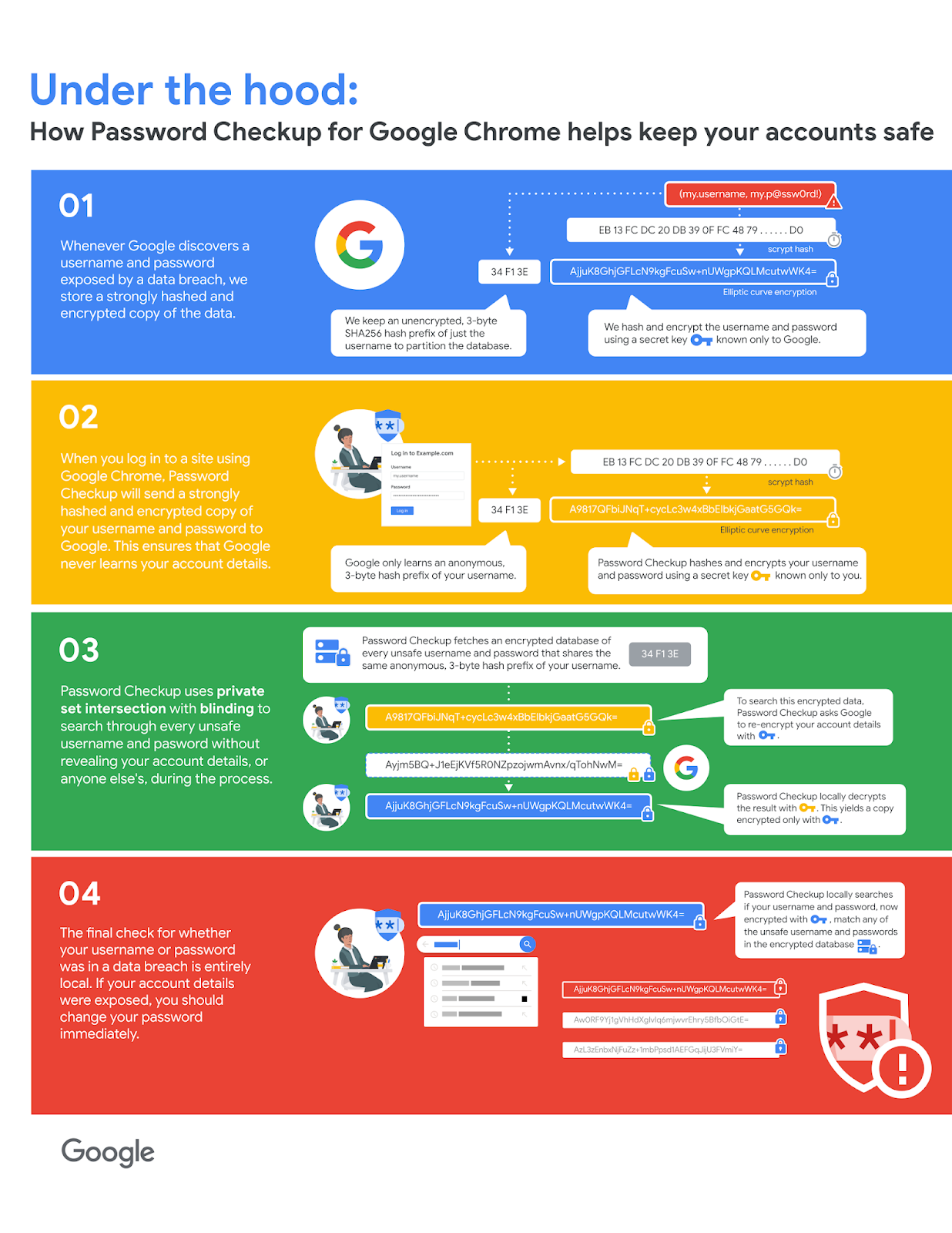
Google's password checking feature has slowly been spreading across the Google ecosystem this past year. It started as the "Password Checkup" extension for desktop versions of Chrome, which would audit individual passwords when you entered them, and several months later it was integrated into every Google account as an on-demand audit you can run on all your saved passwords. Now, instead of a Chrome extension, Password Checkup is being integrated into the desktop and mobile versions of Chrome 79.

How Password Checkup works. All of these Password Checkup features work for people who have their username and password combos saved in Chrome and have them synced to Google's servers. Google figures that since it has a big (encrypted) database of all your passwords, it might as well compare them against a 4-billion-strong public list of compromised usernames and passwords that have been exposed in innumerable security breaches over the years. Any time Google hits a match, it notifies you that a specific set of credentials is public and unsafe and that you should probably change the password.

The whole point of this is security, so Google is doing all of this by comparing your encrypted credentials with an encrypted list of compromised credentials. Chrome first sends an encrypted, 3-byte hash of your username to Google, where it is compared to Google's list of compromised usernames. If there's a match, your local computer is sent a database of every potentially matching username and password in the bad credentials list, encrypted with a key from Google. You then get a copy of your passwords encrypted with two keys—one is your usual private key, and the other is the same key used for Google's bad credentials list. On your local computer, Password Checkup removes the only key it is able to decrypt, your private key, leaving your Google-key-encrypted username and password, which can be compared to the Google-key-encrypted database of bad credentials. Google says this technique, called "private set intersection," means you don't get to see Google's list of bad credentials, and Google doesn't get to learn your credentials, but the two can be compared for matches.

Building Password Checkup into Chrome should make password auditing more mainstream. Only the most security-conscious people would seek out and install the Chrome extension or perform the full password audit at passwords.google.com, and these people probably have better password hygiene to begin with. Building the feature into Chrome will put it in front of more mainstream users who don't usually consider password security, which are exactly the kind of people who need this sort of thing. This is also the first time password checkup has been available on mobile, since mobile Chrome still doesn't support extensions (Google plz).

by Ron Amadeo, Ars Technica |  Read more:
Image: Google
[ed. I believe Firefox has this feature too.]

Fox News Is Now a Threat to National Security

John Harwood, long one of Washington’s most respected conservative voices in journalism, summed up Fox’s approach Monday night simply: “Lunacy.”

It’s worse than lunacy, though. Fox’s bubble reality creates a situation where it’s impossible to have the conversations and debate necessary to function as a democracy. Facts that are inconvenient to President Trump simply disappear down Fox News’ “memory hole,” as thoroughly as George Orwell could have imagined in 1984.

The idea that Fox News represents a literal threat to our national security, on par with Russia’s Internet Research Agency or China’s Ministry of State Security, may seem like a dramatic overstatement of its own—and I, a paid contributor to its competitor CNN, may appear a biased voice anyway—but this week has made clear that, as we get deeper into the impeachment process and as the 2020 election approaches, Fox News is prepared to destroy America’s democratic traditions if it will help its most important and most dedicated daily viewer.

A reporter in a suit leans his chin on a Fox News microphoneThe threat posed to our democracy by Fox News is multifaceted: First and most simply, it’s clearly advancing and giving voice to narratives and smears backed and imagined by our foreign adversaries. Second, its overheated and bombastic rhetoric is undermining America’s foundational ideals and the sense of fair play in politics. Third, its unique combination of lies and half-truths has built a virtual reality so complete that it leaves its viewers too misinformed to fulfill their most basic responsibilities as citizens to make informed choices about the direction of the country.

In the impeachment hearings, former National Security Council official Fiona Hill and other witnesses made clear how those who, like Fox News hosts and the president, advance the false narrative that Ukraine meddled in the US election are serving the Kremlin’s interests. Russia is playing a weak hand geopolitically—its economy is sputtering along and its population shrinking—and so its greatest hope is to stoke internal discord in the West. Robert Mueller warned of this; James Clapper has warned of it; and now Fiona Hill has done the same. “Our nation is being torn apart,” she said. “Truth is questioned.” Yet Fox, and the GOP more broadly, has warmly embraced almost every twist of Kremlin propaganda, up to and including the idea that Russia never meddled in the 2016 election to begin with.

Fox’s clear willingness to parry the wingnuttiest ideas in service of the president, long-term implications to the United States be damned, should worry all concerned about the state of the United States. The Ukraine myth is hardly the only example; for years, it has repeated false conspiracies about the murder of Democratic staffer Seth Rich, a conspiracy literally cooked up by Russian intelligence and fed into the US media. (To say nothing of Fox’s long-term commitment to undermining and questioning climate science, leaving the US both behind in mitigating the worst effects of climate change and also ill-equipped to face the myriad security consequences of a warming planet.)

It’s possible to paint Fox with too broad of a brush—Chris Wallace remains one of the toughest and best interviewers on television and has repeatedly stood up to vapid GOP talking points, and Bret Baier is a talented journalist and historian—but it’s clear from this year that something fundamental and meaningful has tipped inside the network.

While propagandizing has long been a key facet of Fox’s business (Stephen Colbert debuted his own Fox News host alter ego, in dedicated pursuit of “truthiness,” all the way back in 2005), the situation is clearly getting worse: the lies deeper, its always-tenuous commitment to “Fair and Balanced” unraveling further. Whatever loose adherence to a reality-based world the Fox worldview once possessed, whatever guardrails on truth the network might have once installed, are now gone. Shep Smith, long one of the network’s biggest names and best reporters, literally walked out of the Fox building this fall, departing abruptly after apparently deciding that he couldn’t in good conscience be part of a “news” operation that treated facts so fungibly.

Indeed, as the year has unfolded, Fox’s evening talk shows and its presidentially endorsed morning show have proven to be a particularly egregious and odious swamp of fetid, metastasizing lies and bad faith feedback loops that leave its viewers—and, notably, its Presidential Audience of One—foaming at the mouth with outrage and bile. (...)

More than simply embarrassing themselves by spouting obvious falsehoods, though, Fox News’ incendiary, fanatical rants serve to delegitimize to its viewers the very idea of a political opposition. Every Democrat is evil. Every person who disagrees with President Trump is an enemy of the state. Every career federal employee is a member of a deep state opposition.

As writer Gabe Sherman, who authored a history of Fox News, tweeted over the weekend, “Been thinking a lot about why Trump will survive impeachment when Nixon didn’t. For 20+ years Fox News (and rightwing talk radio) has told GOP voters that Democrats are evil. As lawless as Trump is, Republicans believe Dems are worse. That’s the power of propaganda.”

by Garrett M. Graff, Wired |  Read more:
Image: Drew Angerer
[ed. Nothing new, but it makes you wonder why people accept being lied to politically and not personally.]

Saturday, December 14, 2019


photo: markk

Evil is Baked into Big Tech’s Business Plan

Google co-founders Larry Page and Sergey Brin famously launched their search engine with the mantra: “Don’t Be Evil.” Yet soon enough, their ambitions would lead them to talk publicly about doing good while stealthily refining business models based on exploiting, deceiving, and spying on their fellow humans.

Maybe they harbored an adolescent notion of being good. As if nice intentions were enough – like their early aim to steer clear of ad-based business models — without the responsibility, wisdom, and judgment that guide them to reality. Or maybe they had soaked up too much of the Ayn Rand-ethos of the ‘80s. In any case, Page and Brin tossed their youthful idealism overboard to make superyacht-loads of money grabbing your personal data to sell to the highest advertising bidder. Together with other once-idealistic Silicon Valley entrepreneurs, they created gigantic, Gilded Age-style companies that can bully or buy off anyone who stands in their way, sucking up public resources and shredding the democratic fabric as they go. Page and Brin, who recently stepped down from Google, are now the sixth and seventh richest people in the world.

Amid a rising public outcry against Big Tech’s alarming surveillance practices, monopolistic business practices, and growing threats to democracy, America needs guidance on how to reign in these behemoths. Enter the clear-eyed Financial Times columnist Rana Foroohar, who investigates how we ended up in this mess and proposes some practical ways to get back on track. In the following conversation, she discusses her penetrating new book, Don’t be Evil: How Big Tech Betrayed Its Founding Principles — and All of Us, with the Institute for New Economic Thinking.

Lynn Parramore: As global business correspondent, you write on a wide array of topics for the Financial Times. Why a book-length dive on this particular subject at this moment?

Rana Foroohar: Two things. First, I was trolling for some focus in terms of where to throw my reporting energy, and I came across an amazing McKinsey Global Institute stat showing that 80 percent of corporate value was being held by just 10 percent of firms – those with the most IP [networking software] and data. Most were big tech companies, like the FAANGs [Facebook, Apple, Amazon, Netflix, and Google].

At the same time, I came home one day and opened a credit card bill and started scrolling down it and noticed all these tiny charges in increments of $1.99, 3 bucks, etc. I noticed they were all from the App store. At first, I thought I’d been hacked, but it turns out that my 10-year-old son had become addicted to an online soccer game and racked up all these charges in “in app” purchases. I was horrified as a mother, but fascinated as a journalist, and felt I needed to learn all about this insidious business model.

LP: You mention that Silicon Valley was heavily influenced by 60s counterculture and that many people involved in its rise started out wanting world a better place for everyone. How did the tune go from “We are the World” to “Dirty Deeds Done Dirt Cheap”?


RF: I think that over the decades, the “connect the world” ethos morphed from something beautiful into something that was really just about supra-national companies offshoring capital, data, and profits to wherever they could. Many of the people running the platform tech firms today are very young; they came of age in the 80s when you had a neoliberal ethos, a greed is good culture, and a sense that the only thing that the government can do is cut taxes. They don’t think about the largest public/private ecosystem, or citizens – only consumers. That’s a larger shift in the economy and society of course, but Big Tech represents it’s apex – if capital can fly 35,000 feet over the problems of the nation state, data has been able go even further and faster.

LP: We’re used to throwing around the word ‘big’ in association with certain industries: Big Ag, Big Pharma, etc. But the bigness of Big Tech feels like something new. You mention, for example, that the market capitalizations of the FAANG companies is bigger than the economy of France. What does this bigness mean to the rest of the economy?

RF: Platform companies enjoy a super-star effect to the nth degree. Their model has been to move fast, break things, ring fence as much data as possible and then use that position to establish monopoly power. That was always the aim, and the possibility with such firms – you can go back to economists like Hal Varian and look at their early writings and see that data economists understood that potential. So, that’s one reason that I don’t buy it when tech titans come to Capitol Hill to testify and say “oh, we had no idea.” Of course you did. That was the plan – to become the operating system for people’s lives, in every aspect of their lives. (...)

LP: How might we realign the interests of tech firms and interests of customers and citizens? Where do you stand on breaking these companies up v. regulating them more effectively?

RF
: I would like to see 4 things – first, public data banks in which democratically elected governments can decide which companies and which parts of the public sector get access to consider data and under what terms (rather like what Toronto is doing with the Google Sidewalk project). Data being considered a resource of value, like labor, with an appropriate portion of the corporate value extracted from it going back to the individual (this might be done via a sovereign wealth fund for data, or a digital dividend program – both are being considered in California). I think network and commerce should be separated, a la the 19th century railroad model or bank holding company model – a firm like Amazon, for example, shouldn’t be able to own the entire ecommerce network, and compete against its own clients in commerce (particularly with no algorithmic transparency). And finally, we need a digital bill of rights that enshrines basic civil liberties in the digital space, and an FDA of technology to study the cognitive effects and regulate digital tech properly.

by Lynn Parramore, INET | Read more:

Companion Planting

Are you looking for a new method of gardening? If so, then companion planting is one direction that you should look into. As the home gardening sector continues to grow, different green-thumbed individuals are coming up with all kinds of new methods, including this innovative technique. With companion planting, you can plant different kinds of plants and harvest them together, and at the right time.

In this article we’ll provide you with some of the ‘need to know’ details that you should follow in order to become an expert companion planting gardener. We’ll look at the plants that you should plant together, and those that you shouldn’t. There are also several benefits that come with companion planting, some of which we’ll carefully take you through. But first, what is companion planting?

What is companion planting?

Companion planting is a bit more than just the general notion that some specific plants can benefit others if they are planted close to each other. It has been defined as the planting of two or more crop species together in order to achieve benefits such as higher yields and pest control.

However, scientists look at the process with more exacting minds. They have proven that companion gardening embraces various strategies that increase the plant's biodiversity in all agricultural ecosystems – and in what we like to call a simple garden! In layman’s language, it is two plants that help each other to grow.

Companion planting has a long history, but the methods of planting plants for the beneficial interaction are not always well documented in texts. In many situations, they are created from oral tradition, front porch musings and family recommendations. Despite these historical traditions and the science of horticultural farming, we often practice companion planting simply because it’s a practical planting method!

It allows you to grow herbs, veggies and exotic crops to their full potential. The process also helps to keep insects away, as well as helping you to maintain healthy soil. Eventually, you’ll note that the food you grow even tastes better. To kick-start your gardening adventure, here are some important reminders:
  • You should know that beans can grow with almost everything. You can plant them next to spinach and tomatoes for great results.
  • To increase their resistance to diseases, you should plant your horseradish next to your potatoes.
  • Summer cornfields are easily converted into fields of pumpkins in the autumn. In the past, the First Nations people of North America planted pumpkins together with pole and corn beans in a method called the ‘Three Sisters.' The corn offers a sufficient ‘pole’ for the growth of beans, while the beans trap nitrogen in the soil, which is then greatly beneficial for the pumpkins. The pumpkins create a dense ground cover to stop the spread of weeds and to also keep away harmful pests.
  • Pumpkins also function best as a row type of crop when planted together with sunflowers.
  • It’s a good idea to plant some healthy nasturtium next to your squash, as it helps in keeping away those lousy squash vine borers.
  • Consider using sweet marjoram in your gardens and beds to make your herbs and vegetables sweeter!
Why is companion planting significant?

There are many benefits to companion planting. For instance, tomatoes taste better when planted together with basil. Similarly, harvesting them to make a lovely salad is easy, because they are located next to each other.

What are some of the other additional benefits?

by First Tunnels |  Read more:
Image: via
[ed. See also: Companion planting (Wikipedia)] 

Do Journalists Know Less Than They Used To?

Of the myriad crises threatening journalism — and therefore democracy — one challenge is almost invisible. For a host of reasons, journalists today understand less of the truth about the people they’re covering.

No doubt some will vehemently disagree. But it’s a subtle and important shift that alters the public’s knowledge of events. A little history will help me explain.

In 1989, while a press critic at the Los Angeles Times, I got a call from our Miami correspondent, Barry Bearak. One of the paper’s great talents, Bearak was often the writer of choice for complex and tragic breaking news events, such as plane crashes, the kind of stories that required an analytical mind and a poet’s touch.

“We’ve crossed some kind of border,” Bearak said. He was at the scene of a plane crash, and there were so many news outlets there, he said, he could no longer get near the story he was covering. Reporters were being kept behind ropes. They were forbidden from talking to anyone without a press aide present. Most communication occurred in press conferences. “Up till now,” he said, “I used to be able to walk the crash site with NTSB investigators.” But here even people he knew and trusted him wouldn’t speak to him. The result, he worried, was his stories were shallower and less accurate as a result.

Bearak was witnessing a tipping point the relationship between journalists and sources that would accelerate in the digital age. TV news had recently acquired epochal new technology — mobile satellite trucks and light video cameras — which allowed TV to be “live” from anywhere, technology that helped usher in Reagan’s TV presidency. Now, amid slipping ratings, local news stations were discovering they could “parachute” into any story anywhere and make it live, local and late-breaking. Gulf War One, featuring local news standups from Kuwait, was a year away. The O.J. trial was six.

Yet more outlets and reporters on the same story, it turned out, didn’t equal more public knowledge or understanding. Part of the controls being imposed by newsmakers to keep reporters at a distance was a logistical necessity. Officials worried that the influx of hundreds of new journalists and camera crews could literally trample the scene of a crime or an accident.

And some unwitting journalists also brought the controls on themselves. Many parachuting in had little grounding in the kinds of stories they were covering. When more experienced reporters with better sources broke stories, some of the parachutists complained to officials about uneven access, worried their bosses would be angry when they were scooped. It became easier for public relations people to regress to the mean — to make sure all reporters got the same information, banning government officials from talking even to those reporters they knew and trusted. All information was increasingly controlled.

More outlets covering the news had the ironic effect of shifting power away from journalists toward newsmakers. It was simple economic theory at work: More outlets competing for stories made it “a sellers’ market” for information. Sources, rather than journalists, were more able to dictate the terms of the sale, cherry-picking friendly outlets and angles (Trump and his Fox and friends).

A second epochal change compounded the growing number of outlets: speed. No longer just the province of cable and local TV news, live and late-breaking became part of everyone’s business model. And that further shifted the relationship between journalists and sources. Reporters, working in diminished newsrooms, trying to produce across multiple platforms in real time, had less time to carefully develop sources. Technology also fed that, encouraging less face-to-face time. Journalists could assemble stories from official quotes that arrived digitally into their in-baskets. Email sources questions. File without picking up the phone or leaving the office.

The literature of press management talks about the Constituent vs. Conduit Model of media. The Constituent Model involves news sources convincing reporters of the merits of their arguments. The Conduit Model involves news sources treating journalists as technology or conduit through which messages are delivered. Good communications strategists do a little of both.

But the technology that has democratized media has also pushed us toward the Conduit Model, in which reporters are managed and controlled, not persuaded. All this plays out in ways we now take for granted. Sports leagues control the video and produce their own content. Athletes restrict their comments to scrums and press conferences and learn to say as little as possible. So do politicians and corporations.

The same web tools that democratized communication also gave newsmakers more ways to deliver messages without journalists involved much at all. Barack Obama had his YouTube crew. Donald Trump has done away with the White House even holding press briefings to explain what he’s doing. Twitter is his primary form of official communication.

The press is no longer a gatekeeper over what the public knows — the classic definition of the media. It is now instead often an annotator of what the public has already heard.

by Tom Rosenstiel, Poynter | Read more:

Friday, December 13, 2019

Patterns (Rod Serling)


[See also: Patterns (Wikipedia)]

A 5,000-Year-Old Plan to Erase Debts Is Now a Hot Topic

In ancient Babylon, a newly enthroned king would declare a jubilee, wiping out the population’s debts. In modern America, a faint echo of that idea -- call it jubilee-lite -- is catching on.

Support for write-offs has been driven by Democratic presidential candidates. Elizabeth Warren says she’d cancel most of the $1.6 trillion in U.S. student loans. Bernie Sanders would go further -– erasing the whole lot, as well as $81 billion in medical debt.

But it’s coming from other directions too. In October, one of the Trump administration’s senior student-loan officials resigned, calling for wholesale write-offs and describing the American way of paying for higher education as “nuts.’’

Real-estate firm Zillow cites medical and college liabilities as major hurdles for would-be renters and home buyers. Moody’s Investors Service listed the headwinds from student debt -– less consumption and investment, more inequality -- and said forgiveness would boost the economy like a tax cut.

While the current debate centers on college costs, long-run numbers show how debt has spread through the economy. The U.S. relies on consumer spending for growth -– but it hasn’t been delivering significantly higher wages. Household borrowing has filled the gap, with low interest rates making it affordable.

And that’s not unique to America. Steadily growing debts of one kind or another are weighing on economies all over the world.

The idea that debt can grow faster than the ability to repay, until it unbalances a society, was well understood thousands of years ago, according to Michael Hudson, an economist and historian.

Last year Hudson published “And Forgive Them Their Debts,’’ a study of the ancient Near East where the tradition known as a “jubilee” -- wiping the debt-slate clean -- has its roots. He describes how the practice spread through civilizations including Sumer and Babylon, and came to play an important role in the Bible and Jewish law.

Rulers weren’t motivated by charity, Hudson says. They were being pragmatic -- trying to make sure that citizens could meet their own needs and contribute to public projects, instead of just laboring to pay creditors. And it worked, he says. “Societies that canceled the debts enjoyed stable growth for thousands of years.’’

by Ben Holland, Bloomberg |  Read more:
Image: NY Fed Consumer Credit Panel / Equifax
[ed. Instead of government continuing to pass tax cuts for corporations and wealthy shareholders (in hopes of encouraging trickle-down benefits, which never materialize), money that's now being used to service debt payments and bankruptcies could be used instead to stimulate consumer spending (which corporations and shareholders would benefit from as well). Basically, trickle-up economics. See also: The historical case for abolishing billionaires (The Guardian).]

Congress Learns Pentagon Wasted $1 Trillion, Promptly Gives It Bigger Budget

Here’s a fun little thought experiment: Imagine a “big government” bureaucracy embarked on a wildly ambitious project of social engineering — only to discover, almost immediately, that it had little hope of meeting its stated objectives. Reluctant to admit defeat, or jeopardize funding for its endeavors, this federal agency proceeded to deliberately mislead the public about how badly its project was going, and the likelihood of its ultimate success. Over an 18-year-period, these pointy-headed bureaucrats and their allied elected officials conspired to shovel roughly $1 trillion of taxpayer money into an initiative that exacerbated the very problems it purported to solve — and got 2,300 Americans killed in the process!

Now imagine that a major newspaper published a bombshell report meticulously documenting this bureaucracy’s conscious efforts to mislead the American people whom it claimed to serve, so as to ensure that it could carry on squandering our blood and treasure with impunity.

Would Congress reward that bureaucracy with a $22 billion budget increase hours later, with self-identified “small government” conservatives leading the call?

This week, we learned that the answer is “of course.”

On Monday, the Washington Post published “The Afghanistan Papers,” thousands of pages of war documents that our government did not want us to see, and which the paper only secured after a protracted legal battle. Those documents include nearly 2,000 pages of notes from interviews with generals, diplomats, and other officials who played a central role in waging America’s longest war. (...)

This campaign of deceit facilitated mindless misuses of public funds. The Defense Department was not directly responsible for all of this waste. And America’s civilian leadership bears primary responsibility for the war itself. But in routinely misrepresenting the state of the conflict, and lobbying for higher levels of funding for both military and aid operations in Afghanistan, the Pentagon is complicit in boondoggles like these:
During the peak of the fighting, from 2009 to 2012, U.S. lawmakers and military commanders believed the more they spent on schools, bridges, canals and other civil-works projects, the faster security would improve. Aid workers told government interviewers it was a colossal misjudgment, akin to pumping kerosene on a dying campfire just to keep the flame alive. 
One unnamed executive with the U.S. Agency for International Development (USAID) guessed that 90 percent of what they spent was overkill: “We lost objectivity. We were given money, told to spend it and we did, without reason.” (...)
But no detail from our misadventure in Afghanistan may do more to validate the conservative critique of “big government” excess than this one: Before the U.S. invasion, the Taliban had almost completely eradicated the opium trade in Afghanistan. After 18 years of war — and $9 billion in U.S. funding for anti-opium programs in the country — the Taliban remains in power, only now, it presides over a country that supplies 80 percent of the world’s illicit opium.

The Washington Post and New York Times aired all this dirty laundry on Monday morning. Hours later, Congress’s Armed Services Committee released a bipartisan draft of the 2020 National Defense Authorization Act (NDAA) that would give the Pentagon an additional $22 billion to play with next year, bringing its annual budget to $738 billion. Before Donald Trump took office, the U.S. was already spending more on our military than China, Russia, Saudi Arabia, India, France, the United Kingdom, and Japan spend on theirs, combined. The Defense Department’s budget is now $130 billion larger than it was the day Trump was sworn in. Meanwhile, nearly 2 million Americans are still living in places that do not have running water.

by Eric Levitz, The Cut |  Read more:
Image: Joe Raedle/Getty Images
[ed. See also: Afghanistan papers detail US dysfunction: 'We did not know what we were doing'; and Afghanistan agony is a product of political self-delusion – and public indifference (The Guardian).]

Jeff Koons, Olive Oyl 2003
via:

Thursday, December 12, 2019

Music for World, No Strings Attached

Zheng'an, a small county in Guizhou province of Southwest China, is the world's largest guitar manufacturing center from where locals export the instrument globally.

In all, 56 producers of guitar and related spare parts are based out of the guitar industrial park in Zheng'an. The county has developed 34 independent brands, according to the local government.

Zunyi Shenqu Musical Instruments Manufacturing Co Ltd, a major guitar retailer in the county, has developed three independent brands. It also does processing work for some top global music instrument brands such as Japan's Ibanez and US' Fender. So far, it has exported its products to the United States, Brazil, Spain, Germany, and Japan.

"The main consumer groups who buy guitars are schools, art training centers and guitar lovers. Compared with overseas markets, we have relatively lower costs and prices. The prices of average products range from 1,500 yuan ($214) to 5,000 yuan each. Higher-end guitars can cost over 10,000 yuan each, depending on their quality, features and craftsmanship," said Zheng Chuanjiu, general manager of Zunyi Shenqu. (...)

Last year, Zheng'an produced more than 6 million guitars, and the output value reached 6 billion yuan. More than 3.6 million guitars were exported to more than 30 countries and regions globally, including the US and Brazil, and the export value accounted for nearly one-third of the export value of guitars made in China.

With nearly 15,000 employees working there, the industrial park in Zheng'an expects sales to exceed 7 million units by the end of this year, with an output value of more than 7 billion yuan, according to the local government.

by Zhu Wenqian in Beijing and Yang Jun in Guiyang, China Daily |  Read more:
Image: Zhao Yongzhang/For China Daily

The Age of Instagram Face

This past summer, I booked a plane ticket to Los Angeles with the hope of investigating what seems likely to be one of the oddest legacies of our rapidly expiring decade: the gradual emergence, among professionally beautiful women, of a single, cyborgian face. It’s a young face, of course, with poreless skin and plump, high cheekbones. It has catlike eyes and long, cartoonish lashes; it has a small, neat nose and full, lush lips. It looks at you coyly but blankly, as if its owner has taken half a Klonopin and is considering asking you for a private-jet ride to Coachella. The face is distinctly white but ambiguously ethnic—it suggests a National Geographic composite illustrating what Americans will look like in 2050, if every American of the future were to be a direct descendant of Kim Kardashian West, Bella Hadid, Emily Ratajkowski, and Kendall Jenner (who looks exactly like Emily Ratajkowski). “It’s like a sexy . . . baby . . . tiger,” Cara Craig, a high-end New York colorist, observed to me recently. The celebrity makeup artist Colby Smith told me, “It’s Instagram Face, duh. It’s like an unrealistic sculpture. Volume on volume. A face that looks like it’s made out of clay.”(...)

Image result for INSTAGRAM FACEThe human body is an unusual sort of Instagram subject: it can be adjusted, with the right kind of effort, to perform better and better over time. Art directors at magazines have long edited photos of celebrities to better match unrealistic beauty standards; now you can do that to pictures of yourself with just a few taps on your phone. Snapchat, which launched in 2011 and was originally known as a purveyor of disappearing messages, has maintained its user base in large part by providing photo filters, some of which allow you to become intimately familiar with what your face would look like if it were ten-per-cent more conventionally attractive—if it were thinner, or had smoother skin, larger eyes, fuller lips. Instagram has added an array of flattering selfie filters to its Stories feature. FaceTune, which was released in 2013 and promises to help you “wow your friends with every selfie,” enables even more precision. A number of Instagram accounts are dedicated to identifying the tweaks that celebrities make to their features with photo-editing apps. Celeb Face, which has more than a million followers, posts photos from the accounts of celebrities, adding arrows to spotlight signs of careless FaceTuning. Follow Celeb Face for a month, and this constant perfecting process begins to seem both mundane and pathological. You get the feeling that these women, or their assistants, alter photos out of a simple defensive reflex, as if FaceTuning your jawline were the Instagram equivalent of checking your eyeliner in the bathroom of the bar.

“I think ninety-five per cent of the most-followed people on Instagram use FaceTune, easily,” Smith told me. “And I would say that ninety-five per cent of these people have also had some sort of cosmetic procedure. You can see things getting trendy—like, everyone’s getting brow lifts via Botox now. Kylie Jenner didn’t used to have that sort of space around her eyelids, but now she does.”

Twenty years ago, plastic surgery was a fairly dramatic intervention: expensive, invasive, permanent, and, often, risky. But, in 2002, the Food and Drug Administration approved Botox for use in preventing wrinkles; a few years later, it approved hyaluronic-acid fillers, such as Juvéderm and Restylane, which at first filled in fine lines and wrinkles and now can be used to restructure jawlines, noses, and cheeks. These procedures last for six months to a year and aren’t nearly as expensive as surgery. (The average price per syringe of filler is six hundred and eighty-three dollars.) You can go get Botox and then head right back to the office.

A class of celebrity plastic surgeons has emerged on Instagram, posting time-lapse videos of injection procedures and before-and-after photos, which receive hundreds of thousands of views and likes. According to the American Society of Plastic Surgeons, Americans received more than seven million neurotoxin injections in 2018, and more than two and a half million filler injections. That year, Americans spent $16.5 billion on cosmetic surgery; ninety-two per cent of these procedures were performed on women. Thanks to injectables, cosmetic procedures are no longer just for people who want huge changes, or who are deep in battle with the aging process—they’re for millennials, or even, in rarefied cases, members of Gen Z. Kylie Jenner, who was born in 1997, spoke on her reality-TV show “Life of Kylie” about wanting to get lip fillers after a boy commented on her small lips when she was fifteen.

Ideals of female beauty that can only be met through painful processes of physical manipulation have always been with us, from tiny feet in imperial China to wasp waists in nineteenth-century Europe. But contemporary systems of continual visual self-broadcasting—reality TV, social media—have created new disciplines of continual visual self-improvement. Social media has supercharged the propensity to regard one’s personal identity as a potential source of profit—and, especially for young women, to regard one’s body this way, too. In October, Instagram announced that it would be removing “all effects associated with plastic surgery” from its filter arsenal, but this appears to mean all effects explicitly associated with plastic surgery, such as the ones called “Plastica” and “Fix Me.” Filters that give you Instagram Face will remain. For those born with assets—natural assets, capital assets, or both—it can seem sensible, even automatic, to think of your body the way that a McKinsey consultant would think about a corporation: identify underperforming sectors and remake them, discard whatever doesn’t increase profits and reorient the business toward whatever does. (...)

There was something strange, I said, about the racial aspect of Instagram Face—it was as if the algorithmic tendency to flatten everything into a composite of greatest hits had resulted in a beauty ideal that favored white women capable of manufacturing a look of rootless exoticism. “Absolutely,” Smith said. “We’re talking an overly tan skin tone, a South Asian influence with the brows and eye shape, an African-American influence with the lips, a Caucasian influence with the nose, a cheek structure that is predominantly Native American and Middle Eastern.” Did Smith think that Instagram Face was actually making people look better? He did. “People are absolutely getting prettier,” he said. “The world is so visual right now, and it’s only getting more visual, and people want to upgrade the way they relate to it.”

This was an optimistic way of looking at the situation. I told Smith that I couldn’t shake the feeling that technology is rewriting our bodies to correspond to its own interests—rearranging our faces according to whatever increases engagement and likes. “Don’t you think it’s scary to imagine people doing this forever?” I asked.

“Well, yeah, it’s obviously terrifying,” he said.

by Jia Tolentino, New Yorker |  Read more:
Image: via

[ed. Sorry for the lack of posts lately. Maybe it's just burnout. So much of what you read in the media these days is just junk - endless political squabbling and regurgitated stories, apocalypse, celebrities, atrocities, crime, indignation, heartbreak, economic insecurity, even history (with armies of freelancers just looking for something to write about). Too many people chasing the same themes and stories for clicks. I'll have more on this later, but for now check out the archives or just do something that gives you enjoyment, like maybe reading a good book (I'm currently reading The Overstory by Richard Powers and can highly recommend it.)]

Wednesday, December 11, 2019

Fowl Play

Dead ducks set a family’s house on fire

JUNEAU -- Brad Austin was drinking coffee and getting ready for work Friday morning when he heard a strange popping sound, like metal in a clothes dryer.

The Juneau resident caught sight of an orange glow through a window. He poked his head out a side door and saw his front porch on fire.

These two ducks, seen Friday, Dec. 6, 2019, caused a fire that damaged a Juneau home. (Photo contributed by Brad Austin)As he made a hurried call to 911, a fire extinguisher and garden hose got involved. After firefighters arrived, they found the fire’s cause: A pair of dead ducks hanging from his porch light.

“Oh yeah, they got revenge big time,” Austin said Tuesday.

“It was definitely an unusual fire,” said Rich Etheridge, chief of Capital City Fire/Rescue, Juneau’s fire department. “It took them a little while to figure out what had happened.”

Austin’s 26-year-old son, Lyman, is an avid duck hunter and frequently brings his catch back home for drying and butchering. But last year, the family painted their home, and at that time, they pulled the nails where Lyman usually hung his ducks.

With the nails gone, he started hanging them from the porch light fixture using a nylon strap. That wasn’t a problem until Thursday night, when the family left the light on overnight.

“That was the big thing. I think I had gone to bed first and he hadn’t turned the light off,” Austin said.

According to firefighters’ account of events, the ducks’ waterlogged feathers dried out and began to smolder. At a certain point, the natural oils in the ducks’ feathers ignited, turning into wicks for duck-scented candles as fire consumed the ducks’ fat.

The flames ignited the home’s wood siding and sent fire toward the eaves. The burning ducks melted through their hanging strap, landing on a rubber doormat that also caught fire.

As Austin fought the fire, he shouted for his son to get out of the shower, grab their dogs and get out of the house. None were hurt. The fire was confined to the home’s entryway, which Austin said he had wanted to remodel anyway.

“That’s why we can laugh at it. It’s not like half of my house burned down,” Austin said.

Juneau fire marshal Dan Jager said the situation could have been more serious if the family had been asleep or away from the home. The house did not have installed smoke detectors, and there are no nearby neighbors.

Deputy fire chief Travis Mead said the older home’s construction also inhibited the spread of the fire, and a newer home would not have fared as well.

by James Brooks, ADN |  Read more:
Image: Brad Austin

Art Eats Art


'It is something deeper': David Datuna on why he ate the $120,000 banana (The Guardian)
Image: Rhona Wise/EPA
[ed. You can't make this stuff up. Once in a while there's a glitch in The Matrix and it reveals itself.]

Tuesday, December 10, 2019

Round Tree, Square Hole

Why you should plant trees in square holes.

Planting a tree is one of the easiest ways you can make a lasting difference to your local environment and, depending on the species, enjoy decades of flowers, fruit and autumn colour – all in return for a modest outlay and a few minutes’ work.

Round plugs in square holes: it’s counterintuitive but trees thrive when not planted in round holes.Although putting a tree in the ground might not sound like rocket science, in recent decades scientific research has overhauled much of the traditional wisdom about planting saplings, including some ideas that sound a little strange. So, let me explain why science proves that it’s better to plant trees in square holes.

Traditionally, trees were planted in round holes, perhaps because their trunks are round, as is the spread of their canopies. It was just one of those seemingly obvious, unquestioned assumptions. But here’s what happens to the tree’s roots when you plant them in a round hole, especially one filled with lots of rich compost and fertiliser, as the old guide books suggest. The little sapling will rapidly start growing new roots that will spread out into the rich, fluffy growing media, giving you excellent early success. However, once they hit the comparatively poorer and compacted soil at the perimeter of the hole, the roots will react by snaking along the edge of the hole’s edge in search of more ideal growing conditions.

Eventually, this spiralling action around the limits of the hole will create a circular root system, with the plants essentially acting much as they do when grown in a container. Once the roots mature they will thicken and harden into a tight ring, creating an underground girdle that will choke the plant, eventually resulting in the severe stunting and even death of your treasured tree.

The very simple and counterintuitive act of digging a square planting hole will dramatically reduce the chances of this happening. This is because systematic planting trials have shown that roots are not that good at growing round corners. When they hit the tight, 90-degree angle of your square hole, instead of sneaking around to create a spiral, they flare out of the planting hole to colonise the native soil.

by James Wong, The Guardian |  Read more:
Image: Liam Anderstrem/PA

[ed. My birthday present... I only wish it came in a billion gallon size. Please consider donating to Elizabeth or Bernie's campaigns (or both, as I have).]