Friday, September 28, 2012

Glass Works

[ed. The story of Corning and Gorilla Glass, the 'ultrathin, ultrastrong material of the future'.]

From above, Corning’s headquarters in upstate New York looks like a Space Invaders alien: Designed by architect Kevin Roche in the early ’90s, the structure fans out in staggered blocks. From the ground, though, the tinted windows and extended eaves make the building look more like a glossy, futuristic Japanese palace.

The office of Wendell Weeks, Corning’s CEO, is on the second floor, looking out onto the Chemung River. It was here that Steve Jobs gave the 53-year-old Weeks a seemingly impossible task: Make millions of square feet of ultrathin, ultrastrong glass that didn’t yet exist. Oh, and do it in six months. The story of their collaboration—including Jobs’ attempt to lecture Weeks on the principles of glass and his insistence that such a feat could be accomplished—is well known. How Corning actually pulled it off is not.

Weeks joined Corning in 1983; before assuming the top post in 2005, he oversaw both the company’s television and specialty glass businesses. Talk to him about glass and he describes it as something exotic and beautiful—a material whose potential is just starting to be unlocked by scientists. He’ll gush about its inherent touchability and authenticity, only to segue into a lecture about radio-frequency transparency. “There’s a sort of fundamental truth in the design value of glass,” Weeks says, holding up a clear pebble of the stuff. “It’s like a found object; it’s cool to the touch; it’s smooth but has surface to it. What you’d really want is for this to come alive. That’d be a perfect product.”

Weeks and Jobs shared an appreciation for design. Both men obsessed over details. And both gravitated toward big challenges and ideas. But while Jobs was dictatorial in his management style, Weeks (like many of his predecessors at Corning) tends to encourage a degree of insubordination. “The separation between myself and any of the bench scientists is nonexistent,” he says. “We can work in these small teams in a very relaxed way that’s still hyperintense.”

Indeed, even though it’s a big company—29,000 employees and revenue of $7.9 billion in 2011—Corning still thinks and acts like a small one, something made easier by its relatively remote location, an annual attrition rate that hovers around 1 percent, and a vast institutional memory. (Stookey, now 97, and other legends still roam the halls and labs of Sullivan Park, Corning’s R&D facility.) “We’re all lifers here,” Weeks says, smiling. “We’ve known each other for a long time and succeeded and failed together a number of times.”

One of the first conversations between Weeks and Jobs actually had nothing to do with glass. Corning scientists were toying around with microprojection technologies—specifically, better ways of using synthetic green lasers. The thought was that people wouldn’t want to stare at tiny cell phone screens to watch movies and TV shows, and projection seemed like a natural solution. But when Weeks spoke to Jobs about it, Apple’s chief called the idea dumb. He did mention he was working on something better, though—a device whose entire surface was a display. It was called the iPhone.

by Brian Gardner, Wired |  Read more:
Photo: Max Aguilera-Hellweg

Meet Mira, the Supercomputer That Makes Universes


Cosmology is the most ambitious of sciences. Its goal, plainly stated, is to describe the origin, evolution, and structure of the entire universe, a universe that is as enormous as it is ancient. Surprisingly, figuring out what the universe used to look like is the easy part of cosmology. If you point a sensitive telescope at a dark corner of the sky, and run a long exposure, you can catch photons from the young universe, photons that first sprang out into intergalactic space more than ten billion years ago. Collect enough of these ancient glimmers and you get a snapshot of the primordial cosmos, a rough picture of the first galaxies that formed after the Big Bang. Thanks to sky-mapping projects like the Sloan Digital Sky Survey, we also know quite a bit about the structure of the current universe. We know that it has expanded into a vast web of galaxies, strung together in clumps and filaments, with gigantic voids in between.

The real challenge for cosmology is figuring out exactly what happened to those first nascent galaxies. Our telescopes don't let us watch them in time-lapse; we can't fast forward our images of the young universe. Instead, cosmologists must craft mathematical narratives that explain why some of those galaxies flew apart from one another, while others merged and fell into the enormous clusters and filaments that we see around us today. Even when cosmologists manage to cobble together a plausible such story, they find it difficult to check their work. If you can't see a galaxy at every stage of its evolution, how do you make sure your story about it matches up with reality? How do you follow a galaxy through nearly all of time? Thanks to the astonishing computational power of supercomputers, a solution to this problem is beginning to emerge: You build a new universe.

In October, the world's third fastest supercomputer, Mira, is scheduled to run the largest, most complex universe simulation ever attempted. The simulation will cram more than 12 billion years worth of cosmic evolution into just two weeks, tracking trillions of particles as they slowly coalesce into the web-like structure that defines our universe on a large scale. Cosmic simulations have been around for decades, but the technology needed to run a trillion-particle simulation only recently became available. Thanks to Moore's Law, that technology is getting better every year. If Moore's Law holds, the supercomputers of the late 2010s will be a thousand times more powerful than Mira and her peers. That means computational cosmologists will be able to run more simulations at faster speeds and higher resolutions. The virtual universes they create will become the testing ground for our most sophisticated ideas about the cosmos.

Salman Habib is a senior physicist at the Argonne National Laboratory and the leader of the research team working with Mira to create simulations of the universe. Last week, I talked to Habib about cosmology, supercomputing, and what Mira might tell us about the enormous cosmic web we find ourselves in.

Help me get a handle on how your project is going to work. As I understand it, you're going to create a computer simulation of the early universe just after the Big Bang, and in this simulation you will have trillions of virtual particles interacting with each other -- and with the laws of physics -- over a time period of more than 13 billion years. And once the simulation has run its course, you'll be looking to see if what comes out at the end resembles what we see with our telescopes. Is that right?

Habib: That's a good approximation of it. Our primary interest is large-scale structure formation throughout the universe and so we try to begin our simulations well after the Big Bang, and even well after the microwave background era. Let me explain why. We're not sure how to simulate the very beginning of the universe because the physics are very complicated and partially unknown, and even if we could, the early universe is structurally homogenous relative to the complexity that we see now, so you don't need a supercomputer to simulate it. Later on, at the time of the microwave background radiation, we have a much better idea about what's going on. WMAP andPlanck have given us a really clear picture of what the universe looked like at that time, but even then the universe is still very homogenous -- its density perturbations are something like one part in a hundred thousand. With that kind of homogeneity, you can still do the calculations and modeling without a supercomputer. But if you fast forward to the point where the universe is about a million times denser than it is now, that's when things get so complicated that you want to hand over the calculations to a supercomputer.

Now the trillions of particles we're talking about aren't supposed to be actual physical particles like protons or neutrons or whatever. Because these trillions of particles are meant to represent the entire universe, they are extremely massive, something in the range of a billion suns. We know the gravitational mechanics of how these particles interact, and so we evolve them forward to see what kind of densities and structure they produce, both as a result of gravity and the expansion of the universe. So, that's essentially what the simulation does: it takes an initial condition and moves it forward to the present to see if our ideas about structure formation in the universe are correct.

by Ross Andersen, The Atlantic |  Read more:
Photo:Argonne National Laboratory

Thursday, September 27, 2012

Yes, Texas is Different


One of the attractions of the Bob Bullock Museum of Texas State History, an imposing institution just across the street from the campus of the University of Texas at Austin, is “The Star of Destiny,” a fifteen-minute “multimedia experience” purporting to tell “the stories of determination, perseverance, and triumph that have formed the Texas spirit.” It’s a World’s Fair-type presentation, narrated by an actor dressed up as Sam Houston and filmed to look like he’s standing onstage. What makes it “multimedia” is that, besides film, it uses slides projected on a three-screen setup and, in a segment about the gargantuan Galveston hurricane of 1900, employs strobe lights to mimic lightning and a hidden wind machine to blow great gusts of cold misty air into the startled faces of audience members.

At one point, the screens go black and we see projected in white letters:

TEXAS IS BIGGER THAN FRANCE AND ENGLAND

Black again. Then (you knew it was coming):

…COMBINED.

A bit later, another black screen/white letters sequence:

BEFORE TEXAS WAS A STATE…

(portentous pause)

TEXAS WAS A NATION

This, of course, is a reference to the Republic of Texas, as this spacious corner of the world styled itself from 1836 to 1846. In truth, the Republic of Texas was a transitional entity, the larval stage of the State of Texas. Nevertheless, “The Star of Destiny” has a point. Texas is different. It is big, for a start. Not as big as Alaska, which is bigger than France and England and Germany and Japan … combined, but big enough. And it was a nominally independent if ramshackle republic, with embassies and a Congress and everything. Vermont, Hawaii, and, arguably, California were once independent republics, too, but they don’t make a fetish of it. Texas does.

Texas is different. The qualities—the very existence—of the Bob Bullock Museum of Texas State History are evidence of that. Modesty is not the museum’s keynote. On the plaza out front is a huge sculpture of a five-pointed star. It must be twenty feet high. (“Mmm, subtle,” our ninth-grader murmured.) Inside, the exhibits are an uneasy combination of ethnic correctness and unrestrained boasting. One would think that Texas, besides being very, very great, has always been ruled by a kind of U.N. Security Council consisting of one white male, one white female, one black person, one American Indian, and one Mexican or Mexican-American, all of them exemplars of—the phrase is repeated ad nauseam—courage, determination, and hard work.

The stories the exhibits tell are mostly about the state’s economy, agricultural and industrial. Whether it’s oil extraction or cattle raising, rice farming or silicon chipmaking, quicksilver mining or sheepherding, the elements of each are usually the same. A few men become extraordinarily rich. These men are praised for their courage, determination, and hard work. The laborers whose labor produces their wealth are ruthlessly exploited. (The exhibits don’t put it this way, obviously, but the facts are there if you have eyes to see them.) These unfortunates may be poor white men; they may be Mexican immigrant women; they may be enslaved blacks or African-Americans held in sharecropper peonage. They, too, are praised for their courage, determination, and hard work. It all adds up to an unending progression of triumphs for the Texas spirit.

The boasting does not take long to taste a little sour. It begins to feel defensive and insecure. One begins to sense that the museum, on some level, knows that a lot of it is, well, bullockshit.

And yet, and yet. There are redeeming grace notes. The current temporary exhibit at the Bob Bullock Museum is one of them. It’s about Texas music: blues, rock, country, country rock, bluegrass, singer-songwriter, alt-whatever. In this exhibit, the boastfulness feels like simple accuracy and the nods to “diversity” are not a stretch. Respect is shown, properly, to Willie Nelson, Leadbelly, Stevie Ray Vaughan (whose battered Stratocaster occupies a place of honor), Janis Joplin, Big Mama Thornton, and many equally deserving others. And, as befits Austin, there’s live music. During our visit, a fine, fringed six-piece cowboy-country band played and sang a tribute to mid-century radio. All was forgiven.

Does the name Bob Bullock ring a bell? As lieutenant governor “under” George W. Bush (in Texas the post is independently elected and has powers that rival those of the governorship itself), Bob Bullock (1929-1999), a Democrat, was responsible for Dubya’s pre-Presidential reputation for bipartisanship and moderation. In his long career in state government, Bullock was, as far as I can tell, a net plus for Texas, even if his late-in-life Bush-enabling made him a net minus for the nation and the world. But you have to hand it to Texas. How many states would name their enormous marble-clad museum of state history not after a big donor but after a backroom career politician who, by the way, was also a five-times-married alcoholic?

by Hendrick Hertzberg, New Yorker |  Read more:
Photo: Paul Morse

It's a Drone World

“A TV drone flies beside Canada’s Erick Guay during the second practice of the men’s Alpine skiing World Cup downhill race at the Lauberhorn in Wengen, January 12, 2012.” - Reuters (via)

[ed. I think when we look back on this decade the rise of drones (and robotics in general) will be viewed as one of the most significant developments affecting the future, on par with cloud computing and digital money as game changing technologies. Certainly the art of warfare has been altered forever. Eventually, everyone will have drones deployed for some purpose or another (countries, corporations, scientists, terrorist, etc. etc.). Want to spy on your ex-wife,  pre-plan your next hiking trip, have your pizza delivered hot and fresh? There will be a drone business that can help you with that -- probably already is. In any case, near-surface airspace will soon get a lot more crowded (not to mention personal airspace, when hummingbird and insect drones are perfected.]

Gaston La Touche (French, 1854-1913), Pardon in Brittany, 1896. Oil on canvas. Art Institute of Chicago.

Are Hackers Heroes?

On the last day of June of this year, a tech website called Redmond Pie posted two articles in quick succession that, on their face, had nothing to do with each other. The first, with the headline “Root Nexus 7 on Android 4.1 Jelly Bean, Unlock Bootloader, And Flash ClockworkMod Recovery,” was a tutorial on how to modify the software—mainly in order to gain control of the operating system—in Google’s brand-new tablet computer, the Nexus 7, a device so fresh that it hadn’t yet shipped to consumers.

The second headline was slightly more decipherable to the casual reader: “NewOS X Tibet Malware Puts in an Appearance, Sends User’s Personal Information to a Remote Server.” That story, which referred to the discovery of a so-called “Trojan horse” computer virus on certain machines in Tibet, pointed out that Apple computers were no longer as impervious to malicious viruses and worms as they had been in the past and that this attack, which targeted Tibetan activists against the Chinese regime, was not random but political. When the Tibetan activists downloaded the infected file, it would secretly connect their computers to a server in China that could monitor their activities and capture the contents of their machines. (The Redmond Pie writer speculated that the reason Apple computers were targeted in this attack was that they were the preferred brand of the Dalai Lama.)

In fact, the Nexus 7 story and the Tibetan Trojan horse story were both about the same thing: hacking and hackers, although the hacking done by the Nexus 7 hackers—who contribute to an online website called Rootzwiki—was very different from that done by the crew homing in on the Tibetan activists. Hacking and hackers have become such inclusive, generic terms that their meaning, now, must almost always be derived from the context. Still, in the last few years, after the British phone-hacking scandal, after Anonymous and LulzSec, after Stuxnet, in which Americans and Israelis used a computer virus to break centrifuges and delay the Iranian nuclear project, after any number of identity thefts, that context has tended to accent the destructive side of hacking.

In February, when Facebook CEO Mark Zuckerberg observed in his letter to potential shareholders before taking the company public that Facebook embraced a philosophy called “The Hacker Way,” he was not being provocative but, rather, trying to tip the balance in the other direction. (He was also drawing on the words of the veteran technology reporter Steven Levy, whose 1984 book Hackers: Heroes of the Computer Revolution was the first serious attempt to understand the subculture that gave us Steve Jobs, Steve Wozniak, and Bill Gates.) According to Zuckerberg:
In reality, hacking just means building something quickly or testing the boundaries of what can be done. Like most things, it can be used for good or bad, but the vast majority of hackers I’ve met tend to be idealistic people who want to have a positive impact on the world…. Hackers believe that something can always be better, and that nothing is ever complete. They just have to go fix it—often in the face of people who say it’s impossible or are content with the status quo.
Though it might seem neutral, the word “fix” turns out to be open to interpretation. Was the new Google Nexus 7 tablet broken before it was boxed up and shipped? Not to Google or to the vast majority of people who ordered it, but yes to those who saw its specifications and noticed, for instance, that it had a relatively small amount of built-in memory, and wanted to enable the machine to accept an external storage device that could greatly expand its memory. Similarly, there was nothing wrong with the original iPhone—it worked just fine. But for users hoping to load software that was not authored or vetted by Apple, and those who didn’t want to be restricted to a particular service provider (AT&T), and those who liked to tinker and considered it their right as owners to do so, the various “jailbreaks”—or ways of circumventing such restrictions—provided by hackers have addressed and, in Zuckerberg’s term, “fixed” these issues.1

Apple, on the other hand, did not see it this way and argued to the United States Copyright Office that modifying an iPhone’s operating system constituted copyright infringement and thus was illegal. In a ruling in 2010, the Copyright Office disagreed, stating that there was “no basis for copyright law to assist Apple in protecting its restrictive business model.” Copyright laws vary country to country, though, and already this year three people in Japan have been arrested under that country’s recently updated Unfair Competition Prevention Act for modifying—i.e., hacking—Nintendo game consoles. As for the Nexus 7 hackers, they need not worry: Google’s Android software is “open source,” meaning that it is released to the public, which is free to fiddle with it, to an extent.

The salient point of Mark Zuckerberg’s paean to hackers, and the reason he took the opportunity to inform potential shareholders, is that hacking can, and often does, improve products. It exposes vulnerabilities, supplies innovations, and demonstrates both what is possible and what consumers want. Still, as Zuckerberg also intimated, hacking has a dark side, one that has eclipsed its playful, sporty, creative side, especially in the popular imagination, and with good reason. Hacking has become the preferred tool for a certain kind of thief, one who lifts money from electronic bank accounts and sells personal information, particularly as it relates to credit cards and passwords, in a thriving international Internet underground. Hacking has also become a method used for extortion, public humiliation, business disruption, intellectual property theft, espionage, and, possibly, war.

by Sue Halpern, NY Review of Books |  Read more:
Photo: Paul Grover/Rex Features/AP Images

Proportion Control

No other number attracts such a fevered following as the golden ratio. Approximately equal to 1.618 and denoted by the Greek letter phi, it’s been canonized as the “Divine Proportion.” Its devotees will tell you it’s ubiquitous in nature, art and architecture. And there are plastic surgeons and financial mavens who will tell you it’s the secret to pretty faces and handsome returns.

Not bad for the second-most famous irrational number. In your face, pi!

It even made a cameo appearance in “The Da Vinci Code.” While trying to decipher the clues left at the murder scene in the Louvre that opens the novel, the hero, Robert Langdon, “felt himself suddenly reeling back to Harvard, standing in front of his ‘Symbolism in Art’ class, writing his favorite number on the chalkboard. 1.618.”

Langdon tells his class that, among other astonishing things, da Vinci “was the first to show that the human body is literally made of building blocks whose proportional ratios always equal phi.”
“Don’t believe me?” Langdon challenged. “Next time you’re in the shower, take a tape measure.” 
A couple of football players snickered. 
“Not just you insecure jocks,” Langdon prompted. “All of you. Guys and girls. Try it. Measure the distance from the tip of your head to the floor. Then divide that by the distance from your belly button to the floor. Guess what number you get.” 
“Not phi!” one of the jocks blurted out in disbelief. 
“Yes, phi,” Langdon replied. “One-point-six-one-eight. [...] My friends, each of you is a walking tribute to the Divine Proportion.”
I tried it. I’m 6-foot-1, and my belly button is 44 inches from the floor. So my ratio is 73 inches divided by 44 inches, which is about 1.66. That’s about 2.5 percent bigger than 1.618. But then again, nobody ever mistook me for Apollo.

The golden ratio originated in the ideal world of geometry. The Pythagoreans discovered it in their studies of regular pentagons, pentagrams and other geometric figures. A few hundred years later, Euclid gave the first written description of the golden ratio in connection with the problem of dividing a line segment into two unequal parts, such that the whole is to the long part as the long is to the short.

Donald Duck in MathMagicLand

by Steven Strogatz, NY Times |  Read more:
Image via:

Wednesday, September 26, 2012


Avro Ko in the Steelworks Lofts, Brooklyn
via:

Apple’s Scorched-Earth IPhone Fight With Google

In the article “Easter Island’s End,” Jared Diamond described the steps that led to the deforestation of a subtropical, fertile paradise.

Over a few hundred years, inhabitants used the gigantic palm trees around them as rolling surfaces on which to haul stones; they then used more trees to lever the stones into place on platforms. Competing chieftains built larger statues on larger platforms. Eventually, the last tree was gone and the island was covered only in grasses and shrubs, leading to starvation and even cannibalism. Diamond explains that there was no signal crisis:

“Gradually trees became fewer, smaller, and less important. By the time the last fruit-bearing adult palm tree was cut, palms had long since ceased to be of economic significance. That left only smaller and smaller palm saplings to clear each year, along with other bushes and treelets. No one would have noticed the felling of the last small palm.”

The Easter Islanders’ incremental march toward disaster is an apt analogy for Apple Inc. (AAPL)’s decision to keep Google Maps off the newly released iPhone 5, the latest of a series of steps toward control by powerful actors over users’ online behavior. The question is whether the pattern is clear enough for regulatory authorities to take action.  (...)

Users of the iPhone whose maps application was swapped out when they upgraded to Apple’s iOS 6 platform have had a glimpse of what the carriers’ power could entail: Just as Apple chose to remove its reliable maps app that used Google (GOOG)’s data when the two companies’ business relationship became complicated, the cable companies can make services such as Netflix subject to data caps while exempting their own online video offerings. Users may be irritated, of course, but there’s nothing they can do about it.

Anil Dash, the co-founder of the media and technology consulting firm Activate.com, said last week that the move against Google Maps was the first time Apple had put “boxing out competitors” ahead of serving the interests of iPhone users. Similarly, a vertically integrated, market-dominating carrier such as Comcast could now employ its usage caps (which wouldn’t necessarily apply to its own or affiliated services) to effectively squeeze out competitors providing information, entertainment or connections that Comcast didn’t want to support.

by Susan P. Crawford, Bloomberg |  Read more:
Photo: CNET

Virtual Diving with Google Maps


Millions of people will be able to take a virtual dive on the Great Barrier Reef via Google Maps on Wednesday as part of a pioneering underwater scientific expedition.

The Catlin Seaview Survey will allow internet users to share the discoveries of scientists who are using new technology to study the composition and health of the Great Barrier Reef.

Up to 50,000 high-definition panoramic images of the reef will be taken by the world's first tablet-operated underwater camera and geolocated. When the rapid-fire images are linked together, users will be able to choose a location along the reef, dip underwater and go for a viewer-controlled virtual dive using the street view feature of Google Maps.

Dives already completed at three islands on the Great Barrier Reef, as well as sites in Hawaii and the Philippines, will be available today, with more images virtual dive sites added as the scientists map 20 separate reefs along the 2,300km system to a depth of 100m.

by Jessica Aldred, The Guardian |  Read more: 
Photograph: Catlin Seaview Survey

Download, Print, Fire

[ed. Legal issues surrounding 3-D weapons printing technology.]

Imagine an America in which anyone can download and print a gun in their own home. They wouldn't need a license, a background check, or much technical knowledge, just a 3D printer. That's the vision a cadre of industrious libertarians are determined to turn into reality.

Last week, Wiki Weapon, a project to create the first fully printable plastic gun received the $20,000 in funding it needed to get off the ground. The project's goal is not to develop and sell a working gun, but rather to create an open-source schematic (or blueprint) that individuals could download and use to print their own weapons at home.

The technology that makes this possible is 3D printing, a process during which plastic resin is deposited layer by layer to create a three dimensional object. In the past few years 3D printers have become increasingly affordable, and just last week the first two retail stores selling 3D printers opened in the United States with models ranging from $600 to $2,199. (...)

According to Dave Kopel, the research director of the Independence Institute, it is legal to create pistols, revolvers and rifles at home, although some states are stricter than others. As long as an inventor isn't selling, sharing or trading the weapon, under federal law, a license isn't necessary. Homemade creations also don't need to be registered with the US Bureau of Alcohol, Tobacco, Firearms and Explosives (ATF) and are legal for use by the individual who created the weapon.

But there are some exceptions to what can be printed legally. Military-grade weapons like machine guns, rocket launchers, sawed-off shotguns and explosives, as well as concealed firearms (like guns within phones or pens) need prior ATF approval before a manufacturer can create them. Federal law also requires "any other weapon, other than a pistol or revolver, from which a shot is discharged by an explosive if such weapon is capable of being concealed on the person" to be subject to ATF review. Since a potential Wiki Weapon would likely be "any other weapon", the ATF would probably have to approve a prototype, and the bureau has said as much.

Either way, if a fully functional plastic Wiki Weapon is printed, it may be illegal upon creation thanks to an obscure law from the late 1980s. In 1988, Congress passed the Undetectable Firearms Act after the Glock company provoked controversy by selling firearms made with plastic polymers. The technique, which was revolutionary at the time but is common in the industry today, alarmed many gun control advocates who were concerned that plastic guns wouldn't register in airport x-ray machines.

Gun rights advocates remember the uproar as hyperbolic because Glocks do contain metal, and x-ray machines don't even distinguish between metal and plastic. The legacy of the Glock controversy is a law that mandates that all US guns must contain at least 3.7 ounces of steel. However, the law is set to expire in December 2013. If Congress doesn't renew it, Wilson and company wouldn't have to worry about the legislation.

"I haven't felt any real heat yet, but I think it's very possible the project might happen outside of America or the files might be hosted outside of America," said Wilson who is cognizant of the statute. "The point of manufacture might also have to be outside of the United States."

Of course, even if a plastic gun is illegal, it would be incredibly easy to print if a schematic were available. Under US law there's nothing illegal about creating or sharing a schematic for a weapon unless that weapon is copyrighted or patented. Publications like the Anarchists Cookbook and nuclear bomb schematics are available online.

by Alexander Holz, The Guardian |  Read more:

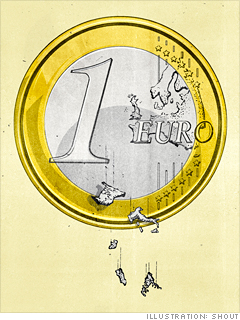
It's Time to Break Up the Euro

Roger Bootle prides himself on being something of a modern-day Nostradamus -- with good reason. In 1999 the British economist predicted a bursting of the dotcom bubble, and in his 2003 book,Money for Nothing, he forecast a worldwide crash in housing that would prove dire for the financial system. A rigorous student of markets, Bootle, 60, is a onetime Oxford don and chief economist for HSBC (HBC) who now runs Capital Economics, a London consulting firm. Operating out of a 19th-century Victorian townhouse near Buckingham Palace, the bald, bespectacled son of a civil servant confidently advises major banks and hedge funds from New York to Beijing. But away from the office he isn't much of a risk-taker. Bootle likes to unwind at England's famous Ascot Racecourse, where he wagers no more than "five or 10 quid just so I have a horse to cheer home."

Today Bootle is betting his professional reputation on another bold contrarian call, one with long-term ramifications for the world economy and global stock markets: He strongly believes that at least a partial breakup of the eurozone is inevitable and that massive changes are coming for the euro, the currency now shared by 17 nations accounting for one-eighth of world GDP.

In July, Bootle and his team won the prestigious Wolfson Economics Prize for providing the best answer to the following question: "If member states leave the Economic and Monetary Union, what is the best way for the economic process to be managed?" In a 114-page report, "Leaving the Euro: A Practical Guide," Bootle delivered a blueprint for the steps a nation should take in exiting the common currency. He also went further, summoning a powerful argument for why an exodus of weak countries is the only solution for Europe's deep malaise.

Bootle is not shy about championing his highly unpopular view. "The euro is a depression-making machine," he tells Fortune. "The politicians keep throwing money to support the weaker nations' debt problem. They never talk about restoring growth. Far from a disaster, a breakup of the euro is the only way to bring back growth and get Europe out of this mess. It can't happen soon enough."

Policymakers continue to take a diametrically opposite approach. Almost without exception, Europe's political leaders and regulators strongly back the euro's survival and generally claim that a breakup would bring economic Armageddon. Optimism that the eurozone will hold rose on Sept. 6, when Mario Draghi, chief of the European Central Bank, announced a giant program for purchasing the sovereign debt of weak eurozone nations. Draghi further stated that "the euro is irreversible." Then, on Sept. 12, a German court approved the country's participation in the European Stability Mechanism, a rescue fund with a lending capacity of $645 billion. Over five trading sessions, the S&P 500 jumped 2.4% in a potent relief rally.

But the continued bailouts are just buying time. Even economists who dread a euro breakup admit that it will probably happen eventually unless Germany and other healthy nations provide far greater support to their weak neighbors. "Europe needs to create federal-style debt shared by all the eurozone members," says Greek economist Yanis Varoufakis. "If that doesn't happen, the eurozone will probably dissolve."

The bet here is that Bootle is right and that the euro will fracture in the next few years. The result will be extremely messy in the immediate aftermath, bringing severe hardship to the exiting countries -- a rash of bankruptcies, giant defaults on sovereign debt, and temporary panic in world stock markets. But the pain that a breakup compresses into a one-time shock will happen anyway if weak nations remain in the euro. It will simply stretch over a number of years and turn out far worse. As Bootle argues, Europe must choose growth, and a split in the euro will bring it back with surprising speed. Let's use his report as a guide for how a successful breakup could play out. (...)

Here's how the mechanics might work if, say, Spain decided to withdraw. The government would announce the decision on a Friday, shortly after the Prime Minister and cabinet reached the decision. It would state that by 12:01 a.m. Monday all wages, bank deposits, pensions, and prices would be reset in pesetas at a 1-to-1 ratio with the euro. Over the weekend, all ATMs and bank branches would be closed and no electronic transfers allowed, to prevent citizens from moving money to, say, Switzerland before the conversion. Bootle recommends that departing nations start printing notes and coins only after the announcement. In the interim all transactions would be via credit or prepaid cash cards. Euros would also be accepted for cash purposes for a fixed period. Starting on Monday morning, the euro would make its debut as a foreign currency. Its value would rise sharply against the new peseta. So a taxi fare priced at two pesetas might go for just one euro within days.

How about the debt issue? Bootle advises nations to re-denominate all sovereign bonds in local currency. The re-denomination really amounts to a default, since the foreign creditors would take big losses. Bootle advocates going further. He wants exiting nations to immediately cease all interest payments and demand a write-down bringing debt to a manageable 60% of GDP. Between the devaluation and the write-down, most creditors would lose 70% of the face value of the bonds. Bootle's argument is that their original value is a pure fiction anyway and a default of that magnitude is inevitable.

by Shaun Tully, CNN Money |  Read more:
Illustration: Shout

Hidden in a Nook, Mastery in Plain Sight


Tiny, hard-to-spot restaurants are a longstanding tradition in Japan, and Ichimura at Brushstroke is steeped in tradition. Mr. Ichimura, 58, practices the Edo-mae style of sushi that he learned decades ago in Tokyo. Developed in street stalls in the era before refrigeration, Edo-mae sushi was made with fish that had often been cured in salt or vinegar, or stored in soy sauce to keep it from spoiling.

Mr. Ichimura’s sushi is a direct descendant of this style, and while he has toned down his use of salt over the years, his fish still offers stronger flavors than are encountered in most New York sushi restaurants. Even the rice, seasoned with a blend of three vinegars, is unusually assertive; it may ruin other sushi for you.

In a phone interview translated by Jamie Graves, Brushstroke’s manager, Mr. Ichimura said he first went to work in a sushi restaurant 42 years ago as a dishwasher. Only after a few years was he permitted, under close supervision, to cut the heads off some fish.

“Nobody actually tells you how to press sushi,” Mr. Graves translated, “so he would do it at night based on watching the chefs do it during the day.” Mr. Ichimura kept a wad of paper in his pocket and when nobody was looking he would copy the motions he had seen: index finger laid over the paper, elbows flexed, he would extend his arms slightly to project a quick, even, gentle pressure. Eventually, still in secrecy, he began to practice after hours with actual fish instead of paper.

He learned the kobu-jime technique, layering fish with kelp, which pulls water from the flesh and leaves behind a umami flavor and a green color. One night, Mr. Ichimura served me fluke that had been prepared that way several days earlier, then carved off a slice of pure white fluke that had arrived just that morning. It was a concise refutation of those who say that sushi chefs don’t do any cooking.

That charge is especially untrue in Mr. Ichimura’s case. He makes the zensai and other cooked dishes that begin each meal. These may include salty fermented tuna, octopus suckers dabbed with wasabi and plum paste, or soy-marinated trout roe on top of tofu skins, so soft they barely hold together during the trip from bowl to mouth.

by Pete Wells, NY Times |  Read more:
Photo: Hiroko Masuike

Tuesday, September 25, 2012


“People say that what we’re all seeking is a meaning for life. I don’t think that’s what we’re really seeking. I think that what we’re seeking is an experience of being alive, so that our life experiences on the purely physical plane will have resonances... so that we actually feel the rapture of being alive.”