Sunday, June 15, 2014

The End

[ed. Another perspective on suicidal ideation.]

The difference between the person who has considered suicide and the one who actually commits it is small. You could say the difference is conditional, accidental even. Committing an act of suicide is just the culmination of a journey, a journey of dangerous ideas that, once allowed into the mind, can never be fully shaken off. This does not mean that suicidal thoughts lead inevitably to suicide. The world’s population would be much smaller if that were the case. What it does mean is that a person who has considered suicide lives, thereafter, with a sort of seductive madness. To entertain suicide is to imagine that the most uncontrollable fact of life — other than birth — can be controlled, taken into one’s own hands, wrested from the chaos that dominates all life on Earth. We can’t escape death. But if we are to die, then why not make death ours — in the same way that we are called to make life ours — by choosing the place, the time, the manner in which we are to die, by determining how and by whom we will be found, what our final message will be, by determining how and in what manner those who love us will continue to love us, to think about us, long after we are dead.

Or so the line of thinking goes.

In Édouard Levé’s short novel Suicide, the suicide comes first.
One Saturday in the month of August, you leave your home wearing your tennis gear, accompanied by your wife. In the middle of the garden, you point out to her that you’ve forgotten your racket in the house. You go back to look for it, but instead of making your way to the cupboard in the entryway where you normally keep it, you head down into the basement. Your wife doesn’t notice this. She stays outside. The weather is fine. She’s making the most of the sun. A few moments later she hears a gunshot. She rushes into the house, cries out your name, notices that the door to the stairway leading down to the basement is open, goes down and finds you there. You’ve put a bullet in your head with the rifle you had carefully prepared. On the table, you left a comic book open to a double page spread. In the heat of the moment, your wife leans on the table; the book falls closed before she realizes that this was your final message.
Suicide is written mostly in the second person. Sometimes, though, the narrator refers to himself, and Suicide toggles back and forth between these two pronouns: the “I” of the narrator and “you,” the friend who committed suicide. This makes it feel like a letter, a letter from one childhood friend to another, regarding the latter’s suicide at the age of 25, twenty years ago. The separation between “I” and “you” often blurs. Each friend becomes a double, is defined by the other and, in turn, reflects the other. We learn that “you” died young. You studied economics; your childhood home was a chateau. You took photographs and read the dictionary. You were a virtuoso on the drums, playing solos in your basement for hours. You felt yourself ill adapted to the world, surprised that the world had produced a being who lives in it as a foreigner. You traveled to “taste the pleasures of being a stranger in a strange town.” You liked to be anonymous, a silent listener, a mobile voyeur. Eventually, you stopped traveling, preferring to be at home.
You were fascinated by the destitute and the morbidly old. Perhaps this is what you feared — to become the living dead, to commit suicide in slow motion. “You were a perfectionist,” the narrator writes. You were such a perfectionist that you wanted to perfect perfecting. But how can one judge whether perfection has been attained? … Your taste for the perfect bordered on madness…
“What was difficult for you,” writes the narrator, “wasn’t beginning or continuing but finishing… sometimes, weary of perfecting perfections, you would abandon your work without destroying or finishing it…instead of finishing the works you undertook, you finished yourself.”

Perfectionism and the fear of finishing go hand in hand. Perfectionism is a form of possession. When something is finished it cannot be possessed, it no longer belongs to us. In the constant struggle to achieve the unachievable, whether in work or in life, the perfectionist is without definitions or limits. Suicide is the infinite preservation of this state of freedom. Thus, “your” suicide and your perfectionism go hand in hand as well. This is not to say that perfectionism is a death impulse; it is the opposite. Perfectionism is the attempt to keep death at bay, to keep everything unfinished. But a lifetime of disappointment, of accomplishing nothing, of suffocating under the burden of possessing yourself with the panicked grip of a drowning man, made your life feel, ironically, foreign. You thought that your perfectionism would allow you to control your life. Instead, life controlled you. In suicide, you could be free again.

by Stefany Anne Golberg, The Smart Set | Read more:
Image Édouard Manet via Wikipedia

Bakufu Ohno (1888-1976)
via:

Scout-Bot
via:

Masters of Love

John Gottman began gathering his most critical findings in 1986, when he set up “The Love Lab” with his colleague Robert Levenson at the University of Washington. Gottman and Levenson brought newlyweds into the lab and watched them interact with each other. With a team of researchers, they hooked the couples up to electrodes and asked the couples to speak about their relationship, like how they met, a major conflict they were facing together, and a positive memory they had. As they spoke, the electrodes measured the subjects' blood flow, heart rates, and how much they sweat they produced. Then the researchers sent the couples home and followed up with them six years later to see if they were still together.

From the data they gathered, Gottman separated the couples into two major groups: the masters and the disasters. The masters were still happily together after six years. The disasters had either broken up or were chronically unhappy in their marriages. When the researchers analyzed the data they gathered on the couples, they saw clear differences between the masters and disasters. The disasters looked calm during the interviews, but their physiology, measured by the electrodes, told a different story. Their heart rates were quick, their sweat glands were active, and their blood flow was fast. Following thousands of couples longitudinally, Gottman found that the more physiologically active the couples were in the lab, the quicker their relationships deteriorated over time.

But what does physiology have to do with anything? The problem was that the disasters showed all the signs of arousal—of being in fight-or-flight mode—in their relationships. Having a conversation sitting next to their spouse was, to their bodies, like facing off with a saber-toothed tiger. Even when they were talking about pleasant or mundane facets of their relationships, they were prepared to attack and be attacked. This sent their heart rates soaring and made them more aggressive toward each other. For example, each member of a couple could be talking about how their days had gone, and a highly aroused husband might say to his wife, “Why don’t you start talking about your day. It won’t take you very long.”

The masters, by contrast, showed low physiological arousal. They felt calm and connected together, which translated into warm and affectionate behavior, even when they fought. It’s not that the masters had, by default, a better physiological make-up than the disasters; it’s that masters had created a climate of trust and intimacy that made both of them more emotionally and thus physically comfortable.

Gottman wanted to know more about how the masters created that culture of love and intimacy, and how the disasters squashed it. In a follow-up study in 1990, he designed a lab on the University of Washington campus to look like a beautiful bed and breakfast retreat. He invited 130 newlywed couples to spend the day at this retreat and watched them as they did what couples normally do on vacation: cook, clean, listen to music, eat, chat, and hang out. And Gottman made a critical discovery in this study—one that gets at the heart of why some relationships thrive while others languish.

Throughout the day, partners would make requests for connection, what Gottman calls “bids.” For example, say that the husband is a bird enthusiast and notices a goldfinch fly across the yard. He might say to his wife, “Look at that beautiful bird outside!” He’s not just commenting on the bird here: he’s requesting a response from his wife—a sign of interest or support—hoping they’ll connect, however momentarily, over the bird.
The wife now has a choice. She can respond by either “turning toward” or “turning away” from her husband, as Gottman puts it. Though the bird-bid might seem minor and silly, it can actually reveal a lot about the health of the relationship. The husband thought the bird was important enough to bring it up in conversation and the question is whether his wife recognizes and respects that.

People who turned toward their partners in the study responded by engaging the bidder, showing interest and support in the bid. Those who didn’t—those who turned away—would not respond or respond minimally and continue doing whatever they were doing, like watching TV or reading the paper. Sometimes they would respond with overt hostility, saying something like, “Stop interrupting me, I’m reading.”

These bidding interactions had profound effects on marital well-being. Couples who had divorced after a six-year follow up had “turn-toward bids” 33 percent of the time. Only three in ten of their bids for emotional connection were met with intimacy. The couples who were still together after six years had “turn-toward bids” 87 percent of the time. Nine times out of ten, they were meeting their partner’s emotional needs.

By observing these types of interactions, Gottman can predict with up to 94 percent certainty whether couples—straight or gay, rich or poor, childless or not—will be broken up, together and unhappy, or together and happy several years later. Much of it comes down to the spirit couples bring to the relationship. Do they bring kindness and generosity; or contempt, criticism, and hostility?

“There’s a habit of mind that the masters have,” Gottman explained in an interview, “which is this: they are scanning social environment for things they can appreciate and say thank you for. They are building this culture of respect and appreciation very purposefully. Disasters are scanning the social environment for partners’ mistakes.”

by Emily Esfahani Smith, The Atlantic |  Read more:
Image: sketchblog/flickr

Noncompete Clauses Increasingly Pop Up in Array of Jobs

Colette Buser couldn’t understand why a summer camp withdrew its offer for her to work there this year.

After all, the 19-year-old college student had worked as a counselor the three previous summers at a nearby Linx-branded camp in Wellesley, Mass. But the company balked at hiring her because it feared that Linx would sue to enforce a noncompete clause tucked into Ms. Buser’s 2013 summer employment contract. Her father, Cimarron Buser, testified before Massachusetts state lawmakers last month that his daughter had no idea that she had agreed to such restrictions, which in this case forbade her for one year from working at a competing camp within 10 miles of any of Linx’s more than 30 locations in Wellesley and neighboring Natick. “This was the type of example you could hardly believe,” Mr. Buser (pronounced BOO-ser) said in an interview.

Noncompete clauses are now appearing in far-ranging fields beyond the worlds of technology, sales and corporations with tightly held secrets, where the curbs have traditionally been used. From event planners to chefs to investment fund managers to yoga instructors, employees are increasingly required to sign agreements that prohibit them from working for a company’s rivals.

There are plenty of other examples of these restrictions popping up in new job categories: One Massachusetts man whose job largely involved spraying pesticides on lawns had to sign a two-year noncompete agreement. A textbook editor was required to sign a six-month pact.

A Boston University graduate was asked to sign a one-year noncompete pledge for an entry-level social media job at a marketing firm, while a college junior who took a summer internship at an electronics firm agreed to a yearlong ban.

“There has been a definite, significant rise in the use of noncompetes, and not only for high tech, not only for high-skilled knowledge positions,” said Orly Lobel, a professor at the University of San Diego School of Law, who wrote a recent book on noncompetes. “Talent Wants to be Free.” “They’ve become pervasive and standard in many service industries,” Ms. Lobel added. (...)

“Noncompetes are a dampener on innovation and economic development,” said Paul Maeder, co-founder and general partner of Highland Capital Partners, a venture capital firm with offices in both Boston and Silicon Valley. “They result in a lot of stillbirths of entrepreneurship — someone who wants to start a company, but can’t because of a noncompete.”

Backers of noncompetes counter that they help spur the state’s economy and competitiveness by encouraging companies to invest heavily in their workers. Noncompetes are also needed, supporters say, to prevent workers from walking off with valuable code, customer lists, trade secrets or expensive training.

Joe Kahn, Linx’s owner and founder, defended the noncompete that his company uses. “Our intellectual property is the training and fostering of our counselors, which makes for our unique environment,” he said. “It’s much like a tech firm with designers who developed chips: You don’t want those people walking out the door. It’s the same for us.” He called the restriction — no competing camps within 10 miles — very reasonable.

“The ban to noncompetes is legislation in search of an issue,” said Christopher P. Geehern, an executive vice president of Associated Industries of Massachusetts, a trade group leading the fight to defeat the proposed restrictions. “They’re used in almost every sector of the economy to the seemingly mutual satisfaction of employers and individuals.”

The legislative fight here pits two powerful groups against each other: venture capitalists opposing noncompetes and many manufacturers and tech companies eager to preserve them.

by Steven Greenhouse, NY Times |  Read more:
Image: Katherine Taylor

Saturday, June 14, 2014

Diane Birch & Daryl Hall

The Perfect Wedding Doesn't Exist. Stop Spending So Much and Enjoy the Party

At a wedding I attended nearly 10 years ago, the bride had a few special requirements: She wanted pie instead of cake. Also, she was deathly allergic to peanuts. So along with the addition of strawberry rhubarb and pecan pies for dessert, she stipulated in writing, and vocalized to her wedding planner, that there must be no peanuts. It was a reasonable request, given that a single bite of peanut would send the bride rushing to the nearest emergency room, hardly a longed-for wedding moment.

And then there was the financial factor: As with most weddings, quite a lot had been invested in what everyone agreed was shaping up to be a very nice event, held at a quaint but elegant Vermont inn at the height of the season. In keeping with the personalities of the bride and groom, it wasn't showy, but it did involve the typical wedding bells and whistles, for which the dollar signs inevitably added up: a planner, a caterer, photography, a band, decorations, the pies and so on.

The wedding itself went off without a hitch, the day glorious and sunny, the bridesmaids, of whom I was one, cooperative and smiling in our blue sundresses, carrying bright flowers. The ceremony was short and lovely, the band energetic and in tune. Everything was, as they say, "perfect" ... until the bride went missing mid-way through her reception.

She'd had some pecan pie.

Despite instructions to the contrary, it had been made with peanuts in the crust. Quickly, an ambulance was called and the bride's new husband gave her a shot of epinephrine. She'd go on to spend the next few hours of her wedding night not dancing and enjoying herself or even eating her pie, but in the nearest emergency room, being treated for anaphylactic shock.

I am not sharing this wedding story to invoke fear among those planning their own nuptials, nor to generate a discussion about the importance of believing people who tell you they have serious allergies (though that is important). I tell this story because we all have them. In my life as a wedding guest, I've found that every single nuptial comes with a mishap, some mistake or unexpected complication or drama or comedic accident. There's always something.

At the same time, I've noticed more and more money being invested in weddings, as if somehow, magically, spending as much as possible ensures the quality of the day – and therefore, goes the unspoken notion, a couple's future life together – as "perfect."

by Jen Doll, The Guardian |  Read more:
Image: E! News / PA

Jimmy Scott ( July, 1925 - June, 2014)


Duilio Barnabè (1914-1961) Still Life with Fruit and Oranges
via:

A Campus Dilemma: Sure, 'No' Means 'No,' But Exactly What Means 'Yes'?

As the federal government presses colleges to improve the way they handle cases of sexual assault, schools are turning their focus to defining "consent" — how to distinguish between activity that's consensual and activity that's not.

On one level, it's obvious. As the old line goes, "You know it when you see it." But less obvious is how to spell it out for the student handbook. There are about as many different definitions of consent as there are colleges.

"If consent were easy to put into words, we'd have a sentence, and we wouldn't have a page and a half of definition," says Mary Spellman, dean of students for Claremont McKenna College, which recently rewrote its definition.

As with most colleges, the bulk of Claremont McKenna's definition covers what's not consent. That's the easier part. For example, any OK from someone who's drunk or drugged or coerced can never count as consent. And consent to have sex last weekend or even an hour ago can't imply consent now.

But the definition also tries to get at those grayer areas, like when a student may be ambivalent or when something ends up happening that a student never intended. (...)

To try to make it a little more clear, some schools amend their definitions with a series of explicit scenarios that read like sexual consent word problems. Yale offers two pages of them.

In one example, "Tyler and Jordan are both drinking heavily. ... Tyler becomes extremely drunk. Jordan offers to take Tyler home ... [and] ... initiates sexual activity. ... Tyler looks confused and tries to go to sleep. Jordan has sex with Tyler."

Yale prints the answer in italics: "There was no consent to have sex. ... The penalty would be expulsion."

But other examples are trickier. One describes two friends, Morgan and Kai, who are engaging in sexual activity in Kai's room. Morgan "looks up at Kai questioningly" before escalating the activity and "Kai nods in agreement" so Morgan proceeds. But when Kai reciprocates, "Morgan lies still for a few minutes, then moves away, saying it is late and they should sleep."

On that one, Yale says that Kai wrongly assumed that it was OK to reciprocate "but took no steps to obtain unambiguous agreement. The ... penalty would likely be a reprimand."

"When you see these scenarios, you understand that this is something that is complicated," says Rory Gerberg, a student at Harvard's Kennedy School of Government who helped advise the White House on its recent guidance for schools. She says these kinds of hypotheticals are critical to showing students what "loud and clear" consent actually looks like.

Carefully crafted legal definitions are one thing, Gerberg says, "but knowing what that actually means in their life on a Friday or Saturday night is different."

by Tovia Smith, NPR |  Read more:
Image: Erin/Flickr

Camera Tossing Self Portrait (by ColourPixie)
via:

Rebecca Mock, The Party
via:

Friday, June 13, 2014

The Downsides of Being a Dad

“All of them told us their stories, and behind each of these stories looms the shadow of that formidable father, a stern, arrogant, and violent man, whose voice alone made Adolf cringe, and who would thrash his son unmercifully for any little reason.”

—John Gunther on Alois Hitler, Vanity Fair, September 1934

There has been no greater villain in the story of mankind than the bad father. The one who hits or humiliates. The one who doesn’t show up. The one who leaves. The one who won’t (please, God) leave. The drunk or the liar or the condescending prick. Bad fathers have ruined more lives than famine and war put together, bruising and battering their sons and daughters emotionally, mentally, and/or physically and dooming them to repeat the cycle, generation after generation until kingdom come.

Men know this. We had friends growing up who had bad fathers, assholes on the sidelines or dinner-table tyrants, or perhaps we had or have one ourselves, the man whose voice alone makes us cringe. We understand the damage that a bad father can do, and we understand what things can and cannot be undone. And when the time comes, as it does for most of us, to have a child of our own, we feel the first measure of that responsibility, that weight, and we say, with confidence: Not us. We will do better. We will hug our kids and hold their hands. We will support and nurture. We will keep our voices down, and our hand, too. We’ll go to the games or recitals we can and we’ll feel guilty when we can’t. We’ll be there for bedtime and teacher conferences, and we’ll be home on the weekends. We’ll do everything we can to be everything they need, because that’s what it means to be a good father today, isn’t it?

Isn’t it?

“I think that adults now pay too much attention to their children at the expense of themselves. Parents close off interests or avenues that they formerly pursued that made them fuller and more interesting people. And they’re totally focused on their little ones, signing them up for every activity under the sun. They’re just all over them. It’s a little bit overdone, and it’s a little obnoxious.”
—An 81-one-year-old father and grandfather, February 2014
It’s worth pointing out that nobody really needs to become a father at all anymore.

Yes, it’s helpful when you’re a politician to have a little one up on the bandstand with you (otherwise, well, the rumors...), and if you’re religiously inclined and spurn contraception, then, okay, kids might be unavoidable, but for the rest of us, it has never been practically easier or more socially acceptable to simply opt out of having a child altogether, and a growing number of us are instead choosing childless cohabitation or perpetual singledom or whatever Clooney has going on these days. More than any other time in modern or ancient history, we’ve got options.

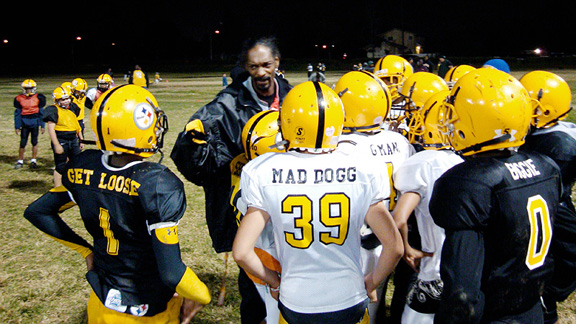
Of those who are choosing to be fathers, though, and choosing to be what they consider to be good fathers—well, these guys are in it. We’re spending three times as many hours every week with our kids as men did in the ‘60s. (Two economists, Valerie and Garey Ramey, noted that among both mothers and fathers, “if the hours were valued at their market wage rate, the increase in childcare time would amount to over $300 billion per year.”) We’re twice as likely as our spouses to say we aren’t spending enough time with our kids, and, like our spouses, we’re nearly twice as likely to find “significant meaning” in child care than in our paid work. We’re the targets of big-balled advertisers from Chevy,Hyundai and VW to Google, Tide, Sears, and Dove; and even Major League Baseball is looking to profit from paternal insecurity and/or pride. We’re having fun with the musings of fellow dads—buying Adam Mansbach’s Go The Fuck to Sleep by the truckload; trying to pass Louis C.K.’s bad-dad riffs off as our own; “liking” the hell out of the recurring “Dadspin” feature on Deadspin.com (with one December post, about one kid’s“insane Christmas wish list,” clocking 3.3 million hits and huge viral play.) You’ve got America’s quarterback kissing and hugging his boys at the playground. You’ve got Snoop Dog coaching kid’s football. You’ve got the heir to the English throne, that Everest of emotional unavailability, saying he changes diapers. (He gets that from his mother.)

And you’ve got Tom Cruise. Last year he sued a tabloid, not for the usual reason he sues tabloids but because said tabloid had indicated Cruise had “abandoned” his daughter because he didn’t see her for a few months while he was busy shooting a movie overseas. (Not unlike—though, really, not at all like—how military personal and oilrig workers and untold many more are required to spend months away from their little ones. Cruise ended up dropping his suit.) Meanwhile, when Mets second baseman Daniel Murphy took a few days off after his son was born, Mike Francesa called paternity leave “a scam and a half” on air and his listeners lit into him for being out of touch, old-fashioned, old. That this wasn’t the NPR crowd parsing modes of patriarchy but a bunch of guys who argue about designated hitters might be the ultimate proof: more men are more active, and more interested, in being fathers today than at any time in anyone’s lifetime.

And this is all to the good—for the kids. Unless you’re a drunk or a bully, or merely one of the so-called helicopter parents who sow seeds of dependency and narcissism in your little centers of the universe, there is no evidence that being present in your kids’ lives is anything but a boon for them. But for you? Your stress levels will go through the roof, as will your odds of experiencing depression. Your physical health and social life will suffer. Your marriage could easily turn into one of those roommate situations you swore it would never become. And you might find yourself, late at night or in the shower or chauffeuring your kid to yet another lesson or practice, thinking that this wasn’t what you signed up for. That you love your children, and that you really would sacrifice anything for them, but that being the kind of father you want to be—a good father—involves too many sacrifices, too much compromise, too high a price.

Does thinking such thoughts make you a bad father?

Does it?

by Richard Dorment, Esquire |  Read more:
Image: Getty

Why Physicists Make Up Stories in the Dark

For centuries, scientists studied light to comprehend the visible world. Why are things colored? What is a rainbow? How do our eyes work? And what is light itself? These are questions that preoccupied scientists and philosophers since the time of Aristotle, including Roger Bacon, Isaac Newton, Michael Faraday, Thomas Young, and James Clerk Maxwell.

But in the late 19th century all that changed, and it was largely Maxwell’s doing. This was the period in which the whole focus of physics—then still emerging as a distinct scientific discipline—shifted from the visible to the invisible. Light itself was instrumental to that change. Not only were the components of light invisible “fields,” but light was revealed as merely a small slice of a rainbow extending far into the unseen.

Physics has never looked back. Today its theories and concepts are concerned largely with invisible entities: not only unseen force fields and insensible rays but particles too small to see even with the most advanced microscopes. We now know that our everyday perception grants us access to only a tiny fraction of reality. Telescopes responding to radio waves, infrared radiation, and X-rays have vastly expanded our view of the universe, while electron microscopes, X-ray beams, and other fine probes of nature’s granularity have unveiled the microworld hidden beyond our visual acuity. Theories at the speculative forefront of physics flesh out this unseen universe with parallel worlds and with mysterious entities named for their very invisibility: dark matter and dark energy.

This move beyond the visible has become a fundamental part of science’s narrative. But it’s a more complicated shift than we often appreciate. Making sense of what is unseen—of what lies “beyond the light”—has a much longer history in human experience. Before science had the means to explore that realm, we had to make do with stories that became enshrined in myth and folklore. Those stories aren’t banished as science advances; they are simply reinvented. Scientists working at the forefront of the invisible will always be confronted with gaps in knowledge, understanding, and experimental capability. In the face of those limits, they draw unconsciously on the imagery of the old stories. This is a necessary part of science, and these stories can sometimes suggest genuinely productive scientific ideas. But the danger is that we will start to believe them at face value, mistaking them for theories. (...)

Much the same consideration applies to the concept of “brane” (short for membrane) worlds. This arises from the most state-of-the-art variants of string theory, which attempt to explain all the known particles and forces in terms of ultra-tiny entities called strings, which can be envisioned as particles extended into little strands that vibrate. Most versions of the theory call for variables in the equations that seem to have the role of extra dimensions in space, so that string theory posits not four dimensions (of time and space) but 11. As physicist and writer Jim Baggott points out, “there is no experimental or observational basis for these assumptions”—the “extra dimensions” are just formal aspects of the equations. However, the latest versions of the theory suggest that these extra dimensions can be extremely large, constituting extra-dimensional branes that are potential repositories for alternative universes separated from our own like the stacked leaves of a book. Inevitably, there is an urge to imagine that these places too might be populated with sentient beings, although that’s optional. The point is that these brane worlds are nothing more than mathematical entities in speculative equations, incarnated, as it were, as invisible parallel universes.

Dark matter and dark energy are more directly motivated by observations of the real world. Dark matter is apparently needed to account for the gravitational effects that seem to come from parts of space where no ordinary matter is visible, or not enough to explain the tug. For example, rotating galaxies seem to have some additional source of gravitational attraction, beyond the visible stars and gas, that stops them from flying apart. The “lensing” effect where distant astrophysical objects get distorted by the gravitational warping of spacetime also seems to demand this invisible form of matter. But dark matter does not exist in the usual sense, in that it has not been seen and there are no theories that can convincingly explain or demand its existence. Dark energy too is a kind of “stuff” required to explain the acceleration of the universe’s expansion, discovered by astronomers observing far-away objects in the mid-1990s. But it is just a name for a puzzle, without any direct detection. (...)

Scientists, of course, are not just making things up, while leaning on the convenience of supposed invisibility. They are using dark matter and dark energy, and (if one is charitable) quantum many-worlds and branes, and other imperceptible and hypothetical realms, to perform an essential task: to plug gaps in their knowledge with notions they can grasp.

by Philip Ball, Nautilus |  Read more:
Image: Miko Maciaszek

Thursday, June 12, 2014

Billy Gibbons


[ed. No one would ever recognize Billy Gibbons without the beard. Which, I guess is a good thing.]

Surasi Kusolwong, Naked Machine (Volkswagen Modern), 2000-2011.
via: