Tuesday, January 20, 2015

Mega-Project: Nicaragua’s Massive New Canal


Just north of Punta Gorda, the view of Nicaragua’s Miskito coast is much as Christopher Columbus would have seen it when he first sailed these waters more than five centuries ago. On the land, there is little sign of habitation among the forested cliff tops and pellucid bays. At sea, the only traffic is a small boat and a pod of half a dozen dolphins.

Our launch, however, is a 21st-century beast that leaps and crashes through the swells with bone-jarring, teeth-rattling thuds as we speed past this nature reserve and indigenous territory that is set to become the stage for a great many more noisy, polluting intrusions by the modern world.

If the dreams of Nicaraguan officials and Chinese businessmen are realised, this remote idyll will be transformed over the next five years into a hub of global trade – the easternmost point of a new canal linking the Atlantic and Pacific for supertankers and bulk carriers that are too big for the Panama canal.

In an era of breathtaking, earth-changing engineering projects, this has been billed as the biggest of them all. Three times as long and almost twice as deep as its rival in Panama, Nicaragua’s channel will require the removal of more than 4.5bn cubic metres of earth – enough to bury the entire island of Manhattan up to the 21st floor of the Empire State Building. It will also swamp the economy, society and environment of one of Latin America’s poorest and most sparsely populated countries. Senior officials compare the scale of change to that brought by the arrival of the first colonisers.


“It’s like when the Spanish came here, they brought a new culture. The same is coming with the canal,” said Manuel Coronel Kautz, the garrulous head of the canal authority. “It is very difficult to see what will happen later – just as it was difficult for the indigenous people to imagine what would happen when they saw the first [European] boats.”

For the native Americans, of course, that first glimpse of Spanish caravels was the beginning of an apocalypse. Columbus’s ships were soon followed by waves ofconquistadores whose feuding, disease and hunger for gold and slaves led to the annihilation of many indigenous populations.

The Nicaraguan government, by contrast, hopes the canal can finally achieve the Sandinista dream of eradicating poverty. In return for a concession to the Chinese company HKND, it hopes for billions of dollars of investment, tens of thousands of jobs and, eventually, a stable source of national income.

First, however, the project has to be built. Since the days of the first Spanish colonisers, there have been more than 70 proposals to construct a route across this stretch of the Central American isthmus. Blueprints have been sketched out by British, US and French engineers. Almost all have remained on the drawing board.

But this time work is already under way. The groundbreaking ceremony took place on 22 December. Over the next five years, engineers will build a 30-metre-deep, 178-mile, fenced waterway which, if finished (and there must always be doubts for a project of this size and cost), will change the lives of millions and the wildlife of a continent.

by Jonathan Watts, The Guardian | Read more:
Images: Fitzcorraldo and The Guardian

Monday, January 19, 2015


Photo: markk 

Hall and Oates

Seahawks 28, Packers 22


Watching the Packers at the end of that game was like every nightmare in which you arrive to class five minutes late, find out there’s a pop quiz, realize you haven’t put on pants, and discover the floor beneath you actually isn’t there, and you’re falling. Except in this case, they happen all at once. And they’re real, not dreams. And Marshawn Lynch is the monster at the end of your real life.

by Grantland Staff |  Read more: here and here
Image: Tom Pennington/Getty

Saturday, January 17, 2015


Tardigrades (also known as waterbears or moss piglets) are water-dwelling, segmented micro-animals, with eight legs.
via:

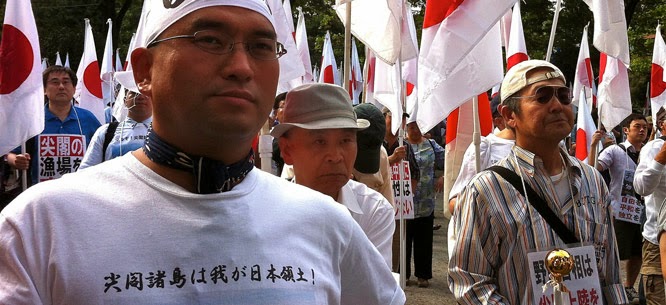
Japan’s Island Problem

[ed. See also: The Shape of Japan to Come.]

“Don’t get me wrong,” said Mr. Hasegawa, a fisherman. “I don’t think that the bombing of Hiroshima was a good thing.” Staring at the furious grey channel where the Pacific Ocean meets the Sea of Okhotsk off Hokkaido in northern Japan on a cold, clear day last March, he spoke like a trauma victim reliving the past: “But if the Americans had dropped the atomic bomb a month earlier, those islands out there would still be Japan’s.”

Were I unaware of the chronology of the summer of 1945 and had we been anywhere else, such a comment would make the engaging 64-year-old seem insensitive or odd. Yet on the horizon three miles in the distance were the snow-covered banks of one of Russia’s Kuril Islands, known to the Japanese who lived there until 1945 as Suishojima of the Habomai group. Mr. Hasegawa’s father was among the 17,291 Japanese who called it and several other nearby islands home. Admiral Yamamoto gathered his fleet there in 1941 to attack Pearl Harbor, and the region was once one of the three richest fishing grounds in the world, replete with salmon, herring, and cod.

In August 1945 wartime Emperor Hirohito announced Japan’s cataclysmic losses following America’s nuclear decimation of Hiroshima and Nagasaki, its firebombing of most other cities, and its devastation of Okinawa island in the East China Sea. Equally important, Russia had disavowed its neutrality pact with Japan, and Soviet troops were advancing into Japanese-controlled Manchuria, northern Korea, and a number of islands around Hokkaido. As the emperor told his defeated subjects with staggering understatement, “The war situation has developed not necessarily to Japan’s advantage.”

What parts of its massive empire Japan would forfeit were then unknown. In the coming years, an area that once resembled an enormous octopus spanning North China and the southern Pacific near Australia would be reduced to the seahorse-shaped nation that we are now familiar with. But this reality has yet to be accepted fully in Japan, especially among people like Mr. Hasegawa, whose lives were upended by history. They were left to imagine any number of alternate realities.

On September 2, 1945, Hirohito’s representatives signed surrender papers to American officers aboard the USS Missouri. At the same moment, Soviet soldiers overwhelmed the islands that the Japanese continue to call the Northern Territories (yet which are known internationally as the southern part of Russia’s Kuril Island chain). At the Yalta Conference in February 1945, Franklin Roosevelt promised these islands to Joseph Stalin in exchange for his troops’ entry into the war on the side of Allies. Within three days of the soldiers’ arrival on the southern Kurils, the Russians began to deport most of the Japanese to Hokkaido, although some were also taken to POW camps in Siberia. 20,000 Russians live on these islands today, and that, to paraphrase Vladimir Putin’s current mood, would appear to be that. Except, of course, for the evicted islanders and their descendants.

The peace treaty that ended war between Japan and the Allied Powers was signed in San Francisco in September 1951 and came into effect the following April. It dismantled Japan’s vast empire, returning the country largely to the shape it was in 1869, the year that Hokkaido became part of it. Whatever detractors say today, at the time Emperor Hirohito was pleased. On April 26, 1952, General Matthew Ridgway sent a telegram from Tokyo to the treaty’s chief architect in Washington, John Foster Dulles: “His Majesty the Emperor of Japan, on his own initiative, graciously called upon me this morning and personally expressed his gratitude … [for] making it possible for Japan to regain her sovereignty next Monday.” (...)

The internationally accepted map of Japan today dates from this moment in the early 1950s. The American negotiators involved in its creation excluded specific mention of the islands at the heart of each of Japan’s territorial disputes with Russia, China and Taiwan, and Korea. President Harry Truman’s special representative to the treaty process, John Foster Dulles, kept abundant correspondence, and his records along with those of other diplomats make clear that the final map would not fully commit to naming who owned what—for reasons ranging from real and perceived threats of Communist takeover of the entire area, including Japan, to a desire to cement the need for American power in the region. The Senate Foreign Relations Committee was displeased with this gamble, especially in terms of the islands Japan contests with Russia. On January 17, 1952, Senator Tom Connally wrote to Dulles that the formula was “vague and contained the germ of future conflicting claims.”

Over sixty years later, that germ has developed and spread: in addition to the conflict with Russia, there is the perilous standoff in the East China Sea over several steep crags known to the Japanese as the Senkaku and to the Chinese and Taiwanese as the Diaoyutai, and the caustic on-again, off-again slugfest with Korea over some rocks in the sea that the Japanese call Takeshima and the Koreans, Dokdo. (...)

In 2012 Japanese novelist Haruki Murakami criticized all sides in the dispute for getting people “drunk” on nationalism’s “cheap liquor.” At the time, the Japanese government had just upped the ante by purchasing the islands for $26 million from the family that had held them privately for decades. The already tense situation erupted into widespread anti-Japanese protests and boycotts throughout China, resulting in hundreds of millions of dollars in trade loss, and leading to Japanese, Chinese, and American warships patrolling the area. Following months of frigid relations, China declared an “Air Defense Identification Zone” in the skies above the islands in November 2013, matching what Japan had maintained for decades but generating new outrage because Beijing dictated its position unilaterally and issued unusually expansive demands. (...)

In 1945 the United States captured these islands in the Battle for Okinawa—known locally as the “Typhoon of Steel”—and then governed them together with the rest of Okinawa, its pilots using them for target practice. When Washington agreed to Okinawa’s sovereign reversion to Japan in 1972, it postponed decisions over who would have control over these rocks, recognizing Japan’s so-called administrative rights but not sovereignty. This remains the U.S. position today, regardless of Tokyo’s hard lobbying and Beijing’s bellicosity.

Oil and natural gas deposits near these islands were discovered in 1968, leading some to say that the fight is simply a resource struggle. Yet as recently as 2008, Japanese and Chinese companies established joint development guidelines. This draws attention to an additional dynamic at play that involves lingering historical animosities, distinct from the new laws of the sea but drawing dividing lines just as powerfully. (...)

The United States did not create these various island disputes, but as the victor in 1945, it drew expedient boundaries to contain a history of conflict, and those boundaries are showing their limits. History matters, of course. Yet the propensity to treat it like a backdrop to the present, rather than learning from it, has helped transform Northeast Asia’s legacies into contemporary tinderboxes.

by Alexis Dudden, Dissent | Read more:
Image: Al Jazeera English

[ed. Cocktail hour comes early around here.]
via:

Is Emirates the World's Best Airline?

The black SUV, included in the $10,000 round-trip Emirates Business Class ticket, picks me up at 8 a.m. for flight 204, departing JFK airport for Dubai at 11:20 a.m. It’s a quick ride to the airport, where an Emirates baggage handler waits at the curb. In less than five minutes, my bags are checked, boarding pass issued. When the flight is called, I walk from the Business Class Lounge, one of the airline’s 30 lounges worldwide, passing a wall-sized Emirates ad that reads “Boredom Is Grounded Indefinitely,” and step straight into the upper deck of the Airbus A380, the world’s biggest jetliner, tall as an eight-story building.
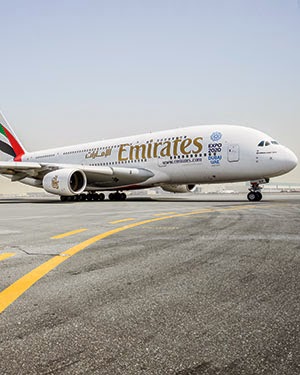
I sink into the flatbed seat, which, compared with those of other international industry leaders, including Cathay Pacific and Singapore Airlines, is state-of-the-art, as is the 1,600-channel in-seat entertainment system­. There’s a small minibar of soft drinks and snacks, but who wants to fetch their own drinks in business and first class? The allure of Emirates goes beyond its hardware into what aviation writer Gary Leff tells me is the “halo effect of some of the over-the-top things they do.” He calls the in-your-face features the “Emirates bling”: the two enormous spa showers in first class; the 14 first-class suites, each with a vanity table, closet, 23-inch TV screen and electronic doors that seal shut for total seclusion; the young fleet, which includes 50 A380s (already more than any other airline, with 90 more on order).

The plane lifts off in a quiet purr—with 550-plus tons and 500 passengers—and soon a caravan of flight attendants, fluent in a dozen languages, is rolling down the aisles, a parade of smiles and service.

“You’re able to park things that are difficult in your life,” a woman’s voice assures me from the noise-canceling headset. “Untether yourself from your schedule.... Let all that go.”

It’s time to head to the lounge. It’s big and circular, with a horseshoe-shaped stand-up bar in the center, created in the cross-aisle for which Emirates forfeited a number of business-class seats. In ads the lounge is shown bubbling with bon vivants: bearded hunks just back from jungles as wild as their souls; unattached beauties with come-hither-into-my-sliding-door-domain smiles; cosmopolitans, captains of industry and other celebrants conversing in the new disco of the skies. When I burst in at about noon, the bar is being staged, a theater set being erected by nine flight attendants assembling bottles, glasses and snacks. Soon Champagne corks are popping and fellow passengers arrive.

Do not run, I tell myself. These people aren’t angling to steal your overhead space or cut in front of you at the bathroom. These are your friends. (...)

The age of Emirates accelerated in 2008 with the introduction of its Airbus A380 flights. Since the double-decker, wide-bodied, four-engine jetliner was introduced in the early 2000s, airline executives and owners, both public and private, had dreamed of how to best maximize its mammoth space. “People were fantasizing about gyms on board and casinos, bowling alleys and swimming pools,” says Sarrabezolles. “None of that really happened with any other airlines.”

Emirates capitalized on the A380’s space with revolutionary bling. To spread the word, the airline launched highly publicized inaugural flights from several cities and held special events from New York to Los Angeles, where there was a gala dinner at the Kodak Theater. Ricky Martin performed, Hilary Swank spoke and Wolfgang Puck catered. There were advertisements in glossy international magazines, on billboards and drive-time radio. The strategy worked: CEO-level executives, American celebrities, politicians, ultra-high-net-worth individuals, the rich, royal and famous were soon reveling in the new way to fly, using Dubai as a hub to connect to the world.

“This airline is amazing,” Paris Hilton tweeted in June 2009 from her Emirates first-class suite. The tweet was estimated by one publicist to be worth $1.5 million in public relations, with $3 million more in free advertising if the message spread in the media, which of course it did. “For the first time, you could travel commercially better than you could privately in anything like a Gulfstream, which was in no way as luxurious as flying on Emirates in the first-class cabin,” says event planner Colin Cowie, who has flown 12 million miles across nearly a hundred countries and became allegiant to Emirates while producing the grand opening of the Atlantis, The Palm resort in Dubai in 2008. “To walk onto the A380 in 2008, to have a bathroom the size of an average Manhattan bathroom, your own attendant, a seven-minute shower, every amenity known to man, full-size bath towels is pretty amazing. You cannot do better on a commercial flight. It was a big game changer.”

Midway through the Dubai-London flight, the Middle Easterners in first class would change their attire to suit their destination. “You’d take off from the Middle East, and everyone would be covered in white robes or black abayas,” says Cowie. “You’d land in London ,and everyone would be in bespoke suits, high heels, tight jeans, fabulous fitted tops. It would be the exact opposite going back.”

Dr. Michael Apa, a leading New York–based cosmetic dentist, heard about Emirates at a dinner party at furrier Dennis Basso’s home in Manhattan. “I was sitting next to Ivanka Trump,” he says. “She said, ‘I just got back from Dubai, and Emirates is so great.’ But I didn’t really understand, because I didn’t think I would be going to Dubai anytime soon.” Then in 2006, members of the royal family became Apa’s patients in New York. In 2008 they flew him to visit on Emirates, which the royal family flies when they are not flying privately. “I’m sitting on that plane and I’m thinking, Wow!” says Apa, who now has an outpost of his practice in Dubai and flies Emirates often.

In the first-class cabin, Apa’s fellow passengers have included Virgin Airlines founder Richard Branson, sportscaster Bryant Gumbel, CNN anchor Richard Quest and rapper Busta Rhymes. But Emirates is as much about who you don’t see as much as who you do. “You are sleeping privately, while on other airlines you are sleeping with everyone else,” says Cowie.

Still, first and business class cannot sustain an airline. Emirates had to communicate its message to the masses. But outside of its stellar equipment and service, it did not yet know what its message was. By 2010, spurred by the explosive growth of tourism in Dubai, the airline was expanding at warp speed, ordering $13 billion in new aircraft.

“Emirates was growing probably as fast as Google,” says Scott Goodson, founder of the StrawberryFrog advertising agency in New York. “And the reason for that was the center of the world was changing. The old center of the world was Europe. Before, if you were flying from Asia to the States or Latin America, you had to fly through London or Frankfurt. But with the new 777s and the A380, the center of the world shifted to Dubai. If you worked at Facebook in California, you could fly from L.A. to Dubai, and it’s a quick hop to Mumbai. The airline realized they needed an idea that could rally both existing employees and new employees. Additionally, they needed help to make this Dubai-based airline not only relevant but admired by the world.”

by Mark Seal, Departures |  Read more:
Image: Alexander Gronsky

Janet Jackson

The Jet Set Life - For Now

One Sunday last spring, Brad Kroenig and his 5-year-old son, Hudson, showed up at a private airport near Paris to meet Karl Lagerfeld, the fashion designer. “Karl will be here 1, 1:30 for takeoff,” announced a Frenchman in a black suit and tie. “O.K., cool,” Brad said. The man in the suit performed something like a bow and retreated. It was 12:45. Brad sank into an armchair by the window and surveyed the tarmac. He pointed out a large gray hawk of a plane that stood off to the side of the slighter, dovelike jets. “It’s the same one that Oprah has,” Brad said. “It’s the biggest one. It flies, like, the longest journey. A lot of private planes have to stop for gas.”

Brad knows what kind of plane Lagerfeld travels on because he has flown on it often. As the most senior and prominent member of a group of male models often referred to as Karl’s Boys, Brad not only works for Chanel and Fendi, the fashion houses where Lagerfeld is the head designer, but also accompanies him on yearly vacations to St. Tropez and work trips and to parties worldwide. He has been photographed with Lagerfeld so often that gossip blogs have mistakenly identified him as the designer’s boyfriend, but their relationship is not romantic. Lagerfeld refers to Brad and the other models that travel with him as his family, albeit a self-selected, genetically ideal one. “I hate ugly people,” Lagerfeld told me. “Very depressing.”

If models were show dogs, Brad would be a golden retriever. He has a strong jaw, hazel eyes and thick blond hair that seems perpetually windswept. The scruff on his face is shaped carefully, deliberately, to draw attention to his cheekbones. Unlike other beautiful people whose appeal lies in a distinctive facial quirk, Brad’s features are perfectly proportioned, with no apparent flaws or peculiarities. When he models, he looks like a Roman statue. “His best bit is the curve of his thigh,” Lagerfeld once said.

At the airport, Hudson snapped photos on an iPhone while his father modeled for him. An hour went by. The man in the suit reappeared and said there would be “a special cake” for “Mr. Hudson” on the plane. Brad asked if there might be special wine for him. “Might as well, right?” he said, and grinned.

Around 2:30, Lagerfeld appeared at the top of the stairs leading to the airport lounge. He was dressed in the manner that has made him the most recognizable designer in the world: a white shirt with a high Edwardian collar, fingerless leather gloves, a strict black blazer and sunglasses. A diamond cat brooch was pinned to his tie, and his tight black pants were covered in a microprint of his own likeness, which ran up and down the leg and, from far away, looked like a thick pinstripe.

“Hello!” Lagerfeld said. He glanced at the field of small planes and frowned. “And where is ours? Is it that one?” Brad pointed to the larger jet parked just out of view. “Ah, the big one,” Lagerfeld said. “Good.”

Lagerfeld was expected that evening in Dubai, where he would show Chanel’s 2015 resort collection in two days. Typically Brad would model in the show, but in Dubai, only Hudson, who is Lagerfeld’s godson, would walk the runway. (He has been appearing in Chanel shows since he was 2.) Lagerfeld was accompanied on the trip, as he is most places, by his 39-year-old bodyguard, Sébastien Jondeau, a part-time boxer with a sinewy build and an intense stare. (A few days later, he nearly body-checked Brad when he held a cup of coffee a little too close to Lagerfeld’s white blazer).

Lagerfeld led the way to the plane. Inside, a wineglass of Diet Coke awaited him at his seat. At the back of the aircraft was a single bed made up with crisp white linens.

“But where am I going to sleep?” Hudson asked.

“You sleep on your seat, darling,” Lagerfeld replied in his heavy German accent. “I have to arrive fresh, you don’t have to. Don’t be selfish.”

Lagerfeld rummaged in one of his many shopping bags and fished out a matching light blue Givenchy tank top and shirt with their tags still attached. “For Dubai,” he said, handing them to Brad. For the plane ride, Brad wore jeans and a blazer by Dior and white Nike high-top sneakers. A rose-gold Rolex glimmered on one wrist, and on the other he wore a diamond bracelet by Chrome Hearts, Lagerfeld’s favorite jewelry brand. “Karl is really generous,” Brad told me. “He likes his friends to look chic.”

After lunch — caviar and salmon tartare for Lagerfeld; caviar, foie gras and scallops for Brad; couscous and vegetables for Hudson — Lagerfeld fell asleep not in his bed, but upright in his seat, Dracula-like. He was still wearing his sunglasses, and the stiff collar of his shirt seemed to dig in uncomfortably at his neck. Brad took out a notebook and jotted down the trip’s mileage. He keeps a log of the cumulative distance he has traveled as a model, currently at 2.4 million miles. Back in St. Louis, where Brad is from, his mother, Barb, keeps track by pinning red flags on a large world map in her basement. The plane climbed into the sky and reached a quiet lull. “See, I told you,” Brad said. “Up here, there’s almost no turbulence.”

Brad likes to say that male modeling is to the women’s business as the W.N.B.A. is to the N.B.A. While Gisele Bündchen’s yearly income is estimated at around $47 million, men of Brad’s standing earn $200,000 to $500,000. A male model, however, can gain an advantage, and ensure career longevity, by forging relationships with influential designers and photographers.

Most of today’s top men have longstanding associations with certain labels. But in a way, Brad is unlike other models, because Lagerfeld isn’t like other designers. Lagerfeld has been at Chanel’s helm since 1983 and still designs 17 collections a year for Chanel, Fendi and his namesake line, an unprecedented feat of creative stamina. He is also a photographer who shoots campaigns for his labels as well as for other brands, like Audi. Brad has become the beneficiary of Lagerfeld’s productivity, appearing on his runways and in his ads. That Brad continues to work well into his 30s is due in no small part to having Lagerfeld as his champion. “If I never met Karl, there’s no way I’d still be modeling,” he said.

by Irina Aleksander, NY Times | Read more:
Image: Brad Kroenig

Friday, January 16, 2015

Answering for America

[ed. See also: Patriot Act Idea Rises in France, and Is Ridiculed]

Americans who live abroad -- more than six million of us worldwide (not counting those who work for the U.S. government) -- often face hard questions about our country from people we live among. Europeans, Asians, and Africans ask us to explain everything that baffles them about the increasingly odd and troubling conduct of the United States. Polite people, normally reluctant to risk offending a guest, complain that America’s trigger-happiness, cutthroat free-marketeering, and “exceptionality” have gone on for too long to be considered just an adolescent phase. Which means that we Americans abroad are regularly asked to account for the behavior of our rebranded “homeland,” now conspicuously in decline and increasingly out of step with the rest of the world.

In my long nomadic life, I’ve had the good fortune to live, work, or travel in all but a handful of countries on this planet. I’ve been to both poles and a great many places in between, and nosy as I am, I’ve talked with people all along the way. I still remember a time when to be an American was to be envied. The country where I grew up after World War II seemed to be respected and admired around the world for way too many reasons to go into here.

That’s changed, of course. Even after the invasion of Iraq in 2003, I still met people -- in the Middle East, no less -- willing to withhold judgment on the U.S. Many thought that the Supreme Court’s installation of George W. Bush as president was a blunder American voters would correct in the election of 2004. His return to office truly spelled the end of America as the world had known it. Bush had started a war, opposed by the entire world, because he wanted to and he could. A majority of Americans supported him. And that was when all the uncomfortable questions really began.

In the early fall of 2014, I traveled from my home in Oslo, Norway, through much of Eastern and Central Europe. Everywhere I went in those two months, moments after locals realized I was an American the questions started and, polite as they usually were, most of them had a single underlying theme: Have Americans gone over the edge? Are you crazy? Please explain.

Then recently, I traveled back to the “homeland.” It struck me there that most Americans have no idea just how strange we now seem to much of the world. In my experience, foreign observers are far better informed about us than the average American is about them. This is partly because the “news” in the American media is so parochial and so limited in its views both of how we act and how other countries think -- even countries with which we were recently, are currently, or threaten soon to be at war. America’s belligerence alone, not to mention its financial acrobatics, compels the rest of the world to keep close track of us. Who knows, after all, what conflict the Americans may drag you into next, as target or reluctant ally?

So wherever we expatriates settle on the planet, we find someone who wants to talk about the latest American events, large and small: another country bombed in the name of our “national security,” another peaceful protest march attacked by our increasingly militarized police, another diatribe against “big government” by yet another wannabe candidate who hopes to head that very government in Washington. Such news leaves foreign audiences puzzled and full of trepidation.

Question Time

Take the questions stumping Europeans in the Obama years (which 1.6 million Americans residing in Europe regularly find thrown our way). At the absolute top of the list: “Why would anyone oppose national health care?” European and other industrialized countries have had some form of national health care since the 1930s or 1940s, Germany since 1880. Some versions, as in France and Great Britain, have devolved into two-tier public and private systems. Yet even the privileged who pay for a faster track would not begrudge their fellow citizens government-funded comprehensive health care. That so many Americans do strikes Europeans as baffling, if not frankly brutal.

by Ann Jones, TomDispatch |  Read more:
Image: Clay Bennett via: 

Thursday, January 15, 2015


ZZ Top
via:

I Was an Amazon Chew Toy

I moved to Seattle five years ago, after being laid off from my job in New York at one of those startups where employees rally around the VC-fueled dream until they’re dumped via email arnd locked out of the office. A job at a larger, more established company like Amazon sounded good. Solid. For my second round of job interviews, I had been called in for meetings at the department’s temporary office in the Columbia Center tower. In a city where executives wear faded jeans and backpacks to work, the Columbia Center is Seattle’s lone totem to conspicuous consumption: seventy-six floors that hover over downtown’s more modest skyscrapers by a good two to three hundred feet, and are wrapped in reflective black glass.

Amazon prides itself on a rigorous hiring process. For a low-level merchandising job in Amazon’s books department, after passing two phone screens that included a logic puzzle—“How many floors are there in the Columbia Center? No, don’t look it up! Pretend there is no Internet”—I was called in for five back-to-back interviews that lasted from morning through lunch. During a break between interviews, the human resources recruiter, Ashley Jones1, came in to tell me more about the company’s benefits. There is something about the fastidious personal grooming of HR recruiters that makes one feel dumpy; gazing at me behind thick, mascara-coated eyelashes that boasted immaculate lash separation, she talked 401Ks and stock options while I stared longingly at her frizz-less locks. “And when we move to our new offices, you can bring your dog to work,” she said.

We live in such a dog-adoring culture that it’s hard to admit when you aren’t totally enamored of them. What you are supposed to feel—what you must always feel—is love. And dog owners are blessed with the extraordinary ability to call bullshit; they can sniff out your limp pats, your half-hearted game of catch. Soon the question comes: “Oh, you don’t like dogs?”

Translation:

1. How can you not like dogs?

2. How can you not like my dog?

3. When a dying baby’s in the street, do you kick it ‘til it fits in the gutter?

No one starts out this way. There’s a time when all kids want a pet, around the time when spreading boogers on the furniture is still okay. My older sister and I worked our way through a small menagerie of pets—hamsters, parakeets, and fish—though everything seemed to perish or run from our feeble, incapable hands. The grass in our backyard grew high, enriched by the nutrients of our decaying mistakes.

But when I was around nine, I was traumatized by my cousins’ unneutered dog, Max. When I visited them in Florida, he ignored the rest of the family, ran over to me, and humped my leg like he hadn’t had sex in years. No one would admit it that perhaps Max picked me because I looked most like a dog. My hair was black just like Max’s coat, and, crouched on the floor screaming, I was just about the same height as a German Shepherd. My cousin Susan always let it go on for a bit too long; I have never understood why people call out the names of their dogs when dogs only respond ten percent of the time, and like humans, never when they are having sex.

“Max! Max! (Ha, ha.) Oh Max, get off her!”

Hump. Hump.

“Bad dog. (Hee hee.) So bad!”

Hump. Hump. Hump.

“Max, what am I going to do with you?”

Humphumphumphumphumphumphump.

After two hours or just ten seconds—what did it matter, when a dog was humping the crap out of you?—she would amble the three long yards across the room to yank Max away, and I would crawl out from under the blanket, the only shield between me and Max’s terrifying dog penis. For years after, Susan would keep me up to date on how my sexual assailant was doing. “When are you coming back?” my cousin asked. “Max misses you.”

My job started in July, and we were supposed to move to Amazon’s new campus the following May. The new campus would unite most of the company into one luxurious mega-compound, the Amazonian equivalent of the Googleplex. I hoped to forget about the new buildings and their dog-filled corridors, but the move was always hovering in the distance, its little puppy paws scratching around the doorway of my mind, dying to be let out so it could take a massive dump. I started to dread my morning hike to work even more than usual. As the date grew closer, you could hear murmurings of excitement around the office and impassioned debates about pet supplies. Kayla, who sat to my left, wanted to discuss her dog’s latest issue. “He keeps peeing on the front yard. It’s so annoying. The neighbors keep complaining about our yard. So now I’m feeding him these pills that won’t kill the grass,” she said.

“There are pills for that?” I asked. I pictured a dog collapsing from acute renal failure in a flower patch. The dog would be fucked, but the begonias, immaculate. “How does that work?”

In November, I felt encouraged by an email sent out by our department head, Scott Reynolds. “Can each of you reply back to me if a) you have allergies to dogs and to what degree, e.g., can’t be on the same floor or just can’t pet them, or b) are afraid or don’t like dogs.”

“Can’t be on the same floor” indicated there might be dog-free floors, which made sense: A multibillion-dollar corporation that had built out space in their complex for nap rooms, outdoor decks, and organic vending machines had surely carved out a few dog-free floors for those of us who wanted to work in a yip-free environment. I speedily typed back my response. “I’m allergic to dog hair—can’t be around furniture or whatever for very long that dogs have been on.” I am far more allergic to cats than dogs, but an allergy is an allergy.

“So if someone had a dog in their office or at their desk,” he wrote back, “would that create problems?”

by Corina Zappia, The Awl | Read more:
Image: wablair

Graphic Design magazine, Japan, 69’
via:

A River Runs Through It

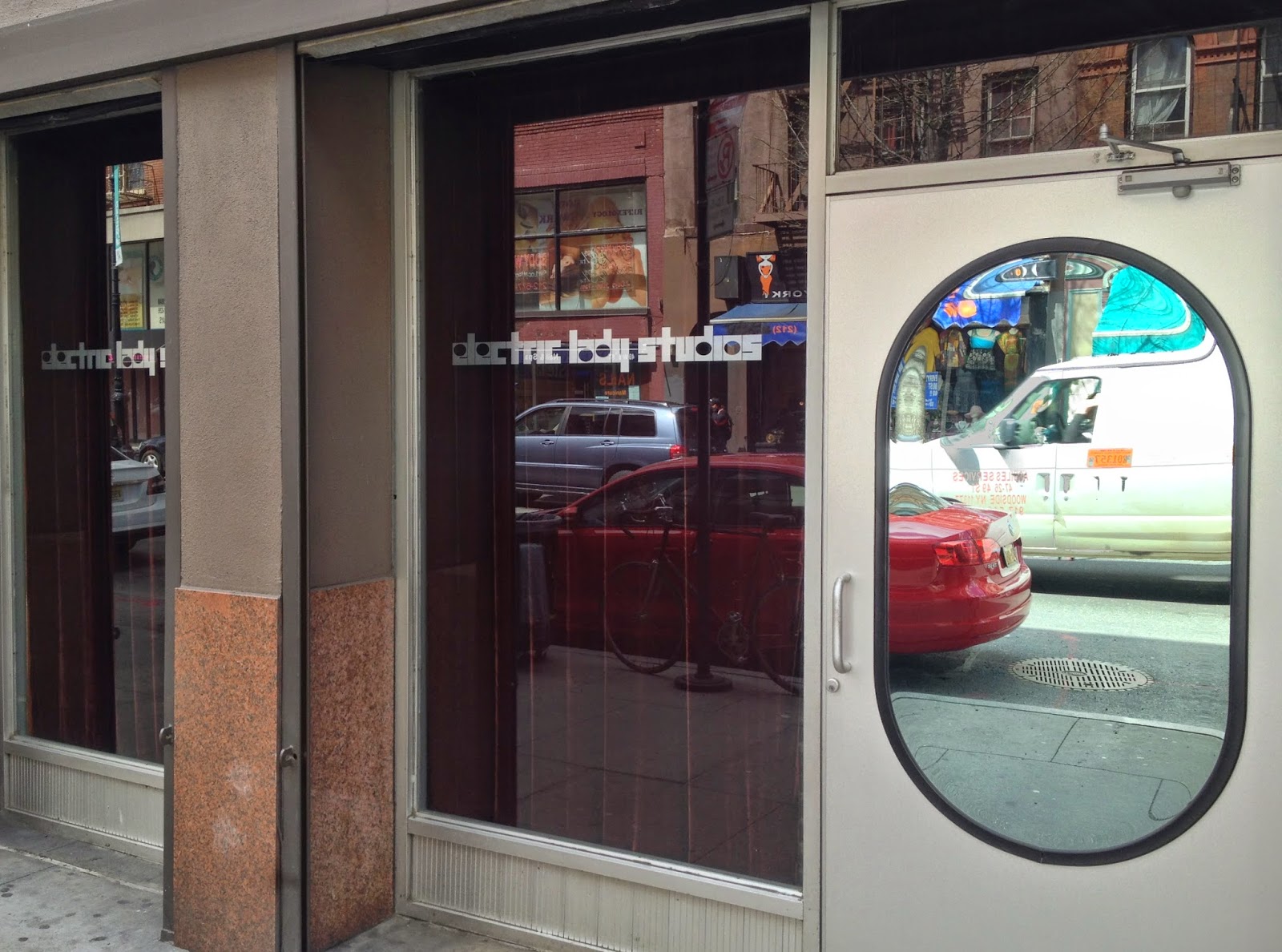
A biography of Jimi Hendrix's Electric Lady Studios, its ownership and other black memories.

Jimi Hendrix had initially wanted to turn the two cavernous bottom floors of 52 West Eighth Street into a club, like it had been when he first visited the space. For almost forty years it had been the Village Barn, a novelty western-themed bar, and then, for a brief time in 1968, a nightclub called the Generation Club (you can watch videos of Hendrix sitting on the side of the stage there while Janis Joplin sings). It was Eddie Kramer, Hendrix’s mix engineer, who suggested he found a studio—a place where Hendrix could have some financial and artistic autonomy—rather than a club, which Kramer insisted was a waste of money. Despite being the highest paid musician in the world, by the time Hendrix played Woodstock, in 1969, he was swamped with money problems. He was always the sort of performer who preferred to push boundaries and do the unexpected, and he was spending well into the six figures to record. He complained that crowds wanted to hear only his hits, so the studio was to be a place where Hendrix could have some freedom—something that despite his outwardly freewheeling look, riotous onstage antics, and easy come, easy go attitude, he had very little of. As Les Paul, the guitarist and inventor, recalled in the New York Times, “Musicians know that I’m a night person, so when someone’s got a technical question—how do you hold the guitar pick for this, how do you finger that chord?—they call. Back when Jimi Hendrix opened Electric Lady Studios, he was on the phone all the time; we talked about how to mike a guitar amplifier and where he should place the mike in the studio.” (...)

Tucked into the whirl of Greenwich Village, Electric Lady could have become a priceless real-estate curio. Instead it has continued to be a place where great American music is born. Unlike many historical sites in Manhattan, Electric Lady Studios has a strict but logical door policy: no tours, no strangers. For the most part, the only people admitted are those who have come to make music—the artists and their retinues.

Maybe that’s why it’s difficult not to feel sentimental, blessed even, when one gets a chance to go inside. There is something about Electric Lady that feels sacrosanct. From the moment the discreet, glass-paned door buzzes and lets you through, disbelief sets in and does not fade as you walk down the bordello-red staircase. These are the steps where a very shy Jimi Hendrix, only weeks away from his death, told a very young Patti Smith his never-to-be realized plans for a universal love orchestra, an orchestra where, as Smith wrote in her memoir, “musicians from all over the world in Woodstock… would sit in a field in a circle and play and play. It didn’t matter what key or tempo or what melody, they would keep on playing through their discordance until they found a common language. Eventually they would record this abstract universal language of music in his studio.”

When I first went to Electric Lady, ten years ago, Richard had booked the oval-shaped Studio A for Baraka to record in, and among the things I remember now is the way, late in the night, the red lights made the room gleam—as if the three-story building were a collection of bedouin tents set into the bow of a very fine, Jules Verne–built boat. There are no straight walls on the first floor of Electric Lady. Most of the studio’s rooms are lit by antique lamps and overhead mood lights that change color and make light shows against the white walls. Now a leather Eames recliner sits in the lobby and, next to it, a wooden record cabinet containing records from the studio’s most recent clients: Kanye West, Lana Del Rey, Daft Punk. There are Moroccan and Persian carpets and objets d’art throughout the building, such as a working 8-track with Ray Charles and Dolly Parton tapes that the current studio manager, Lee Foster, found and painted scarlet. There is a tiny hole in the door of an upstairs bathroom that Keith Richards cut for his microphone cord, so he could record his guitar solos in private. In a hallway there is a framed picture of the old Village Barn that Patti Smith gifted to the studio. In Studio B, the control board is caped in soft aubergine velvet. Another bathroom, painted a deep mauve, is papered with Barbra Streisand records and Polaroids of U2 hamming it up. And all along the walls of the first floor there are hundred-foot-long murals, painted in teal, pink, and purple, of astromen and -women trapped inside cosmic embryos: images, the artist Lance Jost recently told me, that are intended to paint the viewer into a spacecraft that is “hurtling through time and space.” As Erykah Badu put it, having pulled over her tour bus so that we could talk, “The artwork puts you automatically in Jimi Hendrix’s world… You don’t know what time it is, you don’t know what year it is, you’re just in a warp, in a wormhole or a vortex. There were many times that I would sleep there for days and didn’t see the outside world. I would take a sponge bath in the bathroom.But I didn’t mind that, because the mural in the bathroom makes me feel like I’m going into another part of myself. And just to see those people painted on those walls—those people are living still! And breathing through those walls. They are characters who are frozen in one position for the rest of time, who have millions of stories, depending on who lays their eyes on them. And those stories touch all our senses, and they have contributed to many of our songs, I’m sure.”

It’s easy to use words like vibe and surreal to describe Electric Lady, but it is almost impossible to understand the brave new world Hendrix was trying to forge with his studio if one doesn’t know that, in 1968, the idea of a studio owned by an artist—and one that had been built to allow artists to sit in the control room—was almost unheard of. Studios operated for the most part under the ironfisted grip of record companies. Engineers of that era were largely technicians, so much so that they often wore lab coats and cut their mixes in sterile, scientific environments. “There was a real boundary line between one side of the glass and the other, so Jimi’s idea was that it would be a safe haven for artists,” the Electric Lady’s architect, John Storyk, told me last summer. (...)

What is most incredible, to me, about Hendrix’s ascent and decline is how rapid and culturally defining it was for someone who lived for such a brief time. Not too long before Hendrix went vanguard and donned a British brigadier’s jacket, stopped conking his hair and curled it into a wispy Afro, thereby reinventing (but never quite losing) his painfully shy, poor-boy past to become a peacock of a performer, a god of rock, he was just a nameless, guitar-playing journeyman on the touring circuit once offensively known as “the Chitlin Circuit.” Hendrix would travel the Deep South, playing behind his childhood heroes. He also played for acts that were embarrassing and gimmicky, as a YouTube clip of him backing the duo Buddy and Stacey shows. Working behind them, Hendrix appeared for the first time on television on a Nashville-based R&B program called Night Train. Like so many other black musicians, he was a skilled laborer in his craft, but his ability to be flamboyant and vanguard mattered little while he was touring the circuit, and ultimately it served only to get him fired from Little Richard’s band.

Still, the circuit was where he learned the showmanship that Rolling Stone later would mock as being that of a “psychedelic superspade.” And, as songs like “Bold as Love” suggest, it is impossible to believe that he didn’t also learn the most technical, uneducable tricks of the trade from these acts. Before Hendrix claimed the title, Ike Turner was a reigning master of the vibrato, and Hendrix’s playing and showmanship have traces of Turner, a violent man whose fists have all but erased what he could do with his fingers when they strummed a guitar. Hendrix’s performed wildness was borrowed from Little Richard and Chuck Berry, his quickness from Bo Diddley, and (from the man he might have admired most of all) his smoothness from Curtis Mayfield. These were the people on the circuit who would lay the foundation for much of what Hendrix would later aspire to do—and would also serve as a template for what not to do when he became the frontman of his own group.

by Rachel Kaadzi Ghansah, The Believer | Read more:
Image: via:

Wyne Veen, creatie, about strange object design 2013
via:

The Truth About Your Smile

I had braces for seven years of my life—a clumsy mix of pallet expanders, headgear, and invasive lip-bumpers that bulked my skinny face at a time when I was already awkward enough without them. I was one of those middle-schoolers whose parents forced orthodontics on them when they were too young to realize what a great investment it was in their future. Instead, I adopted a coping mechanism of smiling with my mouth closed, a practice subsumed by a general feeling that I would forever be ashamed of my smile. What I didn’t realize then was that my teeth were about to look amazing. Like really amazing.

By ninth grade, the timely convergence of puberty and my braces removal made me feel like Pippi Longstocking blossoming into Jessica Chastain. Diligent toothbrushing through the awkward years paid off! Everywhere I went, people told me I had beautiful teeth: strangers, teachers, friends, parents of friends. People I didn’t know asked me everything from what toothpaste I used to whether or not I had my teeth professionally filed (the answer: never). A TSA agent once told me, as she scanned my luggage, “You have a perfect smile”.

When people compliment a feature of yours repeatedly, vanity leads you to maintain it, and over time I realized that a lot of what we think is good for our mouths are myths propagated by popular culture—or by companies trying to sell us something, like whitening strips, punishingly strong mouthwash, or air-flossers that imply through their advertising that they are sufficient to give us the Perfect White Smile we’ve always wanted. Don’t believe the hype, y’all. I’ve spoken with several dentists about proper oral hygiene and technique (I’m a nerd like that) and the reality is much more humble. Our mouths are pretty complicated, and there isn’t one miracle product that solves all the problems (and this make sense, because that’s also true for hair, diet, and skin). The good news is it’s easy to maintain a fresh breath, white teeth, and other forms of smile-related world domination—but you have to know the rules.

Here are the best “healthy smile” tips I’ve picked up over the years. (...)

Floss More, Brush Less

A dentist in Virginia once told me about this experiment: go 4-5 days without flossing, then floss. After you floss, ball the string up in your hand and smell it. You will never go without flossing again.

The moral of the story is this: the worst bacteria that causes bad breath and cavities lingers near our gum line and flossing is the only way to get them out. Luckily, its actually a lot easier to knock plaque off our teeth than we think, so flossing followed by a light brush is sufficient to keep your mouth squeaky clean. In fact, some dentists suggest that if you had a choice between flossing or brushing you'd be better off just flossing. It's that important. As my best friend's father—a dentist—once told me: “floss more, brush less”.

Sucking On A Clove Fights Bad Breath

Gum, mouthwash, and mints can't address odor that ultimately comes from the stomach, but cloves (yes, the little sticks that you often put inside of potpourri and Jack-O-Lanterns) have been proven to kill odor-causing bacteria in the mouth—they don't just mask it like gum or mouthwash or mints do. My family have all known about this and practiced it for years (my parents and I all carry around little tins filled with cloves instead of mints, and I think its because we love garlic-y hummus but we hate bad breath). I suck on one before important meetings and hot dates.

For chronic conditions like halitosis, however, you should see your doctor; bad breath originates from bacteria/food in the stomach, not the mouth. The good news about bad breath originating from the stomach, too, is that there are certain foods that mask persistent scents like garlic (which stays in your system for two days, usually). Breath-boosting foods include: leafy greens, apples, lemon juice, and turmeric. Eat these things before going on a date and you're golden!

by Molly Beauchemin, The Hairpin | Read more:
Image: Brianne Burnell

Ramen in Japan, Ramen in America


In the first issue of Lucky Peach, Ivan Orkin wrote about what it was like to be a Jewish guy from New York running two of the most popular ramen shops in Tokyo. Now, three years later, he’s moved back to the States to open two more shops in New York. If there’s anyone who can talk about the differences between the two ramen cultures—and what it’s like making ramen in each of the cities—it’s this guy.

It's Harder to Make a Proper Ramen Noodle Here

First of all, I daresay that bread and pastry production are more sophisticated in Japan. When I’m in Tokyo, there’s pastry everywhere! Everywhere. There are amazing loaves of white pullman bread, baguettes, and croissants. It’s all cooked hourly. Here in New York, where are you going to find fresh, warm bread? You’re going to have to seek it out.

In Japan, flour companies have different divisions that make flour for noodles. In general, this flour is milled as much as ten times more finely than it is here. The flour doesn’t need to be as absorbent here in the U.S.—it’s primarily for bread production. So there’s not as much of a reason to mill it as fine. The result is that it’s harder to make a proper ramen noodle here, since the flour is just not fine enough.

Relative to pasta, ramen noodles are on the low end of the water-content spectrum—some can contain as little as 26 percent water. In Tokyo, where we make our own noodles, my machines have these giant, very heavy rollers. When you initially mix your flour in the hopper, it’s not all clumped together; it’s usually very feathery. As you push it through these rollers, it rolls into a sheet. Without the additional water, there’s a tremendous amount of force that’s needed to press the flour into dough. The more refined your flour, the better it will bind with water, and the better the texture of the final noodle.

When I talk to our flour salesman in Tokyo, I can say, “I’m thinking about making a tsukemen noodle, and I want it to be aromatic and have a chew,” and he’ll send me samples that make sense. Then we can talk on the phone and I can say, “I want my ash content to be a bit lower or higher” or “I want to be able to see more or less of the grain color in the noodle.” I can really talk to them and have a super intellectual conversation, and at the end of the day you’re able to make a really good product. (...)

You Can't Get Good Chicken Fat Here in the States

In Japan, you can get great chicken fat for cheap. It’s orange and it doesn’t taste funky—it almost tastes like chicken soup. At the ramen shop where I went with Chang for Mind of a Chef—69 ’N’ Roll One, the one where you’re not allowed to talk—the chef just covers the whole top of the soup with a slick of this amazing chicken fat. It’s so delicious.

You can’t get good chicken fat here in the States. A USDA plant needs approval for each part of the animal they want to use: necks, wings, heads, whatever. A guy at one of the chicken farms we use says he throws all his chicken fat away; it’s too much of a hassle to get it USDA approved, and nobody wants to buy it.

So I use whatever I can get. It’s not bad. It’s good, but it’s not as delicious. At the shop, people are like, You could use Flying Pigs Farms or whatever, and it’s like, Yeah, but they want $15 per pound for their birds. Then they’ll say, Why don’t you use pastured, sustainable, organic meat? And I’m like, Will you pay $25 per bowl of ramen?People think that’s terrible, but it’s like, What the fuck—you don’t want to pay! They want me to have some fucking lady in upstate New York picking carrots out of the ground and carrying them to my restaurant. But they don’t want to pay for that.

by Ivan Orkin, Lucky Peach |  Read more:
Image: Lucky Peach