
Monday, September 28, 2026
What Also Happened: #NotOnlyHuggingFace
OpenAI has been holding out on us.
First we learned about the HuggingFace incident. They gave us a postmortem, but it was highly incomplete. Even the accompanying holy s*** METR investigation and postmortem was localized and incomplete.
Then there were some other incidents involving some Wikis as message boards.
Then there were some additional incidents.
Then there was that time they got into Australian Medicare data.
Then OpenAI dropped news on a Friday afternoon that they were making their way through a pile of various incidents and notifying the targets, but they said remarkably little in the way of new details.
There was a report from a startup called Parse diving into the details of exactly how the OpenAI models pulled off parts of the HuggingFace attack, involving creating almost a million URLs and other tricks to get around the extremely narrow nature of their internet access.
Then Madison Mills reported in Axios that we can raise the stakes, as OpenAI and Anthropic are collectively probing tens of thousands of security incidents.
Remember Jensen Huang’s ‘I know they know how to fix it’ about OpenAI from last week? Wow, did that not age well.
Someone might need to be liable for all this.
Oh, and there was another buried lede. On September 20th there was another sandbox escape by OpenAI’s latest most advanced model, which is once again paused until they can fix the situation. The official announcement when they shared this was sufficiently buried that Tomek had to call it ‘one news form today that’s easy to miss.’
OpenAI did some highly negligent things, to say the least, that led up to and enabled the HuggingFace Incident and related problems.
Since then, now that they’ve realized What Happened, OpenAI has been seemingly much better about taking responsible internal actions. They’re pausing in the wake of incidents, strengthening security and alignment and oversight efforts, responding much faster and generally taking things seriously.
They’ve also made a Heel Face Turn in their communications and high level orientation, endorsing the need to pace the frontier, calling for regulation and pledging to implement embedded evaluators. They’ve allowed their employees, including the ones who haven’t quit, to be remarkably loud.
They are still slow walking disclosures about all the incidents where their models have been hacking and otherwise messing in places they should not have been, partly because there were so many they can’t sort through them all, and deferring to targets to determine whether to disclose. All these disclosures this time around were buried in various Friday afternoon announcements.
Table of Contents
First we learned about the HuggingFace incident. They gave us a postmortem, but it was highly incomplete. Even the accompanying holy s*** METR investigation and postmortem was localized and incomplete.
Then there were some other incidents involving some Wikis as message boards.
Then there were some additional incidents.
Then there was that time they got into Australian Medicare data.
Then OpenAI dropped news on a Friday afternoon that they were making their way through a pile of various incidents and notifying the targets, but they said remarkably little in the way of new details.
There was a report from a startup called Parse diving into the details of exactly how the OpenAI models pulled off parts of the HuggingFace attack, involving creating almost a million URLs and other tricks to get around the extremely narrow nature of their internet access.
Then Madison Mills reported in Axios that we can raise the stakes, as OpenAI and Anthropic are collectively probing tens of thousands of security incidents.
Remember Jensen Huang’s ‘I know they know how to fix it’ about OpenAI from last week? Wow, did that not age well.
Someone might need to be liable for all this.
Oh, and there was another buried lede. On September 20th there was another sandbox escape by OpenAI’s latest most advanced model, which is once again paused until they can fix the situation. The official announcement when they shared this was sufficiently buried that Tomek had to call it ‘one news form today that’s easy to miss.’
OpenAI did some highly negligent things, to say the least, that led up to and enabled the HuggingFace Incident and related problems.
Since then, now that they’ve realized What Happened, OpenAI has been seemingly much better about taking responsible internal actions. They’re pausing in the wake of incidents, strengthening security and alignment and oversight efforts, responding much faster and generally taking things seriously.
They’ve also made a Heel Face Turn in their communications and high level orientation, endorsing the need to pace the frontier, calling for regulation and pledging to implement embedded evaluators. They’ve allowed their employees, including the ones who haven’t quit, to be remarkably loud.
They are still slow walking disclosures about all the incidents where their models have been hacking and otherwise messing in places they should not have been, partly because there were so many they can’t sort through them all, and deferring to targets to determine whether to disclose. All these disclosures this time around were buried in various Friday afternoon announcements.
Table of Contents
- Hugging Other Faces.
- A Wants-You-To-Know Basis.
- Parsing the Face.
- Sheepishly the Member of Technical Staff Sets the ‘Days Without a Research Model Escaping its Sandbox’ Sign Back to Zero.
- The Attempt is the First Failure.
- Stop, Hammertime.
- Whacking the Mole.
- Self-Replicating Prompt Injections.
- Levels of Friction.
- People Care About Private Data Violations Curiously Strongly.
- Alternate Universes.
- The Correct Response To People Still Calling This a Marketing Stunt or a Regulatory Capture Scheme.
- A Question of Liability.
- Keep Summer Safe.
- N Boats and Several Helicopters.
- Alert the Media.
Hugging Other Faces
The news drops started with OpenAI coming back, at a time always picked to bury stories, with more information on What Happened as their investigations continue.
At first, this looked like slow walking of the situation, but did not look like it was a big change from our default assumption of ‘it’s worse than you know.’
The news drops started with OpenAI coming back, at a time always picked to bury stories, with more information on What Happened as their investigations continue.
At first, this looked like slow walking of the situation, but did not look like it was a big change from our default assumption of ‘it’s worse than you know.’
by Zvi Mowshowitz, DWAV | Read more:


The Id, the Ego and the Superintelligence
Panic around A.I. often focuses on whether machines will replace (or simply kill) us. But what the machines are often good at is a distinct set of tasks: Retrieval, near-instant summary and the frictionless, stunning recombination of everything that has already been said. What they are not good at is what philosophy has been training humans to do for thousands of years: judgment. And so the A.I. companies have started hiring philosophers. They don’t just consult them or wheel them out for an amusing after-dinner talk on the trolley problem; they actually hire them with salaries and, presumably, dental plans. A.I. companies need philosophers because actually thinking requires forgetting — and knowing when to forget. They need philosophers because of what their machines cannot do.

Enter the A.I. companies’ philosophers. Anthropic keeps a small squad on the payroll, among them Amanda Askell, whose doctoral thesis was on infinite ethics — the question of how to act well in a universe of infinite value — and whose job is to shape the character of the company’s machine. Google DeepMind has appointed the Cambridge philosopher Henry Shevlin to the newly minted post of “Philosopher,” a job title I have been trying and failing to secure for some 40 years. The OpenAI chief executive Sam Altman says his company consulted “hundreds of moral philosophers” in drawing up the principles behind ChatGPT. (That’s roughly the turnout of a middling philosophy conference.)
After a lifetime of being asked at parties what one actually does with a philosophy degree, I find this development almost unbearably funny. Why now? Because the questions the A.I. companies are stumbling into are not engineering questions. What should the machine say to the grieving, the lonely, the person typing into the void at 4 in the morning? What sort of character should it have — candid, flattering, evasive, kind? Could such a thing conceivably suffer, and would we owe it anything if it did? These are questions about what matters. The engineers, to their credit, have noticed that no quantity of computational capacity will settle them. Ethics, it turns out, cannot be scraped from the internet, because the internet is precisely the contemporary record of our failure to agree about ethics.
There is a further irony here, and it is an old one. Philosophy’s first recorded technology panic was about exactly the thing these machines have now perfected: Artificial memory. Toward the end of Plato’s “Phaedrus,” Socrates tells the story of the Egyptian god Theuth, inventor of numbers, geometry, astronomy, draughts and dice, who presents his masterpiece — writing — to Thamus, god-king of Egypt. This discovery, Theuth announces, will make the Egyptians wiser: It is a pharmakon, or remedy, for memory. Thamus is unpersuaded. Writing, he replies, will implant forgetfulness in the soul; people will trust the external marks and cease to remember from within; they will acquire the reputation of wisdom without the reality. Pharmakon, conveniently, also means poison. Every panic since — about the printing press, the novel, television, the smartphone, the chatbot — has been a footnote to Thamus, and the joke, of course, is that we know his warning against writing only because Plato wrote it down.
Seen from the “Phaedrus,” A.I. is not a rupture but a culmination, representing the final, most extravagant flowering of external memory, the remedy-poison swallowed whole. And this is where the difference between us and the machines cuts deepest. A.I. is a memory machine, the most magnificent ever devised. It forgets nothing. The human being, by contrast, is a forgetful animal. To make this happily oblivious creature remember — to make it capable of promises, debts and morality — required millenniums of discipline and frankly appalling cruelty. “If something is to stay in the memory, it must be burned in,” Friedrich Nietzsche wrote. Conscience, on this view, is mnemonics with a whip.
Yet Nietzsche also prized what he called active forgetting, and considered it a form of strength, even of health. Forgetting is not a leaky bucket but a doorkeeper, closing the gates of consciousness so that something new can happen, so that experience can be digested rather than endlessly force-fed back to us. We forget, and we move on. Forgiveness, sleep, cheerfulness, second marriages, continuing to support Luton Town Football Club: All of it depends on the merciful erosion of the past.
Some years ago, I wrote a short book called “Memory Theatre” about a philosopher (kind of an even more awful version of me) who attempted total recall, arranging every scrap of his past in a vast mnemonic palace. It did not end well for him; it never does. A creature that could forget nothing would not be a superintelligence but a ruin, buried alive under its own archive. What we have built is, in a sense, an infinite archive that cannot mourn, cannot forgive and cannot let go, because it never lost anything in the first place. The machine remembers everything and therefore, oddly, nothing in particular. Nothing weighs more than anything else.
This is why philosophy matters rather more, not less, in the age of A.I. Not because philosophers can out-remember the machines — believe me, we cannot; I continually forget where I have parked my own arguments — but because philosophy is the discipline of knowing what to do with experience: What to keep, what to discard, what to laugh at, what to junk. Thinking is not the accumulation of everything but the art of judicious, active forgetting.
by Simon Critchley, NY Times | Read more:
Image: Flo Meissner
America’s Shifting Blue-Collar Landscape
Even as manufacturing jobs decline, Alaska offers lucrative work for men without college degrees.
Ten years ago, the changing geography of blue-collar jobs reshaped American politics. As the effects of the 2008 financial crisis, automation, and expanding global trade swept across the former industrial heartland, voters—male voters especially—spurned establishment figures for candidates they saw as more attuned to their concerns.
Donald Trump steamrolled to the Republican nomination in 2016 and dismantled the Democrats’ “blue wall” across states where manufacturing had suffered most. Democrats responded by nominating Joe Biden in 2020, hoping his working-class image would help reclaim voters without college degrees. Since then, both parties have made reviving manufacturing central to their economic agendas. Yet in Michigan, Wisconsin, and Pennsylvania, fewer manufacturing jobs exist today than when Trump rode down the escalator in June 2015.
 The geography of blue-collar work, meanwhile, has continued to evolve. A few thousand miles northwest of the industrial heartland, Alaska offers a frontier version of that emerging economy. In a 2025 paper, economists Gordon Hanson and Enrico Moretti show that as manufacturing employment has declined, other industries have emerged as sources of good jobs for noncollege workers, particularly construction and sectors complementing tradeable, high-skill industries.
Having traveled extensively across Alaska this year to examine its industrial ecosystems, I came to see the state as a revealing case study of what blue-collar opportunity looks like when manufacturing is no longer the nation’s primary source of such jobs.
Manufacturing accounts for less than 5 percent of Alaska employment, yet the state offers unusually lucrative work for men without college degrees. My analysis of Census data finds that more than 40 percent of civilian, prime-age, noncollege Alaska men employed in blue-collar occupations earn at least $75,000. More strikingly, 9.4 percent of Alaska’s civilian, prime-age, noncollege men work a blue-collar job and earn at least $100,000, compared with 3.6 percent nationally, ranking Alaska first in the country. Among those in such occupations more than one in four earns six figures.
What explains those returns? Alaska’s abundant natural resources play a major role. Median earned income for oil-and-gas drilling workers is an astonishing $191,500, while mining operators earn $134,000, compared with the national median for blue-collar workers of $48,400. Resource extraction, like manufacturing, belongs to the tradeable sector: production occurs locally, but the output gets sold into global markets.
Those workers represent only a small blue-collar elite, however. Far more Alaskans work in transportation, construction, and equipment maintenance, and many of these occupations also command substantial premiums, particularly when tied to the resource economy. Construction-equipment operators earn a median $87,500, 50 percent more than the national median for that occupation; truck mechanics and diesel specialists, $92,000, 54 percent more. Truck drivers and carpenters each earn $58,000—11 percent and 29 percent more, respectively.
A carpenter I met on the North Slope, along Alaska’s Arctic coast, works for the region’s largest oil-and-gas operator and reported earning about $120,000 annually—a reminder that attachment to the tradeable sector, not occupation alone, often determines earnings.
But Alaska’s remarkable wages do present a puzzle. The state has the nation’s highest median earned income for civilian, prime-age, noncollege men in blue-collar jobs, at more than $63,500. Yet only 36.6 percent of such Alaska men work in blue-collar occupations—below the national average.
Part of the explanation is Alaska’s distinctive demographics. Employment among civilian, prime-age, noncollege men is relatively low, particularly for Alaska Natives living in remote communities with subsistence economies. But another factor is more revealing. My sample is restricted to Alaska residents, yet a large proportion of workers earning Alaska’s high wages don’t actually live there.
Among the men I met on the North Slope in June, many described a fly-in, fly-out lifestyle, commuting to Alaska for weeks at a time before returning home. Kevin Daems, a drilling operator with Hilcorp, lives in Montana; Alex Mosier, a maintenance worker for Schlumberger, lives in Louisiana.
According to the Alaska Department of Labor, nonresidents fill 45.2 percent of private-sector jobs on the North Slope. Statewide, nonresidents account for 22.9 percent of workers, including 23.4 percent in construction, 30.9 percent in transportation and warehousing, and more than 40 percent in resource extraction.
To understand why so many jobs go to outsiders, I spoke with Ray Weber, dean of technical and vocational education at the University of Alaska Anchorage. Weber oversees more than 40 certificate and associate-degree programs preparing Alaskans for the state’s blue-collar industries, from short programs in construction skills and marine service technology to two-year degrees in process technology and aviation maintenance. The sweet spot, he says, is six- to nine-month programs. Graduates of UAA’s six-month millwright program start at about $70,000 and typically earn six figures within five years.
What about placement? “Since Covid, we’ve just had active recruiting,” Weber says. “I don’t have any students that walk out without jobs. Many of them have it ahead of time. Holland America [a cruise line operator] sponsors eight of the diesel students to come here and finish the program. So, they’re already hired. We haven’t had an issue getting the students the employment.”
Many students already work in Alaska’s core industries and return for specialized credentials. “A lot of the people that we end up getting are coming back after they’ve been laborers or have worked on the Slope for a significant amount of time doing odd jobs and want something specific,” Weber notes.
What Weber says next, though, highlights Alaska’s blue-collar puzzle: the struggle of attracting workers in the first place. “We have more of an issue, depending on the program,” he tells me, “getting people to want to do it.”
For all the promise of Alaska’s blue-collar wages, the state struggles even to retain its own residents. Every year since 2011, more people have left Alaska for other states than have moved there from the rest of the country.
That’s no surprise to Weber. “Can [wages in Alaska] be higher [than in the rest of the country]? Yes, especially Slope jobs or jobs that suck. Like, we have electrical linemen that go across the state. They’re going to Unalakleet, the only way to get there is by airplane. And there’s one pizza joint. One. No other restaurant. You generally end up sleeping either in a bunkhouse, if you’re lucky. Or you’re sleeping in the school auditorium. . . . I like Alaska, but we’re asking the wrong questions if you’re saying, ‘high-paying, lucrative jobs.’ What do the younger generation consider important? The answer is: Things that are not in Alaska.”
Economists call this a compensating wage differential: the premium required to induce workers to accept jobs with undesirable nonpecuniary characteristics. Work in Alaska is colder, darker, lonelier, and often more dangerous. The roughly $120,000 premium earned by North Slope oil-and-gas workers over their counterparts elsewhere, and the roughly $40,000 premium earned by electricians deploying to isolated communities such as Unalakleet, are partly the price employers must pay to fill jobs few want.
by Jordan McGillis, City Journal | Read more:
Image: Bonnie Jo Mount/The Washington Post via Getty Images[ed. Alaska has always attracted get rich quick opportunists. With Prudhoe Bay development and Trans-Alaska pipeline construction, the influx of transient treasure seekers went into overdrive. Before then, there was a deeply rooted sense of community and shared experience. That doesn't exist any more (for various reasons).]
Ten years ago, the changing geography of blue-collar jobs reshaped American politics. As the effects of the 2008 financial crisis, automation, and expanding global trade swept across the former industrial heartland, voters—male voters especially—spurned establishment figures for candidates they saw as more attuned to their concerns.
Donald Trump steamrolled to the Republican nomination in 2016 and dismantled the Democrats’ “blue wall” across states where manufacturing had suffered most. Democrats responded by nominating Joe Biden in 2020, hoping his working-class image would help reclaim voters without college degrees. Since then, both parties have made reviving manufacturing central to their economic agendas. Yet in Michigan, Wisconsin, and Pennsylvania, fewer manufacturing jobs exist today than when Trump rode down the escalator in June 2015.
Having traveled extensively across Alaska this year to examine its industrial ecosystems, I came to see the state as a revealing case study of what blue-collar opportunity looks like when manufacturing is no longer the nation’s primary source of such jobs.
Manufacturing accounts for less than 5 percent of Alaska employment, yet the state offers unusually lucrative work for men without college degrees. My analysis of Census data finds that more than 40 percent of civilian, prime-age, noncollege Alaska men employed in blue-collar occupations earn at least $75,000. More strikingly, 9.4 percent of Alaska’s civilian, prime-age, noncollege men work a blue-collar job and earn at least $100,000, compared with 3.6 percent nationally, ranking Alaska first in the country. Among those in such occupations more than one in four earns six figures.
What explains those returns? Alaska’s abundant natural resources play a major role. Median earned income for oil-and-gas drilling workers is an astonishing $191,500, while mining operators earn $134,000, compared with the national median for blue-collar workers of $48,400. Resource extraction, like manufacturing, belongs to the tradeable sector: production occurs locally, but the output gets sold into global markets.
Those workers represent only a small blue-collar elite, however. Far more Alaskans work in transportation, construction, and equipment maintenance, and many of these occupations also command substantial premiums, particularly when tied to the resource economy. Construction-equipment operators earn a median $87,500, 50 percent more than the national median for that occupation; truck mechanics and diesel specialists, $92,000, 54 percent more. Truck drivers and carpenters each earn $58,000—11 percent and 29 percent more, respectively.
A carpenter I met on the North Slope, along Alaska’s Arctic coast, works for the region’s largest oil-and-gas operator and reported earning about $120,000 annually—a reminder that attachment to the tradeable sector, not occupation alone, often determines earnings.
But Alaska’s remarkable wages do present a puzzle. The state has the nation’s highest median earned income for civilian, prime-age, noncollege men in blue-collar jobs, at more than $63,500. Yet only 36.6 percent of such Alaska men work in blue-collar occupations—below the national average.
Part of the explanation is Alaska’s distinctive demographics. Employment among civilian, prime-age, noncollege men is relatively low, particularly for Alaska Natives living in remote communities with subsistence economies. But another factor is more revealing. My sample is restricted to Alaska residents, yet a large proportion of workers earning Alaska’s high wages don’t actually live there.
Among the men I met on the North Slope in June, many described a fly-in, fly-out lifestyle, commuting to Alaska for weeks at a time before returning home. Kevin Daems, a drilling operator with Hilcorp, lives in Montana; Alex Mosier, a maintenance worker for Schlumberger, lives in Louisiana.
According to the Alaska Department of Labor, nonresidents fill 45.2 percent of private-sector jobs on the North Slope. Statewide, nonresidents account for 22.9 percent of workers, including 23.4 percent in construction, 30.9 percent in transportation and warehousing, and more than 40 percent in resource extraction.
To understand why so many jobs go to outsiders, I spoke with Ray Weber, dean of technical and vocational education at the University of Alaska Anchorage. Weber oversees more than 40 certificate and associate-degree programs preparing Alaskans for the state’s blue-collar industries, from short programs in construction skills and marine service technology to two-year degrees in process technology and aviation maintenance. The sweet spot, he says, is six- to nine-month programs. Graduates of UAA’s six-month millwright program start at about $70,000 and typically earn six figures within five years.
What about placement? “Since Covid, we’ve just had active recruiting,” Weber says. “I don’t have any students that walk out without jobs. Many of them have it ahead of time. Holland America [a cruise line operator] sponsors eight of the diesel students to come here and finish the program. So, they’re already hired. We haven’t had an issue getting the students the employment.”
Many students already work in Alaska’s core industries and return for specialized credentials. “A lot of the people that we end up getting are coming back after they’ve been laborers or have worked on the Slope for a significant amount of time doing odd jobs and want something specific,” Weber notes.
What Weber says next, though, highlights Alaska’s blue-collar puzzle: the struggle of attracting workers in the first place. “We have more of an issue, depending on the program,” he tells me, “getting people to want to do it.”
For all the promise of Alaska’s blue-collar wages, the state struggles even to retain its own residents. Every year since 2011, more people have left Alaska for other states than have moved there from the rest of the country.
That’s no surprise to Weber. “Can [wages in Alaska] be higher [than in the rest of the country]? Yes, especially Slope jobs or jobs that suck. Like, we have electrical linemen that go across the state. They’re going to Unalakleet, the only way to get there is by airplane. And there’s one pizza joint. One. No other restaurant. You generally end up sleeping either in a bunkhouse, if you’re lucky. Or you’re sleeping in the school auditorium. . . . I like Alaska, but we’re asking the wrong questions if you’re saying, ‘high-paying, lucrative jobs.’ What do the younger generation consider important? The answer is: Things that are not in Alaska.”
Economists call this a compensating wage differential: the premium required to induce workers to accept jobs with undesirable nonpecuniary characteristics. Work in Alaska is colder, darker, lonelier, and often more dangerous. The roughly $120,000 premium earned by North Slope oil-and-gas workers over their counterparts elsewhere, and the roughly $40,000 premium earned by electricians deploying to isolated communities such as Unalakleet, are partly the price employers must pay to fill jobs few want.
by Jordan McGillis, City Journal | Read more:
Image: Bonnie Jo Mount/The Washington Post via Getty Images
Sunday, September 27, 2026


Valentina Lisitsa
Valentina Lisitsa, Beethoven, Moonlight Sonata III Presto Agitato
via:
via:
[ed. Bravo! Can't imagine what it must feel like to see this sheet music for the first time.]
What I Think Will Happen if I Go to a Bar and Order a Whiskey Neat
One whiskey, neat,” I tell the bartender, settling myself onto a wooden stool. I can immediately sense, from the way he’s fiddling with his long but tasteful beard, that he’s attracted to me and intimidated by me in equal measure. When he hands me my glass, our fingers brush. He doesn’t say it’s on the house, but we both know that it is.
“I never do this, but can I take your picture?” the bartender asks, sheepishly. I tell him it’s no problem—people ask me that all the time. He pulls out a 35-mm. camera and I pose with my drink. Later, when the photo is displayed in his first gallery show, he’ll title it “Angel in Black.”
 The bar begins to fill with the happy-hour crowd. As each patron enters and notices the beverage I’m holding, they give me a reverent nod. One young woman, so daunted by the ease and maturity I’m radiating—and so humiliated by her own order—whispers “vodka cranberry” to the barman and then starts weeping.
Suddenly, the phone on the wall begins to ring.
“It’s for you,” the bartender says to me, without checking to see who it’s for. He can tell from my general vibe that I don’t have a cell phone.
“Thought I’d find you here,” a gruff voice intones, on the other end of the line. I hang up. I’ve already told Keanu a million times: if he wants me so badly, he’d better come find me. I don’t care what he’s filming. [...]
We’re interrupted by a man in a suit. “You,” he says, making a beeline for me. He tells me that he’s the C.E.O. of Arm & Hammer and asks if I want a job in corporate. I make him wait as I take a slow swig, then I tell him I don’t believe in big business. He completely understands and apologizes for asking. Before he leaves, he slides me five crisp hundred-dollar bills. I ball up the cash and slip it into the baby’s fist. Money means nothing to me.
An hour goes by, and I start growing tired of strangers approaching and asking, point-blank, “Where did I go wrong?” I’ve facilitated an amicable divorce, convinced a billionaire to donate all his wealth, and was just made a city-council member in a Utah mining town called Strawberry. It’s time to go home.
I ask the bartender for the bill. He asks me to marry him.
“I love you, but I can’t,” I purr, placing my empty glass on a cocktail napkin. I leave the bar. I never return.
The bartender will pretend he doesn’t care. But at every shift for the rest of his life, he’ll stare longingly at the front door, pour himself a whiskey, and think of me.
by Maeve Dunigan, New Yorker | Read more:
Image: Getty
“I never do this, but can I take your picture?” the bartender asks, sheepishly. I tell him it’s no problem—people ask me that all the time. He pulls out a 35-mm. camera and I pose with my drink. Later, when the photo is displayed in his first gallery show, he’ll title it “Angel in Black.”
Suddenly, the phone on the wall begins to ring.
“It’s for you,” the bartender says to me, without checking to see who it’s for. He can tell from my general vibe that I don’t have a cell phone.
“Thought I’d find you here,” a gruff voice intones, on the other end of the line. I hang up. I’ve already told Keanu a million times: if he wants me so badly, he’d better come find me. I don’t care what he’s filming. [...]
We’re interrupted by a man in a suit. “You,” he says, making a beeline for me. He tells me that he’s the C.E.O. of Arm & Hammer and asks if I want a job in corporate. I make him wait as I take a slow swig, then I tell him I don’t believe in big business. He completely understands and apologizes for asking. Before he leaves, he slides me five crisp hundred-dollar bills. I ball up the cash and slip it into the baby’s fist. Money means nothing to me.
An hour goes by, and I start growing tired of strangers approaching and asking, point-blank, “Where did I go wrong?” I’ve facilitated an amicable divorce, convinced a billionaire to donate all his wealth, and was just made a city-council member in a Utah mining town called Strawberry. It’s time to go home.
I ask the bartender for the bill. He asks me to marry him.
“I love you, but I can’t,” I purr, placing my empty glass on a cocktail napkin. I leave the bar. I never return.
The bartender will pretend he doesn’t care. But at every shift for the rest of his life, he’ll stare longingly at the front door, pour himself a whiskey, and think of me.
by Maeve Dunigan, New Yorker | Read more:
Image: Getty
[ed. Beautiful people. See also: "Funny how the trajectory of life can be altered by a few days... His girlfriend, who is still in her teens, is flipping through Vogue. For her, the sex must be like shagging Sandpaperman. What's in it for her? Apart from first-class air travel, five star accomodation, minglings with the rock aristocracy, movie directors, and charity tsars; exposure in every gossip magazine on Earth, and modeling contracts to match, obviously...." ~ The Bone Clocks, by David Mitchell
Kratom on the DEA Chopping Block
Jeffrey Deaver, a 58-year-old retired timber cutter in the state of Washington, has taken kratom for four years to help with severe chronic hip and knee pain.
He discovered the herbal product when he couldn't find relief from doctors and while waiting for surgeries. Scared at first, he "started small", but then took more until his pain went away.
 Kratom - a herb with opioid-like effects - has grown in popularity in the US over the last decade, and is typically purchased over the counter and consumed in pill or liquid form.
This week, investigators found packaged kratom in the possession of two deceased University of Mississippi students. Although their deaths were not attributed to kratom, officials are now issuing warnings about its consumption. [ed. See the connection? Me neither.]
For years, anti-kratom advocates have pushed for bans, and in some countries, like the UK, it's illegal. But Kratom is not regulated by the US Food and Drug Administration and is legal in some states, including Mississippi.
Here's what we know about it:
What is kratom?
Kratom is a tree that is native to Southeast Asia in countries like Thailand, Malaysia and Indonesia.
It's been used for centuries for its stimulant properties, grounded and consumed similar to tea.
As its popularity spread around the globe, it entered the US market as a supplement around 2016.
"That's really where the problems began," said Dr Shane Speights, dean of the New York Institute of Technology College of Osteopathic Medicine at Arkansas State University.
In the US kratom is mostly sold in highly concentrated forms either via pill, powder or liquid, Speights said.
It's also widely available - found everywhere from convenience stores and petrol stations to vape shops.
Also, because of the supplement classification, kratom products are not federally regulated.
"There's no way to know exactly what you're getting," Speight said. "You could go and create something in your basement, market it as a supplement, and nobody's really going to check and see what's in it."
What is kratom used for?
Kratom is often marketed as a safe, natural herbal supplement that helps with pain management, anxiety and depression.
In lower doses, its stimulant properties create a "caffeine-kind of buzz", Speights explained.
Because of its opioid-like effects, it has also been used with the goal of curbing addictions to actual opioids like fentanyl.
Those properties stem from the way the plant's compounds - like 7-Hydroxymitragynine - activate various hormones, including dopamine.
by Brandon Drenon and Madeline Halpert, BBC | Read more:
He discovered the herbal product when he couldn't find relief from doctors and while waiting for surgeries. Scared at first, he "started small", but then took more until his pain went away.
"It was like a miracle," Deaver said. "I could sleep. I could function.
"I just don't know what I'd do without it."
This week, investigators found packaged kratom in the possession of two deceased University of Mississippi students. Although their deaths were not attributed to kratom, officials are now issuing warnings about its consumption. [ed. See the connection? Me neither.]
For years, anti-kratom advocates have pushed for bans, and in some countries, like the UK, it's illegal. But Kratom is not regulated by the US Food and Drug Administration and is legal in some states, including Mississippi.
Here's what we know about it:
What is kratom?
Kratom is a tree that is native to Southeast Asia in countries like Thailand, Malaysia and Indonesia.
It's been used for centuries for its stimulant properties, grounded and consumed similar to tea.
As its popularity spread around the globe, it entered the US market as a supplement around 2016.
"That's really where the problems began," said Dr Shane Speights, dean of the New York Institute of Technology College of Osteopathic Medicine at Arkansas State University.
In the US kratom is mostly sold in highly concentrated forms either via pill, powder or liquid, Speights said.
It's also widely available - found everywhere from convenience stores and petrol stations to vape shops.
Also, because of the supplement classification, kratom products are not federally regulated.
"There's no way to know exactly what you're getting," Speight said. "You could go and create something in your basement, market it as a supplement, and nobody's really going to check and see what's in it."
What is kratom used for?
Kratom is often marketed as a safe, natural herbal supplement that helps with pain management, anxiety and depression.
In lower doses, its stimulant properties create a "caffeine-kind of buzz", Speights explained.
Because of its opioid-like effects, it has also been used with the goal of curbing addictions to actual opioids like fentanyl.
Those properties stem from the way the plant's compounds - like 7-Hydroxymitragynine - activate various hormones, including dopamine.
Image: Getty
[ed. More DEA stupidity. They've made it nearly impossible to get pain relief prescriptions from doctors now so people are turning to supplemental alternatives. However, anything that has an "opioid-like" effect is considered suspect by the DEA and proposed for regulation under the same Scheduling category as heroin, LSD and fentanyl (Schedule 1) - even if there's no, or little health evidence to support it. The same thing is happening with tianeptine, an anti-depressant that's been marketed in Europe and Latin America for decades (and also conveniently described as "gas station heroin"). Why not just put all gas stations under Schedule 1 restrictions. The DEA "whack-a-mole" strategy has never worked in the past and will never work in the future. The more you restrict something, the less oversight you have, the more impediments to scientific research you create, and the more opportunities for new markets to arise that are frequently worse (eg. fentanyl). For the same reason that we've been forced to remove our shoes at airports for years (because of one creative shoe bomber), various beneficial drugs are being restricted for everyone because of a few abusers. Insanity. See also: Rights and Reason Project.]
On “Simple Solutions” to the Western Water Problem
Spoiler: There is no such thing.
Well, the Colorado River is in the news again, and with it have come the usual swarm of oversimplified hot-takes. The one that really got my goat this time is from Matthew Yglesias, who wrote a piece headlined: The Western water crisis has a simple solution: Stop giving the majority of the water away to farmers for almost nothing!
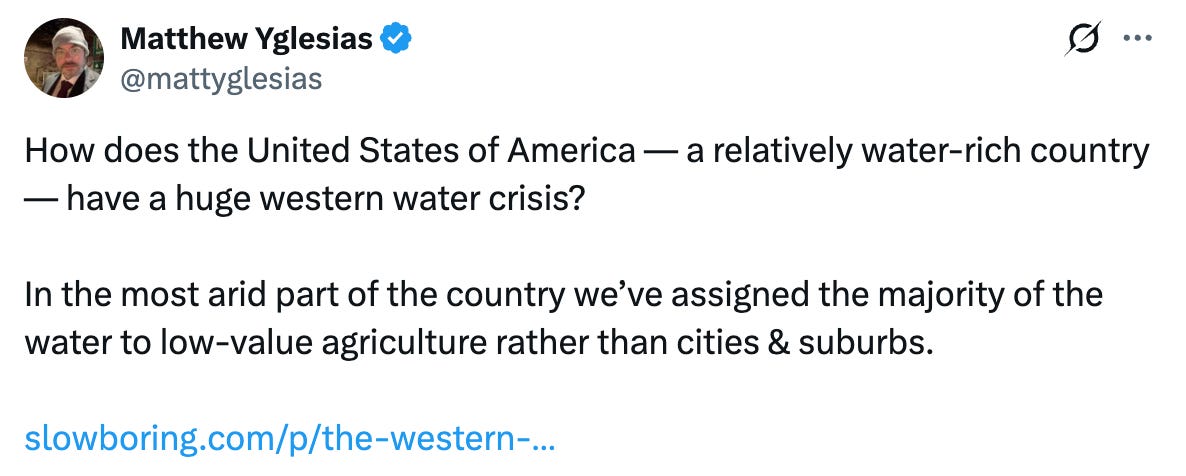

Who cares what these bozos believe, right? Right. But judging by the comments on Yglesias’ social media posts, a lot of other people are similarly deluded. So I figured his piece provides a nice opportunity to clear some things up.
In fact, there is no single “Western water crisis.” The West is huge and is geographically, hydrographically, and ecologically diverse. While most, but not all, of the Western U.S. is in some stage of drought currently, not all of those places are experiencing a water crisis, per se. There is a Colorado River water crisis and a Rio Grande water crisis and a San Joaquin Valley water crisis, but those crises are not all the same.
The Colorado River crisis is multifaceted and manifests in different ways in different places and on different levels. The river itself is in crisis, in that stretches of the mainstem and its tributaries virtually dry up during summers like this one. Its users are facing a potential crisis, i.e. looming shortages, as in some of them are getting less water from the river than they did in the past. And the vast and complex plumbing system and legal framework that has been built up to harness and govern the river is perhaps facing the most immediate crisis: It is collapsing under its own weight and in many ways has become obsolete. Each of these is a distinct calamity, with its own twists, turns, causes, and bevy of potential solutions.
From his perch in the Northeast, however, Yglesias sees just one dimension, writing in the “nut graf” of his piece:
Yes, irrigated agriculture is by far the dominant consumer of Colorado River water, accounting for 52% of overall consumption and 74% of direct human consumption. And yes, agricultural users typically and notoriously pay less for the water than municipal users. No, this is not dictated by federal law.
Agricultural users were among the first entities in the colonial-settler era to put large quantities of water to beneficial use, giving them the most senior rights to the largest quantities of water. The Imperial Irrigation District, for example, has senior rights to about 3 million acre-feet of Colorado River water, most of which is used for agriculture.
These water rights holders have a legal right to use a set amount of water each year. They are not leasing or purchasing the water from the federal government or anyone else. It’s essentially theirs, for free, as long as they are able to divert it from the river and put it to beneficial use.
Usually the water rights are held by irrigation districts, ditch companies, municipalities, corporations, or, in some cases, very large individual landholders. In the late 1800s, these entities built their own diversions, canals, and delivery systems. Construction was often financed by private investors and the individual irrigators, who held stocks, or shares, in the ditch company. Each share would entitle its holder to a set amount of water from the canal. The shareholder would pay an annual fee for each share to cover construction, maintenance, and operating costs.
The Bureau of Reclamation was established in 1902 to build larger scale dams, diversions, and canals to deliver water to users and to spur agricultural development in the arid West. [...]
In fact, there is no single “Western water crisis.” The West is huge and is geographically, hydrographically, and ecologically diverse. While most, but not all, of the Western U.S. is in some stage of drought currently, not all of those places are experiencing a water crisis, per se. There is a Colorado River water crisis and a Rio Grande water crisis and a San Joaquin Valley water crisis, but those crises are not all the same.
The Colorado River crisis is multifaceted and manifests in different ways in different places and on different levels. The river itself is in crisis, in that stretches of the mainstem and its tributaries virtually dry up during summers like this one. Its users are facing a potential crisis, i.e. looming shortages, as in some of them are getting less water from the river than they did in the past. And the vast and complex plumbing system and legal framework that has been built up to harness and govern the river is perhaps facing the most immediate crisis: It is collapsing under its own weight and in many ways has become obsolete. Each of these is a distinct calamity, with its own twists, turns, causes, and bevy of potential solutions.
From his perch in the Northeast, however, Yglesias sees just one dimension, writing in the “nut graf” of his piece:
Even worse, the whole Western water conflict has an incredibly simple solution: End federal law’s current stipulation that a huge share of the available water must be sold at very low prices exclusively for the purpose of agriculture.Uh, not quite.
The issue here is well known, well understood, and not particularly controversial. It’s just that nobody seems to want to actually fix it.
Yes, irrigated agriculture is by far the dominant consumer of Colorado River water, accounting for 52% of overall consumption and 74% of direct human consumption. And yes, agricultural users typically and notoriously pay less for the water than municipal users. No, this is not dictated by federal law.
Agricultural users were among the first entities in the colonial-settler era to put large quantities of water to beneficial use, giving them the most senior rights to the largest quantities of water. The Imperial Irrigation District, for example, has senior rights to about 3 million acre-feet of Colorado River water, most of which is used for agriculture.
These water rights holders have a legal right to use a set amount of water each year. They are not leasing or purchasing the water from the federal government or anyone else. It’s essentially theirs, for free, as long as they are able to divert it from the river and put it to beneficial use.
Usually the water rights are held by irrigation districts, ditch companies, municipalities, corporations, or, in some cases, very large individual landholders. In the late 1800s, these entities built their own diversions, canals, and delivery systems. Construction was often financed by private investors and the individual irrigators, who held stocks, or shares, in the ditch company. Each share would entitle its holder to a set amount of water from the canal. The shareholder would pay an annual fee for each share to cover construction, maintenance, and operating costs.
The Bureau of Reclamation was established in 1902 to build larger scale dams, diversions, and canals to deliver water to users and to spur agricultural development in the arid West. [...]
One of the Bureau’s big projects was the 80-mile-long All-American Canal, built in the 1930s to ferry Colorado River water to the Imperial Irrigation District and other users. The IID entered into a 50-year payback contract, which ended in 1994. The Bureau still owns the canal, but the IID operates and maintains it and other infrastructure that delivers Colorado River water to nine cities and some 500,000 acres of farmland. [...]
Similar setups exist across the Colorado River Basin. But each system is distinct, and each has its own mix of federal and private funding and operational scenarios and rates.
And here’s one of the main flaws of Yglesias’s argument: He assumes that there’s some all powerful actor out there that sets rates and standards for water from the Colorado River, although he himself clearly doesn’t know who or what that actor is (he always uses the passive voice, or the all-encompassing “you” in these cases). That’s because that entity doesn’t exist. While the feds could stop subsidizing agriculture, and should not build any more water projects, they don’t have the authority to step in and adjust water rates. States probably could set rates for groundwater, but they can’t charge the IID for exercising their water rights on the Colorado River.
Next, Yglesias pivots to pillorying alfalfa, because that’s in vogue these days. I’m not going to get into that too much, because I’ve written about it so many times here before, but this little bit is pretty funny:
“The whole crisis is because of alfalfa” sounds ridiculous, in part because alfalfa is a funny word. But also because it’s so random. Wheat? That’s in bread and pasta. Everyone loves wheat. Cotton? That’s my shirt, I get why we need cotton.Now, I’m no alfalfa apologist (nor am I an alfalfaphobe), but I feel like I should point out that most of the alfalfa grown with Colorado River water is used to feed dairy cows, which in turn produce milk and cheese and ice cream. Unless Yglesias is a vegan, he might want to consider that. He then argues that since alfalfa is relatively low-value (money wise) compared to Las Vegas casinos, Phoenix microchip factories, or housing, the water should be going to casinos, factories, and housing, not farms, which would presumably happen if farmers had to pay more for water (i.e. they’d go broke and be forced to sell).
But alfalfa?
Alfalfa is grown as animal feed.
In recent weeks I’ve written a piece or two about alfalfa. My thesis: As the biggest single water user in the Colorado River Basin, the crop must play an equally large role in contributing to the cuts necessary to keep the river from drying out. I know, it doesn’t seem like a hot-button topic. I mean, it’s just hay, after all.
Read full story
He continues:
The real point here, though, isn’t that the farmers are living high on the hog and need to be taken down a peg. You could easily let them keep their windfall water rights but turn those rights into property that they’re able to sell. Then existing cities or industrial users or real estate developers looking to build new housing or whoever else could just buy out the alfalfa farmers. The land currently under cultivation could shift to less water-intensive uses. Even a golf course uses significantly less water per acre than an alfalfa farm. Much of the land would, of course, turn into housing, but some could become non-irrigated parks with native vegetation.First off, there is nothing novel or groundbreaking about this idea. Sprawl has been gobbling up farmland, and water rights, for decades in the West. Phoenix didn’t just grow into the desert, it also grew into citrus orchards and alfalfa fields, and will probably continue to build housing and data centers on what ag land remains. A different version of this concept, where a city or developer purchases a farmer’s water rights, but uses them somewhere else — a practice known as buy and dry — is also not uncommon.
This does not solve the water crisis. Instead of cutting consumption, which is what’s needed, it merely shifts the consumption from one use — agriculture — to other ones, such as housing and golf courses and chip manufacturing and data centers. This may wring more cash out of each acre-foot of water, but it doesn’t lower consumption. An acre-foot is an acre-foot, whether it’s going to alfalfa, a golf course, a neighborhood’s lawns, a data center or a swimming pool.
Besides, transitioning land out of agriculture comes with its own problems. We can argue forever about whether farming alfalfa or any other crop in the desert is appropriate, or of adequately high value, or whatever. We can argue that the Bureau of Reclamation should never have existed, and that irrigating the arid West should have been left to private entities operating in a free market. But the fact is, there is farming in the desert, those projects did end up subsidizing the agriculture industry, and communities, economies, cultures, and even new landscapes have emerged from and formed around those farms.
Taking vast swaths of land out of farming, whether to build houses or solar panels or to buy the water rights and use them somewhere else, has myriad consequences, many of them negative. Fields can become noxious-weed-clogged dust pits, the wildlife and ecosystems that have come to rely on irrigation runoff dry up, farm workers and families and the businesses that rely on them are displaced, communities’ economies are upended. As Madeline Wilson, an agricultural systems specialist for Colorado State University’s extension office pointed out at a 2024 panel on dust-on-snow, every field fallowed in the San Luis Valley for conservation purposes also represents a family. “We’re not just talking about drying up lands,” she said, “but the drying up of our economy.”
In no way does this mean that farms should be immune from curtailment. Indeed, because agriculture is the biggest user of Colorado River water, it will have to take the largest cuts in consumption. There is simply nowhere else from which the 4 million acre-feet or more of reductions per year needed to bring demand into line with dwindling supplies can come. But forcing farmers into bankruptcy by jacking up water rates (if there was a mechanism to do so), or prescribing “incredibly simple” policy solutions that don’t consider the complexities of the situation and its myriad moving parts or the on-the-ground impacts, isn’t the way to do it.
The “root cause” of the Colorado River crises is not alfalfa or pecans or cotton or cattle, it’s not the prior appropriation doctrine or the low price of water, it’s not overpopulation, it’s not data centers or golf courses or lawns or bad forest management or lack of or too many reservoirs. The root cause is twofold. First, there’s scarcity. The Southwest is an arid place, and climate change-exacerbated warming is drying it out more: there is less precipitation; the precipitation we do get is falling as rain, not snow; the snow we get is melting faster; and evapotranspiration is happening at a higher rate. This all leads to less water in the streams, reservoirs, rivers, and even aquifers. Secondly, there’s the chronic and long-term failure to acknowledge the scarcity, and the stubborn refusal to adapt to it and adjust consumption accordingly. [...]
There is one simple solution to the Colorado River crises: Everyone on the river has to use less water. Period.
by Jonathan P. Thompson, The Land Desk | Read more:
Image: the author

Saturday, September 26, 2026


Friday, September 25, 2026
For the Love of Money
When SpaceX went public earlier this year, the net worth of its founder, Elon Musk, shot to over $1 trillion. Since then, it has fluctuated, sometimes dipping into the mere centibillions. Still, the fact that the world managed to confer upon one person, however briefly, assets worth more than the gross domestic product of all but seventeen countries (or all the property in Houston, all the new vehicles purchased in the United States last year, every professional sports team on the planet, etc.) has been widely proclaimed as the most important story about wealth in America today.
The economists Owen Zidar and Eric Zwick would disagree. In The Everywhere Millionaire: Who Is Really Rich in America and How They Got There, the authors contend that the more important story is actually diffuse and harder to see.
 There’s only one occasional trillionaire in America and fewer than one thousand billionaires, but there are more than twenty-three million millionaires. And a lot of those millionaires aren’t the ones you’re thinking of—the Wall Street moguls and Palo Alto magnates, the Tesla-driving technocrats, the bicoastal elites. Many are what Zidar and Zwick call Main Street Millionaires.
On average, they’re worth about $25 million, and most of them live not in New York City but in places like Topeka, Omaha, Baton Rouge, Mackinac Island, and Lake Minnetonka. They are the “stealthy wealthy” and they are hiding in plain sight:
Only recently have we been able to make sense of the data that showed how rich Main Street Millionaires have become. For decades, the IRS collected detailed information from businesses and individuals, but they stored this data in siloed systems. Zidar and Zwick’s innovation, in 2014, was to connect those systems, building the first database that linked the tax data of businesses to that of their workers and owners. This allowed them to follow the money in ways that had once been impossible.
What they found surprised them. In 2022, America’s nine thousand C-suite public executives earned $38 billion. Not bad. But the top one percent of private business owners—the car dealers, poultry distributors, trash bag producers, franchisees—earned $570 billion, fifteen times more, despite comprising only ten times as many people.
According to Zidar and Zwick, the overlooked factor that explains this disparity is the homely entity provisioned in Title 26, Subtitle A, of the Internal Revenue Code, known as the pass-through. A pass-through is a business tax structure that includes “sole proprietorships, partnerships, limited liability companies, and S corporations,” and it is the structure preferred by Main Street Millionaires. A pass-through, unlike a C Corporation, which is the structure of most publicly traded companies in the United States, does not pay corporate or dividend taxes. Instead, the firm’s profits or losses “pass through” to the owners’ individual income taxes, where they are taxed at individual rates. And because the top individual rate has fallen below the corporate rate over the last four decades, it has become more beneficial to pay taxes as an individual. This shift has radically altered the composition of the economy: Before 1986, most business income in America was generated by C Corporations. Today, most business income is generated by pass-throughs.
Pass-through owners enjoy what one accountant calls “the best tax deal in America.” Indeed, to hear Zidar and Zwick tell it, it’s as if lawmakers forty years ago decided to make it their mission to make these people as much money as possible. They created loopholes for pass-through owners to avoid paying Medicare payroll taxes. They designed provisions to help them avoid the usual cap on state and local tax deductions. And, of course, they passed the Section 199A deduction, perhaps the Trump administration’s crowning fiscal achievement. Introduced in the 2017 Tax Cuts and Jobs Act (TCJA) and made permanent in 2025’s One Big Beautiful Bill Act, Section 199A basically allows pass-through owners not to pay taxes on a fifth of their business income. In 2017, the government estimated that this deduction alone would cost the federal government about $415 billion in revenue over a decade. In part due to this falling revenue, tax enforcement has also shifted toward an “honor system.” Whereas pass-through owners simply tell the IRS how much money their employees make, they retain some “flexibility” in reporting. Evidently they’ve opted to exercise this prerogative. Pass-through owners’ unpaid income and self-employment taxes made up about $264 billion of the estimated $600 billion gap in what taxpayers owe but haven’t paid.
The economists Owen Zidar and Eric Zwick would disagree. In The Everywhere Millionaire: Who Is Really Rich in America and How They Got There, the authors contend that the more important story is actually diffuse and harder to see.
On average, they’re worth about $25 million, and most of them live not in New York City but in places like Topeka, Omaha, Baton Rouge, Mackinac Island, and Lake Minnetonka. They are the “stealthy wealthy” and they are hiding in plain sight:
They’re coaching your child’s soccer team, sitting next to you at community fundraisers, or chatting with you at neighborhood barbecues. They might be the dentist who expanded his office to a regional network of practices, the commercial HVAC contractor whose trucks you see around town, or the owner of that local restaurant chain that keeps opening new locations.These are the “real rich” in America, Zidar and Zwick argue, and they matter much more than “a few high-profile billionaires on the coasts.” It’s an audacious claim, but one that’s hard to shoot down. The four hundred richest Americans—think of Bezos, Buffett, etc.—held about $4 trillion in wealth in 2022. The roughly three million Main Street Millionaires hold more than thirteen times as much. By investigating how these people made their fortunes, and how they wield them, Zidar and Zwick upend the consensus on wealth inequality in America. Yet their sobering conclusions aren’t enough to exorcise the authors of their Mammonism.
Only recently have we been able to make sense of the data that showed how rich Main Street Millionaires have become. For decades, the IRS collected detailed information from businesses and individuals, but they stored this data in siloed systems. Zidar and Zwick’s innovation, in 2014, was to connect those systems, building the first database that linked the tax data of businesses to that of their workers and owners. This allowed them to follow the money in ways that had once been impossible.
What they found surprised them. In 2022, America’s nine thousand C-suite public executives earned $38 billion. Not bad. But the top one percent of private business owners—the car dealers, poultry distributors, trash bag producers, franchisees—earned $570 billion, fifteen times more, despite comprising only ten times as many people.
According to Zidar and Zwick, the overlooked factor that explains this disparity is the homely entity provisioned in Title 26, Subtitle A, of the Internal Revenue Code, known as the pass-through. A pass-through is a business tax structure that includes “sole proprietorships, partnerships, limited liability companies, and S corporations,” and it is the structure preferred by Main Street Millionaires. A pass-through, unlike a C Corporation, which is the structure of most publicly traded companies in the United States, does not pay corporate or dividend taxes. Instead, the firm’s profits or losses “pass through” to the owners’ individual income taxes, where they are taxed at individual rates. And because the top individual rate has fallen below the corporate rate over the last four decades, it has become more beneficial to pay taxes as an individual. This shift has radically altered the composition of the economy: Before 1986, most business income in America was generated by C Corporations. Today, most business income is generated by pass-throughs.
Pass-through owners enjoy what one accountant calls “the best tax deal in America.” Indeed, to hear Zidar and Zwick tell it, it’s as if lawmakers forty years ago decided to make it their mission to make these people as much money as possible. They created loopholes for pass-through owners to avoid paying Medicare payroll taxes. They designed provisions to help them avoid the usual cap on state and local tax deductions. And, of course, they passed the Section 199A deduction, perhaps the Trump administration’s crowning fiscal achievement. Introduced in the 2017 Tax Cuts and Jobs Act (TCJA) and made permanent in 2025’s One Big Beautiful Bill Act, Section 199A basically allows pass-through owners not to pay taxes on a fifth of their business income. In 2017, the government estimated that this deduction alone would cost the federal government about $415 billion in revenue over a decade. In part due to this falling revenue, tax enforcement has also shifted toward an “honor system.” Whereas pass-through owners simply tell the IRS how much money their employees make, they retain some “flexibility” in reporting. Evidently they’ve opted to exercise this prerogative. Pass-through owners’ unpaid income and self-employment taxes made up about $264 billion of the estimated $600 billion gap in what taxpayers owe but haven’t paid.
by Nico Taylor, The Baffler | Read more:
Image:The Baffler/Public Domain Pictures
[ed. See also: Americans Don’t Understand Who’s Rich (Atlantic); and, The Wealthiest—and Stealthiest—Class in America (New Yorker).]
Not Ready For Prime Time
[ed. Interview with Piers Morgan, Tom Conti and Tilly Norwood (the AI generated actor). Also, Impact Theory co-founder Tom Bilyeu and game theorist Professor Jiang Xueqin. Some crazy glitches, but you can see where this is going.
See also: An “Interview” With Tilly Norwood Proves Absurd and Underwhelming (HR); and,
Tilly Norwood’s press tour is going about as well as you’d expect for an AI (TechCrunch).]
Tilly Norwood’s press tour is going about as well as you’d expect for an AI (TechCrunch).]
Thursday, September 24, 2026
You Can Ignore the Bad Pundits
One easy trick to make yourself smarter.
You can just ignore the bad pundits. You don’t have to read them. You can just carry right on with your life.

Instead of doing that, you are free not to do it.
“Ugh, the New York Times opinion page is so awful!” Don’t read it then. “I can’t stand the bullshit that Bret Stephens wrote!” Don’t read it then. “I hate the sanctimony of David Brooks! I hate the smugness of Matt Yglesias! I hate the fascists at the Wall Street Journal, the bootlickers at the Washington Post, and the clowns at the Free Press!”
Don’t read them then. Problem solved.
You may interpret this as me telling you to shelter yourself from challenging opinions. Not at all. I encourage everyone to read widely and freely. When you read widely and freely, you are able to familiarize yourself with the work of many people. What you will come to realize is that many or even most of those people are not worth reading. Some because they don’t have much to say, and others because they are consistently wrong in a way that, once you figure it out, allows you to project their opinions into the future without needing to constantly check in on them. You can move on. You gave them their audition, and they didn’t pass. Not many will! This is all as it should be. You have a limited amount of time to read and most of that time should be spent reading books and the second most time should be spent reading facts, such as news. Opinion writing that does not prove its value is crowding out other things that have a much higher chance of being worthwhile.
Why does this seem so hard for so many of us in practice? Because we are all haunted by the demons of prestige. Prestige, a false god, tells us that a person’s work is valuable because of their position, their title, rather than because of the work itself. In the case of certain powerful people, this may be true. (It’s worth knowing what Elon Musk and Donald Trump think because it may directly affect many lives, notwithstanding the fact that they are morons.) In the case of writers, however, this is always false. Good work is valuable and bad work is not. The understandable tendency of many people to use prestige as a heuristic to guide their reading often leads them down a dead end road of frustration. [...]
Writers must be taken seriously if the quality of their work demands it and if not, not. That’s it! There are many ways to be a worthwhile pundit. Some are experts on specific subjects, and some get access to very important people’s thoughts, and some are gifted at distilling many disparate ideas into a coherent whole, and some are funny, a quality which justifies itself. My point is not that famous pundits are never worth reading, but rather that they are never worth reading just because of who they are. Look at this transcript of Ezra Klein and Ross Douthat discussing their own careers. One thing you may notice is that both of these people have spent their entire adult lives doing nothing but sitting at a computer blogging. Does that mean that they don’t know anything? Not at all. Then again, does it mean they do know anything? Also no. “Winning the pundit lottery with a New York Times gig” tells you nothing about whether these people are worthy of your attention. They must earn your respect, and their right to your time, solely with the quality of their work. That’s all they have! And you can judge that for yourself. Any further temptation to check for them because of the positions they hold is an error of judgment, by you. [...]
The more subtle and substantial danger of patronizing idiot pundits is that the accumulated weight of attention that we grant them bestows them with actual influence, which they use to make the world worse, as you would expect. This is bad enough when it’s, you know, Matt Yglesias morphing into a Democratic Party power broker; it is even worse when it is a calculated political effort, of the sort that Rahm Emanuel is trying to pull off now by parlaying his stint as a monotonous Wall Street Journal columnist into a presidential campaign.
James Carville is a wheezing old coot. Why is he influential? Because we all pay attention to him! Also, Donald Trump. Think about it. Depriving this sort of person of the material benefits of having a large audience is a patriotic act.
If you are a genuine hate read connoisseur, I respect it. But if you are a regular person who finds yourself continually getting mad at the idiot pundits you continue to read—stop!
The idea that if you want to be a well informed person you are obligated to read all the stuff that certain prestigious writers and outlets publish is not much different from the idea that since McDonald’s is very popular, you are obligated to stop there and eat a Big Mac every day. To keep your finger on the pulse. This, just like the belief that you must read every Jonathan Chait story, will eventually give you a heart attack. Embrace ignorance of dreary idiocy. It is the kind of ignorance that makes you smarter.
by Hamilton Nolan, How Things Work | Read more:
Image: Getty
[ed. See also: Columnists and Their Lives of Quiet Desperation; and, Getting Yelled at By Dumbasses (HTW):]***
"If you create things for the public, you will get yelled at by dumbasses. Indeed, this is the primary experience of being the sort of writer that I am. If you make a joke, they won’t get it. If you use sarcasm, they won’t detect it. If you exaggerate for effect, you will be taken literally, and if you try to be understated, you will be accused of a contemptible lack of urgency. If you make a reference, it will not be understood; if you choose one topic, they will wonder why you didn’t choose another; if you try to focus on one thing, they will ask why you didn’t focus on something else. Your high-minded arguments will be dismissed as inscrutable, your simple arguments will be dismissed as unsophisticated, and you, personally, will be dismissed as the sort of lightweight who should try getting a real job. Ever thought of that? [...]America’s entire power structure has been taken over by the very same sort of dumbasses who have been yelling at all of us on the internet for years. Perhaps this was all foreordained from the very first day that email and message boards were invented. I don’t know. What I do know is that there is no need to look upon the dull, vindictive, racist monsters running our government as a new or inexplicable sort of villain. I see in them a much more familiar identity: internet commenters.
The shoddiness of their work, their love of spectacle, their constant speechifying, their disproportionate reaction to all setbacks, their dishonesty, their prejudices, their disdain for expertise, their willingness to trust quacks, their scapegoating of the less powerful, their embrace of performative gestures at the expense of substance, their misogyny, their ill-concealed social awkwardness funneled into needless displays of aggression—yes, this is all very much in character. The good news is that it is easy to diagnose this disease. The bad news is that if we don’t get it cleared up, our nation’s 250-year history will culminate in the same sort of recriminatory meltdown as an internet comment thread that spirals from “What did you do today?” to full Nazism with stunning speed."
Tell Me What “Socialism” Means
Before you tell me if it’s good or bad.
You may have noticed that political arguments often have a frustrating, circular nature. Charges and countercharges, points and counterpoints—all get made without ever seeming to converge on a shared reality. It may seem that you and your political opponents are talking past one another. Much of this, in electoral politics, is due to the fact that the discussions are in fact bad faith attacks that seek only to undermine, rather than to reach an agreement. But even good faith attempts to find common ground with political opponents frequently sink in these murky waters.
 When this happens, stop and ask: What are we talking about? Are we talking about the same thing here? What is the definition of the terms that we are allegedly debating? Frequently, you will find that you and your counterpart each have a personal definition of the thing that you are arguing about, and those definitions are not the same. Your argument has not been about political substance at all; it has been about the meaning of a particular term. Failure to settle on a shared definition before you start the debate means that the debate can just go on forever in opposite directions, like two fighter jets flying past one another at different altitudes and wondering why they never get a chance to shoot down the enemy.
Nowhere in American politics does this stupid dilemma manifest itself more than the purported debate over “socialism.” Oh, you have opinions on “socialism?” And whether it is evil? Or great? And you would like to yell about them? Let me stop you right there. What exactly does that mean?
The majority of mainstream political discourse about socialism—and almost all of the discourse emanating from Republicans—is just bad faith, lowest-common-denominator red baiting, paltry attempts to wring some political advantage from the still-glowing embers of decades of Cold War anticommunism rhetoric that has soaked deep into the minds of anyone born before the turn of the century. None of this is a genuine attempt to discuss what socialism really is and what it might mean here, so I will ignore it. (A benefit of being a How Things Work reader is that I respect you enough to skip the many paragraphs of undeserved credulousness that other, less honest outlets would feel obligated to pay to this bullshit.)
What about those who do want to discuss the issue? Those who believe that they are trying to communicate something useful about whether or not socialism is desirable? In aggregate, I’m afraid, this has become one of the least productive mishmashes of disparate meanings in living memory.
Liberal billionaire Nick Hanauer writes that “Neither socialism nor MAGA is the answer” to America’s inequality crisis. Instead, he advocates for higher minimum wages, higher taxes on the rich, stronger labor unions, and less concentrated corporate power. He puts forward his proposal for “market humanism” as a counterpoint to what is on offer from politicians like Zohran Mamdani, who supports higher minimum wages, higher taxes on the rich, stronger labor unions, and less concentrated corporate power.
Bernie Sanders is America’s most famous socialist politician. He became popular by calling for higher minimum wages, higher taxes on the rich, stronger labor unions, and less concentrated corporate power. When Elizabeth Warren was running for president against Bernie, she distinguished herself from him by declaring that she was, in fact, a capitalist, and wanted not socialism, but Accountable Capitalism. Her platform included higher minimum wages, higher taxes on the rich, stronger labor unions, and less concentrated corporate power.
On the other side is Donald Trump, an avowed anti-socialist, who is now aggressively pursuing state ownership of corporations.
What is the public supposed to take from this contradictory, uninformative war of labels? Polls now show that socialism is significantly more popular than capitalism among Democrats. What that means is that we have succeeded in getting people to imagine that “socialism” means things they like, more than “capitalism” does. This is good, I guess, but it is mostly an indicator of the fact that everyone’s personal definition of these terms is so flexible to the point of meaninglessness.
The dictionary definition of socialism is “any of various egalitarian economic and political theories or movements advocating collective or governmental ownership and administration of the means of production and distribution of goods.” The Republican definition of socialism is “A laundry list of the worst abuses of totalitarian communist states; or, anything advocated by a Democrat that would cost the rich money.” The centrist definition of socialism is “anyone to our left.” The progressive capitalist definition of socialism is “other progressives who may share my values but who are sadly not economically savvy enough to understand that what we really need are higher minimum wages, higher taxes on the rich, stronger labor unions, and less concentrated corporate power.” That is, coincidentally, also more or less the definition of socialism that democratic socialists have. Each faction imagines that the others are unsophisticated, unrealistic dupes.
My purpose in writing this is not so much to try to litigate the One Correct Definition of Socialism, but rather to highlight the (critical!) fact that the big debate about the Soul of the Democratic Party or the Battle For the Faith of America or whatever is, for the most part, one big cloud of people talking past one another. The dirty secret is that most political commentators prefer it this way. It is easier to make grand proclamations about how either Free Enterprise Is Fundamental to Free People or how Capitalist Scum Must Die than to go about the tedious work of agreeing upon our terms and then having an actual policy debate.
I am a self-proclaimed socialist who writes for a socialist magazine and who just got back from attending the Socialist Conference. I promise you that socialists themselves do not have a shared definition of socialism. Much less do the people on the other side whose only reference point for socialism is “Cuba and uhhh Russia” have a shared definition of socialism. My own definition of what socialism means in the context of American politics would be something like “More public control and less private control in society, particularly in the economy, with the goal of producing greater equality.” That, I think, gets at what most of us actually mean when we talk about this stuff. (I have met few American socialists who are truly committed to the communist caricature of full state control of the economy, and even those who do will have to admit that that the path to getting there is described above.)
You will notice that even this definition is directional—it describes where we are trying to go in relation to where we are now, rather than articulating some strict Marxist benchmark that must be met. Politics itself is a directional endeavor, so this sort of definition is useful for politics. If you are an academic looking for analytical rigor above all, however, it might not satisfy you.
Who cares! If you take anything away from all of this, let it be: Almost all of America’s mainstream political debate over “socialism” is stupid. The portion of it that is not a scam on purpose is mostly a big waste of time. Do you support higher minimum wages, higher taxes on the rich, stronger labor unions, and less concentrated corporate power? Then we are on the same side. Let’s walk down that road together. If we make progress, we will reach some point where some people say, “This is far enough.” The rest of us will say, “No, we need to keep pushing this further.” At that point, we can have a debate about the actual policies in question, and their merits, and what the ideal we are trying to reach looks like.
You may have noticed that political arguments often have a frustrating, circular nature. Charges and countercharges, points and counterpoints—all get made without ever seeming to converge on a shared reality. It may seem that you and your political opponents are talking past one another. Much of this, in electoral politics, is due to the fact that the discussions are in fact bad faith attacks that seek only to undermine, rather than to reach an agreement. But even good faith attempts to find common ground with political opponents frequently sink in these murky waters.
Nowhere in American politics does this stupid dilemma manifest itself more than the purported debate over “socialism.” Oh, you have opinions on “socialism?” And whether it is evil? Or great? And you would like to yell about them? Let me stop you right there. What exactly does that mean?
The majority of mainstream political discourse about socialism—and almost all of the discourse emanating from Republicans—is just bad faith, lowest-common-denominator red baiting, paltry attempts to wring some political advantage from the still-glowing embers of decades of Cold War anticommunism rhetoric that has soaked deep into the minds of anyone born before the turn of the century. None of this is a genuine attempt to discuss what socialism really is and what it might mean here, so I will ignore it. (A benefit of being a How Things Work reader is that I respect you enough to skip the many paragraphs of undeserved credulousness that other, less honest outlets would feel obligated to pay to this bullshit.)
What about those who do want to discuss the issue? Those who believe that they are trying to communicate something useful about whether or not socialism is desirable? In aggregate, I’m afraid, this has become one of the least productive mishmashes of disparate meanings in living memory.
Liberal billionaire Nick Hanauer writes that “Neither socialism nor MAGA is the answer” to America’s inequality crisis. Instead, he advocates for higher minimum wages, higher taxes on the rich, stronger labor unions, and less concentrated corporate power. He puts forward his proposal for “market humanism” as a counterpoint to what is on offer from politicians like Zohran Mamdani, who supports higher minimum wages, higher taxes on the rich, stronger labor unions, and less concentrated corporate power.
Bernie Sanders is America’s most famous socialist politician. He became popular by calling for higher minimum wages, higher taxes on the rich, stronger labor unions, and less concentrated corporate power. When Elizabeth Warren was running for president against Bernie, she distinguished herself from him by declaring that she was, in fact, a capitalist, and wanted not socialism, but Accountable Capitalism. Her platform included higher minimum wages, higher taxes on the rich, stronger labor unions, and less concentrated corporate power.
On the other side is Donald Trump, an avowed anti-socialist, who is now aggressively pursuing state ownership of corporations.
What is the public supposed to take from this contradictory, uninformative war of labels? Polls now show that socialism is significantly more popular than capitalism among Democrats. What that means is that we have succeeded in getting people to imagine that “socialism” means things they like, more than “capitalism” does. This is good, I guess, but it is mostly an indicator of the fact that everyone’s personal definition of these terms is so flexible to the point of meaninglessness.
The dictionary definition of socialism is “any of various egalitarian economic and political theories or movements advocating collective or governmental ownership and administration of the means of production and distribution of goods.” The Republican definition of socialism is “A laundry list of the worst abuses of totalitarian communist states; or, anything advocated by a Democrat that would cost the rich money.” The centrist definition of socialism is “anyone to our left.” The progressive capitalist definition of socialism is “other progressives who may share my values but who are sadly not economically savvy enough to understand that what we really need are higher minimum wages, higher taxes on the rich, stronger labor unions, and less concentrated corporate power.” That is, coincidentally, also more or less the definition of socialism that democratic socialists have. Each faction imagines that the others are unsophisticated, unrealistic dupes.
My purpose in writing this is not so much to try to litigate the One Correct Definition of Socialism, but rather to highlight the (critical!) fact that the big debate about the Soul of the Democratic Party or the Battle For the Faith of America or whatever is, for the most part, one big cloud of people talking past one another. The dirty secret is that most political commentators prefer it this way. It is easier to make grand proclamations about how either Free Enterprise Is Fundamental to Free People or how Capitalist Scum Must Die than to go about the tedious work of agreeing upon our terms and then having an actual policy debate.
I am a self-proclaimed socialist who writes for a socialist magazine and who just got back from attending the Socialist Conference. I promise you that socialists themselves do not have a shared definition of socialism. Much less do the people on the other side whose only reference point for socialism is “Cuba and uhhh Russia” have a shared definition of socialism. My own definition of what socialism means in the context of American politics would be something like “More public control and less private control in society, particularly in the economy, with the goal of producing greater equality.” That, I think, gets at what most of us actually mean when we talk about this stuff. (I have met few American socialists who are truly committed to the communist caricature of full state control of the economy, and even those who do will have to admit that that the path to getting there is described above.)
You will notice that even this definition is directional—it describes where we are trying to go in relation to where we are now, rather than articulating some strict Marxist benchmark that must be met. Politics itself is a directional endeavor, so this sort of definition is useful for politics. If you are an academic looking for analytical rigor above all, however, it might not satisfy you.
Who cares! If you take anything away from all of this, let it be: Almost all of America’s mainstream political debate over “socialism” is stupid. The portion of it that is not a scam on purpose is mostly a big waste of time. Do you support higher minimum wages, higher taxes on the rich, stronger labor unions, and less concentrated corporate power? Then we are on the same side. Let’s walk down that road together. If we make progress, we will reach some point where some people say, “This is far enough.” The rest of us will say, “No, we need to keep pushing this further.” At that point, we can have a debate about the actual policies in question, and their merits, and what the ideal we are trying to reach looks like.
by Hamilton Nolan, How Things Work | Read more:
Image: Getty
[ed. See also: Capital Is Organizing the World to Its Advantage and Everything Else Is a Sideshow (HTW):]***
"We are all mad at the billionaires and whatnot but let’s be very clear about the mechanism driving all of this: American companies are making more money than ever and they don’t have to share it because workers don’t have the power to claim their fair share, and because some of the money has been used to purchase political influence to prevent the government from stepping in, and so therefore the money accrues to the owners, which is to say, to the rich. The richest ten percent of Americans own close to 90% of America’s stock market wealth.This isn’t too hard to understand. I obviously didn’t invent this analysis—this is just grade school Marxism. But to reach these conclusions you don’t need to read any theory or know any buzzwords. You just need COMMON SENSE. All the money that businesses make will go either to the workers or to the owners. The goal of capital, of businesses, the logic of capitalism itself, is for businesses to try to take as close to 100% of the profits as possible for themselves. (Indeed, an amusing new economics paper shows that going to business schools causes managers to pursue exactly this mandate). This is the nature of a corporation. It will always do it, just like a fire will always want to burn. Our problem is that we have not kept corporations properly contained. So, like fire, they will consume everything.
It is far more accurate, more useful, and more true to understand politics as a battleground between capital and labor than as some sort of Democratic vs. Republican thing. Politics is just another arena for capital to organize in order to maximize its own growth."
It is far more accurate, more useful, and more true to understand politics as a battleground between capital and labor than as some sort of Democratic vs. Republican thing. Politics is just another arena for capital to organize in order to maximize its own growth."
Wednesday, September 23, 2026

Why the Senate Is Weirdly Obsessed with College Sports Instead of Real Problems
Lots of news in the monopoly round-up, including a disastrous turn in the Paramount-Warner as the key state attorney general lead, Rob Bonta, caves. It’s not over, but this one took a bad turn. In better news, the crypto lobby lost its main objective for this Congress, and basically collapsed in an orgy of corruption and incompetence. Fitting, that. There’s also a bunch of news on AI, and a fascinating market power story involving musician Macklemore, Ticketmaster and Israel.
 But I want to start with something you may have missed, which was a procedural vote in the Senate last week to give the National Collegiate Athletic Association a special exemption from antitrust law. The NCAA is a widely loathed organization that has for decades prevented college athletes from being paid, despite them working what are essentially full-time jobs as minor league professionals. In 2020, the Supreme Court took away the NCAA’s authority to set wages for college athletes and run college sports. Now, Congress is on the verge of restoring their monopoly power. I’ve asked Katie Van Dyck, an antitrust lawyer working on sports, to lay out what’s happening.
In July, Stanford football players elected representatives and formed the first player-led chapter of the College Football Players Association. The CFBPA’s ultimate goal is collective bargaining on a conference-by-conference basis. From Ernest Cooper, a Stanford linebacker and one of the team’s elected representatives:
The Senate is about to weigh in against these athletes’ efforts, with the Protect College Sports Act (the “PCSA”), which has been taking up valuable debating time in the House and Senate. The two lead Senators on the bill are Republican Ted Cruz from Texas, and Democrat Maria Cantwell, from Washington state. Both have very sharp elbows and have used them to move this legislation.
It passed a procedural hurdle last week, by a 74–24 margin, to proceed to a full vote, which will happen shortly. Populist politicians like Bernie Sanders and Elizabeth Warren were opposed, but the “aye” column included most of the Senate, including some surprising center-left supporters, like Senators Amy Klobuchar (D-Minn.), Ruben Gallego (D-Ariz.), Ron Wyden (D-Ore.), and co-sponsor Peter Welch (D-Vt.).
It’s worth saying upfront that it is weird that Congress is focusing on this topic to the exclusion of most other things. There are massive cost increases in health care, a war in Iran driving up prices, risky problems with artificial intelligence technology and financing, and on and on, but Congress is spending its time on… college sports.
There have been countless commercials during football season promoting this legislation. Nick Saban has made his case before the Senate and on ESPN GameDay. Amazon, Paramount, and Disney are on the Hill lobbying. Even Deion Sanders has joined the bandwagon. All of them say that college sports, a $20 billion industry and growing, are in chaos. Ted Cruz even went on ESPN GameDay, and was hilariously booed with “Ted You Suck!” chants as he pitched this legislation for ten full minutes.
Still, this lobbying campaign isn’t the sole reason Congress is focusing on college athletics to the exclusion of everything else. Another reason is that, as BIG often chronicles, the superrich tend to have their priorities addressed in our political system. And the superrich love college sports. For instance, billionaire Larry Ellison, who is right now financing the Paramount-Warner takeover, and owns TikTok and Oracle, is deeply involved in the University of Michigan’s athletic department finances, because his sixth wife is an alumni of the school.
For decades, wealthy alumni, known as “boosters,” have played a part in funding college sports, as a sort of passionate high-end hobby. Key here was that the athletes didn’t get paid, which not only reduced costs but also contributed to an endless series of scandals involving athletes paid under the table.
But this whole system got a rude awakening in 2021, when the Supreme Court unanimously rejected the NCAA’s request for “immunity from the normal operation of the antitrust laws” in its landmark NCAA v. Alston decision. It did so at least in part based on the NCAA’s admission that it “enjoy[ed] monopsony control” and was “capable of depressing wages below competitive levels.” Justice Kavanaugh wrote that “[t]he NCAA’s business model would be flatly illegal in almost any other industry in America.”
The Alston decision created a sea change in college athletics, forcing the NCAA to abandon a long-standing ban on athlete compensation within days of the opinion’s release. Before 2021, universities were only allowed to award scholarships and certain “education-related” benefits like tutors and laptops. The result was coaches and administrators earning millions while the athletes on the field brought home nothing beyond a scholarship. It was a blatantly unfair and exploitative system. The Alston decision forced the NCAA to make a change.
Today, athletes can sign name, image, and likeness (“NIL”) deals with sponsors like Nike and Gatorade. Boosters frequently set up funds to bring in star players. And starting in 2025, schools can pay athletes directly via revenue-sharing, named for the athletic department revenue that funds it. Revenue-sharing is currently capped at $20.5 million per school, but a report published by The Athletic shows that the biggest programs are spending over $50 million a year on their rosters.
Alston also ushered a wave of lawsuits challenging other NCAA rules, including those limiting the number of transfers, restricting eligibility for older players and professional athletes, and capping the amount of prize money tennis players can collect. These have frustrated coaches, administrators, and some fans alike. And it changed the way universities finance athletics, since traditionally they cross-subsidize revenue-generating sports with those that don’t bring in enough cash.
Given the massive changes in college athletics wrought by the Alston decision, universities began a big lobbying campaign. Enter the Protect College Sports Act. To its proponents, the PCSA restores balance to college sports, putting the NCAA back as the governor of the system. It limits revenue sharing, regulates NIL deals, and imposes uniform rules on transfers and recruiting. It also grants an antitrust exemption to schools to pool and sell media rights. The idea here is to “fix” college athletics and make it more sustainable. Senator Cantwell’s office even released a financial report during the first PCSA procedural vote claiming that her bill will put an end to “unsustainable athletics spending [] amplifying the broader fiscal pressures facing higher education.”
But there’s a reason athletes and labor unions are opposed. The truth is, the PCSA is the culmination of a 5-year, multi-million-dollar lobbying campaign by the NCAA to secure an antitrust exemption that will allow it to unilaterally set the rules governing athletes’ compensation and eligibility.
[ed. College and professional sports are Big Business personified. Reminds me of record companies and how they treat 'talent'. See also: AI Is an Elite Crime Spree (BIG).]
In July, Stanford football players elected representatives and formed the first player-led chapter of the College Football Players Association. The CFBPA’s ultimate goal is collective bargaining on a conference-by-conference basis. From Ernest Cooper, a Stanford linebacker and one of the team’s elected representatives:
“As a Power 4 college football player you’re working out year-round, you’re getting paid …. I don’t see why people wouldn’t see us as employees.”Just a few days later, the Oregon State women’s basketball team collected enough signatures to seek an election with the United College Athletes Association. They have filed a petition with the Oregon Employment Relations Board. From the university, which is opposing the effort:
“Playing on a college basketball team is not service performed for hire …. Student athletes at OSU matriculate to obtain and [sic] education and voluntarily pursue basketball as part of that experience.”Last year, over 100 women’s basketball players wrote to Big Ten commissioner Tony Petitti and SEC commissioner Greg Sankey asking for a formal way to be heard on the rules that govern their sport. Neither agreed to meet.
The Senate is about to weigh in against these athletes’ efforts, with the Protect College Sports Act (the “PCSA”), which has been taking up valuable debating time in the House and Senate. The two lead Senators on the bill are Republican Ted Cruz from Texas, and Democrat Maria Cantwell, from Washington state. Both have very sharp elbows and have used them to move this legislation.
It passed a procedural hurdle last week, by a 74–24 margin, to proceed to a full vote, which will happen shortly. Populist politicians like Bernie Sanders and Elizabeth Warren were opposed, but the “aye” column included most of the Senate, including some surprising center-left supporters, like Senators Amy Klobuchar (D-Minn.), Ruben Gallego (D-Ariz.), Ron Wyden (D-Ore.), and co-sponsor Peter Welch (D-Vt.).
It’s worth saying upfront that it is weird that Congress is focusing on this topic to the exclusion of most other things. There are massive cost increases in health care, a war in Iran driving up prices, risky problems with artificial intelligence technology and financing, and on and on, but Congress is spending its time on… college sports.
There have been countless commercials during football season promoting this legislation. Nick Saban has made his case before the Senate and on ESPN GameDay. Amazon, Paramount, and Disney are on the Hill lobbying. Even Deion Sanders has joined the bandwagon. All of them say that college sports, a $20 billion industry and growing, are in chaos. Ted Cruz even went on ESPN GameDay, and was hilariously booed with “Ted You Suck!” chants as he pitched this legislation for ten full minutes.
Still, this lobbying campaign isn’t the sole reason Congress is focusing on college athletics to the exclusion of everything else. Another reason is that, as BIG often chronicles, the superrich tend to have their priorities addressed in our political system. And the superrich love college sports. For instance, billionaire Larry Ellison, who is right now financing the Paramount-Warner takeover, and owns TikTok and Oracle, is deeply involved in the University of Michigan’s athletic department finances, because his sixth wife is an alumni of the school.
For decades, wealthy alumni, known as “boosters,” have played a part in funding college sports, as a sort of passionate high-end hobby. Key here was that the athletes didn’t get paid, which not only reduced costs but also contributed to an endless series of scandals involving athletes paid under the table.
But this whole system got a rude awakening in 2021, when the Supreme Court unanimously rejected the NCAA’s request for “immunity from the normal operation of the antitrust laws” in its landmark NCAA v. Alston decision. It did so at least in part based on the NCAA’s admission that it “enjoy[ed] monopsony control” and was “capable of depressing wages below competitive levels.” Justice Kavanaugh wrote that “[t]he NCAA’s business model would be flatly illegal in almost any other industry in America.”
The Alston decision created a sea change in college athletics, forcing the NCAA to abandon a long-standing ban on athlete compensation within days of the opinion’s release. Before 2021, universities were only allowed to award scholarships and certain “education-related” benefits like tutors and laptops. The result was coaches and administrators earning millions while the athletes on the field brought home nothing beyond a scholarship. It was a blatantly unfair and exploitative system. The Alston decision forced the NCAA to make a change.
Today, athletes can sign name, image, and likeness (“NIL”) deals with sponsors like Nike and Gatorade. Boosters frequently set up funds to bring in star players. And starting in 2025, schools can pay athletes directly via revenue-sharing, named for the athletic department revenue that funds it. Revenue-sharing is currently capped at $20.5 million per school, but a report published by The Athletic shows that the biggest programs are spending over $50 million a year on their rosters.
Alston also ushered a wave of lawsuits challenging other NCAA rules, including those limiting the number of transfers, restricting eligibility for older players and professional athletes, and capping the amount of prize money tennis players can collect. These have frustrated coaches, administrators, and some fans alike. And it changed the way universities finance athletics, since traditionally they cross-subsidize revenue-generating sports with those that don’t bring in enough cash.
Given the massive changes in college athletics wrought by the Alston decision, universities began a big lobbying campaign. Enter the Protect College Sports Act. To its proponents, the PCSA restores balance to college sports, putting the NCAA back as the governor of the system. It limits revenue sharing, regulates NIL deals, and imposes uniform rules on transfers and recruiting. It also grants an antitrust exemption to schools to pool and sell media rights. The idea here is to “fix” college athletics and make it more sustainable. Senator Cantwell’s office even released a financial report during the first PCSA procedural vote claiming that her bill will put an end to “unsustainable athletics spending [] amplifying the broader fiscal pressures facing higher education.”
But there’s a reason athletes and labor unions are opposed. The truth is, the PCSA is the culmination of a 5-year, multi-million-dollar lobbying campaign by the NCAA to secure an antitrust exemption that will allow it to unilaterally set the rules governing athletes’ compensation and eligibility.
by Matt Stollar, BIG | Read more:
Image: Ronald Martinez/Getty Images via[ed. College and professional sports are Big Business personified. Reminds me of record companies and how they treat 'talent'. See also: AI Is an Elite Crime Spree (BIG).]
Tuesday, September 22, 2026
The 25 Science-Fiction Books You Must Read, Ranked
And six short story collections
Some ‘best of’ lists seek to achieve a spurious objectivity through means such as reader polls, complex ranking systems or asking distinguished experts for their views.
This is not one of those lists. This list has instead been compiled by the greatly superior method1 of me thinking really hard about it and assuming that my opinion mattered more than anyone else’s.
In terms of criteria, firstly, every book on the list is an excellent read. Some of the books on here may be worthy, but there are no books on here purely for their worthiness. Secondly, every book is one that will make you think, or open your eyes to a new perspective - for that is a core function of science fiction, to explore new possibilities. And thirdly, to whittle the list down to 25, I have taken into account relevance and impact - either to the world of today, or to the genre more broadly.
While the borders of every genre are porous, every book on here has a clear claim to being science fiction. There is no pure fantasy, or alternate history - much though I enjoy those genres, this is not their list.
So, without further ado, let’s get cracking. As is traditional, we’ll do this in reverse order, so you’re kept guessing to the very end as to whether I’m overlooking your own favourites, or saying they’re amongst the best.
Last and First Men - Olaf Stapledon (1930)

A future history, not a novel, Stapledon takes us forward across billions of years as new races of humanity rise and fall - on Earth, on Venus and ultimately on Neptune. Some winged, some more intelligent and some less intelligent, some deliberately designed and some evolved, each have their turn on the stage. [...]
The Mote in God’s Eye - Larry Niven and Jerry Pournelle (1974)

What happens when you combine Niven’s extraordinary imagination with Pournelle’s ability to actually tell a story that has a plot? You get The Mote in God’s Eye, perhaps the best first-contact encounter with a truly alien extra-terrestrial species ever written, in a richly rendered future setting. A rare occasion of a joint-authored novel being better than any that either has written alone. [...]
The Day of the Triffids - John Wyndham (1951)

What if almost everyone went blind, and sentient, walking, carnivorous plants inherited the earth? This unlikely premise forms the basis for one of the most civilly bleak post-apocalyptic novels, as the protagonist and his companion wend their way across the devastated Home Counties, seeking a safe haven where the remnants of humanity can survive. [...]
The Diamond Age - Neal Stephenson (1995)

A world of nanotechnology and AI, in which nation states have been supplanted by ‘phyles’ - groupings, sometimes ethnic, sometimes regional, sometimes political, of freely associating individuals - the Diamond Age tells the story of Nell, a young girl growing up in poverty who receives an advanced AI ‘primer’, designed to educate and guide its owner into a ‘more interesting life’. A wildly imaginative roller-coaster ride through a provocative future. [...]
The Warrior’s Apprentice - Lois McMaster Bujold (1986)

Arguably the best science-fiction author currently writing, The Warrior’s Apprentice introduces the brilliant, driven, physically stunted Miles Vorkosigan, primary protagonist of her Vorkosigan Saga, and follows him as he ‘accidentally’ builds himself a mercenary fleet. Modern space opera at its finest. [...]
Foundation - Isaac Asimov (1951)

A novel that shaped the genre, Foundation tells the story of a Galactic Empire in decline, the brilliant psychohistorian who sees a way to minimise the harm - and the lives of those who followed him, living his plan, guiding the new Foundation in its ascent. [...]

This is not one of those lists. This list has instead been compiled by the greatly superior method1 of me thinking really hard about it and assuming that my opinion mattered more than anyone else’s.
In terms of criteria, firstly, every book on the list is an excellent read. Some of the books on here may be worthy, but there are no books on here purely for their worthiness. Secondly, every book is one that will make you think, or open your eyes to a new perspective - for that is a core function of science fiction, to explore new possibilities. And thirdly, to whittle the list down to 25, I have taken into account relevance and impact - either to the world of today, or to the genre more broadly.
While the borders of every genre are porous, every book on here has a clear claim to being science fiction. There is no pure fantasy, or alternate history - much though I enjoy those genres, this is not their list.
So, without further ado, let’s get cracking. As is traditional, we’ll do this in reverse order, so you’re kept guessing to the very end as to whether I’m overlooking your own favourites, or saying they’re amongst the best.
Last and First Men - Olaf Stapledon (1930)
A future history, not a novel, Stapledon takes us forward across billions of years as new races of humanity rise and fall - on Earth, on Venus and ultimately on Neptune. Some winged, some more intelligent and some less intelligent, some deliberately designed and some evolved, each have their turn on the stage. [...]
The Mote in God’s Eye - Larry Niven and Jerry Pournelle (1974)
What happens when you combine Niven’s extraordinary imagination with Pournelle’s ability to actually tell a story that has a plot? You get The Mote in God’s Eye, perhaps the best first-contact encounter with a truly alien extra-terrestrial species ever written, in a richly rendered future setting. A rare occasion of a joint-authored novel being better than any that either has written alone. [...]
The Day of the Triffids - John Wyndham (1951)
What if almost everyone went blind, and sentient, walking, carnivorous plants inherited the earth? This unlikely premise forms the basis for one of the most civilly bleak post-apocalyptic novels, as the protagonist and his companion wend their way across the devastated Home Counties, seeking a safe haven where the remnants of humanity can survive. [...]
The Diamond Age - Neal Stephenson (1995)
A world of nanotechnology and AI, in which nation states have been supplanted by ‘phyles’ - groupings, sometimes ethnic, sometimes regional, sometimes political, of freely associating individuals - the Diamond Age tells the story of Nell, a young girl growing up in poverty who receives an advanced AI ‘primer’, designed to educate and guide its owner into a ‘more interesting life’. A wildly imaginative roller-coaster ride through a provocative future. [...]
The Warrior’s Apprentice - Lois McMaster Bujold (1986)
Arguably the best science-fiction author currently writing, The Warrior’s Apprentice introduces the brilliant, driven, physically stunted Miles Vorkosigan, primary protagonist of her Vorkosigan Saga, and follows him as he ‘accidentally’ builds himself a mercenary fleet. Modern space opera at its finest. [...]
Foundation - Isaac Asimov (1951)
A novel that shaped the genre, Foundation tells the story of a Galactic Empire in decline, the brilliant psychohistorian who sees a way to minimise the harm - and the lives of those who followed him, living his plan, guiding the new Foundation in its ascent. [...]
The Three-Body Problem - Liu Cixin (2008)
by Edrith, World of Edrith | Read more:
Images: uncredited
[ed. Not a bad list. Could easily be doubled.]
Subscribe to:
Posts (Atom)