Friday, March 18, 2011

Full Moon Fever

There's a full moon Saturday, but it won't be just any old full moon. It'll be bigger and brighter. It will appear larger as it makes its closest approach to Earth in 18 years.

Scientists estimate the "supermoon" rising in the east at sunset will appear 14 percent bigger and 30 percent brighter at its peak.

Full moons vary in size because of the oval shape of its orbit, with one end closer to Earth. On Saturday, the moon will be 221,565 miles away — the closest to Earth since March 1993.

This celestial phenomenon should give people an excuse to take time out for the moon.

Usually, "most people are completely oblivious to its presence," said Geoff Chester of the U.S. Naval Observatory in Washington, D.C.

While Saturday's full moon will shine brighter than normal, it won't be as luminous as the near-supermoon of 2008 when it was higher in the sky, Chester said.

This type of full moon tends to bring a range of high and low tides, but experts say that's nothing to worry about. Nor is there any truth to the superstition that supermoons cause natural disasters.

"Nothing exciting is going to happen," Chester said.

[ed. note.  some people are taking it personally]

Sean Costello (1979 - 2008)


Me and You and Everyone We Know


I was reminded the other day of a wonderful movie I had forgotten:  Me And You and Everyone We Know.  It stars Amanda July, who also wrote and directed this intimate study of how we connect with people and the things that motivate us to do so: attraction, desire, loneliness, fear, curiosity, and the need to find someone who shares our unique perspective.

The hand-burning stunt at the beginning lends a sense of foreboding (hint: use rubbing alcohol instead of lighter fluid) but no malevolence ever comes of it, or anything else for that matter.  Instead, we just experience the diversity of human relationships, their ebb and flow, and how they create something that eventually feels like wisdom.

A detailed review can be found here (spoiler alert:  Roger Ebert gives a pretty concise rundown on the various plotlines).  If you haven't seen the movie, just forget the review and go rent it.  It's that good.

Pills

In the past couple of days, as many of us around the world began thinking seriously about the fallout from the damaged nuclear reactors at Fukushima, Japan, I've gotten lots of questions about potassium iodide pills—"Why do people take them?", "How do they work?", "Should my family take them?"

I've spoken with several health physicists—researchers at American universities and at the Mayo Clinic—and I think that I can now answer these questions well enough to post something. This is a scary, nerve-wracking topic for a lot of people, so I'm not going to bury the information down in a narrative. We'll just get right to the point. In fact, I think that I can clear up most of the confusion by answering four questions.

What are potassium iodide pills?

Read the rest:

Ben

MIT Media Lab’s Infinitely Customizable Logo


Instead of creating one logo for the MIT Media Lab, design firm TheGreenEyl created a system that allows for thousands of unique but clearly related logos–enough that all faculty, staff, and students may have their own.
The logo is based on a visual system, an algorithm that produces a unique logo for each person, for faculty, staff and students. Each person can claim and own an individual shape and can use it on their business card a personal website. The design encompasses all collateral, business cards, letterhead, website, animations, signage etc. A custom web interface was developed to allow each person at the Media Lab to choose and claim an own individual logo for his/her business card, as well as a custom animation software which allows to create custom animations for any video content the lab produces.
via:

Strawberry Dust Devil Ballet


This hypnotic video shows a mini-tornado lifting the plastic sheeting off a strawberry field and swirling it in the air. It is industrial agriculture's equivalent of the plastic bag scene in American Beauty—an unexpectedly beautiful ballet of polypropylene and thermal currents.

Based on data in the USDA's 2007 Agricultural Census, roughly 55,000 acres of land is devoted to growing strawberries each year in the US, with 80 percent of the crop coming from California. And, as Eric Schlosser explains in his book Reefer Madness: Sex, Drugs, and Cheap Labor in the American Black Market, the majority of those strawberries begin and end their lives under plastic.
Before planting, and entire strawberry field is sealed with plastic sheeting and injected with methyl bromide*, a chemical brew that kills harmful microbes and nematodes. Then the sheeting is removed and workers install drip irrigation hoses in the beds, cover the beds with new, clear plastic, and insert the plants through the plastic by hand. This plastic helps retain heat, keeps the soil moist, and prevents erosion. At the end of the harvest, workers rip the plants from the ground and throw them away, along with the plastic and the drip irrigation hoses.
That's a lot of plastic.

* Note: In an international treaty, the United States agreed to phase out the use of methyl bromide, a chemical known to deplete the ozone layer, by 2005. US farmers continued to use it long past that date due to a loophole in the treaty that granted exceptions until a "suitable substitute" can be found. At the end of last year, after a long battle, California finally permitted the use of methyl iodide as a replacement—a neurotoxin that many argue is as bad as the chemical it is replacing.

via:

The Wu Master

The internet is under threat. At risk is what's known as "net neutrality", or the principle of free access for each user to every online site, regardless of content. That's the view of the man who coined the above term, Tim Wu, whose new book, The Master Switch, was published yesterday. It argues the internet now runs the risk of not just political censorship – as seen in Libya and Egypt, and in the American reaction to WikiLeaks – but that of commercial censorship, too. Monopolies such as Google and Apple may soon decide to choose which parts of the internet to give us – or switch off – and in some cases have already started to do so.

"We are in a critical period for the internet," Tim Wu, the book's author, says. "What the internet is, is in flux." Wu looks, a colleague suggests, like a cleverer version of Keanu Reeves. In reality, he is a senior adviser to the Obama administration on, fittingly, the competition issues that concern internet and mobile industries. A position which, ironically, makes him a distant colleague of the officials waging war against WikiLeaks and Bradley Manning. An academic lawyer by trade – he has taught at Chicago, Columbia and Stanford – Wu has also long been a respected commentator on internet issues, and writes regularly for Slate magazine. The first to coin the term "net neutrality", Wu is sometimes mentioned in the same breath as social media experts Jay Rosen and Jeff Jarvis, and sceptics Evgeny Morozov, Nicholas Carr and Jaron Lanier. But unlike these five, whose work is mainly concerned with a discussion about the (de)merits of online activity, Wu's book perhaps places him in a critically different category. The Master Switch is less concerned with the rights and wrongs of the internet today, and more concerned with its long-term future.

"The internet is about 15 years into its cycle as an open medium," says Wu, "and at that moment in their cycle, most open media tend to turn to closed media." What Wu means is that the internet might be about to go the same way as the information services of the 20th century: the telephone, radio, cinema and television. "Internet is the descendant of these industries," Wu says, "a 15-year-old teenager." And if we want to know what kind of adult this teenager will become, "the clearest way is to look at its parents, and look what happened to them when they reached their 20s".

full article:

Deal?

Language As a Window Into Human Nature

This creative video animates one of Steven Pinker’s lectures on ‘Language as a Window into Human Nature’.

It covers how we use certain implicit properties of language to negotiate social relationships – discussing everything from the cult film Fargo to why we try and seduce people with indirect speech rather than coming out and saying “fancy a shag”.

via:

Searching for the Source of a Fountain of Courage

Courage is something that we want for ourselves in gluttonous portions and adore in others without qualification. Yet for all the longstanding centrality of courage to any standard narrative of human greatness, only lately have researchers begun to study it systematically, to try to define what it is and is not, where it comes from, how it manifests itself in the body and brain, who we might share it with among nonhuman animals, and why we love it so much.

A new report in the journal Current Biology describes the case of a woman whose rare congenital syndrome has left her completely, outrageously fearless, raising the question of whether it’s better to conquer one’s fears, or to never feel them in the first place.

In another recent study, neuroscientists scanned the brains of subjects as they struggled successfully to overcome their terror of snakes, identifying regions of the brain that may be key to our everyday heroics.

Researchers in the Netherlands are exploring courage among children, to see when the urge for courage first arises, and what children mean when they call themselves brave.

The theme of courage claims a long and gilded ancestry. Plato included courage among the four cardinal or principal virtues, along with wisdom, justice and moderation.

“As a major virtue, courage helps to define the excellent person and is no mere optional trait,” writes George Kateb, a political theorist and emeritus professor at Princeton University. “One of the worst reproaches in the world is to be called a coward.”

full article:

Thursday, March 17, 2011

Longing

Your feet will bring you to where your heart is.
~ old Irish proverb

Fancy Meatloaf

1/2 loaf Italian bread, crust removed, torn into small pieces (about 2 cups)
1 cup whole milk
1 pound ground beef
1 pound ground veal
2 large eggs, scrambled
4 ounces thinly sliced pancetta, chopped
3/4 cup grated Parmesan
1 bunch parsley, cleaned and finely chopped (about 1 cup)
2 teaspoons grated lemon zest
Kosher salt and freshly ground black pepper
1/4 cup extra-virgin olive oil
1/4 cup butter
1 cup dry white wine.

1. Preheat the oven to 375 degrees. Soak the bread in the milk for 10 minutes.

2. Mix the beef, veal, eggs, pancetta, Parmesan, parsley and lemon zest in a large bowl. Season liberally with salt and pepper. Squeeze the bread to remove excess milk, then chop and add it to the meat. Mix gently until well combined, but do not overmix. Transfer onto a board and shape into a fine meatloaf, shy of a foot in length and 4 inches across. Loosely cover and refrigerate for 15 minutes.

3. Heat the oil and butter in a large, ovenproof skillet over medium-high heat. Add the meatloaf and sear without moving it until it is browned, about 5 minutes. Carefully slide a spatula under the meatloaf, then gently use another spatula to help turn it and brown the second side, again without moving it for 5 minutes. Transfer to a plate.

4. Pour out all but 2 tablespoons of the fat, return the skillet to the stove and raise the heat to high. Add the wine and deglaze the pan, scraping up the browned bits stuck to it with a wooden spoon. Return the meatloaf to the skillet and then transfer to the oven, basting occasionally with the pan juices, until a meat thermometer inserted into the center of the loaf reads 150 degrees, about 25 minutes.

5. Transfer the meatloaf to a platter and let stand, tented with foil, 10 minutes. Slice, pour the pan juices over the top and serve.
 
Serves 6 to 8. 

via: 

One is Not Like the Other

Tax Breaks for the Rich Versus Budget Cuts

Need a stark breakdown of just why it is that attacks on public employees in Wisconsin and beyond are striking such a nerve? Take a look at this chart from the Center for American Progress comparing tax breaks for corporations and the wealthy to budget cuts to 10 social safety net programs.


Combine this visual depiction of our supposed "shared sacrifices" and "painful cuts" with the extremes of wealth and poverty our culture editor, Cord, shared yesterday—how the 400 wealthiest Americans are now richer than the bottom 50 percent of citizens—and it's not hard to understand why people are protesting.

via: 

Rustock Botnet Flatlined

Spam Volumes Plummet

The global volume of junk e-mail sent worldwide took a massive nosedive today following what appears to be a coordinated takedown of the Rustock botnet, one of the world’s most active spam-generating machines.

Rustock spam volumes, from M86 Security Labs

For years, Rustock has been the most prolific purveyor of spam — mainly junk messages touting online pharmacies and male enhancement pills. But late Wednesday morning Eastern Time, dozens of Internet servers used to coordinate these spam campaigns ceased operating, apparently almost simultaneously.

Such an action suggests that anti-spam activists have succeeded in executing possibly the largest botnet takedown in the history of the Internet. Spam data compiled by the Composite Spam Blocklist, the entity that monitors global junk e-mail volumes for the anti-spam outfit Spamhaus.org, shows that at around 2:45 p.m. GMT (10:45 a.m. EDT) spam sent via the Rustock botnet virtually disappeared. The CBL estimates that at least 815,000 Windows computers are currently infected with Rustock, although that number is more than likely a conservative estimate.

“This is a truly dramatic drop,” said one anti-spam activist from Ottawa, Canada, who asked not to be named because he did not have permission from his employer to speak publicly about the spam activity spike. “Normally, Rustock is sending between one to two thousands e-mails per second. Today, we saw infected systems take an abrupt dive to sending about one to two emails per second.”

more here:

The Waterboys


A Victim of Metaphor

A gripping piece from Not Exactly Rocket Science describes how simply changing the metaphors used to describe crime can alter what we think is the best way of tackling it.

The article covers a new study on the power of metaphors and how they can influence our beliefs and understanding of what’s being discussed.

In a series of five experiments, Paul Thibodeau and Lera Boroditsky from Stanford University have shown how influential metaphors can be. They can change the way we try to solve big problems like crime. They can shift the sources that we turn to for information. They can polarise our opinions to a far greater extent than, say, our political leanings. And most of all, they do it under our noses. Writers know how powerful metaphors can be, but it seems that most of us fail to realise their influence in our everyday lives.

First, Thibodeau and Boroditsky asked 1,482 students to read one of two reports about crime in the City of Addison. Later, they had to suggest solutions for the problem. In the first report, crime was described as a “wild beast preying on the city” and “lurking in neighbourhoods”. After reading these words, 75% of the students put forward solutions that involved enforcement or punishment, such as calling in the National Guard or building more jails. Only 25% suggested social reforms such as fixing the economy, improving education or providing better health care.

The second report was exactly the same, except it described crime as a “virus infecting the city” and “plaguing” neighbourhoods. After reading this version, only 56% opted for more enforcement, while 44% suggested social reforms. The metaphors affected how the students saw the problem, and how they proposed to fix it.

The study is interesting because it touches on a central claim of the linguist George Lakoff who has argued that metaphors are central to how we reason and make sense of the world.

Lakoff’s arguments have had a massive influence in linguistics, where they have started more than one scientific skirmish, and were adopted by the US Democratic party in an attempt to reframe the debates over key issues.

Despite the fact that Lakoff was one of the pioneers of the idea that metaphor is central to reasoning, his political associations have made him somewhat unfashionable and it’s interesting that this new study makes only passing reference to his work.

via:

[ed. note.  sort of like the word "torture", which has been excised from our official vocabulary here in the US... unless someone else is doing it.]

Lot 'o Penguins

via:

Visualizing Bloodtests

We were happy to win a design competition in Wired US this month.

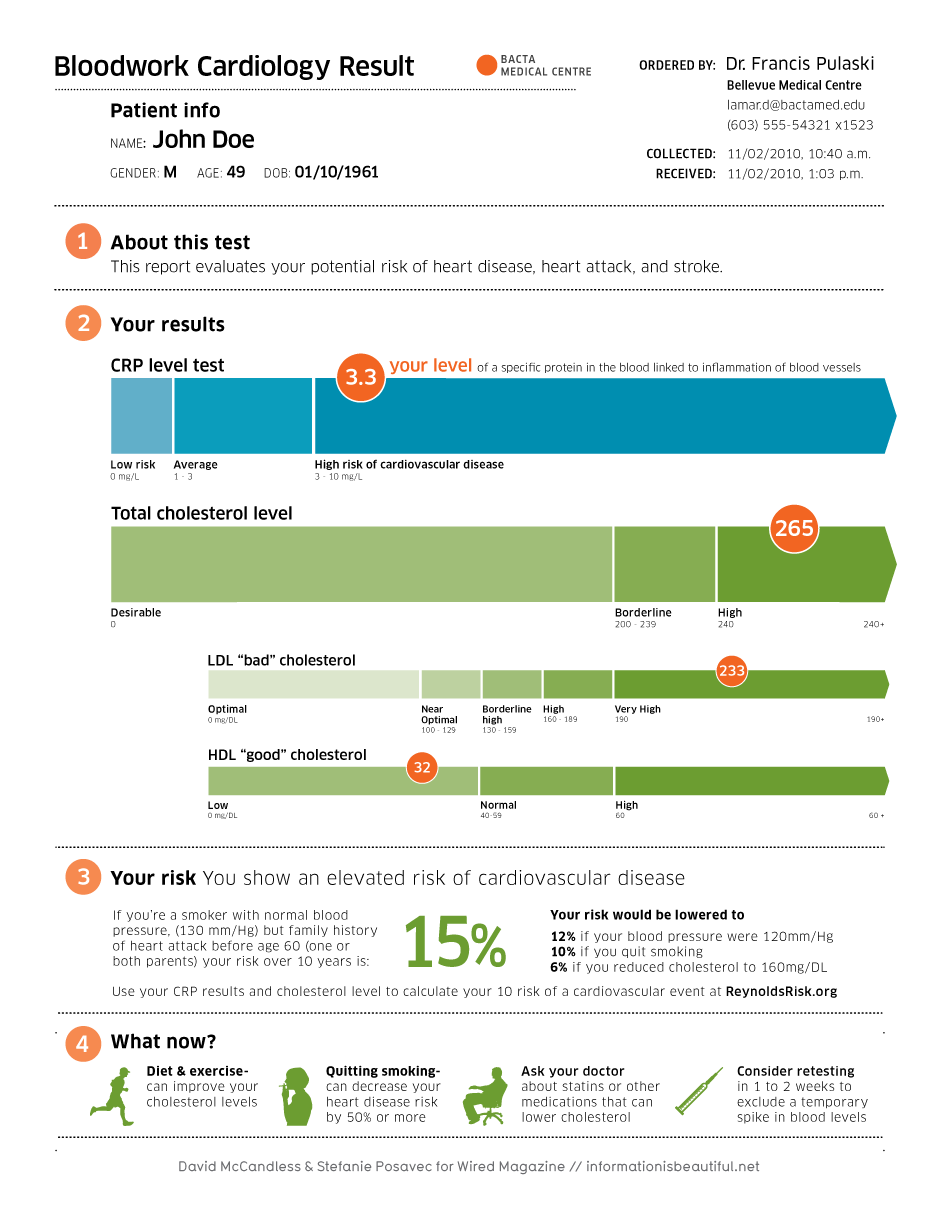
It was around re-envisioning medical data. Specifically, blood test results. Which suck, design-wise. They still look like secret missives from the CIA circa 1965. Yet their contents are vitally – perhaps mortally – important.

Our challenge was to approach a cholesterol level test. First it looked like this.


Then we designed it thus:


Our goal wasn’t just a polish job. We worked hard on the information too. So there was context for all the facts and figures. Ideally, anyone, of any educational background, could get the gist and plan their next move.

See a hi-res version here. Or download a PDF.

via:

Celebrate

As St. Patrick's Day draws near, many of you may be anticipating a nice chilled glass of Guinness, complete with a creamy foam head. But if you're not propping up a bar in Ireland, and are instead pouring your beer out of a can at home, that long-lasting head can only be produced with the help of a plastic widget.

Simply pouring a carbonated beer, such as a lager, from the can into a glass is enough to generate a head. But this is not the case for stouts, which are infused with nitrogen bubbles, rather than carbon dioxide, in order to create their uniquely smooth texture. The small plastic widgets in each can of stout contain pressurized nitrogen, which is released once the can is opened, triggering some of the dissolved nitrogen in the beer to bubble up into a head.

Using applied mathematics, including the ideal gas equation and a fourth-order Runge-Kutta scheme with a timestep of 10-3, however, a team from the University of Limerick in Ireland recently discovered that microscopic plant fibers made of cellulose, such as cotton, can also froth up a stout.

In a paper publishing their findings earlier this month, the Limerick mathematicians conclude:

A typical pouring time for a stout beer is 30 seconds. In this time about 108 postcritical nuclei must be released. A single fibre produces one bubble every 1.28 seconds. Therefore about 4.3 × 10⁶ fibres are needed. If each fibre occupies a surface of area λ2 then the total area that must be occupied by fibres is 8.3 × 10⁻⁴ m2.

Or, in plain English, embedding a 1 inch square of food-safe biodegradable cellulose fibers in a Guinness can would produce a perfect creamy head, doing away with the need for plastic widgets altogether. And although the technology is a long away from the shelves yet, removing plastic from our food chain is certainly something to drink to.

via: