Pots of Gold
Monday, June 13, 2011
The Hidden Power of Typography
by Stephanie Orma (this article originally appeared in Imprint)

"Widows and orphans give us sleepless nights." In any other sense, that phrase might conjure up images of black spiders or a certain little redhead named Annie. But when you realize the words were spoken by partner and typographer-extraordinaire Caz Hildebrand of London-based graphic design firm Here Design, the picture changes mighty fast. She adds, "All of us in the Here studio are unhealthily obsessed with the finer aspects of typesetting." And man -- does it show.

Their attention to typography is spot-on awesome. I was first introduced to Here Design's work when I was in a Barnes and Noble last fall and couldn't take my eyes off the book "The Geometry of Pasta." Then writer Ellen Shapiro interviewed Hildebrand about designing the gorgeous cookbook and I was irreversibly hooked on the studio's work. (By the way, if you haven't seen the typolicious teaser animation for "The Geometry of Pasta" where the letters in "Parmesan" literally break off like grated cheese, check it out asap).
But beyond designing cookbooks, Here Design's work is an orgasmic feast for the obsessive-compulsive type geek in all of us. I was hungry to learn more about their type fetish, so we got to talking. The studio was set up in December 2005 in East London by multi-disciplinary designers Kate Marlow, Caz Hildebrand and Mark Paton. Since then, Here Design has been "crafting quietly powerful design" from restaurant branding to cucumber crate packaging (yes, you read that right!) and everything in between.
Read more:

"Widows and orphans give us sleepless nights." In any other sense, that phrase might conjure up images of black spiders or a certain little redhead named Annie. But when you realize the words were spoken by partner and typographer-extraordinaire Caz Hildebrand of London-based graphic design firm Here Design, the picture changes mighty fast. She adds, "All of us in the Here studio are unhealthily obsessed with the finer aspects of typesetting." And man -- does it show.

Images courtesy Here Design
Their attention to typography is spot-on awesome. I was first introduced to Here Design's work when I was in a Barnes and Noble last fall and couldn't take my eyes off the book "The Geometry of Pasta." Then writer Ellen Shapiro interviewed Hildebrand about designing the gorgeous cookbook and I was irreversibly hooked on the studio's work. (By the way, if you haven't seen the typolicious teaser animation for "The Geometry of Pasta" where the letters in "Parmesan" literally break off like grated cheese, check it out asap).
But beyond designing cookbooks, Here Design's work is an orgasmic feast for the obsessive-compulsive type geek in all of us. I was hungry to learn more about their type fetish, so we got to talking. The studio was set up in December 2005 in East London by multi-disciplinary designers Kate Marlow, Caz Hildebrand and Mark Paton. Since then, Here Design has been "crafting quietly powerful design" from restaurant branding to cucumber crate packaging (yes, you read that right!) and everything in between.
Read more:


Why I Hate 3-D (And You Should Too)
By Roger Ebert.
 3-D is a waste of a perfectly good dimension. Hollywood’s current crazy stampede toward it is suicidal. It adds nothing essential to the moviegoing experience. For some, it is an annoying distraction. For others, it creates nausea and headaches. It is driven largely to sell expensive projection equipment and add a $5 to $7.50 surcharge on already expensive movie tickets. Its image is noticeably darker than standard 2-D. It is unsuitable for grown-up films of any seriousness. It limits the freedom of directors to make films as they choose. For moviegoers in the PG-13 and R ranges, it only rarely provides an experience worth paying a premium for.
That’s my position. I know it’s heresy to the biz side of show business. After all, 3-D has not only given Hollywood its biggest payday ($2.7 billion and counting for Avatar), but a slew of other hits. The year’s top three films—Alice in Wonderland, How to Train Your Dragon, and Clash of the Titans—were all projected in 3-D, and they’re only the beginning. The very notion of Jackass in 3-D may induce a wave of hysterical blindness, to avoid seeing Steve-O’s you-know-what in that way. But many directors, editors, and cinematographers agree with me about the shortcomings of 3-D. So do many movie lovers—even executives who feel stampeded by another Hollywood infatuation with a technology that was already pointless when their grandfathers played with stereoscopes. The heretics’ case, point by point:
Read more:
image credit:
 3-D is a waste of a perfectly good dimension. Hollywood’s current crazy stampede toward it is suicidal. It adds nothing essential to the moviegoing experience. For some, it is an annoying distraction. For others, it creates nausea and headaches. It is driven largely to sell expensive projection equipment and add a $5 to $7.50 surcharge on already expensive movie tickets. Its image is noticeably darker than standard 2-D. It is unsuitable for grown-up films of any seriousness. It limits the freedom of directors to make films as they choose. For moviegoers in the PG-13 and R ranges, it only rarely provides an experience worth paying a premium for.
 That’s my position. I know it’s heresy to the biz side of show business. After all, 3-D has not only given Hollywood its biggest payday ($2.7 billion and counting for Avatar), but a slew of other hits. The year’s top three films—Alice in Wonderland, How to Train Your Dragon, and Clash of the Titans—were all projected in 3-D, and they’re only the beginning. The very notion of Jackass in 3-D may induce a wave of hysterical blindness, to avoid seeing Steve-O’s you-know-what in that way. But many directors, editors, and cinematographers agree with me about the shortcomings of 3-D. So do many movie lovers—even executives who feel stampeded by another Hollywood infatuation with a technology that was already pointless when their grandfathers played with stereoscopes. The heretics’ case, point by point:
Read more:
image credit:
El Bulli
 [ed. Excellent additional story in the NY Times about the spin-off implications from the close of El Bulli, here:]
 by Grant Achatz
When Ferran Adrià announced last week that El Bulli would not reopen at the end of a two-year hiatus in 2014—or, if it did reopen, it would not be in anything like its present form — we wrote to Grant Achatz for his reaction. Mr. Achatz worked at El Bulli for a few weeks in 2000, and what he saw there shaped his career. Now the chef at Alinea in Chicago, Mr. Achatz wrote back with this reflection, based in part on an excerpt from his forthcoming memoir “Life, On the Line.”
I arrived at The French Laundry early one night so I could get some prep done for a VIP table when I saw Thomas Keller gliding through the kitchen toward me. Every morning he would greet each cook with a handshake, and depending on the time, a smile. As he approached on this day, I noticed something in his hand. He placed the October 1999 issue of Gourmet on the stainless-steel counter in front of me and asked me to open to the page marked with a yellow sticky note.
I thumbed to the page, finding an unfamiliar, gruff looking chef surrounded by floating oranges. Who is this guy, I wondered…and why is he juggling citrus fruits?
In a short time, that guy would become known as the best chef in the world. His name was Ferran Adrià.
Chef Keller looked down at the magazine and spoke softly: Read this tonight when you go home. His food really sounds interesting, and right up your alley. I think you should go stage there this summer….I will arrange it for you.
Seven months later I landed at the Barcelona airport. I had not planned very well and had neglected to make arrangements for traveling to El Bulli, two hours north by car. My stage started the next day. As luck would have it, while walking through the airport I ran into a group of American chefs. Wylie Dufresne, Paul Kahan, Suzanne Goin, Michael Schlow and a couple of journalists had been brought over by the Spanish Tourism Board to promote Spanish gastronomy. We talked for a bit before I asked where they were headed. A restaurant called El Bulli, Wylie said, have you ever heard of it? Needless to say I hitched a ride with them on their posh tour bus.
When I arrived with the American chefs I felt a bit like a leech. After all, I was just a sous chef at the time, they were all established chefs on a funded trip. None of them knew me, and furthermore I was there to work. When we arrived at El Bulli the co-owner and maitre d’hotel, Juli Soler, welcomed the group at the door, and the Spanish official who was leading the tour pulled him aside and explained my story. I was prepared to put on a chef coat, right then and there, and start working. Juli walked off to the kitchen, and when he returned he said, “Ferran wants you to eat with the group.” Well, now I really feel like a parasite, but if you insist…
I was a 25-year-old sous chef at what most considered, at the time, the best restaurant in the world. I had grown up in a restaurant since the age of 5. I graduated with honors from what most considered the best culinary school in the world. I thought I knew food and cooking.
I had no idea what we were in for. Honestly, none of us did.
Read more:
via:
image credit:

Living Without a Pulse
by Carrie Feibel
The search for the perfect artificial heart seems never-ending. After decades of trial and error, surgeons remain stymied in their quest for a machine that does not wear out, break down or cause clots and infections.
 But Dr. Billy Cohn and Dr. Bud Frazier at the Texas Heart Institute say they have developed a machine that could avoid all that with simple whirling rotors — which means people may soon get a heart that has no beat.
Inside the institute's animal research laboratory is an 8-month-old calf with a soft brown coat named Abigail. Cohn and Frazier removed Abigail's heart and replaced it with two centrifugal pumps.
"If you listened to her chest with a stethoscope, you wouldn't hear a heartbeat," says Cohn. "If you examined her arteries, there's no pulse. If you hooked her up to an EKG, she'd be flat-lined."
The pumps spin Abigail's blood and move it through her body.
"By every metric we have to analyze patients, she's not living," Cohn says. "But here you can see she's a vigorous, happy, playful calf licking my hand."
Human Trials
In March, after practicing on 38 calves, Cohn and Frazier felt confident enough to try their device on a human patient. They chose Craig Lewis, a 55-year-old who was dying from amyloidosis, which causes a buildup of abnormal proteins. The proteins clog the organs so much that they stop working.
In Lewis' case, his heart became so damaged, doctors said he had about 12 hours left to live.
His wife, Linda, said they should try the artificial heart.
Read more:
The search for the perfect artificial heart seems never-ending. After decades of trial and error, surgeons remain stymied in their quest for a machine that does not wear out, break down or cause clots and infections.
 But Dr. Billy Cohn and Dr. Bud Frazier at the Texas Heart Institute say they have developed a machine that could avoid all that with simple whirling rotors — which means people may soon get a heart that has no beat.
 Inside the institute's animal research laboratory is an 8-month-old calf with a soft brown coat named Abigail. Cohn and Frazier removed Abigail's heart and replaced it with two centrifugal pumps.
"If you listened to her chest with a stethoscope, you wouldn't hear a heartbeat," says Cohn. "If you examined her arteries, there's no pulse. If you hooked her up to an EKG, she'd be flat-lined."
The pumps spin Abigail's blood and move it through her body.
"By every metric we have to analyze patients, she's not living," Cohn says. "But here you can see she's a vigorous, happy, playful calf licking my hand."
Human Trials
In March, after practicing on 38 calves, Cohn and Frazier felt confident enough to try their device on a human patient. They chose Craig Lewis, a 55-year-old who was dying from amyloidosis, which causes a buildup of abnormal proteins. The proteins clog the organs so much that they stop working.
In Lewis' case, his heart became so damaged, doctors said he had about 12 hours left to live.
His wife, Linda, said they should try the artificial heart.
Read more:
Sunday, June 12, 2011

Green Bean Bacon Bundles
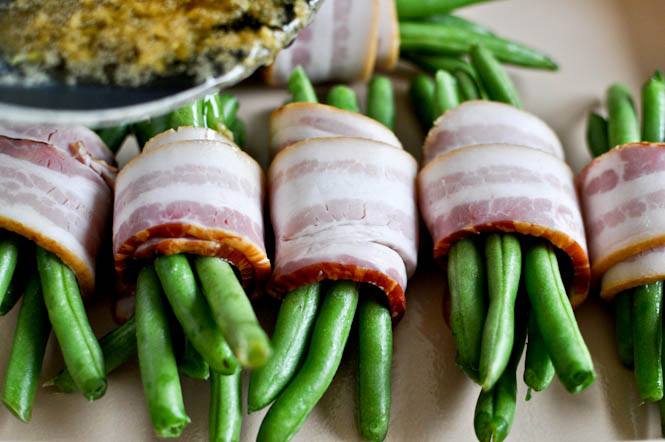
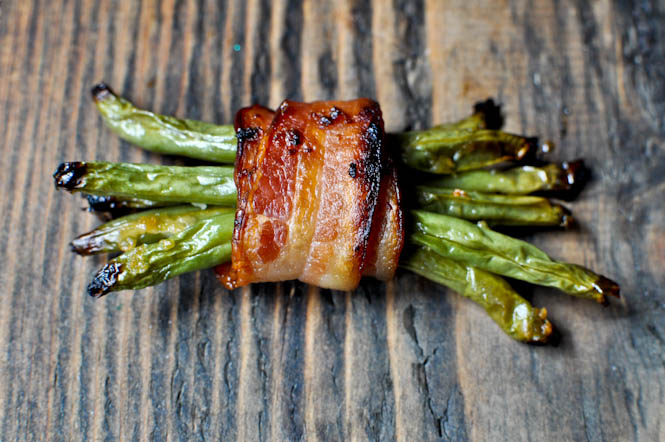
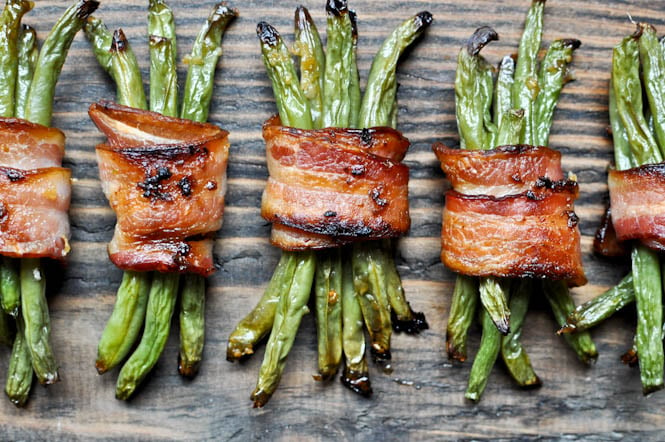
Green Bean Bacon Bundles
makes about 10-12 bundles
1 pound fresh green beans
10-12 slices of thick-cut bacon
2 tablespoons butter
1 tablespoon brown sugar
2 cloves of garlic, minced
1/4 teaspoon salt
1/4 teaspoon pepper
Preheat oven to 400 degrees F. Spray a 9 x 13 baking dish with non-stick spray.
Wash and thoroughly dry green beans, then season with salt and pepper. Bundle together about 5-8 green beans – this will depend on your size of beans and the amount of beans you get for one pound. Bundle together as many as you’d like! Using a slice of bacon, wrap it around the center of the beans to hold it together. Lay the bundle bacon seam side down in the baking dish to hold it together. Repeat with remaining beans.
Heat a small saucepan over low heat. Add butter, brown sugar and garlic and whisk until melted and combined. Using a pastry brush, brush the mixture over top of each green bean bundle. Cover the bundles with foil and bake for 35 minutes. Remove foil and bake for 10-15 minutes more, just until bacon gets crispy.
via:
How to Turn a Pallet into a Garden

Find a Pallet
The first thing you need to do is–obviously–find a pallet. I’ve had good luck finding them in dumpsters behind supermarkets. No need to be squeamish. It doesn’t smell. At least, it doesn’t smell that bad. Don’t just take the first pallet you find. You’re looking for one with all the boards in good condition, no nails sticking out, no rotting, etc. If you intend to put edibles in your pallet, be sure to find one that was heat treated as opposed to fumigated with pesticides.
Collect Your Supplies
For this project, you’ll need the pallet you found, 2 large bags of potting soil, 16 six packs of annual flowers (one six pack per opening on the face of the pallet, and two six packs per opening on the top of the completed pallet garden), a small roll of landscape fabric, a staple gun, staples, and sand paper.
Get Your Pallet into Shape
Once you’ve dragged your pallet home, give it a once over. Are any of the boards a little loose? Is the wood chipping in places? Nail down any loose boards, and use sand paper to smooth down any rough spots.
Let the Stapling Begin!
Decide which side of the pallet will be the bottom when the pallet garden is completed and leaning against the wall. You are going to be covering the bottom, back, and sides with landscape fabric, leaving the spaces between the slats and the top uncovered (you’ll be planting flowers in the uncovered spaces).
Lay the pallet face down. Roll the landscape fabric over the back. Cut two identically sized pieces that are long enough to go from the top edge of the back of the pallet and wrap all the way around the bottom, plus a few extra inches.


For Better or for Worse
by David Finkel
Everyone has had something to say.
Everyone has had something to say.

Her mother said: Get your hair cut. It'll make you feel better.
Her father said: Monitor the joint bank accounts. He might empty them.
Her sister said: Take your time. See a counselor.
Her counselor said: Have faith. It will work out.
Her friends said: Get even. Nail him in the settlement.
Even he had something to say, delivered in a seven-page letter a few weeks after he left.
"Val:" he'd written, "Let me begin this by stating that I am truly sorry that all of this is a painful experience for all involved, and that it comes with difficult issues and situations. I'm confident that in the future all of this will be worked out, feelings will recover, and our lives will return to something that is normal and acceptable. This, unfortunately, is a step toward that future . . ."
And so, trying to gain some control, she has come to a lawyer to see about getting a divorce. Her name is Valerie. Her maiden name is Perrino. Her married name is something she doesn't want published because she has two young children, and because she has no idea what is about to happen to their lives. She is 34, lives in Northern Virginia, has lost 17 pounds since the day her husband left, and now finds herself in Vienna, across from a lawyer named Mark Barondess, who is sitting beneath a large photograph of a snarling Doberman pinscher. "Okay," he is saying, pushing some papers he has prepared across the desk for her to sign. "Here it is." It is the moment she has been dreading. Earlier in the day, thinking about it, she nearly canceled the appointment. She had woken up with a headache. She had driven to Vienna wondering if she would be physically sick. She had come into Barondess's office, noticed the photograph of the Doberman and almost panicked. Up to this point, though, she'd surprised herself with how well she'd maintained her composure, even when Barondess was going over what he'd written, which was a reduction of her marriage to 12 cold paragraphs of type.
Read more:

You Blow My Mind. Hey, Mickey!
by John Jeremiah Sullivan
 One night my wife, M. J., said I should prepare to Disney. It wasn’t presented as a question or even as something to waste time thinking about, just to brace for, because it was happening. We have some old friends, Trevor and Shell (short for Michelle), and they have a girl, Flora, 5, who is only a year older than our daughter, Mimi. The girls grew up thinking of each other as cousins and get along beautifully. Shell and Trevor also have a younger son, Lil’ Dog. He possesses a real, dignified-sounding name, but his grandparents are the only people I’ve ever heard call him that. All his life he has been Lil’ Dog. The nickname didn’t come about in any special way. There’s no story attached. It was as if, at the moment of birth, the boy himself spoke and chose this moniker. When you look at him, something in him makes you want to say, “Lil’ Dog.” He’s a tiny, sandy-haired, muscular guy, with a goofy, lolling grin, who’s always about twice as heavy when you pick him up as you thought he was going to be.
Through family, Shell had come into some discount tickets, enough for the seven of us. It seemed not even a day passed between my getting a slight rumble of that news and finding myself at the wheel of the black Honda, headed south-southwest from North Carolina. For events to have actually moved this quickly is not far-fetched. M. J. often springs trips and appointments on me, in some cases literally overnight, knowing that if she removes the time factor, I won’t be able to generate bogus neurotic back-out plans. Many of the best vacation memories of my life I owe to these strategies, which prove again a useful principle for all couples: don’t try to change each other. Study and subvert each other.
The camper containing Shell, Trevor, Flora and Lil’ Dog moved south-southeast from Chattanooga. We were converging like lines on a graphing calculator. Unless you are very, very strong, the time will come when you Disney, and our time had come, unrolling like a glaring scroll in the form of I-95. It was a Saturday. The next day would be Father’s Day. This whole voyage, it turned out, was billed as a Father’s Day gift to me and Trevor, which in my case was like having been shot with a heavy barbiturate dart and bundled off to your own birthday party. Nonetheless I had little anxiety — a total lack of options will often produce a strange, free feeling. In the rearview mirror, Mimi practically strained her car-seat buckles with impatience. My highway thoughts passed through a curious phase of gratitude toward Walter Disney, as an individual, for having made possible such an intensity of childhood joy. Maybe Trevor felt the same about his little brood, hundreds of miles away, fewer each minute.
There’s something I should mention about Trevor, though I wouldn’t if it weren’t relevant to much of what came later, but he smokes a stupendous amount of weed. Think of a person who smokes a pack of cigarettes a day, that’s 20 cigarettes. Trevor smokes about that many joints, on a heavy day, the first one while he’s making coffee. And yet is highly functional in all social and professional senses, or almost all. I’ve definitely seen him muff some conversations. Still, 90 percent of the time he’s one of the sharpest and most interesting people I know. But to repeat: the brother is always, always high. We’re not talking about stuff your roommate grew in the side lot, either; this is California high-grade he obtains through a kind of nationwide medical-marijuana co-op, moving the legally obtained stuff out of California and into other states. It works the same as regular weed dealing, apparently, but you’re not supporting a criminal network. Except insofar as you are part of a criminal network. It is one of the many contradictions of living at a time when half the country thinks of weed as more innocent than alcohol and the other half thinks of it as a stepping stool to hard drugs. I needled Trevor once for details on his source. He said that, unfortunately, there was one rule: don’t tell your friends.
When Trevor and I became tight — as neighbors, in our early 20s — I was smoking a bit myself, almost competing with him. But when I hit 30, I backed up off it, as the song says. I never stopped liking the stuff or feeling that it benefited me, for that matter, but the habit was starting to make me dumb, and I was just humble enough by 30, I guess, to realize I hadn’t been born with enough cerebral ammunition to go voluntarily squandering any of it. Meanwhile Trevor stayed committed. And when we get together, a couple of times a year, I won’t lie, I fall prey to old patterns. Every so often it causes worry in my wife, especially since our daughter came along. Mostly I think she sees it as a useful pressure valve, which keeps me straighter and narrower the rest of the year. (Study, subvert: happiness = winner.)
Read more:
[ed. Terrific read, not just for the "being there" feeling it provides (...I've never been there), but the fascinating background story on how Disney World came about, its effect on Orlando, and the politics that made it happen.]
Something you learn rearing kids in this young millennium is that the word “Disney” works as a verb. As in, “Do you Disney?” Or, “Are we Disneying this year?” Technically a person could use the terms in speaking about the original Disneyland, in California, but this would be an anomalous usage. One goes to Disneyland and has a great time there, probably — I’ve never been — but one Disneys at the Walt Disney World Resort in Florida. There’s an implication of surrender to something enormous.
Something you learn rearing kids in this young millennium is that the word “Disney” works as a verb. As in, “Do you Disney?” Or, “Are we Disneying this year?” Technically a person could use the terms in speaking about the original Disneyland, in California, but this would be an anomalous usage. One goes to Disneyland and has a great time there, probably — I’ve never been — but one Disneys at the Walt Disney World Resort in Florida. There’s an implication of surrender to something enormous.
 One night my wife, M. J., said I should prepare to Disney. It wasn’t presented as a question or even as something to waste time thinking about, just to brace for, because it was happening. We have some old friends, Trevor and Shell (short for Michelle), and they have a girl, Flora, 5, who is only a year older than our daughter, Mimi. The girls grew up thinking of each other as cousins and get along beautifully. Shell and Trevor also have a younger son, Lil’ Dog. He possesses a real, dignified-sounding name, but his grandparents are the only people I’ve ever heard call him that. All his life he has been Lil’ Dog. The nickname didn’t come about in any special way. There’s no story attached. It was as if, at the moment of birth, the boy himself spoke and chose this moniker. When you look at him, something in him makes you want to say, “Lil’ Dog.” He’s a tiny, sandy-haired, muscular guy, with a goofy, lolling grin, who’s always about twice as heavy when you pick him up as you thought he was going to be.
Through family, Shell had come into some discount tickets, enough for the seven of us. It seemed not even a day passed between my getting a slight rumble of that news and finding myself at the wheel of the black Honda, headed south-southwest from North Carolina. For events to have actually moved this quickly is not far-fetched. M. J. often springs trips and appointments on me, in some cases literally overnight, knowing that if she removes the time factor, I won’t be able to generate bogus neurotic back-out plans. Many of the best vacation memories of my life I owe to these strategies, which prove again a useful principle for all couples: don’t try to change each other. Study and subvert each other.
The camper containing Shell, Trevor, Flora and Lil’ Dog moved south-southeast from Chattanooga. We were converging like lines on a graphing calculator. Unless you are very, very strong, the time will come when you Disney, and our time had come, unrolling like a glaring scroll in the form of I-95. It was a Saturday. The next day would be Father’s Day. This whole voyage, it turned out, was billed as a Father’s Day gift to me and Trevor, which in my case was like having been shot with a heavy barbiturate dart and bundled off to your own birthday party. Nonetheless I had little anxiety — a total lack of options will often produce a strange, free feeling. In the rearview mirror, Mimi practically strained her car-seat buckles with impatience. My highway thoughts passed through a curious phase of gratitude toward Walter Disney, as an individual, for having made possible such an intensity of childhood joy. Maybe Trevor felt the same about his little brood, hundreds of miles away, fewer each minute.
There’s something I should mention about Trevor, though I wouldn’t if it weren’t relevant to much of what came later, but he smokes a stupendous amount of weed. Think of a person who smokes a pack of cigarettes a day, that’s 20 cigarettes. Trevor smokes about that many joints, on a heavy day, the first one while he’s making coffee. And yet is highly functional in all social and professional senses, or almost all. I’ve definitely seen him muff some conversations. Still, 90 percent of the time he’s one of the sharpest and most interesting people I know. But to repeat: the brother is always, always high. We’re not talking about stuff your roommate grew in the side lot, either; this is California high-grade he obtains through a kind of nationwide medical-marijuana co-op, moving the legally obtained stuff out of California and into other states. It works the same as regular weed dealing, apparently, but you’re not supporting a criminal network. Except insofar as you are part of a criminal network. It is one of the many contradictions of living at a time when half the country thinks of weed as more innocent than alcohol and the other half thinks of it as a stepping stool to hard drugs. I needled Trevor once for details on his source. He said that, unfortunately, there was one rule: don’t tell your friends.
When Trevor and I became tight — as neighbors, in our early 20s — I was smoking a bit myself, almost competing with him. But when I hit 30, I backed up off it, as the song says. I never stopped liking the stuff or feeling that it benefited me, for that matter, but the habit was starting to make me dumb, and I was just humble enough by 30, I guess, to realize I hadn’t been born with enough cerebral ammunition to go voluntarily squandering any of it. Meanwhile Trevor stayed committed. And when we get together, a couple of times a year, I won’t lie, I fall prey to old patterns. Every so often it causes worry in my wife, especially since our daughter came along. Mostly I think she sees it as a useful pressure valve, which keeps me straighter and narrower the rest of the year. (Study, subvert: happiness = winner.)
Read more:

The Getaway Car
by Jonathan Raban

[ed. Tender, poignant memoir about letting go, and an excellent travelogue, too.]
For a long time now, I’ve been looking forward to this year with apprehension: 2011 is when my daughter, Julia, now 18, will undertake that very American rite of passage and “go away to college” — a phrase whose operative word is “away.” We live in Seattle, and in the Pacific Northwest, “collegeland,” as my daughter calls it, is centered in New England and New York, where most of her immediate friends will be going in September.
Though I’ve lived for 21 years in the U.S., I still have an Englishman’s stunted sense of distance. I think of 300 miles as a long journey, and all through last summer and fall, I would wake at 4 a.m. to sweat over the prospect of losing my daughter — my best companion, my anchor to the United States, the person with whom I’ve had the longest, most absorbing relationship of my adult life — to some unimaginably distant burg on the East Coast. So I was as elated as she was when she heard she’d been accepted by Stanford, her first choice. Same coast, same time zone — Within driving distance was the thought I clung to.
Interstate highways dull the reality of place and distance almost as effectively as jetliners do: I loathe their scary monotony. I wanted to make palpable the mileage that will stretch between us come September and feel on my own pulse the physical geography of our separation. We would take the coast road and mark out the wriggly, thousand-mile track that leads from my workroom to her future dorm in California.
Julia and I are old hands at taking road trips on her spring breaks, and stuffing our bags into the inadequate trunk of my two-seater convertible on a damp Sunday morning in early April, I sensed that this one might turn out to be our last. In the same car, or its identical predecessor, we’d driven to the Baja peninsula, the Grand Canyon, eastern Montana, British Columbia, on minor roads and with the top down, to open us as far as possible to the world we traveled through.
The rain that morning was the fine-sifted Northwest drizzle that grays this corner of the country for weeks on end; too heavy for the windshield wipers on intermittent and too light for slow, when the wipers skreak and whine on dry glass. To quicken us on our way, I steeled myself to take the Interstate as far as Olympia, the state capital, 60 miles to the southwest, from where we’d branch out to the coast. On the freeway, tire rumble and the kerchunk-kerchunk of our hard suspension’s rattling over expansion joints made conversation impossible, and the car felt as small as a pill bug, likely to be squashed flat by the next 18-wheeler. Julia wired herself to her iPod.
She was 3, going on 4, when her mother and I separated, and she could barely remember a time when she hadn’t commuted between two Seattle houses, twice a week, under the terms of the joint-custody agreement. First she moved with her stuffed bear, then with bear plus live dog; nowadays she traveled with so much stuff that she looked like an overladen packhorse when she staggered out the door with it. College offered her the promise of a life more secure and regular than any she had known since 1996 — an end to all that house-to-school-to-the-other-house gypsying that she managed with forbearing grace. Much as I feared her going away, I knew what a luxury it would be for her to have her books, clothes and bed in one room for the length of a college quarter.
Read more:

For a long time now, I’ve been looking forward to this year with apprehension: 2011 is when my daughter, Julia, now 18, will undertake that very American rite of passage and “go away to college” — a phrase whose operative word is “away.” We live in Seattle, and in the Pacific Northwest, “collegeland,” as my daughter calls it, is centered in New England and New York, where most of her immediate friends will be going in September.
Though I’ve lived for 21 years in the U.S., I still have an Englishman’s stunted sense of distance. I think of 300 miles as a long journey, and all through last summer and fall, I would wake at 4 a.m. to sweat over the prospect of losing my daughter — my best companion, my anchor to the United States, the person with whom I’ve had the longest, most absorbing relationship of my adult life — to some unimaginably distant burg on the East Coast. So I was as elated as she was when she heard she’d been accepted by Stanford, her first choice. Same coast, same time zone — Within driving distance was the thought I clung to.
Interstate highways dull the reality of place and distance almost as effectively as jetliners do: I loathe their scary monotony. I wanted to make palpable the mileage that will stretch between us come September and feel on my own pulse the physical geography of our separation. We would take the coast road and mark out the wriggly, thousand-mile track that leads from my workroom to her future dorm in California.
Julia and I are old hands at taking road trips on her spring breaks, and stuffing our bags into the inadequate trunk of my two-seater convertible on a damp Sunday morning in early April, I sensed that this one might turn out to be our last. In the same car, or its identical predecessor, we’d driven to the Baja peninsula, the Grand Canyon, eastern Montana, British Columbia, on minor roads and with the top down, to open us as far as possible to the world we traveled through.
The rain that morning was the fine-sifted Northwest drizzle that grays this corner of the country for weeks on end; too heavy for the windshield wipers on intermittent and too light for slow, when the wipers skreak and whine on dry glass. To quicken us on our way, I steeled myself to take the Interstate as far as Olympia, the state capital, 60 miles to the southwest, from where we’d branch out to the coast. On the freeway, tire rumble and the kerchunk-kerchunk of our hard suspension’s rattling over expansion joints made conversation impossible, and the car felt as small as a pill bug, likely to be squashed flat by the next 18-wheeler. Julia wired herself to her iPod.
She was 3, going on 4, when her mother and I separated, and she could barely remember a time when she hadn’t commuted between two Seattle houses, twice a week, under the terms of the joint-custody agreement. First she moved with her stuffed bear, then with bear plus live dog; nowadays she traveled with so much stuff that she looked like an overladen packhorse when she staggered out the door with it. College offered her the promise of a life more secure and regular than any she had known since 1996 — an end to all that house-to-school-to-the-other-house gypsying that she managed with forbearing grace. Much as I feared her going away, I knew what a luxury it would be for her to have her books, clothes and bed in one room for the length of a college quarter.
Read more:
Subscribe to:
Posts (Atom)