Tuesday, June 21, 2011

Meltdown

by Gennady Burbulis

For the first time, Boris Yeltsin's right-hand man tells the inside story of the coup that killed glasnost -- and changed the world. 

"That scum!" Boris Yeltsin fumed. "It's a coup. We can't let them get away with it."

It was the morning of Aug. 19, 1991, and the Russian president was standing at the door of his dacha in Arkhangelskoe, a compound of small country houses outside Moscow where the top Russian government officials lived. I had raced over from my own house nearby, after a friend called from Moscow, frantic and nearly hysterical, insisting that I turn on the radio. There had been a coup; Soviet leader Mikhail Gorbachev had been removed from power.

Five minutes later I was at Yeltsin's dacha, an unassuming two-story yellow brick building, where a small group of his closest associates soon gathered. In addition to me (at the time, his secretary of state), there was Ivan Silayev, the head of the Russian cabinet; Ruslan Khasbulatov, the acting chairman of the Supreme Soviet; Mikhail Poltoranin, the minister of press and mass information; Sergei Shakhrai, the state councilor; and Viktor Yaroshenko, the minister of foreign economic relations. Anatoly Sobchak, the mayor of Leningrad, and Yuri Luzhkov, the deputy mayor of Moscow, arrived not long after. Everyone crowded into Yeltsin's small living room.

For months we had half-expected something like this. By the summer of 1991, the Soviet Union was falling apart at the seams. The economy was imploding, the deficit was ballooning, hard currency and gold reserves had been decimated, and Gorbachev's stopgap reforms had only exacerbated the crisis. The notion of a "Soviet people," unified under the banner of socialism, was collapsing along with it. Legislatures in the republics, which had already demanded greater freedoms within the USSR, began calling for independence. By the spring of 1991, five republics -- Armenia, Estonia, Georgia, Latvia, and Lithuania -- had declared it officially. In Russia, democratic forces wanted an end to Soviet totalitarian rule. Our aim was not to allow the chaotic dissolution of the USSR, but to transform it into a confederation that would afford each republic considerable self-determination under its aegis.

We had been moving in this direction for several years. Yeltsin and the other democratic candidates had been elected to the Russian parliament in 1990 with the goal of securing more legally protected rights and freedoms, as well as a market economy, and Yeltsin had been elected president of Russia in June 1991 with almost 60 percent of the vote. But while we were secure in our popular mandate, we were utterly powerless to deal with the greatest threat to Russia: economic collapse. More than 93 percent of the economy, by our estimation, was controlled by the Soviet government. Yeltsin and those of us in his circle of closest associates soon came to believe that unless we were to content ourselves with being nothing more than a ceremonial body, we had to change the legal and economic bases of the union itself.

Read more:

Herbie Hancock - The Jungle Line


The Big Trade

by Mark Jacobson

The legendary tale of two Yankees pitchers who swapped wives, and lives, is an irresistible soap opera. No wonder Red Sox fans Matt Damon and Ben Affleck want to make a movie about it.


It is hard to keep up with the politicians, but the New York Sports Sex-­Scandal Hall of Fame has an impressive roster, back to when Babe Ruth reputedly missed half the 1925 season with the clap. Patrick Ewing, Mike Tyson, Lawrence Taylor, David Cone, Isiah Thomas, and Marv Albert are just a few of the city’s best-known sports figures to splat across the back page on accusations ranging from statutory rape to bull-pen masturbation and cross-dressing toupee loss.

However, even if no center-field monument will commemorate it, New York’s all-time oddest sports sex scandal came to light during spring training in 1973. That was when two Yankees pitchers, Fritz Peterson and Mike Kekich, 40 percent of the team’s starting rotation, called a press conference to inform mind-boggled newsmen that they had traded families. This included wives, children, and pets.

“Don’t make anything sordid out of this,” said the 31-year-old Peterson, a twenty-game winner in 1970 who was then living with Kekich’s wife, Susanne, in Franklin Lakes, New Jersey. The 27-year-old Kekich agreed. “Don’t say this was wife-­swapping, because it wasn’t,” Kekich said. “We didn’t swap wives, we swapped lives.”

Read more:

Radical Shotgun-ectomy

by Nigel Bunyan

For five years Sean Murphy was driven to distraction by a painful blemish that no amount of creams, ointments or doctors' appointments could cure.

So he came up with his own radical and permament procedure to remove the stubborn wart forever - he blasted it with a 12-bore shotgun.

But not only did the blast take off almost his entire finger, it also left him facing 15 years in jail for the illegal possesion of a firearm.

Yesterday, with only a stump to show for the middle of his left hand, and a suspended 16-week prison sentence, he insisted he had no regrets.

“I’m happy with that,” he said outside Doncaster Magistrates’ Court, South Yorkshire.

“I know I could have gone to jail for up to 15 years for a firearms offence. My solicitor did a very good job.

"The best thing is that the wart has gone. It was giving me lot of trouble.”

Richard Haigh, defending, said Murphy, 38, had been “a victim of his own stupidity when domestic pressures got to him”.

Mr Murphy decided to open fire with the Beretta after fortifying himself with several pints of beer. He settled down outside his caravan, took aim and opened fire.

Read more: 

image credit:

Killer Bugs In Your Dishwasher

[ed.  Not sure what to do with this information.  If I had to hand wash everything, a greater health hazard would be procrastination, along with that sketchy dish rag in my sink.] 

by Harry Wallop

The inside of the appliances, which four in ten homes in Britain own, are the perfect breeding ground for fungi associated with potentially deadly illnesses.

The moist and hot environment, combined with the alkaline water caused by the dishwasher tablets, means that the machines appear to have created a previously unknown and possibly serious threat to human health, the research paper has suggested.

The scientists studied 189 dishwashers in 101 different homes around the world. They found 62 per cent of dishwashers contained fungi on the rubber band in the door. More than half of these included the black yeasts Exophiala dermatitidis and E. phaeomuriformis which are known to be dangerous to human health.

Writing in the journal Fungal Biology, Dr Polona Zalar of the University of Ljubljana, said that "the potential hazard they represent should not be overlooked".


Read more:

The Economics of California's Death Penalty

by Carol J. Williams

Taxpayers have spent more than $4 billion on capital punishment in California since it was reinstated in 1978, or about $308 million for each of the 13 executions carried out since then, according to a comprehensive analysis of the death penalty's costs.

The examination of state, federal and local expenditures for capital cases, conducted over three years by a senior federal judge and a law professor, estimated that the additional costs of capital trials, enhanced security on death row and legal representation for the condemned adds $184 million to the budget each year.

The study's authors, U.S. 9th Circuit Judge Arthur L. Alarcon and Loyola Law School professor Paula M. Mitchell, also forecast that the tab for maintaining the death penalty will climb to $9 billion by 2030, when San Quentin's death row will have swollen to well over 1,000.

In their research for "Executing the Will of the Voters: A Roadmap to Mend or End the California Legislature's Multi-Billion-Dollar Death Penalty Debacle," Alarcon and Mitchell obtained California Department of Corrections and Rehabilitation records that were unavailable to others who have sought to calculate a cost-benefit analysis of capital punishment.

Their report traces the legislative and initiative history of the death penalty in California, identifying costs imposed by the expansion of the types of crimes that can lead to a death sentence and the exhaustive appeals guaranteed condemned prisoners.

The authors outline three options for voters to end the current reality of spiraling costs and infrequent executions: fully preserve capital punishment with about $85 million more in funding for courts and lawyers each year; reduce the number of death penalty-eligible crimes for an annual savings of $55 million; or abolish capital punishment and save taxpayers about $1 billion every five or six years.

Read more:

Fit to be Tied


[ed.  Public Service Announcement]

New Math in HIV Fight

by Mark Shoofs

Scientists using a powerful mathematical tool previously applied to the stock market have identified an Achilles heel in HIV that could be a prime target for AIDS vaccines or drugs.

The research adds weight to a provocative hypothesis—that an HIV vaccine should avoid a broadside attack and instead home in on a few targets. Indeed, there is a rare group of patients who naturally control HIV without medication, and these "elite controllers" most often assail the virus at precisely this vulnerable area.

Scientists have identified an Achilles' heel in HIV, the virus that causes AIDS, with a powerful mathematical method previously applied to the stock market, and think the spot could be a prime target for vaccines or drugs. Mark Schoofs explains.

"This is a wonderful piece of science, and it helps us understand why the elite controllers keep HIV under control," said Nobel laureate David Baltimore. Bette Korber, an expert on HIV mutation at the Los Alamos National Laboratory, said the study added "an elegant analytical strategy" to HIV vaccine research.

"What would be very cool is if they could apply it to hepatitis C or other viruses that are huge pathogens—Ebola virus, Marburg virus," said Mark Yeager, chair of the physiology department at the University of Virginia School of Medicine. "The hope would be there would be predictive power in this approach." Drs. Baltimore, Korber and Yeager weren't involved in the new research.

Read more:

10 Myths About Introverts

by Carl King

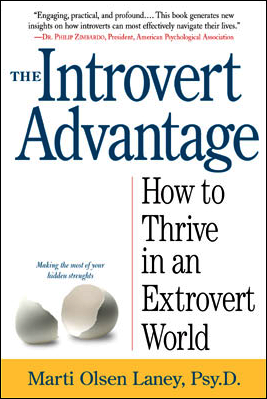
I was lucky enough to discover a book called, The Introvert Advantage (How To Thrive in an Extrovert World), by Marti Laney, Psy.D. I feel like someone has written an encyclopedia entry on a rare race of people to which I belong. Not only has it explained many of my eccentricities, it helps me to redefine my entire life in a new and positive context.

Sure, anyone who knows me would say, “Duh! Why did it take you so long to realize you’re an Introvert?” It’s not that simple. The problem is that labeling someone as an Introvert is a very shallow assessment, full of common misconceptions. It’s more complex than that.

A section of Laney’s book maps out the human brain and explains how neuro-transmitters follow different dominant paths in the nervous systems of Introverts and Extroverts. If the science behind the book is correct, it turns out that Introverts are people who are over-sensitive to Dopamine, so too much external stimulation overdoses and exhausts them. Conversely, Extroverts can’t get enough Dopamine, and they require Adrenaline for their brains to create it. Extroverts also have a shorter pathway and less blood-flow to the brain. The messages of an Extrovert’s nervous system mostly bypass the Broca’s area in the frontal lobe, which is where a large portion of contemplation takes place.

Unfortunately, according to the book, only about 25% of people are Introverts. There are even fewer that are as extreme as I am. This leads to a lot of misunderstandings, since society doesn’t have very much experience with my people. (I love being able to say that.)

So here are a few common misconceptions about Introverts (I put this list together myself, some of them are things I actually believed):

Myth #1 – Introverts don’t like to talk.
This is not true. Introverts just don’t talk unless they have something to say. They hate small talk. Get an introvert talking about something they are interested in, and they won’t shut up for days.

Myth #2 – Introverts are shy.
Shyness has nothing to do with being an Introvert. Introverts are not necessarily afraid of people. What they need is a reason to interact. They don’t interact for the sake of interacting. If you want to talk to an Introvert, just start talking. Don’t worry about being polite.

Myth #3 – Introverts are rude.
Introverts often don’t see a reason for beating around the bush with social pleasantries. They want everyone to just be real and honest. Unfortunately, this is not acceptable in most settings, so Introverts can feel a lot of pressure to fit in, which they find exhausting.

Read more:

Monday, June 20, 2011

Bruce Cockburn


 via:

Mother Gaia

The Failure of Rational Choice Philosophy

by John McCumber

According to Hegel, history is idea-driven. According to almost everyone else, this is foolish. What can “idea driven” even mean when measured against the passion and anguish of a place like Libya?

But Hegel had his reasons. Ideas for him are public, rather than in our heads, and serve to coordinate behavior. They are, in short, pragmatically meaningful words.  To say that history is “idea driven” is to say that, like all cooperation, nation building requires a common basic vocabulary.
One prominent component of America’s basic vocabulary is ”individualism.” Our society accords unique rights and freedoms to individuals, and we are so proud of these that we recurrently seek to install them in other countries. But individualism, the desire to control one’s own life, has many variants. Tocqueville viewed it as selfishness and suspected it, while Emerson and Whitman viewed it as the moment-by-moment expression of one’s unique self and loved it.

After World War II, a third variant gained momentum in America. It defined individualism as the making of choices so as to maximize one’s preferences. This differed from “selfish individualism” in that the preferences were not specified: they could be altruistic as well as selfish. It differed from “expressive individualism” in having general algorithms by which choices were made. These made it rational.

This form of individualism did not arise by chance. Alex Abella’s “Soldiers of Reason” (2008) and S. M. Amadae’s “Rationalizing Capitalist Democracy” (2003) trace it to the RAND Corporation, the hyperinfluential Santa Monica, Calif., think tank, where it was born in 1951 as “rational choice theory.” Rational choice theory’s mathematical account of individual choice, originally formulated in terms of voting behavior, made it a point-for-point antidote to the collectivist dialectics of Marxism; and since, in the view of many cold warriors, Marxism was philosophically ascendant worldwide, such an antidote was sorely needed. Functionaries at RAND quickly expanded the theory from a tool of social analysis into a set of universal doctrines that we may call “rational choice philosophy.” Governmental seminars and fellowships spread it to universities across the country, aided by the fact that any alternative to it would by definition be collectivist. During the early Cold War, that was not exactly a good thing to be.

The overall operation was wildly successful. Once established in universities, rational choice philosophy moved smoothly on the backs of their pupils into the “real world” of business and government (aided in the crossing, to be sure, by the novels of another Rand—Ayn). Today, governments and businesses across the globe simply assume that social reality  is merely a set of individuals freely making rational choices. Wars have been and are still being fought to bring such freedom to Koreans, Vietnamese, Iraqis, Grenadans, and now Libyans, with more nations surely to come.

Read more:

Don't Take Your 2-Year Old Daughter to Hooters

It started with a craving for fried pickles. I love fried pickles, my 2-year-old daughter and I share a similar palate, so I figured she was probably craving fried pickles too, even if she couldn't articulate that fact. Sadly, the only place within driving distance that had fried pickles at 11 a.m. was Hooters. Hooters does not have the best fried pickles, but fried pickle beggars cannot be fried pickle choosers, so after dropping my son off at preschool, my daughter and I began our pilgrimage to the Owls' busty playground.

I'm kinda fond of Hooters. As chain restaurants go, it is a fine establishment with a specific culinary point of view. Food-wise it never tries to be anything it isn’t. The food is deeply fried and tastes like shame, but the bathrooms are always very clean. The domestic beer is served in a frosty cold mug.

The service is spectacular, and I'm not making a dumb joke about boobs here. I've had waitresses scare me up cigarettes after casually mentioning that I'd love a smoke, I've had waitresses offer to watch my computer while I go have a cigarette or make a run to one of the pristine bathrooms, I've even gotten the rare corporate beer buy-back. But mostly, the service is attentive and friendly without being overbearing and obnoxious, which is sort of an amazing feat considering the dress code.

And speaking of the dress code, while those tank tops can be kind of awe-inspiring, the Hooters ensemble, as a whole, is a turn-off. It looks like it was developed by a colorblind exercise fetishist in 1983. It's a hard look for most earth women to pull off successfully.

Hooters is an asexual place for me. I don't go there to get my blood pumping; I go there to feel my blood clogging as I watch the Phillies and get some work done. I don't go to Hooters for a pseudo-sexual performance in the same way I don't go to the strip club for the buffet (that's for hardcore perverts).

So I didn't think it would be weird to take the kid to Hooters.

Read more:

Rockets for Air Conditioners

According to Steve Anderson, a retired brigadier general who served as Gen. Petraeus' chief logistician in Iraq, the Department of Defense spends $20 billion air conditioning tents and temporary structures for the military. That's more than NASA's entire $19 billion annual budget (pdf).

That cost comes out of the fuel needed to heat and cool tents on the front lines. However, the trucks that transport this fuel have become targets for IEDs used by the insurgency in Iraq and Afghanistan. According to Anderson, at least 1000 soldiers have been killed moving fuel.

Anderson believes that a simple solution would be to instead spray tents with polyurethane foam, kind of like the foam sealant you would use in your own home. In fact, an active $95 million contract to insulate tents is producing $1 billion in cost avoidance, proving it's both safer and greener than air conditioning the desert. Doing this while also searching for other energy-efficient solutions would save both money and lives.

via:

The Beautiful People

by Rupert Neate

It was meant to be a dating website exclusively for the use of "beautiful men and women", where members ruthlessly selected and excluded those who did not match their definitions of good looks.

But last month when BeautifulPeople.com was attacked by a computer virus, some claim standards slipped and around 30,000 new members gained admittance. Now, in a move which has made those rejected "apoplectic" with rage, they have been unceremoniously booted off at a financial cost of more than $100,000 (£62,000) to the site's operators.

The virus was quickly named Shrek – after the animated film about how looks should not matter – as it attacked the software used to screen potential members. A helpline has now been set up with counsellors on hand to help the distressed rejects from the site.

"We have to stick to our founding principles of only accepting beautiful people – that's what our members have paid for," said Greg Hodge, managing director of BeautifulPeople.com. "We can't just sweep 30,000 ugly people under the carpet."

Hodge reckoned the Shrek virus – which may have been posted by a disgruntled former employee – had affected the software that existing members use to rate prospective new entrants, allowing anyone to join. The website boasts that "beauty lies in the eyes of the voter" who are able to rank aspiring members on a type of traffic light scale where red is "absolutely not" and bright green is "beautiful". The site posts applicants' photographs alongside information about their weight and height and ask candidates to describe their "body type" as well as whether they own a car or home along with their zodiac sign.

"We got suspicious when tens of thousands of new members were accepted over a six-week period, many of whom were no oil painting," Hodge told the Guardian.
Read more:

Promising Cancer Vaccine

Cancer vaccines may come sooner than you think. And each vaccine will be tailor-made for a specific kind of cancer. This isn't just a theory anymore. It's been done.

A group of medical researchers in the U.K. and the U.S. have successfully cured prostate cancer in mice using a vaccine made partly from healthy human prostate DNA, delivered inside virus shells. This treatment could come to replace toxic chemotherapies, curing cancer with no painful side-effects.

The researchers injected the mice with virus shells (the outer skin of viruses) packed with "libraries" of DNA made up partly of DNA taken from healthy prostate. The researchers believed that delivering the DNA inside viruses would essentially trick the mouse immune system, sending it into overdrive to produce antibodies tailor-made to attack cancers of the prostate. And their theory turned out to be correct. The mice produced antibodies which attacked their cancerous tumors, effectively eliminating the cancer. Because this vaccine's DNA libraries were tailor-made for prostate cancer, however, it also prevented the mice from producing antigens that attacked other organs in their bodies.

According to the Mayo Clinic, where some of the research took place:
All infections, allergens and tissues, including tumors, have a unique fingerprint called an antigen — a molecular protein tag that triggers a response from the body's immune system. Dr. [Richard] Vile deployed the human vaccine prostate cancer antigens through the mutated VSV vector to raise a full-on assault from the mice's T-cells. After exposure to the mutated viruses, the animals' immune systems recognized the antigens expressed in the virus and produced a potent immune response to attack the prostate tumors.
"Nobody really knows how many antigens the immune system can really see on tumor cells," says Dr. Vile. "By expressing all of these proteins in highly immunogenic viruses, we increased their visibility to the immune system. The immune system now thinks it is being invaded by the viruses, which are expressing cancer-related antigens that should be eliminated."
The big question now is whether this therapy could work in humans. Clinical trials that would lead to using this therapy on humans could begin in two years.

Read the full scientific article via Nature Medicine.

via: 
image credit:

Just a Man

by John Manchester

Seven years ago early in the morning of June 1, my father's nurse woke me to say, "Your father has passed." I sat vigil alone at the foot of his bed, glancing at his face and then away, because it was hard to look at him. His mouth hung open, perhaps from trying for a last breath that never came.

I finally got a glimpse of who he was as a person, though that person had departed an hour ago. Despite walls plastered with awards, numerous bestsellers, bushels of adoring fan mail and the company of great men, his face was etched with disappointment.

As a boy, my vision of my father was hindered by physical fear. All I saw was a giant, one who would periodically strike me to unleash his rage.

Just as I became a man, my father, William Manchester, rocketed to international fame after the publication of his bestseller "The Death of a President." Now he towered over me in the world. All I saw was how much he had achieved and how little I had in comparison.

Just as my father reached the age I am now, 60, the mask of the famous author slipped and I saw a very different face, that of his shadow.

As the skeletons clattered from our family closet -- my father's secret lifetime of self-destructive habits, his marriage that was something out of a horror movie -- I could only blink in disbelief. How could these two men, these two lives, coexist in a single body?

Read more:

Sunday, June 19, 2011

How To Land Your Kid In Therapy

By Lori Gottlieb, The Atlantic

If there’s one thing I learned in graduate school, it’s that the poet Philip Larkin was right. (“They fuck you up, your mum and dad, / They may not mean to, but they do.”) At the time, I was a new mom with an infant son, and I’d decided to go back to school for a degree in clinical psychology. With baby on the brain and term papers to write, I couldn’t ignore the barrage of research showing how easy it is to screw up your kids. Of course, everyone knows that growing up with “Mommy Dearest” produces a very different child from one raised by, say, a loving PTA president who has milk and homemade cookies waiting after school. But in that space between Joan Crawford and June Cleaver, where most of us fall, it seemed like a lot could go wrong in the kid-raising department.

As a parent, I wanted to do things right. But what did “right” mean? One look in Barnes & Noble’s parenting section and I was dizzy: child-centered, collaborative, or RIE? Brazelton, Spock, or Sears?

The good news, at least according to Donald Winnicott, the influential English pediatrician and child psychiatrist, was that you didn’t have to be a perfect mother to raise a well-adjusted kid. You just had to be, to use the term Winnicott coined, a “good-enough mother.” I was also relieved to learn that we’d moved beyond the concept of the “schizophrenogenic mother,” who’s solely responsible for making her kid crazy. (The modern literature acknowledges that genetics—not to mention fathers—play a role in determining mental health.) Still, in everything we studied—from John Bowlby’s “attachment theory” to Harry Harlow’s monkeys, who clung desperately to cloth dummies when separated from their mothers—the research was clear: fail to “mirror” your children, or miss their “cues,” or lavish too little affection on them, and a few decades later, if they had the funds and a referral, they would likely end up in one of our psychotherapy offices, on the couch next to a box of tissues, recounting the time Mom did this and Dad didn’t do that, for 50 minutes weekly, sometimes for years.

Our main job as psychotherapists, in fact, was to “re-parent” our patients, to provide a “corrective emotional experience” in which they would unconsciously transfer their early feelings of injury onto us, so we could offer a different response, a more attuned and empathic one than they got in childhood.

At least, that was the theory. Then I started seeing patients.

My first several patients were what you might call textbook. As they shared their histories, I had no trouble making connections between their grievances and their upbringings. But soon I met a patient I’ll call Lizzie. Imagine a bright, attractive 20-something woman with strong friendships, a close family, and a deep sense of emptiness. She had come in, she told me, because she was “just not happy.” And what was so upsetting, she continued, was that she felt she had nothing to be unhappy about. She reported that she had “awesome” parents, two fabulous siblings, supportive friends, an excellent education, a cool job, good health, and a nice apartment. She had no family history of depression or anxiety. So why did she have trouble sleeping at night? Why was she so indecisive, afraid of making a mistake, unable to trust her instincts and stick to her choices? Why did she feel “less amazing” than her parents had always told her she was? Why did she feel “like there’s this hole inside” her? Why did she describe herself as feeling “adrift”?

I was stumped. Where was the distracted father? The critical mother? Where were the abandoning, devaluing, or chaotic caregivers in her life?

As I tried to make sense of this, something surprising began happening: I started getting more patients like her. Sitting on my couch were other adults in their 20s or early 30s who reported that they, too, suffered from depression and anxiety, had difficulty choosing or committing to a satisfying career path, struggled with relationships, and just generally felt a sense of emptiness or lack of purpose—yet they had little to quibble with about Mom or Dad.

Instead, these patients talked about how much they “adored” their parents. Many called their parents their “best friends in the whole world,” and they’d say things like “My parents are always there for me.” Sometimes these same parents would even be funding their psychotherapy (not to mention their rent and car insurance), which left my patients feeling both guilty and utterly confused. After all, their biggest complaint was that they had nothing to complain about!

At first, I’ll admit, I was skeptical of their reports. Childhoods generally aren’t perfect—and if theirs had been, why would these people feel so lost and unsure of themselves? It went against everything I’d learned in my training.

But after working with these patients over time, I came to believe that no florid denial or distortion was going on. They truly did seem to have caring and loving parents, parents who gave them the freedom to “find themselves” and the encouragement to do anything they wanted in life. Parents who had driven carpools, and helped with homework each night, and intervened when there was a bully at school or a birthday invitation not received, and had gotten them tutors when they struggled in math, and music lessons when they expressed an interest in guitar (but let them quit when they lost that interest), and talked through their feelings when they broke the rules, instead of punishing them (“logical consequences” always stood in for punishment). In short, these were parents who had always been “attuned,” as we therapists like to say, and had made sure to guide my patients through any and all trials and tribulations of childhood. As an overwhelmed parent myself, I’d sit in session and secretly wonder how these fabulous parents had done it all.

Until, one day, another question occurred to me: Was it possible these parents had done too much?

Read more: