Sunday, July 3, 2011

Gearing Up for a Fireworks Extravaganza


When the sun goes down on July 4, Americans in more than a hundred cities will see the latest combustible pageantry from Fireworks by Grucci. The 160-year-old pyrotechnics firm has produced eye-popping explosions for everything from The Bachelor (a Las Vegas extravaganza in season 15) to the opening of Dubai's Palm Jumeirah artificial islands (the largest fireworks show in history). But for all the computers and wireless launching systems on hand at events, many of Grucci's most important tools are in its facility on the grounds of an Army ammunition plant in Radford, Virginia. Safety is paramount to executive VP Phil Grucci, who lost his father and a cousin in an explosion in 1983. We asked him to tell us about his tools.


Fireworks and Production Instruments
Safe-T-Ohm Shoe Tester
Conductive footwear and antistatic coveralls are de rigueur at Grucci, where a static shock can have terrible consequences. This meter sends a current through the foot to make sure workers aren't building up a charge. $920


Patterson-Kelley V Blender
Fireworks usually contain an oxidizer and a coloring agent (copper burns blue, for example). These ingredients are mixed in this giant V blender. It can also be used to coat rice hulls with black powder to create a bursting charge. $35,000

Baseball in the Last Frontier

On a summer afternoon in Anchorage, tourists who stumble across Mulcahy Stadium -- a decades-old structure with the picturesque Chugach Mountains to the east, an orange-and-green artificial turf infield that creeps onto the browning grass of the outfield behind second base, and rickety stands that could seat a few thousand but are more likely to hold a number of fans closer to a few dozen -- have at least one of the following reactions: There's baseball in Alaska? Of course. Are these guys professional, or what? Eventually. How much does the beer cost? Not much.

Yes, there's baseball in Alaska

The baseball history of the (very) far north reaches back to at least March of 1894, according to Albert Spalding's "America's National Game." The founder of the sporting goods manufacturing firm that bears his name, Spalding describes a story from Gen. Frederick Funston. Funston was part of a few baseball games between military officers and Native Alaskan guides that had led the group of American soldiers on a 20-day snowshoeing trip to the Yukon's Herschel Island while they waited for ice drifts to clear so they could return home. The participants wore comically thick fur coats and crafted balls and bats out of anything they could find, and the game was played on an ice sheet.

That's the first record of America's pastime reaching the Arctic, at least the first that Lew Freedman was able to track down for his excellent book about Alaska baseball, "Diamonds in the Rough."*

One of the early baseball names to help the cause for a more organized incarnation of baseball in Alaska is the all-time great Satchel Paige, who spent most of his career barnstorming around the United States and pitching around the world in various Negro leagues. Satch participated in an exhibition series against local Alaskans in 1965. By the time Paige arrived at Anchorage International Airport, he was already 59 years old, but he looked many years younger and was enough of a generational icon that he caused a significant local stir over the course of four games.

Those are some of the early, informal bouts with baseball, but thanks to H.A. "Red" Boucher and others, there eventually came into being a full-fledged Alaska Baseball League, which locals and tourists can watch in stadiums like Mulcahy around the state during the summer months. The old stadiums and the laid-back attitude of everyone around the game might distort the fact that the league has grown into one of the elite programs for college baseball players that hope are working on mechanics and staying in shape during the summer, enough so that it is often mentioned in the same breath as the storied Cape Cod League.

What makes the Alaska summer league special is something of a recurring storyline that crops up every year: players with raw talent and endless potential that grow into themselves during a summer in Alaska. That's a well-documented phenomena, but few of those players stand out more than a lanky pitcher from the University of Southern California that played for the Anchorage Glacier Pilots in 1982.

That kid, who intended to work on his pitching form for a few months, was tossed into a position at first base for opening day because of an injury-depleted lineup. It turned out that he did a better job hitting and fielding than he ever would have imagined: he hit .404 with 10 home runs and 44 RBIs that summer in Alaska. It comes as a surprise to many that that kid from SoCal was Mark McGwire.

Joining McGwire is a laundry list of hall-of-fame caliber players that have spent a summer or two in Alaska: Barry Bonds, Tom Seaver, Dave Winfield, Randy Johnson and Jason Giambi, to name a few. Obviously, not everyone that plays in the summer league goes on to that level of success, but it's a safe bet that you'll see a few future major leaguers if you watch a couple of games.

Whoa

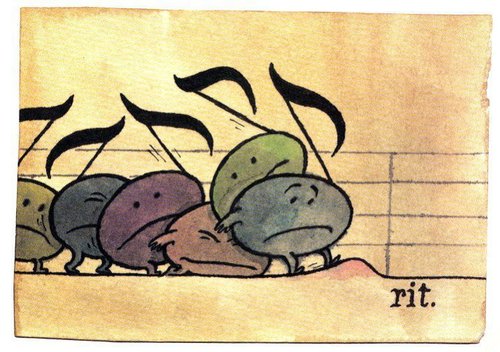
*Def: Ritardando (or rit.) an indication to gradually decrease the tempo of the music (opposite of accelerando).

via:

What's Eating You?

Bugs have always been in our houses and on our persons.

Truly, the arthropods shall inherit the earth. Or they would if they weren’t already running the show: Insects outnumber us 200 million to 1. Ants alone may account for as much as one-third of all animal biomass on earth, according to an estimate by Harvard biologist E.O. Wilson. But in the summer of 2010 bedbugs seemed to be on our minds more than usual.

New York, and therefore a large portion of American news consumers, were terrorized by bedbugs. But so what? There’s a story like that almost every summer, because reporters have less news to cover yet just as many pages and broadcast hours to fill.

So bedbugs are no big deal and you should sleep easy, America. Bedbugs are not as bad as you’ve heard. Right?

Actually, they are much worse than you have heard, says Gail Getty, a leading bedbug expert and entomologist at the University of California–Berkeley’s Urban Pest Management Center. “I don’t think people should necessarily panic at this point, but everything we know in the scientific community suggests this is going to get worse,” Getty says.

Bedbugs were a common household pest in America up through the 1930s, but after the massive DDT fumigation campaigns of the 1940s and 1950s, only small pockets of the insects remained. Their resurgence in the past decade probably has a number of causes, Getty says. The bedbugs that survived fumigations grew increasingly resistant to existing pesticides. Insect control became more targeted toward specific pests, meaning that if you call an exterminator for cockroaches, he’s just going to kill your cockroaches. Finally, bedbugs were never comparably reduced in the rest of the world, and international travel has become more common.

If these trends aren’t creepy enough, consider how bedbugs’ disturbing sex lives—which make even rape-happy otters seem like models of enlightened gender relations—influence their migration patterns.

Field of Plundered Dreams

The city of Los Angeles is emphatically out of love. In fact it is aghast – appalled, disgusted – with one of its most revered institutions, the Dodgers baseball team.

The problem is not with the team's performance. True, the Dodgers are having a stinker of a season, but the city sees only extenuating circumstances as the cause. The real problem is with their out-of-town owner, an erstwhile car park magnate from Boston called Frank McCourt, who has managed in a few short years to run the team's finances into the ground while constructing a life of unabashed luxury for himself and his fractious family.

It is not a sporting scandal so much as a financial one. Multimillion-dollar homes have been bought, refurbished and discarded, the proceeds of the deal which allowed McCourt to purchase the Dodgers; family members have been added to the payroll whether or not they work at the stadium; money and debt have been shuffled around a series of shell companies and subsidiaries, while the team – the beefy sportsmen whose job it is to thwack baseballs into the stands so that the fans keep buying tickets and beers and hot dogs – have been left almost entirely in the lurch.

Many of the story's more extraordinary details have spilled out since Frank and his wife Jamie, who served as the team's chief executive, filed for divorce a year-and-a-half ago and began to savage each other like bloodhounds in open court. Both appear to have regarded the Dodgers as the source of wildly extravagent spending. One senior team executive characterised Jamie's attitude in court as "Why have a family business, but to support the family lifestyle?"

If that sounds like a plotline from Arrested Development, the quirky TV comedy about a family of dysfunctional property developers from the LA suburbs, it is only one way in which reality is proving as strange as fiction.

Among the people found to have been on the Dodgers' payroll is a Russian-born psychic whose sole job was to watch games on his television in the Boston suburbs and send out positive vibes so that they would win more often. In years when the Dodgers made the end-of-season playoffs – which they did in 2008 and 2009 – he was promised a six-figure payoff.

Planet in a Bottle

At 8:15 am on 26 September 1991, eight “bionauts,” as they called themselves, wearing identical red Star Trek–like jumpsuits (made for them by Marilyn Monroe’s former dressmaker) waved to the assembled crowd and climbed through an airlock door in the Arizona desert. They shut it behind them and opened another that led into a series of hermetically sealed greenhouses in which they would live for the next two years. The three-acre complex of interconnected glass Mesoamerican pyramids, geodesic domes, and vaulted structures contained a tropical rain forest, a grassland savannah, a mangrove wetland, a farm, and a salt-water ocean with a wave machine and gravelly beach. This was Biosphere 2—the first biosphere being Earth—a $150 million experiment designed to see if, in a climate of nuclear and ecological fear, the colonization of space might be possible. The project was described in the press as a “planet in a bottle,” “Eden revisited,” and “Greenhouse Ark.”

Before entering, the Biosphere’s pioneer inhabitants had enjoyed a final, hearty breakfast consisting of ham, eggs, and buttered bread, but from here on, they would be self-sufficient—everything they ate would be grown, processed, and prepared in their airtight bubble. A few years before designing the Biosphere, architect Phil Hawes had proposed a space city 110 feet in diameter, a flying doughnut that would spin to create its own gravity and in which miniature animals could be kept and plants cultivated, along with a store of cryogenically frozen seed for the propagation of twenty thousand other species. The space frame of the Biosphere, a terrestrial version of such a sci-fi fantasy, had been built by an engineer who had worked with Buckminster Fuller, author of Operating Manual for Spaceship Earth, which compared the planet to a spaceship flying through the universe with finite resources that could never be resupplied. The Biosphere was intended as a similar symbol of our ecological plight.

The project caught the national imagination. Discover, the popular science magazine, declared the mission “the most exciting venture to be undertaken in the US since President Kennedy launched us towards the moon.” Tourists came by the busload to peer through the glass at the bionauts, trapped in their vivarium like laboratory rats (the project was an acknowledged precursor to the Big Brother reality-TV show). Over the first six months, 159,000 people visited, including William S. Burroughs and Timothy Leary.

Life inside the glass city was colored by its inventors’ countercultural idealism. They had all met on the Synergia Ranch, a commune they founded near Santa Fe, New Mexico, in the late 1960s and ran according to Wilhelm Reich’s idea of “work democracy”; they practiced improvisational theatre and made a fortune building developments of adobe condos, which helped pay for the Biosphere (the commune is described in Laurence Veysey’s 1971 ethnography, The Communal Experience: Anarchist and Mystical Communities in Twentieth-Century America). The Biosphere’s half-acre arable plot had been cultivated for three months in preparation for the crew’s arrival to what was supposed to be a high-tech Eden. However, the members of the chosen team lacked experience as farmers and, despite reading how-to manuals with titles such as How to Grow More Vegetables than You Ever Thought Possible on Less Land than You Can Imagine, yields were disappointing and they began to starve.

The bionauts had to perform hard physical labor to produce their food, but there was only enough for them to consume a measly 1750 calories a day, and they found it difficult to sustain such active lives. On a diet of beans, porridge, beets, carrots, and sweet potatoes, their weight plummeted and their skin began to go orange as a result of the excess beta-carotene in their diet. “It was very stressful, especially with a crew like that,” recalled Sally Silverstone, the Agriculture and Food Systems Manager, “essentially white middle-class, upper-middle-class Western individuals who had never been short of food in their whole life—it was a tremendous shock.”

Silverstone would weigh out the day’s allotment of fresh food for whoever’s turn it was to cook, entering into a computer database the amount of nutrients to check that the crew was keeping above the recommended intake levels of calories, proteins, and fats. At first the meals were served buffet style but, as the crew got hungrier, the cooks scrupulously divided their offerings into equal portions. Leaving every meal still hungry, all the bionauts could think about was food, and their memoirs of the two-year project are full of references to their recurring dreams of McDonald’s hamburgers, lobster, sushi, Snickers-bar cheesecake, lox and bagels, croissants, and whiskey. They bartered most of their possessions, but food was too precious to trade. They became sluggish and irritable through lack of it, and were driven by hunger to acts of sabotage. Bananas were stolen from the basement storeroom; the freezer had to be locked.

The medic who presided over the team’s health was Dr. Roy Walford, a professor of pathology at UCLA Medical School who had served in the Korean War and, at sixty-nine, was the oldest member of the crew. He was a gerontologist and specialist in life extension who, in studies with mice, thought that he’d successfully shown that one could live longer by eating less; his skinny mice outlived his fat ones by as much as forty percent. In his books Maximum Life Span (1983) and The 120-Year Diet (1986), Walford promised that “calorie restriction with optimal nutrition, which I call the ‘CRON-diet,’ will retard your rate of aging, extend lifespan (up to perhaps 150 to 160 years, depending on when you start and how thoroughly you hold to it), and markedly decrease susceptibility to most major diseases.”

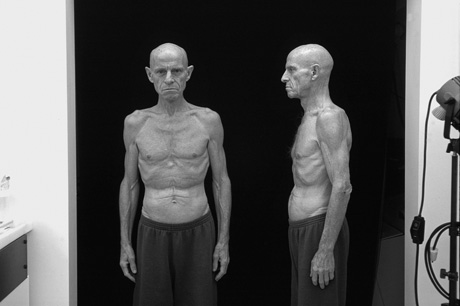
The disappointing crop yields in the Biosphere allowed Walford to experiment with his “healthy starvation diet” on humans in unprecedented laboratory conditions. While his subjects pleaded with mission control for more supplies, Walford—who had been on the CRON-diet for years—maintained that their daily calorie intake was sufficient. “I think if there had been any other nutritionist or physician, they would have freaked out and said, ‘We’re starving,’” Walford said, “but I knew we were actually on a program of health enhancement.” Every two weeks he would give them all a full medical checkup. He discovered that their blood pressure, blood sugar, and cholesterol counts did indeed drop to healthier levels—which he presumed would retard aging and extend maximal lifespan as it seemed to in mice—though an unanticipated side effect of this was that their blood was awash with the toxins that had been stored in their rapidly dissolving body fat.

Whither The Astronauts Without A Shuttle?

On July 8, the final space shuttle will take off from Cape Canaveral in Florida. With it comes the end of a 40-year program that's put more humans in space than any other.

NASA is retiring its fleet of shuttle spacecraft to build something that can take humans past the moon and into deep space. That's expected to take years, leaving astronauts with some hard choices about what to do in the meantime.

Brave, daring and working for the greater good, astronauts rank up there with firemen and the president for jobs that inspire kids and spawn scores of movie scripts. Most of us don't make it past the credits before we've abandoned our own dreams of space travel. Most of us, but not all. Not astronaut Jose Hernandez.

'You Taste It Once, And You Want To Go Back'

"I remember we used to have an old black-and-white console TV, and we would watch the moon walk," Hernandez says. "I would sit there and I would go outside, look at the moon, come back in, watch Gene Cernan walking on the moon, go back out — and I was just amazed that we had humans up on the moon a quarter-million miles away."

Hernandez grew up in a family of migrant workers from Mexico, picking everything from strawberries to lettuce. But ever since he saw those Apollo missions as a kid, he wanted to be an astronaut, and he spent most of his adult life earning engineering degrees, learning Russian, whatever he could to get on NASA's radar.

Saturday, July 2, 2011

Susan Tedeschi, Derek Trucks


Tom Waits


[ed.  Orignal lyrics, though Tom doesn't adhere to them too closely in this video.]

liar liar with your pants on fire, white spades hangin' on the telephone
wire, gamblers reevaluate along the dotted line, you'll never recognize
yourself on heartattack and vine.

doctor lawyer beggar man thief, philly joe remarkable looks on in disbelief,
if you want a taste of madness, you'll have to wait in line, you'll probably
see someone you know on heartattack and vine.

boney's high on china white, shorty found a punk, don't you know there ain't
no devil, there's just god when he's drunk, well this stuff will probably kill
you, let's do another line, what you say you meet me down on heartattack and
vine.

see that little jersey girl in the see-through top, with the peddle pushers
sucking on a soda pop, well i bet she's still a virgin but it's only twenty-
five 'til nine, you can see a million of 'em on heartattack and vine.

better off in iowa against your scrambled eggs, than crawling down cahuenga
on a broken pair of legs, you'll find your ignorance is blissful every goddamn
time, your're waitin' for the rtd on heartattack and vine.

Wonderland

Jeff Buckley


Garage Band

Slim Harpo


Fidel’s Heir

by Jon Lee Anderson

A few years ago, when Hugo ChĂĄvez, the President of Venezuela, said that he wanted a new jet to replace the nearly thirty-year-old Boeing bequeathed to him by his predecessor, his critics raised an outcry. But ChĂĄvez went ahead with his plans. His new plane, which cost sixty-five million dollars, is a gleaming white Airbus A-319, with a white leather interior, seating for sixty passengers, and a private compartment. The folding seat-back trays have gold-colored hinges, and there is plenty of legroom.

ChĂĄvez has spent more than a year altogether on trips abroad since taking office, in February, 1999, and so the jet is a kind of second home. His seat bears an embossed leather Presidential seal. Paintings of nineteenth-century Latin-American independence heroes hang on the walls, including a prominent one of SimĂłn BolĂ­var, known as El Libertador. BolĂ­var led military campaigns to free large parts of South America from Spanish rule, and in 1819 he helped create a vast nation called Gran Colombia, which encompassed the present-day republics of Venezuela, Colombia, Ecuador, and Panama. But political rivalries and internecine warfare frustrated BolĂ­var’s dream of a United States of South America, and Gran Colombia fell apart soon after his death, in 1830.

BolĂ­var is ChĂĄvez’s political muse; ChĂĄvez quotes and invokes him constantly, and is unabashed about his desire to resuscitate BolĂ­var’s dream of a united Latin America. In his first year in office, ChĂĄvez held a successful referendum to draft a new constitution, which officially renamed the country the Bolivarian Republic of Venezuela. More remarkably, he has adopted Fidel Castro as his contemporary role model and socialism as his political ideal, and, a decade and a half after the collapse of the Soviet Union, is leading a left-wing revival across Latin America. ChĂĄvez’s hemispheric ambitions have made him one of the most compelling, audacious, and polarizing figures in the world—one of a number of post-Cold War leaders trying to form regional power blocs. A generation ago, Castro sought to undermine United States authority by supporting armed guerrilla forces; ChĂĄvez has pursued that goal mainly by using money—thanks, in large measure, to U.S. oil purchases. Venezuela is the fifth-largest supplier of oil to the U. S., providing around a million barrels a day, and its proved oil reserves are among the world’s largest.

One recent Sunday, I flew with ChĂĄvez to La Faja del Orinoco, an oil-rich belt of land in eastern Venezuela. In May, 2007, ChĂĄvez ordered the nationalization of pumping and refining facilities in La Faja owned by foreign oil companies. The move was one of a series of measures that ChĂĄvez had taken to increase Venezuela’s share of oil revenues, including increases in royalty payments from 16.6 per cent to 33.3 per cent, and its ownership stake from around forty to at least sixty per cent. (As recently as 2004, these companies were paying royalties of one per cent of the oil’s value.) Most of the oil companies, including Chevron and B.P., agreed to the terms; ConocoPhillips and ExxonMobil did not, and pulled out.

Read more:

Lisa Ekdahl


Pierre Auguste Cot - The Storm (La TempĂȘte), 1880
via: