Friday, July 15, 2011

Smile, You're On Everyone's Camera

by Farhad Manjoo

According to the Wall Street Journal, police departments across the nation will soon adopt handheld facial-recognition systems that will let them identify people with a snapshot. These new capabilities are made possible by BI2 Technologies, a Massachusetts company that has developed a small device that attaches to officers' iPhones. The police departments who spoke to the Journal said they plan to use the device only when officers suspect criminal activity and have no other way to identify a person—for instance, when they stop a driver who isn't carrying her license. Law enforcement officials also seemed wary about civil liberties concerns. Is snapping someone's photo from five feet away considered a search? Courts haven't decided the issue, but sheriffs who spoke to the paper say they plan to exercise caution.

Don't believe it. Soon, face recognition will be ubiquitous. While the police may promise to tread lightly, the technology is likely to become so good, so quickly that officers will find themselves reaching for their cameras in all kinds of situations. The police will still likely use traditional ID technologies like fingerprinting—or even iris scanning—as these are generally more accurate than face-scanning, but face-scanning has an obvious advantage over fingerprints: It works from far away. Bunch of guys loitering on the corner? Scantily clad woman hanging around that run-down motel? Two dudes who look like they're smoking a funny-looking cigarette? Why not snap them all just to make sure they're on the up-and-up?

Sure, this isn't a new worry. Early in 2001, police scanned the faces of people going to the Super Bowl, and officials rolled out the technology at Logan Airport in Boston after 9/11. Those efforts raised a stink, and the authorities decided to pull back. But society has changed profoundly in the last decade, and face recognition is now set to go mainstream. What's more, the police may be the least of your worries. In the coming years—if not months—we'll see a slew of apps that allow your friends and neighbors to snap your face and get your name and other information you've put online. This isn't a theoretical worry; the technology exists, now, to do this sort of thing crudely, and the only thing stopping companies from deploying it widely is a fear of public outcry. That fear won't last long. Face recognition for everyone is coming. Get used to it.

Read more:

Thursday, July 14, 2011

via:

Why Not the Worst?

by Gene Weingarten

We promised to find the armpit of America. Turns out it's only about five inches from the heart.

My little puddle jumper begins its descent into Elko, a charmless city of 20,000 in the northern Nevada desert. Eighteen seats, all filled. This is not because Elko is a hot tourist attraction; it is because almost everyone else onboard belongs to a mariachi band. These guys have identical shiny blue suits and shiny blue shirts and shiny blue ties and shiny blue-black hair, like Rex Morgan in the comics, and they seem embarrassed to have accepted a gig in a place as tacky as Elko.

Compared with my final destination, Elko is Florence during the Italian Renaissance.

When I tell the Elko rental car agent where I am headed, she laughs. Elkonians, who proudly sponsor a yearly civic event called the "Man-Mule Race," consider their neighbor 70 miles west to be an absolute clodhoppy riot.

"Don't sneeze," snorts the rental car woman, "or you'll miss it."

Yeah, I know. I went to Battle Mountain five weeks before, to see if it was dreadful enough to be anointed, officially, "The Armpit of America." I was exorbitantly convinced.

That first visit was in late August. This second one is in early October. In the interim, Everything Changed. With the nation united in mourning and at war, with the Stars and Stripes aflutter in places large and small, slick and hicky, the idea of poking fun at any one part of us became a great deal less funny. The zeitgeist had shifted. Snide was out.

I had to go back, to rethink things.

The road to Battle Mountain is flatter than any cliche -- even pancakes have a certain doughy topology. On this route, there is nothing. No curves. No trees. It is desert, but it is lacking any desert-type beauty. No cacti. No tumbleweeds. None of those spooky cow skulls. The only flora consists of nondescript scrub that resembles acre upon acre of toilet brushes buried to the hilt.

You know you have arrived at Battle Mountain because the town has marked its identity on a nearby hill in enormous letters fashioned from whitewashed rock.

I have returned to this place to find in it not America's armpit, but America's heart. I am here to mine the good in it, to tell the world that Battle Mountain doesn't stink. That is my new challenge.

I hang a right off the highway at the base of the hill, which proudly proclaims, in giant letters:

BM

Man. This is not going to be easy.

Take a small town, remove any trace of history, character, or charm. Allow nothing with any redeeming qualities within city limits -- this includes food, motel beds, service personnel. Then place this pathetic assemblage of ghastly buildings and nasty people on a freeway in the midst of a harsh, uninviting wilderness, far enough from the nearest city to be inconvenient, but not so far for it to develop a character of its own. You now have created Battle Mountain, Nevada.

Read more:

image credit:

Hands-on with Spotify

by Donald Bell

You know something is good when it feels illegal. Such is the case with Spotify, the on-demand music-streaming service that seems too good to be true--or certainly, too good to be free. Yet, here it is, the "celestial jukebox" we've been dreaming of since the days of illegally gorging on the original Napster. It's called Spotify, it's finally available in the U.S., and music fans have reason to cheer.

What it does

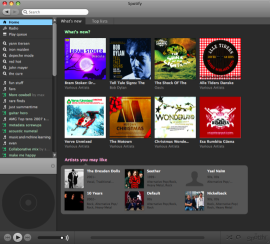
What Spotify does is so simple and seemingly harmless, it's actually a sad comment on humanity that it counts as a groundbreaking product. As a first-time user, you install the free Spotify Mac/PC application, open it up, and watch as it automatically imports your music collection and playlists from iTunes and other music software and presents you with landing page filled with new releases, top lists, and music shared by your friends. The big trick, though, is a little search box at the top of the screen that lets you search for any reasonably popular artist, song, or album in existence and stream it immediately. You can't get The Beatles, but we had no problem finding greats like The Rolling Stones and David Bowie, as well as obscure indies such as The Ghastly Ones or Four Tet.

Put simply, you tell your computer what you want to hear, and it plays it for you...for free, and without limitations for up to 60 days. It doesn't play something similar to the song you want (like Pandora), or a 30- to 60-second clip of the song you want (like iTunes)--it plays you the whole song or album, just as if it were in your personal music collection.

Of course, there are a few other bells and whistles that make Spotify its own special thing. Facebook and Twitter integration allows you to easily share music discoveries with friends. Artist pages encourage discovery with bio pages and links out to similar artists and top hits of the decade to add context. Without any friction preventing you from jumping from one great song to the next, Spotify also provides a play queue off to the side, allowing you to stash your discoveries without interrupting the currently playing song.

And let's not forget the small but not insignificant matter of style. Spotify's polished, iTunes-like interface is as inviting to music fans as a well-stocked record bin. Each portion of the bento boxlike layout can be resized, and playback, volume, and track scrubber controls are placed neatly across the bottom. Browserlike back and forward buttons located to the left of the search box allow you to dig your way back out out of the rabbit's hole of music discovery.

The catch

Spotify's music service is uniquely generous, but it's not without limitations. Using the free version of the service, full songs can be streamed on-demand an unlimited amount for up to six months (with the occasional audio ad popping into rotation, similar to Pandora). After that time, free users can only play a given track a maximum of five times per month and are also subject to a cap of 10 hours of streaming per month. If you can cough up $5 per month, those restrictions (and ads) disappear, but you're still limited to only listening from your computer. At $10 per month, you can use Spotify on mobile devices (including iOS, Android, and Windows Phone 7), and even cache your favorite music and playlists for offline listening.

Jaye P. Morgan

ERIK LAUBSCHER
Swartland No 1

via:
Prehistoric Creature by John Vincent Aranda
via:

The Make-Believer


by Katrina Onstad

Miranda July stood in her living room in the Silver Lake neighborhood of Los Angeles, apologizing for the sunflowers. It really was a copious amount of sunflowers.

They sprouted from Mason jars and vases, punctuating the austere, Shaker-like furniture in the sunny home that July, who is 37, shares with her husband, the filmmaker Mike Mills, who’s 45. Noticing me noticing the sunflowers, she interjected: “We just had a party. We don’t usually have sunflowers everywhere.”

In person, July was very still, with ringlets of curly hair falling over her wide blue eyes like a protective visor, and she seemed perceptively aware of the “precious” label that is often attached both to her and to her work. At a different point in our time together, I followed her into a hotel room in San Francisco, where Mills had left her a knitted octopus wearing a scarf and hat on the couch. She laughed when she saw it but also appeared a bit mortified: “Oh, God,” she said. “It’s kind of a joke. . . . It’s not. . . . Really, this isn’t us at all.”

At their house, Mills emerged from his office; in contrast to July’s measured composure, Mills seemed in constant motion, often running his hands through his Beethoven hair. Both he and July have directed new films being released this summer. His film, “Beginners,” is loosely based on the true story of his father’s coming out at age 75. July’s film, “The Future,” is her second feature as a director, and it’s a funny, sad portrait of a couple at a crossroads. Sophie, played by July, works at a children’s dance school, and Jason, played by Hamish Linklater, provides tech-support by telephone from their sofa. The couple is weeks away from adopting Paw-Paw, an injured cat and a symbol of impending adulthood who is also the film’s narrator. A talking cat is exactly the kind of detail that might endear people who are endeared by Miranda July and infuriate people who are infuriated by her. There are plenty of both.

“You’ve met us at a weird time,” Mills said. “We’re usually just two workaholics in our separate corners.” July and Mills first crossed paths in 2005, when July’s debut feature, “Me and You and Everyone We Know,” made its premiere at Sundance at the same time as Mills’s film “Thumbsucker.” They met at a party — “She wore a yellow dress,” he recalls — and he watched her do a Q. and A. the next day. “She was so strong and declarative. I fell in love instantly.” They married in the summer of 2009 at Mills’s house in the Nevada hills.

In one sense, July has been enjoying the Platonic ideal of creative success in the age of the hyphenate artist. She publishes short stories in The New Yorker. The seven-year Web project, “Learning to Love You More,” which she produced with Harrell Fletcher — in which more than 8,000 people submitted material in response to online assignments like “Make a protest sign and protest” and “Take a picture of your parents kissing” — was recently acquired by the San Francisco Museum of Modern Art. “You and Me and Everyone We Know” won the Camera d’Or at Cannes and was named by Roger Ebert as one of the best films of the 2000s. She inspires a devotion among her fans that is positively swoony: “I love Miranda July, and everything she does is so subtle and sweet and bizarre and necessary,” is a fairly typical sentiment. July is preoccupied with intimacy — she habitually uses the words “you” and “we” in her titles — and this demands, and inspires, an intense engagement from her followers. After a screening of “The Future” at the San Francisco Film Festival, a small crowd surrounded July, pinning her against the back wall of the movie theater, wanting to tell her, with palpable urgency, how much her work mattered to them. Her office has an entire room filled top to bottom with boxes of letters and objects from fans around the world. One man printed every e-mail he ever wrote and sent them all to July, because only she would understand.

Yet despite this (or perhaps because of it) she has also become the unwilling exemplar of an aggravating boho archetype: the dreamy, young hipster whose days are filled with coffee, curios and disposable enchantments. “Yes, in some ways Miranda July is living my dream and life, and yes, maybe I’m a little jealous,” wrote one Brooklyn-based artist on her blog. “I loathe her. It feels personal.” To her detractors (“haters” doesn’t seem like too strong a word) July has come to personify everything infuriating about the Etsy-shopping, Wes Anderson-quoting, McSweeney’s-reading, coastal-living category of upscale urban bohemia that flourished in the aughts. Her very existence is enough to inspire, for example, an I Hate Miranda July blog, which purports to detest her “insufferable precious nonsense.” Or there is the online commenter who roots for July to be exiled to Darfur. Or the blogger who yearns to beat her with a shoe.

Read more:

Always On

Millions of people around the world are carrying smartphones and computer tablets that keep them constantly connected to the Internet. There are now more than 400,000 apps in Apple's online store — and 250,000 in Google's Android market — that allow their users to do hundreds of everyday tasks, all from the comfort of their handheld devices.

Constantly having access to these hundreds of thousands of applications has far-reaching implications for our society, says technology writer Brian X. Chen.

"Millions of us are carrying these devices that have a constant Internet connection and also access to hundreds of thousands of applications of very smart interfaces tailored to suit our everyday needs," he tells Fresh Air's Dave Davies. "If you think of that phenomenon [of being constantly connected], everything has to change: the way we do policing, the way we do education, [and] the way that we might treat medicine."

In Always On: How the iPhone Unlocked the Anything-Anytime-Anywhere Future — and Locked Us In, Chen examines what it means to have an uninterrupted connection to the Internet — and how smartphone-based applications will revolutionize the way we conduct our lives on- and offline.

Some of Chen's personal favorite applications, he says, are DropBox, which allows users to transfer files between computers and mobile devices; Uber, which helps hail black cars in San Francisco; and Pocket God, a game that allows users to manipulate a virtual island full of people.

Educational Applications

Some apps, he says, are not just fun — they may alter the way we relate and learn from one another.

For example, Abilene Christian University in Texas now gives every incoming freshman an iPhone and integrates the device into the curriculum.

"Instead of lecturing students and saying, 'Hey, open your textbook and go to page 96,' the teacher is acting as a guide and saying 'OK, so here's the topic we're going to discuss today. Take out your iPhone and go search on the web or search Wikipedia and let's have a conversation about where we want to take this discussion," Chen says.

He explains that students at Abilene are being taught the importance of discerning good data from bad data — and not just to blindly accept the information that would have been presented in a textbook.

"Abilene Christian is thinking forward and teaching people how to do ... a very important skill, because there's so much bad information out there on the Web," he says. "This is something they're experimenting with, and it's been successful, because students who are part of the iPhone program are actually getting better grades than the students who are taking comparable classes without iPhones."

Medical Applications

Some applications will revolutionize the ways doctors practice medicine and the ways patients interact with their physicians, Chen says.

Researchers at the University of Washington have taken initial steps to create a digital contact lens that would monitor vital signs in real time and provide instantaneous feedback to physicians through wireless radio connections.

"What's interesting about the eye is that the eye is like the little door into the body," Chen says. "And you can collect information about, say, cholesterol or glucose levels or blood pressure and transfer this information to a smartphone."

Currently, the researchers are testing their prototype contact lens on rabbits, but they hope to eventually integrate their designs into everyday eyewear.

"I think eventually we're going to see more of these technologies embedded into our bodies," he says. "Not just our eyes but maybe our hands and our feet, just listening to our vital signs so that we can get real-time feedback and keep good track of our health."

Law Applications

Police officers and lawyers also will benefit from having mobile apps always at the ready. "Some police officers are testing an application called Morris," Chen explains. "[It] allows officers to scan fingerprints of suspects and also scan their eyeballs and cross-reference that information with the database they have back at the police station."

Morris shaves hours off of an initial booking because police no longer have to drive suspects to a station for fingerprint analysis.

"It could help them make a lot more arrests that are accurate in the future," Chen says. "There are only a few stations that are testing this application [because] it costs $30,000, so it's unlikely we're going to see it anytime soon in every police officer's hands, but it's something we're working on to reduce costs and potentially streamline law enforcement a lot."

That Explains It

via:

Wednesday, July 13, 2011

The Midas Touch


by Lewis H. Lapham

Jesus answered, “It is written, ‘Man shall not live
on bread alone, but on every word that comes from the mouth of God.’”
—The Gospel According to Matthew

It is a hard matter, my fellow citizens, to argue with the belly, since it has no ears.
—Cato the Elder

In both the periodical and tabloid press these days, the discussion tends to dwell on the bread alone—its scarcity or abundance, its price, provenance, authenticity, presentation, calorie count, social status, political agenda, and carbon footprint. The celebrity guest on camera with Rachael Ray or an Iron Chef, the missing ingredient in the recipes for five-star environmental collapse. Either way, sous vide or sans tout, the preoccupation with food is front-page news, and in line with the current set of talking points, this issue of Lapham’s Quarterly offers various proofs of the proposition that the belly has no ears.

No ears but many friends and admirers, who spread out on the following pages a cornucopia of concerns about which I knew little or nothing before setting the table of contents. My ignorance I attribute to a coming of age in the America of the late 1940s, its cows grazing on grass, the citizenry fed by farmers growing unpatented crops. Accustomed to the restrictions imposed on the country’s appetite by the Second World War’s ration books, and raised in a Protestant household that didn’t give much thought to fine dining (one ate to live, one didn’t live to eat), I acquired a laissez-faire attitude toward food that I learn from Michael Pollan resembles that of the Australian koala. The koala contents itself with the eating of eucalyptus leaves, choosing to ignore whatever else shows up in or around its tree. Similarly, the few primitive tastes met with before my tenth birthday—peanut butter and jelly, creamed chicken and rice, the Fig Newton—have remained securely in place for the last sixty-six years, faith-based and conservative, apt to be viewed with suspicion at trendsetting New York restaurants, in one of which last winter my asking about the chance of seeing a baked or mashed potato prompted the waiter to remove the menu from my hand, gently but firmly retrieving the pearl from a swine. The judgment was served à la haute bourgeoisie, with a sprig of disdain and a drizzle of disgust. Thirty years ago I would have been surprised, but thirty years ago trendsetting restaurants hadn’t yet become art galleries, obesity wasn’t a crime, and at the airports there weren’t any Homeland Security agents confiscating Coca-Cola.

Times change, and with them what, where, and how people eat. In fifteenth-century London a man could be hanged for eating meat on Friday. An ancient Roman was expected to wear a wreath to a banquet. The potato in sixteenth-century Europe was believed to cause leprosy and syphilis. As of two years ago, 19 percent of America’s meals were being eaten in cars.

Prior to the twentieth century, the changes were relatively slow in coming. The text and illustration in this issue of the Quarterly reach across a span of four thousand years, during most of which time the global economy is agrarian. Man is the tenant of nature, food the measure of both his wealth and well-being. The earliest metal currencies (the shekel, the talent, the mina) represent weights and units of grain. Allowing for cultural difference and regional availability, the human family sits down to meals made of what it finds in the forest or grows in the field, the tables set from one generation to the next in accordance with the changing of the seasons and the benevolence of Ashnan or Ceres. To Achilles and Priam circa the twelfth century bc, Homer brings the meat “pierced…with spits,” the bread “in ample wicker baskets” with the same meaning and intent that Alexandre Dumas in nineteenth-century France imparts to the ripe fruit and the rare fish presented by the Count of Monte Cristo to Monsieur Danglars.

It is the sharing of the spoils of the hunt and the harvest, a public as opposed to a private good, that sustains the existence of the earliest human societies, sows the seeds of moral value, social contract, distributive justice, and holy ground. The communal sacrifice entitles all present to a portion of the bullock or the goat and therefore to a presence in the assembly and a finger in the pie. Table manners are the teaching of both politics and philosophy, for Roman emperors as for the Renaissance scholar Desiderius Erasmus and the Confucian Chinese.

The contract between man and nature remains in force for as long as it is understood which one is the tenant and which one the landlord. Over the course of millennia men discover numerous ways of upgrading their lot—cooking with fire, domesticating animals and plants, bringing the tomato from Mexico to Spain, pepper from Sumatra to Salem, constructing the chopstick, the seine net, and the salad fork—but the world’s population stays more or less in balance with the world’s agriculture because the landlord is careful about matching supply and demand. The sum of the world’s economic enterprise is how much or how little anybody gets to eat, the number of those present above and below the salt accounting for the margin of difference between a bull and a bear market. For thousands of years the four horsemen of the apocalypse, war and famine prominent among them, attend to the culling of the human herd. Europe in the fourteenth century doesn’t produce enough food to serve the increasingly large crowd of expectant guests. The Black Death reduces by a third the number of mouths to feed.

The contract between landlord and tenant doesn’t come up for review until the seventeenth-century plantings of capitalist finance give rise to the Industrial Revolution. Man comes to imagine that he holds the deed to nature, persuaded that if soundly managed as a commercial real estate venture, the property can be made to recruit larger armies, gather more votes, yield more cash. Add to the mechanical staples (John Deere’s cast-steel plow, Cyrus McCormick’s reaper) the twentieth century’s flavorings of laboratory science (chemical pesticides, synthetic gene sequences), and food becomes an industrial product subsumed into the body of a corporation.

So at least is my understanding from what I’m told by the news media and learn from the labels at the supermarket, which isn’t much because the message wrapped in cellophane holds with the Pentagon’s policy of don’t ask, don’t tell. I rely instead on Aristotle, who draws the distinction between wealth as food and wealth as money by pointing out that the stomach, although earless, is open to instruction and subject to restraint. A man can only eat so much (1,500 pounds of food per year according to current estimates), but the craving for money is boundless—the purse, not the belly, is the void that is never filled. Paul Roberts fits Aristotle’s observation to the modern circumstance: “Food production may follow general economic principles of supply and demand; it may indeed create employment, earn trade revenues, and generate profits, sometimes considerable profits; but the underlying product—the thing we eat—has never quite conformed to the rigors of the modern industrial model.”

Read more:
via:

Having a Blast, 30 Years Later


by Claudine Zap

Thirty years ago, the first space shuttle launched into the stratosphere. Chris Bray and his father Kenneth watched -- and took a picture. Then last Friday, the shuttle Atlantis took its final trip. Again, the Bray men were there. And again, the two snapped a photo to capture the moment.

The side-by-side photos, which are up on Chris Bray's Flickr photostream, immediately went viral on the Web.

The first shot shows 13-year-old Chris with then 39-year-old dad looking through binoculars at the space shuttle Columbia's first launch on April 12, 1981, from the Kennedy Space Center.

The second snap comes three decades later and recreates the same moment at the last shuttle voyage. The young son is now an adult. His father is now gray-haired.

Chris Bray wrote on his Flickr page of the side-by-side images: "The picture we waited 30 years to complete."

The younger Bray told the Washington Post, "We've always loved that first photo. Taking a similar one for the last launch seemed like the perfect opportunity to celebrate the shuttle program and our relationship by putting the time passed in perspective, celebrating the interests we share, and illustrating the father/son bond we've maintained over the years."

The Brays' photo touched a chord of nostalgia in many rocket enthusiasts, and the pic has been viewed on Flickr an astronomical 510,000 times.

Comments on the pictures commend the melding of the personal with the historical. Says one: "Epic. To be able to share in something so wonderful with your dad, both beginning and end. I am jealous -- both that you watched not only the first but also the last mission -- but also that you did it with your father."

via:

The Ivy Delusion

Image credit: Yuta Onoda

[ed.  Interesting companion piece to the article following this one.]

by Caitlin Flanagan

Right now, in admissions offices in Cambridge and New Haven and Palo Alto, the teenage children of some of America’s most thoughtful and devoted mothers are coming in for exceptionally close scrutiny—as is, so these women feel, the parenting they have offered their youngsters for the past 18 years. This is the tail end of reading season, when our august universities must turn to what their relentless high-school visiting and U.S. News & World Report boosterism have wrought: a staggering number of requests for an absurdly small number of spots at their schools. Harvard recently announced that this year it is considering an astronomical 35,000 applications for only about 1,640 spaces in the freshman class. The great hope of today’s professional-class parents—whose offspring still make up the majority at elite colleges, no matter how much progress the institutions have made in widening the socioeconomic range of their student bodies—was that the ebbing of the so-called echo boom would save their children from the heartless winnowing. The late 1990s and the 2000s saw an uptick in the number of teenagers in America, and there was a belief, in many quarters, that the increasingly competitive nature of elite-college admissions was a by-product of that demographic fluke. But now, although the number of teens has receded, the percentage of those kids who nurture the dream of attending a selective college continues to skyrocket. And so, for this year’s most accomplished and talented high-school seniors, the reckoning is at hand.

But we were talking about the mothers—the good mothers. The good mothers went to Brown, and they read The Drama of the Gifted Child, and they feel things very deeply, and they love their children in a way that is both complicated and primal, and they will make any sacrifice for them. They know that it takes a lot of time to nurture and guide a child—and also that time is fleeting, and that the bliss of having your kids at home is painfully short-lived—and so most of them have cut back on their professional aspirations in significant ways. The good mothers have certain ideas about how success in life is achieved, and these ideas have been sizzled into their brains by popularizers such as Joseph Campbell and Oprah Winfrey, and they boil down to this: everyone has at least one natural talent (the good mothers call it a “passion”), and creativity, effortless success, and beaucoup dinero flow not from banging your head against the closed door of, say, organic chemistry if you’re not that excited by it, but from dwelling deeply and ecstatically inside the thing that gives you the most pleasure. But you shouldn’t necessarily—or under any circumstances, actually—follow your bliss in a way that keeps you out of Yale. Because Yale is important, too! So important. The good mothers believe that their children should be able to follow their passions all the way to New Haven, Connecticut, and this obdurate belief of theirs is the reason so many of them (Obama voters, Rosa Parks diorama co-creators, gay-rights supporters, champions, in every conceivable way, of racial diversity and tolerance) are suddenly ready to demand restoration of the Chinese Exclusion Act. Because Amy Chua has revealed, in so many blunt and horrifying words, why the good mothers are getting spanked, and why it’s only going to get worse.

You should know that the good mothers have been mad—and getting madder—for quite a while now. The good mothers believe that something is really wrong with the hypercompetitive world of professional-class child rearing, whose practices they have at once co-created and haplessly inherited. The good mothers e-blast each other New York Times articles about overscheduled kids and the importance of restructuring the AP curriculum so that it encourages more creative thinking. They think that the college-admissions process is “soul crushing.” One thing the good mothers love to do—something they undertake with the same “fierce urgency of now” with which my mom used to protest the Vietnam War—is organize viewings of a documentary called Race to Nowhere. Although the movie spends some time exploring the problems of lower-income students, it is most lovingly devoted to a group of neurasthenic, overworked, cracking-at-the-seams kids from a wealthy suburb in Northern California, whom we see mooning around the enormous kitchens of their McMansions and groaning about sleeplessness and stress. It posits that too much homework can give your child stomach pains, chronic anxiety, anhedonia.

Read more:

Harvard and Class

by Misha Glouberman (as told to Sheila Heti)

I grew up in Montreal and went to an upper-middle-class Jewish day school where kids had parents who maybe owned a carpet store or maybe were dentists. And then I went to Harvard for college. And it was pretty weird.

When I applied, I thought it would be great because I would get to meet lots of smart people. Those were the kinds of people I liked to be friends with, and I thought there would be more of them there. That was the main reason I thought it would be a fun place to be. I don’t think I was super ambitious or professional minded or even a very good student.

The thing I figured out soon after I applied was that, on Gilligan’s Island, it wasn’t the Professor who went to Harvard, it was Mr. Howell, the rich man. That was something of a revelation.

It’s funny, because what a lot of people talk about when they talk about going to Harvard is being really intimidated by the place when they arrive. I wasn’t at all intimidated by the place when I arrived—but I was really intimidated after graduating.

I arrived at Harvard from Montreal, which is a pretty fucking hip place to be an eighteen-year-old. I’d been going to bars for a while, and I was in a political theater company that did shows in lofts with homeless people and South American activists. And we went to pubs and got old gay men to buy us drinks. It was a pretty cool, fun, and exciting life for a kid in Montreal. It was a very vibrant place, and young people were really part of the life of the city.

Then when I went to Harvard, the place was full of these nominally smart, interesting people, all of whom at the age of eighteen seemed perfectly happy to live in dormitories and be on a meal plan and live a fully institutional life. And that was completely maddening! This was the opposite of everything I’d hoped for from the environment I’d be in.

By design, the university wants to be an enclosed institution, so you’re required to live on campus, which means that you’re not living in the city. You don’t have a landlord or neighbors or those kinds of things. You’re pretty much required to sign up for the meal plan, which means you don’t interact with people in restaurants or grocery stores or any of that kind of stuff. The drinking age is twenty-one, and it’s strictly enforced in the city but mostly unenforced on campus, which means if you want to drink or go to a party, you can only do that on campus, but if you want to go see a band at a club, you can’t do that.

I spent my first year trying to figure out how to participate in the life of the city in some way, but by the end of my first year I think I gave up because the pull of the university community was so strong and the boundaries were so hard to overcome.

By the end of university, I ended up living somewhere that was considered off campus—a place called the Dudley Co-op. The Dudley Co-op was located in a building that was owned by Harvard. About thirty or forty Harvard students lived there. We did our own cooking and cleaning, but we were on the university phone system and the university did the building maintenance. That’s how fully institutionalized life at Harvard was: even Dudley House, which was the organization that looked after off-campus living, provided university-owned accommodation for people who wanted to live off campus.

There actually was a small percentage of students who genuinely did live off campus—like 1 percent—but you had to get university permission. I think the explanation the university would give is that going to Harvard isn’t just a set of courses, it’s an experience and a community, and they’re interested in people being part of that community, which means living there and participating in what they call the “house system,” the different dorms students live in.

But the end result is that it makes the university into an ivory tower—I mean, incredibly so. It would be one thing if you were out in the woods, but this is Boston. In four years of living in that city I pretty much didn’t come to know anybody who wasn’t affiliated with Harvard. And I’m someone who’s interested in cities and who’s interested in meeting different kinds of people. The university is a completely isolated environment, and the fact that you’re inside a city somehow makes that more insidious and terrible.

All the parties were on campus. So when you went to a party—and that’s what you would do Friday and Saturday night, you would go to a party—the party would be on campus, which means, sort of implicitly, that if you’re a student at the university, you’re welcome, and if you’re not, you’re trespassing. So even at parties—and I went to parties for four years—the average number of people at a given party who weren’t Harvard students was zero. All of this serves to create a very weird, very contained environment.

When I was at university, it shocked me how focused so many people were about their careers, in ways that often seemed pretty narrow. I guess I knew that Harvard attracts very ambitious young people, but I was still surprised. In Montreal I knew a lot of really interesting people doing interesting things, and there was a lot less of that at Harvard than I would have expected. In retrospect it’s not surprising. At a certain level, an institution like that is going to attract people who are very good at playing by the rules.

Read more:

The 17th-Century Breastoration: A Time Before Bras

by Lilli Loofbourow

If you've ever been to a Renaissance Faire (I have), you know that the concept is less Queen Elizabeth and more Don Key-Ho-Tee's Medieval Potlucke WITH BREASTS. Or at least it was 10 years ago when a Ren-friend and I ate shepherd's pie, looked at chain-mail, and — once we'd soaked in enough of the Worlde and its high freckled bosoms — tried some boob-hoisting ourselves.

Putting a corset on is tough, and the instructions I received at the Faire went as follows: Lean down, shove your boobs into it, straighten up, then pop them up so they'll show through the dress. It may or may not surprise you that a) these instructions came from the amiable sales-fellow, and b) I walked around the booth with a nipple on display until my friend came out of her dressing room.

If this story has a moral, it's that cleavage-wrangling is complex. My God! I thought. How did the ladies of yore do it?

I'm finally in a position to find out. Picture it: It's the seventeenth century. Bras don't exist yet. As a typical woman, what do you do?

Option 1: Consult a Reference Work! You might turn to the Ladies' Dictionary. Published in 1694, here's the entry marked “Breasts”:

...how to make them Plump and Round: Breasts that hang loose, and are of an extraordinary largeness, lose their charms, and have their Beauty buried in the grave of uncomeliness, whilst those that are small, plump and round, like two ivory globes, or little worlds of beauty, whereon Love has founded his Empire, command an awful homage from his vassals, captivate the wondering gazer's eyes, and dart warm desires into his Soul, that make him languish and melt before the soft Temptation.

That there's your goal. Now, what to do if you're saddled with large breasts whose beauty is buried in the grave of uncomeliness? The Ladies' Dictionary is here to help.

Therefore to reduce those Breasts that hang flagging out of all comely shape and form, that they may be plump, round and smaller, bind them up close to you with caps or bags that will just fit them, and so let them continue for some nights. Then take carrot-seed, plantain-seeds, aniseeds, fennel-seeds, cumin-seeds, of each two ounces, virgin's honey an ounce, the juice of plantain and vinegar two ounces each. Bruise and mingle them well together. Then, unbinding your breast, spread the composition plaster-wise and lay it on your breasts, binding them up close as before. After two days and two nights, take off the plasters and wash your breasts with white wine and rose-water.

Got that? Basically, fashion a fitted homemade bra out of caps or bags, stuff it with seeds and honey, and marinate in the fruit of your loom for two days.

Then what?

In so doing for twelve or fourteen days together, you will find them reduced to a curious plumpness and charming roundness. Wash them then with water of Benjamin, and it will not only whiten them, but make their azure veins appear in all their intricate meanders, till the Lover in tracing them loses himself.

Whew. Right? Plastic surgeons, take note: This is what those “After” photos you wallpaper restrooms with should convey. (Minus the veins, which you will no doubt recommend cauterizing because circulation is so 1694. Oh, and get better fonts.)

Now that you have your breasts tight, round, and full of blue veins, you might notice that there's a tad too much pink in your skin tone. Tricky, this. If your complexion happens to be on the ruddy side, the Ladies' Dictionary must regrettably advise against the widespread practice of exposing your face and naked breast to the moon at night, “as if the Moon (because pale herself) would make them so, or by spitting in their Faces, scour off the Crimson dye.” This is a silly thing to do, ladies. Dew is moon-spit. It won't wash your color off, and moontanning isn't a thing. So ease up on those half-naked midnight strolls.

An Eye-Opening Adventure in Socialized Medicine

by Steve Silberman

I woke up in a rented room in London in the middle of the night, feeling like my eyes had been packed with hot sand and the lids were somehow glued together. When I pried them apart, the whites of my eyes were an angry crimson.

Maybe it was nothing. I’d been told that the pollen counts in the UK this summer are sky high. A raging heat wave in a city that doesn’t really do air-conditioning (like my gloriously fogbound town of San Francisco) didn’t seem to be helping. But when I squinted in the bathroom mirror, I saw a greenish-white discharge collecting around my tear ducts. This looked like more than a bad case of hay fever.

Then I remembered that one of the cognitive psychologists I’d come to London to interview mentioned that she’d recently had a bad eye infection. I Googled “conjunctivitis.” It dawned on me that the bottle of water I drank in her office may have been a mixed blessing.

But what to do? I was far from home with lots of work to do and no idea how to see a doctor locally. Thankfully, I didn’t have any appointments for a couple of days, and have health insurance from Kaiser-Permanente through my spouse’s employer. But I knew that getting reimbursed for treatment by a doctor outside the Kaiser network can be complex; what about an out-of-country doctor?

When I dialed the 800 number on my Kaiser card to find out what to do, an automated voice from AT&T informed me that I would be billed at the standard international calling rate of $1 a minute. After navigating a maze of call-center prompts, I sat on hold for 15 minutes.

The first Kaiser rep who took my call fired off a barrage of questions. Was I experiencing “blind spots, double vision, floaters, hallucinations, or any other problems” with my vision? Yes — the goopy discharge from my tear ducts was making it hard to see, and I said so. But that turned out to be the wrong answer. The Kaiser rep simply repeated her question in a more brittle tone of voice and added, “Just answer yes or no.”

Yes, I was having problem with my vision, but not “double vision, floaters, or hallucinations.” Judging by the structure of the question, I suspected that it was designed to fish for a different sort of problem than the one I had, such as evidence of entopic phenomena that might indicate something awry inside the eyeball, or even in the brain. I didn’t want to end up shunted onto the wrong track in the voicemail maze. “Floaters, hallucinations, and double-vision, no,” I explained, ”but problems with my vision yes, because the discharge from my tear ducts…”

“Sir,” she cut me off sternly. “These are yes or no questions. Answer either yes or no or I will not be able to help you.” I furiously tried to calculate which falsely binary oversimplifications were the right ones.

Then back to limbo at $1 a minute. Finally an advice nurse picked up. She ran me through a nearly identical gantlet of questions — hadn’t my previous answers been logged into the database? — but unlike the previous insurance rep, the advice nurse could handle nuance. Given the severity of my symptoms, she told me, I should certainly certainly see a doctor right away — as soon as I had secured permission for an out-of-network exam with someone at the member-services line on the other side of my Kaiser card.

It was 2 in the morning in a strange country and my eyes were oozing green goo, but at least I was getting somewhere. I called the other number, navigated another maze of prompts, and waited. Tick, tick, tick.

Thankfully, the member-services rep was both efficient and sympathetic. Of course, she said, it must be upsetting to be having eye problems far from home. I should definitely go to a local clinic. But before she could give me permission to do that, she would have to talk to her supervisor, because she’d never dealt with someone having a medical problem outside the country before. Several minutes passed.

Then, good news from the supervisor — with one caveat. Yes, I should go see a doctor at a local clinic. But because this was all happening out-of-network, I would have to pay out of pocket. As long as I made sure to obtain all the necessary receipts and forms, however, I could submit them when I got home, and Kaiser would “open a case file” on me so I could be reimbursed.

I wondered how much the visit would cost me up front — $200, $500, $1000? The unfavorable exchange rate had already vacuumed out my wallet, just picking up Chunky Hummus Salad wraps and “flat white” coffees at Pret A Manger. But it didn’t matter. My eyes needed help now, and I was almost certainly highly contagious; I didn’t want to pass this mess on to anyone else.

The member-services rep then explained that a Kaiser doctor would be calling me within the next four hours to give me additional information. I asked her gently if the doctor could possibly call in the morning London time, because I was already sleep-deprived and had a lot of work to do the following day. Sorry, she replied, that was just not possible. The doctor would have to call within the four-hour window allotted for my case — even if that meant the phone ringing at 5 in the morning.

Still, I was grateful to finally have permission to seek the care that I desperately needed. I called a number I found on the Web for urgent care in Marylebone, the central London neighborhood where I’d found a semi-affordable place to stay for three weeks. Amazingly, a human being picked up the phone right away — an affable guy with a disarmingly chummy accent and an empathic manner. Yes, yes, of course I should see a doctor right away. Where should they send him?

What? This guy was offering to dispatch someone to examine my eyes immediately in my apartment in the middle of the night?

I couldn’t even remember the last time I’d gotten a house call from a doctor — was it when I had chicken pox in 3rd grade? I expressed my astonishment. The chap on the other end of the line just laughed: I assure you, it’s no problem.

Read more: