Monday, August 8, 2011

Life

"When my husband died, because he was so famous and known for not being a believer, many people would come up to me-it still sometimes happens-and ask me if Carl changed at the end and converted to a belief in an afterlife. They also frequently ask me if I think I will see him again. 

Carl faced his death with unflagging courage and never sought refuge in illusions. The tragedy was that we knew we would never see each other again. I don't ever expect to be reunited with Carl. But, the great thing is that when we were together, for nearly twenty years, we lived with a vivid appreciation of how brief and precious life is. We never trivialized the meaning of death by pretending it was anything other than a final parting. Every single moment that we were alive and we were together was miraculous - not miraculous in the sense of inexplicable or supernatural. We knew we were beneficiaries of chance. . . . That pure chance could be so generous and so kind. . . . That we could find each other, as Carl wrote so beautifully in Cosmos, you know, in the vastness of space and the immensity of time. . . . That we could be together for twenty years. That is something which sustains me and it’s much more meaningful. . . . 

The way he treated me and the way I treated him, the way we took care of each other and our family, while he lived. That is so much more important than the idea I will see him someday. I don't think I'll ever see Carl again. But I saw him. We saw each other. We found each other in the cosmos, and that was wonderful."

(Ann Dryan talking about her husband, Carl Sagan)

On Bristol Bay

by John Davidson

About half the world’s supply of wild salmon comes from a system of rivers, lakes, and streams in western Alaska that empties into Bristol Bay, a relatively shallow body of water roughly 250 miles long and 180 miles wide. Every summer, 40 million sockeye salmon enter the bay in schools of hundreds of thousands and mill in the estuaries of half a dozen large rivers. In the span of about four weeks in June and July, the salmon move into the mouths of these rivers, slowly at first and then, as if responding to an invisible cue, all at once.

From the deck of a drift gillnetter on the flood tide of a clear afternoon in late June, you can look out across the water and see this happening. Four or five salmon will jump or roll simultaneously, and when you turn and scan the water you see that it’s not just a pocket here and there—salmon are jumping and splashing all around the boat, and you realize you’re sitting on perhaps half a million fish that have begun to make a push for the river.

The first time I realized this, it was terrifying. Our net spooled off the stern into the water and came alive with salmon, a quarter-mile of corkline and mesh writhing and splashing. As I watched the net sink (which nets are not supposed to do) it occurred to me that there were more fish moving under us than the entire fleet could possibly catch and that if we didn’t start bringing our gear in right away, we would be in danger of sinking. Over the next four hours we hauled 16,000 pounds of salmon on board a thirty-two foot boat, plugging the holds and bringing the waterline up to the scuppers. Later that evening, after off-loading the day’s catch, we caught another 8,000 pounds, and by the time I collapsed in my bunk early the next morning I had realized something else about Bristol Bay: it is abundant by nature, but overabundant by design.

The single largest source of wild salmon on the planet is also the world’s best-managed fishery. Bristol Bay has been carefully built up over the last forty years to become a $2 billion commercial and sport fishing industry that employs tens of thousands of people and makes up the bulk of the economy in southwest Alaska. Despite the negative feelings people often associate with commercial fishing, Bristol Bay is the epitome of a sustainable, renewable natural resource; absent a cataclysmic event or an environmental disaster, its salmon runs will keep coming in 40 million strong every summer in perpetuity.

But an environmental disaster is already in the works. About ninety miles inland, underneath river drainages and salmon streams that form a substantial part of the bay’s watershed, sits the single largest deposit of gold on the planet, the second largest deposit of copper, and a decent haul of silver and molybdenum ore. Pebble Mine, as it’s called, is thought to be worth more than $400 billion—enough to change global minerals markets and, for the mining companies that own the rights, to justify spending about $5 billion to build and operate a massive open pit mine in the middle of the Alaskan wilderness.

The mineable body of ore at Pebble is thirty times larger than the largest mine in Alaska. If built, the mine itself would be two miles long, a mile and a half wide, and about 1,700 feet deep. It would require the construction of more than 100 miles of roads and bridges, long-distance power transmission lines, pipelines for process water, pipelines for fuel, and a tailings dam 450 feet tall to contain the billions of tons of toxic mining residue the mine will produce. Any accident or earthquake (Pebble Mine sits on a fault line) will pollute Bristol Bay’s freshwater tributaries and wetlands with acid mine runoff, heavy metals, and process chemicals. Salmon spawning beds that drain into the Nushagak and Kvichak river systems, two of the bay’s largest, would be decimated by concentrated pollution of this kind. Even under what the mining industry considers to be “normal circumstances,” the risk of polluting the streams and rivers near the mine is all but certain, as evidenced by the water pollution at open pit mines like Bingham Canyon in Utah, which is comparable to what’s proposed for Pebble Mine
.
Read more:

The Beautiful Girls


It's a Bird! It's a Plane! It's...Some Dude?

They are ordinary men in extraordinary costumes, and they have risen from the ashes of our troubled republic to ensure the safety of their fellow citizens. Jon Ronson goes on patrol with Urban Avenger, Mr. Xtreme, Pitch Black, Knight Owl, Ghost, and the baddest-ass "real-life superhero" of them all, Phoenix Jones

by Jon Ronson

I am rushing to the emergency room to meet a real-life superhero called Phoenix Jones, who has fought one crime too many and is currently peeing a lot of blood. Five nights a week, Phoenix dresses in a superhero outfit of his own invention and chases car thieves and breaks up bar fights and changes the tires of stranded strangers. I've flown to Seattle to join him on patrol. I landed only a few minutes ago, at midnight on a Friday in early March, and in the arrivals lounge I phoned his friend and spokesman, Peter Tangen, who told me the news.

"Hospital?" I said. "Is he okay?"

"I don't know," said Peter. He sounded worried. "The thing you have to remember about Phoenix is that he's not impervious to pain." He paused. "You should get a taxi straight from the airport to there."

Phoenix didn't know this when he first donned the suit about a year ago, but he's one of around 200 real-life superheroes currently patrolling America's streets, looking for wrongs to right. There's DC's Guardian, in Washington, who wears a full-body stars-and-stripes outfit and wanders the troubled areas behind the Capitol building. There's RazorHawk, from Minneapolis, who was a pro wrestler for fifteen years before joining the RLSH movement. There's New York City's Dark Guardian, who specializes in chasing pot dealers out of Washington Square Park by creeping up to them, shining a light in their eyes, and yelling, "This is a drug-free park!" And there are dozens and dozens more. Few, if any, are as daring as Phoenix. Most undertake basically safe community work: helping the homeless, telling kids to stay off drugs, etc. They're regular men with jobs and families and responsibilities who somehow have enough energy at the end of the day to journey into America's neediest neighborhoods to do what they can.

Every superhero has his origin story, and as we drive from the hospital to his apartment, Phoenix tells me his. His life, he says, hasn't been a breeze. He lived for a time in a Texas orphanage, was adopted by a Seattle family around age 9, and now spends his days working with autistic kids. One night last summer, someone broke into his car. There was shattered glass on the floor, and his stepson gashed his knee on it.

"I got tired of people doing things that are morally questionable," he says. "Everyone's afraid. It just takes one person to say, 'I'm not afraid.' And I guess I'm that guy."

Read more:
Austin McCormick
via:

15 Percent of Americans Are Now on Food Stamps

foodstampsebt

Today we discovered the unemployment rate fell a paltry tenth of a percent in July, putting us at 9.1 percent, and experts weighed in on the cratering stock market. It just might be "recession 2.0." At least 45.8 million people are acutely aware of how bad things have been, because they're on food stamps.

According to a new report from the United States Department of Agriculture, almost 46 million Americans received Supplemental Nutrition Assistance Program (SNAP) benefits in May. That's  a record high, not to mention a 12 percent jump from last year at this time and a 34 percent jump from 2009. For context, this means that if you add up the residents of all 10 of America's most populous cities, you'd still need about 22 million people to get the number we've now got on SNAP.

To qualify for food stamps, a person's income can't exceed $14,088 a year, which is 130 percent of the national poverty level. That's a lot of very poor people. Unfortunately, it's easy to forget they exist when our politicians choose to take the focus off of the poor and put it instead on a game of high-stakes chicken.

foodstamps
photo via (cc) Flickr user clementine gallot

via:

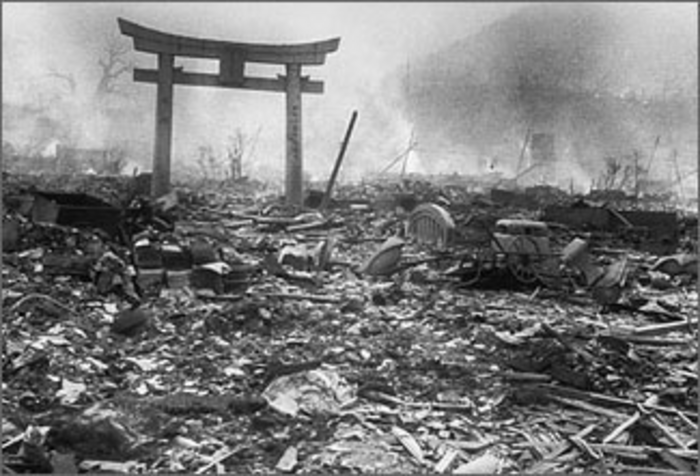
Why Did Japan Surrender?

by Gareth Cook

For nearly seven decades, the American public has accepted one version of the events that led to Japan’s surrender. By the middle of 1945, the war in Europe was over, and it was clear that the Japanese could hold no reasonable hope of victory. After years of grueling battle, fighting island to island across the Pacific, Japan’s Navy and Air Force were all but destroyed. The production of materiel was faltering, completely overmatched by American industry, and the Japanese people were starving. A full-scale invasion of Japan itself would mean hundreds of thousands of dead GIs, and, still, the Japanese leadership refused to surrender.

But in early August 66 years ago, America unveiled a terrifying new weapon, dropping atomic bombs on Hiroshima and Nagasaki. In a matter of days, the Japanese submitted, bringing the fighting, finally, to a close.

On Aug. 6, the United States marks the anniversary of the Hiroshima bombing’s mixed legacy. The leader of our democracy purposefully executed civilians on a mass scale. Yet the bombing also ended the deadliest conflict in human history.

In recent years, however, a new interpretation of events has emerged. Tsuyoshi Hasegawa - a highly respected historian at the University of California, Santa Barbara - has marshaled compelling evidence that it was the Soviet entry into the Pacific conflict, not Hiroshima and Nagasaki, that forced Japan’s surrender. His interpretation could force a new accounting of the moral meaning of the atomic attack. It also raises provocative questions about nuclear deterrence, a foundation stone of military strategy in the postwar period. And it suggests that we could be headed towards an utterly different understanding of how, and why, the Second World War came to its conclusion.

“Hasegawa has changed my mind,” says Richard Rhodes, the Pulitzer Prize-winning author of “The Making of the Atomic Bomb.” “The Japanese decision to surrender was not driven by the two bombings.”

President Truman’s decision to go nuclear has long been a source of controversy. Many, of course, have argued that attacking civilians can never be justified. Then, in the 1960s, a “revisionist school” of historians suggested that Japan was in fact close to surrendering before Hiroshima - that the bombing was not necessary, and that Truman gave the go-ahead primarily to intimidate the Soviet Union with our new power.

Hasegawa - who was born in Japan and has taught in the United States since 1990, and who reads English, Japanese, and Russian - rejects both the traditional and revisionist positions. According to his close examination of the evidence, Japan was not poised to surrender before Hiroshima, as the revisionists argued, nor was it ready to give in immediately after the atomic bomb, as traditionalists have always seen it. Instead, it took the Soviet declaration of war on Japan, several days after Hiroshima, to bring the capitulation.

Read more:

image credit:

Group Wants New Bank to Finance Infrastructure

[ed.  Good planning anticipates where money will go when it drains out of particularly vulnerable/volatile sectors.  This idea might still come around.]  

by Michael Cooper,  NY Times
March 15, 2011

Amid growing concerns that the nation’s infrastructure is deteriorating, a group of Democrats, Republicans, and labor and business leaders called Tuesday for the creation of a national infrastructure bank to help finance the construction of things like roads, bridges, water systems and power grids.

The proposal — sponsored by Senator John Kerry, Democrat of Massachusetts, and Senator Kay Bailey Hutchison, Republican of Texas — would establish an independent bank to provide loans and loan guarantees for projects of regional or national significance. The idea is to attract more infrastructure investment from the private sector: by creating an infrastructure bank with $10 billion now, they say, they could spur up to $640 billion worth of infrastructure spending over the next decade.

“We have a choice,” Mr. Kerry said at a news conference in Washington. “We can either build, and compete, and create jobs for our people, or we can fold up, and let everybody else win. I don’t think that’s America. I don’t believe anybody wants to do that.”

To underscore the need for better infrastructure, two frequent rivals were on hand at the news conference: Richard Trumka, the president of the A.F.L.-C.I.O., and Thomas J. Donohue, the president of the U.S. Chamber of Commerce, the main business lobby. With a nod to the strange-bedfellows experience of having a labor leader as an ally, Mr. Donohue said, “He and I are going to take our show on the road as the new ‘Odd Couple.’ ”

President Obama has called for establishing an infrastructure bank since his 2010 campaign. His budget calls for establishing one — and gives it the catchier name I-Bank — that would work somewhat differently: it would create a $30 billion bank that would invest in transportation projects alone, and that would provide grants as well as loans.

Read more:

Sunday, August 7, 2011

Tax Holiday

[ed.  And the hits keep coming.]

From Bloomberg:

Cisco Systems Inc. has cut its income taxes by $7 billion since 2005 by booking roughly half its worldwide profits at a subsidiary at the foot of the Swiss Alps that employs about 100 people.

Now Cisco, the largest maker of networking equipment, wants to save even more -- by asking Congress to waive most federal taxes due when multinationals bring such offshore earnings home. Chief Executive Officer John T. Chambers has led the charge for the tax holiday, which would be the second since 2004. He says it would encourage companies to “repatriate” as much as $1 trillion held abroad, spur domestic investment and create jobs.

Cisco’s techniques cut the effective tax rate on its reported international income to about 5 percent since 2008 by moving profits from roughly $20 billion in annual global sales through the Netherlands, Switzerland and Bermuda, according to its records in four countries. The maneuvers, permitted by tax law, show how companies that use such strategies most aggressively would get the biggest benefit from the holiday, said Edward D. Kleinbard, a law professor at the University of Southern California in Los Angeles.

“Why should we reward firms for successfully gaming the tax system when we in turn are called on to make up the missing tax revenues?” said Kleinbard, a former corporate tax attorney at Cleary Gottlieb Steen & Hamilton LLP. “Much of these earnings overseas are reaped from an enormous shell game: Firms move their taxable income from the U.S. and other major economies -- where their customers and key employees are in reality located -- to tax havens.”

Companies including Google Inc., Apple Inc. and Pfizer Inc. are also pushing the proposed tax holiday, which would allow profits to return to the U.S. at a discounted 5.25 percent rate. Under current law, American companies can defer federal income taxes on most overseas earnings indefinitely. When they do return to the U.S., they’re taxed at the corporate rate of 35 percent -- with credits for foreign income taxes paid. Thus, companies paying little overseas face higher U.S. tax bills upon repatriation, and would get more benefit from the discount.

From Matt Taibi:

The action revolves around a bill sponsored in May by Texas Republican Kevin Brady (and co-sponsored by Utah Democrat Jim Matheson) called the Freedom To Invest Act, which would “temporarily” lower the effective corporate tax rate to 5.25 percent for all profits being repatriated.

Essentially, this is a one-time tax holiday rewarding companies for systematically offshoring their profits since 2004 – the last time they did this “one-time” deal.

This is a company whose CEO, John Chambers, wrote an editorial last October in the Wall Street Journal predicting that the tax holiday would generate a trillion dollars in repatriated earnings, money that Chambers insisted would outdo even Barack Obama’s stimulus as a job-creation engine:
The amount of corporate cash that would come flooding into the country could be larger than the entire federal stimulus package, and it could be used for creating jobs, investing in research, building plants, purchasing equipment, and other uses.
And yet: Chambers’s company, Cisco, would not commit to creating so much as a single job if the tax holiday is passed. As it is, the company has already committed to a wave of layoffs. When asked a question about Cisco's plans w/regard to a potential tax holiday, the company’s spokesman, John Earhardt, declined to answer. From the Bloomberg piece:
It’s unclear whether any jobs would come from Cisco, which announced plans in May to shed an unspecified number of workers. Earnhardt, the spokesman, declined to comment on hiring plans for the company, whose customers include Verizon Communications Inc. and AT&T Inc.

When Data Disappears

by Kari Kraus

Last spring, the Harry Ransom Center at the University of Texas acquired the papers of Bruce Sterling, a renowned science fiction writer and futurist. But not a single floppy disk or CD-ROM was included among his notes and manuscripts. When pressed to explain why, the prophet of high-tech said digital preservation was doomed to fail. “There are forms of media which are just inherently unstable,” he said, “and the attempt to stabilize them is like the attempt to go out and stabilize the corkboard at the laundromat.”

Mr. Sterling has a point: for all its many promises, digital storage is perishable, perhaps even more so than paper. Disks corrode, bits “rot” and hardware becomes obsolete.

But that doesn’t mean digital preservation is pointless: if we’re going to save even a fraction of the trillions of bits of data churned out every year, we can’t think of digital preservation in the same way we do paper preservation. We have to stop thinking about how to save data only after it’s no longer needed, as when an author donates her papers to an archive. Instead, we must look for ways to continuously maintain and improve it. In other words, we must stop preserving digital material and start curating it.

At first glance, digital preservation seems to promise everything: nearly unlimited storage, ease of access and virtually no cost to making copies. But the practical lessons of digital preservation contradict the notion that bits are eternal. Consider those 5 1/4-inch floppies stockpiled in your basement. When you saved that unpublished manuscript on them, you figured it would be accessible forever. But when was the last time you saw a floppy drive?

And even if you could find the right drive, there’s a good chance the disk’s magnetic properties will have decayed beyond readability. The same goes, generally speaking, for CD-ROMs, DVDs and portable drives.

Even the software needed to read the bits may prove elusive. Like Egyptian hieroglyphs, whose code was indecipherable until the rediscovery of the Rosetta Stone, the string of 1s and 0s on a floppy is meaningless in the absence of a set of computer instructions for translating them. If you don’t have a copy of WordPerfect 2 around, you’re out of luck. No wonder preservationists often wax ominous about the “digital dark ages.”

Of course, there’s always the option of migrating data from old to new media. But migration isn’t as simple as copying files — it’s more like translating from Japanese to Hungarian. Information is invariably lost; do it enough times and the result will be like the garbled message at the end of a game of telephone.

Another option is emulation, in which a software program impersonates a retro hardware environment; essentially, an emulator temporarily “downgrades” a modern computer to act like an old one. But over time, emulation becomes unwieldy: because the host systems for which emulators are designed will themselves become obsolete, emulators must eventually be moved to new computer platforms — emulators to run emulators, ad infinitum.

Nor is the problem just with the medium. We generate over 1.8 zettabytes of digital information a year. By some estimates, that’s nearly 30 million times the amount of information contained in all the books ever published. Even if we had perfectly stable storage, could we ever have enough to preserve everything?

The short answer is no — but only because we’re trying to replicate the practices used for decades to maintain paper archives. In this model, preservation begins only after a record is past its use. With data, intervention needs to happen earlier, ideally at an object’s creation. And tough decisions need to be made, early on, regarding what needs to be saved. We must replace digital preservation with digital curation.

Read more:

The Little Pill That Could Cure Alcoholism

by James Medd

The Hotel Lutetia is a beautiful belle époque building in Paris's sixth arrondissement. It's a place steeped in history: Josephine Baker was a resident, and it was here that General de Gaulle spent his wedding night. It was also here, on 26 January 2000, that Dr Olivier Ameisen, first official physician to the prime minister of France under Raymond Barre, noted cardiologist at Cornell University, talented pianist and friend of both Nobel Peace Prize-winner Elie Wiesel and record producer Arif Mardin, received the Légion d'Honneur for his "contribution to the image of France abroad and to cardiology".

A proud moment in a life of excellence and achievement, you would imagine, but you'd be wrong. Sitting in the bar of the Lutetia 10 years later, Ameisen, now 56, recalls how he felt: "When Barre and all those guys were kissing my cheeks, I thought: 'Where are their brains?' I mean, when I was accepted at Cornell I looked at those guys and I thought that they were mediocre – that if those guys want me, they are idiots."
The truth was that Ameisen, for all his successes in life, was consumed with self-loathing and shame. He was a hopeless alcoholic – hopeless in the sense that, though he seemed able to achieve anything else he put his mind to, he could not stop drinking. Despite running a thriving private practice in New York, in his late thirties he had become a binge drinker and by 1997 was regularly being admitted to hospital. He tried any treatment available: tranquillisers including Valium and Xanax, antidepressants and specific alcohol medications including Antabuse and Acamprosate. He underwent acupuncture and hypnosis, took regular exercise and practised yoga. He attended cognitive behavioural therapy and up to three meetings of Alcoholics Anonymous a day. But his drinking only got worse: "The more I drank to ease my anxiety, stave off panic and counter draining insomnia, the more I had to drink for the same effect." No longer trusting himself to treat his patients responsibly, he stopped working altogether. Finally his doctors told him he had "at best" five years of life left.

It's a dramatic but not unusual story. According to the World Health Organisation, approximately two million people around the world die from the effects of alcohol each year, more than from any single form of cancer. In the UK, government figures estimate that one in 13 people is dependent on alcohol. For all the efforts of doctors, therapists, social workers and support groups, only a fraction of those addicted to alcohol manage to stop drinking and remain abstinent for a significant period.

It's not extraordinary that, despite all his efforts and his obvious intelligence and commitment, Dr Ameisen failed to overcome his addiction. What is extraordinary is that he eventually discovered a drug he claims has cured him of alcoholism and that he claims can cure all addictions, including cocaine, heroin, smoking, bulimia and anorexia, compulsive shopping and gambling. Because that is, according to all other schools of thought, simply impossible.

Read more:

What Happened to Obama?

by Drew Westen

It was a blustery day in Washington on Jan. 20, 2009, as it often seems to be on the day of a presidential inauguration. As I stood with my 8-year-old daughter, watching the president deliver his inaugural address, I had a feeling of unease. It wasn’t just that the man who could be so eloquent had seemingly chosen not to be on this auspicious occasion, although that turned out to be a troubling harbinger of things to come. It was that there was a story the American people were waiting to hear — and needed to hear — but he didn’t tell it. And in the ensuing months he continued not to tell it, no matter how outrageous the slings and arrows his opponents threw at him.

The stories our leaders tell us matter, probably almost as much as the stories our parents tell us as children, because they orient us to what is, what could be, and what should be; to the worldviews they hold and to the values they hold sacred. Our brains evolved to “expect” stories with a particular structure, with protagonists and villains, a hill to be climbed or a battle to be fought. Our species existed for more than 100,000 years before the earliest signs of literacy, and another 5,000 years would pass before the majority of humans would know how to read and write.

Stories were the primary way our ancestors transmitted knowledge and values. Today we seek movies, novels and “news stories” that put the events of the day in a form that our brains evolved to find compelling and memorable. Children crave bedtime stories; the holy books of the three great monotheistic religions are written in parables; and as research in cognitive science has shown, lawyers whose closing arguments tell a story win jury trials against their legal adversaries who just lay out “the facts of the case.”

When Barack Obama rose to the lectern on Inauguration Day, the nation was in tatters. Americans were scared and angry. The economy was spinning in reverse. Three-quarters of a million people lost their jobs that month. Many had lost their homes, and with them the only nest eggs they had. Even the usually impervious upper middle class had seen a decade of stagnant or declining investment, with the stock market dropping in value with no end in sight. Hope was as scarce as credit.

In that context, Americans needed their president to tell them a story that made sense of what they had just been through, what caused it, and how it was going to end. They needed to hear that he understood what they were feeling, that he would track down those responsible for their pain and suffering, and that he would restore order and safety. What they were waiting for, in broad strokes, was a story something like this:
“I know you’re scared and angry. Many of you have lost your jobs, your homes, your hope. This was a disaster, but it was not a natural disaster. It was made by Wall Street gamblers who speculated with your lives and futures. It was made by conservative extremists who told us that if we just eliminated regulations and rewarded greed and recklessness, it would all work out. But it didn’t work out. And it didn’t work out 80 years ago, when the same people sold our grandparents the same bill of goods, with the same results. But we learned something from our grandparents about how to fix it, and we will draw on their wisdom. We will restore business confidence the old-fashioned way: by putting money back in the pockets of working Americans by putting them back to work, and by restoring integrity to our financial markets and demanding it of those who want to run them. I can’t promise that we won’t make mistakes along the way. But I can promise you that they will be honest mistakes, and that your government has your back again.” A story isn’t a policy. But that simple narrative — and the policies that would naturally have flowed from it — would have inoculated against much of what was to come in the intervening two and a half years of failed government, idled factories and idled hands. That story would have made clear that the president understood that the American people had given Democrats the presidency and majorities in both houses of Congress to fix the mess the Republicans and Wall Street had made of the country, and that this would not be a power-sharing arrangement. It would have made clear that the problem wasn’t tax-and-spend liberalism or the deficit — a deficit that didn’t exist until George W. Bush gave nearly $2 trillion in tax breaks largely to the wealthiest Americans and squandered $1 trillion in two wars.

And perhaps most important, it would have offered a clear, compelling alternative to the dominant narrative of the right, that our problem is not due to spending on things like the pensions of firefighters, but to the fact that those who can afford to buy influence are rewriting the rules so they can cut themselves progressively larger slices of the American pie while paying less of their fair share for it.

But there was no story — and there has been none since.

In similar circumstances, Franklin D. Roosevelt offered Americans a promise to use the power of his office to make their lives better and to keep trying until he got it right. Beginning in his first inaugural address, and in the fireside chats that followed, he explained how the crash had happened, and he minced no words about those who had caused it. He promised to do something no president had done before: to use the resources of the United States to put Americans directly to work, building the infrastructure we still rely on today. He swore to keep the people who had caused the crisis out of the halls of power, and he made good on that promise. In a 1936 speech at Madison Square Garden, he thundered, “Never before in all our history have these forces been so united against one candidate as they stand today. They are unanimous in their hate for me — and I welcome their hatred.”

When Barack Obama stepped into the Oval Office, he stepped into a cycle of American history, best exemplified by F.D.R. and his distant cousin, Teddy. After a great technological revolution or a major economic transition, as when America changed from a nation of farmers to an urban industrial one, there is often a period of great concentration of wealth, and with it, a concentration of power in the wealthy. That’s what we saw in 1928, and that’s what we see today. At some point that power is exercised so injudiciously, and the lives of so many become so unbearable, that a period of reform ensues — and a charismatic reformer emerges to lead that renewal. In that sense, Teddy Roosevelt started the cycle of reform his cousin picked up 30 years later, as he began efforts to bust the trusts and regulate the railroads, exercise federal power over the banks and the nation’s food supply, and protect America’s land and wildlife, creating the modern environmental movement.

Read more:

Santana


Saturday, August 6, 2011

Why Van Halen Demanded "No Brown M&Ms"

I heard the story years ago -
In case you weren’t around during the 80s, the rock supergroup Van Halen had a clause in their concert contracts that stipulated that the band would “be provided with one large bowl of M&M candies, with all brown candies removed.”
- and like everyone else, I assumed it was a whimsical request reflective of celebrity hubris.  It wasn't until yesterday that I read about the reason for the request:
Here’s the thing, though: the band put the “no brown M&Ms” clause in their contracts for a very good reason.

Van Halen was one of the first rock bands to bring truly massive concerts to mid-size cities like Macon, Georgia. The staff that worked at concert arenas in these smallish cities were used to bands coming to town with, at most, three tractor-trailers full of equipment. Van Halen’s equipment took up 9 tractor-trailers. It was a lot of stuff, and the staff at these venues were frequently overwhelmed. And when people are overwhelmed, they make mistakes... mistakes can cause stage lights to fall from the ceiling and kill people… which is exactly what the band was afraid of.

At the heart of any major concert is the contract. Much of the text of these contracts is standard legal boilerplate, but each band may attach specific demands via something called a “rider”. Most of the contracts involving concerts at large venues are jam-packed with riders, most of which involve technical details specific to the band’s stage design. For instance, a rider might say “Article 148: There will be fifteen amperage voltage sockets at twenty-foot spaces, spaced evenly, providing nineteen amperes total, on beams suspended from the ceiling of the venue, which shall be able to support a total gross weight of 5,600 pounds each, and be suspended no less than 30 feet, but no more than 37.5 feet, above the stage surface”. Van Halen’s concert contracts would have several hundred such demands, and their contracts ended up (in lead singer David Lee Roth’s words) looking “like a Chinese Yellow Pages”.

The staff at venues in large cities were used to technically-complex shows like Van Halen’s. The band played in venues like New York’s Madison Square Garden or Atlanta’s The Omni without incident. But the band kept noticing errors (sometimes significant errors) in the stage setup in smaller cities. The band needed a way to know that their contract had been read fully. And this is where the “no brown M&Ms” came in. The band put a clause smack dab in the middle of the technical jargon of other riders: “Article 126: There will be no brown M&M’s in the backstage area, upon pain of forfeiture of the show, with full compensation”. That way, the band could simply enter the arena and look for a bowl of M&Ms in the backstage area. No brown M&Ms? Someone read the contract fully, so there were probably no major mistakes with the equipment. A bowl of M&Ms with the brown candies? No bowl of M&Ms at all? Stop everyone and check every single thing, because someone didn’t bother to read the contract.
I owe David Lee Roth and Sammy Hagar an apology.  Further history and details at jimcofer.

via: TYWKIWDBI

The $300 Million Button


"The $300 Million Button," Jared Spool's 2009 article on usability and ecommerce design, is remarkable in that it a) articulates something that anyone who shops widely online already knows; b) is advice that would make a lot of money for sites if they adopted it; c) has been part of the literature for at least two and a half years; d) is roundly ignored.

Spool is recounting the story of an unnamed large ecommerce retailer who had one of those forms that made you register before you could buy anything, and to remember your login and password before you could shop there again. Removing this form, and allowing the option of saving your details with a login and password at the end of the transaction, increased the retailer's sales by $300,000,000 in the first year.

From a commerce perspective, the Internet's glory is reduced search costs for customers. When I was making my office coffee table, I decided I wanted to source some brightly colored anodized aluminum bolts, nuts and washers. I'd never bought these before, but I assumed they existed, and I was right -- a couple searches showed me that they existed and were sold to motorcycle modders. I found a site that supplied them, and ordered sixteen of each, plus some spares. It was the first time in 39-some years I'd needed brightly colored bolts, and it may very well be that long again before I need any more.

So while this specialist bolt retailer is visible to motorcyle hobbyists and can compete for their repeat business with other specialists, they're also tapping into a market to whom they were entirely invisible until the net came along. Periodically, someone like me is going to drop in and spend some money on a one-off basis, and make windfall cash for them. There are a lot of people who, at some time in their lives, want to buy some specialized component or good. Before the Internet came along, we'd likely have just got the non-specialized equivalent. But because of the Internet, businesses all over the world are getting sales from the unlikeliest of corners. And what's more, some of those one-time only customers might discover that they actually really enjoy whatever the specialist thing is, and come back for more. It's win-win.

But the fastest way to alienate those customers and scare away that free money is to make its owner establish a relationship with you before s/he can make a purchase. In the case of the company that sold me my bolts, I was required to create a login and password, and I still get a fortnightly newsletter full of information I don't care to know about bolts (I checked all the opt-out bits, but either I missed one or they just don't pay attention to it).

Spool's research showed that a substantial portion of ecommerce users are even more sick of this stuff than I am -- $300 million/year's worth, in fact. And what's more, of the repeat customers who might have benefited from the faster checkout afforded by creating an account, 45 percent had multiple accounts in the system because they'd forgotten their logins, lost access to the email accounts they'd used, and signed up again with a new address.
Repeat customers weren't any happier. Except for a very few who remembered their login information, most stumbled on the form. They couldn't remember the email address or password they used. Remembering which email address they registered with was problematic - many had multiple email addresses or had changed them over the years.
When a shopper couldn't remember the email address and password, they'd attempt at guessing what it could be multiple times. These guesses rarely succeeded. Some would eventually ask the site to send the password to their email address, which is a problem if you can't remember which email address you initially registered with.
(Later, we did an analysis of the retailer's database, only to discover 45% of all customers had multiple registrations in the system, some as many as 10. We also analyzed how many people requested passwords, to find out it reached about 160,000 per day. 75% of these people never tried to complete the purchase once requested.)
The form, intended to make shopping easier, turned out to only help a small percentage of the customers who encountered it. (Even many of those customers weren't helped, since it took just as much effort to update any incorrect information, such as changed addresses or new credit cards.) Instead, the form just prevented sales - a lot of sales.
The $300 Million Button (via Beth Pratt)

via:

Tom Waits


Federal Court Rules Human Genes can be Patented


by Eric W. Dolan

The United States Court of Appeals for the Federal Circuit ruled in a 2 to 1 decision Friday that human genes can be patented because the DNA extracted from cells is not a product of nature.

The court held (PDF) that Myriad Genetics can patent two human genes used to predict the risk of breast and ovarian cancer in women, overturning a previous decision by a federal district court in March 2010. But the court ruled that the method used to determine a patient's risk of cancer was not patentable.

The lawsuit, Association for Molecular Pathology, et al. v. U.S. Patent and Trademark Office, et al., was filed in May 2009 on behalf of researchers, women patients, cancer survivors and scientific associations against the U.S. Patent and Trademark Office, as well as Myriad Genetics and the University of Utah Research Foundation, which hold the patents on the genes, BRCA1 and BRCA2.

The lawsuit was filed by the Public Patent Foundation and the American Civil Liberties Union, who claimed patents on human genes violate the First Amendment and patent law because genes are "products of nature."

The court disagreed.

Read more: