Sunday, September 4, 2011


The Case Against Summer
by P.J. O'Rourke
The logical argument contra summertime should be four words long: middle-age men in shorts. Q.E.D.
Alas, shorts are being worn year-round by us graying porkers with legs as ugly as stump fences—if stump fences had hairy varicose veins. But there are plenty of other things wrong with summer, starting with the fact that it comes at the wrong time of year.
 In the contiguous 48 states, the best weather isn't in June, July and August. Spring is glorious in the South. Fall is splendid in the North. And winter is swell in Florida and the part of California where the four seasons are Smog, Mudslide, Brush Fire and Oscar.
Our summer weather in 2011 consisted of tornados, heat waves, an earthquake and a hurricane. For everyone this side of Nome, summer vacation in the summer is like having a coffee break at 2 a.m.
Supposedly, summer vacation happens because that's when the kids are home from school, although having the kids home from school is no vacation. And supposedly the kids are home from school because of some vestigial throwback to our agricultural past.
This is nonsense. The little helping hands of farm children were needed during spring planting and fall harvest. (And they must have been more helpful than the little hands of today's children, or our grandparents would have died of starvation.) Farm kids, if they went to school at all, went in midsummer and midwinter, when nothing much was doing around the barn.
Summer vacation is, in fact, based on horse crap. American urbanization predated the automobile. Horses and what they leave behind them clogged cities that were already insalubrious from coal smoke, industry and notional sewage systems. Come summer, it was vacation time because—if you had any sense, common or olfactory—you vacated.
Men who could afford it sent their wives, children and, if possible, themselves off to the mountains or the shore. I live in New Hampshire, several hours from Boston, which has been full of prosperous urbanites for longer than anyplace in America. Every summer, people who use "summer" as a verb dutifully peregrinate here to the middle of nowhere and take up residence in crumbling ancestral 30-room shingle cottages, although they can't quite remember why.
And what are Americans doing taking summer vacations anyway? Our economy is a shambles. U.S. debt has been downgraded. GDP has flat-lined. The unemployment rate—with everyone on vacation—is nearing 100%. We should be in the office right now, trying to get the price of small-cap stocks up, developing new techniques of program trading, maintaining confidence in dot-com start-ups, building a fire under the housing market and generally working our tails off the way we were in the summers of 1929, 1987, 2000 and 2008.
At the very least, our elected officials should be back on the job. They left some unfinished business—such as the survival of America into the second quarter of the 21st century, etc.
Read more:
The logical argument contra summertime should be four words long: middle-age men in shorts. Q.E.D.
Alas, shorts are being worn year-round by us graying porkers with legs as ugly as stump fences—if stump fences had hairy varicose veins. But there are plenty of other things wrong with summer, starting with the fact that it comes at the wrong time of year.
 In the contiguous 48 states, the best weather isn't in June, July and August. Spring is glorious in the South. Fall is splendid in the North. And winter is swell in Florida and the part of California where the four seasons are Smog, Mudslide, Brush Fire and Oscar.
 Our summer weather in 2011 consisted of tornados, heat waves, an earthquake and a hurricane. For everyone this side of Nome, summer vacation in the summer is like having a coffee break at 2 a.m.
Supposedly, summer vacation happens because that's when the kids are home from school, although having the kids home from school is no vacation. And supposedly the kids are home from school because of some vestigial throwback to our agricultural past.
This is nonsense. The little helping hands of farm children were needed during spring planting and fall harvest. (And they must have been more helpful than the little hands of today's children, or our grandparents would have died of starvation.) Farm kids, if they went to school at all, went in midsummer and midwinter, when nothing much was doing around the barn.
Summer vacation is, in fact, based on horse crap. American urbanization predated the automobile. Horses and what they leave behind them clogged cities that were already insalubrious from coal smoke, industry and notional sewage systems. Come summer, it was vacation time because—if you had any sense, common or olfactory—you vacated.
Men who could afford it sent their wives, children and, if possible, themselves off to the mountains or the shore. I live in New Hampshire, several hours from Boston, which has been full of prosperous urbanites for longer than anyplace in America. Every summer, people who use "summer" as a verb dutifully peregrinate here to the middle of nowhere and take up residence in crumbling ancestral 30-room shingle cottages, although they can't quite remember why.
And what are Americans doing taking summer vacations anyway? Our economy is a shambles. U.S. debt has been downgraded. GDP has flat-lined. The unemployment rate—with everyone on vacation—is nearing 100%. We should be in the office right now, trying to get the price of small-cap stocks up, developing new techniques of program trading, maintaining confidence in dot-com start-ups, building a fire under the housing market and generally working our tails off the way we were in the summers of 1929, 1987, 2000 and 2008.
At the very least, our elected officials should be back on the job. They left some unfinished business—such as the survival of America into the second quarter of the 21st century, etc.
Read more:


Eating Golf Balls
[ed. Sorry golf fans, it doesn't looks like Seven Days in Utopia will be another Caddyshack or Tin Cup.]
by Roger Ebert
I would rather eat a golf ball than see this movie again. It tells the dreadful parable of a pro golfer who was abused by his dad, melts down in the Texas Open and stumbles into the clutches of an insufferable geezer in the town of Utopia (pop. 375), who promises him that after seven days in Utopia, he will be playing great golf. He will also find Jesus, but for that, you don't have to play golf, although it might help.
 The geezer is named Johnny Crawford. He is played by Robert Duvall. Only a great actor could give such a bad performance. Duvall takes the arts and skills he has perfected for decades and puts them at the service of a flim-flam man who embodies all the worst qualities of the Personal Motivation Movement. That is the movement that teaches us that if we buy a book, view some DVDs or sit for hours in the "Conference Center" of some crappy hotel, we won't be losers anymore.
How do we know we were losers? Because we were suckers for the fraud. How will we know we are winners? When we rent our own hotel rooms and fleece the innocent. The formula of the movement can be seen at work in this classified ad: Send 25¢ for the secret of how to receive lots of quarters in your mail.
"Seven Days in Utopia" stars Lucas Black as Luke Chisholm, whose father (Joseph Lyle Taylor) has browbeaten him sadistically since childhood to force him to become a pro golfer. When Luke's game blows up on the final hole of the Texas Open, the old man turns his back on him and stalks away in full view of the TV cameras. Devastated, Luke drives blindly into the night and stumbles across the town of Utopia, where he has a Meet Cute with Johnny Crawford. Johnny runs a nearby golf resort, and wouldn't you know it, will take exactly seven days to repair Luke's truck, which is how long Johnny needs to work his spells on the young man.
Read more:
by Roger Ebert
I would rather eat a golf ball than see this movie again. It tells the dreadful parable of a pro golfer who was abused by his dad, melts down in the Texas Open and stumbles into the clutches of an insufferable geezer in the town of Utopia (pop. 375), who promises him that after seven days in Utopia, he will be playing great golf. He will also find Jesus, but for that, you don't have to play golf, although it might help.
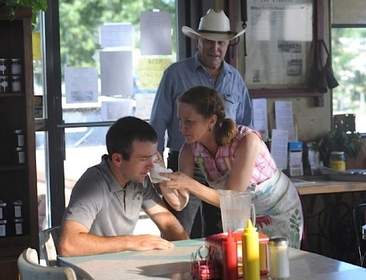 The geezer is named Johnny Crawford. He is played by Robert Duvall. Only a great actor could give such a bad performance. Duvall takes the arts and skills he has perfected for decades and puts them at the service of a flim-flam man who embodies all the worst qualities of the Personal Motivation Movement. That is the movement that teaches us that if we buy a book, view some DVDs or sit for hours in the "Conference Center" of some crappy hotel, we won't be losers anymore.
 How do we know we were losers? Because we were suckers for the fraud. How will we know we are winners? When we rent our own hotel rooms and fleece the innocent. The formula of the movement can be seen at work in this classified ad: Send 25¢ for the secret of how to receive lots of quarters in your mail.
"Seven Days in Utopia" stars Lucas Black as Luke Chisholm, whose father (Joseph Lyle Taylor) has browbeaten him sadistically since childhood to force him to become a pro golfer. When Luke's game blows up on the final hole of the Texas Open, the old man turns his back on him and stalks away in full view of the TV cameras. Devastated, Luke drives blindly into the night and stumbles across the town of Utopia, where he has a Meet Cute with Johnny Crawford. Johnny runs a nearby golf resort, and wouldn't you know it, will take exactly seven days to repair Luke's truck, which is how long Johnny needs to work his spells on the young man.
Read more:
What Is That? Let Your Smartphone Have a Look
[ed. I don't own a smartphone, but it's cool what some of these applications are beginning to be able to do.]
by Steven Leckart
I never carry a point-and-shoot camera. Chances are you don’t either. In the last few years, cellphone optics have improved substantially. That means more megapixels, better image sensors and stronger flashes and zooms on the one device most of us carry all the time.
Now comes the next phase: using your smartphone and its camera to identify what is in front of your eyes.
 Although image-recognition software is still in its infancy, a number of mobile apps are already translating signs, naming landmarks and providing a running commentary on your world.
Google Goggles, which appeared on Android phones in late 2009 and on the iPhone last year, is best at deciphering landmarks, text, book and DVD covers, artwork, logos, bar codes and wine labels. You start the app — it’s part of Google’s search app for the iPhone — and peer at the object through the camera lens. It takes a stab at identifying it.
I’ve found the app especially useful for comparison shopping. If you’re browsing through a bookstore, for instance, one quick snapshot of a book’s cover allows you to check the price on Amazon. It’s much faster than typing the title into a search bar. Same goes for photographing paintings or craft beer bottles.
Perhaps its most promising use, for tourists especially, is language translation. Goggles can scan English, French, German, Italian, Spanish and, a recent addition, Russian text.
In practice, I’ll admit I’ve had only modest success translating phrases from restaurant menus or street signs. Part of the challenge is capturing an image that’s clear enough for the software to recognize. Unless the text appears on a white background, the software’s success is diminished. But when it does work — wow. Optical character recognition is only going to get better and broader.
Asian languages pose different challenges, says Hartwig Adam, a Goggles engineer. Their alphabets consist of thousands of characters, which tend to be strung together with fewer obvious boundaries. Be wary when buying apps that say they translate Japanese or Chinese. The ones I’ve tried are not fully baked. For now, the handwritten specials posted on the walls of no-frills Chinese restaurants will remain a mystery to me.
Even Google admits Goggles is “not so good” at identifying plants. For that you want Leafsnap, a free iPhone app that supplements a traditional field guide. You photograph a leaf on a white background within the app, which then scans the silhouette. The app then cross-references it with its built-in database. For each potential match, you’re shown high-resolution images of the plant’s leaves, flowers, fruit and bark. Your location is also recorded on a map so you can build a database of your urban forest.
Developed by researchers at Columbia University, the University of Maryland and the Smithsonian Institution, Leafsnap has been downloaded 400,000 times since May. It’s easy to see why. I had a blast trying it out in San Francisco — even though the plants in the app’s database are mostly specific to the New York and Washington areas. In the next 18 months, it will expand to 750 species from 250 species found in the continental United States (excluding South Florida), says Peter Belhumeur, a Leafsnap co-founder and computer science professor at Columbia. Eventually, the app will also use your location to refine its search and improve accuracy, he said.
Goggles has other limitations. It’s not good with faces — deliberately, for privacy reasons. And when I photographed an apple using Goggles on both iPhone and Android handsets, no close matches were found. Minutes later, I tried Meal Snap, a $2.99 iPhone app meant as a tool for dieters. Not only did it correctly identify the fruit, but Meal Snap also provided an accurate caloric range (60 to 90 calories).
Even more impressive was what happened when I used the app to deconstruct a bowl of homemade chopped salad. The app correctly identified diced beets and sliced cherry tomatoes alongside broccoli in the tossed mess. That said, the app failed to spot my spinach, deli turkey, cauliflower and bits of pepperoncini. However, the calorie estimate was only off by about 100 calories; and it was actually inflated, which is O.K. if your goal is weight loss.
Read more:
by Steven Leckart
I never carry a point-and-shoot camera. Chances are you don’t either. In the last few years, cellphone optics have improved substantially. That means more megapixels, better image sensors and stronger flashes and zooms on the one device most of us carry all the time.
Now comes the next phase: using your smartphone and its camera to identify what is in front of your eyes.
Although image-recognition software is still in its infancy, a number of mobile apps are already translating signs, naming landmarks and providing a running commentary on your world. Google Goggles, which appeared on Android phones in late 2009 and on the iPhone last year, is best at deciphering landmarks, text, book and DVD covers, artwork, logos, bar codes and wine labels. You start the app — it’s part of Google’s search app for the iPhone — and peer at the object through the camera lens. It takes a stab at identifying it.
I’ve found the app especially useful for comparison shopping. If you’re browsing through a bookstore, for instance, one quick snapshot of a book’s cover allows you to check the price on Amazon. It’s much faster than typing the title into a search bar. Same goes for photographing paintings or craft beer bottles.
Perhaps its most promising use, for tourists especially, is language translation. Goggles can scan English, French, German, Italian, Spanish and, a recent addition, Russian text.
In practice, I’ll admit I’ve had only modest success translating phrases from restaurant menus or street signs. Part of the challenge is capturing an image that’s clear enough for the software to recognize. Unless the text appears on a white background, the software’s success is diminished. But when it does work — wow. Optical character recognition is only going to get better and broader.
Asian languages pose different challenges, says Hartwig Adam, a Goggles engineer. Their alphabets consist of thousands of characters, which tend to be strung together with fewer obvious boundaries. Be wary when buying apps that say they translate Japanese or Chinese. The ones I’ve tried are not fully baked. For now, the handwritten specials posted on the walls of no-frills Chinese restaurants will remain a mystery to me.
Even Google admits Goggles is “not so good” at identifying plants. For that you want Leafsnap, a free iPhone app that supplements a traditional field guide. You photograph a leaf on a white background within the app, which then scans the silhouette. The app then cross-references it with its built-in database. For each potential match, you’re shown high-resolution images of the plant’s leaves, flowers, fruit and bark. Your location is also recorded on a map so you can build a database of your urban forest.
Developed by researchers at Columbia University, the University of Maryland and the Smithsonian Institution, Leafsnap has been downloaded 400,000 times since May. It’s easy to see why. I had a blast trying it out in San Francisco — even though the plants in the app’s database are mostly specific to the New York and Washington areas. In the next 18 months, it will expand to 750 species from 250 species found in the continental United States (excluding South Florida), says Peter Belhumeur, a Leafsnap co-founder and computer science professor at Columbia. Eventually, the app will also use your location to refine its search and improve accuracy, he said.
Goggles has other limitations. It’s not good with faces — deliberately, for privacy reasons. And when I photographed an apple using Goggles on both iPhone and Android handsets, no close matches were found. Minutes later, I tried Meal Snap, a $2.99 iPhone app meant as a tool for dieters. Not only did it correctly identify the fruit, but Meal Snap also provided an accurate caloric range (60 to 90 calories).
Even more impressive was what happened when I used the app to deconstruct a bowl of homemade chopped salad. The app correctly identified diced beets and sliced cherry tomatoes alongside broccoli in the tossed mess. That said, the app failed to spot my spinach, deli turkey, cauliflower and bits of pepperoncini. However, the calorie estimate was only off by about 100 calories; and it was actually inflated, which is O.K. if your goal is weight loss.
Read more:
Saturday, September 3, 2011


Why Political Coverage is Broken
[ed. From a talk to the Austrailian media, which, it sounds like, is not much different from the U.S. media. And why should it be?]
by Jay Rosen
This talk had its origins in my appearance about a year ago on the ABC’s Lateline with Leigh Sales. We were discussing election coverage that looks at the campaign as a kind of sporting event. Every day journalists can ask, “who’s ahead” and “what is the strategy for winning?” A perspective that appeals to political reporters, I said, because it puts them “on the inside, looking at the campaign the way the operatives do.”
I then mentioned the ABC’s Sunday morning program, The Insiders. And I asked Leigh Sales if it was true that the insiders were, on that program, the journalists. She said: “That is right.” I said: “That’s remarkable.” She… well, she changed the subject. And let me add right away that Leigh Sales is one of the most intelligent journalists I have ever had the pleasure to meet.
So this is my theme tonight: how did we get to the point where it seems entirely natural for the Australian Broadcasting Corporation to describe political journalists appearing on its air as “the insiders?” Don’t you think that’s a little strange? I do. Promoting journalists as insiders in front of the outsiders, the viewers, the electorate…. this is a clue to what’s broken about political coverage in the U.S. and Australia. Here’s how I would summarize it: Things are out of alignment. Journalists are identifying with the wrong people. Therefore the kind of work they are doing is not as useful as we need it to be.
Part of the problem was identified by Lindsay Tanner in his book, Sideshow: Dumbing Down Democracy. He points out how often the Australian press reframes politics as entertainment, seizing on trivial episodes that amuse or titillate and then blowing them up until they start to seem important. I’m not going to dwell on this because Tanner has it well covered. So did my mentor in graduate school, Neil Postman, in his 1985 classic, Amusing Ourselves to Death.
From a TV programmer’s point of view the advantage of politics-as-entertainment is that the main characters, the politicians themselves, work for free! The media doesn’t have to pay them because taxpayers do. The sets are provided by the government, the plots by the party leaders, back benchers and spin doctors. Politics as problem-solving or consensus-building would be more expensive to cover. Politics as entertainment is simply a low cost alternative.
Tanner points out how the term “yarn” is often used by journalists here to describe the sort of stories they love to cover, as in: “it’s a good yarn.” A yarn used to refer to stories that were semi-fictionalized to make them more entertaining. That echo is still there, but Australian journalists don’t seem to realize this when they use the term to describe their work.
Politics presented as entertainment charges the press with a failure to treat the serious stuff seriously. And that is a valid critique. But here’s a trickier problem: even when the press is trying to be serious, to provide, say, “analysis” instead of a good yarn, it increasingly relies on an impoverished notion of politics, a cluster of bad ideas that together form the common sense of the craft in the United States, and in Australia.
I was here during the election campaign last year, and saw enough to see strong similarities between my country’s press and yours on most of the points I will raise. If I get something wrong, if I over-draw the comparison, I’m sure someone will tell me during the question period.
I’m going to concentrate on three impoverished and interrelated ideas that (I say) have too much influence in political coverage. Then I will present an alternative scheme that might improve the situation.
Three impoverished ideas:
1. Politics as an inside game.
2. The cult of savviness.
3. The production of innocence.
Politics as an inside game.
The first idea we could do without is the one I presented to Leigh Sales. When journalists define politics as a game played by the insiders, their job description becomes: find out what the insiders are doing to “win.” Reveal those tactics to the public because then the public can… well, this is where it gets dodgy. As my friend Todd Gitlin once wrote, news coverage that treats politics as an insiders’ game invites the public to become “cognoscenti of their own bamboozlement,” which is strange. Or it lavishes attention on media performances, because the insiders are supposed to be good at that: manipulating the media.
by Jay Rosen
This talk had its origins in my appearance about a year ago on the ABC’s Lateline with Leigh Sales. We were discussing election coverage that looks at the campaign as a kind of sporting event. Every day journalists can ask, “who’s ahead” and “what is the strategy for winning?” A perspective that appeals to political reporters, I said, because it puts them “on the inside, looking at the campaign the way the operatives do.”
I then mentioned the ABC’s Sunday morning program, The Insiders. And I asked Leigh Sales if it was true that the insiders were, on that program, the journalists. She said: “That is right.” I said: “That’s remarkable.” She… well, she changed the subject. And let me add right away that Leigh Sales is one of the most intelligent journalists I have ever had the pleasure to meet.
So this is my theme tonight: how did we get to the point where it seems entirely natural for the Australian Broadcasting Corporation to describe political journalists appearing on its air as “the insiders?” Don’t you think that’s a little strange? I do. Promoting journalists as insiders in front of the outsiders, the viewers, the electorate…. this is a clue to what’s broken about political coverage in the U.S. and Australia. Here’s how I would summarize it: Things are out of alignment. Journalists are identifying with the wrong people. Therefore the kind of work they are doing is not as useful as we need it to be.
Part of the problem was identified by Lindsay Tanner in his book, Sideshow: Dumbing Down Democracy. He points out how often the Australian press reframes politics as entertainment, seizing on trivial episodes that amuse or titillate and then blowing them up until they start to seem important. I’m not going to dwell on this because Tanner has it well covered. So did my mentor in graduate school, Neil Postman, in his 1985 classic, Amusing Ourselves to Death.
From a TV programmer’s point of view the advantage of politics-as-entertainment is that the main characters, the politicians themselves, work for free! The media doesn’t have to pay them because taxpayers do. The sets are provided by the government, the plots by the party leaders, back benchers and spin doctors. Politics as problem-solving or consensus-building would be more expensive to cover. Politics as entertainment is simply a low cost alternative.
Tanner points out how the term “yarn” is often used by journalists here to describe the sort of stories they love to cover, as in: “it’s a good yarn.” A yarn used to refer to stories that were semi-fictionalized to make them more entertaining. That echo is still there, but Australian journalists don’t seem to realize this when they use the term to describe their work.
Politics presented as entertainment charges the press with a failure to treat the serious stuff seriously. And that is a valid critique. But here’s a trickier problem: even when the press is trying to be serious, to provide, say, “analysis” instead of a good yarn, it increasingly relies on an impoverished notion of politics, a cluster of bad ideas that together form the common sense of the craft in the United States, and in Australia.
I was here during the election campaign last year, and saw enough to see strong similarities between my country’s press and yours on most of the points I will raise. If I get something wrong, if I over-draw the comparison, I’m sure someone will tell me during the question period.
I’m going to concentrate on three impoverished and interrelated ideas that (I say) have too much influence in political coverage. Then I will present an alternative scheme that might improve the situation.
Three impoverished ideas:
1. Politics as an inside game.
2. The cult of savviness.
3. The production of innocence.
Politics as an inside game.
The first idea we could do without is the one I presented to Leigh Sales. When journalists define politics as a game played by the insiders, their job description becomes: find out what the insiders are doing to “win.” Reveal those tactics to the public because then the public can… well, this is where it gets dodgy. As my friend Todd Gitlin once wrote, news coverage that treats politics as an insiders’ game invites the public to become “cognoscenti of their own bamboozlement,” which is strange. Or it lavishes attention on media performances, because the insiders are supposed to be good at that: manipulating the media.

Purists Gone Wild
by Timothy Egan
I reached for an Irish whiskey — two fingers, neat, as my uncle used to say in trying to teach me how to drink — just after finishing “Last Call,” Daniel Okrent’s haunting and entertaining book on Prohibition. The drink was necessary, in part, because his gallop through one of the most otherworldly episodes in American history made me shudder at the parallels to this age.
We are about to get a full immersion in that great moralistic experiment from 1919 to 1933, a generator of crime not just vast and organized, but vertically integrated from street thugs to judges. “Prohibition,” the latest story from the history factory of filmmaker Ken Burns, is set to run on PBS stations in October. It was co-directed by Lynn Novick and is a “first cousin” to the book, in Okrent’s words.
The obvious echo will be about drugs. You will hear “if only” in many variants this fall — as in, if only the most popular of illicit substances were brought out of criminal shadows to be legalized and taxed.
But the film and book are much more instructive on the political fevers of the early 21st century, particularly those aroused by monomaniacal anti-tax pressure groups and their foot soldiers, the increasingly unpopular Tea Party.
Burns has made that general comparison. “This is a story about a single-issue campaign that metastasized,” he said, when I first heard him talk about “Prohibition” last year. Initially, I didn’t see it that way. Still, after finishing Okrent’s book during a summer of insanity in Congress, I found his conclusion less of a reach.
Consider how a country with such an appetite for drink could arrive at the point where it would amend the Constitution to outlaw daily private behavior. A hundred years ago, as Okrent notes, average consumption of alcohol per adult was about 32 fifths of 80-proof liquor a year, or 520 12-ounce bottles of beer. (It is less today by about 15 percent.)
Okrent asks the obvious question a modern reader brings when trying to understand this social engineering nightmare: “How did a freedom-loving people decide to give up a private right that had been freely exercised by millions upon millions since the first European colonists arrived in the New World?”
Read more:
I reached for an Irish whiskey — two fingers, neat, as my uncle used to say in trying to teach me how to drink — just after finishing “Last Call,” Daniel Okrent’s haunting and entertaining book on Prohibition. The drink was necessary, in part, because his gallop through one of the most otherworldly episodes in American history made me shudder at the parallels to this age.
We are about to get a full immersion in that great moralistic experiment from 1919 to 1933, a generator of crime not just vast and organized, but vertically integrated from street thugs to judges. “Prohibition,” the latest story from the history factory of filmmaker Ken Burns, is set to run on PBS stations in October. It was co-directed by Lynn Novick and is a “first cousin” to the book, in Okrent’s words.
The obvious echo will be about drugs. You will hear “if only” in many variants this fall — as in, if only the most popular of illicit substances were brought out of criminal shadows to be legalized and taxed.
But the film and book are much more instructive on the political fevers of the early 21st century, particularly those aroused by monomaniacal anti-tax pressure groups and their foot soldiers, the increasingly unpopular Tea Party.
Burns has made that general comparison. “This is a story about a single-issue campaign that metastasized,” he said, when I first heard him talk about “Prohibition” last year. Initially, I didn’t see it that way. Still, after finishing Okrent’s book during a summer of insanity in Congress, I found his conclusion less of a reach.
Consider how a country with such an appetite for drink could arrive at the point where it would amend the Constitution to outlaw daily private behavior. A hundred years ago, as Okrent notes, average consumption of alcohol per adult was about 32 fifths of 80-proof liquor a year, or 520 12-ounce bottles of beer. (It is less today by about 15 percent.)
Okrent asks the obvious question a modern reader brings when trying to understand this social engineering nightmare: “How did a freedom-loving people decide to give up a private right that had been freely exercised by millions upon millions since the first European colonists arrived in the New World?”
Read more:
From Scroll to Screen

by Lev Grossman
The last time a change of this magnitude occurred was circa 1450, when Johannes Gutenberg invented movable type. But if you go back further there’s a more helpful precedent for what’s going on. Starting in the first century A.D., Western readers discarded the scroll in favor of the codex — the bound book as we know it today.
In the classical world, the scroll was the book format of choice and the state of the art in information technology. Essentially it was a long, rolled-up piece of paper or parchment. To read a scroll you gradually unrolled it, exposing a bit of the text at a time; when you were done you had to roll it back up the right way, not unlike that other obsolete medium, the VHS tape. English is still littered with words left over from the scroll age. The first page of a scroll, which listed information about where it was made, was called the “protocol.” The reason books are sometimes called volumes is that the root of “volume” is volvere, to roll: to read a scroll, you revolved it.
Scrolls were the prestige format, used for important works only: sacred texts, legal documents, history, literature. To compile a shopping list or do their algebra, citizens of the ancient world wrote on wax-covered wooden tablets using the pointy end of a stick called a stylus. Tablets were for disposable text — the stylus also had a flat end, which you used to squash and scrape the wax flat when you were done. At some point someone had the very clever idea of stringing a few tablets together in a bundle. Eventually the bundled tablets were replaced with leaves of parchment and thus, probably, was born the codex. But nobody realized what a good idea it was until a very interesting group of people with some very radical ideas adopted it for their own purposes. Nowadays those people are known as Christians, and they used the codex as a way of distributing the Bible.
-----
Right now we’re avidly road-testing a new format for the book, just as the early Christians did. Over the first quarter of this year e-book sales were up 160 percent. Print sales — codex sales — were down 9 percent. Those are big numbers. But unlike last time it’s not a clear-cut case of a superior technology displacing an inferior one. It’s more complex than that. It’s more about trade-offs.
Read more:
Friday, September 2, 2011
Jackson Browne, David Lindley
[ed. Not sure who the studio musicians are in the second video but they kill.]

Friday Book Club - A Visit From the Goon Squad
[ed. This book by Jennifer Egan won the 2011 Pulitzer prize for fiction.]
by Ron Charles
If Jennifer Egan is our reward for living through the self-conscious gimmicks and ironic claptrap of postmodernism, then it was all worthwhile. Her new novel, "A Visit From the Goon Squad," is a medley of voices -- in first, second and third person -- scrambled through time and across the globe with a 70-page PowerPoint presentation reproduced toward the end.by Ron Charles
 I know that sounds like the headache-inducing, aren't-I-brilliant tedium that sends readers running to nonfiction, but Egan uses all these stylistic and formal shenanigans to produce a deeply humane story about growing up and growing old in a culture corroded by technology and marketing. And what's best, every movement of this symphony of boomer life plays out through the modern music scene, a white-knuckle trajectory of cool, from punk to junk to whatever might lie beyond. My only complaint is that "A Visit From the Goon Squad" doesn't come with a CD.
The novel is really a collection of de-linked short stories, almost all of them triumphs of technical bravado and tender sympathy. Each relates in some way to Bennie Salazar, a teenage bass player in San Francisco who falls hard for punk groups like the Dead Kennedys and the Sleepers. He's not a particularly talented musician, but he has the passion, and he holds together a ragtag band of desperate friends who run through names: "the Crabs, the Croks, the Crimps, the Crunch, the Scrunch, the Gawks, the Gobs." They play for drinks in underground bars where the patrons throw garbage at them before storming the stage. No matter the injuries and destruction, afterward "everyone agrees the gig went well."
One of the most heartbreaking stories, "Ask Me If I Care," is told by a homely girl who hangs out with the band, adoring Bennie but settling for his pimply friend. "I understand how this is supposed to work," she says. "I'm the dog, so I get Marty." Egan's fidelity to the raw longing of adolescence scrapes away any romanticism about the ease of youth. These kids are hopelessly adrift, convinced that everyone else around them can hear the beat they can't.
A scarifying story called "Out of Body" may be the only really successful piece I've read in the second person. Tragic and headlong, this chapter about a young man who's tired of pretending accelerates like a falling weight, and the garbage dump he dives into along the East River is a graphic symbol of the putrid moral waste these kids swim through.
The book's mixed structure is a challenge but a profitable one that repeatedly places the kids' hopes and fears in ironic juxtaposition with their adult selves. It's nothing so simple as the cool kids turning into dumpy adults while the dweebs win the yuppie rat race, but as you may have noticed at the last college reunion, past performance is no guarantee of future results. Again and again in these stories, characters wonder and ask one another, What happened? How did time, that punishing goon squad, creep over us and leave us with these flabby bodies, these remote spouses, these children we love but can't reach? And why, among everything we've lost -- talent, potency, hair -- do we still retain that desperate thirst for belonging?
Read more:

Power Play
by Matt Taibbi
A power play is underway in the foreclosure arena, according to the New York Times.
On the one side is Eric Schneiderman, the New York Attorney General, who is conducting his own investigation into the era of securitizations – the practice of chopping up assets like mortgages and converting them into saleable securities – that led up to the financial crisis of 2007-2008.
On the other side is the Obama administration, the banks, and all the other state attorneys general.
This second camp has cooked up a deal that would allow the banks to walk away with just a seriously discounted fine from a generation of fraud that led to millions of people losing their homes.
The idea behind this federally-guided “settlement” is to concentrate and centralize all the legal exposure accrued by this generation of grotesque banker corruption in one place, put one single price tag on it that everyone can live with, and then stuff the details into a titanium canister before shooting it into deep space.
This is all about protecting the banks from future enforcement actions on both the civil and criminal sides. The plan is to provide year-after-year, repeat-offending banks like Bank of America with cost certainty, so that they know exactly how much they’ll have to pay in fines (trust me, it will end up being a tiny fraction of what they made off the fraudulent practices) and will also get to know for sure that there are no more criminal investigations in the pipeline.
This deal will also submarine efforts by both defrauded investors in MBS and unfairly foreclosed-upon homeowners and borrowers to obtain any kind of relief in the civil court system. The AGs initially talked about $20 billion as a settlement number, money that would “toward loan modifications and possibly counseling for homeowners,” as Gretchen Morgenson reported the other day.
The banks, however, apparently “balked” at paying that sum, and no doubt it will end up being a lesser amount when the deal is finally done.
To give you an indication of how absurdly small a number even $20 billion is relative to the sums of money the banks made unloading worthless crap subprime assets on foreigners, pension funds and other unsuspecting suckers around the world, consider this: in 2008 alone, the state pension fund of Florida, all by itself, lost more than three times that amount ($62 billion) thanks in significant part to investments in these deadly MBS.
So this deal being cooked up is the ultimate Papal indulgence. By the time that $20 billion (if it even ends up being that high) gets divvied up between all the major players, the broadest and most destructive fraud scheme in American history, one that makes the S&L crisis look like a cheap liquor store holdup, will be safely reduced to a single painful but eminently survivable one-time line item for all the major perpetrators.
But Schneiderman, who earlier this year launched an investigation into the securitization practices of Goldman, Morgan Stanley, Bank of America and other companies, is screwing up this whole arrangement. Until he lies down, the banks don’t have a deal. They need the certainty of having all 50 states and the federal government on board, or else it’s not worth paying anybody off. To quote the immortal Tony Montana, “How do I know you’re the last cop I’m gonna have to grease?” They need all the dirty cops on board, or else the whole enterprise is FUBAR.
Read more:
A power play is underway in the foreclosure arena, according to the New York Times.
On the one side is Eric Schneiderman, the New York Attorney General, who is conducting his own investigation into the era of securitizations – the practice of chopping up assets like mortgages and converting them into saleable securities – that led up to the financial crisis of 2007-2008.
On the other side is the Obama administration, the banks, and all the other state attorneys general.
This second camp has cooked up a deal that would allow the banks to walk away with just a seriously discounted fine from a generation of fraud that led to millions of people losing their homes.
The idea behind this federally-guided “settlement” is to concentrate and centralize all the legal exposure accrued by this generation of grotesque banker corruption in one place, put one single price tag on it that everyone can live with, and then stuff the details into a titanium canister before shooting it into deep space.
This is all about protecting the banks from future enforcement actions on both the civil and criminal sides. The plan is to provide year-after-year, repeat-offending banks like Bank of America with cost certainty, so that they know exactly how much they’ll have to pay in fines (trust me, it will end up being a tiny fraction of what they made off the fraudulent practices) and will also get to know for sure that there are no more criminal investigations in the pipeline.
This deal will also submarine efforts by both defrauded investors in MBS and unfairly foreclosed-upon homeowners and borrowers to obtain any kind of relief in the civil court system. The AGs initially talked about $20 billion as a settlement number, money that would “toward loan modifications and possibly counseling for homeowners,” as Gretchen Morgenson reported the other day.
The banks, however, apparently “balked” at paying that sum, and no doubt it will end up being a lesser amount when the deal is finally done.
To give you an indication of how absurdly small a number even $20 billion is relative to the sums of money the banks made unloading worthless crap subprime assets on foreigners, pension funds and other unsuspecting suckers around the world, consider this: in 2008 alone, the state pension fund of Florida, all by itself, lost more than three times that amount ($62 billion) thanks in significant part to investments in these deadly MBS.
So this deal being cooked up is the ultimate Papal indulgence. By the time that $20 billion (if it even ends up being that high) gets divvied up between all the major players, the broadest and most destructive fraud scheme in American history, one that makes the S&L crisis look like a cheap liquor store holdup, will be safely reduced to a single painful but eminently survivable one-time line item for all the major perpetrators.
But Schneiderman, who earlier this year launched an investigation into the securitization practices of Goldman, Morgan Stanley, Bank of America and other companies, is screwing up this whole arrangement. Until he lies down, the banks don’t have a deal. They need the certainty of having all 50 states and the federal government on board, or else it’s not worth paying anybody off. To quote the immortal Tony Montana, “How do I know you’re the last cop I’m gonna have to grease?” They need all the dirty cops on board, or else the whole enterprise is FUBAR.
Read more:
Who Are You and What Are You Doing Here?
Welcome and congratulations: Getting to the first day of college is a major achievement. You’re to be commended, and not just you, but the parents, grandparents, uncles, and aunts who helped get you here.
 It’s been said that raising a child effectively takes a village: Well, as you may have noticed, our American village is not in very good shape. We’ve got guns, drugs, two wars, fanatical religions, a slime-based popular culture, and some politicians who—a little restraint here—aren’t what they might be. To merely survive in this American village and to win a place in the entering class has taken a lot of grit on your part. So, yes, congratulations to all.
You now may think that you’ve about got it made. Amidst the impressive college buildings, in company with a high-powered faculty, surrounded by the best of your generation, all you need is to keep doing what you’ve done before: Work hard, get good grades, listen to your teachers, get along with the people around you, and you’ll emerge in four years as an educated young man or woman. Ready for life.
Do not believe it. It is not true. If you want to get a real education in America you’re going to have to fight—and I don’t mean just fight against the drugs and the violence and against the slime-based culture that is still going to surround you. I mean something a little more disturbing. To get an education, you’re probably going to have to fight against the institution that you find yourself in—no matter how prestigious it may be. (In fact, the more prestigious the school, the more you’ll probably have to push.) You can get a terrific education in America now—there are astonishing opportunities at almost every college—but the education will not be presented to you wrapped and bowed. To get it, you’ll need to struggle and strive, to be strong, and occasionally even to piss off some admirable people.
“Take ’em later,” he said, “you never know.”
Read more:
 It’s been said that raising a child effectively takes a village: Well, as you may have noticed, our American village is not in very good shape. We’ve got guns, drugs, two wars, fanatical religions, a slime-based popular culture, and some politicians who—a little restraint here—aren’t what they might be. To merely survive in this American village and to win a place in the entering class has taken a lot of grit on your part. So, yes, congratulations to all.
You now may think that you’ve about got it made. Amidst the impressive college buildings, in company with a high-powered faculty, surrounded by the best of your generation, all you need is to keep doing what you’ve done before: Work hard, get good grades, listen to your teachers, get along with the people around you, and you’ll emerge in four years as an educated young man or woman. Ready for life.
Do not believe it. It is not true. If you want to get a real education in America you’re going to have to fight—and I don’t mean just fight against the drugs and the violence and against the slime-based culture that is still going to surround you. I mean something a little more disturbing. To get an education, you’re probably going to have to fight against the institution that you find yourself in—no matter how prestigious it may be. (In fact, the more prestigious the school, the more you’ll probably have to push.) You can get a terrific education in America now—there are astonishing opportunities at almost every college—but the education will not be presented to you wrapped and bowed. To get it, you’ll need to struggle and strive, to be strong, and occasionally even to piss off some admirable people.
I came to college with few resources, but one of them was an understanding, however crude, of how I might use my opportunities there. This I began to develop because of my father, who had never been to college—in fact, he’d barely gotten out of high school. One night after dinner, he and I were sitting in our kitchen at 58 Clewley Road in Medford, Massachusetts, hatching plans about the rest of my life. I was about to go off to college, a feat no one in my family had accomplished in living memory. “I think I might want to be pre-law,” I told my father. I had no idea what being pre-law was. My father compressed his brow and blew twin streams of smoke, dragon-like, from his magnificent nose. “Do you want to be a lawyer?” he asked. My father had some experience with lawyers, and with policemen, too; he was not well-disposed toward either. “I’m not really sure,” I told him, “but lawyers make pretty good money, right?”
My father detonated. (That was not uncommon. My father detonated a lot.) He told me that I was going to go to college only once, and that while I was there I had better study what I wanted. He said that when rich kids went to school, they majored in the subjects that interested them, and that my younger brother Philip and I were as good as any rich kids. (We were rich kids minus the money.) Wasn’t I interested in literature? I confessed that I was. Then I had better study literature, unless I had inside information to the effect that reincarnation wasn’t just hype, and I’d be able to attend college thirty or forty times. If I had such info, pre-law would be fine, and maybe even a tour through invertebrate biology could also be tossed in. But until I had the reincarnation stuff from a solid source, I better get to work and pick out some English classes from the course catalog. “How about the science requirements?”
Read more:
Subscribe to:
Posts (Atom)