Sunday, September 18, 2011


New Relationship
by Sarah Lyall
Ireland is in the midst of a profound transformation, as rapid as it is revolutionary: it is recalibrating its relationship to the Roman Catholic Church, an institution that has permeated almost every aspect of life here for generations.
 This is still a country where abortion is against the law, where divorce became legal only in 1995, where the church runs more than 90 percent of the primary schools and where 87 percent of the population identifies itself as Catholic. But the awe, respect and fear the Vatican once commanded have given way to something new — rage, disgust and defiance — after a long series of horrific revelations about decades of abuse of children entrusted to the church’s care by a reverential populace.
While similar disclosures have tarnished the Vatican’s image in other countries, perhaps nowhere have they shaken a whole society so thoroughly or so intensely as in Ireland. And so when the normally mild-mannered prime minister, Enda Kenny, unexpectedly took the floor in Parliament this summer to criticize the church, he was giving voice not just to his own pent-up feelings, but to those of a nation.
His remarks were a ringing declaration of the supremacy of state over church, in words of outrage and indignation that had never before been used publicly by an Irish leader.
“For the first time in Ireland, a report into child sexual abuse exposed an attempt by the Holy See to frustrate an inquiry into a sovereign, democratic republic as little as three years ago, not three decades ago,” Mr. Kenny said, referring to the Cloyne Report, which detailed abuse and cover-ups by church officials in southern Ireland through 2009.
Reiterating the report’s claim that the church had encouraged bishops to ignore child-protection guidelines the bishops themselves had adopted, the prime minister attacked “the dysfunction, the disconnection, the elitism” that he said “dominate the culture of the Vatican.”
He continued: “The rape and torture of children were downplayed, or ‘managed,’ to uphold instead the primacy of the institution — its power, its standing and its reputation.” Instead of listening with humility to the heartbreaking evidence of “humiliation and betrayal,” he said, “the Vatican’s response was to parse and analyze it with the gimlet eye of a canon lawyer.”
The effect of his speech was instant and electric.
“It was a seminal moment,” said Patsy McGarry, the religious affairs correspondent for The Irish Times. “No Irish prime minister has ever talked to the Catholic Church before in this fashion. The obsequiousness of the Irish state toward the Vatican is gone. The deference is gone.”
Read more:
Ireland is in the midst of a profound transformation, as rapid as it is revolutionary: it is recalibrating its relationship to the Roman Catholic Church, an institution that has permeated almost every aspect of life here for generations.
This is still a country where abortion is against the law, where divorce became legal only in 1995, where the church runs more than 90 percent of the primary schools and where 87 percent of the population identifies itself as Catholic. But the awe, respect and fear the Vatican once commanded have given way to something new — rage, disgust and defiance — after a long series of horrific revelations about decades of abuse of children entrusted to the church’s care by a reverential populace. While similar disclosures have tarnished the Vatican’s image in other countries, perhaps nowhere have they shaken a whole society so thoroughly or so intensely as in Ireland. And so when the normally mild-mannered prime minister, Enda Kenny, unexpectedly took the floor in Parliament this summer to criticize the church, he was giving voice not just to his own pent-up feelings, but to those of a nation.
His remarks were a ringing declaration of the supremacy of state over church, in words of outrage and indignation that had never before been used publicly by an Irish leader.
“For the first time in Ireland, a report into child sexual abuse exposed an attempt by the Holy See to frustrate an inquiry into a sovereign, democratic republic as little as three years ago, not three decades ago,” Mr. Kenny said, referring to the Cloyne Report, which detailed abuse and cover-ups by church officials in southern Ireland through 2009.
Reiterating the report’s claim that the church had encouraged bishops to ignore child-protection guidelines the bishops themselves had adopted, the prime minister attacked “the dysfunction, the disconnection, the elitism” that he said “dominate the culture of the Vatican.”
He continued: “The rape and torture of children were downplayed, or ‘managed,’ to uphold instead the primacy of the institution — its power, its standing and its reputation.” Instead of listening with humility to the heartbreaking evidence of “humiliation and betrayal,” he said, “the Vatican’s response was to parse and analyze it with the gimlet eye of a canon lawyer.”
The effect of his speech was instant and electric.
“It was a seminal moment,” said Patsy McGarry, the religious affairs correspondent for The Irish Times. “No Irish prime minister has ever talked to the Catholic Church before in this fashion. The obsequiousness of the Irish state toward the Vatican is gone. The deference is gone.”
Read more:


Silvio Berlusconi Wiretaps
[ed. This reads like something out of the Onion, with a kicker by Putin at the end. Gives whole new meaning to the term "Prime" Minister.]
by Tom Kington
by Tom Kington

The wiretaps were released at the conclusion of an investigation into entrepreneur Gianpaolo Tarantini, who is accused of paying women to sleep with Berlusconi, 74, at his homes in 2008 and 2009. The Italian prime minister is not under investigation, although the wiretaps throw doubt on Berlusconi's claims that he has never paid for sex.
"They are all well provided for," Berlusconi tells Tarantini of the girls passing through his Rome residence in one of the thousands of recorded conversations released, which filled Italian newspapers on Saturday.
In another conversation, a woman named Vanessa Di Meglio sends a text from Berlusconi's residence to Tarantini at 5.52am asking "Who pays? Do we ask him or you?"
Tarantini first made the headlines through the revelations of prostitute Patrizia D'Addario, who claimed Tarantini recruited her to have sex with Berlusconi. A second scandal has erupted over Berlusconi's parties at his villa near Milan, with the prime minister on trial accused of paying underage Moroccan dancer Karima El Mahroug for sex.
The newly published wiretaps give startling insight into Berlusconi's sexual appetites. "Last night I had a queue outside the door of the bedroom… There were 11 … I only did eight because I could not do it anymore," Berlusconi told Tarantini in 2009. "Listen, all the beds are full here … this lot won't go home, even at gunpoint."
Berlusconi, who boasted to one TV showgirl that he was only "prime minister in my spare time", told Tarantini in September 2008 that he needed to reduce the flow of women since he had a "terrible week" ahead seeing Pope Benedict, Nicolas Sarkozy, Angela Merkel and Gordon Brown. Berlusconi has long insisted that his private parties are informal but elegant affairs, that extend only as far as joke telling and songs, but is revealed on the tapes as putting pressure on Tarantini and his associates to conjure up beautiful female guests.
Read more
Trust Issues
[ed. Fascinating essay on compound interest and perpetual trusts. Really.]
by Paul Collins
Hartwick College didn’t really mean to annihilate the U.S. economy. A small liberal-arts school in the Catskills, Hartwick is the kind of sleepy institution that local worthies were in the habit of founding back in the 1790s; it counts a former ambassador to Belize among its more prominent alumni, and placidly reclines in its berth as the number-174-ranked liberal-arts college in the country. But along with charming buildings and a spring-fed lake, the college once possessed a rather more unusual feature: a slumbering giant of compound interest.by Paul Collins
 With bank rates currently bottomed out, it’s hard to imagine compound interest raising anyone much of a fortune these days. A hundred-dollar account at 5 percent in simple interest doggedly adds five bucks each year: you have $105 after one year, $110 after two, and so on. With compound interest, that interest itself get rolled into the principal and earns interest atop interest: with annual compounding, after one year you have $105, after two you have $110.25. Granted, the extra quarter isn’t much; mathematically, compound interest is a pretty modest-looking exponential function.
Modest, that is, at first. Because thanks to an eccentric New York lawyer in the 1930s, this college in a corner of the Catskills inherited a thousand-year trust that would not mature until the year 2936: a gift whose accumulated compound interest, the New York Times reported in 1961, “could ultimately shatter the nation’s financial structure.” The mossy stone walls and ivy-covered brickwork of Hartwick College were a ticking time-bomb of compounding interest—a very, very slowly ticking time bomb.
One suspects they’d have rather gotten a new squash court.
The notion of a “Methuselah” trust has a long history—and as with many peculiar notions, Benjamin Franklin got there first. Upon his death in 1790, Franklin’s will contained a peculiar codicil setting aside £1,000 (about $4,550) each for the cities of Boston and Philadelphia to provide loans for apprentices to start their businesses. The money was to be invested at compound interest for one hundred years, then a portion of the fund was to be used in Boston for a trade school. For Philadelphia, he recommended using the money for “bringing, by pipes, the water of Wissahickon Creek into the town”—or perhaps “making the Schuylkill completely navigable.” The whole scheme was perfectly suited for a man who once half-jokingly proposed that, in preference “to any ordinary death” he be “immersed in a cask of Madeira wine” for later revival, as he had “a very ardent desire to see and observe the state of America a hundred years hence.”
Franklin’s plans soared beyond a mere century, though. After a portion of the funds were to be paid out for a first set of public works, the remainder was then to grow for another century—until, by Franklin’s estimate, in 1990 both cities would receive a £4,061,000 windfall from their most famous native son.
“Considering the accidents to which all human affairs and projects are subject in such a length of time,” Franklin admitted, “I have, perhaps, too much flattered myself with a vain fancy that these dispositions, if carried into execution, will be continued without interruption and have the effects proposed.”
Nonetheless, Franklin’s experiment inspired Peter Thellusson, a London merchant and a director of the Bank of England, to even dizzier heights. Thellusson had an impressive fortune of some £600,000 by his death in July 1797, worth about $68 million today. But at the reading of the old financier’s will, his reckless sons received the shock of their lives. “It is my earnest wish and desire,” he lectured them from beyond the grave, “that they will avoid ostentation, vanity, and pompous shew; as that will be the best fortune they can possess.”
It would also be almost the only fortune they’d possess. Most of the estate was to be invested at compound interest until every currently existing heir was dead, whereupon upward of £19 million would cascade onto their distant descendants. It was as if, one legal scholar marveled, Thellusson had “locked his treasure in a mausoleum and flung the key to some distant descendant yet unborn.”
His heirs did not take the news well: one took out a pistol and shot the old man’s portrait.
Read more:


The Descendants
[ed. What's not to like? Hawaii, Clooney, Alexander Payne (Sideways), and one of my favorite character actors, Robert Forster (Jackie Brown)].
by Andrew O'Hehir
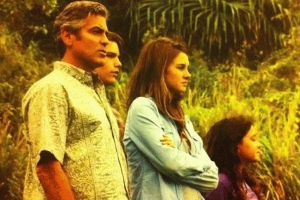 More of a muted, bittersweet Hawaiian-themed cocktail than a masterful cinematic experience, Alexander Payne's new family comedy-drama "The Descendants" clearly emerges from the Toronto International Film Festival as a leading Oscar contender. I suppose that's partly a commentary on the middling quality of this year's Toronto lineup, which features many small-scale delights but few smash hits. But it's also an endorsement of the low-key, seemingly casual charm of "The Descendants," which begins as a rambling tale about an inept father wrestling with tragedy and gradually builds toward a satisfying emotional payoff.
This is George Clooney's star vehicle this fall -- as opposed to "The Ides of March," which he directed and in which he plays a supporting role -- and this is the one that may see him collecting gold figurines during the cold-weather months. Clooney's gotten better and braver as he's aged, and no longer seems the least concerned with nurturing his personal vanity or protecting his star image. He is unquestionably the star of "The Descendants," but his character, a slightly disheveled Honolulu lawyer named Matt King who seems to view chinos and a Hawaiian shirt as formal attire, is not exactly a glamorous movie hero.
Matt faces a number of crises at once, and is ill prepared for all of them. His wife is in a coma after a serious boating accident, and his daughters, 17-year-old Alexandra (Shailene Woodley) and 10-year-old Scotty (Judy Greer) are in open rebellion against parental authority. Matt's superficially eager to seize the moment and become a better husband and father, but essentially has no idea how to manage it. Then there's the immense land trust he manages for his extended family, 25,000 pristine acres on the island of Kauai that represents the last untouched inheritance of Hawaiian royalty. (Matt and his tribe are "haoles," or white Hawaiians, but are descended from the House of Kamehameha through a great-great-grandmother.) The time to sell out to a developer, and reap an enormous payoff that will make the whole family rich, seems to have come -- but the final decision lies with Matt.
Read more:
by Andrew O'Hehir
More of a muted, bittersweet Hawaiian-themed cocktail than a masterful cinematic experience, Alexander Payne's new family comedy-drama "The Descendants" clearly emerges from the Toronto International Film Festival as a leading Oscar contender. I suppose that's partly a commentary on the middling quality of this year's Toronto lineup, which features many small-scale delights but few smash hits. But it's also an endorsement of the low-key, seemingly casual charm of "The Descendants," which begins as a rambling tale about an inept father wrestling with tragedy and gradually builds toward a satisfying emotional payoff.This is George Clooney's star vehicle this fall -- as opposed to "The Ides of March," which he directed and in which he plays a supporting role -- and this is the one that may see him collecting gold figurines during the cold-weather months. Clooney's gotten better and braver as he's aged, and no longer seems the least concerned with nurturing his personal vanity or protecting his star image. He is unquestionably the star of "The Descendants," but his character, a slightly disheveled Honolulu lawyer named Matt King who seems to view chinos and a Hawaiian shirt as formal attire, is not exactly a glamorous movie hero.
Matt faces a number of crises at once, and is ill prepared for all of them. His wife is in a coma after a serious boating accident, and his daughters, 17-year-old Alexandra (Shailene Woodley) and 10-year-old Scotty (Judy Greer) are in open rebellion against parental authority. Matt's superficially eager to seize the moment and become a better husband and father, but essentially has no idea how to manage it. Then there's the immense land trust he manages for his extended family, 25,000 pristine acres on the island of Kauai that represents the last untouched inheritance of Hawaiian royalty. (Matt and his tribe are "haoles," or white Hawaiians, but are descended from the House of Kamehameha through a great-great-grandmother.) The time to sell out to a developer, and reap an enormous payoff that will make the whole family rich, seems to have come -- but the final decision lies with Matt.
Read more:
Lights Out, Game On
by Penelope Green
Last night I slept on athletic shorts. Or more accurately, I slept on the stuff athletic shorts are made of: high-tech performance fabric, the sort of super-Lycra that goes into the uniforms of, say, basketball players.
 My sheets were, in fact, made by two former women’s college basketball coaches, Susan Walvius, 46, and Michelle Marciniak, 37, who worked together at the University of South Carolina, and liked the feeling of their athletic shorts so much that they decided to make sheets out of them.
Their sheets, which they called Sheex, would be a “performance” product, imbued with all the properties you associate with athletic gear: they would wick moisture away from your skin, stretch and breathe better than cotton, dry fast and wear long.
Indeed, Ms. Walvius and Ms. Marciniak hoped to carve out a whole “performance bedding category” by reminding folks that sleep is a fitness issue.
“I sleep hot, and I think most people do,” Ms. Walvius said by phone the other day. “But I don’t think people realize that if you sleep hot, your sleep is disrupted, and the next day you can’t perform well.”
Ten years ago, she said, “as coaches, we were cotton purists. Then we saw the whole evolution of performance fabric. Now, you don’t train in anything but performance fabric, because of the moisture wicking and the temperature management. It just helps your body function better. We thought it would be great to take this technology and apply it to bedding.”
Ms. Marciniak, who was sharing the phone with her business partner, added: “Everybody needs sleep. Whether you’re a mom or an athlete, everybody has to perform the next day. We’re making a performance home story. We want to own the consumer from 8 p.m. to 8 a.m.”
Doesn’t everyone? Sleep has always been big business. In 2010, Americans spent more than $5.8 billion on their mattresses and box springs, up 4 percent from the year before.
But as sleep studies have increasingly focused on the health risks associated with lousy sleep, from Type 2 diabetes to hypertension, obesity and a weakened immune system, the makers of so-called sleep products have begun marketing their sheets, pillows and mattresses as fitness aids, crucial gear to prep for the athletic event that is your life.
It looks like a bed, but it feels like a sneaker.
------
“The race to control the bedroom is the great game in retail,” said Marian Salzman, a trend spotter and chief executive for public relations operations of Euro RSCG Worldwide PR, North America.
And beyond the so-called science, the notion of selling bedding products as athletic gear seems intuitive, tapping as it does into the American competitive spirit.
“We are hyper-competitive, even when it comes to stress and relaxation,” Ms. Salzman wrote recently in an e-mail, still at work at 9 p.m. “And we want to amp up our lives, to ensure we have and enjoy the very best, better than others. Thus, who wouldn’t spring for a few extra bucks for a better, more sporty sleep?”
Read more:
Last night I slept on athletic shorts. Or more accurately, I slept on the stuff athletic shorts are made of: high-tech performance fabric, the sort of super-Lycra that goes into the uniforms of, say, basketball players.
 My sheets were, in fact, made by two former women’s college basketball coaches, Susan Walvius, 46, and Michelle Marciniak, 37, who worked together at the University of South Carolina, and liked the feeling of their athletic shorts so much that they decided to make sheets out of them.
 Their sheets, which they called Sheex, would be a “performance” product, imbued with all the properties you associate with athletic gear: they would wick moisture away from your skin, stretch and breathe better than cotton, dry fast and wear long.
Indeed, Ms. Walvius and Ms. Marciniak hoped to carve out a whole “performance bedding category” by reminding folks that sleep is a fitness issue.
“I sleep hot, and I think most people do,” Ms. Walvius said by phone the other day. “But I don’t think people realize that if you sleep hot, your sleep is disrupted, and the next day you can’t perform well.”
Ten years ago, she said, “as coaches, we were cotton purists. Then we saw the whole evolution of performance fabric. Now, you don’t train in anything but performance fabric, because of the moisture wicking and the temperature management. It just helps your body function better. We thought it would be great to take this technology and apply it to bedding.”
Ms. Marciniak, who was sharing the phone with her business partner, added: “Everybody needs sleep. Whether you’re a mom or an athlete, everybody has to perform the next day. We’re making a performance home story. We want to own the consumer from 8 p.m. to 8 a.m.”
Doesn’t everyone? Sleep has always been big business. In 2010, Americans spent more than $5.8 billion on their mattresses and box springs, up 4 percent from the year before.
But as sleep studies have increasingly focused on the health risks associated with lousy sleep, from Type 2 diabetes to hypertension, obesity and a weakened immune system, the makers of so-called sleep products have begun marketing their sheets, pillows and mattresses as fitness aids, crucial gear to prep for the athletic event that is your life.
It looks like a bed, but it feels like a sneaker.
------
“The race to control the bedroom is the great game in retail,” said Marian Salzman, a trend spotter and chief executive for public relations operations of Euro RSCG Worldwide PR, North America.
And beyond the so-called science, the notion of selling bedding products as athletic gear seems intuitive, tapping as it does into the American competitive spirit.
“We are hyper-competitive, even when it comes to stress and relaxation,” Ms. Salzman wrote recently in an e-mail, still at work at 9 p.m. “And we want to amp up our lives, to ensure we have and enjoy the very best, better than others. Thus, who wouldn’t spring for a few extra bucks for a better, more sporty sleep?”
Read more:
Saturday, September 17, 2011


The Style Invitational
From Wikipedia:
The Style Invitational, or Invite, is a long-running humor contest that ran first in the Style section of the Sunday Washington Post before moving to Saturday's Style and later returning to the Sunday paper. Started in 1993, it has run weekly, except for a hiatus in late 1999. In that time, it has had two anonymous head judges who select winning entries: "The Czar" and "The Empress." The Czar abdicated in late 2003, leaving the contest in the hands of his former associate, The Empress. The humor ranges from an intellectual vein to a less mature style, and frequently touches on sophisticated political or historical allusions. While the contest theme changes every week, some popular contests are periodically repeated. The S.I. has a loyal following of self-proclaimed "Losers," who refer to having a contest entry published as "getting ink".
The Style Invitational kicked off in March 1993 by asking readers to come up with a less offensive name for the Washington Redskins. The winner, published two weeks later, was Douglas R. Miller, with the entry "The Baltimore Redskins. No, don't move the team, just let Baltimore deal with it." He won a Timex watch like the one President Bill Clinton wore at the time, and apparently never entered again, as he wanted to retire undefeated. The second week's contest was to replace the state of Maryland's slogan "Manly deeds, Womanly words" and yielded up such responses as "Maryland - Home to its residents" and winner "Maryland - Wait! We can explain!" by Oslo. He won an as yet unpurchased large kitschy crab sculpture/decoration, but traded it for a Timex watch like the one President Bill Clinton wore at the time. Another early contest asked entrants to help choose a better nickname for Washington, D.C., to replace "A Capital City". Exemplifying the S.I.'s irreverence, the winning entry was "A Work-Free Drug Place".
-----
Some timeless classics:
1. Her face was a perfect oval, like a circle that had its two sides
gently compressed by a Thigh Master.
2. His thoughts tumbled in his head, making and breaking alliances like
underpants in a dryer without Cling Free.
3. He spoke with the wisdom that can only come from experience, like a guy
who went blind because he looked at a solar eclipse without one of those
boxes with a pinhole in it and now goes around the country speaking at
high schools about the dangers of looking at a solar eclipse without one
of those boxes with a pinhole in it.
4. She grew on him like she was a colony of E. Coli, and he was room-
temperature Canadian beef.
5. She had a deep, throaty, genuine laugh! , like that sound a dog makes
just before it throws up.
6. Her vocabulary was as bad as, like, whatever.
7. He was as tall as a six-foot, three-inch tree.
8. The revelation that his marriage of 30 years had disintegrated because
of his wife's infidelity came as a rude shock, like a surcharge at a
formerly surcharge-free ATM machine.
9. The little boat gently drifted across the pond exactly the way a
bowling ball wouldn't.
10. McBride fell 12 stories, hitting the pavement like a Hefty bag filled
with vegetable soup.
11. From the attic came an unearthly howl. The whole scene had an eerie,
surreal quality, like when you're on vacation in another city and Jeopardy
comes on at 7:00 p.m. Instead of 7:30
12. Her hair glistened in the rain like a nose hair
after a sneeze.
The Style Invitational, or Invite, is a long-running humor contest that ran first in the Style section of the Sunday Washington Post before moving to Saturday's Style and later returning to the Sunday paper. Started in 1993, it has run weekly, except for a hiatus in late 1999. In that time, it has had two anonymous head judges who select winning entries: "The Czar" and "The Empress." The Czar abdicated in late 2003, leaving the contest in the hands of his former associate, The Empress. The humor ranges from an intellectual vein to a less mature style, and frequently touches on sophisticated political or historical allusions. While the contest theme changes every week, some popular contests are periodically repeated. The S.I. has a loyal following of self-proclaimed "Losers," who refer to having a contest entry published as "getting ink".
The Style Invitational kicked off in March 1993 by asking readers to come up with a less offensive name for the Washington Redskins. The winner, published two weeks later, was Douglas R. Miller, with the entry "The Baltimore Redskins. No, don't move the team, just let Baltimore deal with it." He won a Timex watch like the one President Bill Clinton wore at the time, and apparently never entered again, as he wanted to retire undefeated. The second week's contest was to replace the state of Maryland's slogan "Manly deeds, Womanly words" and yielded up such responses as "Maryland - Home to its residents" and winner "Maryland - Wait! We can explain!" by Oslo. He won an as yet unpurchased large kitschy crab sculpture/decoration, but traded it for a Timex watch like the one President Bill Clinton wore at the time. Another early contest asked entrants to help choose a better nickname for Washington, D.C., to replace "A Capital City". Exemplifying the S.I.'s irreverence, the winning entry was "A Work-Free Drug Place".
-----
Some timeless classics:
1. Her face was a perfect oval, like a circle that had its two sides
gently compressed by a Thigh Master.
2. His thoughts tumbled in his head, making and breaking alliances like
underpants in a dryer without Cling Free.
3. He spoke with the wisdom that can only come from experience, like a guy
who went blind because he looked at a solar eclipse without one of those
boxes with a pinhole in it and now goes around the country speaking at
high schools about the dangers of looking at a solar eclipse without one
of those boxes with a pinhole in it.
4. She grew on him like she was a colony of E. Coli, and he was room-
temperature Canadian beef.
5. She had a deep, throaty, genuine laugh! , like that sound a dog makes
just before it throws up.
6. Her vocabulary was as bad as, like, whatever.
7. He was as tall as a six-foot, three-inch tree.
8. The revelation that his marriage of 30 years had disintegrated because
of his wife's infidelity came as a rude shock, like a surcharge at a
formerly surcharge-free ATM machine.
9. The little boat gently drifted across the pond exactly the way a
bowling ball wouldn't.
10. McBride fell 12 stories, hitting the pavement like a Hefty bag filled
with vegetable soup.
11. From the attic came an unearthly howl. The whole scene had an eerie,
surreal quality, like when you're on vacation in another city and Jeopardy
comes on at 7:00 p.m. Instead of 7:30
12. Her hair glistened in the rain like a nose hair
after a sneeze.
Peace of Mind
Near-Death Experiences Have Scientific Explanations.
by Charles Q. Choi
 Near-death experiences are often thought of as mystical phenomena, but research is now revealing scientific explanations for virtually all of their common features. The details of what happens in near-death experiences are now known widely—a sense of being dead, a feeling that one's "soul" has left the body, a voyage toward a bright light, and a departure to another reality where love and bliss are all-encompassing.
Approximately 3 percent of the U.S. population says they have had a near-death experience, according to a Gallup poll. Near-death experiences are reported across cultures, with written records of them dating back to ancient Greece. Not all of these experiences actually coincide with brushes with death—one study of 58 patients who recounted near-death experiences found 30 were not actually in danger of dying, although most of them thought they were.
Recently, a host of studies has revealed potential underpinnings for all the elements of such experiences. "Many of the phenomena associated with near-death experiences can be biologically explained," says neuroscientist Dean Mobbs, at the University of Cambridge's Medical Research Council Cognition and Brain Sciences Unit. Mobbs and Caroline Watt at the University of Edinburgh detailed this research online August 17 in Trends in Cognitive Sciences.
For instance, the feeling of being dead is not limited to near-death experiences—patients with Cotard or "walking corpse" syndrome hold the delusional belief that they are deceased. This disorder has occurred following trauma, such as during advanced stages of typhoid and multiple sclerosis, and has been linked with brain regions such as the parietal cortex and the prefrontal cortex—"the parietal cortex is typically involved in attentional processes, and the prefrontal cortex is involved in delusions observed in psychiatric conditions such as schizophrenia," Mobbs explains. Although the mechanism behind the syndrome remains unknown, one possible explanation is that patients are trying to make sense of the strange experiences they are having.
Read more:
Image: Neil T/Flickr
by Charles Q. Choi
Approximately 3 percent of the U.S. population says they have had a near-death experience, according to a Gallup poll. Near-death experiences are reported across cultures, with written records of them dating back to ancient Greece. Not all of these experiences actually coincide with brushes with death—one study of 58 patients who recounted near-death experiences found 30 were not actually in danger of dying, although most of them thought they were.
Recently, a host of studies has revealed potential underpinnings for all the elements of such experiences. "Many of the phenomena associated with near-death experiences can be biologically explained," says neuroscientist Dean Mobbs, at the University of Cambridge's Medical Research Council Cognition and Brain Sciences Unit. Mobbs and Caroline Watt at the University of Edinburgh detailed this research online August 17 in Trends in Cognitive Sciences.
For instance, the feeling of being dead is not limited to near-death experiences—patients with Cotard or "walking corpse" syndrome hold the delusional belief that they are deceased. This disorder has occurred following trauma, such as during advanced stages of typhoid and multiple sclerosis, and has been linked with brain regions such as the parietal cortex and the prefrontal cortex—"the parietal cortex is typically involved in attentional processes, and the prefrontal cortex is involved in delusions observed in psychiatric conditions such as schizophrenia," Mobbs explains. Although the mechanism behind the syndrome remains unknown, one possible explanation is that patients are trying to make sense of the strange experiences they are having.
Read more:
Image: Neil T/Flickr
Artificial Volcano
"Next month, researchers in the U.K. will start to pump water nearly a kilometer up into the atmosphere, by way of a suspended hose. The experiment is the first major test of a piping system that could one day spew sulfate particles into the stratosphere at an altitude of 20 kilometers, supported by a stadium-size hydrogen balloon. The goal is geoengineering, or the 'deliberate, large-scale manipulation of the planetary environment' in the words of the Royal Society of London, which provides scientific advice to policymakers. In this case, researchers are attempting to re-create the effects of volcanic eruptions to artificially cool Earth."
—Cloudbusting takes a step forward.
via: The Awl
Friday, September 16, 2011

Rogue Traders
by Matt Taibbi
The news that a "rogue trader" (I hate that term – more on that in a moment) has soaked the Swiss banking giant UBS for $2 billion has rocked the international financial community and threatened to drive a stake through any chance Europe had of averting economic disaster. There is much hand-wringing in the financial press today as the UBS incident has reminded the whole world that all of the banks were almost certainly lying their asses off over the last three years, when they all pledged to pull back from risky prop trading. Here’s how the WSJ put it:
 The Swiss banking giant has been struggling to rebuild trust after running up vast losses in the original financial crisis. Under Chief Executive Oswald Grubel, the bank claimed to have put in place new risk management practices, pulled back from proprietary trading and focused on a low-risk client-driven model.
All the troubled banks, remember, made similar promises in the wake of the financial crisis. In fact, some of them used the exact same language. Some will recall Goldman’s executive summary from earlier this year in which the bank pledged to respond to a "challenging period" in its history by making changes.
"We reviewed the governance, standards and practices of certain of our firmwide operating committees," the bank wrote, "to ensure their focus on client service, business standards and practices and reputational risk management."
But the reality is, the brains of investment bankers by nature are not wired for "client-based" thinking. This is the reason why the Glass-Steagall Act, which kept investment banks and commercial banks separate, was originally passed back in 1933: it just defies common sense to have professional gamblers in charge of stewarding commercial bank accounts.
Investment bankers do not see it as their jobs to tend to the dreary business of making sure Ma and Pa Main Street get their $8.03 in savings account interest every month. Nothing about traditional commercial banking – historically, the dullest of businesses, taking customer deposits and making conservative investments with them in search of a percentage point of profit here and there – turns them on.
In fact, investment bankers by nature have huge appetites for risk, and most of them take pride in being able to sleep at night even when their bets are going the wrong way. If you’re not a person who can doze through a two-hour foot massage while your client (which might be your own bank) is losing ten thousand dollars a minute on some exotic trade you’ve cooked up, then you won’t make it on today’s Wall Street.
Read more:
The news that a "rogue trader" (I hate that term – more on that in a moment) has soaked the Swiss banking giant UBS for $2 billion has rocked the international financial community and threatened to drive a stake through any chance Europe had of averting economic disaster. There is much hand-wringing in the financial press today as the UBS incident has reminded the whole world that all of the banks were almost certainly lying their asses off over the last three years, when they all pledged to pull back from risky prop trading. Here’s how the WSJ put it:
 The Swiss banking giant has been struggling to rebuild trust after running up vast losses in the original financial crisis. Under Chief Executive Oswald Grubel, the bank claimed to have put in place new risk management practices, pulled back from proprietary trading and focused on a low-risk client-driven model.
 All the troubled banks, remember, made similar promises in the wake of the financial crisis. In fact, some of them used the exact same language. Some will recall Goldman’s executive summary from earlier this year in which the bank pledged to respond to a "challenging period" in its history by making changes.
"We reviewed the governance, standards and practices of certain of our firmwide operating committees," the bank wrote, "to ensure their focus on client service, business standards and practices and reputational risk management."
But the reality is, the brains of investment bankers by nature are not wired for "client-based" thinking. This is the reason why the Glass-Steagall Act, which kept investment banks and commercial banks separate, was originally passed back in 1933: it just defies common sense to have professional gamblers in charge of stewarding commercial bank accounts.
Investment bankers do not see it as their jobs to tend to the dreary business of making sure Ma and Pa Main Street get their $8.03 in savings account interest every month. Nothing about traditional commercial banking – historically, the dullest of businesses, taking customer deposits and making conservative investments with them in search of a percentage point of profit here and there – turns them on.
In fact, investment bankers by nature have huge appetites for risk, and most of them take pride in being able to sleep at night even when their bets are going the wrong way. If you’re not a person who can doze through a two-hour foot massage while your client (which might be your own bank) is losing ten thousand dollars a minute on some exotic trade you’ve cooked up, then you won’t make it on today’s Wall Street.
Read more:

Hitesh Natalwala. It suddenly struck her, fate had taken a turn for the worse, Detail, 2007, Paper collage.
via:
Friday Book Club - Atlas of Remote Islands
by Jesse Kornbluth
That impossible-to-please friend, that cranky relative, that coffee table begging for something more interesting than last Sunday's New York Times Magazine --- worry about them no more.
And no worries that "Atlas of Remote Islands (Fifty Islands I Have Never Set Foot on and Never Will)" will be showing up on legions of gift lists. [To buy "Atlas of Remote Islands" from Amazon, click here.] Though published by Penguin, the biggest recognition the book has received to date is the German Book Office's October Book of the Month. The author, Judith Schalansky, is a German designer and novelist whose last book was "Fraktur Mon Amour, a study of the Nazis' favorite typeface.
Schalansky got interested in maps and atlases for the most personal of reasons. She was born in East Berlin; when she was 10, East and West Germany merged, "and the country I was born in disappeared from the map." With that, she lost interest in political maps and became fascinated with the basic building blocks of Earth's land masses : physical topography.
Fascinating stuff.
You doubt me?
Consider: Schalansky sees a finger traveling across a map as "an erotic gesture."
Consider: Schalansky disdains any island you can easily get to. The more remote the destination, the more enthusiastic she is for it. Like Peter I Island in the Antarctic --- until the late 1990s, fewer people had visited it than had set foot on the moon.
Consider: Schalansky believes "the most terrible events have the greatest potential to tell a story" --- and "islands make the perfect setting for them." Thus, the line at the start of the book: "Paradise is an island. So is hell."
The result? Fifty islands. The world's loneliest places, in lovely two-page spreads, with geographical information and curious histories on the left, and, on the right, a map of the hapless land mass set on a deceptively peaceful blue background.
Start in the Far North, at Lonely Island, where the average annual temperature is -16 degrees. In the Indian Ocean, on Diego Garcia, is a secretive British military base with a golf course where 500 families once lived. A hundred twenty million crabs begin life on Christmas Island; millions of penguins inhabit Macquarie Island. France tested its hydrogen bomb on Fangataufa, after which no one was allowed to set foot on it for six years. On Pukapuka, there is no word for "virgin." The Banabas hang their dead from their huts until the flesh disappears; they store the bones under their houses.
And, to give you a sense of Schalansky's lovely, ironic style as a writer:
St. Kilda, United Kingdom
There are sixteen cottages, three houses and one church in the only village on St. Kilda. The island's future is written in its graveyard. Its children are all born in good health, but most stop feeding during their fourth, fifth or sixth night. On the seventh day, their palates tighten and their throats constrict, so it becomes impossible to get them to swallow anything. Their muscles twitch and their jaws hang loose. Their eyes grow staring and they yawn a great deal; their mouth stretch in mocking grimaces. Between the seventh and ninth day, two-thirds of the newborn babies die, boys outnumbering girls. Some die sooner, some later: one dies on the fourth day, another not till the twenty-first.
Amsterdam Island, France
Everyone who stays on Amsterdam for longer than a year is examined by a medical officer from the south of France to check that he is coping with the long period of restriction of movement and the confined, purely masculine environment. No woman has visited longer than two days. At night, the men gather in the small video room in Great Skua to watch one of the porn films from their personal collection. Each man sits in a row on his own. The loudspeakers emit grunts and groans, and the air is heavy with the musky scent of the bull seals.
Are these stories true? The author is cagey:
That's why the question whether these stories are `true' is misleading. Every detail stems from factual sources...however I was the discoverer of the sources, researching them through ancient and rare books, and I have transformed the texts and appropriated them as sailors appropriate the lands they discover.
Transformed? Well, why not --- it's not like you're booking a ticket to visit any of these places. Just the opposite. Reading in your favorite chair, sipping a cuppa, you can conclude there's no place like home.
via:
Subscribe to:
Posts (Atom)