Friday, October 14, 2011

Dennis Ritchie: (1941 -2011)


by Cade Metz

The tributes to Dennis Ritchie won’t match the river of praise that spilled out over the web after the death of Steve Jobs. But they should.

And then some.

“When Steve Jobs died last week, there was a huge outcry, and that was very moving and justified. But Dennis had a bigger effect, and the public doesn’t even know who he is,” says Rob Pike, the programming legend and current Googler who spent 20 years working across the hall from Ritchie at the famed Bell Labs.

On Wednesday evening, with a post to Google+, Pike announced that Ritchie had died at his home in New Jersey over the weekend after a long illness, and though the response from hardcore techies was immense, the collective eulogy from the web at large doesn’t quite do justice to Ritchie’s sweeping influence on the modern world. Dennis Ritchie is the father of the C programming language, and with fellow Bell Labs researcher Ken Thompson, he used C to build UNIX, the operating system that so much of the world is built on — including the Apple empire overseen by Steve Jobs.

“Pretty much everything on the web uses those two things: C and UNIX,” Pike tells Wired. “The browsers are written in C. The UNIX kernel — that pretty much the entire Internet runs on — is written in C. Web servers are written in C, and if they’re not, they’re written in Java or C++, which are C derivatives, or Python or Ruby, which are implemented in C. And all of the network hardware running these programs I can almost guarantee were written in C.

“It’s really hard to overstate how much of the modern information economy is built on the work Dennis did.”

Even Windows was once written in C, he adds, and UNIX underpins both Mac OS X, Apple’s desktop operating system, and iOS, which runs the iPhone and the iPad. “Jobs was the king of the visible, and Ritchie is the king of what is largely invisible,” says Martin Rinard, professor of electrical engineering and computer science at MIT and a member of the Computer Science and Artificial Intelligence Laboratory.

“Jobs’ genius is that he builds these products that people really like to use because he has taste and can build things that people really find compelling. Ritchie built things that technologists were able to use to build core infrastructure that people don’t necessarily see much anymore, but they use everyday.” (...)

That first version of the language wasn’t all that different from C as we know it today — though it was a tad simpler. It offered full data structures and “types” for defining variables, and this is what Richie and Thompson used to build their new UNIX kernel. “They built C to write a program,” says Pike, who would join Bell Labs 10 years later. “And the program they wanted to write was the UNIX kernel.”

Ritchie’s running joke was that C had “the power of assembly language and the convenience of … assembly language.” In other words, he acknowledged that C was a less-than-gorgeous creation that still ran very close to the hardware. Today, it’s considered a low-level language, not high. But Ritchie’s joke didn’t quite do justice to the new language. In offering true data structures, it operated at a level that was just high enough.

Read more: 
photo: Dennis Ritchie (standing) and Ken Thompson at a PDP-11 in 1972. (Courtesy of Bell Labs)

Thursday, October 13, 2011

Haiti Doesn't Need Your Old T-Shirt

by Charles Kenny

The Green Bay Packers this year beat the Pittsburgh Steelers to win Super Bowl XLV in Arlington, Texas. In parts of the developing world, however, an alternate reality exists: "Pittsburgh Steelers: Super Bowl XLV Champions" appears emblazoned on T-shirts from Nicaragua to Zambia. The shirt wearers, of course, are not an international cadre of Steelers die-hards, but recipients of the many thousands of excess shirts the National Football League produced to anticipate the post-game merchandising frenzy. Each year, the NFL donates the losing team's shirts to the charity World Vision, which then ships them off to developing countries to be handed out for free.

Everyone wins, right? The NFL offloads 100,000 shirts (and hats and sweatshirts) that can't be sold -- and takes the donation as a tax break. World Vision gets clothes to distribute at no cost. And some Nicaraguans and Zambians get a free shirt. What's not to like?

Quite a lot, as it happens -- so much so that there's even a Twitter hashtag, #SWEDOW, for "Stuff We Don't Want," to track such developed-world offloading, whether it's knit teddy bears for kids in refugee camps, handmade puppets for orphans, yoga mats for Haiti, or dresses made out of pillowcases for African children. The blog Tales from the Hood, run by an anonymous aid worker, even set up a SWEDOW prize, won by Knickers 4 Africa, a (thankfully now defunct) British NGO set up a couple of years ago to send panties south of the Sahara.

Here's the trouble with dumping stuff we don't want on people in need: What they need is rarely the stuff we don't want. And even when they do need that kind of stuff, there are much better ways for them to get it than for a Western NGO to gather donations at a suburban warehouse, ship everything off to Africa or South America, and then try to distribute it to remote areas. World Vision, for example, spends 58 cents per shirt on shipping, warehousing, and distributing them, according to data reported by the blog Aid Watch -- well within the range of what a secondhand shirt costs in a developing country. Bringing in shirts from outside also hurts the local economy: Garth Frazer of the University of Toronto estimates that increased used-clothing imports accounted for about half of the decline in apparel industry employment in Africa between 1981 and 2000. Want to really help a Zambian? Give him a shirt made in Zambia.

The mother of all swedow is the $2 billion-plus U.S. food aid program, a boondoggle that lingers on only because of the lobbying muscle of agricultural conglomerates. (Perhaps the most embarrassing moment was when the United States airdropped 2.4 million Pop-Tarts on Afghanistan in January 2002.) Harvard University's Nathan Nunn and Yale University's Nancy Qian have shown that the scale of U.S. food aid isn't strongly tied to how much recipient countries actually require it -- but it does rise after a bumper crop in the American heartland, suggesting that food aid is far more about dumping American leftovers than about sending help where help's needed. And just like secondhand clothing, castoff food exports can hurt local economies. Between the 1980s and today, subsidized rice exports from the United States to Haiti wiped out thousands of local farmers and helped reduce the proportion of locally produced rice consumed in the country from 47 to 15 percent. Former President Bill Clinton concluded that the food aid program "may have been good for some of my farmers in Arkansas, but it has not worked.… I had to live every day with the consequences of the lost capacity to produce a rice crop in Haiti to feed those people because of what I did."

Read more: 
photo: Leah Missbach Day/World Vision

Scouts by Amy Martino 
via:

Apollo 11 Customs Form

by Tariq Malik,

Before the ticker tape parades and the inevitable world tour, the triumphant Apollo 11 astronauts were greeted with a more mundane aspect of life on Earth when they splashed down 40 years ago today - going through customs.

Just what did Apollo 11 astronauts Neil Armstrong, Buzz Aldrin and Michael Collins have to declare? Moon rocks, moon dust and other lunar samples, according to the customs form filed at the Honolulu Airport in Hawaii on July 24, 1969 - the day the Apollo 11 crew splashed down in the Pacific Ocean to end their historic moon landing mission.

The customs form is signed by all three Apollo 11 astronauts. They declared their cargo and listed their flight route as starting Cape Kennedy (now Cape Canaveral) in Florida with a stopover on the moon.

The form was posted to the U.S. Customs and Border Protection Web site this week to mark the Apollo 11 mission's 40th anniversary. A copy was obtained by SPACE.com and verified by NASA.

'Yes, it's authentic,' NASA spokesperson John Yembrick told SPACE.com. 'It was a little joke at the time.

'It's more humor than fact because Apollo 11 splashed down 920 miles (1,480 km) southwest of Hawaii and 13 miles (21 km) from the USS Hornet, a Navy ship sent to recover the crew. It took a two more days for the astronauts to actually return to Hawaii on July 26, where they were welcomed with a July 27 ceremony at Pearl Harbor.

Read more:
via:

Raymond Chandler, The Lady in the Lake, 1943
Art by Ben Newman, 2010

Art With Salt - Steve Jobs


Bionic Contacts

Movie characters from the Terminator to the Bionic Woman use bionic eyes to zoom in on far-off scenes, have useful facts pop into their field of view, or create virtual crosshairs. Off the screen, virtual displays have been proposed for more practical purposes-visual aids to help vision-impaired people, holographic driving control panels and even as a way to surf the Web on the go.

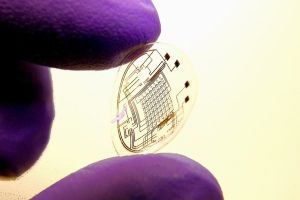
The device to make this happen may be familiar. Engineers at the University of Washington have for the first time used manufacturing techniques at microscopic scales to combine a flexible, biologically safe contact lens with an imprinted electronic circuit and lights.

"Looking through a completed lens, you would see what the display is generating superimposed on the world outside," said Babak Parviz, a UW assistant professor of electrical engineering. "This is a very small step toward that goal, but I think it's extremely promising." The results were presented in January at the Institute of Electrical and Electronics Engineers' international conference on Micro Electro Mechanical Systems by Harvey Ho, a former graduate student of Parviz's now working at Sandia National Laboratories in Livermore, Calif. Other co-authors are Ehsan Saeedi and Samuel Kim in the UW's electrical engineering department and Tueng Shen in the UW Medical Center's ophthalmology department.

There are many possible uses for virtual displays. Drivers or pilots could see a vehicle's speed projected onto the windshield. Video-game companies could use the contact lenses to completely immerse players in a virtual world without restricting their range of motion. And for communications, people on the go could surf the Internet on a midair virtual display screen that only they would be able to see.

"People may find all sorts of applications for it that we have not thought about. Our goal is to demonstrate the basic technology and make sure it works and that it's safe," said Parviz, who heads a multi-disciplinary UW group that is developing electronics for contact lenses.

The prototype device contains an electric circuit as well as red light-emitting diodes for a display, though it does not yet light up. The lenses were tested on rabbits for up to 20 minutes and the animals showed no adverse effects.

Ideally, installing or removing the bionic eye would be as easy as popping a contact lens in or out, and once installed the wearer would barely know the gadget was there, Parviz said.

Read more:

Rachael Yamagata


Breakup songs aren't supposed to be exuberant, particularly when they're conflicted, but tell that to Rachael Yamagata. In "Even If I Don't," the velvet-voiced singer crafts a tune that's as bittersweet as it is buoyant; it's a perfect paean to the pain inherent in both staying in an unhealthy relationship and letting go. More than anything, it's a postcard to lost potential — a postscript to an ideal that lingers even after reality rears its head.

The result is a refreshing change of pace from black-or-white, love-or-hate breakup songs; a song for those who've survived nasty broken relationships, only to harbor fond memories of better days. If nothing else, Yamagata's refreshingly mature refrain — "Even if I don't, I wanted to" — contains some of the kindest, bravest, most honest words to pop up in a song in a long time.

Lyrics

via: NPR

Wednesday, October 12, 2011

A Critic Selects a Last Meal - Per Se

[ed.  NY Times food critic Sam Sifton's last review on the "best restaurant in New York City":  Per Se.]


by Sam Sifton
***
Per Se’s signature starter course is Oysters and Pearls, a dish Mr. Keller developed at French Laundry and brought with him when he moved East. It combines a sabayon of pearl tapioca with Island Creek oysters (small, marble-shaped, from Duxbury, south of Boston, fantastic) and a fat clump of sturgeon caviar from Northern California. These arrive in a bowl of the finest porcelain from Limoges. Paired with a glass of golden sémillon from Elderton, they make a fine argument for the metaphor of transubstantiation.

The appetizer is not food so much as a poem about creaminess, a meditation on brine, a sculpture about the delicious. It is a complete introduction to the restaurant and its pleasures.

But perhaps foie gras is more to your liking? At one dinner at Per Se, I had a torchon of moulard duck foie gras from Élevages Périgord in Quebec, served with a crystallized apple chip, some celery-branch batons (taken to 11 on the flavor scale by some compression and sous-vide cooking), Granny Smith apple marmalade, candied walnuts, frisée and juniper-balsamic vinegar. I spread it thickly on brioche toast that a server kept replacing every few minutes, since (he said) it should never be eaten cool. (This is true, as it happens: the bread grows heavy and stiff.) I ate it silently, as one can do only with friends and family, savoring the experience as I might have a massage or a sunset.

Such excitements have a real effect on who ought to go to Per Se and why. The restaurant is not a place to book for a business meal. Nor is it a restaurant for those who do not eat well together. A meal at Per Se can stretch to four to five hours — a long time to sit with anyone, even a client with whom you are trying to close a multimillion-dollar deal. The restaurant more handsomely rewards the companionship of those who love one another as much as they do pleasure and indulgence.

Nor is Per Se a restaurant for those who do not understand that such pleasure comes at a cost. The menu has a set price of $295 a person, excluding wine. Nine or more courses are prepared, along with canapés to start and mignardises to finish. A conversation with a sommelier can easily double the cost of the buy-in. Dinner for two can scratch at $1,000 — or about the same as the median weekly household income in New York State.

By point of context, though, an aisle orchestra seat at the Metropolitan Opera for Donizetti’s “L’Elisir d’Amore” runs $330, also excluding wine.


Read more:

photos: Daniel Krieger for The New York Times

Equation: Radiocarbon Dating

by Julie Rehmeyer

Right now, 40,000 feet overhead, a cosmic ray is sending a neutron smashing into a nitrogen atom, smacking a proton out of its nucleus and forming an isotope called carbon-14. Armed with the equation below, archaeologists use these atoms to pinpoint how old the Dead Sea Scrolls are, or the drawings in Chauvet Cave, or Ötzi the Iceman.

Living things constantly consume carbon—through photosynthesis, for plants, and for animals, ingestion of those plants. The atmospheric ratio of carbon-14 to regular carbon-12 remains consistent at one part per trillion, so if something is alive, one-trillionth of its carbon atoms will be C-14. But once a plant or animal dies, its carbon-14 is no longer replenished. C-14 is radioactive and unstable, with a half-life of 5,730 years, which means that half the atoms will turn back into nitrogen over that period. That rate of decay is key to gauging age.

Read more:
Illustration: Mario Hugo

The Next Big Bank Bailout

[ed.  Lots of bank and business news these days on Wall Street protests, increased debit card fees, European bail-out maneuvers, and lobbying efforts to repatriate massive offshore tax shelter profits at reduced tax rates.  Then there's this, which has been flying under the radar for the last few weeks.]   

by Matt Taibbi

Amidst all the bad news coming out of Wall Street and the economy, here’s something good: California has backed out of the talks for the long-awaited foreclosure settlement, now making it far from likely that the so-called “Attorneys General” deal will happen anytime soon.

California Attorney General Kamala Harris sent a letter to state and federal regulators explaining that she pulled out because the proposed settlement amount for banks guilty of bad securitization practices leading up to the mortgage crisis – said to be in the $20 billion range – was too small. From Business Week:
Harris says in a letter to state and federal negotiators that the pending settlement is "inadequate" and gives bank officials too much immunity.
I’m convinced that the deal will eventually go through, however, after some further concessions are made. Certainly the absence of both New York (whose Attorney General Eric Schneiderman gamely started this mess by refusing to sign on or abandon his own investigation into corrupt securitization practices) and California will make it difficult for the banks to do any kind of a deal. But there is such an awesome amount of political will to get this deal done in Washington that it almost has to happen before the presidential election season really gets going.

If it does get done, expect a great deal of public debate over whether or not the size of the settlement was sufficient. Did the banks pay enough? Should they have paid ten billion more? Twenty? Even I engaged in a little bit of that some weeks ago.

But if and when that debate takes place, it will actually obscure the real issue, because this settlement is not about getting money from the banks. The deal being contemplated is actually the opposite: a giant bailout.

In fact, any federal foreclosure settlement along the lines of what’s been proposed will amount to a last round of post-2008-crisis bailouts. I talked to one foreclosure activist over the weekend who put it this way: “[The AG settlement] will be a bigger bailout than TARP.”

How? The math actually makes a hell of a lot of sense, when you look at it closely.

Any foreclosure settlement will allow the banks to pay one relatively small bill to cover all of their legal liabilities stemming from the monstrous frauds they all practiced in the years leading up to the 2008 crash (and even afterward), when they all schemed to create great masses of dicey/junk subprime loans and then disguise them as AAA-rated paper for sale to big private investors and institutions like state pension funds and union funds.

To recap the crime: the banks lent money to firms like Countrywide, who in turn created billions in dicey loans, who then sold them back to the banks, who chopped them up and sold them to, among other things, your state’s worker retirement funds.

So this is bankers from Deutsche and Goldman and Bank of America essentially stealing the retirement nest eggs of firemen, teachers, cops, and other actors, as well as the investment monies of foreigners and hedge fund managers. To repeat: this was Wall Street hotshots stealing money from old ladies. 

Along the road to this systematic thievery, a great many other, sometimes smaller offenses were committed. One involved the use of the MERS electronic registration system. By law, banks were supposed to register with county-level offices in each state every time they sold or resold a mortgage, and pay fees each time.

But they didn’t, instead registering with the private deed-transfer agency MERS, allowing them to systematically, and illegally, bypass local taxes.

So any “AG settlement” might allow the banks to avoid legal damages being sought from three different set of enraged creditors: the public institutions who invested in these sham securities, the private investors who did the same, and the localities who were cheated out of their taxes.

Let’s take a look at each of those three categories.

Read more: 

photo: Justin Sullivan/Getty Images

Max Hayslette, Woman and Child Playing Cards
via:

Geoffrey Johnson, The Made Shop
via:

Current Events: Even a Slovak 'Yes' Will Make No Difference

[ed.  I saw a great comment about Slovakia's vote yesterday and the current state of the European Union: like a flea on the tail wagging the dog.]

by Ambrose Evans-Pritchard

Slovakia’s "Nie" last night will not stop the approval of Europe’s revamped bail-out fund (EFSF).

The ultimate outcome has never been in doubt. As in Germany, the opposition backs the bill. In any case, Slovakia’s political class knows that their country will pay a fearful diplomatic price if this drama in the Národná Rada drags on for much longer.

What the Slovak debate has shown us yet again – as if the political storm in Germany over the last two months has not been enough – is that escalating bail-outs are nearing their political limits.

The traumatic affair almost brought down the German government. It has in fact brought down the Slovak government. You can’t keep doing this. Democracies are not to be toyed with.

***
Slovakia’s cry of defiance has not been entirely pointless. Richard Sulik – the speaker of parliament – has caught a mood of popular disgust that goes far beyond his own country.

His objections are unanswerable. How can there be any justification for a state of affairs where a poor but rule-abiding EMU state must bail out a serial violator with twice the per capita income, and triple the level of the pensions – a country which is in any case irretrievably bankrupt? How can it be that the no-bail clause of the Lisbon treaty has been ripped up?

But he also touched on the most neuralgic issue, reminding everybody that the EFSF is "mainly for saving foreign banks". These are French, German, British, Dutch, and Belgian banks, of course.

Mr Sulik is right. The EU-IMF rescue loans have not helped Greece pull out of its downward spiral. They have pushed the country further into bankruptcy. Greek public debt will rise from around 120pc of GDP to 160pc under the rescue programme, and the IMF is pencilling in figures above 180pc.

The rescue loans have rotated into the hands of creditor banks, life insurers, pension funds, and even a few hedge funds. ECB bond purchases have allowed to investors to dump their holdings at reduced loss, shifting the risk to EMU taxpayers. It is a racket for financial elites. A pickpocketing of taxpayers, including poor Slovak taxpayers.

"I’d rather be a pariah in Brussels than have to feel ashamed before my children," he said.

Bravo.

Read more: 

image: