Saturday, January 28, 2012

The Long Goodbye
We thought Daddy was going to die in 2001. He was staggering around the house in his underwear, gasping in pain, his eyes hollow, his face slashed from shaving with an old-fashioned safety razor. He was eighty-two years old. We took him to a doctor, who said his spine was deteriorating, gave him pills, and suggested he pray. A few days later, Daddy fell at the mailbox, bounced his head on the pavement, and crawled up the driveway, scraping the skin off his knees before collapsing on the front steps. Mama sat in her recliner in front of the TV, worried and clueless, until a neighbor called an ambulance. The EMTs got Daddy propped up in his recliner. He refused to go with them. When I arrived, Daddy was gulping down whiskey. I called the ambulance back, and they took him to DeKalb Medical. Doctors found prostate cancer and operated. My sister and I cried, sure Daddy was in his last days.
That was eleven years ago. Since then, Daddy’s long goodbye has drained his retirement income and life savings of more than $300,000. Where’s that money gone? Assisted living, mostly. Of course, that amount doesn’t account for his medical bills, most of which have been paid by Medicare and insurance policies that were part of his retirement. Daddy’s income—Social Security, plus monthly checks from two pensions—pays for the facility where he lives, his taxes, his life insurance policy premiums, and such incidentals as a visiting podiatrist to clip his nails.
And he has been kicked out of two hospices for not dying.
Daddy is ninety-three now and wears a diaper, is spoon-fed, and urinates through a catheter, drifting in and out of deep sleep in which he gasps for air and appears to be dead. Trisha, my sister, texted a picture of him in October to one of her daughters, who texted back: “Happy Halloween!” When he wakes up, his caregivers dress him and plop him in a wheelchair. He rolls around like a child until it’s time to eat again.
I cannot imagine that this once-dignified Southern gentleman, who clawed his way out of the grit of a Depression-era tobacco farm in North Carolina and bought a snazzy double-breasted suit with one of his first paychecks, would be anything but humiliated by what is happening to him now—if he had all his faculties. Yet as one of his nurses told me, “Your father has no interest in dying.” It is not heroic measures keeping him alive; he just keeps ticking. He takes only two medicines: an antibiotic for a urinary tract infection and OxyContin for the pain in his spine.
At sixty-four, I am at the leading edge of baby boomers who have ringside seats to the slow-motion demise of the Greatest Generation, watching our parents pass away slowly and stubbornly, dying piece by piece over a decade or more, often unwilling or unable to share their feelings. Most of us, such as my sister and I, head into the turmoil of caring for an aging Immortal utterly unprepared.
Daddy used to laugh at Trisha and me whenever we suggested discussing assisted living and long-term care insurance with him. He insisted—with the unshakable confidence of a career civil engineer—that he didn’t need to make such plans, that he would simply drop dead one day and that would be the end of it. He refused to discuss it further.
It didn’t work out according to that plan, and there was no other plan.
by Doug Monroe, Atlanta Magazine | Read more:
 Illustration by Emiliano Ponzi |
That was eleven years ago. Since then, Daddy’s long goodbye has drained his retirement income and life savings of more than $300,000. Where’s that money gone? Assisted living, mostly. Of course, that amount doesn’t account for his medical bills, most of which have been paid by Medicare and insurance policies that were part of his retirement. Daddy’s income—Social Security, plus monthly checks from two pensions—pays for the facility where he lives, his taxes, his life insurance policy premiums, and such incidentals as a visiting podiatrist to clip his nails.
And he has been kicked out of two hospices for not dying.
Daddy is ninety-three now and wears a diaper, is spoon-fed, and urinates through a catheter, drifting in and out of deep sleep in which he gasps for air and appears to be dead. Trisha, my sister, texted a picture of him in October to one of her daughters, who texted back: “Happy Halloween!” When he wakes up, his caregivers dress him and plop him in a wheelchair. He rolls around like a child until it’s time to eat again.
I cannot imagine that this once-dignified Southern gentleman, who clawed his way out of the grit of a Depression-era tobacco farm in North Carolina and bought a snazzy double-breasted suit with one of his first paychecks, would be anything but humiliated by what is happening to him now—if he had all his faculties. Yet as one of his nurses told me, “Your father has no interest in dying.” It is not heroic measures keeping him alive; he just keeps ticking. He takes only two medicines: an antibiotic for a urinary tract infection and OxyContin for the pain in his spine.
At sixty-four, I am at the leading edge of baby boomers who have ringside seats to the slow-motion demise of the Greatest Generation, watching our parents pass away slowly and stubbornly, dying piece by piece over a decade or more, often unwilling or unable to share their feelings. Most of us, such as my sister and I, head into the turmoil of caring for an aging Immortal utterly unprepared.
Daddy used to laugh at Trisha and me whenever we suggested discussing assisted living and long-term care insurance with him. He insisted—with the unshakable confidence of a career civil engineer—that he didn’t need to make such plans, that he would simply drop dead one day and that would be the end of it. He refused to discuss it further.
It didn’t work out according to that plan, and there was no other plan.
by Doug Monroe, Atlanta Magazine | Read more:


Monday, January 23, 2012
Lots of Strings Attached
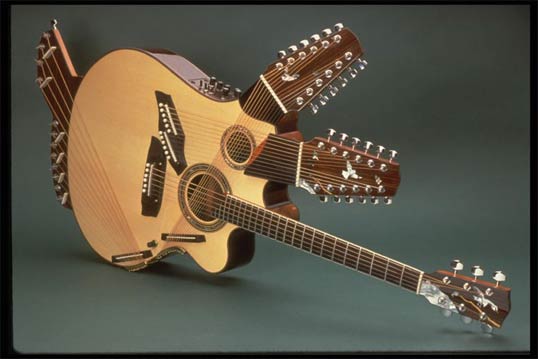
I love my six strings, I really do. I never pine for more, not even a seventh. In fact, most of us are okay with six, but some people just have to break new boundaries and head into the unknown. I have joyfully experienced a number of these musicians and their seemingly crazy quest to make music with bunches of strings, although three seem to separate themselves from the pack with their unique guitars and music. The music is certainly worth checking out, but the technical aspects of these axes will simply blow your mind.
At the top of the list is the Pikasso. Its name is ostensibly derived from its likeness in appearance to the cubist works of Pablo Picasso. The one pictured belongs to Pat Metheny, one of the most famous jazz guitar players of our time. In Pat’s hands, this guitar is not just for show. He works the daylights out of this thing. The Pikasso guitar was built for him by luthier Linda Manzer in 1984 and it has 42 strings. This 42-string beast with three necks has been popularized by Pat and can be heard on his song “Into the Dream” and on the albums Quartet, Imaginary Day, Jim Hall & Pat Metheny, Trio Live, and Metheny Mehldau Quartet his 2007 second collaboration with pianist Brad Mehldau. The guitar can also be seen on the Speaking of Now Live and Imaginary Day DVDs. Metheny has also used the guitar in his guest appearances on other artists’ albums and on a Jazz TV show, Legends of Jazz, where he referred to it simply as a 42- string guitar. I wonder how often those strings get changed.
by Rick Wheeler, Premier Guitar | Read more:
The Invention of the Heterosexual

If you met Hanne Blank and her partner on the street, you might have a lot of trouble classifying them. While Blank looks like a feminine woman, her partner is extremely androgynous, with little to no facial hair and a fine smooth complexion. Hanne’s partner is neither fully male, nor fully female; he was born with an unconventional set of chromosomes, XXY, that provide him with both male genitalia and feminine characteristics. As a result, Blank’s partner has been mistaken for a gay woman, a straight man, a transman — and their relationship has been classified as gay, straight and everything in between.
Blank mentions her personal story at the beginning of her provocative new history of heterosexuality, “Straight,” as a way of illustrating just how artificial our notions of “straightness” really are. In her book, Blank, a writer and historian who has written extensively about sexuality and culture, looks at the ways in which social trends and the rise of psychiatry conspired to create this new category in the late 19th and early 20th century. Along the way, she examines the changing definition of marriage, which evolved from a businesslike agreement into a romantic union centered around love, and how social Darwinist ideas shaped the divisions between gay and straight. With her eye-opening book, Blank tactfully deconstructs a facet of modern sexuality that most of us take for granted.
Salon spoke to Blank over the phone about the origins of heterosexuality, the evolution of marriage and why the rise of the “bromance” is a very good thing.
Men and woman have been having sex for as long as there have been humans. So how can we talk about there being a “history” of heterosexuality?
We can talk about there being a history of heterosexuality in the same way that we can talk about there being a history of religions. People have been praying to God for a really long time too, and yet the ways people relate to the divine have specific histories. They come from particular places, they take particular trajectories, there are particular texts, and individuals that are important in them. There are events, names, places, dates. It’s really very similar.
So where does the term “heterosexual” come from?
“Heterosexual” was actually coined in a letter at the same time as the word “homosexual,” [in the mid-19thcentury], by an Austro-Hungarian journalist named Károly Mária Kertbeny. He created these words as part of his response to a piece of Prussian legislation that made same-sex erotic behavior illegal, even in cases where the identical act performed by a man and a woman would be considered legal. And he was one of a couple of people who did a lot of writing and campaigning and pamphleteering to try to change legal opinion on that matter. He coined the words “heterosexual” and “homosexual” in a really very clever bid to try to equalize same-sex and different-sex. His intent was to suggest that there are these two categories in which human beings could be sexual, that they were not part of a hierarchy, that they were just two different flavors of the same thing.
by Thomas Rogers, Salon | Read more:
Will the Maine Coon become an American Icon?

The Maine Coon is fast approaching the status of charismatic megafauna like orcas and eagles and howling white wolves. No other breed of cat has starred in so many viral videos, has inspired so many airbrushed t-shirts or so many wretched – and even a few not-so-wretched – tchotchkes as the Maine Coon. A search for “Maine Coon” returns 56.4 million search results, while its longhaired cousin the Persian returns only 8.1 million and the Abyssinian returns a mere 3.4 million. The Coon’s combination of rugged looks and an undeniably goofy disposition seem thoroughly plugged into that folksy vein of Americana that generated Paul Bunyan and his Blue Ox Babe. There is also an almost mystical air to the cat’s provenance.
No one really knows when the first Maine Coon came lumbering out of Maine’s timberlands to sprawl in front of wood stoves, though there are some pretty compelling creation myths floating around on the internet. For the cat to truly become part of America’s enduring iconography of log cabins and cowboys and ironclads and the Stars and Stripes, however, one of these peculiar stories will have to stick. Which one will it be? The most enduring stories cleave close to the facts, and there are a few Maine Coon milestones that are part of the public record.
by James McGirk, 3 Quarks Daily | Read more:
Joe Paterno (December, 1926 - January, 2012)
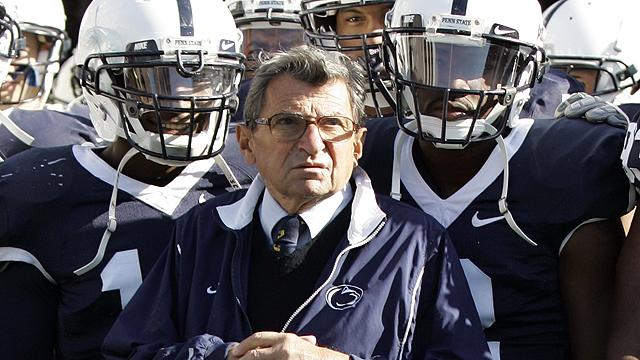
Joe Paterno, who won more games than any other major-college football coach, and who became the face of Pennsylvania State University and a symbol of integrity in collegiate athletics only to be fired during the 2011 season amid a child sexual abuse scandal that reverberated throughout the nation, died Sunday in State College, Pa. He was 85.
His family announced his death in a statement released Sunday morning. The cause was lung cancer, according to Mount Nittany Medical Center, where he had been treated. Paterno’s family announced in mid-November that he had received a diagnosis of lung cancer after a visit to a physician regarding a bronchial illness a few days earlier. He lived in State College.
During his 46 years as head coach, as he paced the sideline in his thick tinted glasses, indifferent to fashion in his white athletic socks and rolled-up baggy khaki pants, Paterno seemed as much a part of the Penn State landscape as Mount Nittany, overlooking the central Pennsylvania campus known as Happy Valley.
When Penn State defeated Illinois, 10-7, on Oct. 29, 2011, the victory was Paterno’s 409th, and he surpassed Eddie Robinson of Grambling for most career victories among N.C.A.A. Division I coaches. Penn State’s president at the time, Graham B. Spanier, presented Paterno with a commemorative plaque in a postgame ceremony shown on the huge scoreboard at Beaver Stadium.
It would be Paterno’s last game. Within days his former defensive coordinator Jerry Sandusky was indicted and arrested on multiple charges of sexually abusing young boys extending back to his time on Paterno’s staff. On Nov. 9, Paterno and Spanier were fired by the university’s board of trustees because of their failure to go to the police after they were told of an accusation against Sandusky in 2002.
Paterno’s abrupt firing at 84 was something that could hardly have been imagined, although he had stubbornly clung to the spotlight at an age when most head coaches, whatever their renown, had retired.
He had held himself to an exceedingly high standard with what he called his “grand experiment”: fielding outstanding teams with disciplined players whose graduation rates far exceeded that at most football powers. His football program had never been tainted by a recruiting scandal. His statue stood outside Beaver Stadium alongside the legend “Educator, Coach, Humanitarian.”
Former players who succeeded in professional life far beyond the football field had told of their debt to him.
“Look how many go to medical school or law school,” said Bill Lenkaitis, a dentist in Foxborough, Mass., who played for Paterno in the 1960s and became a longtime center for the New England Patriots. “Look how many become heads of corporations.”
Many a Pennsylvania home was stocked with Paterno knickknacks: Cup of Joe coffee mugs, Stand-up Joe life-size cutouts, JoePa golf balls bearing his likeness.
Paterno and his wife, Sue, were major benefactors of Penn State. During his nearly half-century as head coach, donors gave hundreds of millions of dollars to the university, helping to shape it into a major research institution, seemingly an outgrowth of his having made Penn State a national brand name through its football teams.
by Richard Goldstein, NY Times | Read more:
Photo via: Technorati

Cracking Teenagers’ Online Codes

With her coordinated zebra-striped scarf, tights and arm warmers (arm warmers?), spiky out-to-there hat and pierced tongue, 34-year-old Danah Boyd provides an electric Gen Y contrast to the staid gray lobby of Microsoft Research in Cambridge, Mass., which she enters in a flurry of animated conversation, Elmo-decorated iPhone in hand. In a juxtaposition that causes her no end of mischievous delight, her laptop bears a sticker of Snow White, whose outstretched arm gently cradled the Apple logo.
But Dr. Boyd — a senior researcher at Microsoft, an assistant professor at New York University and a fellow at the Berkman Center for Internet and Society at Harvard — is a widely respected figure in social media research. With a number of influential scholarly papers under her name, she travels relentlessly, tweets under the handle Zephoria and has fans trailing her at TED conferences, at South by Southwest and elsewhere on the high-tech speaking circuit.
She is also a kind of rock star emissary from the online and offline world of teenagers. The young subjects of her research become her friends on Facebook and subscribe to her Twitter feed.
“The single most important thing about Danah is that she’s the first anthropologist we’ve got who comes from the tribe she’s studying,” said Clay Shirky, a professor in the interactive telecommunications program at N.Y.U. and a fellow at the Berkman Center.
There’s no shortage of grown-up distress over the dangers young people face online. Parents, teachers and schools worry about teenagers posting their lives (romantic indiscretions, depressing poetry and all), leaking passwords and generally flouting social conventions as predators, bullies and unsavory marketers lurk. Endless back-and-forthing over how to respond effectively — shutting Web sites, regulating online access and otherwise tempering the world of social media for children — dominates the P.T.A. and the halls of policy makers.
But as Dr. Boyd sees it, adults are worrying about the wrong things.
by Pamela Paul, NY Times | Read more:
Sunday, January 22, 2012
A Sharper Mind, Middle Age and Beyond

Many researchers believe that human intelligence or brainpower consists of dozens of assorted cognitive skills, which they commonly divide into two categories. One bunch falls under the heading “fluid intelligence,” the abilities that produce solutions not based on experience, like pattern recognition, working memory and abstract thinking, the kind of intelligence tested on I.Q. examinations. These abilities tend to peak in one’s 20s.
“Crystallized intelligence,” by contrast, generally refers to skills that are acquired through experience and education, like verbal ability, inductive reasoning and judgment. While fluid intelligence is often considered largely a product of genetics, crystallized intelligence is much more dependent on a bouquet of influences, including personality, motivation, opportunity and culture.
To illustrate how crystallized intelligence can operate, Gene D. Cohen, a founder of the field of geriatric psychiatry, related a story about his in-laws from his book “The Mature Mind: The Positive Power of the Aging Brain.” The couple, in their 70s, arrived in Washington for a visit during a snowstorm and found themselves stranded by the train station. When they saw a pizzeria across the street, his father-in-law had an idea. The couple went inside, ordered a pizza to be delivered to their daughter’s house, and then asked if they could ride along.
As Cohen explained, one of the brain’s most powerful tools is its ability to quickly scan a vast storehouse of templates for relevant information and past experience to come up with a novel solution to a problem. In this context, the mature brain is especially well equipped, which is probably why we still associate wisdom with age.
by Patrica Cohen, NY Times | Read more:
Illustration: Margaret Riegel
Pitchfork, 1995–Present

One day in early 2010, the internet message board I Love Music began discussing the Pazz and Jop poll, which the Village Voice had recently published on its website. The Voice has conducted Pazz and Jop annually since 1971. Hundreds of music critics submit lists ranking their favorite albums and singles, and the Voice compiles two master lists identifying the year’s best music. It is the main event in American popular music criticism. On I Love Music, the Pazz and Jop thread chugged slowly along for a few hours. Then Scott Plagenhoef, editor-in- chief of the music website Pitchfork, began posting under the name “scottpl,” and things picked up speed. “11 of the top 13 LPs and five of the top six singles are shared between this and the Pitchfork list,” Plagenhoef wrote. “For what it’s worth.”
The suggestion that the nation’s music critics had copied their end-of-the-year charts from a website just over a decade old was a clear provocation, and twenty-four hours and hundreds of posts later the conversation was no longer about Pazz and Jop. “Man, Pitchfork circa 2000 and 2001 vs now is night and day,” Plagenhoef wrote. “The size of the site now utterly dwarfs the site then, and certainly the way it’s run and decisions are made are different.” Plagenhoef did his best to maintain a modest pose (“I don’t beg for credit or claim to be responsible for things”), but in the end it was hard to resist a triumphal note. “We’ve succeeded at a time when nobody else has,” he wrote. “We reach more people right now than Spin or Vibe ever did, even if you use the bs print mag idea that ‘every copy is read by 2.5 people’ . . . hell, I should stop caring, get back to work, and let people keep underestimating us.” Then he posted two more times. Then he wrote, “Alright, I will get out of this thread.” Then he posted eighteen more times.
He may have been bragging, but Plagenhoef was right. In the last decade, no organ of music criticism has wielded as much influence as Pitchfork. It is the only publication, online or print, that can have a decisive effect on a musician or band’s career. This has something to do with the site’s diligently cultivated readership: no genre’s fans are more vulnerable to music criticism than the educated, culturally anxious young people who pay close attention to indie rock. Other magazines and websites compete for these readers’ attention, of course, but they come and go, one dissolving into the next, while Pitchfork keeps on gathering strength. Everyone acknowledges this. And yet everyone also acknowledges something else: whatever attracts people to Pitchfork, it isn’t the writing. Even writers who admire the site’s reviews almost always feel obliged to describe the prose as “uneven,” and that’s charitable. Pitchfork has a very specific scoring system that grades albums on a scale from 0.0 to 10.0, and that accounts for some of the site’s appeal, but it can’t just be the scores. I could start a website with scores right now, and nobody would care. So what is it? How has Pitchfork succeeded where so many other websites and magazines have not? And why is that success depressing?
by Richard Beck, n+1 | Read more:
Image: Raekwon fans at the Pitchfork Music Festival, 2010. Via kate.gardiner.
How the U.S. Lost Out on iPhone Work
When Barack Obama joined Silicon Valley’s top luminaries for dinner in California last February, each guest was asked to come with a question for the president.
 But as Steven P. Jobs of Apple spoke, President Obama interrupted with an inquiry of his own: what would it take to make iPhones in the United States?
Not long ago, Apple boasted that its products were made in America. Today, few are. Almost all of the 70 million iPhones, 30 million iPads and 59 million other products Apple sold last year were manufactured overseas.
Why can’t that work come home? Mr. Obama asked.
Mr. Jobs’s reply was unambiguous. “Those jobs aren’t coming back,” he said, according to another dinner guest.
The president’s question touched upon a central conviction at Apple. It isn’t just that workers are cheaper abroad. Rather, Apple’s executives believe the vast scale of overseas factories as well as the flexibility, diligence and industrial skills of foreign workers have so outpaced their American counterparts that “Made in the U.S.A.” is no longer a viable option for most Apple products.
Apple has become one of the best-known, most admired and most imitated companies on earth, in part through an unrelenting mastery of global operations. Last year, it earned over $400,000 in profit per employee, more than Goldman Sachs, Exxon Mobil or Google.
However, what has vexed Mr. Obama as well as economists and policy makers is that Apple — and many of its high-technology peers — are not nearly as avid in creating American jobs as other famous companies were in their heydays.
Apple employs 43,000 people in the United States and 20,000 overseas, a small fraction of the over 400,000 American workers at General Motors in the 1950s, or the hundreds of thousands at General Electric in the 1980s. Many more people work for Apple’s contractors: an additional 700,000 people engineer, build and assemble iPads, iPhones and Apple’s other products. But almost none of them work in the United States. Instead, they work for foreign companies in Asia, Europe and elsewhere, at factories that almost all electronics designers rely upon to build their wares.
“Apple’s an example of why it’s so hard to create middle-class jobs in the U.S. now,” said Jared Bernstein, who until last year was an economic adviser to the White House.
“If it’s the pinnacle of capitalism, we should be worried.”
by Charles Duhigg and Keith Bradsher, NY Times | Read more:
Photo via:
 But as Steven P. Jobs of Apple spoke, President Obama interrupted with an inquiry of his own: what would it take to make iPhones in the United States?
 Not long ago, Apple boasted that its products were made in America. Today, few are. Almost all of the 70 million iPhones, 30 million iPads and 59 million other products Apple sold last year were manufactured overseas.
Why can’t that work come home? Mr. Obama asked.
Mr. Jobs’s reply was unambiguous. “Those jobs aren’t coming back,” he said, according to another dinner guest.
The president’s question touched upon a central conviction at Apple. It isn’t just that workers are cheaper abroad. Rather, Apple’s executives believe the vast scale of overseas factories as well as the flexibility, diligence and industrial skills of foreign workers have so outpaced their American counterparts that “Made in the U.S.A.” is no longer a viable option for most Apple products.
Apple has become one of the best-known, most admired and most imitated companies on earth, in part through an unrelenting mastery of global operations. Last year, it earned over $400,000 in profit per employee, more than Goldman Sachs, Exxon Mobil or Google.
However, what has vexed Mr. Obama as well as economists and policy makers is that Apple — and many of its high-technology peers — are not nearly as avid in creating American jobs as other famous companies were in their heydays.
Apple employs 43,000 people in the United States and 20,000 overseas, a small fraction of the over 400,000 American workers at General Motors in the 1950s, or the hundreds of thousands at General Electric in the 1980s. Many more people work for Apple’s contractors: an additional 700,000 people engineer, build and assemble iPads, iPhones and Apple’s other products. But almost none of them work in the United States. Instead, they work for foreign companies in Asia, Europe and elsewhere, at factories that almost all electronics designers rely upon to build their wares.
“Apple’s an example of why it’s so hard to create middle-class jobs in the U.S. now,” said Jared Bernstein, who until last year was an economic adviser to the White House.
“If it’s the pinnacle of capitalism, we should be worried.”
by Charles Duhigg and Keith Bradsher, NY Times | Read more:
Photo via:

In Which I Fix My Girlfriend’s Grandparents’ WiFi and Am Hailed as a Conquering Hero.
Lo, in the twilight days of the second year of the second decade of the third millenium did a great darkness descend over the wireless internet connectivity of the people of 276 Ferndale Street in the North-Central lands of Iowa. For many years, the gentlefolk of these lands basked in a wireless network overflowing with speed and ample internet, flowing like a river into their Compaq Presario. Many happy days did the people spend checking Hotmail and reading USAToday.com.
 But then one gray morning did Internet Explorer 6 no longer load The Google. Refresh was clicked, again and again, but still did Internet Explorer 6 not load The Google. Perhaps The Google was broken, the people thought, but then The Yahoo too did not load. Nor did Hotmail. Nor USAToday.com. The land was thrown into panic. Internet Explorer 6 was minimized then maximized. The Compaq Presario was unplugged then plugged back in. The old mouse was brought out and plugged in beside the new mouse. Still, The Google did not load.
Some in the kingdom thought the cause of the darkness must be the Router. Little was known of the Router, legend told it had been installed behind the recliner long ago by a shadowy organization known as Comcast. Others in the kingdom believed it was brought by a distant cousin many feasts ago. Concluding the trouble must lie deep within the microchips, the people of 276 Fernadale Street did despair and resign themselves to defeat.
But with the dawn of the feast of Christmas did a beacon of hope manifest itself upon the inky horizon. Riding in upon a teal Ford Focus came a great warrior, a suitor of the gentlefolks’ granddaughter. Word had spread through the kingdom that this warrior worked with computers and perhaps even knew the true nature of the Router.
The people did beseech the warrior to aid them. They were a simple people, capable only of rewarding him with gratitude and a larger-than-normal serving of Jell-O salad. The warrior considered the possible battles before him. While others may have shirked the duties, forcing the good people of Ferndale Street to prostrate themselves before the tyrants of Comcast, Linksys, and Geek Squad, the warrior could not chill his heart to these depths. He accepted the quest and strode bravely across the beige shag carpet of the living room.
Deep, deep behind the recliner did the warrior crawl, over great mountains of National Geographic magazines and deep chasms of TV Guides. At last he reached a gnarled thicket of cords, a terrifying knot of gray and white and black and blue threatening to ensnare all who ventured further. The warrior charged ahead. Weaker men would have lost their minds in the madness: telephone cords plugged into Ethernet jacks, AC adapters plugged into phone jacks, a lone VGA cable wrapped in a firm knot around an Ethernet cord. But the warrior bested the thicket, ripping away the vestigial cords and swiftly untangling the deadly trap.
And at last the warrior arrived at the Router. It was a dusty black box with an array of shimmering green lights, blinking on and off, as if to taunt him to come any further. The warrior swiftly maneuvered to the rear of the router and verified what he had feared, what he had heard whispered in his ear from spirits beyond: all the cords were securely in place.
The warrior closed his eyes, summoning the power of his ancestors, long departed but watchful still. And then with the echoing beep of his digital watch, he moved with deadly speed, wrapping his battle-hardened hands around the power cord at the back of the Router.
Gripping it tightly, he pulled with all his force, dislodging the cord from the Router. The heavens roared. The earth wailed. The green lights turned off. Silently the warrior counted. One. Two. Three. And just as swiftly, the warrior plugged the cord back into the router. Great crashes of blood-red lightning boomed overhead. Murders of crows blackened the skies. The Power light came on solid green. The seas rolled. The WLAN light blinked on. The forests ignited. A dark fog rolled over the land and suddenly all was silent. The warrior stared at the Internet light, waiting, waiting. And then, as the world around him seemed all but dead, the Internet light began to blink.
The warrior darted out back over the mountains of National Geographic magazines and made haste to the Compaq Presario. He woke up Windows XP from sleep mode and deftly defeated twelve notifications to update Norton AntiVirus. With a resounding click he opened Internet Explorer 6 and gazed deep into its depths, past the Yahoo toolbar, the MSN toolbar, the Ask.com toolbar, and the AOL toolbar. And then did he see, at long last, that The Google did load.
And so the good people of the kingdom were delighted and did heap laurels and Jell-O salad at the warrior’s feet, for now again they could have their Hotmail as the wireless internet did flow freely to their Compaq Presario. The warrior ate his Jell-O salad, thanked the gentlefolk, and then went to the basement because the TiVo was doing something weird with the VCR.
by Mike Lacher, McSweeny's
Photo via: About.com
 But then one gray morning did Internet Explorer 6 no longer load The Google. Refresh was clicked, again and again, but still did Internet Explorer 6 not load The Google. Perhaps The Google was broken, the people thought, but then The Yahoo too did not load. Nor did Hotmail. Nor USAToday.com. The land was thrown into panic. Internet Explorer 6 was minimized then maximized. The Compaq Presario was unplugged then plugged back in. The old mouse was brought out and plugged in beside the new mouse. Still, The Google did not load.
Some in the kingdom thought the cause of the darkness must be the Router. Little was known of the Router, legend told it had been installed behind the recliner long ago by a shadowy organization known as Comcast. Others in the kingdom believed it was brought by a distant cousin many feasts ago. Concluding the trouble must lie deep within the microchips, the people of 276 Fernadale Street did despair and resign themselves to defeat.
But with the dawn of the feast of Christmas did a beacon of hope manifest itself upon the inky horizon. Riding in upon a teal Ford Focus came a great warrior, a suitor of the gentlefolks’ granddaughter. Word had spread through the kingdom that this warrior worked with computers and perhaps even knew the true nature of the Router.
The people did beseech the warrior to aid them. They were a simple people, capable only of rewarding him with gratitude and a larger-than-normal serving of Jell-O salad. The warrior considered the possible battles before him. While others may have shirked the duties, forcing the good people of Ferndale Street to prostrate themselves before the tyrants of Comcast, Linksys, and Geek Squad, the warrior could not chill his heart to these depths. He accepted the quest and strode bravely across the beige shag carpet of the living room.
Deep, deep behind the recliner did the warrior crawl, over great mountains of National Geographic magazines and deep chasms of TV Guides. At last he reached a gnarled thicket of cords, a terrifying knot of gray and white and black and blue threatening to ensnare all who ventured further. The warrior charged ahead. Weaker men would have lost their minds in the madness: telephone cords plugged into Ethernet jacks, AC adapters plugged into phone jacks, a lone VGA cable wrapped in a firm knot around an Ethernet cord. But the warrior bested the thicket, ripping away the vestigial cords and swiftly untangling the deadly trap.
And at last the warrior arrived at the Router. It was a dusty black box with an array of shimmering green lights, blinking on and off, as if to taunt him to come any further. The warrior swiftly maneuvered to the rear of the router and verified what he had feared, what he had heard whispered in his ear from spirits beyond: all the cords were securely in place.
The warrior closed his eyes, summoning the power of his ancestors, long departed but watchful still. And then with the echoing beep of his digital watch, he moved with deadly speed, wrapping his battle-hardened hands around the power cord at the back of the Router.
Gripping it tightly, he pulled with all his force, dislodging the cord from the Router. The heavens roared. The earth wailed. The green lights turned off. Silently the warrior counted. One. Two. Three. And just as swiftly, the warrior plugged the cord back into the router. Great crashes of blood-red lightning boomed overhead. Murders of crows blackened the skies. The Power light came on solid green. The seas rolled. The WLAN light blinked on. The forests ignited. A dark fog rolled over the land and suddenly all was silent. The warrior stared at the Internet light, waiting, waiting. And then, as the world around him seemed all but dead, the Internet light began to blink.
The warrior darted out back over the mountains of National Geographic magazines and made haste to the Compaq Presario. He woke up Windows XP from sleep mode and deftly defeated twelve notifications to update Norton AntiVirus. With a resounding click he opened Internet Explorer 6 and gazed deep into its depths, past the Yahoo toolbar, the MSN toolbar, the Ask.com toolbar, and the AOL toolbar. And then did he see, at long last, that The Google did load.
And so the good people of the kingdom were delighted and did heap laurels and Jell-O salad at the warrior’s feet, for now again they could have their Hotmail as the wireless internet did flow freely to their Compaq Presario. The warrior ate his Jell-O salad, thanked the gentlefolk, and then went to the basement because the TiVo was doing something weird with the VCR.
by Mike Lacher, McSweeny's
Photo via: About.com
More Etta
[ed. Still can't believe she's gone. Keith Richards in his biography Life talks about "marrying" Etta in a show business ceremony. They had such a strong connection. Here's a link with many more great videos (including Something's Got a Hold on Me, which I was surprised formed the basis for Pretty Lights', Finally Moving.]
Also, this tribute by Hilton Als in the New Yorker.
More Etta James videos (via The Awl)
[ed. For someone that was once very special to me.]
Also, this tribute by Hilton Als in the New Yorker.
More Etta James videos (via The Awl)
Tunnel to the Other Side of the Earth

Have you ever wondered which part of the other side of the earth is directly below you? Find out using this map tunnelling tool.
Photo via: Howstuffworks
The Orchid Olympics

Orchids are seducers. They trick animals into pollinating them and usually give nothing in exchange. Some orchid species mimic nectar-producing flowers to lure bees; others emit the fetid smell of rotting meat to attract carrion flies. In China, Dendrobium sinense orchids release a chemical normally broadcast by bees in distress; the scent attracts bee-eating hornets expecting an easy meal. The scent of Cymbidium serratum entices a wild mountain mouse, which spreads pollen from flower to flower with its snout. And around the world, orchid species have evolved to look or smell like female insects; males try to mate with the flowers but gather and deposit pollen, which they carry on their flight from deception to deception.
But perhaps the most spectacular evidence of the plant’s powers of attraction could be seen several weeks ago in Singapore, at the 20th World Orchid Conference, a triennial affair that drew about 1,000 participants from 55 countries and more than 300,000 spectators. It was one of the largest orchid competitions in history, a colorful, heavily scented affair that showcased the growing popularity and cutting-edge science of orchid breeding. (...)
Orchids may be the most diverse flower family in the world, with more than 25,000 species. (Their only competition comes from daisies.) The orchid family maintains such diversity in the wild in part because individual orchid species summon only specific pollinators; the flowers thus avoid mingling their genes with those of other nearby orchids that are visited by their own pollinators. But most of the 50,000 orchids from 5,000 varieties on display at the conference do not occur in the wild; they are hybrids, created by people who have cross-fertilized orchid species, often from far-flung lands.
“The joy of breeding orchids is to see if you can combine two species in order to create something even more beautiful than either of the parents,” Martin Motes, a commercial grower from Florida and conference judge, said as visitors poured into the hall and crowded around the displays. He has been breeding orchids for 40 years, and many varieties of his 500 hybrids are named after his wife, Mary. “My wife thinks I am playing God! Well, man is given dominion over the beasts of the fields and orchids of the greenhouse, I guess,” he said.
by Somali Roy, Smithsonian | Read more:
Photographs by JG Bryce
Saturday, January 21, 2012


The Man Who Bought North Dakota

Harold G. Hamm is lost. The 66-year-old founder, chairman, and chief executive of Continental Resources (CLR) is steering a Chevy Tahoe past sunflower fields and grazing cows in western North Dakota. He’s found millions of barrels of oil in these low prairie hills, but on this bright fall day, he’s having trouble locating one of his own drilling rigs.
In the back seat, Hamm’s public-relations handler uses her smartphone to get their bearings. “So, we go three miles east, five north,” Hamm says in his Oklahoma drawl. “Got it.” Meandering past an idle John Deere combine and clutches of mobile homes where oil workers live, he points out wells his company has already drilled as if showing a guest around his home. He misses a turn, shrugs, stops, doubles back. “It’s a great day in North Dakota,” he says. “We’ll find it.”
Finally, he pulls into a dusty yard surrounding a 140-foot-tall rig. Workers hustle around in hard hats and black fire-retardant coveralls. From this single location, Hamm explains, four drills will corkscrew down nearly two miles, then turn and pierce the rock horizontally, two wells to the north, two to the south. He pulls on his own hard hat and coveralls, jams his hands in his pockets, and beams at the rig. Shouting over the whine of a drill bit, he says, “Without a doubt, this is going to be like the one up the road. It came in close to 2,000 barrels a day.” That translates into about $150,000 in revenue per day to Continental Resources.
Hamm is the man who bought the Bakken, the shale formation that’s the biggest U.S. oil find since Alaska’s Prudhoe Bay in 1968. The Bakken stretches from central North Dakota into the northeastern corner of Montana and up into southern Saskatchewan and Manitoba. He leased his first acres and drilled his first wells in North Dakota nearly 20 years ago, and stayed with it when others gave up. Today, Continental, with a stock market value of $13.5 billion, vies with oil giants such as Hess (HES) for the most Bakken acres under lease (more than 900,000), the most drilling rigs (24), and the most wells (more than 350). Continental’s revenue has nearly tripled from two years ago to an expected $1.76 billion in 2011, while profits have grown sevenfold to an estimated $538 million, according to data compiled by Bloomberg. Hamm and his family control 78 percent of the company’s shares, a stake valued at more than $10 billion.
Hamm, a stocky man of medium height with a leprechaun’s playful grin and a diamond-studded Continental ring on his right hand, has revived a character who had faded from the American oil patch. He’s a wildcatter, the sort of oil hunter unafraid to lease land and put a drill bit in the ground where there might or might not be crude. “I find oil,” he says as he drives to the company jet that will take him back to Continental headquarters in his native Oklahoma. “In America, people lost the will to drill for oil. But I’m a little more hardheaded than other people.”
by Bryan Gruley, Bloomberg Businessweek | Read more:
Photograph by Mark Mahaney
Bill Clinton: Esquire Interview

Just then, the first exit-poll numbers began to come in, and it became clear that Clinton's desperate bid to survive had worked. Suddenly energized, Begala began to type furiously. "The guy's been shit on and shot at more than anybody in American presidential politics, and he's survived!" he said. "He's the Comeback Kid!"
This, of course, all happened before a single moment of the Clinton presidency transpired, one of the most rancorous and partisan periods in American history, culminating in a presidential impeachment that was seen as so political as to be illegitimate, and that has all but been forgotten.
And so twenty years after Bill Clinton walked onto the world stage, during this new period of astoundingly rancorous partisanship, it might amuse him that he himself has become one of the few things that Americans can agree on. Comeback Kid indeed.
ESQUIRE: Mr. President, as we're going into an election year that will likely scorch the earth, we want to talk with you about the notion of American consensus for the common good and why that is in so much trouble right now, and we want to find consensus on some things. As impossible as it might have seemed twenty years ago, there is now no figure of greater consensus in America than you. How did that happen? What is different between now and then? Why does the politics seem so much more caustic now than even then?
CLINTON: Well, it is more caustic now, but don't forget, when I was there, there were radio talk shows accusing me of murder, killing guys on train tracks in Arkansas, and of running drugs in western Arkansas, that kind of stuff.
First of all, I think the obvious answer is that I'm not running for anything anymore, and when you get out of the conflict, there is no particular advantage to somebody continuing to tear you down. And I think the second thing is the work I have done since I left office. It is seen as both conventionally progressive — the kind of stuff a Democrat would do in America and around the world — but it focuses on what works, and I've been able to generate support from liberals and conservatives across the board. One of the real dilemmas we have in our country and around the world is that what works in politics is organization and conflict. That is, drawing the sharp distinctions. But in real life, what works is networks and cooperation. And we need victories in real life, so we've got to get back to networks and cooperation, not just conflict. But politics has always been about conflict, and in the coverage of politics, information dissemination tends to be organized around conflict as well. It is extremely personal now, and you see in these primaries that the more people agree with each other on the issues, the more desperate they are to make the clear distinctions necessary to win, so the deeper the knife goes in.
by Charles P. Pierce and Mark Warren, Esquire | Read more:
Photo: Peter Yang
Subscribe to:
Posts (Atom)