Wednesday, January 1, 2014

Slaves to the Algorithm

There are many reasons to believe that film stars earn too much. Brad Pitt and Angelina Jolie once hired an entire train to travel from London to Glasgow. Tom Cruise’s daughter Suri is reputed to have a wardrobe worth $400,000. Nicolas Cage once paid $276,000 for a dinosaur head. He would have got it for less, but he was bidding against Leonardo DiCaprio.

Nick Meaney has a better reason for believing that the stars are overpaid: his algorithm tells him so. In fact, he says, with all but one of the above actors, the studios are almost certainly wasting their money. Because, according to his movie-analysis software, there are only three actors who make money for a film. And there is at least one A-list actress who is worth paying not to star in your next picture.

The headquarters of Epagogix, Meaney’s company, do not look like the sort of headquarters from which one would confidently launch an attack on Hollywood royalty. A few attic rooms in a shared south London office, they don’t even look as if they would trouble Dollywood. But my meeting with Meaney will be cut short because of another he has, with two film executives. And at the end, he will ask me not to print the full names of his analysts, or his full address. He is worried that they could be poached.

Worse though, far worse, would be if someone in Hollywood filched his computer. It is here that the iconoclasm happens. When Meaney is given a job by a studio, the first thing he does is quantify thousands of factors, drawn from the script. Are there clear bad guys? How much empathy is there with the protagonist? Is there a sidekick? The complex interplay of these factors is then compared by the computer to their interplay in previous films, with known box-office takings. The last calculation is what it expects the film to make. In 83% of cases, this guess turns out to be within $10m of the total. Meaney, to all intents and purposes, has an algorithm that judges the value—or at least the earning power—of art.

To explain how, he shows me a two-dimensional representation: a grid in which each column is an input, each row a film. "Curiously," Meaney says, "if we block this column…" With one hand, he obliterates the input labelled "star", casually rendering everyone from Clooney to Cruise, Damon to De Niro, an irrelevancy. "In almost every case, it makes no difference to the money column."

"For me that’s interesting. The first time I saw that I said to the mathematician, ‘You’ve got to change your program—this is wrong.’ He said, ‘I couldn’t care less—it’s the numbers.’" There are four exceptions to his rules. If you hire Will Smith, Brad Pitt or Johnny Depp, you seem to make a return. The fourth? As far as Epagogix can tell, there is an actress, one of the biggest names in the business, who is actually a negative influence on a film. "It’s very sad for her," he says. But hers is a name he cannot reveal.

by Tom Whipple, Intelligent Life |  Read more:
Image: Brett Ryder

At 407: My Grandfather's House and a Lost Era


We called it 407 after its address, 407 Highland Avenue—an early Victorian, a big house on a street of big houses. It had high ceilings, airy and claustrophobic at the same time, like a church. It had a cured smell, the comfortable pungence of a can of pipe tobacco or mink coats in closets. There were huge Oriental rugs, wingback chairs, and standup ashtrays. On tables were objects of crystal, bronze, and sterling silver with monograms—cigarette boxes, porringers, picture frames, and a tea set of architectural splendor. To me, at the age of ten or so, it all had the air of furnishings for a ritual, however outworn.

My grandfather, Henry Southworth Allen, Jr., was called Harry. (My father is the third with that name, and I am the fourth.) He was a managing partner at Spencer Trask, a Wall Street investment bank. It was a station in life that gave him much satisfaction. He bought 407 after the First World War. An artist had owned it once, and had added a studio that went up two stories, enclosing an exterior wall whose bedroom windows overlooked what became the living room. After bedtime, we children could peer down on the mysteries of grownups, the men backhanding logs into the fireplace and lighting the women’s cigarettes.

When the three Allen sons, my father and his two younger brothers, got together there on holidays, they had wary smiles, as if life at 407 were an inside joke. They had grace, too, gliding around in pleated trousers that hung from high nineteen-forties waists. They lightly hitched them up by the creases before they sat down; they held cigarettes at the last knuckle of their fingers and smoked only half of them. They had spent their youths on the right lists, for coming-out parties at the Ritz-Carlton or the Plaza. That was before the war. (...)

I was born in 1941; my grandmother died soon after, of asthma and heart disease, at the age of fifty-six. She and her death seemed to occupy 407, at the edge of our peripheral vision. My grandfather took refuge in a small, dark, ground-floor bedroom. He would lead me and my younger sister, Julie, in there, lift us up, and let us put one hand in his penny jar. We could keep all the pennies we could hold—a lesson in the fundamentals of capitalism.

He had a little potbelly, quick eyes, and a busy precision about him. In middle age he had learned to figure skate in the old style, gliding backward to draw figure eights. He believed in homeopathy. He was superstitious. If he saw a man on crutches during his morning ferry ride to Wall Street and then the market went down, he’d come home grumbling about the “goddam cripple.” After very bad days, he would throw away the necktie he’d worn.

Into the nineteen-forties, he still went to New York on Saturdays to work a half day in the old style. He would not return until evening. My father asked him once what he did with the other half of the day.

He said: “I have lunch with Kerensky and then we go antique shopping.”

Kerensky! Alexander Kerensky, who lived in New York then, had been the Prime Minister of Russia, the last chance for democracy before the Bolsheviks overthrew him. I love the bravado of this lie. The truth was, my grandfather spent Saturdays with his secretary and their son: he had another family.

I wrote a poem about this:
Grandpa had a mistress.
The mistress had a son.
When Grandpa died the cancelled checks
Would show what he had done.
My grandfather was everything to my father. My mother despised him. “He was such a phony,” she would say.

She resented him for allowing one and only one martini to be served before dinner. He kept a close eye on the drinking, a family disease. I suspect she also didn’t like having to fight him for my father’s loyalty. He insisted that my father—though not his younger brother, David—follow him to Wall Street, as if it were a family legacy. My grandmother thought that he should be an Episcopal priest, but she was overruled. I think he would have found the clergy tedious, but he found working as a bond broker tedious, too—and he lacked the knack for making money. As for my father’s own youthful ambitions, he mooned over two impossible romances: Broadway songwriting and going to sea, as he had read about it in Joseph Conrad. (...)

Near the end of his junior year, he quit Princeton to attempt a transatlantic sail in a thirty-six-foot Friendship sloop with two friends—a feat that was covered in at least one New York newspaper. The boat sprung a board five hundred miles out, and they had to pump their way back to Nova Scotia. While repairs were being made, my father got a job harpooning swordfish. He hated the cruelty of it.

He told me about his boyhood failures, perhaps to comfort me for mine. Once, at St. George’s, he was running down a football field with the winning pass arcing toward him, and dropped the ball. I was sorry he told me.

In Southport, before the Depression, my father crewed on a Star boat that tied for first in the Eastern championships. The skipper had already rented a flatcar to haul the boat to San Francisco for the Nationals. In the sail-off, the other Star went out looking for wind on a reach and found it, and that was that. So many almosts, so many not quites.

by  Henry Allen, New Yorker |  Read more:
Image: courtesy Henry Allen

Tuesday, December 31, 2013


Tara Keefe. Tequila!
via:

Meth: Adderall for Construction Workers

The trailer parks of Jefferson County, Missouri, are a far cry from the international cartels of Breaking Bad, but this is the real picture of meth in America: Eveready batteries and Red Devil Lye on kitchen counters, used syringes mixed in with children's homework, drawers full of forks bent out of shape by chronic users’ obsessive tinkering. Over the course of nearly a decade studying home meth production in the rural U.S., SUNY Purchase anthropologist Jason Pine has looked on as Jefferson County’s practiced ‘chemists’ cook their product, watched addicts inject their own veins, and visited houses destroyed by meth lab explosions. “Jefferson County is largely rural,” Pine told me. “Houses can be quite secluded. It has rocky ridges that make it unsuitable for farming, but great for meth cooking.”

Alice Robb: Who makes meth?

Jason Pine: Many people in Jefferson County begin cooking to supplement their income and to cover the costs of their own addiction. There were some people profiting, but those profits dwindled as their habits increased. These meth manufacturers are not like cartel leaders: They’re making it for personal use. New regulations against pseudoephedrine-based medicine have made large-scale production harder. There’s a new recipe that’s easier and simpler, though it’s more dangerous and explosive.

The cost of setting up a lab is very low—you need a Gatorade bottle, some tubing, some batteries. And it’s portable: You can make it on the run. If you need to, you can pick up your ‘lab’ and throw it out.

Cooking meth is a kind of apprenticeship. Recipes circulate among cooks like secrets or rumors. Apprenticeships take place in the woods or in the home, sometimes inter-generationally. There are cases when three generations of a single family have cooked and used together. They engage in a DIY practice that I equate with alchemy. They’re transmuting base substances—everyday commodities you can find at Walmart—into something precious: a panacea, a cure-all. Meth cures all ills of the world by transforming the world, by tweaking the user’s neurological relation to the world. Meth cooking is alchemy in its contemporary, late capitalist form.

AR: How do people in Jefferson County get into meth?

JP: Many of the people I met began meth on the job—concrete work, roofing, trucking, factory work. It’s a way to make the job easier, to work longer hours and make more money. Meth increases dopamine levels in the brain, which can cause people to engage in repetitive (and often meaningless) actions—a behavioral effect that syncs up well with ‘work you gotta turn your mind off for,’ as one cook told me.

Others began at home, often because their parents, older siblings, or grandparents were making it. I talked to people in prison who began when they were in elementary school. Some users will administer it to their children—they’ll blow it into their mouths if they’re smoking it. They want to share it with their children; they want to experience it together, feel closer. If there’s no entertainment, no sports, nothing to do after school—you need money to pay for gas, to go to the movies—the main activities are drinking, smoking weed. The boundaries are blurry.

With meth, there aren’t big parties like there are with some other drugs. If there are large groups of people who take meth together regularly, it's a network of people who help each other acquire the ingredients to cook it.

by Alice Robb, New Republic |  Read more:
Image: Behrouz Mehri/AFP/Getty

Utagawa Kuniyoshi
via:

Fukushima Plume Already at Alaska Coast

  • Main inventory of Fukushima 137Cs had been transported towards central North Pacific By 2012. […] The inventory of Fukushima radioactivity will almost entirely shift from the western to the eastern North Pacific during the next 5 years.
  • Surface water distribution of Fukushima 137Cs in 2012 (Aoyama et al., 2013; G. Hong, pers. comm.)
via: ENENews

Bacteria for Breakfast

Here’s something to think about while you eat and drink to excess on New Year's Eve: your large intestine is host to roughly a hundred trillion bacteria, weighing a few kilos, and they can have a surprising effect on your health and maybe even your behaviour.

In December, researchers at the California Institute of Technology showed that mice demonstrating abnormal social interactions, obsessive behaviour and intestinal problems – all traits associated with autism in human beings – can be cured if they ingest the right type of bacteria.

That’s quite a startling result, and just the latest in a booming area of research. Typically, you will have hundreds of different species of microbes living in your gut; this is known as your gut microbiome. A study reported this spring showed that not hosting a sufficiently diverse bacteria population can lead to insulin resistance, which is often a precursor for Type 2 diabetes and can make you prone to putting on weight. This is fixable, according to another recent study: if you go on a low-calorie diet, it boosts your gut microbe diversity.

Or you could have a microbe transplant. Lean mice have been made obese simply by giving them the gut flora of obese mice. And, in a remarkable study published in September, gut flora taken from human twins where one is obese and one is lean affected the corpulence of the mice that received them. Those that received the microbiome of the fat twin became fat, and the ones that got the lean twin’s bacteria became lean. Body shape is, to a certain degree, transmissible.

Microbiology is becoming cheaper, and the processing of biological information is happening ever faster. Today, there are even crowdsourced, open-access studies, such as the American Gut project. In September, its scientists released the first analysis of the gut microbiome of North America, based on 1,000 stool samples. This is just the start: 4,000 people are now signed up to the project (you can sign up from anywhere in the world but researchers are having problems with US Customs over importing faecal matter). American Gut is co-ordinating its findings with information from large-scale genomic and body-mapping projects; we are beginning to build the kinds of database that could revolutionise medicine.

by Michael Brooks, New Statesman |  Read more:
Image: Getty

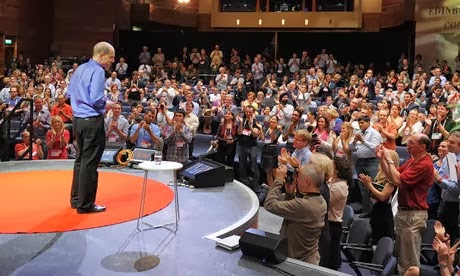
We Need to Talk About TED

In our culture, talking about the future is sometimes a polite way of saying things about the present that would otherwise be rude or risky.

But have you ever wondered why so little of the future promised in TED talks actually happens? So much potential and enthusiasm, and so little actual change. Are the ideas wrong? Or is the idea about what ideas can do all by themselves wrong?

I write about entanglements of technology and culture, how technologies enable the making of certain worlds, and at the same time how culture structures how those technologies will evolve, this way or that. It's where philosophy and design intersect.

So the conceptualization of possibilities is something that I take very seriously. That's why I, and many people, think it's way past time to take a step back and ask some serious questions about the intellectual viability of things like TED. (...)

So what is TED exactly?

Perhaps it's the proposition that if we talk about world-changing ideas enough, then the world will change. But this is not true, and that's the second problem.

TED of course stands for Technology, Entertainment, Design, and I'll talk a bit about all three. I Think TED actually stands for: middlebrow megachurch infotainment.

The key rhetorical device for TED talks is a combination of epiphany and personal testimony (an "epiphimony" if you like ) through which the speaker shares a personal journey of insight and realisation, its triumphs and tribulations.

What is it that the TED audience hopes to get from this? A vicarious insight, a fleeting moment of wonder, an inkling that maybe it's all going to work out after all? A spiritual buzz?

I'm sorry but this fails to meet the challenges that we are supposedly here to confront. These are complicated and difficult and are not given to tidy just-so solutions. They don't care about anyone's experience of optimism. Given the stakes, making our best and brightest waste their time – and the audience's time – dancing like infomercial hosts is too high a price. It is cynical.

Also, it just doesn't work.

by Benjamin Bratton, The Guardian |  Read more:
Image: James Duncan Davidson/TED

Monday, December 30, 2013


Dieter Roth and Björn Roth 

via:

Camila Moreno / Incendie

Preste Atenção


via:
[ed. Or one generation plants the weeds, and another gets the weedwhacker.]

Ken Price (American, 1935-2012), Untitled, 1991
via:

He Ain't Going Nowhere


The title track to Guy Clark’s most recent album, My Favorite Picture of You, may be the finest song he’s ever written. This is no small feat. For one thing, there’s his catalog to consider. Guy wrote “L.A. Freeway,” one of American music’s greatest driving songs and the final word for small-town troubadours on the false allure of big cities. His lyrical detail in “Desperados Waiting for a Train” and “Texas, 1947” presents a view of life in postwar West Texas that is as true as Dorothea Lange’s best Dust Bowl portraiture. When he wrote about the one possession of his father’s that he wanted when his dad died in “The Randall Knife,” he made a universal statement about paternal love and respect. Bob Dylan lists Guy among his handful of favorite songwriters, and most of Nashville does too.

And then there’s the equally significant matter of his timing. Those songs were written in the seventies and eighties, when the hard-living coterie of Guy, Townes Van Zandt, and Jerry Jeff Walker was inventing the notion that a Texas singer-songwriter practiced his own distinct form of artistry, creating the niche in which disciples like Lyle Lovett, Steve Earle, and Robert Earl Keen would make their careers. Yet Guy penned “My Favorite Picture of You” a mere three years ago, just after turning 69, an age to which most of his contemporaries had chosen to coast, provided they were still living at all.

The song originated the way most of them do, with a line. A friend, Gordie Sampson, came to write at Guy’s West Nashville home and brought a hook list with him, a page of potential lines and titles. The two reviewed the list in Guy’s basement workshop, where he splits his time between writing and building guitars, sustaining himself on black coffee, peanut-butter crackers, hand-rolled cigarettes, and an occasional toke of boo. One wall is covered with shelves that hold some 1,500 cassette tapes of demos, live shows, and friends’ albums, and another wall holds luthier tools. The rest of the room is cluttered with the ephemera of his life, some of it stored in little clementine orange crates, the remainder hanging on the walls and scattered on tables. Guy is endlessly loyal, and each item carries a specific sentimental tie. There’s a tight portrait of Van Zandt taken by their friend Jim McGuire. A cane that artist Terry Allen found for him in Santa Fe. Every last piece of a fiddle that Guy smashed on a mantel in a drunken fit forty years ago and still means to repair. And on a stand-up table along the back wall, the actual Randall knife, along with others sent in by fans and a letter of thanks signed by the knife maker himself.

Guy sat across from Sampson at a workbench in the center of the room. A tall man with regal posture, he’s got an angular white mustache and soul patch, wavy gray hair that curls up at his collar, and a woodblock of a forehead that looms over deep-set blue eyes. His general expression is that of someone who’s thinking about something more important than you are. Or at least more interesting. (...)

In November Guy turned 72, but it must be noted that songwriter years, like dog years, aren’t the same as people years. Nashville writers of Guy’s era lived by a different set of rules than the rest of us. They didn’t punch a time clock. If they went for early-afternoon drinks on a weekday, they weren’t skipping out on work but fishing for lines, scribbling the best bits of conversation on cocktail napkins. When they passed a guitar around after the bars closed, ingesting whatever chemicals would carry them to dawn, they were soliciting reactions to new material, refining new songs. It wasn’t partying, it was writing. But it also wasn’t healthy, and while it may have kept them open to exotic ideas and experiences, it worked hell on their bodies. Those who couldn’t manage their appetites either quit drinking and drugging, like Steve Earle, or died, like the long list running from Hank Williams through Van Zandt. Somehow Guy always maintained just enough control to survive without stopping. And now he’s got a young man’s curious mind atop a body that’s fixing to turn 111.  (...)

Guy occupies a unique place among Nashville writers. His reputation is much like John Prine’s—a songwriter who has maintained a long creative career without an outlandish number of big hits. They both get referred to as songwriter’s songwriters, though as Guy told Garden and Gun last year, “It’s flattering, I guess, but you can’t make a f—ing living being a songwriter’s songwriter.” To be clear, Guy has written two country number ones, and his songs have been charting since the seventies, covered by everyone from Johnny Cash and Bobby Bare to Brad Paisley and Kenny Chesney. But it’s the way Guy has conducted his career, his refusal to write songs to anyone’s taste but his own, that has made him one of the most revered figures in Nashville.

by John Spong, Texas Monthly |  Read more:
Image: Wyatt McSpadden

Robert Rauschenberg, Arcanum XI", ur: "Arcanum suite". 1981
via: