Saturday, June 14, 2014


Friday, June 13, 2014
The Downsides of Being a Dad
“All of them told us their stories, and behind each of these stories looms the shadow of that formidable father, a stern, arrogant, and violent man, whose voice alone made Adolf cringe, and who would thrash his son unmercifully for any little reason.”
—John Gunther on Alois Hitler, Vanity Fair, September 1934
 There has been no greater villain in the story of mankind than the bad father. The one who hits or humiliates. The one who doesn’t show up. The one who leaves. The one who won’t (please, God) leave. The drunk or the liar or the condescending prick. Bad fathers have ruined more lives than famine and war put together, bruising and battering their sons and daughters emotionally, mentally, and/or physically and dooming them to repeat the cycle, generation after generation until kingdom come.
Men know this. We had friends growing up who had bad fathers, assholes on the sidelines or dinner-table tyrants, or perhaps we had or have one ourselves, the man whose voice alone makes us cringe. We understand the damage that a bad father can do, and we understand what things can and cannot be undone. And when the time comes, as it does for most of us, to have a child of our own, we feel the first measure of that responsibility, that weight, and we say, with confidence: Not us. We will do better. We will hug our kids and hold their hands. We will support and nurture. We will keep our voices down, and our hand, too. We’ll go to the games or recitals we can and we’ll feel guilty when we can’t. We’ll be there for bedtime and teacher conferences, and we’ll be home on the weekends. We’ll do everything we can to be everything they need, because that’s what it means to be a good father today, isn’t it?
Isn’t it?
“I think that adults now pay too much attention to their children at the expense of themselves. Parents close off interests or avenues that they formerly pursued that made them fuller and more interesting people. And they’re totally focused on their little ones, signing them up for every activity under the sun. They’re just all over them. It’s a little bit overdone, and it’s a little obnoxious.”
Yes, it’s helpful when you’re a politician to have a little one up on the bandstand with you (otherwise, well, the rumors...), and if you’re religiously inclined and spurn contraception, then, okay, kids might be unavoidable, but for the rest of us, it has never been practically easier or more socially acceptable to simply opt out of having a child altogether, and a growing number of us are instead choosing childless cohabitation or perpetual singledom or whatever Clooney has going on these days. More than any other time in modern or ancient history, we’ve got options.
Of those who are choosing to be fathers, though, and choosing to be what they consider to be good fathers—well, these guys are in it. We’re spending three times as many hours every week with our kids as men did in the ‘60s. (Two economists, Valerie and Garey Ramey, noted that among both mothers and fathers, “if the hours were valued at their market wage rate, the increase in childcare time would amount to over $300 billion per year.”) We’re twice as likely as our spouses to say we aren’t spending enough time with our kids, and, like our spouses, we’re nearly twice as likely to find “significant meaning” in child care than in our paid work. We’re the targets of big-balled advertisers from Chevy,Hyundai and VW to Google, Tide, Sears, and Dove; and even Major League Baseball is looking to profit from paternal insecurity and/or pride. We’re having fun with the musings of fellow dads—buying Adam Mansbach’s Go The Fuck to Sleep by the truckload; trying to pass Louis C.K.’s bad-dad riffs off as our own; “liking” the hell out of the recurring “Dadspin” feature on Deadspin.com (with one December post, about one kid’s“insane Christmas wish list,” clocking 3.3 million hits and huge viral play.) You’ve got America’s quarterback kissing and hugging his boys at the playground. You’ve got Snoop Dog coaching kid’s football. You’ve got the heir to the English throne, that Everest of emotional unavailability, saying he changes diapers. (He gets that from his mother.)
And you’ve got Tom Cruise. Last year he sued a tabloid, not for the usual reason he sues tabloids but because said tabloid had indicated Cruise had “abandoned” his daughter because he didn’t see her for a few months while he was busy shooting a movie overseas. (Not unlike—though, really, not at all like—how military personal and oilrig workers and untold many more are required to spend months away from their little ones. Cruise ended up dropping his suit.) Meanwhile, when Mets second baseman Daniel Murphy took a few days off after his son was born, Mike Francesa called paternity leave “a scam and a half” on air and his listeners lit into him for being out of touch, old-fashioned, old. That this wasn’t the NPR crowd parsing modes of patriarchy but a bunch of guys who argue about designated hitters might be the ultimate proof: more men are more active, and more interested, in being fathers today than at any time in anyone’s lifetime.
And this is all to the good—for the kids. Unless you’re a drunk or a bully, or merely one of the so-called helicopter parents who sow seeds of dependency and narcissism in your little centers of the universe, there is no evidence that being present in your kids’ lives is anything but a boon for them. But for you? Your stress levels will go through the roof, as will your odds of experiencing depression. Your physical health and social life will suffer. Your marriage could easily turn into one of those roommate situations you swore it would never become. And you might find yourself, late at night or in the shower or chauffeuring your kid to yet another lesson or practice, thinking that this wasn’t what you signed up for. That you love your children, and that you really would sacrifice anything for them, but that being the kind of father you want to be—a good father—involves too many sacrifices, too much compromise, too high a price.
Does thinking such thoughts make you a bad father?
Does it?
—John Gunther on Alois Hitler, Vanity Fair, September 1934
There has been no greater villain in the story of mankind than the bad father. The one who hits or humiliates. The one who doesn’t show up. The one who leaves. The one who won’t (please, God) leave. The drunk or the liar or the condescending prick. Bad fathers have ruined more lives than famine and war put together, bruising and battering their sons and daughters emotionally, mentally, and/or physically and dooming them to repeat the cycle, generation after generation until kingdom come.Men know this. We had friends growing up who had bad fathers, assholes on the sidelines or dinner-table tyrants, or perhaps we had or have one ourselves, the man whose voice alone makes us cringe. We understand the damage that a bad father can do, and we understand what things can and cannot be undone. And when the time comes, as it does for most of us, to have a child of our own, we feel the first measure of that responsibility, that weight, and we say, with confidence: Not us. We will do better. We will hug our kids and hold their hands. We will support and nurture. We will keep our voices down, and our hand, too. We’ll go to the games or recitals we can and we’ll feel guilty when we can’t. We’ll be there for bedtime and teacher conferences, and we’ll be home on the weekends. We’ll do everything we can to be everything they need, because that’s what it means to be a good father today, isn’t it?
Isn’t it?
“I think that adults now pay too much attention to their children at the expense of themselves. Parents close off interests or avenues that they formerly pursued that made them fuller and more interesting people. And they’re totally focused on their little ones, signing them up for every activity under the sun. They’re just all over them. It’s a little bit overdone, and it’s a little obnoxious.”
—An 81-one-year-old father and grandfather, February 2014It’s worth pointing out that nobody really needs to become a father at all anymore.
Yes, it’s helpful when you’re a politician to have a little one up on the bandstand with you (otherwise, well, the rumors...), and if you’re religiously inclined and spurn contraception, then, okay, kids might be unavoidable, but for the rest of us, it has never been practically easier or more socially acceptable to simply opt out of having a child altogether, and a growing number of us are instead choosing childless cohabitation or perpetual singledom or whatever Clooney has going on these days. More than any other time in modern or ancient history, we’ve got options.
Of those who are choosing to be fathers, though, and choosing to be what they consider to be good fathers—well, these guys are in it. We’re spending three times as many hours every week with our kids as men did in the ‘60s. (Two economists, Valerie and Garey Ramey, noted that among both mothers and fathers, “if the hours were valued at their market wage rate, the increase in childcare time would amount to over $300 billion per year.”) We’re twice as likely as our spouses to say we aren’t spending enough time with our kids, and, like our spouses, we’re nearly twice as likely to find “significant meaning” in child care than in our paid work. We’re the targets of big-balled advertisers from Chevy,Hyundai and VW to Google, Tide, Sears, and Dove; and even Major League Baseball is looking to profit from paternal insecurity and/or pride. We’re having fun with the musings of fellow dads—buying Adam Mansbach’s Go The Fuck to Sleep by the truckload; trying to pass Louis C.K.’s bad-dad riffs off as our own; “liking” the hell out of the recurring “Dadspin” feature on Deadspin.com (with one December post, about one kid’s“insane Christmas wish list,” clocking 3.3 million hits and huge viral play.) You’ve got America’s quarterback kissing and hugging his boys at the playground. You’ve got Snoop Dog coaching kid’s football. You’ve got the heir to the English throne, that Everest of emotional unavailability, saying he changes diapers. (He gets that from his mother.)
And you’ve got Tom Cruise. Last year he sued a tabloid, not for the usual reason he sues tabloids but because said tabloid had indicated Cruise had “abandoned” his daughter because he didn’t see her for a few months while he was busy shooting a movie overseas. (Not unlike—though, really, not at all like—how military personal and oilrig workers and untold many more are required to spend months away from their little ones. Cruise ended up dropping his suit.) Meanwhile, when Mets second baseman Daniel Murphy took a few days off after his son was born, Mike Francesa called paternity leave “a scam and a half” on air and his listeners lit into him for being out of touch, old-fashioned, old. That this wasn’t the NPR crowd parsing modes of patriarchy but a bunch of guys who argue about designated hitters might be the ultimate proof: more men are more active, and more interested, in being fathers today than at any time in anyone’s lifetime.
And this is all to the good—for the kids. Unless you’re a drunk or a bully, or merely one of the so-called helicopter parents who sow seeds of dependency and narcissism in your little centers of the universe, there is no evidence that being present in your kids’ lives is anything but a boon for them. But for you? Your stress levels will go through the roof, as will your odds of experiencing depression. Your physical health and social life will suffer. Your marriage could easily turn into one of those roommate situations you swore it would never become. And you might find yourself, late at night or in the shower or chauffeuring your kid to yet another lesson or practice, thinking that this wasn’t what you signed up for. That you love your children, and that you really would sacrifice anything for them, but that being the kind of father you want to be—a good father—involves too many sacrifices, too much compromise, too high a price.
Does thinking such thoughts make you a bad father?
Does it?
by Richard Dorment, Esquire | Read more:
Image: Getty

Why Physicists Make Up Stories in the Dark
For centuries, scientists studied light to comprehend the visible world. Why are things colored? What is a rainbow? How do our eyes work? And what is light itself? These are questions that preoccupied scientists and philosophers since the time of Aristotle, including Roger Bacon, Isaac Newton, Michael Faraday, Thomas Young, and James Clerk Maxwell.
 But in the late 19th century all that changed, and it was largely Maxwell’s doing. This was the period in which the whole focus of physics—then still emerging as a distinct scientific discipline—shifted from the visible to the invisible. Light itself was instrumental to that change. Not only were the components of light invisible “fields,” but light was revealed as merely a small slice of a rainbow extending far into the unseen.
Physics has never looked back. Today its theories and concepts are concerned largely with invisible entities: not only unseen force fields and insensible rays but particles too small to see even with the most advanced microscopes. We now know that our everyday perception grants us access to only a tiny fraction of reality. Telescopes responding to radio waves, infrared radiation, and X-rays have vastly expanded our view of the universe, while electron microscopes, X-ray beams, and other fine probes of nature’s granularity have unveiled the microworld hidden beyond our visual acuity. Theories at the speculative forefront of physics flesh out this unseen universe with parallel worlds and with mysterious entities named for their very invisibility: dark matter and dark energy.
This move beyond the visible has become a fundamental part of science’s narrative. But it’s a more complicated shift than we often appreciate. Making sense of what is unseen—of what lies “beyond the light”—has a much longer history in human experience. Before science had the means to explore that realm, we had to make do with stories that became enshrined in myth and folklore. Those stories aren’t banished as science advances; they are simply reinvented. Scientists working at the forefront of the invisible will always be confronted with gaps in knowledge, understanding, and experimental capability. In the face of those limits, they draw unconsciously on the imagery of the old stories. This is a necessary part of science, and these stories can sometimes suggest genuinely productive scientific ideas. But the danger is that we will start to believe them at face value, mistaking them for theories. (...)
Much the same consideration applies to the concept of “brane” (short for membrane) worlds. This arises from the most state-of-the-art variants of string theory, which attempt to explain all the known particles and forces in terms of ultra-tiny entities called strings, which can be envisioned as particles extended into little strands that vibrate. Most versions of the theory call for variables in the equations that seem to have the role of extra dimensions in space, so that string theory posits not four dimensions (of time and space) but 11. As physicist and writer Jim Baggott points out, “there is no experimental or observational basis for these assumptions”—the “extra dimensions” are just formal aspects of the equations. However, the latest versions of the theory suggest that these extra dimensions can be extremely large, constituting extra-dimensional branes that are potential repositories for alternative universes separated from our own like the stacked leaves of a book. Inevitably, there is an urge to imagine that these places too might be populated with sentient beings, although that’s optional. The point is that these brane worlds are nothing more than mathematical entities in speculative equations, incarnated, as it were, as invisible parallel universes.
Dark matter and dark energy are more directly motivated by observations of the real world. Dark matter is apparently needed to account for the gravitational effects that seem to come from parts of space where no ordinary matter is visible, or not enough to explain the tug. For example, rotating galaxies seem to have some additional source of gravitational attraction, beyond the visible stars and gas, that stops them from flying apart. The “lensing” effect where distant astrophysical objects get distorted by the gravitational warping of spacetime also seems to demand this invisible form of matter. But dark matter does not exist in the usual sense, in that it has not been seen and there are no theories that can convincingly explain or demand its existence. Dark energy too is a kind of “stuff” required to explain the acceleration of the universe’s expansion, discovered by astronomers observing far-away objects in the mid-1990s. But it is just a name for a puzzle, without any direct detection. (...)
Scientists, of course, are not just making things up, while leaning on the convenience of supposed invisibility. They are using dark matter and dark energy, and (if one is charitable) quantum many-worlds and branes, and other imperceptible and hypothetical realms, to perform an essential task: to plug gaps in their knowledge with notions they can grasp.
But in the late 19th century all that changed, and it was largely Maxwell’s doing. This was the period in which the whole focus of physics—then still emerging as a distinct scientific discipline—shifted from the visible to the invisible. Light itself was instrumental to that change. Not only were the components of light invisible “fields,” but light was revealed as merely a small slice of a rainbow extending far into the unseen.Physics has never looked back. Today its theories and concepts are concerned largely with invisible entities: not only unseen force fields and insensible rays but particles too small to see even with the most advanced microscopes. We now know that our everyday perception grants us access to only a tiny fraction of reality. Telescopes responding to radio waves, infrared radiation, and X-rays have vastly expanded our view of the universe, while electron microscopes, X-ray beams, and other fine probes of nature’s granularity have unveiled the microworld hidden beyond our visual acuity. Theories at the speculative forefront of physics flesh out this unseen universe with parallel worlds and with mysterious entities named for their very invisibility: dark matter and dark energy.
This move beyond the visible has become a fundamental part of science’s narrative. But it’s a more complicated shift than we often appreciate. Making sense of what is unseen—of what lies “beyond the light”—has a much longer history in human experience. Before science had the means to explore that realm, we had to make do with stories that became enshrined in myth and folklore. Those stories aren’t banished as science advances; they are simply reinvented. Scientists working at the forefront of the invisible will always be confronted with gaps in knowledge, understanding, and experimental capability. In the face of those limits, they draw unconsciously on the imagery of the old stories. This is a necessary part of science, and these stories can sometimes suggest genuinely productive scientific ideas. But the danger is that we will start to believe them at face value, mistaking them for theories. (...)
Much the same consideration applies to the concept of “brane” (short for membrane) worlds. This arises from the most state-of-the-art variants of string theory, which attempt to explain all the known particles and forces in terms of ultra-tiny entities called strings, which can be envisioned as particles extended into little strands that vibrate. Most versions of the theory call for variables in the equations that seem to have the role of extra dimensions in space, so that string theory posits not four dimensions (of time and space) but 11. As physicist and writer Jim Baggott points out, “there is no experimental or observational basis for these assumptions”—the “extra dimensions” are just formal aspects of the equations. However, the latest versions of the theory suggest that these extra dimensions can be extremely large, constituting extra-dimensional branes that are potential repositories for alternative universes separated from our own like the stacked leaves of a book. Inevitably, there is an urge to imagine that these places too might be populated with sentient beings, although that’s optional. The point is that these brane worlds are nothing more than mathematical entities in speculative equations, incarnated, as it were, as invisible parallel universes.
Dark matter and dark energy are more directly motivated by observations of the real world. Dark matter is apparently needed to account for the gravitational effects that seem to come from parts of space where no ordinary matter is visible, or not enough to explain the tug. For example, rotating galaxies seem to have some additional source of gravitational attraction, beyond the visible stars and gas, that stops them from flying apart. The “lensing” effect where distant astrophysical objects get distorted by the gravitational warping of spacetime also seems to demand this invisible form of matter. But dark matter does not exist in the usual sense, in that it has not been seen and there are no theories that can convincingly explain or demand its existence. Dark energy too is a kind of “stuff” required to explain the acceleration of the universe’s expansion, discovered by astronomers observing far-away objects in the mid-1990s. But it is just a name for a puzzle, without any direct detection. (...)
Scientists, of course, are not just making things up, while leaning on the convenience of supposed invisibility. They are using dark matter and dark energy, and (if one is charitable) quantum many-worlds and branes, and other imperceptible and hypothetical realms, to perform an essential task: to plug gaps in their knowledge with notions they can grasp.
by Philip Ball, Nautilus | Read more:
Image: Miko Maciaszek
Thursday, June 12, 2014
Billy Gibbons
[ed. No one would ever recognize Billy Gibbons without the beard. Which, I guess is a good thing.]

,+2000-2011..jpg)
When the Beat Goes Off
Rhythm pulses inside the brain of a Ghanaian drummer, sitting in a physics laboratory in Gottingen, Germany. His hands caress the skin of a bongo drum, guided by the metronome’s tick through his headphones. He plays for five minutes, filling the sterile lab environment with staccato sounds, as a team of physicists records him, searching for a pattern.
 But the researchers aren’t interested in what he does correctly — they are listening for his errors. Though the drummer is a professional, like all humans, his rhythm is imperfect. Each time his hand hits the drum, his beat falls ahead or behind the metronome by 10 to 20 milliseconds. On average, he anticipates the beat, and plays ahead of it, 16 milliseconds ahead — less than the time it takes a person to blink, or a dragonfly to flap its wings. What the physicists want to know is: Are these errors random, or correlated in a way that can be expressed by a mathematical law?
Rhythm research has implications for both audio engineering and neural clocks, said Holger Hennig, a postdoctoral fellow in the laboratory of Eric Heller in the Physics Department at Harvard, and first author of a study of the Ghanaian and other drummers in the journal Physics Today. Software for computer-generated music includes a “humanizing” function, which adds random deviations to the beat to give it a more human, “imperfect” feel. But these variations tend to make the music sound “off” and artificial. The fact that listeners are turned off by “humanized” music led Hennig and colleagues at the Max Planck Institute for Dynamics and Self-Organization in Germany to wonder whether human error in musical rhythm might show a pattern. Perhaps the “humanizing” features of computer-generated rhythms fail because they produce the wrong kind of errors — deviations unlike the kind humans produce. There are rhythms inherent in the human brain, which may affect our musical rhythm. The primal bio-rhythmin the neurons of the Ghanaian drummer might be echoed in the rhythm of his music, the physicists suspected.
When they analyzed the drummer’s playing statistically, Hennig and colleagues found that his errors were correlated across long timescales: tens of seconds to minutes. A given beat depended not just on the timing of the previous beat, but also on beats that occurred minutes before.
“You can have these trends,” said Hennig. “For example, the drummer plays ahead of the beat for 30 consecutive beats, while half a minute earlier, he tended to play slightly behind the metronome clicks. These trends are pleasant to the ear.”
The trends, Hennig found, are correlated: Patterns of fluctuations are likely to be repeated. “This property is found for short and long patterns — hence on different timescales, ” Hennig explained. “The pattern can be seen as a fractal — a self-similar structure.” Fractal patterns are the recurring shapes seen in snowflakes, the leaves of a fern, and “even the coastline of Britain,” Hennig said. “If you zoom into a fractal, you see something that looks similar to the whole thing again.” Deviations in human musical rhythms, like snowflakes and coastlines, are fractals.
But the researchers aren’t interested in what he does correctly — they are listening for his errors. Though the drummer is a professional, like all humans, his rhythm is imperfect. Each time his hand hits the drum, his beat falls ahead or behind the metronome by 10 to 20 milliseconds. On average, he anticipates the beat, and plays ahead of it, 16 milliseconds ahead — less than the time it takes a person to blink, or a dragonfly to flap its wings. What the physicists want to know is: Are these errors random, or correlated in a way that can be expressed by a mathematical law?Rhythm research has implications for both audio engineering and neural clocks, said Holger Hennig, a postdoctoral fellow in the laboratory of Eric Heller in the Physics Department at Harvard, and first author of a study of the Ghanaian and other drummers in the journal Physics Today. Software for computer-generated music includes a “humanizing” function, which adds random deviations to the beat to give it a more human, “imperfect” feel. But these variations tend to make the music sound “off” and artificial. The fact that listeners are turned off by “humanized” music led Hennig and colleagues at the Max Planck Institute for Dynamics and Self-Organization in Germany to wonder whether human error in musical rhythm might show a pattern. Perhaps the “humanizing” features of computer-generated rhythms fail because they produce the wrong kind of errors — deviations unlike the kind humans produce. There are rhythms inherent in the human brain, which may affect our musical rhythm. The primal bio-rhythmin the neurons of the Ghanaian drummer might be echoed in the rhythm of his music, the physicists suspected.
When they analyzed the drummer’s playing statistically, Hennig and colleagues found that his errors were correlated across long timescales: tens of seconds to minutes. A given beat depended not just on the timing of the previous beat, but also on beats that occurred minutes before.
“You can have these trends,” said Hennig. “For example, the drummer plays ahead of the beat for 30 consecutive beats, while half a minute earlier, he tended to play slightly behind the metronome clicks. These trends are pleasant to the ear.”
The trends, Hennig found, are correlated: Patterns of fluctuations are likely to be repeated. “This property is found for short and long patterns — hence on different timescales, ” Hennig explained. “The pattern can be seen as a fractal — a self-similar structure.” Fractal patterns are the recurring shapes seen in snowflakes, the leaves of a fern, and “even the coastline of Britain,” Hennig said. “If you zoom into a fractal, you see something that looks similar to the whole thing again.” Deviations in human musical rhythms, like snowflakes and coastlines, are fractals.
by Taylor Beck, Harvard Gazette | Read more:
Image: Agbenyega Attiogbe-Redlich
The Fall of Mosul and the False Promises of Modern History
The fall of Mosul to the radical, extremist Islamic State of Iraq and Syria (ISIS) is a set of historical indictments. Mosul is Iraq’s second largest city, population roughly 2 million (think Houston) until today, when much of the population was fleeing. While this would-be al-Qaeda affiliate took part of Falluja and Ramadi last winter, those are smaller, less consequential places and in Falluja tribal elders persuaded the prime minister not to commit the national army to reducing the city.
It is an indictment of the George W. Bush administration, which falsely said it was going into Iraq because of a connection between al-Qaeda and Baghdad. There was none. Ironically, by invading, occupying, weakening and looting Iraq, Bush and Cheney brought al-Qaeda into the country and so weakened it as to allow it actually to take and hold territory in our own time. They put nothing in place of the system they tore down. They destroyed the socialist economy without succeeding in building private firms or commerce. They put in place an electoral system that emphasizes religious and ethnic divisions. They helped provoke a civil war in 2006-2007, and took credit for its subsiding in 2007-2008, attributing it to a troop escalation of 30,000 men (not very plausible). In fact, the Shiite militias won the civil war on the ground, turning Baghdad into a largely Shiite city and expelling many Sunnis to places like Mosul. There are resentments.
Those who will say that the US should have left troops in Iraq do not say how that could have happened. The Iraqi parliament voted against it. There was never any prospect in 2011 of the vote going any other way. Because the US occupation of Iraq was horrible for Iraqis and they resented it. Should the Obama administration have reinvaded and treated the Iraqi parliament the way Gen. Bonaparte treated the French one?

I hasten to say that the difficulty Baghdad is having with keeping Mosul is also an indictment of the Saddam Hussein regime (1979-2003), which pioneered the tactic of sectarian rule, basing itself on a Sunni-heavy Baath Party in the center-north and largely neglecting or excluding the Shiite South. Now the Shiites have reversed that strategy, creating a Baghdad-Najaf-Basra power base.
Mosul’s changed circumstances are also an indictment of the irresponsible use to which Sunni fundamentalists in Kuwait, Saudi Arabia and elsewhere in the Oil Gulf are putting their riches. The high petroleum prices, usually over $100 a barrel, of the past few years in a row, have injected trillions of dollars into the Gulf. Some of that money has sloshed into the hands of people who rather admired Usama Bin Laden and who are perfectly willing to fund his clones to take over major cities like Aleppo and Mosul. The vaunted US Treasury Department ability to stop money transfers by people whom Washington does not like has faltered in this case. Is it because Washington is de facto allied with the billionaire Salafis of Kuwait City in Syria, where both want to see the Bashar al-Assad government overthrown and Iran weakened? The descent of the US into deep debt, and the emergence of Gulf states and sovereign wealth funds is a tremendous shift of geopolitical power to Riyadh, Kuwait City and Abu Dhabi, who can now simply buy Egyptian domestic and foreign policy away from Washington. They are also trying to buy a Salafi State of Syria and a Salafi state of northern and western Iraq.
It is an indictment of the George W. Bush administration, which falsely said it was going into Iraq because of a connection between al-Qaeda and Baghdad. There was none. Ironically, by invading, occupying, weakening and looting Iraq, Bush and Cheney brought al-Qaeda into the country and so weakened it as to allow it actually to take and hold territory in our own time. They put nothing in place of the system they tore down. They destroyed the socialist economy without succeeding in building private firms or commerce. They put in place an electoral system that emphasizes religious and ethnic divisions. They helped provoke a civil war in 2006-2007, and took credit for its subsiding in 2007-2008, attributing it to a troop escalation of 30,000 men (not very plausible). In fact, the Shiite militias won the civil war on the ground, turning Baghdad into a largely Shiite city and expelling many Sunnis to places like Mosul. There are resentments.
Those who will say that the US should have left troops in Iraq do not say how that could have happened. The Iraqi parliament voted against it. There was never any prospect in 2011 of the vote going any other way. Because the US occupation of Iraq was horrible for Iraqis and they resented it. Should the Obama administration have reinvaded and treated the Iraqi parliament the way Gen. Bonaparte treated the French one?

I hasten to say that the difficulty Baghdad is having with keeping Mosul is also an indictment of the Saddam Hussein regime (1979-2003), which pioneered the tactic of sectarian rule, basing itself on a Sunni-heavy Baath Party in the center-north and largely neglecting or excluding the Shiite South. Now the Shiites have reversed that strategy, creating a Baghdad-Najaf-Basra power base.
Mosul’s changed circumstances are also an indictment of the irresponsible use to which Sunni fundamentalists in Kuwait, Saudi Arabia and elsewhere in the Oil Gulf are putting their riches. The high petroleum prices, usually over $100 a barrel, of the past few years in a row, have injected trillions of dollars into the Gulf. Some of that money has sloshed into the hands of people who rather admired Usama Bin Laden and who are perfectly willing to fund his clones to take over major cities like Aleppo and Mosul. The vaunted US Treasury Department ability to stop money transfers by people whom Washington does not like has faltered in this case. Is it because Washington is de facto allied with the billionaire Salafis of Kuwait City in Syria, where both want to see the Bashar al-Assad government overthrown and Iran weakened? The descent of the US into deep debt, and the emergence of Gulf states and sovereign wealth funds is a tremendous shift of geopolitical power to Riyadh, Kuwait City and Abu Dhabi, who can now simply buy Egyptian domestic and foreign policy away from Washington. They are also trying to buy a Salafi State of Syria and a Salafi state of northern and western Iraq.
by Juan Cole, Informed Comment | Read more:
Image: uncredited
The Sneaker Comes of Age
When Christopher Tennant, the editor of the magazine Man of the World, met up with his future in-laws a few months ago at JoJo, an Upper East Side restaurant, he wore a navy blazer from Barneys New York, olive slacks and — what else? — a pair of sneakers by Common Projects.
 “I always wear sneakers,” he said.
When Jian DeLeon, the deputy style editor at Complex magazine, went to the ballet last month, he paired a plaid suit with white sneakers by the Amsterdam brand ETQ, which he said feel “just as luxe as a pair of oxfords, and are 10 times more comfortable.”
And when Tyler Thoreson, the head of men’s editorial for Gilt Groupe, appeared recently on NBC’s “Today” to talk fashion, he wore a custom blue suit, a white dress shirt and navy blue sneakers, also by Common Projects. His wardrobe has become so sneaker-centric, he said, that “when I put a suit on, I have to think twice: ‘Oh, maybe I’ll mix it up and throw on my wingtips today.’
The once ungentlemanly sneaker, it seems, has undergone a fashion baptism. The distinction between dress and athletic shoes is on the verge of collapse for fashion-forward men, as the humble gym shoe has outgrown its youth-culture/streetwear origins to become a fashion accessory, as well as a staple on runways, red carpets and in the workplace, where it is no longer considered the height of quirk to wear them with a suit.
The boundaries of acceptability in casual footwear are shifting so quickly that Cary Grant himself, if he were to rise from the dead, would hardly look out of place with a pair of Adidas Stan Smiths poking from the cuffs of his glen-check Kilgour suit.
“At some point in the last two years, all the guys being photographed by The Sartorialist and Tommy Ton went from wearing Alden boots and double monk-strap shoes to Nike Roshes and retro New Balances,” said Brad Bennett, who runs the men’s style blog Well Spent. “It was almost as though some decree had been handed down by New York City’s fashion elite.”
“I always wear sneakers,” he said.When Jian DeLeon, the deputy style editor at Complex magazine, went to the ballet last month, he paired a plaid suit with white sneakers by the Amsterdam brand ETQ, which he said feel “just as luxe as a pair of oxfords, and are 10 times more comfortable.”
And when Tyler Thoreson, the head of men’s editorial for Gilt Groupe, appeared recently on NBC’s “Today” to talk fashion, he wore a custom blue suit, a white dress shirt and navy blue sneakers, also by Common Projects. His wardrobe has become so sneaker-centric, he said, that “when I put a suit on, I have to think twice: ‘Oh, maybe I’ll mix it up and throw on my wingtips today.’
The once ungentlemanly sneaker, it seems, has undergone a fashion baptism. The distinction between dress and athletic shoes is on the verge of collapse for fashion-forward men, as the humble gym shoe has outgrown its youth-culture/streetwear origins to become a fashion accessory, as well as a staple on runways, red carpets and in the workplace, where it is no longer considered the height of quirk to wear them with a suit.
The boundaries of acceptability in casual footwear are shifting so quickly that Cary Grant himself, if he were to rise from the dead, would hardly look out of place with a pair of Adidas Stan Smiths poking from the cuffs of his glen-check Kilgour suit.
“At some point in the last two years, all the guys being photographed by The Sartorialist and Tommy Ton went from wearing Alden boots and double monk-strap shoes to Nike Roshes and retro New Balances,” said Brad Bennett, who runs the men’s style blog Well Spent. “It was almost as though some decree had been handed down by New York City’s fashion elite.”
by Alex Williams, NY Times | Read more:
Image: Tony Cenicola
Wednesday, June 11, 2014
Vinyl Re-enchantment
The Economist‘s website has an article about Record Store Day, a marketing stunt during which a bunch of vinyl-only releases and reissues are choreographed in hopes of driving music buyers to support some brick-and-mortar businesses. Every label wants to piggy-back on the hype of every other release, leading to an overwhelming hodge-podge of material record stores are supposed to carry to be full participants in the event. This creates problems for the stores that the event is supposed to help, saddling them with stock whose appeal to non-hardcore record collectors may already be questionable.
I have never understood the point of Record Store Day, in part because I have not traditionally been sentimental about record stores. I tend to associate them with judgmental clerks and aggressive taste peacocking and stereos playing the most confrontational music the workers could get away with to keep the store clear of unwanted browsers. Independent record stores often seemed more like clubhouses, and I was never confident enough in my tastes to believe I could truly belong. The record store was a place where “nerds” could be vengeful bullies; now that we have a whole culture that is like that, record stores feel a bit redundant in that respect.
 But the more salient reason Record Store Day repels me is that it runs counter to what I do find appealing about shopping in small record stores, the fact that I can’t predict what they will actually have in stock. Record Store Day supplies you with a prefab shopping list and an easy way to cross off every item on it — just come early (or have a friend who works at the store; it’s still a private club, a market in which it matters who you know). If I wanted to shop in a market that I knew in advance would have what I want, I would go on to Amazon, or to Spotify. But I started to buy vinyl again not for the records so much as for the intermittent rewards. Going to a used record store not knowing what I will find allows me to go in not knowing for sure even what I want — and this expands my capacity for desiring things. It re-enchants consumption for me, for better or worse. I have a list in my head of records I hope to come across some day, but since I can download all this music to actually listen to it, I am more invested in the quest itself than its completion. It keeps me flipping through crates, looking for a lottery-like payout.
Record stores are a bit like thrift stores in that they produce a sense of rarity and serendipity, a shopping experience that can trump whatever it is one ends up buying. When I go to record stores, I want to enter into a fantasy of one-of-a-kind finds, of consumption sweetened by its contrived precariousness. I want to pretend I’m in a world where you have to earn your consumer pleasures, and where the bond between pleasure and ownership is still tight. (This is a depressing realization.) It’s not uncommon for me to be so excited about coming across a record I love that I’ll buy it again, “forgetting” that I already have a vinyl copy. (...)
My craving for these purely idiosyncratic consumption experiences has something to do with wanting to enjoy something unsharable, something that can’t go viral, as though that might authenticate it in the solipsistic counter-reality I try to create for myself. The curator of the Oakland exhibition remarks that albums, as material objects, places the emphasis on music appreciation’s “social aspect,” but I think that’s backward. I want to use records to prove that I am “better” than those social pleasures of validation that are now so readily sought for online. I want records so I can try to remind myself that I can get autonomous joy from a private world of things.
I have never understood the point of Record Store Day, in part because I have not traditionally been sentimental about record stores. I tend to associate them with judgmental clerks and aggressive taste peacocking and stereos playing the most confrontational music the workers could get away with to keep the store clear of unwanted browsers. Independent record stores often seemed more like clubhouses, and I was never confident enough in my tastes to believe I could truly belong. The record store was a place where “nerds” could be vengeful bullies; now that we have a whole culture that is like that, record stores feel a bit redundant in that respect.
But the more salient reason Record Store Day repels me is that it runs counter to what I do find appealing about shopping in small record stores, the fact that I can’t predict what they will actually have in stock. Record Store Day supplies you with a prefab shopping list and an easy way to cross off every item on it — just come early (or have a friend who works at the store; it’s still a private club, a market in which it matters who you know). If I wanted to shop in a market that I knew in advance would have what I want, I would go on to Amazon, or to Spotify. But I started to buy vinyl again not for the records so much as for the intermittent rewards. Going to a used record store not knowing what I will find allows me to go in not knowing for sure even what I want — and this expands my capacity for desiring things. It re-enchants consumption for me, for better or worse. I have a list in my head of records I hope to come across some day, but since I can download all this music to actually listen to it, I am more invested in the quest itself than its completion. It keeps me flipping through crates, looking for a lottery-like payout.Record stores are a bit like thrift stores in that they produce a sense of rarity and serendipity, a shopping experience that can trump whatever it is one ends up buying. When I go to record stores, I want to enter into a fantasy of one-of-a-kind finds, of consumption sweetened by its contrived precariousness. I want to pretend I’m in a world where you have to earn your consumer pleasures, and where the bond between pleasure and ownership is still tight. (This is a depressing realization.) It’s not uncommon for me to be so excited about coming across a record I love that I’ll buy it again, “forgetting” that I already have a vinyl copy. (...)
My craving for these purely idiosyncratic consumption experiences has something to do with wanting to enjoy something unsharable, something that can’t go viral, as though that might authenticate it in the solipsistic counter-reality I try to create for myself. The curator of the Oakland exhibition remarks that albums, as material objects, places the emphasis on music appreciation’s “social aspect,” but I think that’s backward. I want to use records to prove that I am “better” than those social pleasures of validation that are now so readily sought for online. I want records so I can try to remind myself that I can get autonomous joy from a private world of things.
by Rob Horning, Marginal Utility | Read more:
Image: uncredited


College Radio is Dying
WRAS 88.5 FM in Atlanta was the first radio station to play Outkast. It was one of the first few stations in the country to play R.E.M., Deerhunter and the Indigo Girls. It’s been a crucial, student-run force in independent music both locally and nationally for decades. But later this month, a backdoor deal will replace all of its daytime programming with “Fresh Air” simulcasts and “Car Talk” reruns.
 This is a huge blow for the students who run WRAS, for Atlanta’s art and music communities and for the entire independent music industry. WRAS is one of the most powerful college radio stations in the nation. Its signal is as strong as the law will allow; those 100,000 watts cover all of Atlanta’s sprawling metropolitan area. And the closure of WRAS is just the latest in a long string of colleges failing to preserve their cultural institutions and selling their radio signals off to outside interests. It happened at Rice in 2011, at Vanderbilt between 2011 and 2014, and now it’s happening at Georgia State University, home of one of the most important college radio stations in the nation.
In early May, GSU announced an agreement to hand over WRAS’s signal to Georgia Public Broadcasting for 14 hours a day, from 5 a.m. to 7 p.m. The student-produced programming that WRAS has broadcast during those hours since 1971 will now be confined to an Internet stream. The students who run the station weren’t included in negotiations, which stretch back to 2012. The station’s student management only learned about the deal shortly before the public did. The larger GSU student body didn’t get to vote on the deal or have any input in the agreement. It feels similar to another recent ugly scene in Atlanta, as the neighboring Cobb County resorted to banana republic tactics to squelch public debate on its plan to give the Atlanta Braves hundreds of millions of dollars for a new stadium.
Since 1971, WRAS has played a mix of new independent rock, hip-hop, experimental noise and electronic music that’s played by no other radio station in Atlanta. WRAS is programmed and hosted by students who otherwise wouldn’t have any opportunity to DJ on FM radio, and it aids local arts and music communities by promoting upcoming events and giving away tickets. (...)
Although GPB has touted new educational possibilities for GSU students as part of the agreement, along with an expanded NPR presence in the city, it’s hard to see how this deal is good for either the students or Atlanta. The students are losing 98 hours of terrestrial radio a week, including the hours that draw the largest audiences. 88.5 might attract more listeners with NPR stalwarts than obscure indie rock or specialty shows devoted to reggae or hardcore, but non-commercial radio stations traditionally aren’t concerned with ratings, and the listener base for student programming will immediately plummet when it’s walled away online.
The demise of WRAS is bigger than Georgia State or even Atlanta. Today college radio is threatened by the same forces that undermine the commercial radio industry. The Internet has upended the entire notion of radio, as listeners can find almost anything they want at any moment. Satellite radio has eaten into the audience for local stations during drive-time hours. Younger listeners don’t grow up with a love for college radio, and thus don’t go out of their way to volunteer at a station when they’re in school, which leads to the increasingly common sound of older voices on the college frequency as community members fill in the gaps on the schedule.
Before the Internet conquered the world, college radio was the most reliable way to hear new underground music. Seventies punk grew into ’80s college rock and ’90s indie rock in seclusion at the left end of the FM dial, while the commercial radio stations and mainstream music industry that so smugly dismissed them chased trends and cycled through formats. College radio filled a vital gap, and although it has diminished in the face of 21st century technology, college radio stations are still as valuable as ever.
This is a huge blow for the students who run WRAS, for Atlanta’s art and music communities and for the entire independent music industry. WRAS is one of the most powerful college radio stations in the nation. Its signal is as strong as the law will allow; those 100,000 watts cover all of Atlanta’s sprawling metropolitan area. And the closure of WRAS is just the latest in a long string of colleges failing to preserve their cultural institutions and selling their radio signals off to outside interests. It happened at Rice in 2011, at Vanderbilt between 2011 and 2014, and now it’s happening at Georgia State University, home of one of the most important college radio stations in the nation.In early May, GSU announced an agreement to hand over WRAS’s signal to Georgia Public Broadcasting for 14 hours a day, from 5 a.m. to 7 p.m. The student-produced programming that WRAS has broadcast during those hours since 1971 will now be confined to an Internet stream. The students who run the station weren’t included in negotiations, which stretch back to 2012. The station’s student management only learned about the deal shortly before the public did. The larger GSU student body didn’t get to vote on the deal or have any input in the agreement. It feels similar to another recent ugly scene in Atlanta, as the neighboring Cobb County resorted to banana republic tactics to squelch public debate on its plan to give the Atlanta Braves hundreds of millions of dollars for a new stadium.
Since 1971, WRAS has played a mix of new independent rock, hip-hop, experimental noise and electronic music that’s played by no other radio station in Atlanta. WRAS is programmed and hosted by students who otherwise wouldn’t have any opportunity to DJ on FM radio, and it aids local arts and music communities by promoting upcoming events and giving away tickets. (...)
Although GPB has touted new educational possibilities for GSU students as part of the agreement, along with an expanded NPR presence in the city, it’s hard to see how this deal is good for either the students or Atlanta. The students are losing 98 hours of terrestrial radio a week, including the hours that draw the largest audiences. 88.5 might attract more listeners with NPR stalwarts than obscure indie rock or specialty shows devoted to reggae or hardcore, but non-commercial radio stations traditionally aren’t concerned with ratings, and the listener base for student programming will immediately plummet when it’s walled away online.
The demise of WRAS is bigger than Georgia State or even Atlanta. Today college radio is threatened by the same forces that undermine the commercial radio industry. The Internet has upended the entire notion of radio, as listeners can find almost anything they want at any moment. Satellite radio has eaten into the audience for local stations during drive-time hours. Younger listeners don’t grow up with a love for college radio, and thus don’t go out of their way to volunteer at a station when they’re in school, which leads to the increasingly common sound of older voices on the college frequency as community members fill in the gaps on the schedule.
Before the Internet conquered the world, college radio was the most reliable way to hear new underground music. Seventies punk grew into ’80s college rock and ’90s indie rock in seclusion at the left end of the FM dial, while the commercial radio stations and mainstream music industry that so smugly dismissed them chased trends and cycled through formats. College radio filled a vital gap, and although it has diminished in the face of 21st century technology, college radio stations are still as valuable as ever.
by Garrett Martin, Salon | Read more:
Image: Rough Trade/Tom Sheehan/Elektra Entertainment
Dixie Zen: On the Laid-back Art of Tubing

The point is that Louisiana’s heat is inescapable and aggressive. It dominates life to such an extent that you start to think consciously about things that are, in friendlier climates, unremarkable: breathing, for instance, and blood circulation. You start to strategize about walking, replacing it whenever possible with sprints from one air-conditioned building to the next. Life—restricted to the biosphere of your house and the local supermarket—begins to seem like an endurance experiment engineered by NASA.
This means that, from June to September, Louisiana’s outdoors are off-limits. Activities that would have been pleasant diversions to the tropical fall or the temperate winter—hiking, biking, tracking weird birds with binoculars—become exercises in instant dehydration. Fortunately, however, the state comes with its own cooling system: It is one of the wettest in the nation, soaked by patchy marshes and Rorschach lakes, which are in turn drained and filled by an extensive network of mostly hospitable rivers. In all, Louisiana is more than twenty percent water, and through several millennia of absurdly hot summers residents have found ways to squeeze into the state’s aquatic fifth by boating, skiing, swimming, fishing, and sportively dodging things with sharp teeth. In my experience, the most effective antidote to the heat is what I like to consider the unofficial summer sport of the South: tubing. Other parts of the country tube too, of course, but they may as well be knitting. In Oregon or Nebraska, tubing is just an incidentally wet version of a stroll in the woods, the spiritual equivalent of a hundred other outdoor leisure activities. In the South, it represents one of the only possible escapes from a greenhouse climate threatening to replace human life with ferns. Southerners are forced to tube.
by Sam Anderson, Oxford American | Read more:
Image: Debbie Fleming Caffery, courtesy of the Octavia Gallery
Tuesday, June 10, 2014
Judge Strikes Down California Tenure
[ed. See also: The Issue of Tenure for Teachers]
A judge struck down tenure and other job protections for California's public school teachers as unconstitutional Tuesday, saying such laws harm students - especially poor and minority ones - by saddling them with bad teachers who are almost impossible to fire.
In a landmark decision that could influence the gathering debate over tenure across the country, Los Angeles County Superior Court Judge Rolf Treu cited the historic case of Brown v. Board of Education in ruling that students have a fundamental right to equal education.
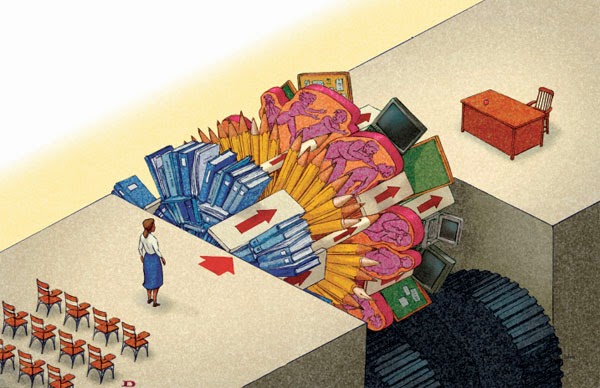 Siding with the nine students who brought the lawsuit, he ruled that California's laws on hiring and firing in schools have resulted in "a significant number of grossly ineffective teachers currently active in California classrooms."
He agreed, too, that a disproportionate number of these teachers are in schools that have mostly minority and low-income students.
The judge stayed the ruling pending appeals. The case involves 6 million students from kindergarten through 12th grade.
The California Attorney General's office said it is considering its legal options, while the California Teachers Association, the state's biggest teachers union with 325,000 members, vowed an appeal.
"Circumventing the legislative process to strip teachers of their professional rights hurts our students and our schools," the union said.
Teachers have long argued that tenure prevents administrators from firing teachers on a whim. They contend also that the system preserves academic freedom and helps attract talented teachers to a profession that doesn't pay well.
Other states have been paying close attention to how the case plays out in the nation's most populous state.
"It's powerful," said Theodore Boutrous Jr., the students' attorney. "It's a landmark decision that can change the face of education in California and nationally."
He added: "This is going to be a huge template for what's wrong with education."
The lawsuit was backed by wealthy Silicon Valley entrepreneur David Welch's nonprofit group Students Matter, which assembled a high-profile legal team including Boutrous, who successfully fought to overturn California's gay-marriage ban.
In an interview following the decision, Welch tried to open a door to working with teachers' unions, but the enmity of the two sides intensified.
"Inherently it is not a battle with the teachers union. It's a battle with the education system," Welch said. "Unfortunately, the teachers union has decided that the rights of children are not their priority."
He said he hoped union leaders can eventually work with his group to put in place a system that ensures children get a better education.
But the unions were having none of it.
Dennis Van Roekel, president of the National Education Association, the nation's biggest teachers union, bitterly criticized the lawsuit as "yet another attempt by millionaires and corporate special interests to undermine the teaching profession" and privatize public education. (...)
The trial represented the latest battle in a nationwide movement to abolish or toughen the standards for granting teachers permanent employment protection and seniority-based preferences during layoffs.
A judge struck down tenure and other job protections for California's public school teachers as unconstitutional Tuesday, saying such laws harm students - especially poor and minority ones - by saddling them with bad teachers who are almost impossible to fire.
In a landmark decision that could influence the gathering debate over tenure across the country, Los Angeles County Superior Court Judge Rolf Treu cited the historic case of Brown v. Board of Education in ruling that students have a fundamental right to equal education.
Siding with the nine students who brought the lawsuit, he ruled that California's laws on hiring and firing in schools have resulted in "a significant number of grossly ineffective teachers currently active in California classrooms."He agreed, too, that a disproportionate number of these teachers are in schools that have mostly minority and low-income students.
The judge stayed the ruling pending appeals. The case involves 6 million students from kindergarten through 12th grade.
The California Attorney General's office said it is considering its legal options, while the California Teachers Association, the state's biggest teachers union with 325,000 members, vowed an appeal.
"Circumventing the legislative process to strip teachers of their professional rights hurts our students and our schools," the union said.
Teachers have long argued that tenure prevents administrators from firing teachers on a whim. They contend also that the system preserves academic freedom and helps attract talented teachers to a profession that doesn't pay well.
Other states have been paying close attention to how the case plays out in the nation's most populous state.
"It's powerful," said Theodore Boutrous Jr., the students' attorney. "It's a landmark decision that can change the face of education in California and nationally."
He added: "This is going to be a huge template for what's wrong with education."
The lawsuit was backed by wealthy Silicon Valley entrepreneur David Welch's nonprofit group Students Matter, which assembled a high-profile legal team including Boutrous, who successfully fought to overturn California's gay-marriage ban.
In an interview following the decision, Welch tried to open a door to working with teachers' unions, but the enmity of the two sides intensified.
"Inherently it is not a battle with the teachers union. It's a battle with the education system," Welch said. "Unfortunately, the teachers union has decided that the rights of children are not their priority."
He said he hoped union leaders can eventually work with his group to put in place a system that ensures children get a better education.
But the unions were having none of it.
Dennis Van Roekel, president of the National Education Association, the nation's biggest teachers union, bitterly criticized the lawsuit as "yet another attempt by millionaires and corporate special interests to undermine the teaching profession" and privatize public education. (...)
The trial represented the latest battle in a nationwide movement to abolish or toughen the standards for granting teachers permanent employment protection and seniority-based preferences during layoffs.
by Linda Deutsch, Yahoo News | Read more:
Image:

How Much Does It Hurt?
Even before a single doctor in the United States had written a prescription for Zohydro, the controversial long-acting painkiller approved by the Food and Drug Administration last October, potential users were already dreaming up possible street names. “How many times will this be said in the future,” someone posted on Opiophile, an online forum for people who like to share their drug experiences and expertise. “Got any of dem Zoh’s?” There were other possibilities: Zs, Zodros, and Zorros.
Another voiced chimed in: “I like Zorros … Yeah, has a ring to it.” This was on October 26, 2013, less than 24 hours after the FDA announced its decision. (...)
 In the annals of new-drug rollouts, Zohydro seems to be in a class by itself. It has become a political nightmare for the drug’s manufacturer, Zogenix, Inc., and for the FDA—Massachusetts tried to ban it; the attorneys general of 28 states excoriated the FDA for approving the drug without “tamper-resistant” features, a decision Senator Charles Schumer of New York has called “baffling”; and Senator Joe Manchin of West Virginia has introduced legislation to roll back the approval. It has inspired apocalyptic warnings, mostly because Zohydro belongs to a class of drugs that the Centers for Disease Control and Prevention said in 2011 has created a nationwide, doctor-driven epidemic of addiction, death (roughly 16,000 a year), and unquantifiable familial devastation. And yet, so far, it has been nearly invisible—as of March 31, the company reported exactly 1,141 prescriptions filled nationwide.
“Watchful waiting” is a time-honored term in medicine, and it is the perfect phrase to describe the collective sense of anxiety, dread, and fatalism playing out as Zohydro slowly makes its way to pharmacies and ultimately into medicine cabinets. Zohydro is neither the first long-acting opioid painkiller nor, milligram per milligram, the most potent, so why all the fuss? Part of the concern is that because the drug is an extended-release formulation, it packs up to 50 milligrams of hydrocodone in a single capsule (Vicodin, the more familiar, instant-release version of hydrocodone, tops out at 10 milligrams per pill). And since it does not come in a tamper-resistant formulation, addicts can theoretically crush and snort or inject it to get an instant high from all 50 milligrams at once. OxyContin, the most infamous of prescription opioids and the main protagonist in the painkiller epidemic, did not come in a tamper-resistant formulation until 2010. By then, it had been implicated in thousands of overdose deaths since it hit the market in 1996.
It was precisely those fears that unnerved a panel of pain experts convened by the FDA to consider Zohydro 18 months ago. “Are we really, in the long run, helping people, or are we creating an epidemic?” asked one. As another briskly put it, “There are too many deaths already.”
Another voiced chimed in: “I like Zorros … Yeah, has a ring to it.” This was on October 26, 2013, less than 24 hours after the FDA announced its decision. (...)
In the annals of new-drug rollouts, Zohydro seems to be in a class by itself. It has become a political nightmare for the drug’s manufacturer, Zogenix, Inc., and for the FDA—Massachusetts tried to ban it; the attorneys general of 28 states excoriated the FDA for approving the drug without “tamper-resistant” features, a decision Senator Charles Schumer of New York has called “baffling”; and Senator Joe Manchin of West Virginia has introduced legislation to roll back the approval. It has inspired apocalyptic warnings, mostly because Zohydro belongs to a class of drugs that the Centers for Disease Control and Prevention said in 2011 has created a nationwide, doctor-driven epidemic of addiction, death (roughly 16,000 a year), and unquantifiable familial devastation. And yet, so far, it has been nearly invisible—as of March 31, the company reported exactly 1,141 prescriptions filled nationwide.“Watchful waiting” is a time-honored term in medicine, and it is the perfect phrase to describe the collective sense of anxiety, dread, and fatalism playing out as Zohydro slowly makes its way to pharmacies and ultimately into medicine cabinets. Zohydro is neither the first long-acting opioid painkiller nor, milligram per milligram, the most potent, so why all the fuss? Part of the concern is that because the drug is an extended-release formulation, it packs up to 50 milligrams of hydrocodone in a single capsule (Vicodin, the more familiar, instant-release version of hydrocodone, tops out at 10 milligrams per pill). And since it does not come in a tamper-resistant formulation, addicts can theoretically crush and snort or inject it to get an instant high from all 50 milligrams at once. OxyContin, the most infamous of prescription opioids and the main protagonist in the painkiller epidemic, did not come in a tamper-resistant formulation until 2010. By then, it had been implicated in thousands of overdose deaths since it hit the market in 1996.
It was precisely those fears that unnerved a panel of pain experts convened by the FDA to consider Zohydro 18 months ago. “Are we really, in the long run, helping people, or are we creating an epidemic?” asked one. As another briskly put it, “There are too many deaths already.”
by Stephen S. Hall, New York Magazine | Read more:
Image: Bobby Doherty

Subscribe to:
Posts (Atom)