Wednesday, January 14, 2015


When I Grow Up
The theme-park chain where children pretend to be adults.
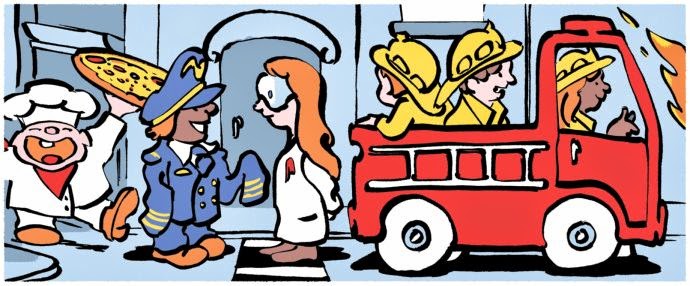 Several decades ago, the district of Santa Fe, on the western edge of Mexico City, was an industrial zone devoted to strip-mining. After the gravel and sand pits were depleted, they became enormous garbage dumps where scavengers roamed. In the nineties, the government initiated a reclamation project, and the area is now filled with high-rise condominiums, luxury hotels, and office towers occupied by multinationals, set along manicured highways that are free of trash or pedestrians. In the middle of this invented neighborhood is the Centro Santa Fe mall, one of the largest in Latin America. With more than five hundred stores and an indoor skating rink, it draws twenty-two million visitors a year. At one end of the mall is KidZania, a theme park for children that opened fifteen years ago, and has since spread to cities in a dozen other countries, including Tokyo, Kuala Lumpur, Mumbai, and Istanbul.
Rather than offering thrill rides, like Disney World, or video-game arcades, like Chuck E. Cheese’s, KidZania gives children between the ages of four and fourteen the chance to enact the roles of grownups in a lavishly realized, scaled-down world. If the neighborhood of Santa Fe is the realization of a contemporary urban vision—corporate, sanitized, market-driven—then KidZania is a quirky, child-size iteration. Known before its international expansion as La Ciudad de los Niños (The Children’s City), the KidZania in Santa Fe—like all the franchises it has spawned—is uncanny in its realism. Its brick-paved streets are lined with buildings in the style of different historical periods, like an authentic cityscape that has evolved over centuries, with storefronts bearing the logos of familiar brands like McDonald’s and Sony. From a child’s perspective, KidZania is an enclosed, enticing world—resembling the outside one but oriented to children’s capacities and interests. Kids can roam freely, since the only traffic is a slow-moving, if clamorous, fire truck and a similarly unhurried ambulance, both of which perpetually circulate through the town square, under a roof that has been painted indigo to represent a sky in the twilight hours, as if it were always—excitingly—just past bedtime.
Whereas Disney’s Magic Kingdom parks promise fantasy and wish fulfillment, KidZania is a proudly mundane municipality: children can work on a car assembly line, or move furniture, or put out a fake fire with real water. KidZania has its own currency, kidzos, which can be used in branches around the world, or deposited in the central bank and accessed with a realistic-looking debit card. Children receive a check for fifty kidzos upon arriving at KidZania, and can supplement that with the “salary” they earn for participating in an activity. The most popular of them, like training to be a pilot on a simplified flight simulator, are not as remunerative as the less popular, like being a dentist. (You peer inside a dummy’s mouth.) Children can spend their kidzos on renting a car—small electric vehicles moving around a go-kart track that is sponsored by companies like Mercedes-Benz or Renault—or at the mini city’s department store, which bears the name of a regional chain and is stocked with covetable trinkets.
KidZania even has its own “language”—short phrases that are delivered in a combination of English and something that an alien in a low-budget sci-fi movie might speak. “Kai!” is an informal greeting usually delivered with a gesture peculiar to KidZania: the first two fingers of the right hand splayed over the heart. “Zanks!” substitutes for “thanks.” The valediction “Z-U!” is used everywhere from Santiago to Seoul. The adults who staff the establishments and guide the children through the activities are called Zupervisors, and when speaking to children in their native language they end conversations with the exhortation “Have a productive day.” (...)
The Santa Fe park opened in September, 1999. Eight hundred thousand people came in the first year, twice the number anticipated. Corporate sponsors, upon whose investment the business model depends, also embraced the concept, and there are now more than eight hundred worldwide. “KidZania is a good platform in terms of building brand loyalty,” Maricruz Arrubarrena, one of KidZania’s Mexican executives, told me. “Kids don’t have a lot of loyalty—they have a lot of options. In KidZania, the brands can work with the kids when they are kids, and in the future build a more loyal client.”
The Santa Fe park was so successful that, in 2006, López expanded to the Mexican city of Monterrey. (Laresgoiti had sold his share to López in 2002 and moved to Florida, where he launched Wannado, a theme park similar to KidZania. It closed in 2011.) Like the Santa Fe park, the Monterrey branch was owned and operated by López’s company, but later that year the concept was taken to Tokyo under a franchise operation. Franchises have since opened in Seoul, where kids can manufacture ramen noodles, and in Mumbai, where there is a scaled-down Bollywood studio—one of López’s partners is Shah Rukh Kahn, the actor. KidZania opens a London branch this spring. (...)
Although KidZanias look much like one another, the behavior of their visitors varies by nation. In Mexico, kids tend to spend their kidzos immediately after earning them; in Japan, it is difficult to persuade children to part with their kidzos at all. López jokes that when KidZania arrives in the U.S. kids will demand the introduction of a credit card. In Lisbon, kids mostly come with their parents, whereas in the Gulf states they are often accompanied by nannies or dropped off by drivers. KidZania tries to be sensitive to local mores, but López also sees a role for the company in implicitly promoting the values of a Western, market-driven democracy. In KidZania Jeddah, which is scheduled to open in Saudi Arabia later this month, girls will be permitted to drive cars, a privilege denied their mothers.
A few years ago, López’s marketing department came up with an origin myth for KidZania: kids, having seen what a mess adults had made of the world, founded their own country, whose borders children cross every time they visit the park. A KidZanian Declaration of Independence was written, which outlines the six “rightz” of childhood: to be, to know, to create, to share, to care, and to play. It concludes with the national motto: “Get ready for a better world.” To López’s frustration, children who visit KidZania are largely unaware of this invented history. He hopes eventually to educate them about it—perhaps by producing a KidZania movie. “Usually, all these stories start with a movie or a TV program, and then that story comes all the way to a theme park—that’s what Disney does,” he told me. “We started from the theme park, and have to go backward.”
López believes that his young visitors are getting ready for a better world, whether they realize it or not. “We are empowering them to become independent,” he said. “What they love most, on the second or third visit, is their independence. They have their own kidzos; they can make their own decisions. This is their world, where they are not being told what to do. Even if you go to Disneyland, you are guided—you are supposed to walk a typical way. But here children are by themselves. We don’t tell them anything. Just cash your check, get money, and start spending money—that is the only thing we tell them.”
Several decades ago, the district of Santa Fe, on the western edge of Mexico City, was an industrial zone devoted to strip-mining. After the gravel and sand pits were depleted, they became enormous garbage dumps where scavengers roamed. In the nineties, the government initiated a reclamation project, and the area is now filled with high-rise condominiums, luxury hotels, and office towers occupied by multinationals, set along manicured highways that are free of trash or pedestrians. In the middle of this invented neighborhood is the Centro Santa Fe mall, one of the largest in Latin America. With more than five hundred stores and an indoor skating rink, it draws twenty-two million visitors a year. At one end of the mall is KidZania, a theme park for children that opened fifteen years ago, and has since spread to cities in a dozen other countries, including Tokyo, Kuala Lumpur, Mumbai, and Istanbul.Rather than offering thrill rides, like Disney World, or video-game arcades, like Chuck E. Cheese’s, KidZania gives children between the ages of four and fourteen the chance to enact the roles of grownups in a lavishly realized, scaled-down world. If the neighborhood of Santa Fe is the realization of a contemporary urban vision—corporate, sanitized, market-driven—then KidZania is a quirky, child-size iteration. Known before its international expansion as La Ciudad de los Niños (The Children’s City), the KidZania in Santa Fe—like all the franchises it has spawned—is uncanny in its realism. Its brick-paved streets are lined with buildings in the style of different historical periods, like an authentic cityscape that has evolved over centuries, with storefronts bearing the logos of familiar brands like McDonald’s and Sony. From a child’s perspective, KidZania is an enclosed, enticing world—resembling the outside one but oriented to children’s capacities and interests. Kids can roam freely, since the only traffic is a slow-moving, if clamorous, fire truck and a similarly unhurried ambulance, both of which perpetually circulate through the town square, under a roof that has been painted indigo to represent a sky in the twilight hours, as if it were always—excitingly—just past bedtime.
Whereas Disney’s Magic Kingdom parks promise fantasy and wish fulfillment, KidZania is a proudly mundane municipality: children can work on a car assembly line, or move furniture, or put out a fake fire with real water. KidZania has its own currency, kidzos, which can be used in branches around the world, or deposited in the central bank and accessed with a realistic-looking debit card. Children receive a check for fifty kidzos upon arriving at KidZania, and can supplement that with the “salary” they earn for participating in an activity. The most popular of them, like training to be a pilot on a simplified flight simulator, are not as remunerative as the less popular, like being a dentist. (You peer inside a dummy’s mouth.) Children can spend their kidzos on renting a car—small electric vehicles moving around a go-kart track that is sponsored by companies like Mercedes-Benz or Renault—or at the mini city’s department store, which bears the name of a regional chain and is stocked with covetable trinkets.
KidZania even has its own “language”—short phrases that are delivered in a combination of English and something that an alien in a low-budget sci-fi movie might speak. “Kai!” is an informal greeting usually delivered with a gesture peculiar to KidZania: the first two fingers of the right hand splayed over the heart. “Zanks!” substitutes for “thanks.” The valediction “Z-U!” is used everywhere from Santiago to Seoul. The adults who staff the establishments and guide the children through the activities are called Zupervisors, and when speaking to children in their native language they end conversations with the exhortation “Have a productive day.” (...)
The Santa Fe park opened in September, 1999. Eight hundred thousand people came in the first year, twice the number anticipated. Corporate sponsors, upon whose investment the business model depends, also embraced the concept, and there are now more than eight hundred worldwide. “KidZania is a good platform in terms of building brand loyalty,” Maricruz Arrubarrena, one of KidZania’s Mexican executives, told me. “Kids don’t have a lot of loyalty—they have a lot of options. In KidZania, the brands can work with the kids when they are kids, and in the future build a more loyal client.”
The Santa Fe park was so successful that, in 2006, López expanded to the Mexican city of Monterrey. (Laresgoiti had sold his share to López in 2002 and moved to Florida, where he launched Wannado, a theme park similar to KidZania. It closed in 2011.) Like the Santa Fe park, the Monterrey branch was owned and operated by López’s company, but later that year the concept was taken to Tokyo under a franchise operation. Franchises have since opened in Seoul, where kids can manufacture ramen noodles, and in Mumbai, where there is a scaled-down Bollywood studio—one of López’s partners is Shah Rukh Kahn, the actor. KidZania opens a London branch this spring. (...)
Although KidZanias look much like one another, the behavior of their visitors varies by nation. In Mexico, kids tend to spend their kidzos immediately after earning them; in Japan, it is difficult to persuade children to part with their kidzos at all. López jokes that when KidZania arrives in the U.S. kids will demand the introduction of a credit card. In Lisbon, kids mostly come with their parents, whereas in the Gulf states they are often accompanied by nannies or dropped off by drivers. KidZania tries to be sensitive to local mores, but López also sees a role for the company in implicitly promoting the values of a Western, market-driven democracy. In KidZania Jeddah, which is scheduled to open in Saudi Arabia later this month, girls will be permitted to drive cars, a privilege denied their mothers.
A few years ago, López’s marketing department came up with an origin myth for KidZania: kids, having seen what a mess adults had made of the world, founded their own country, whose borders children cross every time they visit the park. A KidZanian Declaration of Independence was written, which outlines the six “rightz” of childhood: to be, to know, to create, to share, to care, and to play. It concludes with the national motto: “Get ready for a better world.” To López’s frustration, children who visit KidZania are largely unaware of this invented history. He hopes eventually to educate them about it—perhaps by producing a KidZania movie. “Usually, all these stories start with a movie or a TV program, and then that story comes all the way to a theme park—that’s what Disney does,” he told me. “We started from the theme park, and have to go backward.”
López believes that his young visitors are getting ready for a better world, whether they realize it or not. “We are empowering them to become independent,” he said. “What they love most, on the second or third visit, is their independence. They have their own kidzos; they can make their own decisions. This is their world, where they are not being told what to do. Even if you go to Disneyland, you are guided—you are supposed to walk a typical way. But here children are by themselves. We don’t tell them anything. Just cash your check, get money, and start spending money—that is the only thing we tell them.”
by Rebecca Mead, New Yorker | Read more:
Image: Nishant Choksi


A Football Sunday With Richard Sherman
Maple Valley, Wash. — Richard Sherman is calm, quiet and engaged. Barefoot and dressed in sweats, he’s staring at a 70-inch flat-screen TV mounted on a living room wall. His girlfriend, Ashley, and his father, Kevin, are also here, watching the Cowboys-Packers playoff game in the cocoon of Sherman’s 9,435-square-foot mansion outside Seattle. It’s drizzling on the full-length basketball court and the Koi pond out back. A Domino’s pepperoni and sausage pizza is on the way. Suddenly, Sherman leaps to his feet, knocking the remote off a couch armrest and onto the floor.
 “That’s 71 Trap! 71 Trap!”
The play isn’t even over yet. The Packers are doing something wacky with their coverage: Cornerback Sam Shields presses the outside wideout on the three-receiver side for about three steps, then peels off and steps into the flat, walling off an open man. The trap is meant for Tony Romo. The quarterback’s head begins to dart. He panics and scrambles to his right before being sandwiched by Packers linemen.
“Got him!” Sherman shouts.
Ashley and dad are still lounging. They’re used to this by now. But I’m at a loss. What happened?
Sherman reaches out with both hands.
“Give me the notebook,” he says. “71 Trap. It looks like a simple man coverage, but this corner has whoever stops in the flat, and the safety takes that receiver going up the sideline, and the linebacker or nickel takes the slot guy if he…”
But you can’t see the safety on TV…
“Right,” he says. “With TV, you kind of have to assume certain things are true.”
This is how the best cornerback in football watches NFL games: He diagnoses, he plots, and he guesses. The guesses will be confirmed over and over again during film-study sessions throughout the week to come, but this is a first look at the upcoming NFC Championship Game through Sherman’s eyes.
He hands the notebook back, and then the doorbell rings. The pizza is here. Time to eat.
To get to Sherman’s house from downtown Seattle, you drive 10 miles down I-5 South, east on 405 past Renton (where the Seahawks’ facility rests on the edge of Lake Washington), and along a stretch of heaven called SE Petrovitsky Rd. It is a coniferous escape route from the hassles of the city that takes you past rushing creeks and small ponds and the occasional mom-and-pop store. Turn into a quiet neighborhood and pass the horse farm and there’s Sherman’s house, which he bought for $2.3 million in June from, of all people, the NBA’s Jamal Crawford.
Several media outlets published links to the address, giving fans easy access that would otherwise take some digging to find online. And fans began showing up at his gate, even entire football teams of 12-year-olds filing off school buses in full uniform, pleading for autographs. Sherman stopped talking to local media for months as a result.
Fans soon got the hint and stopped showing up by the busload. And he started talking again. After Sunday’s divisional-round win over the Panthers—a 31-17 victory in which Sherman snagged his first career playoff interception—he was the last player in the locker room talking to a media scrum. Seahawks PR rarely steps in anymore. Sometimes a straggler will try to sneak in a few private questions after the group disperses, and Sherman almost always obliges. He drops some quote-bombs that make Twitter waves for beat writers and must-hear sound bites for TV stations. Of teammate Kam Chancellor, Sherman said, “He plays in a dark place … He damages people’s souls.”
In short, NFL play-callers are boring. Sherman estimates about 26 teams run the same handful of plays on third down. Of the teams he’s played over the last two years, he can think of three that don’t: New England, Denver and New Orleans.
“New Orleans runs a bunch of stuff out of a bunch of different formations,” he says. “And then they have a few plays that look like they’re drawn in the dirt. It just looks dumb, but if you’re not prepared for it, it’s going for six.”
“That’s 71 Trap! 71 Trap!”The play isn’t even over yet. The Packers are doing something wacky with their coverage: Cornerback Sam Shields presses the outside wideout on the three-receiver side for about three steps, then peels off and steps into the flat, walling off an open man. The trap is meant for Tony Romo. The quarterback’s head begins to dart. He panics and scrambles to his right before being sandwiched by Packers linemen.
“Got him!” Sherman shouts.
Ashley and dad are still lounging. They’re used to this by now. But I’m at a loss. What happened?
Sherman reaches out with both hands.
“Give me the notebook,” he says. “71 Trap. It looks like a simple man coverage, but this corner has whoever stops in the flat, and the safety takes that receiver going up the sideline, and the linebacker or nickel takes the slot guy if he…”
But you can’t see the safety on TV…
“Right,” he says. “With TV, you kind of have to assume certain things are true.”
This is how the best cornerback in football watches NFL games: He diagnoses, he plots, and he guesses. The guesses will be confirmed over and over again during film-study sessions throughout the week to come, but this is a first look at the upcoming NFC Championship Game through Sherman’s eyes.
He hands the notebook back, and then the doorbell rings. The pizza is here. Time to eat.
To get to Sherman’s house from downtown Seattle, you drive 10 miles down I-5 South, east on 405 past Renton (where the Seahawks’ facility rests on the edge of Lake Washington), and along a stretch of heaven called SE Petrovitsky Rd. It is a coniferous escape route from the hassles of the city that takes you past rushing creeks and small ponds and the occasional mom-and-pop store. Turn into a quiet neighborhood and pass the horse farm and there’s Sherman’s house, which he bought for $2.3 million in June from, of all people, the NBA’s Jamal Crawford.
Several media outlets published links to the address, giving fans easy access that would otherwise take some digging to find online. And fans began showing up at his gate, even entire football teams of 12-year-olds filing off school buses in full uniform, pleading for autographs. Sherman stopped talking to local media for months as a result.
Fans soon got the hint and stopped showing up by the busload. And he started talking again. After Sunday’s divisional-round win over the Panthers—a 31-17 victory in which Sherman snagged his first career playoff interception—he was the last player in the locker room talking to a media scrum. Seahawks PR rarely steps in anymore. Sometimes a straggler will try to sneak in a few private questions after the group disperses, and Sherman almost always obliges. He drops some quote-bombs that make Twitter waves for beat writers and must-hear sound bites for TV stations. Of teammate Kam Chancellor, Sherman said, “He plays in a dark place … He damages people’s souls.”
This is Sherman in media mode, delivering Randy Savage rhetoric with a Chris Rock cadence and a Denzel smile. This Richard Sherman raises teammates to mythic proportions, turns a postgame interview into an offseason-long sports culture debate, and cashes endorsement checks from Campbell’s Soup and Beats by Dre. But I came to his house to see the other Richard, the guy who writes and speaks intelligently about concussions, race, society and above all, football. (...)
What some teams call a 288 special—two identical post routes on one side of the formation and a crossing route from the other side—the Seahawks call “Dino.” The Cowboys run a route combination featuring a streaking tight end, a hitch from the slot receiver and a deep in from the outside receiver. The Seahawks call it “Ram,” a nod to Dick Vermeil and Mike Martz, who developed and perfected it with Kurt Warner in the late 1990s. Seattle uses this language to anticipate and identify what teams will run before they run it.
“If it’s third down,” Sherman says, “a lot of times you can look at the formation and know the play, especially if it’s a team you’ve played this season.”
How is that possible?
What some teams call a 288 special—two identical post routes on one side of the formation and a crossing route from the other side—the Seahawks call “Dino.” The Cowboys run a route combination featuring a streaking tight end, a hitch from the slot receiver and a deep in from the outside receiver. The Seahawks call it “Ram,” a nod to Dick Vermeil and Mike Martz, who developed and perfected it with Kurt Warner in the late 1990s. Seattle uses this language to anticipate and identify what teams will run before they run it.
“If it’s third down,” Sherman says, “a lot of times you can look at the formation and know the play, especially if it’s a team you’ve played this season.”
How is that possible?
In short, NFL play-callers are boring. Sherman estimates about 26 teams run the same handful of plays on third down. Of the teams he’s played over the last two years, he can think of three that don’t: New England, Denver and New Orleans.
“New Orleans runs a bunch of stuff out of a bunch of different formations,” he says. “And then they have a few plays that look like they’re drawn in the dirt. It just looks dumb, but if you’re not prepared for it, it’s going for six.”
by Peter King, MMQB | Read more:
Image: Rod Mar for Sports Illusrated/The MMQB
Tuesday, January 13, 2015

BPA Replacement Could Be Just as Bad For You as BPA

"Bisphenol A," aka, BPA is a compound found in many polycarbonate plastics, like your old Nalgene water bottle from summer camp. It's everywhere, and it's been linked, as the authors point out, to obesity, cancer, and childhood neurological disorders. Study after study showed the chemical was harmful and so eventually, manufacturers relented and started using "bisphenol S," aka BPS, as a substitute. If you buy something that says "BPA-free" on it, there's a pretty good chance the manufacturer just swapped out BPS for BPA.
This would be a great triumph for consumers, except that now it seems that BPS is just as bad.
The Washington Post reports the findings study published in the Proceedings of the National Academy of Sciences, which show that BPS has at least one unfortunate similarity to BPA in the way it affects Zebrafish. The study showed that caused the same "precocious" neurological behavior in zebrafish larvae as BPA, indicating that the overall effect of BPA and BPS could be similar on humans. In particular, the affects could be similar on childhood neurological development.
by Mario Aguilar, Gizmodo | Read more:
Image: uncredited
A Teenager’s View on Social Media - Written By An Actual Teen

[ed. See also: the second installment to this essay, plus this response from an "Old Fogey".]
For transparency, I am a 19-year-old male attending The University of Texas at Austin. I am extremely interested in social media’s role in our society as well as how it is currently evolving. Thus, the views I provide here are my own, but do stem from observation of not only my own habits but my peers’ habits as well.
This article will not use any studies, data, sources, etc. This is because you can easily get that from any other technology news website and analyze from there. I’m here to provide a different view based off of my life in this “highly coveted” age bracket. That being said, I'm not an expert at this by a long shot and I'm sure there will be data that disproves some of the points I make, but this is just what I've noticed.
I think the best way to approach this would be to break it down by social media network and the observations/viewpoints I've gathered over the years.
Facebook
In short, many have nailed this on the head. It’s dead to us. Facebook is something we all got in middle school because it was cool but now is seen as an awkward family dinner party we can't really leave. It’s weird and can even be annoying to have Facebook at times. That being said, if youdon't have Facebook, that’s even more weird and annoying. Weird because of the social pressure behind the question, “Everyone has Facebook, why don't you?” and annoying because you'll have to answer that to just about everyone in classes you meet who makes an attempt to friend you or find you on there.
Facebook is often used by us mainly for its group functionality. I know plenty of classmates who only go on Facebook to check the groups they are part of and then quickly log off. In this part Facebook shines—groups do not have the same complicated algorithms behind them that the Newsfeed does. It is very easy to just see the new information posted on the group without having to sift through tons of posts and advertising you don't really care about.
Messaging on Facebook is also extremely popular among our age group, mainly because they provide the means to talk to those people who you weren't really comfortable with asking for their number but comfortable enough to send them a friend request.
Facebook is often the jumping-off point for many people to try to find you online, simply because everyone around us has it. If I met you one time at some party, I’m not going to try to check Twitter or Instagram to find out who you are. Instead, many opt for the ease of Facebook and the powerful search functionality that gives you results of people who you actually have a chance of knowing (unlike Instagram, whose search functionality, although it improved slightly in the last update, leaves much to be desired)
In short, many have nailed this on the head. It’s dead to us. Facebook is something we all got in middle school because it was cool but now is seen as an awkward family dinner party we can't really leave. It’s weird and can even be annoying to have Facebook at times. That being said, if youdon't have Facebook, that’s even more weird and annoying. Weird because of the social pressure behind the question, “Everyone has Facebook, why don't you?” and annoying because you'll have to answer that to just about everyone in classes you meet who makes an attempt to friend you or find you on there.
Facebook is often used by us mainly for its group functionality. I know plenty of classmates who only go on Facebook to check the groups they are part of and then quickly log off. In this part Facebook shines—groups do not have the same complicated algorithms behind them that the Newsfeed does. It is very easy to just see the new information posted on the group without having to sift through tons of posts and advertising you don't really care about.
Messaging on Facebook is also extremely popular among our age group, mainly because they provide the means to talk to those people who you weren't really comfortable with asking for their number but comfortable enough to send them a friend request.
Facebook is often the jumping-off point for many people to try to find you online, simply because everyone around us has it. If I met you one time at some party, I’m not going to try to check Twitter or Instagram to find out who you are. Instead, many opt for the ease of Facebook and the powerful search functionality that gives you results of people who you actually have a chance of knowing (unlike Instagram, whose search functionality, although it improved slightly in the last update, leaves much to be desired)
by Andrew Watts, Medium | Read more:
Image: uncredited
'Do you like my eel skin purse and spray-on dress?'
The conventional leather industry is being shaken up by new fashion innovators that are developing leather-like fabrics out of unlikely materials, such as fish skin and fruit.
Waste salmon and eel skins, a by-product of the food industry, are now being turned into high end accessories by start-up Heidi & Adele.
 Founded 18 months ago by Heidi Carneau, a former Goldman Sachs director, and serial entrepreneur Adele Taylor, the fashion business works with a salmon factory in Iceland and an eel processing plant in Korea to make the “eco exotic” leathers.
Fish leather is just as strong as other leathers on the market and takes dye easily, so Heidi & Adele’s range of bags, purses, and oyster card holders come in a dazzling array of colours.
The finished leather has striking scales and patterns that are similar to reptile leather, but without the “guilt factor”.
“Python has been very big in the past few years, but many of those manufacturers source snakes illegally in Indonesia,” says Carneau, who is hoping to appeal to the ethical fashionista.
“Python are inflated while alive to stretch the skin then their heads are chopped off. It’s horrendous - the next fashion scandal waiting to break.” (...)
Footwear brands Puma and Camper are currently experimenting with one of these eco alternatives, made entirely from pineapple leaves.
Pinetex has been developed by former leather consultant Carmen Hijosa after she discovered the material in the Philippines.
“It is made from pineapple leaf fibres that are a waste product of the pineapple harvest,” Ananas Anam founder Hijosa told the Telegraph. “It can be made into any kind of fashion accessory such as bags, shoes, and hats, as well as furnishings and interiors.”
by Rebecca Burn-Callander, The Telegraph | Read more:
Image: Pinatex
Waste salmon and eel skins, a by-product of the food industry, are now being turned into high end accessories by start-up Heidi & Adele.
Founded 18 months ago by Heidi Carneau, a former Goldman Sachs director, and serial entrepreneur Adele Taylor, the fashion business works with a salmon factory in Iceland and an eel processing plant in Korea to make the “eco exotic” leathers.Fish leather is just as strong as other leathers on the market and takes dye easily, so Heidi & Adele’s range of bags, purses, and oyster card holders come in a dazzling array of colours.
The finished leather has striking scales and patterns that are similar to reptile leather, but without the “guilt factor”.
“Python has been very big in the past few years, but many of those manufacturers source snakes illegally in Indonesia,” says Carneau, who is hoping to appeal to the ethical fashionista.
“Python are inflated while alive to stretch the skin then their heads are chopped off. It’s horrendous - the next fashion scandal waiting to break.” (...)
Footwear brands Puma and Camper are currently experimenting with one of these eco alternatives, made entirely from pineapple leaves.
Pinetex has been developed by former leather consultant Carmen Hijosa after she discovered the material in the Philippines.
“It is made from pineapple leaf fibres that are a waste product of the pineapple harvest,” Ananas Anam founder Hijosa told the Telegraph. “It can be made into any kind of fashion accessory such as bags, shoes, and hats, as well as furnishings and interiors.”
by Rebecca Burn-Callander, The Telegraph | Read more:
Image: Pinatex
The War on Drugs Is Burning Out
The conservative wave of 2014 featured an unlikely, progressive undercurrent: In two states, plus the nation's capital, Americans voted convincingly to pull the plug on marijuana prohibition. Even more striking were the results in California, where voters overwhelmingly passed one of the broadest sentencing reforms in the nation, de-felonizing possession of hard drugs. One week later, New York Mayor Bill de Blasio and the NYPD announced an end to arrests for marijuana possession. It's all part of the most significant story in American drug policy since the passage of the 21st Amendment legalized alcohol in 1933: The people of this country are leading a dramatic de-escalation in the War on Drugs.
 November's election results have teed up pot prohibition as a potent campaign issue for 2016. Notwithstanding the House GOP's contested effort to preserve pot prohibition in D.C., the flowering of the marijuana-legalization movement is creating space for a more rational and humane approach to adjudicating users of harder drugs, both on the state level and federally. "The door is open to reconsidering all of our drug laws," says Alison Holcomb, who led the pot-legalization push in Washington state in 2012, and has been tapped to direct the ACLU's new campaign against mass incarceration. (...)
The trajectory of the citizen-led drawdown of the Drug War is clearest in California – where four years ago the pot-legalization movement's biggest stumble, ironically, helped clear a path for one of the anti-Drug War movement's most transformational successes this past November.
Pushing the envelope back in 2010, California activists qualified a ballot initiative to legalize recreational marijuana. At the time, Holder warned the Justice Department would "vigorously enforce" federal marijuana prohibition in California. Eager to pre-empt a constitutional crisis over fully legal weed, then-governor Arnold Schwarzenegger steered passage of a half-measure – an October 2010 law decriminalizing marijuana use.
The Governator's gambit worked. Decriminalization helped take the wind out of the sails of the legalization campaign, which failed at the ballot box. But having spurred the legislature to action, pot activists indirectly scored a huge victory for criminal and racial justice. Possession of up to an ounce of marijuana became an infraction, like a parking ticket, with a maximum $100 fine. And the California law applied to users of any age – not just tokers 21 and over.
The impact of this tweak has been remarkable: By removing low-level youth pot offenses from the criminal-justice system, overall youth crime has plummeted by nearly 30 percent in California – to levels not seen since the Eisenhower administration. And decriminalization didn't lead to any of the harms foretold by prohibitionists. Quite the opposite: Since the law passed in 2010, the rate of both high school dropouts and youth drug overdoses are down by 20 percent, according to a new research report from the Center on Juvenile and Criminal Justice. Non--marijuana drug arrests for California youth, meanwhile, are also down 23 percent – fully debunking the gateway theory.
Decriminalization in California, the report concludes, has reduced the harms of prohibition for thousands of California teens. "Fewer young people," its authors write, "are suffering the damages and costs of criminal arrest, prosecution, incarceration, fines, loss of federal aid and other punishments." Perhaps most important, the Darren Wilsons of California have one less pretext to disrupt the lives of the state's Michael Browns.
In November – building on the success of decriminalization and on public disgust at the state's criminally overcrowded and ruinously expensive prison system – California voters took an even bolder leap with Proposition 47, which reduced possession of hard drugs including cocaine, heroin and meth from a felony to a misdemeanor. (Prop 47 also de-felonized nonviolent theft of less than $950.)
In a year of record-low voter turnout, Prop 47 passed with 59 percent support, thanks in part to endorsements from nationally prominent Republicans like Rand Paul and Newt Gingrich. The new law is expected to affect 24,000 drug convictions a year. And the reduction in the ranks of the incarcerated will create savings, the state estimates, in the "low hundreds of millions of dollars annually." Innovatively, Prop 47 captures those savings and steers them into community programs. "This is the first voter initiative to literally take money out of the prison budget and put it into prevention and treatment," says Lenore Anderson, executive director of Californians for Safety and Justice, which spearheaded the campaign for Proposition 47.
The new law also allows current convicts to petition to get their sentences- reduced retroactively. In the cases of some convicts under California's notorious "Three Strikes" laws, this will mean the difference between a continued life sentence and freedom. Additionally, as many as 1 million Californians will qualify to have felony records expunged – removing what Anderson calls the "Scarlet- F" from their chests – opening doors to fuller integration in society, with fewer obstacles to getting a job, finding an apartment or enrolling in public assistance.
"We're not only stopping overincarceration," Anderson says. "We're also going to clean up its legacy."
November's election results have teed up pot prohibition as a potent campaign issue for 2016. Notwithstanding the House GOP's contested effort to preserve pot prohibition in D.C., the flowering of the marijuana-legalization movement is creating space for a more rational and humane approach to adjudicating users of harder drugs, both on the state level and federally. "The door is open to reconsidering all of our drug laws," says Alison Holcomb, who led the pot-legalization push in Washington state in 2012, and has been tapped to direct the ACLU's new campaign against mass incarceration. (...)The trajectory of the citizen-led drawdown of the Drug War is clearest in California – where four years ago the pot-legalization movement's biggest stumble, ironically, helped clear a path for one of the anti-Drug War movement's most transformational successes this past November.
Pushing the envelope back in 2010, California activists qualified a ballot initiative to legalize recreational marijuana. At the time, Holder warned the Justice Department would "vigorously enforce" federal marijuana prohibition in California. Eager to pre-empt a constitutional crisis over fully legal weed, then-governor Arnold Schwarzenegger steered passage of a half-measure – an October 2010 law decriminalizing marijuana use.
The Governator's gambit worked. Decriminalization helped take the wind out of the sails of the legalization campaign, which failed at the ballot box. But having spurred the legislature to action, pot activists indirectly scored a huge victory for criminal and racial justice. Possession of up to an ounce of marijuana became an infraction, like a parking ticket, with a maximum $100 fine. And the California law applied to users of any age – not just tokers 21 and over.
The impact of this tweak has been remarkable: By removing low-level youth pot offenses from the criminal-justice system, overall youth crime has plummeted by nearly 30 percent in California – to levels not seen since the Eisenhower administration. And decriminalization didn't lead to any of the harms foretold by prohibitionists. Quite the opposite: Since the law passed in 2010, the rate of both high school dropouts and youth drug overdoses are down by 20 percent, according to a new research report from the Center on Juvenile and Criminal Justice. Non--marijuana drug arrests for California youth, meanwhile, are also down 23 percent – fully debunking the gateway theory.
Decriminalization in California, the report concludes, has reduced the harms of prohibition for thousands of California teens. "Fewer young people," its authors write, "are suffering the damages and costs of criminal arrest, prosecution, incarceration, fines, loss of federal aid and other punishments." Perhaps most important, the Darren Wilsons of California have one less pretext to disrupt the lives of the state's Michael Browns.
In November – building on the success of decriminalization and on public disgust at the state's criminally overcrowded and ruinously expensive prison system – California voters took an even bolder leap with Proposition 47, which reduced possession of hard drugs including cocaine, heroin and meth from a felony to a misdemeanor. (Prop 47 also de-felonized nonviolent theft of less than $950.)
In a year of record-low voter turnout, Prop 47 passed with 59 percent support, thanks in part to endorsements from nationally prominent Republicans like Rand Paul and Newt Gingrich. The new law is expected to affect 24,000 drug convictions a year. And the reduction in the ranks of the incarcerated will create savings, the state estimates, in the "low hundreds of millions of dollars annually." Innovatively, Prop 47 captures those savings and steers them into community programs. "This is the first voter initiative to literally take money out of the prison budget and put it into prevention and treatment," says Lenore Anderson, executive director of Californians for Safety and Justice, which spearheaded the campaign for Proposition 47.
The new law also allows current convicts to petition to get their sentences- reduced retroactively. In the cases of some convicts under California's notorious "Three Strikes" laws, this will mean the difference between a continued life sentence and freedom. Additionally, as many as 1 million Californians will qualify to have felony records expunged – removing what Anderson calls the "Scarlet- F" from their chests – opening doors to fuller integration in society, with fewer obstacles to getting a job, finding an apartment or enrolling in public assistance.
"We're not only stopping overincarceration," Anderson says. "We're also going to clean up its legacy."
by Tim Dickenson, Wired | Read more:
Image: Victor Juhasz


How Tobogganing Works in 2015
The front page of Monday’s National Post informed me that North American parks are witnessing a “war on the toboggan.”
“Dubuque, Iowa, is set to ban toboggans in nearly all its 50 parks,” reporter Jen Gerson wrote. “Other cities, including Des Moines, Iowa; Montville, New Jersey; Lincoln, Nebraska; and Columbia City, Indiana, are following suit by restricting certain runs or posting signs warning people away. . . . In Canada, Hamilton has restricted sledding on pain of a hefty fine for almost 15 years.” (...)
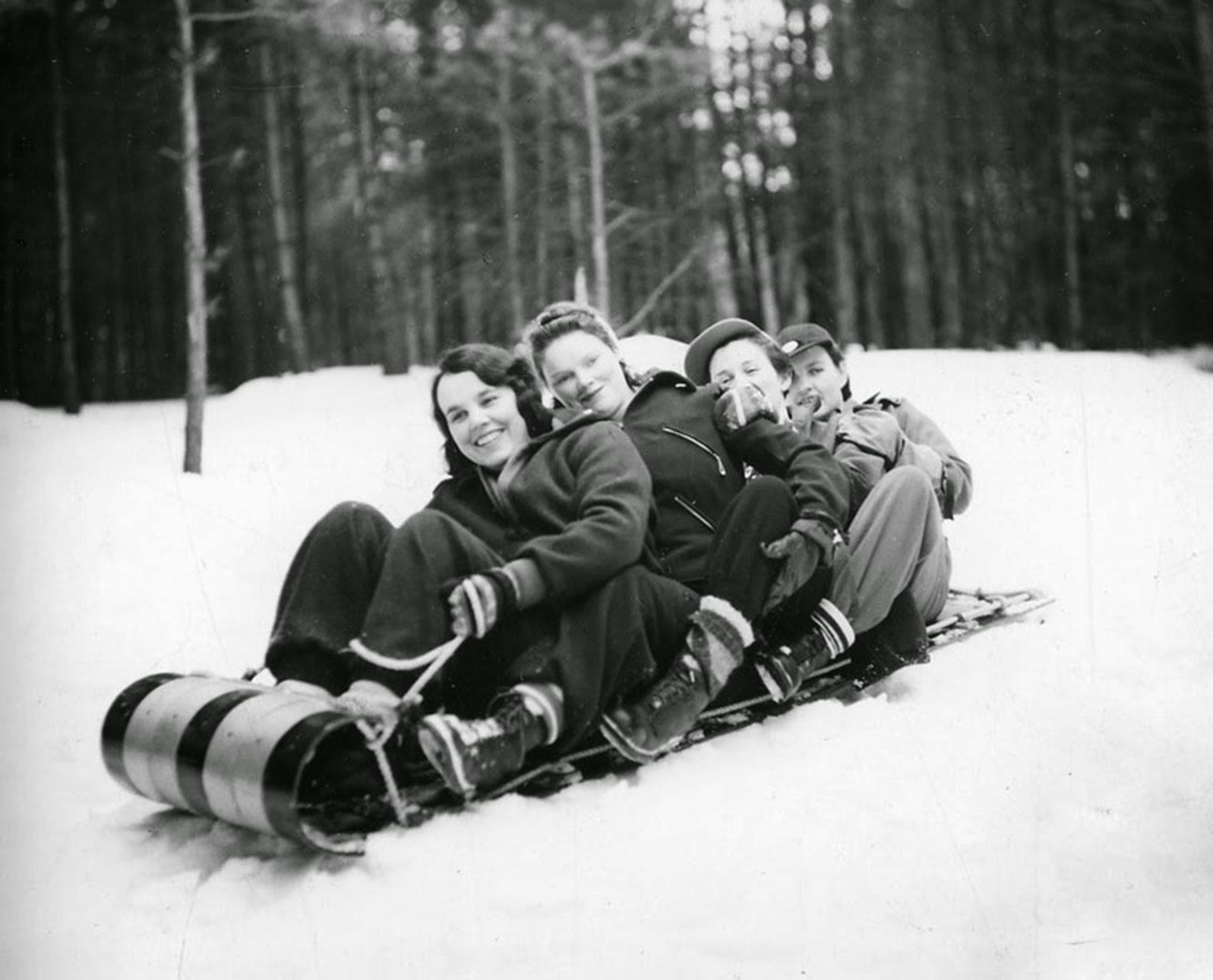 When I was a young kid on vacation in the Laurentians, my mother would zip my sister and me up in our ski jackets and toss us outside the very moment there was snow on the ground. We would go up and down the hill until one of us was frostbitten or injured. My mother’s level of participation consisted of making us hot chocolate when we returned home. I have no idea what she did while we were out risking our necks. I assume she was reading, since mom always managed to blast through great stacks of books and magazines when we headed up north. As for my dad, he often was in the garage, where he pursued a hobby restoring World War II–era US Army jeeps.
As any modern parent knows, this is not how tobogganing works in 2015. The idea of sending young kids out on their own is considered dangerous since, in their childish stupidity, they presumably will pick a too-steep hill and crash. Or they will arrive safely at the bottom of the hill and glide right into the arms of a waiting pedophile.
What happens instead is that the whole family goes out to the hill together as part of their weekend “quality time.” Maybe mom gets on the toboggan, to steer the thing, and keep the kids safe, and prove she is a Fun Mom. Maybe dad takes pictures on his smartphone to post to Facebook. The whole thing lasts about ten minutes, because that’s how long it takes one parent to get bored and the other to get cold. Also, the kids are whiney—because mom and dad, mom and mom, or dad and dad are both in attendance, so, hey, why not. (...)
It’s common for culture critics to lament that our obsession with safety has made children risk-averse and less adventurous. And it’s true—they are. But what we don’t talk about nearly as often is how this affects parents. I just spent the last two weeks on winter vacation with my young children, who now are around the age I was in my rock-hopping and tobogganing prime. During this period, I dutifully accompanied them through the whole gamut of wholesome outdoor activities. In two weeks, I read exactly half a book, and restored zero army jeeps.
According to one study I’ve seen, twenty-first century parents spend something like three times as much time with their children as parents did in the 1960s—despite the fact that we also are working harder to make money. When I go home tonight, I will help my kids with their homework (despite the fact that my assistance won’t statistically help them do any better in school), then I will hover over them to ensure they eat the nutritious parts of their dinner, referee their arguments, read them books (look, Facebook, we’re enjoying Dr. Seuss!), and, finally, lie with them in bed until they fall asleep. At this point, the day will be over, and I will go to sleep, too. Thus do the child-free, late-evening hours—which my wife and I might otherwise use to drink cocktails, talk, and watch television together—evaporate into nothingness.
“Dubuque, Iowa, is set to ban toboggans in nearly all its 50 parks,” reporter Jen Gerson wrote. “Other cities, including Des Moines, Iowa; Montville, New Jersey; Lincoln, Nebraska; and Columbia City, Indiana, are following suit by restricting certain runs or posting signs warning people away. . . . In Canada, Hamilton has restricted sledding on pain of a hefty fine for almost 15 years.” (...)
When I was a young kid on vacation in the Laurentians, my mother would zip my sister and me up in our ski jackets and toss us outside the very moment there was snow on the ground. We would go up and down the hill until one of us was frostbitten or injured. My mother’s level of participation consisted of making us hot chocolate when we returned home. I have no idea what she did while we were out risking our necks. I assume she was reading, since mom always managed to blast through great stacks of books and magazines when we headed up north. As for my dad, he often was in the garage, where he pursued a hobby restoring World War II–era US Army jeeps.As any modern parent knows, this is not how tobogganing works in 2015. The idea of sending young kids out on their own is considered dangerous since, in their childish stupidity, they presumably will pick a too-steep hill and crash. Or they will arrive safely at the bottom of the hill and glide right into the arms of a waiting pedophile.
What happens instead is that the whole family goes out to the hill together as part of their weekend “quality time.” Maybe mom gets on the toboggan, to steer the thing, and keep the kids safe, and prove she is a Fun Mom. Maybe dad takes pictures on his smartphone to post to Facebook. The whole thing lasts about ten minutes, because that’s how long it takes one parent to get bored and the other to get cold. Also, the kids are whiney—because mom and dad, mom and mom, or dad and dad are both in attendance, so, hey, why not. (...)
It’s common for culture critics to lament that our obsession with safety has made children risk-averse and less adventurous. And it’s true—they are. But what we don’t talk about nearly as often is how this affects parents. I just spent the last two weeks on winter vacation with my young children, who now are around the age I was in my rock-hopping and tobogganing prime. During this period, I dutifully accompanied them through the whole gamut of wholesome outdoor activities. In two weeks, I read exactly half a book, and restored zero army jeeps.
According to one study I’ve seen, twenty-first century parents spend something like three times as much time with their children as parents did in the 1960s—despite the fact that we also are working harder to make money. When I go home tonight, I will help my kids with their homework (despite the fact that my assistance won’t statistically help them do any better in school), then I will hover over them to ensure they eat the nutritious parts of their dinner, referee their arguments, read them books (look, Facebook, we’re enjoying Dr. Seuss!), and, finally, lie with them in bed until they fall asleep. At this point, the day will be over, and I will go to sleep, too. Thus do the child-free, late-evening hours—which my wife and I might otherwise use to drink cocktails, talk, and watch television together—evaporate into nothingness.
by Jonathan Kay, The Walrus | Read more:
Image: B.W. Muir/Forest History Society
Monday, January 12, 2015


CONSTELLATION VELA—Claiming that the mere thought is an “absolute nightmare,” WR 67c, a terrestrial planet from the distant Gamma Velorum star system, expressed its profound terror Wednesday at the possibility of one day gaining the capacity to sustain human life.
The 5.2-billion-year-old celestial body, which is located roughly 1,100 light years from Earth, said that for both its own sake and that of its entire solar system, it can only hope to never possess the necessary planetary characteristics and chemical elements needed to support either a deep-space human outpost or, more gravely, an entire human colony.
“Luckily, with my high levels of atmospheric sulfur dioxide, methane, and radon, there’s no way any human could survive on my surface for more than a few seconds,” said WR 67c, adding that it is “incredibly lucky” to have developed extremely violent and widespread volcanism in addition to its poisonous atmosphere. “But I don’t know, what if I produce a magnetic field that blocks out stellar wind and cosmic radiation? What if I develop an axial tilt that fosters a mild global climate? It’s terrifying to admit, but my surface temperature already sometimes drops to 120 degrees Fahrenheit at night, and their species can technically survive in that.”
“Stuff like that really freaks me out,” the extrasolar planet continued. “The real doomsday scenario would be someday acquiring a breathable atmosphere rich with oxygen and ultraviolet-absorbing ozone. At that point, I might as well just hurl myself at the nearest black hole and be done with it.”
The Onion | Read more:
Image: uncredited
Inside the Buzz-Fueled Media Startups Battling for Your Attention
Over the past couple of decades, this war for eyeballs has been fought across an ever-expanding territory. With the advent of the modern web, online publications and blogs competed to dominate your laptop screen. But with the rise of mobile, the battleground has become infinite. No matter where you are or what you’re doing—eating, drinking, watching a movie—the news has access to you. Stories roll in on push notifications and social media streams in a nonstop look-at-me barrage, all of them lighting up the same small screen. There is only one true channel now, and it’s probably in your pocket (or hand) at this very moment.
 What’s more, everyone has access to it. Everyone can program it. The media has been so completely flattened and democratized that your little sister can use the same distribution methods as the world’s most powerful publishers. She has instant access to you—potentially to everyone—and she doesn’t need to invest in broadcast towers or a printing press, satellites or coaxial cable. Neither does anyone else. That little vibration in your pocket could mean that we are bombing Iraq again or that a massive typhoon is headed for the Gulf of Thailand or that your father has tagged a photo of you on Facebook. (Nice Boy Scouts uniform.) Even Hearst never had to compete with corgi videos.
But the thing is, the media isn’t just competing with your little sister—it’s co-opting her, using her as a vector to spread its content. She is the new delivery mechanism. We don’t learn about the world from The New York Times, we learn about it from the Times stories that our family and friends share or that show up as push notifications four minutes before one from The Guardian does. Thirty percent of American adults get news from Facebook, according to the Pew Research Center, and more than half of Americans got news from a smartphone within the past week, according to the American Press Institute. And these metrics are just going up, up, up. The question for news publishers is no longer how to draw an audience to their sites, it’s how to implant themselves into their audience’s lives.
These dynamics have unleashed a new breed of media company that is racing to master these cutting-edge distribution systems. Much as Hearst, Henry Luce, and Ted Turner figured out how to amass huge audiences using newspapers, magazines, and television, the latest would-be kingpins are learning what kinds of stories resonate with readers on phones and Facebook. Instead of hiring newsies to scream at you in the streets, they are enlisting social media experts to scream at you on Twitter. Instead of investing in satellite trucks or paying for prime placement at the corner newsstand, they are reverse-engineering Facebook’s algorithm to ensure their stories dominate your News Feed. (...)
The vibe at BuzzFeed headquarters in lower Manhattan is young and antiseptic. Everything looks too brand-new. The walls are white. Great Big Screens are mounted everywhere. Where the data team sits they show charts and numbers. And at each of the editors’ desks, dashboards display the ebb and flow of its stories’ popularity on BuzzFeed itself as well as across social media. And those numbers are moving relentlessly, inevitably, always and forever up.
BuzzFeed is best known for its lists and quizzes— many of which are gauche little trifles designed to shock, like “29 Things Everyone With a Vagina Definitely Should Know”—or those too-cute compilations of cat pictures and corgi GIFs. But over the years it has muscled into other genres: breaking and investigative news, service-oriented lifestyle stories, long-form narrative, and video. It’s growing like a well-fed toddler, building out bureaus both domestically and internationally, and has launched a motion picture studio in Los Angeles. It’s also creating a new division, BFF, that will make content that lives only in the apps where kids are, like Vine and Snapchat and Imgur. Noted VC firm Andreessen Horowitz just invested $50 million in the company, giving it a reported valuation of $850 million, which it is using to extend its reach even farther. The much larger New York Times Company is worth $1.9 billion. But with profits declining, the Times is slashing its workforce yet again, while BuzzFeed is hiring. Dear God, yes, it’s hiring!
“BuzzFeed News has the potential to become the leading news source for a generation of readers who will never subscribe to a print newspaper or watch a cable news show,” explains the company’s CEO, Jonah Peretti. It’s not hard to see BuzzFeed as the next great media empire, something like Time Warner was in its prime, publishing news, entertainment, and even games. But unlike Time Warner, its growth doesn’t come from lavish ad campaigns or newsstand placement but from social media. Its stories—be they quizzes, listicles, or investigative news—are engineered to come to you. They exist as free-floating agents, cruising along as links in social media streams and finding readers via shares and retweets and email forwards and pins. To do that effectively, BuzzFeed’s staff has to understand why people share things. They have to understand what makes a story go viral and then try to apply that understanding to all sorts of media.
What’s more, everyone has access to it. Everyone can program it. The media has been so completely flattened and democratized that your little sister can use the same distribution methods as the world’s most powerful publishers. She has instant access to you—potentially to everyone—and she doesn’t need to invest in broadcast towers or a printing press, satellites or coaxial cable. Neither does anyone else. That little vibration in your pocket could mean that we are bombing Iraq again or that a massive typhoon is headed for the Gulf of Thailand or that your father has tagged a photo of you on Facebook. (Nice Boy Scouts uniform.) Even Hearst never had to compete with corgi videos.But the thing is, the media isn’t just competing with your little sister—it’s co-opting her, using her as a vector to spread its content. She is the new delivery mechanism. We don’t learn about the world from The New York Times, we learn about it from the Times stories that our family and friends share or that show up as push notifications four minutes before one from The Guardian does. Thirty percent of American adults get news from Facebook, according to the Pew Research Center, and more than half of Americans got news from a smartphone within the past week, according to the American Press Institute. And these metrics are just going up, up, up. The question for news publishers is no longer how to draw an audience to their sites, it’s how to implant themselves into their audience’s lives.
These dynamics have unleashed a new breed of media company that is racing to master these cutting-edge distribution systems. Much as Hearst, Henry Luce, and Ted Turner figured out how to amass huge audiences using newspapers, magazines, and television, the latest would-be kingpins are learning what kinds of stories resonate with readers on phones and Facebook. Instead of hiring newsies to scream at you in the streets, they are enlisting social media experts to scream at you on Twitter. Instead of investing in satellite trucks or paying for prime placement at the corner newsstand, they are reverse-engineering Facebook’s algorithm to ensure their stories dominate your News Feed. (...)
The vibe at BuzzFeed headquarters in lower Manhattan is young and antiseptic. Everything looks too brand-new. The walls are white. Great Big Screens are mounted everywhere. Where the data team sits they show charts and numbers. And at each of the editors’ desks, dashboards display the ebb and flow of its stories’ popularity on BuzzFeed itself as well as across social media. And those numbers are moving relentlessly, inevitably, always and forever up.
BuzzFeed is best known for its lists and quizzes— many of which are gauche little trifles designed to shock, like “29 Things Everyone With a Vagina Definitely Should Know”—or those too-cute compilations of cat pictures and corgi GIFs. But over the years it has muscled into other genres: breaking and investigative news, service-oriented lifestyle stories, long-form narrative, and video. It’s growing like a well-fed toddler, building out bureaus both domestically and internationally, and has launched a motion picture studio in Los Angeles. It’s also creating a new division, BFF, that will make content that lives only in the apps where kids are, like Vine and Snapchat and Imgur. Noted VC firm Andreessen Horowitz just invested $50 million in the company, giving it a reported valuation of $850 million, which it is using to extend its reach even farther. The much larger New York Times Company is worth $1.9 billion. But with profits declining, the Times is slashing its workforce yet again, while BuzzFeed is hiring. Dear God, yes, it’s hiring!
“BuzzFeed News has the potential to become the leading news source for a generation of readers who will never subscribe to a print newspaper or watch a cable news show,” explains the company’s CEO, Jonah Peretti. It’s not hard to see BuzzFeed as the next great media empire, something like Time Warner was in its prime, publishing news, entertainment, and even games. But unlike Time Warner, its growth doesn’t come from lavish ad campaigns or newsstand placement but from social media. Its stories—be they quizzes, listicles, or investigative news—are engineered to come to you. They exist as free-floating agents, cruising along as links in social media streams and finding readers via shares and retweets and email forwards and pins. To do that effectively, BuzzFeed’s staff has to understand why people share things. They have to understand what makes a story go viral and then try to apply that understanding to all sorts of media.
by Mat Honan, Wired | Read more:
Image: National Venture Capital Associastion, First Look Meida, Circa, Atavist
Why Life Is Absurd
A Consideration of Time, Space, Relativity, Meaning and Absurdity (Yep, All of It)
by Rivka Weinberg, NY Times | Read more:
Image: Leif Parsons
I. Relativity
 DZIGAN: Professor Einstein said, “In the world, there is time. And just as there is time, there is another thing: space. Space and time, time and space. And these two things,” he said, “are relative.”
Do you know what “relative” means?
SHUMACHER: Sigh. Nu? The point? Continue.
DZIGAN: There is no person these days who doesn’t know what “relative” means. I will explain it to you with an analogy and soon you will also know. Relativity is like this: If you have seven hairs on your head, it’s very few but if you have seven hairs in your milk, it’s very many.
II. Absurdity
In the 1870s, Leo Tolstoy became depressed about life’s futility. He had it all but so what? In “My Confession,” he wrote: “Sooner or later there will come diseases and death (they had come already) to my dear ones and to me, and there would be nothing left but stench and worms. All my affairs, no matter what they might be, would sooner or later be forgotten, and I myself should not exist. So why should I worry about these things?”
Life’s brevity bothered Tolstoy so much that he resolved to adopt religious faith to connect to the infinite afterlife, even though he considered religious belief “irrational” and “monstrous.” Was Tolstoy right? Is life so short as to make a mockery of people and their purposes and to render human life absurd?
In a famous 1971 paper, “The Absurd,” Thomas Nagel argues that life’s absurdity has nothing to do with its length. If a short life is absurd, he says, a longer life would be even more absurd: “Our lives are mere instants even on a geological time scale, let alone a cosmic one; we will all be dead any minute. But of course none of these evident facts can be what makes life absurd, if it is absurd. For suppose we lived forever; would not a life that is absurd if it lasts 70 years be infinitely absurd if it lasted through eternity?”
This line of reasoning has a nice ring to it but whether lengthening an absurd thing will relieve it of its absurdity depends on why the thing is absurd and how much you lengthen it. A longer life might be less absurd even if an infinite life would not be. A short poem that is absurd because it is written in gibberish would be even more absurd if it prattled on for longer. But, say I decided to wear a skirt so short it could be mistaken for a belt. On my way to teach my class, a colleague intercepts me:
“Your skirt,” she says, “is absurd.”
“Absurd? Why?” I ask.
“Because it is so short!” she replies.
“If a short skirt is absurd, a longer skirt would be even more absurd,” I retort.
Now who’s being absurd? The skirt is absurd because it is so short. A longer skirt would be less absurd. Why? Because it does not suffer from the feature that makes the short skirt absurd, namely, a ridiculously short length. The same goes for a one-hour hunger strike. The point of a hunger strike is to show that one feels so strongly about something that one is willing to suffer a lack of nourishment for a long time in order to make a point. If you only “starve” for an hour, you have not made your point. Your one-hour hunger strike is absurd because it is too short. If you lengthened it to one month or one year, you might be taken more seriously. If life is absurd because it’s short, it might be less absurd if it were suitably longer.
Absurdity occurs when things are so ill-fitting or ill-suited to their purpose or situation as to be ridiculous, like wearing a clown costume to a (non-circus) job interview or demanding that your dog tell you what time it is. Is the lifespan of a relatively healthy and well-preserved human, say somewhere between 75 and 85, so short as to render it absurd, ill-suited to reasonable human purposes?
DZIGAN: Professor Einstein said, “In the world, there is time. And just as there is time, there is another thing: space. Space and time, time and space. And these two things,” he said, “are relative.”Do you know what “relative” means?
SHUMACHER: Sigh. Nu? The point? Continue.
DZIGAN: There is no person these days who doesn’t know what “relative” means. I will explain it to you with an analogy and soon you will also know. Relativity is like this: If you have seven hairs on your head, it’s very few but if you have seven hairs in your milk, it’s very many.
II. Absurdity
In the 1870s, Leo Tolstoy became depressed about life’s futility. He had it all but so what? In “My Confession,” he wrote: “Sooner or later there will come diseases and death (they had come already) to my dear ones and to me, and there would be nothing left but stench and worms. All my affairs, no matter what they might be, would sooner or later be forgotten, and I myself should not exist. So why should I worry about these things?”
Life’s brevity bothered Tolstoy so much that he resolved to adopt religious faith to connect to the infinite afterlife, even though he considered religious belief “irrational” and “monstrous.” Was Tolstoy right? Is life so short as to make a mockery of people and their purposes and to render human life absurd?
In a famous 1971 paper, “The Absurd,” Thomas Nagel argues that life’s absurdity has nothing to do with its length. If a short life is absurd, he says, a longer life would be even more absurd: “Our lives are mere instants even on a geological time scale, let alone a cosmic one; we will all be dead any minute. But of course none of these evident facts can be what makes life absurd, if it is absurd. For suppose we lived forever; would not a life that is absurd if it lasts 70 years be infinitely absurd if it lasted through eternity?”
This line of reasoning has a nice ring to it but whether lengthening an absurd thing will relieve it of its absurdity depends on why the thing is absurd and how much you lengthen it. A longer life might be less absurd even if an infinite life would not be. A short poem that is absurd because it is written in gibberish would be even more absurd if it prattled on for longer. But, say I decided to wear a skirt so short it could be mistaken for a belt. On my way to teach my class, a colleague intercepts me:
“Your skirt,” she says, “is absurd.”
“Absurd? Why?” I ask.
“Because it is so short!” she replies.
“If a short skirt is absurd, a longer skirt would be even more absurd,” I retort.
Now who’s being absurd? The skirt is absurd because it is so short. A longer skirt would be less absurd. Why? Because it does not suffer from the feature that makes the short skirt absurd, namely, a ridiculously short length. The same goes for a one-hour hunger strike. The point of a hunger strike is to show that one feels so strongly about something that one is willing to suffer a lack of nourishment for a long time in order to make a point. If you only “starve” for an hour, you have not made your point. Your one-hour hunger strike is absurd because it is too short. If you lengthened it to one month or one year, you might be taken more seriously. If life is absurd because it’s short, it might be less absurd if it were suitably longer.
Absurdity occurs when things are so ill-fitting or ill-suited to their purpose or situation as to be ridiculous, like wearing a clown costume to a (non-circus) job interview or demanding that your dog tell you what time it is. Is the lifespan of a relatively healthy and well-preserved human, say somewhere between 75 and 85, so short as to render it absurd, ill-suited to reasonable human purposes?
by Rivka Weinberg, NY Times | Read more:
Image: Leif Parsons
Why is There a Worm in Bottles of Tequila?
Dear Cecil:
The other night I was talking with a friend who worked at a bar in Arizona where most of the hicks got shots of tequila. As they got drunker they would ask to have "the worm" (bleagh) along with their shot. My questions are: What kind of worm is that thing? Does drinking/eating the worm make you drunker? And how did the worm end up in the tequila?
— Beth L. Grover, via the Internet
 Cecil replies:
You probably think this is some ancient Mexican tradition, right? Not unless your idea of ancient is 1950. We even know who invented the practice. Various reasons are given for it, but I say it all boils down to: Let's see if we can get the gringos to eat worms.
First let's get a few things straight. There's no worm in tequila, or at least there isn't supposed to be. Purists (hah!) say the worm belongs only in a related product, mescal. Strictly speaking, mescal is a generic term meaning any distillate of the many species of agave (or maguey) plant, tequila included. Today, however, mescal is popularly understood to mean a product bottled in the region around the city of Oaxaca. For years this stuff was basically home-brewed firewater consumed by the locals, but in 1950, Mexico City entrepreneur Jacobo Lozano Paez hit on the idea of putting a worm in each bottle as a marketing gimmick. Stroke of genius, eh? I don't get it either, but that's what separates us from the visionaries.
The critter in question is the agave worm, which is actually a butterfly larva. The worms bore into the agave plant's pineapplelike heart, and quite a few get cooked up in the brew used to make mescal. Far from being grossed out, Jacobo concluded that the worm was an essential component of the liquor's flavor and color. He may also have figured, Hey, mescal is about as palatable as paint remover, and the only people who are going to drink this stuff are macho lunatics, so why not take it to the max? In fairness, the worms were also said to have aphrodisiac properties, and worms and bugs are sometimes consumed in Mexico as a delicacy. (Supposedly this dates back to the Aztecs.) At any rate, the ploy worked and the worm in the bottle is now a firmly established tradition.
The other night I was talking with a friend who worked at a bar in Arizona where most of the hicks got shots of tequila. As they got drunker they would ask to have "the worm" (bleagh) along with their shot. My questions are: What kind of worm is that thing? Does drinking/eating the worm make you drunker? And how did the worm end up in the tequila?
— Beth L. Grover, via the Internet
Cecil replies:You probably think this is some ancient Mexican tradition, right? Not unless your idea of ancient is 1950. We even know who invented the practice. Various reasons are given for it, but I say it all boils down to: Let's see if we can get the gringos to eat worms.
First let's get a few things straight. There's no worm in tequila, or at least there isn't supposed to be. Purists (hah!) say the worm belongs only in a related product, mescal. Strictly speaking, mescal is a generic term meaning any distillate of the many species of agave (or maguey) plant, tequila included. Today, however, mescal is popularly understood to mean a product bottled in the region around the city of Oaxaca. For years this stuff was basically home-brewed firewater consumed by the locals, but in 1950, Mexico City entrepreneur Jacobo Lozano Paez hit on the idea of putting a worm in each bottle as a marketing gimmick. Stroke of genius, eh? I don't get it either, but that's what separates us from the visionaries.
The critter in question is the agave worm, which is actually a butterfly larva. The worms bore into the agave plant's pineapplelike heart, and quite a few get cooked up in the brew used to make mescal. Far from being grossed out, Jacobo concluded that the worm was an essential component of the liquor's flavor and color. He may also have figured, Hey, mescal is about as palatable as paint remover, and the only people who are going to drink this stuff are macho lunatics, so why not take it to the max? In fairness, the worms were also said to have aphrodisiac properties, and worms and bugs are sometimes consumed in Mexico as a delicacy. (Supposedly this dates back to the Aztecs.) At any rate, the ploy worked and the worm in the bottle is now a firmly established tradition.
by Cecil Adams, The Straight Dope | Read more:
Image: via:
Saturday, January 10, 2015
John Henry Wise
[ed. Marcus Mariota isn't the first Hawaiian football player to gain fame with a big "O" on his jersey, or to be associated with a Heisman. That would be John Henry Wise.
 Oberlin was the first school coached by the legendary John W. Heisman. He coached the teams in 1892 and '94, the second and fourth seasons that football was a varsity sport at the college. The faculty had not approved football as a sport prior to 1891, but it agreed to hire Heisman as head coach for the '92 season because he was recommended by Walter Camp. Heisman was a graduate of the University of Pennsylvania where he starred as an end in football. In those days football was quite popular in the East and was just beginning to take root in the Midwest. The hiring of Heisman enabled Oberlin to become one of the leading team's in the Midwest. In 1892 the "O" Men, as they were called at the time, were led by Heisman to their first undefeated season with a perfect 7-0-0 record beating their opponents by an average score of 37-4 which included two wins over Ohio State and one over Michigan. To this day, the Wolverines still claim they won the contest but all agree that both sides played the game as it should have been played (without any slugging.) Because Heisman enrolled in post graduate courses in art, he was permitted to play football for Oberlin as he participated in the late stages of some games near the end of the season. Heisman became known as the leading pioneer in developing the game of football into what it is today with formation shifts, centering the ball, and forward passing. His contribution to Oberlin was in proving that an intelligent coach was an integral part of the sport. The Heisman name is more famous today than back in 1892, being synonymous with the award for most outstanding player in college football. As a result, Oberlin named their athletics booster club after Heisman, in an attempt encourage support for all of Oberlin's athletic programs.
Controversial game vs. Michigan
On a cold Saturday afternoon in November 1892, Oberlin's team took the field in Ann Arbor against a heavily favored Michigan squad which had trounced them handily the year before. Notable among the Oberlin visitors was their new player-coach John Heisman, who had been hired away from the University of Pennsylvania by the Oberlin Athletic Association (a student-run enterprise in those days) and who brought an undefeated team with him to Ann Arbor. The team's fastest running back was Charles Savage, who a few years later would become Oberlin's director of athletics and, like Heisman, a nationally prominent figure. Oberlin's best lineman was theology student John Henry Wise, half-German, half-Hawaiian, who after graduation returned to his island home and joined the 1895 Counter-Revolution aimed at toppling the Republic of Hawaii and restoring Queen Liliuokalani and the monarchy. He was sent to prison for three years charged with treason. Oberlin's team trainer, "nurse to the wounded," was pre-med student Clarence Hemingway, who would go on to practice medicine in Oak Park, Illinois, and pass on his love of hunting in Michigan to his son, future novelist Ernest Hemingway.
The game in Ann Arbor was close all the way. At halftime Michigan led 22-18. The team captains agreed on a shortened second half, to end at 4:50 p.m. so Oberlin could catch the last train home. With less than two minutes remaining, Michigan drove to the 5-yard line before Oberlin stopped them and took over on downs. Then halfback Savage entered the mists of Oberlin athletic legend by dodging through the line and sprinting 90 yards to the Michigan 5, where Michigan's star player, George Jewett, caught him from behind.
Two plays later Oberlin made its final touchdown. Score: Oberlin 24, Michigan 22, with less than a minute to go. As Michigan launched its last drive, the referee (an Oberlin sub) announced that 4:50 p.m. had arrived, time had expired, and the Oberlin squad trotted off the field to catch the train. Next the umpire (a Michigan man) ruled that four minutes remained on the game clock, owing to timeouts that Oberlin's timekeeper had not recorded. Michigan then walked the ball over the goal line for an uncontested touchdown and was declared the winner, 26 to 24. By that time the Oberlinians were headed home clutching their own victory, 24 to 22. Officially, each school recognizes a win for themselves in the respective archives.
by Wikipedia | Read more:
Image: Wikipedia

Subscribe to:
Comments (Atom)