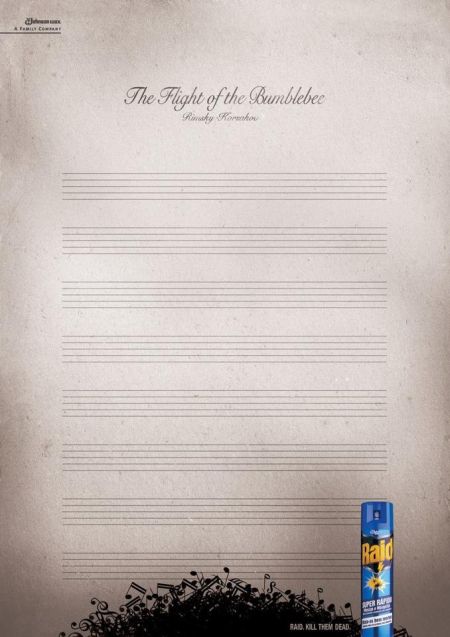
[ed. I've wondered why no one ever made a movie about Brian Wilson, the Beach Boys' troubled genius. Now they have. I hope it doesn't suck. (God only knows)]
h/t Boing Boing


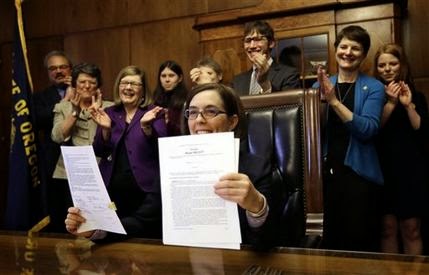 Under the legislation, every adult citizen in Oregon who has interacted with the Driver and Motor Vehicle Services Division since 2013 but hasn't registered to vote will receive a ballot in the mail at least 20 days before the next statewide election. The measure is expected to add about 300,000 new voters to the rolls.
 For most who arrive or depart from Canada’s busiest airport, that luggage cart is the only glimpse they’ll get of the vast apparatus built to handle the straining suitcases and lumpy gym bags they check in at the departure counter. As passengers shuffle through the bright, airy airplane terminal, ground workers like Osoble shepherd thousands of pieces of luggage into a dimly lit world of grubby conveyor belts, bulky scanning machines and pinball-like flippers that violently shove luggage in the direction of its final destination. The average suitcase takes just 8.5 minutes to wind its way through the 16-km maze of conveyor belts at Pearson’s Terminal 1, and less than one per cent of the tens of millions of bags moved every year in Canada end up lost.
 Perhaps this is no surprise. People come expecting the worst, and with expectations so dismally calibrated, something like hot water starts to sound pretty amazing. Reviewers carefully note that many of the hotel’s quirks—you can’t walk out the front door unaccompanied, for instance—are out of the manager’s hands. (You’ll have to take that up with the Supreme Leader.) It may not be the Ritz-Carlton, the sentiment goes, but considering the fact that you are staying in the marquee property in the showcase capital of the world’s most repressive regime, it may be best to, as one reviewer counseled, “just chill out, have some beers, some expired Oreos from the gift shop and make friends with the other tourists.”
 Philip Moeller, a writer and retirement expert, also had it wrong, though he almost didn’t find out as he stubbornly insisted to Mr. Kotlikoff that he and his wife knew what they were doing. They did not; Mr. Kotlikoff landed them nearly $50,000 extra with some fancy footwork related to spousal benefits.
 This abiding passion for words, cultivated fervently from antiquity into modern times—or at least until around 1800, in Turner’s view—encompassed a huge range of subjects as it developed: not only grammar and syntax, but rhetoric, textual editing and commentary, etymology and lexicography, as well as, eventually, anthropology, archeology, biblical exegesis, linguistics, literary criticism, and even law. It comprised three large areas: textual philology, theories about the origins of language, and, much later, comparative studies of different related languages. Two texts predominated: Homer, considered sacred by the ancient Greeks, and the Bible, a contested area of interpretation for both Jews and Christians. As for theories of language origins, these go back to the pre-Socratics and Plato; the controversy was over whether language was divinely given, with words corresponding to the things they named, or arrived at by convention (the nomos versus physis debate). As for comparative studies, these arose in the eighteenth-century, largely as a result of Sir William Jones’s discovery of the common Indo-European matrix of most European languages. Encounters with “exotic,” that is, non-European, peoples in the course of the Renaissance voyages of discovery were another important source; here American Indian languages in their variety and complexity offered an especially rich, if perplexing, new field of inquiry.
 Our world — Earth — was covered with lava, then granite mountains. Oceans formed, a wormy thing crawled from the sea. There were pea-brained brontosauri and fiery meteor showers and gnawing, hairy-backed monsters that kept coming and coming — these furious little stumps, human beings, us. Under the hot sun, we roasted different colors, fornicated, and fought. Full of wonder, we attached words to the sky and the mountains and the water, and claimed them as our own. We named ourselves Homer, Sappho, Humperdinck, and Nixon. We made bewitching sonatas and novels and paintings. Stargazed and built great cities. Exterminated some people. Settled the West. Cooked meat and slathered it with special sauce. Did the hustle. Built the strip mall.

 In a media landscape of zip-fast reports as stripped of context as a potato might be stripped of fibre, most news stories fail to satiate. We don’t consume news all day because we’re hungry for information – we consume it because we’re hungry for connection. That’s the confusing conundrum for the 21st century heart and mind: to be at once over-informed and grasping for understanding.
 And as no candidate is likely to win big in the wild jumble of Israel's political landscape, the outcome of the March 17 election could well be a joint government between Netanyahu and his moderate challenger Isaac Herzog. It's an irony, because the animosities are overwhelming.