Wednesday, June 3, 2015

How I Came Out as Gray

It was supposed to be our secret. My hairdresser claimed to possess a special elixir that could subtly, naturally, almost undetectably “blend away” gray hair, which, at 45, I had a touch of.

Sitting before a mirror in her chair, uncertain whether to start the masquerade, I examined my head in a way I shied away from when I was alone at home, without support. I looked at myself from angles I wasn’t used to, discovering that the gray was more extensive than I’d been willing to admit.

Instead of threading its way between the darker hairs, it had consumed whole sectors of my head, especially on the sides and in the back. It was advancing the way frost does, or like mold.

“I suggest we leave some in,” my hairdresser said. “Just enough to make you look distinguished.” I nodded, but the word did not sit well with me. It sounded exactly like what it was: another way of saying “old.”
Color of the Seasons

This conversation, or some version of it, was repeated every month for seven years. The world moved along, the seasons changed, but my hair stayed the same, or approximately the same.

Toward the end of each color cycle, my natural color — or lack of it — would reassert itself, a bit more conspicuously each time, forcing me deeper and deeper into fraudulence.

My girlfriend during this period, now my wife, began to argue (mildly at first but increasingly emphatically) that gray hair looked terrific on men my age. For evidence, she pointed to various luminaries who looked terrific no matter what. George Clooney. Bill Clinton. The journalist Anderson Cooper.

They were the silver all-stars, and I hated them. I hated them not for their age-defying male beauty but for their ability to accept themselves.

In Guy de Maupassant’s short story “The Mask,” a rakish man about town who loves the night life collapses at a dance. While attempting to revive him, a doctor notices that he is wearing a lifelike, youthful mask. The doctor cuts it off with scissors, revealing the man’s white hair and wrinkled face.

I’d read this story when I was young myself, along with other similar tales of postponed decrepitude such as “The Picture of Dorian Gray.” Their gloomy, common message seemed to be that when it comes to signs of aging, you can run but not hide — and that the longer you attempt to run, the worse the final reckoning will be.

My hairdresser seemed to disagree: Her faith in modern products was that strong. And so was mine, until six months ago, when my hairdresser tried a stronger potion, convinced that the old one would no longer suffice.

by Matt Chase, NY Times |  Read more:
Image: via:

Where Are the China Hawks?

On Monday, Lindsey Graham announced his presidential candidacy in a speechdevoted mostly to foreign policy. He mentioned variations of the word “Islam” six times. He said “the nuclear ambitions of the radical Islamists who control Iran” constitute the “biggest threat” to the United States. He twice emphasized his devotion to Israel. And once, about halfway through his remarks, he mentioned China.

In American politics today, especially in the GOP, Graham’s priorities are typical. Two years ago, during Secretary of Defense nominee Chuck Hagel’s contentious seven-and-a-half-hour grilling by the Armed Services Committee, senators mentioned Israel 178 times and Iran 171 times. The number of references to China? Five.

The emphasis is odd because it’s likely that the “biggest threat” to America’s national security is neither Iran nor “radical Islam” writ large. It is China.

The Islamic extremists in ISIS and other violent jihadist groups kill between 10 and 20 Americans a year. That number could spike dramatically, of course, as it did on 9/11. But for many years now, the trend has been toward lone-wolf-style attacks where very small numbers of Americans die.

For its part, Iran is a midsize power with a noxious regime. It aspires to dominate the Middle East, but it is likely to fail in that endeavor. It’s likely to fail in part because the other powerful countries in the region (Israel, Saudi Arabia, Egypt, Turkey), backed by the United States, want it to fail. And it’s likely to fail because, as a Shiite power in a mostly Sunni region inflamed by Sunni-Shiite conflict, Iranian domination doesn’t have much appeal.

Of course, if Iran develops a nuclear weapon, or even a nuclear-weapons capacity, its power will grow. But it will still face neighbors—Israel, Pakistan, India—with larger nuclear arsenals of their own. And there is no reason to believe that Tehran will commit regime suicide by using a nuclear weapon against Israel or anyone else, and thus invite a massive nuclear response, given that it has proved emphatically non-suicidal during its 36 years in power.

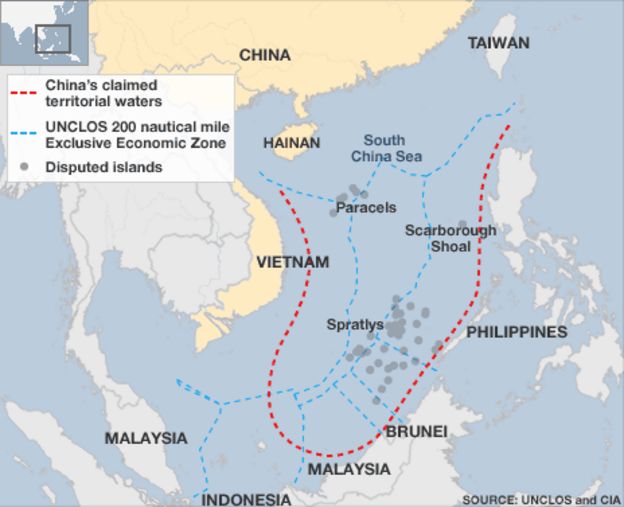
China, by contrast, is not a midsize power. It’s a superpower. At current prices, its GDP is 28 times larger than Iran’s. Its military budget is roughly 13 times larger. Its willingness to invest vast sums in the economic development of other nations gives it tremendous soft power. And it is claiming much of the South China Sea as its own, thus asserting dominion over a territory with vast oil and gas reserves through which one-third of the world’s shipping travels.

From 1941 to 1989, the United States risked war to prevent great powers from dominating the world’s economic and industrial heartlands, and thus gaining veto power over America’s ability to conduct international commerce. That’s what China is seeking today.

So why aren’t Lindsey Graham and his GOP presidential competitors talking more about China? (To be fair, Hillary Clinton isn’t talking much about China either. But her campaign thus far has been much less weighted toward foreign policy in general.)

Three reasons come to mind.

by Peter Beinart, The Atlantic | Read more:
Image: Carlos Barria / Reuters

Pause

I recently came across an old cryalog that I kept during the month of April in 1998. ‘C’ stands for the fact that I cried, the number of C’s represents the number of times I cried, and ‘NC’ indicates that I did not cry on that day.

The saddest thing is, I now find the cryalog very funny, and laugh when I look at it.

But when I kept it, I wanted to die. Literally, to kill myself – with an iron, a steaming hot turned-on iron.

This was not depression, this was menopause.

Reading this, or any other thing ever written about menopause, will not help you in any way, for how you respond to menopause is not up to you, it is up to your body, and though you believe now that you can control your body (such is your strength after all that yoga) you cannot.

Of course, you may be lucky: I know a woman who experienced menopause in no way whatsoever except that one day she realized it had been a couple of years since her last period, which was indeed her last.

You hear a lot about hot flashes, but hot flashes are the least of it, totally inconsequential in every way: you get as hot as a steam iron at odd moments – so what? The media would have you believe that hot flashes are the single most significant symptom toward which you should direct your attention and businesses their products, but when I think of menopause I don’t think of hot flashes; I am not here to talk about hot flashes.

Except to tell you that they do not cease even after you have completely gone through menopause; they become a part of your life the way periods were, they are periodic and, after a while, you stop talking about them.

No, I am here to tell you that one woman, a woman who is the most undepressed, optimistic, upbeat person I know, awoke one morning and walked straight into her kitchen and grabbed a butcher’s knife (she is a world class cook) with the intent of driving it through her heart. That was menopause.

If you take the time to peruse the annals of any nineteenth century asylum, as I have, you will discover that the ‘cause of admittance’ for all women over forty is listed as ‘change of life’.

In other words, you go crazy. When you go crazy, you don’t have the slightest inclination to read anything Foucault ever wrote about culture and madness.

It may be that you recall your thirteenth year on earth. Menopause is adolescence all over again, only you are an adult and have to go out into the world every day in ways you did not have to when you were in school, where you were surrounded by other adolescents, safe, or relatively so, in the asylum of junior high.

You are a thirteen-year-old with the experience and daily life of a forty-five-year-old.

You have on some days the desire to fuck a tree, or a dog, whichever is closest.

You have the desire to leave your husband or lover or partner, whatever.

No matter how stable or loving the arrangement, you want out.

You may decide to take up an insane and hopeless cause. You may decide to walk to Canada, or that it is high time you begin to collect old blue china, three thousand pieces of which will leave you bankrupt. Suddenly the solution to all problems lies in selling your grandmother’s gold watch or drinking your body weight in cider vinegar. A kind of wild forest blood runs in your veins.

This, and other behaviors, will horrify you. You will seek medical help because you are intelligent, and none of the help will help.

by Mary Ruefle, Granta |  Read more:
Image: Mary Ruefle

Who The @!#$&% is John Legere?

"The fuckers hate you."
"I can’t wait to watch the peckers scream and cry."
"I’m bombing their factories."

Action-movie villains spit this kind of venom. Comedy writers hurl similarly foul tirades at one another. And as the Sony email hack revealed, business executives can speak this way too. In private. But in the open, CEOs—particularly those running multibillion-dollar, publicly traded companies—present a soothing stream of bromides, buzzwords, and nonanswers. All except John Legere, the man responsible for those quotes. At a downtown Manhattan loft this past March, the club music thumps as a crowd of telecom analysts and press wait expectantly for the CEO of T-Mobile to spew his gutter talk. He does not disappoint. Legere, 57, takes the stage at "Un-carrier 9.0," the latest in a series of T-Mobile news events, wearing a black leather jacket over a black T-shirt emblazoned with a hot pink T on the chest. On his feet: hot pink skater sneakers. With his wave of shoulder-length brown hair and mild paunch protruding from what was once an athletic physique, Legere looks like he might have been a member of Kiss rather than a lifelong telecom executive. Once he starts talking, he becomes the anthropomorphized embodiment of the tall can of Red Bull in his left hand.

He launches his opening salvo: "It’s safe to say that our friends in the cozy little duopoly have been shitting themselves more in the past two years than in history." Legere is going straight at T-Mobile’s much larger competitors, AT&T and Verizon. "Dumb and dumber," or "the pricks," as Legere usually refers to them, watched T-Mobile win 8.3 million new customers last year alone. A smile oozes from his asymmetrical mouth. "Yes, that’s in the first minute that I swore," he flirts with the crowd. He knows they’ll be tweeting his feistiest lines. In fact, he’s counting on it. "Those of you with the f-bomb pool will have to wait a little bit longer," he quips. (If you had bet that he’d drop one within the first four minutes, you won.)

This performance—to announce new terms for T-Mobile’s business customers—would get most CEOs fired or sued, especially in the buttoned-up telecom industry. Legere, though, gets an ovation when he takes the stage and another when he’s done.

Amid the applause, questions hover: Who the @#$% is John Legere? Why is he presenting himself as an amalgam of faith healer, social media stuntman, professional trash-talker, and drunken boardwalk pitchman? Is he a marketing genius? A bullshit artist? Or both? He has certainly anointed himself the Dr. House of telecom, jamming a syringe full of adrenaline into the heart of the wireless business. As one industry journalist, Dan O’Shea, tells me, "This guy is being treated like he just popped out of a spaceship from nowhere, but everybody has a history."

Perhaps the most important question is: Why have Legere’s antics worked? Since he first recast T-Mobile as the underdog anti-carrier in the spring of 2013, it has come back from near death. In addition to customer growth, revenues increased 13% year over year in the first quarter of 2015 (though the company continues to lose money), and it is now on par with the incumbent No. 3, Sprint. Virtually every time T-Mobile unleashes a new "un-carrier" move—abolishing contracts and international roaming fees; giving away streaming music; handing out unlimited upgrades for new iPhones; offering to pay off customers’ AT&T contracts if they switch—"the pricks" do their best to match it. Legere is singlehandedly dragging the industry into a new era. Even Verizon’s acquisition of AOL can be seen, in part, as a reaction to T-Mobile’s rising profile.

Camouflaged beneath Legere’s profane shtick and age-inappropriate wardrobe is the germ of an alternative, thoroughly modern model for corporate leadership. A generation ago, if a customer knew of a CEO, it was because he projected an avuncular gravitas on TV that helped to sell Chrysler cars or chocolate Frostys. The public today, inherently skeptical and weaned on social media bluntness, no longer trusts a canned talking head. Both customers and employees expect more, a CEO in the maelstrom just like them. Authenticity of the sort Legere projects is what moves merchandise. Even if it’s just an act. (...)

Legere’s official debut came four months into his tenure, at the annual Consumer Electronics Show in Las Vegas in January 2013. He had already started to loosen up his wardrobe now that his customers were millennials and not milquetoast CIOs. "Open coat, nice collared shirt" is how Legere’s longtime friend David Carey, T-Mobile’s EVP for corporate services, describes Legere’s first steps toward finding the clothes that would make the man. "It was very Silicon Valley–like," he says.

But Legere began to worry he still looked like too much of a suit. "We were up in the suite," Carey says, recalling the night before T-Mobile’s press event at CES, "and he said, ‘What should I wear?’ And I said, ‘I don’t know, look at me. What the hell are you asking me for?’ " The two fiftysomething dudes bantered for a bit, until Carey suggested "this cool hipster kind of sport coat that he had just gotten." Legere was receptive but still flummoxed. "What shirt?" he asked. Carey told him, "I’m not a fashion guy, but I think you’re supposed to wear one of those T-shirt kinda things to get that cool look going."

Legere came up with a twist. What if it was a magenta T-shirt with a giant T on it? Vegas, baby, Vegas. They had the T-shirt made overnight.

When he showed up at the Venetian hotel the next day for his first public introduction to the technology industry as T-Mobile’s new CEO, Legere had accessorized the hip sport-coat-over-a-T-shirt look with a dangling silver chain and a chunky white plastic watch. He donned a New York Yankees cap in a nod to a partnership with Major League Baseball.

Legere had a script, but something about his sartorial transformation encouraged him to scrap it. He had all those frustrations coursing through him from listening to those customer service calls, so he channeled that. "My head exploded," Legere says now, "and I just went on a rant about the wireless industry and how I didn’t get it." Like a preacher finding his groove, Legere hit upon a recurring bit, what in one conversation he calls his I-just-landed-from-Mars technique and in another the 5-year-old kid questions: Why, why, why? "People hate contracts. Let’s not have them! ‘You can’t,’ companies say. Why?" (...)

Legere’s performance at the Venetian, which alternated between attacking his competitors and presenting himself as the customer’s only friend in the business, was viewed as a tour de force as it was taking place. "T-Mobile CEO John Legere is killing it," tweeted one reporter from CNet. "Holy moley John Legere is the UnCarrierCEO," said another from PC Magazine. To the outside world, Legere had just dropped in from Mars. But for longtime industry observers who remembered Legere the suit, this irreverent channeling of consumer wrath was even more shocking. "It was obvious that he was going to be quite different in this new role," says analyst Jan Dawson, who covered Legere during his time at Global Crossing. "This was John Legere 2.0."

by Danielle Sacks, Fast Company | Read more:
Image: Jeff Lysgaard; Source Photo: Steve Sands, Getty Images

Tuesday, June 2, 2015

Harry Nilsson


[ed. A lovely classic from The Point (full movie here)]

Turning Skyscrapers, Toronto
via:

Isabella Rossellini by Jean-Christian Bourcart, 1990.
via:

[ed. Menpachi (Fishing and Recipe)]
via:

The Internet Research Agency

Around 8:30 a.m. on Sept. 11 last year, Duval Arthur, director of the Office of Homeland Security and Emergency Preparedness for St. Mary Parish, Louisiana, got a call from a resident who had just received a disturbing text message. “Toxic fume hazard warning in this area until 1:30 PM,” the message read. “Take Shelter. Check Local Media and columbiachemical.com.”

St. Mary Parish is home to many processing plants for chemicals and natural gas, and keeping track of dangerous accidents at those plants is Arthur’s job. But he hadn’t heard of any chemical release that morning. In fact, he hadn’t even heard of Columbia Chemical. St. Mary Parish had a Columbian Chemicals plant, which made carbon black, a petroleum product used in rubber and plastics. But he’d heard nothing from them that morning, either. Soon, two other residents called and reported the same text message. Arthur was worried: Had one of his employees sent out an alert without telling him?

If Arthur had checked Twitter, he might have become much more worried. Hundreds of Twitter accounts were documenting a disaster right down the road. “A powerful explosion heard from miles away happened at a chemical plant in Centerville, Louisiana #ColumbianChemicals,” a man named Jon Merritt tweeted. The #ColumbianChemicals hashtag was full of eyewitness accounts of the horror in Centerville. @AnnRussela shared an image of flames engulfing the plant. @Ksarah12 posted a video of surveillance footage from a local gas station, capturing the flash of the explosion. Others shared a video in which thick black smoke rose in the distance.

Dozens of journalists, media outlets and politicians, from Louisiana to New York City, found their Twitter accounts inundated with messages about the disaster. “Heather, I’m sure that the explosion at the #ColumbianChemicals is really dangerous. Louisiana is really screwed now,” a user named @EricTraPPP tweeted at the New Orleans Times-Picayune reporter Heather Nolan. Another posted a screenshot of CNN’s home page, showing that the story had already made national news. ISIS had claimed credit for the attack, according to one YouTube video; in it, a man showed his TV screen, tuned to an Arabic news channel, on which masked ISIS fighters delivered a speech next to looping footage of an explosion. A woman named Anna McClaren (@zpokodon9) tweeted at Karl Rove: “Karl, Is this really ISIS who is responsible for #ColumbianChemicals? Tell @Obama that we should bomb Iraq!” But anyone who took the trouble to check CNN.com would have found no news of a spectacular Sept. 11 attack by ISIS. It was all fake: the screenshot, the videos, the photographs.

In St. Mary Parish, Duval Arthur quickly made a few calls and found that none of his employees had sent the alert. He called Columbian Chemicals, which reported no problems at the plant. Roughly two hours after the first text message was sent, the company put out a news release, explaining that reports of an explosion were false. When I called Arthur a few months later, he dismissed the incident as a tasteless prank, timed to the anniversary of the attacks of Sept. 11, 2001. “Personally I think it’s just a real sad, sick sense of humor,” he told me. “It was just someone who just liked scaring the daylights out of people.” Authorities, he said, had tried to trace the numbers that the text messages had come from, but with no luck. (The F.B.I. told me the investigation was still open.)

The Columbian Chemicals hoax was not some simple prank by a bored sadist. It was a highly coordinated disinformation campaign, involving dozens of fake accounts that posted hundreds of tweets for hours, targeting a list of figures precisely chosen to generate maximum attention. The perpetrators didn’t just doctor screenshots from CNN; they also created fully functional clones of the websites of Louisiana TV stations and newspapers. The YouTube video of the man watching TV had been tailor-made for the project. A Wikipedia page was even created for the Columbian Chemicals disaster, which cited the fake YouTube video. As the virtual assault unfolded, it was complemented by text messages to actual residents in St. Mary Parish. It must have taken a team of programmers and content producers to pull off. (...)

Who was behind all of this? When I stumbled on it last fall, I had an idea. I was already investigating a shadowy organization in St. Petersburg, Russia, that spreads false information on the Internet. It has gone by a few names, but I will refer to it by its best known: the Internet Research Agency. The agency had become known for employing hundreds of Russians to post pro-Kremlin propaganda online under fake identities, including on Twitter, in order to create the illusion of a massive army of supporters; it has often been called a “troll farm.” The more I investigated this group, the more links I discovered between it and the hoaxes. In April, I went to St. Petersburg to learn more about the agency and its brand of information warfare, which it has aggressively deployed against political opponents at home, Russia’s perceived enemies abroad and, more recently, me.

by Adrian Chen, NY Times |  Read more:
Image: James Hill

What's Wrong With FIFA?


[ed. Five days after being re-elected, Blatter says he will resign as FIFA President.]
Image via:

The Voice of Reason

Scientists studying the inner voice say it takes shape in early childhood and persists lifelong as companion and creative muse. It is so intimate, so constant, says British psychologist Charles Fernyhough, that it can be considered thought itself. “When asked by Theaetetus to define thought,” Fernyhough explains, “Socrates replied, ‘The talk which the soul has with itself.’” User beware: This talk may be misused or pushed to extremes, becoming a source of painful rumination or even psychosis. Yet it can also make us detached observers of our own life. Inner talk is one of the most effective, least-utilized tools available to master the psyche and foster success.

When We Were Young

Self-talk starts audibly during the toddler years. The incessant self-talk of toddlers is conducted out loud as a kind of instruction manual, a self-generated road map to mastery; your voice directs you to build Lego houses, sound out words and sentences in big-letter books.

Here’s what it sounds like, as captured in the riff of a little boy guiding himself through the construction of a Tinkertoy truck: “The wheels go here, the wheels go here. Oh, we need to start it all over again. We need to close it up. See, it closes up. We’re starting it all over again.”

Dubbed private talk by the Soviet psychologist Lev Vygotsky, that early out-loud self-talk “transforms the task in question, just as the use of a screwdriver transforms the task of assembling a shed,” Fernyhough says. “Putting our thoughts into words gives them a more tangible form, which makes them easier to use.”

Inner talk isn’t just mechanical, Vygotsky contended—it is the ultimate social act, an embrace and reinterpretation of teachings picked up from knowledgeable elders, pushed back out in the child’s own words. The more challenging the task, the more elaborate and vociferous the talk, all the better to help children take control of their actions and behavior.

Self-talk is the means by which the child navigates what Vygotsky famously called “the zone of proximal development,” the realm of challenges just beyond reach, too complex for a child to master alone. Children build learning partnerships with adults to gain a skill and then go off on their own, talking themselves through the task aloud. As mastery is gained, self-talk is internalized until it is mostly silent—still part of the ongoing dialogue with oneself, but more intimate, no longer broadcast.

A generation of child psychologists, led by Laura Berk at the University of Southern Illinois, has spent decades documenting the nuances: In the best circumstances, the patient teacher or caregiver teaches children the unemotional, useful, step-by-step language for mastering any task; the children, in turn, use such language in their private speech to teach themselves other things. “You can do it—try again,” the well-taught child might say to herself when she runs into trouble, guiding herself through the most challenging problems, one logical phrase at a time.

By contrast, an abrupt, angry teacher, prone to outbursts or impatience, can set children up for an enduring pattern of self-defeating self-talk. Children exposed to such teachers learn the language of frustration, becoming inefficient self-guiders, getting mad at themselves the minute they feel confused. “Idiot, you can’t do anything,” a child might say to himself, tossing his book across the room. To add injury to insult, the child also fails to master the task.

by Pamela Weintraub, Psychology Today | Read more:
Image: uncredited

Monday, June 1, 2015


Peter Kennard and Cat Phillipps
via:

Anonymous Fearmongering on the Patriot Act

Several of the most extremist provisions of the 2001 Patriot Act are going to expire on June 1 unless Congress reauthorizes them in some form. Obama officials such as Director of National Intelligence James Clapper and new Attorney General Loretta Lynch have been engaged in rank fear-mongering to coerce renewal, warning that we’ll all be “less safe” if these provisions are allowed to “sunset” as originally intended, while invoking classic Cheneyite rhetoric by saying Patriot Act opponents will bear the blame for the next attack. In an interview yesterday with the Intercept, ACLU Deputy Legal Director Jameel Jaffer explained why those scare tactics are outright frivolous.

Enter the New York Times. An article this morning by Julie Hirschfeld Davis, in the first paragraph, cites anonymous Obama officials warning that “failing to [strike a deal by the deadline] would suspend crucial domestic surveillance authority at a time of mounting terrorism threats.” Behold the next two paragraphs:
“What you’re doing, essentially, is you’re playing national security Russian roulette,” one senior administration official said of allowing the powers to lapse. That prospect appears increasingly likely with the measure, the USA Freedom Act, stalled and lawmakers in their home states and districts during a congressional recess. 
“We’re in uncharted waters,” another senior member of the administration said at a briefing organized by the White House, where three officials spoke with reporters about the consequences of inaction by Congress. “We have not had to confront addressing theterrorist threat without these authorities, and it’s going to befraught with unnecessary risk.”
Those two paragraphs, courtesy of the Obama White House and the Paper of Record, have it all: the principal weapons that have poisoned post-9/11 political discourse in the U.S.

We have the invocation of wholly vague but Extremely Scary and Always Intensifying Terrorism Dangers (“at a time of mounting terrorism threats”). We have the actual terror threat that failure to accede to the government’s demands for power will result in your death (“you’re playing national security Russian roulette”); compare what Bush officials spewed in 2005 about the few members of Congress who tried to enact some mild Patriot Act reforms back then (White House press secretary Scott McClellan: “In the war on terror, we cannot afford to be without these vital tools for a single moment … The time for Democrats to stop standing in the way has come”).

And we have the New York Times – in the name of reporting on White House efforts to pressure Congress to act – granting anonymity to “senior administration officials” to spew their official fear-mongering script. This isn’t even an instance where some administration “source” called the paper pretending to leak information that was really just official narrative; this was a White House-arranged call where anonymity was demanded as a condition for the honor of stenographically disseminating their words.

Worst of all, it’s all published uncritically. There’s not a syllable challenging or questioning any of these dire warnings. No Patriot Act opponent is heard from. None of the multiple facts exposing these scare tactics as manipulative and false are referenced.

It’s just government propaganda masquerading as a news article, where anonymous officials warn the country that they will die if the Patriot Act isn’t renewed immediately, while decreeing that Congressional critics of the law will have blood on their hands due to their refusal to obey. In other words, it’s a perfect museum exhibit for how government officials in both parties and American media outlets have collaborated for 15 years to enact one radical measure after the next and destroy any chance for rational discourse about it.

* * * * *

Are terror threats ever not “mounting”? It’s now embedded in the journalistic slogan: Mounting Terrorism Threats.

by Glenn Greenwald, The Intercept |  Read more:

Robert Frank, Untitled (children with sparklers in Provincetown) 1958.
via:

O Canada