
Sunday, August 23, 2015

In Praise of Missing Out: On the Paradoxical Value of Our Unlived Lives
“Our lived lives might become a protracted mourning for, or an endless tantrum about, the lives we were unable to live. But the exemptions we suffer, whether forced or chosen, make us who we are.”
 “In the gap between who we wish one day to be and who we are at present, must come pain, anxiety, envy and humiliation,” Alain de Botton wrote in his meditation on Nietzsche and why a fulfilling life requires difficulty. “We are well advised to keep on nodding terms with the people we used to be, whether we find them attractive company or not,” Joan Didion wrote in contemplating the value of keeping a notebook. But we are just as well advised, it turns out, to keep on nodding terms with the people we could’ve been, the people we never were, the people who perished in the abyss between our ideal selves and our real selves. So argues psychoanalyst Adam Phillips in Missing Out: In Praise of the Unlived Life (public library) — a fascinating read, acutely relevant to our culture so plagued by the fear of missing out that we’ve shorthanded it to “FOMO.”
Phillips — whom I’ve long considered the Carl Jung of our time, and who has written beautifully about such transfixing psychosocial complexities as how kindness became our forbidden pleasure, balance and the requisite excesses of life, and the necessity of boredom — examines the paradoxical relationship between frustration and satisfaction, exploring how our unlived lives illuminate the priorities, values, and desires undergirding the lives we do live.
In a sentiment that calls to mind Parker Palmer’s magnificent commencement address on the wholehearted life — “If the unexamined life is not worth living,” he counseled graduates, “it’s equally true that the unlived life is not worth examining.”— Phillips writes:
by Maria Popova, Brain Pickings | Read more:
Image: uncredited
 “In the gap between who we wish one day to be and who we are at present, must come pain, anxiety, envy and humiliation,” Alain de Botton wrote in his meditation on Nietzsche and why a fulfilling life requires difficulty. “We are well advised to keep on nodding terms with the people we used to be, whether we find them attractive company or not,” Joan Didion wrote in contemplating the value of keeping a notebook. But we are just as well advised, it turns out, to keep on nodding terms with the people we could’ve been, the people we never were, the people who perished in the abyss between our ideal selves and our real selves. So argues psychoanalyst Adam Phillips in Missing Out: In Praise of the Unlived Life (public library) — a fascinating read, acutely relevant to our culture so plagued by the fear of missing out that we’ve shorthanded it to “FOMO.”
Phillips — whom I’ve long considered the Carl Jung of our time, and who has written beautifully about such transfixing psychosocial complexities as how kindness became our forbidden pleasure, balance and the requisite excesses of life, and the necessity of boredom — examines the paradoxical relationship between frustration and satisfaction, exploring how our unlived lives illuminate the priorities, values, and desires undergirding the lives we do live.
In a sentiment that calls to mind Parker Palmer’s magnificent commencement address on the wholehearted life — “If the unexamined life is not worth living,” he counseled graduates, “it’s equally true that the unlived life is not worth examining.”— Phillips writes:
The unexamined life is surely worth living, but is the unlived life worth examining? It seems a strange question until one realizes how much of our so-called mental life is about the lives we are not living, the lives we are missing out on, the lives we could be leading but for some reason are not. What we fantasize about, what we long for, are the experiences, the things and the people that are absent. It is the absence of what we need that makes us think, that makes us cross and sad. We have to be aware of what is missing in our lives — even if this often obscures both what we already have and what is actually available — because we can survive only if our appetites more or less work for us. Indeed, we have to survive our appetites by making people cooperate with our wanting. We pressurize the world to be there for our benefit. And yet we quickly notice as children — it is, perhaps, the first thing we do notice — that our needs, like our wishes, are always potentially unmet. Because we are always shadowed by the possibility of not getting what we want, we learn, at best, to ironize our wishes — that is, to call our wants wishes: a wish is only a wish until, as we say, it comes true — and, at worst, to hate our needs. But we also learn to live somewhere between the lives we have and the lives we would like.
[…]
We refer to them as our unlived lives because somewhere we believe that they were open to us; but for some reason — and we might spend a great deal of our lived lives trying to find and give the reason — they were not possible. And what was not possible all too easily becomes the story of our lives. Indeed, our lived lives might become a protracted mourning for, or an endless tantrum about, the lives we were unable to live. But the exemptions we suffer, whether forced or chosen, make us who we are.Nowhere is this paradox more evident than in how we think of loves that never were — “the one that got away” implies that the getting away was merely a product of probability and had the odds turned out differently, the person who “got away” would have been The One. But Phillips argues this is a larger problem that affects how we think about every aspect of our lives, perhaps most palpably when we peer back on the road not taken from the fixed vantage point of our present destination:
We are always haunted by the myth of our potential, of what we might have it in ourselves to be or do… We share our lives with the people we have failed to be.
[…]
Our lives become an elegy to needs unmet and desires sacrificed, to possibilities refused, to roads not taken. The myth of our potential can make of our lives a perpetual falling-short, a continual and continuing loss, a sustained and sometimes sustaining rage.Phillips argues that these unlived lives reveal themselves most obviously in our envy of others, the psychology of which Kierkegaard keenly observed a century and a half earlier, and in the demands we place on our children — an idea that furthers the parallel between Phillips with Jung, for it was the great Swiss psychiatrist who famously asserted that what most shapes children’s developing psychological reality are “the unlived lives of the parents.” But where Jung believed that “the sole purpose of human existence is to kindle a light in the darkness of mere being,” Phillips suggests that it’s equally important to kindle a light in the darkness of non-being, of never-having-been.
by Maria Popova, Brain Pickings | Read more:
Image: uncredited


Dinner and Deception
It's 4:25 p.m. I make my way through the kitchen, past the prep cooks, up to the locker room on the second floor. Getting dressed takes 10 minutes. That leaves 20 to get “family meal” before the porters break everything down. At 4:55, I’m ready. Lineup is in five minutes — “live at five.” I double-check my uniform, an expensive-looking suit issued by the restaurant, before I join the rest of the wait staff downstairs.
 Lineup is our final meeting before service. The managers report on menu changes and our ranking on the world’s top restaurants list. Sometimes they test us. “Where did Chef get his first Michelin star?” “What kind of stone is the floor made of?” But tonight we just taste the new wine. A classic Burgundy: red fruit, rose petal, underripe cherry; med-high acid, soft tannins. It’ll pair well with the pork.
The dining room has four “stations,” each with six or seven tables overseen by a four-person service team — captain, sommelier, server and assistant server. As a captain, I’m in charge of my team. It took me eight months to get promoted to this job; some captains waited for years.
Six food runners also roam the floor, along with three managers. Two expediters — the “expos” — stay in the kitchen to decide when food leaves and where it goes. At most other three-Michelin-star restaurants in New York City, the system is much the same.
Doors open at 5:30. Tonight, the book says 152 covers. About 120 used to be normal, but the owners are opening a new place next month and need cash. So tonight it’s 152. The service director calls this an “opportunity for more guests to experience the restaurant.” But this is spin, and everyone knows it. Thirty-two more covers means we need to turn eight more tables, two more in my section, which means I’ll be taking a cab home at 3 a.m., not 2.
My team is good. Not perfect, good. The sommelier knows his wine, but on busy nights gets buried fast. I can rely on my server. My assistant server is great. Every captain knows that an assistant server can make or break you. “Crumb, clear, water” — that’s all an assistant server technically does, but a good one keeps things moving in your section.
First table gets seated at 5:31. I print and scan the chit, a digital dossier we keep on every guest, new or old. Who are these people? V.I.P.? (“Soigné” is the preferred term.) It’s the first seating, so I know they’re not, but I check anyway. Have they been here before? Do they have a water preference? Food allergies? Likes? Dislikes? Spend big on wine?
I announce my presence on the greet: a flourish, a hand gesture, a pressing of the palms, anything to signal that everyone at the table needs to pay attention, that I’ll be dictating the pace of the experience tonight, not the other way around. “Good evening.” Big smile. “Do you still prefer sparkling water? Or would you like something else this time?” The assistant server stands by the credenza next to the Champagne bucket, waiting. A slight wiggle of my fingers behind my back means bubbles; a slashing motion, still; a twist of the fist, ice water. Like magic, he appears with the correct selection. “May I take a moment to explain the menu?”
Captains compete for the briefest menu spiel possible. The key is to eliminate unnecessary choices; most people just want to be told what to do. At 5:35 I’m back at the table for the order. I memorize every guest’s selection; writing things down would suggest a “transactional” relationship, something I want to avoid. Each guest should feel special. A minute later I dictate the orders to the server, who transcribes and then places them while I stay on the floor.
In an ideal service, the captain never leaves the floor. After that, it’s all about table maintenance until I drop the check with some complimentary cognac in three or five hours, depending on whether they go four-course or tasting. I’ll do this 13 more times tonight.
 Lineup is our final meeting before service. The managers report on menu changes and our ranking on the world’s top restaurants list. Sometimes they test us. “Where did Chef get his first Michelin star?” “What kind of stone is the floor made of?” But tonight we just taste the new wine. A classic Burgundy: red fruit, rose petal, underripe cherry; med-high acid, soft tannins. It’ll pair well with the pork.
The dining room has four “stations,” each with six or seven tables overseen by a four-person service team — captain, sommelier, server and assistant server. As a captain, I’m in charge of my team. It took me eight months to get promoted to this job; some captains waited for years.
Six food runners also roam the floor, along with three managers. Two expediters — the “expos” — stay in the kitchen to decide when food leaves and where it goes. At most other three-Michelin-star restaurants in New York City, the system is much the same.
Doors open at 5:30. Tonight, the book says 152 covers. About 120 used to be normal, but the owners are opening a new place next month and need cash. So tonight it’s 152. The service director calls this an “opportunity for more guests to experience the restaurant.” But this is spin, and everyone knows it. Thirty-two more covers means we need to turn eight more tables, two more in my section, which means I’ll be taking a cab home at 3 a.m., not 2.
My team is good. Not perfect, good. The sommelier knows his wine, but on busy nights gets buried fast. I can rely on my server. My assistant server is great. Every captain knows that an assistant server can make or break you. “Crumb, clear, water” — that’s all an assistant server technically does, but a good one keeps things moving in your section.
First table gets seated at 5:31. I print and scan the chit, a digital dossier we keep on every guest, new or old. Who are these people? V.I.P.? (“Soigné” is the preferred term.) It’s the first seating, so I know they’re not, but I check anyway. Have they been here before? Do they have a water preference? Food allergies? Likes? Dislikes? Spend big on wine?
I announce my presence on the greet: a flourish, a hand gesture, a pressing of the palms, anything to signal that everyone at the table needs to pay attention, that I’ll be dictating the pace of the experience tonight, not the other way around. “Good evening.” Big smile. “Do you still prefer sparkling water? Or would you like something else this time?” The assistant server stands by the credenza next to the Champagne bucket, waiting. A slight wiggle of my fingers behind my back means bubbles; a slashing motion, still; a twist of the fist, ice water. Like magic, he appears with the correct selection. “May I take a moment to explain the menu?”
Captains compete for the briefest menu spiel possible. The key is to eliminate unnecessary choices; most people just want to be told what to do. At 5:35 I’m back at the table for the order. I memorize every guest’s selection; writing things down would suggest a “transactional” relationship, something I want to avoid. Each guest should feel special. A minute later I dictate the orders to the server, who transcribes and then places them while I stay on the floor.
In an ideal service, the captain never leaves the floor. After that, it’s all about table maintenance until I drop the check with some complimentary cognac in three or five hours, depending on whether they go four-course or tasting. I’ll do this 13 more times tonight.
by Edward Frame, NY Times | Read more:
Image: Owen Freeman
Saturday, August 22, 2015

A Simple Fusion Reactor That Could Be Running in 10 years
Scientists at Massachusetts Institute for Technology (MIT) in the US have designed a 6.6-metre-wide fusion reactor that they say could provide electricity to around 100,000 people. Even better, it could be up and running within 10 years, according to their calculations.
 For decades, scientists have been trying to find a way to harness nuclear fusion - the reaction that powers stars - because of its ability to produce almost-unlimited energy supplies using little more than seawater, and without emitting greenhouse gasses. But despite many promising designs, finding a way to contain and commercialise the reaction on Earth has proven far more challenging than imagined. In fact it's a long-running joke among scientists that practical nuclear fusion power plants are just 30 years away - and always will be.
But not only does the new MIT design promise to be cheaper and smaller than current reactors, it also provides hope that commercial nuclear fusion reactors could become a reality in our lifetime, with the team explaining that similar devices in size and complexity have taken just five years to build.
"Fusion energy is certain to be the most important source of electricity on Earth in the 22nd century, but we need it much sooner than that to avoid catastrophic global warming," David Kingham, a UK-based nuclear fusion expert who wasn't involved in the research, told David L. Chandler from the MIT news office. "This paper shows a good way to make quicker progress."
To explain it very simply, nuclear fusion relies on fusing hydrogen atoms together at super-high temperatures to release enormous amounts of energy. This is different to the nuclear fission used in nuclear power plants, which is where scientists split atoms to generate electricity - a process that's less stable and also produces large amounts of nuclear waste.
So why aren't we already using nuclear fusion to generate ridiculous amounts of clean energy? Well, that's because the reaction requires heating hydrogen atoms to hundreds of millions of degrees Celsius. And keeping that super-hot plasma together in one place for long enough for the atoms to fuse is a lot harder than it sounds.
 For decades, scientists have been trying to find a way to harness nuclear fusion - the reaction that powers stars - because of its ability to produce almost-unlimited energy supplies using little more than seawater, and without emitting greenhouse gasses. But despite many promising designs, finding a way to contain and commercialise the reaction on Earth has proven far more challenging than imagined. In fact it's a long-running joke among scientists that practical nuclear fusion power plants are just 30 years away - and always will be.
But not only does the new MIT design promise to be cheaper and smaller than current reactors, it also provides hope that commercial nuclear fusion reactors could become a reality in our lifetime, with the team explaining that similar devices in size and complexity have taken just five years to build.
"Fusion energy is certain to be the most important source of electricity on Earth in the 22nd century, but we need it much sooner than that to avoid catastrophic global warming," David Kingham, a UK-based nuclear fusion expert who wasn't involved in the research, told David L. Chandler from the MIT news office. "This paper shows a good way to make quicker progress."
To explain it very simply, nuclear fusion relies on fusing hydrogen atoms together at super-high temperatures to release enormous amounts of energy. This is different to the nuclear fission used in nuclear power plants, which is where scientists split atoms to generate electricity - a process that's less stable and also produces large amounts of nuclear waste.
So why aren't we already using nuclear fusion to generate ridiculous amounts of clean energy? Well, that's because the reaction requires heating hydrogen atoms to hundreds of millions of degrees Celsius. And keeping that super-hot plasma together in one place for long enough for the atoms to fuse is a lot harder than it sounds.
by Fiona McDonald, Science Alert | Read more:
Image: MIT
Are Lawyers Getting Dumber?
 Last August, the tens of thousands of answer sheets from the bar exam started to stream into the National Conference of Bar Examiners. The initial results were so glaringly bad that staffers raced to tell their boss, Erica Moeser. In most states, the exam spans two days: The first is devoted to six hours of writing, and the second day brings six hours of multiple-choice questions. The NCBE, a nonprofit in Madison, Wis., creates and scores the multiple-choice part of the test, administered in every state but Louisiana. Those two days of bubble-filling and essay-scribbling are extremely stressful. For people who just spent three years studying the intricacies of the law, with the expectation that their $120,000 in tuition would translate into a bright white-collar future, failure can wreak emotional carnage. It can cost more than $800 to take the exam, and bombing the first time can mean losing a law firm job.
When he saw the abysmal returns, Mark Albanese, director of testing and research at the NCBE, scrambled to check his staff’s work. Once he and Moeser were confident the test had been fairly scored, they began reporting the numbers to state officials, who released their results to the public over the course of several weeks.
In Idaho, bar pass rates dropped 15 percentage points, from 80 percent to 65 percent. In Delaware, Iowa, Minnesota, Oregon, Tennessee, and Texas, scores dropped 9 percentage points or more. By the time all the states published their numbers, it was clear that the July exam had been a disaster everywhere. Scores on the multiple-choice part of the test registered their largest single-year drop in the four-decade history of the test.
“It was tremendously embarrassing,” says Matt Aksamit, a graduate of Creighton University School of Law, who failed Nebraska’s July bar exam last year. “I think a lot of people can relate to what it’s like to work hard for something and fall short of what you want.” (Aksamit took it again in February and passed.)
Panic swept the bottom half of American law schools, all of which are ranked partly on the basis of their ability to get their graduates into the profession. Moeser sent a letter to law school deans. She outlined future changes to the exam and how to prepare for them. Then she made a hard turn to the July exam. “The group that sat in July 2014 was less able than the group that sat in July 2013,” she wrote. It’s not us, Moeser was essentially saying. It’s you.
by Natalie Kitroeff, Bloomberg | Read more:
Image: Meredith Jenks
Friday, August 21, 2015


Thursday, August 20, 2015

Love in the Age of Big Data
Once upon a time, in the Pony Expresso cafe in Seattle, a man and a woman began to experience the long-mysterious but increasingly scientifically investigated thing we call love. The first stage is called "limerence." This is the spine-tingling, heart-twisting, can't-stop-staring feeling, when it seems as though the world stops whirling and time itself bows down and pauses before the force of your longing. The man, a then-44-year-old University of Washington research psychologist named John Gottman, was drawn to the woman's wild mane of black curly hair and her creativity: She was an amateur musician and painter as well as a psychologist like himself. The woman, a then-35-year-old named Julie Schwartz, who'd placed a personal ad in the Seattle Weekly that John had answered, was turned on by John's humble little car—voted the ugliest vehicle in the University of Washington faculty parking lot—and his expansive curiosity. He read physics and math and history and kept a little spiral-bound notebook in his pocket that he used to jot down things his companions said that captivated him.
 They talked avidly; it felt as if they'd known each other forever. Over the following months they drew closer and closer, proceeding through subsequent stages of building a fulfilling love relationship. John learned about the unhappy home life growing up in Michigan that had driven Julie to spend so much time in the forest by herself, and Julie learned about John's desire to understand deeply earth's biggest mysteries, like the nature of time. Although they were afraid—they'd both been divorced before—they confided their admiration for each other, John's for the courage Julie showed in her therapy practice by helping the “sickest of the sickest,” schizophrenics and Vietnam veterans on Skid Row, and Julie's for John's absurdist sense of humor. They kayaked together. They joined a synagogue. They married and had a daughter, fulfilling one of John's longtime dreams, and bought a house on a forested island three hours north of Seattle, fulfilling a dream of Julie's. They fought. They attended couples therapy. Through their conflict they came to love each other more.
Twenty-nine years after that first date, John Gottman and Julie Schwartz Gottman stood on a black stage in a ballroom of the Seattle Sheraton in front of about 250 other couples, young and old, straight and gay. The intense intimacy of their relationship was on full display: They finished each other's sentences, bantered with each other and talked candidly about how their struggles had made them stronger. Julie wept. John held Julie, caressing her hair. The rest of us, seated in chairs that had been hooked together in sets of twos, watched them with yearning.
We'd come to see the Gottmans because the pair has spent the last 20 years refining a science-based method to build a beautiful love partnership yourself. They reveal it over a two-day, $750-per-pair workshop called "The Art and Science of Love." “It turns out Tolstoy was wrong," John told the crowd in an opening lecture. "All happy relationships are similar and all unhappy relationships are also similar. … Is there a secret? It turns out, empirically, yes, there is a secret."
 They talked avidly; it felt as if they'd known each other forever. Over the following months they drew closer and closer, proceeding through subsequent stages of building a fulfilling love relationship. John learned about the unhappy home life growing up in Michigan that had driven Julie to spend so much time in the forest by herself, and Julie learned about John's desire to understand deeply earth's biggest mysteries, like the nature of time. Although they were afraid—they'd both been divorced before—they confided their admiration for each other, John's for the courage Julie showed in her therapy practice by helping the “sickest of the sickest,” schizophrenics and Vietnam veterans on Skid Row, and Julie's for John's absurdist sense of humor. They kayaked together. They joined a synagogue. They married and had a daughter, fulfilling one of John's longtime dreams, and bought a house on a forested island three hours north of Seattle, fulfilling a dream of Julie's. They fought. They attended couples therapy. Through their conflict they came to love each other more.
Twenty-nine years after that first date, John Gottman and Julie Schwartz Gottman stood on a black stage in a ballroom of the Seattle Sheraton in front of about 250 other couples, young and old, straight and gay. The intense intimacy of their relationship was on full display: They finished each other's sentences, bantered with each other and talked candidly about how their struggles had made them stronger. Julie wept. John held Julie, caressing her hair. The rest of us, seated in chairs that had been hooked together in sets of twos, watched them with yearning.
We'd come to see the Gottmans because the pair has spent the last 20 years refining a science-based method to build a beautiful love partnership yourself. They reveal it over a two-day, $750-per-pair workshop called "The Art and Science of Love." “It turns out Tolstoy was wrong," John told the crowd in an opening lecture. "All happy relationships are similar and all unhappy relationships are also similar. … Is there a secret? It turns out, empirically, yes, there is a secret."
by Eve Fairbanks, Huffington Post | Read more:
Image: Jun Cen
Plain White T-Shirts, Ranked

In case you momentarily forgot which website you were reading, let me say right here up at the top that I am not a textile expert. I’m actually not even particularly fashionable. To me, obsessing about fashion is silly. There are better things to obsess about, such as the optimal marinade for skirt steak. The fact that I’m not qualified to opine about fashion, however, makes me absolutely well qualified to opine on something that symbolizes its opposite: the white T-shirt.
The white T-shirt is my kind of garment. It is utilitarian by design. Extensive research has taught me that its origin dates back to the Spanish-American War, when the Navy issued them as part of the standard uniform. “The word T-shirt became part of American English by the 1920s,” says a website I read. This makes it even better: Not only is the white T the garment of choice for those of us who despise having to choose garments, but it’s also quintessentially American.
 In Amazon, there are 2.6 million results that come up when you search “Men’s White T-Shirt,” and while those get pretty interesting pretty fast (“Konflic NWT Men’s Giant Cross Graphic Designer MMA Muscle T-shirt”), reviewing all of them would take more time and effort than anyone has. Here, along with my research assistant (pictured at left), I’ve done my best to compile a range of recognizable brands at various price points, with some curveballs thrown in as well, because if you’re going to write about white T-shirts, you need to buy at least one of the outlandishly expensive ones, just to see how the other half lives. And actually, since that particular shirt is far and away the worst garment of the 14 brands I tried, we might as well just start there. Here is the definitive ranking of white T-shirts, from worst to best, with at-press-time prices from Amazon, plus a few from the brands’ sites themselves.
Price: $70 for a single damn shirt
These guys have one of those websites where everything is in black and white and the sexless models stare back at you like failed AI experiments (which actually sums up the Swiss in general, I’ve found). The shirt itself is made from a blend of cotton and “elastane” (aka spandex) and stretches like a pair of pantyhose. You’re not supposed to put it in the dryer. Now, I believe that if a T-shirt makes you feel like $70 worth of awesome when you wear it, then go right ahead and spend that money (you overpaid social-media marketing whiz, you). This shirt, however, makes me feel like a robot’s penis sheathed in a polymer condom. Knowing that there are people are out there actually wearing this somehow makes me feel both superior and inferior at the same time.

Price: $29.50 for a two-pack
I had high hopes for Levi’s. I have at least two pairs of their 511 jeans in heavy rotation at all times, and a lot of their flannels and jackets are the male equivalent of yoga pants, in that they’re basically designed like pajamas you can wear outside. But this “reengineered” V-neck blows. It’s not soft, it rides up in the armpits, and there’s an obnoxious square of red stitching sewn into the lower-right flank. White T-shirts should be white, period—no branding, no subtle flourish that whispers, “Dude, check it out, I’m wearing Levi’s.” Even the Swiss Robot Condom people know better.
by Garrett Kamps, Adequate Man | Read more:
Image: Jim Cooke
Welcome To Larry Ellison’s Cat Island

Like a cat, an island is a funny thing to own. But Ellison is far from the first person to have this much control over the well-being and employment of the people who made their homes on Lana’i. The island has, at times, served as King Kamehameha I’s favorite fishing village, ranch lands for a cattle company, a pineapple plantation for what eventually became Dole foods, and a quaint resort town in service of two Four Seasons hotels.
Lana’i has the sort of worn-in, authentic-feeling vibe that would make developers in the Florida Keys or North Carolina’s Outer Banks flip out. In Lana’i City, the 3,100-resident town that serves as the island’s commercial and cultural center, nearly every one of the single-story, plantation-style houses has a porch. You can tell who’s a tourist because they all drive the same late-model Jeep Wrangler rented from the local gas station. Down on the beach at Hulopo’e, next to the pristine luau grounds at the Four Seasons, there’s a boarded-up snack bar where packs of local teens like to vape. There are two golf courses and no stoplights. There’s a pizza place with a bar in the back and a bustling takeout business.
And there are cats, hundreds and hundreds of them — many in the sanctuary, many still roaming free around the island. They, like the deer and sheep that still attract hunters to Lana’i today, were originally brought here for someone’s amusement, before they were eventually abandoned and left to fend for themselves. Mooallem was concerned with how Ellison would take care of an island that has a long history of booms and busts at the hands of foreign entrepreneurs. I want to know who’s taking care of all these cats.
by Andrew Dalton, Buzzfeed | Read more:
Image: Andrew Dalton
Wednesday, August 19, 2015

Ad Blockers and the Nuisance at the Heart of the Modern Web
The great philosopher Homer Simpson once memorably described alcohol as “the cause of and solution to all of life’s problems.” Internet advertising is a bit like that — the funder of and terrible nuisance baked into everything you do online.
 Advertising sustains pretty much all the content you enjoy on the web, not least this very newspaper and its handsome, charming technology columnist; as I’ve argued before, many of the world’s most useful technologies may never have come about without online advertising. But at the same time, ads and the vast, hidden, data-sucking machinery that they depend on to track and profile you are routinely the most terrible thing about the Internet.
Now, more and more web users are escaping the daily bombardment of online advertising by installing an ad blocker. This simple, free software lets you roam the web without encountering any ads that shunt themselves between you and the content you want to read or watch. With an ad blocker, your web browser will generally run faster, you’ll waste less bandwidth downloading ads, and you’ll suffer fewer annoyances when navigating the Internet. You’ll wonder why everyone else in the world doesn’t turn to the dark side.
Well, everyone may be catching on. Ad blocking has been around for years, but adoption is now rising steeply, at a pace that some in the ad industry say could prove catastrophic for the economic structure underlying the web. That has spurred a debate about the ethic of ad blocking. Some publishers and advertisers say ad blocking violates the implicit contract that girds the Internet — the idea that in return for free content, we all tolerate a constant barrage of ads.
But in the long run, there could be a hidden benefit to blocking ads for advertisers and publishers: Ad blockers could end up saving the ad industry from its worst excesses. If blocking becomes widespread, the ad industry will be pushed to produce ads that are simpler, less invasive, and are far more transparent about the way they’re handling our data — or risk getting blocked forever if they fail.
“It’s clear to us that the ads ecosystem is broken,” said Ben Williams, a spokesman for Eyeo, the German company that makes Adblock Plus, the most popular ad-blocking software. “What we need is a sea change in the industry to get to a place where we have a good amount of better ads out there, ads that users accept.”
The industry may not have much time to wait. In a report last week, Adobe and PageFair, an Irish start-up that tracks ad-blocking, estimated that blockers will cost publishers nearly $22 billion in revenue this year. Nearly 200 million people worldwide regularly block ads, the report said, and the number is growing fast, increasing 41 percent globally in the last year.
 Advertising sustains pretty much all the content you enjoy on the web, not least this very newspaper and its handsome, charming technology columnist; as I’ve argued before, many of the world’s most useful technologies may never have come about without online advertising. But at the same time, ads and the vast, hidden, data-sucking machinery that they depend on to track and profile you are routinely the most terrible thing about the Internet.
Now, more and more web users are escaping the daily bombardment of online advertising by installing an ad blocker. This simple, free software lets you roam the web without encountering any ads that shunt themselves between you and the content you want to read or watch. With an ad blocker, your web browser will generally run faster, you’ll waste less bandwidth downloading ads, and you’ll suffer fewer annoyances when navigating the Internet. You’ll wonder why everyone else in the world doesn’t turn to the dark side.
Well, everyone may be catching on. Ad blocking has been around for years, but adoption is now rising steeply, at a pace that some in the ad industry say could prove catastrophic for the economic structure underlying the web. That has spurred a debate about the ethic of ad blocking. Some publishers and advertisers say ad blocking violates the implicit contract that girds the Internet — the idea that in return for free content, we all tolerate a constant barrage of ads.
But in the long run, there could be a hidden benefit to blocking ads for advertisers and publishers: Ad blockers could end up saving the ad industry from its worst excesses. If blocking becomes widespread, the ad industry will be pushed to produce ads that are simpler, less invasive, and are far more transparent about the way they’re handling our data — or risk getting blocked forever if they fail.
“It’s clear to us that the ads ecosystem is broken,” said Ben Williams, a spokesman for Eyeo, the German company that makes Adblock Plus, the most popular ad-blocking software. “What we need is a sea change in the industry to get to a place where we have a good amount of better ads out there, ads that users accept.”
The industry may not have much time to wait. In a report last week, Adobe and PageFair, an Irish start-up that tracks ad-blocking, estimated that blockers will cost publishers nearly $22 billion in revenue this year. Nearly 200 million people worldwide regularly block ads, the report said, and the number is growing fast, increasing 41 percent globally in the last year.
by Farhad Manjoo, NY Times | Read more:
Image: Stuart Goldenberg
Writers and Their Favorite Tools
In seventh grade, I started hanging out with a girl who wore thick, dark eyeliner and convinced me to shoplift. We’d walk to Main Street after school. One of my favorite shops was the office supply store—no surprise to anyone who knew my nerdy self. I spent a long time in front of the pens, trying each one out on the Post-It notes on display. I’d uncap a Pilot Varsity disposable fountain pen (turquoise ink) and write SMILE! with a Super S, one of those strange blocky S’s that was popular in the 1990s. One day, my friend encouraged me to just stuff a bunch of pens into the pocket of my monogrammed eggplant-purple L.L. Bean bag. I caved to peer pressure, but immediately regretted it. It was too late. The cashier noticed.
 “Give the pens back immediately, and we won’t call the police.”
Panicking, I unzipped my bag and grabbed the fistful of stolen loot, dropping them on the counter in one guilty gesture.
As a teenager, I got a job at Staples. I’ve always loved office supplies. I have fond memories of going back-to-school shopping with my mother, picking out a Lisa Frank trapper keeper, a planner (maybe this would be the year I’d finally get organized!), journals with college-ruled lines so I could write tiny, bold letters with my Bic mechanical pencils, which I coveted even though the thin lead constantly broke.
Nowadays, I sometimes write by hand in my Moleskine journals with the same pens I obsessively used throughout high school and college: Pilot P-700 Rollerball Stick Gel Pens, preferably in blue or purple.
I am not alone in my intense relationship to the tools of the writing trade, so I thought I’d ask some writers I deeply admire about their favorite pens and pencils. The first person who came to mind was Mary Norris, author of Between You & Me: Confessions of a Comma Queen and a copy editor for The New Yorker.
“I have a lot of nerve, as a non-artist, being so precious about pencils,” Norris says. “But when I copy-edit with Blackwings I think of something a friend’s mother once said as she bought underwear for her daughter who was going off to nursing school: ‘As long as you have to wear that uniform, you might as well feel fancy underneath.’”
by Michele Filgate, Literary Hub | Read more:
Image: uncredited
 “Give the pens back immediately, and we won’t call the police.”
Panicking, I unzipped my bag and grabbed the fistful of stolen loot, dropping them on the counter in one guilty gesture.
As a teenager, I got a job at Staples. I’ve always loved office supplies. I have fond memories of going back-to-school shopping with my mother, picking out a Lisa Frank trapper keeper, a planner (maybe this would be the year I’d finally get organized!), journals with college-ruled lines so I could write tiny, bold letters with my Bic mechanical pencils, which I coveted even though the thin lead constantly broke.
Nowadays, I sometimes write by hand in my Moleskine journals with the same pens I obsessively used throughout high school and college: Pilot P-700 Rollerball Stick Gel Pens, preferably in blue or purple.
I am not alone in my intense relationship to the tools of the writing trade, so I thought I’d ask some writers I deeply admire about their favorite pens and pencils. The first person who came to mind was Mary Norris, author of Between You & Me: Confessions of a Comma Queen and a copy editor for The New Yorker.
“I have a lot of nerve, as a non-artist, being so precious about pencils,” Norris says. “But when I copy-edit with Blackwings I think of something a friend’s mother once said as she bought underwear for her daughter who was going off to nursing school: ‘As long as you have to wear that uniform, you might as well feel fancy underneath.’”
by Michele Filgate, Literary Hub | Read more:
Image: uncredited
Was the Ashley Madison Database Leaked?
[ed. What's more concerning to me (other than a bunch of adulterers being outed) is that businesses such as Netflix are using tools like Scumbler to scour the web, presumably to enforce copyright, defamation and other corporate interests. Scary.]
Update, 11:52 p.m. ET: I’ve now spoken with three vouched sources who all have reported finding their information and last four digits of their credit card numbers in the leaked database. Also, it occurs to me that it’s been almost exactly 30 days since the original hack. Finally, all of the accounts created at Bugmenot.com for Ashleymadison.com prior to the original breach appear to be in the leaked data set as well. I’m sure there are millions of AshleyMadison users who wish it weren’t so, but there is every indication this dump is the real deal.
Original story:
A huge trove of data nearly 10 gigabytes in size was dumped onto the Deep Web and onto various Torrent file-sharing services over the past 48 hours. According to a story at Wired.com, included in the files are names, addresses and phone numbers apparently attached to AshleyMadison member profiles, along with credit card data and transaction information. Links to the files were preceded by a text file message titled “Time’s Up” (see screenshot below).
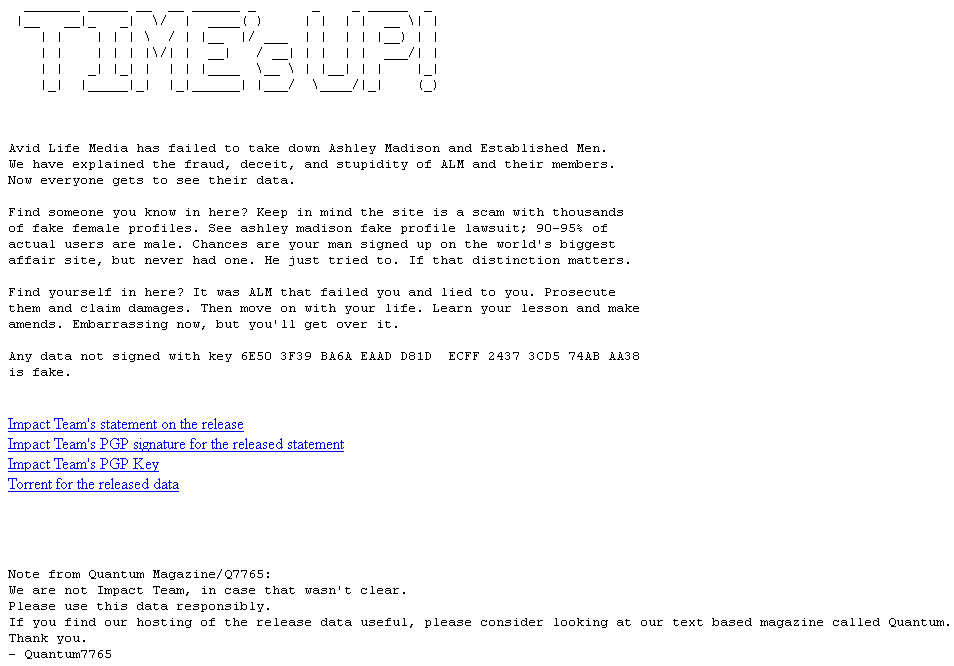
From taking in much of the media coverage of this leak so far — for example, from the aforementioned Wired piece or from the story at security blogger Graham Cluley’s site — readers would most likely conclude that this latest collection of leaked data is legitimate. But after an interview this evening with Raja Bhatia — AshleyMadison’s original founding chief technology officer — I came away with a different perspective.
Bhatia said he has teamed up with an international team of roughly a dozen investigators working seven days a week, 24-hours a day just to keep up with all of the fake data dumps claiming to be the stolen AshleyMadison database that was referenced by the original hackers on July 19. Bhatia said his team sees no signs that this latest dump is legitimate.
“On a daily basis, we’re seeing 30 to 80 different claimed dumps come online, and most of these dumps are entirely fake and being used by other organizations to capture the attention that’s been built up through this release,” Bhatia said. “In total we’ve looked at over 100GB of data that’s been put out there. For example, I just now got a text message from our analysis team in Israel saying that the last dump they saw was 15 gigabytes. We’re still going through that, but for the most part it looks illegitimate and many of the files aren’t even readable.”
The former AshleyMadison CTO, who’s been consulting for the company ever since news of the hack broke last month, said many of the fake data dumps the company has examined to date include some or all of the files from the original July 19 release. But the rest of the information, he said, is always a mix of data taken from other hacked sources — not AshleyMadison.com.
“The overwhelming amount of data released in the last three weeks is fake data,” he said. “But we’re taking every release seriously and looking at each piece of data and trying to analyze the source and the veracity of the data.”
Bhatia said the format of the fake leaks has been changing constantly over the last few weeks.
“Originally, it was being posted through Imgur.com and Pastebin.com, and now we’re seeing files going out over torrents, the Dark Web, and TOR-based URLs,” he said.
To help locate new troves of data claiming to be the files stolen from AshleyMadison, the company’s forensics team has been using a tool that Netflix released last year called Scumblr, which scours high-profile sites for specific terms and data. (...)
I should be clear that I have no idea whether this dump is in fact real; I’m only reporting what I have been able to observe so far. I have certainly seen many people I know on Twitter saying they’ve downloaded the files and found data from friends who’d acknowledged being members of the site.
Nearly every day since I first reported the exclusive story of the Ashley Madison hack on July 19, I’ve received desperate and sad emails from readers who were or are AshleyMadison users and who wanted to know if the data would ever be leaked, or if I could somehow locate their information in any documents leaked so far. Unfortunately, aside from what I’ve reported here and in my original story last month, I don’t have any special knowledge or insight into this attack.
by Brian Krebs, Krebs on Security | Read more:
Image: Unknown
Tuesday, August 18, 2015

Could the FDIC Seize Bank Deposits During a Crisis?
As we noted last week, one of the biggest problems for the Central Banks is actual physical cash.
The financial system is predominantly comprised of digital money. Actual physical Dollars bills and coins only amount to $1.36 trillion. This is only a little over 10% of the $10 trillion sitting in bank accounts. And it’s a tiny fraction of the $20 trillion in stocks, $38 trillion in bonds and $58 trillion in credit instruments floating around the system.
Suffice to say, if a significant percentage of people ever actually moved their money into physical cash, it could very quickly become a systemic problem.
 Indeed, this is precisely what caused the 2008 meltdown, when nearly 24% of the assets in Money Market funds were liquidated in the course of four weeks. The ensuing liquidity crush nearly imploded the system.
Because of this, Central Banks and the regulators have declared a War on Cash in an effort to stop people trying to get their money out of the system.
One policy they are considering is to put a carry tax on physical cash meaning that your Dollar bills would gradually depreciate once they were taken out of the bank. Another idea is to do away with actual physical cash completely.
Perhaps the most concerning is the fact that should a “systemically important” financial entity go bust, any deposits above $250,000 located therein could be converted to equity… at which point if the company’s shares, your wealth evaporates.
Indeed, the FDIC published a paper proposing precisely this back in December 2012. Below are some excerpts worth your attention.
So… if a large bank fails in the US, your deposits at this bank would either be “written-down” (read: disappear) or converted into equity or stock shares in the company. And once they are converted to equity you are a shareholder not a depositor… so you are no longer insured by the FDIC.
So if the bank then fails (meaning its shares fall)… so does your deposit.
by Phoenix Capital Research, Zero Hedge | Read more:
Image: Rick Wilking
The financial system is predominantly comprised of digital money. Actual physical Dollars bills and coins only amount to $1.36 trillion. This is only a little over 10% of the $10 trillion sitting in bank accounts. And it’s a tiny fraction of the $20 trillion in stocks, $38 trillion in bonds and $58 trillion in credit instruments floating around the system.
Suffice to say, if a significant percentage of people ever actually moved their money into physical cash, it could very quickly become a systemic problem.
 Indeed, this is precisely what caused the 2008 meltdown, when nearly 24% of the assets in Money Market funds were liquidated in the course of four weeks. The ensuing liquidity crush nearly imploded the system.
Because of this, Central Banks and the regulators have declared a War on Cash in an effort to stop people trying to get their money out of the system.
One policy they are considering is to put a carry tax on physical cash meaning that your Dollar bills would gradually depreciate once they were taken out of the bank. Another idea is to do away with actual physical cash completely.
Perhaps the most concerning is the fact that should a “systemically important” financial entity go bust, any deposits above $250,000 located therein could be converted to equity… at which point if the company’s shares, your wealth evaporates.
Indeed, the FDIC published a paper proposing precisely this back in December 2012. Below are some excerpts worth your attention.
This paper focuses on the application of “top-down” resolution strategies that involve a single resolution authority applying its powers to the top of a financial group, that is, at the parent company level. The paper discusses how such a top-down strategy could be implemented for a U.S. or a U.K. financial group in a cross-border context…
These strategies have been designed to enable large and complex cross- border firms to be resolved without threatening financial stability and without putting public funds at risk…
An efficient path for returning the sound operations of the G-SIFI to the private sector would be provided by exchanging or converting a sufficient amount of the unsecured debt from the original creditors of the failed company into equity. In the U.S., the new equity would become capital in one or more newly formed operating entities.
…Insured depositors themselves would remain unaffected. Uninsured deposits would be treated in line with other similarly ranked liabilities in the resolution process, with the expectation that they might be written down. (ed. http://www.fdic.gov/about/srac/2012/gsifi.pdf)In other words… any liability at the bank is in danger of being written-down should the bank fail. And guess what? Deposits are considered liabilities according to US Banking Law. In this legal framework, depositors are creditors.
So… if a large bank fails in the US, your deposits at this bank would either be “written-down” (read: disappear) or converted into equity or stock shares in the company. And once they are converted to equity you are a shareholder not a depositor… so you are no longer insured by the FDIC.
So if the bank then fails (meaning its shares fall)… so does your deposit.
by Phoenix Capital Research, Zero Hedge | Read more:
Image: Rick Wilking
Subscribe to:
Posts (Atom)