
Tuesday, November 10, 2015
Evil But Stupid
On May 10, the London Review of Books published “The Killing of Osama bin Laden,” a 10,000-word piece by veteran reporter Seymour Hersh. The story argued that the official White House narrative of the al Qaeda leader’s killing was a fabrication. The intelligence blogger R. J. Hillhouse had made similar claims a few years earlier, which had gone largely ignored in the US. But these allegations came from the most celebrated investigative journalist of the past half-century — they received more attention. The number of people trying to read Hersh’s story online was enough to crash the LRB’s website, something their many articles on Greco-Roman numismatics had previously failed to do.
 Hersh’s story was largely sourced from an unnamed retired US intelligence official, whose direct quotes are scattered through the piece, and whose account of the bin Laden raid is backed by testimony from several defense consultants and the former head of Pakistan’s Inter-Services Intelligence (all of whom, as Hersh’s detractors quickly pointed out, are retired or otherwise out of the loop). Its main claim was that Pakistan’s government had been holding bin Laden under house arrest in a compound in Abbottabad since 2006. The US government claims the raid was the result of years of patient intelligence work, which culminated in the identification of bin Laden’s courier (through the use of “enhanced” interrogation techniques, as famously depicted in the movie Zero Dark Thirty), who was then tracked back to the compound. Hersh says the precipitating event was, instead, just an unplanned accident: in 2010, a retired officer of the Pakistani intelligence service walked into the US Embassy and offered to reveal bin Laden’s location in exchange for $25 million, the reward the US had offered since 2001.
This initial event set off a chain of consequences. First, Hersh says, the US attempted to confirm the story with Pakistan’s chief of army staff and the head of the country’s intelligence service. Eventually, after threats, bribery, and blackmail, Pakistani officials admitted they had custody of bin Laden and were coerced into offering a sample of his DNA to prove it. Pakistan’s situation, Hersh claims, was complicated: they were using bin Laden as a bargaining chip in negotiations with the Taliban and al Qaeda, and they were also receiving payments from bin Laden’s Saudi Arabian sources to finance his upkeep. They needed foreign aid and support, but they couldn’t publicly hand bin Laden, a popular hero in Pakistan, over to the US. According to Hersh, the deal they struck was that they wouldn’t oppose a US raid on bin Laden’s compound, but bin Laden had to be killed.
The raid was planned for May 2, 2011. As it was in the interest of both sides to keep their cooperation secret, the initial plan, according to Hersh, was to say that bin Laden had been killed by a drone strike in the mountains on the Afghanistan-Pakistan border, where he was widely believed to be hiding. The Pakistan Army agreed that on the night of the raid they would turn a blind eye to the presence of American helicopters in their airspace. The guards at bin Laden’s compound were ordered to leave as soon as they heard the sound of approaching choppers.
The broad outlines of Hersh’s account match those of the official version: two Black Hawk helicopters brought an elite team of Navy SEALs to bin Laden’s compound. One crashed on the lawn while attempting to land. The SEALs forced their way into the building, blasted through security doors, and surprised bin Laden in his room. But Hersh’s story features no armed guards, no firefight, no wives used as human shields. Nor was bin Laden killed in self-defense, as the White House still maintains. One of the pleasures of reading Hersh’s account is the way it elegantly dismantles aspects of the story that seemed suspect from the beginning, and first among these is the notion that bin Laden, had he surrendered, would have been taken alive. “Let’s face it,” the retired intelligence officer told Hersh. “We’re going to commit a murder.”
After this point Hersh’s story and the administration’s largely jibe. Although they offer differing assessments of the quantity and value of the intelligence gathered from bin Laden’s compound, and the care with which it was collected, both agree that the SEALs took at least some of bin Laden’s papers (the administration claimed there was also computer equipment, which Hersh’s source denies) and went outside to wait for a backup helicopter. Before they left, the SEALs set a controlled explosion in the crashed helicopter to destroy its communications equipment. Hersh argues that these last actions should be seen as indirect confirmation of Pakistan’s support for the raid: if there really was a high risk of detection — the sort of risk you might expect when landing two helicopters in the heart of Pakistan’s military establishment — the SEALs would have abandoned their body armor and weapons, left the damaged helicopter intact for the Pakistanis to find, and crammed into the remaining helicopter for the return trip.
After the raid was complete, Hersh claims, there was a third unplanned event: the White House rushed to share the news. The original plan had been to wait a week and then claim that a drone strike had killed bin Laden in the Hindu Kush mountains, just across the border in Afghanistan. But given the helicopter crash and resulting fireball, the Obama Administration felt the raid would be impossible to keep under wraps for a week. With the vocal exception, Hersh says, of Defense Secretary Robert Gates, Obama’s advisers urged him to go public with the story as quickly as possible, before the Pentagon could announce it and take credit for it. According to Hersh, the White House had no press plan to implement should the raid go awry, no backup story. So they had to make up the story as they presented it to the world. Over the course of a few weeks, this scrambling produced inconsistencies. Bin Laden used a woman as a human shield; then he didn’t. Bin Laden was buried at sea from a naval vessel; the ship’s log has no record of any such burial. Bin Laden was shooting at SEALs when he was shot; or he wasn’t. And so on.
Hersh’s article solved several puzzles in the official report of bin Laden’s death. How could he have been hiding in a compound less than a mile from an elite military academy without Pakistan’s knowledge (a question raised in the days after the attack by the Senate Intelligence Committee’s Dianne Feinstein, among others)? Why, when bin Laden’s neighbors called the Abbottabad police after the SEALs’ helicopter crashed, did the Pakistani military tell the police not to respond? Why had Obama, in his speech announcing the news, originally claimed that the raid was due to the help of Pakistan’s intelligence agency, only to refute this claim the next day? Why were the pictures of bin Laden’s supposed burial at sea at first kept classified and then said to have been destroyed?
Then the melee began. (...)
Is Hersh paranoid? In some ways, the label seems appropriate. He has written about the private lives of the Kennedys and claimed that high-ranking military officials are members of the Knights of Malta and Opus Dei (although, as Greg Grandin pointed out in the Nation, a number of current and former high-ranking military officials really have been members of extreme right-wing Christian sects such as the Knights of Malta). In its unending accumulation of detail after disastrous detail, Hersh’s reporting often has the screwball plotting of a Pynchon novel. If the subject matter weren’t so upsetting, his reports would be funny.
But in other respects, the term doesn’t fit. Hersh’s stories break down complex events into chains of isolated, largely reactive individual decisions. His reporting never points back, as Pynchon’s novels do, to shadowy conspiracies; there is no titanic clash between impersonal forces, no central organizing principle, only human action churning away. Near the beginning of Hersh’s book on the Iraq war, an intelligence official complaining about the “enhanced interrogation” tactics at Guantánamo says, “It was wrong and also dysfunctional.” A few pages later, this refrain is repeated by another source: “It’s evil, but it’s also stupid.”
Evil but also stupid: that’s the keynote of the book, and in some ways of Hersh’s entire career. He is a great chronicler of bureaucracy. His stories are powered by scenes of administrative incompetence, organizational stupidity, turf warfare, inadequate foresight, random outbursts of violence, disorganized reactions, and self-serving attempts by everyone involved to spin the narrative of events to their own advantage. The bin Laden story depends on a string of uncoordinated accidents — the walk-in, the helicopter crash — and a series of mostly unsuccessful responses, culminating in the White House’s rush to claim public credit for the raid without informing the Pentagon or its Pakistani allies.
 Hersh’s story was largely sourced from an unnamed retired US intelligence official, whose direct quotes are scattered through the piece, and whose account of the bin Laden raid is backed by testimony from several defense consultants and the former head of Pakistan’s Inter-Services Intelligence (all of whom, as Hersh’s detractors quickly pointed out, are retired or otherwise out of the loop). Its main claim was that Pakistan’s government had been holding bin Laden under house arrest in a compound in Abbottabad since 2006. The US government claims the raid was the result of years of patient intelligence work, which culminated in the identification of bin Laden’s courier (through the use of “enhanced” interrogation techniques, as famously depicted in the movie Zero Dark Thirty), who was then tracked back to the compound. Hersh says the precipitating event was, instead, just an unplanned accident: in 2010, a retired officer of the Pakistani intelligence service walked into the US Embassy and offered to reveal bin Laden’s location in exchange for $25 million, the reward the US had offered since 2001.
This initial event set off a chain of consequences. First, Hersh says, the US attempted to confirm the story with Pakistan’s chief of army staff and the head of the country’s intelligence service. Eventually, after threats, bribery, and blackmail, Pakistani officials admitted they had custody of bin Laden and were coerced into offering a sample of his DNA to prove it. Pakistan’s situation, Hersh claims, was complicated: they were using bin Laden as a bargaining chip in negotiations with the Taliban and al Qaeda, and they were also receiving payments from bin Laden’s Saudi Arabian sources to finance his upkeep. They needed foreign aid and support, but they couldn’t publicly hand bin Laden, a popular hero in Pakistan, over to the US. According to Hersh, the deal they struck was that they wouldn’t oppose a US raid on bin Laden’s compound, but bin Laden had to be killed.
The raid was planned for May 2, 2011. As it was in the interest of both sides to keep their cooperation secret, the initial plan, according to Hersh, was to say that bin Laden had been killed by a drone strike in the mountains on the Afghanistan-Pakistan border, where he was widely believed to be hiding. The Pakistan Army agreed that on the night of the raid they would turn a blind eye to the presence of American helicopters in their airspace. The guards at bin Laden’s compound were ordered to leave as soon as they heard the sound of approaching choppers.
The broad outlines of Hersh’s account match those of the official version: two Black Hawk helicopters brought an elite team of Navy SEALs to bin Laden’s compound. One crashed on the lawn while attempting to land. The SEALs forced their way into the building, blasted through security doors, and surprised bin Laden in his room. But Hersh’s story features no armed guards, no firefight, no wives used as human shields. Nor was bin Laden killed in self-defense, as the White House still maintains. One of the pleasures of reading Hersh’s account is the way it elegantly dismantles aspects of the story that seemed suspect from the beginning, and first among these is the notion that bin Laden, had he surrendered, would have been taken alive. “Let’s face it,” the retired intelligence officer told Hersh. “We’re going to commit a murder.”
After this point Hersh’s story and the administration’s largely jibe. Although they offer differing assessments of the quantity and value of the intelligence gathered from bin Laden’s compound, and the care with which it was collected, both agree that the SEALs took at least some of bin Laden’s papers (the administration claimed there was also computer equipment, which Hersh’s source denies) and went outside to wait for a backup helicopter. Before they left, the SEALs set a controlled explosion in the crashed helicopter to destroy its communications equipment. Hersh argues that these last actions should be seen as indirect confirmation of Pakistan’s support for the raid: if there really was a high risk of detection — the sort of risk you might expect when landing two helicopters in the heart of Pakistan’s military establishment — the SEALs would have abandoned their body armor and weapons, left the damaged helicopter intact for the Pakistanis to find, and crammed into the remaining helicopter for the return trip.
After the raid was complete, Hersh claims, there was a third unplanned event: the White House rushed to share the news. The original plan had been to wait a week and then claim that a drone strike had killed bin Laden in the Hindu Kush mountains, just across the border in Afghanistan. But given the helicopter crash and resulting fireball, the Obama Administration felt the raid would be impossible to keep under wraps for a week. With the vocal exception, Hersh says, of Defense Secretary Robert Gates, Obama’s advisers urged him to go public with the story as quickly as possible, before the Pentagon could announce it and take credit for it. According to Hersh, the White House had no press plan to implement should the raid go awry, no backup story. So they had to make up the story as they presented it to the world. Over the course of a few weeks, this scrambling produced inconsistencies. Bin Laden used a woman as a human shield; then he didn’t. Bin Laden was buried at sea from a naval vessel; the ship’s log has no record of any such burial. Bin Laden was shooting at SEALs when he was shot; or he wasn’t. And so on.
Hersh’s article solved several puzzles in the official report of bin Laden’s death. How could he have been hiding in a compound less than a mile from an elite military academy without Pakistan’s knowledge (a question raised in the days after the attack by the Senate Intelligence Committee’s Dianne Feinstein, among others)? Why, when bin Laden’s neighbors called the Abbottabad police after the SEALs’ helicopter crashed, did the Pakistani military tell the police not to respond? Why had Obama, in his speech announcing the news, originally claimed that the raid was due to the help of Pakistan’s intelligence agency, only to refute this claim the next day? Why were the pictures of bin Laden’s supposed burial at sea at first kept classified and then said to have been destroyed?
Then the melee began. (...)
Is Hersh paranoid? In some ways, the label seems appropriate. He has written about the private lives of the Kennedys and claimed that high-ranking military officials are members of the Knights of Malta and Opus Dei (although, as Greg Grandin pointed out in the Nation, a number of current and former high-ranking military officials really have been members of extreme right-wing Christian sects such as the Knights of Malta). In its unending accumulation of detail after disastrous detail, Hersh’s reporting often has the screwball plotting of a Pynchon novel. If the subject matter weren’t so upsetting, his reports would be funny.
But in other respects, the term doesn’t fit. Hersh’s stories break down complex events into chains of isolated, largely reactive individual decisions. His reporting never points back, as Pynchon’s novels do, to shadowy conspiracies; there is no titanic clash between impersonal forces, no central organizing principle, only human action churning away. Near the beginning of Hersh’s book on the Iraq war, an intelligence official complaining about the “enhanced interrogation” tactics at Guantánamo says, “It was wrong and also dysfunctional.” A few pages later, this refrain is repeated by another source: “It’s evil, but it’s also stupid.”
Evil but also stupid: that’s the keynote of the book, and in some ways of Hersh’s entire career. He is a great chronicler of bureaucracy. His stories are powered by scenes of administrative incompetence, organizational stupidity, turf warfare, inadequate foresight, random outbursts of violence, disorganized reactions, and self-serving attempts by everyone involved to spin the narrative of events to their own advantage. The bin Laden story depends on a string of uncoordinated accidents — the walk-in, the helicopter crash — and a series of mostly unsuccessful responses, culminating in the White House’s rush to claim public credit for the raid without informing the Pentagon or its Pakistani allies.
by The Editors, N+1 | Read more:
Image: Pete Sousa


The Birth of “The New Yorker Story”
[ed. See also: The covers of the New Yorker magazine.]
The fifties were a key decade in the evolution of American magazine fiction. Earlier in the century, there had been a large stable of magazines to which writers like Katherine Anne Porter and F. Scott Fitzgerald could make a fine living by selling short stories. Later in the century, The New Yorker was preeminent; placing a story in its pages was the grail of budding writers, the ultimate validation. By the end of the century, the magazine essentially had the commercial market for short fiction to itself.
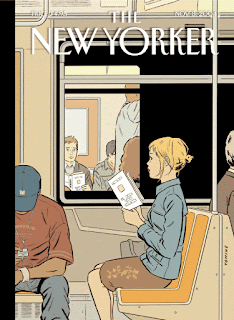 It was also in the fifties that “the New Yorker story” emerged, quite suddenly, as a distinct literary genus. What made a story New Yorker was its carefully wrought, many-comma’d prose; its long passages of physical description, the precision and the sobriety of which created a kind of negative emotional space, a suggestion of feeling without the naming of it; its well-educated white characters, who could be found experiencing the melancholies of affluence, the doldrums of suburban marriage, or the thrill or the desolation of adultery; and, above all, its signature style of ending, which was either elegantly oblique or frustratingly coy, depending on your taste. Outside the offices of The New Yorker, its fiction editors were rumored to routinely delete the final paragraph of any story accepted for publication.
The heyday of “the New Yorker story” coincided so neatly with the tenure of William Shawn, who succeeded Harold Ross as editor in 1952 and presided until 1987, that it might instead be called “the Shawn story.” The one story from the Ross era in this volume, Roald Dahl’s “Taste,” is written in an older and more conventional register. Its setting—the dinner party of a parvenu stockbroker—is still recognizable and relevant today, but its high-concept premise and its O. Henry ending hark back to the decades when magazine fiction supplied the sort of popular entertainment now considered television’s province. The fifties put an end to that, and “the New Yorker story,” with its emphasis on sentence craft and its rejection of neatly tied-up endings, can be understood, in part, as a retreat from the pressure of commercial TV, a retrenchment in provinces beyond the reach of visual media.
The fifties were a key decade in the evolution of American magazine fiction. Earlier in the century, there had been a large stable of magazines to which writers like Katherine Anne Porter and F. Scott Fitzgerald could make a fine living by selling short stories. Later in the century, The New Yorker was preeminent; placing a story in its pages was the grail of budding writers, the ultimate validation. By the end of the century, the magazine essentially had the commercial market for short fiction to itself.
 It was also in the fifties that “the New Yorker story” emerged, quite suddenly, as a distinct literary genus. What made a story New Yorker was its carefully wrought, many-comma’d prose; its long passages of physical description, the precision and the sobriety of which created a kind of negative emotional space, a suggestion of feeling without the naming of it; its well-educated white characters, who could be found experiencing the melancholies of affluence, the doldrums of suburban marriage, or the thrill or the desolation of adultery; and, above all, its signature style of ending, which was either elegantly oblique or frustratingly coy, depending on your taste. Outside the offices of The New Yorker, its fiction editors were rumored to routinely delete the final paragraph of any story accepted for publication.
The heyday of “the New Yorker story” coincided so neatly with the tenure of William Shawn, who succeeded Harold Ross as editor in 1952 and presided until 1987, that it might instead be called “the Shawn story.” The one story from the Ross era in this volume, Roald Dahl’s “Taste,” is written in an older and more conventional register. Its setting—the dinner party of a parvenu stockbroker—is still recognizable and relevant today, but its high-concept premise and its O. Henry ending hark back to the decades when magazine fiction supplied the sort of popular entertainment now considered television’s province. The fifties put an end to that, and “the New Yorker story,” with its emphasis on sentence craft and its rejection of neatly tied-up endings, can be understood, in part, as a retreat from the pressure of commercial TV, a retrenchment in provinces beyond the reach of visual media.
In the fifties, and for a long time afterward, The New Yorker didn’t identify its fiction as fiction. The author’s name appeared only at the end, in small capital letters, the same way the magazine’s journalists and critics were credited. What began, perhaps, as an affectation of Harold Ross’s became an emblem of the magazine’s definition of itself: the writing literally came first, the author’s ego-bearing name last. Although fiction in those days was usually given pride of place at the front of the magazine (rather than being secreted near the back, as is the case today), the number of short stories varied from issue to issue, which left it to the reader to determine whether the text in front of her was fiction or nonfiction. The respect the magazine thereby accorded fiction writers—the implication that what mattered about a piece was its sentence-by-sentence excellence, not its genre, not the weight of its subject matter—was part of what made The New Yorker the place every young American story writer dreamed of being published.
“The New Yorker story” was a stereotype, of course, and inevitably an unfair one—Shawn ran dozens of shtetl stories by I. B. Singer and Irish country stories by Frank O’Connor, and he devoted most of one issue to the experimental novel Snow White, by Donald Barthelme, who at the time was not well known. But it was “the New Yorker story,” as it developed in the fifties, that became the model for aspiring writers, because it seemed to be the key to getting into the magazine, and by the seventies the model was so dominant that it generated mockery and backlash. Too many stories about mopey suburbanites. Too many well-off white people. A surfeit of descriptions, a paucity of action. Too much privileging of prose for the sake of prose, too little openness to rougher energies. And those endings? A style repeated too often devolves into a tic. After Shawn retired and the magazine’s fiction section became more of a free-for-all, more multivalent and multiethnic, the “New Yorker story” began to look like a form in well-deserved retirement—a relic of an era when subscribers had still had the patience and the time, in New Canaan, in Armonk, on a beach in the Hamptons, to read slow-moving stories in which nothing much happened at the end.
“The New Yorker story” was a stereotype, of course, and inevitably an unfair one—Shawn ran dozens of shtetl stories by I. B. Singer and Irish country stories by Frank O’Connor, and he devoted most of one issue to the experimental novel Snow White, by Donald Barthelme, who at the time was not well known. But it was “the New Yorker story,” as it developed in the fifties, that became the model for aspiring writers, because it seemed to be the key to getting into the magazine, and by the seventies the model was so dominant that it generated mockery and backlash. Too many stories about mopey suburbanites. Too many well-off white people. A surfeit of descriptions, a paucity of action. Too much privileging of prose for the sake of prose, too little openness to rougher energies. And those endings? A style repeated too often devolves into a tic. After Shawn retired and the magazine’s fiction section became more of a free-for-all, more multivalent and multiethnic, the “New Yorker story” began to look like a form in well-deserved retirement—a relic of an era when subscribers had still had the patience and the time, in New Canaan, in Armonk, on a beach in the Hamptons, to read slow-moving stories in which nothing much happened at the end.
by Jonathan Franzen, The New Yorker | Read more:
Image: Adrian Tomine
Portuguese Bean Soup
 [ed. A fall tradition.]
Portuguese Bean Soup
Serves approx. 10-12
Ingredients:
3 Smoked Ham Hocks (these are usually available in the meat freezer section. Make sure they’re smoked). [ed. I also add additional ham shanks]
1 Large Portuguese Sausage (any brand), cut into bite-size pieces (I used MUCH more than 1 for this batch, since that’s how much I had)
1 bag of dry kidney beans
1-2 cups (uncooked) macaroni (add more or less at your discretion)
2 medium-sized potatoes, peeled and cut into bite size pieces
1 white round onion, diced
2 large carrots, peeled and chopped into bite size pieces
3 cloves garlic, crushed
1 bunch cilantro, chopped (save some extra unchopped for garnish)
2 bay leaves
1 six oz. can Tomato Paste (this will help to slightly thicken it)
1 fourteen oz. can Stewed Tomatoes
1 fourteen oz. can chicken stock
Salt and Pepper
Water
5 quart (or larger) pot or dutch oven
*Options: You can also add chopped celery and/or cabbage. I didn’t because there was no room for it. You can also substitute canned Kidney Beans for the uncooked type used here.
The most important part of this soup is the ham hock soup stock base it’s started with. This provides the dish with its “porky”, slightly smoky signature.
by Pomai, The Tasty Island | Read more:
Image: uncredited

Monday, November 9, 2015


In the Stream of Internet Radio, Music Stations Hold Their Own
[ed. KEXP is the best (but you already knew that, right?). Check out YouTube and all the artists they've spotlighted over the years)]
Internet radio was supposed to squash small FM music stations like KEXP. Someone forget to tell that to KEXP, the little station that has helped start the careers of big music acts like the Lumineers and Macklemore and Ryan Lewis.
 Last week John Richards, the morning D.J. at KEXP, walked through the station’s gleaming new headquarters not far from the Space Needle. It is a $15 million project intended to further the station’s evolution into a brick-and-mortar music programmer for the Internet age.
As workers put the finishing touches on the soaring public performance space near the building’s entrance, Mr. Richards pointed to a corner that will eventually have a cafe and another that will house a record store. A large soundproof window provided an aquarium-like view into the booth that Mr. Richards and other D.J.s will begin broadcasting from next month.
“It’s like ‘Star Trek’ in here,” Mr. Richards said, inspecting the electronic consoles, microphones and computer displays inside the booth.
Music fans live in a time of plenty, when nearly every song for any musical taste can be listened to in an instant over the Internet, from Spotify, Pandora and dozens of other sources. Satellite and commercial radio crowd the airwaves with further options for discovering new music and listening to the old.
And yet a handful of nonprofit music stations like KEXP with roots in college radio have never been doing better. They are using the Internet to reach bigger audiences around the globe, adding to their video programming and seeking to become in-person destinations for fans.
Most of all, they are trying to stand out with their music programming, with genre-hopping mixes selected by D.J.s rather than software or dictated by program directors at commercial radio chains.
The abundance of music and methods of distribution has increased demand for human tour guides for all of it.
“There’s so much music out there, so many places to go,” said Roger LaMay, general manager of WXPN, a public music station in Philadelphia, and chairman of the board of National Public Radio. “But finding curation from a trusted source is a lifeline for most music lovers who don’t have the time or wherewithal to sift through it all on their own.”
Internet radio was supposed to squash small FM music stations like KEXP. Someone forget to tell that to KEXP, the little station that has helped start the careers of big music acts like the Lumineers and Macklemore and Ryan Lewis.
 Last week John Richards, the morning D.J. at KEXP, walked through the station’s gleaming new headquarters not far from the Space Needle. It is a $15 million project intended to further the station’s evolution into a brick-and-mortar music programmer for the Internet age.
As workers put the finishing touches on the soaring public performance space near the building’s entrance, Mr. Richards pointed to a corner that will eventually have a cafe and another that will house a record store. A large soundproof window provided an aquarium-like view into the booth that Mr. Richards and other D.J.s will begin broadcasting from next month.
“It’s like ‘Star Trek’ in here,” Mr. Richards said, inspecting the electronic consoles, microphones and computer displays inside the booth.
Music fans live in a time of plenty, when nearly every song for any musical taste can be listened to in an instant over the Internet, from Spotify, Pandora and dozens of other sources. Satellite and commercial radio crowd the airwaves with further options for discovering new music and listening to the old.
And yet a handful of nonprofit music stations like KEXP with roots in college radio have never been doing better. They are using the Internet to reach bigger audiences around the globe, adding to their video programming and seeking to become in-person destinations for fans.
Most of all, they are trying to stand out with their music programming, with genre-hopping mixes selected by D.J.s rather than software or dictated by program directors at commercial radio chains.
The abundance of music and methods of distribution has increased demand for human tour guides for all of it.
“There’s so much music out there, so many places to go,” said Roger LaMay, general manager of WXPN, a public music station in Philadelphia, and chairman of the board of National Public Radio. “But finding curation from a trusted source is a lifeline for most music lovers who don’t have the time or wherewithal to sift through it all on their own.”
by Nick Wingfield, NY Times | Read more:
Image: Ruth Fremson
The Vanished World of ‘Stoner’

That same year, a teacher from Northeast Texas published a novel about one such determined young man. Stoner, by the professor and novelist John Williams, tells the story of a man whose life was shaped by the higher education system. The book traces the life of Bill Stoner, an upwardly-mobile student who leaves his parents’ farm to matriculate at the University of Missouri, where he studies, and then teaches, for the rest of his life. “William Stoner entered the University of Missouri as a freshman in the year of 1910, at the age of nineteen,” the book begins:
Eight years later, during the height of World War I, he received his Doctor of Philosophy degree and accepted an instructorship at the same University, where he taught until his death in 1956. He did not rise above the rank of assistant professor, and few students remembered him with any sharpness after they took his courses. When he died, his colleagues made a memorial contribution of a medieval manuscript to the University library. This manuscript may still be found in the Rare Books Collection, bearing the inscription: “Presented to the Library of the University of Missouri, in memory of William Stoner, Department of English. By his colleagues.”The opening paragraph, muted in tone, presents the book’s plot in miniature. Williams takes readers from Stoner’s birth on a farm in 1891 to his death throes on a sunny day sixty-five years later. The novel asks readers to assess the value of the life it describes. During his many decades at the university, Stoner suffers one painful setback after another: a loveless marriage, a ruthless professional rival, a thwarted love affair, and, finally, a cancerous tumor that kills him. Williams recounts each of these events in unsparing detail; his lucid prose renders acute emotional distress without ever tipping into melodrama. The book is as brutal in feeling as it is narrow in scope. It is the story of a man whose suffering, and minor successes, were lost to history.
Stoner itself met a similarly quiet fate. It sold only 2000 copies in the years after its first publication. But it wormed its way into the hearts of academics, writers, and teachers. Over the years, Irving Howe and C.P. Snow championed it in print. According to the writer Steve Almond, grad students in the 1990s passed it around like some form of delicious contraband. The novel was re-released by NYRB Classics in 2006, and it’s been on an upward trajectory ever since. Morris Dickstein sang its praises in the New York Times. In 2013 it was a bestseller across Europe. The New Yorker called it “The Greatest American Novel You’ve Never Heard Of,” while the Guardian named it one of the “must-read books” of 2013. This month, NYRB is releasing a 50th anniversary edition. It’s the perfect holiday gift for anyone who views teaching as a vocation.
For many of us who teach at the college level, though, reading Stoner on its fiftieth anniversary is an ironic experience. Stoner’s tragic life is, at once, familiar and aspirational. We recognize his love of teaching and devotion to his students. What looks increasingly unfamiliar, though, is the professional stability that Williams describes, and on which the plot of his novel depends. (...)
Times have changed. Today, an academic life is a precarious one, thanks to significant changes to the practice of academic hiring. Cost-cutting administrators aim to balance university budgets by relying on contingent, rather than permanent, instructors. In the 1970s, roughly two-thirds of university faculty were tenured or tenure-track. Today, only 24 per cent of faculty are on the tenure-track. The rest are adjuncts, hired on a course-by-course basis, or full-time instructors, often hired for periods of several years, who are ineligible for tenure.
Adjuncts are cheap: for a semester-long course, an adjunct will cost the university only a couple thousand dollars (the median pay across the nation is $2,700 for a semester-long course). Unless an adjunct works thirty hours at the same institution, he or she won’t be eligible for benefits. As a result, most adjuncts teach at multiple colleges and spend hours commuting from campus to campus. Many rely on food stamps or Medicaid; a study by the University of California at Berkeley found that roughly one quarter of the nation’s one million part-time college faculty receives some form of government aid. Meanwhile, since 1975, college tuition has more than tripled.
The gap between our academic climate and the world Williams describes is what gives Stoner its peculiar poignancy. Both the highpoints and crises of Stoner’s teaching career seem nearly unimaginable from our current vantage point. (...)
Still, one can long for an academic environment in which teaching was prioritized, and in which dedicated teachers were recognized. This is the world Williams’s novel returns to us. After several years of teaching, Stoner manages to bridge the “gulf that lay between what he felt for his subject and what he delivered in the classroom.” Williams’s description of this change is one that will resonate with teachers today:
He suspected that he was beginning, ten years late, to discover who he was; and figure he saw was both more and less than he had once imagined it to be. He felt himself at last beginning to be a teacher, which was simply a man to whom his book is true, to whom is given a dignity of art that has little to do with his foolishness or weakness or inadequacy as a man. It was a knowledge of which he could not speak, but one which changed him, once he had it, so that no one could mistake its presence.Stoner, tragic figure though he is, finds something much described and more rarely seen: teaching as a vocation.
by Maggie Doherty, TNR | Read more:
Image: Stoner, John Williams
GoFundMe Gone Wild
As someone with the keen observational skills of Mr. Magoo, it took me a long time to notice a problem social-media acquaintances had been talking about for months.
“I woke up to four new people today asking me for money on four different donation platforms,” one friend said. “One was my ex-babysitter announcing her wedding and where I could send cash. No invitation to the wedding. Just cash.”
 “I’m a believer in giving to real charities: medical research, school drives, the Red Cross, etc.,” said Heidi Knodle, owner of a picture framing store in San Francisco. “I’m tired of people asking for a vacation, funds for a wedding or their college tuition.”
The crime writer Mark Ebner, whose mailboxes have been increasingly filled with monetary requests, has a theory about it all. “I think online begging has become the new economy.”
I thought my friends were exaggerating. After all, a visit to GoFundMe or YouCaring yields site after site of worthy donation recipients. People whose homes were wiped out by natural disasters. People with diseases I’d never heard of, with no insurance and staggering medical expenses. Kids trying to pay for their parents’ funerals. Parents with seriously ill children wanting a trip to Disney World, and sick animals owned by people who couldn’t afford the vet bills.
One man had set up a fund for a friend who needed to take a couple of months off while his wife died of brain cancer.
But then, there were others. Many, many others. Education funds are great, but do I really want to pay for a friend to travel to Peru to become a shaman?
Should the woman who has lost a lot of weight (good for you!) ask her friends to pay for $2,500 worth of laser skin tightening? What about the girl seeking $600 for her “personal development journey”? (Not much to ask, but she was so beautiful, I didn’t understand why she didn’t develop herself into a model and make a whole lot more than that.)
Another woman was asking for help with the legal bills for her divorce, as her new husband had bolted to Israel. She was a little dramatic in her plea: “My life — the innocent, carefree life which I had known, and the blissful happy life of hopes and dreams shattered overnight. Instead of partaking of gourmet meals and donning my kalla/bridal trousseau, chaos and turmoil, sprinkled with vicious gossip became my daily food and clothing.”
The requests continued.
“I woke up to four new people today asking me for money on four different donation platforms,” one friend said. “One was my ex-babysitter announcing her wedding and where I could send cash. No invitation to the wedding. Just cash.”
 “I’m a believer in giving to real charities: medical research, school drives, the Red Cross, etc.,” said Heidi Knodle, owner of a picture framing store in San Francisco. “I’m tired of people asking for a vacation, funds for a wedding or their college tuition.”
The crime writer Mark Ebner, whose mailboxes have been increasingly filled with monetary requests, has a theory about it all. “I think online begging has become the new economy.”
I thought my friends were exaggerating. After all, a visit to GoFundMe or YouCaring yields site after site of worthy donation recipients. People whose homes were wiped out by natural disasters. People with diseases I’d never heard of, with no insurance and staggering medical expenses. Kids trying to pay for their parents’ funerals. Parents with seriously ill children wanting a trip to Disney World, and sick animals owned by people who couldn’t afford the vet bills.
One man had set up a fund for a friend who needed to take a couple of months off while his wife died of brain cancer.
But then, there were others. Many, many others. Education funds are great, but do I really want to pay for a friend to travel to Peru to become a shaman?
Should the woman who has lost a lot of weight (good for you!) ask her friends to pay for $2,500 worth of laser skin tightening? What about the girl seeking $600 for her “personal development journey”? (Not much to ask, but she was so beautiful, I didn’t understand why she didn’t develop herself into a model and make a whole lot more than that.)
Another woman was asking for help with the legal bills for her divorce, as her new husband had bolted to Israel. She was a little dramatic in her plea: “My life — the innocent, carefree life which I had known, and the blissful happy life of hopes and dreams shattered overnight. Instead of partaking of gourmet meals and donning my kalla/bridal trousseau, chaos and turmoil, sprinkled with vicious gossip became my daily food and clothing.”
The requests continued.
by Judith Newman, NY Times | Read more:
Image: via:
Friday, November 6, 2015


The Poop's in the Mail
Clostridium difficile (C. diff) is a terrible way to die. It's an antibiotic-resistant gut bug that causes painful diarrhea, fever and kidney failure. Almost half a million Americans are diagnosed with C. diff a year, the Centers for Disease Control and Prevention announced in a February press release. Of those people, around 29,000 die within 30 days of diagnosis.
 To put those numbers into perspective, here are a few more. In 2013, 32,719 people were killed in car crashes in the U.S., according to the Insurance Institute for Highway Safety. Every year, according to the CDC, 33,000 people are killed by guns in the U.S. This year, about 40,000 women in the U.S. are expected to die from breast cancer.
The intestinal infection comes from a spore-forming bacteria that neither soap nor alcohol can effectively kill and can live on surfaces for months. Though it's largely preventable with proper hygiene, it's usually spread in hospitals and nursing homes.
C. diff is generally treated in two ways: antibiotics and fecal microbiota transplantation (FMT), also known as a fecal transplant — the "microbial equivalent of a blood transfusion," according to MinuteEarth. Doctors take a fecal sample from a healthy person and transplant it into the patient's intestines through a colonoscopy, enema or nasoenteric tube, which goes up the nose and down into the stomach. FMT is highly effective in treating C. diff cases when antibiotics fail, but it's an invasive procedure and is considered an experimental treatment. Currently, it's used only on patients for whom antibiotics have proven ineffective.
Now there's a much easier cure for this deadly infection: the poop pill.
On Oct. 28, OpenBiome announced that it had started production of the first fecal transplant pill.
Even though FMT has been extremely successful for treating C. diff, it's still been difficult to make these transplants happen for people. That difficulty is what inspired Mark Smith to start OpenBiome, the world's first poop bank.
Since 2013, the Boston-based lab has been collecting healthy fecal matter, packaging it and sending it out to doctors around the world. Since then, OpenBiome has been involved in more than 7,500 treatments in roughly 460 hospitals, Carolyn Edelstein, OpenBiome's director of policy and global partnerships, told Mic.
"Despite the underlying simplicity and efficacy of FMT, prior to OpenBiome, it had become difficult for clinicians to offer FMT at a scale that matched patient needs because of the challenges of identifying and screening donors and processing stool material," OpenBiome's website says.
C. diff has traditionally been treated with antibiotics, and around 80% of C. diff patients will be cured by antibiotics, according to OpenBiome's clinical primer.
A study performed from 2008 to 2013 by the Academic Medical Center at the University of Amsterdam tested the efficacy of FMT and antibiotics to treat C. diff. Researchers found that fecal transplants were far much more effective than antibiotics — so conclusively that they stopped the study early. Ninety-four percent of the participants who received FMT as treatment were cured, compared to 31% and 23% cured by different antibiotics. (...)
FMT is arguably the best alternative to antibiotic treatment for infections like C. diff. It's actually a little odd that C. diff is treated with antibiotics, because "almost all cases of C. diff are associated with antibiotic use," Smith told Mic.
"Imagine that there were terrorists on the loose in New York City, and we decided the way to deal with it was nuking New York." Smith said. "That's what antibiotics are like. C. diff is like a sleeper cell; it's waiting for a disturbance caused by antibiotics."
 To put those numbers into perspective, here are a few more. In 2013, 32,719 people were killed in car crashes in the U.S., according to the Insurance Institute for Highway Safety. Every year, according to the CDC, 33,000 people are killed by guns in the U.S. This year, about 40,000 women in the U.S. are expected to die from breast cancer.
The intestinal infection comes from a spore-forming bacteria that neither soap nor alcohol can effectively kill and can live on surfaces for months. Though it's largely preventable with proper hygiene, it's usually spread in hospitals and nursing homes.
C. diff is generally treated in two ways: antibiotics and fecal microbiota transplantation (FMT), also known as a fecal transplant — the "microbial equivalent of a blood transfusion," according to MinuteEarth. Doctors take a fecal sample from a healthy person and transplant it into the patient's intestines through a colonoscopy, enema or nasoenteric tube, which goes up the nose and down into the stomach. FMT is highly effective in treating C. diff cases when antibiotics fail, but it's an invasive procedure and is considered an experimental treatment. Currently, it's used only on patients for whom antibiotics have proven ineffective.
Now there's a much easier cure for this deadly infection: the poop pill.
On Oct. 28, OpenBiome announced that it had started production of the first fecal transplant pill.
Even though FMT has been extremely successful for treating C. diff, it's still been difficult to make these transplants happen for people. That difficulty is what inspired Mark Smith to start OpenBiome, the world's first poop bank.
Since 2013, the Boston-based lab has been collecting healthy fecal matter, packaging it and sending it out to doctors around the world. Since then, OpenBiome has been involved in more than 7,500 treatments in roughly 460 hospitals, Carolyn Edelstein, OpenBiome's director of policy and global partnerships, told Mic.
"Despite the underlying simplicity and efficacy of FMT, prior to OpenBiome, it had become difficult for clinicians to offer FMT at a scale that matched patient needs because of the challenges of identifying and screening donors and processing stool material," OpenBiome's website says.
C. diff has traditionally been treated with antibiotics, and around 80% of C. diff patients will be cured by antibiotics, according to OpenBiome's clinical primer.
A study performed from 2008 to 2013 by the Academic Medical Center at the University of Amsterdam tested the efficacy of FMT and antibiotics to treat C. diff. Researchers found that fecal transplants were far much more effective than antibiotics — so conclusively that they stopped the study early. Ninety-four percent of the participants who received FMT as treatment were cured, compared to 31% and 23% cured by different antibiotics. (...)
FMT is arguably the best alternative to antibiotic treatment for infections like C. diff. It's actually a little odd that C. diff is treated with antibiotics, because "almost all cases of C. diff are associated with antibiotic use," Smith told Mic.
"Imagine that there were terrorists on the loose in New York City, and we decided the way to deal with it was nuking New York." Smith said. "That's what antibiotics are like. C. diff is like a sleeper cell; it's waiting for a disturbance caused by antibiotics."
When Does 'Eating Clean' Become an Eating Disorder?
The idea of an eating disorder that didn't involve a loss of appetite or the desire to purge began hitting the zeitgeist a year and a half ago. The disease was called orthorexia, a term coined by Dr. Steven Bratman in 1997. "Orthorexia is defined as an unhealthy obsession with healthy food," Dr. Bratman tells Broadly. "It's not the diet that is orthorexia, it's the diet that could lead to it. The more extreme or restrictive the diet, the more likely it could lead to orthorexia."
After coining the term, Dr. Bratman went on to publish several books about orthorexia and healthy living. Today, he has created an official scientific definition for the disease and is working on getting it published and accepted by the medical community. But Dr. Bratman was not the one to bring orthorexia to the mainstream some year and a half ago. Jordan Younger, a 25-year-old lifestyle blogger from California, was.
 Younger was a devout raw vegan who had built an online following of tens of thousands by writing about veganism and her virtuous diet on her then-blog The Blonde Vegan. To Younger, veganism was the cure-all she was hoping for—no longer did she suffer from chronic indigestion or feelings of bloating and discomfort. As she preached about the benefits of a plant-based diet alongside photos of bright green smoothies, mason jars brimming with chia seeds, and chopped kale salads, the popularity of her vegan persona grew.
Soon vegan cleanse companies sought her out to try their pricey cleanses for free. Younger started cleansing religiously—for a minimum of three days a week, eventually finding that every time she finished a cleanse and reintroduced solid food, her stomach problems returned, making her feel even worse than before. But Younger was resolute in turning to vegan cleanses as the answer. Soon the cycle of cleansing, getting too hungry, binging on solid food, feeling guilty, and cleansing again became the norm. Instead of looking outside of veganism to feel better, Younger started fearing vegan foods that weren't as healthy as she'd like them to be, and became riddled with anxiety about the food she ate.
Eventually, Younger came to understand that she had a problem. But hers wasn't a classic eating disorder that people were familiar with; hers was a fixation on the virtue of food. She introduced the term orthorexia to her following, saying that she was suffering and was going to get help. The response she got was overwhelming: "Once I started talking about experience with orthorexia on my blog and national news picked up on it, a flood of people came forward saying they identified with me," Younger tells Broadly. "We're talking tens of thousands of messages. It's been a year and a half and I haven't stopped hearing from people. It's not that number anymore; it's a couple people a day now, but it showed me how many people feel inadequate and feel that living a balanced life is not enough." (...)
People have died of orthorexia because they haven't been properly diagnosed. And, as Younger's floodgate of messages can attest, there are an enormous number of people suffering from orthorexic symptoms today. Nutritional therapist Dr. Karin Kratina, who has specialized in treating eating disorders for over 30 years and authored a paper about orthorexia on NationalEatingDisorders.org, tells Broadly: "I have absolutely seen a rise in orthorexic patients as a nutrition therapist. It's almost rising exponentially. Now I get a new client every week with orthorexic symptoms. It is a serious problem."
One of the reasons Dr. Kratina believes orthorexia is rising in popularity is because of our fixation on health. "There is nothing wrong with eating local or being a vegetarian or vegan," she says. "I think a lot of those diets are inherently valuable. The problem is that we have moralized eating, weight, food, and exercise. Food has become presented—more and more—as the answer."
We see this moral fixation on the virtues of food thrown back into our faces on a daily basis. Instagram can often seem like ground zero for a grotesque display of morally just food choices. Food bloggers like Deliciously Ella—whose vegan food blog has attracted hundreds of thousands of Instagram followers and multiple books deals—are attractive to us because they provide a clear answer: eating healthy will make you good. This answer, regularly served in the convenient form of an easily digestible #eatclean picture, feels so nice on our eyes.
"I think the images of all the really beautiful food—the joke for me is the kale smoothie—the endless kale smoothies are very pretty," says Dr. Bratman. "A lot of it is wonderful food photography. I think this type of media is definitely causing orthorexia to reach a larger audience and a younger audience."
After coining the term, Dr. Bratman went on to publish several books about orthorexia and healthy living. Today, he has created an official scientific definition for the disease and is working on getting it published and accepted by the medical community. But Dr. Bratman was not the one to bring orthorexia to the mainstream some year and a half ago. Jordan Younger, a 25-year-old lifestyle blogger from California, was.
 Younger was a devout raw vegan who had built an online following of tens of thousands by writing about veganism and her virtuous diet on her then-blog The Blonde Vegan. To Younger, veganism was the cure-all she was hoping for—no longer did she suffer from chronic indigestion or feelings of bloating and discomfort. As she preached about the benefits of a plant-based diet alongside photos of bright green smoothies, mason jars brimming with chia seeds, and chopped kale salads, the popularity of her vegan persona grew.
Soon vegan cleanse companies sought her out to try their pricey cleanses for free. Younger started cleansing religiously—for a minimum of three days a week, eventually finding that every time she finished a cleanse and reintroduced solid food, her stomach problems returned, making her feel even worse than before. But Younger was resolute in turning to vegan cleanses as the answer. Soon the cycle of cleansing, getting too hungry, binging on solid food, feeling guilty, and cleansing again became the norm. Instead of looking outside of veganism to feel better, Younger started fearing vegan foods that weren't as healthy as she'd like them to be, and became riddled with anxiety about the food she ate.
Eventually, Younger came to understand that she had a problem. But hers wasn't a classic eating disorder that people were familiar with; hers was a fixation on the virtue of food. She introduced the term orthorexia to her following, saying that she was suffering and was going to get help. The response she got was overwhelming: "Once I started talking about experience with orthorexia on my blog and national news picked up on it, a flood of people came forward saying they identified with me," Younger tells Broadly. "We're talking tens of thousands of messages. It's been a year and a half and I haven't stopped hearing from people. It's not that number anymore; it's a couple people a day now, but it showed me how many people feel inadequate and feel that living a balanced life is not enough." (...)
People have died of orthorexia because they haven't been properly diagnosed. And, as Younger's floodgate of messages can attest, there are an enormous number of people suffering from orthorexic symptoms today. Nutritional therapist Dr. Karin Kratina, who has specialized in treating eating disorders for over 30 years and authored a paper about orthorexia on NationalEatingDisorders.org, tells Broadly: "I have absolutely seen a rise in orthorexic patients as a nutrition therapist. It's almost rising exponentially. Now I get a new client every week with orthorexic symptoms. It is a serious problem."
One of the reasons Dr. Kratina believes orthorexia is rising in popularity is because of our fixation on health. "There is nothing wrong with eating local or being a vegetarian or vegan," she says. "I think a lot of those diets are inherently valuable. The problem is that we have moralized eating, weight, food, and exercise. Food has become presented—more and more—as the answer."
We see this moral fixation on the virtues of food thrown back into our faces on a daily basis. Instagram can often seem like ground zero for a grotesque display of morally just food choices. Food bloggers like Deliciously Ella—whose vegan food blog has attracted hundreds of thousands of Instagram followers and multiple books deals—are attractive to us because they provide a clear answer: eating healthy will make you good. This answer, regularly served in the convenient form of an easily digestible #eatclean picture, feels so nice on our eyes.
"I think the images of all the really beautiful food—the joke for me is the kale smoothie—the endless kale smoothies are very pretty," says Dr. Bratman. "A lot of it is wonderful food photography. I think this type of media is definitely causing orthorexia to reach a larger audience and a younger audience."
by Claudia McNeilly, Broadly | Read more:
Image: Stocksy
Interviews With People That Have Interesting Or Unusual Jobs
Q: What is your job?
 A: I am currently a golf caddie. I’ve been doing it for four years.
Q: How often do you work?
A: Seven days a week. I work as much as I can because it’s a very weather-dependent job.
Q: Did you know how to play golf when you started being a caddie?
A: I’ve been playing golf since I was 11 years old.
Q: Who do you caddie for?
A: I deal with extremely rich, extremely white people. People that have a lot of money and this is their escape. A round of golf takes like four hours. They can turn their cell phones off. You’re not allowed to talk on cell phones while on the course.
Q: What do you do as a caddie? Just carry the clubs?
A: There are three types of caddies.
The first is VIP, like what I do. You’re a psychologist, a coach, and a physical laborer all at the same time. They ask me, “Should I use the seven iron or the eight iron?” The higher the number, the shorter the ball goes. So if you’re even thinking about that question, you go with the one that goes further.
The second type is a bag caddie, where everybody walks and I take two golfers and carry one bag on each shoulder. It’s approximately 70 pounds and the course is approximately seven miles in length so you have to be in good shape. I run a lot. It’s an extremely physical job.
Third is a fore caddie, where you always stay in front of them. The players are in the carts, and you have just stay up with the carts. Golf carts go 14 mph, which is like a four minute 22 second mile, and you have to stay ahead of them.
Q: If they’re taking a cart, why can’t you take a cart too?
A: I guess I would say, we’re not getting paid to take a cart.
You can’t argue with the money though. It’s around four and a half, maybe five hours of work and you get $250-$300 a day. And that’s seven days a week. It pays very well. Sometimes it doesn’t. It could be $80. It depends on the tips.
Q: How did you find this job?
A: I used to be a high school English teacher. I was helping one of my students look at labor gigs on Craigslist and golf caddie popped up. He applied but I also put in an application for myself. I started one day a week, but I realized I was making twice what I made as a teacher.
Q: Were you in good shape when you started working as a caddie?
A: I’ve always been in pretty good shape. I’m 5’9” and 140 pounds and have two percent body fat. I know this because I got nailed by a golf ball last week and they did x-rays and stuff.
Q: Where did you get hit?
A: It was a half inch from my right nipple. I don’t know how it would’ve felt if it hit my nipple.
Q: How many times have you been hit?
A: I’ve been hit twice in four years.
Q: Have you ever had clients that you couldn’t get along with?
A: Only twice I’ve had a problem. Twice in about 800 rounds.
One time I just walked off. I said, “Have a nice round, I’m done with you.” They were abusive… mean… like plantation slave-owner mean.
The other time I had a single woman come down. I deal with mostly men. I’ve seen people that are drunk or have smoked weed but she was high on something—I have no idea. LSD?
She didn’t have golf attire on. She came down in a red cocktail dress with a rented set of clubs. I did the first couple of holes. I asked her her name and she said, “Umm… Jenny.”
She had no bra, no panties, and her boobs were falling out of the sides of her dress. She kept saying, “Prince Harry is my fiancé. Can you go and find Prince Harry for me?”
I did an hour and a half and then I went to my boss and they took her off the course. Later that night she was wandering around the hotel looking for Prince Harry again.
A: I am currently a golf caddie. I’ve been doing it for four years.Q: How often do you work?
A: Seven days a week. I work as much as I can because it’s a very weather-dependent job.
Q: Did you know how to play golf when you started being a caddie?
A: I’ve been playing golf since I was 11 years old.
Q: Who do you caddie for?
A: I deal with extremely rich, extremely white people. People that have a lot of money and this is their escape. A round of golf takes like four hours. They can turn their cell phones off. You’re not allowed to talk on cell phones while on the course.
Q: What do you do as a caddie? Just carry the clubs?
A: There are three types of caddies.
The first is VIP, like what I do. You’re a psychologist, a coach, and a physical laborer all at the same time. They ask me, “Should I use the seven iron or the eight iron?” The higher the number, the shorter the ball goes. So if you’re even thinking about that question, you go with the one that goes further.
The second type is a bag caddie, where everybody walks and I take two golfers and carry one bag on each shoulder. It’s approximately 70 pounds and the course is approximately seven miles in length so you have to be in good shape. I run a lot. It’s an extremely physical job.
Third is a fore caddie, where you always stay in front of them. The players are in the carts, and you have just stay up with the carts. Golf carts go 14 mph, which is like a four minute 22 second mile, and you have to stay ahead of them.
Q: If they’re taking a cart, why can’t you take a cart too?
A: I guess I would say, we’re not getting paid to take a cart.
You can’t argue with the money though. It’s around four and a half, maybe five hours of work and you get $250-$300 a day. And that’s seven days a week. It pays very well. Sometimes it doesn’t. It could be $80. It depends on the tips.
Q: How did you find this job?
A: I used to be a high school English teacher. I was helping one of my students look at labor gigs on Craigslist and golf caddie popped up. He applied but I also put in an application for myself. I started one day a week, but I realized I was making twice what I made as a teacher.
Q: Were you in good shape when you started working as a caddie?
A: I’ve always been in pretty good shape. I’m 5’9” and 140 pounds and have two percent body fat. I know this because I got nailed by a golf ball last week and they did x-rays and stuff.
Q: Where did you get hit?
A: It was a half inch from my right nipple. I don’t know how it would’ve felt if it hit my nipple.
Q: How many times have you been hit?
A: I’ve been hit twice in four years.
Q: Have you ever had clients that you couldn’t get along with?
A: Only twice I’ve had a problem. Twice in about 800 rounds.
One time I just walked off. I said, “Have a nice round, I’m done with you.” They were abusive… mean… like plantation slave-owner mean.
The other time I had a single woman come down. I deal with mostly men. I’ve seen people that are drunk or have smoked weed but she was high on something—I have no idea. LSD?
She didn’t have golf attire on. She came down in a red cocktail dress with a rented set of clubs. I did the first couple of holes. I asked her her name and she said, “Umm… Jenny.”
She had no bra, no panties, and her boobs were falling out of the sides of her dress. She kept saying, “Prince Harry is my fiancé. Can you go and find Prince Harry for me?”
I did an hour and a half and then I went to my boss and they took her off the course. Later that night she was wandering around the hotel looking for Prince Harry again.
by Suzanne Yeagley, McSweeny's | Read more:
Image: Caddyshack
Thursday, November 5, 2015


What's the Best Way to Die?
[ed. See also: One in a million.]
After a particularly gruesome news story — ISIS beheadings, a multicar pileup, a family burnt in their beds during a house fire — I usually get to wondering whether that particular tragic end would be the worst way to go. The surprise, the pain, the fear of impending darkness.
But lately, I’ve been thinking that it’s the opposite question that begs to be asked: what’s the best way to die? Given hypothetical, anything-goes permission to choose from a creepy, unlimited vending machine of endings, what would you select?
 If it helps, put yourself in that mindset that comes after a few glasses of wine with friends — your pal asks something dreamy, like where in the whole world you’d love to travel, or, if you could sleep with any celebrity, who would it be? Except this answer is even more personal.
There are lots of ways to look at the query. Would I want to know when I’m going to die, or be taken by surprise? (I mean, as surprising as such an inevitable event can be.) Would I want to be cognizant, so I can really experience dying as a process? Or might it be better to drowse my way through it?
Many surveys suggest that about three-quarters of Americans want to die at home, though the reality is that most Americans, upwards of 68 percent, will die in a hospital or other medicalized environment. Many also say they want to die in bed, but consider what that actually means: just lying there while your heart ticks away, your lungs heave to a stop. Lying around for too long also gets rather uncomfortable — as anyone who’s spent a lazy weekend in bed can tell you — and this raises a further question: should we expect comfort as we exit this life?
Sometimes I think getting sniped while walking down the street is the best way to go. Short, sweet, surprising; no worries, no time for pain. Sure, it’d be traumatic as hell for the people nearby, but who knows — your death might spark a social movement, a yearlong news story that launches media, legal, and criminal justice careers. What a death! It might mean something. Does that matter to you — that your death helps or otherwise changes other people’s lives? If there’s not a point to your death, you might wonder, was there a point to your life?
These are heavy questions — ahem, vital, ones — that don’t seem to come up very often.
I got curious about how other people would answer this question, so I started asking colleagues and friends for their ideal death scenarios (yes, I’m a blast at parties). I heard a wide variety of answers. Skydiving while high on heroin for the second time (because you want to have fun the first time, according to a colleague). Drowning, because he’d heard it was fairly peaceful once the panic clears. Storming a castle and felling enemies with a sword to save a woman, who he then has appreciative sex with, just as he’s taking his dying breaths. (That poor gal!) An ex-boyfriend of mine used to say that the first time he lost bowel control, he’d drive to the Grand Canyon and jump off.
My own non-serious answer is to be tickled to death, sheerly for the punniness of it.
Anecdotally, young men were more fancy-free about their answers, while the older folks and women I spoke with gave more measured answers or sat quietly. Wait, what did you ask? I’d repeat the question. A pause. Hmm.
One old standby came up quite a lot: dying of old age in my bed, surrounded by family. The hospital nurses I asked had a twist on that trope: in bed, surrounded by family, and dying of kidney failure. Among nurses, there was consensus that this is the best way to go if you’re near death and in intensive care — you just fade out and pass, one ICU nurse told me. In the medical community, there’s debate about how calm death by kidney failure actually is, but really, who can you ask?
These answers are all interesting, but my nurse friend got me wondering about people who deal with death on the regular — what do they think about the best death? Do they think about it? Surely hospice workers, physicians, oncologists, “right-to-die” advocates, cancer-cell biologists, bioethicists, and the like have a special view on dying. What might their more-informed criteria be for my “best death” query?
I started with a concept that I think most can agree with — an ideal death should be painless.
Turns out, a painless death is a pretty American way to think about dying.
by Robyn K. Coggins, Wilson Quarterly | Read more:
Image: via:
After a particularly gruesome news story — ISIS beheadings, a multicar pileup, a family burnt in their beds during a house fire — I usually get to wondering whether that particular tragic end would be the worst way to go. The surprise, the pain, the fear of impending darkness.
But lately, I’ve been thinking that it’s the opposite question that begs to be asked: what’s the best way to die? Given hypothetical, anything-goes permission to choose from a creepy, unlimited vending machine of endings, what would you select?
 If it helps, put yourself in that mindset that comes after a few glasses of wine with friends — your pal asks something dreamy, like where in the whole world you’d love to travel, or, if you could sleep with any celebrity, who would it be? Except this answer is even more personal.
There are lots of ways to look at the query. Would I want to know when I’m going to die, or be taken by surprise? (I mean, as surprising as such an inevitable event can be.) Would I want to be cognizant, so I can really experience dying as a process? Or might it be better to drowse my way through it?
Many surveys suggest that about three-quarters of Americans want to die at home, though the reality is that most Americans, upwards of 68 percent, will die in a hospital or other medicalized environment. Many also say they want to die in bed, but consider what that actually means: just lying there while your heart ticks away, your lungs heave to a stop. Lying around for too long also gets rather uncomfortable — as anyone who’s spent a lazy weekend in bed can tell you — and this raises a further question: should we expect comfort as we exit this life?
Sometimes I think getting sniped while walking down the street is the best way to go. Short, sweet, surprising; no worries, no time for pain. Sure, it’d be traumatic as hell for the people nearby, but who knows — your death might spark a social movement, a yearlong news story that launches media, legal, and criminal justice careers. What a death! It might mean something. Does that matter to you — that your death helps or otherwise changes other people’s lives? If there’s not a point to your death, you might wonder, was there a point to your life?
These are heavy questions — ahem, vital, ones — that don’t seem to come up very often.
I got curious about how other people would answer this question, so I started asking colleagues and friends for their ideal death scenarios (yes, I’m a blast at parties). I heard a wide variety of answers. Skydiving while high on heroin for the second time (because you want to have fun the first time, according to a colleague). Drowning, because he’d heard it was fairly peaceful once the panic clears. Storming a castle and felling enemies with a sword to save a woman, who he then has appreciative sex with, just as he’s taking his dying breaths. (That poor gal!) An ex-boyfriend of mine used to say that the first time he lost bowel control, he’d drive to the Grand Canyon and jump off.
My own non-serious answer is to be tickled to death, sheerly for the punniness of it.
Anecdotally, young men were more fancy-free about their answers, while the older folks and women I spoke with gave more measured answers or sat quietly. Wait, what did you ask? I’d repeat the question. A pause. Hmm.
One old standby came up quite a lot: dying of old age in my bed, surrounded by family. The hospital nurses I asked had a twist on that trope: in bed, surrounded by family, and dying of kidney failure. Among nurses, there was consensus that this is the best way to go if you’re near death and in intensive care — you just fade out and pass, one ICU nurse told me. In the medical community, there’s debate about how calm death by kidney failure actually is, but really, who can you ask?
These answers are all interesting, but my nurse friend got me wondering about people who deal with death on the regular — what do they think about the best death? Do they think about it? Surely hospice workers, physicians, oncologists, “right-to-die” advocates, cancer-cell biologists, bioethicists, and the like have a special view on dying. What might their more-informed criteria be for my “best death” query?
I started with a concept that I think most can agree with — an ideal death should be painless.
Turns out, a painless death is a pretty American way to think about dying.
by Robyn K. Coggins, Wilson Quarterly | Read more:
Image: via:
Wednesday, November 4, 2015

How to Compliment a Guy
 These are things I have said to women I don’t know:
“That bag is incroyable!” (Instead of incredible.)
“Your eyebrows look so amazing today. I feel like dying!”
“Wait, you put avocado on your face? Is it hard to be a genius?”
In order to be equal in all my doings, I recently set out to compliment men more. Do men even like compliments? On one hand, everyone always seems to appreciate the books, movies, and skyscrapers men make. But does anyone ever tell them nice things about their clothes and hair? It was time for someone (me) to go up to some men and try it. Without objectifying them, because that would be bad for their self-esteem.
The first guy I complimented was in my grocery store. I was buying coffee, and he had on some cool Elvis Costello–style glasses. “Nice glasses!” I said. He smiled and nudged the girl next to him, who was talking to some other people. She turned around, and I could see that she was wearing awesome glasses, even better than his. Then the girl said to me, “He’s happy because everyone always compliments my glasses.” I felt bad about not complimenting her, so I left.
I kept looking for men to compliment. I saw one dude wearing cool sneakers and another guy carrying a really cute yellow-and-white-striped beach bag (?!), but it’s difficult to just yell compliments at a man while he’s walking down the street. That could make him feel unsafe!
The next time I complimented a man, I was in a pharmacy and I did actually yell at him, but it was mostly because of circumstances. This man had a gigantic watch on that literally was covering his entire wrist. He was also wearing a tremendously tight blue cashmere V-neck sweater over a plaid shirt, legginglike jeans, and little brown slippers like a Viennese dancer. To my mind, he was really asking for the attention.
“Nice watch!” I screamed, because he was walking away from me. He turned toward me with a look of disgust.
This, however, was my only negative reaction. Most men seem extremely pleased when you compliment them on anything that has to do with their clothing or hair. It’s uncanny: When you say anything even slightly nice to a man, his face will melt into a grateful sunburst of a grin, as if he had never been complimented before. I complimented a guy at my gym on his sneakers, and he looked as if he was going to weep.
But, of course, these are not the only kind of compliments there are. You can also compliment a man on his ability to do activities. I must say, this other type of compliment didn’t even occur to me at first because, in general, girls don’t really compliment one another about how well they are doing tasks. They’re just like, “What an amazing pair of boots. Are you French?”
When I started to compliment men on their abilities, it engendered a slightly different reaction. Instead of weeping with gratitude, they started to act all proud and almost annoyed. For example, I rented a Zipcar to go see the demolished Great Gatsby mansion on Sands Point, and the guy working in the parking garage had to maneuver the car out of a very confined space. I was impressed. “You are an incredible driver!” I said, not even thinking about my man-complimenting project. The guy walked away as if he didn’t hear me. Later, a different man expertly mounted my TV. “That’s the most beautiful TV I’ve ever seen,” I told him. “It looks like a picture on a wall.” He simply nodded.
by Rebecca Harrington, NY Magazine | Read more:
Image: Philip Gendreau/Bettmann/Corbis
The Lure of Luxury
Why would anyone spend thousands of dollars on a Prada handbag, an Armani suit, or a Rolex watch? If you really need to know the time, buy a cheap Timex or just look at your phone and send the money you have saved to Oxfam. Certain consumer behaviors seem irrational, wasteful, even evil. What drives people to possess so much more than they need?
Maybe they have good taste. In her wonderful 2003 book The Substance of Style, Virginia Postrel argues that our reaction to many consumer items is “immediate, perceptual, and emotional.” We want these things because of the pleasure we get from looking at and interacting with high-quality products—and there is nothing wrong with this. “Decoration and adornment are neither higher nor lower than ‘real’ life,” she writes. “They are part of it.”
 Postrel is pushing back against a more cynical theory held by many sociologists, economists, and evolutionary theorists. Building from the insights of Thorstein Veblen, they argue that we buy such things as status symbols. Though we are often unaware of it and might angrily deny it, we are driven to accumulate ostentatious goods to impress others. Evolutionary psychologist Geoffrey Miller gives this theory an adaptationist twist, arguing that the hunger for these luxury goods is a modern expression of the evolved desire to signal attractive traits—such as intelligence, ambition, and power—to entice mates: Charles Darwin’s sexual selection meets Veblen’s conspicuous consumption.
Signaling is a theory with broad scope—it has been applied to everything from self-mutilating behavior to the fact that the best private schools teach dead languages—but it is most blatant in the consumer world. Advertisements are often pure signaling fantasies. Your neighbors gasp as your car drives by; the attractive stranger in a bar is aroused by your choice of beer; your spouse and children love you because you bought the right brand of frozen pizza. Consistent with this, neuroscience studies reveal that when people look at products they judge to be “cool,” brain areas associated with praise and social approval are activated.
If such purchases are motivated by status enhancement, they become positional goods: their value is determined by what other people possess. This inspires a powerful critique of consumerism. Status is a zero-sum game, and just as countries in a literal arms race have to strip away resources from domestic priorities, the figurative arms race that economist Robert H. Frank calls “luxury fever” takes away from individual consumers money that would be better spent on more substantial goods, such as socializing and travel. It is hard for people to opt out. To say that an individual can simply refuse to participate is like saying that countries in a literal arms race can choose to stop buying all those fighter planes and put the money into school lunches and Shakespeare in the Park. Sure they can—if they don’t mind being invaded. If everyone else buys fancy suits for their job interviews, then I risk unemployment by choosing not to.
We would be better off, then, if some Leviathan could force us to disarm, so Miller, Frank, and others argue that the government should step in. A policy aimed at curbing luxury shopping might involve higher marginal tax rates or, as a more targeted intervention, a consumption tax. As it becomes harder to afford a Rolex, people will devote more money to pleasures that really matter. Less waste, more happiness.
Now, only a philistine would deny Postrel’s point that some consumer preferences are aesthetic, even sensual. And only a rube would doubt that some people buy some luxury items to impress colleagues, competitors, spouses, and lovers. Perhaps we can divvy up the consumer world. An appreciation of beauty explains certain accessible and universal consumer pleasures—Postrel begins her book in Kabul after the Taliban fell, describing how the women there reveled in their freedom to possess burkas of different colors and to paint their nails—while signaling theory applies to the more extravagant purchases. A crimson burka? Aesthetics. A $30,000 watch? Signaling. Aristotle Onassis’s choice to upholster the bar stools in his yacht with whale foreskin? Definitely signaling.
I don’t think any of this is mistaken. But it is seriously incomplete. There is a further explanation for our love of such goods, which draws upon one of the most interesting ideas in the cognitive sciences: that humans are not primarily sensory creatures. Rather, we respond to what we believe are objects’ deeper properties, including their histories. Sensory properties are relevant and so is signaling, but the pleasure we get from the right sort of history explains much of the lure of luxury items—and of more mundane consumer items as well.
Maybe they have good taste. In her wonderful 2003 book The Substance of Style, Virginia Postrel argues that our reaction to many consumer items is “immediate, perceptual, and emotional.” We want these things because of the pleasure we get from looking at and interacting with high-quality products—and there is nothing wrong with this. “Decoration and adornment are neither higher nor lower than ‘real’ life,” she writes. “They are part of it.”
 Postrel is pushing back against a more cynical theory held by many sociologists, economists, and evolutionary theorists. Building from the insights of Thorstein Veblen, they argue that we buy such things as status symbols. Though we are often unaware of it and might angrily deny it, we are driven to accumulate ostentatious goods to impress others. Evolutionary psychologist Geoffrey Miller gives this theory an adaptationist twist, arguing that the hunger for these luxury goods is a modern expression of the evolved desire to signal attractive traits—such as intelligence, ambition, and power—to entice mates: Charles Darwin’s sexual selection meets Veblen’s conspicuous consumption.
Signaling is a theory with broad scope—it has been applied to everything from self-mutilating behavior to the fact that the best private schools teach dead languages—but it is most blatant in the consumer world. Advertisements are often pure signaling fantasies. Your neighbors gasp as your car drives by; the attractive stranger in a bar is aroused by your choice of beer; your spouse and children love you because you bought the right brand of frozen pizza. Consistent with this, neuroscience studies reveal that when people look at products they judge to be “cool,” brain areas associated with praise and social approval are activated.
If such purchases are motivated by status enhancement, they become positional goods: their value is determined by what other people possess. This inspires a powerful critique of consumerism. Status is a zero-sum game, and just as countries in a literal arms race have to strip away resources from domestic priorities, the figurative arms race that economist Robert H. Frank calls “luxury fever” takes away from individual consumers money that would be better spent on more substantial goods, such as socializing and travel. It is hard for people to opt out. To say that an individual can simply refuse to participate is like saying that countries in a literal arms race can choose to stop buying all those fighter planes and put the money into school lunches and Shakespeare in the Park. Sure they can—if they don’t mind being invaded. If everyone else buys fancy suits for their job interviews, then I risk unemployment by choosing not to.
We would be better off, then, if some Leviathan could force us to disarm, so Miller, Frank, and others argue that the government should step in. A policy aimed at curbing luxury shopping might involve higher marginal tax rates or, as a more targeted intervention, a consumption tax. As it becomes harder to afford a Rolex, people will devote more money to pleasures that really matter. Less waste, more happiness.
Now, only a philistine would deny Postrel’s point that some consumer preferences are aesthetic, even sensual. And only a rube would doubt that some people buy some luxury items to impress colleagues, competitors, spouses, and lovers. Perhaps we can divvy up the consumer world. An appreciation of beauty explains certain accessible and universal consumer pleasures—Postrel begins her book in Kabul after the Taliban fell, describing how the women there reveled in their freedom to possess burkas of different colors and to paint their nails—while signaling theory applies to the more extravagant purchases. A crimson burka? Aesthetics. A $30,000 watch? Signaling. Aristotle Onassis’s choice to upholster the bar stools in his yacht with whale foreskin? Definitely signaling.
I don’t think any of this is mistaken. But it is seriously incomplete. There is a further explanation for our love of such goods, which draws upon one of the most interesting ideas in the cognitive sciences: that humans are not primarily sensory creatures. Rather, we respond to what we believe are objects’ deeper properties, including their histories. Sensory properties are relevant and so is signaling, but the pleasure we get from the right sort of history explains much of the lure of luxury items—and of more mundane consumer items as well.
by Paul Bloom, Boston Review | Read more:
Image: scion_cho
Subscribe to:
Posts (Atom)