Saturday, November 14, 2015

Dark Times For Diners
There are no Michelin stars on the door, but you will not find a better breakfast in New York City than at the Bel Aire Diner in Astoria, Queens. The coffee, a lighter roast than Starbucks' and brewed three gallons at a time, is always fresh because just about every customer gets a refill or three. The Greek Breakfast entrée is a masterpiece of the line cook's art, a combination of eggs (any style), feta cheese, soft black olives and grilled fresh tomatoes whose juice seasons the toasted pita.
 The Bel Aire is run under the glare of Argyris "Archie" Dellaportas, who immigrated to Queens in 1972 at age 18 from the Greek island of Cephalonia. He baked bread at the Westway Diner in Hell's Kitchen and other joints before being hired to run a diner in Maryland, which meant long stretches away from his wife and children.
In 1996, Dellaportas came back when he bought the Bel Aire for $350,000. The diner is open 24 hours a day, and for many years Dellaportas toiled during most of them, going to work at 5 in the morning and staying until 11 at night or later. The backbreaking work paid off when, in 2001 and again in 2005, the Daily News named the Bel Aire New York's best diner. Food tourists and curiosity seekers—including Tina Fey and James Gandolfini, whose television series were filmed nearby—flocked to the corner of Broadway and 21st Street, if only to see the exemplar of what is at once a classic symbol and generic staple of New York culture.
"To me, the Bel Aire epitomizes the diner," said Astoria native Nick Papamichael. "So much in New York has changed, but the Bel Aire is the same great place."
At least for now, Dellaportas, who is 62 and hasn't taken a vacation in 20 years, has dialed back his hours and is contemplating retirement. That would mean passing on the business to his two sons, whom he's been grooming for a while. But, truth be told, he isn't sure they're up to the task. Diners, historically more profitable than most restaurants, have seen their margins halved in recent years, owing to the rising cost of rent, staff and even eggs.
In this environment, Dellaportas isn't sure his boys have the personalities to compete. "You have to be tough in this business; otherwise people will cheat you," he said one recent afternoon as he ate an early dinner of grilled skirt steak and fries. "I don't know if my sons are tough enough."
The situation at the Bel Aire says a lot about what's happening throughout New York's diner culture, where the helpings are huge, the prices are right, and poring over the laminated pages of Greek, Italian and American menu options takes about as long as reading a Russian novel.
But these breakfast conveniences, lunch go-tos, dinners of last resort and midnight hangouts are closing at a rapid rate. Between economic pressures, changes in eating habits and a next-generation not as interested as their parents in spending 16 hours a day manning a cash register, the city's diner scene may soon no longer exist. (...)
Historians devoted to the study of diners—yes, that's a thing—estimate there were 1,000 diners in the city a generation ago. There are now only 398 establishments that describe themselves as diners or coffee shops, according to city Department of Health records. (...)
t's also a business with its own distinct place in popular culture. Exhibit A: Edward Hopper's iconic Nighthawks painting, with its depiction of three customers and a waiter burning the midnight oil. Exhibit B: Seinfeld, the classic sitcom whose main characters regularly noshed at Monk's, an imaginary Upper West Side greasy spoon modeled after Tom's Diner at West 112th Street and Broadway. (Tom's was also the subject of a song by Suzanne Vega, who attended nearby Barnard College.) Exhibit C: Diners, Drive-Ins and Dives, the long-running Food Network series starring Guy Fieri.
A diner is where Tony Soprano had what may have been his last meal and where John Travolta and Samuel L. Jackson's characters discussed the difference between miracles and acts of God in Pulp Fiction. Just recently, a scene in The Good Wife was shot at the Bel Aire.
The draw of diners for cultural tastemakers may have something to do with their egalitarian nature, drawing the high and mighty as well as average Joes. (...)
 The Bel Aire is run under the glare of Argyris "Archie" Dellaportas, who immigrated to Queens in 1972 at age 18 from the Greek island of Cephalonia. He baked bread at the Westway Diner in Hell's Kitchen and other joints before being hired to run a diner in Maryland, which meant long stretches away from his wife and children.
In 1996, Dellaportas came back when he bought the Bel Aire for $350,000. The diner is open 24 hours a day, and for many years Dellaportas toiled during most of them, going to work at 5 in the morning and staying until 11 at night or later. The backbreaking work paid off when, in 2001 and again in 2005, the Daily News named the Bel Aire New York's best diner. Food tourists and curiosity seekers—including Tina Fey and James Gandolfini, whose television series were filmed nearby—flocked to the corner of Broadway and 21st Street, if only to see the exemplar of what is at once a classic symbol and generic staple of New York culture.
"To me, the Bel Aire epitomizes the diner," said Astoria native Nick Papamichael. "So much in New York has changed, but the Bel Aire is the same great place."
At least for now, Dellaportas, who is 62 and hasn't taken a vacation in 20 years, has dialed back his hours and is contemplating retirement. That would mean passing on the business to his two sons, whom he's been grooming for a while. But, truth be told, he isn't sure they're up to the task. Diners, historically more profitable than most restaurants, have seen their margins halved in recent years, owing to the rising cost of rent, staff and even eggs.
In this environment, Dellaportas isn't sure his boys have the personalities to compete. "You have to be tough in this business; otherwise people will cheat you," he said one recent afternoon as he ate an early dinner of grilled skirt steak and fries. "I don't know if my sons are tough enough."
The situation at the Bel Aire says a lot about what's happening throughout New York's diner culture, where the helpings are huge, the prices are right, and poring over the laminated pages of Greek, Italian and American menu options takes about as long as reading a Russian novel.
But these breakfast conveniences, lunch go-tos, dinners of last resort and midnight hangouts are closing at a rapid rate. Between economic pressures, changes in eating habits and a next-generation not as interested as their parents in spending 16 hours a day manning a cash register, the city's diner scene may soon no longer exist. (...)
Historians devoted to the study of diners—yes, that's a thing—estimate there were 1,000 diners in the city a generation ago. There are now only 398 establishments that describe themselves as diners or coffee shops, according to city Department of Health records. (...)
t's also a business with its own distinct place in popular culture. Exhibit A: Edward Hopper's iconic Nighthawks painting, with its depiction of three customers and a waiter burning the midnight oil. Exhibit B: Seinfeld, the classic sitcom whose main characters regularly noshed at Monk's, an imaginary Upper West Side greasy spoon modeled after Tom's Diner at West 112th Street and Broadway. (Tom's was also the subject of a song by Suzanne Vega, who attended nearby Barnard College.) Exhibit C: Diners, Drive-Ins and Dives, the long-running Food Network series starring Guy Fieri.
A diner is where Tony Soprano had what may have been his last meal and where John Travolta and Samuel L. Jackson's characters discussed the difference between miracles and acts of God in Pulp Fiction. Just recently, a scene in The Good Wife was shot at the Bel Aire.
The draw of diners for cultural tastemakers may have something to do with their egalitarian nature, drawing the high and mighty as well as average Joes. (...)
Gutman, who was a consultant to the 1982 Barry Levinson film Diner, explained that "there's a certain unpretentiousness to diners, with the counter, stools and booths. But there's also action and a friendliness you can partake of in a way you can't in a chain restaurant."
There's even a patois particular to diners, where rye bread is referred to as "whiskey," rye toast is "whiskey down," "black and blue" is a rare steak, and "84 scrambled" means eight scrambled eggs served on four plates.
Foodie culture also has taken to diners. Champs Diner in Brooklyn specializes in vegan fare such as tofu Benedict and "soysage" patties. The Empire Diner in Chelsea, whose kitchen until July was run by celebrity chef Amanda Freitag, offers a vintage look and upmarket fare like $25 pan-roasted, antibiotic-free chicken and a $16 Greek salad with "protein additions," such as seared yellowfin tuna, for an additional $7. "The Empire became the first diner to put on airs," said Gutman. "A diner has got to be affordable. Otherwise it gets too uppity."
There's even a patois particular to diners, where rye bread is referred to as "whiskey," rye toast is "whiskey down," "black and blue" is a rare steak, and "84 scrambled" means eight scrambled eggs served on four plates.
Foodie culture also has taken to diners. Champs Diner in Brooklyn specializes in vegan fare such as tofu Benedict and "soysage" patties. The Empire Diner in Chelsea, whose kitchen until July was run by celebrity chef Amanda Freitag, offers a vintage look and upmarket fare like $25 pan-roasted, antibiotic-free chicken and a $16 Greek salad with "protein additions," such as seared yellowfin tuna, for an additional $7. "The Empire became the first diner to put on airs," said Gutman. "A diner has got to be affordable. Otherwise it gets too uppity."
by Aaron Elstein, Crain's | Read more:
Image: Buck Ennis

Friday, November 13, 2015
Findings

Officials at Yosemite National Park hoped that designated selfie zones might prevent millennials from falling into rivers and drowning. Restricting access to suicide hot spots reduces deaths by 90 percent. A blood test in combination with a questionnaire can predict suicidal thoughts in bipolar patients with 98 percent accuracy. Austerity increases suicides in male European adolescents. Having a reason to live reduces suicide among the transgendered. Participants in Becoming a Man, a program that seeks to reduce “automatic behavior” among Chicago boys, were 44 percent less likely to be arrested for a violent crime. Mystical experiences are not ineffable. By downregulating posterior-medial-frontal-cortex activity via transcranial magnetic stimulation, an interdisciplinary team reduced subjects’ belief in God. A newly discovered microsnail can easily pass through the eye of a needle, camel’s milk was declared beneficial for autistic children by scientists at India’s National Research Centre on Camel, and the richest 1 percent of humanity was found to possess half the world’s wealth. The tweets of the rich express more anger and fear than the tweets of the poor, which express more disgust, sadness, and surprise; joy does not vary.
by Rafil Kroll-Zaidi, Harper's | Read more:
Image: Camouflage, Anna Bella Geiger. Courtesy Galería Aural, Alicante, Spain

It’s a $cam!
The American Way of War in the Twenty-First Century
Let’s begin with the $12 billion in shrink-wrapped $100 bills, Iraqi oil money held in the U.S. The Bush administration began flying it into Baghdad on C-130s soon after U.S. troops entered that city in April 2003. Essentially dumped into the void that had once been the Iraqi state, at least $1.2 to $1.6 billion of it was stolen and ended up years later in a mysterious bunker in Lebanon. And that’s just what happened as the starting gun went off.
It’s never ended. In 2011, the final report of the congressionally mandated Commission on Wartime Contracting estimated that somewhere between $31 billion and $60 billion taxpayer dollars had been lost to fraud and waste in the American “reconstruction” of Iraq and Afghanistan. In Iraq, for instance, there was that $75 million police academy, initially hailed “as crucial to U.S. efforts to prepare Iraqis to take control of the country's security.” It was, however, so poorly constructed that it proved a health hazard. In 2006, “feces and urine rained from the ceilings in [its] student barracks” and that was only the beginning of its problems.
When the bad press started, Parsons Corporation, the private contractor that built it, agreed to fix it for nothing more than the princely sum already paid. A year later, a New York Times reportervisited and found that “the ceilings are still stained with excrement, parts of the structures are crumbling, and sections of the buildings are unusable because the toilets are filthy and nonfunctioning.” This seems to have been par for the course. Typically enough, the Khan Bani Saad Correctional Facility, a $40 million prison Parsons also contracted to build, was never even finished.
And these were hardly isolated cases or problems specific to Iraq. Consider, for instance, those police stations in Afghanistan believed to be crucial to “standing up” a new security force in that country. Despite the money poured into them and endless cost overruns, many were either never completed or never built, leaving new Afghan police recruits camping out. And the police were hardly alone. Take the $3.4 million unfinished teacher-training center in Sheberghan, Afghanistan, that an Iraqi company was contracted to build (using, of course, American dollars) and from which it walked away, money in hand.
And why stick to buildings, when there were those Iraqi roads to nowhere paid for by American dollars? At least one of them did at least prove useful to insurgent groups moving their guerrillas around (like the $37 million bridge the U.S. Army Corps of Engineers built between Afghanistan and Tajikistan that helped facilitate the region's booming drug trade in opium and heroin). In Afghanistan, Highway 1 between the capital Kabul and the southern city of Kandahar, unofficially dubbed the “highway to nowhere,” was so poorly constructed that it began crumbling in its first Afghan winter.
And don’t think that this was an aberration. The U.S. Agency for International Development (USAID) hired an American nonprofit, International Relief and Development (IRD), to oversee an ambitious road-building program meant to gain the support of rural villagers. Almost $300 million later, it could point to “less than 100 miles of gravel road completed.” Each mile of road had, by then, cost U.S. taxpayers $2.8 million, instead of the expected $290,000, while a quarter of the road-building funds reportedly went directly to IRD for administrative and staff costs. Needless to say, as the road program failed, USAID hired IRD to oversee other non-transportation projects.
In these years, the cost of reconstruction never stopped growing. In 2011, McClatchy Newsreported that “U.S. government funding for at least 15 large-scale programs and projects grew from just over $1 billion to nearly $3 billion despite the government's questions about their effectiveness or cost.”
The Gas Station to Nowhere
So much construction and reconstruction -- and so many failures. There was the chicken-processing plant built in Iraq for $2.58 million that, except in a few Potemkin-Village-like moments, never plucked a chicken and sent it to market. There was the sparkling new, 64,000-square-foot, state-of-the-art, $25 million headquarters for the U.S. military in Helmand Province, Afghanistan, that doubled in cost as it was being built and that three generals tried to stop. They were overruled because Congress had already allotted the money for it, so why not spend it, even though it would never be used? And don’t forget the $20 million that went into constructing roads and utilities for the base that was to hold it, or the $8.4 billion that went into Afghan opium-poppy-suppression and anti-drug programs and resulted in... bumper poppy crops and record opium yields, or the aid funds that somehow made their way directly into the hands of the Taliban (reputedly its second-largest funding source after those poppies).
There were the billions of dollars in aid that no one could account for, and a significant percentage of the 465,000 small arms (rifles, machine guns, grenade launchers, and the like) that the U.S. shipped to Afghanistan and simply lost track of. Most recently, there was the Task Force for Business Stability Operations, an $800-million Pentagon project to help jump-start the Afghan economy. It was shut down only six months ago and yet, in response to requests from the Special Inspector General for Afghanistan Reconstruction, the Pentagon swears that there are “no Defense Department personnel who can answer questions about” what the task force did with its money. As ProPublica’s Megan McCloskey writes, “The Pentagon’s claims are particularly surprising since Joseph Catalino, the former acting director of the task force who was with the program for two years, is still employed by the Pentagon as Senior Advisor for Special Operations and Combating Terrorism."
Still, from that pile of unaccountable taxpayer dollars, one nearly $43 million chunk did prove traceable to a single project: the building of a compressed natural gas station. (The cost of constructing a similar gas station in neighboring Pakistan: $300,000.) Located in an area that seems to have had no infrastructure for delivering natural gas and no cars converted for the use of such fuel, it represented the only example on record in those years of a gas station to nowhere.
All of this just scratches the surface when it comes to the piles of money that were poured into an increasingly privatized version of the American way of war and, in the form of overcharges andabuses of every sort, often simply disappeared into the pockets of the warrior corporations that entered America’s war zones. In a sense, a surprising amount of the money that the Pentagon and U.S. civilian agencies “invested” in Iraq and Afghanistan never left the United States, since it went directly into the coffers of those companies.
Clearly, Washington had gone to war like a drunk on a bender, while the domestic infrastructure began to fray. At $109 billion by 2014, the American reconstruction program in Afghanistan was already, in today's dollars, larger than the Marshall Plan (which helped put all of devastated Western Europe back on its feet after World War II) and still the country was a shambles. In Iraq, a mere$60 billion was squandered on the failed rebuilding of the country. Keep in mind that none of this takes into account the staggering billions spent by the Pentagon in both countries to build strings of bases, ranging in size from American towns (with all the amenities of home) to tiny outposts. There would be 505 of them in Iraq and at least 550 in Afghanistan. Most were, in the end, abandoned, dismantled, or sometimes simply looted. And don’t forget the vast quantities of fuel imported into Afghanistan to run the U.S. military machine in those years, some of which was siphoned off by American soldiers, to the tune of at least $15 million, and sold to local Afghans on the sly.
In other words, in the post-9/11 years, “reconstruction” and “war” have really been euphemisms for what, in other countries, we would recognize as a massive system of corruption.
It’s never ended. In 2011, the final report of the congressionally mandated Commission on Wartime Contracting estimated that somewhere between $31 billion and $60 billion taxpayer dollars had been lost to fraud and waste in the American “reconstruction” of Iraq and Afghanistan. In Iraq, for instance, there was that $75 million police academy, initially hailed “as crucial to U.S. efforts to prepare Iraqis to take control of the country's security.” It was, however, so poorly constructed that it proved a health hazard. In 2006, “feces and urine rained from the ceilings in [its] student barracks” and that was only the beginning of its problems.
When the bad press started, Parsons Corporation, the private contractor that built it, agreed to fix it for nothing more than the princely sum already paid. A year later, a New York Times reportervisited and found that “the ceilings are still stained with excrement, parts of the structures are crumbling, and sections of the buildings are unusable because the toilets are filthy and nonfunctioning.” This seems to have been par for the course. Typically enough, the Khan Bani Saad Correctional Facility, a $40 million prison Parsons also contracted to build, was never even finished.
And these were hardly isolated cases or problems specific to Iraq. Consider, for instance, those police stations in Afghanistan believed to be crucial to “standing up” a new security force in that country. Despite the money poured into them and endless cost overruns, many were either never completed or never built, leaving new Afghan police recruits camping out. And the police were hardly alone. Take the $3.4 million unfinished teacher-training center in Sheberghan, Afghanistan, that an Iraqi company was contracted to build (using, of course, American dollars) and from which it walked away, money in hand.
And why stick to buildings, when there were those Iraqi roads to nowhere paid for by American dollars? At least one of them did at least prove useful to insurgent groups moving their guerrillas around (like the $37 million bridge the U.S. Army Corps of Engineers built between Afghanistan and Tajikistan that helped facilitate the region's booming drug trade in opium and heroin). In Afghanistan, Highway 1 between the capital Kabul and the southern city of Kandahar, unofficially dubbed the “highway to nowhere,” was so poorly constructed that it began crumbling in its first Afghan winter.
And don’t think that this was an aberration. The U.S. Agency for International Development (USAID) hired an American nonprofit, International Relief and Development (IRD), to oversee an ambitious road-building program meant to gain the support of rural villagers. Almost $300 million later, it could point to “less than 100 miles of gravel road completed.” Each mile of road had, by then, cost U.S. taxpayers $2.8 million, instead of the expected $290,000, while a quarter of the road-building funds reportedly went directly to IRD for administrative and staff costs. Needless to say, as the road program failed, USAID hired IRD to oversee other non-transportation projects.
In these years, the cost of reconstruction never stopped growing. In 2011, McClatchy Newsreported that “U.S. government funding for at least 15 large-scale programs and projects grew from just over $1 billion to nearly $3 billion despite the government's questions about their effectiveness or cost.”
The Gas Station to Nowhere
So much construction and reconstruction -- and so many failures. There was the chicken-processing plant built in Iraq for $2.58 million that, except in a few Potemkin-Village-like moments, never plucked a chicken and sent it to market. There was the sparkling new, 64,000-square-foot, state-of-the-art, $25 million headquarters for the U.S. military in Helmand Province, Afghanistan, that doubled in cost as it was being built and that three generals tried to stop. They were overruled because Congress had already allotted the money for it, so why not spend it, even though it would never be used? And don’t forget the $20 million that went into constructing roads and utilities for the base that was to hold it, or the $8.4 billion that went into Afghan opium-poppy-suppression and anti-drug programs and resulted in... bumper poppy crops and record opium yields, or the aid funds that somehow made their way directly into the hands of the Taliban (reputedly its second-largest funding source after those poppies).
There were the billions of dollars in aid that no one could account for, and a significant percentage of the 465,000 small arms (rifles, machine guns, grenade launchers, and the like) that the U.S. shipped to Afghanistan and simply lost track of. Most recently, there was the Task Force for Business Stability Operations, an $800-million Pentagon project to help jump-start the Afghan economy. It was shut down only six months ago and yet, in response to requests from the Special Inspector General for Afghanistan Reconstruction, the Pentagon swears that there are “no Defense Department personnel who can answer questions about” what the task force did with its money. As ProPublica’s Megan McCloskey writes, “The Pentagon’s claims are particularly surprising since Joseph Catalino, the former acting director of the task force who was with the program for two years, is still employed by the Pentagon as Senior Advisor for Special Operations and Combating Terrorism."
Still, from that pile of unaccountable taxpayer dollars, one nearly $43 million chunk did prove traceable to a single project: the building of a compressed natural gas station. (The cost of constructing a similar gas station in neighboring Pakistan: $300,000.) Located in an area that seems to have had no infrastructure for delivering natural gas and no cars converted for the use of such fuel, it represented the only example on record in those years of a gas station to nowhere.
All of this just scratches the surface when it comes to the piles of money that were poured into an increasingly privatized version of the American way of war and, in the form of overcharges andabuses of every sort, often simply disappeared into the pockets of the warrior corporations that entered America’s war zones. In a sense, a surprising amount of the money that the Pentagon and U.S. civilian agencies “invested” in Iraq and Afghanistan never left the United States, since it went directly into the coffers of those companies.
Clearly, Washington had gone to war like a drunk on a bender, while the domestic infrastructure began to fray. At $109 billion by 2014, the American reconstruction program in Afghanistan was already, in today's dollars, larger than the Marshall Plan (which helped put all of devastated Western Europe back on its feet after World War II) and still the country was a shambles. In Iraq, a mere$60 billion was squandered on the failed rebuilding of the country. Keep in mind that none of this takes into account the staggering billions spent by the Pentagon in both countries to build strings of bases, ranging in size from American towns (with all the amenities of home) to tiny outposts. There would be 505 of them in Iraq and at least 550 in Afghanistan. Most were, in the end, abandoned, dismantled, or sometimes simply looted. And don’t forget the vast quantities of fuel imported into Afghanistan to run the U.S. military machine in those years, some of which was siphoned off by American soldiers, to the tune of at least $15 million, and sold to local Afghans on the sly.
In other words, in the post-9/11 years, “reconstruction” and “war” have really been euphemisms for what, in other countries, we would recognize as a massive system of corruption.
by Tom Engelhardt, TomDispatch | Read more:
A River Ran Through It
Way up in the mountains of Allegheny National Forest in northern Pennsylvania, you can dip your toe into a creek with no name. In minutes, the molecules of water sliding by your skin will be part of the Otter Branch. In hours, they’ll gain membership to Minister Creek.
Over the course of the following day, those same molecules will sing the battle hymn of the Allegheny River and then march alongside billions of their brethren as part of the Ohio River.
 Eventually, the droplets from the no-name-creek will rage along the banks of the Mississippi and oxygenate the gills of a thresher shark in the Gulf of Mexico.
Water connects us—from fields and streams to mountains and beaches, and back again. Water molecules never lose their life-sustaining importance, but during their journey, they meander in and out of various levels of federal, state, tribal, and local protection.
That is why a team of scientists wants to create the first-ever riparian conservation network—a nationwide system of protected creeks, streams, and rivers the likes of which the world has never seen.
Riparian zones consist of rivers, floodplains, and wetlands, and Alexander Fremier, a Washington State University ecologist, thinks having these lush corridors connect protected lands to each other would be a bonanza for the environment. In a new paper outlining the idea in Biological Conservation, he and his co-authors explain how these links could improve water quality and help combat habitat loss and fragmentation.
Allowing more trees and shrubs to grow along banks staves off erosion, and banning livestock from grazing around rivers and streams could reduce sedimentation and nitrification (what happens when they, um, overfertilize a body of water). Less industrial pollution might also head downstream if there were tighter restrictions on mining and manufacturing near rivers.
Riparian corridors don’t just facilitate the flow of water from one region to the next; they also act as highways for wildlife. In one study of predators in California wine country, scientists found that coyotes and other small carnivores prefer to travel through forests, but when no trees are in sight, they take to the riverbanks. The research showed that waterways not only are important for the usual suspects of fish, ducks, muskrats, and the like, but are crucial routes for just about any animal looking to avoid humans and other dangers (think roads) on their journey.
OK, you may be thinking, this is all great, but connecting protected river corridors across the United States sounds like a daunting, if not impossible, undertaking—one that would require the cooperation of millions of private landowners and hundreds of federal, state, tribal, and local agencies. And you’d be right. But according to Fremier, this liquid network kind of, sort of exists already.
Over the course of the following day, those same molecules will sing the battle hymn of the Allegheny River and then march alongside billions of their brethren as part of the Ohio River.
 Eventually, the droplets from the no-name-creek will rage along the banks of the Mississippi and oxygenate the gills of a thresher shark in the Gulf of Mexico.
Water connects us—from fields and streams to mountains and beaches, and back again. Water molecules never lose their life-sustaining importance, but during their journey, they meander in and out of various levels of federal, state, tribal, and local protection.
That is why a team of scientists wants to create the first-ever riparian conservation network—a nationwide system of protected creeks, streams, and rivers the likes of which the world has never seen.
Riparian zones consist of rivers, floodplains, and wetlands, and Alexander Fremier, a Washington State University ecologist, thinks having these lush corridors connect protected lands to each other would be a bonanza for the environment. In a new paper outlining the idea in Biological Conservation, he and his co-authors explain how these links could improve water quality and help combat habitat loss and fragmentation.
Allowing more trees and shrubs to grow along banks staves off erosion, and banning livestock from grazing around rivers and streams could reduce sedimentation and nitrification (what happens when they, um, overfertilize a body of water). Less industrial pollution might also head downstream if there were tighter restrictions on mining and manufacturing near rivers.
Riparian corridors don’t just facilitate the flow of water from one region to the next; they also act as highways for wildlife. In one study of predators in California wine country, scientists found that coyotes and other small carnivores prefer to travel through forests, but when no trees are in sight, they take to the riverbanks. The research showed that waterways not only are important for the usual suspects of fish, ducks, muskrats, and the like, but are crucial routes for just about any animal looking to avoid humans and other dangers (think roads) on their journey.
OK, you may be thinking, this is all great, but connecting protected river corridors across the United States sounds like a daunting, if not impossible, undertaking—one that would require the cooperation of millions of private landowners and hundreds of federal, state, tribal, and local agencies. And you’d be right. But according to Fremier, this liquid network kind of, sort of exists already.
by Jason Bittel, Pacific Standard | Read more:
Image: Ralph Tiner/USFWS

Thursday, November 12, 2015

Splat Goes the Theory

Few people are indifferent to the sun-drenched cherry tomatoes served up in every picturesque Italian village trattoria; or a well-tended vegetable garden where the branches of each tomato plant are carefully tied by hand with a green ribbon – these fruits are harvested with loving care. Most likely you feel that such tomatoes should be organically grown, on small fields, reflecting tradition and history. You might think that, this way, they accrue authenticity, honesty and truth, that their production will be small-scale, and preferably local.
But how ‘good’ are they really? And what does ‘good’ mean in this context? Are the organic hand-picked tomatoes sold at farmers’ markets really better, in a technical sense, or do they just make us feel like better consumers – perhaps even better human beings? If the organic tomato is just a vehicle for romantic fallacy, then we have to look dispassionately at how they are grown from the perspective of sustainability.
The logic of farmers’ markets begins with this: that the route from harvest to plate ought to be as direct as possible. That’s fine if farmers live round the corner from consumers. But urban land is in short supply, expensive, often polluted, and unsuitable for horticulture. And there is more. Even in a short chain from farm to table, produce can get spoiled. A fresh tomato is not dead; like all fresh products, it’s a living organism with an active metabolism, post-harvesting, that provides a fertile substrate for microorganisms and causes tomatoes to deteriorate very fast. Freshness does not in itself translate into sustainability: unless the supply chain is well‑organised, losses can be considerable. And food losses come down to a waste of land, water, energy and chemicals used to produce what is ultimately discarded. This ought to be a good argument for local markets, but it is not. Everything depends on transportation, storage and speed. Poorly packed products go to waste in a matter of hours.
Thanks to decades of research, we now understand the interacting metabolisms of vegetables and microorganisms. We can design high-tech transport and storage techniques that slow down, even halt, deterioration through the use of harmless mixtures of gases. Chips fitted to containers give off signals when the gas composition and temperature need adjusting to plan ripening at the exact moment of delivery. Likewise, to minimise food losses in supermarkets, packaging techniques and materials have been developed to prolong shelf life. Surprising but true: modern treatments with biodegradable plastic bags and sealing create an optimal environment inside the package and reduce loss. So does the industrial washing of packed and cut vegetables, which also saves water, compared with household‑level processing.
What then of labour? While ‘handpicked’ sounds attractive to the urban consumer or occasional gardener, this type of manual labour is backbreaking if done all day long. Remuneration is poor, job security close to zero, and only few are willing to do this kind of work. To top it all, the yield from organic farming is low. So think about the alternative: harvesting vegetables such as tomatoes with smart robots that carefully grab each fruit, after assessing its ripeness with a special camera; using smart technology to fine-tune the dosing of fertiliser to every stage of plant development. This enhances flavour and texture, and reduces the overall amount of fertiliser needed. The result is that, in greenhouses, one square metre of tomato plants produces more than 70 kilos of high‑quality tomatoes, all of which make it to consumers’ kitchens.
Since we’re on the subject of freshness, consider this: ketchup might actually be better for us than fresh tomatoes – and not just because of economics (the tomatoes used in ketchup are subgrade ones that would otherwise be destroyed). While fresh tomatoes contribute to a healthy diet, human digestive systems are not tuned to extracting most nutrients from fresh tomatoes. Tomatoes are far more nutritious when cooked or processed into ketchup or paste. So, ketchup is no bad thing – unless overloaded with sugar and salt. Indeed, a growing body of evidence suggests that the discovery of fire and cooking – that is, heating food – has been essential in the evolution of the human brain because it allowed for a better absorption of nutrients. Moreover, drying and smoking promoted the preservation of perishable foodstuffs, and perhaps facilitated the emergence of a more complex diet and division of labour.
But surely, you’ll object, tomatoes grown in small-scale gardens taste better. Not so! Double-blind tasting panels have been unable to pick out the greenhouse tomatoes as lacking in flavour, or tomatoes grown without fertiliser as more tasteful. According to Dutch reports on such testing, taste is more dependent on the variety of tomato than on the way it is grown. More importantly, the context of eating determines everything. The on-the-vine tomatoes you consume with mozzarella and olive oil on a village square in Italy will never taste the same at home. It’s a matter of psychology and gastronomy, not chemistry and biology.
by Louise O Fresco, Aeon | Read more:
Image: Yuki Murata/Getty
Do You Drive Stick? Fans of Manual Transmission Can’t Let Go
Alan Macey is clutching the past. Three years ago, he persuaded his wife to ditch the family automatic for a car with a manual transmission, once commonly known as the stick shift.
 “I had just had enough of driving this soulless refrigerator,” he said.
But the 33-year-old Michigan man, a designer at Jeep, part of Fiat Chrysler Automobiles NV, knows only too well the downshifting fortunes of the stick.
The proportion of cars and light trucks in the U.S. sold with manual transmissions has fallen to around 7% in 2014 from 35% in 1980, according to WardsAuto, which keeps data on car manufacturing and sales.
The decline is expected to accelerate as high-performance sports cars, once holdouts, increasingly shift to hybrid automatics.
While some young buyers still crave the clutch, most are disinclined to manually shift gears, according to Clay Voorhees, an associate professor at Michigan State University, who studies the attitude of millennials toward cars.
“The high of getting the Facebook update outweighs the emotional high of experiencing the G-forces of going around a corner,” Mr. Voorhees said. In other words, he explained, “Driving a manual is going to make you less able to text or check your phone.”
Mr. Macey is among those in the minority. “We find joy in those fleeting moments between ratios; the crescendo of rpm, the gentle click of the gate, the building inertia in our chest as the drivetrain becomes whole again,” he wrote in a manifesto that helped give birth to The Manual Gearbox Preservation Society, a movement in the making whose Facebook page has 27 likes.
 “I had just had enough of driving this soulless refrigerator,” he said.
But the 33-year-old Michigan man, a designer at Jeep, part of Fiat Chrysler Automobiles NV, knows only too well the downshifting fortunes of the stick.
The proportion of cars and light trucks in the U.S. sold with manual transmissions has fallen to around 7% in 2014 from 35% in 1980, according to WardsAuto, which keeps data on car manufacturing and sales.
The decline is expected to accelerate as high-performance sports cars, once holdouts, increasingly shift to hybrid automatics.
While some young buyers still crave the clutch, most are disinclined to manually shift gears, according to Clay Voorhees, an associate professor at Michigan State University, who studies the attitude of millennials toward cars.
“The high of getting the Facebook update outweighs the emotional high of experiencing the G-forces of going around a corner,” Mr. Voorhees said. In other words, he explained, “Driving a manual is going to make you less able to text or check your phone.”
Mr. Macey is among those in the minority. “We find joy in those fleeting moments between ratios; the crescendo of rpm, the gentle click of the gate, the building inertia in our chest as the drivetrain becomes whole again,” he wrote in a manifesto that helped give birth to The Manual Gearbox Preservation Society, a movement in the making whose Facebook page has 27 likes.
by Zusha Elinson, WSJ | Read more:
Image: shazam 791
The Marshawn Lynch Encyclopedia
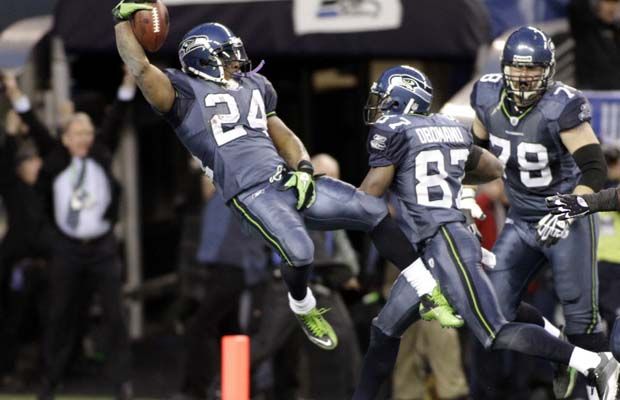
[ed. A true original. See also: The Sound and the Fury.]
Marshawn Lynch never gives interviews, but has several of the NFL's most famous quotes. He says over and over again he wants to avoid media attention, but gets called an attention-seeker. His job description includes getting tackled, but he inflicts more pain than the tacklers.
Marshawn Lynch makes so little sense in this world that wherever he goes, he leaves a trail of fascinating things in his wake. Sometimes they're weird words. Sometimes they're brutalized defenders. We can't hope to understand him, but we've tried to compile all the wonderful, strange, and good things about Marshawn Lynch in one post. This is the Marshawn Lynch Encyclopedia.
by Rodger Sherman, SB Nation | Read more:
Image: uncredited
Wednesday, November 11, 2015
Biologists Announce They’re All Done With Rodents

by The Onion | Read more:
Image: uncredited
Bento Boxes and the Grade-School Power Lunch
“Bento Monogatari,” a Belgian short film that was released in 2010, a woman makes her husband a bento box for lunch each day, in an attempt to salvage their marriage. Traditionally, bento is a single-portion meal, served in a box that contains small amounts of several types of food. In Japan, bento, which dates back hundreds of years, is highly aesthetic, reflecting clean lines, ordered geometries, and uncluttered space; today, it often includes food shaped into adorable characters. And so the wife in “Bento Monogatari,” who wears Harajuku-style dresses and fills her house with Japanese tchotchkes, molds rice balls into elaborate rabbits and piglets. Her husband, however, is more interested in his beautiful male co-worker, and he throws away the food. When the wife finds out, she explodes. “Don’t forget that I wake up at five every morning to prepare this ‘garbage’ for you!” she snaps. But the allure of bento prevails in the end: in a surreal twist, the husband is transformed into a bento character, and the beautiful co-worker eats him for lunch.
 The film played at Cannes, in 2011, a small part of a wave of international interest in bento over the past few years. A decade ago, it was difficult to find bento supplies outside Japan. Now bento-dedicated blogs and Pinterest boardsabound. There are bento contests and bento how-to books. As of this month, the best-selling lunchbox on Amazon.com was a set of three-compartment “Bento Lunch Box Containers.” This year’s flurry of back-to-school media coverage included reports on bento from the “Today” show, the Guardian, and the Halifax Chronicle Herald, to name a few. The term “bento” has also spread beyond lunch, to describe balanced, compartmentalized, and aesthetically appealing design in any field. In fashion, for example, the online retailerMM.LaFleur offers customers a stylist-curated bento consisting of three to five base garments and an assortment of accessories. (“We often hear from customers that they feel like we ‘know’ them and have solved a major problem in their lives,” Sarah LaFleur, the company’s founder and C.E.O., wrote to me in an e-mail.)
It’s in the realm of food, though, and especially food for children, that bento has become a status symbol. The trendy version of bento depicted in “Bento Monogatari” follows mainly from the contemporary Japanese practice of charaben, which features food sculpted into intricate and adorable characters, like SpongeBob SquarePants and Pikachu. Charaben makers painstakingly fashion the food using stencils, specialized picks, cutters, and other tools, with the aim of achieving kawaii, a type of cuteness associated with things like babies, snowmen, and baby pandas. For his book “Face Food: The Visual Creativity of Japanese Bento Boxes,” Christopher D. Salyers photographed the elaborate bento made by Japanese mothers (and one father), who told him that they would often wake up at 5 A.M. to tweeze seaweed and tapioca into piglets and manga princesses. “The devotion they had to the craft was one inspired by an absolute avidity toward pleasing their children,” Salyers writes.
Online bento culture is focussed on the exquisite and the practical. Shirley Wong, a Singaporean blogger who goes by the moniker Little Miss Bento, runs workshops to teach people how to make the perfect charaben. Elsewhere, bloggers like Sheri Chen, of Happy Little Bento, and Li Ming Lee, at Bento Monsters, document the bento they build for their families. (Caroline Miros, the C.E.O. of PlanetBox, a maker of bento-like containers, told me that about ninety per cent of people sharing lunches on her company’s social-media pages are women.) The downside of this conspicuous creativity is the expectations it can place on parents. A recent article by Kimberly Leonard in U.S. News and World Report suggested that pressure born of bento-dedicated social media, in particular, is excessive. “For parents who make these lunches and for those who don’t, the topic of what they are feeding their kids is deeply personal, rife with insecurity, anxiety, judgment and criticism,” she writes. Bettina Elias Siegel, a food-policy commentator who blogs about children and food at The Lunch Tray, wrote to me in an e-mail, “Are [bloggers] justifiably proud of their work and entitled to show off a little, the way we all trumpet our accomplishments on social media these days? Or are they coming across as morally superior?”
As Kenji Ekuan, the Japanese designer best known for creating the Kikkoman soy-sauce bottle, writes in his 1998 book, “The Aesthetics of the Japanese Lunchbox,” these social concerns are woven into the history of the bento box. The bento has humble beginnings, tracing back to twelfth-century Japanese farmers who used them to carry simple balls of rice into the fields. A more elaborate bento culture flourished during the Edo period (1603–1867), when it became the province of the élite. Sightseers would carry koshibento, or “waist bento,” which consisted of easily portable rice balls wrapped in bamboo leaves and tucked into a woven bamboo box. Makunouchi bento, or “between-the-acts bento,” consisting of cylinders of rice and side dishes, were served during intermissions of Noh and Kabuki performances.
Later, bento became prevalent in more areas of Japanese society—in offices, as white-collar workers began to carry their lunches in compartmentalized aluminum containers, and at train stations, which came to feature a wide selection of to-go bento. By mid-century, factories were churning out cheap bento boxes, to the dismay of some élites. “The quality of these mass-produced lunchboxes is appallingly low, making them an entirely different breed from their gorgeous ancestors,” Ekuan writes. “In many cases, the rice is no longer even shaped or wrapped but simply crammed into the assigned portion.”
 The film played at Cannes, in 2011, a small part of a wave of international interest in bento over the past few years. A decade ago, it was difficult to find bento supplies outside Japan. Now bento-dedicated blogs and Pinterest boardsabound. There are bento contests and bento how-to books. As of this month, the best-selling lunchbox on Amazon.com was a set of three-compartment “Bento Lunch Box Containers.” This year’s flurry of back-to-school media coverage included reports on bento from the “Today” show, the Guardian, and the Halifax Chronicle Herald, to name a few. The term “bento” has also spread beyond lunch, to describe balanced, compartmentalized, and aesthetically appealing design in any field. In fashion, for example, the online retailerMM.LaFleur offers customers a stylist-curated bento consisting of three to five base garments and an assortment of accessories. (“We often hear from customers that they feel like we ‘know’ them and have solved a major problem in their lives,” Sarah LaFleur, the company’s founder and C.E.O., wrote to me in an e-mail.)
It’s in the realm of food, though, and especially food for children, that bento has become a status symbol. The trendy version of bento depicted in “Bento Monogatari” follows mainly from the contemporary Japanese practice of charaben, which features food sculpted into intricate and adorable characters, like SpongeBob SquarePants and Pikachu. Charaben makers painstakingly fashion the food using stencils, specialized picks, cutters, and other tools, with the aim of achieving kawaii, a type of cuteness associated with things like babies, snowmen, and baby pandas. For his book “Face Food: The Visual Creativity of Japanese Bento Boxes,” Christopher D. Salyers photographed the elaborate bento made by Japanese mothers (and one father), who told him that they would often wake up at 5 A.M. to tweeze seaweed and tapioca into piglets and manga princesses. “The devotion they had to the craft was one inspired by an absolute avidity toward pleasing their children,” Salyers writes.
Online bento culture is focussed on the exquisite and the practical. Shirley Wong, a Singaporean blogger who goes by the moniker Little Miss Bento, runs workshops to teach people how to make the perfect charaben. Elsewhere, bloggers like Sheri Chen, of Happy Little Bento, and Li Ming Lee, at Bento Monsters, document the bento they build for their families. (Caroline Miros, the C.E.O. of PlanetBox, a maker of bento-like containers, told me that about ninety per cent of people sharing lunches on her company’s social-media pages are women.) The downside of this conspicuous creativity is the expectations it can place on parents. A recent article by Kimberly Leonard in U.S. News and World Report suggested that pressure born of bento-dedicated social media, in particular, is excessive. “For parents who make these lunches and for those who don’t, the topic of what they are feeding their kids is deeply personal, rife with insecurity, anxiety, judgment and criticism,” she writes. Bettina Elias Siegel, a food-policy commentator who blogs about children and food at The Lunch Tray, wrote to me in an e-mail, “Are [bloggers] justifiably proud of their work and entitled to show off a little, the way we all trumpet our accomplishments on social media these days? Or are they coming across as morally superior?”
As Kenji Ekuan, the Japanese designer best known for creating the Kikkoman soy-sauce bottle, writes in his 1998 book, “The Aesthetics of the Japanese Lunchbox,” these social concerns are woven into the history of the bento box. The bento has humble beginnings, tracing back to twelfth-century Japanese farmers who used them to carry simple balls of rice into the fields. A more elaborate bento culture flourished during the Edo period (1603–1867), when it became the province of the élite. Sightseers would carry koshibento, or “waist bento,” which consisted of easily portable rice balls wrapped in bamboo leaves and tucked into a woven bamboo box. Makunouchi bento, or “between-the-acts bento,” consisting of cylinders of rice and side dishes, were served during intermissions of Noh and Kabuki performances.
Later, bento became prevalent in more areas of Japanese society—in offices, as white-collar workers began to carry their lunches in compartmentalized aluminum containers, and at train stations, which came to feature a wide selection of to-go bento. By mid-century, factories were churning out cheap bento boxes, to the dismay of some élites. “The quality of these mass-produced lunchboxes is appallingly low, making them an entirely different breed from their gorgeous ancestors,” Ekuan writes. “In many cases, the rice is no longer even shaped or wrapped but simply crammed into the assigned portion.”
by Adrienne Raphel, New Yorker | Read more:
Image: Mikey Burton
Tuesday, November 10, 2015
The Guilded Age
The seal is broken on the “sharing economy.” There is a chance we can roll back that name; the collection of things it represents, however, is sticking around in some form. Uber has steamrolled through municipality after municipality. Airbnb Head of Global Policy Chris Lehane, at a press conference following the defeat of Proposition F, a ballot measure that would have more stringently regulated Airbnb-style rentals in San Francisco, described this change as emblematic of “a broader evolution in capitalism.” He’s probably right. Airbnb’s pitch, that your home is not just a place you live but an underutilized asset, represents a kind of systemic creep that’s hard to reverse. In the coming years, with or without interruption, various Uber-fors will grow in size and influence. (...)
 In the meantime, sharing economy companies must deal with more immediate issues. For example: A lot of the things they help people do are not quite legal. By extension, despite these companies’ best efforts to evade liability and pass it to their partners, some of the things they do are not quite legal. A lot of the things they help people do, as self-evident as these companies may think they are, are either not widely understood or are running up against some pushback. Some of this pushback comes from incumbent competitors, to whom the sharing economy companies represent a more efficient or cheaper competitor. So they’re trying to change the law; they’re trying to alter public opinion; they’re trying to win private and public battles in politics and public relations. They’re hiring the biggest-shot lawyers and PR people in the world. They’re also trying to mobilize their users, “partners,” and anyone else who’s using their various platforms. (...)
Uber’s regulatory battles will, to some extent, pave the way for other services, be they car-hailing apps or delivery networks or privatized replacements for public transit or just other types of on-demand labor whatevers. Airbnb’s will free up, to some extent, Airbnb competitors. But because they’re first, and because they’re huge, and because their investors have lots of adjacent interests, these regulatory battles belong to them. This means our next laws regarding how people drive and get driven, and the next sets of rules determining what and where a hotel can be, will be written largely by these companies. Or, at least, in the context of the specific battles these companies are fighting. Let’s say you don’t have any, or many, qualms about this “broader evolution” in capitalism and all the changes it may entail in our ideas about labor, ownership, and capital itself. Or just that you’re directly invested in it: you use or drive for Uber; you use or host on Airbnb. Your interests, in the near term, would obviously align with Uber’s and Airbnb’s! They’re fighting for your ability to use Uber and Airbnb. Of course you want that. You have demonstrated that you want that! These companies are fighting on your behalf in a real way. But they’re doing so as an unavoidable side effect of fighting for themselves. Airbnb in particular is comfortable speaking as a perfect representative of the concept it popularized, and the types of laws it would seek to defeat or enact would have to be somewhat well-aligned with the general idea of person-to-person nightly room rentals. But an ascendant Airbnb is different from a dominant Airbnb. An Uber battling with taxi companies is different from an Uber that has replaced taxi companies. These companies know this. Their leaders are CEOs and investors, not activists. Their interests will change, and not necessarily in parallel with the interests of their partners.
 In the meantime, sharing economy companies must deal with more immediate issues. For example: A lot of the things they help people do are not quite legal. By extension, despite these companies’ best efforts to evade liability and pass it to their partners, some of the things they do are not quite legal. A lot of the things they help people do, as self-evident as these companies may think they are, are either not widely understood or are running up against some pushback. Some of this pushback comes from incumbent competitors, to whom the sharing economy companies represent a more efficient or cheaper competitor. So they’re trying to change the law; they’re trying to alter public opinion; they’re trying to win private and public battles in politics and public relations. They’re hiring the biggest-shot lawyers and PR people in the world. They’re also trying to mobilize their users, “partners,” and anyone else who’s using their various platforms. (...)
Uber’s regulatory battles will, to some extent, pave the way for other services, be they car-hailing apps or delivery networks or privatized replacements for public transit or just other types of on-demand labor whatevers. Airbnb’s will free up, to some extent, Airbnb competitors. But because they’re first, and because they’re huge, and because their investors have lots of adjacent interests, these regulatory battles belong to them. This means our next laws regarding how people drive and get driven, and the next sets of rules determining what and where a hotel can be, will be written largely by these companies. Or, at least, in the context of the specific battles these companies are fighting. Let’s say you don’t have any, or many, qualms about this “broader evolution” in capitalism and all the changes it may entail in our ideas about labor, ownership, and capital itself. Or just that you’re directly invested in it: you use or drive for Uber; you use or host on Airbnb. Your interests, in the near term, would obviously align with Uber’s and Airbnb’s! They’re fighting for your ability to use Uber and Airbnb. Of course you want that. You have demonstrated that you want that! These companies are fighting on your behalf in a real way. But they’re doing so as an unavoidable side effect of fighting for themselves. Airbnb in particular is comfortable speaking as a perfect representative of the concept it popularized, and the types of laws it would seek to defeat or enact would have to be somewhat well-aligned with the general idea of person-to-person nightly room rentals. But an ascendant Airbnb is different from a dominant Airbnb. An Uber battling with taxi companies is different from an Uber that has replaced taxi companies. These companies know this. Their leaders are CEOs and investors, not activists. Their interests will change, and not necessarily in parallel with the interests of their partners.


Evil But Stupid
On May 10, the London Review of Books published “The Killing of Osama bin Laden,” a 10,000-word piece by veteran reporter Seymour Hersh. The story argued that the official White House narrative of the al Qaeda leader’s killing was a fabrication. The intelligence blogger R. J. Hillhouse had made similar claims a few years earlier, which had gone largely ignored in the US. But these allegations came from the most celebrated investigative journalist of the past half-century — they received more attention. The number of people trying to read Hersh’s story online was enough to crash the LRB’s website, something their many articles on Greco-Roman numismatics had previously failed to do.
 Hersh’s story was largely sourced from an unnamed retired US intelligence official, whose direct quotes are scattered through the piece, and whose account of the bin Laden raid is backed by testimony from several defense consultants and the former head of Pakistan’s Inter-Services Intelligence (all of whom, as Hersh’s detractors quickly pointed out, are retired or otherwise out of the loop). Its main claim was that Pakistan’s government had been holding bin Laden under house arrest in a compound in Abbottabad since 2006. The US government claims the raid was the result of years of patient intelligence work, which culminated in the identification of bin Laden’s courier (through the use of “enhanced” interrogation techniques, as famously depicted in the movie Zero Dark Thirty), who was then tracked back to the compound. Hersh says the precipitating event was, instead, just an unplanned accident: in 2010, a retired officer of the Pakistani intelligence service walked into the US Embassy and offered to reveal bin Laden’s location in exchange for $25 million, the reward the US had offered since 2001.
This initial event set off a chain of consequences. First, Hersh says, the US attempted to confirm the story with Pakistan’s chief of army staff and the head of the country’s intelligence service. Eventually, after threats, bribery, and blackmail, Pakistani officials admitted they had custody of bin Laden and were coerced into offering a sample of his DNA to prove it. Pakistan’s situation, Hersh claims, was complicated: they were using bin Laden as a bargaining chip in negotiations with the Taliban and al Qaeda, and they were also receiving payments from bin Laden’s Saudi Arabian sources to finance his upkeep. They needed foreign aid and support, but they couldn’t publicly hand bin Laden, a popular hero in Pakistan, over to the US. According to Hersh, the deal they struck was that they wouldn’t oppose a US raid on bin Laden’s compound, but bin Laden had to be killed.
The raid was planned for May 2, 2011. As it was in the interest of both sides to keep their cooperation secret, the initial plan, according to Hersh, was to say that bin Laden had been killed by a drone strike in the mountains on the Afghanistan-Pakistan border, where he was widely believed to be hiding. The Pakistan Army agreed that on the night of the raid they would turn a blind eye to the presence of American helicopters in their airspace. The guards at bin Laden’s compound were ordered to leave as soon as they heard the sound of approaching choppers.
The broad outlines of Hersh’s account match those of the official version: two Black Hawk helicopters brought an elite team of Navy SEALs to bin Laden’s compound. One crashed on the lawn while attempting to land. The SEALs forced their way into the building, blasted through security doors, and surprised bin Laden in his room. But Hersh’s story features no armed guards, no firefight, no wives used as human shields. Nor was bin Laden killed in self-defense, as the White House still maintains. One of the pleasures of reading Hersh’s account is the way it elegantly dismantles aspects of the story that seemed suspect from the beginning, and first among these is the notion that bin Laden, had he surrendered, would have been taken alive. “Let’s face it,” the retired intelligence officer told Hersh. “We’re going to commit a murder.”
After this point Hersh’s story and the administration’s largely jibe. Although they offer differing assessments of the quantity and value of the intelligence gathered from bin Laden’s compound, and the care with which it was collected, both agree that the SEALs took at least some of bin Laden’s papers (the administration claimed there was also computer equipment, which Hersh’s source denies) and went outside to wait for a backup helicopter. Before they left, the SEALs set a controlled explosion in the crashed helicopter to destroy its communications equipment. Hersh argues that these last actions should be seen as indirect confirmation of Pakistan’s support for the raid: if there really was a high risk of detection — the sort of risk you might expect when landing two helicopters in the heart of Pakistan’s military establishment — the SEALs would have abandoned their body armor and weapons, left the damaged helicopter intact for the Pakistanis to find, and crammed into the remaining helicopter for the return trip.
After the raid was complete, Hersh claims, there was a third unplanned event: the White House rushed to share the news. The original plan had been to wait a week and then claim that a drone strike had killed bin Laden in the Hindu Kush mountains, just across the border in Afghanistan. But given the helicopter crash and resulting fireball, the Obama Administration felt the raid would be impossible to keep under wraps for a week. With the vocal exception, Hersh says, of Defense Secretary Robert Gates, Obama’s advisers urged him to go public with the story as quickly as possible, before the Pentagon could announce it and take credit for it. According to Hersh, the White House had no press plan to implement should the raid go awry, no backup story. So they had to make up the story as they presented it to the world. Over the course of a few weeks, this scrambling produced inconsistencies. Bin Laden used a woman as a human shield; then he didn’t. Bin Laden was buried at sea from a naval vessel; the ship’s log has no record of any such burial. Bin Laden was shooting at SEALs when he was shot; or he wasn’t. And so on.
Hersh’s article solved several puzzles in the official report of bin Laden’s death. How could he have been hiding in a compound less than a mile from an elite military academy without Pakistan’s knowledge (a question raised in the days after the attack by the Senate Intelligence Committee’s Dianne Feinstein, among others)? Why, when bin Laden’s neighbors called the Abbottabad police after the SEALs’ helicopter crashed, did the Pakistani military tell the police not to respond? Why had Obama, in his speech announcing the news, originally claimed that the raid was due to the help of Pakistan’s intelligence agency, only to refute this claim the next day? Why were the pictures of bin Laden’s supposed burial at sea at first kept classified and then said to have been destroyed?
Then the melee began. (...)
Is Hersh paranoid? In some ways, the label seems appropriate. He has written about the private lives of the Kennedys and claimed that high-ranking military officials are members of the Knights of Malta and Opus Dei (although, as Greg Grandin pointed out in the Nation, a number of current and former high-ranking military officials really have been members of extreme right-wing Christian sects such as the Knights of Malta). In its unending accumulation of detail after disastrous detail, Hersh’s reporting often has the screwball plotting of a Pynchon novel. If the subject matter weren’t so upsetting, his reports would be funny.
But in other respects, the term doesn’t fit. Hersh’s stories break down complex events into chains of isolated, largely reactive individual decisions. His reporting never points back, as Pynchon’s novels do, to shadowy conspiracies; there is no titanic clash between impersonal forces, no central organizing principle, only human action churning away. Near the beginning of Hersh’s book on the Iraq war, an intelligence official complaining about the “enhanced interrogation” tactics at Guantánamo says, “It was wrong and also dysfunctional.” A few pages later, this refrain is repeated by another source: “It’s evil, but it’s also stupid.”
Evil but also stupid: that’s the keynote of the book, and in some ways of Hersh’s entire career. He is a great chronicler of bureaucracy. His stories are powered by scenes of administrative incompetence, organizational stupidity, turf warfare, inadequate foresight, random outbursts of violence, disorganized reactions, and self-serving attempts by everyone involved to spin the narrative of events to their own advantage. The bin Laden story depends on a string of uncoordinated accidents — the walk-in, the helicopter crash — and a series of mostly unsuccessful responses, culminating in the White House’s rush to claim public credit for the raid without informing the Pentagon or its Pakistani allies.
 Hersh’s story was largely sourced from an unnamed retired US intelligence official, whose direct quotes are scattered through the piece, and whose account of the bin Laden raid is backed by testimony from several defense consultants and the former head of Pakistan’s Inter-Services Intelligence (all of whom, as Hersh’s detractors quickly pointed out, are retired or otherwise out of the loop). Its main claim was that Pakistan’s government had been holding bin Laden under house arrest in a compound in Abbottabad since 2006. The US government claims the raid was the result of years of patient intelligence work, which culminated in the identification of bin Laden’s courier (through the use of “enhanced” interrogation techniques, as famously depicted in the movie Zero Dark Thirty), who was then tracked back to the compound. Hersh says the precipitating event was, instead, just an unplanned accident: in 2010, a retired officer of the Pakistani intelligence service walked into the US Embassy and offered to reveal bin Laden’s location in exchange for $25 million, the reward the US had offered since 2001.
This initial event set off a chain of consequences. First, Hersh says, the US attempted to confirm the story with Pakistan’s chief of army staff and the head of the country’s intelligence service. Eventually, after threats, bribery, and blackmail, Pakistani officials admitted they had custody of bin Laden and were coerced into offering a sample of his DNA to prove it. Pakistan’s situation, Hersh claims, was complicated: they were using bin Laden as a bargaining chip in negotiations with the Taliban and al Qaeda, and they were also receiving payments from bin Laden’s Saudi Arabian sources to finance his upkeep. They needed foreign aid and support, but they couldn’t publicly hand bin Laden, a popular hero in Pakistan, over to the US. According to Hersh, the deal they struck was that they wouldn’t oppose a US raid on bin Laden’s compound, but bin Laden had to be killed.
The raid was planned for May 2, 2011. As it was in the interest of both sides to keep their cooperation secret, the initial plan, according to Hersh, was to say that bin Laden had been killed by a drone strike in the mountains on the Afghanistan-Pakistan border, where he was widely believed to be hiding. The Pakistan Army agreed that on the night of the raid they would turn a blind eye to the presence of American helicopters in their airspace. The guards at bin Laden’s compound were ordered to leave as soon as they heard the sound of approaching choppers.
The broad outlines of Hersh’s account match those of the official version: two Black Hawk helicopters brought an elite team of Navy SEALs to bin Laden’s compound. One crashed on the lawn while attempting to land. The SEALs forced their way into the building, blasted through security doors, and surprised bin Laden in his room. But Hersh’s story features no armed guards, no firefight, no wives used as human shields. Nor was bin Laden killed in self-defense, as the White House still maintains. One of the pleasures of reading Hersh’s account is the way it elegantly dismantles aspects of the story that seemed suspect from the beginning, and first among these is the notion that bin Laden, had he surrendered, would have been taken alive. “Let’s face it,” the retired intelligence officer told Hersh. “We’re going to commit a murder.”
After this point Hersh’s story and the administration’s largely jibe. Although they offer differing assessments of the quantity and value of the intelligence gathered from bin Laden’s compound, and the care with which it was collected, both agree that the SEALs took at least some of bin Laden’s papers (the administration claimed there was also computer equipment, which Hersh’s source denies) and went outside to wait for a backup helicopter. Before they left, the SEALs set a controlled explosion in the crashed helicopter to destroy its communications equipment. Hersh argues that these last actions should be seen as indirect confirmation of Pakistan’s support for the raid: if there really was a high risk of detection — the sort of risk you might expect when landing two helicopters in the heart of Pakistan’s military establishment — the SEALs would have abandoned their body armor and weapons, left the damaged helicopter intact for the Pakistanis to find, and crammed into the remaining helicopter for the return trip.
After the raid was complete, Hersh claims, there was a third unplanned event: the White House rushed to share the news. The original plan had been to wait a week and then claim that a drone strike had killed bin Laden in the Hindu Kush mountains, just across the border in Afghanistan. But given the helicopter crash and resulting fireball, the Obama Administration felt the raid would be impossible to keep under wraps for a week. With the vocal exception, Hersh says, of Defense Secretary Robert Gates, Obama’s advisers urged him to go public with the story as quickly as possible, before the Pentagon could announce it and take credit for it. According to Hersh, the White House had no press plan to implement should the raid go awry, no backup story. So they had to make up the story as they presented it to the world. Over the course of a few weeks, this scrambling produced inconsistencies. Bin Laden used a woman as a human shield; then he didn’t. Bin Laden was buried at sea from a naval vessel; the ship’s log has no record of any such burial. Bin Laden was shooting at SEALs when he was shot; or he wasn’t. And so on.
Hersh’s article solved several puzzles in the official report of bin Laden’s death. How could he have been hiding in a compound less than a mile from an elite military academy without Pakistan’s knowledge (a question raised in the days after the attack by the Senate Intelligence Committee’s Dianne Feinstein, among others)? Why, when bin Laden’s neighbors called the Abbottabad police after the SEALs’ helicopter crashed, did the Pakistani military tell the police not to respond? Why had Obama, in his speech announcing the news, originally claimed that the raid was due to the help of Pakistan’s intelligence agency, only to refute this claim the next day? Why were the pictures of bin Laden’s supposed burial at sea at first kept classified and then said to have been destroyed?
Then the melee began. (...)
Is Hersh paranoid? In some ways, the label seems appropriate. He has written about the private lives of the Kennedys and claimed that high-ranking military officials are members of the Knights of Malta and Opus Dei (although, as Greg Grandin pointed out in the Nation, a number of current and former high-ranking military officials really have been members of extreme right-wing Christian sects such as the Knights of Malta). In its unending accumulation of detail after disastrous detail, Hersh’s reporting often has the screwball plotting of a Pynchon novel. If the subject matter weren’t so upsetting, his reports would be funny.
But in other respects, the term doesn’t fit. Hersh’s stories break down complex events into chains of isolated, largely reactive individual decisions. His reporting never points back, as Pynchon’s novels do, to shadowy conspiracies; there is no titanic clash between impersonal forces, no central organizing principle, only human action churning away. Near the beginning of Hersh’s book on the Iraq war, an intelligence official complaining about the “enhanced interrogation” tactics at Guantánamo says, “It was wrong and also dysfunctional.” A few pages later, this refrain is repeated by another source: “It’s evil, but it’s also stupid.”
Evil but also stupid: that’s the keynote of the book, and in some ways of Hersh’s entire career. He is a great chronicler of bureaucracy. His stories are powered by scenes of administrative incompetence, organizational stupidity, turf warfare, inadequate foresight, random outbursts of violence, disorganized reactions, and self-serving attempts by everyone involved to spin the narrative of events to their own advantage. The bin Laden story depends on a string of uncoordinated accidents — the walk-in, the helicopter crash — and a series of mostly unsuccessful responses, culminating in the White House’s rush to claim public credit for the raid without informing the Pentagon or its Pakistani allies.
by The Editors, N+1 | Read more:
Image: Pete Sousa
The Birth of “The New Yorker Story”
[ed. See also: The covers of the New Yorker magazine.]
The fifties were a key decade in the evolution of American magazine fiction. Earlier in the century, there had been a large stable of magazines to which writers like Katherine Anne Porter and F. Scott Fitzgerald could make a fine living by selling short stories. Later in the century, The New Yorker was preeminent; placing a story in its pages was the grail of budding writers, the ultimate validation. By the end of the century, the magazine essentially had the commercial market for short fiction to itself.
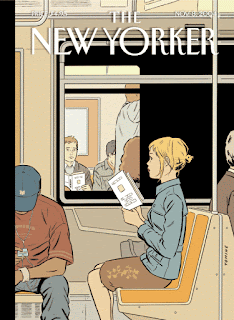 It was also in the fifties that “the New Yorker story” emerged, quite suddenly, as a distinct literary genus. What made a story New Yorker was its carefully wrought, many-comma’d prose; its long passages of physical description, the precision and the sobriety of which created a kind of negative emotional space, a suggestion of feeling without the naming of it; its well-educated white characters, who could be found experiencing the melancholies of affluence, the doldrums of suburban marriage, or the thrill or the desolation of adultery; and, above all, its signature style of ending, which was either elegantly oblique or frustratingly coy, depending on your taste. Outside the offices of The New Yorker, its fiction editors were rumored to routinely delete the final paragraph of any story accepted for publication.
The heyday of “the New Yorker story” coincided so neatly with the tenure of William Shawn, who succeeded Harold Ross as editor in 1952 and presided until 1987, that it might instead be called “the Shawn story.” The one story from the Ross era in this volume, Roald Dahl’s “Taste,” is written in an older and more conventional register. Its setting—the dinner party of a parvenu stockbroker—is still recognizable and relevant today, but its high-concept premise and its O. Henry ending hark back to the decades when magazine fiction supplied the sort of popular entertainment now considered television’s province. The fifties put an end to that, and “the New Yorker story,” with its emphasis on sentence craft and its rejection of neatly tied-up endings, can be understood, in part, as a retreat from the pressure of commercial TV, a retrenchment in provinces beyond the reach of visual media.
The fifties were a key decade in the evolution of American magazine fiction. Earlier in the century, there had been a large stable of magazines to which writers like Katherine Anne Porter and F. Scott Fitzgerald could make a fine living by selling short stories. Later in the century, The New Yorker was preeminent; placing a story in its pages was the grail of budding writers, the ultimate validation. By the end of the century, the magazine essentially had the commercial market for short fiction to itself.
 It was also in the fifties that “the New Yorker story” emerged, quite suddenly, as a distinct literary genus. What made a story New Yorker was its carefully wrought, many-comma’d prose; its long passages of physical description, the precision and the sobriety of which created a kind of negative emotional space, a suggestion of feeling without the naming of it; its well-educated white characters, who could be found experiencing the melancholies of affluence, the doldrums of suburban marriage, or the thrill or the desolation of adultery; and, above all, its signature style of ending, which was either elegantly oblique or frustratingly coy, depending on your taste. Outside the offices of The New Yorker, its fiction editors were rumored to routinely delete the final paragraph of any story accepted for publication.
The heyday of “the New Yorker story” coincided so neatly with the tenure of William Shawn, who succeeded Harold Ross as editor in 1952 and presided until 1987, that it might instead be called “the Shawn story.” The one story from the Ross era in this volume, Roald Dahl’s “Taste,” is written in an older and more conventional register. Its setting—the dinner party of a parvenu stockbroker—is still recognizable and relevant today, but its high-concept premise and its O. Henry ending hark back to the decades when magazine fiction supplied the sort of popular entertainment now considered television’s province. The fifties put an end to that, and “the New Yorker story,” with its emphasis on sentence craft and its rejection of neatly tied-up endings, can be understood, in part, as a retreat from the pressure of commercial TV, a retrenchment in provinces beyond the reach of visual media.
In the fifties, and for a long time afterward, The New Yorker didn’t identify its fiction as fiction. The author’s name appeared only at the end, in small capital letters, the same way the magazine’s journalists and critics were credited. What began, perhaps, as an affectation of Harold Ross’s became an emblem of the magazine’s definition of itself: the writing literally came first, the author’s ego-bearing name last. Although fiction in those days was usually given pride of place at the front of the magazine (rather than being secreted near the back, as is the case today), the number of short stories varied from issue to issue, which left it to the reader to determine whether the text in front of her was fiction or nonfiction. The respect the magazine thereby accorded fiction writers—the implication that what mattered about a piece was its sentence-by-sentence excellence, not its genre, not the weight of its subject matter—was part of what made The New Yorker the place every young American story writer dreamed of being published.
“The New Yorker story” was a stereotype, of course, and inevitably an unfair one—Shawn ran dozens of shtetl stories by I. B. Singer and Irish country stories by Frank O’Connor, and he devoted most of one issue to the experimental novel Snow White, by Donald Barthelme, who at the time was not well known. But it was “the New Yorker story,” as it developed in the fifties, that became the model for aspiring writers, because it seemed to be the key to getting into the magazine, and by the seventies the model was so dominant that it generated mockery and backlash. Too many stories about mopey suburbanites. Too many well-off white people. A surfeit of descriptions, a paucity of action. Too much privileging of prose for the sake of prose, too little openness to rougher energies. And those endings? A style repeated too often devolves into a tic. After Shawn retired and the magazine’s fiction section became more of a free-for-all, more multivalent and multiethnic, the “New Yorker story” began to look like a form in well-deserved retirement—a relic of an era when subscribers had still had the patience and the time, in New Canaan, in Armonk, on a beach in the Hamptons, to read slow-moving stories in which nothing much happened at the end.
“The New Yorker story” was a stereotype, of course, and inevitably an unfair one—Shawn ran dozens of shtetl stories by I. B. Singer and Irish country stories by Frank O’Connor, and he devoted most of one issue to the experimental novel Snow White, by Donald Barthelme, who at the time was not well known. But it was “the New Yorker story,” as it developed in the fifties, that became the model for aspiring writers, because it seemed to be the key to getting into the magazine, and by the seventies the model was so dominant that it generated mockery and backlash. Too many stories about mopey suburbanites. Too many well-off white people. A surfeit of descriptions, a paucity of action. Too much privileging of prose for the sake of prose, too little openness to rougher energies. And those endings? A style repeated too often devolves into a tic. After Shawn retired and the magazine’s fiction section became more of a free-for-all, more multivalent and multiethnic, the “New Yorker story” began to look like a form in well-deserved retirement—a relic of an era when subscribers had still had the patience and the time, in New Canaan, in Armonk, on a beach in the Hamptons, to read slow-moving stories in which nothing much happened at the end.
by Jonathan Franzen, The New Yorker | Read more:
Image: Adrian Tomine
Subscribe to:
Posts (Atom)