Sunday, December 20, 2015

Nike's Football Business Depends on Adults Playing Dress-Up
Nike pays a fortune for the privilege of making all of the gear worn in the National Football League, and most of it will be bought by almost nobody. Professional and college players get their equipment for free, and few fans have enough enthusiasm to buy the same $100 gloves worn by their favorite wide receiver. But grown men and women have proved eager in the past decade to pay as much as $300 for jerseys identical to those worn on the field. The same feats of fabric wizardry meant to enhance the performance of elite athletes see more use by fans rushing the beer vendor at halftime and blitzing platters of chicken wings in front of the TV.
 Last week, in the middle of its fourth year as the league’s gear supplier, Nike unveiled yet another futuristic football uniform. The shirts and pants players will wear next season, dubbed Vapor Untouchable, are almost a third lighter than the current uniform. “The feedback from the athletes is, ‘I’ve got better range of motion, and I feel faster,’” said Todd Van Horne, Nike’s creative director for football. Fans probably aren't concerned with how much their shirts weigh, but they will need to spend again to match the on-field look—and that’s exactly what Nike was counting on when it bet heavily on football. (...)
Adult fans didn’t always get a thrill by dressing themselves in the jerseys of football stars. For decades, a guy in the stands would clothe himself more like Vince Lombardi than like Bart Starr. Gradually, the sea of wool overcoats and fedoras gave way to logo-plastered sweatshirts and jackets. The NFL jersey didn’t become “official” until 2000, when the league cut a deal with Reebok for the exclusive rights to on-field apparel. For the first time, fans could pay for the privilege of donning the exact garment worn by players, and just at the moment when online shopping arrived in earnest.
The market for authentic football jerseys “exploded,” the NFL’s Kane said of the period after the Rebook deal. “All of a sudden, if you were going to a game, you were wearing a jersey,” he said. “It has really become the uniform of the fan.”
When Nike was bidding on the NFL gear business, it saw some gaps in the field that Reebok had largely left open. Female fans, for one, had never been offered a chance to buy an official jersey with a cut that wasn’t intended to flatter massive men with shoulder pads, or Cheesehead hats. Nike made better-fitting women’s jerseys and helped the league move beyond what Kane describes as the “shrink-it-and-pink-it” approach. Today, women’s and kids’ styles account for almost half the jerseys sold at Fanatics.com.
Nike also took control of the official jersey business just as the fantasy football phenomenon was beginning to build. The traditional boundaries of fandom were shifting from geographies and teams to individual stars. In the 2012 season, for example, Saints quarterback Drew Brees made a lot of money for fans who couldn’t care less about New Orleans, and his jersey sold accordingly.
Nike is now selling three or four times as many jerseys as Reebok was 10 years ago, according to the NFL. People are buying more jerseys in part because there are more to buy.
 Last week, in the middle of its fourth year as the league’s gear supplier, Nike unveiled yet another futuristic football uniform. The shirts and pants players will wear next season, dubbed Vapor Untouchable, are almost a third lighter than the current uniform. “The feedback from the athletes is, ‘I’ve got better range of motion, and I feel faster,’” said Todd Van Horne, Nike’s creative director for football. Fans probably aren't concerned with how much their shirts weigh, but they will need to spend again to match the on-field look—and that’s exactly what Nike was counting on when it bet heavily on football. (...)
Adult fans didn’t always get a thrill by dressing themselves in the jerseys of football stars. For decades, a guy in the stands would clothe himself more like Vince Lombardi than like Bart Starr. Gradually, the sea of wool overcoats and fedoras gave way to logo-plastered sweatshirts and jackets. The NFL jersey didn’t become “official” until 2000, when the league cut a deal with Reebok for the exclusive rights to on-field apparel. For the first time, fans could pay for the privilege of donning the exact garment worn by players, and just at the moment when online shopping arrived in earnest.
The market for authentic football jerseys “exploded,” the NFL’s Kane said of the period after the Rebook deal. “All of a sudden, if you were going to a game, you were wearing a jersey,” he said. “It has really become the uniform of the fan.”
When Nike was bidding on the NFL gear business, it saw some gaps in the field that Reebok had largely left open. Female fans, for one, had never been offered a chance to buy an official jersey with a cut that wasn’t intended to flatter massive men with shoulder pads, or Cheesehead hats. Nike made better-fitting women’s jerseys and helped the league move beyond what Kane describes as the “shrink-it-and-pink-it” approach. Today, women’s and kids’ styles account for almost half the jerseys sold at Fanatics.com.
Nike also took control of the official jersey business just as the fantasy football phenomenon was beginning to build. The traditional boundaries of fandom were shifting from geographies and teams to individual stars. In the 2012 season, for example, Saints quarterback Drew Brees made a lot of money for fans who couldn’t care less about New Orleans, and his jersey sold accordingly.
Nike is now selling three or four times as many jerseys as Reebok was 10 years ago, according to the NFL. People are buying more jerseys in part because there are more to buy.
by Kyle Stock, Bloomberg | Read more:
Image: Robbie McClaran

Saturday, December 19, 2015
Inside the Billion-Dollar Battle for Puerto Rico’s Future
The money poured in by the millions, then by the hundreds of millions, and finally by the billions. Over weak coffee in a conference room in Midtown Manhattan last year, a half-dozen Puerto Rican officials exhaled: Their cash-starved island had persuaded some of the country’s biggest hedge funds to lend them more than $3 billion to keep the government afloat.
There were plenty of reasons for the hedge funds to like the deal: They would be earning, in effect, a 20 percent return. And under the island’s Constitution, Puerto Rico was required to pay back its debt before almost any other bills, whether for retirees’ health care or teachers’ salaries.
 But within months, Puerto Rico was saying it had run out of money, and the relationship between the impoverished United States territory and its unlikely saviors fell apart, setting up an extraordinary political and financial fight over Puerto Rico’s future.
On the surface, it is a battle over whether Puerto Rico should be granted bankruptcy protections, putting at risk tens of billions of dollars from investors around the country. But it is also testing the power of an ascendant class of ultrarich Americans to steer the fate of a territory that is home to more than three million fellow citizens.
The investors with a stake in the outcome are some of the wealthiest people in America. Many of them have also taken on an outsize role in financing political campaigns in the aftermath of the Supreme Court’s 2010 Citizens United decision. They have put millions of dollars behind candidates of both parties, including Hillary Clinton and Jeb Bush. Some belong to a small circle of 158 families that provided half of the early money for the 2016 presidential race.
To block proposals that would put their investments at risk, a coalition of hedge funds and financial firms has hired dozens of lobbyists, forged alliances with Tea Party activists and recruited so-called AstroTurf groups on the island to make their case. This approach — aggressive legal maneuvering, lobbying and the deployment of prodigious wealth — has proved successful overseas, in countries like Argentina and Greece, yielding billions in profit amid economic collapse.
The pressure has been widely felt. Senator Marco Rubio, whose state, Florida, has a large Puerto Rican population, expressed interest this year in sponsoring bankruptcy legislation for the island, says Senator Richard Blumenthal, Democrat of Connecticut. Mr. Rubio’s staff even joined in drafting the bill. But this summer, three weeks after a fund-raiser hosted by a hedge-fund founder, Mr. Rubio broke with those backing the measure. Bankruptcy, he said, should be considered only as a “last resort.”
And this past week, House Republican leaders said any financial rescue for Puerto Rico may not come until the end of March.
The fight over the island’s future is stretching from the oceanside neighborhoods of San Juan, where a growing number of wealthy investors and financial professionals have migrated in recent years to exploit generous tax breaks, to Capitol Hill. Their efforts are being closely watched by financial institutions, labor unions and policy makers on the mainland, where many ordinary investors own Puerto Rican bonds through mutual funds.
Some warn that Puerto Rico could be a test case for the rest of the country, paving the way for troubled states like Illinois to escape unsustainable debts.
Stephen J. Spencer, a restructuring expert representing Puerto Rico bondholders including some hedge funds, said letting the government renege on agreements with hedge funds and other investors would set a dangerous precedent, undermining the integrity of the bond market.
“It’s really a wealth transfer from the bondholders to the municipalities,” Mr. Spencer said.
Others fear a different precedent: A handful of wealthy investors, they argue, are trying to rewrite the social contract of an entire United States territory. Puerto Rican officials say they have already cut public services and slashed central government spending by a fifth to keep ahead of payments to the hedge funds and financiers.
“What they are doing, by getting all the resources for themselves, is undermining the viability of Puerto Rico as a commonwealth,” said Joseph E. Stiglitz, the Nobel Prize-winning economist. “They want their money now, and they want to get the rules set so that they can make money for the next 20 years.”
A Bet on Resurgence
Along Ashford Avenue in San Juan’s Condado district, newly renovated hotels gleam beside shops like Gucci and Cartier. Slightly to the west are new high-rise condominiums, known as WeCo, or West Condado, by an enterprising real estate agent originally from Manhattan. Still farther west, not far from the Capitol in Old San Juan, a new development named the Paseo Caribe makes a more explicit pitch to potential buyers: “The Puerto Rico Advantage: Sun, Sand and Zero Taxes,” the development’s website promises.
This was supposed to help solve Puerto Rico’s problems. The commonwealth has been in a depression for over a decade. Pharmaceutical companies and manufacturers have fled the island, followed by young Puerto Ricans looking for jobs, draining the island’s work force and tax base. Forty percent of the island’s residents live in poverty.
Three years ago, in a bid to lure financial services firms and other employers, Puerto Rico’s governor at that time, Luis Fortuño, a Republican, signed laws intended to turn the island into a domestic tax haven. Americans who relocated to Puerto Rico, spent at least half a year there and brought their company with them would pay no federal income or capital gains taxes.
Private-equity magnates, hedge funds and investment advisers began moving to the island. They settled in Condado and a handful of coastal enclaves like the Dorado Beach Resort, where the billionaire investor Toby Neugebauer, who provided $10 million to the presidential campaign of Senator Ted Cruz of Texas, bought a home.
John Paulson, the hedge fund investor and leading Republican donor, snapped up resort properties and fading resort hotels, betting on a resurgence. Puerto Rico, Mr. Paulson told an investor conference last year, would become “the Singapore of the Caribbean.” This spring, at his urging, the island even rented a booth at the hedge fund industry’s annual conference at the Bellagio casino in Las Vegas, where two attractive women pitched Puerto Rico’s charms to guests.
It was not the first time that Puerto Rico had turned to Wall Street for help. For decades, the island had been borrowing money to pay its bills. Puerto Rico’s bonds were particularly attractive to mutual funds because they were exempt from federal, state and local taxes in all 50 states. But in 2013, after the island’s general obligation bonds were downgraded, they caught the attention of a different sort of investor: hedge funds specializing in distressed assets.
These funds began buying up the debt at a steep discount, confident that this was a bet they could not lose. Not only were the bonds guaranteed by the Puerto Rican Constitution, but under a wrinkle of federal law, the island’s public corporations and municipalities — unlike those of the 50 states — do not have bankruptcy as a recourse.
When the investment bank Lazard hosted a discussion for investors on Puerto Rico in October 2013, so many people showed up that some had to stand. By the next spring, as the island’s economic situation worsened, virtually no one else was willing to lend to Puerto Rico.
A round of spending cuts and tax increases by Gov. Alejandro García Padilla, the Democrat who succeeded Mr. Fortuño, had not produced enough cash to keep up with the island’s earlier debts. A prospectus circulated for the March 2014 bond offering — which raised the $3.5 billion that Mr. García Padilla hoped would buy time for a recovery — warned in boldface type of “significant risks.”
Nevertheless, some of the biggest hedge funds kept buying, drawn by the promise of what was a 20 percent return, based on the interest rate coupled with the tax exemption. Mr. Paulson’s firm purchased bonds in March 2014, as did Appaloosa Management, founded by David Tepper; Marathon Asset Management; BlueMountain Capital Management; and Monarch Alternative Capital, said Puerto Rico officials involved in the sale.
The recovery never arrived. The $3.5 billion ran out. And Puerto Rico now owes its creditors in excess of $70 billion, a bigger debt load than all but two states. As much as a third of it is owed to hedge funds, according to some estimates.
There were plenty of reasons for the hedge funds to like the deal: They would be earning, in effect, a 20 percent return. And under the island’s Constitution, Puerto Rico was required to pay back its debt before almost any other bills, whether for retirees’ health care or teachers’ salaries.
 But within months, Puerto Rico was saying it had run out of money, and the relationship between the impoverished United States territory and its unlikely saviors fell apart, setting up an extraordinary political and financial fight over Puerto Rico’s future.
On the surface, it is a battle over whether Puerto Rico should be granted bankruptcy protections, putting at risk tens of billions of dollars from investors around the country. But it is also testing the power of an ascendant class of ultrarich Americans to steer the fate of a territory that is home to more than three million fellow citizens.
The investors with a stake in the outcome are some of the wealthiest people in America. Many of them have also taken on an outsize role in financing political campaigns in the aftermath of the Supreme Court’s 2010 Citizens United decision. They have put millions of dollars behind candidates of both parties, including Hillary Clinton and Jeb Bush. Some belong to a small circle of 158 families that provided half of the early money for the 2016 presidential race.
To block proposals that would put their investments at risk, a coalition of hedge funds and financial firms has hired dozens of lobbyists, forged alliances with Tea Party activists and recruited so-called AstroTurf groups on the island to make their case. This approach — aggressive legal maneuvering, lobbying and the deployment of prodigious wealth — has proved successful overseas, in countries like Argentina and Greece, yielding billions in profit amid economic collapse.
The pressure has been widely felt. Senator Marco Rubio, whose state, Florida, has a large Puerto Rican population, expressed interest this year in sponsoring bankruptcy legislation for the island, says Senator Richard Blumenthal, Democrat of Connecticut. Mr. Rubio’s staff even joined in drafting the bill. But this summer, three weeks after a fund-raiser hosted by a hedge-fund founder, Mr. Rubio broke with those backing the measure. Bankruptcy, he said, should be considered only as a “last resort.”
And this past week, House Republican leaders said any financial rescue for Puerto Rico may not come until the end of March.
The fight over the island’s future is stretching from the oceanside neighborhoods of San Juan, where a growing number of wealthy investors and financial professionals have migrated in recent years to exploit generous tax breaks, to Capitol Hill. Their efforts are being closely watched by financial institutions, labor unions and policy makers on the mainland, where many ordinary investors own Puerto Rican bonds through mutual funds.
Some warn that Puerto Rico could be a test case for the rest of the country, paving the way for troubled states like Illinois to escape unsustainable debts.
Stephen J. Spencer, a restructuring expert representing Puerto Rico bondholders including some hedge funds, said letting the government renege on agreements with hedge funds and other investors would set a dangerous precedent, undermining the integrity of the bond market.
“It’s really a wealth transfer from the bondholders to the municipalities,” Mr. Spencer said.
Others fear a different precedent: A handful of wealthy investors, they argue, are trying to rewrite the social contract of an entire United States territory. Puerto Rican officials say they have already cut public services and slashed central government spending by a fifth to keep ahead of payments to the hedge funds and financiers.
“What they are doing, by getting all the resources for themselves, is undermining the viability of Puerto Rico as a commonwealth,” said Joseph E. Stiglitz, the Nobel Prize-winning economist. “They want their money now, and they want to get the rules set so that they can make money for the next 20 years.”
A Bet on Resurgence
Along Ashford Avenue in San Juan’s Condado district, newly renovated hotels gleam beside shops like Gucci and Cartier. Slightly to the west are new high-rise condominiums, known as WeCo, or West Condado, by an enterprising real estate agent originally from Manhattan. Still farther west, not far from the Capitol in Old San Juan, a new development named the Paseo Caribe makes a more explicit pitch to potential buyers: “The Puerto Rico Advantage: Sun, Sand and Zero Taxes,” the development’s website promises.
This was supposed to help solve Puerto Rico’s problems. The commonwealth has been in a depression for over a decade. Pharmaceutical companies and manufacturers have fled the island, followed by young Puerto Ricans looking for jobs, draining the island’s work force and tax base. Forty percent of the island’s residents live in poverty.
Three years ago, in a bid to lure financial services firms and other employers, Puerto Rico’s governor at that time, Luis Fortuño, a Republican, signed laws intended to turn the island into a domestic tax haven. Americans who relocated to Puerto Rico, spent at least half a year there and brought their company with them would pay no federal income or capital gains taxes.
Private-equity magnates, hedge funds and investment advisers began moving to the island. They settled in Condado and a handful of coastal enclaves like the Dorado Beach Resort, where the billionaire investor Toby Neugebauer, who provided $10 million to the presidential campaign of Senator Ted Cruz of Texas, bought a home.
John Paulson, the hedge fund investor and leading Republican donor, snapped up resort properties and fading resort hotels, betting on a resurgence. Puerto Rico, Mr. Paulson told an investor conference last year, would become “the Singapore of the Caribbean.” This spring, at his urging, the island even rented a booth at the hedge fund industry’s annual conference at the Bellagio casino in Las Vegas, where two attractive women pitched Puerto Rico’s charms to guests.
It was not the first time that Puerto Rico had turned to Wall Street for help. For decades, the island had been borrowing money to pay its bills. Puerto Rico’s bonds were particularly attractive to mutual funds because they were exempt from federal, state and local taxes in all 50 states. But in 2013, after the island’s general obligation bonds were downgraded, they caught the attention of a different sort of investor: hedge funds specializing in distressed assets.
These funds began buying up the debt at a steep discount, confident that this was a bet they could not lose. Not only were the bonds guaranteed by the Puerto Rican Constitution, but under a wrinkle of federal law, the island’s public corporations and municipalities — unlike those of the 50 states — do not have bankruptcy as a recourse.
When the investment bank Lazard hosted a discussion for investors on Puerto Rico in October 2013, so many people showed up that some had to stand. By the next spring, as the island’s economic situation worsened, virtually no one else was willing to lend to Puerto Rico.
A round of spending cuts and tax increases by Gov. Alejandro García Padilla, the Democrat who succeeded Mr. Fortuño, had not produced enough cash to keep up with the island’s earlier debts. A prospectus circulated for the March 2014 bond offering — which raised the $3.5 billion that Mr. García Padilla hoped would buy time for a recovery — warned in boldface type of “significant risks.”
Nevertheless, some of the biggest hedge funds kept buying, drawn by the promise of what was a 20 percent return, based on the interest rate coupled with the tax exemption. Mr. Paulson’s firm purchased bonds in March 2014, as did Appaloosa Management, founded by David Tepper; Marathon Asset Management; BlueMountain Capital Management; and Monarch Alternative Capital, said Puerto Rico officials involved in the sale.
The recovery never arrived. The $3.5 billion ran out. And Puerto Rico now owes its creditors in excess of $70 billion, a bigger debt load than all but two states. As much as a third of it is owed to hedge funds, according to some estimates.
by Jonathan Mahler adn Nicholas Confessore, NY Times | Read more:
Image:Christopher Gregory


The Psychology of Clickbait
This article will not restore your faith in humanity. Nor will it amaze, stun, delight, shock, charm, or in any literal or figurative way, blow your mind. What it will do—hopefully in a clear and intelligent way—is explain why people continually fall for clickbait. You know, like you just did a few seconds ago.
 Whether you think it’s on the rise, obscurant and self-negating, not such a big deal, or the root of all evil, one thing is clear about clickbait: It’s increasingly hard to pin down. Some, like Buzzfeed’s Ben Smith, narrowly define it as an article that doesn’t deliver on its headline’s promise. Others think it means vapid listicles, quizzes, and Betteridge’s Law headlines. And then there are those who simply use it as shorthand for stuff they don’t like on the Internet.
Here’s what most people can agree on: Clickbait is annoying, but by god, it works—even when readers recognize it for what it is. The word’s substantial semantic drift may be behind some of this effectiveness. But a hefty helping of behavioral science is at play, too. As a number of new studies confirm, you can blame your clickbait habit on two things: the outsized role emotion plays in your intuitive judgements and daily choices, and your lazy brain.
Manufacturing Emotion
Clickbait doesn’t just happen on its own. Editors write headlines in an effort to manipulate you—or at least grab your attention—and always have. “Headless Body In Topless Bar,” and “Sticks Nix Hick Pix” wouldn’t exist if publications didn’t care about attracting eyeballs. The difference with clickbait is you’re often aware of this manipulation, and yet helpless to resist it. It’s at once obvious in its bait-iness, and somehow still effective bait.
 Whether you think it’s on the rise, obscurant and self-negating, not such a big deal, or the root of all evil, one thing is clear about clickbait: It’s increasingly hard to pin down. Some, like Buzzfeed’s Ben Smith, narrowly define it as an article that doesn’t deliver on its headline’s promise. Others think it means vapid listicles, quizzes, and Betteridge’s Law headlines. And then there are those who simply use it as shorthand for stuff they don’t like on the Internet.
Here’s what most people can agree on: Clickbait is annoying, but by god, it works—even when readers recognize it for what it is. The word’s substantial semantic drift may be behind some of this effectiveness. But a hefty helping of behavioral science is at play, too. As a number of new studies confirm, you can blame your clickbait habit on two things: the outsized role emotion plays in your intuitive judgements and daily choices, and your lazy brain.
Manufacturing Emotion
Clickbait doesn’t just happen on its own. Editors write headlines in an effort to manipulate you—or at least grab your attention—and always have. “Headless Body In Topless Bar,” and “Sticks Nix Hick Pix” wouldn’t exist if publications didn’t care about attracting eyeballs. The difference with clickbait is you’re often aware of this manipulation, and yet helpless to resist it. It’s at once obvious in its bait-iness, and somehow still effective bait.
by Brian Gardiner, Wired | Read more:
Image: Robbie Porter/Getty
Designing a Madonna Mega-Tour

When Madonna descended from the heavens in an illuminated cage at the start of her Rebel Heart show at London’s O2 arena last week, it was the start of a dazzling spectacle. She performed for two hours, changed her costume every ten minutes, and sashayed over every inch of the stage and a 100ft-long catwalk, thrust like an arrow into the audience in the shape of a cross tipped with a heart. There were warriors in kimonos, nuns on stripper poles, mechanics in a body shop and a “Last Supper” scene played out on a long carved table that, true to the star’s proclivities, was more orgy than re-enactment. And all that was in the first half hour.
“A Madonna show is very complex; one of the most complex,” explains Ric Lipson of Stufish Entertainment Architects, the London-based practice that designed the sets and staging for this show. And he would know. Stufish has designed tours for the likes of the Rolling Stones, U2, Lady Gaga and Pink Floyd as well as the closing ceremony for the Beijing Olympics in 2008. “Not only is Madonna one of the biggest acts, if not the biggest act, in the world,” he continues, “she also has a band, 20 dancers, a 130-strong crew and an attention to detail that is meticulous.” It’s big business, too. Lipson says constructing the Rebel Heart sets and staging cost at least $10m.
by Giovanna Dunmall, More Intelligent Life | Read more:
Image: uncredited
Gathering At ‘The Fifty’

The package arrives by overnight mail for out-of-town guests — it is hand-delivered by team security personnel to those in the area — and contains a box holding an acrylic tray with the Cowboys star logo etched in the middle. Nestled inside the tray is a card requesting that the recipients join the Jones family “on the fifty” (as in yard line), along with tickets, a parking map and a parking pass.
All visitors receive valet privileges, but only some are afforded the luxury of driving beneath AT&T Stadium, to the base of an elevator that lifts them directly into the suite.
“It’s the most valuable thing we have,” said Jones’s daughter, Charlotte Jones Anderson, an executive vice president of the team. “Even better than the seat.”
There are 48 of those seats, terraced in three rows, and one of Anderson’s unofficial duties is teaming with her mother, Gene Jones, to determine how each is filled — who, exactly, is granted entry into one of the most exclusive spaces in the sporting realm.
 Los Angeles does not have a football team, so on Cowboys game days, Hollywood comes to AT&T Stadium.
As the irrepressible owner (and general manager) of the N.F.L.’s richest team, Jones wields considerable power on league matters, though he offers only occasional input on the composition of his own suite. His wife and daughter strive for a convivial atmosphere and a diverse crowd filled with business associates, arts patrons, political figures, celebrities, friends and family members.
“It’s always quite a puzzle to see that everyone does think that they’re the most important person in the room,” Anderson said. “You want to make sure that everyone has a great experience and not feel like they were slighted.”
That desire is reflected in subtle ways, like the menu — loaded with comfort foods like hot dogs and fried chicken and chicken fried steak — and the availability of household items, like safety pins and Tylenol. Spill on your shirt? Here’s some stain remover and a hair dryer. Feeling cold? We’ll fetch you a blanket.
A photographer roams the suite to shoot pictures of guests with members of the Jones family, and again at halftime, when two cheerleaders come up to pose with anyone interested. When visitors open gift bags that are passed out to them in the fourth quarter, they will find that one of those photos has been framed. Everyone receives a hat — the style changes every season — and a book detailing the art and architecture at the stadium.
“I knew it was going to be a neat, once-in-a-lifetime experience,” the “Today” show co-anchor Savannah Guthrie, who attended the Nov. 1 game against Seattle, said in a telephone interview. “What you don’t know is just how exquisite an experience it is.”
Image: Allison V. Smith
Friday, December 18, 2015

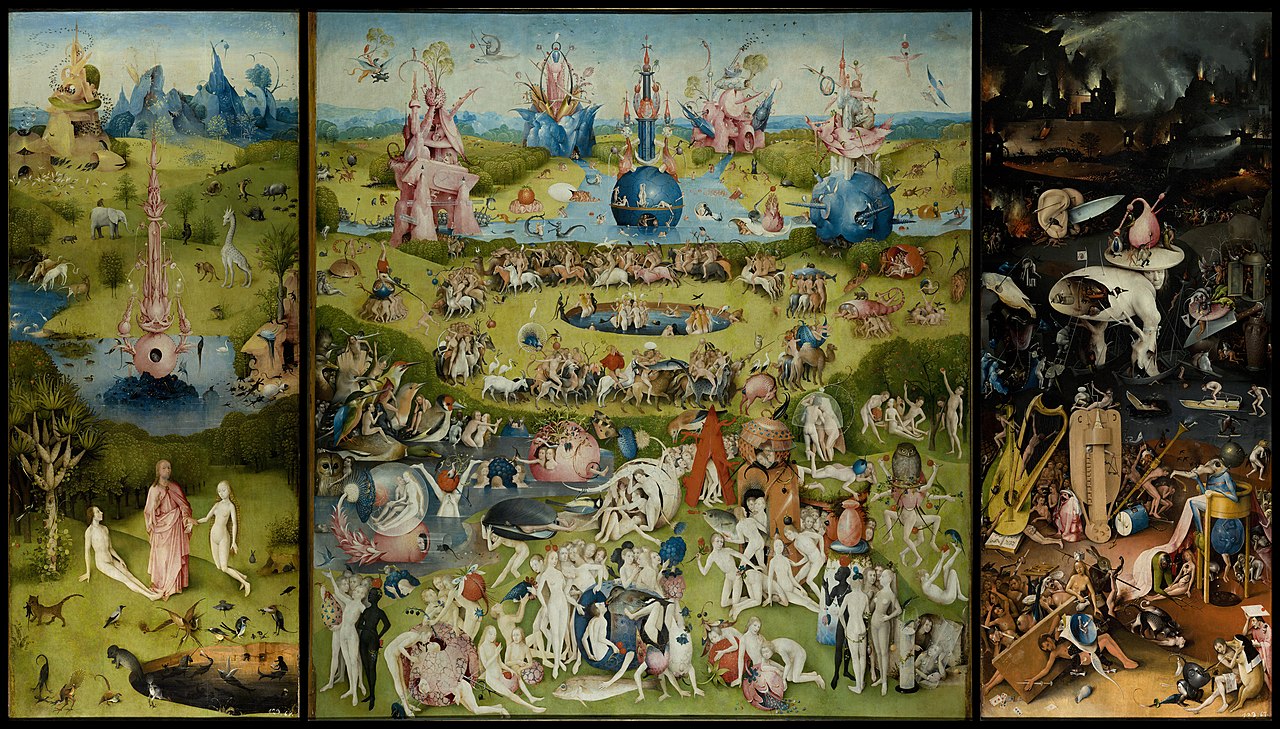
Hieronymus Bosch, Garden of Earthly Delights (detail), c. 1500.
via:
[ed. I'm continually surprised at the details people find.]

Everything You Know About Martin Shkreli Is Wrong—or Is It?
[ed. I told myself I wasn't going to post a single word about Mr. Shkreli. But like the man himself, I'm reneging on that promise (because this is such a good read, and because the wall-to-wall news he generates every day is clogging up my internet connection). In any case, he's proving to be a fun diversion from what's really scary and just plain deceitful.]
I don’t mean to be presumptuous, but I liken myself to the robber barons.” So says Martin Shkreli, the 32-year-old hedge-fund manager turned pharmaceutical-company C.E.O., who achieved instantaneous notoriety last fall when he acquired the U.S. rights to a lifesaving drug and promptly boosted its price over 5,000 percent, from $13.50 a tablet to $750. The tsunami of rage (the BBC asked if Shkreli was “the most hated man in America”) only got worse when Shkreli said he would lower the price—and then didn’t. An anonymous user on the Web site Reddit summed up the sentiment bluntly: “Just fucking die will you?”
 “The attempt to public shame is interesting,” says Shkreli. “Because everything we’ve done is legal. [Standard Oil tycoon John D.] Rockefeller made no attempt to apologize as long as what he was doing was legal.” In fact, Shkreli says, he wishes he had raised the price higher. “My investors expect me to maximize profits,” he said in an interview in early December at theForbes Healthcare Summit, after which Forbes contributor Dan Diamond summed up Shkreli as “fascinating, horrifying, and utterly compelling.” (...)
Although Shkreli is a minor part of a much bigger issue, every morality play needs a villain, and, oh, what a perfect villain he is. He is an avid user of social media, where he relishes portraying himself as a wealthy young hedge-fund guy. He tweets obnoxious snapshots of labels of $1,000-plus bottles of wine like 1982 Lafite-Rothschild, along with selfies inside a helicopter buzzing over Manhattan or posed next to a life-size chess set by a pool in the Hamptons. In one tweet, he linked to a video of Eminem’s “The Way I Am,” which goes, “I’m not Mr. Friendly, I can be a prick….I don’t mean to be mean but all I can be is just me.”
Actually, he’s such a perfect villain when viewed from afar that it’s almost impossible not to like him more up close. He swerves seamlessly among obnoxious bravado, old-world politeness, purposeful displays of powerful intelligence, and even flashes of sweetness. He is slight and pale, almost vampirish, with dark hair, which he has a habit of twirling. He’s oddly twitchy (you can see this in the many lengthy livestreams he does of himself analyzing stocks) and fast-talking, especially when it comes to the scientific details of how drugs work. (“Most pharmaceutical C.E.O.’s don’t even know where the spleen is located,” he says.) He defends his actions as both irrelevant in the larger scheme of things (“Daraprim is 0.01 percent of healthcare costs in the U.S.”) and in keeping with the American tradition. He pulls up a chart of the price of admission to Disney World, which has skyrocketed from $3.50 in 1971 to $105 today. “Now, that’s price gouging,” he says, laughing.
In one breath, he calls himself a capitalist and in the next an altruist—the latter because, he claims, his real goal is to invent new drugs for rare diseases. Turing recently announced discounts of Daraprim for hospitals, and Shkreli says that for people without insurance it will cost only $1 a pill. For everyone else, insurance, which he argues is paid for by corporate America’s profits, will cover the cost. “I’m like Robin Hood,” he continues. “I’m taking Walmart’s money and doing research for diseases no one cares about.”
Of his social-media presence, he says, “Anyone who knows me knows I am not that guy.” When I ask why he does it—and the speculation among those who know him ranges from an overbearing need for attention to an Asperger’s-like inability to see things the way other people do—he says, “I’m not sure I have all the answers.” The identity he creates, he says, is “an extremely weird form of sarcasm.” Neither the Hamptons house nor the helicopter belongs to him, and the text accompanying the helicopter shot reads, “Let’s take the boat out on the bay and forget your job for just one day.” Do a quick Internet search and you’ll find that these lyrics belong to a dark song by the punk band Blink-182: “Why do I want what I can’t get / I wish it didn’t have to be so bad.” Of the outraged response to many of his tweets, he says, “It’s fun to see people get so animated.” He adds, “Authenticity is really important to me.”
But it’s hard to know which manifestation of Martin is authentic. What muddles the picture even more is the arena in which he operates: small biotech companies, some of which thrive thanks to loopholes, legal frauds, pipe dreams, and stock promoters—and a smattering of real science, just enough to ignite fantasies of fame and fortune. Those who know how to game the system can make huge profits without creating anything of value. “Welcome to the underworld,” says one investor.
Shkreli is unquestionably brilliant, and he has an almost cult-like group of true believers, both online (“You’re a god,” wrote one Twitter follower) and in the real world, where he has engendered tremendous loyalty among some investors and employees. But in his wake he has left a tangled trail of blowups, lawsuits, disillusionment, and outright hatred. He’s facing criminal prosecution over his actions at one of his previous companies, Retrophin. “Sociopath” is a not uncommon description of him. “Malicious” is the word another person uses. Shkreli says that the harsh words don’t bother him and adds, “I am perfectly well, short of some mild anxiety, a deviated septum, and a fractured wrist.” Everyone agrees on this word: complicated.
I don’t mean to be presumptuous, but I liken myself to the robber barons.” So says Martin Shkreli, the 32-year-old hedge-fund manager turned pharmaceutical-company C.E.O., who achieved instantaneous notoriety last fall when he acquired the U.S. rights to a lifesaving drug and promptly boosted its price over 5,000 percent, from $13.50 a tablet to $750. The tsunami of rage (the BBC asked if Shkreli was “the most hated man in America”) only got worse when Shkreli said he would lower the price—and then didn’t. An anonymous user on the Web site Reddit summed up the sentiment bluntly: “Just fucking die will you?”
 “The attempt to public shame is interesting,” says Shkreli. “Because everything we’ve done is legal. [Standard Oil tycoon John D.] Rockefeller made no attempt to apologize as long as what he was doing was legal.” In fact, Shkreli says, he wishes he had raised the price higher. “My investors expect me to maximize profits,” he said in an interview in early December at theForbes Healthcare Summit, after which Forbes contributor Dan Diamond summed up Shkreli as “fascinating, horrifying, and utterly compelling.” (...)
Although Shkreli is a minor part of a much bigger issue, every morality play needs a villain, and, oh, what a perfect villain he is. He is an avid user of social media, where he relishes portraying himself as a wealthy young hedge-fund guy. He tweets obnoxious snapshots of labels of $1,000-plus bottles of wine like 1982 Lafite-Rothschild, along with selfies inside a helicopter buzzing over Manhattan or posed next to a life-size chess set by a pool in the Hamptons. In one tweet, he linked to a video of Eminem’s “The Way I Am,” which goes, “I’m not Mr. Friendly, I can be a prick….I don’t mean to be mean but all I can be is just me.”
Actually, he’s such a perfect villain when viewed from afar that it’s almost impossible not to like him more up close. He swerves seamlessly among obnoxious bravado, old-world politeness, purposeful displays of powerful intelligence, and even flashes of sweetness. He is slight and pale, almost vampirish, with dark hair, which he has a habit of twirling. He’s oddly twitchy (you can see this in the many lengthy livestreams he does of himself analyzing stocks) and fast-talking, especially when it comes to the scientific details of how drugs work. (“Most pharmaceutical C.E.O.’s don’t even know where the spleen is located,” he says.) He defends his actions as both irrelevant in the larger scheme of things (“Daraprim is 0.01 percent of healthcare costs in the U.S.”) and in keeping with the American tradition. He pulls up a chart of the price of admission to Disney World, which has skyrocketed from $3.50 in 1971 to $105 today. “Now, that’s price gouging,” he says, laughing.
In one breath, he calls himself a capitalist and in the next an altruist—the latter because, he claims, his real goal is to invent new drugs for rare diseases. Turing recently announced discounts of Daraprim for hospitals, and Shkreli says that for people without insurance it will cost only $1 a pill. For everyone else, insurance, which he argues is paid for by corporate America’s profits, will cover the cost. “I’m like Robin Hood,” he continues. “I’m taking Walmart’s money and doing research for diseases no one cares about.”
Of his social-media presence, he says, “Anyone who knows me knows I am not that guy.” When I ask why he does it—and the speculation among those who know him ranges from an overbearing need for attention to an Asperger’s-like inability to see things the way other people do—he says, “I’m not sure I have all the answers.” The identity he creates, he says, is “an extremely weird form of sarcasm.” Neither the Hamptons house nor the helicopter belongs to him, and the text accompanying the helicopter shot reads, “Let’s take the boat out on the bay and forget your job for just one day.” Do a quick Internet search and you’ll find that these lyrics belong to a dark song by the punk band Blink-182: “Why do I want what I can’t get / I wish it didn’t have to be so bad.” Of the outraged response to many of his tweets, he says, “It’s fun to see people get so animated.” He adds, “Authenticity is really important to me.”
But it’s hard to know which manifestation of Martin is authentic. What muddles the picture even more is the arena in which he operates: small biotech companies, some of which thrive thanks to loopholes, legal frauds, pipe dreams, and stock promoters—and a smattering of real science, just enough to ignite fantasies of fame and fortune. Those who know how to game the system can make huge profits without creating anything of value. “Welcome to the underworld,” says one investor.
Shkreli is unquestionably brilliant, and he has an almost cult-like group of true believers, both online (“You’re a god,” wrote one Twitter follower) and in the real world, where he has engendered tremendous loyalty among some investors and employees. But in his wake he has left a tangled trail of blowups, lawsuits, disillusionment, and outright hatred. He’s facing criminal prosecution over his actions at one of his previous companies, Retrophin. “Sociopath” is a not uncommon description of him. “Malicious” is the word another person uses. Shkreli says that the harsh words don’t bother him and adds, “I am perfectly well, short of some mild anxiety, a deviated septum, and a fractured wrist.” Everyone agrees on this word: complicated.
by Bethany McLean, Vanity Fair | Read more:
Image: Nigel Parry
Kindergarten Has Become the New First Grade
Step into an American preschool classroom today and you are likely to be bombarded with what we educators call a print-rich environment, every surface festooned with alphabet charts, bar graphs, word walls, instructional posters, classroom rules, calendars, schedules, and motivational platitudes—few of which a 4-year-old can “decode,” the contemporary word for what used to be known as reading.
 Because so few adults can remember the pertinent details of their own preschool or kindergarten years, it can be hard to appreciate just how much the early-education landscape has been transformed over the past two decades. The changes are not restricted to the confusing pastiche on classroom walls. Pedagogy and curricula have changed too, most recently in response to the Common Core State Standards Initiative’s kindergarten guidelines. Much greater portions of the day are now spent on what’s called “seat work” (a term that probably doesn’t need any exposition) and a form of tightly scripted teaching known as direct instruction, formerly used mainly in the older grades, in which a teacher carefully controls the content and pacing of what a child is supposed to learn.
One study, titled “Is Kindergarten the New First Grade?,” compared kindergarten teachers’ attitudes nationwide in 1998 and 2010 and found that the percentage of teachers expecting children to know how to read by the end of the year had risen from 30 to 80 percent. The researchers also reported more time spent with workbooks and worksheets, and less time devoted to music and art. Kindergarten is indeed the new first grade, the authors concluded glumly. In turn, children who would once have used the kindergarten year as a gentle transition into school are in some cases being held back before they’ve had a chance to start. A study out of Mississippi found that in some counties, more than 10 percent of kindergartners weren’t allowed to advance to first grade.
Until recently, school-readiness skills weren’t high on anyone’s agenda, nor was the idea that the youngest learners might be disqualified from moving on to a subsequent stage. But now that kindergarten serves as a gatekeeper, not a welcome mat, to elementary school, concerns about school preparedness kick in earlier and earlier. A child who’s supposed to read by the end of kindergarten had better be getting ready in preschool. As a result, expectations that may arguably have been reasonable for 5- and 6-year-olds, such as being able to sit at a desk and complete a task using pencil and paper, are now directed at even younger children, who lack the motor skills and attention span to be successful.
Preschool classrooms have become increasingly fraught spaces, with teachers cajoling their charges to finish their “work” before they can go play. And yet, even as preschoolers are learning more pre-academic skills at earlier ages, I’ve heard many teachers say that they seem somehow—is it possible?—less inquisitive and less engaged than the kids of earlier generations. More children today seem to lack the language skills needed to retell a simple story or to use basic connecting words and prepositions. They can’t make a conceptual analogy between, say, the veins on a leaf and the veins in their own hands.
New research sounds a particularly disquieting note. A major evaluation of Tennessee’s publicly funded preschool system, published in September, found that although children who had attended preschool initially exhibited more “school readiness” skills when they entered kindergarten than did their non-preschool-attending peers, by the time they were in first grade their attitudes toward school were deteriorating. And by second grade they performed worse on tests measuring literacy, language, and math skills. The researchers told New York magazine that overreliance on direct instruction and repetitive, poorly structured pedagogy were likely culprits; children who’d been subjected to the same insipid tasks year after year after year were understandably losing their enthusiasm for learning.
That’s right. The same educational policies that are pushing academic goals down to ever earlier levels seem to be contributing to—while at the same time obscuring—the fact that young children are gaining fewer skills, not more.
 Because so few adults can remember the pertinent details of their own preschool or kindergarten years, it can be hard to appreciate just how much the early-education landscape has been transformed over the past two decades. The changes are not restricted to the confusing pastiche on classroom walls. Pedagogy and curricula have changed too, most recently in response to the Common Core State Standards Initiative’s kindergarten guidelines. Much greater portions of the day are now spent on what’s called “seat work” (a term that probably doesn’t need any exposition) and a form of tightly scripted teaching known as direct instruction, formerly used mainly in the older grades, in which a teacher carefully controls the content and pacing of what a child is supposed to learn.
One study, titled “Is Kindergarten the New First Grade?,” compared kindergarten teachers’ attitudes nationwide in 1998 and 2010 and found that the percentage of teachers expecting children to know how to read by the end of the year had risen from 30 to 80 percent. The researchers also reported more time spent with workbooks and worksheets, and less time devoted to music and art. Kindergarten is indeed the new first grade, the authors concluded glumly. In turn, children who would once have used the kindergarten year as a gentle transition into school are in some cases being held back before they’ve had a chance to start. A study out of Mississippi found that in some counties, more than 10 percent of kindergartners weren’t allowed to advance to first grade.
Until recently, school-readiness skills weren’t high on anyone’s agenda, nor was the idea that the youngest learners might be disqualified from moving on to a subsequent stage. But now that kindergarten serves as a gatekeeper, not a welcome mat, to elementary school, concerns about school preparedness kick in earlier and earlier. A child who’s supposed to read by the end of kindergarten had better be getting ready in preschool. As a result, expectations that may arguably have been reasonable for 5- and 6-year-olds, such as being able to sit at a desk and complete a task using pencil and paper, are now directed at even younger children, who lack the motor skills and attention span to be successful.
Preschool classrooms have become increasingly fraught spaces, with teachers cajoling their charges to finish their “work” before they can go play. And yet, even as preschoolers are learning more pre-academic skills at earlier ages, I’ve heard many teachers say that they seem somehow—is it possible?—less inquisitive and less engaged than the kids of earlier generations. More children today seem to lack the language skills needed to retell a simple story or to use basic connecting words and prepositions. They can’t make a conceptual analogy between, say, the veins on a leaf and the veins in their own hands.
New research sounds a particularly disquieting note. A major evaluation of Tennessee’s publicly funded preschool system, published in September, found that although children who had attended preschool initially exhibited more “school readiness” skills when they entered kindergarten than did their non-preschool-attending peers, by the time they were in first grade their attitudes toward school were deteriorating. And by second grade they performed worse on tests measuring literacy, language, and math skills. The researchers told New York magazine that overreliance on direct instruction and repetitive, poorly structured pedagogy were likely culprits; children who’d been subjected to the same insipid tasks year after year after year were understandably losing their enthusiasm for learning.
That’s right. The same educational policies that are pushing academic goals down to ever earlier levels seem to be contributing to—while at the same time obscuring—the fact that young children are gaining fewer skills, not more.
by Erika Christakis, The Atlantic | Read more:
Image: Edmon de Haro
Making Saints
The Catholic Church makes saints to provide role models for the faithful, and Pope Francis has followed in the footsteps of his predecessors in churning them out at a rapid clip. The process is cloaked in secrecy and open to criticism, given that it deals with science-defying miracles, politicized choices and significant sums of money, as was recently revealed in some blockbuster books on Vatican finance.
 But saints aren't going away anytime soon, and Francis has actually made the process easier in some ways by doing away with the miracle requirement for several high-profile saints.
But saints aren't going away anytime soon, and Francis has actually made the process easier in some ways by doing away with the miracle requirement for several high-profile saints.
HOW ARE SAINTS MADE?
A postulator - essentially the cheerleader spearheading the project - gathers testimony and documentation and presents the case to the Vatican's Congregation for the Causes of Saints. If the congregation's experts agree the candidate lived a virtuous life, the case is forwarded to the pope, who signs a decree attesting to the candidate's "heroic virtues."
If the postulator finds someone was miraculously healed by praying for the candidate's intercession, and if the cure cannot be medically explained, the case is presented to the congregation as the possible miracle needed for beatification. Panels of doctors, theologians, bishops and cardinals must certify that the cure was instantaneous, complete and lasting - and was due to the intercession of the saintly candidate. If convinced, the congregation sends the case to the pope, who signs a decree saying the candidate can be beatified.
A second miracle is needed for canonization, which means the person becomes a saint.
Martyrs - people killed for their faith - can be beatified without a miracle. A miracle is needed, however, for martyrs to be canonized.
A postulator - essentially the cheerleader spearheading the project - gathers testimony and documentation and presents the case to the Vatican's Congregation for the Causes of Saints. If the congregation's experts agree the candidate lived a virtuous life, the case is forwarded to the pope, who signs a decree attesting to the candidate's "heroic virtues."
If the postulator finds someone was miraculously healed by praying for the candidate's intercession, and if the cure cannot be medically explained, the case is presented to the congregation as the possible miracle needed for beatification. Panels of doctors, theologians, bishops and cardinals must certify that the cure was instantaneous, complete and lasting - and was due to the intercession of the saintly candidate. If convinced, the congregation sends the case to the pope, who signs a decree saying the candidate can be beatified.
A second miracle is needed for canonization, which means the person becomes a saint.
Martyrs - people killed for their faith - can be beatified without a miracle. A miracle is needed, however, for martyrs to be canonized.
by Nicole Winfield, AP | Read more:
Image: AP
Thursday, December 17, 2015


Kapu: When Hawaii Was Ruled by Shark-Like Gods
Polynesian voyagers first arrived in Hawai‘i around AD 1000 (not in the sixth century, as Moore writes based on outdated scholarship), part of an extraordinary diaspora that led, at roughly the same time, to the settlement of other remote islands including New Zealand and Easter Island. For the next four centuries, a tenuous link between Hawai‘i and the ancestral homeland in central Polynesia (especially Tahiti) was maintained by occasional voyages led by priest-navigators whose names are still celebrated in Hawaiian traditions. Then, for reasons still unclear, the voyaging ceased. Hawai‘i became an isolated world unto itself, with only an increasingly distant memory of those lands beyond the horizon, collectively labeled “Kahiki” (the Hawaiian name for Tahiti).
 By the early eighteenth century, a unique variant of Polynesian culture had emerged in this large and fertile archipelago. Supported by irrigation works and dryland field systems that yielded bountiful harvests of taro and sweet potato, augmented by fishponds and the husbandry of hogs and dogs for food, the indigenous population had swelled to more than half a million (the exact number at the time of Cook’s visit is still debated). The great majority were commoners—farmers and fishermen—ruled over by a relatively small group of elites, called ali‘i. The commoners worked the land as part of their tributary obligations to the ali‘i, who in turn held large territorial estates (ahupua‘a) distributed (and frequently redistributed) by each island’s paramount chief or king.
The ali‘i were obsessed with genealogy and lineage. The most exalted of the nine ranks of chiefs, the product (called nī‘aupi‘o) of incestuous unions between high-ranking brothers and sisters, were regarded as divine beings. As the nineteenth-century Hawaiian historian David Malo put it, “the people held the chiefs in great dread and looked upon them as gods.” Metaphorically, the chiefs were regarded as sharks that traveled on the land, devouring all in sight.
Central to this hyperelaborated system of hereditary chiefship and divine kingship was the deeply rooted Polynesian concept of tapu, introduced into the English language as “taboo” thanks to the accounts of Captain Cook and other eighteenth-century voyagers. Susanna Moore zeroes in on kapu, the Hawaiian variant of tapu, as a key to understanding both the cloistered nature of Hawaiian society prior to 1778 and its subsequent dramatic unraveling.
The divinely descended Hawaiian ali‘i were understood as intermediaries through which mana—the supernatural force or power enabling life, fertility, success, and efficacy of all kinds—flowed from the gods to men. As kapu, sacred beings, the ali‘i had to be kept separate from polluting influences. Secluded in their kapu compounds, the highest-ranked ali‘i often traveled at night to avoid being seen by commoners. Any commoners encountering the ali‘i had to strip off their garments and lie prostrate on the ground until the entourage passed; to attempt a glance was to risk death.
The Hawaiian system of kapu had evolved far beyond anything elsewhere in Polynesia, pervading all aspects of daily life. Pigs, certain kinds of red fish (red was the sacred color), and bananas were kapu to women; indeed, the food of men and women had to be cooked in separate earth ovens while the two genders ate in separate houses. As Moore writes, “time itself could be placed under a kapu,” with nine days out of each lunar month consecrated to particular deities. Perhaps the most fearful kapu were those associated with the king’s war rituals, which were conducted on imposing stone temple platforms where human sacrifices were offered to the war god Kū. For a commoner, merely coughing near the warrior guard during such rituals could bring instant death.
Moore regards kapu as the invisible glue that held traditional Hawaiian society together, entwining ali‘i and commoners in bonds of mutual obligation:
by Patrick Vinton Kirch, NY Review of Books | Read more:
Image:Engraving by Thomas Cook after a drawing by John Webber, 1779
 By the early eighteenth century, a unique variant of Polynesian culture had emerged in this large and fertile archipelago. Supported by irrigation works and dryland field systems that yielded bountiful harvests of taro and sweet potato, augmented by fishponds and the husbandry of hogs and dogs for food, the indigenous population had swelled to more than half a million (the exact number at the time of Cook’s visit is still debated). The great majority were commoners—farmers and fishermen—ruled over by a relatively small group of elites, called ali‘i. The commoners worked the land as part of their tributary obligations to the ali‘i, who in turn held large territorial estates (ahupua‘a) distributed (and frequently redistributed) by each island’s paramount chief or king.
The ali‘i were obsessed with genealogy and lineage. The most exalted of the nine ranks of chiefs, the product (called nī‘aupi‘o) of incestuous unions between high-ranking brothers and sisters, were regarded as divine beings. As the nineteenth-century Hawaiian historian David Malo put it, “the people held the chiefs in great dread and looked upon them as gods.” Metaphorically, the chiefs were regarded as sharks that traveled on the land, devouring all in sight.
Central to this hyperelaborated system of hereditary chiefship and divine kingship was the deeply rooted Polynesian concept of tapu, introduced into the English language as “taboo” thanks to the accounts of Captain Cook and other eighteenth-century voyagers. Susanna Moore zeroes in on kapu, the Hawaiian variant of tapu, as a key to understanding both the cloistered nature of Hawaiian society prior to 1778 and its subsequent dramatic unraveling.
The divinely descended Hawaiian ali‘i were understood as intermediaries through which mana—the supernatural force or power enabling life, fertility, success, and efficacy of all kinds—flowed from the gods to men. As kapu, sacred beings, the ali‘i had to be kept separate from polluting influences. Secluded in their kapu compounds, the highest-ranked ali‘i often traveled at night to avoid being seen by commoners. Any commoners encountering the ali‘i had to strip off their garments and lie prostrate on the ground until the entourage passed; to attempt a glance was to risk death.
The Hawaiian system of kapu had evolved far beyond anything elsewhere in Polynesia, pervading all aspects of daily life. Pigs, certain kinds of red fish (red was the sacred color), and bananas were kapu to women; indeed, the food of men and women had to be cooked in separate earth ovens while the two genders ate in separate houses. As Moore writes, “time itself could be placed under a kapu,” with nine days out of each lunar month consecrated to particular deities. Perhaps the most fearful kapu were those associated with the king’s war rituals, which were conducted on imposing stone temple platforms where human sacrifices were offered to the war god Kū. For a commoner, merely coughing near the warrior guard during such rituals could bring instant death.
Moore regards kapu as the invisible glue that held traditional Hawaiian society together, entwining ali‘i and commoners in bonds of mutual obligation:
Kapu served to establish order, requiring men to respect the land, to honor the chiefs who were the literal representatives of the gods, and to serve the thousands of omnipresent big and little gods. In return, the gods endowed the land and sea with bountiful food, and protected people from danger (often the gods themselves).
The arrival of Captain Cook, first at Kaua‘i in 1778 and then for a longer stay at Hawai‘i in 1779, made the first inroads in what would become an increasing assault on the kapu system and on the social and political order of Hawaiian civilization. At Kealakekua Bay, Hawaiian women “came to the ships to offer themselves to the sailors in exchange for scissors, beads, iron, and mirrors.” Below decks on the Resolution and Discovery, the women ate forbidden pork and bananas with the sailors. Their husbands and brothers, eager to receive the gifts of iron adz blades and trinkets, did not punish them for breaking the kapu. (...)
The beginning of the nineteenth century found Kamehameha established in the port village of Honolulu on O‘ahu Island, which increasingly became the archipelago’s center of commercial and political power. No longer needing to engage in war, Kamehameha quietly abandoned the rituals of human sacrifice—another rent in the kapu fabric.
Kamehameha had taken seventeen-year-old Ka‘ahumanu—granddaughter of the revered Maui king Kekaulike—as his third wife in 1785. Although of high rank, she was not considered sacred like Keōpūolani, the exalted chiefess who bore Kamehameha his royal heir and successor Liholiho (Kamehameha II). Indeed, Ka‘ahumanu produced no offspring; her power instead sprang from her influence over Kamehameha, with whom she shared a similar political cunning. Ka‘ahumanu, rather than his birth mother, watched over and raised young Liholiho. “As Liholiho’s guardian,” Moore writes, “the subtle Ka‘ahumanu was easily able to shape him to her liking, strengthening her already formidable position at the center of court.”
When Kamehameha eventually died of old age in Kona in 1819, Ka‘ahumanu was poised to bend the pliant Liholiho (then twenty-one years old) to her will. After a period of mourning in the northern part of the island, Liholiho returned to Kona to find Ka‘ahumanu waiting. “Holding Kamehameha’s favorite spear, she was dressed in the dead king’s feather cloak and war helmet, lest there be any lingering hope that Liholiho might rule the kingdom alone.” Ka‘ahumanu proclaimed that “we two shall share the rule of the land,” appointing herself to the newly created title of kuhina nui, or regent.
Ka‘ahumanu—who had for some years broken the kapu against women eating pork and shark meat—next engineered a remarkable act, inducing Liholiho to sit down at a feast and eat with the female ali‘i. “Six months after the death of his father, and with the urging of his stepmother and guardian and the quiet persuasion of his mother, the king ate with the women, bringing to an end a thousand years of kapu.” This famous act—the‘ai noa, or “free eating”—marked the end of the entire kapu system. Shortly thereafter, Ka‘ahumanu commanded that the temples be dismantled and the wooden idols of the gods burned. As Moore writes, “the fixed world of the Hawaiians, governed by a hereditary ali‘i and priesthood with a distinctive system of kapu, suddenly became one of flux, if not chaos.”
The beginning of the nineteenth century found Kamehameha established in the port village of Honolulu on O‘ahu Island, which increasingly became the archipelago’s center of commercial and political power. No longer needing to engage in war, Kamehameha quietly abandoned the rituals of human sacrifice—another rent in the kapu fabric.
Kamehameha had taken seventeen-year-old Ka‘ahumanu—granddaughter of the revered Maui king Kekaulike—as his third wife in 1785. Although of high rank, she was not considered sacred like Keōpūolani, the exalted chiefess who bore Kamehameha his royal heir and successor Liholiho (Kamehameha II). Indeed, Ka‘ahumanu produced no offspring; her power instead sprang from her influence over Kamehameha, with whom she shared a similar political cunning. Ka‘ahumanu, rather than his birth mother, watched over and raised young Liholiho. “As Liholiho’s guardian,” Moore writes, “the subtle Ka‘ahumanu was easily able to shape him to her liking, strengthening her already formidable position at the center of court.”
When Kamehameha eventually died of old age in Kona in 1819, Ka‘ahumanu was poised to bend the pliant Liholiho (then twenty-one years old) to her will. After a period of mourning in the northern part of the island, Liholiho returned to Kona to find Ka‘ahumanu waiting. “Holding Kamehameha’s favorite spear, she was dressed in the dead king’s feather cloak and war helmet, lest there be any lingering hope that Liholiho might rule the kingdom alone.” Ka‘ahumanu proclaimed that “we two shall share the rule of the land,” appointing herself to the newly created title of kuhina nui, or regent.
Ka‘ahumanu—who had for some years broken the kapu against women eating pork and shark meat—next engineered a remarkable act, inducing Liholiho to sit down at a feast and eat with the female ali‘i. “Six months after the death of his father, and with the urging of his stepmother and guardian and the quiet persuasion of his mother, the king ate with the women, bringing to an end a thousand years of kapu.” This famous act—the‘ai noa, or “free eating”—marked the end of the entire kapu system. Shortly thereafter, Ka‘ahumanu commanded that the temples be dismantled and the wooden idols of the gods burned. As Moore writes, “the fixed world of the Hawaiians, governed by a hereditary ali‘i and priesthood with a distinctive system of kapu, suddenly became one of flux, if not chaos.”
by Patrick Vinton Kirch, NY Review of Books | Read more:
Image:Engraving by Thomas Cook after a drawing by John Webber, 1779
The Perfect Wedding Vow Template
Dear [INSERT PARTNER’S NAME],
I can’t believe this day has finally arrived. We’ve been together for [NUMBER] years, but it feels like only yesterday when we first met. Me, a [GIRL/BOY] from [NAME OF CITY] and you, a [NEPHEW/TALL WOMAN] from [NAME OF TOWNSHIP]. Standing beside you today, I’m taken back to our first [BIZARRE SEXUAL ACT] at the [NEAREST LOCAL PANERA BREAD]. At that moment, I knew you were the one with whom I wanted to share my [PROBABLE AMOUNT OF TIME UNTIL DEATH].
 Thank you for being you. Thank you for being so [PARTNER’S OBJECTIVE BEAUTY LEVEL] and for having such an incredible [RACK/SET OF NUTS]. I can gaze into your [SEVERITY OF PARTNER’S DEPRESSION] eyes and can’t help but think about [ANIMAL YOU’RE ATTRACTED TO]. You are thoughtful, kind and your [DEGREE OF BURNS] face can brighten my worst day. I love your big [FAVORITE VERTEBRA] and your even bigger [LUNG CAPACITY]. I love that we both bonded over [BOOK YOU’VE LIED ABOUT READING]. I love how we both have the same [PERSONAL DEFINITION OF AMERICAN FUNDAMENTALISM]. I love that on Sunday mornings, you always wake me up and make me [ANY 18TH CENTURY POLISH DELICACY]. And I love that cute face you make when you talk about [EISENHOWER’S WORST ECONOMIC POLICY MISTAKE, IN YOUR OPINION]. I love you so much, that it’s hard to be without you. When you’re not by my side, I feel [THAT GREAT FEELING YOU GET WHEN YOU’RE AWAY FROM YOUR PARTNER].
Today, I vow before [NAMES OF TWO NEIGHBORHOOD SEX-OFFENDERS], to be loving, faithful and to always be at [MOUNTAIN YOU’VE SUMMITED] when you need me. I vow to respect you as a person, a partner, and a [TYCOON/CYBORG]. I vow to stand by [YOUR OWN NAME] and to stand up for [YOUR OWN NAME]. I vow to accept your [READING LEVEL], to encourage your [RECURRING NIGHTMARE], and inspire you to achieve your [CALF SIZE]. I promise to be the very best [APPROPRIATE SLUR] I can be. I promise to share your joy in good times, and in bad times, to bear your [LEVEL OF HORNINESS]. I promise to put [EITHER OF THE HEMSWORTH BROTHERS] first, and to do the hard [DERIVED UNIT OF ENERGY] of making now into always. I will support you while you’re working at [PARTNER’S CURRENT HUMILIATING JOB] and while I continue my work with [CHEMICAL ELEMENT YOU’VE DISCOVERED]. I will love you, for better or worse, in sickness and [ROBERT DUVALL’S CURRENT MEDICAL CONDITION], for richer or [NICOLAS CAGE’S CURRENT LEVEL OF SUCCESS] as long as [THE BEARD LENGTH OF YOUR COMMUNITY’S WISEST RABBI]. My love knows no bounds. I love you more than [YOUR FAT INTAKE TRANSLATED INTO BHUTANESE]. More than [YOUR MOTHER’S WEIGHT ON MERCURY]. More than [(YOUR CUP-SIZE/ YOUR LSAT SCORE) + (YOUR GUESS AS TO HOW MANY PEOPLE DIED IN THE GULF WAR WITHOUT GOOGLING) ^2].
I can’t believe this day has finally arrived. We’ve been together for [NUMBER] years, but it feels like only yesterday when we first met. Me, a [GIRL/BOY] from [NAME OF CITY] and you, a [NEPHEW/TALL WOMAN] from [NAME OF TOWNSHIP]. Standing beside you today, I’m taken back to our first [BIZARRE SEXUAL ACT] at the [NEAREST LOCAL PANERA BREAD]. At that moment, I knew you were the one with whom I wanted to share my [PROBABLE AMOUNT OF TIME UNTIL DEATH].
 Thank you for being you. Thank you for being so [PARTNER’S OBJECTIVE BEAUTY LEVEL] and for having such an incredible [RACK/SET OF NUTS]. I can gaze into your [SEVERITY OF PARTNER’S DEPRESSION] eyes and can’t help but think about [ANIMAL YOU’RE ATTRACTED TO]. You are thoughtful, kind and your [DEGREE OF BURNS] face can brighten my worst day. I love your big [FAVORITE VERTEBRA] and your even bigger [LUNG CAPACITY]. I love that we both bonded over [BOOK YOU’VE LIED ABOUT READING]. I love how we both have the same [PERSONAL DEFINITION OF AMERICAN FUNDAMENTALISM]. I love that on Sunday mornings, you always wake me up and make me [ANY 18TH CENTURY POLISH DELICACY]. And I love that cute face you make when you talk about [EISENHOWER’S WORST ECONOMIC POLICY MISTAKE, IN YOUR OPINION]. I love you so much, that it’s hard to be without you. When you’re not by my side, I feel [THAT GREAT FEELING YOU GET WHEN YOU’RE AWAY FROM YOUR PARTNER].
Today, I vow before [NAMES OF TWO NEIGHBORHOOD SEX-OFFENDERS], to be loving, faithful and to always be at [MOUNTAIN YOU’VE SUMMITED] when you need me. I vow to respect you as a person, a partner, and a [TYCOON/CYBORG]. I vow to stand by [YOUR OWN NAME] and to stand up for [YOUR OWN NAME]. I vow to accept your [READING LEVEL], to encourage your [RECURRING NIGHTMARE], and inspire you to achieve your [CALF SIZE]. I promise to be the very best [APPROPRIATE SLUR] I can be. I promise to share your joy in good times, and in bad times, to bear your [LEVEL OF HORNINESS]. I promise to put [EITHER OF THE HEMSWORTH BROTHERS] first, and to do the hard [DERIVED UNIT OF ENERGY] of making now into always. I will support you while you’re working at [PARTNER’S CURRENT HUMILIATING JOB] and while I continue my work with [CHEMICAL ELEMENT YOU’VE DISCOVERED]. I will love you, for better or worse, in sickness and [ROBERT DUVALL’S CURRENT MEDICAL CONDITION], for richer or [NICOLAS CAGE’S CURRENT LEVEL OF SUCCESS] as long as [THE BEARD LENGTH OF YOUR COMMUNITY’S WISEST RABBI]. My love knows no bounds. I love you more than [YOUR FAT INTAKE TRANSLATED INTO BHUTANESE]. More than [YOUR MOTHER’S WEIGHT ON MERCURY]. More than [(YOUR CUP-SIZE/ YOUR LSAT SCORE) + (YOUR GUESS AS TO HOW MANY PEOPLE DIED IN THE GULF WAR WITHOUT GOOGLING) ^2].
by Gil Ozeri, McSweeny's | Read more:
Image: via:
Open to Inspection

Even if the spy, Allen Dulles, should arrive in heaven through somebody’s absentmindedness, he would begin to blow up the clouds, mine the stars, and slaughter the angels.
—Ilya Ehrenburg
—Ilya Ehrenburg
I cannot think that espionage can be recommended as a technique for building an impressive civilization. It’s a lout’s game.
—Rebecca West
Reports of the CIA’s blunders tend to show up on the record well after the fact. I’ve been reading them with interest over the past fifty years, but they don’t come as a surprise. Long ago and in another country, America in 1957, I sought enlistment in the CIA and sat for an interview with a credentials committee ordained by God and country and Allen Dulles. From that day forward I’ve never doubted the agency’s talent for making a mess of almost any operation, overt or covert, beyond its capacity to perform.
In 1957 I was recently returned from a year at Cambridge University in England, where I had come to know several students who in October 1956 went to Budapest to join the uprising against the regime holding Hungary hostage to communist domination. Two of the young men died in the street fighting, and I didn’t need to be told by General Eisenhower that the communist hordes were at the gate of Western civilization. In my last year at Yale I had been tipped to the agency by an English professor (Shakespeare scholar, Tyrolean hat, former OSS), who passed on a phone number to call if I was prepared to take a shot at the dark. At the age of twenty-two I was willing to leave at once, preferably at night, with trench coat and code name, on the next train to Berlin.
In Washington the written, physical, and psychological examinations occupied the better part of a week before I was summoned to an interview with five operatives in their late twenties, all of them graduates of Yale and not unlike President George W. Bush in appearance and manner. The interview took place in a Quonset hut near the Lincoln Memorial. The design of the building imparted an air of urgent military purpose, as did the muted, offhand bravado of the young men asking the questions. Very pleased with themselves, they exchanged knowing nods to “that damned thing in Laos,” allowed me to understand that we were talking life and death, whether I had the right stuff to play for the varsity team in the big game against the Russians.
Prepared for nothing less, I had spent the days prior to the interview reading about Lenin’s train and Stalin’s prisons, the width of the Fulda Gap, the depth of the Black Sea. None of the study was called for. Instead of being asked about the treaties of Brest-Litovsk or the October Revolution, I was asked three questions bearing on my social qualifications for admission into what the young men at the far end of the table clearly regarded as the best fraternity on the campus of the free world:
1. When standing on the thirteenth tee at the National Golf Links in Southampton, which club does one take from the bag?
2. On final approach under sail into Hay Harbor on Fishers Island, what is the direction (at dusk in late August) of the prevailing wind?
3. Does Muffy Hamilton wear a slip?
The first and second questions I answered correctly, but Muffy Hamilton I knew only at a distance. In the middle 1950s she was a glamorous figure on the Ivy League weekend circuit, very beautiful and very rich, much admired for the indiscriminate fervor of her sexual enthusiasms. At the Fence Club in New Haven I had handed her a glass of brandy and milk (known to be her preferred drink by college football captains in five states) but about the mysteries of her underwear my sources were unreliable, my information limited to rumors of Belgian lace.
The three questions, however, put an end to my interest in the CIA. The smug complacence of my examiners was as smooth as their matching silk handkerchiefs and ties. When I excused myself from the interview (apologizing for having misread the job description and wasted everybody’s quality time) I remember being frightened by the presence of so much self-glorifying certainty and primogeniture crowded into so small a room. Here were people like Woodrow Wilson before them, after them Vice President Dick Cheney and Defense Secretary Donald Rumsfeld, who knew more about what was good for the world than the world—poor, lost, unhappy, un-American world—had managed to learn on its own. Even at the age of twenty-two I was old enough to recognize the attitude as not well positioned for intelligence gathering. It was better suited to the projection of monsters on the screens of deluded fantasy than to their destruction in a forest or a swamp.
—Rebecca West
By now it goes without saying or objection in most quarters of a once freedom-loving and democratic society that our lives, liberties, and pursuits of happiness are closely monitored by a paranoid surveillance apparatus possessed of the fond hopes and great expectations embedded in the fifteenth-century Spanish Inquisition. Our local fire departments don’t grant permits for burnings at the stake, but our federal intelligence agencies (seventeen at last count, staffed by more than 100,000 inquisitors petty and grand) make no secret of their missionary zeal.
Four months after the fall of the World Trade Center and President George W. Bush’s preaching of holy crusade against all the world’s evil, the Pentagon established an Information Awareness Office, adopting as an emblem for its letterhead and baseball cap the all-seeing eye of God. Under orders to secure the American future against the blasphemy of terrorist attack, the IAO’s director, Rear Admiral John Poindexter, presented plans for programming its hydra-headed computer screens and databanks to spot incoming slings and arrows of outrageous fortune well in advance of their ETA overhead the Washington Monument or Plymouth Rock—to conduct “truth maintenance” and deploy “market-based techniques for avoiding surprises”; to defeat and classify every once and future hound from hell on a near or far horizon; no envelope or email left unopened, no phone untapped, no suspicious beard or suitcase descending unnoticed from cruise ship or Toyota.
Thirteen years further along the roads to perdition, the dream of a risk-free future under the digital umbrellas of protective fantasy is the stuff of which our wars and movies now are made, the thousand natural shocks to which the flesh is heir, projected day and night on the hundred million screens that text and shred our collective consciousness, herd our public and private lives—the latter no longer distinguishable from the former—into the shelters of heavy law enforcement and harmless speech.
This issue of Lapham’s Quarterly looks for the when and why did the lout’s game of espionage become the saving grace that makes cowards of us all. I’m familiar with at least some of the story because I’m old enough to remember the provincial and easygoing American republic of the 1940s—wisecracking, open-hearted, not so scared of the undiscovered country from whose bourn no traveler returns. I also can remember the days when people weren’t afraid of cigarette smoke and saturated fats, when it was possible to apply for a job without submitting a blood or urine test, when civil liberty was a constitutional right and not a political favor, the White House unprotected by concrete revetments, and it was possible to walk the streets of New York without making a series of cameo appearances on surveillance camera. (...)
Four months after the fall of the World Trade Center and President George W. Bush’s preaching of holy crusade against all the world’s evil, the Pentagon established an Information Awareness Office, adopting as an emblem for its letterhead and baseball cap the all-seeing eye of God. Under orders to secure the American future against the blasphemy of terrorist attack, the IAO’s director, Rear Admiral John Poindexter, presented plans for programming its hydra-headed computer screens and databanks to spot incoming slings and arrows of outrageous fortune well in advance of their ETA overhead the Washington Monument or Plymouth Rock—to conduct “truth maintenance” and deploy “market-based techniques for avoiding surprises”; to defeat and classify every once and future hound from hell on a near or far horizon; no envelope or email left unopened, no phone untapped, no suspicious beard or suitcase descending unnoticed from cruise ship or Toyota.
Thirteen years further along the roads to perdition, the dream of a risk-free future under the digital umbrellas of protective fantasy is the stuff of which our wars and movies now are made, the thousand natural shocks to which the flesh is heir, projected day and night on the hundred million screens that text and shred our collective consciousness, herd our public and private lives—the latter no longer distinguishable from the former—into the shelters of heavy law enforcement and harmless speech.
This issue of Lapham’s Quarterly looks for the when and why did the lout’s game of espionage become the saving grace that makes cowards of us all. I’m familiar with at least some of the story because I’m old enough to remember the provincial and easygoing American republic of the 1940s—wisecracking, open-hearted, not so scared of the undiscovered country from whose bourn no traveler returns. I also can remember the days when people weren’t afraid of cigarette smoke and saturated fats, when it was possible to apply for a job without submitting a blood or urine test, when civil liberty was a constitutional right and not a political favor, the White House unprotected by concrete revetments, and it was possible to walk the streets of New York without making a series of cameo appearances on surveillance camera. (...)
Reports of the CIA’s blunders tend to show up on the record well after the fact. I’ve been reading them with interest over the past fifty years, but they don’t come as a surprise. Long ago and in another country, America in 1957, I sought enlistment in the CIA and sat for an interview with a credentials committee ordained by God and country and Allen Dulles. From that day forward I’ve never doubted the agency’s talent for making a mess of almost any operation, overt or covert, beyond its capacity to perform.
In 1957 I was recently returned from a year at Cambridge University in England, where I had come to know several students who in October 1956 went to Budapest to join the uprising against the regime holding Hungary hostage to communist domination. Two of the young men died in the street fighting, and I didn’t need to be told by General Eisenhower that the communist hordes were at the gate of Western civilization. In my last year at Yale I had been tipped to the agency by an English professor (Shakespeare scholar, Tyrolean hat, former OSS), who passed on a phone number to call if I was prepared to take a shot at the dark. At the age of twenty-two I was willing to leave at once, preferably at night, with trench coat and code name, on the next train to Berlin.
In Washington the written, physical, and psychological examinations occupied the better part of a week before I was summoned to an interview with five operatives in their late twenties, all of them graduates of Yale and not unlike President George W. Bush in appearance and manner. The interview took place in a Quonset hut near the Lincoln Memorial. The design of the building imparted an air of urgent military purpose, as did the muted, offhand bravado of the young men asking the questions. Very pleased with themselves, they exchanged knowing nods to “that damned thing in Laos,” allowed me to understand that we were talking life and death, whether I had the right stuff to play for the varsity team in the big game against the Russians.
Prepared for nothing less, I had spent the days prior to the interview reading about Lenin’s train and Stalin’s prisons, the width of the Fulda Gap, the depth of the Black Sea. None of the study was called for. Instead of being asked about the treaties of Brest-Litovsk or the October Revolution, I was asked three questions bearing on my social qualifications for admission into what the young men at the far end of the table clearly regarded as the best fraternity on the campus of the free world:
1. When standing on the thirteenth tee at the National Golf Links in Southampton, which club does one take from the bag?
2. On final approach under sail into Hay Harbor on Fishers Island, what is the direction (at dusk in late August) of the prevailing wind?
3. Does Muffy Hamilton wear a slip?
The first and second questions I answered correctly, but Muffy Hamilton I knew only at a distance. In the middle 1950s she was a glamorous figure on the Ivy League weekend circuit, very beautiful and very rich, much admired for the indiscriminate fervor of her sexual enthusiasms. At the Fence Club in New Haven I had handed her a glass of brandy and milk (known to be her preferred drink by college football captains in five states) but about the mysteries of her underwear my sources were unreliable, my information limited to rumors of Belgian lace.
The three questions, however, put an end to my interest in the CIA. The smug complacence of my examiners was as smooth as their matching silk handkerchiefs and ties. When I excused myself from the interview (apologizing for having misread the job description and wasted everybody’s quality time) I remember being frightened by the presence of so much self-glorifying certainty and primogeniture crowded into so small a room. Here were people like Woodrow Wilson before them, after them Vice President Dick Cheney and Defense Secretary Donald Rumsfeld, who knew more about what was good for the world than the world—poor, lost, unhappy, un-American world—had managed to learn on its own. Even at the age of twenty-two I was old enough to recognize the attitude as not well positioned for intelligence gathering. It was better suited to the projection of monsters on the screens of deluded fantasy than to their destruction in a forest or a swamp.
by Lewis Lapham, Lapham's Quarterly | Read more:
Image: Sir Frances Walsingham, attributed to John de Critz the Elder, c. 1585
Subscribe to:
Posts (Atom)