Sunday, November 3, 2019

Ok Boomer

In a viral audio clip on TikTok, a white-haired man in a baseball cap and polo shirt declares, “The millennials and Generation Z have the Peter Pan syndrome, they don’t ever want to grow up.”

Thousands of teens have responded through remixed reaction videos and art projects with a simple phrase: “ok boomer.”

“Ok boomer” has become Generation Z’s endlessly repeated retort to the problem of older people who just don’t get it, a rallying cry for millions of fed up kids. Teenagers use it to reply to cringey YouTube videos, Donald Trump tweets, and basically any person over 30 who says something condescending about young people — and the issues that matter to them. (...)

The meme-to-merch cycle is nothing new, but unlike most novelty products, “ok boomer” merch is selling. Shannon O’Connor, 19, designed a T-shirt and hoodie with the phrase “ok boomer” written in the “thank you” style of a plastic shopping bag. She uploaded it to Bonfire, a site for selling custom apparel, with the tagline “Ok boomer have a terrible day.” After promoting the shirt on TikTok, she received more than $10,000 in orders. (...)

Ms. O’Connor is far from the only one cashing in. Hundreds of “ok boomer” products are for sale through on-demand shopping sites like Redbubble and Spreadshirt, where many young people are selling “ok boomer” phone cases, bedsheets, stickers, pins and more.

Nina Kasman, an 18-year-old college student selling “ok boomer" stickers, socks, shirts, leggings, posters, water bottles, notebooks and greeting cards, said that while older generations have always looked down on younger kids or talked about things “back in their day,” she and other teens believe older people are actively hurting young people. “Everybody in Gen Z is affected by the choices of the boomers, that they made and are still making,” she said. “Those choices are hurting us and our future. Everyone in my generation can relate to that experience and we’re all really frustrated by it.” (...)

Rising inequality, unaffordable college tuition, political polarization exacerbated by the internet, and the climate crisis all fuel anti-boomer sentiment.

And so Ms. Kasman and other teenagers selling merch say that monetizing the boomer backlash is their own little form of protest against a system they feel is rigged. “The reason we make the ‘ok boomer’ merch is because there’s not a lot that I can personally do to reduce the price of college, for example, which was much cheaper for older generations who then made it more expensive,” Ms. Kasman said. “There’s not much I can personally do to restore the environment, which was harmed due to corporate greed of older generations. There’s not much I can personally do to undo political corruption, or fix Congress so it’s not mostly old white men boomers who don’t represent the majority of generations.”

by Taylor Lorenz, NY Times | Read more:
Image: Shannon O’Connor

The Happiness Ruse

Happiness is in many ways the marketing breakthrough of the past decade, with self-care and anti-stress products now rounding out the bestseller list on Amazon (think of ‘gravity blankets’, ‘de-stressing’ adult colouring books and fidget spinners), where they nestle alongside chart-topping tomes by ‘happiness bloggers’. All of this is made possible by a specific, disturbing and very new version of ‘happiness’ that holds that bad feelings must be avoided at all costs.

This imperative to avoid being – even appearing – unhappy has led to a culture that rewards a performative happiness, in which people curate public-facing lives, via Instagram and its kin, composed of a string of ‘peak experiences’ – and nothing else. Sadness and disappointment are rejected, even neutral or mundane life experiences get airbrushed out of the frame. It’s as though appearing unhappy implies some kind of Protestant moral fault: as if you didn’t work hard enough or believe sufficiently in yourself.

Happiness has, of course, not always been conceived of this way. The Epicurean outlook on happiness – which Thomas Jefferson was thinking of when he enjoined Americans to cherish ‘life, liberty, and the pursuit of happiness’ in the Declaration of Independence – is exceedingly simple and different. As Epicurus saw it, happiness is merely the lack of aponia – physical pain – and ataraxia – mental disturbance. It was not about the pursuit of material gain, or notching up gratifying experiences, but instead was a happiness that lent itself to a constant gratefulness. So long as we are not in mental or physical pain, we can, within this understanding of happiness, be contented. (...)

Not all happiness movements retain as close a relation to Epicurean ideas. Positive psychology, for instance, became voguish after Martin Seligman chose happiness as his core theme in 1998, after becoming president of the American Psychological Association (APA). Seligman proposed that happiness came from having and searching for positive emotions, a sense of community and existential meaning. He believed that humans tend to ‘learn’ unhappiness in choosing not to escape unpleasant situations even when we can. On this view, happiness is something we must constantly teach ourselves: it is something we work towards.

From here, it’s only a small leap to today’s widespread understanding of happiness as the pursuit and purchase of peak experience. Prescription antidepressants are consumed at record levels, self-help books crowd the shelves, and multiple therapies compete to shift us out of negative mindsets so that we might flourish. All of this is work, but of a particular variety, in which every moment is optimised in order to achieve peak happiness, no matter how fleeting, at the same time as unhappiness is actively pushed away.

But it’s a concept riddled with problems. ‘What is happiness?’ asks the fictional advertising executive Don Draper in Mad Men, in neo-Hobbesian mode, before answering: ‘It’s the moment before you need more happiness.’ These days, we pursue happiness rather than letting it come to us. We try to collect moments of happiness like shells at the beach, even as the waves wash them away. The pursuit is Sisyphean; it inevitably leads down a disappointing path.

There is no image of modern existential emptiness quite like the person travelling the world while constantly posting pictures of restaurants and landmarks on social media, and competitively performing happiness at the expense of making genuine connections with his peers. In trying to be happier – better – than others, this person risks alienating himself from them. It’s a zero-sum game. (...)

The fetish for pursuing happiness appears to be a peculiarly Anglo-American phenomenon, perhaps because there is such strong cultural pressure in both countries to downplay negative emotions. Compared with, say, the French, who are generally content to live outside of happiness – happiness being unsophisticated, not the marker of a life well lived – Brits and, most especially, Americans downplay negative emotions in favour of putting forth the happiest face possible. Americans are known for the fake smile and ‘I’m good, thanks!’ while Brits are renowned for avoiding conversational unpleasantness, and for maintaining a ‘stiff upper lip’ in the face of pain and disappointment. Denying and masking negative feelings, because they are socially and culturally unacceptable, is the norm. In the Anglo-American scheme of thinking, negative emotions are negatively reflective of us – as if we’ve made a fundamental mistake, lived without the gusto and positivity needed to achieve happiness.

But all of this happy pretending catches up. A person living in a Western culture is about four to 10 times more likely to develop clinical depression or anxiety than a person in an Eastern culture, according to the psychologist Brock Bastian’s book, The Other Side of Happiness: Embracing a More Fearless Approach to Living (2018). In China and Japan, Bastian writes, people tend to view positive and negative emotions as essential and equal; happiness, in the East, should not be actively pursued, just as sadness should not be actively avoided. Bastian sources this stance in religion, especially those Buddhist philosophies that seek to embrace the entirety of the human condition and to comprehend pain in terms of its underlying reasons.

The desire to twist our negative emotions into something upbeat is a way of thinking that leaves us open to the kind of ad-man manipulation in which Watson specialised. But it’s not a desire that entered our culture from a vacuum. There’s a significant economic incentive for businesses when people believe that happiness is something that we must work – and buy – toward. Happy workers tend to be about 12 per cent more productive. Google has a ‘chief happiness officer’. The ‘treat-yourself’ ethic is still a major sales driver, and nearly every beauty brand now bases its advertisements on ‘self-care’. Meanwhile, the APA revised its fifth edition of the Diagnostic and Statistical Manual of Mental Disorders (2013) so that any bereaved person grieving longer than two months might be considered to have a mental illness requiring medical treatment – for example, antidepressants such as Wellbutrin.

If Wellbutrin sounds a bit like the happiness-inducing drug ‘soma’ in Aldous Huxley’s novel Brave New World (1932), it’s probably because it – and all of this happiness conditioning – is a bit Huxleyan. With the rise of positive psychology in the midcentury, which piggybacks on Hobbes’s 17th-century ideas, Huxley foresaw how the Epicurean ideal of happiness was being – and would be – transformed. ‘The right to the pursuit of happiness,’ he wrote in 1956, ‘is nothing else than the right to disillusionment phrased in another way.’

by Cody Delistraty, Aeon |  Read more:
Image: David Pollack/Corbis/Getty
[ed. See also: Can You Overdose on Happiness? (Nautilus).]

Saturday, November 2, 2019

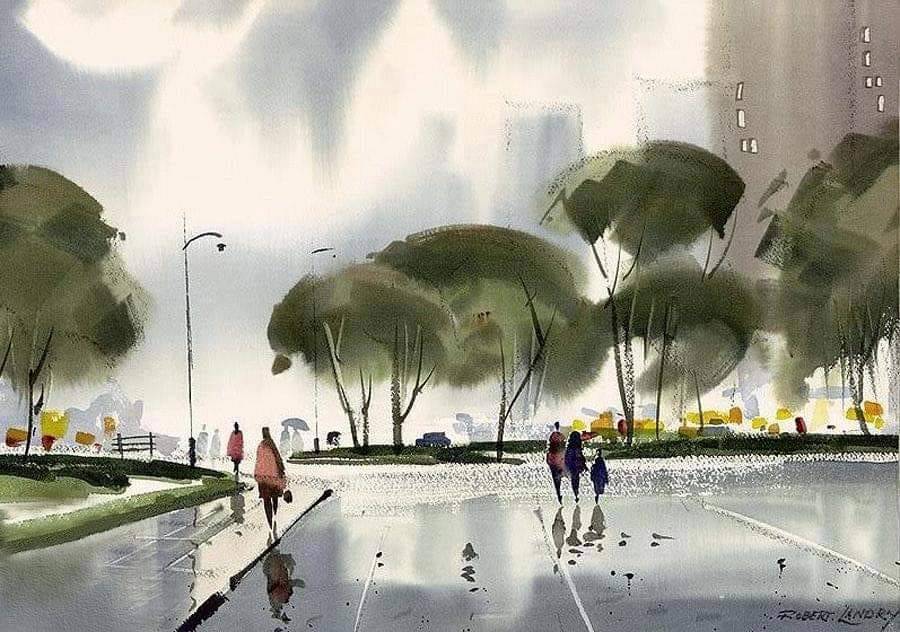
fravery:
“Robert Landry, from Washington (1921 - 1991)
”

Robert Landry

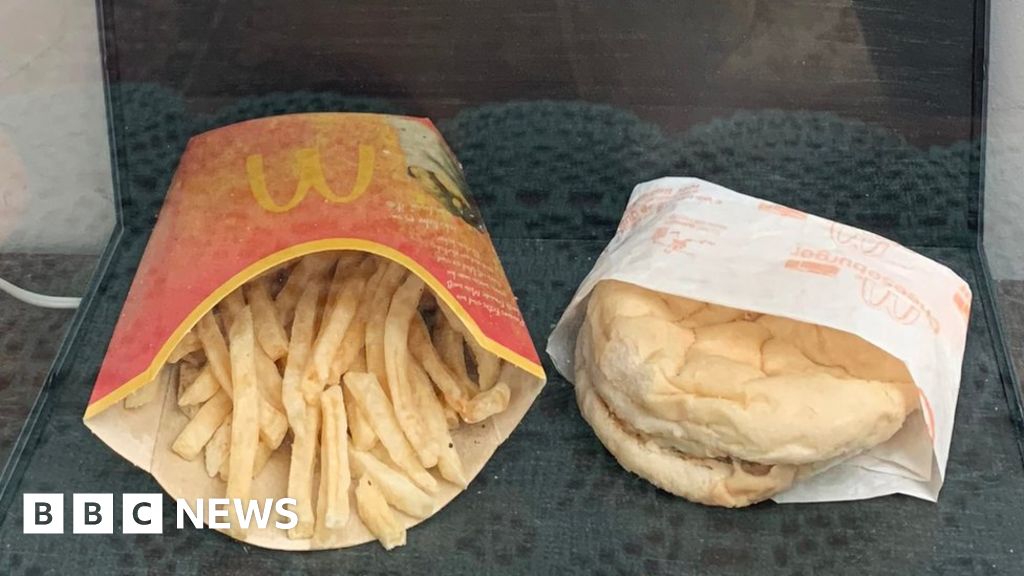
Iceland Livestreams 10-Year-Old McDonald's Cheeseburger

When McDonald's closed all its restaurants in Iceland in 2009, one man decided to buy his last hamburger and fries.

"I had heard that McDonald's never decompose so I just wanted to see if it was true or not," Hjortur Smarason told AFP.

This week, it's 10 years since the seemingly indestructible meal was purchased, and it barely looks a day older.

Curious observers can watch a live stream of the burger and fries from its current location in a glass cabinet in Snotra House, a hostel in southern Iceland.

"The old guy is still there, feeling quite well. It still looks quite good actually," the hostel's owner Siggi Sigurdur told BBC News.

"It's a fun thing, of course, but it makes you think about what you are eating. There is no mould, it's only the paper wrapping that looks old." (...)

Pictures posted on social media sparked discussion of other robust foods that have resisted the ravages of time.

"The health teacher in our high school did this, but just left them on a shelf," commented one Twitter user.

"He would point out how even after years they didn't grow mould because apparently there weren't even enough nutrients in it for microbes."

by Georgina Rannard, BBC | Read more:
Image: BBC

Mark Knopfler

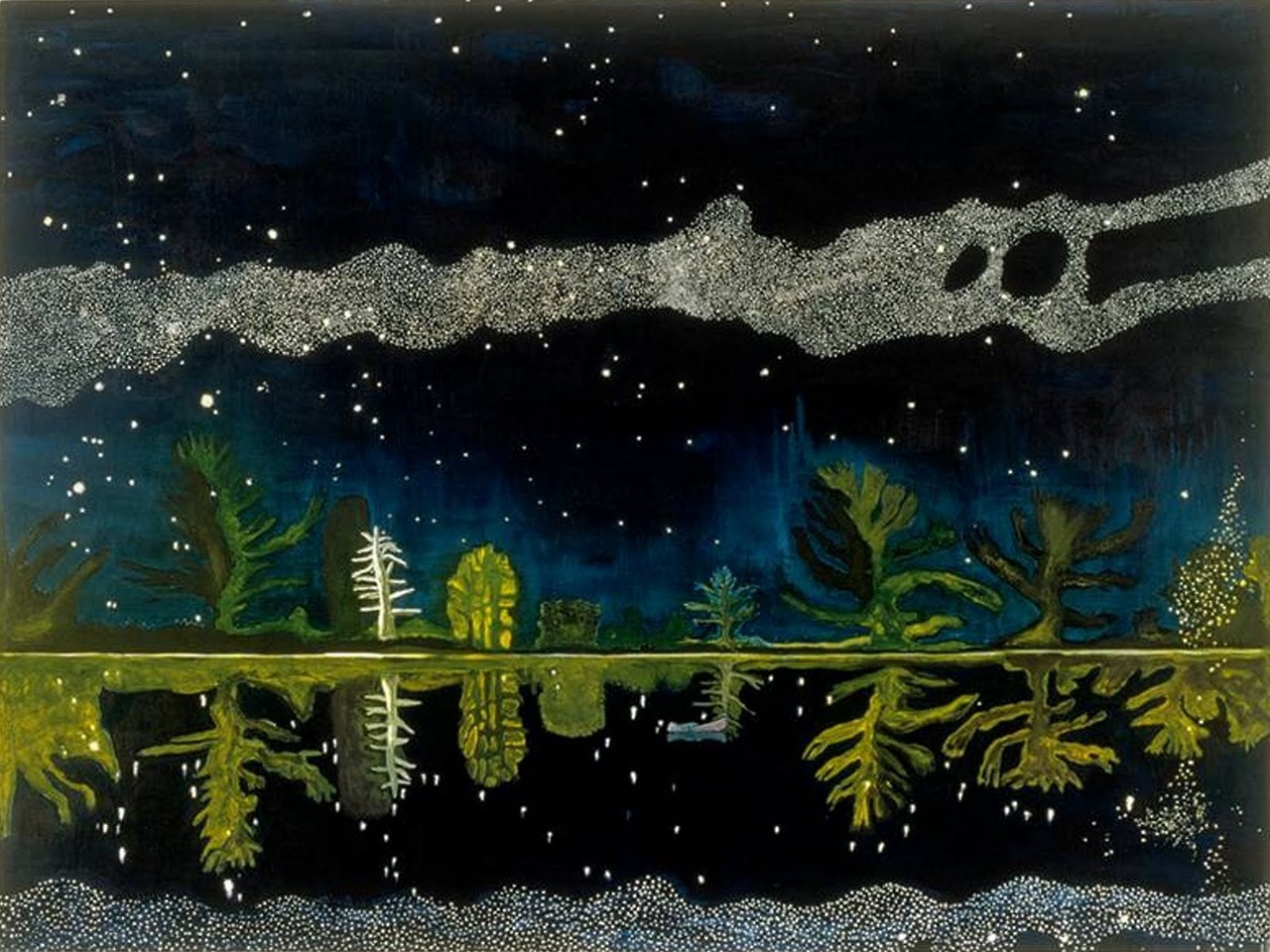
Peter Doig (b Scotland, 1959)
Milky Way 1990
oil on canvas

Peter Doig, Milky Way 1990

Friday, November 1, 2019

Jane Fonda is White, Wealthy and Privileged – and Using That Power For Good

As a way to step up her commitment to the global fight against climate inaction, Jane Fonda has decided to start getting arrested – on what seems to be weekly basis.

It’s a curious sentiment for her to feel like she should be doing more, considering her activist history eclipses pretty much the entirety of Hollywood’s, but it’s a genuinely heart-warming notion from our pinko grandmother. (Those pics of her picketing with Arundhati Roy and Naomi Klein? You really love to see it.) In recent photos, she is seen dressed immaculately in a Chanel coat, smiling while police take her away, raising her closed fists as high as she can, given the restraints binding them together.

Jane Fonda is arrested during a climate protest in WashingtonThe reaction, interestingly, has been mixed. Young people (ie those who haven’t grown up with an especially firm knowledge of now-aged Hollywood divas– I can’t relate) have taken to Twitter to critique the action. It’s performative, they write from the safety of their Brooklyn apartments – it’s problematic, it’s an irresponsible show of privilege as an older rich white woman … as if her privilege, and manoeuvring of it, isn’t the point.

It’s quite the ouroboros – a tweet calling someone else performative can end up being performative in itself, but it’s par for the course with online discourse these days. It’s also a peculiar misreading of the optics behind Jane’s actions. At her age, garnering media attention and using the tools of recognisability is an effective way of connecting to her much older audience. It’s one that isn’t particularly known for positive contributions to environmental sustainability conversations, and one that might be uninterested in hearing from younger activists on the topic. It’s a shame that’s the case, but integrating older figures into our battles is nothing more than a smart tactical move. It’s time to start getting intergenerational instead of fixating solely on a single voice.

Imagine being 81 years old and facing ostracisation and constant threats by multiple US governments and a powerful contingent of rightwingers, only for young leftwing people to call your activism superficial, and you might have some kind of understanding of how bad faith these criticisms sound. There are, of course, hundreds of celebrities who have tapped into the zeitgeist and the metrics of “wokeness” to appeal to new markets without doing anything significant to, say, change that market, or enact any kind of significant difference or shift in consciousness, so the suspicion is perhaps understandable. It’s nonetheless important for us to parse why legitimate actions are scorned, so that we may be more critical of the powerful, and less susceptible to the ever growing manipulations of modern day PR.

by Jonno Revanche, The Guardian | Read more:
Image: John Lamparski/Getty Images

Tales From the Teenage Cancel Culture

A few weeks ago, Neelam, a high school senior, was sitting in class at her Catholic school in Chicago. After her teacher left the room, a classmate began playing “Bump N’ Grind,” an R. Kelly song.

Neelam, 17, had recently watched the documentary series “Surviving R. Kelly” with her mother. She said it had been “emotional to take in as a black woman.”

Neelam asked the boy and his cluster of friends to stop playing the track, but he shrugged off the request. “‘It’s just a song,’” she said he replied. “‘We understand he’s in jail and known for being a pedophile, but I still like his music.’”

She was appalled. They were in a class about social justice. They had spent the afternoon talking about Catholicism, the common good and morality. The song continued to play.

That classmate, who is white, had done things in the past that Neelam described as problematic, like casually using racist slurs — not name-calling — among friends. After class, she decided he was “canceled,” at least to her.

Her decision didn’t stay private; she told a friend that week that she had canceled him. She told her mother too. She said that this meant she would avoid speaking or engaging with him in the future, that she didn’t care to hear what he had to say, because he wouldn’t change his mind and was beyond reason.

“When it comes to cancel culture, it’s a way to take away someone’s power and call out the individual for being problematic in a situation,” Neelam said. “I don’t think it’s being sensitive. I think it’s just having a sense of being observant and aware of what’s going on around you.”

The term “canceled” “sort of spawned from YouTube,” said Ben, a high school junior in Providence, R.I. (Because of their age and the situations involved, The New York Times has granted partial anonymity to some people. We have confirmed details with parents or schoolmates.)

He talked about the YouTuber James Charles, who was canceled by the platform’s beauty community in May after some drama with his mentor, Tati Westbrook, also a YouTuber, and a vitamin entrepreneur. That was a big cancellation, widely covered, that helped popularize the term. Teenagers often bring it up.

Ben, 17, said that people should be held accountable for their actions, whether they’re famous or not, but that canceling someone “takes away the option for them to learn from their mistakes and kind of alienates them.” (...)

It took some time for L to understand that she had been canceled. She was 15 and had just returned to a school she used to attend. “All the friends I had previously had through middle school completely cut me off,” she said. “Ignored me, blocked me on everything, would not look at me.”

Months went by. Toward the end of sophomore year, she reached out over Instagram to a former friend, asking why people were not talking to her. It was lunchtime; the person she asked was sitting in the cafeteria with lots of people and so they all piled on. It was like an avalanche, L said.

Within a few minutes she got a torrent of direct messages from the former friend on Instagram, relaying what they had said. One said she was a mooch. One said she was annoying and petty. One person said that she had ruined her self-esteem. Another said that L was an emotional leech who was thirsty for validation.

“This put me in a situation where I thought I had done all these things,” L said. “I was bad. I deserved what was happening.”

Two years have passed since then. “You can do something stupid when you’re 15, say one thing and 10 years later that shapes how people perceive you,” she said. “We all do cringey things and make dumb mistakes and whatever. But social media’s existence has brought that into a place where people can take something you did back then and make it who you are now.”

In her junior year, L said, things got better. Still, that rush of messages and that social isolation have left a lasting impact. “I’m very prone to questioning everything I do,” she said. “‘Is this annoying someone?’ ‘Is this upsetting someone?’”

“I have issues with trusting perfectly normal things,” she said. “That sense of me being some sort of monster, terrible person, burden to everyone, has stayed with me to some extent. There’s still this sort of lingering sense of: What if I am?”

by Sanam Yar and Jonah Engel Bromwich, NY Times | Read more:
Image: Anthony Freda
[ed. See also: Call-out culture: how to get it right (and wrong) (The Guardian).]

Comments Close For SNAP Benefits

Friday is the last day for the public to comment on a proposed rule change by the Trump administration that would eliminate Supplemental Nutrition Assistance Program benefits, or food stamps, for more than 3 million people.

The U.S. Department of Agriculture also recently admitted that the plan would mean that almost a million children would no longer automatically qualify for free school lunches.

In a new analysis released two weeks ago, the USDA says that almost half of those children would likely get free lunches, but only if they reapply to the school lunch program. The agency estimates that another half would likely qualify for reduced-price meals, instead of free ones, and that about 40,000 children would lose free lunches altogether because their family incomes exceed eligibility limits.

Opposition to the proposal has been strong, with almost 170,000 comments from the public so far, most of them negative.

"There is no excuse that in our first world country we have children who are malnourished," Eric Failing, executive director of the Pennsylvania Catholic Conference, wrote in a typical comment. "Yet this proposed rule, rather than helping to address these issues, will make them far worse."

Failing says an estimated 200,000 Pennsylvanians would lose food stamps if the proposed rule goes into effect.

The Trump administration says that it's trying to close a loophole in current law, which gives states the flexibility to waive certain asset and income limits for individuals who are receiving both SNAP and other welfare benefits. Most states take advantage of these waivers, in part because it makes it easier to administer safety-net programs, which often have different eligibility requirements.

U.S. Agriculture Secretary Sonny Perdue said when announcing the proposed rule change this summer that food stamps should be a "temporary safety net" for low-income families. He said the administration wants to move people off of government aid and into the workforce so they can become more self reliant.

Perdue also noted that the change – which involves something called "broad-based categorical eligibility" — would save an estimated $2.5 billion a year from the SNAP program. Currently, the federal government spends about $4 billion every month to provide food stamps to more than 36 million people.

The SNAP eligibility proposal is one of several the administration has made over the past year to cut assistance for low-income families. Among other things, the administration has proposed imposing tougher work requirements on able-bodied childless adults who receive SNAP benefits. It also wants to change the way a family's utility costs are calculated in determining the size of their monthly food stamp benefit. The latter change alone would save the government an estimated $4.5 billion over five years.

None of these proposals has gone into effect yet, and all have been fiercely opposed by a broad coalition of anti-poverty advocates, social service providers and state and local government officials.

by Pam Fessler, NPR |  Read more:
Image: Julio Cortez/AP
[ed. Wonder what their grandchildren will think of them.]

Thursday, October 31, 2019

Joe Jackson


Pretty soon now, you know I'm gonna make a comeback
And like the birds and the bees in the trees it's a sure-fire smash
I'll speak, to the masses through the media
And if you got anything to say to me you can say it with cash

'Cause I've got the trash
And you got the cash
So baby we should get along fine
So give me all your money
'Cause I know you think I'm funny, yeah
Can't you hear me laughing
Can't you see me smile
I'm the man

Lyrics:

What’s Wrong With the New Figurative Painting?


To be clear, what bothered me was not the spectacle of bad work, of which there’s always plenty around. Instead, the problem had to do with good work that still didn’t seem as good as it could have been, art that engaged my interest but left me unsatisfied. “What’s wrong,” I kept asking myself. “What’s the problem?” My silent answer was, repeatedly, “This work is academic.” Or rather, “There’s something academic in this work.”

What’s Wrong With the New Figurative Painting? (The Nation)
Image: Doron Langberg, Daniel Reading (2019)

Peter Luger Used to Sizzle. Now It Sputters.

I can count on Peter Luger Steak House in Brooklyn to produce certain sensations at every meal.

There is the insistent smell of broiled dry-aged steak that hits me the minute I open the door and sometimes sooner, while I’m still outside on the South Williamsburg sidewalk, producing a raised pulse, a quickening of the senses and a restlessness familiar to anyone who has seen a tiger that has just heard the approach of the lunch bucket.

There is the hiss of butter and melted tallow as they slide down the hot platter, past the sliced porterhouse or rib steak and their charred bones, to make a pool at one end. The server will spoon some of this sizzling fat over the meat he has just plated, generally with some line like “Here are your vitamins.”

There is the thunk of a bowl filled with schlag landing on a bare wood table when dessert is served, and soon after, the softer tap-tap-tap of waxy chocolate coins in gold foil dropped one at a time on top of the check.

And after I’ve paid, there is the unshakable sense that I’ve been scammed.

The last sensation was not part of the Peter Luger experience when I started eating there, in the 1990s. I was acutely aware of the cost back then because I would settle the tab by counting out $20 bills; cash was the only way to pay unless you had a Peter Luger credit card. At the end of the night my wallet would be empty. Because a Peter Luger steak made me feel alive in a way that few other things did, I considered this a fair trade, although I could afford it only once a year or so.

I don’t remember when the doubts began, but they grew over time.

Diners who walk in the door eager to hand over literal piles of money aren’t greeted; they’re processed. A host with a clipboard looks for the name, or writes it down and quotes a waiting time. There is almost always a wait, with or without a reservation, and there is almost always a long line of supplicants against the wall. A kind word or reassuring smile from somebody on staff would help the time pass. The smile never comes. The Department of Motor Vehicles is a block party compared with the line at Peter Luger. (...)

The servers, who once were charmingly brusque, now give the strong impression that these endless demands for food and drink are all that’s standing between them and a hard-earned nap. Signals that a customer has a question or request don’t get picked up as quickly; the canned jokes about spinach and schlag don’t flow as freely.

Some things are the same as ever. The shrimp cocktail has always tasted like cold latex dipped in ketchup and horseradish. The steak sauce has always tasted like the same ketchup and horseradish fortified by corn syrup.

Although the fries are reasonably crisp, their insides are mealy and bland in a way that fresh-cut potatoes almost certainly would not be. The sole — yes, I’m the person who ordered the sole at Peter Luger — was strangely similar: The bread crumbs on top were gold and crunchy, but the fish underneath was dry and almost powdery.

Was the Caesar salad always so drippy, the croutons always straight out of a bag, the grated cheese always so white and rubbery? I know there was a time the German fried potatoes were brown and crunchy, because I eagerly ate them each time I went. Now they are mushy, dingy, gray and sometimes cold. I look forward to them the way I look forward to finding a new, irregularly shaped mole.

Lunch one afternoon vividly demonstrated the kitchen’s inconsistency: I ordered a burger, medium-rare, at the bar. So had the two people sitting to my right, it turned out. One of them got what we’d all asked for, a midnight-dark crust giving way to an evenly rosy interior so full of juices it looked like it was ready to cry. The other one got a patty that was almost completely brown inside. I got a weird hybrid, a burger whose interior shaded from nearly perfect on one side to gray and hard on the other. (...)

Luger is not the city’s oldest, but it’s the one in which age, tradition, superb beef, blistering heat, an instinctive avoidance of anything fancy and an immensely attractive self-assurance came together to produce something that felt less like a restaurant than an affirmation of life, or at least life as it is lived in New York City. This sounds ridiculously grand. Years ago I thought it was true, though, and so did other people.

The restaurant will always have its loyalists. They will laugh away the prices, the $16.95 sliced tomatoes that taste like 1979, the $229.80 porterhouse for four. They will say that nobody goes to Luger for the sole, nobody goes to Luger for the wine, nobody goes to Luger for the salad, nobody goes to Luger for the service. The list goes on, and gets harder to swallow, until you start to wonder who really needs to go to Peter Luger, and start to think the answer is nobody.

by Pete Wells, NY Times |  Read more:
Image:Ellen Silverman for The New York Times
[ed. I've never been to NY City, heard of Luger's, or particularly care. I just like reading a good Pete Wells takedown (although, all his restaurant reviews are generally interesting). See also: How a Food Critic Plots His Pans (NY Times).]

New Atheism: The Godlessness That Failed

Thucydides predicted that future generations would underestimate the power of Sparta. It built no great temples, left no magnificent ruins. Absent any tangible signs of the sway it once held, memories of its past importance would sound like ridiculous exaggerations.

This is how I feel about New Atheism.

If I were to describe the power of New Atheism over online discourse to a teenager, they would never believe me. Why should they? Other intellectual movements have left indelible marks in the culture; the heyday of hippiedom may be long gone, but time travelers visiting 1969 would not be surprised by the extent of Woodstock. But I imagine the same travelers visiting 2005, logging on to the Internet, and holy @#$! that’s a lot of atheism-related discourse what is going on here?

My first forays onto the Internet were online bulletin boards about computer games. They would have a lot of little forums about various aspects of the games, plus two off-topic forums. One for discussion of atheism vs. religion. And the other for everything else. This was a common structure for websites in those days. You had to do it, or the atheism vs. religion discussions would take over everything. At the time, this seemed perfectly normal.

In 2005, a college student made a webpage called The Church Of The Flying Spaghetti Monster. It was a joke based on the idea that there was no more scientific evidence for God or creationism than for belief in a flying spaghetti monster. The monster’s website received tens of millions of visitors, 60,000 emails (“about 95 percent” supportive), and was covered in The New York Times, The Washington Post, and The Daily Telegraph. Six publishing companies entered a bidding war for the rights to the spaghetti monster’s “gospel”, with the winner, Random House, offering an $80,000 advance. The book was published to massive fanfare, sold over 100,000 copies, and was translated into multiple languages. Putin’s thugs broke up a pro-Flying-Spaghetti-Monster demonstration in Russia. At the time, this seemed perfectly normal.

People compiled endless lists of arguments and counterarguments for or against atheism. The Talk.Origins newsgroup created a Dewey-Decimal-system-esque index of almost a thousand creationist arguments, from CA211.1 (“Karl Popper said that Darwinism is not testable”), to CD011.1 (“Variable C-14/C-12 ratio invalidates carbon dating”), through CH508 (“Chinese treasure ships show Noah’s Ark was feasible”) – and painstakingly debunked all of them; in case that wasn’t enough they linked 133 other sites doing similar work. Their arch-enemies, creationist site True.Origin, then went through and debunked all of their debunkings. Another atheist group created the Skeptics’ Annotated Bible, a version of the Bible highlighting everything bad or wrong in it. For example, if for some reason you need a hit job on the second chapter of the Book of Malachi in particular, you can look up its SAB page and find that Malachi 2:11 castigates Judah for “marrying the daughter of a strange god” (which is intolerant), Malachi 2:17 accuses the Israelites of “wearying the Lord with your words”, (which is absurd since God cannot be wearied), and Malachi 2:3 says that God will spread dung upon the faces of unbelievers (which is gross). This last entry includes a link to a 2007 YouTube video “God Wants To Smear Dung On Your Face” with 21,947 views. And the video links to a store selling Malachi-2:3-says-God-wants to-put-dung-on-your-face-related t-shirts, bumper stickers, keychains, and coffee mugs. At the time, this seemed perfectly normal.

Whatever media you liked, there were atheism-themed versions of it. Obviously if you liked webcomics you would never be able to finish all the different atheist options from Russell’s Teapot through Jesus & Mo through The Sheeples. If you liked TV, there were atheist TV shows like John Safran vs. God or The Atheist Experience. If you liked pithy quotes, you could read the top 10,000 atheist quotations in order of popularity. If you just liked discussion, you could go to the now-infamous r/atheism subreddit, which at the time was one of Reddit’s highest-ranked, beating topics like “news”, “humor”, and – somehow – “sex”. At the time, this seemed perfectly normal.

But these still don’t quite make my point, because the defining feature of this period wasn’t just that there were a lot of atheism-focused things. It was how the religious-vs-atheist conflict subtly bled into everything. Read enough old articles and blogs from this period and you’ll spot it. Some travel writer going on about how the boring small town he ended up in is probably full of fundies who hate gays and think the Earth is six thousand years old. Some logician giving an example of circular arguments: “I know the Bible is true because it says so in the Bible.” Some political writer saying a stupid policy is only to be expected in a country where X% of people still get their ethics from Bronze Age superstitions. At the time, this seemed perfectly normal.

It seemed perfectly normal because religion vs. atheism was the most important issue, maybe the only issue. How could you run a 21st century democracy with half the population believing in science and compassion, and the other half believing whatever they read in a 3000 year old book about a magic sky father? To truly understand the spirit of the time, you can’t just think of religion as evil. You have to think of it as the ur-evil, without which no other evil would exist. Homophobia? Only there because the Bible says to stone gay people. War? It’s all holy war of one sort or another, whether it’s Arabs vs. Israelis, Sunnis vs. Shias, or the Christian/Muslim “clash of civilizations”. Environmental devastation? Only there because religious people believe God elevated Adam over the animals and told him to exploit them for his own purposes. Poverty? Only because religious people believe in the prosperity gospel that says people get what they deserve. (...)

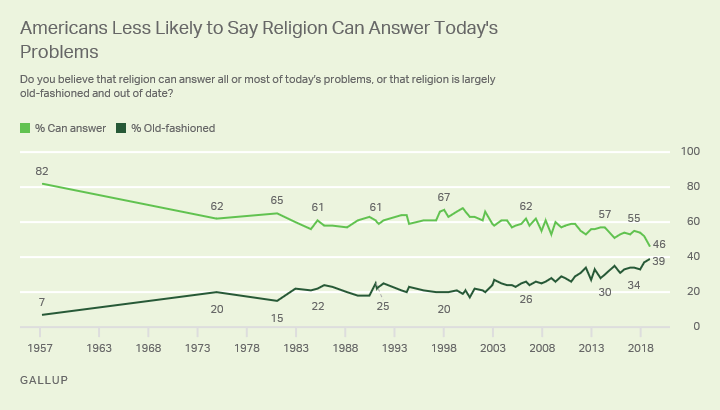
Between the first stirrings of internet atheism in 2000 and the beginning of the end in 2015, the percent of Americans identifying as Christian dropped about 10%; the percent identifying as no religion increased about the same amount. There are many different ways of looking at the data: self-reported affiliation, church attendance, even polls on whether religion can answer all of today’s problems, but they all show the same story of slow, steady decline.

By the numbers, the decline is slight: from 80% Christian / 15% atheist in 2000 to 70% Christian / 25% atheist in 2018. This could hide wider social changes. The number of gay people has barely changed since 2000, but society’s attitude toward them has totally transformed. Likewise, although religion has barely declined, and nonbelief barely risen, Christianity no longer seems to command quite the same level of political power, nor does atheism provoke quite as much revulsion.

But the sudden fall of New Atheism didn’t feel like a process of gradual social change and eventual acceptance. It felt like a movement certain of its own victory burning out spectacularly over the course of a few short years, followed by mysterious yet near-total contempt from the very people it thought it had convinced. (...)

To get an intuitive feel for the first category, look at the two sites involved. Talk Origins is almost perfectly preserved, a time capsule from an era when people really wanted to debate creationism. Internet Infidels has decayed a bit more, but even its ruins are impressive: a database of forty videotaped atheist-vs-theist debates, an online library of uploaded works by about two hundred atheist authors, and the obligatory list of several hundred Biblical contradictions. Who does that these days?

This exercise is gradually bringing back memories of just how intellectual the Internet was around the turn of the millennium. You would go to bulletin boards, have long and acrimonious debates over whether or not the Gospels were based on pagan myths. Then someone would check Vast Apologetics Library tektonics.org and repost every one of their twenty-eight different articles about all the pagan myths the Gospels weren’t based on, from Adonis (“yet another unprofitable proposition for the copycat theorist”) to Zalmoxis (“there is no comparison, other than by illicit collapsing of terminology and by unsubstantiated speculation”). Both sides had these vast pre-built armories full of facts and arguments to go to.

At some point, in a way unrelated to the fall of New Atheism, the Internet stopped being like this. The topics that interest people today don’t get debated in the same way. People dunk on each other on Twitter, occasionally even have back-and-forth exchanges, but the average person doesn’t post long screeds and get equally long responses fisking each of their points. There’s less need for giant databases containing every fact you might need to win a particular argument, organized Dewey-Decimal-style by which argument you are trying to win. People just stopped caring.

I’m not sure why this happened. Maybe it took about ten years from the founding of the Internet for people to really internalize that online arguments didn’t change minds. The first Internet pioneers, starting their dial-up modems and running headfirst into people outside their filter bubbles, must have been so excited. For the first time in human history, people interested in debating a subject could do so 24-7 out in a joint salon-panopticon with all of the information of the human race at their fingertips. Bible Belt churchgoers for whom atheists had been an almost-fictional bogeyman, and New York atheists who thought of the religious as unsophisticated yokels, came together for the first time thinking “Convincing these people is going to be so easy”. The decade or so before they figured out that it wasn’t was a magical time, of which the great argument-arsenals of the past are almost the only remaining monument.

Or maybe it was something else. Maybe it was that getting online was actually pretty hard in those days, you needed to be technically inclined or attending a college or both, and so netizens were just more educated. Maybe the sort of people who interrupt any attempt at intellectual discussion with words like “rationalbro” or “mansplaining” or “well acktually” were still stuck in their caves, fruitlessly banging AOL CDs against rocks trying to create fire. Maybe it was something as simple as Wikipedia not existing yet, leaving the intellectual world in a sort of state of nature with every man for himself. Maybe it was just that the bulletin board format was more conducive to this than the later social media style fora.

Whatever it was, the decline of this culture started no later than 2000, and is reflected in the fate of argument-related search terms like “biblical contradictions” and “creationism”, and in the fading of the great argument-armories like Talk Origins and Infidels.

But the “atheism” search term keeps rising for another decade. What happened? (...)

I think it seamlessly merged into the modern social justice movement.

by Scott Alexander, Slate Star Codex |  Read more:
[ed. Wow. Some days I thank God/No God for the internet.]

Wednesday, October 30, 2019

How the Rich Get Away With It

Emmanuel Saez and Gabriel Zucman’s The Triumph of Injustice: How the Rich Dodge Taxes and How To Make Them Pay will make you angry. If you want to get a better understanding of what we on the left are actually talking about when we talk about wealth inequality, you should read it. It will show you how taxes work and who pays them, and you’ll come away thinking more clearly about concepts like “redistribution” and “progressive taxation.”

Saez and Zucman destroy some important myths about taxation. One of the helpful things they do is look at all taxes together, so that we can better understand what we’re paying in total. This makes it easy to understand why Mitt Romney’s comment that 47 percent of Americans pay no federal income tax was both technically true and also misleading and despicable. Everyone pays taxes. Saez and Zucman break it down so that we can see what kinds of taxes people pay in total, both federal and state:


The X-axis here shows percentiles: so P0-10 are the poorest ten percent, etc. On the right, Saez and Zucman have broken things down further so that you can see how this changes for the very richest. As you can see, rich people tend to pay a greater percentage of their income in income taxes while poor people pay more of it in payroll and consumption taxes. But here’s one of their striking findings: the rich do not pay a greater percentage of their income in taxes than the poor, and the very rich actually pay less of a percentage of their income than the poor. Warren Buffett pays less of a percentage of his income than I do, even though 25% of his income means much less to him than 25% of my income means to me. Saez and Zucman therefore argue that the U.S. tax system is quite obviously regressive, since billionaires pay lower tax rates than the working class.

In fact, drawing our attention back to the “working class” is one of the values of the Saez-Zucman book. They say that among the 122 million adults in the lower half of the American income distribution, the average annual income is $18,500, before taxes and transfers. People talk a lot in politics about the supposed “vanishing middle class,” but Saez and Zucman say that “the striking fact about the American economy is not that the middle class is vanishing. It’s how little income the working class makes.” (This, by the way, is why young people are not very open to free market arguments about how “capitalism creates prosperity.” Millions and millions of people can see with their own eyes that their pay is low. It’s worthless to tell someone earning $8 an hour—nearly 200,000 workers here in Louisiana would see a pay rise if the minimum wage were $8.50 instead of $7.25—that this system is fair and is creating prosperity. You can’t fool them. They can see your cars.)

A critical point Saez and Zucman make is about the impact of health insurance. They show very effectively why it’s so objectionable for people like Pete Buttigieg and Joe Biden to tell votes that “Medicare for All will raise your taxes.” Saez and Zucman encourage you to think of your health insurance as a “tax” you are already paying. You’re just paying it to a for-profit corporation instead of to the government.

Buttigieg and Biden are encouraging you to ignore the giant amount of money you spend on private insurance. Their framework is deeply conservative: money to the government is bad Tax but money to corporations is good. Saez and Zucman, like Bernie Sanders, say what we need to do is look at the bottom line: if we switched health insurance from a tax you pay for private insurance to a tax you pay for socialized insurance, you would almost certainly save a lot of money without losing anything in services, because for-profit insurance is not designed to give you as much healthcare as you need, it’s designed to soak you for as much of your paycheck as possible. Saez and Zucman say that if we use an income tax to pay for healthcare, over 90% of workers who currently have employer-sponsored health insurance would come out ahead.

One valuable contribution Saez and Zucman make is in their extensive discussion of tax evasion/tax avoidance by the rich. We almost treat it as a joke: everyone knows that Google is not actually based in Bermuda, even though it shifted $23 billion there in 27. Today, “close to 60% of the—large and rising—amount of profits made by US multinationals abroad are booked in low-tax countries,” primarily Ireland and Bermuda. Saez and Zucman say that we need to stop treating this as inevitable. In fact, it’s criminal. It’s simple tax evasion. Google knows that it should actually be paying tax on this money under U.S. law, so it is fraudulently pretending that it makes its money somewhere else. This shouldn’t be considered “using a loophole,” it should be considered “violating the law,” because it requires defrauding the government. “Ah, but we’re technically based in Palau.” Technically my ass. You’re not based there. It doesn’t count. If you ask Google why it has billions of dollars in Bermuda, there is only one answer: to avoid paying the taxes it would owe if it told the truth about where it made its money. The rich always try to draw a distinction between “tax avoidance” (taking advantage of legal loopholes) and tax evasion (“not paying the taxes you are legally required to pay”) but the whole point of stuffing wealth in Panama and the Cayman Islands and pretending you’re headquartered in a place where you just have a PO Box is “not paying the taxes you are legally required to pay.” Shell corporations are shells, i.e. fake, fraudulent, a lie. We need to stop treating Apple’s constant elaborate attempts to avoid contributing to the tax base of the companies it operates in as anything other than a crime.

Now, you might say “well, under existing U.S. law…” But let’s remember how law works: law is vague and slippery, that’s the entire reason why these companies are able to craft elaborate excuses for not paying their fair share. Law also empowers prosecutors and judges. In fact, the job of a good judge is to enforce justice and the principle of the law. If the attorneys for a company have found some badly worded part of the tax code they think they can take advantage of, but it would result in billions being kept out of the public treasury that belongs there, judges need to prioritize fairness over technicalities that create obvious lies and absurdities. If Barack Obama had gotten serious about cracking down on corporate tax evasion, if he had threatened some prosecutions, you might see some corporate behavior changing rapidly.

Making corporations pay the tax they’re already supposed to pay could bring in hundreds of billions of dollars. Remember what this means. (...)

Saez and Zucman propose a new wealth tax, taxing dividends and capital gains, a 30% effective corporate tax rate, and an increased income tax, which they say can be used to fully fund universal health care, universal public child care and education, free tuition at public universities, and the elimination of regressive sales taxes. (Their wealth tax is quite modest. People who are billionaires would still be billionaires, but multi-multi billionaires would just become multi-billionaires. Mark Zuckerberg, for instance, would be worth $21 billion instead of $61. Is having to live life with only 20 billion dollars unjust?) Of course, one of the main points raised in response to proposals like these is: it won’t raise the expected revenue, because the wealthy will just “find ways to dodge the tax.” One reason there is so much effective tax evasion by the rich is that their wealth is mobile: they can just move it to countries where they are taxed less. So you can impose a wealth tax, but just as with today’s corporate taxes, nobody will actually end up paying it.

One of the excellent contributions of Saez and Zucman’s book is that it successfully rebuts this sort of “futility” argument. Actually, there’s nothing to stop the United States from taxing money regardless of where people keep it. It’s just a matter of willingness to enforce the policy. There has been a widespread consensus that countries are trapped in a “race to the bottom” on taxes, because they now have to compete with each other to keep businesses in their country. Saez and Zucman point out that for the United States, there is no reason this need be the case. Amazon operates in the United States, we can tax it how we please and choose whether to recognize tax shelters as legitimate or not. Saez and Zucman say that countries have an interest in agreeing to levy uniform minimum tax rates (they suggest a 25% corporate tax) but there is much they can do unilaterally. As they say:

The choice is ours. The race to the bottom that rages today is a decision we’ve collectively made—perhaps not fully consciously or explicitly, certainly not a choice that was debated transparently and democratically, but a choice nonetheless… We could have chosen to prevent multinationals from booking profits in low-tax places, but we let them do it. We can make other choices, starting today.

So, no, don’t accept that the wealthy will “just evade” new taxes. They won’t if they’re prosecuted for it. This is a matter of political willpower. We can make the wealthy pay their fair share, if we’re willing to enforce the laws as they are written and say that the U.S. corporate tax rate is the U.S. corporate tax rate, period.

by Nathan J. Robinson, Current Affairs |  Read more:
Image: Emmanuel Saez and Gabriel Zucman
[ed. I'd think the one thing liberals and conservatives (making less than the top 10%) could rally around would be fair taxation - a relatively straightforward proposition, unlike climate change, another bi-partisan issue. Where are the riots in the streets? (I'd join one). The only obstacle: a furious and predictable brainwashing campaign by corporations, media and politicians against the idea. People will someday get over that.]

The CBS Golf Crew On What You Don't See on TV

In a roundtable discussion with Jim Nantz, Nick Faldo, Peter Kostis, Gary McCord, Dottie Pepper, Ian Baker-Finch and Amanda Balionis, we covered a variety of topics from what fans don't see on TV to their favorite tournaments to how they handle feedback from fans and players. Here's a glimpse into the minds of some of golf's most recognizable voices and how this close-knit group interacts when the cameras aren't rolling. (...)

What are some challenges to broadcasting golf that the average fan sitting at home doesn’t realize?

Pepper: Everything. It’s a city that gets put up and broken down every week and relocated. The logistics of it are incredibly thick. If you just think about the towers that go up however many stories, they have to have an occupancy certificate. So this is so far in advance, but people think you just flick the light switch and it magically happens. There’s miles and miles of cable, and trucks, and it’s a city that moves every time we move. It’s not like you can just plug it in and press play.

Kostis: There’s also when they watch the show they see this seamless transition of Jim to Nick talking, to throwing it to 16 to this and that, and it’s very soothing. What they fail to realize what’s going on in our ear pieces. An announcer’s first rule is never, ever let what’s going in your ear come out your mouth. Ever. So while it seems like it’s a slow-moving sport, in our world, our lives exist in six-second increments, and we’ve got two people talking to us in our headphones while we’re trying to say something on air. From our perspective, it can be chaotic at times, even if it comes across as anything but.

Pepper: There are no timeouts. There’s a ball in the air all the time, even if we’re not on the air live. So that has to be covered as well.

How do you handle the various roles you play on the broadcast, and what’s your weekly prep schedule like?

Faldo: I still like to prepare myself as a golfer. I always go out and see the golf course, I still draw my own greens to make sure I know when someone misses the green long right, I can blurt out, “He’s dead,” and be 99-percent right. I like to chat to players to get an inside scoop on where they are, what they’re working on. You can know where there confidence level is. So I do all of that and then when I jump in the tower, Jim tees us up and I react to a picture.

Balionis: If it’s a course I haven’t been to, I try to come in on a Thursday as opposed to a Friday and walk the course to get a feel for it. It’s not like I’m doing any analysis, but it makes me feel more comfortable with my whereabouts. And then it’s a lot of watching the broadcast Thursday/Friday, reading every article possible, and really keeping an eye on social media because we’ve found players are less likely sometimes to talk to a reporter than they are to directly connect with fans. But I also go to the range to talk to coaches and caddies to make sure I can ask informed questions. You can never have too much information going in.

Kostis: Like Nick said, it really isn’t much different from playing in the sense you do all your practicing, you do all your work, you do all your drills, but when you get to the first tee, you leave all that behind and you just play. For Dottie and I, we often don’t even know which groups we’re going to be walking with. So you prepare for a whole bunch of stuff, but you can’t guarantee that you’re prepared for that group because you never saw them coming when we were in rehearsal.

Pepper: You have a bit of a safety net because you’ve prepared for so many, but if I had to put the math to it, I think I use about 3 percent of what I’ve prepared for on the air.

Nantz: Times have changed, though. Early in our careers, we didn’t have cable coverage that came right up to within 15 minutes or 30 minutes or whatever the window is until we take over the broadcast. It used to be, in Chirkinian’s world, really important to nail the rehearsal. We seriously rehearsed.

McCord: Yep, half hour. Solid.

Nantz: You’d go through golf action, cutting from hole to hole. He wanted everyone to get into a flow so we’d do the full broadcast like you were doing a rehearsal for a play. Then we’d turn around and go on the air. And if you screwed around, he would yell at you. So by the time you came on the air, it was just a continuum of what you’d done. You were duped into feeling you’d already been on the air. Obviously, those days are long gone now. It was different. (...)

How do you balance covering players while maintaining good relationships with them? Peter, how much blowback have you gotten for breaking down players' swings?

Kostis: Other than the fact Tiger wouldn’t talk to me for a year-and-a-half.

Faldo: Only a year-and-a-half?

Nantz: That’s pretty good.

Kostis: I don’t think I’m being critical when I discuss their swings. I’m being honest and evaluating. Nine times out of 10, if he’s hit the ball right, I’m figuring out what he did that caused that. There’s too many different golf swings out there to say this one is no good and that one is. I just describe what happened, and I’ve had way more players come up to me and say I was right than have complained about what I said. I’ve had less than a handful of players complain. (...)

Anyone else have run-ins with players?

Nantz: You know, they’re really decent guys. And I have the context of seeing a lot of different sports, and for golfers, it’s different for me. By in large, your stars of the sport are around for a long time, and you travel in the same circles. We see them at our hotels, we see them at restaurants, a great many of us, full disclosure, see them at outings together away from tournament weeks. You get to know the player, the family, their children. My wife gets to know some of the wives. And this is not an exception, we all travel in the same circles. You can’t put a wall up and say “I’ve got to cover them, I can’t really get close to them or get to know them.” Part of what makes it so good is we have really great relationships with the subjects we’re covering. And I think that comes out on the air every week.

What are your thoughts on the amount of coverage Tiger Woods gets during a telecast?

Kostis: It’s a cliche, but he doesn’t move the needle, he is the needle right now. You’ve got to cover him. He’s got a tremendous amount of stories to tell, too, with all the injuries and surgeries. Look, half the people who watch Tiger hate him and hope he shoots 90, and the other half hopes he wins by 15. So you’re always going to make someone unhappy with your coverage, too much or too little. Hey, he’s changed the game.

Faldo: He’s probably the most intriguing sportsman on the planet so you have to be there whatever he does. Everything is a story with him. People will start about Augusta and what he’ll be able to do there, he’s like no athlete ever in any sport.

by Alex Meyers, Golf Digest |  Read more:
Image: uncredited
[ed. I'd imagine it's basically similar for all sports broadcasts.]

Underwater


Rising Seas Will Erase More Cities by 2050, New Research Shows (NY Times)
Image: Population data from WorldPop and building footprints from OpenStreetMap

Tuesday, October 29, 2019

All Right Already

Precisely how full of shit is Mark Zukerberg? Does he believe in anything beyond some vague coder’s logic of efficiency and scale? For years I’ve parsed his robotic utterances, and I’m still not sure. Based on his recent public appearances—a soft-focus Fox News interview by former Bush spokesperson Dana Perino; a dead-on-arrival bit of humanitarian philosophizing in front of a Georgetown audience that included Tiffany Trump; a typically awkward grilling before a Congressional subcommittee—it doesn’t seem that Zuckerberg knows either.

In public, Zuckerberg lobs useless bromides about free speech and connection while privately he dines with far-right media figures and frothing South Carolina senator Lindsey Graham and girds his team for battle against Elizabeth Warren. (While Zuckerberg has claimed he has dinners with “lots of people across the spectrum,” that spectrum doesn’t appear to include the left.) His company donates substantial amounts to conservative politicians, and conservative media does extraordinarily well on Facebook, with Ben Shapiro, Breitbart, and other right-wing luminaries often ranking among the top shared articles. (As of Friday, Breitbart is also a “trusted partner” of Facebook News, the company’s long-gestating feed of verified news stories.) A handful of top company executives, including Joel Kaplan, Facebook’s vice president of global public policy and a prominent Brett Kavanaugh supporter, are Republican political operatives. (Kaplan was even considered for a Trump cabinet position.) Recently, in order to investigate whether the platform exhibited bias against conservatives, Facebook hired former Republican senator Jon Kyl, whose report gently chided Facebook as insensitive to conservatives’ concerns while ultimately exonerating the company of anything more serious. When defending Libra, Facebook’s embattled cryptocurrency project, before Congress, Zuckerberg made a plea of economic nationalism that would appeal to any conservative, arguing that the United States must fend off a digital Chinese renminbi.

If it’s not clear already, then it must be said: Facebook is a right-wing company, hostage to conservative ideas about speech and economics, its fortunes tied to its allies in Republican politics, including the president, whose campaign spends millions on Facebook ads. Offering support to some of the worst figures in American political life, Facebook is as nihilistic as an oil company and just as willing to dump its pollution on all of us. That it has come to so thoroughly dominate our public sphere is a tragic indictment of American civic life and American techno-capitalism, which has confused the pitiless surveillance of today’s internet with utopian empowerment.

But an unfeeling right-wing ideology is not the image that Facebook wishes to project. Promoting a kind of beneficent nonpartisanship, Facebook’s latest line is that the company stands for free expression and “Voice” (the capitalization intentional, as is the lack of a definite article). That neither of these, in Zuckerberg’s perambulating formulations, is ever clearly defined doesn’t much matter. Zuckerberg—who, because he reportedly wanted to “maximize for sincerity,” wrote his Georgetown speech without the editorial help customarily afforded to tycoons—has never been one for intellectual rigor or originality, and the official Facebook origin story has long been malleable, eliding early accusations of betrayal and intellectual property theft. Now Zuckerberg claims that Facebook was created to hash out the political division and powerlessness felt over the launch of the Iraq War. Never mind that this is fiction as well as functionally impossible, given that Facebook’s predecessor, the sophomoric Hot-Or-Not rip-off known as FaceMash, was created after the war began. (Early versions of Facebook, too, did not feature walls, news feeds, and discussion groups like it has now.)

Bearing the perverse logic known only to authoritarian state propaganda, Zuckerberg wishes us to believe that Facebook is a benevolent sovereign, a gateway to flourishing connectivity and public discourse, instead of an all-seeing surveillance apparatus that attempts to predict our needs, guide our behaviors, and monetize our dearest relationships and communications for obscene profits. It may not be the death knell to democracy that some claim, but it would be dubious to say that targeted advertising—and the coercion that attends it—has done anything to improve our lives. Nevertheless, Zuckerberg argues otherwise. Part and parcel of the new rhetoric is that Facebook’s technologically enabled users represent “a fifth estate,” a new member of the public sphere. “People no longer have to rely on traditional gatekeepers in politics or media to have their voices heard,” Zuckerberg told the Georgetown crowd.

This speech was a shabby defense of his own blinkered version of free expression, one which Facebook, with its billions of customers and quasi-nation-state status, has been deputized to guard. But while Zuckerberg speaks of the masses and of quashing division, he offers absolutely no specifics, no hint of authentic belief. “When people don’t feel like they can express themselves,” he warned vaguely, “they lose faith in democracy and are more likely to support populist parties that support specific policy outcomes over the health of our democratic and civil norms.”

Imagine people supporting “specific policy outcomes”—the horror!

What Zuckerberg ignores is that his form of rigorous nonpartisanship, his refusal to take any stand at all, is itself a political act, especially when Donald Trump is president. A specific type of right-wing populist movement is currently in power, with a specific, iniquitous ideology, and it got there in part by leveraging the Facebook platform, yet Zuckerberg refuses to give it a name. Nor will he even consent to fact-checking or blocking the deliberately misleading ads that Trump’s campaign and its allies regularly run on Facebook. This passivity is not a form of even-handedness or a devotion to free expression. He has taken a side, and it happens to be occupied by some of the most malign forces in American political life.

But the tech billionaire continues to live in cosseted denial, even as his airless remarks would have you believe that he has been reading from the right-wing playbook that says we are all just too sensitive. During this era of dissensus, he warned the Georgetown crowd, “a popular impulse is to pull back from free expression.” But the social networking boy-king wishes otherwise. “I believe we must continue to stand for free expression,” he said, even if “free expression has never been absolute.” That last part, of course, is the rub, and Facebook, which has no constitutional obligation to free speech, polices speech all the time, using cadres of traumatized and poorly paid contractors to remove pornography, violence, and other unacceptable content from the platform. (When questioned by Rep. Katie Porter last week whether he’d sit in as a content moderator, Zuckerberg averred and said he wasn’t sure it’d be a good use of his time.)

Facebook, in other words, has quite specific rules about speech. It just doesn’t happen to prohibit politicians paying to spread lies. Facebook says that political advertising is a fraction of its overall ad haul, but it has an interest in continuing to accept political ads—it helps the bottom line and keeps politicians dependent on the platform for advertising, communication, and constituent outreach. For many American politicians, there is no alternative to Facebook.

by Jacob Silverman, The Baffler | Read more:
Image: I.Robot
[ed. See also: Trump, Zuckerberg & Pals Are Breaking America (NY Times).]

Miss Alexa Stirling


[ed. The 'Empress of Golf". Friend of Bobby Jones and one the first great women golfers to play the game.]

Carole Bellaiche
via: