Thursday, December 19, 2019

Sweden Retreats from Negative Interest Rate Experiment

For some time, we’ve maintained that negative interest rates would fail at achieving their intended results, which was to stimulate spending. Honestly, it beggars belief that economists could have convinced themselves of that idea. As we’ll discuss, the Swedish central bank has just thrown in the towel on them.

We’ve heard for years that the Fed had privately come to the conclusion that its experiment with super low interest rates was a bust, even though it still hasn’t figured how to move away from them to a more normal rate posture. In keeping with that line of thinking, the Fed had also concluded that negative interest rates were a bad idea and was unhappy that other central banks hadn’t figured that out. The Fed’s distaste for negative interest rates was finally made official with the release of FOMC minutes saying as much last month.

One of the many times we debunked the official rationale for negative interest rates was in a 2016 post, Economists Mystified that Negative Interest Rates Aren’t Leading Consumers to Run Out and Spend. We’ll hoist at length:
It been remarkable to witness the casual way in which central banks have plunged into negative interest rate terrain, based on questionable models. Now that this experiment isn’t working out so well, the response comes troubling close to, “Well, they work in theory, so we just need to do more or wait longer to see them succeed.” 
The particularly distressing part, as a new Wall Street Journal article makes clear, is that the purveyors of this snake oil talked themselves into the insane belief that negative interest rates would induce consumers to run out and spend. From the story:
Two years ago, the European Central Bank cut interest rates below zero to encourage people such as Heike Hofmann, who sells fruits and vegetables in this small city, to spend more. 
Policy makers in Europe and Japan have turned to negative rates for the same reason—to stimulate their lackluster economies. Yet the results have left some economists scratching their heads. Instead of opening their wallets, many consumers and businesses are squirreling away more money. 
When Ms. Hofmann heard the ECB was knocking rates below zero in June 2014, she considered it “madness” and promptly cut her spending, set aside more money and bought gold. “I now need to save more than before to have enough to retire,” says Ms. Hofmann, 54 years old. 
Recent economic data show consumers are saving more in Germany and Japan, and in Denmark, Switzerland and Sweden, three non-eurozone countries with negative rates, savings are at their highest since 1995, the year the Organization for Economic Cooperation and Development started collecting data on those countries. Companies in Europe, the Middle East, Africa and Japan also are holding on to more cash.
The article then discusses that these consumers all went on a saving binge..because demographics! because central banks did a bad job of PR! Only then does it turn to the idea that the higher savings rates were caused by negative interest rates. 
How could they have believed otherwise? Do these economists all have such fat pensions that they have no idea what savings are for, or alternatively, they have their wives handle money? 
People save for emergencies and retirement. Economists, who are great proponents of using central bank interest rate manipulation to create a wealth effect, fail to understand that super low rates diminish the wealth of ordinary savers. Few will react the way speculators do and go into risky assets to chase yield. They will stay put, lower their spending to try to compensate for their reduced interest income. Those who are still working will also try to increase their savings balances, since they know their assets will generate very little in the way of income in a zero/negative interest rate environment. 
It is apparently difficult for most economists to grasp that negative interest rates reduce the value of those savings to savers by lowering the income on them. Savers are loss averse and thus are very reluctant to spend principal to compensate for reduced income. Given that central banks have driven policy interest rates into negative real interest rate terrain, this isn’t an illogical reading of their situation. Ed Kane has estimated that low interest rates were a $300 billion per year subsidy taken from consumers and given to financial firms in the form of reduces interest income. Since interest rates on the long end of the yield curve have fallen even further, Kane’s estimate is now probably too low.
Aside from the effect on savings (that economists expected negative interest rates to induce savers to dip into their capital to preserve their lifestyles and make up for lost interest income), a second reason negative interest rates hurt, or at least don’t help spending is by sending a deflationary signal. If things might be cheaper in a year, why buy now?

Some economists had nevertheless believed they could force consumers to spend in a negative rate regime by getting rid of physical cash. If citizens could not hoard cash, their monies would (presumably) be in bank accounts, where bank would charge them to hold funds, providing an incentive to go out and buy things. Note that negative interest rate fan Ken Rogoff has been a noisy advocate of getting rid of currency as important for this very reason.

by Yves Smith, Naked Capitalism |  Read more:
Image: WSJ
[ed. From the comments section: “The bank is slowly taking away my savings, better spend it all right now” – No one, ever. See also: First Central Bank Exits Negative Interest Rates (Wolf Street).]

The Miseducation of the American Boy

I knew nothing about Cole before meeting him; he was just a name on a list of boys at a private school outside Boston who had volunteered to talk with me (or perhaps had had their arm twisted a bit by a counselor). The afternoon of our first interview, I was running late. As I rushed down a hallway at the school, I noticed a boy sitting outside the library, waiting—it had to be him. He was staring impassively ahead, both feet planted on the floor, hands resting loosely on his thighs.

My first reaction was Oh no.

It was totally unfair, a scarlet letter of personal bias. Cole would later describe himself to me as a “typical tall white athlete” guy, and that is exactly what I saw. At 18, he stood more than 6 feet tall, with broad shoulders and short-clipped hair. His neck was so thick that it seemed to merge into his jawline, and he was planning to enter a military academy for college the following fall. His friends were “the jock group,” he’d tell me. “They’re what you’d expect, I guess. Let’s leave it at that.” If I had closed my eyes and described the boy I imagined would never open up to me, it would have been him.

But Cole surprised me. He pulled up a picture on his phone of his girlfriend, whom he’d been dating for the past 18 months, describing her proudly as “way smarter than I am,” a feminist, and a bedrock of emotional support. He also confided how he’d worried four years earlier, during his first weeks as a freshman on a scholarship at a new school, that he wouldn’t know how to act with other guys, wouldn’t be able to make friends. “I could talk to girls platonically,” he said. “That was easy. But being around guys was different. I needed to be a ‘bro,’ and I didn’t know how to do that.”

Whenever Cole uttered the word bro, he shifted his weight to take up more space, rocking back in his chair, and spoke from low in his throat, like he’d inhaled a lungful of weed. He grinned when I pointed that out. “Yeah,” he said, “that’s part of it: seeming relaxed and never intrusive, yet somehow bringing out that aggression on the sports field. Because a ‘bro’ ”—he rocked back again—“is always, always an athlete.”

Cole eventually found his people on the crew team, but it wasn’t a smooth fit at first. He recalled an incident two years prior when a senior was bragging in the locker room about how he’d convinced one of Cole’s female classmates—a young sophomore, Cole emphasized—that they were an item, then started hooking up with other girls behind her back. And the guy wasn’t shy about sharing the details. Cole and a friend of his, another sophomore, told him to knock it off. “I started to explain why it wasn’t appropriate,” Cole said, “but he just laughed.”

The next day, a second senior started talking about “getting back at” a “bitch” who’d dumped him. Cole’s friend spoke up again, but this time Cole stayed silent. “And as I continued to step back” and the other sophomore “continued to step up, you could tell that the guys on the team stopped liking him as much. They stopped listening to him, too. It’s almost as if he spent all his social currency” trying to get them to stop making sexist jokes. “Meanwhile, I was sitting there”—Cole thumped his chest—“too afraid to spend any of mine, and I just had buckets left.

“I don’t know what to do,” he continued earnestly. “Once I’m in the military, and I’m a part of that culture, I don’t want to have to choose between my own dignity and my relationship with others I’m serving with. But …” He looked me in the eye. “How do I make it so I don’t have to choose?”

I’ve spent two years talking with boys across America—more than 100 of them between the ages of 16 and 21—about masculinity, sex, and love: about the forces, seen and unseen, that shape them as men. Though I spoke with boys of all races and ethnicities, I stuck to those who were in college or college-bound, because like it or not, they’re the ones most likely to set cultural norms. Nearly every guy I interviewed held relatively egalitarian views about girls, at least their role in the public sphere. They considered their female classmates to be smart and competent, entitled to their place on the athletic field and in school leadership, deserving of their admission to college and of professional opportunities. They all had female friends; most had gay male friends as well. That was a huge shift from what you might have seen 50, 40, maybe even 20 years ago. They could also easily reel off the excesses of masculinity. They’d seen the headlines about mass shootings, domestic violence, sexual harassment, campus rape, presidential Twitter tantrums, and Supreme Court confirmation hearings. A Big Ten football player I interviewed bandied about the term toxic masculinity. “Everyone knows what that is,” he said, when I seemed surprised.

Yet when asked to describe the attributes of “the ideal guy,” those same boys appeared to be harking back to 1955. Dominance. Aggression. Rugged good looks (with an emphasis on height). Sexual prowess. Stoicism. Athleticism. Wealth (at least some day). It’s not that all of these qualities, properly channeled, are bad. But while a 2018 national survey of more than 1,000 10-to-19-year-olds conducted by the polling firm PerryUndem found that young women believed there were many ways to be a girl—they could shine in math, sports, music, leadership (the big caveat being that they still felt valued primarily for their appearance)—young men described just one narrow route to successful masculinity. One-third said they felt compelled to suppress their feelings, to “suck it up” or “be a man” when they were sad or scared, and more than 40 percent said that when they were angry, society expected them to be combative. In another survey, which compared young men from the U.S., the U.K., and Mexico, Americans reported more social pressure to be ever-ready for sex and to get with as many women as possible; they also acknowledged more stigma against homosexuality, and they received more messages that they should control their female partners, as in: Men “deserve to know” the whereabouts of their girlfriends or wives at all times.

Feminism may have provided girls with a powerful alternative to conventional femininity, and a language with which to express the myriad problems-that-have-no-name, but there have been no credible equivalents for boys. Quite the contrary: The definition of masculinity seems to be in some respects contracting. When asked what traits society values most in boys, only 2 percent of male respondents in the PerryUndem survey said honesty and morality, and only 8 percent said leadership skills—traits that are, of course, admirable in anyone but have traditionally been considered masculine. When I asked my subjects, as I always did, what they liked about being a boy, most of them drew a blank. “Huh,” mused Josh, a college sophomore at Washington State. (All the teenagers I spoke with are identified by pseudonyms.) “That’s interesting. I never really thought about that. You hear a lot more about what is wrong with guys.”

While following the conventional script may still bring social and professional rewards to boys and men, research shows that those who rigidly adhere to certain masculine norms are not only more likely to harass and bully others but to themselves be victims of verbal or physical violence. They’re more prone to binge-drinking, risky sexual behavior, and getting in car accidents. They are also less happy than other guys, with higher depression rates and fewer friends in whom they can confide.

It wasn’t always thus. According to Andrew Smiler, a psychologist who has studied the history of Western masculinity, the ideal late-19th-century man was compassionate, a caretaker, but such qualities lost favor as paid labor moved from homes to factories during industrialization. In fact, the Boy Scouts, whose creed urges its members to be loyal, friendly, courteous, and kind, was founded in 1910 in part to counter that dehumanizing trend. Smiler attributes further distortions in masculinity to a century-long backlash against women’s rights. During World War I, women proved that they could keep the economy humming on their own, and soon afterward they secured the vote. Instead of embracing gender equality, he says, the country’s leaders “doubled down” on the inalienable male right to power, emphasizing men’s supposedly more logical and less emotional nature as a prerequisite for leadership.

Then, during the second half of the 20th century, traditional paths to manhood—early marriage, breadwinning—began to close, along with the positive traits associated with them. Today many parents are unsure of how to raise a boy, what sort of masculinity to encourage in their sons. But as I learned from talking with boys themselves, the culture of adolescence, which fuses hyperrationality with domination, sexual conquest, and a glorification of male violence, fills the void.

For Cole, as for many boys, this stunted masculinity is a yardstick against which all choices, even those seemingly irrelevant to male identity, are measured. When he had a choice, he would team up with girls on school projects, to avoid the possibility of appearing subordinate to another guy. “With a girl, it feels safer to talk and ask questions, to work together or to admit that I did something wrong and want help,” Cole said. During his junior year, he briefly suggested to his crew teammates that they go vegan for a while, just to show that athletes could. “And everybody was like, ‘Cole, that is the dumbest idea ever. We’d be the slowest in any race.’ That’s somewhat true—we do need protein. We do need fats and salts and carbs that we get from meat. But another reason they all thought it was stupid is because being vegans would make us pussies.”

by Peggy Orenstein, The Atlantic | Read more:
Image: Anthony Blasko

Wednesday, December 18, 2019

Insurance Company Annoyed With Customer Who Didn't Realize They Were Just Being Polite

LOUISVILLE, KY—Wondering if the woman had any idea how normal interactions like this are supposed to work, employees at Humana Insurance were becoming annoyed Wednesday with a customer who did not seem to realize that offers to pay for healthcare were just supposed to be a polite gesture. “Offering to cover 80% of surgery cost is just something you kind of say to make people feel better, nobody is actually supposed to follow through on that offer,” said case manager Raymond Carberry, who expressed frustration when a customer stepped completely outside the bounds of a normal, courteous interaction with her submission of a claim form for a broken arm. “Every non-crazy person knows how this works, they’re just supposed to pay us a premium and then move on. What kind of weirdo actually asks for money? It’s deranged. She even wants us to pay for her ambulance ride, that’s just something you throw on a contract because it’s expected, it doesn’t actually mean anything.” At press time, a relieved Carberry had noticed that the customer misspelled the name of the hospital and denied the claim in full.

by The Onion |  Read more:
Image: uncredited
nevver:
“Who are you?
”

Who are you?

Tuesday, December 17, 2019

Hilario Duran

This is What Insanity Sounds Like

One of the dumbest, most lantern-jawed songs of all time was a major rock radio hit back in 2010. Through astoundingly dim-witted lyrics, Godsmack’s “Cryin Like a Bitch” rehashes the tired conceit that showing emotional vulnerability isn’t manly: “I’m tougher than nails. / I can promise you that. / Step out of line / And you get bitch-slapped back.” Too distracted by his own machismo, singer Sully Erna never specifies why he has such harsh words for whomever “you” is supposed to be, and he doesn’t have to. Erna isn’t posturing for just any listener but a select audience he knows will cheer on his every roided tantrum.

Godsmack is part of an aggressive, no-cowards-allowed milieu of hard rock known as “post-grunge” (or pejoratively “butt rock”), which was at its most lucrative during the late 1990s and throughout the aughts, when it dominated both the rock and pop charts. Obscuring the stylistic boundaries between neighboring genres—country, grunge, and the genre which grunge supposedly killed, hair metal—post-grunge is characterized by its dragging tempos, down-tuned chord progressions, sporadic twanginess, and overly passionate vocals. If you took an eighties power ballad’s major key and turned it minor, you’d have a post-grunge song more or less. Even today, as its pop appeal has vanished, it remains viable in the realm of mainstream rock, selling out amphitheaters and filling up the playlists on “Alt Nation”-type stations. It soundtracks WWE pay-per-views; it’s what plays over the loudspeakers in Six Flags food courts. (...)

GUITARIST TONY ROMBOLA MOURNS LOSS OF SONIf anything, what makes post-grunge contemptible is that its hypermasculinity is so hysterically intense and over-the-top. Instead of depth or nuance, post-grunge singers rely on cliches: sweeping imagery and violent sentiments that communicate the frustration they feel towards vague, looming enemies. Groups like Nickelback, Creed, and 3 Doors Down aren’t despised because their singers attempt to confess their feelings, supposedly a feminine gesture, but because their attempts are ultimately evasive in spite of the music’s overbearing fervor. These men keep reassuring themselves that they deserve to be mad and sad as all hell, but they don’t seem to be sure about what exactly.

Which is perhaps to state the obvious: while white male rage and despair went on to define American domestic terrorism in the 2010s, post-grunge—a predominantly white genre—was celebrating these same emotions on the foremost rock and pop stations throughout the country. The problem was not that bands were vocalizing these emotions in the first place, but that rather than looking deeper into rage and despair, they romanticized their surface-level irrationality in one radio hit after another. As a result of its prolonged presence on the airwaves and in other media, such bands helped normalize the extent to which listeners might be willing to articulate their own similar feelings. It’s why the ambiguous, deflective fury of post-grunge has always harbored a largely conservative audience. (...)

In varying forms, hard rock has been at the heart of World Wrestling Entertainment since it began releasing soundtrack albums in the mid-1980s, but at that time the organization was having trouble deciding on a specific direction of hard rock to pursue—evidenced by the track list of an early release, the 1987 Piledriver soundtrack, which includes contributions from various washed-up rockers. Glam guitarist Rick Derringer composed Hulk Hogan’s theme, and he re-recorded with “Mean Gene” Okerlund his only hit, “Rock and Roll, Hoochie Koo,” from 1973. Singing “Girls in Cars,” the theme for wrestling duo Strike Force, was the very minor yacht-rocker Robbie Dupree, known for his one 1980 hit “Steal Away.” By 1996’s WWF Full Metal soundtrack, the organization had replaced these puzzling classic rock selections with the Slam Jam band, comprised of members of thrash metal groups like Anthrax and Overkill. Still, the WWE couldn’t afford to stick with thrash metal since the music wasn’t consistently comprehensible; the speedy tempo and screamed vocals on a Slam Jam track like “Thorn in Your Eye” are enlivening, though they obfuscate lyrics which explain how wrestling in a cage is a liberating activity. For the sake of pay-per-view viability, the organization needed a hard rock that could express themes of anguish and toughening up at as steady a tempo as possible.

It was with 2002’s Forceable Entry soundtrack that the WWE established its signature sound, hellbent on nu-metal and rap metal, but most of all, post-grunge. The material on this album encapsulates how the latter genre definitively morphed grunge’s mopey navel-gazing into macho self-aggrandizement that guaranteed violence on all fronts: Disturbed has a track about lining people up to murder all of them (they don’t specify how); Creed has one about how being a boy is not the same thing as being a man (in the context of the WWE, should we wonder if what makes this distinction is a tendency for violent behavior?). These bands, however, didn’t reflect the wrestlers’ personal tastes; in fact, it was the complete opposite for someone like Mick Foley, who has written extensively on his Tori Amos fandom.

Staged and comical as it is, the WWE was instrumental in post-grunge’s metamorphosis into aggressive gloominess, thus enabling other domination-oriented sentiments—objectifying women is a big one—to fester throughout discographies. Brace yourself. From Puddle of Mudd’s “Famous,” which has been used in numerous WWE events: “‘Cause I just wanna be famous / Be so fuckin jaded / ‘Cause all the Playboy bunnies take my money from me / Show up at the Oscars / Smoke out Dennis Hopper / The money is for nothing and the chicks are for free.” From Saving Abel’s “Addicted,” not a WWE song unfortunately: “I’m so addicted to / All the things you do / When you’re going down on me / In between the sheets / Oh, the sounds you make / With every breath you take / It’s unlike anything / When you’re loving me.” In these two examples at least, the choppy, gauche lyricism shows how awkward these bands were at performing their sexism, as if they just wanted to meet the bare minimum of commercial hard rock’s required objectification of women. They would have opted to sing about the absence of a lover—giving them the chance to glorify, say, brooding alone in their bedroom—rather than any active romance. “Addicted” comes close to this; besides getting a blow job, it’s about lying face-up in bed and doing nothing.

by Eli Zeger, The Baffler |  Read more:
Image: Godsmack

Polo Montañez

Whack-A-Mole

TULSA, Okla. — The teenager had pink cheeks from the cold and a matter-of-fact tone as she explained why she had started using methamphetamine after becoming homeless last year.

“Having nowhere to sleep, nothing to eat — that’s where meth comes into play,” said the girl, 17, who asked to be identified by her nickname, Rose. “Those things aren’t a problem if you’re using.”

Rose, center, with her boyfriend and another young man, all homeless, walking to a drop-in youth center in Tulsa. “Having nowhere to sleep, nothing to eat — that’s where meth comes into play,” she said. “Those things aren’t a problem if you’re using.”She stopped two months ago, she said, after smoking so much meth over a 24-hour period that she hallucinated and nearly jumped off a bridge. Deaths associated with meth use are climbing here in Oklahoma and in many other states, an alarming trend for a nation battered by the opioid epidemic, and one that public health officials are struggling to fully explain.

The meth problem has sneaked up on state and national leaders. In Oklahoma, meth and related drugs, including prescription stimulants, now play a role in more deaths than all opioids combined, including painkillers, heroin and fentanyl, according to the Centers for Disease Control and Prevention.

The spending package that lawmakers agreed on this week includes legislation from Senators Jeanne Shaheen, Democrat of New Hampshire, and Rob Portman, Republican of Ohio, that would allow states to address the resurgence of meth and cocaine by using some of the billions of dollars that Congress had appropriated to combat opioid addiction.

Meth use first ballooned in the United States from the 1990s into the early 2000s, when it was often made in small home labs with pseudoephedrine, the main ingredient in many drugstore cold medicines. But today’s meth, largely imported from Mexico, is far more potent.

“It’s way different from the meth people were using 20 years ago,” said Dr. Jason Beaman, the chairman of psychiatry and behavioral sciences at the Center for Health Sciences at Oklahoma State University. “It’s like they were drinking Mountain Dew and now they are injecting Red Bull.”

Nationally, since late last year, meth has turned up in more deaths than opioid painkillers like oxycodone and hydrocodone. In 14 of the 35 states that report overdose deaths to the federal government on a monthly basis, meth is also involved in more deaths than fentanyl, by far the most potent opioid.

Provisional data from the C.D.C. shows there were about 13,000 deaths involving meth nationwide in 2018, more than twice as many as in 2015. That is still far fewer than opioid deaths overall, which passed 47,000, but the pace is accelerating while opioid fatalities have flattened.

by Abby Goodnough, NY Times | Read more:
Image: Joseph Rushmore
[ed. America's decades-long War on Drugs (like other metaphorical "Wars") has caused more misery than the drugs themselves, with no solution in sight. My prescription: Try Something Different. Legalize them (all of them), establish safe and controlled use sites, monitor and provide basic support and rehabilitation services. What's to lose, it can't get much worse. See also: Portugal’s radical drugs policy is working. Why hasn’t the world copied it? (The Guardian).]

Tiny Trumpets
Stentors — or trumpet animalcules — are a group of single-celled freshwater protozoa. This image won second prize in the 2019 Nikon Small World Photomicrography Competition, and was captured at 40 times magnification by researcher Igor Siwanowicz at the Howard Hughes Medical Institute’s Janelia Research Campus in Ashburn, Virginia.


The best science images of the year: 2019 in pictures (Nature)

The Art of Dying

Lung cancer, rampant. No surprise. I’ve smoked since I was sixteen, behind the high-school football bleachers in Northfield, Minnesota. I used to fear the embarrassment of dying youngish, letting people natter sagely, “He smoked, you know.” But at seventy-seven I’m into the actuarial zone.

I know about ending a dependency. I’m an alcoholic twenty-seven years sober. Drink was destroying my life. Tobacco only shortens it, with the best parts over anyway.

I got the preliminary word from my doctor by phone while driving alone upstate from the city to join my wife, Brooke, at our country place. After the call, I found myself overwhelmed by the beauty of the passing late-August land. At mile eighty-one of the New York State Thruway, the gray silhouettes of the Catskills come into view, perfectly framed and proportioned. How many times had I seen and loved the sight? How many more times would I? I thought of Thomas Cole’s paintings, from another angle, of those very old, worn mountains, brooding on something until the extinction of matter.

Patsy Cline was playing on the car radio: “Walkin’ After Midnight.” Not a great song, but performed in Cline’s way of attending selflessly to the sounds and the senses of the words. Showing how art should be done. She was thirty when she died in a plane crash, consummate.

I was at the wheel of my first brand-new car since 1962, a blue Subaru Forester that I dote on. I wanted for nothing. I want for nothing. The other night, I dreamed that I fetched the car from a parking lot only to find that it was another Subaru Forester, with two hundred thousand miles on it, dirty and falling apart. (That’s diseased me now, I suppose.) But the real one sits gleaming on East Seventh Street today.

Twenty-some years ago, I got a Guggenheim grant to write a memoir. I ended up using most of the money to buy a garden tractor. I failed for a number of reasons.

I don’t feel interesting.

I don’t trust my memories (or anyone’s memories) as reliable records of anything—and I have a fear of lying. Nor do I have much documentary material. I’ve never kept a diary or a journal, because I get spooked by addressing no one. When I write, it’s to connect.

I am beset, too, by obsessively remembered thudding guilts and scalding shames. Small potatoes, as traumas go, but intensified by my aversion to facing them.

Susan Sontag observed that when you have a disease people identify you with it. Fine by me! I could never sustain an expedient “I” for more than a paragraph. (Do you imagine that writers speak “as themselves”? No such selves exist.) Playing the Dying Man (Enter left. Exit trapdoor) gives me a persona. It’s a handy mask. (...)

Death is like painting rather than like sculpture, because it’s seen from only one side. Monochrome—like the mausoleum-gray former Berlin Wall, which kids in West Berlin glamorized with graffiti. What I’m trying to do here.

Swatted a fly the other day and thought, Outlived you. (...)

Family and friends are being wonderful to me in my sickness. I’ve toiled all my life, in vain, to like myself. Now the task has been outsourced. I can’t go around telling everybody they’re idiots.

I always said that when my time came I’d want to go fast. But where’s the fun in that?

True story: a friend received a preliminary diagnosis suggesting advanced breast cancer. Normally shy, she took this as license to tell or show everyone in her circle how little she liked or respected them. False alarm. It was cat-scratch fever. She moved overseas.

“When a man knows he is to be hanged in a fortnight, it concentrates his mind wonderfully,” per Samuel Johnson.

“Why isn’t Schjeldahl’s copy in?” “He’s dead.” “Uh, O.K., then.”

The best excuse. (...)

Life doesn’t go on. It goes nowhere except away. Death goes on. Going on is what death does for a living. The secret to surviving in the universe is to be dead.

Self-knowledge! Almost better never than this late. (I don’t mean that at all. But I enjoy the sound of it.) I am endeavoring to practice self-forgiveness. I believe it’s recommended.

As for folks out there in resentful and envious circles who will be glad to have me out of the way, they, by their pleasure, afford me a bonus credit for increasing human happiness.

by Peter Schjeldahl, New Yorker | Read more:
Image: Courtesy of the author
nobrashfestivity:
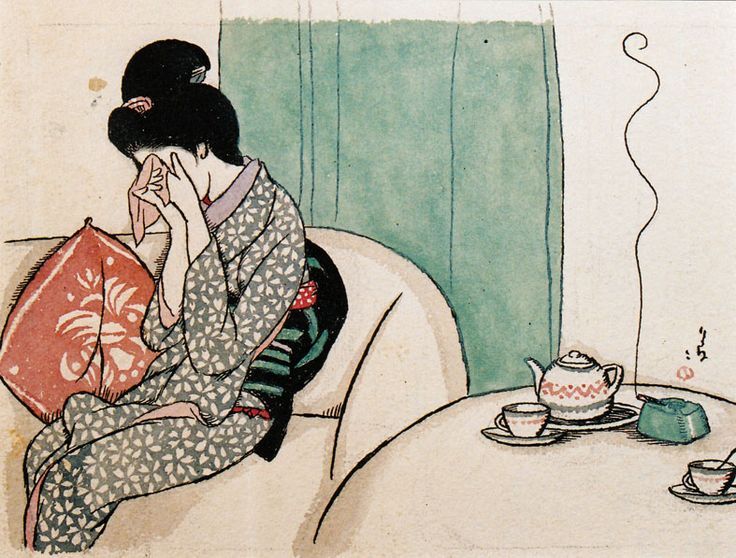
“  Yumeji Takehisa 1910-20
Yumeji Takehisa was a Japanese poet and painter. He also painted in the Nihonga style.
”

Yumeji Takehisa 1910-20
via:

Monday, December 16, 2019


Gösta Diehl
via:

Capitlism's Grave Diggers: Why Private Equity Firms Should Be Abolished

In his latest BIG newsletter, Matt Stoller (previously) relates the key moments in the history of private equity, from its roots in the notorious "leveraged buyouts" of the 1980s, and explains exactly how the PE con works: successful, productive business are acquired through debt financing, drained of their cash and assets, and then killed, leaving workers unemployed and with their pension funds looted, and with the business's creditors out in the cold. (...)

[ed. Link to Stoller's essay, Why Private Equity Should Not Exist: here]

The darlings of this movement -- Henry Manne, Milton Friedman, Michael Jenson -- promoted the idea of "shareholder capitalism" and the notion that managers have a single duty: to put as much money in the pockets of investors, even at the expense of the business's sustainability or the well-being of its workers. They joined forces with Robert Bork, who had set about discrediting antitrust law, arguing (successfully) that the only time laws against monopolies should be enforced was when monopolists raised prices immediately after attaining their monopolies -- everything else was fair game (Bork is a major reason that every industry in the economy is now super-concentrated, with only a handful of major firms).

Simon's policy prescriptions -- massive reductions in capital gains taxes, deregulation of trucking, finance and transport, and a move from guaranteed pensions to 401(k)s that only provide in old age if you make the right bets in the stock market -- were adopted by Carter and the Democrats, flooding the market with huge amounts of cash to be invested.

That's when the leveraged buyout industry was born. In 1982, Simon convinced Barclays and General Electric to loan him $80m to buy Gibson Greeting Cards from its parent company RCA. Once the company was theirs, they looted its bank account to pay themselves a $900k "special dividend," sold off its real-estate holdings for $4m, and took the company public for $270m, with Simon cashing out $70m from the transaction (Simon's total investment was $330k).

This was the starter pistol for future leveraged buyouts, through which companies like Bain Capital and the Carlyle Group buy multiple companies in the same sector and transmit "winning strategies" between them: new ways to dodge taxes, raise prices, and avoid regulation. PE owners suck any financial cushion out of companies -- funds that firms set aside for downturns or R&D -- and replace it with "brutal debt schedules." The PE owners benefit massively when this drives up share prices, but take no downsides when the companies fail.

Under PE, companies have emphasized firing workers and replacing them with overseas subcontractors, and amassing "brands, patents and tax loopholes" as their primary assets. PE firms specialize in self-dealing, cutting in the banks and brokers who set up the deals for a share of the upside. A company bought by a private equity firm is ten times more likely to go bankrupt than one with a traditional capital/management structure.

Elizabeth Warren has proposed some commonsense reforms to private equity: making PE investors liable for the debts they load their companies up with (including an obligation to fund workers' pensions); ending special fees and dividends; and reforming bankruptcy and tax laws to force PE companies to operate on the same terms as other businesses. Stoller calls this "reunifying ownership and responsibility": making the people who assume ownership of these productive companies take responsibility for their liabilities, not just their profits.

As Stoller points out, critics of Warren's plan say that this would end private equity investing as we know it ("Unfortunately, Warren’s fixes for these problems... would pretty much guarantee that nobody invests in or lends to private equity firms" -- Steven Pearlstein, Washington Post), but of course, that's the whole point.

by Cory Doctorow, Boing Boing |  Read more:
***
[ed. Exerpt below:]

"So what is private equity? In one sense, it’s a simple question to answer. A private equity fund is a large unregulated pool of money run by financiers who use that money to invest in and/or buy companies and restructure them. They seek to recoup gains through dividend pay-outs or later sales of the companies to strategic acquirers or back to the public markets through initial public offerings. But that doesn’t capture the scale of the model. There are also private equity-like businesses who scour the landscape for companies, buy them, and then use extractive techniques such as price gouging or legalized forms of complex fraud to generate cash by moving debt and assets like real estate among shell companies. PE funds also lend money and act as brokers, and are morphing into investment bank-like institutions. Some of them are public companies.

While the movement is couched in the language of business, using terms like strategy, business models returns of equity, innovation, and so forth, and proponents refer to it as an industry, private equity is not business. On a deeper level, private equity is the ultimate example of the collapse of the enlightenment concept of what ownership means. Ownership used to mean dominion over a resource, and responsibility for caretaking that resource. PE is a political movement whose goal is extend deep managerial controls from a small group of financiers over the producers in the economy. Private equity transforms corporations from institutions that house people and capital for the purpose of production into extractive institutions designed solely to shift cash to owners and leave the rest behind as trash. Like much of our political economy, the ideas behind it were developed in the 1970s and the actual implementation was operationalized during the Reagan era. (...)

The takeover of Toys “R” Us is a good example of what private equity really does. Bain Capital, KKR, and Vornado Realty Trust bought the public company in 2005, loading it up with debt. By 2007, though Toys “R” Us was still an immensely popular toy store, the company was spending 97% of its operating profit on debt service. Bain, KKR, and Vornado were technically the ‘owners’ of Toys “R” Us, but they were not liable for any of the debts of the company, or the pensions. Periodically, Toys “R” Us would pay fees to Bain and company, roughly $500 million in total. The toy store stopped innovating, stopped taking care of its stores, and cut costs as aggressively as possible so it could continue the payout. In 2017, the company finally went under, liquidating its stores and firing all of its workers without severance. A lot of people assume Amazon or Walmart killed Toys “R” Us, but it was selling massive numbers of toys until the very end (and toy suppliers are going to suffer as the market concentrates). What destroyed the company were financiers, and public policies that allowed the divorcing of ownership from responsibility."

by Matt Stoller, BIG |  Read more:
[ed. Must read. Private equity is neoliberalism's Godzilla, profiting from the destruction of a wide range of American businesses (and insinuating itself into more industries every day). See also: What are private equity firms? (Wikipedia).]

photo: Calvin K.

Sunday, December 15, 2019

Having Kids

Before I had kids, I was afraid of having kids. Up to that point I felt about kids the way the young Augustine felt about living virtuously. I'd have been sad to think I'd never have children. But did I want them now? No.

If I had kids, I'd become a parent, and parents, as I'd known since I was a kid, were uncool. They were dull and responsible and had no fun. And while it's not surprising that kids would believe that, to be honest I hadn't seen much as an adult to change my mind. Whenever I'd noticed parents with kids, the kids seemed to be terrors, and the parents pathetic harried creatures, even when they prevailed.

When people had babies, I congratulated them enthusiastically, because that seemed to be what one did. But I didn't feel it at all. "Better you than me," I was thinking.

Now when people have babies I congratulate them enthusiastically and I mean it. Especially the first one. I feel like they just got the best gift in the world.

What changed, of course, is that I had kids. Something I dreaded turned out to be wonderful.

Partly, and I won't deny it, this is because of serious chemical changes that happened almost instantly when our first child was born. It was like someone flipped a switch. I suddenly felt protective not just toward our child, but toward all children. As I was driving my wife and new son home from the hospital, I approached a crosswalk full of pedestrians, and I found myself thinking "I have to be really careful of all these people. Every one of them is someone's child!"

So to some extent you can't trust me when I say having kids is great. To some extent I'm like a religious cultist telling you that you'll be happy if you join the cult too — but only because joining the cult will alter your mind in a way that will make you happy to be a cult member. But not entirely. There were some things about having kids that I clearly got wrong before I had them.

For example, there was a huge amount of selection bias in my observations of parents and children. Some parents may have noticed that I wrote "Whenever I'd noticed parents with kids." Of course the times I noticed kids were when things were going wrong. I only noticed them when they made noise. And where was I when I noticed them? Ordinarily I never went to places with kids, so the only times I encountered them were in shared bottlenecks like airplanes. Which is not exactly a representative sample. Flying with a toddler is something very few parents enjoy.

What I didn't notice, because they tend to be much quieter, were all the great moments parents had with kids. People don't talk about these much — the magic is hard to put into words, and all other parents know about them anyway — but one of the great things about having kids is that there are so many times when you feel there is nowhere else you'd rather be, and nothing else you'd rather be doing. You don't have to be doing anything special. You could just be going somewhere together, or putting them to bed, or pushing them on the swings at the park. But you wouldn't trade these moments for anything. One doesn't tend to associate kids with peace, but that's what you feel. You don't need to look any further than where you are right now.

Before I had kids, I had moments of this kind of peace, but they were rarer. With kids it can happen several times a day.

by Paul Graham |  Read more:

The Strange Death of Social-Democratic England

The immediate, clear consequence of the UK election of December 12, 2019, is that Boris Johnson’s Conservative Party has succeeded where Theresa May’s failed in the last general election, in 2017—by winning an emphatic parliamentary majority that can pass the legislation necessary to facilitate Britain’s departure from the European Union. The faint irony of that two-year hiatus and the handover of party leadership from May to Johnson is that the latter’s deal is rather worse—from the Brexiteers’ point of view—than the one May repeatedly failed to get past Parliament. Nevertheless, the 2019 general election will go down as the moment British voters in effect voted a resounding “yes” in a de facto second referendum on Brexit and gave Boris Johnson a mandate to make his deal law and attempt to meet the latest Brexit deadline (January 31, 2020).

Far-reaching though the effects of this punctuation mark in the Brexit story will be, the 2019 general election may change the landscape of British politics and the fabric of its society in even more profound and decisive ways.

Brexit’s compromise over the status of Northern Ireland, half-in and half-out of Europe, is an unstable constitutional non-settlement that risks the fragile peace that’s held there since the 1998 Good Friday Agreement, while accelerating the hopes of some for a United Ireland. But the future of the Union faces a still more pressing challenge from renewed calls for a referendum on independence for Scotland, where a large majority of voters favor continued membership in Europe. The specter of “the breakup of Britain” that has long haunted the United Kingdom may materialize at last—just at the moment when English nationalists are celebrating their Brexit victory.

So much for the political landscape; what of the social fabric? A fourth successive defeat for the Labour Party, with its most ambitious anti-austerity program yet, and an outright win for a Conservative Party that has purged its moderates have sharpened dividing lines, squeezed the liberal center, and broken consensus into polarity. A minority of Britons—roughly a third, who will now see themselves as effectively disenfranchised—voted for a radical expansion of the public sector, a great leap forward toward a socialist Britain. But the plurality chose a party that, while promising more spending, has actually recomposed itself around a reanimated Thatcherite vision of exclusionary, anti-egalitarian, moralizing social Darwinism. Some part of the Tory electoral coalition might have more welfare-chauvinist reflexes, but the greater part of it distrusts the state, resents the taxation that pays for it, and would like to shrink both.

What is at stake after this election, then—in a Britain that might soon mean, to all intents and purposes, England & Wales—is the future of what has made it a reasonably civilized country since 1945: social democracy.

by Matt Seaton, NYRB |  Read more:
Image: Christopher Furlong/Getty Images

The Drums of Cyberwar

In mid-October, a cybersecurity researcher in the Netherlands demonstrated, online, as a warning, the easy availability of the Internet protocol address and open, unsecured access points of the industrial control system—the ICS—of a wastewater treatment plant not far from my home in Vermont. Industrial control systems may sound inconsequential, but as the investigative journalist Andy Greenberg illustrates persuasively in Sandworm: A New Era of Cyberwar and the Hunt for the Kremlin’s Most Dangerous Hackers, they have become the preferred target of malicious actors aiming to undermine civil society. A wastewater plant, for example, removes contaminants from the water supply; if its controls were to be compromised, public health would be, too.

That Vermont water treatment plant’s industrial control system is just one of 26,000 ICS’s across the United States, identified and mapped by the Dutch researcher, whose Internet configurations leave them susceptible to hacking. Health care, transportation, agriculture, defense—no system is exempt. Indeed, all the critical infrastructure that undergirds much of our lives, from the water we drink to the electricity that keeps the lights on, is at risk of being held hostage or decimated by hackers working on their own or at the behest of an adversarial nation. According to a study of the United States by the insurance company Lloyd’s of London and the University of Cambridge’s Centre for Risk Studies, if hackers were to take down the electric grid in just fifteen states and Washington, D.C., 93 million people would be without power, quickly leading to a “rise in mortality rates as health and safety systems fail; a decline in trade as ports shut down; disruption to water supplies as electric pumps fail and chaos to transport networks as infrastructure collapses.” The cost to the economy, the study reported, would be astronomical: anywhere from $243 billion to $1 trillion. Sabotaging critical infrastructure may not be as great an existential threat as climate change or nuclear war, but it has imperiled entire populations already and remains a persistent probability.

Vladimir Putin; drawing by Tom BachtellFrom 2011 to 2013 Iranian hackers breached the control system of a small dam outside of New York City. Around the same time, they also broke into the servers of banks and financial firms, including JPMorgan Chase, American Express, and Wells Fargo, and besieged them for 144 days. The attacks were in retaliation for the Stuxnet virus, unleashed in 2010, which caused the destruction of nearly a thousand centrifuges at Iran’s largest uranium enrichment facility. Though neither the United States nor Israel took credit for the attack, both countries are widely believed to have created and deployed the malware that took over the facility’s automated controllers and caused the centrifuges to self-destruct. The attack was intended to be a deterrent—a way to slow down Iran’s nuclear development program and force the country to the negotiating table.

If it hadn’t worked, a more powerful cyberweapon, Nitro Zeus, was being held in reserve, apparently by the US, primed to shut down parts of the Iranian power grid, as well as its communications systems and air defenses. Had it been deployed, Nitro Zeus could have crippled the entire country with a cascading series of catastrophes: hospitals could not have been able to function, banks could have been shuttered and ATMs could have ceased to work, transportation could have come to a standstill. Without money, people might not have been able to buy food. Without a functioning supply chain, there would have been no food to buy. The many disaster scenarios that could have followed are not hard to imagine and can be summed up in just a few words: people would have died.

When government officials like the director of the US Defense Intelligence Agency, Lieutenant General Robert Ashley, say they are kept up at night by the prospect of cyberwarfare, the vulnerability of industrial control systems is likely not far from mind. In 2017 Russian hackers found their way into the systems of one hundred American nuclear and other power plants. According to sources at the Department of Homeland Security, as reported in The New York Times, Russia’s military intelligence agency, in theory, is now in a position “to take control of parts of the grid by remote control.”

More recently, it was discovered that the same hacking group that disabled the safety controls at a Saudi Arabian oil refinery in 2017 was searching for ways to infiltrate the US power grid. Dragos, the critical infrastructure security firm that has been tracking the group, calls it “easily the most dangerous threat publicly known.” Even so, a new review of the US electrical grid by the Government Accountability Office (GAO) found that the Department of Energy has so far failed to “fully analyze grid cybersecurity risks.” China and Russia, the GAO report states, pose the greatest threat, though terrorist groups, cybercriminals, and rogue hackers “can potentially cause harm through destruction, disclosure, modification of data, or denial of service.” Russia alone is spending around $300 million a year on its cybersecurity and, in the estimation of scholars affiliated with the New America think tank, has the capacity to “go from benign to malicious rapidly, and…rapidly escalate its actions to cyber warfare.”

It’s not just Russia. North Korea, Iran, and China all have sophisticated cyberwarfare units. So, too, the United States, which by one account spends $7 billion a year on cyber offense and defense. That the United States has not advocated for a ban on cyberattacks on critical infrastructure, the Obama administration’s top cybersecurity official, J. Michael Daniel, tells Greenberg in Sandworm, may be because it wants to reserve that option itself. In June David Sanger and Nicole Perlroth reported in The New York Times that the United States had increased its incursions into the Russian power grid.

There are no rules of engagement in cyberspace. Like cyberspace itself, cyberwarfare is a relatively new concept, and one that is ill-defined. Greenberg appears to interpret it liberally, suggesting that it is a state-sponsored attack using malware or other malicious software, even if there is no direct retaliation, escalation, or loss of life. It may seem like a small semantic distinction, but cyberwarfare is not the same as cyberwar. The first is a tactic, the second is either a consequence of that tactic, or an accessory to conventional armed conflicts. (The military calls these kinetic combat.) This past June, when the United States launched a cyberattack on Iran after it shot down an American drone patrolling the Strait of Hormuz, the goal was to forestall or prevent an all-out kinetic war. Responding to a physical attack with a cyberattack was a risk because, as Amy Zegart of Stanford’s Hoover Institute told me shortly afterward, we don’t yet understand escalation in cyberspace.

Absent rules of engagement, nation-states have a tremendous amount of leeway in how they use cyberweapons. In the case of Russia, cyberwarfare has enabled an economically weak country to pursue its ambitious geopolitical agenda with impunity. It has used cyberattacks on industrial control systems to cripple independent states that had been part of the Soviet Union in an effort to get them back into the fold, while sending a message to established Western democracies to stay out of its way.

As Russia has attacked, Greenberg has not been far behind, reporting on these incursions in Wired while searching for their perpetrators. Like the best true-crime writing, his narrative is both perversely entertaining and terrifying.

by Sue Halpern, NYRB |  Read more:
Image: Vladimir Putin; drawing by Tom Bachtell

Bob Dylan & Johnny Cash


[ed. I like that they went with the imperfect version.]

Chrome 79 Will Continuously Scan Your Passwords Against Public Data Breaches

Google's password checking feature has slowly been spreading across the Google ecosystem this past year. It started as the "Password Checkup" extension for desktop versions of Chrome, which would audit individual passwords when you entered them, and several months later it was integrated into every Google account as an on-demand audit you can run on all your saved passwords. Now, instead of a Chrome extension, Password Checkup is being integrated into the desktop and mobile versions of Chrome 79.

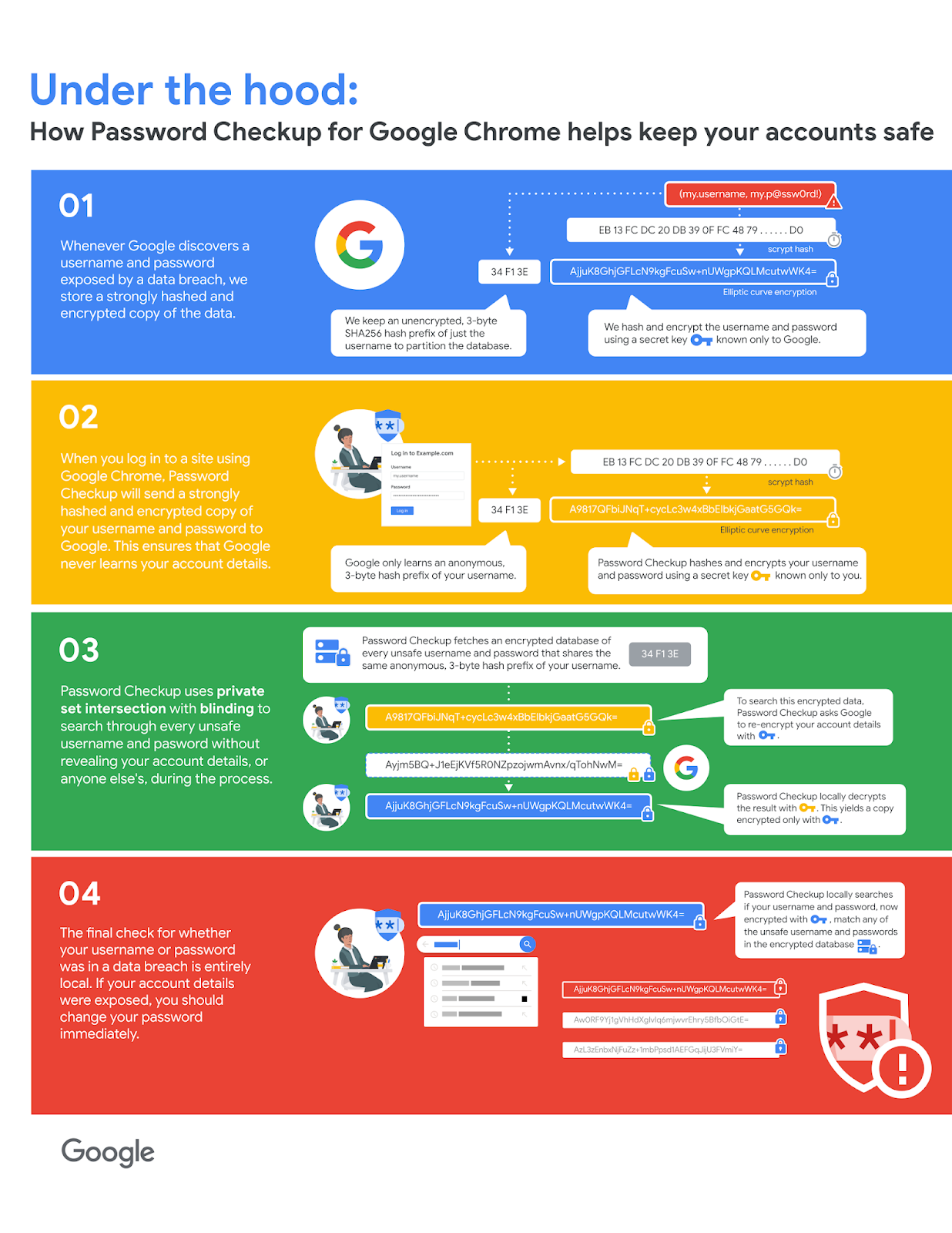
How Password Checkup works. All of these Password Checkup features work for people who have their username and password combos saved in Chrome and have them synced to Google's servers. Google figures that since it has a big (encrypted) database of all your passwords, it might as well compare them against a 4-billion-strong public list of compromised usernames and passwords that have been exposed in innumerable security breaches over the years. Any time Google hits a match, it notifies you that a specific set of credentials is public and unsafe and that you should probably change the password.

The whole point of this is security, so Google is doing all of this by comparing your encrypted credentials with an encrypted list of compromised credentials. Chrome first sends an encrypted, 3-byte hash of your username to Google, where it is compared to Google's list of compromised usernames. If there's a match, your local computer is sent a database of every potentially matching username and password in the bad credentials list, encrypted with a key from Google. You then get a copy of your passwords encrypted with two keys—one is your usual private key, and the other is the same key used for Google's bad credentials list. On your local computer, Password Checkup removes the only key it is able to decrypt, your private key, leaving your Google-key-encrypted username and password, which can be compared to the Google-key-encrypted database of bad credentials. Google says this technique, called "private set intersection," means you don't get to see Google's list of bad credentials, and Google doesn't get to learn your credentials, but the two can be compared for matches.

Building Password Checkup into Chrome should make password auditing more mainstream. Only the most security-conscious people would seek out and install the Chrome extension or perform the full password audit at passwords.google.com, and these people probably have better password hygiene to begin with. Building the feature into Chrome will put it in front of more mainstream users who don't usually consider password security, which are exactly the kind of people who need this sort of thing. This is also the first time password checkup has been available on mobile, since mobile Chrome still doesn't support extensions (Google plz).

by Ron Amadeo, Ars Technica |  Read more:
Image: Google
[ed. I believe Firefox has this feature too.]