Wednesday, June 4, 2025

Ukraine’s Attack Exposed America’s Achilles’ Heel

It turns out Volodymyr Zelensky did have another card to play.

Ukraine’s astonishing drone attack on military airfields and critical assets deep inside Russia on Sunday blindsided the Kremlin, destroyed at least a dozen strategic bombers and marked a seismic shift in modern warfare.

The mission, dubbed Operation Spider’s Web, was a fresh reminder to leaders of the world’s most advanced militaries that the toughest threats they face today are not limited to their regular rivals with expensive gear. Instead, swarms of small, off-the-shelf drones that can evade ground defenses can also knock out billions of dollars of military hardware in an instant.

What happened in Russia can happen in the United States — or anywhere else. The risk facing military bases, ports and command headquarters peppered across the globe is now undeniably clear.

We don’t yet know if the operation will impact the Trump administration’s push for a peace deal between Ukraine and Russia, but it nonetheless delivered a tactical defeat to Russia’s military and will put pressure on President Vladimir Putin to respond. And what is almost certain is that the innovative use of inexpensive technology will inspire other asymmetric attacks that inflict serious damage against a well-heeled adversary.

Mr. Zelensky, Ukraine’s president, called the attack, which was planned by Ukraine’s Security Service, or S.B.U., his country’s “longest-range operation.” By smuggling more than 100 explosive-laden quadcopter drones across the border in cargo trucks, Ukraine managed to evade air defenses and then fly the drones undetected above four Russian bases, where they damaged or destroyed what Ukrainian officials said were more than 40 high-value aircraft used in the assault on Ukrainian cities. Those involved with the attack left Russia before it began, Ukrainian officials said. The operators could watch live video and hover the aircraft above their targets before steering them into a nosedive.

The extent of the attack — and the choice of targets — opens a new chapter in how drones are used in modern warfare, one that was improbable even a decade ago. The widespread availability of technology in the intervening years has empowered Ukraine to have mostly free rein in the skies above its larger, wealthier enemy, despite having a limited traditional air force.

The U.S. military understands Russia’s vulnerability firsthand. Although American pilots have managed to control the skies where they operate since the Korean War, U.S. troops in recent years have come under greater danger from drones. Militant groups have used the aircraft, which are a small fraction of the size of U.S. warplanes, to target American positions in the Middle East, dropping crude munitions that have maimed and killed American service members.

The U.S. military has globe-spanning technology to detect, track and shoot down ballistic missiles, but — so far — its multimillion-dollar systems remain helpless against the drone threat. The Pentagon has tried to develop technologies and defensive tactics, but results have been spotty at best. So-called hard-kill tactics to blast the drones out of the sky, or soft-kill methods to electronically disable them, haven’t proved to be silver bullets. The unmanned aircraft typically fly low to the ground and don’t always transmit their positions. Current radar systems are engineered to spot larger flying objects.

American commanders increasingly realize that forces stateside are just as exposed. Gen. Gregory M. Guillot, the head of Northern Command, told Congress in February that there were some 350 detections of drone overflights above 100 military installations in the United States last year. Those small drones appeared to be more of a nuisance than a threat, but Spider’s Web exposed the risk of not taking them seriously.

The Federal Aviation Administration has licensed more than a million drones in the United States. Most fly by the rules, but sightings of drones making illegal flights are on the rise. The F.A.A. reports there are now 100 drone sightings around airports each month, despite federal law that requires them to avoid flying near airports in controlled airspace without authorization.

Military bases and aircraft hangars should be hardened to guard against the worst. Congress is poised to set aside about $1.3 billion this fiscal year for the Pentagon to develop and deploy counter-drone technologies. This is a good start. But the Pentagon’s most ambitious and expensive plans fail to address the threat.

President Trump unveiled plans last month for his $175 billion antimissile shield, called Golden Dome, which aims to shoot down all manners of ballistic, hypersonic and cruise missiles. The program, which is under development, wouldn’t protect the United States from the types of small drones Ukraine used in Spider’s Web.

The United States has spent millions of dollars to help Ukraine manufacture and fine-tune its drones but has not pushed American contractors to do the same. The Pentagon has been slow to procure the smaller, cheaper, less advanced brand of drones that are omnipresent over the battlefields in Ukraine. In August 2023 it did announce a project to field thousands of autonomous systems. The billion-dollar initiative, called Replicator, was inspired by lessons learned in Ukraine to manufacture inexpensive drones and make them widely available by this fall. The Pentagon has said vanishingly little about the effort’s systems and programs since Mr. Trump took office, though.

by W.J. Hennigan, NY Times | Read more:
Image: Mauricio Lima for The New York Times
[ed. As we know, the US doesn't do asymetrical warfare well, so why is this a surprise? It's long been a staple of CIA thrillers. Check this one out by Terry Hayes - The Year of the Locust; or Mark Helprin's The Ocean and the StarsAlso, this essay: Imagining the Drone Air Force (VS).]

Forced to Relocate by Climate Change, These Southwest Alaska Villagers Found a New Crisis


Newtok’s relocation to the new site of Mertarvik, where much of the infrastructure is already failing, highlights the nation’s failure to prepare for the ways climate change is making some places uninhabitable.

A jumble of shipping containers holds all that remains of the demolished public school in Newtok, where on a recent visit, a few stray dogs and a lone ermine prowled among the ruins.

Late last year, the final residents of this sinking village near the Bering Sea left behind the waterlogged tundra of their former home, part of a fraught, federally funded effort to resettle communities threatened by climate change.

Nearly 300 people from Newtok have moved nine miles across the Ninglick River to a new village known as Mertarvik. But much of the infrastructure there is already failing. Residents lack running water, use 5-gallon buckets as toilets and must contend with intermittent electricity and deteriorating homes that expose them to the region’s fierce weather.

Newtok’s relocation was supposed to provide a model for dozens of Alaska communities that will need to move in the coming decades. Instead, those who’ve worked on the effort say what happened in Newtok demonstrates the federal government’s failure to oversee the complex project and understand communities’ unique cultural needs. And it highlights how ill-prepared the United States is to respond to the way climate change is making some places uninhabitable, according to an investigation by The Washington Post, ProPublica and KYUK radio in Bethel, Alaska.

Dozens of grants from at least seven federal agencies have helped pay for the relocation, which began in 2019 and is expected to cost more than $150 million. But while the federal government supplied taxpayer dollars, it left most of the responsibility for the move to the tiny Newtok Village Council. The federally recognized tribal government lacked the expertise to manage the project and has faced high turnover and internal political conflict, according to tribal records and interviews with more than 70 residents as well as dozens of current and former members of the seven-person village council.

Federal auditors have warned for years that climate relocation projects need a lead agency to coordinate assistance and reduce the burden on local communities. The Biden administration tried to address those concerns by creating an interagency task force led by the Federal Emergency Management Agency and the Interior Department. The task force’s report in December also called for more coordination and guidance across the federal government as well as long-term funding for relocations.

But the Trump administration has removed the report from FEMA’s website and, as part of its withdrawal of climate funding, frozen millions in federal aid that was supposed to pay for housing construction in Mertarvik this summer. The administration did not respond to a request for comment.

“We’re physically seeing the impacts of a changing climate on these communities,” said Don Antrobus, a climate adaptation consultant for the Alaska Native Tribal Health Consortium. “And the fact that we don’t have a government framework for dealing with these issues is not just an Alaska problem, it’s a national problem.”

Newtok’s relocation follows the resettlement of Isle de Jean Charles, Louisiana, where land vanished under rising sea levels. Both relocations have been labeled “blueprints” for the federal government’s response to climate change. Both have been mired in complicated and disjointed funding systems and accusations that the government neglected traditional knowledge.

by Emily Schwing and Ash Adams, Washington Post via ADN |  Read more:
Image: Tiny homes in Mertarvik. (Ash Adams/For The Washington Post)

Tuesday, June 3, 2025

What Could Go Wrong?

Sam Altman and Jony Ive Will Force A.I. Into Your Life

Last Wednesday, OpenAI announced that it was acquiring a company called io, an artificial-intelligence-forward product-development firm co-founded, last year, by Jony Ive, the vastly influential designer known for his work with Steve Jobs at Apple. Ive led the designs of the original iMac, the iPad, and the Apple Watch, among other era-defining products. Then, in 2019, he left Apple to start his own design firm called LoveFrom. The news of his move to OpenAI felt something like learning that LeBron James was joining the Miami Heat: Ive had become synonymous with Apple’s success, perhaps second only to Jobs. Now, after a period of independence, he was choosing a new team. The announcement of the deal with OpenAI—for a reported $6.5 billion in OpenAI equity—came via a press release, featuring a rather cuddly portrait of Ive with OpenAI’s C.E.O. and co-founder, Sam Altman (shot by the British fashion photographer Craig McDean) and a faux-casual videotaped interview session between the two at San Francisco’s Cafe Zoetrope. In it, Altman describes “a family of devices that would let people use A.I. to create all sorts of wonderful things,” enabled by “magic intelligence in the cloud.” The symbolism of the partnership was clear: Altman is the new Jobs, and together he and Ive promise to create the next ur-device, a personal technology that will reshape our lives just as the iPhone did. Once it’s ready, they say, they’ll ship a hundred million devices “faster than any company” ever has.

We don’t know what it will look like just yet, but Altman swears that it will be “​​the coolest piece of technology that the world will have ever seen.” Ming-chi Kuo, a respected analyst of Apple’s Chinese manufacturing, posted on X that the product is planned to be “as compact and elegant as an iPod Shuffle” and that it will have “cameras and microphones for environmental detection.” It might resemble other early A.I. devices announced or launched in the past year, such as Friend, another pendant-like chatbot companion; Humane, an A.I. pin with a laser projector; or Rabbit, a small handheld gadget. Yet the functionality of these nascent inventions is severely limited. “Vaporware” is a term of art from the nineteen-eighties that was popularized in the early internet era, referring to new software or technology that overpromises and underdelivers—if the product is even released in the first place. However many breathless headlines about OpenAI’s acquisition, it’s just vaporware until Altman and Ive prove otherwise. Hype, after all, is one of OpenAI’s primary achievements—despite predictions about ChatGPT changing the world, the company is losing billions of dollars a year.

What we can do, in the meantime, is imagine what an iPhone of A.I. might look like based on the A.I. technology that so far exists. Generative A.I. has already been integrated into many of our daily digital experiences, whether we want it there or not. iPhones now summarize text threads using A.I. and allow users to generate custom emojis. Google recently announced an “AI Mode” that it intends to supplant its traditional search box with, a development that threatens to slow open-web traffic down to a trickle. Meta’s “AI Glasses,” a collaboration with Ray-Ban, integrate voice chatting and live translation with the company’s A.I. assistant. And chatbots with distinct personalities, like Replika and Character.ai, are becoming increasingly popular as they get better at mimicking human connection. Perhaps Altman and Ive’s machine will mingle all of these functionalities: it might listen to and interpret the sounds around you; it might respond with predictive text, delivered to you instantaneously and in a customizable tone; and it might become your main avenue for accessing information, like a personal concierge. It will reportedly not attempt to supplant the other technologies you depend on: according to the Wall Street Journal, Altman described it as a kind of third device, meant to work within an ecosystem that includes your laptop and smartphone. But it will effectively be a self-surveillance machine that creates a technological scrim for your personal reality. The involvement of Ive invites inevitable comparisons with the iPhone, but this is not necessarily a compliment; to many of us, an iPhone of A.I. sounds less like a utopian promise than like a threat that A.I. will soon become ubiquitous and unavoidable. Smartphones have already absorbed us in our screens, creating personalized information bubbles; omnipresent A.I. will only intensify that atomization while being more automated, more inscrutable, and more inescapable.

The video claims that more information about the new product will be shared next year, which would mean that we’re currently in the Palm Pilot stage of A.I.—with the iPhone-like invention looming around the corner, poised to obliterate the competition. But there are vast logistical hurdles to achieving this optimistic timeline for ubiquitous consumer A.I. More than a billion people in the world own iPhones. Some research estimates that generating a typical e-mail using A.I. consumes a bottle’s worth of water to siphon heat away from the data centers’ servers to separate cooling towers. This means that, if we all started using our personal A.I. machines dozens of times a day, as we do our iPhones, the environmental toll of our personal technology would skyrocket—imagine something like turning every car on the road into a diesel truck. This, in turn, would warp the direction of global economies, requiring the construction of ever-larger data centers. The economic and environmental overhaul would be done in the name of outsourcing our human thoughts and memories to an omnipresent machine resting in our pockets or hanging around our necks. (...)

Speculative mockups online imagine an A.I. companion device that looks simple, like a rounded metal amulet—it would be Ive’s style to make the design approachable yet austere. Yet the sleek and frictionless object will rely on a vast infrastructure of factories and server farms; the labor of human maintenance workers and moderators; and, ultimately, the corpus of information that has been digested as training data, which is effectively the entire history of human thought. The little pendants around our necks will be a hundred million Trojan horses, smuggling A.I. into every aspect of our lives. The comforting tone of Altman and Ive’s pitch belies the enormous uncertainty of what their plan would unleash.

by Kyle Chayka, New Yorker |  Read more:
Image: Ariel Davis

via:

Substack Has Changed in the Last 30 Days

Everything happens so quickly at Substack. And in just the last few days, something big has changed.

By my measure, we’ve suddenly reached stage four in the evolution of this platform.

And I expect we will quickly get to level five (more on that below). But first let’s look at how we got here.

STAGE ONE

In the first stage, people ignored us. That was easy enough—Substack was small and out on the very fringes of the media world.

When I told people I published a Substack, I got blank stares. I tried to explain what Substack was. That wasn’t easy, because I wasn’t really sure myself.

Was I publishing a newsletter? Was I now just another blogger? Even worse, had I signed up for some cult or pyramid scheme?

I like to think of myself as a culture historian. Or maybe an essayist, who sometimes dabbles in journalism. But what I was now doing with The Honest Broker didn’t fit easily into those (or any other) categories.

Of course, this didn’t really matter—because nobody paid any attention whatsoever.

If someone asked about Substack, I said it was an “alternative publishing platform”—and left it at that.

But this anonymity didn’t last long.

STAGE TWO

In the second stage, people mocked us.

Substack had arrived—but only as the punchline to a joke. Or the pretext for a derisive cartoon in The New Yorker.

In this cartoon, a dismayed woman stares at her laptop and complains to her partner: “My mother’s upgrading the holiday newsletter to a paid Substack.”

During this period, Substack finally got noticed by the establishment. But they treated us like a circus that shows up uninvited on the edge of town. No matter how many tickets we’ve sold, we’re still just clowns and grifters.

Then something unexpected happened. The circus never left town—instead we kept growing.

So now we entered stage three.

STAGE THREE

That’s when powerful people began attacking Substack. They especially hated the fact that this platform lets writers decide what to write, and readers decide what to read.

That made them uneasy. It shouldn’t be allowed.

Around this time, total strangers started sending me rude emails—one wrote me four times during the course of a single week, telling me the various rules and controls he wanted to impose on my work.

These attacks soon lost steam. Few found them convincing, and Substack’s growth didn’t slow down a whit.

Judging by my experience, we actually expanded our audience because of this organized hate campaign. That often happens to censors. They add to the allure of what they try to censor.

Of course, it didn’t help the credibility of these assaults that many who attacked Substack soon decided to join it.

Some had no choice—they lost their jobs with legacy media. Or, in many cases, their previous employer disappeared entirely, as part of the ongoing media meltdown.

But the larger truth is that writers of all ideologies and persuasions began to grasp the value of a publishing platform that resists bullying by politicians, billionaires, or interest groups.

Democracy can’t operate without that kind of independence, and Substack has done more than any organization I know to protect journalism from brute power.

But this has led to stage four in Substack’s evolution.

STAGE FOUR

The establishment is now in a mad rush to join us. Just in the last 30 days, the whole vibe has shifted.

This is probably a good thing—although I will admit to some anxiety over gentrification here. But even more to the point, this is an inevitable next step.

I guess we’re the cool kids now. So others follow our lead.

In several recent articles, I wrote about the likelihood of this happening. But even I am shocked at the speed and intensity of the transition.

Check out, for example, the contortions taking place at The New Yorker. Just a few months ago, Substack was a target for their jokes. Substack writers were—or so they implied—like your insufferable mother-in-law.

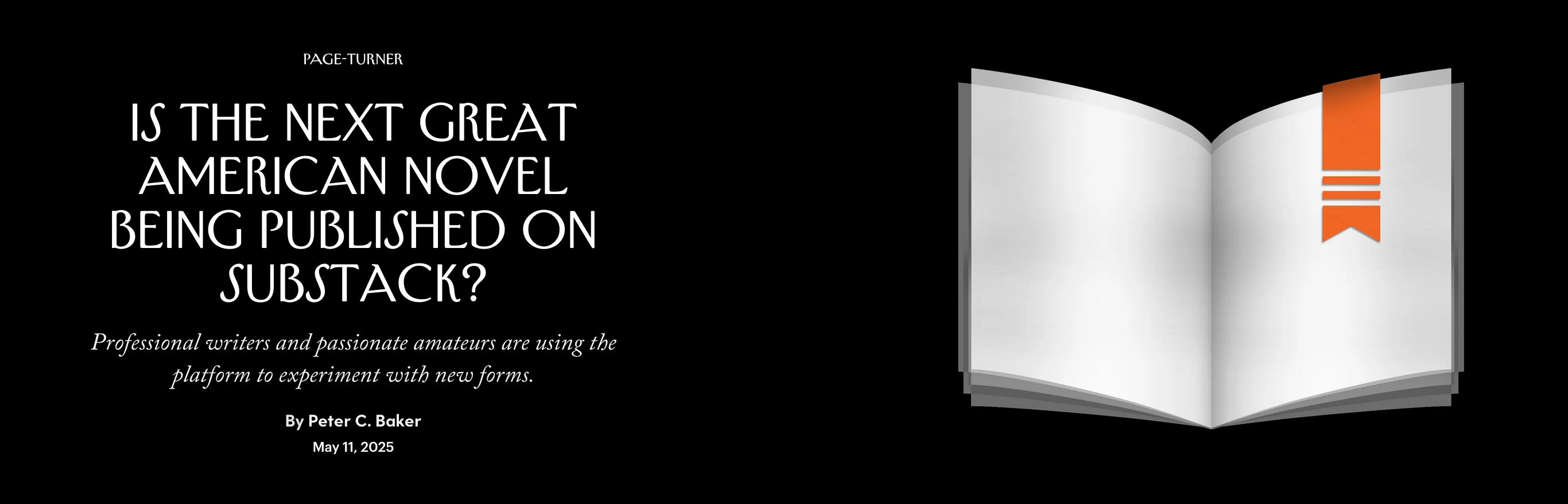
But all of a sudden, The New Yorker published this on May 11.


It’s absurd how quickly the vibe shifted. The New Yorker had never reviewed anything on Substack before. They only ridiculed us. Then—in a flash!—they declare Substack as the source of the Great American Novel.

That turnabout is actually more amusing than any of their cartoons.

And The New Yorker is not the only establishment vehicle that fell in love with Substack during the month of May.

In my world of music writing, Billboard is a huge power broker. But from their perspective, I don’t even exist.

At least I didn’t until May 9, 2025.

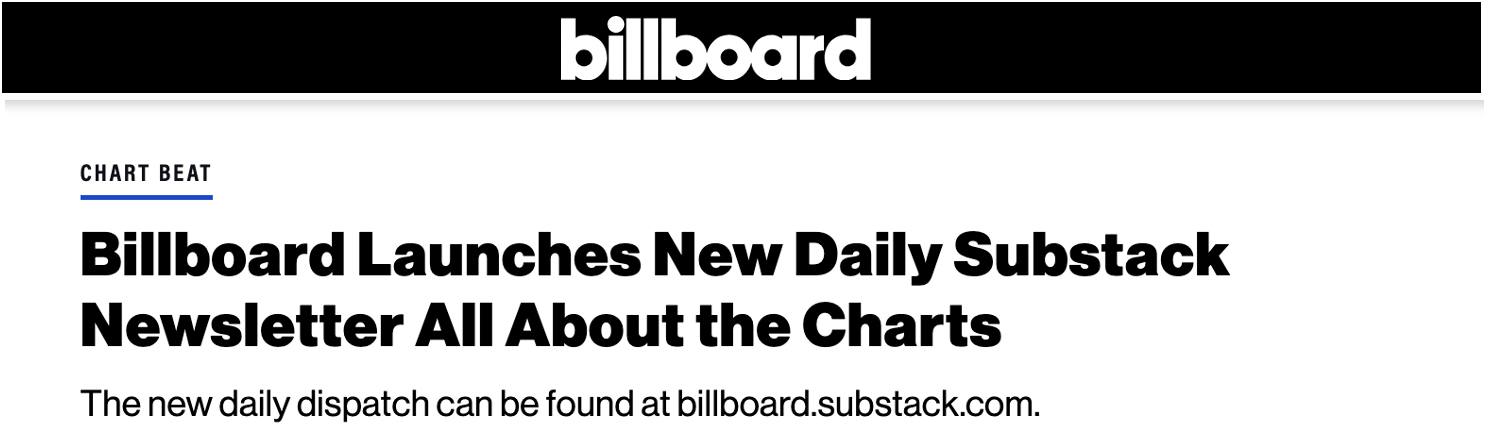
That’s when Billboard felt obliged to respond to my criticism of private equity funds. (...)

But then guess what happened ten days later.

Yes, you guessed it. Billboard launched its own Substack on May 19. You can’t make this stuff up.


Don’t get me wrong. I think this is healthy for everybody. But these legacy outlets will find it difficult to adapt to the messy world of new media.

Consider the case of BBC History, which also joined Substack this month. As of yesterday morning, they only had 200 subscribers. That must be painful for the BBC—once the monopolistic media voice for a world-dominating empire.

But if they want to play in this new sandbox, they will need to fight for readers like the rest of us.

But the clearest sign of Substack’s ascendancy may be the number of aspiring politicians who are now on the platform.

I can’t tell you who will win the 2028 presidential election. But I’m fairly certain that the next president will be a Substacker.

Like all these others, Pete Buttigieg joined Substack in May. According to The Bulwark:
Buttigieg’s Substack already has over 380,000 followers, making him one of the most prominent Democrats now on the platform….

Connecticut Sen. Chris Murphy has become a prolific Substack poster. Texas Rep. Jasmine Crockett published her first Substack newsletter last Thursday….Rahm Emanuel posted for the first time just last month and the Democratic National Committee made its debut on the platform in March.
Republican hopefuls are also on board. Marco Rubio launched a Substack for the US State Department in late April. Robert F. Kennedy, Jr. and Tulsi Gabbard are also on the platform. I expect to see many other leading politicians, of all parties and persuasions, join them in the coming months.

“I think that the 2026 and 2028 elections are going to play out on Substack,” boasts Catherine Valentine, Substack’s head of politics. That’s a sure bet, as far as I can see.

The final sign of Substack’s embrace by the establishment can be measured in the number of major brands and businesses now on board.

Many of them also joined in May.

Substack is “reshaping how brands communicate,” according to Forbes.
“Substack has found success because it offers what people have been craving: community,” shares the (anonymous) founder of People, Brands And Things. “Unlike mainstream social media, it thrives on creativity and niche interests. It’s a refreshing departure from data-driven content.”
Do I really want to see McDonald's and Pepsi and Nike on Substack?

I’m not so chuffed about this, but I don’t think they will have much luck here. They know how to pay for advertising and buy endorsements, but in the free-flowing world of Substack, they will struggle for influence.

And that’s how it should be.

But I do see more change in our future. In particular, I anticipate a stage five in the evolution of Substack.

by Ted Gioia, The Honest Broker |  Read more:
Images: Barnum & Bailey poster; New Yorker; Billboard
[ed. Definitely trending. Many of the posts here come from Substack authors.]

Roxana Amed

[ed. See also: Tus Sueños; and, Roxana Amed - Laura Va (Official Video).]

Monday, June 2, 2025

Twain Dreams

The enigma of Samuel Clemens

Could some kind of Mark Twain revival be afoot in this, the 175th-anniversary year of Harper’s Magazine, a periodical that more consistently than any other provided a home for Twain’s writing during the half-century-long major phase of his career?  The signs are come unto us. The writer Percival Everett’s 2024 novel James, in which Everett reimagines the story of Twain’s Adventures of Huckleberry Finn from the perspective of Huck’s raft mate on the Mississippi, the self-emancipated Jim, took home last year’s National Book Award for Fiction. Only two months ago, we got a major new book by the Stanford professor Shelley Fisher Fishkin, who in the long history of scholarship on Mark Twain has written some of the best of it. Jim is the title, and subject, of Fishkin’s latest. So, we have James and Jim, barely a year apart. Meanwhile, the annual Mark Twain Prize for American Humor has taken on new significance as a sort of dissenter’s pulpit. This year’s winner, the comedian and talk-show host Conan O’Brien, seized the moment of his acceptance speech, delivered in March onstage at the Kennedy Center in Washington—where the previous month, the board of trustees had been ousted by President Trump and replaced with a shock brigade of his sort of people, among them the country singer Lee Greenwood, of “Proud to Be an American” fame, all in the interest of ushering in a new “Golden Age in Arts and Culture,” with Trump himself at the head, as chair, lobbing brain-damaged non sequiturs about this one time he saw Cats—and used it, O’Brien did, to speak out not-so-subtly against the regime. “Twain hated bullies,” O’Brien told the crowd, a statement largely true (although Tom Sawyer was a bully at times, and a manipulative narcissist at all times). O’Brien said that Twain hated racism too, and it is true that Twain came to hate racism, although he had been a racist earlier in his life and even farcically fought for the Confederacy for a couple of weeks. But this is pedantry on my part. (...)

I grew up so hopelessly steeped in the cult of Twain that I have to perform a mental adjustment to understand how a Twain revival could be possible. How does one revive what is ever-present and oppressively urgent? My sportswriter father, who died when I was in my mid-twenties, worshipped Twain, to the extent of wearing, every year on specific occasions, a tailored white suit. With the shaggy hair and Twainish mustache that he maintained year-round, the object of the homage was unmistakable. I was raised in New Albany, Indiana, across the Ohio River from Louisville, Kentucky, and in the late Seventies, when I was a boy, some of the last of the old-time steamboat races were held there. One of my earliest memories is of being taken down to the riverfront at the age of four to watch that spectacle. Twain’s face was everywhere. It was on TV, in a disturbing Claymation film called The Adventures of Mark Twain, which, I have since learned from the internet, gave bad dreams not just to me but to my whole microgeneration. Every Christmas until I was a teenager, I would find waiting under the tree a fine hardback copy of one or another Twain novel, sometimes one of the editions that had those marvelous N. C. Wyeth illustrations. These gifts would then stress me out for the rest of the year. They were given in love, but with a certain expectation or pressure, as well—they were a form of cultural proselytizing—and somehow I never felt that I read or loved them well enough. My father would quiz me on the stories. Hadn’t I loved the part when such and such happened? When Huck decided he’d rather go to hell than hand over Jim to be reenslaved? No, more than that, more than any “rather,” did I grasp the fact that Huck actually believed he would go to hell for this loyalty to Jim, and chose it regardless? My answers, no matter how much forced enthusiasm I tried to pump in behind them, always left him a little crestfallen, a little chagrined. In his smoke-filled basement office, he would play his recordings of Hal Holbrook doing Twain. When I was cast in the role of Joe Harper, in our seventh-grade production of Tom Sawyer, he grew briefly delighted, and suggested I revisit the novel for character insights, but the show bombed. We had too little talent for too many parts. I remember our Injun Joe, a kid named Kevin. Bless him, he had one line, and the line consisted of a single word—“Bah!”—and somehow he kept fucking it up. It required a kind of genius to fuck up this line, but he did it every time, in a different way. The director would clutch the top of her head and scrunch up a fistful of hair and say, “Oh, Kevin!” I may be tidying the timeline somewhat here, but I’m pretty sure that the school play marked the end of my father’s efforts to inspire me with his devotion. He had already inflicted on me, though, some guilty shadow of it. (...)

Like Kafka when he went to see the aeroplanes at Brescia, did I not come to Percival Everett’s James with a kind of hostility? And if the answer is yes, what was the source of it? Certainly not any sense that a sacred cow of some kind had been violated, although the way I wrote “certainly” there makes me wonder if, in fact, it was that. Yes, there may have been some childish instinct to defend Twain. But Mr. Everett, you must realize that Twain himself saw Jim as fully human, and in the context of the time . . . Hilarious. Everett knows this as well as anyone. Twain’s “humor and humanity,” he acknowledges in the acknowledgments, “affected me long before I became a writer.” No, this hostility was more an expectation that the “brilliance” of the concept—Jim becomes James, the runaway becomes the self-emancipated, the boy (in the racist sense) becomes a man, and the whole polarity of the narrative, in which Huck’s choices matter, while Jim’s are incidental, has been reversed—would prove greater than the novel could possibly prove good, and that the story, as a result, would amount more or less to an extended skit, throughout the interminable course of which you would have to keep reminding yourself how brilliant the idea was, to make your hand turn the actual pages. The worst kind of book, the kind we are assailed by in this era, the kind of book people tell you they “loved,” and you think to yourself, They cannot possibly have read the book I tried to read. And often if you ask probing questions you find that they have not done so, or that they, like you, tried and failed, but came away loving the book nonetheless, or feeling a need to say as much, and after a while, when you have been burned enough times, it can feel like this is what books have become, things not to read but to love.

You know the story about Hemingway and Joyce’s Ulysses? A “most goddamn wonderful book,” he called it, but when Hemingway died and they examined his copy, a third of the pages were “uncut”—they had never been read. Or even seen! Well, obviously there is a place for books like that in the world.

Hemingway also said, or had the character of himself, “Papa” (!), say, in one of his books, Green Hills of Africa, which is classified as non-fiction but contains many scenes that read not quite plausibly as such, “All modern American literature comes from one book by Mark Twain called Huckleberry Finn.” But then Papa adds,
If you read it you must stop where Nigger Jim is stolen from the boys. That is the real end. The rest is just cheating. But it’s the best book we’ve had. All American writing comes from that. There was nothing before. There has been nothing as good since.
So many things about this oft-quoted statement are hard to understand. It’s the best American novel, but we should not read the last twelve chapters? That’s the final almost one hundred pages of the book. Ordinarily that would constitute a significant knock on a novel’s quality. Hemingway means that there is something deep and intrinsic in the good parts, qualities so important that they outweigh otherwise fatal formal defects. Hemingway is, by the way, technically correct to suggest the cut, in the sense that a good editor, the best editor, might have made the same suggestion to Twain. The chapter that Hemingway recommends be the last chapter is the aforementioned crucial chapter, the one in which Huck decides to go to hell rather than betray Jim. It is also the chapter in which Huck learns that Jim has been kidnapped and temporarily sold back into slavery by a confidence man. The novel would thus end in existential tragedy, with Huck making his moral choice and losing Jim anyway. Huck: bereft. Jim: reenslaved. Tom: who gives a shit. We are reminded (I am reminded, by a piece that Greil Marcus wrote for the Los Angeles Times twenty-eight years ago, on the occasion of the last Twain revival) that the critic Leslie Fiedler, in his 1960 book Love and Death in the American Novel, called Huck “the first Existentialist hero”:
He is the product of no metaphysics, but of a terrible breakthrough of the undermind of America itself. In him, the obsessive American theme of loneliness reaches an ultimate level of expression, being accepted at last not as a blessing to be sought or a curse to be flaunted or fled, but quite simply as a man’s fate. There are mythic qualities in Ahab and even Dimmesdale; but Huck is a myth: not invented but discovered by one close enough to the popular mind to let it; this once at least, speak through him. Twain sometimes merely pandered to that popular mind, played the buffoon for it, but he was unalienated from it; and when he let it possess him, instead of pretending to condescend to it, he and the American people dreamed Huck—dreamed, that is to say, the anti-American American dream.
We dreamed it together . . . how lovely.

Hemingway says that “Nigger Jim” (Twain never used that epithet) is “stolen from the boys.” That last part is wrong in two ways. Jim is not stolen from “the boys.” Tom is not there when it happens. Nor is Jim “stolen.” Huck does not own him. Huck pretends to be Jim’s owner, when he finds out that Jim has been caught, in order to conceal their true relationship: Jim is his friend, and Huck is helping him escape. It is not possible for Jim to be “stolen” from the boys, or even from Huck. And don’t say, “Oh, you know what he means . . .” No, it was the wrongest possible word Papa could have used.

Those details aside, what on earth does Hemingway mean when he says, “All American writing comes from that. There was nothing before. There has been nothing as good since”? People have wondered, psychoanalyzed. Hemingway could be so fantastically full of shit. There was nothing before? But there were Melville and Dickinson and Hawthorne and Whitman and Poe and . . . There had been “nothing as good since,” i.e., between 1885 and 1935, when Hemingway published those sentences? But there had been Henry James and Edith Wharton and Willa Cather and William Faulkner. Speaking of Faulkner, what did he mean, twenty years later, when he called Twain “the father of American literature”?

If we could get under and behind this tradition of hyperbole, figure out what motivates it, we might learn something not only about Hemingway and Faulkner but about ourselves and this country. Why has it so often seemed necessary to claim Twain in this fashion? Presumably the answer involves some variant of whatever instinct prompted Everett to subvert (and thereby affirm the power of) the very book that gave rise to this glorification.

James is a good novel and not just a clever idea. Everett accomplished the task that was necessary to make this so: not to criticize Twain and his novel (though he does that often enough and subtly enough) but to provide the element most sorely missing from those original Adventures, namely, the interior life of Jim. The first sentence made me burst out laughing: “Those little bastards were hiding out there in the tall grass.” Or rather I burst out laughing ten sentences later when it is revealed that those little bastards are Huck and Tom. Much further into the story, the choice of insult will provide the matter for a deeper joke, one that may even transcend the status of a joke.

The place where Everett has left himself open to the most obvious criticism is in his decision to make James  an intellectual. The man is not merely intelligent, in other words, in the way that any healthy, alert person might be. He is instead a highly literate and systematic thinker, who, when he dreams, is visited by John Locke and Voltaire. They discuss such topics as the nature of civic equality and natural rights and the real-world responsibilities of philosophers. It’s absurd, in a way. Jim becomes not just James but a heroic scholar-in-exile, of the kind that one might occasionally have encountered not among the enslaved or formerly enslaved, as a rule, but in the free black communities of the South, the social context that produced a writer like David Walker (of Walker’s Appeal). By drafting James as a man born enslaved who rose to this level of cultural sophistication by reading books in the library of his owner, Everett has situated James’s backstory among an infinitesimally tiny group of historical destinies. One is meant to think, perhaps, of Toussaint Louverture in his Haitian cabin, reading the Abbé Raynal’s Histoire des deux Indes. All but unique, in other words, and therefore—one could argue—a flawed lens through which to view James’s full humanity. But these passages, and the cluster of authorial decisions behind them, are redeemed by, of all things, laughter. At least, I’m pretty sure that I can hear Everett laughing behind them, or smiling, anyway. He hears the thing in me (and, I have to assume, in many other readers) that starts to rise up and protest, “Hey, come on, did you have to make him an intellectual?,” and the writer in him laughs. I see you little bastards hiding out there in the tall grass. James and I will decide what he dreams about. (...)

The pen name, Mark Twain, derives (as we used to learn in school) from a boatman’s call. “By the mark, twain!” meant that the water was two fathoms deep—or twelve feet, according to the leadsman’s weighted sounding rope—and by extension that it was safe to keep going: there was enough water for the boat to float through and not run aground. A hopeful cry, then.

Twain consistently lied about where he’d got the name from—the idea of using it, that is. He claimed that he had essentially stolen it, albeit in an act of homage, from an older riverboat pilot—one of the original Mississippi steamboat men—Isaiah Sellers, who (according to Twain) used to generate occasional on-the-spot reports of river conditions and send them to the Picayune in New Orleans, signing himself “Mark Twain.” These reports were said to be amusingly all-knowing in tone. “Hoary” would be the word, I suppose. Twain writes about them, and Sellers, in Life on the Mississippi, and even quotes one of the alleged reports: “My opinion is that the water will be 4 feet deep in Canal Street before the first of next June,” etc.

A fatal difficulty arises in that scholars have gone looking for these items, in the old newspapers, and they appear not to exist. Certainly there are none signed “Mark Twain.” Sellers existed—we can confirm that—but there is no evidence of his having published anything at all, much less under the famous pen name. An independent Twain scholar in Texas, named Kevin Mac Donnell, has recently discovered a far more likely source: a humor sketch, from a magazine published in 1861, that featured a character called Mark Twain. This would explain not only where the name came from but why Twain may have felt motivated to lie about it—he had basically plagiarized it, and not by way of honoring an obscure figure whom he felt bad about having lampooned, but from a popular source. Off the rack, as it were.

by John Jeremiah Sullivan, Harper's |  Read more:
Image: Mark Twain on the steps leading up to his study at Quarry Farm, New York, 1903, by T. E. Marr
[ed. James is indeed a very good book, definitely worth it - even if you've forgotten most of Huckleberry Finn.]

Feeld Grows in Different Directions

Unconventional dating app Feeld reports surge in ‘vanilla tourists’

Ethical non-monogamy, switch, edging: you might expect these terms to be old hat for people on a non-traditional dating app – but increasingly they’re not.

Feeld, which describes itself as being for “the curious”, is being colonised by so-called “vanilla tourists” – people who are using the app for more conventional dating.

The result is that Feeld has been booming in recent years, at a time when other dating apps’ numbers are falling. Since 2022, its user base has grown by 30% year on year, helped by those looking to observe and perhaps dip their toe into experimental lifestyles.

The dating app’s chief executive, Ana Kirova, said reaching a wide audience has never been a goal, and that it raises questions of how to integrate new and longstanding members.

“I do think it’s a challenge that it’s becoming more mainstream in some ways,” she said. “How do we welcome people who’ve never heard of Feeld, who don’t understand the list of sexualities and genders [or] who don’t understand what ethical non-monogamy is?”

But she added: “Every time someone tells me about this vanilla people being on the app, I just ask: ‘What’s the problem with vanilla?’ Why are we so binary about it – [as if] there is vanilla, which is boring and whatever, and then there is the rest, which is dark and interesting?

“We don’t yuck anyone’s yum … and that does count for more traditional relationships and popular sexual experiences, too. I think there is space for that.”

Unlike other dating apps, users are able to browse profiles without gamified swiping “like” and “dislike”, and Feeld does not use AI or predictive algorithms to find matches, which Kirova likens to “shopping for granola”.

“That constrains the experience for the members. As soon as you join the app, you’re put on to a conveyor of what your experience should be. And the platform makes a lot of choices for you in order for an algorithm to match you and people, because there is a default assumption for everyone that you’re there to find X,” she added.

As a result, she believes there is less – although not no – bad behaviour such as ghosting and “benching” someone in the belief there is someone better a swipe away.

However, she added that safety is still a battle. “With toxic misogyny still a challenge in wider society, it inevitably finds its way into the dating app landscape,” she said.

There has also been a proliferation of sophisticated romance scams, for which Feeld uses AI to identify fake profiles. “There are big companies that are investing in scammers. It’s like there is Feeld and then there is the ‘dark Feeld’ somewhere, with a lot of people and resources invested into making fake accounts on dating apps … it’s a real difficult thing to tackle,” she said.

Feeld has benefited from changing cultural attitudes towards sex, relationships, sexuality and identity, and a shift away from the “linear journey from single to coupled to married to having children to having a house”, Kirova says.

She has observed a growing openness. “Older generations look at identity and sexual orientation as quite static. They’re starting to change slowly, but that’s their perception. Whereas younger people see them as ongoing, growing and changing parts of the self.”

by Rachel Hall, The Guardian |  Read more:
Image: Koshiro K/Alamy

Bernini’s Apollo and Daphne
via: Wikimedia Commons [CC BY-SA 4.0]

Sunday, June 1, 2025

Art Pepper

[ed. Another recommendation - Straight Life. See also: Notes From A Jazz Survivor | Art Pepper Unmasked: The Symphony of Ones Turbulent Life (YT).]

"Art Pepper, born in Gardena, California on September 1, 1925 and raised in nearby San Pedro, began playing clarinet at age 9 and, by 15, was performing in Lee Young’s band at the Club Alabam on Central Avenue, the home of jazz in prewar Los Angeles.

He joined Stan Kenton’s band, touring the U.S. and gaining fame, but was drafted in 1943 serving as an MP in London and performing with some British jazz bands. He returned to the States and to Kenton, touring and recording. In 1952 he placed second only to Charlie Parker in the Down Beat jazz poll. Probably his most famous recording from that period is his stunning performance of “Art Pepper,” written by Shorty Rogers (as part of a series of charts Kenton had commissioned to feature members of his band).

Art left Stan Kenton in 1951 to form his own group, occasionally recording for Rogers and others. He signed with Contemporary Records in 1957.

From the beginning Art’s playing combined a tender delicacy of tone with a purity of narrative line—a gift for storytelling that was made irresistible by an inherent, dancing, shouting, moaning inability to ever stop swinging.

He was one of the few alto players to resist the style and tone of Charlie Parker. What he failed to resist was the lure of drugs, ubiquitous, at that time, among jazz musicians. And although some users managed to get through and over their addictions, Art, survivor of a rocky childhood (alcoholic neglectful mother, alcoholic violent father), unbalanced from the get-go, never did quite triumph over his, though he may have fought them to a draw.

So, in 1952, he began a long series of hospitalizations and incarcerations for violations of the drug laws of his time—possession, internal possession (“marks”), and then for violations of his previous releases (more possessions and internal possessions). In time, he became a petty thief, a real thief, a robber (though not an armed robber; his fellow criminals thought he was too crazy to be trusted with a gun). He served time for the Feds (Terminal Island) and for the State of California (San Quentin). He prided himself on being “a stand-up guy,” a good criminal.

All this history makes a pretty gripping story as it’s told by Art with his wife Laurie Pepper in their book, Straight Life (DaCapo). What’s surprising is that the music he managed to make during irregular bursts of freedom was enthralling, too. The gift was starved for the spotlight, for opportunities for performing and recording, but it flowered in the dark, became deeper and more soulful. The performances—from The Art Pepper Quartet (1952) and Art Pepper Meets the Rhythm Section (with Miles Davis’s rhythm section) on Contemporary (1957) all the way through the recordings he made at the Village Vanguard (Contemporary, 1977) and his later recording with strings (Winter Moon, Galaxy, 1981)—are brilliant, poignant, and a joy to hear. The rigor and abandon with which he lived his life were present in every note he played.

Art Pepper died June 15, 1982 of a cerebral hemorrhage. But the 1979 publication of Straight Life and accompanying press had revived Art’s career. With Laurie’s help, he spent the last years of his life trying to make up for lost time, making each performance a life-or-death occasion, touring worldwide with his own bands, recording over a hundred albums, writing songs, winning polls, respect, and adulation."  ~  Straight Life - The Stories of Art Pepper

Therapy for the Disoriented

Why MAGA Defends Everything Trump Does

There is no executive order too authoritarian, no lie too blatant, and no action too extreme for the MAGA base to defend. To understand why, one must dig deeper than party politics. MAGA is not merely a right-wing movement, it is a full-spectrum identity ecosystem built on loyalty, grievance, and manufactured narratives of moral clarity.

Trump's most recent executive order, "Restoring Truth and Sanity to American History," is a case study in how propaganda becomes policy. It seeks to overhaul museums, public monuments, and the Smithsonian Institution itself, casting any mention of systemic racism, gender identity, or structural inequality as a dangerous ideological distortion. It does not merely revise history, it replaces pluralism with a state-sanctioned narrative that criminalizes complexity and centralizes the cultural narrative under one ideology.

And MAGA loves it.

The Authoritarian Blueprint, Seize the Culture

Paulo Freire warned of the oppressor's need to control cultural institutions to shape how the oppressed see the world. In Pedagogy of the Oppressed, he argued that once dominant forces dictate the terms of education and culture, the oppressed internalize their role, often fighting to preserve the very systems that subjugate them.

This is exactly what Trump’s executive order does, it forces federal institutions to frame American history not as a story of progress through struggle, but as a seamless celebration of exceptionalism. In doing so, it violates the core tenets of historical inquiry and replaces it with myth. This act is not simply about pride, it is about engineering consent.

As Golec de Zavala (2020) describes, collective narcissism emerges when a group sees itself as exceptional but under siege. MAGA doesn’t want an honest retelling of the past, it wants a curated myth that proves America has always been right, and that they, as its defenders, are righteous. This sense of victimized exceptionalism feeds directly into why they perceive criticism of the past as an existential threat to the present.

Cognitive Armor, Why MAGA Can’t Let Go

This loyalty is not accidental. It is scaffolded by a mix of psychological traits and media reinforcement. Right-Wing Authoritarianism (RWA), Social Dominance Orientation (SDO), and collective narcissism work in concert. RWA creates a desire for strong leaders and rigid social order. SDO creates comfort with inequality as long as the hierarchy benefits them. And collective narcissism transforms Trump from a politician into a totem of cultural survival.

In Understanding Peace and Conflict through Social Identity Theory, McKeown et al. (2016) explore how identity threats can entrench group loyalty. To the MAGA base, any criticism of Trump is not a political disagreement, it is a personal attack. Trump embodies their sense of justice, power, and cultural primacy. His humiliation is their humiliation. His success, their vindication. As a result, they engage in motivated reasoning, reversing the direction of logic so the conclusion always supports their loyalty, and any fact that contradicts it is viewed as propaganda.

This is why even when Trump is caught lying, indicted, or contradicting past statements, the base rushes to protect him. Their defense isn’t rational, it’s existential. And that existentialism is rooted in fear: fear of change, of equality, of perceived loss. That fear becomes the fuel that binds them emotionally to the narrative, no matter how contradictory or unsupported.

Why Defending Trump Feels Like Morality

When Trump passes an order demanding that museums stop displaying systemic racism as historical fact, the MAGA base doesn’t see it as censorship. They see it as moral clarity. This is how authoritarianism disguises itself. It doesn't arrive wearing jackboots, it comes cloaked in the language of virtue.

by The Rational League |  Read more:
Image: uncredited
[ed. Reality really is crazier than fiction. Who'd have thought we'd see a massive crazy cult form around a scamming billionaire in our lifetimes? Which begs the question: is it transferable? See also: Why MAGA’s ‘One Big Beautiful Bill’ Repeats Every Economic Mistake Since Reagan. More here (TRL).]


Brenda Stichter, Flood Stage
via:

via:

via:
[ed. Potemkin buffalo.]

Saturday, May 31, 2025

I’m a Trump-Loving Springsteen Fanatic, and the Cognitive Dissonance Is Finally Catching Up with Me

“Bruce Springsteen has spoken out against the White House again after President Donald Trump called him a ‘dried-out prune’ on social media. Speaking in Manchester, England, the musician criticized the government for the second time during his Land of Hopes and Dreams tour, despite Trump previously biting back.” Newsweek, May 18, 2025
- - -

I’m a middle-aged guy from Jersey. A freedom-loving, meat-and-potatoes family guy. A Springsteen guy. A Trump guy.

I’ve seen the Boss forty-seven times and own one of the largest collections of Springsteen bootlegs in North America. I’ve also been a registered Republican since I was old enough to vote and was part of the great Gen X wave that brought Trump back into office.

If you’re thinking that Springsteen’s empathy for the working class and exploration of the runaway American dream are about as far as you can get from President Trump’s plans to make America great again, well, my leftist daughter would agree with you.

“Have you actually listened to the lyrics of ‘Born in the USA’ or ‘The Ghost of Tom Joad’ or, like, anything on Nebraska, Dad?” she asked me last year, before the election, when she was still speaking to me. Four years at Liberal University and all she learned is how to be a pain in my ass, but I just smiled.

I’ll never tell her what I really love about the Boss: all the songs about sex. On those first four albums, young Bruce was doing it everywhere: underneath the boardwalk, in an old abandoned beach house, possibly even in an ambulance. He was dancing in the dark, proving it all night, and teenage me couldn’t get enough.

Sure, I know Springsteen is a bleeding-heart liberal and has written a ton of political songs. I get that he intended “Born in the USA” as an indictment of our country, not a celebration. Doesn’t bother me. You know how people talk about separating the art from the artist? I believe in separating the lyrics from a good bop. Hell yeah, I was born in the USA! Somewhere in the swamps of Jersey! Bru-u-u-u-u-u-uce! I feel no need to go deeper than that. When Bruce tells those little stories between songs at his shows, anything that sounds like it might have some kind of “woke” point, I usually go get a hot dog and a couple of beers.

But this latest brouhaha has been impossible to miss, and I feel like I’m being asked to take sides. Touring in Europe, the Boss called our president “corrupt, incompetent, and treasonous,” and Trump called Springsteen “a pushy obnoxious JERK” and a “dried-out prune.” He also hinted that the Boss might not be let back into the country. I fully expected a gloating text from my daughter, but it never came.

“You know Wendy’s not speaking to you,” my wife said, and reminded me that our daughter lost her job in one of those DOGE cuts. The look she gave me as she left the room suggested she thought I was, at least in part, to blame.

I wanted nothing more than to blast one of my favorite bootlegs—perhaps Bruce at the Nassau Coliseum in 1980, or Gothenburg, Sweden, in 2008—but those songs would just reinforce the choice I had to make. How could I give up Springsteen’s world of hot girls and cars? Of working men, so much like the working men and women who bust their asses in the business I inherited from my father?

But I also love the things Trump loves: money, and the promise of returning to a simpler time, when men were men, women were girls, and pronouns were something you barely remembered from fourth-grade English. Sure, the president can be petty and a bully. But also my business will make millions if he wipes out some of the EPA rules he’s promised to get rid of.

So I guess if I have to choose between a Tenth Avenue freeze-out and Trump’s Fifth Avenue hypothetical, I’ve gotta side with the leader of the free world. If I keep riding the Trump train, I’ll be able to afford the bachelor pad I see waiting for me in my future, and I’ll decorate it with Springsteen memorabilia should the Boss ever see the error of his ways.

by Lisa Borders, McSweeny's |  Read more:
Image: via
[ed. Haha... I was actually wondering about this too. It must be destabilizing to learn who to hate each week, even if it's someone you've loved or respected all your life.]

St. Vincent

Friday, May 30, 2025

Politics and the English Language

Most people who bother with the matter at all would admit that the English language is in a bad way, but it is generally assumed that we cannot by conscious action do anything about it. Our civilization is decadent and our language – so the argument runs – must inevitably share in the general collapse. It follows that any struggle against the abuse of language is a sentimental archaism, like preferring candles to electric light or hansom cabs to aeroplanes. Underneath this lies the half-conscious belief that language is a natural growth and not an instrument which we shape for our own purposes.

Now, it is clear that the decline of a language must ultimately have political and economic causes: it is not due simply to the bad influence of this or that individual writer. But an effect can become a cause, reinforcing the original cause and producing the same effect in an intensified form, and so on indefinitely. A man may take to drink because he feels himself to be a failure, and then fail all the more completely because he drinks. It is rather the same thing that is happening to the English language. It becomes ugly and inaccurate because our thoughts are foolish, but the slovenliness of our language makes it easier for us to have foolish thoughts. The point is that the process is reversible. Modern English, especially written English, is full of bad habits which spread by imitation and which can be avoided if one is willing to take the necessary trouble. If one gets rid of these habits one can think more clearly, and to think clearly is a necessary first step toward political regeneration: so that the fight against bad English is not frivolous and is not the exclusive concern of professional writers. I will come back to this presently, and I hope that by that time the meaning of what I have said here will have become clearer. Meanwhile, here are five specimens of the English language as it is now habitually written.

These five passages have not been picked out because they are especially bad – I could have quoted far worse if I had chosen – but because they illustrate various of the mental vices from which we now suffer. They are a little below the average, but are fairly representative examples. I number them so that I can refer back to them when necessary: (...)

Each of these passages has faults of its own, but, quite apart from avoidable ugliness, two qualities are common to all of them. The first is staleness of imagery; the other is lack of precision. The writer either has a meaning and cannot express it, or he inadvertently says something else, or he is almost indifferent as to whether his words mean anything or not. This mixture of vagueness and sheer incompetence is the most marked characteristic of modern English prose, and especially of any kind of political writing. As soon as certain topics are raised, the concrete melts into the abstract and no one seems able to think of turns of speech that are not hackneyed: prose consists less and less of words chosen for the sake of their meaning, and more and more of phrases tacked together like the sections of a prefabricated hen-house. I list below, with notes and examples, various of the tricks by means of which the work of prose-construction is habitually dodged. (...)

Meaningless words. In certain kinds of writing, particularly in art criticism and literary criticism, it is normal to come across long passages which are almost completely lacking in meaning. Words like romantic, plastic, values, human, dead, sentimental, natural, vitality, as used in art criticism, are strictly meaningless, in the sense that they not only do not point to any discoverable object, but are hardly even expected to do so by the reader. When one critic writes, ‘The outstanding feature of Mr. X’s work is its living quality’, while another writes, ‘The immediately striking thing about Mr. X’s work is its peculiar deadness’, the reader accepts this as a simple difference of opinion. If words like black and white were involved, instead of the jargon words dead and living, he would see at once that language was being used in an improper way. Many political words are similarly abused. The word Fascism has now no meaning except in so far as it signifies ‘something not desirable’. The words democracy, socialism, freedom, patriotic, realistic, justice, have each of them several different meanings which cannot be reconciled with one another. In the case of a word like democracy, not only is there no agreed definition, but the attempt to make one is resisted from all sides. It is almost universally felt that when we call a country democratic we are praising it: consequently the defenders of every kind of régime claim that it is a democracy, and fear that they might have to stop using that word if it were tied down to any one meaning. Words of this kind are often used in a consciously dishonest way. That is, the person who uses them has his own private definition, but allows his hearer to think he means something quite different. Statements like Marshal Pétain was a true patriot, The Soviet press is the freest in the world, The Catholic Church is opposed to persecution, are almost always made with intent to deceive. Other words used in variable meanings, in most cases more or less dishonestly, are: class, totalitarian, science, progressive, reactionary, bourgeois, equality.

Now that I have made this catalogue of swindles and perversions, let me give another example of the kind of writing that they lead to. This time it must of its nature be an imaginary one. I am going to translate a passage of good English into modern English of the worst sort. Here is a well-known verse from Ecclesiastes:
I returned and saw under the sun, that the race is not to the swift, nor the battle to the strong, neither yet bread to the wise, nor yet riches to men of understanding, nor yet favour to men of skill; but time and chance happeneth to them all.
Here it is in modern English:
Objective consideration of contemporary phenomena compels the conclusion that success or failure in competitive activities exhibits no tendency to be commensurate with innate capacity, but that a considerable element of the unpredictable must invariably be taken into account.
This is a parody, but not a very gross one. Exhibit 3 above, for instance, contains several patches of the same kind of English. It will be seen that I have not made a full translation. The beginning and ending of the sentence follow the original meaning fairly closely, but in the middle the concrete illustrations – race, battle, bread – dissolve into the vague phrase ‘success or failure in competitive activities’. This had to be so, because no modern writer of the kind I am discussing – no one capable of using phrases like ‘objective’ consideration of contemporary phenomena’ – would ever tabulate his thoughts in that precise and detailed way. The whole tendency of modern prose is away from concreteness. Now analyse these two sentences a little more closely. The first contains 49 words but only 60 syllables, and all its words are those of everyday life. The second contains 38 words of 90 syllables: 18 of its words are from Latin roots, and one from Greek. The first sentence contains six vivid images, and only one phrase (‘time and chance’) that could be called vague. The second contains not a single fresh, arresting phrase, and in spite of its 90 syllables it gives only a shortened version of the meaning contained in the first. Yet without a doubt it is the second kind of sentence that is gaining ground in modern English. I do not want to exaggerate. This kind of writing is not yet universal, and outcrops of simplicity will occur here and there in the worst-written page. Still if you or I were told to write a few lines on the uncertainty of human fortunes, we should probably come much nearer to my imaginary sentence than to the one from Ecclesiastes.

As I have tried to show, modern writing at its worst does not consist in picking out words for the sake of their meaning and inventing images in order to make the meaning clearer. It consists in gumming together long strips of words which have already been set in order by someone else, and making the results presentable by sheer humbug. The attraction of this way of writing is that it is easy.

by George Orwell, The Orwell Foundation |  Read more:
Image: George Orwell
[ed. Take DEI. Some people think it means affirmative action (it doesn't), or political correctness (sometimes). But it seems diversity and equity are really just another way of saying 'multi-cultural'. In Hawaii (where I'm from) diversity and equity are equally celebrated in what's called the Aloha Spirit, a melting pot of races and cultures, defined by mutual respect and acceptance. But the catch of course is the "I". Inclusion. That's an actionable term where laws, contract stipulations, H&R policies, certifications, honorary celebrations, forced pronouns, etc. etc. all converge and become open to varying degrees of interpretation and emphasis. So as this essay suggests, when something is ill-defined people will attach whatever meaning they want to it. Other essays and works by Mr.Orwell are here.]

Who Owns Lahaina’s Future?

First came the Maui wildfires. Now come the land grabs: ‘Who owns the land is key to Lahaina’s future’ (Guardian).
Image: The Washington Post/Getty Images
[ed. Recurrent theme, most recently in LA. where many homes were multi-generational passdowns, frequently paid off, and homeowners barely had funds for insurance and taxes, let alone home rebuilding. As they say, never let a good disaster go to waste.]