
Monday, September 22, 2025


Alaska’s Future Is No Brighter Than America’s Future
I recently read Lisa Murkowski‘s book “Far From Home.” Whether you agree or disagree with her politically, I recommend reading her book. It reminded me of — and taught me more about — many important episodes in Alaska’s and America’s history, such as her primary loss to Joe Miller; her successful write-in campaign; the prosecution, conviction, exoneration and death of Ted Stevens; the Kavanaugh Supreme Court appointment; and the Jan. 6 insurrection.
 Throughout the book, Murkowski emphasizes that, like her mentor Stevens and her long-time colleague Don Young, she has always wanted to do “what’s best for Alaska.” Her priority has always been to work for Alaska-focused goals she cares about, such as federal funding for the state’s needs and enabling Alaska resource development. In the first chapter, she writes: “I have one overriding purpose in the Senate: to get things done for Alaskans.” In the last chapter, she writes: “Addressing Alaskans’ challenges is more important to me than who wins elections or which party holds power, and certainly more important than what anyone thinks of me. I have to continue working with my colleagues, and to work with President Trump, as I work with whoever is president, because these people are relying on me.”
Of course, we want our congressional delegation to get things done for Alaskans and address Alaskans’ challenges. But the most important priority for Alaska is no longer federal funding or resource development. The most important thing Sen. Murkowski can do for Alaska is to help stop President Trump from systematically tearing down our American Constitution, our institutions and our norms.
We’re not just Alaskans: we’re Americans. Alaska’s future is no brighter than America’s future. No amount of funding and resource development will be worth it if we lose our American constitution, our democracy, the rule of law and our freedoms.
The illegal, corrupt, and incompetent actions of this administration threaten the lives, prosperity and freedom of Alaskans. Alaskans will die if the mRNA vaccine, which could save us from the next pandemic, is never developed. We will be less safe — and at greater risk of war — if we continue to trash our long-time alliances and show Putin, Xi and other dictators that we won’t stand up to their aggression. Our Alaska economy will suffer as Trump’s illegal, impulsive and stupid tariffs raise our prices — and our critical export markets retaliate with tariffs of their own. Our Alaska industries will suffer if increasingly blatant corruption makes contributing to the president’s inauguration and flattering his ego the most important factors in whether they get tariff exemptions and regulatory relief — or get shut down. We will never get a natural gas pipeline — or any long-term foreign investment — if other countries realize that their investments set them up for economic blackmail by a U.S. president who can’t be trusted.
Alaskans will suffer if we lose our freedom of speech and anyone who dares to write something like this can be called a crazy leftist lunatic who hates America — and be fired for writing it. Drip by drip, we will all suffer if the dignity of the presidency and our country continue to be eroded by an illiterate and profane president who communicates by tweet and can’t stop bragging about himself. And how will it feel to live in a country where masked thugs can grab long-time contributing members of our community off the street and send them to concentration camps–as is already starting to happen in Alaska?
Regardless of what you think of some of Sen. Murkowski’s votes, she clearly recognizes the threats Trump poses to America, and what needs to be done. About the 2016 election campaign, she wrote “. . . Within months, most Republicans would be afraid of challenging his offensive remarks. We gave him that power to destroy norms by failing to stand up to him from the start.” She has had more courage to stand up to him than most of her colleagues. I hope she will recognize that standing up to Trump — and for the powers of Congress — is now the most important thing she can do for Alaska. Anything she can do in Congress for Alaska — starting with any funding or legislation for Alaska — will be meaningless if the president can ignore the budgets and legislation passed by Congress.
As for Sen. Sullivan and Rep. Begich, it’s far past time for you to start standing up for the Constitution you swore to uphold by standing up to this president’s blatantly unconstitutional actions.
Of course, we want our congressional delegation to get things done for Alaskans and address Alaskans’ challenges. But the most important priority for Alaska is no longer federal funding or resource development. The most important thing Sen. Murkowski can do for Alaska is to help stop President Trump from systematically tearing down our American Constitution, our institutions and our norms.
We’re not just Alaskans: we’re Americans. Alaska’s future is no brighter than America’s future. No amount of funding and resource development will be worth it if we lose our American constitution, our democracy, the rule of law and our freedoms.
The illegal, corrupt, and incompetent actions of this administration threaten the lives, prosperity and freedom of Alaskans. Alaskans will die if the mRNA vaccine, which could save us from the next pandemic, is never developed. We will be less safe — and at greater risk of war — if we continue to trash our long-time alliances and show Putin, Xi and other dictators that we won’t stand up to their aggression. Our Alaska economy will suffer as Trump’s illegal, impulsive and stupid tariffs raise our prices — and our critical export markets retaliate with tariffs of their own. Our Alaska industries will suffer if increasingly blatant corruption makes contributing to the president’s inauguration and flattering his ego the most important factors in whether they get tariff exemptions and regulatory relief — or get shut down. We will never get a natural gas pipeline — or any long-term foreign investment — if other countries realize that their investments set them up for economic blackmail by a U.S. president who can’t be trusted.
Alaskans will suffer if we lose our freedom of speech and anyone who dares to write something like this can be called a crazy leftist lunatic who hates America — and be fired for writing it. Drip by drip, we will all suffer if the dignity of the presidency and our country continue to be eroded by an illiterate and profane president who communicates by tweet and can’t stop bragging about himself. And how will it feel to live in a country where masked thugs can grab long-time contributing members of our community off the street and send them to concentration camps–as is already starting to happen in Alaska?
Regardless of what you think of some of Sen. Murkowski’s votes, she clearly recognizes the threats Trump poses to America, and what needs to be done. About the 2016 election campaign, she wrote “. . . Within months, most Republicans would be afraid of challenging his offensive remarks. We gave him that power to destroy norms by failing to stand up to him from the start.” She has had more courage to stand up to him than most of her colleagues. I hope she will recognize that standing up to Trump — and for the powers of Congress — is now the most important thing she can do for Alaska. Anything she can do in Congress for Alaska — starting with any funding or legislation for Alaska — will be meaningless if the president can ignore the budgets and legislation passed by Congress.
As for Sen. Sullivan and Rep. Begich, it’s far past time for you to start standing up for the Constitution you swore to uphold by standing up to this president’s blatantly unconstitutional actions.
by Gunnar Knapp, Anchorage Daily News | Read more:
Image: Yereth Rosen, Alaska Beacon
[ed. Her hand-wringing, faux moderate anguish on every policy issue of importance (in which she eventually capitulates after garnering maximum attention) - like her friend Susan Collins of Maine - has greatly exceeded its expiration date. As for her Alaskan collegues (Dan Sullivan, Nick Begich), forget it. Those two bozos are just happy to lay low and do whatever they're told. No fake anguish there. See also: Murkowski's Big Ugly Vote (AK Beacon).]


TikTok Clock
Here comes TrumpTok.
Treasury Secretary Scott Bessent said there was a “framework for a deal” for a TikTok sale, though he has said the words “framework for a deal” eleventy-hundred times. Through the months of Trump’s insane pingponging deals with China we have learned that “framework” and “deal” are two very different things. Though at least this is better than the “handshake for a framework” Howard Lutnick said they had back in June. So on Friday are Trump and Scott Bessent really, finally going to get that deal from China on those rare earth minerals, the ones US tech companies need to make all of their AI chips, planes, and high-tech gadgets that Trump screwed them out of by self-embargoing the US? It’s concepts of a framework for maybe!
TikTok being forced under his thumb has apparently long been a wish of Trump’s, at least since app users first ground his gears back in 2020 by registering to attend his rally in Tulsa, Oklahoma, with no intention of showing up, causing his delicate ego embarrassment when the yuge surging crowd he was expecting turned out to be a mere trickle. He raged for TikTok to be BANNED, because something something Chinese spies, and Congress passed an act that banned the app unless its algorithm was put under the control of a US company. And Joe Biden signed it!
Remember that extra-stupid hearing with TikTok’s CEO Shou Chew, with Tom Cotton refusing to accept that he is from Singapore, which is a whole different country than China, and how embarrassingly pig-ignorant the senators were about the basics of how the Internet even works?
But, the Chinese government doesn’t and has never owned TikTok. A Chinese man founded it and is still 20 percent of the board, but the company was never incorporated in China. There has been no evidence that the Chinese government ever had access to user data, much less that they were using it to spy on dissidents or Americans making cucumber salads.
TikTok being forced under his thumb has apparently long been a wish of Trump’s, at least since app users first ground his gears back in 2020 by registering to attend his rally in Tulsa, Oklahoma, with no intention of showing up, causing his delicate ego embarrassment when the yuge surging crowd he was expecting turned out to be a mere trickle. He raged for TikTok to be BANNED, because something something Chinese spies, and Congress passed an act that banned the app unless its algorithm was put under the control of a US company. And Joe Biden signed it!
Remember that extra-stupid hearing with TikTok’s CEO Shou Chew, with Tom Cotton refusing to accept that he is from Singapore, which is a whole different country than China, and how embarrassingly pig-ignorant the senators were about the basics of how the Internet even works?
But, the Chinese government doesn’t and has never owned TikTok. A Chinese man founded it and is still 20 percent of the board, but the company was never incorporated in China. There has been no evidence that the Chinese government ever had access to user data, much less that they were using it to spy on dissidents or Americans making cucumber salads.
TikTok is owned by ByteDance Ltd., which is headquartered in the Cayman Islands, and TikTok Inc. is headquartered in Los Angeles and Singapore. And its servers — ORACLE servers, in fact — dish out its secret-sauce algorithm from Virginia. Sixty percent of ByteDance is currently owned by non-Chinese global institutional investors including Susquehanna International Group (majority shareholder Jeff Yass), the Carlyle Group, General Atlantic, KKR, BlackRock, and Tiger Global Management; 20 percent of the firm is owned by Beijing-based founder Zhang Yiming, and 20 percent is owned by employees.
But Congress and Biden decided to ban the app anyway, after Trump had said it was a CHINESE SPY EMERGENCY. And then some curious things happened!
Jeff Yass, the managing director of Susquehanna International Group, the company that is also the largest shareholder of TikTok’s parent company, bought two percent of Digital World Acquisition Corporation, which merged with Trump Media & Technology Group, making its share price surge 140 percent, defibrillating Trump’s flatlining company.
And then right before the ‘24 election, the TikTok algorithm underwent a noticeable shift, and Trumpy content began appearing in people’s feeds when it hadn’t before. And TikTok CEO Shou Chew attended Trump’s inauguration in January.
And after his win, Trump credited TikTok with helping him win more young voters, so he loved it again and decided to save it, even going to the Supreme Court to try to stop them from enacting the ban he himself had asked Congress to pass. The deadline for a sale has since been extended four times already, and has now been pushed off until December 16.
The Wall Street Journal has more details of the prospective deal: The company’s board would stay the same, except that Zhang Yiming’s stake would be reduced to less than 20 percent, and a consortium of US companies, including Susquehanna International, KKR, General Atlantic Oracle, Silver Lake, and Andreessen Horowitz would control 80 percent of the company. A new US entity would be created, with a board with one member designated by the US government, which is unheard of. And the US company would license the magic algorithm, putting it into a new US version of the app, so that the Trumpy board would be able to customize it and make it massage everybody’s feed this way and that, promoting the reach of some accounts and limiting access to others.
But Congress and Biden decided to ban the app anyway, after Trump had said it was a CHINESE SPY EMERGENCY. And then some curious things happened!
Jeff Yass, the managing director of Susquehanna International Group, the company that is also the largest shareholder of TikTok’s parent company, bought two percent of Digital World Acquisition Corporation, which merged with Trump Media & Technology Group, making its share price surge 140 percent, defibrillating Trump’s flatlining company.
And then right before the ‘24 election, the TikTok algorithm underwent a noticeable shift, and Trumpy content began appearing in people’s feeds when it hadn’t before. And TikTok CEO Shou Chew attended Trump’s inauguration in January.
And after his win, Trump credited TikTok with helping him win more young voters, so he loved it again and decided to save it, even going to the Supreme Court to try to stop them from enacting the ban he himself had asked Congress to pass. The deadline for a sale has since been extended four times already, and has now been pushed off until December 16.
The Wall Street Journal has more details of the prospective deal: The company’s board would stay the same, except that Zhang Yiming’s stake would be reduced to less than 20 percent, and a consortium of US companies, including Susquehanna International, KKR, General Atlantic Oracle, Silver Lake, and Andreessen Horowitz would control 80 percent of the company. A new US entity would be created, with a board with one member designated by the US government, which is unheard of. And the US company would license the magic algorithm, putting it into a new US version of the app, so that the Trumpy board would be able to customize it and make it massage everybody’s feed this way and that, promoting the reach of some accounts and limiting access to others.
by Marcie Jones, Wonkette | Read more:
Image: YouTube/Guardian
[ed. I try to pay attention but this whole TikTok deal is too convoluted and politicized to make any sense. Is this some kind of sweatheart business deal, budding propaganda platform, rare-earth minerals squeeze...or what? Who knows.]
Sunday, September 21, 2025
Mai Tai Love

House Mai Tai
- 2 oz Hamilton 86 Rum
- 1 oz fresh lime juice
- 1 oz house orgeat
- 1 oz Ferrand Dry Curacao
House Orgeat
[ed. For future reference. Best cocktail, ever. See also: 196 Flavors: Mai Tai.]
- 1 cup unsweetened almond milk
- 2 cups white sugar
- ¼ t orange blossom water
- ¼ sea salt
The history of the Mai Tai is a tiki legend. As the story goes, Trader Vic was working late at the bar with some Polynesian friends, trying to find a good recipe for a bottle of 17-year-old Wray and Nephew rum that had fallen into his possession. He shook up the original Mai Tai and handed it to his friend, who exclaimed, “Mai tai!” —Polynesian for “you nailed it!’ The original 17-year-old rum is long gone, but Mai Tai enthusiasts have used a blend of excellent rums to recreate the original.
Mai Tais and margaritas are kissing cousins. If you squint your eyes and look at both recipes together, you can see how each ingredient replaces the other. Rum for tequila, curaçao for triple sec, lime juice, orgeat for agave syrup — it makes sense, kinda. It’s a useful analogy for bartenders. The margarita is the most popular cocktail in America; if you’re behind the pine, you’ve cranked out dozens by now, and you understand how to make one tarter, sweeter, or more spirit-forward for a given customer. Mai Tais are no different. The recipe I’ve provided is pretty balanced, but if you prefer a sharper, sweeter, or more rum-laden Mai Tai, it should be easy to tweak the recipe to your tastes. (It’s worth noting that Vic put a tequila version of the Mai Tai on the menu in the ‘70s, called the Pinky Gonzales.)
Unfortunately, modern pop culture seems to think that a “mai tai” is any sort of sweet rum and fruit juice combination, which results in some … interesting drinks. Captain Morgan is currently selling a canned (rumless) “Mango Mai Tai,” and a few cans of (coconut water flavored?) Cutwater Tiki Mai Tai cocktails are lurking in my pantry. I swear that the local hibachi joint once served me a “Mai Tai” with none of the original ingredients, up to and including the rum. Drink the original. Make it yourself. I’m on vacation. You deserve a treat.
Let’s talk ingredients:

Hamilton 86 Rum: My favorite rum of all time. Use your favorite. I’ve seen recipes for the Mai Tai that use no less than four different rums, including Smith and Cross, Plantation OFTD, and other rums I’d love to have in my liquor cabinet. An unaged Jamaican rum like Probitas would be great. If you’re using Bacardi, dial up the other ingredients and push the rum into the background a touch. Don’t use Captain Morgan. Please. I’m begging you.
Fresh Lime Juice: It is proving absurdly hard to get good limes in my corner of the world. Tiny, dry, juiceless limes are all too common. Look for a lime that’s the size of a decent lemon that isn’t rock hard to the touch.
Orgeat: It’s pronounced “Orzeat,” like Zsa Zsa Gabot. I can order some good almond syrups online, but they’re expensive and a pain in the butt to have delivered. This grocery-store version of the cocktail ingredient works just fine.
Ferrand Dry Curacao: This curacao is less sweet than Grand Marnier, which lets other flavors in the drink come forward. Use Grand Marnier in a pinch, but dial back the orgeat to compensate.
Mai Tais and margaritas are kissing cousins. If you squint your eyes and look at both recipes together, you can see how each ingredient replaces the other. Rum for tequila, curaçao for triple sec, lime juice, orgeat for agave syrup — it makes sense, kinda. It’s a useful analogy for bartenders. The margarita is the most popular cocktail in America; if you’re behind the pine, you’ve cranked out dozens by now, and you understand how to make one tarter, sweeter, or more spirit-forward for a given customer. Mai Tais are no different. The recipe I’ve provided is pretty balanced, but if you prefer a sharper, sweeter, or more rum-laden Mai Tai, it should be easy to tweak the recipe to your tastes. (It’s worth noting that Vic put a tequila version of the Mai Tai on the menu in the ‘70s, called the Pinky Gonzales.)
Unfortunately, modern pop culture seems to think that a “mai tai” is any sort of sweet rum and fruit juice combination, which results in some … interesting drinks. Captain Morgan is currently selling a canned (rumless) “Mango Mai Tai,” and a few cans of (coconut water flavored?) Cutwater Tiki Mai Tai cocktails are lurking in my pantry. I swear that the local hibachi joint once served me a “Mai Tai” with none of the original ingredients, up to and including the rum. Drink the original. Make it yourself. I’m on vacation. You deserve a treat.
Let’s talk ingredients:
Hamilton 86 Rum: My favorite rum of all time. Use your favorite. I’ve seen recipes for the Mai Tai that use no less than four different rums, including Smith and Cross, Plantation OFTD, and other rums I’d love to have in my liquor cabinet. An unaged Jamaican rum like Probitas would be great. If you’re using Bacardi, dial up the other ingredients and push the rum into the background a touch. Don’t use Captain Morgan. Please. I’m begging you.
Fresh Lime Juice: It is proving absurdly hard to get good limes in my corner of the world. Tiny, dry, juiceless limes are all too common. Look for a lime that’s the size of a decent lemon that isn’t rock hard to the touch.
Orgeat: It’s pronounced “Orzeat,” like Zsa Zsa Gabot. I can order some good almond syrups online, but they’re expensive and a pain in the butt to have delivered. This grocery-store version of the cocktail ingredient works just fine.
Ferrand Dry Curacao: This curacao is less sweet than Grand Marnier, which lets other flavors in the drink come forward. Use Grand Marnier in a pinch, but dial back the orgeat to compensate.
by Matthew Hooper, Wonkette | Read more:
Image: uncredited

Saturday, September 20, 2025
The Way They Were
In 1986, my most prized possession was a little pink phone message slip written by a hotel clerk.
“Miss Dowd,” it read, “Robert Redford called. He’s at the same number as last night.”
I’d never met Redford, but that piece of paper was a magic portal to all kinds of pink-cloud fantasies. I stuck it up on my cubicle in the Washington bureau of The Times and gazed at it whenever I needed a lift.
Then, one night, the bureau chief went on a crazed cleaning campaign and sent a crew in to throw out every stray piece of paper around our desks.
I came in the next morning and my beloved message was gone.
 I had called Redford to interview him for a Times Magazine profile on Paul Newman. Often, movie stars won’t talk about other movie stars (it’s not about them!); Joanne Woodward wouldn’t even talk to me about her husband for that piece.
But Redford was happy to talk about his pal. When I heard that famous voice on the phone, I said: “Wait a minute, let me get a pen and pencil. I mean, a pen and pen. No, a pen and paper.”
He just laughed, accustomed to women getting flustered.
I heard from someone on his team about seven years later. Redford wanted to offer me a role in a movie he was directing called “Quiz Show.” It was just one line — “Excuse me, are you the son?” — uttered by a woman who’s at a book party trying to chat up Ralph Fiennes’s Charles Van Doren, the fraudulent quiz whiz and son of the renowned Shakespearean scholar Mark Van Doren.
I wrote Redford a note, explaining that I was too shy to act in a glossy movie. I couldn’t even muster the nerve to do TV as myself.
He sent a handwritten letter back, telling me that being shy was not a good excuse and that he was shy and you had to push past that and take risks. It was a charming letter — and I vowed to take his advice in the future.
Years later, I got to know Redford over friendly lunches and dinners and interviews for The Times and at Harvard’s Kennedy School. And that rarest of things happened: He was everything you hoped he would be. I had the same experience when I spent that week interviewing Newman.
Both men were elusive, private, funny, generous and self-deprecating. They both liked painting and writing poetry. (Newman’s poetry — and humor — was goofier.) And they both struggled with the sex symbol role.
“To work as hard as I’ve worked to accomplish anything and then have some yo-yo come up and say, ‘Take off those dark glasses and let’s have a look at those blue eyes’ is really discouraging,” Newman told me, adding: “Usually, I just say, ‘I would take off my sunglasses, madam, but my pants would fall down.’” What if his eyes turned brown, he wondered ruefully, and he died a failure?
Redford chafed at the chatter about his blond locks. At first, he told me, it felt great when he became a top Hollywood hunk with “Butch Cassidy” and “The Way We Were.” But then the constant references to his looks and some “out of whack” fan run-ins made it “exhausting.” He felt like he was being put in a cage and wanted to protest, “No, I’m an actor.”
When I talked to him for his solitary and horrific sailboat yarn, “All Is Lost,” in 2013, about aging onscreen and whether it became harder to do close-ups, he replied: “Well, let’s get something straight. I don’t see myself as beautiful. I was a kid who was freckle-faced, and they used to call me ‘hay head.’”
When Redford got kicked out of college in Colorado and lost his baseball scholarship for carousing too much, he went to be an underfed bohemian in Europe, trying his hand at painting. He wore a beret and stripy T-shirt but failed to impress French girls, who thought he was too ignorant about politics.
While being gorgeous can propel your career — can we agree that Newman and Redford were the most charismatic screen couple ever? — there is also a penalty. It’s as though you can’t have too much. Many in Hollywood were slow to realize what wonderful actors the two men were. Despite a string of indelible performances, Newman did not win a best actor Oscar until 1987, for “The Color of Money.” And Redford, an iconic American star of the sort that no longer exists, never won an Oscar for acting.
They both kept Hollywood at arm’s length, disdaining the superficiality, which didn’t endear them to Tinseltown. Newman lived on the East Coast and Redford conjured Sundance, creating a film lab and festival that transformed the movie industry and produced many great talents. (He was appalled when it got so popular that Paris Hilton showed up.)
The two friends with the raffish all-American smiles and sporting lives radiated cool and glamour, as though — to paraphrase “The Way We Were” — things came too easily to them.
But their self-images were different. Newman, the son of a Cleveland sporting goods store owner, said he thought of himself as a terrier with a bone, always working to make his acting more distilled. Redford, who grew up feeling economically insecure and suffered a bout of polio when he was 11, told me he thought of himself as climbing the hill, Sisyphus-style, never “standing at the top.” He quoted a favorite T.S. Eliot line: “There is only the trying. The rest is not our business.”
Both men could be uncomfortable in their skins, filled with self-doubt, haunted by family traumas. Newman lost a son and Redford lost two.
And yet, over several decades, they helped define American culture with their riveting portrayals of morally ambiguous characters.
“I was not interested in the red, white and blue part of America,” Redford told NPR’s Terry Gross. “I was interested in the gray part where complexity lies.”
by Maureen Dowd, NY Times | Read more:
Image: Robert Redford and Paul Newman in 1969’s “Butch Cassidy and the Sundance Kid.”Credit...Screen Archives/Getty Images
“Miss Dowd,” it read, “Robert Redford called. He’s at the same number as last night.”
I’d never met Redford, but that piece of paper was a magic portal to all kinds of pink-cloud fantasies. I stuck it up on my cubicle in the Washington bureau of The Times and gazed at it whenever I needed a lift.
Then, one night, the bureau chief went on a crazed cleaning campaign and sent a crew in to throw out every stray piece of paper around our desks.
I came in the next morning and my beloved message was gone.
But Redford was happy to talk about his pal. When I heard that famous voice on the phone, I said: “Wait a minute, let me get a pen and pencil. I mean, a pen and pen. No, a pen and paper.”
He just laughed, accustomed to women getting flustered.
I heard from someone on his team about seven years later. Redford wanted to offer me a role in a movie he was directing called “Quiz Show.” It was just one line — “Excuse me, are you the son?” — uttered by a woman who’s at a book party trying to chat up Ralph Fiennes’s Charles Van Doren, the fraudulent quiz whiz and son of the renowned Shakespearean scholar Mark Van Doren.
I wrote Redford a note, explaining that I was too shy to act in a glossy movie. I couldn’t even muster the nerve to do TV as myself.
He sent a handwritten letter back, telling me that being shy was not a good excuse and that he was shy and you had to push past that and take risks. It was a charming letter — and I vowed to take his advice in the future.
Years later, I got to know Redford over friendly lunches and dinners and interviews for The Times and at Harvard’s Kennedy School. And that rarest of things happened: He was everything you hoped he would be. I had the same experience when I spent that week interviewing Newman.
Both men were elusive, private, funny, generous and self-deprecating. They both liked painting and writing poetry. (Newman’s poetry — and humor — was goofier.) And they both struggled with the sex symbol role.
“To work as hard as I’ve worked to accomplish anything and then have some yo-yo come up and say, ‘Take off those dark glasses and let’s have a look at those blue eyes’ is really discouraging,” Newman told me, adding: “Usually, I just say, ‘I would take off my sunglasses, madam, but my pants would fall down.’” What if his eyes turned brown, he wondered ruefully, and he died a failure?
Redford chafed at the chatter about his blond locks. At first, he told me, it felt great when he became a top Hollywood hunk with “Butch Cassidy” and “The Way We Were.” But then the constant references to his looks and some “out of whack” fan run-ins made it “exhausting.” He felt like he was being put in a cage and wanted to protest, “No, I’m an actor.”
When I talked to him for his solitary and horrific sailboat yarn, “All Is Lost,” in 2013, about aging onscreen and whether it became harder to do close-ups, he replied: “Well, let’s get something straight. I don’t see myself as beautiful. I was a kid who was freckle-faced, and they used to call me ‘hay head.’”
When Redford got kicked out of college in Colorado and lost his baseball scholarship for carousing too much, he went to be an underfed bohemian in Europe, trying his hand at painting. He wore a beret and stripy T-shirt but failed to impress French girls, who thought he was too ignorant about politics.
While being gorgeous can propel your career — can we agree that Newman and Redford were the most charismatic screen couple ever? — there is also a penalty. It’s as though you can’t have too much. Many in Hollywood were slow to realize what wonderful actors the two men were. Despite a string of indelible performances, Newman did not win a best actor Oscar until 1987, for “The Color of Money.” And Redford, an iconic American star of the sort that no longer exists, never won an Oscar for acting.
They both kept Hollywood at arm’s length, disdaining the superficiality, which didn’t endear them to Tinseltown. Newman lived on the East Coast and Redford conjured Sundance, creating a film lab and festival that transformed the movie industry and produced many great talents. (He was appalled when it got so popular that Paris Hilton showed up.)
The two friends with the raffish all-American smiles and sporting lives radiated cool and glamour, as though — to paraphrase “The Way We Were” — things came too easily to them.
But their self-images were different. Newman, the son of a Cleveland sporting goods store owner, said he thought of himself as a terrier with a bone, always working to make his acting more distilled. Redford, who grew up feeling economically insecure and suffered a bout of polio when he was 11, told me he thought of himself as climbing the hill, Sisyphus-style, never “standing at the top.” He quoted a favorite T.S. Eliot line: “There is only the trying. The rest is not our business.”
Both men could be uncomfortable in their skins, filled with self-doubt, haunted by family traumas. Newman lost a son and Redford lost two.
And yet, over several decades, they helped define American culture with their riveting portrayals of morally ambiguous characters.
“I was not interested in the red, white and blue part of America,” Redford told NPR’s Terry Gross. “I was interested in the gray part where complexity lies.”
by Maureen Dowd, NY Times | Read more:
Image: Robert Redford and Paul Newman in 1969’s “Butch Cassidy and the Sundance Kid.”Credit...Screen Archives/Getty Images
How Jane Birkin Handled the Problem of Beauty
In Agnès Varda’s film “Jane B. par Agnès V.,” from 1988, a nearly forty-year-old Jane Birkin, dressed in jeans, a white T-shirt, and a tweed blazer, her messy brown hair pinned back, sits in front of the Eiffel Tower and dumps out the contents of her purse. The purse, which she helped design, is named for her: it’s the Birkin bag, by Hermès, one of the most famous accessories in the world. Inside are loose papers, notebooks, a tube of Maybelline’s Great Lash mascara, a copy of Dostoyevsky’s “The Gambler,” a Swiss Army knife, pens and markers, a roll of tape. “Well,” Birkin says, in heavily accented French, “did you learn anything about me from seeing my bag?” Then a grin: “Even if we reveal everything, we don’t show much.”

Throughout “Jane B.,” Varda draws attention to the elusiveness of her subject. Birkin, a British-born actress and singer best known, then as now, for the raunchy pop songs she recorded with her lover Serge Gainsbourg, comes across as both open and enigmatic, singular in a way that is hard to parse. Her beauty is undeniable, but its borders are vague. Proud of her own eccentricity, she is also shy and awkward, with the voice of a little girl—hushed, rushed, and airy. Varda dresses her up as Joan of Arc, Caravaggio’s Bacchus, the Virgin Mary, a cowboy, and a flamenco dancer, as if to suggest that Birkin’s mystery is itself a symbol, one as important to modern culture as Renaissance painting and the mother of Christ.
Birkin, who died in 2023, had “it”: an undefinable, unmistakable glamour that shifts our collective sense of what’s cool, or at least of what’s worth paying attention to. Easily mingling English reserve and European sensuality, she had a sweetness that set her apart from contemporaries such as the bombshell Brigitte Bardot or the edgier Anna Karina. “She wasn’t a hippie,” the journalist Marisa Meltzer writes in her new biography, “It Girl: The Life and Legacy of Jane Birkin” (Atria), “but rather a rising star from the upper class,” someone who radiated privilege even when she dressed down. One of the first celebrities to be regularly photographed in her everyday clothes, Birkin was an early icon of street style, traipsing around Paris in sneakers and rumpled sweaters, wicker basket in hand. The outfits could be easily mimicked and therefore easily marketed. Today, when social-media influencers praise “the French-girl look”—wispy bangs, minimal makeup, bluejeans, marinière tops—the look they have in mind is hers.
Birkin, Meltzer writes, was “nonchalance personified.” If this was not exactly an illusion, neither was it the whole story. A lifelong depressive, Birkin often thought about—and at least once attempted—suicide. Her diaries, two volumes of which have been published, reveal a wonderful writer, lyrical and self-lacerating. They also reveal her struggles with the costs and compromises of the It Girl role, how it left her feeling as though she had—as she puts it in Varda’s film—“no exceptional talents” to offset her fast-fleeting youth. What Birkin did have is je ne sais quoi, to her misfortune as much as to her advantage. After all, being famous for your ineffable qualities is perilously close to being famous for no reason. (...)
At fifteen, Jane became smitten with a middle-aged man named Alan, an “arty type” who lived across the street from her, in Chelsea. David Birkin let his daughter spend time at Alan’s apartment, certain he could see everything from the family’s balcony. Then Alan moved. “He invited me to his place, a basement,” Jane would say later.
After her suicide attempt, Birkin’s parents sent her to a finishing school in Paris, where she learned some French and hung around Versailles, the Louvre, and the Jeu de Paume. “I like poor Toulouse-Lautrec,” Birkin wrote in her diary. “He’s sad and the vulgarity and patchiness of life comes out in his painting.” (...)
How did this fragile young woman become “The Emancipated Venus of the New Age,” as the Belgian magazine Ciné Télé Revue dubbed her in 1969? Birkin was desperate for love, and when she got it she blossomed. A year earlier, in May, 1968, she had met Gainsbourg, a famous singer-songwriter and an established playboy, on the set of the romantic comedy “Slogan.” He was recovering from a breakup with Brigitte Bardot, Birkin was recovering from the breakup of her marriage, and all of France was about to be thrown into the heady days of a student uprising, when huge labor strikes brought the country to a standstill. Neither Gainsbourg nor Birkin was impressed. “He was Russian!” Birkin told Le Monde, in 2013. “It seemed anecdotal compared to the October Revolution.”
The Birkin of the Gainsbourg years is the one we know best, the It Girl of Meltzer’s title. According to Elinor Glyn, who popularized the concept in her 1927 novel, “It,” the quality couldn’t be reduced to mere sex appeal. “The most exact description,” she told an interviewer, is “some curious magnetism, and it always comes with people who are perfectly, perfectly self-confident . . . indifferent to everything and everybody.” In the blockbuster silent film “It,” based on Glyn’s novel, Clara Bow plays Betty Lou Spence, a spirited shopgirl who attracts the attention of her wealthy boss when she’s seen on the town in a chic flapper look reworked from a shabby day dress. Slicing off her sailor collar to create a deep-V neckline and attaching some fake flowers to her hip, Betty Lou marches out her tenement apartment and into a fancy restaurant with her head high, pointedly unbothered by the looks she gets from upper-crust diners.
Birkin projected just this sort of youthful insouciance. Skinny and flat-chested, with big teeth and a galumphing walk, she was no pinup and knew it. She styled herself, Meltzer notes, “in contrast to the quintessential French women of the time”: instead of hip-hugging dresses and high heels, there were Repetto flats, denim cutoffs, soft knits, and crocheted crop tops. The look was improvisational yet elegant, a perfect match for shifting social and sartorial trends. If a young Parisienne in the nineteen-twenties could feel liberated by the loose tailoring and comfortable fabrics of Coco Chanel’s new suits, Birkin’s generation wanted something even less restrictive. “I don’t care much about expensive couture clothes,” Birkin told Women’s Wear Daily, in 1969. “I like the floppy look of Saint Laurent.”
And yet Birkin was far from the self-reliant gamine embodied by Clara Bow. According to Meltzer, Birkin seemed unable “to cultivate much sense of self outside of her relationships with men and her children.” At first, life with Gainsbourg was idyllic. Shacked up on the Rue de Verneuil with Kate and another baby, Charlotte, on the way, they became a bohemian power couple. They took Kate, dressed in Baby Dior, to casinos and bought a house in Normandy, where they went boating with the children. Being Birkin’s partner was an ego boost for Gainsbourg, who had never been conventionally handsome and whose heavy drinking and smoking had aged him prematurely. (He had his first heart attack at forty-five and would die of another, at sixty-two.) “When they tell me I’m ugly,” he crows on his song “Des Laids des Laids,” from 1979, “I laugh softly, so as not to wake you up.”
Gainsbourg doted on Birkin and their girls, but he also went through periods of being, in Birkin’s words, “systematically drunk”—and, at times, violent. “I was too abusive,” Meltzer quotes him saying. “I came home completely pissed, I beat her. When she gave me an earful, I didn’t like it: two seconds too much and bam!” Birkin’s diaries suggest a man who was insecure, moody, and controlling: (...)
Birkin, who died in 2023, had “it”: an undefinable, unmistakable glamour that shifts our collective sense of what’s cool, or at least of what’s worth paying attention to. Easily mingling English reserve and European sensuality, she had a sweetness that set her apart from contemporaries such as the bombshell Brigitte Bardot or the edgier Anna Karina. “She wasn’t a hippie,” the journalist Marisa Meltzer writes in her new biography, “It Girl: The Life and Legacy of Jane Birkin” (Atria), “but rather a rising star from the upper class,” someone who radiated privilege even when she dressed down. One of the first celebrities to be regularly photographed in her everyday clothes, Birkin was an early icon of street style, traipsing around Paris in sneakers and rumpled sweaters, wicker basket in hand. The outfits could be easily mimicked and therefore easily marketed. Today, when social-media influencers praise “the French-girl look”—wispy bangs, minimal makeup, bluejeans, marinière tops—the look they have in mind is hers.
Birkin, Meltzer writes, was “nonchalance personified.” If this was not exactly an illusion, neither was it the whole story. A lifelong depressive, Birkin often thought about—and at least once attempted—suicide. Her diaries, two volumes of which have been published, reveal a wonderful writer, lyrical and self-lacerating. They also reveal her struggles with the costs and compromises of the It Girl role, how it left her feeling as though she had—as she puts it in Varda’s film—“no exceptional talents” to offset her fast-fleeting youth. What Birkin did have is je ne sais quoi, to her misfortune as much as to her advantage. After all, being famous for your ineffable qualities is perilously close to being famous for no reason. (...)
At fifteen, Jane became smitten with a middle-aged man named Alan, an “arty type” who lived across the street from her, in Chelsea. David Birkin let his daughter spend time at Alan’s apartment, certain he could see everything from the family’s balcony. Then Alan moved. “He invited me to his place, a basement,” Jane would say later.
I’d had too much red wine to drink for dinner—he drank whiskey and we ate ratatouille. He lay beside me and tried to get on top of me. I said it was the wrong time of the month, and he said it didn’t matter. I found that a bit disgusting and I ran away. . . . I went to my room and swallowed all the Junior Aspirin that I’d saved just in case. My sister found me at four in the morning, deathly pale. She told Ma. Stomach pump. Ma slapped me and was right to do so. Ever since I’ve always hated whiskey and ratatouille.Afterward, Birkin wrote a poem called “Suicide Lost,” in which she presents herself as “a child who’s frightened to live . . . a person who can’t find a way out.” If Alan was the first arty, abusive man to whom she found herself drawn, he would by no means be the last.
After her suicide attempt, Birkin’s parents sent her to a finishing school in Paris, where she learned some French and hung around Versailles, the Louvre, and the Jeu de Paume. “I like poor Toulouse-Lautrec,” Birkin wrote in her diary. “He’s sad and the vulgarity and patchiness of life comes out in his painting.” (...)
How did this fragile young woman become “The Emancipated Venus of the New Age,” as the Belgian magazine Ciné Télé Revue dubbed her in 1969? Birkin was desperate for love, and when she got it she blossomed. A year earlier, in May, 1968, she had met Gainsbourg, a famous singer-songwriter and an established playboy, on the set of the romantic comedy “Slogan.” He was recovering from a breakup with Brigitte Bardot, Birkin was recovering from the breakup of her marriage, and all of France was about to be thrown into the heady days of a student uprising, when huge labor strikes brought the country to a standstill. Neither Gainsbourg nor Birkin was impressed. “He was Russian!” Birkin told Le Monde, in 2013. “It seemed anecdotal compared to the October Revolution.”
The Birkin of the Gainsbourg years is the one we know best, the It Girl of Meltzer’s title. According to Elinor Glyn, who popularized the concept in her 1927 novel, “It,” the quality couldn’t be reduced to mere sex appeal. “The most exact description,” she told an interviewer, is “some curious magnetism, and it always comes with people who are perfectly, perfectly self-confident . . . indifferent to everything and everybody.” In the blockbuster silent film “It,” based on Glyn’s novel, Clara Bow plays Betty Lou Spence, a spirited shopgirl who attracts the attention of her wealthy boss when she’s seen on the town in a chic flapper look reworked from a shabby day dress. Slicing off her sailor collar to create a deep-V neckline and attaching some fake flowers to her hip, Betty Lou marches out her tenement apartment and into a fancy restaurant with her head high, pointedly unbothered by the looks she gets from upper-crust diners.
Birkin projected just this sort of youthful insouciance. Skinny and flat-chested, with big teeth and a galumphing walk, she was no pinup and knew it. She styled herself, Meltzer notes, “in contrast to the quintessential French women of the time”: instead of hip-hugging dresses and high heels, there were Repetto flats, denim cutoffs, soft knits, and crocheted crop tops. The look was improvisational yet elegant, a perfect match for shifting social and sartorial trends. If a young Parisienne in the nineteen-twenties could feel liberated by the loose tailoring and comfortable fabrics of Coco Chanel’s new suits, Birkin’s generation wanted something even less restrictive. “I don’t care much about expensive couture clothes,” Birkin told Women’s Wear Daily, in 1969. “I like the floppy look of Saint Laurent.”
And yet Birkin was far from the self-reliant gamine embodied by Clara Bow. According to Meltzer, Birkin seemed unable “to cultivate much sense of self outside of her relationships with men and her children.” At first, life with Gainsbourg was idyllic. Shacked up on the Rue de Verneuil with Kate and another baby, Charlotte, on the way, they became a bohemian power couple. They took Kate, dressed in Baby Dior, to casinos and bought a house in Normandy, where they went boating with the children. Being Birkin’s partner was an ego boost for Gainsbourg, who had never been conventionally handsome and whose heavy drinking and smoking had aged him prematurely. (He had his first heart attack at forty-five and would die of another, at sixty-two.) “When they tell me I’m ugly,” he crows on his song “Des Laids des Laids,” from 1979, “I laugh softly, so as not to wake you up.”
Gainsbourg doted on Birkin and their girls, but he also went through periods of being, in Birkin’s words, “systematically drunk”—and, at times, violent. “I was too abusive,” Meltzer quotes him saying. “I came home completely pissed, I beat her. When she gave me an earful, I didn’t like it: two seconds too much and bam!” Birkin’s diaries suggest a man who was insecure, moody, and controlling: (...)
In 1979, Birkin began an affair with the filmmaker Jacques Doillon, who was thirty-five to her thirty-two—an invigorating change from Gainsbourg, eighteen years her senior. The new relationship promised something less complicated, more harmonious. “I want a house full of sunlight,” she wrote, “nothing forbidden, no more orders.” She took Kate and Charlotte to a hotel, leaving Gainsbourg behind but not yet formalizing things with Doillon. The two men were “like complementary bookstands,” she wrote. “Let go one and you slide, let go both and you fall. . . . So there I am, stubbornly living my life as best I can without either.” This period of independence was short-lived. Soon, she and Doillon moved in together, and in 1982 their daughter, Lou, was born. Gainsbourg sent her a gift basket full of baby clothes, from “Papa Deux.”
It was around this time that Birkin made her most celebrated contribution to fashion. On an Air France flight, she found herself seated next to Jean-Louis Dumas, the chief executive of Hermès. As Birkin struggled to stow her signature wicker basket, spilling its contents, Dumas suggested that she needed a new bag. This prompted Birkin to complain that she couldn’t find one that both looked good and held all her stuff. She recalled sketching a roomy, wedgelike design on the back of an air-sickness bag. Dumas took the design to his studio, tweaked it, and the Birkin was born. Current models can sell for more than four hundred thousand dollars; in July, at Sotheby’s, the prototype went for ten million. It was the second most valuable fashion item ever sold at auction, behind only Dorothy’s slippers.
by Anahid Nersessian, New Yorker | Read more:
Image: via
It was around this time that Birkin made her most celebrated contribution to fashion. On an Air France flight, she found herself seated next to Jean-Louis Dumas, the chief executive of Hermès. As Birkin struggled to stow her signature wicker basket, spilling its contents, Dumas suggested that she needed a new bag. This prompted Birkin to complain that she couldn’t find one that both looked good and held all her stuff. She recalled sketching a roomy, wedgelike design on the back of an air-sickness bag. Dumas took the design to his studio, tweaked it, and the Birkin was born. Current models can sell for more than four hundred thousand dollars; in July, at Sotheby’s, the prototype went for ten million. It was the second most valuable fashion item ever sold at auction, behind only Dorothy’s slippers.
by Anahid Nersessian, New Yorker | Read more:
Image: via
Friday, September 19, 2025
No Public Comment Allowed
No public comment or hearings on environmental review of oil leasing in Alaska’s Cook Inlet. The U.S. Bureau of Ocean Energy Management is cutting out a public comment process, citing a Trump administration policy aimed at ‘streamlining’ development.
Federal regulators will accept no public comments on a pending environmental study of oil leasing in Alaska’s Cook Inlet, a U.S. Department of the Interior agency announced through a Federal Register notice published Thursday.
There will be no public comment period and no public hearing on a draft supplemental environmental impact statement for a Cook Inlet lease sale that was held in 2022 but found to be legally flawed, said U.S. Bureau of Ocean Energy Management, which manages oil and gas development in federal offshore areas.
 The rejection of public comments is in accordance with Trump administration changes to the National Environmental Policy Act, the 55-year-old law that guides federal decisions about activities that may have environmental impacts. The changes are aimed at speeding up environmental reviews and developing infrastructure projects.
BOEM is following the administration’s updated NEPA regulations and a new department handbook on the law, which went into effect on July 3, said Elizabeth Pearce, a U.S. Department of the Interior senior public affairs specialist.
“This Supplemental Environmental Impact Statement is narrowly focused on addressing the court’s concerns, without a separate public-comment round – streamlining what is typically a protracted, multi-year process down to a few months.” Pearce said by email on Thursday.
Although no public comments will be accepted, the public will be able to read the new environmental impact statement when it is finished, Pearce added. “The completed Supplemental EIS will be posted online so Alaskans and other stakeholders can see exactly how we addressed the court’s limited concerns,” she said. [ed. How nice. God forbid the government would want us to know what it's doing.]
The Cook Inlet environmental study stems from a federal lease sale that was held on Dec. 30, 2022. It drew only one bid. (...)
BOEM’s announcement about the lack of public comment opportunities was blasted by environmental plaintiffs in the case.
“BOEM’s decision to exclude the public from its supplemental environmental statement is unacceptable. Public participation is not a box to check — it is the heart of NEPA,” Loren Barrett, co-executive director the water conservation non-profit Cook Inletkeeper, said in an emailed statement. (...)
“This secrecy around exploiting public waters for fossil fuels is completely unacceptable. It would only take one oil spill to devastate Cook Inlet and its beluga whales, which is why the law requires transparency for these dangerous sales,” Monsell said in a statement.
Federal regulators will accept no public comments on a pending environmental study of oil leasing in Alaska’s Cook Inlet, a U.S. Department of the Interior agency announced through a Federal Register notice published Thursday.
There will be no public comment period and no public hearing on a draft supplemental environmental impact statement for a Cook Inlet lease sale that was held in 2022 but found to be legally flawed, said U.S. Bureau of Ocean Energy Management, which manages oil and gas development in federal offshore areas.
BOEM is following the administration’s updated NEPA regulations and a new department handbook on the law, which went into effect on July 3, said Elizabeth Pearce, a U.S. Department of the Interior senior public affairs specialist.
“This Supplemental Environmental Impact Statement is narrowly focused on addressing the court’s concerns, without a separate public-comment round – streamlining what is typically a protracted, multi-year process down to a few months.” Pearce said by email on Thursday.
Although no public comments will be accepted, the public will be able to read the new environmental impact statement when it is finished, Pearce added. “The completed Supplemental EIS will be posted online so Alaskans and other stakeholders can see exactly how we addressed the court’s limited concerns,” she said. [ed. How nice. God forbid the government would want us to know what it's doing.]
The Cook Inlet environmental study stems from a federal lease sale that was held on Dec. 30, 2022. It drew only one bid. (...)
BOEM’s announcement about the lack of public comment opportunities was blasted by environmental plaintiffs in the case.
“BOEM’s decision to exclude the public from its supplemental environmental statement is unacceptable. Public participation is not a box to check — it is the heart of NEPA,” Loren Barrett, co-executive director the water conservation non-profit Cook Inletkeeper, said in an emailed statement. (...)
“This secrecy around exploiting public waters for fossil fuels is completely unacceptable. It would only take one oil spill to devastate Cook Inlet and its beluga whales, which is why the law requires transparency for these dangerous sales,” Monsell said in a statement.
by Yereth Rosen, Alaska Beacon | Read more:
Image: Yereth Rosen
[ed. This is what I did (among other things) during my career. Never in my 30+ years overseeing oil and gas leasing in Alaska was the public ever excluded from commenting on lease sales or any other major federal action. Presumably this recent edict applies to the State of Alaska, as well. It isn't legal, but it's not surprising either. What happened to state's rights?]
Thursday, September 18, 2025
The Uggo Police
The life of Marilyn Monroe yields a few lessons for those who would follow in her footsteps. One, don’t marry a playwright. Two, get paid. No current-day actress has taken this second lesson to heart like Sydney Sweeney, whose tousled good looks are practically designed to make people underestimate her. Sweeney understands that being an object of sexual fantasy involves a hefty dose of contempt—and says, If that’s the game, I’m going to make some money off of me, too. She’s under no illusions that if her career is left to others, she’ll be cast in parts she finds interesting. So if she sees a script she likes, she funds it herself. To get money, she sells stuff: bath soap that supposedly contains her bathwater, jeans, ice cream.
 And if these products are advertised in ways that are a little tasteless, or a little offensive, that means that people will talk about the ads, and that talk means sales, and those sales mean, in the end, more checks for Sweeney. Asking whether or not Sweeney knew that a jeans ad campaign with the tagline “Sydney Sweeney has great jeans” would activate the very weird and very horny portion of the Internet that has made her into a symbol of anti-wokeness misses the point. She would have done it either way. That is, I imagine that Sweeney regards her crew of weird, horny right-wing fans the same way she probably regards any group of fans: as wallets.
As for me, personally? I like Sydney Sweeney, in a vague way that doesn’t mean I have any interest in her movies. I just have a lot of respect for actors who don’t ever say no to a check (see, Orson Welles). The other side of libidinal contempt is feel-good pity, but there’s nothing pitiable about Sweeney either. Some girls are born connected, some girls are born pretty, and some girls are born smart. Two out of three isn’t so bad. But her cultists are another story. Aside from the obvious—adopting Sydney Sweeney as a cause allows them to post pictures of her in underwear with plausible deniability—what’s going on there?
The “Ballad of Sydney Sweeney” goes like this: “They” wanted to exterminate beautiful busty blondes. “They” put ugly people in ads (sometimes). Now, however, here comes Sydney Sweeney, ending wokeness once and for all. The implication is that at some point in the past ten years, it’s been disadvantageous to be a curvaceous babe. The only sense in which that is true has not changed: Sweeney keeps showing up in ads in bras that don’t fit. But never mind that; thanks to Sweeney, it is now legal to be hot. The hot people have come out from the places where they’d been driven into hiding by the uggo police. Now they frolic freely in the sun. Very touching.
Meanwhile, the anti-Sweeney in this drama is Taylor Swift. Swift and Sweeney have been pitted against each other by spectators, including Donald Trump: Swift, who represents woke, is no longer hot; Sweeney, anti-woke, is hot. (Out with the old blonde, in with the new.) Like so many statements about both Taylor Swift and Sydney Sweeney, or, for that matter, by Trump, this one has no tether to reality, but it’s how a certain type of person wants things to be. There’s a level of personal betrayal at play here. Swift, who stays out of trouble, avoids politics, doesn’t do drugs, rarely seems out of control, and sings about love, was the crypto-conservative icon of an earlier era. Eventually, it turned out that she was not one of them. Their Brünnhilde was within another ring of fire. Now all their hopes are pinned on Sweeney.
Does something about this scenario feel a little off to you? Not to sound like I’ve woken up from a coma, in which I have languished since 1992 after hearing Dan Quayle rail against Murphy Brown, but when exactly did making cleavage great again become a conservative cause? Somebody with the combined memory powers of (let’s say) three goldfish can easily imagine an alternate present in which Sweeney and her cleavage were an object of outraged conservative disdain. In this other world, Sweeney is attracting rage-filled press over her horror movie in which (I’m told) she plays a nun who bashes a baby to death. But in this world, these people don’t even get to do that. All rage provides is free marketing.
The people who are slavering over Sweeney will cheerfully confess to motivations that are gross enough. They like her because she’s white, busty, blonde, thin, and blue-eyed, but it seems like the white part might be the most important trait [ed. don't think so.]. To them, Sweeney represents things being right with the world; she’s the hot cheerleader to their collective star quarterback. (Among her many crimes, Taylor Swift’s engagement to a woke-for-football fellow, whose name I can’t recall, surely ranks pretty high on the list.) She’s the human embodiment of A.I.-generated pictures of beautiful white families, on a farm, reading the Bible, captioned, This is what they took from you!
Intriguingly little of this fandom has anything to do with Sydney Sweeney, the actual person, her professional life, or her public statements. When Doreen St. Félix, a writer for the New Yorker, had the temerity to call the American Eagle ad (and Sweeney, by implication) “banal,” the immediate reaction was to try to get her fired by digging up tweets she had written more than ten years ago and accusing her of racism against white people. One wonders whether what really set them off was St. Félix’s pointing out that Sweeney dyes her hair blonde: “Her blondness, like a lot of adult blondness, is a chemical thing masquerading as natural only to those most gullible in the population, straight men, who don’t know, and don’t care to understand, how much of so-called natural female beauty is constructed.” As both St. Félix’s piece and the subsequent backlash illustrated, the idea that Sydney Sweeney might be marketing herself undoes the illusion of the naturally beautiful girl who attracts attention and fame for doing nothing. Her fans miss all the things Sweeney herself clearly is—a smart businesswoman and an ambitious artist—because in her advertisements they see only a sleepy-looking fantasy object. Do any of these people even know that Sweeney makes movies? It’s an open question. (...)
So these people are deprived not only of the chance to ogle but of control. Neither their approval nor their disapproval can move the needle. The only thing that can is conjuring up the idea of a phantom lib, outraged and disapproving, and hoping some real people will come along to play the part. This type of resentment politics is the only card they really have: Look at how they despise you; make them mad, drink their tears! There’s always a professor somewhere who has said something inflammatory and stupid to back up this assertion.
But who cares? Really. Who cares? At last, to own the libs, we can admit McDonald’s tastes good, have fun at the movies, and post pictures of beautiful women in advertisements. But we already could do all of those things. It’s just that McDonald’s is junk, the movies are junk, and those advertisements exist to sell us junk. (...)
It might sound paradoxical to say that Sweeney’s worst fans adore her because they hate women, but it’s true. (Also, they don’t adore her.) There is always a young blonde to attach yourself to, and an older blonde to throw away. As long as Sweeney does nothing to alienate them, they will continue to hype her up; if one day she endorses a politician they don’t like, then it will be time to start talking about how she’s washed (or whatever slang has replaced “washed” by then). What they really want, besides the Fourth Reich, is a world in which women are either objects or invisible, disposable or essentially private.
As for me, personally? I like Sydney Sweeney, in a vague way that doesn’t mean I have any interest in her movies. I just have a lot of respect for actors who don’t ever say no to a check (see, Orson Welles). The other side of libidinal contempt is feel-good pity, but there’s nothing pitiable about Sweeney either. Some girls are born connected, some girls are born pretty, and some girls are born smart. Two out of three isn’t so bad. But her cultists are another story. Aside from the obvious—adopting Sydney Sweeney as a cause allows them to post pictures of her in underwear with plausible deniability—what’s going on there?
The “Ballad of Sydney Sweeney” goes like this: “They” wanted to exterminate beautiful busty blondes. “They” put ugly people in ads (sometimes). Now, however, here comes Sydney Sweeney, ending wokeness once and for all. The implication is that at some point in the past ten years, it’s been disadvantageous to be a curvaceous babe. The only sense in which that is true has not changed: Sweeney keeps showing up in ads in bras that don’t fit. But never mind that; thanks to Sweeney, it is now legal to be hot. The hot people have come out from the places where they’d been driven into hiding by the uggo police. Now they frolic freely in the sun. Very touching.
Meanwhile, the anti-Sweeney in this drama is Taylor Swift. Swift and Sweeney have been pitted against each other by spectators, including Donald Trump: Swift, who represents woke, is no longer hot; Sweeney, anti-woke, is hot. (Out with the old blonde, in with the new.) Like so many statements about both Taylor Swift and Sydney Sweeney, or, for that matter, by Trump, this one has no tether to reality, but it’s how a certain type of person wants things to be. There’s a level of personal betrayal at play here. Swift, who stays out of trouble, avoids politics, doesn’t do drugs, rarely seems out of control, and sings about love, was the crypto-conservative icon of an earlier era. Eventually, it turned out that she was not one of them. Their Brünnhilde was within another ring of fire. Now all their hopes are pinned on Sweeney.
Does something about this scenario feel a little off to you? Not to sound like I’ve woken up from a coma, in which I have languished since 1992 after hearing Dan Quayle rail against Murphy Brown, but when exactly did making cleavage great again become a conservative cause? Somebody with the combined memory powers of (let’s say) three goldfish can easily imagine an alternate present in which Sweeney and her cleavage were an object of outraged conservative disdain. In this other world, Sweeney is attracting rage-filled press over her horror movie in which (I’m told) she plays a nun who bashes a baby to death. But in this world, these people don’t even get to do that. All rage provides is free marketing.
The people who are slavering over Sweeney will cheerfully confess to motivations that are gross enough. They like her because she’s white, busty, blonde, thin, and blue-eyed, but it seems like the white part might be the most important trait [ed. don't think so.]. To them, Sweeney represents things being right with the world; she’s the hot cheerleader to their collective star quarterback. (Among her many crimes, Taylor Swift’s engagement to a woke-for-football fellow, whose name I can’t recall, surely ranks pretty high on the list.) She’s the human embodiment of A.I.-generated pictures of beautiful white families, on a farm, reading the Bible, captioned, This is what they took from you!
Intriguingly little of this fandom has anything to do with Sydney Sweeney, the actual person, her professional life, or her public statements. When Doreen St. Félix, a writer for the New Yorker, had the temerity to call the American Eagle ad (and Sweeney, by implication) “banal,” the immediate reaction was to try to get her fired by digging up tweets she had written more than ten years ago and accusing her of racism against white people. One wonders whether what really set them off was St. Félix’s pointing out that Sweeney dyes her hair blonde: “Her blondness, like a lot of adult blondness, is a chemical thing masquerading as natural only to those most gullible in the population, straight men, who don’t know, and don’t care to understand, how much of so-called natural female beauty is constructed.” As both St. Félix’s piece and the subsequent backlash illustrated, the idea that Sydney Sweeney might be marketing herself undoes the illusion of the naturally beautiful girl who attracts attention and fame for doing nothing. Her fans miss all the things Sweeney herself clearly is—a smart businesswoman and an ambitious artist—because in her advertisements they see only a sleepy-looking fantasy object. Do any of these people even know that Sweeney makes movies? It’s an open question. (...)
So these people are deprived not only of the chance to ogle but of control. Neither their approval nor their disapproval can move the needle. The only thing that can is conjuring up the idea of a phantom lib, outraged and disapproving, and hoping some real people will come along to play the part. This type of resentment politics is the only card they really have: Look at how they despise you; make them mad, drink their tears! There’s always a professor somewhere who has said something inflammatory and stupid to back up this assertion.
But who cares? Really. Who cares? At last, to own the libs, we can admit McDonald’s tastes good, have fun at the movies, and post pictures of beautiful women in advertisements. But we already could do all of those things. It’s just that McDonald’s is junk, the movies are junk, and those advertisements exist to sell us junk. (...)
It might sound paradoxical to say that Sweeney’s worst fans adore her because they hate women, but it’s true. (Also, they don’t adore her.) There is always a young blonde to attach yourself to, and an older blonde to throw away. As long as Sweeney does nothing to alienate them, they will continue to hype her up; if one day she endorses a politician they don’t like, then it will be time to start talking about how she’s washed (or whatever slang has replaced “washed” by then). What they really want, besides the Fourth Reich, is a world in which women are either objects or invisible, disposable or essentially private.
by B.D. McClay, The Lamp | Read more:
Image: American Eagle
[ed. Still high on winning the 'War on Christmas'. Also, have nothing against breasts.]
Uh Oh, US Farmers Totally Screwed
And that is bad news for The Groceries.
For fucking around with the world of Trump, some groups of people are reaching the find out phase faster and harder than others. And one of those groups is among the most loyal to the regime, farmers. While farm income is technically up, it’s only because of $42 billion in socialist bailout money in the form of a 720 percent increase in ad hoc disaster payments, that so far have made up more than 23 percent of Net Farm Income in 2025. But without that, farm income is down nearly 6 percent from December. And economists with the University of Illinois report that agricultural exports dropped by nearly $5 billion in just July alone.
The reason why is no mystery! Those Trump tariffs screwed over farmers coming and going, with higher input costs for supplies like seeds, fertilizer, and tractors, and lower selling prices for commodities. So far this year, China has not purchased one single, solitary soybean, opting to shop for them in friendlier Brazil, instead.
 And US soybean farmers are projected to lose roughly $100 an acre this year. Nor are Mexican or Canadian companies as interested in buying the US’s corn or rice, now that retaliatory tariffs have made them more expensive. So farmers who took out loans or dipped into capital reserves expecting to sell their crops are facing the threat of bankruptcy, and in Q1 of 2025 the number of farm bankruptcies was nearly double the level of the first quarter of 2024.
Of course Trump knew full well this was going to happen, because it happened in his first term too: He levied tariffs, farm bankruptcies reached the highest level in a decade, and he ended up giving farmers a $16 billion bailout. And now Agriculture Secretary Brooke Rollins says even more bailout money might be coming.
It would be simple to help out farmers without giving them any socialist bailout money. Quit tariffing fertilizer, for one thing! Even Chuck Grassley has noticed this.
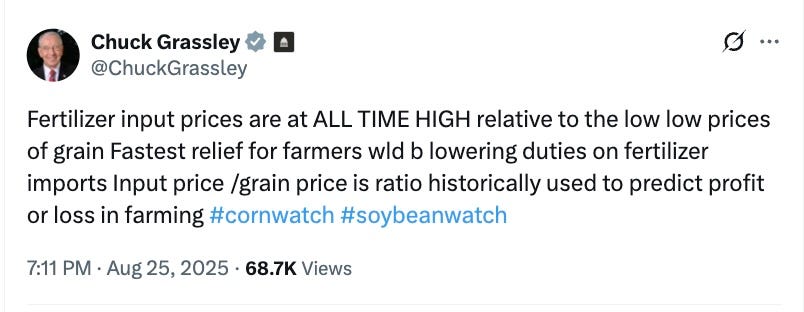
There’s a guy who definitely writes his own posts, who surely does watch a lot of corn. In an interview with RFD-TV, he vented more:
From the WSJ:
And the shortage of farmworkers is another self-made Trump problem. When the regime isn’t humiliatingly rounding up and detaining people with and without proper work visas, it’s also allowing the ones who do have H-2A visas to work in conditions one federal judge called “a form of modern-day slavery,” where they’re frequently abused, get their wages stolen, and are threatened with a call to ICE if they complain. (...)
And then there’s how USAID is no more, and not buying farmers’ extra grain any more. Cruel as they are stupid, ayup.
Are Republicans starting to smell the disaster Trump is brewing? Polling shows more Republicans than Democrats are worried about the economy, and Trump’s approval rating on the top issue dumbshit voters picked him to fix, The Groceries, has been going down to poundtown. And his approval rating is underwater in most states, including the breadbasket ones. Even in Arkansas, it’s plunged to single digits.
Anyway, it’s tempting to laugh at the poor dumb rural folk who thought that Donald Trump, the man who went broke on casinos, was going to be their savior. He bailed them out before, so guess they just expect that he and Congress will keep on doing it.
But we all have to eat, and bad news for The Groceries is bad news for everybody. But good news, soyboys, maybe at least domestic soybeans will be real cheap.
For fucking around with the world of Trump, some groups of people are reaching the find out phase faster and harder than others. And one of those groups is among the most loyal to the regime, farmers. While farm income is technically up, it’s only because of $42 billion in socialist bailout money in the form of a 720 percent increase in ad hoc disaster payments, that so far have made up more than 23 percent of Net Farm Income in 2025. But without that, farm income is down nearly 6 percent from December. And economists with the University of Illinois report that agricultural exports dropped by nearly $5 billion in just July alone.
The reason why is no mystery! Those Trump tariffs screwed over farmers coming and going, with higher input costs for supplies like seeds, fertilizer, and tractors, and lower selling prices for commodities. So far this year, China has not purchased one single, solitary soybean, opting to shop for them in friendlier Brazil, instead.
Of course Trump knew full well this was going to happen, because it happened in his first term too: He levied tariffs, farm bankruptcies reached the highest level in a decade, and he ended up giving farmers a $16 billion bailout. And now Agriculture Secretary Brooke Rollins says even more bailout money might be coming.
It would be simple to help out farmers without giving them any socialist bailout money. Quit tariffing fertilizer, for one thing! Even Chuck Grassley has noticed this.
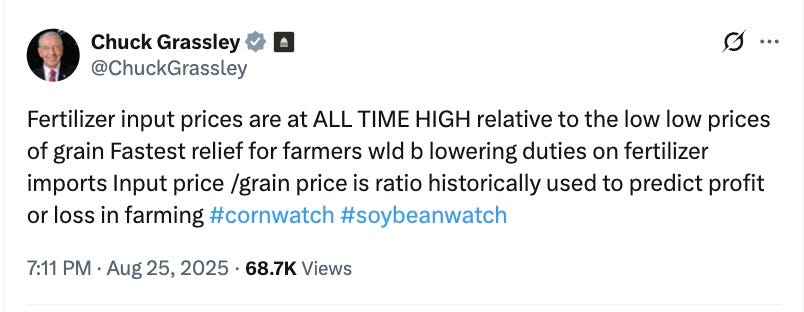
There’s a guy who definitely writes his own posts, who surely does watch a lot of corn. In an interview with RFD-TV, he vented more:
“We’ve got this farm crisis now, and this President should deal with this farm crisis right now. I’m hearing from bankers. I’m hearing from people that are getting pressed by their bankers to maybe sell part of their farm to somebody, [so] that when they build up their equity, they might be able to buy it back. We haven’t had this kind of stress in agriculture since the 1980s.”Another big-brain idea, quit tariffing tractors! Or even just make ONE tariff rate and stick to it. The tariffs aren’t only expensive, they’re bizarrely complicated, and of course, prone to shifting with the tides of Dear Leader’s ever-changing moods.
From the WSJ:
The effective tariff facing exporters now varies depending on a product’s metal content. For a machine worth $1 million with a 20% steel content, the rate would be 50% of $200,000 and 15% of the rest, resulting in a $220,000 levy per machine—or a 22% tariff. The U.S. has said it would review the metals tariff list every four months, adding to the uncertainty.Or as Grassley put it:
“Putting 50% tariffs on things that have steel in them, when you can’t buy those things in the United States, and you need them for your tractor to be finally manufactured? There should be tariffs on things that you can’t get in the United States. Why drive up the price of John Deeres because of a tariff on something they need for the tractor that they can’t even get in the United States? It’s a stupid policy.”Indeed, if the point of these tariffs is to start making more tractors in the US, why put kooky tariffs on the metal that tractors are made out of? If we were cynical, it might seem like a ploy to make farmland real cheap so big agribusiness can buy it all up.
And the shortage of farmworkers is another self-made Trump problem. When the regime isn’t humiliatingly rounding up and detaining people with and without proper work visas, it’s also allowing the ones who do have H-2A visas to work in conditions one federal judge called “a form of modern-day slavery,” where they’re frequently abused, get their wages stolen, and are threatened with a call to ICE if they complain. (...)
And then there’s how USAID is no more, and not buying farmers’ extra grain any more. Cruel as they are stupid, ayup.
Are Republicans starting to smell the disaster Trump is brewing? Polling shows more Republicans than Democrats are worried about the economy, and Trump’s approval rating on the top issue dumbshit voters picked him to fix, The Groceries, has been going down to poundtown. And his approval rating is underwater in most states, including the breadbasket ones. Even in Arkansas, it’s plunged to single digits.
Anyway, it’s tempting to laugh at the poor dumb rural folk who thought that Donald Trump, the man who went broke on casinos, was going to be their savior. He bailed them out before, so guess they just expect that he and Congress will keep on doing it.
But we all have to eat, and bad news for The Groceries is bad news for everybody. But good news, soyboys, maybe at least domestic soybeans will be real cheap.
by Marci Jones, Wonkette | Read more:
Image: Tomasz Filipek on Unsplash
[ed. For a clear explanation of why so many farmers supported Trump (knowing full well the downsides). See this:
[ed. For a clear explanation of why so many farmers supported Trump (knowing full well the downsides). See this:
How I Joined the Resistance
The religious evolution of J.D. Vance.
To lose my faith was to lose my cultural conservatism, and in a world that was growing increasingly aligned with the Republican party, my ideological response took the form of overcompensation: having lost my cultural conservatism, I would become even more economically conservative. The irony, of course, is that it was the economic program of the Republican party that least interested my family—none of them cared how much the Bush administration slashed tax rates for billionaires. The G.O.P. became a kind of totem—I attached myself to it ever more strongly because it gave me some common ground with my family. And the most respectable way to do so among my new college friends was through a dogged commitment to neoliberal economic orthodoxy. Tax breaks and Social Security cuts were socially acceptable ways to be conservative among the American elite. (...)

I had immersed myself in the logic of the meritocracy and found it deeply unsatisfying. And I began to wonder: were all these worldly markers of success actually making me a better person? I had traded virtue for achievement and found the latter wanting. But the woman I wanted to marry cared little whether I obtained a Supreme Court clerkship. She just wanted me to be a good person.
It’s possible, of course, to overstate our own inadequacies. I never cheated on my would-be spouse. I never became violent with her. But there was a voice in my head that demanded better of me: that I put her interests above my own; that I master my temper for her sake as much as for mine. And I began to realize that this voice, wherever it came from, was not the same one that compelled me to climb as high as I could up our ladder of meritocracy. It came from somewhere more ancient, and more grounded—it required reflection about where I came from rather than cultural divorce from it.
As I considered these twin desires—for success and character—and how they conflicted (and didn’t), I came across a meditation from Saint Augustine on Genesis. I had been a fan of Augustine since a political theorist in college assigned City of God. But his thoughts on Genesis spoke to me, and are worth reproducing at length:
In matters that are obscure and far beyond our vision, even in such as we may find treated in Holy Scripture, different Interpretations are sometimes possible without prejudice to the faith we have received. In such a case, we should not rush in headlong and so firmly take our stand on one side that, if further progress in the search of truth justly undermines this position, we too fall with it. That would be to battle not for the teaching of Holy Scripture but for our own, wishing its teaching to conform to ours, whereas we ought to wish ours to conform to that of Sacred Scripture.I couldn’t stop thinking about how I would have reacted to this passage when I was a kid: If someone had made the very same argument to me when I was 17, I would have called him a heretic. This was an accommodation to science, the kind that someone like Bill Maher rightly mocked contemporary moderate Christians for indulging. Yet here was a person telling us 1600 years ago that my own approach to Genesis was arrogance—the kind that might turn a person from his faith.
Let us suppose that in explaining the words, “And God said, ‘Let there be light,’ and light was made,” (Gn 1, 3), one man thinks that it was material light that was made, and another that it was spiritual. As to the actual existence of “spiritual light” in a spiritual creature, our faith leaves no doubt; as to the existence of material light, celestial or supercelestial, even existing before the heavens, a light which could have been followed by night, there will be nothing in such a supposition contrary to the faith until un-erring truth gives the lie to it. And if that should happen, this teaching was never in Holy Scripture but was an opinion proposed by man in his ignorance.
Usually, even a non-Christian knows something about the earth, the heavens, and the other elements of the world, about the motion and orbit of the stars and even their size and relative positions, about the predictable eclipses of the sun and moon, the cycles of the years and the seasons, about the kinds of animals, shrubs, stones, and so forth, and this knowledge he holds to as being certain from reason and experience. Now, it is a disgraceful and dangerous thing for an infidel to hear a Christian, presumably giving the meaning of Holy Scripture, talking nonsense on these topics; and we should take all means to prevent such an embarrassing situation, in which people show up vast ignorance in a Christian and laugh it to scorn. The shame is not so much that an ignorant individual is derided, but that people outside the household of faith think our sacred writers held such opinions, and, to the great loss of those for whose salvation we toil, the writers of our Scripture are criticized and rejected as unlearned men. If they find a Christian mistaken in a field which they themselves know well and hear him maintaining his foolish opinions about our books, how are they going to believe those books in matters concerning the resurrection of the dead, the hope of eternal life, and the kingdom of heaven, when they think their pages are full of falsehoods on facts which they themselves have learnt from experience and the light of reason?
This, it turned out, was a little too on the nose, and the first crack in my proverbial armor. I began circulating the quote among friends—believers and nonbelievers alike, and I thought about it constantly.
Around the same time, I attended a talk at our law school with Peter Thiel. This was 2011, and Thiel was a well-known venture capitalist but hardly a household name. He would later blurb my book and become a good friend, but I had no idea what to expect at the time. He spoke first in personal terms: arguing that we were increasingly tracked into cutthroat professional competitions. We would compete for appellate clerkships, and then Supreme Court clerkships. We would compete for jobs at elite law firms, and then for partnerships at those same places. At each juncture, he said, our jobs would offer longer work hours, social alienation from our peers, and work whose prestige would fail to make up for its meaninglessness. He also argued that his own world of Silicon Valley spent too little time on the technological breakthroughs that made life better—those in biology, energy, and transportation—and too much on things like software and mobile phones. Everyone could now tweet at each other, or post photos on Facebook, but it took longer to travel to Europe, we had no cure for cognitive decline and dementia, and our energy use increasingly dirtied the planet. He saw these two trends—elite professionals trapped in hyper-competitive jobs, and the technological stagnation of society—as connected. If technological innovation were actually driving real prosperity, our elites wouldn’t feel increasingly competitive with one another over a dwindling number of prestigious outcomes.
Peter’s talk remains the most significant moment of my time at Yale Law School. He articulated a feeling that had until then remained unformed: that I was obsessed with achievement in se—not as an end to something meaningful, but to win a social competition. My worry that I had prioritized striving over character took on a heightened significance: striving for what? I didn’t even know why I cared about the things I cared about. I fancied myself educated, enlightened, and especially wise about the ways of the world—at least compared with most of the people from my hometown. Yet I was obsessed with obtaining professional credentials—a clerkship with a federal judge and then an associate position at a prestigious firm—that I didn’t understand. I hated my limited exposure to legal practice. I looked to the future, and realized that I’d been running a desperate race where the first prize was a job I hated.
I began immediately planning for a career outside the law, which is why I spent less than two years after graduation as a practicing attorney. But Peter left me with one more thing: he was possibly the smartest person I’d ever met, but he was also a Christian. He defied the social template I had constructed—that dumb people were Christians and smart ones atheists. I began to wonder where his religious belief came from, which led me to René Girard, the French philosopher whom he apparently studied under at Stanford. Girard’s thought is rich enough that any effort to summarize will fail to do the man justice. His theory of mimetic rivalry—that we tend to compete over the things that other people want—spoke directly to some of the pressures I experienced at Yale. But it was his related theory of the scapegoat—and what it revealed about Christianity—that made me reconsider my faith.
One of Girard’s central insights is that human civilizations are often, perhaps even always, founded on a “scapegoat myth”—an act of violence committed against someone who has wronged the broader community, retold as a sort of origin story for the community.
(...)
To Girard, the Christian story contains a crucial difference—a difference that reveals something “hidden since the foundation of the world.” In the Christian telling, the ultimate scapegoat has not wronged the civilization; the civilization has wronged him. The victim of the madness of crowds is, as Christ was, infinitely powerful—able to prevent his own murder—and perfectly innocent—undeserving of the rage and violence of the crowd. In Christ, we see our efforts to shift blame and our own inadequacies onto a victim for what they are: a moral failing, projected violently upon someone else. Christ is the scapegoat who reveals our imperfections, and forces us to look at our own flaws rather than blame our society’s chosen victims.
People come to truth in different ways, and I’m sure some will find this account unsatisfying. But in 2013, it captured so well the psychology of my generation, especially its most privileged inhabitants. Mired in the swamp of social media, we identified a scapegoat and digitally pounced. We were keyboard warriors, unloading on people via Facebook and Twitter, blind to our own problems. We fought over jobs we didn’t actually want while pretending we didn’t fight for them at all. And the end result for me, at least, was that I had lost the language of virtue. I felt more shame over failing in a law school exam than I did about losing my temper with my girlfriend.
That all had to change. It was time to stop scapegoating and focus on what I could do to improve things. (...)
I noticed during my research that many of those social problems came from behavior for which social scientists and policy experts had a different vocabulary. On the right, the conversation often turned to “culture” and “personal responsibility”—the ways in which individuals or communities held back their own progress. And though it seemed obvious to me that there was something dysfunctional about some of the places in which I’d grown up, the discourse on the right seemed a little heartless. It failed to account for the fact that destructive behaviors were almost always tragedies with terrible consequences. It is one thing to wag your finger at another person for failing to act a certain way, but it is something else to feel the weight of the misery that comes from those actions.
The left’s intellectuals focused much more on the structural and external problems facing families like mine—the difficulty in finding jobs and the lack of funding for certain types of resources. And while I agreed that more resources were often necessary, there seemed to me a sense in which our most destructive behaviors persisted—even flourished—in times of material comfort. The economic left was often more compassionate, but theirs was a kind of compassion—devoid of any expectation—that reeked of giving up. A compassion that assumes a person is disadvantaged to the point of hopelessness is like sympathy for a zoo animal, and I had no use for it.
And as I reflected on these competing views of the world, and the wisdom and shortcomings of each, I felt desperate for a worldview that understood our bad behavior as simultaneously social and individual, structural and moral; that recognized that we are products of our environment; that we have a responsibility to change that environment, but that we are still moral beings with individual duties; one that could speak against rising rates of divorce and addiction, not as sanitized conclusions about their negative social externalities, but with moral outrage. (...)
And here, again, the words of Saint Augustine echoed from a millennium and a half earlier, articulating a truth I had felt for a long time but hadn’t spoken. This is a passage from City of God, where Augustine summarizes the debauchery of Rome’s ruling class:
This is our concern, that every man be able to increase his wealth so as to supply his daily prodigalities, and so that the powerful may subject the weak for their own purposes. Let the poor court the rich for a living, and that under their protection they may enjoy a sluggish tranquillity; and let the rich abuse the poor as their dependants, to minister to their pride. Let the people applaud not those who protect their interests, but those who provide them with pleasure. Let no severe duty be commanded, no impurity forbidden. Let kings estimate their prosperity, not by the righteousness, but by the servility of their subjects. Let the provinces stand loyal to the kings, not as moral guides, but as lords of their possessions and purveyors of their pleasures; not with a hearty reverence, but a crooked and servile fear. Let the laws take cognizance rather of the injury done to another man’s property, than of that done to one’s own person. If a man be a nuisance to his neighbor, or injure his property, family, or person, let him be actionable; but in his own affairs let everyone with impunity do what he will in company with his own family, and with those who willingly join him. Let there be a plentiful supply of public prostitutes for every one who wishes to use them, but specially for those who are too poor to keep one for their private use. Let there be erected houses of the largest and most ornate description: in these let there be provided the most sumptuous banquets, where every one who pleases may, by day or night, play, drink, vomit, dissipate. Let there be everywhere heard the rustling of dancers, the loud, immodest laughter of the theatre; let a succession of the most cruel and the most voluptuous pleasures maintain a perpetual excitement. If such happiness is distasteful to any, let him be branded as a public enemy; and if any attempt to modify or put an end to it let him be silenced, banished, put an end to. Let these be reckoned the true gods, who procure for the people this condition of things, and preserve it when once possessed.It was the best criticism of our modern age I’d ever read. A society oriented entirely towards consumption and pleasure, spurning duty and virtue. Not long after I first read these words, my friend Oren Cass published a book arguing that American policy makers have focused far too much on promoting consumption as opposed to productivity, or some other measure of wellbeing. The reaction—criticizing Oren for daring to push policies that might lower consumption—almost proved the argument. “Yes,” I found myself saying, “Oren’s preferred policies might reduce per-capita consumption. But that’s precisely the point: our society is more than the sum of its economic statistics. If people die sooner in the midst of historic levels of consumption, then perhaps our focus on consumption is misguided.”
And indeed it was this insight, more than any other, that ultimately led not just to Christianity, but to Catholicism. Despite my Mamaw’s unfamiliarity with the liturgy, the Roman and Italian cultural influences, and the foreign pope, I slowly began to see Catholicism as the closest expression of her kind of Christanity: obsessed with virtue, but cognizant of the fact that virtue is formed in the context of a broader community; sympathetic with the meek and poor of the world without treating them primarily as victims; protective of children and families and with the things necessary to ensure they thrive. And above all: a faith centered around a Christ who demands perfection of us even as He loves unconditionally and forgives easily.
by J.D. Vance, The Lamp | Read more:
Image: uncredited
[ed. Poor J.D. definitely lost the plot (not hard if solipsism and rationalization are your super powers). Hard to feel sorry for him though. In his present world view - Catholic or not - ambition (maybe destiny!) Trumps everything.]
Wednesday, September 17, 2025
Buddies

Image: Twentieth Century Fox Film Corporation/Sunset Boulevard/Corbis, via Getty Images
[ed. Time marches on, and friendships... what you make of them. See also: Robert Redford and the Perils of Perfection (New Yorker).]

Decades of Public-Lands Planning, Overturned in a Day
On the sagebrush plains of eastern Montana, cattle graze alongside mule deer, and pumpjacks rise from coal seams. For nearly a decade, the future of this landscape was hammered out in the Miles City Resource Management Plan, a compromise shaped by ranchers, tribes, hunters, energy companies and conservationists. Now, with one vote in Washington, Congress has thrown that bargain into doubt, and with it, decades of public-lands decisions across the West.
Finalized in November 2024 after years of debate and litigation, the Miles City plan is one of the nation’s largest, governing 12 million acres of BLM land and 55 million acres of federal mineral estate across eastern Montana.

Finalized in November 2024 after years of debate and litigation, the Miles City plan is one of the nation’s largest, governing 12 million acres of BLM land and 55 million acres of federal mineral estate across eastern Montana.
But on Sept. 3, the U.S. House of Representatives voted to overturn three Bureau of Land Management plans, including Miles City, under the Congressional Review Act, the first time the law has ever been applied to land-use planning. Legal experts and conservation groups warn that the consequences could be far-reaching, enabling Congress to unravel decades of environmental protections and management decisions on public lands.
Resource management plans serve as guidelines for how the BLM manages the public lands it oversees. The plans are developed through a lengthy process that combines local and tribal input with environmental review under the National Environmental Policy Act. The goal is to create a blueprint for “multiple use” management, balancing economic activities such as grazing and oil and gas development with other concerns, including wildlife habitat, outdoor recreation and conservation.
In Montana, the disappearance of that blueprint will have immediate consequences. Ranchers face uncertainty on how many cattle they can run, when their permits will be renewed, and what will happen during a serious drought. Tribal cultural sites are likely to be left unprotected and years of tribal consultation overridden. Conservation groups warn that congressional vetoes could sideline science-based safeguards for vulnerable habitats. In Miles City, the resource management plan would have reformed coal seam leases near the Powder River Basin; without those reforms, habitat for elk, mule deer, sharp-tailed grouse and pheasants could be fragmented by new energy development.
The Miles City plan drew input from ranchers, tribes, energy companies, hunters, outdoor recreation groups and conservation groups, and its supporters argue that undoing it sets a dangerous precedent.
“It’s disregarding all the conversations that have happened on the ground,” said Land Tawney of American Hunters and Anglers. “That balance sometimes isn’t perfect for anybody, but it’s a path forward for all.” (...)
The 1996 Congressional Review Act allows Congress to overturn agency rules within a 60-day window using only a simple majority, bypassing the filibuster. This is the first time resource management plans have ever been treated as “rules.”
“That’s why we’re at an inflection point,” said Chris Winter, director of the Getches-Wilkinson Center at the University of Colorado Law School. (Disclosure: Winter serves on High Country News’ board of directors.) Resource management plans, he said, have never been submitted to Congress for review. “Applying it now could unravel decades of land-use planning practice,” he said.
The CRA was employed only once before 2017, but the first Trump administration dramatically expanded its use. If this resolution stands, it would subject all RMPs to possible congressional approval, throwing every element of the planning process into doubt. According to Michael Blumm, a professor at Lewis & Clark Law School, this reinterpretation “calls into question the legitimacy” of the more than 100 plans finalized since the Congressional Review Act became law.
by Zoë Rom, High Country News | Read more:
Image: Luna Anna Archey
Resource management plans serve as guidelines for how the BLM manages the public lands it oversees. The plans are developed through a lengthy process that combines local and tribal input with environmental review under the National Environmental Policy Act. The goal is to create a blueprint for “multiple use” management, balancing economic activities such as grazing and oil and gas development with other concerns, including wildlife habitat, outdoor recreation and conservation.
In Montana, the disappearance of that blueprint will have immediate consequences. Ranchers face uncertainty on how many cattle they can run, when their permits will be renewed, and what will happen during a serious drought. Tribal cultural sites are likely to be left unprotected and years of tribal consultation overridden. Conservation groups warn that congressional vetoes could sideline science-based safeguards for vulnerable habitats. In Miles City, the resource management plan would have reformed coal seam leases near the Powder River Basin; without those reforms, habitat for elk, mule deer, sharp-tailed grouse and pheasants could be fragmented by new energy development.
The Miles City plan drew input from ranchers, tribes, energy companies, hunters, outdoor recreation groups and conservation groups, and its supporters argue that undoing it sets a dangerous precedent.
“It’s disregarding all the conversations that have happened on the ground,” said Land Tawney of American Hunters and Anglers. “That balance sometimes isn’t perfect for anybody, but it’s a path forward for all.” (...)
The 1996 Congressional Review Act allows Congress to overturn agency rules within a 60-day window using only a simple majority, bypassing the filibuster. This is the first time resource management plans have ever been treated as “rules.”
“That’s why we’re at an inflection point,” said Chris Winter, director of the Getches-Wilkinson Center at the University of Colorado Law School. (Disclosure: Winter serves on High Country News’ board of directors.) Resource management plans, he said, have never been submitted to Congress for review. “Applying it now could unravel decades of land-use planning practice,” he said.
The CRA was employed only once before 2017, but the first Trump administration dramatically expanded its use. If this resolution stands, it would subject all RMPs to possible congressional approval, throwing every element of the planning process into doubt. According to Michael Blumm, a professor at Lewis & Clark Law School, this reinterpretation “calls into question the legitimacy” of the more than 100 plans finalized since the Congressional Review Act became law.
by Zoë Rom, High Country News | Read more:
Image: Luna Anna Archey
[ed. See also: Trump looks to suffocate public lands; and, How to comment on the planned roadless rule rollback (HCN).]
Tuesday, September 16, 2025

Hot Dog University
A man in a Vienna Beef apron is lecturing into a speakerphone. Somewhere, someone scribbles notes in the margins of a Costco receipt. Elsewhere, a woman slices onions with the precision of a surgeon. A teenager in Chicago buffs his stainless steel hot dog cart until it gleams like a spaceship. A former landscape mogul-turned-cannabis-entrepreneur serves 20 custom hot dogs from a hand-built stand nestled between a ski mountain in Vermont and his dispensary. In Washington State, a Silicon Valley escapee helps his social media manager capture the perfect shot of his stand. A retired math professor counts out buns in Texas. In North Carolina, a man unfurls a 14-foot banner that reads BIG SEXY DAWGS, then opens a folding chair and waits for customers outside a rowdy college bar.
Different zip codes, different lives, but somehow, they all trace the same strange road back to a place called Hot Dog University.Yes, that’s a real place — tucked into the back of the Vienna Beef factory on Chicago’s North Side. Part classroom, part test kitchen, part pilgrimage for anyone who’s ever dreamed of slinging sausages for a living.
 Every graduate of Hot Dog U knows the drill. They've studied the sacred script. They know the snap of the casing is non-negotiable. They've practiced the topping order like it’s a choreography: yellow mustard, neon green relish, chopped onions, tomato wedges, a pickle spear, sport peppers, and just a dash of celery salt.
And they all know the cardinal rule, taught by their P.H.D. (that’s Professor of Hot Dogs): no ketchup. Unless you still ride a tricycle (and can prove it), you're pregnant (we don’t argue with cravings), or it’s your wedding day (and we’d better see the dress).
It’s easy to laugh, until it isn’t.
This is serious business and the students at Hot Dog U are gearing up. Not just for summer, but for something bigger — independence, reinvention, the hope that if they can just get the cart to the right corner, maybe, just maybe, everything might work out.
It’s a little Ted Lasso, a little Abbott Elementary — big-hearted, scrappy, and, unexpectedly, profound. Our story begins in a classroom where the lessons are about hot dogs, sure. But this is also a story about failure and second chances, hustle and hope, and the deeply American belief that a sidewalk, a spatula, and a dream might still be enough.
In my family, hot dogs were never just food. They were in-between moments: passed across bleacher seats at ballgames, devoured at gas station stops, slightly charred at backyard cookouts. Hot dogs became shorthand for time spent together.
So when I set out to report this story, it wasn’t because I had a grand theory about encased meats. It was something more subtle: a soft spot for a food that always felt like home. And I didn’t expect to find much more than nostalgia.
But what I found at Hot Dog U wasn’t just a quirky trade school with a great logo. People arrive from burned-out careers and unexpected life turns, from family kitchens and military mess halls, carrying stories as varied as their menus. They leave with a cart, a diploma, and — if it works — a shot at something better.
There’s something quietly radical about that. In a country where “entrepreneur” has become a buzzword for tech bros and hustlers, the students at Hot Dog U are a different breed. They're working-class dreamers. Retired couples. First-generation families. People who don’t want to disrupt the industry. They just want a patch of sidewalk, a roll of napkins, and a line of hungry customers.
by Celia Aniskovich, Switchboard | Read more:
Image: Hot Dog University poster
[ed. From things I've heard it can be a pretty cutthroat business. Mostly about getting the right spot.]
Different zip codes, different lives, but somehow, they all trace the same strange road back to a place called Hot Dog University.Yes, that’s a real place — tucked into the back of the Vienna Beef factory on Chicago’s North Side. Part classroom, part test kitchen, part pilgrimage for anyone who’s ever dreamed of slinging sausages for a living.

And they all know the cardinal rule, taught by their P.H.D. (that’s Professor of Hot Dogs): no ketchup. Unless you still ride a tricycle (and can prove it), you're pregnant (we don’t argue with cravings), or it’s your wedding day (and we’d better see the dress).
It’s easy to laugh, until it isn’t.
This is serious business and the students at Hot Dog U are gearing up. Not just for summer, but for something bigger — independence, reinvention, the hope that if they can just get the cart to the right corner, maybe, just maybe, everything might work out.
It’s a little Ted Lasso, a little Abbott Elementary — big-hearted, scrappy, and, unexpectedly, profound. Our story begins in a classroom where the lessons are about hot dogs, sure. But this is also a story about failure and second chances, hustle and hope, and the deeply American belief that a sidewalk, a spatula, and a dream might still be enough.
In my family, hot dogs were never just food. They were in-between moments: passed across bleacher seats at ballgames, devoured at gas station stops, slightly charred at backyard cookouts. Hot dogs became shorthand for time spent together.
So when I set out to report this story, it wasn’t because I had a grand theory about encased meats. It was something more subtle: a soft spot for a food that always felt like home. And I didn’t expect to find much more than nostalgia.
But what I found at Hot Dog U wasn’t just a quirky trade school with a great logo. People arrive from burned-out careers and unexpected life turns, from family kitchens and military mess halls, carrying stories as varied as their menus. They leave with a cart, a diploma, and — if it works — a shot at something better.
There’s something quietly radical about that. In a country where “entrepreneur” has become a buzzword for tech bros and hustlers, the students at Hot Dog U are a different breed. They're working-class dreamers. Retired couples. First-generation families. People who don’t want to disrupt the industry. They just want a patch of sidewalk, a roll of napkins, and a line of hungry customers.
by Celia Aniskovich, Switchboard | Read more:
Image: Hot Dog University poster
[ed. From things I've heard it can be a pretty cutthroat business. Mostly about getting the right spot.]

Subscribe to:
Posts (Atom)