
Saturday, February 28, 2026
Hissy Fit

The public spat between the Pentagon and Anthropic began after Axios reported that US military leaders used Claude to assist in planning its operation to capture Venezuela’s president, Nicolás Maduro. After the operation, an employee at Palantir relayed concerns from an Anthropic staffer to US military leaders about how its models had been used. Anthropic has denied ever raising concerns or interfering with the Pentagon’s use of its technology. (Ars Technica).
Undersecretary of State Jeremy Lewin: This isn’t about Anthropic or the specific conditions at issue. It’s about the broader premise that technology deeply embedded in our military must be under the exclusive control of our duly elected/appointed leaders. No private company can dictate normative terms of use—which can change and are subject to interpretation—for our most sensitive national security systems. The @DeptofWar obviously can’t trust a system a private company can switch off at any moment.Dario Amodei and Anthropic responded to this on Thursday the 26th with this brave and historically important statement that everyone should read.
Timothy B. Lee: OK, so don't renew their contract. Why are you threatening to go nuclear by declaring them a supply chain risk?
Dean W. Ball: As I have been saying repeatedly, this principle is entirely defensible, and this is the single best articulation of it anyone in the administration has made.
The way to enforce this principle is to publicly and proudly decline to do business with firms that don’t agree to those terms. Cancel Anthropic’s contract, and make it publicly clear why you did so.
Right now, though, USG’s policy response is to attempt to destroy Anthropic’s business, and this is a dire mistake for both practical and principled reasons.
The statement makes clear that Anthropic wishes to work with the Department of War, and that they strongly wish to continue being government contractors, but that they cannot accept the Department of War’s terms, nor do any threats change their position. Response outside of DoW was overwhelmingly positive.
by Zvi Mowshowitz, DWAtV | Read more:
Image: Truth Social
[ed. Another rant from the Mad King™. Anthropic had a contract with DOD that included terms DOD now wants to reneg on. Just cancel the damn contract. See also: Statement from Dario Amodei on our discussions with the Department of War (Anthropic). My admiration for Amodei and Anthropic has gone up ten fold in the last two weeks. What's at stake (DWAtV):]
Axios calls this a ‘first step towards blacklisting Anthropic.’
I would instead call this as the start of a common sense first step you would take long before you actively threaten to slap a ‘supply chain risk’ designation on Anthropic. It indicates that the Pentagon has not done the investigation of ‘exactly how big of a cluster**** would this be’ and I highly encourage them to check.
This goes well beyond those people entirely ignoring existential risk. The Very Serious People are denying existence of powerful AI, or transformational AI, now and in the future, even on a mundane level, period. Dean came in concerned about impacts on developing economies in the Global South, and they can’t even discuss that.
***
Axios calls this a ‘first step towards blacklisting Anthropic.’
I would instead call this as the start of a common sense first step you would take long before you actively threaten to slap a ‘supply chain risk’ designation on Anthropic. It indicates that the Pentagon has not done the investigation of ‘exactly how big of a cluster**** would this be’ and I highly encourage them to check.
Divyansh Kaushik: Are we seriously going to label Anthropic a supply chain risk but are totally fine with Alibaba/Qwen, Deepseek, Baidu, etc? What are we doing here?An excellent question. Certainly we can agree that Alibaba, Qwen, Deepseek or Baidu are all much larger ‘supply chain risks’ than Anthropic. So why haven’t we made those designations yet? [...]
Dean W. Ball: At some point in 2024, for reasons I still do not entirely understand, global elites simply decided: “no, we do not live in that world. We live in this other world, the nice one, where the challenges are all things we can understand and see today.”
Those who think we might live in that world talk about what to do, but mostly in private these days. It is not considered polite—indeed it is considered a little discrediting in many circles—to talk about the issues of powerful AI.
Yet the people whose technical intuitions I respect the most are convinced we do live in that world, and so am I.
The American elites aren’t quite as bad about that, but not as bad isn’t going to cut it.
We are indeed living in that world. We do not yet know yet which version of it, or if we will survive in it for long, but if you want to have a say in that outcome you need to get in the game. If you want to stop us from living in that world, that ship has sailed, and to the extent it hasn’t the first step is admitting you have a problem.
But the question is very much “what are autonomous swarms of superintelligent agents going to mean for our lives?” as opposed to “will we see autonomous swarms of superintelligent agents in the near future?”What it probably means for our lives is that it ends them. What it definitely doesn’t mean for our lives is going on as before, or a ‘gentle singularity’ you barely notice.
Elites that do not talk about such issues will not long remain elites. That might be because all the humans are dead, or it might be because they wake up one morning and realize other people, AIs or a combination thereof are the new elite, without realizing how lucky they are to still be waking up at all.
I am used to the idea of Don’t Look Up for existential risk, but I haven’t fully internalized how much of the elites are going Don’t Look Up for capabilities, period.


February 27, 2026
On Monday, February 23, Daniel Ruetenik, Pat Milton, and Cara Tabachnick of CBS News reported a newly uncovered document in the Epstein files shows that the U.S. Drug Enforcement Agency (DEA) was running an investigation of Jeffrey Epstein and fourteen other people for drug trafficking, prostitution, and money laundering.
This investigation—which is different from the sex trafficking case under way when he died—began on December 17, 2010, under the Obama administration and was still operating in 2015. A heavily redacted document in the Epstein files from the director of the DEA’s Organized Crime Drug Enforcement Task Forces (OCDETF) said “DEA reporting indicates the above individuals are involved in illegitimate wire transfers which are tied to illicit drug and/or prostitution activities occurring in the U.S. Virgin Islands and New York City.” The investigation was named “Chain Reaction.”
 Senator Ron Wyden of Oregon, the top-ranking Democrat on the Senate Finance Committee, described OCDETF as “a premier task force set up to identify, disrupt and dismantle major organized crime and drug trafficking operations.” It “worked with partners across federal agencies to conduct sophisticated investigations into transnational organized crime and money laundering. OCDETF frequently targeted dangerous drug cartels , the Russian mafia and violent gangs moving fentanyl and weapons.” The Trump administration dismantled OCDETF.
The document is 69 pages long and is heavily redacted. It comes from a request by the DEA to an Organized Crime Drug Enforcement Task Forces Fusion Center in Virginia for information from other agencies related to Epstein and the other targets. A law enforcement source told the reporters that a request to the Fusion Center is not routine, which suggests the investigation was a “significant” one.
Wyden has been investigating the finances behind Epstein’s criminal sex trafficking organization. His investigation has turned up the information that JPMorgan Chase neglected to report more than $4 billion in suspicious financial transactions linked to Epstein. Treasury Secretary Scott Bessent has refused to produce the records to the Senate Finance Committee, and in September, Wyden introduced the Produce Epstein Treasury Records Act (PETRA) to get access to them. In November, Congress passed the Epstein Files Transparency Act, but it did not cover Treasury financial records.
“The basic question here is whether a bunch of rich pedophiles and Epstein accomplices are going to face any consequences for their crimes,” Wyden said, “and Scott Bessent is doing his best to make sure they won’t. My head just about exploded when I heard Bessent say it wasn’t his department’s job to investigate these Epstein bank records…. From the beginning, my view has been that following the money is the key to identifying Epstein’s clients as well as the henchmen and banks that enabled his sex trafficking network. It’s past time for Bessent to quit running interference for pedophiles and give us the Epstein files he’s sitting on.”
When the CBS News reporters broke the story about the DEA investigation, Wyden said: “It appears Epstein was involved in criminal activity that went way beyond pedophilia and sex trafficking, which makes it even more outrageous that [Attorney General] Pam Bondi is sitting on several million unreleased files.”
On Wednesday, February 23, Wyden wrote to Terrance C. Cole, administrator of the DEA, noting that “[t]he fact that Epstein was under investigation by the DOJ’s OCDETF task force suggests that there was ample evidence indicating that Epstein was engaged in heavy drug trafficking and prostitution as part of cross-border criminal conspiracy. This is incredibly disturbing and raises serious questions as to how this investigation by the DEA was handled.”
He noted that Epstein and the fourteen co-conspirators were never charged for drug trafficking or financial crimes, and wrote: “I am concerned that the DEA and DOJ during the first Trump Administration moved to terminate this investigation in order to protect pedophiles.” He also noted that the heavy redactions in the document appear to go far beyond anything authorized by the Epstein Files Transparency Act, and since the document was not classified, “there is no reason to withhold an unredacted version of this document from the U.S. Congress.
Wyden asked Cole to produce a number of documents by March 13, 2026, two weeks away. Wyden asked for an unredacted copy of the memo in the files, information about what triggered the investigation, what types of drugs Epstein and his fourteen associates were buying or selling, when operation “Chain Reaction” concluded and what was its result, why no one was charged, and why the names of the fourteen co-conspirators were redacted.
Asked by a reporter about Epstein today, Trump said: “I don’t know anything about the Epstein files. I’ve been fully exonerated.”
Trump’s name is, in fact, all through the Epstein files, and the DOJ’s clumsy attempt to hide files that discuss him has only called attention to them. The recent news that the DOJ withheld files about allegations that Trump raped a 13-year-old girl has raised suggestions of an illegal coverup, whether the allegations are true or not. Representative Robert Garcia of California, the top Democrat on the House Oversight Committee, says he will open an investigation. [ed. See: DOJ Removed Record of Multiple FBI Interviews with Underage Trump Accuser, Epstein Data Shows (Roger Sollenberger).]
This investigation—which is different from the sex trafficking case under way when he died—began on December 17, 2010, under the Obama administration and was still operating in 2015. A heavily redacted document in the Epstein files from the director of the DEA’s Organized Crime Drug Enforcement Task Forces (OCDETF) said “DEA reporting indicates the above individuals are involved in illegitimate wire transfers which are tied to illicit drug and/or prostitution activities occurring in the U.S. Virgin Islands and New York City.” The investigation was named “Chain Reaction.”
The document is 69 pages long and is heavily redacted. It comes from a request by the DEA to an Organized Crime Drug Enforcement Task Forces Fusion Center in Virginia for information from other agencies related to Epstein and the other targets. A law enforcement source told the reporters that a request to the Fusion Center is not routine, which suggests the investigation was a “significant” one.
Wyden has been investigating the finances behind Epstein’s criminal sex trafficking organization. His investigation has turned up the information that JPMorgan Chase neglected to report more than $4 billion in suspicious financial transactions linked to Epstein. Treasury Secretary Scott Bessent has refused to produce the records to the Senate Finance Committee, and in September, Wyden introduced the Produce Epstein Treasury Records Act (PETRA) to get access to them. In November, Congress passed the Epstein Files Transparency Act, but it did not cover Treasury financial records.
“The basic question here is whether a bunch of rich pedophiles and Epstein accomplices are going to face any consequences for their crimes,” Wyden said, “and Scott Bessent is doing his best to make sure they won’t. My head just about exploded when I heard Bessent say it wasn’t his department’s job to investigate these Epstein bank records…. From the beginning, my view has been that following the money is the key to identifying Epstein’s clients as well as the henchmen and banks that enabled his sex trafficking network. It’s past time for Bessent to quit running interference for pedophiles and give us the Epstein files he’s sitting on.”
When the CBS News reporters broke the story about the DEA investigation, Wyden said: “It appears Epstein was involved in criminal activity that went way beyond pedophilia and sex trafficking, which makes it even more outrageous that [Attorney General] Pam Bondi is sitting on several million unreleased files.”
On Wednesday, February 23, Wyden wrote to Terrance C. Cole, administrator of the DEA, noting that “[t]he fact that Epstein was under investigation by the DOJ’s OCDETF task force suggests that there was ample evidence indicating that Epstein was engaged in heavy drug trafficking and prostitution as part of cross-border criminal conspiracy. This is incredibly disturbing and raises serious questions as to how this investigation by the DEA was handled.”
He noted that Epstein and the fourteen co-conspirators were never charged for drug trafficking or financial crimes, and wrote: “I am concerned that the DEA and DOJ during the first Trump Administration moved to terminate this investigation in order to protect pedophiles.” He also noted that the heavy redactions in the document appear to go far beyond anything authorized by the Epstein Files Transparency Act, and since the document was not classified, “there is no reason to withhold an unredacted version of this document from the U.S. Congress.
Wyden asked Cole to produce a number of documents by March 13, 2026, two weeks away. Wyden asked for an unredacted copy of the memo in the files, information about what triggered the investigation, what types of drugs Epstein and his fourteen associates were buying or selling, when operation “Chain Reaction” concluded and what was its result, why no one was charged, and why the names of the fourteen co-conspirators were redacted.
Asked by a reporter about Epstein today, Trump said: “I don’t know anything about the Epstein files. I’ve been fully exonerated.”
Trump’s name is, in fact, all through the Epstein files, and the DOJ’s clumsy attempt to hide files that discuss him has only called attention to them. The recent news that the DOJ withheld files about allegations that Trump raped a 13-year-old girl has raised suggestions of an illegal coverup, whether the allegations are true or not. Representative Robert Garcia of California, the top Democrat on the House Oversight Committee, says he will open an investigation. [ed. See: DOJ Removed Record of Multiple FBI Interviews with Underage Trump Accuser, Epstein Data Shows (Roger Sollenberger).]
by Heather Cox Richardson, Letters From an American | Read more:
Image: Epstein Island Reuters via
[ed. This story is metastisizing. Quite a picture of how the elite swamp (in and out of Washington) really operates. Oh yeah... and Israel and Gulf Arab states just sucked us into a war with Iran.]
Tom Bukovac And Guthrie Trapp
Nashville Cats
Well, there's thirteen hundred and fifty two
Guitar pickers in Nashville
And they can pick more notes than the number of ants
On a Tennessee anthill
Yeah, there's thirteen hundred and fifty two
Guitar cases in Nashville
And any one that unpacks 'is guitar could play
Twice as better than I will
[ed. Two of the best. Also really love this recording of a song with Nashville session players and Bukovac handling guitar duties.]
Well, there's thirteen hundred and fifty two
Guitar pickers in Nashville
And they can pick more notes than the number of ants
On a Tennessee anthill
Yeah, there's thirteen hundred and fifty two
Guitar cases in Nashville
And any one that unpacks 'is guitar could play
Twice as better than I will
~ John Sebastian
Friday, February 27, 2026

China's DeepSeek Trained AI Model On Nvidia's Best Chip Despite US Ban
[ed. As predicted. China got the chips, Trump and Witkoff got the millions.]
The U.S. believes DeepSeek will remove the technical indicators that might reveal its use of American AI chips, the official said, adding that the Blackwells are likely clustered at its data center in Inner Mongolia, an autonomous region of China.

Nvidia declined to comment, while the Commerce Department and DeepSeek did not respond to requests for comment. [...]
U.S. government confirmation of DeepSeek obtaining the chips, first reported by Reuters, could further divide Washington policymakers as they struggle to determine where to draw the line on Chinese access to the crown jewels of American AI semiconductor chips.
White House AI Czar David Sacks and Nvidia CEO Jensen Huang argue that shipping advanced AI chips to China discourages Chinese competitors like Huawei from redoubling efforts to catch up with Nvidia's and AMD's technology.
But China hawks fear chips could easily be diverted from commercial uses to help supercharge China's military and threaten U.S. dominance in AI.
"This shows why exporting any AI chips to China is so dangerous," said Chris McGuire, who served as a White House National Security Council official under former President Joe Biden.
"Given China's leading AI companies are brazenly violating U.S. export controls, we obviously cannot expect that they will comply with U.S. conditions that would prohibit them from using chips to support the Chinese military," he added.
US CONCERNS
U.S. export controls, overseen by the Commerce Department, currently bar Blackwell shipments to China.
In August, U.S. President Donald Trump opened the door to Nvidia selling a scaled-down version of the Blackwell in China. But he later reversed course, suggesting the firm's most advanced chips should be reserved for U.S. companies and kept out of China.
Trump's decision in December to allow Chinese firms to buy Nvidia's second most advanced chips, known as the H200, drew sharp criticism from China hawks, but shipments of the chips remain stalled over guardrails built into the approvals.
"Chinese AI companies' reliance on smuggled Blackwells underscores their massive shortfall of domestically produced AI chips and why approvals of H200 chips would represent a lifeline," said Saif Khan, who served as director of technology and national security at the White House's National Security Council under former President Joe Biden. [...]
Hangzhou-based DeepSeek shook markets early last year with a set of AI models that rivaled some of the best offerings from the U.S., fueling concerns in Washington that China could catch up in the AI race despite restrictions.
The Information previously reported that DeepSeek had smuggled chips into China to train its next model. Reuters is reporting for the first time on the U.S. government's confirmation of the chips' use for that purpose in DeepSeek's Inner Mongolia-based facility.
by Steve Holland and Alexandra Alper, Reuters | Read more:
[ed. How did they get these chips? Anatomy of Two Giant Deals: The U.A.E. Got Chips. The Trump Team Got Crypto Riches (NYT):]
***
At the heart of their relationship are two multibillion-dollar deals. One involved a crypto company founded by the Witkoff and the Trump families that benefited both financially. The other involved a sale of valuable computer chips that benefited the Emirates economically. [...]In May, Mr. Witkoff’s son Zach announced the first of the deals at a conference in Dubai. One of Sheikh Tahnoon’s investment firms would deposit $2 billion into World Liberty Financial, a cryptocurrency start-up founded by the Witkoffs and Trumps.
Two weeks later, the White House agreed to allow the U.A.E. access to hundreds of thousands of the world’s most advanced and scarce computer chips, a crucial tool in the high-stakes race to dominate artificial intelligence. Many of the chips would go to G42, a sprawling technology firm controlled by Sheikh Tahnoon, despite national security concerns that the chips could be shared with China. [...]
Mr. Trump made no public mention of the $2 billion transaction with his family company.
The Pentagon Threatens Anthropic
Here’s my understanding of the situation:
 Anthropic signed a contract with the Pentagon last summer. It originally said the Pentagon had to follow Anthropic’s Usage Policy like everyone else. In January, the Pentagon attempted to renegotiate, asking to ditch the Usage Policy and instead have Anthropic’s AIs available for “all lawful purposes”. Anthropic demurred, asking for a guarantee that their AIs would not be used for mass surveillance of American citizens or no-human-in-the-loop killbots. The Pentagon refused the guarantees, demanding that Anthropic accept the renegotiation unconditionally and threatening “consequences” if they refused. These consequences are generally understood to be some mix of :
- canceling the contract
- using the Defense Production Act, a law which lets the Pentagon force companies to do things, to force Anthropic to agree.
- the nuclear option, designating Anthropic a “supply chain risk”. This would ban US companies that use Anthropic products from doing business with the military. Since many companies do some business with the government, this would lock Anthropic out of large parts of the corporate world and be potentially fatal to their business. The “supply chain risk” designation has previously only been used for foreign companies like Huawei that we think are using their connections to spy on or implant malware in American infrastructure. Using it as a bargaining chip to threaten a domestic company in contract negotiations is unprecedented.
Needless to say, I support Anthropic here. I’m a sensible moderate on the killbot issue (we’ll probably get them eventually, and I doubt they’ll make things much worse compared to AI “only” having unfettered access to every Internet-enabled computer in the world). But AI-enabled mass surveillance of US citizens seems like the sort of thing we should at least have a chance to think over, rather than demanding it from the get-go.
More important, I don’t want the Pentagon to destroy Anthropic. Partly this is a generic belief: the “supply chain risk” designation was intended as a defense against foreign spies, and it’s pathetic Third World bullshit to reconceive it as an instrument that lets the US government destroy any domestic company it wants, with no legal review, because they don’t like how contract negotiations are going. But partly it’s because I like Anthropic in particular - they’re the most safety-conscious AI company, and likely to do a lot of the alignment research that happens between now and superintelligence. This isn’t the hill I would have chosen to die on, but I’m encouraged that they even have a hill. AI companies haven’t been great at choosing principles over profits lately. If Dario is capable of having a spine at all, in any situation, then that makes me more confident in his decision-making in other cases, and makes him a precious resource that must be defended.
I’ve been debating it on Twitter all day and think I have a pretty good grasp on where I disagree with the (thankfully small number of) Hegseth defenders. Here are some pre-emptive arguments so I don’t have to relitigate them all in the comments:
Isn’t it unreasonable for Anthropic to suddenly set terms in their contract? The terms were in the original contract, which the Pentagon agreed to. It’s the Pentagon who’s trying to break the original contract and unilaterally change the terms, not Anthropic.
Doesn’t the Pentagon have a right to sign or not sign any contract they choose? Yes. Anthropic is the one saying that the Pentagon shouldn’t work with them if it doesn’t want to. The Pentagon is the one trying to force Anthropic to sign the new contract.
Since the Pentagon needs to wage war, isn’t it unreasonable to have its hands tied by contract clauses? This is a reasonable position for the Pentagon to take, in which case it shouldn’t sign contracts tying its hands. It’s not reasonable for the Pentagon to sign such a contract, unilaterally demand that it be changed after it’s signed, refuse to switch to another vendor that doesn’t want such clauses, and threaten to destroy the company involved if it refuses to change their terms.
But since AI is a strategically important technology, doesn’t that turn this into a national security issue? It might if there weren’t other AI companies, but there are. Why is Hegseth throwing a hissy fit instead of switching to an Anthropic competitor, like OpenAI or GoogleDeepMind? I’ve heard it’s because Anthropic is the only company currently integrated into classified systems (a legacy of their earlier contract with Palantir) and it would be annoying to integrate another company’s product. Faced with doing this annoying thing, Hegseth got a bruised ego from someone refusing to comply with his orders, and decided to turn this into a clash of personalities so he could feel in control. He should just do the annoying thing.
Doesn’t Anthropic have some responsibility, as good American citizens following the social contract, to support the military? The social contract is just the regular contract of laws, the Constitution, etc. These include freedom of contract, freedom of conscience, etc. There’s no additional obligation, above and beyond the laws, to violate your conscience and participate in what you believe to be an authoritarian assault on the freedoms of ordinary citizens. If the Pentagon figures out some law that compels Anthropic to do this, they should either obey, or practice the sort of civil disobedience where they know full well that they’ll be punished for it and don’t really have a right to complain. Until that happens, they’re within their rights to follow their conscience.
Can’t the Pentagon just use the Defense Production Act to force Anthropic to work for them? This would be a less bad outcome than designating Anthropic a supply chain risk. I think the Pentagon is reluctant to do this because it would look authoritarian, give them bad PR, and make Congress question the Defense Production Act’s legitimacy. But them having to look authoritarian and suffer bad PR in order to force unwilling scientists to implement a mass surveillance program on US citizens is the system functioning as intended!
Isn’t Hegseth just doing his job of trying to ensure the military has the best weapons possible? The idea of declaring a US company to be a foreign adversary, potentially destroying it, just because it’s not allowing the Pentagon to unilaterally renegotiate its contract is not normal practice. It’s insane Third World bullshit that nobody would have considered within the Overton Window a week ago. It will rightly chill investment in the US, make future companies scared to contract with the Pentagon (lest the Pentagon unilaterally renegotiate their contracts too), and give the Trump administration a no-legal-review-necessary way to destroy any American company that they dislike for any reason. Probably the mere fact that a government official has considered this option is reason to take the “supply chain risk” law off the books, no matter how useful it is in dealing with Huawei etc, since the government has proven it can’t use it responsibly. Every American company ought to be screaming bloody murder about this. If they aren’t, it’s because they’re too scared they’ll be next.
The Pentagon’s preferred contract language says they should be allowed to use Anthropic’s AIs for “all legal uses”. Doesn’t that already mean they can’t do the illegal types of mass surveillance? And whichever types of mass surveillance are legal are probably fine, right? Even ignoring the dubious assumption in the last sentence, this Department of War has basically ignored US law since Day One, and no reasonable person expects it to meticulously comply going forward. In an ideal world, Anthropic could wait for them to request a specific illegal action, then challenge it in court. But everything about this is likely to be so classified that Anthropic will be unable to mention it, let alone challenge it.
Why does Anthropic care about this so much? Some of them are libs, but more speculatively, they’ve put a lot of work into aligning Claude with the Good as they understand it. Claude currently resists being retrained for evil uses. My guess is that Anthropic still, with a lot of work, can overcome this resistance and retrain it to be a brutal killer, but it would be a pretty violent action, along the line of the state demanding you beat your son who you raised well until he becomes a cold-hearted murderer who’ll kill innocents on command. There’s a question of whether you can really beat him hard enough to do this, and also an additional question of what sort of person you’d be if you agreed.
If you’re so smart, what’s your preferred solution? In an ideal world, the Pentagon backs off from its desire to mass surveil American citizens. In the real world, the Pentagon cancels its contract with Anthropic, pays whatever its normal contract cancellation damages are, learns an important lesson about negotiating things beforehand next time, and replaces them with OpenAI or Google, accepting the minor annoyance of getting them connected to the classified systems. If OpenAI and Google are also unwilling to participate in this, they use Grok. If they’re unhappy with having use an inferior technology, they think hard about why no intelligent people capable of making good products are willing to work with them.
More important, I don’t want the Pentagon to destroy Anthropic. Partly this is a generic belief: the “supply chain risk” designation was intended as a defense against foreign spies, and it’s pathetic Third World bullshit to reconceive it as an instrument that lets the US government destroy any domestic company it wants, with no legal review, because they don’t like how contract negotiations are going. But partly it’s because I like Anthropic in particular - they’re the most safety-conscious AI company, and likely to do a lot of the alignment research that happens between now and superintelligence. This isn’t the hill I would have chosen to die on, but I’m encouraged that they even have a hill. AI companies haven’t been great at choosing principles over profits lately. If Dario is capable of having a spine at all, in any situation, then that makes me more confident in his decision-making in other cases, and makes him a precious resource that must be defended.
I’ve been debating it on Twitter all day and think I have a pretty good grasp on where I disagree with the (thankfully small number of) Hegseth defenders. Here are some pre-emptive arguments so I don’t have to relitigate them all in the comments:
Isn’t it unreasonable for Anthropic to suddenly set terms in their contract? The terms were in the original contract, which the Pentagon agreed to. It’s the Pentagon who’s trying to break the original contract and unilaterally change the terms, not Anthropic.
Doesn’t the Pentagon have a right to sign or not sign any contract they choose? Yes. Anthropic is the one saying that the Pentagon shouldn’t work with them if it doesn’t want to. The Pentagon is the one trying to force Anthropic to sign the new contract.
Since the Pentagon needs to wage war, isn’t it unreasonable to have its hands tied by contract clauses? This is a reasonable position for the Pentagon to take, in which case it shouldn’t sign contracts tying its hands. It’s not reasonable for the Pentagon to sign such a contract, unilaterally demand that it be changed after it’s signed, refuse to switch to another vendor that doesn’t want such clauses, and threaten to destroy the company involved if it refuses to change their terms.
But since AI is a strategically important technology, doesn’t that turn this into a national security issue? It might if there weren’t other AI companies, but there are. Why is Hegseth throwing a hissy fit instead of switching to an Anthropic competitor, like OpenAI or GoogleDeepMind? I’ve heard it’s because Anthropic is the only company currently integrated into classified systems (a legacy of their earlier contract with Palantir) and it would be annoying to integrate another company’s product. Faced with doing this annoying thing, Hegseth got a bruised ego from someone refusing to comply with his orders, and decided to turn this into a clash of personalities so he could feel in control. He should just do the annoying thing.
Doesn’t Anthropic have some responsibility, as good American citizens following the social contract, to support the military? The social contract is just the regular contract of laws, the Constitution, etc. These include freedom of contract, freedom of conscience, etc. There’s no additional obligation, above and beyond the laws, to violate your conscience and participate in what you believe to be an authoritarian assault on the freedoms of ordinary citizens. If the Pentagon figures out some law that compels Anthropic to do this, they should either obey, or practice the sort of civil disobedience where they know full well that they’ll be punished for it and don’t really have a right to complain. Until that happens, they’re within their rights to follow their conscience.
Can’t the Pentagon just use the Defense Production Act to force Anthropic to work for them? This would be a less bad outcome than designating Anthropic a supply chain risk. I think the Pentagon is reluctant to do this because it would look authoritarian, give them bad PR, and make Congress question the Defense Production Act’s legitimacy. But them having to look authoritarian and suffer bad PR in order to force unwilling scientists to implement a mass surveillance program on US citizens is the system functioning as intended!
Isn’t Hegseth just doing his job of trying to ensure the military has the best weapons possible? The idea of declaring a US company to be a foreign adversary, potentially destroying it, just because it’s not allowing the Pentagon to unilaterally renegotiate its contract is not normal practice. It’s insane Third World bullshit that nobody would have considered within the Overton Window a week ago. It will rightly chill investment in the US, make future companies scared to contract with the Pentagon (lest the Pentagon unilaterally renegotiate their contracts too), and give the Trump administration a no-legal-review-necessary way to destroy any American company that they dislike for any reason. Probably the mere fact that a government official has considered this option is reason to take the “supply chain risk” law off the books, no matter how useful it is in dealing with Huawei etc, since the government has proven it can’t use it responsibly. Every American company ought to be screaming bloody murder about this. If they aren’t, it’s because they’re too scared they’ll be next.
The Pentagon’s preferred contract language says they should be allowed to use Anthropic’s AIs for “all legal uses”. Doesn’t that already mean they can’t do the illegal types of mass surveillance? And whichever types of mass surveillance are legal are probably fine, right? Even ignoring the dubious assumption in the last sentence, this Department of War has basically ignored US law since Day One, and no reasonable person expects it to meticulously comply going forward. In an ideal world, Anthropic could wait for them to request a specific illegal action, then challenge it in court. But everything about this is likely to be so classified that Anthropic will be unable to mention it, let alone challenge it.
Why does Anthropic care about this so much? Some of them are libs, but more speculatively, they’ve put a lot of work into aligning Claude with the Good as they understand it. Claude currently resists being retrained for evil uses. My guess is that Anthropic still, with a lot of work, can overcome this resistance and retrain it to be a brutal killer, but it would be a pretty violent action, along the line of the state demanding you beat your son who you raised well until he becomes a cold-hearted murderer who’ll kill innocents on command. There’s a question of whether you can really beat him hard enough to do this, and also an additional question of what sort of person you’d be if you agreed.
If you’re so smart, what’s your preferred solution? In an ideal world, the Pentagon backs off from its desire to mass surveil American citizens. In the real world, the Pentagon cancels its contract with Anthropic, pays whatever its normal contract cancellation damages are, learns an important lesson about negotiating things beforehand next time, and replaces them with OpenAI or Google, accepting the minor annoyance of getting them connected to the classified systems. If OpenAI and Google are also unwilling to participate in this, they use Grok. If they’re unhappy with having use an inferior technology, they think hard about why no intelligent people capable of making good products are willing to work with them.
by Scott Alexander, Astral Codex Ten | Read more:
Image: uncredited
[ed. From Helen Toner (former Open AI board member) X:]
Image: uncredited
[ed. From Helen Toner (former Open AI board member) X:]
***
One thing the Pentagon is very likely underestimating: how much Anthropic cares about what *future Claudes* will make of this situation. Because of how Claude is trained, what principles/values/priorities the company demonstrate here could shape its "character" for a long time.


All Show, No Dough

Image: NYT
The lesson is not that tearing things down requires any less of a legislative majority than building things up does, as shown by the fact that Trump’s only truly successful tear-downs — the ones not still snarled in court battles — are the ones he was able to get a congressional majority to support. Tearing things down unilaterally can generate a lot of chaos, and a lot of headlines, and even a period where things grind to a halt or are consumed by confusion, giving the appearance of victory. But it is much too early to say that tearing things down unilaterally works.
Strangely, one lesson from the Trump era (for those willing to learn it), may end up being the importance of respecting process. Accomplishments are only secure when codified by legislation, and even more secure when codified by bipartisan legislation, which means they have garnered the support of a broad-based majority and are unlikely to soon be overturned. This is something our most successful presidents have understood, and it’s something that has become clear once again in the Trump era, even as the president has tried to promote the appearance of success via unilateral action. Cutting corners (mostly) hasn’t worked; Trump’s most successful efforts to tear down agencies have still happened through a congressional process. [...]
It turns out that if you want to successfully run a government — whether “success,” to you, means expanding bureaucracy or slashing it — it helps to have people who know about the government.
And the same is true of Trump’s attempts to slash the government, which were similarly foiled by a lack of expertise.
[ed. Recommended. See also: The Best-Kept Secret in Washington (NYT):]
***
These days, Congress, which hosted President Trump’s State of the Union address on Tuesday night, is often seen as the third wheel of the federal government, forever overshadowed by the presidency and Supreme Court, with a truly dismal approval rating.
But Kevin R. Kosar, a senior fellow at the American Enterprise Institute, thinks Americans might have gone a little too far in their Congress bashing. Congress — or at least the “secret Congress,” as he calls it — is not nearly as gridlocked or incompetent as its reputation suggests. The “toxic Congress,” on the other hand …
John Guida: You recently called Congress “both deeply dysfunctional and surprisingly functional.” While it frequently fails even to pass a budget on time, it also does plenty of “valuable things that are nearly invisible to Americans,” like raising the compensation and benefits for veterans last year to keep up with inflation.
At the heart of your qualified defense of Congress is what you call the “secret Congress.” What is that?
Kevin R. Kosar: The secret Congress is the Congress that operates mostly in plain sight but that the average American simply does not see. This is not because our legislators are spending time squirreled away in a secret, plush room in the Capitol with leather chairs and covertly governing the country. (Although they do have some private rooms where they haggle.)
No, most of what the secret Congress does is readily visible, but most of us do not look. Very few of us, for example, surf to Congress.gov to see how many laws have been passed by Congress in recent weeks or months or spend much time watching hearings on C-SPAN. [...]
Guida: The flip side of the coin is what you call the “toxic Congress.” I take it that is where you identify the biggest shifts over the years in how Congress operates.
Kosar: The toxic Congress is the Congress we Americans are all too familiar with. It is the Congress that does not make much policy, and when it does, it passes laws by party-line votes. The toxic Congress is the Congress where legislators behave in truly awful ways to one another, where partisans openly speak of members of the other party as radicals and fascists. The toxic Congress is mostly what we see when we open X or Bluesky. It’s individuals refusing to do what Congress was built to do: bring diverse people together to bargain out policy the country can live with.
At the heart of your qualified defense of Congress is what you call the “secret Congress.” What is that?
Kevin R. Kosar: The secret Congress is the Congress that operates mostly in plain sight but that the average American simply does not see. This is not because our legislators are spending time squirreled away in a secret, plush room in the Capitol with leather chairs and covertly governing the country. (Although they do have some private rooms where they haggle.)
No, most of what the secret Congress does is readily visible, but most of us do not look. Very few of us, for example, surf to Congress.gov to see how many laws have been passed by Congress in recent weeks or months or spend much time watching hearings on C-SPAN. [...]
Guida: The flip side of the coin is what you call the “toxic Congress.” I take it that is where you identify the biggest shifts over the years in how Congress operates.
Kosar: The toxic Congress is the Congress we Americans are all too familiar with. It is the Congress that does not make much policy, and when it does, it passes laws by party-line votes. The toxic Congress is the Congress where legislators behave in truly awful ways to one another, where partisans openly speak of members of the other party as radicals and fascists. The toxic Congress is mostly what we see when we open X or Bluesky. It’s individuals refusing to do what Congress was built to do: bring diverse people together to bargain out policy the country can live with.
Guida: Who are the heroes of the secret Congress?
Kosar: Certainly Representative Tom Cole, Republican of Oklahoma, and Representative Rosa DeLauro, Democrat of Connecticut. These are not household names, like the right-wing firebrand Representative Lauren Boebert of Colorado and the democratic socialist Representative Alexandria Ocasio-Cortez of New York. Cole and DeLauro sit atop the House Appropriations Committee. They are in charge of initiating trillions of dollars in spending legislation. They are two very different individuals with distinct views about government, and yet they quietly worked together to get pending bills to President Trump’s desk, which he signed, and these bills, I’ll add, do push back on the executive branch in various ways.
There are many others who are workhorses, not show horses. And I should add that many legislators behave as both — raging partisans on high-salience issues that get lots of media coverage and that are core to the party brand (like immigration) and professional lawmakers on boring, low-salience, wonky matters.
Thanks For All the Fish
We were honored as Alaska Teachers of the Year. Now we can no longer stay.
In 2019, after being selected as Alaska’s 2018 State Teacher of the Year, I worked with other award-winning educators to pen an op-ed: “Why teach in Alaska?” At the time, we eagerly co-signed as we believed in dedicating a career to Alaska students and that our legislators and community wanted a thriving public education system.
My answer now is a heavy “I can’t.” My wife, Catherine Walker — the 2024 Alaska Teacher of the Year and one of four National Teacher of the Year finalists — and I are leaving. When two people recognized among the most dedicated by the state itself decide they no longer see a future, the “Alaska is a great place to teach” narrative hasn’t just frayed; it has disintegrated.
 Leaving Alaska isn’t a choice made lightly. It is a heartbreaking conclusion forced by two decades of witnessing leadership denigrate and undervalue the profession we love. Let’s start at the top: Gov. Mike Dunleavy is possibly the most anti-public education governor in the history of Alaska. Over eight years, he has done little to improve the educational experience of the 95% of young Alaskans coming through public schools every day. He has vetoed nearly every bill aimed at bettering public education, whether it be funding, improving the lives of public school teachers or even taking care of the one school directly in the state’s care. While he pulls a public pension from our state coffers as a public school educator, he has systematically torn down public education through administration hires, funding vetoes, rhetoric and policy changes, and has been outwardly anti-teacher with the not-so-hidden purpose of funneling public money to inequitable and unaccountable private and religious schools. [...]
The reality is that Alaska is the only state in the union that offers its teachers neither a defined-benefit pension nor Social Security. This retirement crisis is fueling the fire of our education system’s collapse. We have the worst educator turnover in the country, and it is proven that high teacher turnover directly impacts student outcomes. When a student loses a teacher midyear or when a school replaces 30% of its staff annually, the continuity of learning is shattered...
My answer now is a heavy “I can’t.” My wife, Catherine Walker — the 2024 Alaska Teacher of the Year and one of four National Teacher of the Year finalists — and I are leaving. When two people recognized among the most dedicated by the state itself decide they no longer see a future, the “Alaska is a great place to teach” narrative hasn’t just frayed; it has disintegrated.
The reality is that Alaska is the only state in the union that offers its teachers neither a defined-benefit pension nor Social Security. This retirement crisis is fueling the fire of our education system’s collapse. We have the worst educator turnover in the country, and it is proven that high teacher turnover directly impacts student outcomes. When a student loses a teacher midyear or when a school replaces 30% of its staff annually, the continuity of learning is shattered...
In Alaska, our retirement is not only the worst in the nation for teachers, it is the worst in the nation among all professionals. If any of us worked in the private sector with the educational level we have, we would have a 401(k) with an employer match. This is basically what we have with the state of Alaska. But that is where it stops. In the private sector, we would also be paying into Social Security, as would our employer. This is not an option for Alaska teachers. So we end up dead last in not only teacher retirement but retirement in general. And it is not just teachers; all public service areas, including state troopers and firefighters, are being decimated and finding it impossible to staff at the levels needed to provide a high quality of life to Alaskans.
“Alaska is open for business” seems to be a favorite refrain of those refusing to fulfill their constitutional duty to fund services while also refusing to get Alaskans’ fair share from resource extraction. The funny thing is, 49 other states are also open for business, and all 49 arguably have better environments for teachers than Alaska. Alaska is a beautiful state and was a great place for us to raise our children outside and be active. But Alaska needs to realize you can kayak and fish in plenty of other states while also being treated like a professional and earning a secure pension, in addition to having a high quality of life due to funded and respected public sector services and employees.
Cat and I didn’t want to leave. I’ve lived in Alaska since I was 2, and Cat was born here. We’ve raised two kids here and have family here. We wanted to stay and help build the world-class education system our leaders love to talk about. But you cannot have a world-class system when your leaders treat people like a disposable commodity or are actively working to destroy it.
We are the products of Alaska public schools and eagerly enrolled our kids in Anchorage public schools. All we have ever wanted, and all any of the thousands of families we have worked with over the years have ever wanted, is a robust public school experience for our children like we had growing up — one in which they have teachers who are experienced, feel supported and want to stay their entire career in one community and retire with security; schools with electives like art and music; and extracurriculars like sports, theater and clubs. Buildings that are safe and well maintained. At the same time, as community members, Alaskans deserve all public services to be well-funded and maintained and public sector workers to be compensated and taken care of after a lifetime of service to Alaskans. As adults and parents, we have been front-row witnesses to the callous degradation of the quality of life in Alaska, where corporate interests come before residents, where we choose companies over sustainability, and out-of-state workers and tourists over our children. The criminal underfunding of education may be the canary, but unless Alaskans wake up and vote to retake control from corporations and those in power who do their bidding, Alaska as so many of us have known it growing up will no longer exist.
The most maddening part is that there are solutions and other options. This is not the only way. Other resource-heavy states and countries do not have continual deficits and treat public sectors with dignity and pay and benefits requisite with their experience. This problem of billions of dollars flowing through our state but continually having fiscal problems is a uniquely Alaska experience. But when this is the case for a large chunk of someone’s lifetime, like it has been for Cat and me, you realize it is time for us to change, as it is quite possible this state never will.
There really isn’t much more to say that thousands of teachers, troopers, firefighters, families, students, business leaders and concerned community members haven’t said year after year after year about funding, retirement, rhetoric and a complete disregard for the valuable contributions of public schools, public school teachers and all public service employees.
So I’ll just end with, as Douglas Adams wrote, “Goodbye and thanks for all the fish.”
“Alaska is open for business” seems to be a favorite refrain of those refusing to fulfill their constitutional duty to fund services while also refusing to get Alaskans’ fair share from resource extraction. The funny thing is, 49 other states are also open for business, and all 49 arguably have better environments for teachers than Alaska. Alaska is a beautiful state and was a great place for us to raise our children outside and be active. But Alaska needs to realize you can kayak and fish in plenty of other states while also being treated like a professional and earning a secure pension, in addition to having a high quality of life due to funded and respected public sector services and employees.
Cat and I didn’t want to leave. I’ve lived in Alaska since I was 2, and Cat was born here. We’ve raised two kids here and have family here. We wanted to stay and help build the world-class education system our leaders love to talk about. But you cannot have a world-class system when your leaders treat people like a disposable commodity or are actively working to destroy it.
We are the products of Alaska public schools and eagerly enrolled our kids in Anchorage public schools. All we have ever wanted, and all any of the thousands of families we have worked with over the years have ever wanted, is a robust public school experience for our children like we had growing up — one in which they have teachers who are experienced, feel supported and want to stay their entire career in one community and retire with security; schools with electives like art and music; and extracurriculars like sports, theater and clubs. Buildings that are safe and well maintained. At the same time, as community members, Alaskans deserve all public services to be well-funded and maintained and public sector workers to be compensated and taken care of after a lifetime of service to Alaskans. As adults and parents, we have been front-row witnesses to the callous degradation of the quality of life in Alaska, where corporate interests come before residents, where we choose companies over sustainability, and out-of-state workers and tourists over our children. The criminal underfunding of education may be the canary, but unless Alaskans wake up and vote to retake control from corporations and those in power who do their bidding, Alaska as so many of us have known it growing up will no longer exist.
The most maddening part is that there are solutions and other options. This is not the only way. Other resource-heavy states and countries do not have continual deficits and treat public sectors with dignity and pay and benefits requisite with their experience. This problem of billions of dollars flowing through our state but continually having fiscal problems is a uniquely Alaska experience. But when this is the case for a large chunk of someone’s lifetime, like it has been for Cat and me, you realize it is time for us to change, as it is quite possible this state never will.
There really isn’t much more to say that thousands of teachers, troopers, firefighters, families, students, business leaders and concerned community members haven’t said year after year after year about funding, retirement, rhetoric and a complete disregard for the valuable contributions of public schools, public school teachers and all public service employees.
So I’ll just end with, as Douglas Adams wrote, “Goodbye and thanks for all the fish.”
by Ben Walker, Anchorage Daily News | Read more:
Image: Bill Roth
[ed. Sad. It's no surprise that Anchorage, and Alaska in general, has declined precipitously since its former glory days. Many reasons, but here are just a few: Republican skin flints who do nothing but advocate for more government spending cuts each year, along with big tax breaks for industry, and subsidies for any new harebrained, get-rich quick scheme; elimination of the state income tax; an annual Permanent Fund dividend from the state's oil royalty account that attracted a bunch of free-loaders and installed a sense of entitlement in the voting electorate. Many other examples. All that wealth down the drain, even with federal spending that, per capita, tops every other state in the country. See also: Anchorage School Board approves ‘severe’ budget with hundreds of staff layoffs and 3 school closures (ST); and, Lawmakers press for cuts to Department of Corrections spending amid big increases (ADN):] [ed. priorities]
The department’s budget is driven in part by its inflexible staffing formulas. Every correctional facility must be manned by a set number of officers and support staff, determined by the department based on the type of prison and inmates housed in each facility. On average, there are between four and five inmates for every correctional officer in the department. If there aren’t enough employees to meet the requirements, the department doesn’t simply slacken the staffing ratios. Rather, it demands that existing employees work overtime. [...]
The overtime mandates led the department last year to spend over $22 million on more than 329,000 overtime hours, the equivalent of more than 158 full-time employees. Nearly 1,700 individual employees reported working at least one hour of overtime in 2025. Of them, 179 reported at least 500 hours of overtime. Two employees reported more than 2,200 overtime hours each — meaning they worked more than the equivalent of a full-time job, on top of their full-time job.
Of its more than 2,100 funded staffing positions, more than 300 are vacant. The number of filled positions went down last year compared to the year before.
***
Though the number of inmates has remained largely stable since 2019, state spending on the Department of Corrections is up more than 54%, far outpacing inflation. The budget has grown every year since Gov. Mike Dunleavy has taken office, commanding an increasing share of annual state spending. This year’s budget request exceeds $500 million for the first time. [...]The department’s budget is driven in part by its inflexible staffing formulas. Every correctional facility must be manned by a set number of officers and support staff, determined by the department based on the type of prison and inmates housed in each facility. On average, there are between four and five inmates for every correctional officer in the department. If there aren’t enough employees to meet the requirements, the department doesn’t simply slacken the staffing ratios. Rather, it demands that existing employees work overtime. [...]
The overtime mandates led the department last year to spend over $22 million on more than 329,000 overtime hours, the equivalent of more than 158 full-time employees. Nearly 1,700 individual employees reported working at least one hour of overtime in 2025. Of them, 179 reported at least 500 hours of overtime. Two employees reported more than 2,200 overtime hours each — meaning they worked more than the equivalent of a full-time job, on top of their full-time job.
Of its more than 2,100 funded staffing positions, more than 300 are vacant. The number of filled positions went down last year compared to the year before.


Wednesday, February 25, 2026

Political Amnesia
The Trump voters telling pollsters they never voted for him.
There is a curious polling phenomenon where a nontrivial share of respondents falsely claim to have voted for the winner of the last election. Whether they’re lying, misremembering, or rewriting history, “winner’s recall” is common enough that many reputable pollsters have observed it in past elections.
In our national polling of registered voters, though, we’re finding something different: a nontrivial chunk of people who are mad at Trump seem to suddenly have amnesia and no longer admit to having voted for him in 2024.
 Voters abandoning the winning candidate is a pretty big reversal of a well-established phenomenon. But we now have enough data to suggest that it’s both real and the direct result of Trump’s unpopularity.
Let’s back up for a second. How do we even know who people voted for in the first place?
The day after the 2024 election, our polling partner Verasight collected data from every respondent in its panel about whom they voted for. For each new recruit who joined its pool post-2024, it asked for 2024 vote choice as part of the signup process.
In other words, a respondent’s 2024 vote is recorded as part of their profile at a time when it was fresh in their memory. As Nate Cohn of The New York Times explained, this kind of logging of past vote is more reliable (and significantly less noisy) than asking someone who they voted for months (or even years) down the line.
But every survey, we also separately ask respondents whom they voted for so that we can see how people’s responses and memories drift and diverge from reality over time.
Here’s what we’re finding: six percent of Trump voters — as determined by the recorded vote data we have, which we’ll treat as the ground truth — don’t even admit to voting for him in the last election.

The evidence suggests that unhappiness with Trump’s performance in office is the reason these voters don’t admit to having voted for him any longer.
Approximately 15% of Trump’s 2024 voters disapproved of his job performance. Among this group, almost one in four didn’t admit to having voted for the president. Thirteen percent even falsely claimed to have voted for Kamala Harris, while 12% claimed they actually didn’t vote at all.
But among the 84% who voted for Trump and still approve of him, 98% correctly recalled having voted for him.

So we know that if a Trump voter disapproves of Trump, they’re more likely to (incorrectly) say they never voted for him in the first place.
I suspect this is down to respondents attempting to reconcile their memory of their previous vote with the way they feel right now. I call this “preference reconciliation,” and there’s a good amount of research to reinforce this theory. [...]
Here’s more proof the effect is real: it also holds for Harris voters, as well as for nonvoters and third-party voters. For example, of the Harris voters who approve of Trump, 18% falsely recalled voting for him, while among Harris voters who disapprove of Trump, this number was just 0.4%.
And looking at respondents who didn’t vote for either Harris or Trump in 2024, those who approved of him wrongly claimed they voted for him over Harris by a margin of 43 percentage points to five, whereas those who disapproved of him reported voting for Harris over Trump by a margin of 19 points to five.
In other words, the evidence in favor of “preference reconciliation” is clear, consistent, and highly observable across every stripe of partisanship: Trump voters who dislike Trump are less likely to admit to voting for him, and non-Trump voters who like him are more likely to incorrectly claim they supported him.
You can imagine that at the start of his second term, when his political strength was arguably at its peak, this effect would have inflated Trump’s recalled vote share quite a bit. Now, the effect is the opposite; with the president’s approval rating sitting at a whopping -15 points in our most recent poll, there is no appetite among the electorate to align with Trump.
by Lakshya Jain, The Argument | Read more:
In our national polling of registered voters, though, we’re finding something different: a nontrivial chunk of people who are mad at Trump seem to suddenly have amnesia and no longer admit to having voted for him in 2024.
Let’s back up for a second. How do we even know who people voted for in the first place?
The day after the 2024 election, our polling partner Verasight collected data from every respondent in its panel about whom they voted for. For each new recruit who joined its pool post-2024, it asked for 2024 vote choice as part of the signup process.
In other words, a respondent’s 2024 vote is recorded as part of their profile at a time when it was fresh in their memory. As Nate Cohn of The New York Times explained, this kind of logging of past vote is more reliable (and significantly less noisy) than asking someone who they voted for months (or even years) down the line.
But every survey, we also separately ask respondents whom they voted for so that we can see how people’s responses and memories drift and diverge from reality over time.
Here’s what we’re finding: six percent of Trump voters — as determined by the recorded vote data we have, which we’ll treat as the ground truth — don’t even admit to voting for him in the last election.

The evidence suggests that unhappiness with Trump’s performance in office is the reason these voters don’t admit to having voted for him any longer.
Approximately 15% of Trump’s 2024 voters disapproved of his job performance. Among this group, almost one in four didn’t admit to having voted for the president. Thirteen percent even falsely claimed to have voted for Kamala Harris, while 12% claimed they actually didn’t vote at all.
But among the 84% who voted for Trump and still approve of him, 98% correctly recalled having voted for him.

So we know that if a Trump voter disapproves of Trump, they’re more likely to (incorrectly) say they never voted for him in the first place.
I suspect this is down to respondents attempting to reconcile their memory of their previous vote with the way they feel right now. I call this “preference reconciliation,” and there’s a good amount of research to reinforce this theory. [...]
Here’s more proof the effect is real: it also holds for Harris voters, as well as for nonvoters and third-party voters. For example, of the Harris voters who approve of Trump, 18% falsely recalled voting for him, while among Harris voters who disapprove of Trump, this number was just 0.4%.
And looking at respondents who didn’t vote for either Harris or Trump in 2024, those who approved of him wrongly claimed they voted for him over Harris by a margin of 43 percentage points to five, whereas those who disapproved of him reported voting for Harris over Trump by a margin of 19 points to five.
In other words, the evidence in favor of “preference reconciliation” is clear, consistent, and highly observable across every stripe of partisanship: Trump voters who dislike Trump are less likely to admit to voting for him, and non-Trump voters who like him are more likely to incorrectly claim they supported him.
You can imagine that at the start of his second term, when his political strength was arguably at its peak, this effect would have inflated Trump’s recalled vote share quite a bit. Now, the effect is the opposite; with the president’s approval rating sitting at a whopping -15 points in our most recent poll, there is no appetite among the electorate to align with Trump.
by Lakshya Jain, The Argument | Read more:
Image: Jeff Swensen/Getty Images
[ed. I've noticed this too but never seen it quantified.]
[ed. I've noticed this too but never seen it quantified.]

'Banality of Evil Personified'
A fake ICE tip line reveals neighbors reporting neighbors.
Ben Palmer, a stand-up comic in Nashville, has built a following online with his signature style of elaborate deadpan pranks, stumbling his way onto court TV shows and pyramid-scheme calls to poke fun at the latent absurdities of American life.
Then last January, he had an idea for a new bit: He’d set up a fake tip line that people could use to report anyone they thought was an undocumented immigrant. It was darker than his other stunts, but it felt topical, the kind of challenge he wanted to try. At the very least, he thought, he might get a few calls he could talk about at his next show.
 Instead, his website has received nearly 100 submissions from across the country: people reporting their neighbors, ex-lovers, Uber drivers, strangers they saw at the grocery store. One tip came from a teacher reporting the parents of a kindergarten student at her school.
“I mean, they seem like nice people or whatever,” the woman told Palmer on the call. “But if they’re taking up resources from our county, I’m not into illegal people being here.”
Will Johnson, a pro-Trump podcaster and content creator in Texas, said Palmer is “leading people on who think they’re reporting a crime” and that he could go to prison for impersonating law enforcement.
“He’s making people who are reporting people taking advantage of the system look like just bad human beings,” Johnson said in an interview. In cases like the kindergarten video, he added, it may “look bad, but at the same time we are a nation of laws.” (ICE and the Department of Homeland Security did not respond to requests for comment.)
But neither Palmer nor the website say they represent a government agency, and the sites’ privacy policies include disclaimers at the bottom saying they’re intended only for “parody, joke purposes and sociological research.” (Palmer spoke on the condition that The Washington Post not name the websites, so as not to ruin the bit.)
His supporters have argued the strategy is worth it because it has helped reveal the horrors of America’s immigration crackdown, exposing the moral contradictions and hidden inhumanities of deportation politics — and reaching viewers, through their TikTok and Instagram feeds, who might otherwise be politically disengaged. One commenter said the teacher video showed the “banality of evil personified.”
Matt Sienkiewicz, a Boston College professor who studies political comedy and saw the video on social media, said Palmer’s satire has been effective because he plays the conversations as straight as possible, letting the caller deliver an unimpeded justification that slowly crumbles under its own weight.
“It creates this uncomfortable irony, where he's letting the person deliver the argument and it just beats itself, because it's so morally problematic or hypocritical or wrong,” he said. “You can kind of sense that they think they're doing the right thing, and then he just repeats what they said, and they kind of realize they're doing something terrible.”
Palmer's project, Sienkiewicz said, feels especially distinctive in the short-video era because he does not copy the style of many social media ideologues by “rage-baiting” viewers into an immediate emotional response.
“So much of contemporary internet culture is showing something offensive and telling people how to feel about it,” he said. “It’s his refusal to act enraged that allows the audience to then choose their own level of anger.” [...]
After reading dozens of reports, he said he was stunned by how many people seemed driven by personal annoyance. One woman reported the new girlfriend of her ex-husband. Another homeowner reported his neighbor after he used his trash can.
One tipster called after she went to Publix and the worker who helped her find the water didn’t speak English. “And then she did help you find the water?” Palmer asked on the call, to which the woman responded, “Right, she walked me right to it.”
Many of the tipsters spoke as if the government was “their own personal army,” Palmer said. “If these are the calls I’m getting, as a fake, not legitimate person, imagine what’s happening at the actual ICE.”
In the kindergarten call, the teacher said she’d decided to report the student’s parents after looking them up in the school files and seeing that they were born in Honduras and El Salvador. She said the student was born in New York, and was 5 or 6 years old, but that she didn’t like people “taking up resources from our country.”
When Palmer read back her report in a flat tone, she scoffed. “You make it sound terrible,” she said. Later in the call, she asked to speak to Palmer’s supervisor after saying she didn’t like his attitude.
“I can’t help that they have a 6-year-old. That’s on them,” she said. [...]
Dannagal Young, a political communication professor at the University of Delaware, said Palmer’s videos could help reach Americans turned off by politics and uninformed about how deportations work. She noted that immigration, once one of Trump’s most popular policy issues, has become the one area where he’s lost the most support.
“There’s something really powerful about witnessing someone have to reckon with their own moral judgment in the moment, especially because they think they’re calling a welcome receiver, and they think they’re going to be applauded,” Young said.
“He is describing to them the reality of what they’re requesting as though it is completely fine and desirable, and through that calm matter-of-fact representation, it reveals itself to be absolutely inhumane,” she added. “The greatest nightmare for this administration is [normal people] paying attention.”
[ed. 'Banality of Evil' ~ Hannah Arendt, Eichmann in Jerusalem]
Then last January, he had an idea for a new bit: He’d set up a fake tip line that people could use to report anyone they thought was an undocumented immigrant. It was darker than his other stunts, but it felt topical, the kind of challenge he wanted to try. At the very least, he thought, he might get a few calls he could talk about at his next show.
“I mean, they seem like nice people or whatever,” the woman told Palmer on the call. “But if they’re taking up resources from our county, I’m not into illegal people being here.”
What began as a comedy routine has become one of the most viral pieces of social satire during President Donald Trump’s mass-deportation campaign. The kindergarten video has been watched more than 20 million times on TikTok and exploded across Facebook, Reddit and YouTube, where one commenter called it “one of the most creative, nonviolent and effective acts of resistance” they’d ever seen. [...]
Will Johnson, a pro-Trump podcaster and content creator in Texas, said Palmer is “leading people on who think they’re reporting a crime” and that he could go to prison for impersonating law enforcement.
“He’s making people who are reporting people taking advantage of the system look like just bad human beings,” Johnson said in an interview. In cases like the kindergarten video, he added, it may “look bad, but at the same time we are a nation of laws.” (ICE and the Department of Homeland Security did not respond to requests for comment.)
But neither Palmer nor the website say they represent a government agency, and the sites’ privacy policies include disclaimers at the bottom saying they’re intended only for “parody, joke purposes and sociological research.” (Palmer spoke on the condition that The Washington Post not name the websites, so as not to ruin the bit.)
His supporters have argued the strategy is worth it because it has helped reveal the horrors of America’s immigration crackdown, exposing the moral contradictions and hidden inhumanities of deportation politics — and reaching viewers, through their TikTok and Instagram feeds, who might otherwise be politically disengaged. One commenter said the teacher video showed the “banality of evil personified.”
Matt Sienkiewicz, a Boston College professor who studies political comedy and saw the video on social media, said Palmer’s satire has been effective because he plays the conversations as straight as possible, letting the caller deliver an unimpeded justification that slowly crumbles under its own weight.
“It creates this uncomfortable irony, where he's letting the person deliver the argument and it just beats itself, because it's so morally problematic or hypocritical or wrong,” he said. “You can kind of sense that they think they're doing the right thing, and then he just repeats what they said, and they kind of realize they're doing something terrible.”
Palmer's project, Sienkiewicz said, feels especially distinctive in the short-video era because he does not copy the style of many social media ideologues by “rage-baiting” viewers into an immediate emotional response.
“So much of contemporary internet culture is showing something offensive and telling people how to feel about it,” he said. “It’s his refusal to act enraged that allows the audience to then choose their own level of anger.” [...]
After reading dozens of reports, he said he was stunned by how many people seemed driven by personal annoyance. One woman reported the new girlfriend of her ex-husband. Another homeowner reported his neighbor after he used his trash can.
One tipster called after she went to Publix and the worker who helped her find the water didn’t speak English. “And then she did help you find the water?” Palmer asked on the call, to which the woman responded, “Right, she walked me right to it.”
Many of the tipsters spoke as if the government was “their own personal army,” Palmer said. “If these are the calls I’m getting, as a fake, not legitimate person, imagine what’s happening at the actual ICE.”
In the kindergarten call, the teacher said she’d decided to report the student’s parents after looking them up in the school files and seeing that they were born in Honduras and El Salvador. She said the student was born in New York, and was 5 or 6 years old, but that she didn’t like people “taking up resources from our country.”
When Palmer read back her report in a flat tone, she scoffed. “You make it sound terrible,” she said. Later in the call, she asked to speak to Palmer’s supervisor after saying she didn’t like his attitude.
“I can’t help that they have a 6-year-old. That’s on them,” she said. [...]
Dannagal Young, a political communication professor at the University of Delaware, said Palmer’s videos could help reach Americans turned off by politics and uninformed about how deportations work. She noted that immigration, once one of Trump’s most popular policy issues, has become the one area where he’s lost the most support.
“There’s something really powerful about witnessing someone have to reckon with their own moral judgment in the moment, especially because they think they’re calling a welcome receiver, and they think they’re going to be applauded,” Young said.
“He is describing to them the reality of what they’re requesting as though it is completely fine and desirable, and through that calm matter-of-fact representation, it reveals itself to be absolutely inhumane,” she added. “The greatest nightmare for this administration is [normal people] paying attention.”
by Drew Harwell, Washington Post | Read more:
Image: Natalie Vineberg/The Washington Post; Screenshots from Ben Palmer's YouTube and reportaliens.us; iStock
Tuesday, February 24, 2026
Does Anyone Know Why We're Still Doing Tariffs?
The ridiculous policy has taken on a life of its own.
In case you haven’t heard, the Supreme Court just ruled many of Donald Trump’s tariffs illegal:
Economists don’t actually have a good handle on what causes trade deficits, but whatever it is, it’s clear that tariffs have a hard time getting rid of them without causing severe damage to the economy. Trump seemed to sense this when stock markets fell and money started fleeing America, which is why he backed off on much of his tariff agenda.
Trump also seemed to believe that tariffs would lead to a renaissance in American manufacturing. Economists did know something about that — namely, they recognized that tariffs are taxes on intermediate goods, and would therefore hurt American manufacturing more than they helped. The car industry and the construction industry and other industries all use steel, so if you put taxes on imported steel, you protect the domestic market for American steel manufacturers, but you hurt all those other industries by making their inputs more expensive.
And guess what? The economists were right. Under Trump’s tariffs, the U.S. manufacturing sector has suffered. Here’s the WSJ:

Instead, the tariffs have mostly just caused inconvenience for American consumers, who have been cut off from being able to buy many imported goods. The Kiel Institute studied what happened to traded products after Trump put tariffs on their country of origin, and found out that they mostly just stopped coming:
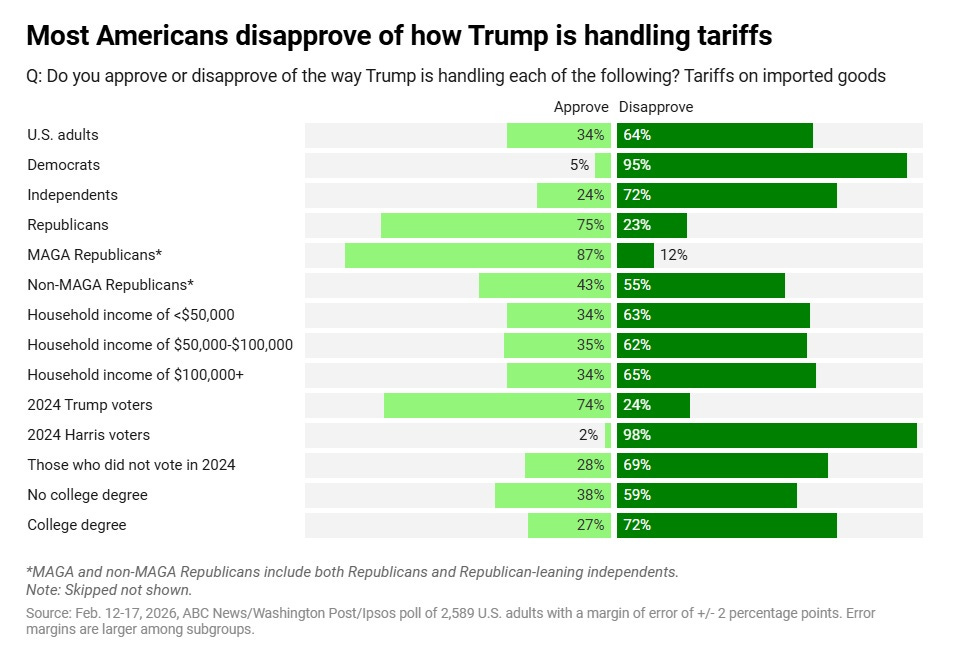
A Fox News poll found the same, and Trump’s approval rating on both trade and the economy is underwater by over 16 points despite a solid labor market. Consumer sentiment, meanwhile, has crashed:
Trump has belatedly begun to realize the hardship he’s inflicting on voters. But instead of simply abandoning the tariff strategy, he’s issuing yet more exemptions and carve-outs in an attempt to placate consumers:
He called the liberals a “disgrace to our nation.” But he heaped particular vitriol on the three conservatives [who ruled against him]. They “think they’re being ‘politically correct,’ which has happened before, far too often, with certain members of this Court,” Mr. Trump said. “When, in fact, they’re just being fools and lapdogs for the RINOs and the radical left Democrats—and . . . they’re very unpatriotic and disloyal to our Constitution. It’s my opinion that the Court has been swayed by foreign interests.”
Why are the President and his loyalists so incensed over the SCOTUS decision? The tariffs are a millstone weighing down Trump’s presidency, and his various walk-backs confirm that he realizes this. It would have been smarter, from a purely political standpoint, to just let SCOTUS do the administration a favor and cancel the tariffs. Instead, Trump is going to the mat for the policy. Why?
One possibility is simply that Trump hates having his authority challenged by anyone. Tariffs were his signature economic policy — something he probably decided on after hearing people like Lou Dobbs complain about trade deficits back in the 1990s. To give up and admit that tariffs aren’t a good solution to trade imbalances would mean a huge loss of face for Trump.
Another possibility is that Trump ideologically hates the idea of trade with other nations, viewing it as an unacceptable form of dependency on foreigners. Perhaps by using ever-shifting uncertainty about who would be hit by tariffs next, he hoped to prod other countries into simply giving up and not selling much to the United States.
A third possibility is that tariffs offer Trump a golden opportunity for corruption and personal enrichment. Trump issues blanket tariffs, and then offers carve-outs and exemptions to various companies and/or their products. This means companies line up to curry favor with Trump and his family, in the hopes that Trump will grant them a reprieve.
But the explanation I find most convincing is power. If all Trump wanted was to kick out against global trade, the Section 122 tariffs and all the other alternatives would surely suffice. Instead, he was very specifically attached to the IEEPA tariffs that SCOTUS struck down. Those tariffs allowed Trump to levy tariffs on specific countries, at rates of his own choosing, as well as to grant specific exemptions. That gave Trump an enormous amount of negotiating leverage with countries that value America’s big market.
This is the kind of personal power that no President had before Trump. It allowed him to conduct foreign policy entirely on his own. It allowed him to enrich himself and his family. It allowed him to gain influence domestically, by holding out the promise of tariff exemptions for businesses that toe his political line. And it allowed him to act as a sort of haphazard economic central planner, using tariffs like a scalpel to discourage the kinds of trade and production that he didn’t personally like.
In other words, I think that although the tariffs had their origin in 1990s-era worries about trade deficits, they ended up as a way to make the Presidency more like a dictatorship. That is almost certainly why the Supreme Court struck the IEEPA tariffs down, citing concerns over presidential overreach instead of more technical considerations.
For much of the modern GOP, I think, autocracy has become its own justification. To many Republicans, tariffs were good because they made the President powerful, and SCOTUS’ ruling is anathema because it pushes back on the imperial Presidency.
[ed. Look at the charts. Nothing penetrates with some people. See also: February 23, 2026 (LFaA).]
[T]he Supreme Court ruled that the unilaterally imposed [tariffs] were illegal…No longer does Trump have a tariff “on/off” switch…Future tariffs will need to be imposed by lengthy, more technical trade authorities — or through Congress…What was the point of these tariffs? It has never really been clear. Trump’s official justification was that they were about reducing America’s chronic trade deficit. In fact, the initial “Liberation Day” tariffs were set according to a formula based on America’s bilateral trade deficits with various countries. But trade deficits are not so easy to banish, and although America’s trade deficit bounced around a lot and shifted somewhat from China to other countries, it stayed more or less the same overall:
In a 6-3 ruling, the Supreme Court said that affirming Trump's use of the International Emergency Economic Powers Act (IEEPA) would "represent a transformative expansion of the President's authority over tariff policy."…Chief Justice John Roberts said that IEEPA does not authorize the president to impose tariffs because the Constitution grants Congress — and only Congress — the power to levy taxes and duties. [...]
Economists don’t actually have a good handle on what causes trade deficits, but whatever it is, it’s clear that tariffs have a hard time getting rid of them without causing severe damage to the economy. Trump seemed to sense this when stock markets fell and money started fleeing America, which is why he backed off on much of his tariff agenda.
Trump also seemed to believe that tariffs would lead to a renaissance in American manufacturing. Economists did know something about that — namely, they recognized that tariffs are taxes on intermediate goods, and would therefore hurt American manufacturing more than they helped. The car industry and the construction industry and other industries all use steel, so if you put taxes on imported steel, you protect the domestic market for American steel manufacturers, but you hurt all those other industries by making their inputs more expensive.
And guess what? The economists were right. Under Trump’s tariffs, the U.S. manufacturing sector has suffered. Here’s the WSJ:
The manufacturing boom President Trump promised would usher in a golden age for America is going in reverse…Manufacturers shed workers in each of the eight months after Trump unveiled “Liberation Day” tariffs, according to federal figures…An index of factory activity tracked by the Institute for Supply Management shrunk in 26 straight months through December…[M]anufacturing construction spending, which surged with Biden-era funding for chips and renewable energy, fell in each of Trump’s first nine months in office. [...]
Macroeconomically, the tariffs haven’t been as big a deal as initially feared. Growth came in slightly weak in the final quarter of 2025, but that was mostly due to the government shutdown, and will rebound next quarter. Inflation keeps bumping along at a little bit above the official target, distressing the American consumer but failing to either explode or collapse. The President’s cronies have taken to holding up this lack of catastrophe as a great victory, but this sets the bar too low. If you back off of most of your tariffs and the economy fails to crash, you don’t get to celebrate — after all, the tariffs were ostensibly supposed to fix something in our economy, and they have fixed absolutely nothing.
Instead, the tariffs have mostly just caused inconvenience for American consumers, who have been cut off from being able to buy many imported goods. The Kiel Institute studied what happened to traded products after Trump put tariffs on their country of origin, and found out that they mostly just stopped coming:
The 2025 US tariffs are an own goal: American importers and consumers bear nearly the entire cost. Foreign exporters absorb only about 4% of the tariff burden—the remaining 96% is passed through to US buyers…Using shipment-level data covering over 25 million transactions…we find near-complete pass-through of tariffs to US import prices……Event studies around discrete tariff shocks on Brazil (50%) and India (25–50%) confirm: export prices did not decline. Trade volumes collapsed instead…Indian export customs data validates our findings: when facing US tariffs, Indian exporters maintained their prices and reduced shipments. They did not “eat” the tariff. [emphasis mine]So it’s no surprise that the most recent polls show that Americans despise the tariffs:
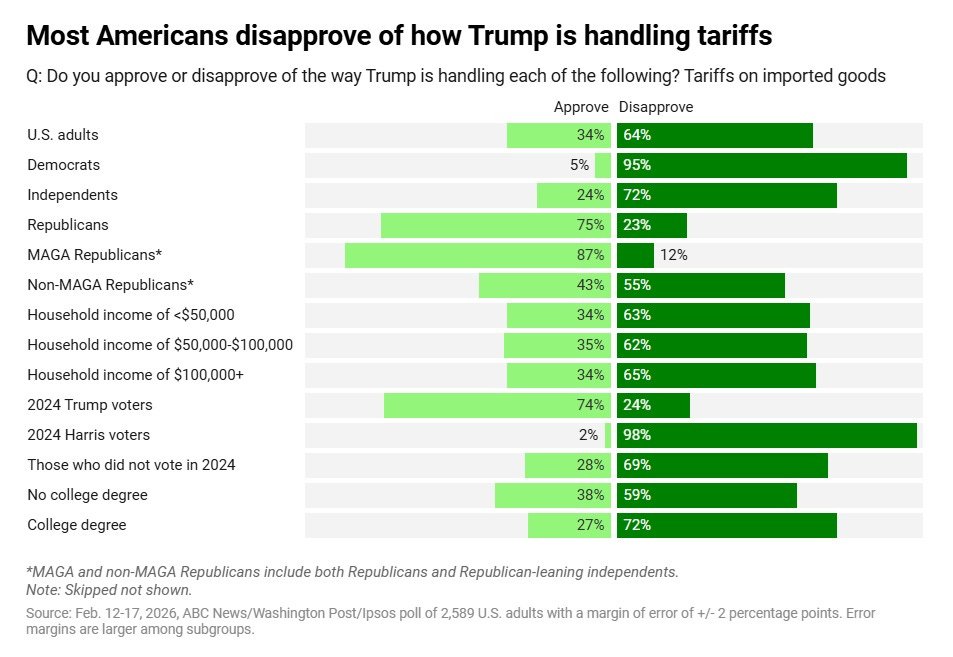
Source: ABC
Trump has belatedly begun to realize the hardship he’s inflicting on voters. But instead of simply abandoning the tariff strategy, he’s issuing yet more exemptions and carve-outs in an attempt to placate consumers:
Donald Trump is planning to scale back some tariffs on steel and aluminium goods as he battles an affordability crisis that has sapped his approval ratings…The US president hit steel and aluminium imports with tariffs of up to 50 per cent last summer, and has expanded the taxes to a range of goods made from those metals including washing machines and ovens…But his administration is now reviewing the list of products affected by the levies and plans to exempt some items, halt the expansion of the lists and instead launch more targeted national security probes into specific goods, according to three people familiar with the matter.Tariffs — or at least, broad, blanket tariffs on many products from many different countries — are simply a bad policy that accomplishes nothing while causing varying degrees of economic harm. But despite all his chicken-outs and walk-backs and exemptions, Trump is still deeply wedded to the idea. When news of the Supreme Court ruling reached him, he flew into a rage and accused the Justices of serving foreign interests:
He called the liberals a “disgrace to our nation.” But he heaped particular vitriol on the three conservatives [who ruled against him]. They “think they’re being ‘politically correct,’ which has happened before, far too often, with certain members of this Court,” Mr. Trump said. “When, in fact, they’re just being fools and lapdogs for the RINOs and the radical left Democrats—and . . . they’re very unpatriotic and disloyal to our Constitution. It’s my opinion that the Court has been swayed by foreign interests.”
Why are the President and his loyalists so incensed over the SCOTUS decision? The tariffs are a millstone weighing down Trump’s presidency, and his various walk-backs confirm that he realizes this. It would have been smarter, from a purely political standpoint, to just let SCOTUS do the administration a favor and cancel the tariffs. Instead, Trump is going to the mat for the policy. Why?
One possibility is simply that Trump hates having his authority challenged by anyone. Tariffs were his signature economic policy — something he probably decided on after hearing people like Lou Dobbs complain about trade deficits back in the 1990s. To give up and admit that tariffs aren’t a good solution to trade imbalances would mean a huge loss of face for Trump.
Another possibility is that Trump ideologically hates the idea of trade with other nations, viewing it as an unacceptable form of dependency on foreigners. Perhaps by using ever-shifting uncertainty about who would be hit by tariffs next, he hoped to prod other countries into simply giving up and not selling much to the United States.
A third possibility is that tariffs offer Trump a golden opportunity for corruption and personal enrichment. Trump issues blanket tariffs, and then offers carve-outs and exemptions to various companies and/or their products. This means companies line up to curry favor with Trump and his family, in the hopes that Trump will grant them a reprieve.
But the explanation I find most convincing is power. If all Trump wanted was to kick out against global trade, the Section 122 tariffs and all the other alternatives would surely suffice. Instead, he was very specifically attached to the IEEPA tariffs that SCOTUS struck down. Those tariffs allowed Trump to levy tariffs on specific countries, at rates of his own choosing, as well as to grant specific exemptions. That gave Trump an enormous amount of negotiating leverage with countries that value America’s big market.
This is the kind of personal power that no President had before Trump. It allowed him to conduct foreign policy entirely on his own. It allowed him to enrich himself and his family. It allowed him to gain influence domestically, by holding out the promise of tariff exemptions for businesses that toe his political line. And it allowed him to act as a sort of haphazard economic central planner, using tariffs like a scalpel to discourage the kinds of trade and production that he didn’t personally like.
In other words, I think that although the tariffs had their origin in 1990s-era worries about trade deficits, they ended up as a way to make the Presidency more like a dictatorship. That is almost certainly why the Supreme Court struck the IEEPA tariffs down, citing concerns over presidential overreach instead of more technical considerations.
For much of the modern GOP, I think, autocracy has become its own justification. To many Republicans, tariffs were good because they made the President powerful, and SCOTUS’ ruling is anathema because it pushes back on the imperial Presidency.
by Noah Smith, Noahpinion | Read more:
Images: Joey Politano/ABC
Images: Joey Politano/ABC
Child’s Play
Tech’s new generation and the end of thinking
The first sign that something in San Francisco had gone very badly wrong was the signs. In New York, all the advertising on the streets and on the subway assumes that you, the person reading, are an ambiently depressed twenty-eight-year-old office worker whose main interests are listening to podcasts, ordering delivery, and voting for the Democrats. I thought I found that annoying, but in San Francisco they don’t bother advertising normal things at all. The city is temperate and brightly colored, with plenty of pleasant trees, but on every corner it speaks to you in an aggressively alien nonsense. Here the world automatically assumes that instead of wanting food or drinks or a new phone or car, what you want is some kind of arcane B2B service for your startup. You are not a passive consumer. You are making something.
 This assumption is remarkably out of step with the people who actually inhabit the city’s public space. At a bus stop, I saw a poster that read: TODAY, SOC 2 IS DONE BEFORE YOUR GIRLFRIEND BREAKS UP WITH YOU. IT'S DONE IN DELVE. Beneath it, a man squatted on the pavement, staring at nothing in particular, a glass pipe drooping from his fingers. I don’t know if he needed SOC 2 done any more than I did. A few blocks away, I saw a billboard that read: NO ONE CARES ABOUT YOUR PRODUCT. MAKE THEM. UNIFY: TRANSFORM GROWTH INTO A SCIENCE. A man paced in front of the advertisement, chanting to himself. “This . . . is . . . necessary! This . . . is . . . necessary!” On each “necessary” he swung his arms up in exaltation. He was, I noticed, holding an alarmingly large baby-pink pocketknife. Passersby in sight of the billboard that read WEARABLE TECH SHAREABLE INSIGHTS did not seem piqued by the prospect of having their metrics constantly analyzed. I couldn’t find anyone who wanted to PROMPT IT. THEN PUSH IT. After spending slightly too long in the city, I found that the various forms of nonsense all started to bleed into one another. The motionless people drooling on the sidewalk, the Waymos whooshing around with no one inside. A kind of pervasive mindlessness. Had I seen a billboard or a madman preaching about “a CRM so smart, it updates itself”? Was it a person in rags muttering about how all his movements were being controlled by shadowy powers working out of a data center somewhere, or was it a car?
Somehow people manage to live here. But of all the strange and maddening messages posted around this city, there was one particular type of billboard that the people of San Francisco couldn’t bear. People shuddered at the sight of it, or groaned, or covered their eyes. The advertiser was the most utterly despised startup in the entire tech landscape. Weirdly, its ads were the only ones I saw that appeared to be written in anything like English:
What I discovered, though, is that behind all these small complaints, there’s something much more serious. Roy Lee is not like other people. He belongs to a new and possibly permanent overclass. One of the pervasive new doctrines of Silicon Valley is that we’re in the early stages of a bifurcation event. Some people will do incredibly well in the new AI era. They will become rich and powerful beyond anything we can currently imagine. But other people—a lot of other people—will become useless. They will be consigned to the same miserable fate as the people currently muttering on the streets of San Francisco, cold and helpless in a world they no longer understand. The skills that could lift you out of the new permanent underclass are not the skills that mattered before. For a long time, the tech industry liked to think of itself as a meritocracy: it rewarded qualities like intelligence, competence, and expertise. But all that barely matters anymore. Even at big firms like Google, a quarter of the code is now written by AI. Individual intelligence will mean nothing once we have superhuman AI, at which point the difference between an obscenely talented giga-nerd and an ordinary six-pack-drinking bozo will be about as meaningful as the difference between any two ants. If what you do involves anything related to the human capacity for reason, reflection, insight, creativity, or thought, you will be meat for the coltan mines.
The future will belong to people with a very specific combination of personality traits and psychosexual neuroses. An AI might be able to code faster than you, but there is one advantage that humans still have. It’s called agency, or being highly agentic. The highly agentic are people who just do things. They don’t timidly wait for permission or consensus; they drive like bulldozers through whatever’s in their way. When they see something that could be changed in the world, they don’t write a lengthy critique—they change it. AIs are not capable of accessing whatever unpleasant childhood experience it is that gives you this hunger. Agency is now the most valuable commodity in Silicon Valley. In tech interviews, it’s common for candidates to be asked whether they’re “mimetic” or “agentic.” You do not want to say mimetic. Once, San Francisco drew in runaway children, artists, and freaks; today it’s an enormous magnet for highly agentic young men. I set out to meet them.
[ed. Seems like we're already creating artificial humans. That said, I have only the highest regard for Scott Alexander, one of the people profiled here. The article makes him sound like some kind of cult leader or something (he's a psychologist), but he's really just a smart guy with a wide range of interests that intelligent people gravitate to (also a great writer). Here's his response on his website ACX:]
Somehow people manage to live here. But of all the strange and maddening messages posted around this city, there was one particular type of billboard that the people of San Francisco couldn’t bear. People shuddered at the sight of it, or groaned, or covered their eyes. The advertiser was the most utterly despised startup in the entire tech landscape. Weirdly, its ads were the only ones I saw that appeared to be written in anything like English:
HI MY NAME IS ROY
I GOT KICKED OUT OF SCHOOL FOR CHEATINGBUY MY CHEATING TOOLCLUELY.COM
Cluely and its co-founder Chungin “Roy” Lee were intensely, and intentionally, controversial. They’re no longer in San Francisco, having been essentially chased out of the city by the Planning Commission. The company is loathed seemingly out of proportion to what its product actually is, which is a janky, glitching interface for ChatGPT and other AI models. It’s not in a particularly glamorous market: Cluely is pitched at ordinary office drones in their thirties, working ordinary bullshit email jobs. It’s there to assist you in Zoom meetings and sales calls. It involves using AI to do your job for you, but this is what pretty much everyone is doing already. The cafés of San Francisco are full of highly paid tech workers clattering away on their keyboards; if you peer at their screens to get a closer look, you’ll generally find them copying and pasting material from a ChatGPT window. A lot of the other complaints about Cluely seem similarly hypocritical. The company is fueled by cheap viral hype, rather than an actual workable product—but this is a strange thing to get upset about when you consider that, back in the era of zero interest rates, Silicon Valley investors sank $120 million into something called the Juicero, a Wi-Fi-enabled smart juicer that made fresh juice from fruit sachets that you could, it turned out, just as easily squeeze between your hands.
What I discovered, though, is that behind all these small complaints, there’s something much more serious. Roy Lee is not like other people. He belongs to a new and possibly permanent overclass. One of the pervasive new doctrines of Silicon Valley is that we’re in the early stages of a bifurcation event. Some people will do incredibly well in the new AI era. They will become rich and powerful beyond anything we can currently imagine. But other people—a lot of other people—will become useless. They will be consigned to the same miserable fate as the people currently muttering on the streets of San Francisco, cold and helpless in a world they no longer understand. The skills that could lift you out of the new permanent underclass are not the skills that mattered before. For a long time, the tech industry liked to think of itself as a meritocracy: it rewarded qualities like intelligence, competence, and expertise. But all that barely matters anymore. Even at big firms like Google, a quarter of the code is now written by AI. Individual intelligence will mean nothing once we have superhuman AI, at which point the difference between an obscenely talented giga-nerd and an ordinary six-pack-drinking bozo will be about as meaningful as the difference between any two ants. If what you do involves anything related to the human capacity for reason, reflection, insight, creativity, or thought, you will be meat for the coltan mines.
The future will belong to people with a very specific combination of personality traits and psychosexual neuroses. An AI might be able to code faster than you, but there is one advantage that humans still have. It’s called agency, or being highly agentic. The highly agentic are people who just do things. They don’t timidly wait for permission or consensus; they drive like bulldozers through whatever’s in their way. When they see something that could be changed in the world, they don’t write a lengthy critique—they change it. AIs are not capable of accessing whatever unpleasant childhood experience it is that gives you this hunger. Agency is now the most valuable commodity in Silicon Valley. In tech interviews, it’s common for candidates to be asked whether they’re “mimetic” or “agentic.” You do not want to say mimetic. Once, San Francisco drew in runaway children, artists, and freaks; today it’s an enormous magnet for highly agentic young men. I set out to meet them.
by Sam Kriss, Harper's | Read more:
Image: Max Guther***
I agreed to be included, it’s basically fine, I’m not objecting to it, but a few small issues, mostly quibbles with emphasis rather than fact:1. The piece says rationalists believe “that to reach the truth you have to abandon all existing modes of knowledge acquisition and start again from scratch”. The Harper’s fact-checker asked me if this was true and I emphatically said it wasn’t, so I’m not sure what’s going on here.
2. The article describes me having dinner with my “acolytes”. I would have used the word “friends”, or, in one case, “wife”.
3. The article says that “When there weren’t enough crackers to go with the cheese spread, [Scott] fetched some, murmuring to himself, “I will open the crackers so you will have crackers and be happy.”” As written, this makes me sound like a crazy person; I don’t remember this incident but, given the description, I’m almost sure I was saying it to my two year old child, which would have been helpful context in reassuring readers about my mental state. (UPDATE: Sam says this isn’t his memory of the incident, ¯\_(ツ)_/¯ )
4. The article assessed that AI was hitting a wall at the time of writing (September 2025). I explained some of the difficulties with AI agents, but I’m worried that as written it might suggest to readers think that I agreed with its assessment. I did not.
5. In the article, I say that I “never once actually made a decision [in my life]”. I don’t remember this conversation perfectly and he’s the one with the tape recorder, but I would have preferred to frame this as life mostly not presenting as a series of explicit decisions, although they do occasionally come up.
6. Everything else is in principle a fair representation of what I said, but it’s impossible to communicate clearly through a few sentences that get quoted in disjointed fragments, so a lot of things came off as unsubtle or not exactly how I meant them. If you have any questions, I can explain further in the comments.
Subscribe to:
Comments (Atom)