Starving People Over Politics
During an appropriations lapse, most of the government’s discretionary programs shut down, but programs like Social Security, Medicare, and Medicaid that are funded on an ongoing basis rather than through annual appropriations continue.

The White House could — but chose not to — tap an emergency fund that exists to keep the program running.
There’s going to be litigation as to whether Trump truly has discretion here or is just breaking the law. But SNAP benefits won’t be paid this month unless judges intervene. And while the non-payment is in a sense because of the shutdown, it was not a forced move. The White House believes that cutting off SNAP payments will increase pressure on Democrats to cave, because they believe that Democrats care a lot about the safety net and the lives of poor people.
An interesting quirk of American politics is that lower-income states tend to be more conservative so, in a sense, the economic hit of sharply curtailed low-end consumption falls harder on red America. (...)
So the politics of firing this gun may not play out exactly how Republicans hope.
That said, what I actually want to talk about today is the substance of SNAP. It’s hard, journalistically, to cover static facts about the world, but SNAP is a big important program that makes a real difference in people’s lives. Trump shutting it down is a good time to talk about that, and also a good time to mention GiveDirectly’s program where you can give money to Americans directly impacted by this situation.
SNAP is a really big deal
SNAP is a large program, but most people don’t think about it very much, to the extent that one of the most common reactions I saw to news of looming cuts was incredulity that nearly 12 percent of the population could really be receiving food assistance benefits. And a lot of that spiraled into conspiratorial thinking about massive underestimates of the immigrant population or benefits fraud.
But the poverty rate in the United States is either 10.6 or 12.9 percent, depending on which measure you use, so the scale of food assistance shouldn’t be surprising. And the demographics of SNAP are similar to other American anti-poverty programs: the biggest groups of enrollees are children, the elderly, and the disabled, and the program skews significantly toward single mothers and their kids rather than two-parent households.
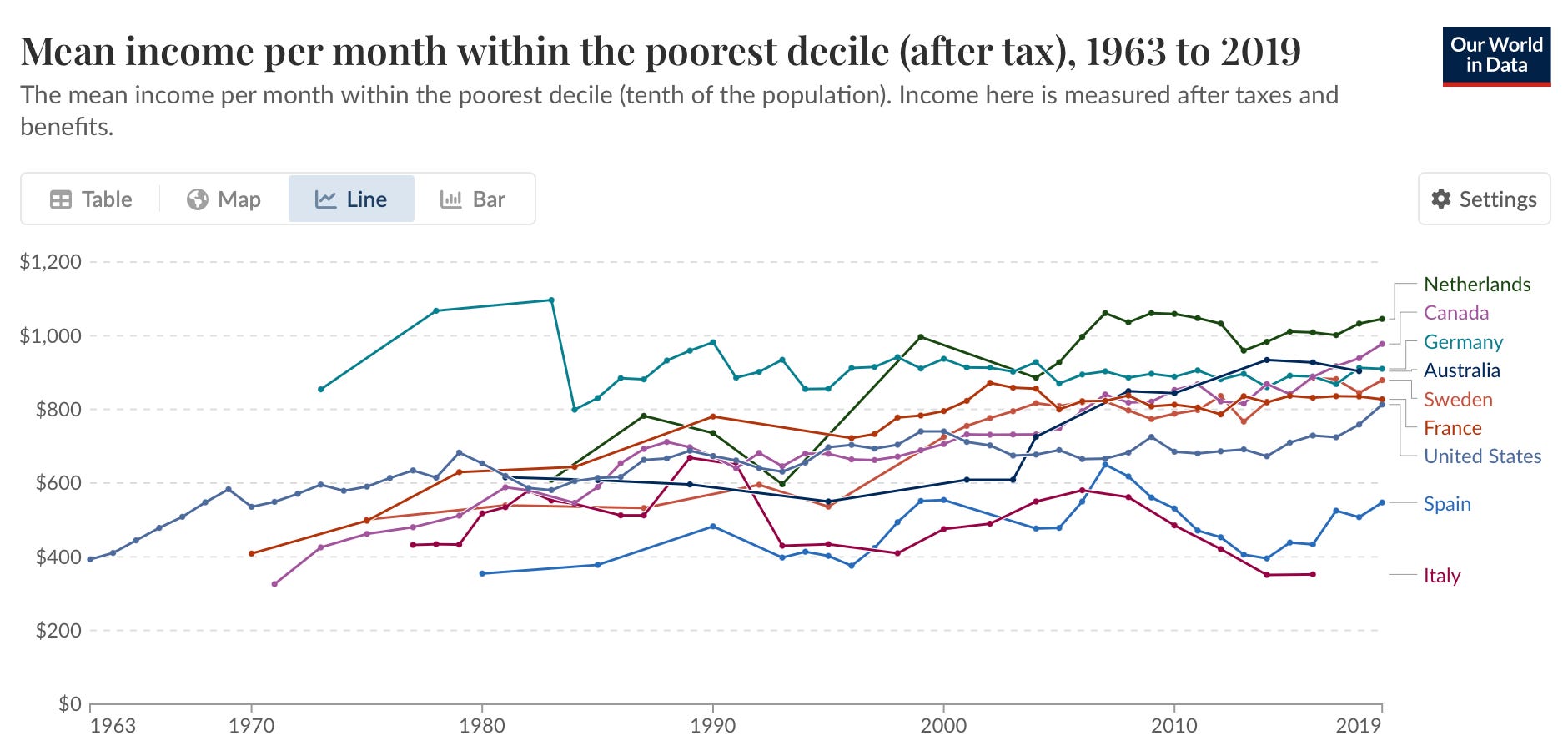
In general, I think people tend to underrate both the fact that the United States is a very rich country — not just in the sense of billionaires or the top 1 percent, but that our median living standards are much higher than in Europe or Asia — and also that it’s a really hard place to be poor. The prosperity of the country tends to make things a little expensive here, because you’re either hiring the labor of residents of a rich country or bidding against the residents of a rich country for scarce goods.
If you look at living standards in the poorest 10 percent of the population, the bottom decile of Americans is doing worse than the bottom decile of Canadians or Australians or residents of northern Europe.

Reasonable people can disagree as to what to make of that, but it’s one of the most important structural facts of American life.
Somewhat flexible help for the poor
On average, SNAP recipients receive $187 per month, but poorer families get more and less-poor ones get less. It’s not a particularly generous program. But relative to the rest of the American safety net, it’s a flexible program in that it takes a fairly expansive view of what counts as groceries. When I was a kid and recipients had to bring actual food stamps to the grocery store to get their benefits, their use of the program was quite obvious to anyone behind them in the checkout line. But in the modern world, benefits are administered via an Electronic Benefits Transfer card that looks and functions like a debit card or a credit card, so it’s easy to miss — perhaps one reason people seemed to be surprised by the scope of the program.
by Matthew Yglesias, Slow Boring | Read more:
Image: Hispanolistic
[ed. Poor people being used as political pawns again. Starting with burdensome new Medicaid application, work and reporting requirements; suspended H-2A worker programs which provided visiting workers for essential agricultural and dairy support jobs (that Americans won't do); ICE arresting anyone that looks poor and brown, and now this - just outright starving them. See also: Trump’s deportations are causing farm labor issues... with no viable, long-term solution (Investigate Midwest); and Wages of Citizenship (PW):]
Draconian methods were to be expected. Less clear is whether the promised crackdowns threaten the uneasy alliance between the federal government and employers in agriculture, construction, and food and hospitality industries. Despite the “war on terror” redefining the outer limits of executive power to surveil and detain foreign nationals, the workplace has over the past two decades remained largely insulated. The resilience of this arrangement reflects a clear hegemonic interest in cheap and docile labor, which allows for both lower prices and higher profits; a critical supply of health and childcare workers; a vital source of future labor; and close to $100 billion annually in state, local, and federal tax revenues. This is the perspective of US employers, expressed by the notion of “sanctuary businesses,” in which the legal segmentation of the labor market has propelled business growth."
***
"The Trump Administration’s crusade to transform the US immigration system has included sweeping changes to increase the state’s capacity to locate and remove noncitizen residents. The administration has empowered immigration agents to enter formerly “sensitive” spaces like schools and churches, suspended due process for legal noncitizens, and established immigration jails outside national borders. It made a deal with the Internal Revenue Service (IRS) to use once off-limits tax data to locate up to seven million undocumented workers. Dramatic deportation operations are now underway across the country, with the Department of Homeland Security (DHS) boasting 113,000 arrests and “north of” 100,000 deportations since Trump took office in January. The numbers include a rise in “collateral” arrests and deportations and are likely to rise after Immigration and Customs Enforcement’s (ICE) March 25 repeal of work authorization for 530,000 legal migrants of Cuba, Nicaragua, Haiti, and Venezuela, who have thirty days—until April 24—to depart before they too will be targeted for arrests and deportations.
Draconian methods were to be expected. Less clear is whether the promised crackdowns threaten the uneasy alliance between the federal government and employers in agriculture, construction, and food and hospitality industries. Despite the “war on terror” redefining the outer limits of executive power to surveil and detain foreign nationals, the workplace has over the past two decades remained largely insulated. The resilience of this arrangement reflects a clear hegemonic interest in cheap and docile labor, which allows for both lower prices and higher profits; a critical supply of health and childcare workers; a vital source of future labor; and close to $100 billion annually in state, local, and federal tax revenues. This is the perspective of US employers, expressed by the notion of “sanctuary businesses,” in which the legal segmentation of the labor market has propelled business growth."