My friend Hua and I have been discussing how much ordinary and lovely language is contained in technical descriptions of the world. If you want to write poetic language, you can learn a lot from descriptions that aren’t even trying to be beautiful! They’re simply trying to capture reality, as precisely and clearly as possible.
One of the best examples, made popular by the renowned short story writer and translator Lydia Davis, is the Beaufort wind scale:

There is a precision in these descriptions that rises to the level of poetry. Beaufort 2: wind felt on face. Beaufort 5: crested wavelets form on inland waters. Beaufort 8: moving cars veer.
Where else can we find descriptions like these? (Not a rhetorical question!)
by Celine Nguyen, Personal Cannon | Read more:
Image: Merriam Webster chart of the Beaufort Scale
[ed. See also: Mere description (PC):]
We describe things. All the time. And those descriptions can be ordinary, unremarkable, obvious—or they can be strange, surreal, exciting, unexpected. When I write I’m always trying to do the second kind of description (good, interesting, literary description) and avoid the first. But it’s hard to describe things well, like really well. And lately I’ve been thinking that my fear of ordinary description is the problem.
We describe things. All the time. And those descriptions can be ordinary, unremarkable, obvious—or they can be strange, surreal, exciting, unexpected. When I write I’m always trying to do the second kind of description (good, interesting, literary description) and avoid the first. But it’s hard to describe things well, like really well. And lately I’ve been thinking that my fear of ordinary description is the problem.
I’m still reading The Everyday, the contemporary art anthology I wrote about in my last post. This week I came across a passage from the French novelist and essayist Georges Perec. He describes, in playfully deliberate detail, a particular street in Paris. Then he explains his approach towards writing:
Observe the street…Note down what you can see. Anything worth of note going on.What struck me was this advice: Nothing strikes you. You don’t know how to see. You must set about it more slowly, almost stupidly. We think we know more than we do, understand more than we do, until we describe it.
Do you know how to see what’s worthy of note?
Is there anything that strikes you?
Nothing strikes you. You don’t know how to see.
You must set about it more slowly, almost stupidly.
Force yourself to write down what is of no interest, what is most obvious, most common, most colourless.
I was talking to a friend about Renoir yesterday, so let’s take Renoir’s famous Luncheon of the Boating Party painting as an example. What do I see? A group of people having lunch. Wait, but do I know they’re having lunch because of the title has luncheon in the name, or because it looks like lunch? I see wine bottles, a bowl of fruits with the grapes spilling over the edge, empty plates and cups.
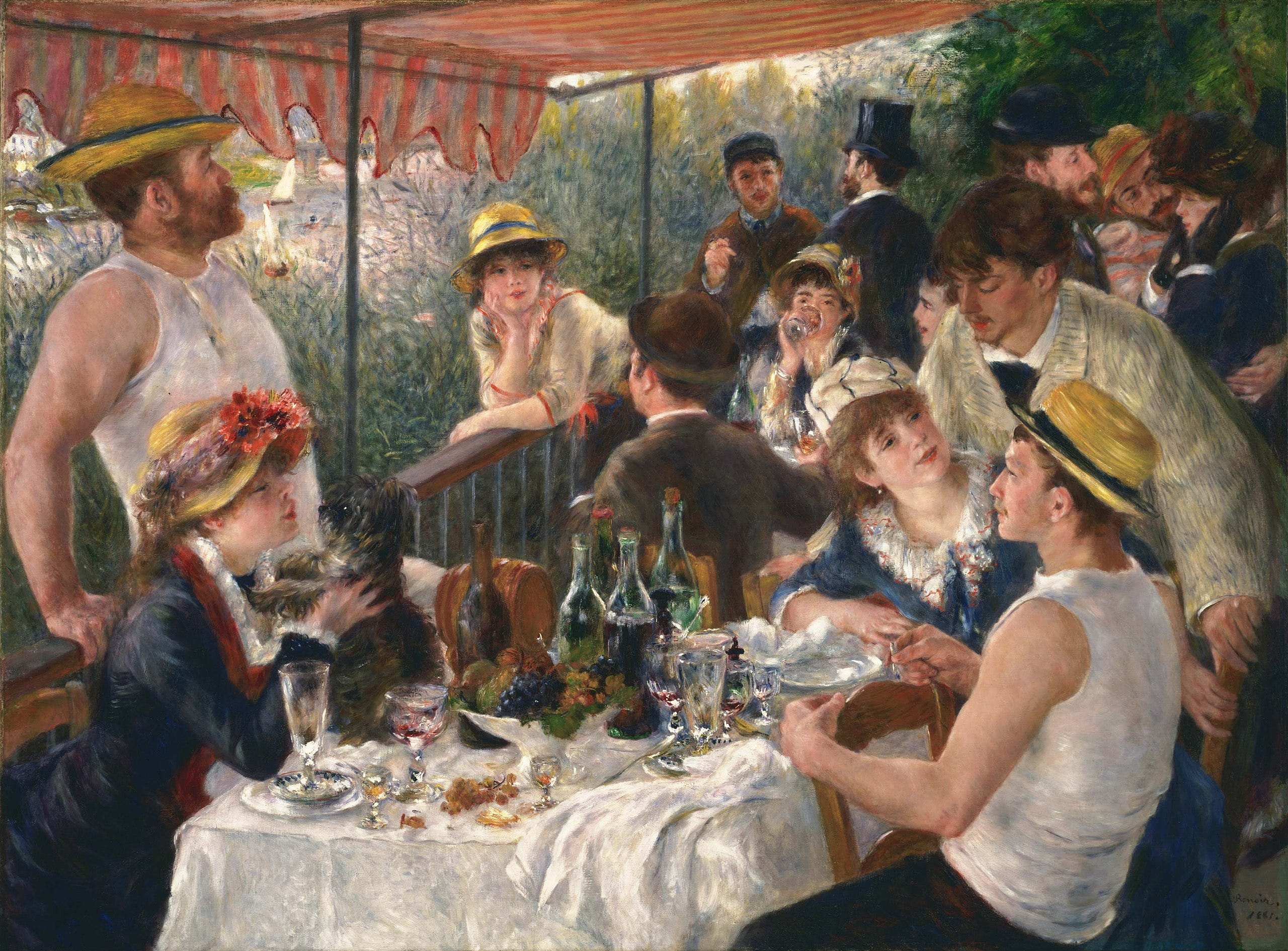
Pierre-Auguste Renoir’s Luncheon of the Boating Party/Le déjeuner des canotiers, 1880–1. Image from Google Arts & Culture
There’s so much more to describe. Everyone in it is white. (Probably.) They’re dressed in white and navy, mostly, but there’s a man to the right whose jacket is—how would I describe it? Is it meant to be a pale yellow with black pinstripes? And now that I’ve tried to describe the colors, I’m noticing the man in a brown jacket, the man in the very back of the—I mean, what are they on? A terrace or veranda (I could have said “patio”, too, but I don’t like how that word looks as much) with that stripy covering—is there a name for that kind of thing? You know, the stripy…fabric…???
Slowly, almost stupidly, I look at the painting, I pay attention, I try to understand what I’m seeing. (...)
Mere description: it’s easy to forget about! But it’s worth it.
Very, very good descriptions
The goal, of course, is for mere description to become more than that. Even a functional description can, in the details it includes and the specificity of those details, become beautifully expressive.
A beautiful example of this comes from Flights, a novel by the Nobel Prize in Literature laureate Olga Tokarczuk. Before I tell you anything about the novel, let’s start with how the narrator of Flights is described:
What kind of character introduces herself by telling us about her hemoglobin levels and leukocyte count? The central character of a novel that, as it unfolds, is obsessed with the body, with how the organs function (or don’t), the medical interventions that can extend or shorten life, the ways in which bodies are preserved after death. The novel follows this unnamed woman through various airports as she visits museums devoted to anatomy and the body. Later on in the novel, the narrator asserts that “Every body part deserves to be remembered. Every human body deserves to last. It is an outrage that it’s so fragile, so delicate.” This ideal is reflected in how the narrator describes herself—in her intense concern with the mechanics of her own body.
Equally striking are Tokarczuk’s descriptions of the world. Tokarczuk was a poet first, actually, and published a poetry collection before turning to the novels that made her famous in Poland and then the world. And you get a sense of that poetic background in the great economy and beauty of descriptions like this:
It’s a great verb, scraped. Mostly deployed to describe scraping your knee, scraping the burnt bits off a pan, scraping ice off of a car windshield. An ordinary verb, turned towards extraordinary purposes..
The goal, of course, is for mere description to become more than that. Even a functional description can, in the details it includes and the specificity of those details, become beautifully expressive.
A beautiful example of this comes from Flights, a novel by the Nobel Prize in Literature laureate Olga Tokarczuk. Before I tell you anything about the novel, let’s start with how the narrator of Flights is described:
I have a practical build. I’m petite, compact. My stomach is tight, small, undemanding. My lungs and my shoulders are strong. I’m not on any prescriptions—not even the pill—and I don’t wear glasses. I cut my hair with clippers, once every three months, and I use almost no makeup. My teeth are healthy, perhaps a bit uneven, but intact, and I have just one old filling, which I believe is located in my lower left canine. My liver function is within the normal range. As is my pancreas. Both my right and left kidneys are in great shape. My abdominal aorta is normal. My bladder works. Hemoglobin 12.7. Leukocytes 4.5. Hematocrit 41.6. Platelets 228. Cholesterol 204. Creatinine 1.0. Bilirubin 4.2. And so on. My IQ—if you put any stock in that kind of thing—is 121; it’s passable. My spatial reasoning is particularly advanced, almost eidetic, though my laterality is lousy. Personality unstable, or not entirely reliable. Age all in your mind. Gender grammatical. I actually buy my books in paperback, so that I can leave them without remorse on the platform, for someone else to find. I don’t collect anything.In this highly specific, highly dispassionate description of the self, we learn quite a bit about the narrator. A woman (petite, not on the pill: only women describe themselves with these details). Capable of cool self-assessment (teeth: healthy, IQ: passable, personality: unstable). Some personal interest or professional expertise in the body, because she specifies a filling in her lower left canine, not just a tooth.
What kind of character introduces herself by telling us about her hemoglobin levels and leukocyte count? The central character of a novel that, as it unfolds, is obsessed with the body, with how the organs function (or don’t), the medical interventions that can extend or shorten life, the ways in which bodies are preserved after death. The novel follows this unnamed woman through various airports as she visits museums devoted to anatomy and the body. Later on in the novel, the narrator asserts that “Every body part deserves to be remembered. Every human body deserves to last. It is an outrage that it’s so fragile, so delicate.” This ideal is reflected in how the narrator describes herself—in her intense concern with the mechanics of her own body.
Equally striking are Tokarczuk’s descriptions of the world. Tokarczuk was a poet first, actually, and published a poetry collection before turning to the novels that made her famous in Poland and then the world. And you get a sense of that poetic background in the great economy and beauty of descriptions like this:
A crisp morning, the streets are lively, sunrise, the sun’s disk scraped up by slender poplars—it’s a pleasant walk.This description is seared into my memory. Ordinary descriptions—a crisp morning, a pleasant walk—bracket an extraordinary poetic image: the sun’s disk scraped up by slender poplars...
It’s a great verb, scraped. Mostly deployed to describe scraping your knee, scraping the burnt bits off a pan, scraping ice off of a car windshield. An ordinary verb, turned towards extraordinary purposes..

