Three weeks ago, in Duluth, half the riders on every bus I took were mentally tortured and/or intoxicated. The downtown Starbucks, pedestrian malls, and shuttered doorways of vacated buildings all housed broken people. Same in Indianapolis, El Paso, New York City, Jacksonville, LA, Phoenix, and almost every community I’ve been to in the U.S., save for those gated by wealth.

You can learn more about the U.S. by traveling overseas and comparing, and five years of that has taught me we accept far too much public disorder.
We are the world’s richest country, and yet our buses, parking lots, and city streets are filthy, chaotic, and threatening. Antisocial and abnormal behavior, open addiction, and mentally tortured people are common in almost every community regardless of size.
I’ve written about this many times before, because it is so striking, and it has widespread consequences, beyond the obvious moral judgement that a society should simply not be this way.
It’s a primary reason why we shy away from dense walkable spaces and instead move towards suburban sprawl. People in the U.S. don’t respect, trust, or want to be around other random citizens, out of fear and disgust. Japanese/European style urbanism—density, fantastic public transport, mixed-use zoning, that so many American tourists admire—can't happen here because there is a fine line between vibrant streets and squalid ones, and that line is public trust. The U.S. is on the wrong side of it. Simply put, nobody wants to be accosted by a stranger, no matter how infrequent, and until that risk is close to nil, people will continue edging towards isolated living.
It is why we “can’t have nice things” because we have to construct our infrastructure to be asshole-proof, and so we don’t build anything or build with a fortress mentality, stripping our public spaces down to the austere and utilitarian, emptying them of anything that can be vandalized.

Another nice thing we don’t have in the U.S. is public restrooms. We don’t have them out of a justified fear of abuse, which is the same reason many Starbucks lock their restrooms. McDonald’s does this as well, depending on the location, and also even strips them of mirrors in the especially bad communities, to discourage people from using them for an hour-long morning toilet, as well as breaking the mirrors just for the hell of it.
This lack of public restrooms became an issue on Twitter when the latest round of debate about disorder in the U.S. was kicked off when a tweeter noted how offensive it was to have seen someone urinating in a crowded New York subway car.
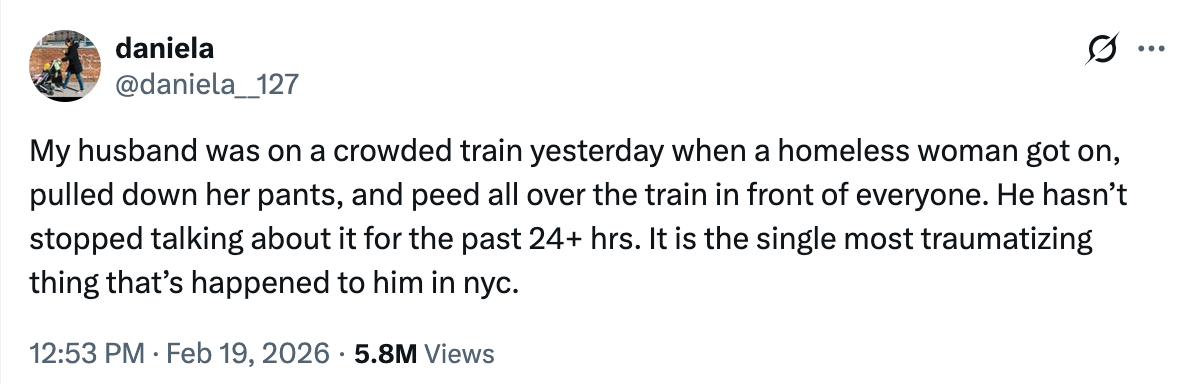
This debate brought out a lot of absurd arguments, mostly from those trying to shrug it off or suggest it was simply the price of living in a big city.
No, the rest of the world doesn’t tolerate the amount of antisocial behavior we in the U.S. do. If someone were to piss on a subway anywhere else in the world, and very very few ever would want to (more on why below), they are removed from society for a period of time.
We however let people who aren’t mentally competent continue to engage in self-destructive and aberrant behavior without removing them, which consequently ruins it for everyone else, except those wealthy enough to build their own private islands of comfort.
Someone peeing on the subway is not of sound mind, and it isn’t normal behavior by any measure. It’s a sign of distress that should cause an intervention—by police, social workers, whoever—that mandates them into an institution for a period of time, until they regain sanity and stability. For someone actively psychotic —civil commitment to psychiatric hospital. For violent individuals refusing treatment—secure prison facilities with mandatory programs. For severe addiction—medical detox and residential treatment without the ability to walk away.
They should not be allowed to do whatever they want because they cannot control themselves enough to have that freedom. Someone shouting at strangers, someone washing themselves with flour tortillas, someone punching at the air voicing threats shouldn’t, for their own safety and others, be out roaming the streets. [...]
I’ve been very careful up to now not to use the word homeless, because it’s become an overly broad category that covers families in motels with Section 8 vouchers, people sleeping on friends’ couches until they can get back on their feet, mothers with children in long-term shelters, and then those who live in tents under bridges or sleep in a soiled sleeping bag.
Eighty-five percent (or so) of those in this broad category are not causing problems. They are, like most everyone else, doing their best to get by and better themselves. Sure, they have more complicated and chaotic lives than most, but they try to play by the rules as best they can.
Our problems in public spaces come from the fifteen percent or so who fall into the last group—the stubbornly intransigent—which are people who have options for housing but turn them down for a variety of reasons, some driven by mental demons, some by an overwhelming desire to always be on drugs, some simply out of preference to be alone. Others in this category have been ejected from housing because of continual violent and threatening behavior.
They are not, by almost any metric, of sound mind, and shouldn’t be granted the full privileges other citizens have.
The cover photo is John, and he is in this category. He had set himself on fire the day before I met him, freebasing a perc 30, and refused to go to the hospital because he didn’t want to lose his favorite spot behind the garbage bin, since it was only a block away from dealers and perfect to piss in. He had a government room he didn’t use because catching on fire (something he did every now and then) set off smoke alarms. He also thought it was cursed and monitored by the same people who had held him captive on an island in the middle of the Pacific—an island he escaped from three months before by swimming the four hundred miles. He showed me an arm, covered with burns, that he claimed was where a shark had bit him.
John should be mandated into a prison, a mental institution, or a rehab clinic, until he is competent enough to be on his own, not out on the streets in mental and physical pain, setting himself on fire. It is as simple as that, although I understand a change like this comes with additional nuanced policy debate. As for costs, it is more a question of redirecting what we spend rather than finding additional money, because we already spend an immense amount on this problem—the New York City budget for homeless services is four billion—without 'solving' it.
Even if you put aside the destruction this type of behavior has done to broader society, and your concerns are only focused on the health and welfare of the stubbornly intransigent, then our current system is still deeply wrong. We are not providing them justice by allowing them to choose a public display of mental misery, where the self harm they can do is far greater than when being monitored.
Beneath all this discussion is the additional question of why we in the U.S. have so many mentally unstable people, why so many are addicted to drugs, why so many people are OK with doing shocking things.
by Chris Arnade, Walks the World | Read more:
Images: X/uncredited
***
One of the things travel does best is remove the normalization filter we build at home. When you move between countries long enough, patterns that once felt “just how things are” start to look like choices societies have made - or failed to make.
What strikes me in pieces like this is not the comparison itself, but the discomfort it creates. Clean transit systems, safe public spaces, and functioning streets aren’t cultural miracles; they’re outcomes of priorities, incentives, and sustained public decisions. When those systems break down, the result isn’t abstract policy failure - it’s visible human suffering playing out in the most ordinary places.
Travel doesn’t just show us new landscapes. It quietly exposes which problems we’ve decided to tolerate.
***
Chinese commentators are talking a lot these days about poverty in the United States, claiming China’s superiority by appropriating an evocative phrase from video game culture.
The phrase, “kill line,” is used in gaming to mark the point where the condition of opposing players has so deteriorated that they can be killed by one shot. Now, it has become a persistent metaphor in Communist Party propaganda.

The power is in the simplicity of what it describes: an abrupt threshold where misery begins and a happy life is irreversibly lost. The narrative is meant to offer China’s people emotional relief while attempting to deflect criticism of its leaders.
The worse things look across the Pacific, the logic of the propaganda goes, the more tolerable present struggles become. [...]
The worse things look across the Pacific, the logic of the propaganda goes, the more tolerable present struggles become. [...]
The fact is that societal inequality is a problem in both China and the United States. And the American economy no doubt leaves many people in fragile positions. The causes are complex.
Yet in China, poverty is experienced and perceived differently. In most Chinese cities, street begging and visible homelessness are tightly managed, making them far less prominent in daily life. Many urban residents encounter such scenes only through foreign reporting, rebroadcast by Chinese state media, about the United States and other places. [...]
When I was growing up in China in the early 1980s, my family subscribed to China Children’s News, which ran a weekly column with a simple slogan: “Socialism is good; capitalism is bad.” It described seniors in American cities scavenging for food, and homeless people freezing to death. Those stories were not invented, but they lacked context and were presented as the dominant experiences in American society. Much of Chinese society was still closed off from the world, and reliable information was scarce.
That many people accepted such narratives was hardly surprising. What’s striking is that similar portrayals continue to resonate today, when access to information is relatively much greater despite state control.
The formula is simple: magnify foreign suffering to deflect from domestic problems. That approach is taking shape today around the “kill line” metaphor.
The phrase is believed to have been first popularized in this new context on the Bilibili video platform in early November by a user known as Squid King. In a five-hour video, he stitched together what he claimed were firsthand encounters of poverty from time he spent in the United States. His video used scenes of children knocking on doors on a cold Halloween night asking for food, delivery workers suffering from hunger because of their meager wages and injured laborers discharged from hospitals because they could not pay.
The scenes were presented not as isolated cases but as evidence of a system: Above the “kill line,” life continues; below it, society stops treating people as human.
The narrative spread beyond the Squid King video, and many people online repeated his anecdotes. Essays on the nationalist news site Guancha and China’s biggest social media platform, WeChat, described the “kill line” as the “real operating logic” of American capitalism. [...]
In many of the commentaries, anecdotes about Americans experiencing abrupt financial crises are followed by comparisons with China. Universal basic health care, minimum subsistence guarantees and poverty alleviation campaigns are cited as evidence that China does not permit anyone to fall into sudden distress.
“China’s system will not allow a person to be ‘killed’ by a single misfortune,” one commentary from a provincial propaganda department states.
Many readers expressed shock at American poverty and gratitude for China’s system. “At least we have a safety net,” said one commenter...
“A topic does not gain traction simply because people are foolish,” one person wrote on WeChat. “Often, it spreads because confronting reality is harder.”
by Li Yuan, NY Times | Read more:
Image: Doris Liou

