This breaks down into two questions:
1. What makes texts good?This essay will focus on question 1, and is thus mostly about aesthetics.
2. Why is it difficult for AI to do that?
1. Surprise
One of the things that so offends us about AI ‘slop’ images is a sense that the details don’t matter. The cup is green, but it may as well have been blue. In good human works, every detail feels carefully chosen. Arbitrarily changing a color in a Hopper painting would make it worse.
You can put this in terms of compression. A cliche illustration of, say, a vase of flowers can just be described as “imagine a New Yorker cartoon of a vase of flowers“. But a really good painting of a vase of flowers can only be captured by seeing the painting itself: nothing else will substitute. Great artworks are hard to compress (i.e. have high information content); slop is easy to compress. When you type a few short sentences into an AI image generator and it makes you an image for your blog post, you are likely generating slop because you are injecting relatively little information yourself.
Another word for ‘high information’ is ‘surprising’. Thus:
1. Great art is not predictable or obvious, it is surprising.One can explain this using the predictive processing model of the brain. As we are scanning a text, our brain is constructing the meaning and predicting the next several words. Where there is no surprise — where something is perfectly predictable, or fits some pattern that we know — our brain registers only dullness. When our expectations are violated in a way that’s satisfying to resolve, we get pleasure and novelty. [...]
Compare the famous passage from Macbeth, where both of the bolded words are famously surprising:
Will all great Neptune’s ocean wash this bloodHence, too, the story of the writing professor who would give his students a copy of the below stanza from Larkin’s The Whitsun Weddings with many words blanked out, and ask them to guess those words, and claimed that nobody had ever gotten ‘hothouse’ or ‘uniquely’:
Clean from my hand? No, this my hand will rather
The multitudinous seas incarnadine,
Making the green one red.
All afternoon, through the tall heat that sleptThe value of surprise is more obvious in visual art. In his four-volume work The Nature of Order, the architect Christopher Alexander gives this example from a Fra Angelico painting:
For miles inland,
A slow and stopping curve southwards we kept.
Wide farms went by, short-shadowed cattle, and
Canals with floatings of industrial froth;
A hothouse flashed uniquely: hedges dipped
And rose…
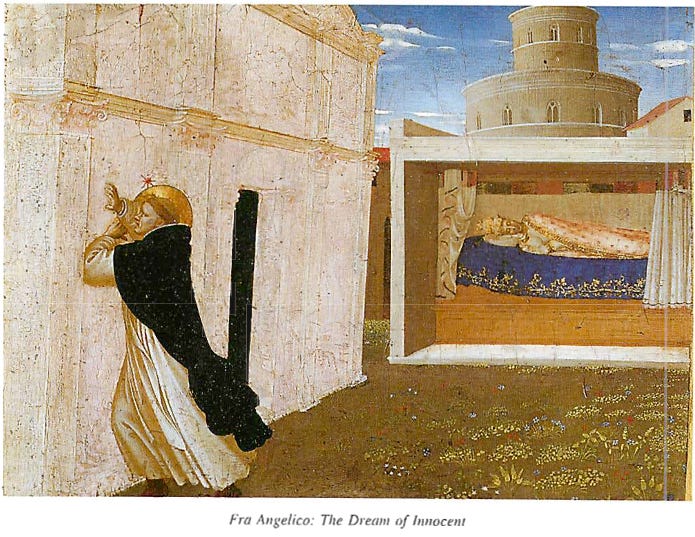
Alexander asks us to cover up the black stripe on the priest’s robes and the door, and imagine we were the painter:
Imagine some moment before the black of the door and priest’s robe had been painted, but when everything else is more or less already there...You can see what I mean by putting your hand over the picture, so as not to see the black parts. Do you see that the picture loses much of its haunting character...can you see how immensely surprising it is?The surprise principle operates in other ways, too. We barely see everyday objects because we are so used to them (low novel information again), but great art can make you see these objects afresh, the way a child might. This too is a kind of surprise, sometimes called defamiliarization. This is a favorite technique of Tolstoy’s, who often takes a normal action that we are all familiar with, and describes it the way an alien might. Thus he describes a person being whipped as “to strip people who have broken the law, to hurl them to the floor...“ and so on, deconstructing the action without ever using the word ‘whipping’. This makes you feel the action much more viscerally than if he had just used the word to summarize it.
— Christopher Alexander, The Nature of Order, Book 4, p. 133
These are all familiar points to lovers of art. But the surprise principle operates at even deeper levels, below even our conscious perception. [...]
My main argument in this section has been that surprisingness, or strangeness, operates at many different levels in the art we value: word choice (or color choice), grammar, sentence, plot, form, and so on. This strangeness is essential for the effect of great art, because we like to make sense of things, and if we make sense of things too easily they are not interesting to us; great works of art are therefore necessarily somewhat difficult to grasp the meaning of, their meanings are multiple and constantly shifting, and they require a pleasant kind of effort to make sense of.
To go back to AI, all of this gives us some sense of why LLMs aren’t great writers by default. At the word level, they tend to pick relatively ‘obvious’ choices. Thus, I ask the model currently considered the best AI writer: “write a descriptive paragraph about a day in the park“ and it starts with: “A warm afternoon unfolds in the park, where sunlight filters through the canopy of old oak trees and dapples the ground in shifting patterns of gold and green“. Note that this is the most cliche possible detail to have picked, and the word ‘dapples’ is the most common word to use in this context; in short, the whole thing is unsurprising.
And yet: you cannot fix this problem simply by asking the AI to be more surprising. Why?
2. Echoes
The eye is the first circle; the horizon which it forms is the second; and throughout nature this primary figure is repeated without end. It is the highest emblem in the cipher of the world. St. Augustine described the nature of God as a circle whose centre was everywhere and its circumference nowhere. We are all our lifetime reading the copious sense of this first of forms…The most surprising sequence of numbers is a random one, but a random sequence of numbers is not great art. You need more than just surprise. The details of great artworks relate to each other somehow. They are chosen in such a way that they cohere with each other at multiple levels.
— Ralph Waldo Emerson, Circles
Great works are full of patterns. They are as intricately patterned as Persian rugs or Norwegian stave churches. [...]
2. Great art contains multiple overlapping layers of echoes.This is often harder to spot in verbal artifacts, but it is this feature that I think distinguishes really good works of art from merely ‘ok’ ones.
Most of us are familiar with the surface level ways of doing this: rhyme, for example, knits together different lines of a poem in a semantically irrelevant way that nevertheless makes it feel like part of a unifying whole. Same with assonance and other such effects most of us are familiar with from English class. It is echoes, for example, that make so many verses from the King James Bible so pleasing and beautiful to listen to:
“Arise, shine; for thy light is come, and the glory of the Lord is risen upon thee.” (Isaiah 60:1)Note the echoing vowel sounds throughout in ‘arise’, ‘shine’, ‘light’, and ‘thy’. Rhyme and assonance are verbal echoes.
In music, the most famous example perhaps is Beethoven’s Fifth, with its famous “ba-ba-ba-BUM“ theme; the short-short-short-long statement in the beginning then echoes through that movement in thousands of ways, sometimes stretched, sometimes slowed down, so that the whole movement feels like an organic thing that has grown from that single seed.
Good art layers these, one on top of another, to build up artifacts of stunning complexity. These are the text equivalents of Gothic cathedrals. Each layer alludes to other layers, too, adding more and more constraints, until you get an artifact where changing any one word does violence to the whole.
To see this density in action, let’s look at Shakespeare’s Sonnet 15. Click through the layers to see how a single fourteen-line poem simultaneously participates in half a dozen independent systems of meaning — sonic, structural, thematic, and more.
Shakespeare, Sonnet 15
When I consider everything that grows(The interactive version of this essay lets you click through a few layers of the poem and see the below analysis.) [...]
Holds in perfection but a little moment,
That this huge stage presenteth nought but shows
Whereon the stars in secret influence comment;
When I perceive that men as plants increase,
Cheerèd and checked even by the selfsame sky,
Vaunt in their youthful sap, at height decrease,
And wear their brave state out of memory:
Then the conceit of this inconstant stay
Sets you most rich in youth before my sight,
Where wasteful Time debateth with Decay
To change your day of youth to sullied night:
And, all in war with Time for love of you,
As he takes from you, I ingraft you new.
Echoes are sewn through sophisticated literary works in more subtle ways, too.
Thus Nabokov, in his Lectures on Literature, points out that Anna Karenina is filled with trains and railway images even apart from the fact that the main plot points occur at railway stations; Kafka’s Metamorphosis is filled with occurrences of the number three. Lots of movies and books use Christian symbolism this way — crosses, doves, and so on. Macbeth is full of birds (ravens, crows, bats, owls, the Thane of *Caw*dor...).
Sometimes these symbols are significant, as in the Christian symbolism; and sometimes they are insignificant, as in the number three; but either way, the density of these symbols strewn throughout a work give it an additional coherence that would be lacking if you wrote down things at random. It gives it the same type of coherence that you see when you look at a beautiful tree, or a grassy field: things feel right. This feeling of rightness is achieved through these echoes.
by Nabeel S. Qureshi, Substack | Read more:
Image: Fra Angelico

