When two men knocked on Ida Huddleston’s door last May, they carried a contract worth more than $33m in exchange for the Kentucky farm that had fed her family for centuries.

More than a dozen of her neighbors received the same knock. Searching public records for answers, they discovered that a new customer had applied for a 2.2 gigawatt project from the local power plant, nearly double its annual generation capacity.
The unknown company was building a datacenter.
“You don’t have enough to buy me out. I’m not for sale. Leave me alone, I’m satisfied,” Huddleston, 82, later told the men.
As tech companies race to build the massive datacenters needed to power artificial intelligence across the US and the world, bids like the one for Huddleston’s land are appearing on rural doorsteps nationwide. Globally, 40,000 acres of powered land – real estate prepped for datacenter development – are projected to be needed for new projects over the next five years, double the amount currently in use.
Yet despite sums that often dwarf the land’s recent value, farmers are increasingly shutting the door. At least five of Huddleston’s neighbors gave similar categorical rejections, including one who was told he could name any price.
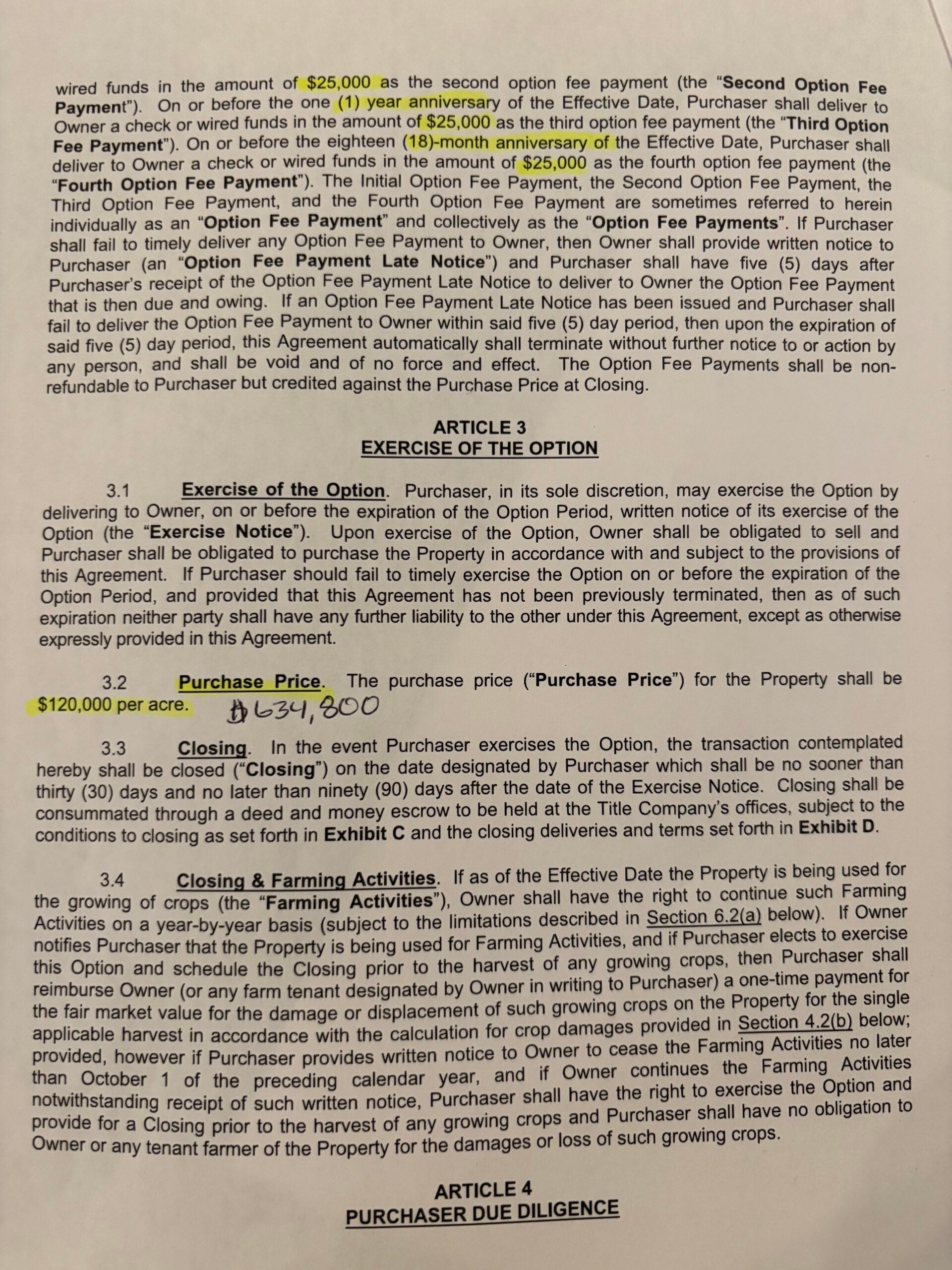
In Pennsylvania, a farmer rejected $15m in January for land he’d worked for 50 years. A Wisconsin farmer turned down $80m the same month. Other landowners have declined offers exceeding $120,000 per acre – prices unimaginable just a few years ago. [...]
Today, where residents see meandering creeks and open pastures, Silicon Valley executives see weak zoning protections, cheap power and abundant water.
Developers keep knocking because there are billions to be made. In northern Virginia last November, an investor paid $615m for less than 100 acres – property the seller had bought for just $57m four years prior. Days later, Amazon spent $700m on nearby farmland that had sold for a fraction of that price the year before. In Georgia, a local developer flipped land to Amazon for $270m after paying $4m for it 12 months earlier. For the middlemen scouting these deals, potential returns exceed 1,000%.
‘Name your price’
About 20 Mason county residents have reportedly been offered deals, with the datacenter project estimated to cover 2,000 acres.
After Dr Timothy Grosser, 75, rejected an $8m offer for his 250-acre farm – 3,500% more than he’d paid nearly four decades earlier – the developers came back with a new proposition: “Name your price.”
His answer: “There is none.” [...]
[ed. No disrespect to folks determined to keep their land (generational diffusion and family disageements usually take care of that), but something seems off here. Globally, 40000 acres of land are projected to be needed for data centers? That's almost nothing. So what are companies really paying for?]
“You don’t have enough to buy me out. I’m not for sale. Leave me alone, I’m satisfied,” Huddleston, 82, later told the men.
As tech companies race to build the massive datacenters needed to power artificial intelligence across the US and the world, bids like the one for Huddleston’s land are appearing on rural doorsteps nationwide. Globally, 40,000 acres of powered land – real estate prepped for datacenter development – are projected to be needed for new projects over the next five years, double the amount currently in use.
Yet despite sums that often dwarf the land’s recent value, farmers are increasingly shutting the door. At least five of Huddleston’s neighbors gave similar categorical rejections, including one who was told he could name any price.
In Pennsylvania, a farmer rejected $15m in January for land he’d worked for 50 years. A Wisconsin farmer turned down $80m the same month. Other landowners have declined offers exceeding $120,000 per acre – prices unimaginable just a few years ago. [...]
Today, where residents see meandering creeks and open pastures, Silicon Valley executives see weak zoning protections, cheap power and abundant water.
Developers keep knocking because there are billions to be made. In northern Virginia last November, an investor paid $615m for less than 100 acres – property the seller had bought for just $57m four years prior. Days later, Amazon spent $700m on nearby farmland that had sold for a fraction of that price the year before. In Georgia, a local developer flipped land to Amazon for $270m after paying $4m for it 12 months earlier. For the middlemen scouting these deals, potential returns exceed 1,000%.
‘Name your price’
About 20 Mason county residents have reportedly been offered deals, with the datacenter project estimated to cover 2,000 acres.
After Dr Timothy Grosser, 75, rejected an $8m offer for his 250-acre farm – 3,500% more than he’d paid nearly four decades earlier – the developers came back with a new proposition: “Name your price.”
His answer: “There is none.” [...]
‘Keeping our people here’
Local officials in Mason county insist the datacenter would sustain future generations by bringing much-needed tax revenue and jobs, an argument being made in town halls across the country.
Mason’s population has shrunk by around 10% since 1980, largely due to the loss of manufacturing. Developers say the datacenter project would bring 1,000 construction jobs, although it may only create 50 full-time operational jobs.
In places like Loudoun county, Virginia – home to “Data Center Alley”, where about a fifth of the world’s internet traffic goes through – datacenter tax revenue nearly equals the county’s entire operating budget.any
“We can continue to shrink – losing population, losing jobs and watching our young people leave for opportunities elsewhere – or we can chart a new course,” Tyler McHugh, Mason county’s industrial development director, said at a public hearing in December. “It’s about keeping our people here.”
Local officials in Mason county insist the datacenter would sustain future generations by bringing much-needed tax revenue and jobs, an argument being made in town halls across the country.
Mason’s population has shrunk by around 10% since 1980, largely due to the loss of manufacturing. Developers say the datacenter project would bring 1,000 construction jobs, although it may only create 50 full-time operational jobs.
In places like Loudoun county, Virginia – home to “Data Center Alley”, where about a fifth of the world’s internet traffic goes through – datacenter tax revenue nearly equals the county’s entire operating budget.any
“We can continue to shrink – losing population, losing jobs and watching our young people leave for opportunities elsewhere – or we can chart a new course,” Tyler McHugh, Mason county’s industrial development director, said at a public hearing in December. “It’s about keeping our people here.”
by Niamha Rowe, The Guardian | Read more:
Image: Jim West/Universal Images Group/Getty Images[ed. No disrespect to folks determined to keep their land (generational diffusion and family disageements usually take care of that), but something seems off here. Globally, 40000 acres of land are projected to be needed for data centers? That's almost nothing. So what are companies really paying for?]