Monday, July 4, 2011
Next Life
"In my next life I want to live my life backwards. You start out dead and get that out of the way. Then you wake up in an old people's home feeling better every day. You get kicked out for being too healthy, go collect your pension, and then when you start work, you get a gold watch and a party on your first day. You work for 40 years until you're young enough to enjoy your retirement. You party, drink alcohol, and are generally promiscuous, then you are ready for high school. You then go to primary school, you become a kid, you play. You have no responsibilities, you become a baby until you are born. And then you spend your last 9 months floating in luxurious spa-like conditions with central heating and room service on tap, larger quarters every day and then Voila! You finish off as an orgasm!"
- Woody Allen
- Woody Allen


I Dream of Weenie
[ed. For a scientific explanation of how competitive eaters do it , click here. Update: Google, in it's estimable wisdom has decided to delete this post entirely because it apparently "violates Blogger Community Guidelines." (if you are reading this it was reinstated). This is the third post this week that Blogger has flagged for deletion or a warning page. Do they provide any specific reasons for these actions? No. In this case, I can only imagine it must be because the article or title uses the word "Weenie", or something? The last post so restricted by Google/Blogger was an excerpt from the London Review of Books mentioning dating service questions about sexual preferences. The London Review of Books! What is going on with Google/Blogger? No one knows, and the non-specific nature and apparent randomness of their actions reflects badly on whatever they're trying to achieve. God help us if this is what they spend their time on.]
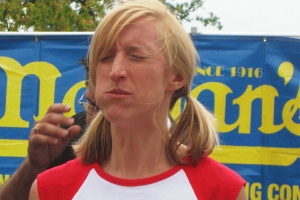 Twelve hot dogs are stacked high on a cookie sheet in front of me. This is my Everest.
 "I think you should try the Solomon method," says Crazy Legs Conti, world-record holder for most pancakes eaten in 12 minutes (3.5 pounds) and my competitive-eating mentor. He's referring to a technique in which you break a wiener in half, shove both ends in your mouth, and chase it down with a wet bun. It's named after King Solomon's controversial maternity test. You know, the baby-sawing one. Crazy Legs pours me three glasses of Crystal Light lemonade (for dunking) and one glass of water (for drinking). To my right, he places a garbage can (for yakking). "You ready for the dirty dozen?" he asks.
I am. It's long been my dream to compete in the world's biggest, best known, most nitrate-filled gorging competition: The Nathan's Famous Hot Dog Eating Contest, held every Fourth of July in Coney Island. So deep is this aspiration that for two years, I shimmied my way onto the main stage as a Bunnette, a girl who counts hot dogs and riles up the crowd while wearing a very short skirt. A wiener cheerleader, if you will. If you witnessed the epic battle in 2009 between Joey "The Jaws" Chestnut and Japanese eating machine Takeru Kobayashi, I was the blonde behind Chestnut, spastically flipping through his number placard and pumping my fist in the air, as he chowed his way to victory, 68 dogs to Kobayashi's 64.5.

This year, I'm hanging up my pom-poms. Because for the first time ever, Nathan's will have a separate women's division. Sure, females have been able to compete before, assuming you're built like Sonya "The Black Widow" Thomas, who can down 41 hot dogs in 10 minutes and smoke guys three times her size (she's 98 freakin' pounds!). But opening up a women's-only category makes the competition attainable for slightly more modest — yet still heroically voracious — eaters like myself. (...)
- - - - - - - - - - - -
My obsession with the glorious sport of competitive eating goes back to my childhood, when I saw my first contest at Pepper Fest, an annual festival in Hudson, Wis. The discipline was spaghetti, and I watched in awe as 10 participants — all men, mostly overweight — sat on a stage, tearing apart meatballs and shoveling noodles into their mouths, their lips framed by circles of tomato sauce, like marinara goatees. I felt, at once, disgust and a sense of belonging — I wanted to spray them down and then shake their hands. I was excited that such a competition existed. It catered to my one skill I would have never thought could amount to anything of recognition: I was a big eater.
Despite my scrawny preteen figure, I had the appetite of an obese child, one who fed her feelings as often as her stomach. What may have been a cause of concern to some parents was a cause of celebration for mine. "That's my girl!" my mom would beam, as I'd plow through my third helping of Hamburger Helper. Most of the time, our family dinners started with a prayer and ended with my declaration of gluttonous victory. "I win!" I'd yell, lifting up my clean plate for the rest of the table to admire. Without any other discernible skills — save my ability to rescue the princess on Super Mario Bros. 1 through 3, I viewed my big appetite as a natural talent. A gift sent from the gorging gods. Something to be proud of. (...)
This Monday, I'm going to achieve my childhood dream and compete in the biggest and best eating competition in the world. And then I'm never, ever going to do it again.
Check back in on July 4, and we'll update the story with Laura Leu's contest results.
Laura Leu is a writer and soon-to-be retired competitive eater. You can follow her on Twitter @LauraLeu, or visit her website, lauraleu.com. More: Laura Leu
via:
Huge Rare Earth Deposits Found in the Pacific
Vast deposits of rare earth minerals, crucial in making high-tech electronics products, have been found on the floor of the Pacific Ocean and can be readily extracted, Japanese scientists said on Monday.
 "The deposits have a heavy concentration of rare earths. Just one square kilometer (0.4 square mile) of deposits will be able to provide one-fifth of the current global annual consumption," said Yasuhiro Kato, an associate professor of earth science at the University of Tokyo.
The discovery was made by a team led by Kato and including researchers from the Japan Agency for Marine-Earth Science and Technology.
They found the minerals in sea mud extracted from depths of 3,500 to 6,000 meters (11,500-20,000 ft) below the ocean surface at 78 locations. One-third of the sites yielded rich contents of rare earths and the metal yttrium, Kato said in a telephone interview.
The deposits are in international waters in an area stretching east and west of Hawaii, as well as east of Tahiti in French Polynesia, he said.
He estimated rare earths contained in the deposits amounted to 80 to 100 billion metric tons, compared to global reserves currently confirmed by the U.S. Geological Survey of just 110 million tonnes that have been found mainly in China, Russia and other former Soviet countries, and the United States.
Details of the discovery were published on Monday in the online version of British journal Nature Geoscience.
 "The deposits have a heavy concentration of rare earths. Just one square kilometer (0.4 square mile) of deposits will be able to provide one-fifth of the current global annual consumption," said Yasuhiro Kato, an associate professor of earth science at the University of Tokyo.
The discovery was made by a team led by Kato and including researchers from the Japan Agency for Marine-Earth Science and Technology.
They found the minerals in sea mud extracted from depths of 3,500 to 6,000 meters (11,500-20,000 ft) below the ocean surface at 78 locations. One-third of the sites yielded rich contents of rare earths and the metal yttrium, Kato said in a telephone interview.
The deposits are in international waters in an area stretching east and west of Hawaii, as well as east of Tahiti in French Polynesia, he said.
He estimated rare earths contained in the deposits amounted to 80 to 100 billion metric tons, compared to global reserves currently confirmed by the U.S. Geological Survey of just 110 million tonnes that have been found mainly in China, Russia and other former Soviet countries, and the United States.
Details of the discovery were published on Monday in the online version of British journal Nature Geoscience.


The Swinger
 “The Swinger” is a novel about a very famous golfer who has an amazing career record, a slew of endorsement deals, a gorgeous wife and a squeaky-clean reputation — until his extracurricular kinks become a huge public embarrassment and spoil everything. The authors, Michael Bamberger (“This Golfing Life”) and Alan Shipnuck (“Bud, Sweat and Tees”), call this golfer Herbert X. Tremont, known as Tree, and his wife, Belinda. But they don’t insult the reader’s intelligence by claiming that these characters bear no resemblance to persons living or dead.
 They don’t embroider the facts much, either. Sure, Tree lives in St. Petersburg, Fla., whereas Tiger Woods lived near Orlando. Tree has ankle surgery, but Mr. Woods had surgery on his knee. Tree’s wife comes from Italy, but Mr. Woods married Elin Nordegren, who was born in Sweden. When Tree’s raunchy correspondence with his many girlfriends is exposed, Belinda beats him up with a 5 iron. Ms. Nordegren may not have whacked Mr. Woods with a 5 iron at all.
Why read a novel that hews so close to glorified gossip? Why read any fiction about celebrities, even if the famous person (like Diana, Princess of Wales, in Monica Ali’s “Untold Story”) has been laboriously renamed, reimagined and packed off to the American Midwest? The answer, in the case of “The Swinger,” is that the authors know their man and know their game.
There’s a fair amount of golf in “The Swinger.” But the game that really shapes this funny, fast-moving book is the one played by the press and the public. Mr. Bamberger and Mr. Shipnuck, senior writers at Sports Illustrated, understand the trade-offs that were part of Mr. Woods’s predebacle career and that are essential to keeping any star athlete out of trouble. Tree’s public and private personae may be very different (“He was often playfully profane unless he was in public or his mother was around”), but if reporters want to get anywhere near him, they’d better not say so. When a sports prodigy who is this two-faced proclaims publicly that “family is everything to me,” no eyebrows had better be raised.
But Tree Tremont’s hubris leads him to forget these ground rules. While certain athletes — the book mentions Derek Jeter — have the humility to keep their private exploits reasonably private, Tree pushes his privilege to the breaking point. “Tree wanted everything,” the authors write. “He wanted the hot nightlife and the kiddie-soccer home life and the glamorous wife and the get-rich-now corporate life that was the foundation of the P.G.A. Tour. To keep it all going, he had to wallpaper his life with lies.”
Watermelon and Tomato Salad

In some ways, this dish owes its provenance to a classic Turkish breakfast dish of watermelon, feta and sometimes mint, but little else. After tasting that, I began to see watermelon in a new light. By itself, watermelon is simply and appealingly sweet. With savory ingredients, the flavor is softer and more complex — sugariness is no longer its main quality.
Ingredients
- 2 1/2 cups seedless watermelon, in 1-inch cubes or balls (cut over a bowl to catch the juice and reserve it)
- 1 1/2 cups cherry or grape tomatoes, cut in half
- 1/2 cup finely diced or crumbled Stilton, Gorgonzola, Roquefort or Maytag blue cheese
- 1/2 cup minced scallions
- Salt
- 2 tablespoons extra virgin olive oil
- 2 tablespoons sherry vinegar
- Pinch cayenne
- 1/2 cup parsley, roughly chopped
Method
- 1. Combine the watermelon, tomato, cheese, scallions and salt in a bowl.
- 2. Whisk or blend together about 2 tablespoons of the watermelon juice, oil, vinegar and cayenne. To serve, dress the salad with this mixture and garnish with parsley. Do not refrigerate and serve within 30 minutes.
Tools of Entry, No Need for a Key Chain
[ed. Guess it's inevitable, I need to get a cell phone one of these days.]
 Front pockets and purses are slowly being emptied of one of civilization’s most basic and enduring tools: the key. It’s being swallowed by the cellphone.
New technology lets smartphones unlock hotel, office and house doors and open garages and even car doors.
It’s a not-too-distant cousin of the technology that allows key fobs to remotely unlock automobiles or key cards to be waved beside electronic pads at office entrances. What’s new is that it is on the device more people are using as the Swiss Army knife of electronics — in equal parts phone, memo pad, stereo, map, GPS unit, camera and game machine.
The phone simply sends a signal through the Internet and a converter box to a deadbolt or door knob. Other systems use internal company networks, like General Motors’ OnStar system, to unlock car doors.
Because nearly everyone has a cellphone, a number of start-ups, lock companies and carmakers are betting on broad acceptance of the technology.
Schlage, a major lock maker, markets a system that lets homeowners use their mobile phones to unlock their doors from miles away, and manage their home heating and air-conditioning, lights and security cameras. Customers buy locks that are controlled by wireless radio signals sent from an Internet-connected box in their home.
Recently, Dwight Gibson, vice president for connected home solutions at Ingersoll Rand, Schlage’s parent, said that he used the system to let a friend into his house while he was sitting at his desk at work. “She thought it was magic,” he said.
Front pockets and purses are slowly being emptied of one of civilization’s most basic and enduring tools: the key. It’s being swallowed by the cellphone.New technology lets smartphones unlock hotel, office and house doors and open garages and even car doors.
It’s a not-too-distant cousin of the technology that allows key fobs to remotely unlock automobiles or key cards to be waved beside electronic pads at office entrances. What’s new is that it is on the device more people are using as the Swiss Army knife of electronics — in equal parts phone, memo pad, stereo, map, GPS unit, camera and game machine.
The phone simply sends a signal through the Internet and a converter box to a deadbolt or door knob. Other systems use internal company networks, like General Motors’ OnStar system, to unlock car doors.
Because nearly everyone has a cellphone, a number of start-ups, lock companies and carmakers are betting on broad acceptance of the technology.
Schlage, a major lock maker, markets a system that lets homeowners use their mobile phones to unlock their doors from miles away, and manage their home heating and air-conditioning, lights and security cameras. Customers buy locks that are controlled by wireless radio signals sent from an Internet-connected box in their home.
Recently, Dwight Gibson, vice president for connected home solutions at Ingersoll Rand, Schlage’s parent, said that he used the system to let a friend into his house while he was sitting at his desk at work. “She thought it was magic,” he said.
Big Data

[ed. Fascinating article with wide-ranging implications. I found the part about health care reform particularly intriguing.]
WHEN the Sloan Digital Sky Survey started work in 2000, its telescope in New Mexico collected more data in its first few weeks than had been amassed in the entire history of astronomy. Now, a decade later, its archive contains a whopping 140 terabytes of information. A successor, the Large Synoptic Survey Telescope, due to come on stream in Chile in 2016, will acquire that quantity of data every five days.
Such astronomical amounts of information can be found closer to Earth too. Wal-Mart, a retail giant, handles more than 1m customer transactions every hour, feeding databases estimated at more than 2.5 petabytes—the equivalent of 167 times the books in America’s Library of Congress (see article for an explanation of how data are quantified). Facebook, a social-networking website, is home to 40 billion photos. And decoding the human genome involves analysing 3 billion base pairs—which took ten years the first time it was done, in 2003, but can now be achieved in one week.
All these examples tell the same story: that the world contains an unimaginably vast amount of digital information which is getting ever vaster ever more rapidly. This makes it possible to do many things that previously could not be done: spot business trends, prevent diseases, combat crime and so on. Managed well, the data can be used to unlock new sources of economic value, provide fresh insights into science and hold governments to account.
 But they are also creating a host of new problems. Despite the abundance of tools to capture, process and share all this information—sensors, computers, mobile phones and the like—it already exceeds the available storage space (see chart 1). Moreover, ensuring data security and protecting privacy is becoming harder as the information multiplies and is shared ever more widely around the world.
 Alex Szalay, an astrophysicist at Johns Hopkins University, notes that the proliferation of data is making them increasingly inaccessible. “How to make sense of all these data? People should be worried about how we train the next generation, not just of scientists, but people in government and industry,” he says.
“We are at a different period because of so much information,” says James Cortada of IBM, who has written a couple of dozen books on the history of information in society. Joe Hellerstein, a computer scientist at the University of California in Berkeley, calls it “the industrial revolution of data”. The effect is being felt everywhere, from business to science, from government to the arts. Scientists and computer engineers have coined a new term for the phenomenon: “big data”.
Sunday, July 3, 2011

Mother Nature's Sons
 For the last few years I’ve been seeing woodsmen on my city’s streets. They wear long beards and long hair, or long beards and no hair. They favor beat-up leather boots and wool beanies and jobs involving wood. At Best Made Co., a downtown boutique, they purchase hand-painted axes and canvas portage packs. At French atelier APC, they try on pieces by Carhartt, a manufacturer of blue-collar outdoor wear, that have been recut for slimmer legs and thicker wallets. Until recently, they were able to hone their bow-hunting skills in the basement archery range of clothier/barbershop Freeman’s Sporting Club.These urban dwellers seem to be getting ready for a long camping trip that never takes place; their flannel grows tatty and their boots scuffed, but they are never stained with real dirt.
Actual lumberjacks, of course, no longer wear flannel. They wear polyester fleeces and CAT boots and wraparound sunglasses and XXL T-shirts. Professional explorers (mountaineers, polar researchers) now wear outfits—often puffy down or synthetic loft in a breathable waterproof shell—that resemble spacesuits. Turn on the Discovery Channel or NatGeo, and you’ll see both types of outdoorsman within two hours: the blue-collar workers emptying our forests of trees, our oceans of crabs, and our rivers of gold; and the explorers, Gore-Tex clad, embarking on extravagant, high-risk vacations. But in order to find Brooklyn’s noveaux voyeageurs, you’ll need to flip over to FashionTV, because they do not exist in the wild.
In any era since the invention of polyester fleece, flannel is a patently absurd choice for outdoor work: when woven from wool it is too heavy; when woven from cotton it fails to retain heat once wet. But the fashion industry, in its ongoing campaign to dust off bygone archetypes of masculinity, has revived the fabric. Along with waxed canvas and leather, flannel plays an important role in repackaging the sex appeal of the vintage outdoorsman while sidestepping both the flimsy artificiality of petroleum-spun fabrics and also the earnestness of organic cloth, which carries with it a whiff of environmentalism—a supposedly emasculating ethos that prudishly promotes the suppression of desire.
Basic physics dictate that, in order to become more sustainable, technology must become ever lighter, quieter, and less hungry. Is it merely a coincidence that these engineering constraints also mirror our favored model of femininity? In a recent study, pollsters found that 82 percent of respondents felt that going green is “more feminine than masculine.” The risk of feminine contamination, the researchers concluded, “holds men back from visible green behavior like using reusable grocery bags or carrying around reusable water bottles.” Add to that the reproachful tone that environmentalists often resort to in their attempts to spread the gospel of Deep Ecology—which stresses the rights of the ecosystem over those of man—and you glimpse how environmentalists came to be miscast as sanctimonious nags.
To expiate their green guilt, tough guys go to extreme lengths: they live in unheated houses, fuel their trucks with rancid cooking oil, subsist on other people’s trash. The tension emerges most clearly with regards to food. Many progressives would like to eat local and organic but don’t want to be seen as either pampering or depriving themselves (or both pampering and depriving themselves, like the diners in Portlandia who must personally visit a chicken on its farm before they can feel sure of its free-range pedigree). In an attempt to live more naturally, a few dozen men in New York City, along with one woman, have reportedly committed themselves to a so-called caveman diet. The diet’s strictures allow them to eat only meat and vegetables—no grains, sugar, dairy, or oil—and requires days of fasting between meals. “I didn’t want to do some faddish diet that my sister would do,” one of the dieters told the New York Times.
Like many Americans, the cave people seem distrustful, even contemptuous, of vegan asceticism. Abstaining from animal byproducts is considered difficult, but not tough: your kid sister might gladly survive on barbecued seitan and cartons of Rice Dream. Even as progressive men renounce the traditional notion of subordinated femininity, many still harbor conflicted notions about manhood. They want to feel individually reckless, but not socially irresponsible. They want to minimize carbon emissions, but not to scold, scrimp, or carry tote bags. They want to be pure of deed but wild at heart. So they dig ever deeper into the past, searching for a way of life that existed before “real” men and their ecological consciences parted ways.

Relieve Itchy Mosquito and Wasp Bites with Vick’s Vapo Rub

[ed. This is not an endorsement - I've never tried Vicks for this purpose, but it might be worth investigating.]
It's finally Summer but that brings one of the year's most annoying problems: bug bites. If you do fall victim to a bee sting or mosquito bite, you can easily relieve the itching and redness with the help of Vick's Vapo Rub.
This tip comes from The People's Pharmacy:
For more years than I can remember, I've had an allergy to mosquito bites. Now I don't suffer long. With a touch of Vicks the itching and redness are gone.It seems to work for the same reasons as toothpaste, since both use menthol and menthol is a local anesthetic, but a Vick's has the distinct advantage of being made for skin application and won't show as a white splotch while you're enjoying the upcoming fourth of July weekend.
Graedon's Guide to Unique Uses for Vicks (PDF)
Subscribe to:
Posts (Atom)