
Tuesday, July 12, 2011
The Eight Truths About Weddings (That No One Ever Tells You)
by Melissa Lafsky
Once you decide to have a wedding, there are many, many things to read: etiquette guides, Dos and Don'ts, planning checklists, vendor guides, “inspiration boards,” disaster stories, angry bridesmaid rants ("bitch made me wear PURPLE SHOES!"), even socio-political screeds about the cultural irrelevance of the whole thing. All of these are nice, and all of them are utterly useless.
 If you're the one getting married—which I am, in three months, while also attending eight other weddings in as many months due to a hyper-marital zeitgeist (that, as of July 24th, includes New York gays!! Welcome to the madness!!)—a mysterious stupor befalls you. The tales of "bridal nervous breakdowns” have become ingrained in pop culture, "ingrained” meaning “anything that gets its own reality show.” Such breakdowns do happen, and they're hardly gender-specific, but these displays of emotional gangrene fail to get at the heart of the nuptial plight.
So where does one go to find a guide to the true sources of wedding-angst? One resource is the wedding industry, that fondant tower of chintzy madness that exists to suck your wallet and self-esteem out through multiple orifices. The industry gets plenty of flack, mostly for its organza-wrapped obfuscation of anything important. But all this hating is silly. Yes, the wedding industry will crack open your skull and pour in gallons of raspberry-hazelnut ganache, and then send you a bill for $15,000. But that's its job. It's absurd to expect people in the industry to tell you the truth about weddings. They're there for one purpose: to sell you shit. Calling them manipulative capitalist assholes (ahem, Rebecca Mead) isn’t solving the problem; it’s simply blaming the addiction on the dealer.
The truth about weddings was once something we all figured out for ourselves as we made our way across the glurpy morass of the engagement tar fields. Until now! Here is your look into the things no one ever tells you about weddings (but are nonetheless true).
1. WEDDINGS ARE EMOTIONAL RECKONINGS.
Have you dealt with your issues? I’m not talking about a few months in therapy and the occasional Xanax on a bad day—I’m talking about really digging in, sitting under the Bodhi tree, and dealing with all the nasty icky hurts and fears and angers that have burned your face and clamped your guts since you were five. If you have never once taken a hard look at what really triggers you emotionally, and figured out a way to release that trigger, you're in for a shock. Because ALL of your submerged emotions will rear their Gorgon heads during the process of planning a wedding. Prepare to be confronted.
First, there’s your family. Ahh, family. The one group with perma-instant access to every emotional trigger in your psyche ("Of course your mother knows how to push all your buttons!" a matriarch once told me. 'She created them!!"). Do you still resent your mom for that "Honey, your thighs don’t need that ice cream!" comment in 8th grade? Clinging to the last vestiges of anger at your dad for never kissing you goodnight or reading your term papers? Secretly seethe at your brother for moving far away and leaving you to deal with the full brunt of your parents' needs? Lucky you! You're going to experience all of it again, since each of these people will be intimately involved in your Big Megaspecial Day (whether you invite them or not). If you do not give up any and all familial anger, it will seize you in its talons and tear out your liver at least once a day, Prometheus style. You will find yourself shrieking over the fact that your mom disapproves of your choice of chair covers ("You never liked my clothes in junior high!!! Wail Sob!”) or that your dad suggested "Psychokiller" as a father-daughter dance ("You spent my childhood in the office and now this!!"). Any unresolved issue, annoyance or pin in the side that you’ve had since, well, birth will now be a part of your daily life. And we haven’t even gotten to the fact that you may be asking them for money!
Once you decide to have a wedding, there are many, many things to read: etiquette guides, Dos and Don'ts, planning checklists, vendor guides, “inspiration boards,” disaster stories, angry bridesmaid rants ("bitch made me wear PURPLE SHOES!"), even socio-political screeds about the cultural irrelevance of the whole thing. All of these are nice, and all of them are utterly useless.
 If you're the one getting married—which I am, in three months, while also attending eight other weddings in as many months due to a hyper-marital zeitgeist (that, as of July 24th, includes New York gays!! Welcome to the madness!!)—a mysterious stupor befalls you. The tales of "bridal nervous breakdowns” have become ingrained in pop culture, "ingrained” meaning “anything that gets its own reality show.” Such breakdowns do happen, and they're hardly gender-specific, but these displays of emotional gangrene fail to get at the heart of the nuptial plight.
 So where does one go to find a guide to the true sources of wedding-angst? One resource is the wedding industry, that fondant tower of chintzy madness that exists to suck your wallet and self-esteem out through multiple orifices. The industry gets plenty of flack, mostly for its organza-wrapped obfuscation of anything important. But all this hating is silly. Yes, the wedding industry will crack open your skull and pour in gallons of raspberry-hazelnut ganache, and then send you a bill for $15,000. But that's its job. It's absurd to expect people in the industry to tell you the truth about weddings. They're there for one purpose: to sell you shit. Calling them manipulative capitalist assholes (ahem, Rebecca Mead) isn’t solving the problem; it’s simply blaming the addiction on the dealer.
The truth about weddings was once something we all figured out for ourselves as we made our way across the glurpy morass of the engagement tar fields. Until now! Here is your look into the things no one ever tells you about weddings (but are nonetheless true).
1. WEDDINGS ARE EMOTIONAL RECKONINGS.
Have you dealt with your issues? I’m not talking about a few months in therapy and the occasional Xanax on a bad day—I’m talking about really digging in, sitting under the Bodhi tree, and dealing with all the nasty icky hurts and fears and angers that have burned your face and clamped your guts since you were five. If you have never once taken a hard look at what really triggers you emotionally, and figured out a way to release that trigger, you're in for a shock. Because ALL of your submerged emotions will rear their Gorgon heads during the process of planning a wedding. Prepare to be confronted.
First, there’s your family. Ahh, family. The one group with perma-instant access to every emotional trigger in your psyche ("Of course your mother knows how to push all your buttons!" a matriarch once told me. 'She created them!!"). Do you still resent your mom for that "Honey, your thighs don’t need that ice cream!" comment in 8th grade? Clinging to the last vestiges of anger at your dad for never kissing you goodnight or reading your term papers? Secretly seethe at your brother for moving far away and leaving you to deal with the full brunt of your parents' needs? Lucky you! You're going to experience all of it again, since each of these people will be intimately involved in your Big Megaspecial Day (whether you invite them or not). If you do not give up any and all familial anger, it will seize you in its talons and tear out your liver at least once a day, Prometheus style. You will find yourself shrieking over the fact that your mom disapproves of your choice of chair covers ("You never liked my clothes in junior high!!! Wail Sob!”) or that your dad suggested "Psychokiller" as a father-daughter dance ("You spent my childhood in the office and now this!!"). Any unresolved issue, annoyance or pin in the side that you’ve had since, well, birth will now be a part of your daily life. And we haven’t even gotten to the fact that you may be asking them for money!


Tennis Ball Pajamas

by Anahad O'Connor
For some people who snore, a slight tweak in sleeping position — lying on one side instead of the back — can lead to a better night’s rest. Yet staying put in that position, while wrapped in slumber, is not always an easy feat.
One of the oldest and simplest solutions involves a tennis ball, which is taped or sewn into the back of the pajamas to prevent a snorer from rolling onto his or her back at night. The technique is widely recommended by sleep experts, but studies have found it may not work for many chronic snorers.
In 2009 a team of researchers studied whether this trick could reduce snoring in 67 people with obstructive sleep apnea, which causes snoring and breathing interruptions throughout the night. The patients had an average of 30 breathing pauses per hour of sleep, which climbed to over 50 interruptions when they were on their backs, but was roughly 14 when they slept on their sides. They were taught to use the tennis ball technique, then followed for an average of over two years.
At the end of the study, which was published in The Journal of Clinical Sleep Medicine, the researchers found that most patients gave it up. Less than 10 percent still used the technique. Those who stopped said that it was ineffective or caused backaches, or that the ball moved around too much, among other problems.
For those in need of a more promising strategy, devices that provide continuous positive airway pressure, or C.P.A.P., help keep the airways open and are extremely effective. Some doctors also offer noninvasive treatments that tighten the throat tissue and improve breathing, taking the roar out of your snore.
THE BOTTOM LINE
Research shows that for many people, the tennis ball trick is not a very effective anti-snoring technique.
via:
War Without Humans
by Barbara Ehrenreich
For a book about the all-too-human “passions of war,” my 1997 work Blood Rites ended on a strangely inhuman note: I suggested that, whatever distinctly human qualities war calls upon -- honor, courage, solidarity, cruelty, and so forth -- it might be useful to stop thinking of war in exclusively human terms. After all, certain species of ants wage war and computers can simulate “wars” that play themselves out on-screen without any human involvement.
 More generally, then, we should define war as a self-replicating pattern of activity that may or may not require human participation. In the human case, we know it is capable of spreading geographically and evolving rapidly over time -- qualities that, as I suggested somewhat fancifully, make war a metaphorical successor to the predatory animals that shaped humans into fighters in the first place.
A decade and a half later, these musings do not seem quite so airy and abstract anymore. The trend, at the close of the twentieth century, still seemed to be one of ever more massive human involvement in war -- from armies containing tens of thousands in the sixteenth century, to hundreds of thousands in the nineteenth, and eventually millions in the twentieth century world wars.
It was the ascending scale of war that originally called forth the existence of the nation-state as an administrative unit capable of maintaining mass armies and the infrastructure -- for taxation, weapons manufacture, transport, etc. -- that they require. War has been, and we still expect it to be, the most massive collective project human beings undertake. But it has been evolving quickly in a very different direction, one in which human beings have a much smaller role to play.
One factor driving this change has been the emergence of a new kind of enemy, so-called “non-state actors,” meaning popular insurgencies and loose transnational networks of fighters, none of which are likely to field large numbers of troops or maintain expensive arsenals of their own. In the face of these new enemies, typified by al-Qaeda, the mass armies of nation-states are highly ineffective, cumbersome to deploy, difficult to maneuver, and from a domestic point of view, overly dependent on a citizenry that is both willing and able to fight, or at least to have their children fight for them.
Yet just as U.S. military cadets continue, in defiance of military reality, to sport swords on their dress uniforms, our leaders, both military and political, tend to cling to an idea of war as a vast, labor-intensive effort on the order of World War II. Only slowly, and with a reluctance bordering on the phobic, have the leaders of major states begun to grasp the fact that this approach to warfare may soon be obsolete.
Consider the most recent U.S. war with Iraq. According to then-president George W. Bush, the casus belli was the 9/11 terror attacks. The causal link between that event and our chosen enemy, Iraq, was, however, imperceptible to all but the most dedicated inside-the-Beltway intellectuals. Nineteen men had hijacked airplanes and flown them into the Pentagon and the World Trade Center -- 15 of them Saudi Arabians, none of them Iraqis -- and we went to war against… Iraq?
Military history offers no ready precedents for such wildly misaimed retaliation. The closest analogies come from anthropology, which provides plenty of cases of small-scale societies in which the death of any member, for any reason, needs to be “avenged” by an attack on a more or less randomly chosen other tribe or hamlet.
Why Iraq? Neoconservative imperial ambitions have been invoked in explanation, as well as the American thirst for oil, or even an Oedipal contest between George W. Bush and his father. There is no doubt some truth to all of these explanations, but the targeting of Iraq also represented a desperate and irrational response to what was, for Washington, an utterly confounding military situation.
We faced a state-less enemy -- geographically diffuse, lacking uniforms and flags, invulnerable to invading infantries and saturation bombing, and apparently capable of regenerating itself at minimal expense. From the perspective of Secretary of Defense Donald Rumsfeld and his White House cronies, this would not do.
Since the U.S. was accustomed to fighting other nation-states -- geopolitical entities containing such identifiable targets as capital cities, airports, military bases, and munitions plants -- we would have to find a nation-state to fight, or as Rumsfeld put it, a “target-rich environment.” Iraq, pumped up by alleged stockpiles of “weapons of mass destruction,” became the designated surrogate for an enemy that refused to play our game.
The effects of this atavistic war are still being tallied: in Iraq, we would have to include civilian deaths estimated at possibly hundreds of thousands, the destruction of civilian infrastructure, and devastating outbreaks of sectarian violence of a kind that, as we should have learned from the dissolution of Yugoslavia, can readily follow the death or removal of a nationalist dictator.
But the effects of war on the U.S. and its allies may end up being almost as tragic. Instead of punishing the terrorists who had attacked the U.S., the war seems to have succeeded in recruiting more such irregular fighters, young men (and sometimes women) willing to die and ready to commit further acts of terror or revenge. By insisting on fighting a more or less randomly selected nation-state, the U.S. may only have multiplied the non-state threats it faces.
Unwieldy Armies
Whatever they may think of what the U.S. and its allies did in Iraq, many national leaders are beginning to acknowledge that conventional militaries are becoming, in a strictly military sense, almost ludicrously anachronistic. Not only are they unsuited to crushing counterinsurgencies and small bands of terrorists or irregular fighters, but mass armies are simply too cumbersome to deploy on short notice.
In military lingo, they are weighed down by their “tooth to tail” ratio -- a measure of the number of actual fighters in comparison to the support personnel and equipment the fighters require. Both hawks and liberal interventionists may hanker to airlift tens of thousands of soldiers to distant places virtually overnight, but those soldiers will need to be preceded or accompanied by tents, canteens, trucks, medical equipment, and so forth. “Flyover” rights will have to be granted by neighboring countries; air strips and eventually bases will have to be constructed; supply lines will have be created and defended -- all of which can take months to accomplish.
Read more:
image credit:
For a book about the all-too-human “passions of war,” my 1997 work Blood Rites ended on a strangely inhuman note: I suggested that, whatever distinctly human qualities war calls upon -- honor, courage, solidarity, cruelty, and so forth -- it might be useful to stop thinking of war in exclusively human terms. After all, certain species of ants wage war and computers can simulate “wars” that play themselves out on-screen without any human involvement.
 More generally, then, we should define war as a self-replicating pattern of activity that may or may not require human participation. In the human case, we know it is capable of spreading geographically and evolving rapidly over time -- qualities that, as I suggested somewhat fancifully, make war a metaphorical successor to the predatory animals that shaped humans into fighters in the first place.
 A decade and a half later, these musings do not seem quite so airy and abstract anymore. The trend, at the close of the twentieth century, still seemed to be one of ever more massive human involvement in war -- from armies containing tens of thousands in the sixteenth century, to hundreds of thousands in the nineteenth, and eventually millions in the twentieth century world wars.
It was the ascending scale of war that originally called forth the existence of the nation-state as an administrative unit capable of maintaining mass armies and the infrastructure -- for taxation, weapons manufacture, transport, etc. -- that they require. War has been, and we still expect it to be, the most massive collective project human beings undertake. But it has been evolving quickly in a very different direction, one in which human beings have a much smaller role to play.
One factor driving this change has been the emergence of a new kind of enemy, so-called “non-state actors,” meaning popular insurgencies and loose transnational networks of fighters, none of which are likely to field large numbers of troops or maintain expensive arsenals of their own. In the face of these new enemies, typified by al-Qaeda, the mass armies of nation-states are highly ineffective, cumbersome to deploy, difficult to maneuver, and from a domestic point of view, overly dependent on a citizenry that is both willing and able to fight, or at least to have their children fight for them.
Yet just as U.S. military cadets continue, in defiance of military reality, to sport swords on their dress uniforms, our leaders, both military and political, tend to cling to an idea of war as a vast, labor-intensive effort on the order of World War II. Only slowly, and with a reluctance bordering on the phobic, have the leaders of major states begun to grasp the fact that this approach to warfare may soon be obsolete.
Consider the most recent U.S. war with Iraq. According to then-president George W. Bush, the casus belli was the 9/11 terror attacks. The causal link between that event and our chosen enemy, Iraq, was, however, imperceptible to all but the most dedicated inside-the-Beltway intellectuals. Nineteen men had hijacked airplanes and flown them into the Pentagon and the World Trade Center -- 15 of them Saudi Arabians, none of them Iraqis -- and we went to war against… Iraq?
Military history offers no ready precedents for such wildly misaimed retaliation. The closest analogies come from anthropology, which provides plenty of cases of small-scale societies in which the death of any member, for any reason, needs to be “avenged” by an attack on a more or less randomly chosen other tribe or hamlet.
Why Iraq? Neoconservative imperial ambitions have been invoked in explanation, as well as the American thirst for oil, or even an Oedipal contest between George W. Bush and his father. There is no doubt some truth to all of these explanations, but the targeting of Iraq also represented a desperate and irrational response to what was, for Washington, an utterly confounding military situation.
We faced a state-less enemy -- geographically diffuse, lacking uniforms and flags, invulnerable to invading infantries and saturation bombing, and apparently capable of regenerating itself at minimal expense. From the perspective of Secretary of Defense Donald Rumsfeld and his White House cronies, this would not do.
Since the U.S. was accustomed to fighting other nation-states -- geopolitical entities containing such identifiable targets as capital cities, airports, military bases, and munitions plants -- we would have to find a nation-state to fight, or as Rumsfeld put it, a “target-rich environment.” Iraq, pumped up by alleged stockpiles of “weapons of mass destruction,” became the designated surrogate for an enemy that refused to play our game.
The effects of this atavistic war are still being tallied: in Iraq, we would have to include civilian deaths estimated at possibly hundreds of thousands, the destruction of civilian infrastructure, and devastating outbreaks of sectarian violence of a kind that, as we should have learned from the dissolution of Yugoslavia, can readily follow the death or removal of a nationalist dictator.
But the effects of war on the U.S. and its allies may end up being almost as tragic. Instead of punishing the terrorists who had attacked the U.S., the war seems to have succeeded in recruiting more such irregular fighters, young men (and sometimes women) willing to die and ready to commit further acts of terror or revenge. By insisting on fighting a more or less randomly selected nation-state, the U.S. may only have multiplied the non-state threats it faces.
Unwieldy Armies
Whatever they may think of what the U.S. and its allies did in Iraq, many national leaders are beginning to acknowledge that conventional militaries are becoming, in a strictly military sense, almost ludicrously anachronistic. Not only are they unsuited to crushing counterinsurgencies and small bands of terrorists or irregular fighters, but mass armies are simply too cumbersome to deploy on short notice.
In military lingo, they are weighed down by their “tooth to tail” ratio -- a measure of the number of actual fighters in comparison to the support personnel and equipment the fighters require. Both hawks and liberal interventionists may hanker to airlift tens of thousands of soldiers to distant places virtually overnight, but those soldiers will need to be preceded or accompanied by tents, canteens, trucks, medical equipment, and so forth. “Flyover” rights will have to be granted by neighboring countries; air strips and eventually bases will have to be constructed; supply lines will have be created and defended -- all of which can take months to accomplish.
Read more:
image credit:
Monday, July 11, 2011


The Last Guy Standing
by Jonathan Goldstein
On Saturday afternoon at 2 o'clock, the staff of Forest Trace, a retirement community just outside Fort Lauderdale, Fla., clears aside the tables and chairs in the foyer of the main building to create a circle for the women and men to dance, though when I say the women and men, I mainly mean the women and Hy Kaplan.
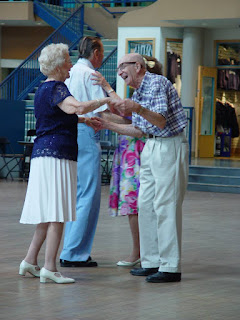 When I walk into the lobby at 2:30, Kaplan, 93, is twirling Thelma Kahn in the middle of a circle of two dozen watchful women in wicker chairs. It is a scene of ethereal beauty. The couple dance among tall white pillars, and sunlight streams in through the skylight high above, giving Kahn's puffy white hair a halo. After a few more twirls, Kaplan returns Kahn to her chair and approaches the next lucky lady.
This is how it works: Kaplan escorts each partner to the center of the circle, where, depending on the song and Kaplan's mood, they will fox trot, waltz, tango or even merengue. As the afternoon wears on, Kaplan's white-leather loafers bounce gracefully about the carpet, and no matter how good or bad his partner, he always demonstrates a little showmanship, throwing in a Westchester step here and there, doing other little fancy things with his feet that I don't know the name for. When the song is over, he extends his arms to the next woman down the line, who always accepts them. There's something in Kaplan's manner that makes it seem as if he has a job to do, as if he's unloading a truck of women in boxes whom he must dance with one at a time before the quitting whistle blows.
A man named Big Nick wears a white suit and plays a white baby grand piano. He belts out tunes like ''Hava Nagila'' and ''It Had to Be You,'' and when he hits the opening notes of ''Bye Bye Blackbird,'' a hushed chorus of women's voices chime in.
I ask the woman seated in front of me if Kaplan is the best dancer here.
''Well,'' she says, ''he doesn't have much competition.''
There are more than twice as many women as men at Forest Trace. All a man has to do is stay alive, and he's guaranteed a full dance card. A couple of these men sit with the women, watching with a sort of aristocratic indifference as Kaplan dances. Simply because they are men, they have their choice of women, but even the casual observer can see that they are a bunch of sleepy yellow-pant-ed Potsies and practical-walking-shoed Ralphs, while around here, Hy Kaplan is the Fonz.
Forest Trace, home to more than 400 seniors, is all about leisure, and as such, a kind of courtlike behavior has emerged here, full of intrigues and legends and gossip. It's the kind of thing you think you're only going to live through once, in high school.
''It's like Peyton Place here,'' says Bea Utal, who is sitting in the foyer. ''There are so many affairs.'' Utal tells me the story of how a Forest Trace couple in their 90's were found naked in bed together. It seems that one of them, during the throes of passion, accidentally pulled the emergency cord above the bed.
Read more:
image credit:
On Saturday afternoon at 2 o'clock, the staff of Forest Trace, a retirement community just outside Fort Lauderdale, Fla., clears aside the tables and chairs in the foyer of the main building to create a circle for the women and men to dance, though when I say the women and men, I mainly mean the women and Hy Kaplan.
 When I walk into the lobby at 2:30, Kaplan, 93, is twirling Thelma Kahn in the middle of a circle of two dozen watchful women in wicker chairs. It is a scene of ethereal beauty. The couple dance among tall white pillars, and sunlight streams in through the skylight high above, giving Kahn's puffy white hair a halo. After a few more twirls, Kaplan returns Kahn to her chair and approaches the next lucky lady.
This is how it works: Kaplan escorts each partner to the center of the circle, where, depending on the song and Kaplan's mood, they will fox trot, waltz, tango or even merengue. As the afternoon wears on, Kaplan's white-leather loafers bounce gracefully about the carpet, and no matter how good or bad his partner, he always demonstrates a little showmanship, throwing in a Westchester step here and there, doing other little fancy things with his feet that I don't know the name for. When the song is over, he extends his arms to the next woman down the line, who always accepts them. There's something in Kaplan's manner that makes it seem as if he has a job to do, as if he's unloading a truck of women in boxes whom he must dance with one at a time before the quitting whistle blows.
A man named Big Nick wears a white suit and plays a white baby grand piano. He belts out tunes like ''Hava Nagila'' and ''It Had to Be You,'' and when he hits the opening notes of ''Bye Bye Blackbird,'' a hushed chorus of women's voices chime in.
I ask the woman seated in front of me if Kaplan is the best dancer here.
''Well,'' she says, ''he doesn't have much competition.''
There are more than twice as many women as men at Forest Trace. All a man has to do is stay alive, and he's guaranteed a full dance card. A couple of these men sit with the women, watching with a sort of aristocratic indifference as Kaplan dances. Simply because they are men, they have their choice of women, but even the casual observer can see that they are a bunch of sleepy yellow-pant-ed Potsies and practical-walking-shoed Ralphs, while around here, Hy Kaplan is the Fonz.
Forest Trace, home to more than 400 seniors, is all about leisure, and as such, a kind of courtlike behavior has emerged here, full of intrigues and legends and gossip. It's the kind of thing you think you're only going to live through once, in high school.
''It's like Peyton Place here,'' says Bea Utal, who is sitting in the foyer. ''There are so many affairs.'' Utal tells me the story of how a Forest Trace couple in their 90's were found naked in bed together. It seems that one of them, during the throes of passion, accidentally pulled the emergency cord above the bed.
Read more:
image credit:


Two Decades of the Web: A Utopia No Longer
by Evgeny Morozov
The internet is a child with many fathers. It is an extremely complex multi-module technology and each module—from communication protocols to browsers—has a convoluted history. The internet’s earliest roots lie in the rise of cybernetics during the 1950s. Later breakthroughs included the invention of packet switching in the 1960s, a novel way for transmitting data by breaking it into chunks. Various university and government networks began to appear in the early 1970s, and were interlinked in the 1980s. The first browsers came on line in the early 1990s—20 years ago this August.
 Many seemingly unrelated developments in the computer industry played an important role. The idea of personalised, decentralised and playful computing was being advanced by the likes of Apple and Microsoft in the 1970s. In contrast, IBM’s idea of computing was of an expensive, centralised and institutional activity. If this latter view had prevailed, the internet might have never developed beyond email, which would probably have been limited to academics and investment bankers. That your mobile phone moonlights as a computer is not the result of inevitable technological trends, but the outcome of deeply ideological and now almost forgotten struggle between two different visions of computing.
Much of the credit for the technical advances of the internet goes to individuals such as Vint Cerf, creator of the first inter-network protocol, which helped to unify the numerous pre-internet networks; David D Clark, who helped to theorise the “end-to-end” principle, the precursor to the modern concept of “net neutrality”; and Tim Berners-Lee, who invented the world wide web.
But studying the history of the internet is impossible without studying the ideas, biases, and desires of its early cheerleaders, a group distinct from the engineers. This included Stewart Brand, Kevin Kelly, John Perry Barlow, and the crowd that coalesced around Wired magazine after its launch in 1993. They were male, California-based, and had fond memories of the tumultuous hedonism of the 1960s.
These men emphasised the importance of community and shared experiences; they viewed humans as essentially good, influenced by rational deliberation, and tending towards co-operation. Anti-Hobbesian at heart, they viewed the state and its institutions as an obstacle to be overcome—and what better way to transcend them than via cyberspace? Their values had profound effects on the mechanics of the internet, not all of them positive. The proliferation of spam and cybercrime is, in part, the consequence of their failure to predict what might happen as a result of the internet’s open infrastructure. The first spam message dates back to 1978; now, 85 per cent of all email traffic in the world is spam.
Perhaps the cheerleaders’ greatest achievement was in wresting dominance of the internet from the founding engineers, whose mentality was that of the Cold War. These researchers greatly depended on the largesse of the US department of defence and its nervous anticipation of a nuclear exchange with the Soviet Union. The idea of the “virtual community”—the antithesis of Cold War paranoia—was popularised by the writer and thinker Howard Rheingold. The term arose from his experiences with Well.com, an early precursor to Facebook.
But this cyber-boosterism was not without a serious side. Figures such as Nicholas Negroponte, co-founder of the MIT Media Laboratory and the spiritual leader of the “One Laptop per Child” movement, Bill Gates of Microsoft, and Esther Dyson, the commentator and entrepreneur, helped to assure the public that the internet was not just a hangout for Bay Area hippies— it was also a serious place for doing business. And as the cyber-pundits kept promising, it was also a place for “getting empowered,” an attitude that made it a good fit for the broader neoliberal agenda of the 1990s.
Read more:
The internet is a child with many fathers. It is an extremely complex multi-module technology and each module—from communication protocols to browsers—has a convoluted history. The internet’s earliest roots lie in the rise of cybernetics during the 1950s. Later breakthroughs included the invention of packet switching in the 1960s, a novel way for transmitting data by breaking it into chunks. Various university and government networks began to appear in the early 1970s, and were interlinked in the 1980s. The first browsers came on line in the early 1990s—20 years ago this August.
Many seemingly unrelated developments in the computer industry played an important role. The idea of personalised, decentralised and playful computing was being advanced by the likes of Apple and Microsoft in the 1970s. In contrast, IBM’s idea of computing was of an expensive, centralised and institutional activity. If this latter view had prevailed, the internet might have never developed beyond email, which would probably have been limited to academics and investment bankers. That your mobile phone moonlights as a computer is not the result of inevitable technological trends, but the outcome of deeply ideological and now almost forgotten struggle between two different visions of computing. Much of the credit for the technical advances of the internet goes to individuals such as Vint Cerf, creator of the first inter-network protocol, which helped to unify the numerous pre-internet networks; David D Clark, who helped to theorise the “end-to-end” principle, the precursor to the modern concept of “net neutrality”; and Tim Berners-Lee, who invented the world wide web.
But studying the history of the internet is impossible without studying the ideas, biases, and desires of its early cheerleaders, a group distinct from the engineers. This included Stewart Brand, Kevin Kelly, John Perry Barlow, and the crowd that coalesced around Wired magazine after its launch in 1993. They were male, California-based, and had fond memories of the tumultuous hedonism of the 1960s.
These men emphasised the importance of community and shared experiences; they viewed humans as essentially good, influenced by rational deliberation, and tending towards co-operation. Anti-Hobbesian at heart, they viewed the state and its institutions as an obstacle to be overcome—and what better way to transcend them than via cyberspace? Their values had profound effects on the mechanics of the internet, not all of them positive. The proliferation of spam and cybercrime is, in part, the consequence of their failure to predict what might happen as a result of the internet’s open infrastructure. The first spam message dates back to 1978; now, 85 per cent of all email traffic in the world is spam.
Perhaps the cheerleaders’ greatest achievement was in wresting dominance of the internet from the founding engineers, whose mentality was that of the Cold War. These researchers greatly depended on the largesse of the US department of defence and its nervous anticipation of a nuclear exchange with the Soviet Union. The idea of the “virtual community”—the antithesis of Cold War paranoia—was popularised by the writer and thinker Howard Rheingold. The term arose from his experiences with Well.com, an early precursor to Facebook.
But this cyber-boosterism was not without a serious side. Figures such as Nicholas Negroponte, co-founder of the MIT Media Laboratory and the spiritual leader of the “One Laptop per Child” movement, Bill Gates of Microsoft, and Esther Dyson, the commentator and entrepreneur, helped to assure the public that the internet was not just a hangout for Bay Area hippies— it was also a serious place for doing business. And as the cyber-pundits kept promising, it was also a place for “getting empowered,” an attitude that made it a good fit for the broader neoliberal agenda of the 1990s.
Read more:


Visitor For Hire

by Vincent M. Mallozzi
Squinting through dark sunglasses at row after row of neatly lined headstones, Terry Marotta-Lopriore drove slowly through Gate of Heaven Cemetery.
Holding the steering wheel with one hand and a bouquet of flowers with the other, she pulled to the curb, glanced at several notes scribbled inside a folder and walked to Section 17, Plot No. 26, Grave No. 6. There, she came upon a pinkish headstone, bathed in bright sunshine, that belonged to Cristy Akyildiz. Chiseled inside a giant heart were the words “Angel of God, Cristy, October 25, 2001.”
“Poor little girl,” Mrs. Marotta-Lopriore said before kneeling and gently laying the flowers on the grave.
Mrs. Marotta-Lopriore is not a relative or a family friend.
In fact, she had not known the girl.
A paralegal and married mother of three trying to earn extra money in a tough economy, Mrs. Marotta-Lopriore, 57, embarked last month on a new career: cemetery visitor for hire.
Read more:
Bear Napping

On a recent photo trip to Alaska’s McNeil River, I spent four days observing and photographing Brown Bears. The bears routine became pretty obvious – they’d fish for a while until their bellies were full, then they’d wander off into the grass for a little nap. This ole gal never quite got that far – after snaring this salmon, she wandered into a shallow pool at the side of the river, cradled the fish under her arm, and promptly nodded off. It was really comical to see her just sitting there sound asleep.via:
Gassed by John Singer Sargent (1918)

[ed. I recall as a young boy listening to my grandfather describe the horrors of mustard gas in World War I. He never mentioned it more than once but the images have stuck with me all my life. The poem at the end of this piece pretty much says it all.]
My Daily Art Display painting for today follows the theme of yesterday’s offering. Once again I am featuring a painting which highlights the savagery of war. This is another realistic depiction of the horrors of war which are often badly received by people who prefer to just see depictions of glorious victories, heroic acts and the happy return of our fighting men. Sadly these kinds of pictures give one a false impression of the reality of war and it is sad to think that some of us want to close our eyes to what a war really is about and the terrifying effect it has on those who have to fight for somebody’s cause. My painting today is entitled Gassed and is by the American artist John Singer Sargent which depicts the horrors of the trench fighting in the First World War. It is a massive painting measuring 231cms high and 611 cms wide (91 inches x 240 inches) and can be seen in the Imperial War Museum in London.
John Singer Sargent was an American painter. His parents were Americans but he was actually born in Florence where the family had moved to as an aid to his mother’s health. The family travelled extensively throughout Europe. Sargent loved his country yet he spent most of his life in Europe. He became one of the most celebrated portraitists of his time but at the very height of his fame as a portrait painter he decided to devote full time to landscape painting, water colours and public art.
...
So today’s featured painting was very different to his normal works. It is a scene Sargent witnessed in August 1918 at Le Bac du Sud on the road between the French towns of Arras and Doullens in the Somme area of Northern France. We see a line of nine soldiers, blinded by mustard gas, being helped along a boarded path by two orderlies towards a medical station. The medical post is out of sight to the right of the scene but we can make out the guy ropes which support the tent-like structure. The line of men who struggle to make their way towards the tent are silhouetted against the golden sunset sky. In the left background we can just make out some bivouacs and to the right we see another line of wounded men being led towards the medical facility. The foreground of the painting is littered with the wounded lying at rest, many with their heads bandaged.
The Good Short Life
by Dudley Clendinen
I have wonderful friends. In this last year, one took me to Istanbul. One gave me a box of hand-crafted chocolates. Fifteen of them held two rousing, pre-posthumous wakes for me. Several wrote large checks. Two sent me a boxed set of all the Bach sacred cantatas. And one, from Texas, put a hand on my thinning shoulder, and appeared to study the ground where we were standing. He had flown in to see me.
 “We need to go buy you a pistol, don’t we?” he asked quietly. He meant to shoot myself with.
“Yes, Sweet Thing,” I said, with a smile. “We do.”
I loved him for that.
I love them all. I am acutely lucky in my family and friends, and in my daughter, my work and my life. But I have amyotrophic lateral sclerosis, or A.L.S., more kindly known as Lou Gehrig’s disease, for the great Yankee hitter and first baseman who was told he had it in 1939, accepted the verdict with such famous grace, and died less than two years later. He was almost 38.
I sometimes call it Lou, in his honor, and because the familiar feels less threatening. But it is not a kind disease. The nerves and muscles pulse and twitch, and progressively, they die. From the outside, it looks like the ripple of piano keys in the muscles under my skin. From the inside, it feels like anxious butterflies, trying to get out. It starts in the hands and feet and works its way up and in, or it begins in the muscles of the mouth and throat and chest and abdomen, and works its way down and out. The second way is called bulbar, and that’s the way it is with me. We don’t live as long, because it affects our ability to breathe early on, and it just gets worse.
At the moment, for 66, I look pretty good. I’ve lost 20 pounds. My face is thinner. I even get some “Hey, there, Big Boy,” looks, which I like. I think of it as my cosmetic phase. But it’s hard to smile, and chew. I’m short of breath. I choke a lot. I sound like a wheezy, lisping drunk. For a recovering alcoholic, it’s really annoying.
There is no meaningful treatment. No cure. There is one medication, Rilutek, which might make a few months’ difference. It retails for about $14,000 a year. That doesn’t seem worthwhile to me. If I let this run the whole course, with all the human, medical, technological and loving support I will start to need just months from now, it will leave me, in 5 or 8 or 12 or more years, a conscious but motionless, mute, withered, incontinent mummy of my former self. Maintained by feeding and waste tubes, breathing and suctioning machines.
No, thank you. I hate being a drag. I don’t think I’ll stick around for the back half of Lou.
I think it’s important to say that. We obsess in this country about how to eat and dress and drink, about finding a job and a mate. About having sex and children. About how to live. But we don’t talk about how to die. We act as if facing death weren’t one of life’s greatest, most absorbing thrills and challenges. Believe me, it is. This is not dull. But we have to be able to see doctors and machines, medical and insurance systems, family and friends and religions as informative — not governing — in order to be free.
And that’s the point. This is not about one particular disease or even about Death. It’s about Life, when you know there’s not much left. That is the weird blessing of Lou. There is no escape, and nothing much to do. It’s liberating.
I have wonderful friends. In this last year, one took me to Istanbul. One gave me a box of hand-crafted chocolates. Fifteen of them held two rousing, pre-posthumous wakes for me. Several wrote large checks. Two sent me a boxed set of all the Bach sacred cantatas. And one, from Texas, put a hand on my thinning shoulder, and appeared to study the ground where we were standing. He had flown in to see me.
 “We need to go buy you a pistol, don’t we?” he asked quietly. He meant to shoot myself with.
 “Yes, Sweet Thing,” I said, with a smile. “We do.”
I loved him for that.
I love them all. I am acutely lucky in my family and friends, and in my daughter, my work and my life. But I have amyotrophic lateral sclerosis, or A.L.S., more kindly known as Lou Gehrig’s disease, for the great Yankee hitter and first baseman who was told he had it in 1939, accepted the verdict with such famous grace, and died less than two years later. He was almost 38.
I sometimes call it Lou, in his honor, and because the familiar feels less threatening. But it is not a kind disease. The nerves and muscles pulse and twitch, and progressively, they die. From the outside, it looks like the ripple of piano keys in the muscles under my skin. From the inside, it feels like anxious butterflies, trying to get out. It starts in the hands and feet and works its way up and in, or it begins in the muscles of the mouth and throat and chest and abdomen, and works its way down and out. The second way is called bulbar, and that’s the way it is with me. We don’t live as long, because it affects our ability to breathe early on, and it just gets worse.
At the moment, for 66, I look pretty good. I’ve lost 20 pounds. My face is thinner. I even get some “Hey, there, Big Boy,” looks, which I like. I think of it as my cosmetic phase. But it’s hard to smile, and chew. I’m short of breath. I choke a lot. I sound like a wheezy, lisping drunk. For a recovering alcoholic, it’s really annoying.
There is no meaningful treatment. No cure. There is one medication, Rilutek, which might make a few months’ difference. It retails for about $14,000 a year. That doesn’t seem worthwhile to me. If I let this run the whole course, with all the human, medical, technological and loving support I will start to need just months from now, it will leave me, in 5 or 8 or 12 or more years, a conscious but motionless, mute, withered, incontinent mummy of my former self. Maintained by feeding and waste tubes, breathing and suctioning machines.
No, thank you. I hate being a drag. I don’t think I’ll stick around for the back half of Lou.
I think it’s important to say that. We obsess in this country about how to eat and dress and drink, about finding a job and a mate. About having sex and children. About how to live. But we don’t talk about how to die. We act as if facing death weren’t one of life’s greatest, most absorbing thrills and challenges. Believe me, it is. This is not dull. But we have to be able to see doctors and machines, medical and insurance systems, family and friends and religions as informative — not governing — in order to be free.
And that’s the point. This is not about one particular disease or even about Death. It’s about Life, when you know there’s not much left. That is the weird blessing of Lou. There is no escape, and nothing much to do. It’s liberating.
How to Mend a Broken Heart

by Shannon Service
One question snowballed into a museum: What about the little wind-up bunny?
It was seven hours into our flight to Croatia when I starting worrying about the juggler’s balls in the luggage hold below. The balls were a gift from my ex-girlfriend Andrea, who made them out of socks stuffed with rice. They were exactly the right size for my small hands and landed with a dense, satisfying plunk. More importantly, they reminded me of the day I taught Andrea to juggle on the lawn outside my apartment.
I’d gotten her to the point where she could cycle through a few rounds, a feat accomplished through gritted teeth and wildly flailing limbs. I went inside while she practiced, catching her profile through the window: hair spiked up, body tilted to forty-five degrees, chasing her tosses across the window before disappearing. I laughed, but when she came back for another pass, I began to cry—overwhelmed by the knowledge that I was absolutely, incontrovertibly in love with this crazy person, balls aloft, in full physical comedy, running through my yard. But nine months of elation dissolved into nine months of hell, until we broke our engagement over what we agreed to call differing opinions on fidelity. From there it was five years of putting myself back together until, finally, there I was, forty thousand feet above Greenland, about to hand the juggler’s balls over to a couple I’d never met who ran a museum I half suspected was a brilliantly conceived gimmick.
As I drifted off to sleep, the balls started expanding in my mind. They grew and grew until I had the thought—grotesque, uninvited—of the juggling balls bursting out of the cargo hold and dangling beneath the plane like a pair of testicles, rocking back and forth so ferociously that the passengers began to panic, worried the plane would soon flip over. Pandemonium ensued. Cries and shrieks. Then, just as quickly, the thought passed, and I was left, once again, in row sixty-one, aisle seat, the lone passenger awake in a sea of angled heads.
Breakups are tough on the psyche. Really tough. One study shows there’s a chance that heartbreak alone can spur heart spasms in otherwise healthy people. The researchers call it “myocardial stunning due to exaggerated sympathetic stimulation”—a heart seizure brought on by overwhelming emotion. Most breakups aren’t lethal, of course, or most of us wouldn’t have survived junior high. But they can be substantial, and they run the full emotional gamut, varying in wide and interesting ways. Some splits are big and public, while others fracture in stifling silence. Paul Simon sang of “50 Ways to Leave Your Lover,” but it turns out there are far, far more than that. In fact, there are at least four hundred, as collected and assembled in Croatia’s newly opened Museum of Broken Relationships.
Which is exactly where I was headed.
The Museum of Broken Relationships was conceived late one night at a kitchen table in Zagreb. Late because OlinkaVistica worked long hours coordinating Croatia’s biggest film festival and late because Drazen Grubisic, her now ex-boyfriend, never put words together effectively until after noon. They sat across from each other in the house that seemed already cleaved down the middle, divvying up the physical remains of their four years together. Some objects were easily sorted by value—she gets the TV, he gets the computer—but then there were the incalculables, the objects with little monetary worth but pounds of emotional weight. Objects like the Little Wind-up Bunny.
The bunny is scruffy and about five inches tall. Sometimes, when Olinka came home at night, she’d open the door and find him marching in circles in the entryway. If one of them left on a trip, the bunny went along in the suitcase, and the partner at home got photos. There’s one picture of the bunny in Iran and another of him on a podium addressing a crowd. He didn’t belong to either of them as much as he belonged to both of them. But “they” had collapsed, which is why, late at night with their possessions all around them, they suddenly hit on the answer to the question that would snowball into a museum and send them both around the world: What about the Little Wind-up Bunny?
Olinka and Drazen are artists, and after some time passed, they did what artists often do: they put their feelings on display. They became investigators into the plane wreck of love, bagging and tagging individual pieces of evidence. Their collection of breakup mementos was accepted into a local art festival. It was a smash hit. Soon they were putting up installations in Berlin, San Francisco, and Istanbul, showing the concept to the world. Everywhere they went, from Bloomington to Belgrade, people packed the halls and delivered their own relics of extinguished love: “The Silver Watch” with the pin pulled out at the moment he first said, “I love you.” The wood-handled “Ex Axe” that a woman used to chop her cheating lover’s furniture into tiny bits. Trinkets that had meaning to only two souls found resonance with a worldwide audience that seemed to recognize the same heartache all too well.
Read more:
Sunday, July 10, 2011
Subscribe to:
Posts (Atom)