Friday, September 2, 2011

Who Are You and What Are You Doing Here?

[ed.  It might be insightful to click on this link before reading this article.]

by Mark Edmundson

Welcome and congratulations: Getting to the first day of college is a major achievement. You’re to be commended, and not just you, but the parents, grandparents, uncles, and aunts who helped get you here.

It’s been said that raising a child effectively takes a village: Well, as you may have noticed, our American village is not in very good shape. We’ve got guns, drugs, two wars, fanatical religions, a slime-based popular culture, and some politicians who—a little restraint here—aren’t what they might be. To merely survive in this American village and to win a place in the entering class has taken a lot of grit on your part. So, yes, congratulations to all.

You now may think that you’ve about got it made. Amidst the impressive college buildings, in company with a high-powered faculty, surrounded by the best of your generation, all you need is to keep doing what you’ve done before: Work hard, get good grades, listen to your teachers, get along with the people around you, and you’ll emerge in four years as an educated young man or woman. Ready for life.

Do not believe it. It is not true. If you want to get a real education in America you’re going to have to fight—and I don’t mean just fight against the drugs and the violence and against the slime-based culture that is still going to surround you. I mean something a little more disturbing. To get an education, you’re probably going to have to fight against the institution that you find yourself in—no matter how prestigious it may be. (In fact, the more prestigious the school, the more you’ll probably have to push.) You can get a terrific education in America now—there are astonishing opportunities at almost every college—but the education will not be presented to you wrapped and bowed. To get it, you’ll need to struggle and strive, to be strong, and occasionally even to piss off some admirable people.

I came to college with few resources, but one of them was an understanding, however crude, of how I might use my opportunities there. This I began to develop because of my father, who had never been to college—in fact, he’d barely gotten out of high school. One night after dinner, he and I were sitting in our kitchen at 58 Clewley Road in Medford, Massachusetts, hatching plans about the rest of my life. I was about to go off to college, a feat no one in my family had accomplished in living memory. “I think I might want to be pre-law,” I told my father. I had no idea what being pre-law was. My father compressed his brow and blew twin streams of smoke, dragon-like, from his magnificent nose. “Do you want to be a lawyer?” he asked. My father had some experience with lawyers, and with policemen, too; he was not well-disposed toward either. “I’m not really sure,” I told him, “but lawyers make pretty good money, right?”

My father detonated. (That was not uncommon. My father detonated a lot.) He told me that I was going to go to college only once, and that while I was there I had better study what I wanted. He said that when rich kids went to school, they majored in the subjects that interested them, and that my younger brother Philip and I were as good as any rich kids. (We were rich kids minus the money.) Wasn’t I interested in literature? I confessed that I was. Then I had better study literature, unless I had inside information to the effect that reincarnation wasn’t just hype, and I’d be able to attend college thirty or forty times. If I had such info, pre-law would be fine, and maybe even a tour through invertebrate biology could also be tossed in. But until I had the reincarnation stuff from a solid source, I better get to work and pick out some English classes from the course catalog. “How about the science requirements?”

“Take ’em later,” he said, “you never know.”

Read more:

The Trophy Wife

by Deanna Fei

One balmy evening in Shanghai, my boyfriend and I were strolling home from dinner when two boozy blond men called to us. Expecting a plea for directions, we stopped. The men leered at me and grinned at my boyfriend.

“Where’s the party?” they asked jovially. “You know, Chinese girls. Where can we get one of these?”

They meant me.

My boyfriend cursed at them and held me close as we crossed the street, but I dropped his hand. For the six months we’d been together, we had endured more than our share of stares, from curious to smug to hostile, from Chinese and Westerners and everyone in between. But nothing had been as flagrant as this. Suddenly, I felt as if those men had seen the truth, while what we knew of ourselves was a sham.

He was no longer the boyfriend whose home I shared, the journalist whose dedication and drive kept me inspired, the man who scratched my back through entire seasons of “The Sopranos.” In that moment, he was just a laowai, another foreigner in China taking home an Asian woman like a souvenir.

And I was no longer the girlfriend he loved, the native New Yorker like him, the Chinese-American who had moved to Shanghai on a Fulbright to research a novel, the woman who challenged him on a daily (he’d say hourly) basis. I was just another local naïf, maybe a gold digger, possibly a prostitute.

My boyfriend tried to reason with me. Those men were bumbling tourists. The truth of our relationship was in the life we shared. He said, “All we can do is be who we are.”

But that was part of the problem. He was a successful white man ensconced in cushy expatriate life. I was a young Asian female who had somehow ended up living off him.

Read more:

Thursday, September 1, 2011

Elizabeth Warren

[ed.  This woman should be President. There is no smarter or more persistent advocate for the middle class.  In this nearly hour long lecture, Ms. Warren explains in detail and with precision why the middle class is threatened, how this threat affects individuals and what it means to our society.]


Distinguished law scholar Elizabeth Warren teaches contract law, bankruptcy, and commercial law at Harvard Law School. She is an outspoken critic of America's credit economy, which she has linked to the continuing rise in bankruptcy among the middle-class. Series: "UC Berkeley Graduate Council Lectures" [6/2007] [Public Affairs] [Business] [Show ID: 12620]

The Internet: Everything You Need to Know

[ed. A sharp, concise primer for understanding the internet, in nine big themes.]

by John Naughton

A funny thing happened to us on the way to the future. The internet went from being something exotic to being boring utility, like mains electricity or running water – and we never really noticed. So we wound up being totally dependent on a system about which we are terminally incurious. You think I exaggerate about the dependence? Well, just ask Estonia, one of the most internet-dependent countries on the planet, which in 2007 was more or less shut down for two weeks by a sustained attack on its network infrastructure. Or imagine what it would be like if, one day, you suddenly found yourself unable to book flights, transfer funds from your bank account, check bus timetables, send email, search Google, call your family using Skype, buy music from Apple or books from Amazon, buy or sell stuff on eBay, watch clips on YouTube or BBC programmes on the iPlayer – or do the 1,001 other things that have become as natural as breathing.

The internet has quietly infiltrated our lives, and yet we seem to be remarkably unreflective about it. That's not because we're short of information about the network; on the contrary, we're awash with the stuff. It's just that we don't know what it all means. We're in the state once described by that great scholar of cyberspace, Manuel Castells, as "informed bewilderment".

Mainstream media don't exactly help here, because much – if not most – media coverage of the net is negative. It may be essential for our kids' education, they concede, but it's riddled with online predators, seeking children to "groom" for abuse. Google is supposedly "making us stupid" and shattering our concentration into the bargain. It's also allegedly leading to an epidemic of plagiarism. File sharing is destroying music, online news is killing newspapers, and Amazon is killing bookshops. The network is making a mockery of legal injunctions and the web is full of lies, distortions and half-truths. Social networking fuels the growth of vindictive "flash mobs" which ambush innocent columnists such as Jan Moir. And so on.

All of which might lead a detached observer to ask: if the internet is such a disaster, how come 27% of the world's population (or about 1.8 billion people) use it happily every day, while billions more are desperate to get access to it?

So how might we go about getting a more balanced view of the net ? What would you really need to know to understand the internet phenomenon? Having thought about it for a while, my conclusion is that all you need is a smallish number of big ideas, which, taken together, sharply reduce the bewilderment of which Castells writes so eloquently.
-----
The most common — and still surprisingly widespread — misconception is that the internet and the web are the same thing. They're not. A good way to understand this is via a railway analogy. Think of the internet as the tracks and signalling, the infrastructure on which everything runs. In a railway network, different kinds of traffic run on the infrastructure — high-speed express trains, slow stopping trains, commuter trains, freight trains and (sometimes) specialist maintenance and repair trains.

On the internet, web pages are only one of the many kinds of traffic that run on its virtual tracks. Other types of traffic include music files being exchanged via peer-to-peer networking, or from the iTunes store; movie files travelling via BitTorrent; software updates; email; instant messages; phone conversations via Skype and other VoIP (internet telephony) services; streaming video and audio; and other stuff too arcane to mention.

And (here's the important bit) there will undoubtedly be other kinds of traffic, stuff we can't possibly have dreamed of yet, running on the internet in 10 years' time.

So the thing to remember is this: the web is huge and very important, but it's just one of the many things that run on the internet. The net is much bigger and far more important than anything that travels on it.

Understand this simple distinction and you're halfway to wisdom.

Read more:

Radioactive Control


For their latest intervention titled “Radioactive Control” Spanish performance collective Luzinterruptus created a mysterious army of 100 illuminated radioactive figures advancing threateningly upon their natural surroundings. The installation was created for the Dockville Festival in de Hamburg which tried to demonstrate, in a humorous tone, the paranoia that we are suffering from since the escape of radioactive material in Japan, has brought into question the safety systems at the nuclear power plants.

via:
More about the installation here.

Max Roach

by Chris Higgins

Surely you’re familiar with Max Roach, the fantastic jazz drummer. Oh, you’re not?

Hi-Hat

Using just two sticks and a hi-hat, Roach demonstrates the versatility of his craft. Keep your eyes peeled for the section near the end, when he turns a stick around and uses the reverse end.


More here:  snare with brushes, full kit solo, Max Roach vs. Buddy Rich.

You’re Not a Stranger When You Leave

by Jed Lipinski

Daniel Ruf and Patrick Palme, budget-minded students from Hanover, Germany, drove across the United States this spring without paying for nearly any of their accommodations. During the trip, they stayed overnight in 20 cities with people they met through CouchSurfing, a social networking Web site whose members make their homes available to travelers free of charge.

Stephanie Muise, in her Toronto home, with her guest Ricardo Neumann from Berlin. “When I come home, I take off my shoes, feed my cats and get naked,” she said.

But after sending dozens of requests to New Yorkers, the only response they got was from Robert Redmond, a 48-year-old retired New York City parks department employee, whose online profile shows him crawling naked into a kayak on the Delaware River.

Mr. Redmond, it turned out, was a member of the site’s Clothing Optional group and has been a nudist since the age of 23, when he first skinny-dipped in Lake Michigan. For the last year, he has been hosting travelers in his three-bedroom apartment on the Upper West Side, most of the time wearing nothing but a Swiss Army watch and a weathered pair of Tevas.

“I’ll always slip on some shorts if my guests are uncomfortable,” he said recently, as he served bagels and lox to Mr. Ruf and Mr. Palme, who were fully clothed but appeared perfectly at ease with Mr. Redmond, who was not.

“It’s Bob’s home,” said Mr. Palme, 20. “He can do whatever he wants.”

Mr. Ruf, 21, added: “We’re just happy to have a place to stay.”

As membership in CouchSurfing’s seven-year-old global community has soared to more than 2.8 million from around 4,000 in 2004, so has the number of its online groups, through which members share their interests. There are now more than 36,000, including straightforward categories like “Piano Players” and “Libertarians” and more existential ones like “What Am I Doing With My Life?”

Those looking for a nudist-friendly environment have a variety of groups from which to choose — not just Clothing Optional, but also Naked at Home, Freedom for Nudity, Nudist Lifestyle and nakedveganpotsmokingcyclists, among others. By designating their homes as nudist-friendly spaces, members of these groups provide travelers with temporary havens from the tyranny of fabric and public nudity laws. More important, perhaps, from the hosts’ viewpoint, they are taking the intimacy of couch surfing to an extreme, bringing the unguarded ethos of the nudist camp into their homes.

Read more:

Pill Mills

by Lizette Alvarez

Florida has long been the nation’s center of the illegal sale of prescription drugs: Doctors here bought 89 percent of all the Oxycodone sold in the country last year. At its peak, so many out-of-staters flocked to Florida to buy drugs at more than 1,000 pain clinics that the state earned the nickname “Oxy Express.”
Related

But with the help of tougher laws, officials have moved aggressively this year to shut down so-called pill mills and disrupt the pipeline that moves the drugs north. In the past year, more than 400 clinics were either shut down or closed their doors.

Prosecutors have indicted dozens of pill mill operators, and nearly 80 doctors have seen their licenses suspended for prescribing mass quantities of pills without clear medical need.

New laws are also cutting off distribution. As of July, Florida doctors are barred, with a few exceptions, from dispensing narcotics and addictive medicines in their offices or clinics. As a result, doctors’ purchases of Oxycodone, which reached 32.2 million doses in the first six months of 2010, fell by 97 percent in the same period this year. The ban was phased in beginning last October, with a limit on the number of pills a doctor could dispense.

Read more:

Wednesday, August 31, 2011

So You've Decided to Drink More Water

by Mallory Ortberg

On the first day, you make the decision. “I’m going to drink more water,” you say. “Eight glasses a day, to start with. Maybe more.” Suddenly you realize the break room has gone silent. The sun sinks below the horizon as a sign of respect. You begin right away, finishing the cup of water already in your hand.

The next morning, you open your eyes after eight uninterrupted hours of deep sleep. The sun spills through the window onto the fresh white linens on your bed, and a glass of water sits on your nightstand, sparkling in the morning light. You drink it and realize that you no longer have the urge to eat breakfast. The water is enough.

Later, on the subway, a beautiful, serene older woman comes over to you and lays her gloved hand gently on your arm. “Your skin,” she murmurs. “It’s positively glowing. So fresh. So luminous. May I ask — it’s water, isn’t it?” You smile. She plants a tender kiss on your forehead and glides away.

A week passes. You go in for your yearly physical. “I don’t understand,” your doctor mutters as she looks at your chart. “A woman your age — it just doesn’t make any sense.” You shift nervously on the papered table. “Your body doesn’t have a single toxin. They’ve all disappeared. It’s as if something just ... flushed them away overnight.” She shakes her head. “I’m not even sure how to tell you this. Have you found yourself experiencing a decreased appetite lately? Difficulty finishing meals?” You nod, unsure of where this is going. “This is extremely rare, but your entire digestive system has been transmuted into pure mother-of-pearl.”

“I see,” you say slowly. You pull a bottle of water out of your purse and take a sip, and her face breaks into a relieved smile. “You didn’t tell me you’d started drinking water! Eight glasses of water a day? Of course! Is that why every inch of your skin is radiating a soft and healthy glow?” You nod again. She laughs and takes off her stethoscope. “I can see we won’t be needing this anymore!”

You start to carry water with you everywhere. Sometimes after getting home from work you drink from the kitchen faucet in great, hiccuping gulps. In no time at all you’ve moved from eight cups a day to a few gallons. Anyone else might have died of hyponatremia by now, but not you. You only grow stronger and more beautiful.

Every publication in the world, from The Lancet to Maxim to Mother Jones, wants to know your secret. “Tell us,” they beg you. Their eyes are hungry (thirsty?). “We have to know. How do you do it?” You sigh exquisitely. “I just like to drink water,” you tell them. Still their eyes bore into yours, pleading. “Sometimes I put a slice of cucumber or lemon in it. For the taste.” Upon hearing these words, an envious Anna Wintour sets herself on fire.

Grown men sink to their knees as you pass, their faces crumpling into shameless sobs. Mothers lift their children up to you in mute and expectant appeal. You bless them all.

Every country in the world bans the drinking of any beverage other than water. All droughts cease; deserts erupt in a riot of frondescence. You twirl in delight, slowly at first, round and round, as the entire world joins you in drinking more water. Everyone is drinking more water now. A soft, cool rain begins to fall. “She’s the one,” you hear someone whisper before you ascend to a plane of existence where human vocalizations no longer mean anything to you. “The one who drinks a lot of water.”

via:

A Matter of Life and Death

[ed.  Ms. Williams died in January 2005, at the age of 47.  This is a clear-eyed and poignant memoir about her battle with cancer and the process of assimilating life's finality.  Different from all other stories and definitely worth reading.]

by Marjorie Williams

The beast first showed its face benignly, in the late-June warmth of a California swimming pool, and it would take me more than a year to know it for what it was. Willie and I were lolling happily in the sunny shallow end of my in-laws’ pool when he—then only seven—said, “Mommy, you’re getting thinner.”

It was true, I realized with some pleasure. Those intractable 10 or 15 pounds that had settled in over the course of two pregnancies: hadn’t they seemed, lately, to be melting away? I had never gained enough weight to think about trying very hard to lose it, except for sporadic, failed commitments to the health club. But I’d carried—for so many years I hardly noticed it—an unpleasant sensation of being more cushiony than I wanted to be. And now, without trying, I’d lost at least five pounds, perhaps even eight.

I suppose I fell into the smug assumption that I had magically restored the lucky metabolism of my 20s and 30s, when it had been easy for me to carry between 110 and 120 pounds on a frame of five feet six inches. True, in the months before Willie’s observation, I’d been working harder, and more happily, than I had in years—burning more fuel through later nights and busier days. I’d also been smoking, an old habit I’d fallen into again two years earlier, bouncing back and forth between quitting and succumbing, working up to something like eight cigarettes a day.

Of course Willie noticed it first, I now think: children major in the study of their mothers, and Willie has the elder child’s umbilical awareness of me. But how is it that I didn’t even question a weight loss striking enough for a child to speak up about? I was too happy enjoying this unexpected gift to question it even briefly: the American woman’s yearning for thinness is so deeply a part of me that it never crossed my mind that a weight loss could herald something other than good fortune.

As it happened, I took up running about a month later, in concert with quitting smoking for good. By the end of the summer I was running about four miles a day, at least five days a week. And with all that exercise I found I could eat pretty much anything I wanted without worrying about my weight. So more weight melted away, and the steady weight loss that might have warned me something was going badly wrong disguised itself instead as the reward for all those pounding steps I was taking through the chill of early fall, the sting of winter, the beauty of spring’s beginning. I went from around 126 pounds, in the spring of 2000, to about 109 a year later.

Somewhere in there my period became irregular—first it was late, then it stopped altogether. Well, I’d heard of this: women who exercise heavily sometimes do become amenorrheic. I discussed it with my gynecologist in January, and he agreed it was no real cause for alarm. He checked my hormone levels and found I definitely hadn’t hit perimenopause, but what I most remember about that visit is the amazed approval with which he commented on the good shape I was in.

Around that time—I can’t pinpoint exactly when—I began to have hot flashes, almost unnoticeable at first, gradually increasing in intensity. Well, I said to myself, I must be perimenopausal after all; a gynecologist friend told me that hormone levels can fluctuate so much that the test my doctor had done wasn’t necessarily the last word on the subject.

Then one day in April I was lying on my back, talking idly on the telephone (strangely, I don’t remember to whom), and running my hand up and down my now deliciously scrawny stomach. And just like that I felt it: a mass, about the size of a small apricot, on the lower right side of my abdomen. My mind swung sharply into focus: Have I ever felt this thing before, this lump? Well, who knows, maybe this is a part of my anatomy I was just never aware of before—I had always had a little layer of fat between my skin and the mysteries of the innards. Maybe there was some part of the intestine that felt that way, and I had just never been thin enough to notice it before.

You know how you’ve always wondered about it: Would you notice if you had a sudden lump? Would you be sensible enough to do something about it? How would your mind react? For all of us, those wonderings have a luxuriantly melodramatic quality. Because surely that isn’t really how it works; you don’t just stumble onto the fact that you have a lethal cancer while you’re gabbing on the phone like a teenager. Surely you can’t have a death sentence so close to the surface, just resting there, without your being in some other way aware of it.

Read more:

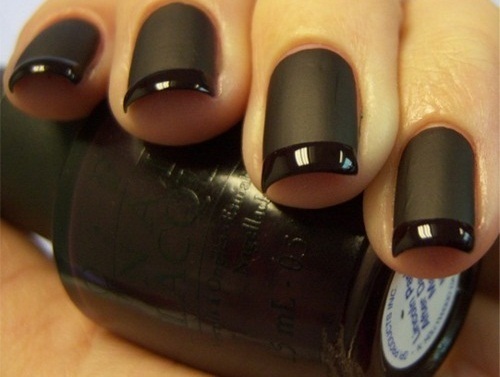
Black Shine On Black Matte Manicure


[ed.  Looks cool.]
via:

The Most Poisonous Rivalry in Sports

by Ben Austen

Last January, two weeks after the Auburn Tigers vanquished the Oregon Ducks for the national championship, Paul Finebaum, the host of a radio sports show in Birmingham, took a call from a listener who went by the name "Al." Al's real name, police would later learn, was Harvey Updyke. A 62-year-old retired Texas highway patrolman, Updyke had moved to Alabama only two years before to be close to his favorite football team, the Crimson Tide. His first year in his new home, he'd attained sports-fan nirvana. The Tide had won the 2009 national title, and Updyke had been in the stands to see it. His second year in Alabama was more like sports-fan hell.

In November he'd pilgrimaged to Tuscaloosa for the Iron Bowl, the regular-season Auburn-Alabama showdown. In the second half, the Tigers overcame a twenty-four-point deficit to humiliate the Tide on their home field, 28–27. On Finebaum's show, Bama partisans harped on the illegitimacy of Auburn's star quarterback, Cam Newton, who was nearly banned from the game after it was discovered his father had shopped him around as part of a pay-for-play scheme. For them, the Iron Bowl proved that Auburn could win only by cheating, that the "West Georgia" team was devoid of all honor, that—fuck it—look at our thirteen championships to your two. Roll Tide!

Updyke told Finebaum he'd seen Auburn fans outside the Iron Bowl dressing the statue of the late, great Paul "Bear" Bryant in a "Scam" Newton jersey. He claimed to have seen a newspaper clipping that showed how years back, Auburn fans celebrated Coach Bryant's death by "rolling" the live oaks at Toomer's Corner, the gateway to the Auburn campus where students mark wins by streaming the trees with toilet paper. So here's what Updyke said he did: He drove down to Toomer's Corner and doused the venerated trees with Spike 80DF, a lethal herbicide.

"Did they die?" an incredulous Finebaum asked.

"They definitely will die," said Updyke.

"Is that against the law—to poison a tree?"

"Do you think I care?" Updyke said. "I really don't. Roll damn Tide!" Arborists later confirmed that the trees had been poisoned. Police traced the call and charged Updyke with several felony counts. His disheveled, puffy-faced mug shot made the national news. Many Tide devotees were eager to write him off as a lunatic, a pathological fan. But the highway patrolman was not without his defenders. On Tide fan sites, some even called on the school to build a statue of Updyke next to the ones of Bryant and the other Bama heroes.

Tuesday, August 30, 2011

Rest by Winslow Homer, 1885
via:
Photo by Lloyd Ullberg
Philadelphia, 1935
via:
galleriaheino.fi
Samuli Heimonen
via:

Stuff Moms Say: The Bracket


Moms say amazing things, so we asked a bunch of Hairpin pals to anonymously pass along their moms' best, and we made it into a tournament. An impartial judge picked the "winners."

1. [I baked crappy-looking brownies for the sixth-grade bake sale, and no one bought them, so I came home crying. My mom gave me shots of Baileys, and told me:] "I will always be here with shots when your first boyfriend breaks up with you and when you don't get into the college you want to go to."

2. "Don't touch me!" ["Oh. Why?"] "Because it doesn't feel good."

3. "It's such a shame that in this age of disease and danger you'll never be able to enjoy purely casual sex in the way I did."

4. "Don't ever have sex."

5. "I told [my boyfriend] I was too old to have children, but he said we could just use your eggs..." [She looks at me curiously]

Read more:

Inside David Foster Wallace's Private Self-Help Library

[ed. I read this today and went back to the author's originial article, which I remembered vaguely but had largely forgotten. On one level, I miss DFW like I miss other immensely talented literary, scientific, political and cultural giants who leave too soon - with the sadness of what might have been and will now never be. But in DFW's case, I, like many others in this article, miss his gentle soul and his "regular-guyness", despite his obvious genius. My winter project is to re-read Infinite Jest. This time I expect it to go much quicker, knowing the basic plotline (as there is) and the various characters ahead of time. I've heard it's much more enjoyable the second (or third!) time around, when you're better able to appreciate nuances in the narrative and style without getting bogged down in details. And I will read all the footnotes!]


by Maria Bustillos

"Humility—the acceptance that being human is good enough—is the embrace of ordinariness." —underlined by David Foster Wallace in his copy of Ernest Kurtz's The Spirituality of Imperfection.

"True heroism is minutes, hours, weeks, year upon year of the quiet, precise, judicious exercise of probity and care—with no one there to see or cheer. This is the world." —David Foster Wallace, The Pale King

Among David Foster Wallace's papers at the Ransom Center at the University of Texas at Austin are three hundred-odd books from his personal library, most of them annotated, some heavily as if he were scribbling a dialogue with the author page by page. There are several of his undergraduate papers from Amherst; drafts of his fiction and non-fiction; research materials; syllabi; notes, tests and quizzes from classes he took, and from those he taught; fan correspondence and juvenilia. As others have found, it's entirely boggling for a longtime fan to read these things. I recently spent three days in there and have yet to cram my eyeballs all the way back in where they belong.

Wallace committed suicide in 2008. There has been a natural reluctance to broach questions surrounding the tragedy with his family and friends, just as there was reluctance to ask him directly about his personal history when he was alive. But there are indications—particularly in the markings of his books—of Wallace's own ideas about the sources of his depression, some of which seem as though they ought to be the privileged communications of a priest or a psychiatrist. But these things are in a public archive and are therefore going to be discussed and so I will tell you about them.

One surprise was the number of popular self-help books in the collection, and the care and attention with which he read and reread them. I mean stuff of the best-sellingest, Oprah-level cheesiness and la-la reputation was to be found in Wallace's library. Along with all the Wittgenstein, Husserl and Borges, he read John Bradshaw, Willard Beecher, Neil Fiore, Andrew Weil, M. Scott Peck and Alice Miller. Carefully.

Much of Wallace's work has to do with cutting himself back down to size, and in a larger sense, with the idea that cutting oneself back down to size is a good one, for anyone (q.v., the Kenyon College commencement speech, later published as This is Water). I left the Ransom Center wondering whether one of the most valuable parts of Wallace's legacy might not be in persuading us to put John Bradshaw on the same level with Wittgenstein. And why not; both authors are human beings who set out to be of some use to their fellows. It can be argued, in fact, that getting rid of the whole idea of special gifts, of the exceptional, and of genius, is the most powerful current running through all of Wallace's work.

All his life, he'd been the smartest boy in class, the gifted athlete, the super brain, the best writer. He graduated summa cum laude from Amherst, writing two senior theses, one in philosophy and one in English, both praised to the skies; the latter was published as a novel, The Broom of the System, when he was just 24. When Infinite Jest appeared, in 1996, acclaim came in like a tidal wave from nearly every critic of stature. "A work of genius." "The plaques and citations can now be put in escrow." "Exhilarating." "Truly remarkable." "Taking the next step in fiction." The New York Times was relatively restrained in its praise, but still called Wallace "a writer of virtuosic talents who can seemingly do anything."

But Wallace had already learned to mistrust such praise. There are many, many places where he talks about that mistrust, but here's just one: David Lipsky spoke with him in 1996 in an interview that later grew into Lipsky's book, Although of Course You End Up Becoming Yourself. Here, Wallace explained that he was proud of Infinite Jest in a way that he was not proud of The Broom of the System: "Which I think shows some talent, but was in many ways a fuck-off enterprise. It was written very quickly, rewritten sloppily, sound editorial suggestions were met with a seventeen-page letter about literary theory that was really a not-very-interesting way... really a way for me to avoid doing hard work. [...] I was arrogant, and missed a chance to make that book better."

A bit later, he expanded on what he'd since learned: "I gotta tell you, I just think to look across the room and automatically assume that somebody else is less aware than me, or that somehow their interior life is less rich, and complicated, and acutely perceived than mine, makes me not as good a writer. Because that means I'm going to be performing for a faceless audience, instead of trying to have a conversation with a person. [...] It's true that I want very much—I treasure my regular-guyness. I've started to think it's my biggest asset as a writer. Is that I'm pretty much just like everybody else."

Wallace's self-image was fragile and complex, but he was consistent on these points, from then onward. His later work enters into many, many kinds of minds, many points of view, with unvarying respect and an uncanny degree of understanding. Every kind of person was of interest to him.

The love his admirers bear this author has a peculiarly intimate and personal character. This is because Wallace gave voice to the inner workings of ordinary human beings in a manner so winning and so truthful and forgiving as to make him seem a friend.

Wallace seemed always to be trying to erase the distance between himself and others in order to understand them better, and trying visibly to make himself understood—always asking questions, demanding to know more details. He owned his own weaknesses willingly and in the gentlest, most inclusive manner. Also he talked a lot about the role of good fiction, which, he opined more than once, is about making us feel less alone. He offered a lot of himself to his readers, in all his writing; this generosity seemed like his whole project, in a way. This was the outward, public Wallace.

But those who followed his career at all closely always knew that there was another, darker part to his nature. A secret part. Wallace was fairly well known to have been very ill, to have been hospitalized more than once for depression, to have attempted suicide, and to have been in recovery for addiction to alcohol and drugs. The paradox of Wallace's humor and good-natured candor, the qualities so many of his readers enjoyed most, set against the many secrets there have always been around his private life, is laid bare in the Ransom Center documents.

Read more:

A Guitar Lover’s Guide to the CITES Conservation Treaty

[ed.  Gibson Guitar raided by federal agents.  This is insane.  I can understand the good intentions, but I think about these masterpieces sitting in some immense warehouse, ala Raiders of the Lost Ark, gathering dust and being played sporadically by a few janitors, if anyone at all.]

by John Thomas

Coming into Los Angeles

Bringing in a couple of keys

Don't touch my bags if you please

Mister Customs Man

Man, this is not going to end well. I’m on my way to Europe and I’m standing in the security line at the airport, sweating bullets, with a large object strapped to my back. I’m worried about violating CITES, or the Convention on International Trade in Endangered Species of Wild Fauna and Flora. The object strapped to my back is a guitar, and I’m concerned that I’ll be accused of trying to illegally export products from endangered fauna, like elephant ivory, or flora, like Brazilian rosewood.

Now, I really have no reason to worry, but Arlo Guthrie’s 1969 paean to smuggling (something other than wood) is feeding my paranoia. I had planned on taking one of my old Gibsons on the trip; they have Brazilian rosewood fingerboards and bridges. I called the U.S. Fish and Wildlife Service (USFWS), our CITES enforcement authority.

“You’ll need a permit, and a permit takes at least 60 days to obtain, and more likely at least 90 days,” an employee told me.

“Uh,” I replied, “what happens if I don’t get a permit?”

“Your guitar will probably be seized, sir, and you won't be able to get it back.”

Hmmm. So, I carefully examined all of my guitars for traces of Brazilian rosewood, ivory and other CITES substances and settled on taking my National M2. Until plywood becomes classified as an endangered floral species, this guitar should be able to cross international borders with ease. You might not want to try this with that old prewar herringbone of yours, though. If your guitar has even the smallest scrap of a listed species, unless you’ve got an export permit from the U.S. (which also works as a re-import permit) and import and export permits from your destination country, you can say goodbye to your holy grail.

See, if you decide to take that old beater ‘bone to do a bit of pickin’ on the beaches of the French Riviera, and someone does look in that case, your guitar will be seized--forever--with no possibility of return or reimbursement. Even if you belatedly obtain the import or export permits, USFWS will not return it, because you’ll be a known violator of international law. USFWS can’t sell the seized guitars to the public because that would be the equivalent of supporting illegal trade.

Read more: 

image credit: