Monday, September 5, 2011


Bank of North Dakota
by Ellen Brown
In an article in The New York Times on August 19th titled “The North Dakota Miracle,” Catherine Rampell writes:
A number of other mineral-rich states were initially not affected by the economic downturn, but they lost revenues with the later decline in oil prices. North Dakota is the only state to be in continuous budget surplus since the banking crisis of 2008. Its balance sheet is so strong that it recently reduced individual income taxes and property taxes by a combined $400 million, and is debating further cuts. It also has the lowest foreclosure rate and lowest credit card default rate in the country, and it has had NO bank failures in at least the last decade.
If its secret isn’t oil, what is so unique about the state? North Dakota has one thing that no other state has: its own state-owned bank.
Access to credit is the enabling factor that has fostered both a boom in oil and record profits from agriculture in North Dakota. The Bank of North Dakota (BND) does not compete with local banks but partners with them, helping with capital and liquidity requirements. It participates in loans, provides guarantees, and acts as a sort of mini-Fed for the state. In 2010, according to the BND’s annual report:
In an article in The New York Times on August 19th titled “The North Dakota Miracle,” Catherine Rampell writes:
Forget the Texas Miracle. Let’s instead take a look at North Dakota, which has the lowest unemployment rate and the fastest job growth rate in the country.
According to new data released by the Bureau of Labor Statistics today, North Dakota had an unemployment rate of just 3.3 percent in July—that’s just over a third of the national rate (9.1 percent), and about a quarter of the rate of the state with the highest joblessness (Nevada, at 12.9 percent).
North Dakota has had the lowest unemployment in the country (or was tied for the lowest unemployment rate in the country) every single month since July 2008.
Its healthy job market is also reflected in its payroll growth numbers. . . . [Y]ear over year, its payrolls grew by 5.2 percent. Texas came in second, with an increase of 2.6 percent.
Why is North Dakota doing so well? For one of the same reasons that Texas has been doing well: oil.Oil is certainly a factor, but it is not what has put North Dakota over the top. Alaska has roughly the same population as North Dakota and produces nearly twice as much oil, yet unemployment in Alaska is running at 7.7 percent. Montana, South Dakota, and Wyoming have all benefited from a boom in energy prices, with Montana and Wyoming extracting much more gas than North Dakota has. The Bakken oil field stretches across Montana as well as North Dakota, with the greatest Bakken oil production coming from Elm Coulee Oil Field in Montana. Yet Montana’s unemployment rate, like Alaska’s, is 7.7 percent.
A number of other mineral-rich states were initially not affected by the economic downturn, but they lost revenues with the later decline in oil prices. North Dakota is the only state to be in continuous budget surplus since the banking crisis of 2008. Its balance sheet is so strong that it recently reduced individual income taxes and property taxes by a combined $400 million, and is debating further cuts. It also has the lowest foreclosure rate and lowest credit card default rate in the country, and it has had NO bank failures in at least the last decade.
If its secret isn’t oil, what is so unique about the state? North Dakota has one thing that no other state has: its own state-owned bank.
Access to credit is the enabling factor that has fostered both a boom in oil and record profits from agriculture in North Dakota. The Bank of North Dakota (BND) does not compete with local banks but partners with them, helping with capital and liquidity requirements. It participates in loans, provides guarantees, and acts as a sort of mini-Fed for the state. In 2010, according to the BND’s annual report:
The Bank provided Secured and Unsecured Federal Fund Lines to 95 financial institutions with combined lines of over $318 million for 2010. Federal Fund sales averaged over $13 million per day, peaking at $36 million in June.The BND also has a loan program called Flex PACE, which allows a local community to provide assistance to borrowers in areas of jobs retention, technology creation, retail, small business, and essential community services. In 2010, according to the BND annual report:
The need for Flex PACE funding was substantial, growing by 62 percent to help finance essential community services as energy development spiked in western North Dakota. Commercial bank participation loans grew to 64 percent of the entire $1.022 billion portfolio.The BND’s revenues have also been a major boost to the state budget. It has contributed over $300 million in revenues over the last decade to state coffers, a substantial sum for a state with a population less than one-tenth the size of Los Angeles County. According to a study by the Center for State Innovation, from 2007 to 2009 the BND added nearly as much money to the state’s general fund as oil and gas tax revenues did (oil and gas revenues added $71 million while the Bank of North Dakota returned $60 million). Over a 15-year period, according to other data, the BND has contributed more to the state budget than oil taxes have.


Hacked Off

by Guy Adams
When is a Banksy not a Banksy?
That is the million, or rather $450,000 question facing bonus-fuelled New York collectors who are beating a path to a new, and unsanctioned, exhibition of work by the world's most famous street artist.
The Keszler Gallery in the Hamptons, Wall Street's favourite holiday destination, is facing stern criticism from Banksy representatives and his fans after attempting to sell two high-profile works of public art, which were originally intended to brighten up the streets of Bethlehem.
The pieces, referred to as Stop & Search and Wet Dog, were stencilled on to prominent walls in the West Bank city during a visit by the British artist in 2007. They disappeared shortly afterwards, only to re-emerge at the Keszler Gallery in Southampton Village late last month.
News of the sale has angered Banksy enthusiasts, who argue that the works were meant for public consumption. They argue that street art is meaningless – and therefore value-less – outside of its original context, and say that foreign art dealers had no right to participate in their removal.
The gallery takes an opposing view. It insists that the pieces, among seven large Banksy works in its new show, were legitimately purchased and exported from the Palestinian territory. If left unprotected in their original location, they were in severe danger of deteriorating, and by now would almost certainly have been vandalised.
Fuelling the controversy is Pest Control, an organisation that is the nearest thing the reclusive British artist has to official representation. In a statement to Artnet magazine, it claimed that only one of the six pieces in the Keszler show had been formally authenticated as Banksy's work, and admonished the gallery for removing them from their original setting.
"We have warned Mr Keszler [the gallery's owner] of the serious implications of selling unauthenticated works, but he seems to not care," read their statement. "We have no doubt that these works will come back to haunt Mr Keszler."
The debate highlights the problems that emerge when the soaring contemporary art market turns what some view as petty vandalism into a prized commodity. These days, Banksy pieces can fetch as much as $1.9m, meaning that his public works are often thought to be worth more than the building they originally graced.
Sunday, September 4, 2011


Afghanistan Dispatches

Mosquitoes (be sure to click through the second page).
The Art, Science, and Carpentry of Explosives
Michael Yon is a former Green Beret, native of Winter Haven, Fl. who has been reporting from Iraq and Afghanistan since December 2004. No other reporter has spent as much time with combat troops in these two wars. Michael’s dispatches from the frontlines have earned him the reputation as the premier independent combat journalist of his generation. His work has been featured on “Good Morning America,” The Wall Street Journal, The New York Times, CNN, ABC, FOX, as well as hundreds of other major media outlets all around the world.
via:
Bored UCLA Student Joins Libyan Rebels
by Spencer Ackerman
Bummed out by the end of summer vacation? Want to take the awesomest road trip evar? Not really bothered by the idea of conflict tourism or turning someone else’s struggle for freedom into your bar-stool anecdote?
 Dude: you need to join the Libyan revolution!
Bradley Hope, a reporter covering Libya’s uprising, writes in Abu Dhabi newspaper The National that he recently made a curious discovery near An Nawfaliyah: Chris Jeon, a 21-year old University of California–Los Angeles math student. That’s Jeon in the picture above, very unsafely resting his rifle on the ground with the barrel pointed up while his new buddies crowd around. Spoiler: He doesn’t have any military experience.
Why’d he make the long trek from L.A. to L-iby-A? “It is the end of my summer vacation, so I thought it would be cool to join the rebels,” Jeon told Hope. “This is one of the only real revolutions.”
Read more:
Bummed out by the end of summer vacation? Want to take the awesomest road trip evar? Not really bothered by the idea of conflict tourism or turning someone else’s struggle for freedom into your bar-stool anecdote?
 Dude: you need to join the Libyan revolution!
Bradley Hope, a reporter covering Libya’s uprising, writes in Abu Dhabi newspaper The National that he recently made a curious discovery near An Nawfaliyah: Chris Jeon, a 21-year old University of California–Los Angeles math student. That’s Jeon in the picture above, very unsafely resting his rifle on the ground with the barrel pointed up while his new buddies crowd around. Spoiler: He doesn’t have any military experience.
Why’d he make the long trek from L.A. to L-iby-A? “It is the end of my summer vacation, so I thought it would be cool to join the rebels,” Jeon told Hope. “This is one of the only real revolutions.”
Read more:
LikeALittle
[ed. I think I understand the concept, but I'm not sure. Seems like social media is (more and more) removing the serendipity and mystery of meeting and connecting with people spontaneously.]
by Alexia Tsotsis
LikeALittle, the social network for college students who want a place to anonymously flirt on college campuses, announces the launch of its first mobile product today, LikeALittle People. Like a Color but with text or a Yobongo focusing on Interests, the LikeALittle people app allows you to log in with Facebook and immediately see the Interests (but not names or emails)of LikeALittle users around you.
The app’s premise is simple enough: People generally want to meet the people around them but don’t know where to start . LikeALittle founder Evan Reas tells me that socializing in real life would be a lot easier if everyone had a thought bubble over their heads announcing their current status. The LikeALittle app, which eliminates real-life identity in favor of Interests, attempts to function as a sort of digital thought bubble.
Reas tells me that the app solves the loneliness problem evidenced by Color and Yobongo by algorithmically matching users near each other based on activity, backgrounds and interests,”Yobongo and Color are both symmetric communication platforms where the most value is derived only if other people are on at the exact same time in the same place,” says Reas. ”Our app solves that because it connects you to the right people who you can communicate with anytime, either in a symmetric or asymmetric way.”
With LikeALittle people, users can login with Facebook and have their Interests automatically populated through their Facebook Likes. You can scan the app for profiles by refreshing the screen and drill down into a users profile by pressing the + button.
But the app works even if you’re not proactive — If a user around you has similar interests the app will directly message you. In addition you have the option of giving a Shoutout to a particular Interest, messaging someone yourself, bookmarking a person for later viewing or adding Interests to your profile either manually or from someone else’s page.
While the product is a divergence from the core LikeALittle flirting network, Reas says it’s still on point with his overall mission of using location to connect people, “The original likealittle flirting and chatting product did that in a very focused way and this product now broadens the type of interaction from flirting more general communication, discovery and chatting and also broadens the audience to mainstream.”
Read more:
by Alexia Tsotsis
LikeALittle, the social network for college students who want a place to anonymously flirt on college campuses, announces the launch of its first mobile product today, LikeALittle People. Like a Color but with text or a Yobongo focusing on Interests, the LikeALittle people app allows you to log in with Facebook and immediately see the Interests (but not names or emails)of LikeALittle users around you.
The app’s premise is simple enough: People generally want to meet the people around them but don’t know where to start . LikeALittle founder Evan Reas tells me that socializing in real life would be a lot easier if everyone had a thought bubble over their heads announcing their current status. The LikeALittle app, which eliminates real-life identity in favor of Interests, attempts to function as a sort of digital thought bubble.
Reas tells me that the app solves the loneliness problem evidenced by Color and Yobongo by algorithmically matching users near each other based on activity, backgrounds and interests,”Yobongo and Color are both symmetric communication platforms where the most value is derived only if other people are on at the exact same time in the same place,” says Reas. ”Our app solves that because it connects you to the right people who you can communicate with anytime, either in a symmetric or asymmetric way.”
With LikeALittle people, users can login with Facebook and have their Interests automatically populated through their Facebook Likes. You can scan the app for profiles by refreshing the screen and drill down into a users profile by pressing the + button.
But the app works even if you’re not proactive — If a user around you has similar interests the app will directly message you. In addition you have the option of giving a Shoutout to a particular Interest, messaging someone yourself, bookmarking a person for later viewing or adding Interests to your profile either manually or from someone else’s page.
While the product is a divergence from the core LikeALittle flirting network, Reas says it’s still on point with his overall mission of using location to connect people, “The original likealittle flirting and chatting product did that in a very focused way and this product now broadens the type of interaction from flirting more general communication, discovery and chatting and also broadens the audience to mainstream.”
Read more:


The Case Against Summer
by P.J. O'Rourke
The logical argument contra summertime should be four words long: middle-age men in shorts. Q.E.D.
Alas, shorts are being worn year-round by us graying porkers with legs as ugly as stump fences—if stump fences had hairy varicose veins. But there are plenty of other things wrong with summer, starting with the fact that it comes at the wrong time of year.
 In the contiguous 48 states, the best weather isn't in June, July and August. Spring is glorious in the South. Fall is splendid in the North. And winter is swell in Florida and the part of California where the four seasons are Smog, Mudslide, Brush Fire and Oscar.
Our summer weather in 2011 consisted of tornados, heat waves, an earthquake and a hurricane. For everyone this side of Nome, summer vacation in the summer is like having a coffee break at 2 a.m.
Supposedly, summer vacation happens because that's when the kids are home from school, although having the kids home from school is no vacation. And supposedly the kids are home from school because of some vestigial throwback to our agricultural past.
This is nonsense. The little helping hands of farm children were needed during spring planting and fall harvest. (And they must have been more helpful than the little hands of today's children, or our grandparents would have died of starvation.) Farm kids, if they went to school at all, went in midsummer and midwinter, when nothing much was doing around the barn.
Summer vacation is, in fact, based on horse crap. American urbanization predated the automobile. Horses and what they leave behind them clogged cities that were already insalubrious from coal smoke, industry and notional sewage systems. Come summer, it was vacation time because—if you had any sense, common or olfactory—you vacated.
Men who could afford it sent their wives, children and, if possible, themselves off to the mountains or the shore. I live in New Hampshire, several hours from Boston, which has been full of prosperous urbanites for longer than anyplace in America. Every summer, people who use "summer" as a verb dutifully peregrinate here to the middle of nowhere and take up residence in crumbling ancestral 30-room shingle cottages, although they can't quite remember why.
And what are Americans doing taking summer vacations anyway? Our economy is a shambles. U.S. debt has been downgraded. GDP has flat-lined. The unemployment rate—with everyone on vacation—is nearing 100%. We should be in the office right now, trying to get the price of small-cap stocks up, developing new techniques of program trading, maintaining confidence in dot-com start-ups, building a fire under the housing market and generally working our tails off the way we were in the summers of 1929, 1987, 2000 and 2008.
At the very least, our elected officials should be back on the job. They left some unfinished business—such as the survival of America into the second quarter of the 21st century, etc.
Read more:
The logical argument contra summertime should be four words long: middle-age men in shorts. Q.E.D.
Alas, shorts are being worn year-round by us graying porkers with legs as ugly as stump fences—if stump fences had hairy varicose veins. But there are plenty of other things wrong with summer, starting with the fact that it comes at the wrong time of year.
 In the contiguous 48 states, the best weather isn't in June, July and August. Spring is glorious in the South. Fall is splendid in the North. And winter is swell in Florida and the part of California where the four seasons are Smog, Mudslide, Brush Fire and Oscar.
 Our summer weather in 2011 consisted of tornados, heat waves, an earthquake and a hurricane. For everyone this side of Nome, summer vacation in the summer is like having a coffee break at 2 a.m.
Supposedly, summer vacation happens because that's when the kids are home from school, although having the kids home from school is no vacation. And supposedly the kids are home from school because of some vestigial throwback to our agricultural past.
This is nonsense. The little helping hands of farm children were needed during spring planting and fall harvest. (And they must have been more helpful than the little hands of today's children, or our grandparents would have died of starvation.) Farm kids, if they went to school at all, went in midsummer and midwinter, when nothing much was doing around the barn.
Summer vacation is, in fact, based on horse crap. American urbanization predated the automobile. Horses and what they leave behind them clogged cities that were already insalubrious from coal smoke, industry and notional sewage systems. Come summer, it was vacation time because—if you had any sense, common or olfactory—you vacated.
Men who could afford it sent their wives, children and, if possible, themselves off to the mountains or the shore. I live in New Hampshire, several hours from Boston, which has been full of prosperous urbanites for longer than anyplace in America. Every summer, people who use "summer" as a verb dutifully peregrinate here to the middle of nowhere and take up residence in crumbling ancestral 30-room shingle cottages, although they can't quite remember why.
And what are Americans doing taking summer vacations anyway? Our economy is a shambles. U.S. debt has been downgraded. GDP has flat-lined. The unemployment rate—with everyone on vacation—is nearing 100%. We should be in the office right now, trying to get the price of small-cap stocks up, developing new techniques of program trading, maintaining confidence in dot-com start-ups, building a fire under the housing market and generally working our tails off the way we were in the summers of 1929, 1987, 2000 and 2008.
At the very least, our elected officials should be back on the job. They left some unfinished business—such as the survival of America into the second quarter of the 21st century, etc.
Read more:
Eating Golf Balls
[ed. Sorry golf fans, it doesn't looks like Seven Days in Utopia will be another Caddyshack or Tin Cup.]
by Roger Ebert
I would rather eat a golf ball than see this movie again. It tells the dreadful parable of a pro golfer who was abused by his dad, melts down in the Texas Open and stumbles into the clutches of an insufferable geezer in the town of Utopia (pop. 375), who promises him that after seven days in Utopia, he will be playing great golf. He will also find Jesus, but for that, you don't have to play golf, although it might help.
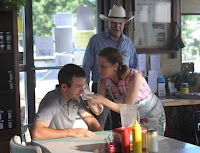 The geezer is named Johnny Crawford. He is played by Robert Duvall. Only a great actor could give such a bad performance. Duvall takes the arts and skills he has perfected for decades and puts them at the service of a flim-flam man who embodies all the worst qualities of the Personal Motivation Movement. That is the movement that teaches us that if we buy a book, view some DVDs or sit for hours in the "Conference Center" of some crappy hotel, we won't be losers anymore.
How do we know we were losers? Because we were suckers for the fraud. How will we know we are winners? When we rent our own hotel rooms and fleece the innocent. The formula of the movement can be seen at work in this classified ad: Send 25¢ for the secret of how to receive lots of quarters in your mail.
"Seven Days in Utopia" stars Lucas Black as Luke Chisholm, whose father (Joseph Lyle Taylor) has browbeaten him sadistically since childhood to force him to become a pro golfer. When Luke's game blows up on the final hole of the Texas Open, the old man turns his back on him and stalks away in full view of the TV cameras. Devastated, Luke drives blindly into the night and stumbles across the town of Utopia, where he has a Meet Cute with Johnny Crawford. Johnny runs a nearby golf resort, and wouldn't you know it, will take exactly seven days to repair Luke's truck, which is how long Johnny needs to work his spells on the young man.
Read more:
by Roger Ebert
I would rather eat a golf ball than see this movie again. It tells the dreadful parable of a pro golfer who was abused by his dad, melts down in the Texas Open and stumbles into the clutches of an insufferable geezer in the town of Utopia (pop. 375), who promises him that after seven days in Utopia, he will be playing great golf. He will also find Jesus, but for that, you don't have to play golf, although it might help.
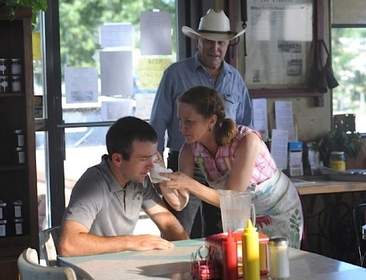 The geezer is named Johnny Crawford. He is played by Robert Duvall. Only a great actor could give such a bad performance. Duvall takes the arts and skills he has perfected for decades and puts them at the service of a flim-flam man who embodies all the worst qualities of the Personal Motivation Movement. That is the movement that teaches us that if we buy a book, view some DVDs or sit for hours in the "Conference Center" of some crappy hotel, we won't be losers anymore.
 How do we know we were losers? Because we were suckers for the fraud. How will we know we are winners? When we rent our own hotel rooms and fleece the innocent. The formula of the movement can be seen at work in this classified ad: Send 25¢ for the secret of how to receive lots of quarters in your mail.
"Seven Days in Utopia" stars Lucas Black as Luke Chisholm, whose father (Joseph Lyle Taylor) has browbeaten him sadistically since childhood to force him to become a pro golfer. When Luke's game blows up on the final hole of the Texas Open, the old man turns his back on him and stalks away in full view of the TV cameras. Devastated, Luke drives blindly into the night and stumbles across the town of Utopia, where he has a Meet Cute with Johnny Crawford. Johnny runs a nearby golf resort, and wouldn't you know it, will take exactly seven days to repair Luke's truck, which is how long Johnny needs to work his spells on the young man.
Read more:
What Is That? Let Your Smartphone Have a Look
[ed. I don't own a smartphone, but it's cool what some of these applications are beginning to be able to do.]
by Steven Leckart
I never carry a point-and-shoot camera. Chances are you don’t either. In the last few years, cellphone optics have improved substantially. That means more megapixels, better image sensors and stronger flashes and zooms on the one device most of us carry all the time.
Now comes the next phase: using your smartphone and its camera to identify what is in front of your eyes.
 Although image-recognition software is still in its infancy, a number of mobile apps are already translating signs, naming landmarks and providing a running commentary on your world.
Google Goggles, which appeared on Android phones in late 2009 and on the iPhone last year, is best at deciphering landmarks, text, book and DVD covers, artwork, logos, bar codes and wine labels. You start the app — it’s part of Google’s search app for the iPhone — and peer at the object through the camera lens. It takes a stab at identifying it.
I’ve found the app especially useful for comparison shopping. If you’re browsing through a bookstore, for instance, one quick snapshot of a book’s cover allows you to check the price on Amazon. It’s much faster than typing the title into a search bar. Same goes for photographing paintings or craft beer bottles.
Perhaps its most promising use, for tourists especially, is language translation. Goggles can scan English, French, German, Italian, Spanish and, a recent addition, Russian text.
In practice, I’ll admit I’ve had only modest success translating phrases from restaurant menus or street signs. Part of the challenge is capturing an image that’s clear enough for the software to recognize. Unless the text appears on a white background, the software’s success is diminished. But when it does work — wow. Optical character recognition is only going to get better and broader.
Asian languages pose different challenges, says Hartwig Adam, a Goggles engineer. Their alphabets consist of thousands of characters, which tend to be strung together with fewer obvious boundaries. Be wary when buying apps that say they translate Japanese or Chinese. The ones I’ve tried are not fully baked. For now, the handwritten specials posted on the walls of no-frills Chinese restaurants will remain a mystery to me.
Even Google admits Goggles is “not so good” at identifying plants. For that you want Leafsnap, a free iPhone app that supplements a traditional field guide. You photograph a leaf on a white background within the app, which then scans the silhouette. The app then cross-references it with its built-in database. For each potential match, you’re shown high-resolution images of the plant’s leaves, flowers, fruit and bark. Your location is also recorded on a map so you can build a database of your urban forest.
Developed by researchers at Columbia University, the University of Maryland and the Smithsonian Institution, Leafsnap has been downloaded 400,000 times since May. It’s easy to see why. I had a blast trying it out in San Francisco — even though the plants in the app’s database are mostly specific to the New York and Washington areas. In the next 18 months, it will expand to 750 species from 250 species found in the continental United States (excluding South Florida), says Peter Belhumeur, a Leafsnap co-founder and computer science professor at Columbia. Eventually, the app will also use your location to refine its search and improve accuracy, he said.
Goggles has other limitations. It’s not good with faces — deliberately, for privacy reasons. And when I photographed an apple using Goggles on both iPhone and Android handsets, no close matches were found. Minutes later, I tried Meal Snap, a $2.99 iPhone app meant as a tool for dieters. Not only did it correctly identify the fruit, but Meal Snap also provided an accurate caloric range (60 to 90 calories).
Even more impressive was what happened when I used the app to deconstruct a bowl of homemade chopped salad. The app correctly identified diced beets and sliced cherry tomatoes alongside broccoli in the tossed mess. That said, the app failed to spot my spinach, deli turkey, cauliflower and bits of pepperoncini. However, the calorie estimate was only off by about 100 calories; and it was actually inflated, which is O.K. if your goal is weight loss.
Read more:
by Steven Leckart
I never carry a point-and-shoot camera. Chances are you don’t either. In the last few years, cellphone optics have improved substantially. That means more megapixels, better image sensors and stronger flashes and zooms on the one device most of us carry all the time.
Now comes the next phase: using your smartphone and its camera to identify what is in front of your eyes.
Although image-recognition software is still in its infancy, a number of mobile apps are already translating signs, naming landmarks and providing a running commentary on your world. Google Goggles, which appeared on Android phones in late 2009 and on the iPhone last year, is best at deciphering landmarks, text, book and DVD covers, artwork, logos, bar codes and wine labels. You start the app — it’s part of Google’s search app for the iPhone — and peer at the object through the camera lens. It takes a stab at identifying it.
I’ve found the app especially useful for comparison shopping. If you’re browsing through a bookstore, for instance, one quick snapshot of a book’s cover allows you to check the price on Amazon. It’s much faster than typing the title into a search bar. Same goes for photographing paintings or craft beer bottles.
Perhaps its most promising use, for tourists especially, is language translation. Goggles can scan English, French, German, Italian, Spanish and, a recent addition, Russian text.
In practice, I’ll admit I’ve had only modest success translating phrases from restaurant menus or street signs. Part of the challenge is capturing an image that’s clear enough for the software to recognize. Unless the text appears on a white background, the software’s success is diminished. But when it does work — wow. Optical character recognition is only going to get better and broader.
Asian languages pose different challenges, says Hartwig Adam, a Goggles engineer. Their alphabets consist of thousands of characters, which tend to be strung together with fewer obvious boundaries. Be wary when buying apps that say they translate Japanese or Chinese. The ones I’ve tried are not fully baked. For now, the handwritten specials posted on the walls of no-frills Chinese restaurants will remain a mystery to me.
Even Google admits Goggles is “not so good” at identifying plants. For that you want Leafsnap, a free iPhone app that supplements a traditional field guide. You photograph a leaf on a white background within the app, which then scans the silhouette. The app then cross-references it with its built-in database. For each potential match, you’re shown high-resolution images of the plant’s leaves, flowers, fruit and bark. Your location is also recorded on a map so you can build a database of your urban forest.
Developed by researchers at Columbia University, the University of Maryland and the Smithsonian Institution, Leafsnap has been downloaded 400,000 times since May. It’s easy to see why. I had a blast trying it out in San Francisco — even though the plants in the app’s database are mostly specific to the New York and Washington areas. In the next 18 months, it will expand to 750 species from 250 species found in the continental United States (excluding South Florida), says Peter Belhumeur, a Leafsnap co-founder and computer science professor at Columbia. Eventually, the app will also use your location to refine its search and improve accuracy, he said.
Goggles has other limitations. It’s not good with faces — deliberately, for privacy reasons. And when I photographed an apple using Goggles on both iPhone and Android handsets, no close matches were found. Minutes later, I tried Meal Snap, a $2.99 iPhone app meant as a tool for dieters. Not only did it correctly identify the fruit, but Meal Snap also provided an accurate caloric range (60 to 90 calories).
Even more impressive was what happened when I used the app to deconstruct a bowl of homemade chopped salad. The app correctly identified diced beets and sliced cherry tomatoes alongside broccoli in the tossed mess. That said, the app failed to spot my spinach, deli turkey, cauliflower and bits of pepperoncini. However, the calorie estimate was only off by about 100 calories; and it was actually inflated, which is O.K. if your goal is weight loss.
Read more:
Saturday, September 3, 2011


Why Political Coverage is Broken
[ed. From a talk to the Austrailian media, which, it sounds like, is not much different from the U.S. media. And why should it be?]
by Jay Rosen
This talk had its origins in my appearance about a year ago on the ABC’s Lateline with Leigh Sales. We were discussing election coverage that looks at the campaign as a kind of sporting event. Every day journalists can ask, “who’s ahead” and “what is the strategy for winning?” A perspective that appeals to political reporters, I said, because it puts them “on the inside, looking at the campaign the way the operatives do.”
I then mentioned the ABC’s Sunday morning program, The Insiders. And I asked Leigh Sales if it was true that the insiders were, on that program, the journalists. She said: “That is right.” I said: “That’s remarkable.” She… well, she changed the subject. And let me add right away that Leigh Sales is one of the most intelligent journalists I have ever had the pleasure to meet.
So this is my theme tonight: how did we get to the point where it seems entirely natural for the Australian Broadcasting Corporation to describe political journalists appearing on its air as “the insiders?” Don’t you think that’s a little strange? I do. Promoting journalists as insiders in front of the outsiders, the viewers, the electorate…. this is a clue to what’s broken about political coverage in the U.S. and Australia. Here’s how I would summarize it: Things are out of alignment. Journalists are identifying with the wrong people. Therefore the kind of work they are doing is not as useful as we need it to be.
Part of the problem was identified by Lindsay Tanner in his book, Sideshow: Dumbing Down Democracy. He points out how often the Australian press reframes politics as entertainment, seizing on trivial episodes that amuse or titillate and then blowing them up until they start to seem important. I’m not going to dwell on this because Tanner has it well covered. So did my mentor in graduate school, Neil Postman, in his 1985 classic, Amusing Ourselves to Death.
From a TV programmer’s point of view the advantage of politics-as-entertainment is that the main characters, the politicians themselves, work for free! The media doesn’t have to pay them because taxpayers do. The sets are provided by the government, the plots by the party leaders, back benchers and spin doctors. Politics as problem-solving or consensus-building would be more expensive to cover. Politics as entertainment is simply a low cost alternative.
Tanner points out how the term “yarn” is often used by journalists here to describe the sort of stories they love to cover, as in: “it’s a good yarn.” A yarn used to refer to stories that were semi-fictionalized to make them more entertaining. That echo is still there, but Australian journalists don’t seem to realize this when they use the term to describe their work.
Politics presented as entertainment charges the press with a failure to treat the serious stuff seriously. And that is a valid critique. But here’s a trickier problem: even when the press is trying to be serious, to provide, say, “analysis” instead of a good yarn, it increasingly relies on an impoverished notion of politics, a cluster of bad ideas that together form the common sense of the craft in the United States, and in Australia.
I was here during the election campaign last year, and saw enough to see strong similarities between my country’s press and yours on most of the points I will raise. If I get something wrong, if I over-draw the comparison, I’m sure someone will tell me during the question period.
I’m going to concentrate on three impoverished and interrelated ideas that (I say) have too much influence in political coverage. Then I will present an alternative scheme that might improve the situation.
Three impoverished ideas:
1. Politics as an inside game.
2. The cult of savviness.
3. The production of innocence.
Politics as an inside game.
The first idea we could do without is the one I presented to Leigh Sales. When journalists define politics as a game played by the insiders, their job description becomes: find out what the insiders are doing to “win.” Reveal those tactics to the public because then the public can… well, this is where it gets dodgy. As my friend Todd Gitlin once wrote, news coverage that treats politics as an insiders’ game invites the public to become “cognoscenti of their own bamboozlement,” which is strange. Or it lavishes attention on media performances, because the insiders are supposed to be good at that: manipulating the media.
by Jay Rosen
This talk had its origins in my appearance about a year ago on the ABC’s Lateline with Leigh Sales. We were discussing election coverage that looks at the campaign as a kind of sporting event. Every day journalists can ask, “who’s ahead” and “what is the strategy for winning?” A perspective that appeals to political reporters, I said, because it puts them “on the inside, looking at the campaign the way the operatives do.”
I then mentioned the ABC’s Sunday morning program, The Insiders. And I asked Leigh Sales if it was true that the insiders were, on that program, the journalists. She said: “That is right.” I said: “That’s remarkable.” She… well, she changed the subject. And let me add right away that Leigh Sales is one of the most intelligent journalists I have ever had the pleasure to meet.
So this is my theme tonight: how did we get to the point where it seems entirely natural for the Australian Broadcasting Corporation to describe political journalists appearing on its air as “the insiders?” Don’t you think that’s a little strange? I do. Promoting journalists as insiders in front of the outsiders, the viewers, the electorate…. this is a clue to what’s broken about political coverage in the U.S. and Australia. Here’s how I would summarize it: Things are out of alignment. Journalists are identifying with the wrong people. Therefore the kind of work they are doing is not as useful as we need it to be.
Part of the problem was identified by Lindsay Tanner in his book, Sideshow: Dumbing Down Democracy. He points out how often the Australian press reframes politics as entertainment, seizing on trivial episodes that amuse or titillate and then blowing them up until they start to seem important. I’m not going to dwell on this because Tanner has it well covered. So did my mentor in graduate school, Neil Postman, in his 1985 classic, Amusing Ourselves to Death.
From a TV programmer’s point of view the advantage of politics-as-entertainment is that the main characters, the politicians themselves, work for free! The media doesn’t have to pay them because taxpayers do. The sets are provided by the government, the plots by the party leaders, back benchers and spin doctors. Politics as problem-solving or consensus-building would be more expensive to cover. Politics as entertainment is simply a low cost alternative.
Tanner points out how the term “yarn” is often used by journalists here to describe the sort of stories they love to cover, as in: “it’s a good yarn.” A yarn used to refer to stories that were semi-fictionalized to make them more entertaining. That echo is still there, but Australian journalists don’t seem to realize this when they use the term to describe their work.
Politics presented as entertainment charges the press with a failure to treat the serious stuff seriously. And that is a valid critique. But here’s a trickier problem: even when the press is trying to be serious, to provide, say, “analysis” instead of a good yarn, it increasingly relies on an impoverished notion of politics, a cluster of bad ideas that together form the common sense of the craft in the United States, and in Australia.
I was here during the election campaign last year, and saw enough to see strong similarities between my country’s press and yours on most of the points I will raise. If I get something wrong, if I over-draw the comparison, I’m sure someone will tell me during the question period.
I’m going to concentrate on three impoverished and interrelated ideas that (I say) have too much influence in political coverage. Then I will present an alternative scheme that might improve the situation.
Three impoverished ideas:
1. Politics as an inside game.
2. The cult of savviness.
3. The production of innocence.
Politics as an inside game.
The first idea we could do without is the one I presented to Leigh Sales. When journalists define politics as a game played by the insiders, their job description becomes: find out what the insiders are doing to “win.” Reveal those tactics to the public because then the public can… well, this is where it gets dodgy. As my friend Todd Gitlin once wrote, news coverage that treats politics as an insiders’ game invites the public to become “cognoscenti of their own bamboozlement,” which is strange. Or it lavishes attention on media performances, because the insiders are supposed to be good at that: manipulating the media.
Subscribe to:
Posts (Atom)