Saturday, April 13, 2013


How Wireless Carriers Are Monetizing Your Movements

This data is under lock and key no more. Under pressure to seek new revenue streams (see “AT&T Looks to Outside Developers for Innovation”), a growing number of mobile carriers are now carefully mining, packaging, and repurposing their subscriber data to create powerful statistics about how people are moving about in the real world.
More comprehensive than the data collected by any app, this is the kind of information that, experts believe, could help cities plan smarter road networks, businesses reach more potential customers, and health officials track diseases. But even if shared with the utmost of care to protect anonymity, it could also present new privacy risks for customers.
Verizon Wireless, the largest U.S. carrier with more than 98 million retail customers, shows how such a program could come together. In late 2011, the company changed its privacy policy so that it could share anonymous and aggregated subscriber data with outside parties. That made possible the launch of its Precision Market Insights division last October.
The program, still in its early days, is creating a natural extension of what already happens online, with websites tracking clicks and getting a detailed breakdown of where visitors come from and what they are interested in.
Similarly, Verizon is working to sell demographics about the people who, for example, attend an event, how they got there or the kinds of apps they use once they arrive. In a recent case study, says program spokeswoman Debra Lewis, Verizon showed that fans from Baltimore outnumbered fans from San Francisco by three to one inside the Super Bowl stadium. That information might have been expensive or difficult to obtain in other ways, such as through surveys, because not all the people in the stadium purchased their own tickets and had credit card information on file, nor had they all downloaded the Super Bowl’s app.
Other telecommunications companies are exploring similar ideas. In Europe, for example, Telefonica launched a similar program last October, and the head of this new business unit gave the keynote address at new industry conference on “big data monetization in telecoms” in January.
“It doesn’t look to me like it’s a big part of their [telcos’] business yet, though at the same time it could be,” says Vincent Blondel, an applied mathematician who is now working on a research challenge from the operator Orange to analyze two billion anonymous records of communications between five million customers in Africa.
The concerns about making such data available, Blondel says, are not that individual data points will leak out or contain compromising information but that they might be cross-referenced with other data sources to reveal unintended details about individuals or specific groups (see “How Access to Location Data Could Trample Your Privacy”).
Already, some startups are building businesses by aggregating this kind of data in useful ways, beyond what individual companies may offer. For example, AirSage, an Atlanta, Georgia, a company founded in 2000, has spent much of the last decade negotiating what it says are exclusive rights to put its hardware inside the firewalls of two of the top three U.S. wireless carriers and collect, anonymize, encrypt, and analyze cellular tower signaling data in real time. Since AirSage solidified the second of these major partnerships about a year ago (it won’t specify which specific carriers it works with), it has been processing 15 billion locations a day and can account for movement of about a third of the U.S. population in some places to within less than 100 meters, says marketing vice president Andrea Moe.
by Jessica Leber, MIT Technolgy Review | Read more:
Image: uncredited
by Jessica Leber, MIT Technolgy Review | Read more:
Image: uncredited


Sergio and the Golf Guy
People, you're going at life all wrong. Do not try, try again. Try a few times and then go back to your room and mope. Set the bar low and then slink under it. The key to success is being positive ... that it will never happen to you.
 Take, for instance Sergio Garcia, the Sulking Spaniard. He is a man who does not see a glass half full. He sees a glass that someone will soon pick up and crack over his skull.
Take last year at the Masters, for instance. Garcia shot himself out of it with a Saturday 75 and then announced to the world he was done trying.
"I'm not good enough," he said that day. "I don't have the thing I need to have. In 13 years [as a pro], I've come to the conclusion that I need to play for second or third place. I have no more options. I wasted my options. ... Tell me something I can do."
And yet?
If you check your favorite sports website this morning, you'll see that this same Sergio Garcia, the Eeyore of golf, has a share of the lead at this 2013 Masters after a brilliant 6-under 66 Thursday.
It won't be easy playing for third place from first, but if anybody can do it, it's Garcia.
"This is obviously not my favorite place -- my most favorite place, that is," he said afterward. "We try to enjoy it as much as we can. Sometimes it comes out better than others. Today it was one of those good days. Let's enjoy it while it lasts."
Hey, Sergio, can you come speak at my Pessimists' Club meeting?
Look at him, would you? The man just shot 66 and he looks like he just shot 86. He has all the joy of a mortician whose hearse just ran over his own dog. His next smile is scheduled for Aug. 13.
I don't know where the happy, jumping-off-the-golf-cart, 19-year-old Sergio went, but what we're left with now is the waiting-for-a-Steinway-to-fall-on-his-head Sergio.
"That's the beautiful [thing] about being 19," he reminisced recently, at 33. "When you are 19 or 15 or 12, you don't think. You just go out there and you don't think and you let it fly and there isn't a worry in the world. ... And then, as the years go by and you've been hit with disappointments and they start to wear down on you, you start thinking too much. Back then, the world was right in front of me."
Wow. Anybody got a Xanax?
by Rick Reilly, ESPN | Read more:
Jewel Samad/AFP/Getty Images
***
Get to Know the Essence of the Golf GuyEveryone loves the Masters Tournament.
Even non-golfers like the Masters. It’s a sign of spring and a good excuse to take a weekend afternoon nap.
 Those of us who play golf like it even more. It means golf season is here and that it’s time to get the clubs out of the garage again.
 But there is a third category of person who watches the Masters. He is Golf Guy. Anyone who has played golf knows Golf Guy.
Golf Guy loves golf like nothing else. It is all he has. It is very sad.
Let’s get to know Golf Guy better.
Attire
Like any weirdo you might choose to dress up as for Halloween, getting the right costume for Golf Guy is of utmost importance.
To pull off the look of Golf Guy, you will want to start with a pair of pants that exists somewhere in the realm between khaki cargo pants and tan dress pants. Look for some tan, cotton-blend pants with a bit of a sheen to them. Think high-end Dockers.
Next, buy several dozen short-sleeve polo shirts. These will be the only shirts you own for the rest of your life. The more boring the better, but mixing in a few extremely ugly ones that don’t go with anything -- even tan pants somehow -- is fine, too. Wear them tucked in with a belt and seriously consider buttoning the shirt all the way up to the top button.
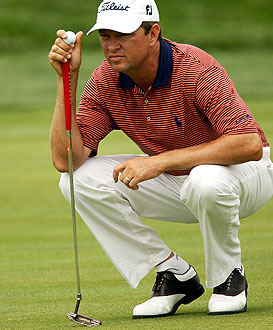
Now, look in the mirror. Do you look like a perfect mix between accountant on a casual Friday and 5-year-old boy dressed by his mother for school picture day? Do you look like Davis Love III? Would people look at you and think: “I bet that guy drives a Buick and loves Hootie and the Blowfish.” The answer to all three questions should be "yes" or you don’t have the look right.
Golf Guy always dresses as though he just stepped off the golf course, or could step on the golf course at any moment, or is on the golf course right now, as Golf Guy must always be ready for the possibility of some golf.
by DJ Gallo, ESPN | Read more:
Jamie Squire/Getty Images

Woods Penalized but Can Still Play
[ed. This seems to be a terrible decision, any way you look at it. Why didn't one of the numerous rules officials around the course advise him at the time that it was going to be an illegal drop? Why wait until after the news conference in which he discussed his thought process? And, what if he hadn't said anything, would he still be penalized? Finally, if he was officially determined to have violated the rules, why allow him to keep playing after signing an invalid scorecard (and why didn't he DQ himself)? The rules officials seem to be promoting exactly what Rule 33-7 was designed to prevent - armchair officiating. See also: Mistakes Compounded in Tiger Ruling.]
 Tiger Woods was three strokes off the lead in the Masters when he completed the second round at Augusta National Golf Club on Friday. But he began his third round five strokes behind the leader Jason Day after being assessed a two-stroke penalty on Saturday for an illegal drop on the 15th hole of the second round.
Woods, 37, was summoned to Augusta National hours before his tee time Saturday with his participation uncertain for the third round of a tournament he has won four times.
He could have been disqualified for signing an incorrect scorecard. But after reviewing the episode with Woods, the rules committee at Augusta National chose to add two strokes to Woods’s score and allow him to play the weekend. The committee invoked Rule 33-7, which allows a penalty of disqualification to be waived or modified in exceptional cases. The rule addresses the issue of armchair rules officials’ calling in or posting to Twitter violations that are clearly inadvertent.
On the hole in question, a 530-yard par 5, Woods laid up. His approach shot clanked off the flagstick and caromed into the water. After taking a one-stroke penalty, Woods dropped his ball in the fairway, a few feet behind his original divot, and hit a wedge shot to within three feet and made the putt for a bogey 6. After the ruling, his score was changed to an 8.
When choosing to drop near one’s divot, a golfer should play his ball “as nearly as possible” at the spot from which the original ball was last played. After his round, Woods said he purposely dropped the ball two yards from his first divot.
He said: “Well, I went down to the drop area, that wasn’t going to be a good spot, because obviously it’s into the grain, it’s really grainy there. And it was a little bit wet. So it was muddy and not a good spot to drop. So I went back to where I played it from, but two yards further back, and I took, tried to take two yards off the shot of what I felt I hit.”
The committee’s decision not to disqualify Woods, a 77-time winner on the PGA Tour, reinforced how the rules of golf, once clear, have grown blurry. From the definition of a legal putting stroke to the enforcement of slow play, there has been confusion about the way to interpret and apply the rules. On Friday, Guan Tianlang, a 14-year-old amateur from China, became the only known player in Masters history to be assessed a one-stroke penalty for slow play, which is endemic on the tour. Many players in the field wondered why Guan was singled out when some professionals routinely play with great deliberation and are never penalized with strokes.
by Karen Crouse, NY Times | Read more:
Photo: Charlie Riedel/Associated Press

Dogshit Orgasm
 Golden Goat is a strain of marijuana distinguished by a citrus scent and a potent but mellow buzz. “The person who originally created that strain, I knew him personally,” explains Garrett Pearson of Natural Remedies Medical Marijuana Dispensary in Colorado. “There was a recycling plant out in Kansas where the strain is originally from. When the sun hit those empty bottles and the scent of soda and beer mingled, it smelled a certain way, and that’s just what the strain smells like. So he named it Golden Goat after the Golden Goat recycling factory.”
Greg Williams, better known as Marijuana Man, told me the story behind another strain. Williams used to sell seeds by mail order, “There was a strain in our catalogue called A-Frame. We always wondered why it was called A-Frame,” he said, in exactly the sort of leisurely drawl you might expect from someone known as Marijuana Man. “We thought maybe it was because the shape of the plant was like an A-shape but it turns out, the seeds originally came from a guy who lived in an A-frame.”
OG Kush, Big Afghan Skunk, AK47, Alien God, Fraggle Rock, Smelly Guy, Blueberry Yum Yum. There’s one named Snoop Dogg too. It’s potent and cerebral. According to online reviews, your brain will feel like it’s hovering over your body.
Linnaean biological classifications divide the genus Cannabis into three species: indica, sativa, and ruderalis. The strain named for DO-double-G is one of many indicas, distinguished from the sativas by its drowsy, fullbody effects. Sativas provide a more energetic high. To speak in reductive binaries, indica is nighttime while sativa is daytime. No one really cares about ruderalis because it has a negligible THC count.
Many of the strains come from crossbreading indicas and sativas to get that perfect high, the best of both worlds, the stoner’s holy grail. (Ruderalis are often cross-bred as well, but only for the plant’s auto-flowering and therefore fast-finishing trait.) S.A.G.E. stands for Sativa Afghani Genetic Equilibrium and was designed to be 50-50 sativa and indica.
At Natural Remedies in Colarado, they cross-bred S.A.G.E. with another strain called Hanis. For no good reason, they call that one Bob Saget. That’s the non-story behind a lot of these strain names. Others are descriptive. Girl Scout Cookies supposedly smells and tastes not like the cookies themselves but the box they come in, a mix of mint and cardboard.
The demand for all these different strains is relatively recent. Once upon a time, pot was pot and you bought what your dealer down the street was selling. But a new breed of cannabis connoisseur has emerged alongside increasingly nuanced legal restrictions. In the Netherlands in the 1970s, coffee shops dispensing marijuana tolerated by the government started cropping up. For the first time, there were dozens of different strains on the menu. Today medical marijuana dispensaries in North America offer a similar range of choices.
Even before growers started crossbreeding there were regional varieties. The term “landrace” refers to a strain of cannabis that was geographically isolated and pollinated itself — it’s the same phenomenon that we refer to as “heirloom” in the world of vegetables. Marijuana Man’s favourite strain is one of these landraces, a rare pure African sativa called Congolese. The landrace indigenous to Jamaica is known as Lambsbread (or sometimes Lamb’s Breath, a mondegreen suggesting the oral history of these names). Whatever you call it, its effects include energy and positive introspection. (...)
At the medical dispensary where Pearson works in Colorado, they have 60 to 80 varieties in their garden and offer about 20 different strains at a time. They always have a mix of sativas and indicas to provide different types of relief to their patients. Pearson sees clients refining their tastes. “There’s lots of nerds out there,” he explains.” It’s like wine.” He adds that a lot of this comes from an increased level of comfort talking about marijuana on the Internet and on the phone. “People don’t use secret code words anymore,” Pearson said.
by Whitney Mallett, TNI | Read more:
Image: Imp Kerr

Awakening

Since its introduction in 1846, anesthesia has allowed for medical miracles. Limbs can be removed, tumors examined, organs replaced—and a patient will feel and remember nothing. Or so we choose to believe. In reality, tens of thousands of patients each year in the United States alone wake up at some point during surgery. Since their eyes are taped shut and their bodies are usually paralyzed, they cannot alert anyone to their condition. In efforts to eradicate this phenomenon, medicine has been forced to confront how little we really know about anesthesia’s effects on the brain. The doctor who may be closest to a solution may also answer a question that has confounded centuries’ worth of scientists and philosophers: What does it mean to be conscious?
This experience is called “intraoperative recall” or “anesthesia awareness,” and it’s more common than you might think. Although studies diverge, most experts estimate that for every 1,000 patients who undergo general anesthesia each year in the United States, one to two will experience awareness. Patients who awake hear surgeons’ small talk, the swish and stretch of organs, the suctioning of blood; they feel the probing of fingers, the yanks and tugs on innards; they smell cauterized flesh and singed hair. But because one of the first steps of surgery is to tape patients’ eyes shut, they can’t see. And because another common step is to paralyze patients to prevent muscle twitching, they have no way to alert doctors that they are awake. (...)
An anesthesiologist’s job is surprisingly subjective. The same patient could be put under general anesthesia a number of different ways, all to accomplish the same fundamental goal: to render him unconscious and immune to pain. Many methods also induce paralysis and prevent the formation of memory. Getting the patient under, and quickly, is almost always accomplished with propofol, a drug now famous for killing Michael Jackson. It is milky and viscous, almost like yogurt in a fat syringe. When injected, it has a nearly instant hypnotic effect: blood pressure falls, heart rate increases, and breathing stops. (Anesthesiologists use additional drugs, as well as ventilation, to immediately correct for these effects.)
Other drugs in the anesthetic arsenal include fentanyl, which kills pain, and midazolam, which does little for pain but induces sleepiness, relieves anxiety, and interrupts memory formation. Rocuronium disconnects the brain from the muscles, creating a neuromuscular blockade, also known as paralysis. Sevoflurane is a multipurpose gaseous wonder, making it one of the most commonly used general anesthetics in the United States today—even though anesthesiologists are still relatively clueless as to how it produces unconsciousness. It crosses from the lungs into the blood, and from the blood to the brain, but … then what?
Other mysteries have been untangled. Redheads are known to feel pain especially acutely. This confused researchers, until someone realized that the same genetic mutation that causes red hair also increases sensitivity to pain. One study found that redheaded patients require about 20 percent more general anesthesia than brunettes. Like redheads, children also require stronger anesthesia; their youthful livers clear drugs from the system much more quickly than adults’ livers do. Patients with drug or alcohol problems, on the other hand, may be desensitized to anesthesia and require more—unless the patient is intoxicated at that moment, in which case less drug is needed.
After delivering the appropriate cocktail, anesthesiologists carefully monitor a patient’s reactions. One way they do this is by tracking vital signs: blood pressure, heart rate, and temperature; fluid intake and urine output; oxygen saturation in arteries. They also observe muscles, pupils, breathing, and pallor, among many other indicators.
One organ, however, has remained stubbornly beyond their watch. Even though anesthesiologists are not entirely sure how their drugs work, they do know where they go: the brain. All changes in your vital signs are only the peripheral reverberations of anesthetic drugs’ hammering on the soft mass inside your skull. Determining consciousness by measuring anything besides brain activity is like trying to decide whether a friend is angry by studying his or her facial expressions instead of asking directly, “Are you mad?”
In lamenting how little we know about the anesthetized brain, Gregory Crosby, a professor of anesthesiology at Harvard, wrote in The New England Journal of Medicine in 2011, “The astonishing thing is not that awareness occurs, but that it occurs so infrequently.”
An anesthesiologist’s job is surprisingly subjective. The same patient could be put under general anesthesia a number of different ways, all to accomplish the same fundamental goal: to render him unconscious and immune to pain. Many methods also induce paralysis and prevent the formation of memory. Getting the patient under, and quickly, is almost always accomplished with propofol, a drug now famous for killing Michael Jackson. It is milky and viscous, almost like yogurt in a fat syringe. When injected, it has a nearly instant hypnotic effect: blood pressure falls, heart rate increases, and breathing stops. (Anesthesiologists use additional drugs, as well as ventilation, to immediately correct for these effects.)
Other drugs in the anesthetic arsenal include fentanyl, which kills pain, and midazolam, which does little for pain but induces sleepiness, relieves anxiety, and interrupts memory formation. Rocuronium disconnects the brain from the muscles, creating a neuromuscular blockade, also known as paralysis. Sevoflurane is a multipurpose gaseous wonder, making it one of the most commonly used general anesthetics in the United States today—even though anesthesiologists are still relatively clueless as to how it produces unconsciousness. It crosses from the lungs into the blood, and from the blood to the brain, but … then what?
Other mysteries have been untangled. Redheads are known to feel pain especially acutely. This confused researchers, until someone realized that the same genetic mutation that causes red hair also increases sensitivity to pain. One study found that redheaded patients require about 20 percent more general anesthesia than brunettes. Like redheads, children also require stronger anesthesia; their youthful livers clear drugs from the system much more quickly than adults’ livers do. Patients with drug or alcohol problems, on the other hand, may be desensitized to anesthesia and require more—unless the patient is intoxicated at that moment, in which case less drug is needed.
After delivering the appropriate cocktail, anesthesiologists carefully monitor a patient’s reactions. One way they do this is by tracking vital signs: blood pressure, heart rate, and temperature; fluid intake and urine output; oxygen saturation in arteries. They also observe muscles, pupils, breathing, and pallor, among many other indicators.
One organ, however, has remained stubbornly beyond their watch. Even though anesthesiologists are not entirely sure how their drugs work, they do know where they go: the brain. All changes in your vital signs are only the peripheral reverberations of anesthetic drugs’ hammering on the soft mass inside your skull. Determining consciousness by measuring anything besides brain activity is like trying to decide whether a friend is angry by studying his or her facial expressions instead of asking directly, “Are you mad?”
In lamenting how little we know about the anesthetized brain, Gregory Crosby, a professor of anesthesiology at Harvard, wrote in The New England Journal of Medicine in 2011, “The astonishing thing is not that awareness occurs, but that it occurs so infrequently.”
by Joshua Lang, The Atlantic | Read more:
Image: Max Aguilera-Hellweg
The Cure for Loneliness

Books written by sociologists, novelists, and psychologists describing this cultural turn of events were suddenly thick on the ground: David Riesman’s The Lonely Crowd (1950), Harry Stack Sullivan’s Interpersonal Theory of Psychiatry (1953), Sloan Wilson’s The Man in the Gray Flannel Suit (1953), and in some ways the most penetrating of all, Richard Yates’s Revolutionary Road, a novel published in 1961 but set in 1955. It was a time, Yates claimed, that embodied “a kind of blind, desperate clinging to safety and security at any price.”
The book, however, that accounted most fully for the ’50s’ near-morbid desire for security at any price, had been written a decade earlier by the émigré psychoanalyst Erich Fromm. Escape from Freedom (1941), rooted in a European intellectual thought that had been heavily influenced by the work of both Karl Marx and Sigmund Freud, brought social psychology to the United States where, in the years ahead, it flourished wildly. The book launched its author on one of the most celebrated careers that any public intellectual, anywhere, has ever achieved. (...)
Overnight, it seemed, millions of people, indifferent to the loss of democracy, were happy to capitulate to the rule of the strongman, relieved to feel order restored when they were being told what they could and could not do, no matter the human cost. This was a crisis that, in Fromm’s view, threatened “the greatest achievement of modern culture—individuality and uniqueness of personality.”
Why was this happening? What was it in the human psyche that welcomed what Fromm could only think of as a return to tribalism? The more he thought about it, the more clearly he saw that in all human beings a tug of war persisted between the desire to have freedom and the desire to shun its responsibilities. Friedman calls the latter “conformist escapism.”
In Fromm’s view, humanity was always trading freedom for the comfort of external authority. (...)
And it is just here that Fromm and Freud part company in a way that accounts for the vital difference between social psychology and hard-worked analysis. For Freud, the all-important loneliness of mankind was inborn; for Fromm it was culturally created. Freud said the conflict of instinctual drives means that human beings are born into a sense of loss and abandonment that can be ameliorated only through psychoanalysis. Fromm said it was enough to understand that the race is born with a sense of connectedness that is destroyed by the social climate.
Ironically, though, for each of these thinkers, it was the exercise of the very powers that had brought about our downfall that alone could release human beings from the imprisonment of such separateness. If men and women learned to occupy their own conscious selves, fully and freely, they would find that they were no longer alone: they would have themselves for company. Once one had company one could feel benign toward others.
This, Fromm said, was the only solution to the problem of the alienated individual in relation to the modern world. The only thing that could save humanity from its own soul-destroying loneliness was the individual’s ability to inhabit what came to be known as the “authentic” self. If you achieved authenticity, you would be rewarded with the inner peace necessary to become a free agent who is happy to do unto others as you would have others do unto you.
The fly in the ointment, as Fromm the Marxist saw it, was that we were living in a world where “economic, social and political conditions . . . do not offer a basis for the realization of individuality.” That meant that the struggle to achieve authenticity was continually being so undercut that it became “an unbearable burden.” If a burden is unbearable one will do almost anything to be relieved of it, even if relief demands submission to a set of social conventions that suffocates the spirit. This, however, is a Faustian bargain that creates anxiety. Now, something was needed to dull the anxiety. Capitalism, as Fromm and many other Frankfurt intellectuals said, had just the thing: consumerism. The pursuit of worldly goods—escapist conformism—would etherize the unrealized hunger for a genuine self. (...)
In the Art of Loving Fromm argued that the phrase “falling in love” was a dangerous misnomer. We did not fall into anything; what we did, once attraction had allowed a relationship to form, was recognize ourselves in the other and then—through affection, respect, and responsibility—work hard to teach ourselves how to honor that recognition. “Once one had discovered how to listen to, appreciate, and indeed love oneself,” Friedman paraphrases The Art of Loving, “it would be possible to love somebody else . . . to fathom the loved one’s inner core as one listened to one’s own core.” In short, the dynamic would induce an emotional generosity that allowed each of us to be ourselves in honor of the other. Once one had achieved this admittedly ideal state, Fromm declared, as he did in every single book he wrote, one could extend that love to all mankind.
by Vivian Gornick, Boston Review | Read more:
Photo courtesy of Anita Hagan
Friday, April 12, 2013


What the Hell Happened to David Duval?

"David, David! Mr. Duval! Over here! Please!"
Autograph hounds were brandishing visors and balls and pictures of him in his prime as he moved toward the first tee, where four nervous amateurs awaited the start of their Pro-Am round at the Honda Classic. It was the first week of March; a cold wind was rattling the palms on the Champion course at PGA National in Palm Beach Gardens, Florida. Duval, in a blue shell and black trousers, stopped at the rope line and scribbled his name on some old magazine covers bearing images of the person he used to be.
"Good luck, David!" a man shouted as the Pro-Am party set off.
If the thin crowd that tagged along didn't know his game, they did know the outline of his story: his rapid emergence on the PGA Tour, a fixture in the mix on Sundays, the player who might have won the Masters four years in a row but for the sort of breaks that make you appreciate golf's cruelty. When Duval had a good round going, he wasn't afraid to try for a great one. In one incandescent period from the end of 1997 to early 1999, he won 11 of 34 tournaments, including a come-from-behind victory at the 1999 Bob Hope Chrysler Classic, where he eagled the last hole for a total score of 59 and one of the most sublime rounds ever carded in the history of the game.
"David Duval is On Fire" read the cover of the April 12, 1999, Sports Illustrated, showing the new star in his wraparound sunglasses, blowing the smoke off a sizzling midiron. By then the world rankings had made official what had been obvious for months: It was no longer Tiger Woods who was the number one player in the world. It was Duval, the four-time All-American from Georgia Tech with the hidden eyes and the fluid, homegrown swing that left him peering out over his right shoulder, his back in a twist, hands hoisted up around the side of his head as if he were trying to open a locket at the nape of his neck.
As much as Duval relished being the best, he wasn't born for the showmanship of being number one. He didn't smile easily like Tiger, didn't play to crowds with uppercuts and primal screams. His three fist pumps and a hand smack after the immortal 59 were the most extravagant display of emotion most fans had ever seen from him.
He was as composed in adversity as in triumph. His signature Oakley shades, worn to correct astigmatism and protect his sensitive eyes, seemed symbolic of a desire to keep the world at bay, a reluctance to be seen. His shyness and social anxiety came across as callow self-absorption or a lack of empathy. He was suspicious of people who wanted his opinion just because he had a one beside his name. Unlike Woods, who in interviews had perfected the art of talking without saying anything, Duval spoke his mind, sometimes with a brutal lack of tact. He was candid and cerebral one moment, prickly and aloof the next.
He was the sort of golfer it was easier to admire than to love. He didn't want your heart. Few fans mourned when his approach shot found the bunker on the Road Hole at St. Andrews in 2000 and he foundered in sand, taking four shots to get out and effectively ceding the Open Championship to Woods, the people's choice. Duval won only once that year, and only once on the Tour the next year, capturing the 2001 Open Championship at Royal Lytham & St. Annes. That November in 2001, on his 30th birthday, he won the Dunlop Phoenix championship on the Japan tour.
And that was it.
Slowly and all at once, the way people lose fortunes or love, he lost his game.
by Chip Brown, Men's Journal (June, 200) | Read more:
Image: Gregg Segal
Gold Loses Its Luster

And in Pocatello, Idaho, the tiny golden treasure of Jon Norstog has dwindled, too. A $29,000 investment that Mr. Norstog made in 2011 is now worth about $17,000, a loss of 42 percent.
“I thought if worst came to worst and the government brought down the world economy, I would still have something that was worth something,” Mr. Norstog, 67, says of his foray into gold.
Gold, pride of Croesus and store of wealth since time immemorial, has turned out to be a very bad investment of late. A mere two years after its price raced to a nominal high, gold is sinking — fast. Its price has fallen 17 percent since late 2011. Wednesday was another bad day for gold: the price of bullion dropped $28 to $1,558 an ounce.
It is a remarkable turnabout for an investment that many have long regarded as one of the safest of all. The decline has been so swift that some Wall Street analysts are declaring the end of a golden age of gold. The stakes are high: the last time the metal went through a patch like this, in the 1980s, its price took 30 years to recover.
What went wrong? The answer, in part, lies in what went right. Analysts say gold is losing its allure after an astonishing 650 percent rally from August 1999 to August 2011. Fast-money hedge fund managers and ordinary savers alike flocked to gold, that haven of havens, when the world economy teetered on the brink in 2009. Now, the worst of the Great Recession has passed. Things are looking up for the economy and, as a result, down for gold. On top of that, concern that the loose monetary policy at Federal Reserve might set off inflation — a prospect that drove investors to gold — have so far proved to be unfounded.
And so Wall Street is growing increasingly bearish on gold, an investment that banks and others had deftly marketed to the masses only a few years ago. On Wednesday, Goldman Sachs became the latest big bank to predict further declines, forecasting that the price of gold would sink to $1,390 within a year, down 11 percent from where it traded on Wednesday. Société Générale of France last week issued a report titled, “The End of the Gold Era,” which said the price should fall to $1,375 by the end of the year and could keep falling for years.
by Nathanial Popper, NY Times | Read more:
Image: Jay Directo/Agence France-Presse — Getty Images


The Tyranny of the Taxi Medallions

The root cause of taxi drivers’ problems is that they need access to a medallion in order to drive and make a living. Because of this, taxi companies that distribute medallion access can charge usurious fees and freely abuse the drivers. If the drivers don’t like it, well, then they can’t be taxi drivers then.
In a study of Los Angeles taxi drivers, UCLA professors Gary Blasi and Jacqueline Leavitt found that taxi drivers work on average 72 hours a week for a median take home wage of $8.39 per hour. Not only do they have to pay $2000 in “leasing fees” per month to taxi companies, but the city regulates things like what color socks they can wear (black) and how many days a week they can go to the airport (once). None of the drivers in the survey had health insurance provided by their companies and 61% of them were completely without health insurance.
Recently, the Boston Globe, published an undercover expose on the Boston taxi industry. One of their writers (who used to drive a cab in college) started driving a taxi for a company called Boston Cab. He discovered a corrupt system where medallion access empowered taxi dispatchers to abuse drivers.
The writer describes the fees drivers faced as follows:
Boston Cab charges him the standard shift rate of $77, plus an $18 premium for a newer cab, as well as a city-sanctioned, 30-cent parking violation fee. Factor in the sales tax ($5.96) and optional collision damage waiver ($5), and his cost per shift is $106.26, not including gas.In order to get the opportunity to pay this $106 fee, taxi drivers had to bribe the dispatchers to get good shifts or to drive at all. The author waited around for hours before he could drive a taxi since he didn’t bribe the dispatchers. (...)
A number of mobile phone apps, however, are replacing taxi dispatch services and allowing anyone with a car to become a taxi driver without needing access to a medallion. Increasingly, if you want to become a taxi driver, all you need is a car and an app that tells you where to pick up passengers.
In the last half decade, two trends conspired to end the taxi medallion regime. First, people are more comfortable with trusting strangers. This is evidenced by the success of the company AirBnB where regular people people rent out extra rooms in their home to strangers. Marketplaces like AirBnB provide the data (reviews of guests and hosts), brand, and insurance that allow strangers to trust each other.
The second trend is that we all carry around location enabled sensors in our pockets in the form of our phones. Before smart phones, the best way to find a taxi was to go outside and wait for one on the streets like an idiot. Now, you can click a button and an app that knows your location can connect you with the nearest car. Since you can see reviews of the driver, you can trust that it’s safe to get in the car.
The ride-sharing economy started conservatively with Uber allowing anyone to call a black town car via its app. That quickly led to companies like Sidecar and Lyft, that let anyone with a car act as a taxi driver and hybrid services like InstantCab that lets taxi drivers and community drivers both get fares. These companies and their products are called “ride-sharing” apps.
Cheekily, if you hail a ride using one of these ride-sharing apps, the payment is called a “donation.” This sort of seems like a made up legal loophole that can justify any behavior (“Officer I wasn’t paying for sex, I was making a donation!”). But for now that’s one of the ways ride-sharing apps nominally get around local regulations that restrict who can be a taxi.
The ride-sharing economy started conservatively with Uber allowing anyone to call a black town car via its app. That quickly led to companies like Sidecar and Lyft, that let anyone with a car act as a taxi driver and hybrid services like InstantCab that lets taxi drivers and community drivers both get fares. These companies and their products are called “ride-sharing” apps.
Cheekily, if you hail a ride using one of these ride-sharing apps, the payment is called a “donation.” This sort of seems like a made up legal loophole that can justify any behavior (“Officer I wasn’t paying for sex, I was making a donation!”). But for now that’s one of the ways ride-sharing apps nominally get around local regulations that restrict who can be a taxi.
by Rohin Dahr, Priceonomics | Read more:
Image: uncredited
Subscribe to:
Posts (Atom)