Tuesday, July 24, 2018

Man Bites Prawn
The first cold night of fall, I went to the Living Fish Center, a small, superbly named Koreatown restaurant in whose window a brilliant neon trout burns in permanent midleap. Inside, a school of scarlet fish stare dumbly out from their dim tank, and a bubbling glass raceway teeming with prawns runs just below the ceiling. I am always happy to see swimming prawns.
From its name I had always inferred Living Fish Center was a . . . vivarium, a Korean analogue to Maine lobster pounds or posh Chinatown seafood palaces, but inside, the restaurant seemed more like a roadhouse, really, a basic Korean cafe, sparsely populated with students and elderly Korean couples and knots of workers still in their technicians' overalls. A chef stood mute guard over what looked like a refrigerated counter borrowed from an ice cream parlor, and cards on each table advertised fantastically expensive dinners in blocky Hangool script.
 A waitress handed me a plastic glass half-filled with tepid tea that tasted mostly of detergent, and slid a small dish of oily toasted-rice gruel onto the menu-imprinted place mat. "Eat this first," she said, shrugging. "Perhaps you will like it."
It wasn't particularly good. The rubbery squid sauteed in spicy-sweet bean sauce, the clumsy fish chowder churning in its black iron pot, and the sugared, fried seaweed were hardly better. On the Korean sashimi platter, the slabs of tuna were still frozen, the whitefish dull, and the salmon had the funny, off-orange color of marshmallow peanuts. (You wrap Korean sashimi in lettuce leaves with fermented bean paste, sliced serrano chiles and cloves of raw garlic, so the actual taste of the fish may be fairly irrelevant - I suspect shark chum would taste good with raw garlic and big bottles of cold Hite beer.) The slices of raw sea cucumber on the platter were fine, gooey and briny and fresh, but you can eat only so much of that stuff before your system goes into overload. (One friend insists that raw sea cucumber is exactly like sperm, though a bit crunchier.)
More dishes arrived, part of the typical Korean generosity, including a whole fried fish, a foil tray packed with sauteed onions and diced shellfish, and half of a fresh sea urchin, spines still describing circles in the air, packed with its mild, briny roe. (Fresh sea urchin bears the same relation to the stinky stuff you get at sushi bars that fresh bluefin tuna does to a can of Star Kist.)
It is never easy to intuit an Asian cafe's specialty on a first visit, and Seoul-food menus, where non-Koreans tend to be steered toward bland stews and grilled meat dishes, are often the most unfathomable of all. (A New York Times reporter, famous for her knowledge of Asian cooking, recently wrote about a Manhattan soontofu restaurant apparently without realizing that the restaurant served soontofu at all.)
It wasn't until we looked at the prawns leaping about the tank, and the chef behind the bar, and what seemed to be on the plates of half the customers, that we figured out what the restaurant's specialty might be. I said a couple of words to the waitress, and the chef came out from behind his counter and climbed up to the raceway containing the prawns.
He dipped a hand into the tank, rippling the still, clear water until some of the prawns sprang up to nip at his fingers. He plucked the liveliest specimens from the water and brought them back to his station, where he quickly removed most of their shells. A few seconds later, the prawns were served on a mound of crushed ice, heads intact and very much alive.
It was among the most unsettling experiences I have ever had in a restaurant, preparing to bite into a living creature as it glared back at me, antennae whipping in wild circles, legs churning, body contorting as if to power the spinnerets that had been so rudely ripped from its torso, less at that moment a foodstuff than a creature that clearly did not want to be eaten.
I have consumed thousands of animals in my lifetime: seen lambs butchered, snipped the faces off innumerable soft-shell crabs, killed and gutted my share of fish. I had, I thought, come to terms with the element of predation inherent in eating meat - and I am thankful to the beasts that have nourished me. But this was the first time I had ever come up against one of the most basic of nature's postulates: You live; your prey dies. In order to eat, you must first rip into living flesh . . . not by proxy, not from a distance, not with a gun or knife, but intimately, with your teeth.
I thought about the Hindu cabby who had driven me back into town from a Singapore seafood restaurant years ago, lecturing me the entire way on the spirituality inherent in a single prawn, and I thought about my vegan friends who refuse to eat anything that once had a face.
I bit into the animal, devouring all of its sweetness in one mouthful, and I felt the rush of life pass from its body into mine, the sudden relaxation of its feelers, the blankness I swear I could see overtaking its eyes. It was weird and primal and breathtakingly good, and I don't want to do it again.
From its name I had always inferred Living Fish Center was a . . . vivarium, a Korean analogue to Maine lobster pounds or posh Chinatown seafood palaces, but inside, the restaurant seemed more like a roadhouse, really, a basic Korean cafe, sparsely populated with students and elderly Korean couples and knots of workers still in their technicians' overalls. A chef stood mute guard over what looked like a refrigerated counter borrowed from an ice cream parlor, and cards on each table advertised fantastically expensive dinners in blocky Hangool script.
 A waitress handed me a plastic glass half-filled with tepid tea that tasted mostly of detergent, and slid a small dish of oily toasted-rice gruel onto the menu-imprinted place mat. "Eat this first," she said, shrugging. "Perhaps you will like it."
It wasn't particularly good. The rubbery squid sauteed in spicy-sweet bean sauce, the clumsy fish chowder churning in its black iron pot, and the sugared, fried seaweed were hardly better. On the Korean sashimi platter, the slabs of tuna were still frozen, the whitefish dull, and the salmon had the funny, off-orange color of marshmallow peanuts. (You wrap Korean sashimi in lettuce leaves with fermented bean paste, sliced serrano chiles and cloves of raw garlic, so the actual taste of the fish may be fairly irrelevant - I suspect shark chum would taste good with raw garlic and big bottles of cold Hite beer.) The slices of raw sea cucumber on the platter were fine, gooey and briny and fresh, but you can eat only so much of that stuff before your system goes into overload. (One friend insists that raw sea cucumber is exactly like sperm, though a bit crunchier.)
More dishes arrived, part of the typical Korean generosity, including a whole fried fish, a foil tray packed with sauteed onions and diced shellfish, and half of a fresh sea urchin, spines still describing circles in the air, packed with its mild, briny roe. (Fresh sea urchin bears the same relation to the stinky stuff you get at sushi bars that fresh bluefin tuna does to a can of Star Kist.)
It is never easy to intuit an Asian cafe's specialty on a first visit, and Seoul-food menus, where non-Koreans tend to be steered toward bland stews and grilled meat dishes, are often the most unfathomable of all. (A New York Times reporter, famous for her knowledge of Asian cooking, recently wrote about a Manhattan soontofu restaurant apparently without realizing that the restaurant served soontofu at all.)
It wasn't until we looked at the prawns leaping about the tank, and the chef behind the bar, and what seemed to be on the plates of half the customers, that we figured out what the restaurant's specialty might be. I said a couple of words to the waitress, and the chef came out from behind his counter and climbed up to the raceway containing the prawns.
He dipped a hand into the tank, rippling the still, clear water until some of the prawns sprang up to nip at his fingers. He plucked the liveliest specimens from the water and brought them back to his station, where he quickly removed most of their shells. A few seconds later, the prawns were served on a mound of crushed ice, heads intact and very much alive.
It was among the most unsettling experiences I have ever had in a restaurant, preparing to bite into a living creature as it glared back at me, antennae whipping in wild circles, legs churning, body contorting as if to power the spinnerets that had been so rudely ripped from its torso, less at that moment a foodstuff than a creature that clearly did not want to be eaten.
I have consumed thousands of animals in my lifetime: seen lambs butchered, snipped the faces off innumerable soft-shell crabs, killed and gutted my share of fish. I had, I thought, come to terms with the element of predation inherent in eating meat - and I am thankful to the beasts that have nourished me. But this was the first time I had ever come up against one of the most basic of nature's postulates: You live; your prey dies. In order to eat, you must first rip into living flesh . . . not by proxy, not from a distance, not with a gun or knife, but intimately, with your teeth.
I thought about the Hindu cabby who had driven me back into town from a Singapore seafood restaurant years ago, lecturing me the entire way on the spirituality inherent in a single prawn, and I thought about my vegan friends who refuse to eat anything that once had a face.
I bit into the animal, devouring all of its sweetness in one mouthful, and I felt the rush of life pass from its body into mine, the sudden relaxation of its feelers, the blankness I swear I could see overtaking its eyes. It was weird and primal and breathtakingly good, and I don't want to do it again.
by Jonathan Gold, LA Weekly | Read more:
Image: Rocky Point Prawns
[ed. See also: A Look Back at the Gold Standard and What Will Los Angeles Do Without Jonathan Gold?]
[ed. See also: A Look Back at the Gold Standard and What Will Los Angeles Do Without Jonathan Gold?]


Administration Announces Multibillion Stimulus For Farmers
Facing the brunt of President Trump's trade war with China, which threatens some $34 billion of US products and agriculture with duties, the White House has announced a $12 billion "short-term" stimulus plan to help US farmers hurt by China's "illegal" retaliatory tariffs.
The package, as expected, will consist of direct payments, food purchases and trade development - under a program already authorized under the Commodity Credit Corp act, which means Congressional approval is not required. Further details on the program will come by Labor Day, according to USDA Secretary Sonny Perdue and top officials.
 Earlier in the day, Trump told a Veteran's group: "This country is doing better than it's ever done before, economically...It's all working out. Just remember: what you're seeing and what you're reading is not what's happening."
As we reported earlier, China's retaliation against Trump's tariffs was a lefy on 545 categories of US products, ranging from soybeans, pork, chicken and seafood to sport-utility vehicles and electric vehicles, and as a result of plunging commodity prices, one group emerged as especially hard hit by the administration's tariffs: farmers.
Iowa Senator Joni Ernst appeared on CBS' "Face The Nation" warning that: "farmer ranchers are “always the first to be retaliated against” in these types of “trade negotiations," adding that farmers have been put in “very vulnerable position.”
Meanwhile, Iowa Secretary of Agriculture Mike Naig said that "there are real issues in our trade relationship with China that need to be addressed, but Iowa agriculture cannot continue to bear the brunt of the retaliation from our trading partners."
In short, America's farmers were getting ever more angry with Trump's policies.
Senator Bob Corker (R-TN) slammed the plan in a Tuesday press release, which reads:
The Nebraska senator said that Trump's trade war is "cutting the legs out from under farmers," and that the White House will now "spend $12 billion on gold crutches."
The plan, which has been in the works for months, seeks to ensure U.S. farmers and ranchers — a key constituency for President Donald Trump and Republicans — don’t bear the brunt of an escalating trade fight with China, the European Union and other major economies.
The package, as expected, will consist of direct payments, food purchases and trade development - under a program already authorized under the Commodity Credit Corp act, which means Congressional approval is not required. Further details on the program will come by Labor Day, according to USDA Secretary Sonny Perdue and top officials.
Earlier in the day, Trump told a Veteran's group: "This country is doing better than it's ever done before, economically...It's all working out. Just remember: what you're seeing and what you're reading is not what's happening." As we reported earlier, China's retaliation against Trump's tariffs was a lefy on 545 categories of US products, ranging from soybeans, pork, chicken and seafood to sport-utility vehicles and electric vehicles, and as a result of plunging commodity prices, one group emerged as especially hard hit by the administration's tariffs: farmers.
Iowa Senator Joni Ernst appeared on CBS' "Face The Nation" warning that: "farmer ranchers are “always the first to be retaliated against” in these types of “trade negotiations," adding that farmers have been put in “very vulnerable position.”
Meanwhile, Iowa Secretary of Agriculture Mike Naig said that "there are real issues in our trade relationship with China that need to be addressed, but Iowa agriculture cannot continue to bear the brunt of the retaliation from our trading partners."
In short, America's farmers were getting ever more angry with Trump's policies.
"Soybeans are the top agriculture export for the United States, and China is the top market for purchasing those exports, The math is simple. You tax soybean exports at 25 percent, and you have serious damage to U.S. farmers."Cheese producers were also hard hit, forced to discount their products to keep customers, with many putting orders put on hold and resulting in the biggest cheese inventory in US history.
"We have seen large drops in our dairy product sales prices at all levels," said Catherine de Ronde, economist for the Agri-Mark Inc. dairy cooperative. "It will create a significant backup of dairy products."Not everyone is happy with Trump's emergency aid.
Senator Bob Corker (R-TN) slammed the plan in a Tuesday press release, which reads:
WASHINGTON — U.S. Senator Bob Corker (R-Tenn.), chairman of the Senate Foreign Relations Committee, today released the following statement regarding reports that the Trump administration is considering offering $12 billion in farm aid to ease the impact of tariffs recently implemented by the administration.
"I am glad that the administration finally seems to understand that the Trump-Pence tariffs are hurting the American people," said Corker.And responding to earlier reports of Trump's $12 billion stimulus plan, Senator Bob Sasse (R-NE) said that the Trump administration was "going to make it 1929 again."
"These tariffs are a massive tax increase on American consumers and businesses, and instead of offering welfare to farmers to solve a problem they themselves created, the administration should reverse course and end this incoherent policy. We will continue to push for a binding vote here in Congress to reassert our constitutional role on national security-designated tariffs."
The Nebraska senator said that Trump's trade war is "cutting the legs out from under farmers," and that the White House will now "spend $12 billion on gold crutches."
"America’s farmers don’t want to be paid to lose – they want to win by feeding the world," Sasse said in a statement. "This administration’s tariffs and bailouts aren’t going to make America great again, they’re just going to make it 1929 again."As we noted earlier, under the White House plan, the money will be disbursed in at least three ways, coming through direct assistance, a food purchase and distribution program, and a trade promotion program.
The plan, which has been in the works for months, seeks to ensure U.S. farmers and ranchers — a key constituency for President Donald Trump and Republicans — don’t bear the brunt of an escalating trade fight with China, the European Union and other major economies.
by Tyler Durden, Zero Hedge | Read more:
Image: via
Monday, July 23, 2018
Wasabi: Japanese Flavor
When we discuss Japanese food, wasabi (Japanese horseradish) has been an indispensable foodstuff since olden times. Even in Europe and the United States, it is now common for wasabi to be used in dishes amid the booming popularity of “washoku” (Japanese cuisine). Shedding light on wasabi that has become a worldwide foodstuff as a condiment originating in Japan, we take a closer look at the influences it has given to food culture and its attractiveness.
Part 1: Seeking ‘Japan's No.1’
Selected wasabi (Japanese horseradish) are assembled in Tokyo's Tsukiji market from throughout the country. In its vegetable and fruit sales floor, wasabi that line the storefront of long-established intermediate wholesaler Kushiya are especially conspicuous. They are priced at more than 20,000 yen (about $170) per kilogram, which is higher than tuna sold in the adjacent seafood sales floor.
 This wasabi attracts customers not only in high-class sushi restaurants in central Tokyo but also overseas.
“If you know the flavors of ‘maguro’ (tuna) and ‘hirame’ (bastard halibut) served with this wasabi, you cannot eat them without it,” said Masahiro Sugimoto, president of Kushiya.
What wasabi elicits such high praise from the professional maven? We visited its producer, Keiichi Tashiro, 43, a farmer in Gotemba, Shizuoka Prefecture.
Exposing it to spring water
Tashiro's wasabi fields are dotted along a river that flows between the mountains. The area has an abundance of spring water, whose temperature ranges between 10 and 13 degrees throughout most of the year. His wasabi fields take in this spring water. The fields are slightly inclined so that the water spreads equally to the entire fields. However, each field differs in size and shape. He slightly changes the field depending on such factors as the amounts of sunlight and the tilt of the land.
There are various cultivation methods, and Tashiro is adopting a method called “ishiue” (stone on). It is called that because a stone is placed on a seedling when wasabi is grown.
“Another method is ‘chon-ue,’ whose word origin is said to be ‘chokon to ueru’ (planting it slightly). In addition, there is a cultivation method of protecting a seedling from outside elements by covering it with pipes,” he said.
In the ishiue method, wasabi is laid on its side, so it grows horizontally. As a result, almost all the parts of wasabi are exposed to spring water and become bright green.
Even a cultivation career of 20 years
Following in the footsteps of his father, Kaoru Tashiro, 78, Keiichi began to cultivate wasabi. His career has spanned about 20 years. However, he fails even now.
In 2016, wasabi grew to only about the size of the tip of a thumb in one field. He is raising a variety called “Mazuma,” which takes about a year and a half to one year and 10 months for the wasabi to grow from seedlings to a size large enough for shipping. The period from planting the seedling to harvesting is lengthy, unlike many other agricultural products.
Because of that, it is painful when wasabi have not grown large enough to be shipped at the time of harvesting.
“I don't know the clear reason for the failure. If my father cultivates it, he does not experience such a failure,” said Keiichi Tashiro.
What his father has that he does not have is intuition resulting from experience, which is important for growing wasabi.
According to Tashiro, three factors are indispensable for wasabi cultivation: abundant spring water, avoiding strong sunlight and soil with good permeability. Seeing the degrees in the growth of wasabi, he changes the amount of water when irrigating them, mixes soil to improve its permeability and covers the plant with black plastic sheets depending on the strength of the sunlight. These works have major influences on the growth of wasabi. And even if he continues to do the same work, wasabi does not necessarily grow as idealistically as hoped.
Conquering complete destruction
In September 2010, Tashiro's wasabi fields were completely destroyed by a flood caused by a typhoon. Reminders of those days remain around the area.
“It can't be helped because wasabi cultivation is influenced by nature,” said Kaoru Tashiro.
The Tashiros were forced to start to create wasabi fields from scratch. It took nearly six years to return the fields to their original state though Kaoru also made efforts to do so.
“As long as there are people who are waiting for my wasabi, I cannot stop cultivating it,” Tashiro said with a smile.
Best wasabi are ‘handsome’
Masahiro Sugimoto, president of long-established intermediate wholesaler Kushiya in the Tsukiji market, has continued to purchase the Tashiro's wasabi for more than 20 years since the days of the father, Kaoru.
Sugimoto has tasted the wasabi of almost all the major production areas, such as Izu (Shizuoka Prefecture), Nagano, Akita, Iwate and Okutama (Tokyo).
Among these, Sugimoto “fell in love” with Tashiro's wasabi.
“His wasabi is especially delicious and its appearance is also good.”
Sugimoto doesn't fall in love with wasabi unless it scores nearly complete points in all five categories of hue, aroma, adhesiveness, hot flavor and sweetness.
“Delicious wasabi becomes a fresh green color when it is grated. Its pungent aroma is also distinctive. It also has adhesiveness and has a strong, hot flavor. There is also a delicate sweetness that comes after a while. The biggest difference between Tashiro's wasabi and other wasabi is sweetness,” Sugimoto said.
Even among Tashiro's wasabi, there is a difference in prices shown by Sugimoto. The cheap ones are priced between 6,000 yen and 8,000 yen per kilogram while the best ones are priced at more than 20,000 yen. According to Sugimoto, the best wasabi are different in appearance, and he calls them “handsome.”
The characteristics of the appearances are as follows: They are straight in shape and have few convex or concave portions on their surfaces. The color of their stems is purple. The bumps, which are traces of leaves that fell, are the same. The distances between spiral lines that can be found if seen up close are also equal.
“Handsome wasabi are extremely delicious. If they are not so, I cannot show prices that are four times higher than those of conventional ones,” Sugimoto said.
Wasabi he has purchased from Tashiro are mostly sold out within a week. A chef has even traveled from New York to buy the wasabi from Sugimoto.
The Kushiya president believes that wasabi plays a role in enriching Japanese food culture.
“Wasabi is not a main ingredient in sushi or sashimi (slices of raw fish). In addition, it is free of charge when offered in restaurants, though it is more expensive than most of the main items when purchased. Despite that, there are chefs who recognize its value and buy it. That is because there are customers who seek it out,” he said.
He added, “There were times when customers said, ‘Give me tears’ when they ask for wasabi in sushi restaurants (because wasabi is so pungent that they often shed tears when they eat it). If they say so, chefs would be able to understand that. Such a play on words was born, which promoted communication. I think that wasabi also has such a power.”
Part 1: Seeking ‘Japan's No.1’
Selected wasabi (Japanese horseradish) are assembled in Tokyo's Tsukiji market from throughout the country. In its vegetable and fruit sales floor, wasabi that line the storefront of long-established intermediate wholesaler Kushiya are especially conspicuous. They are priced at more than 20,000 yen (about $170) per kilogram, which is higher than tuna sold in the adjacent seafood sales floor.
 This wasabi attracts customers not only in high-class sushi restaurants in central Tokyo but also overseas.
“If you know the flavors of ‘maguro’ (tuna) and ‘hirame’ (bastard halibut) served with this wasabi, you cannot eat them without it,” said Masahiro Sugimoto, president of Kushiya.
What wasabi elicits such high praise from the professional maven? We visited its producer, Keiichi Tashiro, 43, a farmer in Gotemba, Shizuoka Prefecture.
Exposing it to spring water
Tashiro's wasabi fields are dotted along a river that flows between the mountains. The area has an abundance of spring water, whose temperature ranges between 10 and 13 degrees throughout most of the year. His wasabi fields take in this spring water. The fields are slightly inclined so that the water spreads equally to the entire fields. However, each field differs in size and shape. He slightly changes the field depending on such factors as the amounts of sunlight and the tilt of the land.
There are various cultivation methods, and Tashiro is adopting a method called “ishiue” (stone on). It is called that because a stone is placed on a seedling when wasabi is grown.
“Another method is ‘chon-ue,’ whose word origin is said to be ‘chokon to ueru’ (planting it slightly). In addition, there is a cultivation method of protecting a seedling from outside elements by covering it with pipes,” he said.
In the ishiue method, wasabi is laid on its side, so it grows horizontally. As a result, almost all the parts of wasabi are exposed to spring water and become bright green.
Even a cultivation career of 20 years
Following in the footsteps of his father, Kaoru Tashiro, 78, Keiichi began to cultivate wasabi. His career has spanned about 20 years. However, he fails even now.
In 2016, wasabi grew to only about the size of the tip of a thumb in one field. He is raising a variety called “Mazuma,” which takes about a year and a half to one year and 10 months for the wasabi to grow from seedlings to a size large enough for shipping. The period from planting the seedling to harvesting is lengthy, unlike many other agricultural products.
Because of that, it is painful when wasabi have not grown large enough to be shipped at the time of harvesting.
“I don't know the clear reason for the failure. If my father cultivates it, he does not experience such a failure,” said Keiichi Tashiro.
What his father has that he does not have is intuition resulting from experience, which is important for growing wasabi.
According to Tashiro, three factors are indispensable for wasabi cultivation: abundant spring water, avoiding strong sunlight and soil with good permeability. Seeing the degrees in the growth of wasabi, he changes the amount of water when irrigating them, mixes soil to improve its permeability and covers the plant with black plastic sheets depending on the strength of the sunlight. These works have major influences on the growth of wasabi. And even if he continues to do the same work, wasabi does not necessarily grow as idealistically as hoped.
Conquering complete destruction
In September 2010, Tashiro's wasabi fields were completely destroyed by a flood caused by a typhoon. Reminders of those days remain around the area.
“It can't be helped because wasabi cultivation is influenced by nature,” said Kaoru Tashiro.
The Tashiros were forced to start to create wasabi fields from scratch. It took nearly six years to return the fields to their original state though Kaoru also made efforts to do so.
“As long as there are people who are waiting for my wasabi, I cannot stop cultivating it,” Tashiro said with a smile.
Best wasabi are ‘handsome’
Masahiro Sugimoto, president of long-established intermediate wholesaler Kushiya in the Tsukiji market, has continued to purchase the Tashiro's wasabi for more than 20 years since the days of the father, Kaoru.
Sugimoto has tasted the wasabi of almost all the major production areas, such as Izu (Shizuoka Prefecture), Nagano, Akita, Iwate and Okutama (Tokyo).
Among these, Sugimoto “fell in love” with Tashiro's wasabi.
“His wasabi is especially delicious and its appearance is also good.”
Sugimoto doesn't fall in love with wasabi unless it scores nearly complete points in all five categories of hue, aroma, adhesiveness, hot flavor and sweetness.
“Delicious wasabi becomes a fresh green color when it is grated. Its pungent aroma is also distinctive. It also has adhesiveness and has a strong, hot flavor. There is also a delicate sweetness that comes after a while. The biggest difference between Tashiro's wasabi and other wasabi is sweetness,” Sugimoto said.
Even among Tashiro's wasabi, there is a difference in prices shown by Sugimoto. The cheap ones are priced between 6,000 yen and 8,000 yen per kilogram while the best ones are priced at more than 20,000 yen. According to Sugimoto, the best wasabi are different in appearance, and he calls them “handsome.”
The characteristics of the appearances are as follows: They are straight in shape and have few convex or concave portions on their surfaces. The color of their stems is purple. The bumps, which are traces of leaves that fell, are the same. The distances between spiral lines that can be found if seen up close are also equal.
“Handsome wasabi are extremely delicious. If they are not so, I cannot show prices that are four times higher than those of conventional ones,” Sugimoto said.
Wasabi he has purchased from Tashiro are mostly sold out within a week. A chef has even traveled from New York to buy the wasabi from Sugimoto.
The Kushiya president believes that wasabi plays a role in enriching Japanese food culture.
“Wasabi is not a main ingredient in sushi or sashimi (slices of raw fish). In addition, it is free of charge when offered in restaurants, though it is more expensive than most of the main items when purchased. Despite that, there are chefs who recognize its value and buy it. That is because there are customers who seek it out,” he said.
He added, “There were times when customers said, ‘Give me tears’ when they ask for wasabi in sushi restaurants (because wasabi is so pungent that they often shed tears when they eat it). If they say so, chefs would be able to understand that. Such a play on words was born, which promoted communication. I think that wasabi also has such a power.”
by Tsukiji, Asahi | Read more:
Image: uncredited
Why I’d Never Do a TED Talk
Picture this. A darkened auditorium, an attentive, cult-like audience staring ahead expectantly, hardly daring to breathe; a huge screen on which there is an image no one can decipher. And then, the person everyone has been waiting for strides confidently on to the spotlit stage, wearing a headset and carrying a PowerPoint remote, dressed immaculately and sporting a brand-new haircut. You can hear a pin drop as the presenter begins, “You think the world is round, but I am going to tell you to begin to believe it is actually square.”
Predictable, false and embarrassing; how I hate TED talks. And it’s not even because they’re named after a man. What I can’t abide is the way presenters pace around the stage, I hate the gravity with which they deliver their message, and being patronised by a smug, overconfident “thought leader” is pretty intolerable.
 I have friends who have done TED talks, and have respectfully watched their efforts. But one minute in, I start to look away, cringing. Why are they so popular? Why do tickets for spectators sell for thousands of dollars? How come some folk clamber to get on the TED circuit, despite not being paid a penny for the privilege?
TED makes some pretty big claims: according to its website, its aim is to “foster the spread of great ideas, [by providing] a platform for thinkers, visionaries and teachers … Core to this goal is a belief that there is no greater force for changing the world than a powerful idea.” It’s difficult to know how it will change the world when style appears to be given a hundred times more thought than content. I imagine speakers rehearsing before the audition, checking hand gestures in the mirror in front of a bemused cat. Why do they all seem to perform identical gesticulations?
Those invited to be potential TED talkers are required to attend several auditions, and, if they are one of the chosen few, a number of rehearsals before they are deemed ready. I know one speaker who flew from London to New York just to audition to do TED, paying his own flight for the sheer privilege of performing a live advertorial and hopefully flogging a few books. The talks are so rehearsed that even the well-placed pauses and casual hair flicks look hideously false. TED-bots strut around the stage, posing, delivering well-crafted smiles and frowns. It’s like amateur dramatics for would-be intellectuals.
Many of the speakers state the blatantly obvious on a loop, sounding as though they have discovered the theory of relativity all over again. The pretentious gestures, rehearsed pauses and speech traits single them out from other public speakers. They appear to have learned the art of making the simplest ideas appear complex.
Let’s have a look at some of the topics tackled in these talks, only lightly paraphrased by me: “Why charity shops should replace posh designer shops”, “Why go fast when slow is better?” “Embracing openness and being yourself” (10,000 versions), “Schools kill creativity”, “Kids should teach themselves”, “How letting yourself be vulnerable, by someone about as vulnerable as Donald Trump, is the way to go”, “We have been tying our shoes wrong – here’s how to tie them right”, and my all-time favourite, “We are depressed because things are shit, therefore if things weren’t shit we wouldn’t be depressed, or need to take medication”.
I often give talks to both small and large audiences, and always feel nervous beforehand. This used to bother me, after decades of public speaking, but I then realised that being nervous is respectful of those who are there to hear me. Why would anyone wish to listen to some overconfident, over-rehearsed guru? Why would I want to subject them to a performance?
by Julie Bindel, The Guardian | Read more:
Predictable, false and embarrassing; how I hate TED talks. And it’s not even because they’re named after a man. What I can’t abide is the way presenters pace around the stage, I hate the gravity with which they deliver their message, and being patronised by a smug, overconfident “thought leader” is pretty intolerable.
 I have friends who have done TED talks, and have respectfully watched their efforts. But one minute in, I start to look away, cringing. Why are they so popular? Why do tickets for spectators sell for thousands of dollars? How come some folk clamber to get on the TED circuit, despite not being paid a penny for the privilege?
TED makes some pretty big claims: according to its website, its aim is to “foster the spread of great ideas, [by providing] a platform for thinkers, visionaries and teachers … Core to this goal is a belief that there is no greater force for changing the world than a powerful idea.” It’s difficult to know how it will change the world when style appears to be given a hundred times more thought than content. I imagine speakers rehearsing before the audition, checking hand gestures in the mirror in front of a bemused cat. Why do they all seem to perform identical gesticulations?
Those invited to be potential TED talkers are required to attend several auditions, and, if they are one of the chosen few, a number of rehearsals before they are deemed ready. I know one speaker who flew from London to New York just to audition to do TED, paying his own flight for the sheer privilege of performing a live advertorial and hopefully flogging a few books. The talks are so rehearsed that even the well-placed pauses and casual hair flicks look hideously false. TED-bots strut around the stage, posing, delivering well-crafted smiles and frowns. It’s like amateur dramatics for would-be intellectuals.
Many of the speakers state the blatantly obvious on a loop, sounding as though they have discovered the theory of relativity all over again. The pretentious gestures, rehearsed pauses and speech traits single them out from other public speakers. They appear to have learned the art of making the simplest ideas appear complex.
Let’s have a look at some of the topics tackled in these talks, only lightly paraphrased by me: “Why charity shops should replace posh designer shops”, “Why go fast when slow is better?” “Embracing openness and being yourself” (10,000 versions), “Schools kill creativity”, “Kids should teach themselves”, “How letting yourself be vulnerable, by someone about as vulnerable as Donald Trump, is the way to go”, “We have been tying our shoes wrong – here’s how to tie them right”, and my all-time favourite, “We are depressed because things are shit, therefore if things weren’t shit we wouldn’t be depressed, or need to take medication”.
I often give talks to both small and large audiences, and always feel nervous beforehand. This used to bother me, after decades of public speaking, but I then realised that being nervous is respectful of those who are there to hear me. Why would anyone wish to listen to some overconfident, over-rehearsed guru? Why would I want to subject them to a performance?
by Julie Bindel, The Guardian | Read more:
Image: PR
[ed. I avoid TED talks too (but could never articulate exactly why they all seem so grating). This is it. Didn't know about the extensive audition and rehearsal process.]
[ed. I avoid TED talks too (but could never articulate exactly why they all seem so grating). This is it. Didn't know about the extensive audition and rehearsal process.]
Sunday, July 22, 2018


How the Bottled Water Industry Conned Us All
Space is at a premium in Manhattan, but most supermarkets will devote at least half an aisle to water. There are various brands of purified and distilled water – which is essentially processed tap water marked up several hundred times from the stuff pumped into every New Yorker’s home. There’s water shipped from Alpine springs, or melted icebergs, or aquifers in remote Pacific islands, and you can find a vast range of “enhanced” waters, with proprietary electrolyte blends or mystical pH balances that make them exactly like water, but better. Few communities, it seems, are more credulous than New York health freaks.
 Then again, maybe we’ve all been lured in by the marketing. Figures show that in 2017, sales of bottled water overtook those of fizzy drinks in the US. The same year in Britain, shoppers bought more water than cola for the first time.
Sugar taxes and health-consciousness have played a role – but they don’t explain why Western consumers are willing to buy something they can obtain just as easily, and more cheaply, from a tap.
I’ve spent most of my adult life with a water bottle clunking around in my handbag, as though I might be at risk of shrivelling up without warning should I stray too far from a tap. This fear of dehydration seems to be a modern phenomenon. I don’t think I’ve ever seen my grandparents drink water. They seem to subsist on tea and wine and look no more desiccated than the average nonagenarian. When offered water in a restaurant, my late maternal grandfather used to bellow, in his thick Dutch accent, “Vater? I don’t even like vater in my shoes!”
These days, it’s widely believed that we need to drink at least eight glasses of water a day, and that if you manage more all kinds of health benefits will accrue: clearer skin, a slimmer waist, pristine kidneys. There’s no scientific evidence that this is the case. You need drink only when you are thirsty, and tea and coffee will hydrate you as well as water, scientists say. And yet the myth persists.
The modern bottled water industry can trace its roots to the smart marketers of Perrier, who hired Orson Welles to narrate a 1979 television commercial for sparkling water. This was reborn as the beverage of choice for the modern sophisticate, and Perrier sales in the US rose from a couple of million in 1975 to more than 75 million by 1978. Since then, mineral water has often benefited from its close association with celebrity.
In 2014, New York magazine published an intentionally inane listicle featuring 33 quotes from famous people on drinking water. Beyoncé says she drinks a gallon a day; Elizabeth Hurley recommends drinking water whenever “you start to dream about toast and Marmite”. “I hate when I’m on a flight and I wake up with a water bottle next to me like ‘oh great now I gotta be responsible for this water bottle’,” Kanye West complains.
The real problem is that no one does feel responsible for their water bottles. According to the Guardian, a million plastic bottles are bought around the world every minute and less than half of these are recycled. They languish in landfill sites or leak into the ocean, killing sea-life and contributing to an enormous floating plastic island in the Pacific that is already three times the size of France. On top of the ecological senselessness of shipping water across the globe, experts at the University of Nottingham estimate that it requires 162 grams of oil and seven litres of water to make a one-litre plastic bottle.
by Sophie McBain, New Statesman | Read more:
Image: via
 Then again, maybe we’ve all been lured in by the marketing. Figures show that in 2017, sales of bottled water overtook those of fizzy drinks in the US. The same year in Britain, shoppers bought more water than cola for the first time.
Sugar taxes and health-consciousness have played a role – but they don’t explain why Western consumers are willing to buy something they can obtain just as easily, and more cheaply, from a tap.
I’ve spent most of my adult life with a water bottle clunking around in my handbag, as though I might be at risk of shrivelling up without warning should I stray too far from a tap. This fear of dehydration seems to be a modern phenomenon. I don’t think I’ve ever seen my grandparents drink water. They seem to subsist on tea and wine and look no more desiccated than the average nonagenarian. When offered water in a restaurant, my late maternal grandfather used to bellow, in his thick Dutch accent, “Vater? I don’t even like vater in my shoes!”
These days, it’s widely believed that we need to drink at least eight glasses of water a day, and that if you manage more all kinds of health benefits will accrue: clearer skin, a slimmer waist, pristine kidneys. There’s no scientific evidence that this is the case. You need drink only when you are thirsty, and tea and coffee will hydrate you as well as water, scientists say. And yet the myth persists.
The modern bottled water industry can trace its roots to the smart marketers of Perrier, who hired Orson Welles to narrate a 1979 television commercial for sparkling water. This was reborn as the beverage of choice for the modern sophisticate, and Perrier sales in the US rose from a couple of million in 1975 to more than 75 million by 1978. Since then, mineral water has often benefited from its close association with celebrity.
In 2014, New York magazine published an intentionally inane listicle featuring 33 quotes from famous people on drinking water. Beyoncé says she drinks a gallon a day; Elizabeth Hurley recommends drinking water whenever “you start to dream about toast and Marmite”. “I hate when I’m on a flight and I wake up with a water bottle next to me like ‘oh great now I gotta be responsible for this water bottle’,” Kanye West complains.
The real problem is that no one does feel responsible for their water bottles. According to the Guardian, a million plastic bottles are bought around the world every minute and less than half of these are recycled. They languish in landfill sites or leak into the ocean, killing sea-life and contributing to an enormous floating plastic island in the Pacific that is already three times the size of France. On top of the ecological senselessness of shipping water across the globe, experts at the University of Nottingham estimate that it requires 162 grams of oil and seven litres of water to make a one-litre plastic bottle.
by Sophie McBain, New Statesman | Read more:
Image: via
[ed. Sorry, total BS. Nobody was conned. Everyone just chooses convenience over conscience (people in Flint, Michigan excluded). Can't even be bothered to refill an empty bottle. See also: So You've Decided to Drink More Water.]
Saturday, July 21, 2018
Cleaning Up: Inside the Wildfire Debris Removal Job That Cost Taxpayers $1.3 Billion
Last Oct. 23, as the wildfires that ignited two weeks earlier still smoldered across Northern California, a few hundred survivors gathered at a press conference in downtown Santa Rosa to hear an update on their next major hurdle: getting rid of the ash, toxic debris and waste left behind where their homes used to stand.
One after another, federal, state, and local officials reassured the anxious crowd. They promised that their devastated homes would be cleared safely, carefully and quickly.
“Leadership at the highest level ... are prepared to give us whatever else we need to achieve the goal of being done with this cleanup in early 2018,” Eric Lamoureux, a regional administrator from the Governor’s Office of Emergency Services, told the crowd. “Rest assured this is going to be done rapidly, efficiently and coordinated with you and your community leaders.”
Over the next seven and a half months, contractors worked across Sonoma, Mendocino, Napa and Lake counties, where they scraped 2 million tons of soil, concrete and burned-out appliances from 4,563 properties, loaded it all into dump trucks, and hauled it away.
In the end, the government-run program was the most expensive disaster cleanup in California history. The project, managed by the Army Corps of Engineers, totaled $1.3 billion, or an average of $280,000 per property. The bulk of that $1.3 billion comes from the Federal Emergency Management Agency (FEMA), but state and local governments are also responsible for about $130 million. (...)
Contractors under investigation
As the fires burned across Northern California, Gov. Jerry Brown saw that the cleanup would be a massive undertaking. He asked the federal government for help, and the Army Corps of Engineers was tasked with overseeing the job.
The Army Corps hired three prime contractors that it often relies on to respond to hurricanes, floods and wildfires -- AshBritt Inc., based in Deerfield Beach, Florida, Environmental Chemical Corp. (ECC), based in Burlingame, California, and Ceres Environmental, based in Sarasota, Florida.
The Army Corps said these “turn-key” disaster contractors are awarded multimillion-dollar contracts after a rigorous bidding process. It’s their job to hire and manage the subcontractors, truck drivers and construction workers necessary to complete the cleanup work.
But some of these contractors have also faced allegations of waste and fraud going back more than a decade.
The Government Accountability Office found that AshBritt Inc. and Ceres Environmental have overcharged taxpayers going back to the Hurricane Katrina cleanup in 2005. Florida’s attorney general is currently investigating AshBritt, Ceres and ECC for alleged price gouging during the Hurricane Irma cleanup in 2017.
ECC had never done a wildfire cleanup job before.
And yet, these prime contractors were awarded $1.3 billion and given responsibility for one of the most complex debris cleanup jobs in the country since 9/11. (...)
'Gold falling from the sky'
 Critics say many of the problems with the project -- high cost, safety lapses and over-excavation -- are linked to the primary incentive structure that the Army Corps put into place: paying by the ton.
Contracts reviewed by KQED show that the Army Corps of Engineers paid upward of $350 per ton for wildfire debris. Dan’s truck could haul about 15 tons. That’s more than $5,000 per load -- a powerful financial incentive to haul as much heavy material as possible as quickly as possible.
Dan said he saw workers inflate their load weights with wet mud. Sonoma County Supervisor James Gore said he heard similar stories of subcontractors actually being directed to mix metal that should have been recycled into their loads to make them heavier.
“They [contractors] saw it as gold falling from the sky,” Dan said. “That is the biggest issue. They can’t pay tonnage on jobs like this and expect it to be done safely.”(...)
Holes where homes used to be
Stephen Krickl’s Fountaingrove property sits on a vernal creek and boasts sweeping views of Sonoma’s rolling hills. He and his wife used to talk about how they didn’t deserve the place.
“To me this is like the greatest lot,” he said. “It’s beautiful here. It's the sky. I miss the sky."
Krickl pointed to where his home used to stand. It’s a 6-foot deep depression that he affectionately called his “pond”.
That “pond” was created when contractors removed the foundation, soil and an entire concrete pad for Krickl’s garage, leaving behind a large hole.
This is another side effect of the incentive structure of Army Corps contracts. Paying contractors by the ton incentivizes them to haul away as much dirt, rocks and concrete as they can.
“It's such a needless waste of our society's resources to pay by the ton,” said Sonoma County contractor Tom Lynch, who was an early and vocal critic of the program.
So many sites were over-excavated that the Governor’s Office of Emergency Services recently launched a new program to refill the holes left behind by Army Corps contractors. That’s estimated to cost another $3.5 million.
One after another, federal, state, and local officials reassured the anxious crowd. They promised that their devastated homes would be cleared safely, carefully and quickly.
“Leadership at the highest level ... are prepared to give us whatever else we need to achieve the goal of being done with this cleanup in early 2018,” Eric Lamoureux, a regional administrator from the Governor’s Office of Emergency Services, told the crowd. “Rest assured this is going to be done rapidly, efficiently and coordinated with you and your community leaders.”
Over the next seven and a half months, contractors worked across Sonoma, Mendocino, Napa and Lake counties, where they scraped 2 million tons of soil, concrete and burned-out appliances from 4,563 properties, loaded it all into dump trucks, and hauled it away.
In the end, the government-run program was the most expensive disaster cleanup in California history. The project, managed by the Army Corps of Engineers, totaled $1.3 billion, or an average of $280,000 per property. The bulk of that $1.3 billion comes from the Federal Emergency Management Agency (FEMA), but state and local governments are also responsible for about $130 million. (...)
Contractors under investigation
As the fires burned across Northern California, Gov. Jerry Brown saw that the cleanup would be a massive undertaking. He asked the federal government for help, and the Army Corps of Engineers was tasked with overseeing the job.
The Army Corps hired three prime contractors that it often relies on to respond to hurricanes, floods and wildfires -- AshBritt Inc., based in Deerfield Beach, Florida, Environmental Chemical Corp. (ECC), based in Burlingame, California, and Ceres Environmental, based in Sarasota, Florida.
The Army Corps said these “turn-key” disaster contractors are awarded multimillion-dollar contracts after a rigorous bidding process. It’s their job to hire and manage the subcontractors, truck drivers and construction workers necessary to complete the cleanup work.
But some of these contractors have also faced allegations of waste and fraud going back more than a decade.
The Government Accountability Office found that AshBritt Inc. and Ceres Environmental have overcharged taxpayers going back to the Hurricane Katrina cleanup in 2005. Florida’s attorney general is currently investigating AshBritt, Ceres and ECC for alleged price gouging during the Hurricane Irma cleanup in 2017.
ECC had never done a wildfire cleanup job before.
And yet, these prime contractors were awarded $1.3 billion and given responsibility for one of the most complex debris cleanup jobs in the country since 9/11. (...)
'Gold falling from the sky'
 Critics say many of the problems with the project -- high cost, safety lapses and over-excavation -- are linked to the primary incentive structure that the Army Corps put into place: paying by the ton.
Contracts reviewed by KQED show that the Army Corps of Engineers paid upward of $350 per ton for wildfire debris. Dan’s truck could haul about 15 tons. That’s more than $5,000 per load -- a powerful financial incentive to haul as much heavy material as possible as quickly as possible.
Dan said he saw workers inflate their load weights with wet mud. Sonoma County Supervisor James Gore said he heard similar stories of subcontractors actually being directed to mix metal that should have been recycled into their loads to make them heavier.
“They [contractors] saw it as gold falling from the sky,” Dan said. “That is the biggest issue. They can’t pay tonnage on jobs like this and expect it to be done safely.”(...)
Holes where homes used to be
Stephen Krickl’s Fountaingrove property sits on a vernal creek and boasts sweeping views of Sonoma’s rolling hills. He and his wife used to talk about how they didn’t deserve the place.
“To me this is like the greatest lot,” he said. “It’s beautiful here. It's the sky. I miss the sky."
Krickl pointed to where his home used to stand. It’s a 6-foot deep depression that he affectionately called his “pond”.
That “pond” was created when contractors removed the foundation, soil and an entire concrete pad for Krickl’s garage, leaving behind a large hole.
This is another side effect of the incentive structure of Army Corps contracts. Paying contractors by the ton incentivizes them to haul away as much dirt, rocks and concrete as they can.
“It's such a needless waste of our society's resources to pay by the ton,” said Sonoma County contractor Tom Lynch, who was an early and vocal critic of the program.
So many sites were over-excavated that the Governor’s Office of Emergency Services recently launched a new program to refill the holes left behind by Army Corps contractors. That’s estimated to cost another $3.5 million.
by Sukey Lewis, KQED | Read more:
Image: uncredited

For One Last Night, Make It a Blockbuster Night

He lived in the country with the wild green river, with the Moose Crossing signs on the roads, where he’d spent much of his life, where he’d rented DVDs to customers for 10 years. He could barely remember a life without Blockbuster. Without laminated cards and late fees and being kind to rewind when he was a kid. Then growing up to be on the other side of the counter at one of the last stores in the world, raising his own three children by letting them hang out there and work on homework and help put movies away in the evening hours after he picked them up from school.
It was the beginning of the summer, the beginning of the tourist season, the salmon season. The land had thawed and turned green. He was 37, living with his parents, at the moment avoiding the reality of what he would have to do next. Justin Trickel unlocked the door before noon on May 13 and began Sunday with the burden of information that he was asked not to broadcast, something that customers would eventually find out in a Facebook post on the Blockbuster Alaska page later that night — that without ceremony, the store was closing for rental business after 23 years. A message from his boss the general manager — “Justin and his crew have done a phenomenal job and will be greatly missed” — thanked everyone on the Kenai peninsula for their years of support, and turned into an online cenotaph of crying emoji and those little floating hearts broken in two: “NO!!! This sucks. … My grandma goes here weekly. … Technology has taken over everything. … the internet is wayyyy to [sic] expensive. … I hate the rental places in IGA and the other store the DVDs are always scratched up! … This is absolutely heart breaking. … This was my favorite thing to do. …”
“I’ll probably end up at Fred Meyer, or Safeway,” he sighed behind the counter, staring at the parking lot.
The hours had been good there. The pay was OK. There wasn’t much stress. The five employees beneath him all seemed to get along, sometimes drank beer and played board games together at each other’s houses after work. If there had ever been anything to complain about it was the parking lot. The shared lot with a Safeway and a Pizza Hut and a Sportsman’s Warehouse where he could see the kayaks glinting through the windows as he stared, and tourists in RVs and trucks blocked the handicap spaces in front of the store; he was always having to ask them to move.
He wasn’t exactly a people person. But he was pretty good at talking about movies. And that was the best part, wasn’t it? What still made Blockbuster better, what had made it essential in such a town and let it live almost a decade beyond its lifespan in the Lower 48 — the promise that on-demand had never been able to fulfill, what neither the Redbox knockoff at neighboring Safeway, or Amazon Prime, or Netflix and its recommendation algorithm had come close to replicating. If a customer was looking for something in particular, they could browse for it there and could share the language of movies with him, and he had seen just about everything — 10 free rentals for employees per week! — and if it was checked out he could suggest something in the same genre, perhaps with the same actress, steer them to the right aisle in maybe BASED ON A TRUE STORY or FAMILY GOLD.
“People are going to lose the personal touch,” he said. “There are some people who can’t get high-speed internet, and can get only dial-up. Some places that can’t get internet at all. A lot of people don’t have internet here, can’t get it. It’s so far out here, and when [the customers] come in, they get to talk to people — to us.”
He busied himself with tasks that broke up the time, as though if he just pretended the store wasn’t closing, maybe it wouldn’t. He opened DVD cases to make sure there was a movie inside, straightened the candy aisle, the popcorn buckets and Snickers bars and Hot Mama pickles and microwavable pork rinds that he would never order again. It would be worst in the coming winters, he knew. When he was working somewhere else, and the residents of Soldotna and Kenai and the little villages were forced by the cold to withdraw from the outside world. When everyone faced the winter with their blankets and Blockbuster movies, the harshest element there being the darkness itself. He didn’t know what people there would do for entertainment. They had always rented movies.
by Justin Heckert, The Ringer | Read more:
Image: Tumblr
[ed. I lived in Anchorage for 35 years. There were three places you could almost always count on running into someone you knew: REI, Barnes and Noble, and Blockbuster.]
Arrived
This post has been a decade in the making. It was ten years ago this past February that I flew in to JFK for what was intended to be a three month American adventure, traveling across the US by plane, train and automobile and trying to blag my way into luxury hotels. If you’ve read The Upgrade, you’ll know what happened next: I fell in love with the country and decided to make it my home.
Ten years ago.
Earlier this afternoon, in the San Francisco mailbox I share with my girlfriend, her two children and our three cats, I found an envelope from the United States Customs and Immigration Service. Inside that envelope was this…
…my green card!
 “Welcome to United States”: With those four words it’s official, I am now a lawful permanent resident. I can live where I like, work where I like, travel away and back as I like, and enjoy almost all the same rights and privileges enjoyed by my friends who were lucky enough to be born here. (Almost: Voting is still off the table unless and until I become a naturalized citizen.)
It’s an interesting time to become a permanent resident. My friends certainly seem to think so. Over the past few months, as my final green card interview date neared, an alarming number of them on both sides of the Atlantic asked me the same question: Are you sure you still want to live in America?
I hardly need to spell out the subtext: Am I sure I want to live in a country in which the President routinely compares immigrants (at least those who don’t look and sound like me) to vermin? A country whose leader acts an awful lot like an FSB asset, determined to isolate it from allies and cozy up with dictators? A country which every day seems to creeps closer to a version of Margaret Atwood’s Gilead?
At a time when every liberal and their dog is threatening to move to Canada, can I possibly be as in love with America as I was ten years ago?
The answer to that question is an unequivocal yes. This is absolutely still the same America I fell in love with a decade ago. The people are still the same people, the strengths, weaknesses, opportunities and threats mostly the same. What’s changed is the balance of power. (...)
None of which is the point of this post.
The point of this post is to share a little about my green card experience, and vent about something that has driven me mad for almost a decade: The absolute idiocy of the immigration “debate” in America.
In particular, I want to talk about “the line.”
You’ve heard about “the line”. You’ve heard about it every time Republicans, and a surprising number of Democrats, blithely insist that DACA recipients and those fleeing persecution in their home countries should get to the back of it. This line, so the rhetoric goes, is the only proper and orderly way for non-Americans to gain lawful residence. They should go to the American embassy in their home country, fill out a form and “join the back of the line.”
Simple.
Except for one problem: The line doesn’t exist. It’s a lie. A trick.
For most would-be immigrants who want to live and work in America – including countless thousands of young people who have spent their entire lives living here without documentation – there is virtually no way to lawfully gain a green card. For anyone without money and connections, especially non- native English speakers, the process is so unbelievably complex, so constantly in flux, that they might just as easily “join the line” to live on Mars.
I have started multiple companies, raised millions of dollars in venture capital, written more than a dozen published books and countless thousand newspaper and magazine articles. I’m fortunate enough to have access to expensive lawyers, and was able to get letters of recommendation from some of the powerful people on the planet: The kind of rich white men who feature on Fortune billionaire lists and in Time ‘most influential’ issues. And yet, despite all these insane advantages, it still took a decade to get my green card.
The idea that someone who was brought to America as a baby, without documentation, could somehow leave the country and join some imaginary line for permission to remain is so far beyond offensive it’s barely visible with the naked eye.
On undocumented childhood arrivals, American immigration law is clear: If you’re in the United States without legal status for half a year or more (if, say, your parents brought you here as a baby without a visa) and you try to leave to join ‘the line’, you will be automatically barred from re-entering the USA for anywhere between three and ten years. Automatically. This isn’t a Trump policy: The bars were created under the 1996 Illegal Immigration Reform and Responsibility Act. So blame Bill Clinton for that one.
And even after that bar expires – after 3-10 years away from family and friends and in many cases children – there’s still no line to join.
(A quick note on the perennial ‘can’t you just find an American to marry you for a green card?’ question: True, it is marginally easier for someone legitimately married to an American to get approved to apply for a conditional green card, provided their spouse agrees to financially support them and they don’t get divorced. But even if approved, they still have to go through the entire painful process I describe below, with the addition of a so-called Stokes interview — a fun game show where the possible prizes includes jail and deportation.
Even for people like me who have always played by American immigration rules, the path to permanent residency is more like a mine field. According to a 2013 study by the Migration Policy Institute, the backlog to process the applications of those who have already been found eligible for a US visa is 19 years.
Reader, I beat the odds! Early last year, after eight years navigating various visas (including several so-called ‘extraordinary ability’ visas), I was finally deemed eligible – by dint of a decade of professional achievements – to apply for my green card. My approval notice for that first stage arrived when Sarah and I were on a plane back from New York. “Welcome home!” wrote my lawyer.
The feeling of joy and relief was incredible, and lasted for perhaps ten minutes before it sunk in what came next.
by Paul Bradley Carr | Read more:
Image: Paul Bradley Carr
[ed. On the subject of 'Bureaucracy', see also: My Mother and Her Scammer]
Ten years ago.
Earlier this afternoon, in the San Francisco mailbox I share with my girlfriend, her two children and our three cats, I found an envelope from the United States Customs and Immigration Service. Inside that envelope was this…
…my green card!
 “Welcome to United States”: With those four words it’s official, I am now a lawful permanent resident. I can live where I like, work where I like, travel away and back as I like, and enjoy almost all the same rights and privileges enjoyed by my friends who were lucky enough to be born here. (Almost: Voting is still off the table unless and until I become a naturalized citizen.)
It’s an interesting time to become a permanent resident. My friends certainly seem to think so. Over the past few months, as my final green card interview date neared, an alarming number of them on both sides of the Atlantic asked me the same question: Are you sure you still want to live in America?
I hardly need to spell out the subtext: Am I sure I want to live in a country in which the President routinely compares immigrants (at least those who don’t look and sound like me) to vermin? A country whose leader acts an awful lot like an FSB asset, determined to isolate it from allies and cozy up with dictators? A country which every day seems to creeps closer to a version of Margaret Atwood’s Gilead?
At a time when every liberal and their dog is threatening to move to Canada, can I possibly be as in love with America as I was ten years ago?
The answer to that question is an unequivocal yes. This is absolutely still the same America I fell in love with a decade ago. The people are still the same people, the strengths, weaknesses, opportunities and threats mostly the same. What’s changed is the balance of power. (...)
None of which is the point of this post.
The point of this post is to share a little about my green card experience, and vent about something that has driven me mad for almost a decade: The absolute idiocy of the immigration “debate” in America.
In particular, I want to talk about “the line.”
You’ve heard about “the line”. You’ve heard about it every time Republicans, and a surprising number of Democrats, blithely insist that DACA recipients and those fleeing persecution in their home countries should get to the back of it. This line, so the rhetoric goes, is the only proper and orderly way for non-Americans to gain lawful residence. They should go to the American embassy in their home country, fill out a form and “join the back of the line.”
Simple.
Except for one problem: The line doesn’t exist. It’s a lie. A trick.
For most would-be immigrants who want to live and work in America – including countless thousands of young people who have spent their entire lives living here without documentation – there is virtually no way to lawfully gain a green card. For anyone without money and connections, especially non- native English speakers, the process is so unbelievably complex, so constantly in flux, that they might just as easily “join the line” to live on Mars.
I have started multiple companies, raised millions of dollars in venture capital, written more than a dozen published books and countless thousand newspaper and magazine articles. I’m fortunate enough to have access to expensive lawyers, and was able to get letters of recommendation from some of the powerful people on the planet: The kind of rich white men who feature on Fortune billionaire lists and in Time ‘most influential’ issues. And yet, despite all these insane advantages, it still took a decade to get my green card.
The idea that someone who was brought to America as a baby, without documentation, could somehow leave the country and join some imaginary line for permission to remain is so far beyond offensive it’s barely visible with the naked eye.
On undocumented childhood arrivals, American immigration law is clear: If you’re in the United States without legal status for half a year or more (if, say, your parents brought you here as a baby without a visa) and you try to leave to join ‘the line’, you will be automatically barred from re-entering the USA for anywhere between three and ten years. Automatically. This isn’t a Trump policy: The bars were created under the 1996 Illegal Immigration Reform and Responsibility Act. So blame Bill Clinton for that one.
And even after that bar expires – after 3-10 years away from family and friends and in many cases children – there’s still no line to join.
(A quick note on the perennial ‘can’t you just find an American to marry you for a green card?’ question: True, it is marginally easier for someone legitimately married to an American to get approved to apply for a conditional green card, provided their spouse agrees to financially support them and they don’t get divorced. But even if approved, they still have to go through the entire painful process I describe below, with the addition of a so-called Stokes interview — a fun game show where the possible prizes includes jail and deportation.
Even for people like me who have always played by American immigration rules, the path to permanent residency is more like a mine field. According to a 2013 study by the Migration Policy Institute, the backlog to process the applications of those who have already been found eligible for a US visa is 19 years.
Reader, I beat the odds! Early last year, after eight years navigating various visas (including several so-called ‘extraordinary ability’ visas), I was finally deemed eligible – by dint of a decade of professional achievements – to apply for my green card. My approval notice for that first stage arrived when Sarah and I were on a plane back from New York. “Welcome home!” wrote my lawyer.
The feeling of joy and relief was incredible, and lasted for perhaps ten minutes before it sunk in what came next.
by Paul Bradley Carr | Read more:
Image: Paul Bradley Carr
[ed. On the subject of 'Bureaucracy', see also: My Mother and Her Scammer]
Friday, July 20, 2018
Republicans 'Couldn't Care Less'
Donald Trump began the week facing accusations of treason over his embrace of Vladimir Putin. He ended it with a middle finger to his many critics by inviting the Russian autocrat to the White House.
The defiant gesture illustrated Trump’s confidence that he had weathered yet another political storm. While opponents had briefly hoped that what they saw as his disastrous showing alongside Putin in Helsinki would be the breaking point for his presidency, for American conservatives it appears to be business as usual.
Some 79% of Republicans approved of his handling of the Russian president at the post-summit press conference, according to an Axios/ SurveyMonkey poll of 2,100 people. An even higher share, 85%, think the justice department investigation into Russia’s meddling in US elections is a distraction.
“You’ve got to really examine the flyover states,” said Anthony Scaramucci, the former White House communications director. “They couldn’t care less about what happened in Russia. They love this guy, they think this guy’s for them. These are low information emotional voters and they like what they see in the president. They think he’s working for them.”
The pattern follows earlier Trump crises where it was assumed that he would haemorrhage support. During the 2016 presidential election campaign, the release of an Access Hollywood video in which he boasted about groping women caused a Republican backlash, but a month later he was elected. A year ago he drew moral equivalence between white supremacists and antiracist activists, prompting an uproar, but again his base was unshaken.
The Teflon president has also survived allegations of infidelity with the pornographic film actor Stormy Daniels; a policy that separated immigrant parents from their children at the Mexican border; and endless scandals over falsehoods, conflicts of interest and racially divisive rhetoric. What did not kill him made him stronger. In Helsinki, however, the risks were unusually high.
 After talks with only interpreters present that lasted more than two hours, Trump and Putin appeared together at the podium. Asked about his own intelligence agencies’ finding that Russia hacked the 2016 election, the US president declared: “I don’t see any reason why it would be. I have great confidence in my intelligence people, but I will tell you that President Putin was extremely strong and powerful in his denial today.” (...)
The president was taken aback by the breadth and depth of the fury and, under pressure from the White House chief of staff John Kelly, issued a clarification making the improbable claim that when he had said, “I don’t see any reason why it would be”, he meant to say, “I don’t see any reason why it wouldn’t be”.
There were howls of derision from Democrats, political commentators and late-night TV satirists. As the week wore on the waffling continued, with at one point Trump contradicting Dan Coats, his own director of national intelligence, on whether Russia was still targeting the US, only for his press secretary to make another retreat. Republican Senator Susan Collins said: “There’s a walk-back of the walk-back of the walk-back of the walk-back? This is dizzying.”
But the concession appeared to do the trick, just as similar cleanup operations did for the Access Hollywood tape, Charlottesville and the border separations, granting willing Republicans a licence to return to the fold. Gingrich attacked the “hysteria” of leftwing critics and predicted that the Helsinki press conference will be seen as a mere “aberration”.
The defiant gesture illustrated Trump’s confidence that he had weathered yet another political storm. While opponents had briefly hoped that what they saw as his disastrous showing alongside Putin in Helsinki would be the breaking point for his presidency, for American conservatives it appears to be business as usual.
Some 79% of Republicans approved of his handling of the Russian president at the post-summit press conference, according to an Axios/ SurveyMonkey poll of 2,100 people. An even higher share, 85%, think the justice department investigation into Russia’s meddling in US elections is a distraction.
“You’ve got to really examine the flyover states,” said Anthony Scaramucci, the former White House communications director. “They couldn’t care less about what happened in Russia. They love this guy, they think this guy’s for them. These are low information emotional voters and they like what they see in the president. They think he’s working for them.”
The pattern follows earlier Trump crises where it was assumed that he would haemorrhage support. During the 2016 presidential election campaign, the release of an Access Hollywood video in which he boasted about groping women caused a Republican backlash, but a month later he was elected. A year ago he drew moral equivalence between white supremacists and antiracist activists, prompting an uproar, but again his base was unshaken.
The Teflon president has also survived allegations of infidelity with the pornographic film actor Stormy Daniels; a policy that separated immigrant parents from their children at the Mexican border; and endless scandals over falsehoods, conflicts of interest and racially divisive rhetoric. What did not kill him made him stronger. In Helsinki, however, the risks were unusually high.
 After talks with only interpreters present that lasted more than two hours, Trump and Putin appeared together at the podium. Asked about his own intelligence agencies’ finding that Russia hacked the 2016 election, the US president declared: “I don’t see any reason why it would be. I have great confidence in my intelligence people, but I will tell you that President Putin was extremely strong and powerful in his denial today.” (...)
The president was taken aback by the breadth and depth of the fury and, under pressure from the White House chief of staff John Kelly, issued a clarification making the improbable claim that when he had said, “I don’t see any reason why it would be”, he meant to say, “I don’t see any reason why it wouldn’t be”.
There were howls of derision from Democrats, political commentators and late-night TV satirists. As the week wore on the waffling continued, with at one point Trump contradicting Dan Coats, his own director of national intelligence, on whether Russia was still targeting the US, only for his press secretary to make another retreat. Republican Senator Susan Collins said: “There’s a walk-back of the walk-back of the walk-back of the walk-back? This is dizzying.”
But the concession appeared to do the trick, just as similar cleanup operations did for the Access Hollywood tape, Charlottesville and the border separations, granting willing Republicans a licence to return to the fold. Gingrich attacked the “hysteria” of leftwing critics and predicted that the Helsinki press conference will be seen as a mere “aberration”.
by David Smith, The Guardian | Read more:
Image: Michael Jackson
[ed. Say what you will about the Mooch, at least he's refreshingly unfiltered. See aso: 'Trump derangement syndrome': the week America went mad]
What Does Childbirth Feel Like?
Twenty-four hours into my labour I could be found wearing a pair of XXL hi-vis trousers – the kind worn by overweight construction workers as they repave motorways – walking up and down a small, rat-scuttled stretch of the River Lea, rubbing my nipples like kindling and muttering to my partner in the steady, driving rain.
Six hours into my labour I was eating a chicken bagel on a bouncing birthing ball, watching Dr No with my cousin; 48 hours into my labour, I woke up, light-headed and wet, my waters broken; 51 hours into my labour, I was kneeling in a birthing pool in Homerton hospital, holding a beautiful, howling prune in my arms.
 Like cheese sandwiches, the Milibands and snowflakes, no two labours are ever the same. The same mother with the same father in the same room will have utterly different experiences with each child, let alone the differences from woman to woman. You may have a caesarean, you may have an epidural, you may deliver in the bathroom, you may be sent home from the hospital; you may tear, you may take no pain relief, you may be induced, you may deliver early, you may need interventions; you may mistake the early signs, you may not.
But remember this: any labour that results in a healthy mother and a healthy baby is a good labour. Any woman who goes through any form of childbirth is a hero. The blood, the courage, the self-sacrifice, the stamina, the body-shuddering pressure, the fear, the gore: no wonder men had to invent war to soothe their phenomenal sense of inadequacy. Childbirth is an act of bravery, strength and endurance no man will ever know.
When I was pregnant, people seemed eager to tell me horror stories about the women they’d known who had suffered greatly. Those experiences are real and valid and belong to the women who experienced them. But if you are pregnant, or thinking of getting pregnant while reading this, may I simply say: it isn’t always like that. It can be very different.
Let us begin with contractions, for that is probably how things will start. My friend, the author Amy Liptrot, described contractions as “an earthquake going through your body”. It is, for me, a perfect description. I was expecting nuclear period pains – what I got, as my mother did before me, was a feeling like an HGV reversing into my lower back. They were seriously heavy weather and I remember thinking, two days in, as I hung on to the windowsill, in the dark, my partner rubbing my back, my face against the glass, “I am never doing this ever again.”
They were unrelenting – a near-total block on thought, a thick black noise filling every inch of my body, an unshareable weight, a central focus for all the gravity in the universe. But they weren’t exactly painful – just overwhelming and exhausting. Because they kept on coming.
Of course, people do experience incredible pain and if you are induced, your contractions will feel entirely different. I mention mine simply to point out that contractions, like all elements of labour, may not be what you’re expecting. If you possibly can, do not resist them, for they are productive, necessary and they do pass. I found this balloon metaphor quite helpful.
My waters finally broke after two days and two nights of contractions. I felt suddenly light, radiant, made of something like glass – everything was bright and sharp but also shining. As I walked through the hospital I felt each breath rushing in like something white and icy.
I had been sent home twice that previous night, hunkered over like an animal, a towel over my head to block out the world, heaving, groaning, sweating, impatient, throbbing. I had endured contractions lying on a bed, under a screaming fluorescent bulb, two monitor belts across my belly. I was not ready yet. I had to go home. I have never been so disappointed.
When I returned that morning, light-headed, my pyjamas wet, unable to sit, walking like sand, the midwife examined me to discover that I was fully dilated. I have never felt such relief.
“Nell, can you feel anything in your bottom?” the beautiful, clear-faced midwife asked me as I lay naked on a mattress beside the window. Did she mean the contractions? This pulsating heaving pressure in my lower back? “Do you mean my pooing bum?” I asked, bleary-eyed. She did. I felt nothing until, dragging my way into the toilet for a wee, I suddenly felt the urge. I walked out of the toilet, into my birthing room, naked, sweat-soaked, eyes half closed. “My bum,” I announced, “is now involved.”
Pushing out a baby, the final stage, was – and please believe me when I say this – wonderful. After two days of contractions – a feeling that I was getting nowhere, the almost unbearable wait punctuated by the unrelenting crashing waves of pressure – to realise that I was finally going to evacuate was brilliant. Suddenly, I didn’t care where I was, who was with me, what happened. I could have pushed that baby out in the middle of a Lidl car park.
by Nell Frizzell, The Guardian | Read more:
Image:PHDG/Getty Images/iStockphoto
Six hours into my labour I was eating a chicken bagel on a bouncing birthing ball, watching Dr No with my cousin; 48 hours into my labour, I woke up, light-headed and wet, my waters broken; 51 hours into my labour, I was kneeling in a birthing pool in Homerton hospital, holding a beautiful, howling prune in my arms.
 Like cheese sandwiches, the Milibands and snowflakes, no two labours are ever the same. The same mother with the same father in the same room will have utterly different experiences with each child, let alone the differences from woman to woman. You may have a caesarean, you may have an epidural, you may deliver in the bathroom, you may be sent home from the hospital; you may tear, you may take no pain relief, you may be induced, you may deliver early, you may need interventions; you may mistake the early signs, you may not.
But remember this: any labour that results in a healthy mother and a healthy baby is a good labour. Any woman who goes through any form of childbirth is a hero. The blood, the courage, the self-sacrifice, the stamina, the body-shuddering pressure, the fear, the gore: no wonder men had to invent war to soothe their phenomenal sense of inadequacy. Childbirth is an act of bravery, strength and endurance no man will ever know.
When I was pregnant, people seemed eager to tell me horror stories about the women they’d known who had suffered greatly. Those experiences are real and valid and belong to the women who experienced them. But if you are pregnant, or thinking of getting pregnant while reading this, may I simply say: it isn’t always like that. It can be very different.
Let us begin with contractions, for that is probably how things will start. My friend, the author Amy Liptrot, described contractions as “an earthquake going through your body”. It is, for me, a perfect description. I was expecting nuclear period pains – what I got, as my mother did before me, was a feeling like an HGV reversing into my lower back. They were seriously heavy weather and I remember thinking, two days in, as I hung on to the windowsill, in the dark, my partner rubbing my back, my face against the glass, “I am never doing this ever again.”
They were unrelenting – a near-total block on thought, a thick black noise filling every inch of my body, an unshareable weight, a central focus for all the gravity in the universe. But they weren’t exactly painful – just overwhelming and exhausting. Because they kept on coming.
Of course, people do experience incredible pain and if you are induced, your contractions will feel entirely different. I mention mine simply to point out that contractions, like all elements of labour, may not be what you’re expecting. If you possibly can, do not resist them, for they are productive, necessary and they do pass. I found this balloon metaphor quite helpful.
My waters finally broke after two days and two nights of contractions. I felt suddenly light, radiant, made of something like glass – everything was bright and sharp but also shining. As I walked through the hospital I felt each breath rushing in like something white and icy.
I had been sent home twice that previous night, hunkered over like an animal, a towel over my head to block out the world, heaving, groaning, sweating, impatient, throbbing. I had endured contractions lying on a bed, under a screaming fluorescent bulb, two monitor belts across my belly. I was not ready yet. I had to go home. I have never been so disappointed.
When I returned that morning, light-headed, my pyjamas wet, unable to sit, walking like sand, the midwife examined me to discover that I was fully dilated. I have never felt such relief.
“Nell, can you feel anything in your bottom?” the beautiful, clear-faced midwife asked me as I lay naked on a mattress beside the window. Did she mean the contractions? This pulsating heaving pressure in my lower back? “Do you mean my pooing bum?” I asked, bleary-eyed. She did. I felt nothing until, dragging my way into the toilet for a wee, I suddenly felt the urge. I walked out of the toilet, into my birthing room, naked, sweat-soaked, eyes half closed. “My bum,” I announced, “is now involved.”
Pushing out a baby, the final stage, was – and please believe me when I say this – wonderful. After two days of contractions – a feeling that I was getting nowhere, the almost unbearable wait punctuated by the unrelenting crashing waves of pressure – to realise that I was finally going to evacuate was brilliant. Suddenly, I didn’t care where I was, who was with me, what happened. I could have pushed that baby out in the middle of a Lidl car park.
by Nell Frizzell, The Guardian | Read more:
Image:PHDG/Getty Images/iStockphoto
Friends and Enemies: On Slogan Tees
LOVE SEE NO COLOR, the T-shirts read, stacked in neat piles on a card table. They are there every day on the south side of Portland’s Pioneer Square, available for 10 dollars each.
It’s summer break, 1993, and I spend most Saturdays near the square with my friends, trying to avoid getting ticketed for underage smoking, loitering, and jaywalking. We use paper clips to make free pay phone calls to each other’s pagers, passing notes in numeric code. We pierce our own ears in the bathrooms of the Nordstrom across the street. We sneak samples from the perfume counter to scent our Zippos with CK One. We wade in the fountain in front of the Civic Auditorium.
 My parents give me some money for back-to-school clothes so I buy a LOVE SEE NO COLOR T-shirt. It’s a Hanes men’s size medium and hangs off my shoulders in a just-right way. It must have been screen printed hastily, because the black is a little streaky in places. Made for a man, there is nothing soft or yielding about the shirt. The collar is thick, double-strength. So are the seams on the sleeves. After washing, the fabric loosens a bit but it stays stiff. I adore its coarseness.
The shirt looks cutest with super-short cutoffs and docs, but it also works with jeans. It dresses up, knotted at the bottom over a denim mini; it dresses down, tucked into too-big men’s slacks from the Goodwill.
I get tons of compliments. No one ever mentions race.
But things have changed. The population has grown by 50 percent since 2000 and the average cost of a house has more than doubled. There are homeless encampments on the margins of every public space. Most of the city seems to be either shantytowns or luxury condos. An entire downtown neighborhood has been constructed where there was once a huge rail yard.
I am living in that neighborhood. If, while I am sleeping, my bed is magically transported back to 1993, I will wake up hanging in space, 50 feet above a freight train.
I look for my old friends, scouring faces for something familiar.
At Powell’s Books, I see a woman about my age wearing a white T-shirt with the title of Chimamanda Ngozi Adichie’s book We Should All Be Feminists screen-printed on it in all caps. The letters are a little bit faded. She’s flipping through Roxane Gay’s Hunger, thoughtfully biting the nail of her index finger. Even though I know I’ve never met her, I have a rush of identification and unconsciously move closer to her, feeling comfortable in the proximity of a stranger who feels familiar.
When I get home, I Google the T-shirt and learn that it retails for $710 at Dior. That is when I learn that I can no longer tell the difference between friends and enemies.
It’s summer break, 1993, and I spend most Saturdays near the square with my friends, trying to avoid getting ticketed for underage smoking, loitering, and jaywalking. We use paper clips to make free pay phone calls to each other’s pagers, passing notes in numeric code. We pierce our own ears in the bathrooms of the Nordstrom across the street. We sneak samples from the perfume counter to scent our Zippos with CK One. We wade in the fountain in front of the Civic Auditorium.
 My parents give me some money for back-to-school clothes so I buy a LOVE SEE NO COLOR T-shirt. It’s a Hanes men’s size medium and hangs off my shoulders in a just-right way. It must have been screen printed hastily, because the black is a little streaky in places. Made for a man, there is nothing soft or yielding about the shirt. The collar is thick, double-strength. So are the seams on the sleeves. After washing, the fabric loosens a bit but it stays stiff. I adore its coarseness.
The shirt looks cutest with super-short cutoffs and docs, but it also works with jeans. It dresses up, knotted at the bottom over a denim mini; it dresses down, tucked into too-big men’s slacks from the Goodwill.
I get tons of compliments. No one ever mentions race.
¤
It’s 2018 and the political “slogan tee” is back in style, along with a bunch of other things that were bad ideas in the 1990s, including alternative rock, pre-ripped jeans, and heroin. I’m back in Portland for the summer, where the ’90s vibe is particularly intense. The T-shirts say things like LOVE WINS and PEOPLE ARE PEOPLE. Everywhere I go I hear Bush and Smashing Pumpkins on the radio. There’s a lot of purple hair dye and chokers. And it isn’t just fashion and music that seem to have reeled back two decades. Last year, two men were murdered by a white supremacist on a commuter train, echoing the 1988 murder of Mulugeta Seraw by neo-Nazi skinheads. If I squint, I feel like I’m 14 again.But things have changed. The population has grown by 50 percent since 2000 and the average cost of a house has more than doubled. There are homeless encampments on the margins of every public space. Most of the city seems to be either shantytowns or luxury condos. An entire downtown neighborhood has been constructed where there was once a huge rail yard.
I am living in that neighborhood. If, while I am sleeping, my bed is magically transported back to 1993, I will wake up hanging in space, 50 feet above a freight train.
I look for my old friends, scouring faces for something familiar.
At Powell’s Books, I see a woman about my age wearing a white T-shirt with the title of Chimamanda Ngozi Adichie’s book We Should All Be Feminists screen-printed on it in all caps. The letters are a little bit faded. She’s flipping through Roxane Gay’s Hunger, thoughtfully biting the nail of her index finger. Even though I know I’ve never met her, I have a rush of identification and unconsciously move closer to her, feeling comfortable in the proximity of a stranger who feels familiar.
When I get home, I Google the T-shirt and learn that it retails for $710 at Dior. That is when I learn that I can no longer tell the difference between friends and enemies.
¤
In his 1932 study, The Concept of the Political, Carl Schmitt offers the following definition of politics: the “political is the most intense and extreme antagonism, and every concrete antagonism becomes that much more political the closer it approaches the most extreme point, that of the friend-enemy grouping.”
Schmitt believed that the political sphere was inherently antagonistic, and that any attempts to make it otherwise amounted to a denial of politics as such. To be political, he argues, is to be fundamentally concerned with the distinction between one’s friends and one’s enemies.
According to all the reports, we are in a new era of political fashion, with a particular emphasis on the slogan tee. From high-fashion designers such as Prabal Gurung, Christian Siriano, and, of course, Dior, to small boutiques such as Portland’s own Wildfang, to online print-your-own novelty shops, slogan T-shirts can be found virtually everywhere. Even The New York Times has gotten into the slogan tee business, prompting controversy with its shirt responding to Donald Trump’s assault on journalism. Designed by Sacai and currently available for $300 at Saks, the shirt reads: “Truth. It’s more important now than ever.”
Kari Molvar, assessing the phenomenon for Allure, sounds accidentally Schmittian when she argues that the slogan tee offers “a form of bonding among those who share the same beliefs.” Other fashion insiders agree. The season’s obsession with slogan tees, according to Sarah Young, is a function of the desire for “a visual marker for what you believe in.” The slogan tee, according to this notion, is like a military uniform or tribal marker. It should alert a person to who her friends are. It should be a vehicle for the intensification of politics.
And in a certain sense this is the case. The slogan tee is one of many cultural markers of polarization in the United States today. The left has pink hats and NASTY WOMAN T-shirts; the right has red hats and DON’T TREAD ON ME T-shirts. It doesn’t seem too far-fetched to imagine that pink and red could take the place of blue and gray in a 21st-century civil war.
But on the other hand, the slogan-tee-as-fashion-item has a longer history, one that precedes our current moment. The trend has roots in the commercialization of the counterculture in the 1960s and punk in the 1970s. Slogan tees with bold black letters first became a fashion trend in the 1980s and ’90s. They took a hiatus during the ironic 2000s and minimalist early 2010s and are now back. This history does not coincide with a steady rise in political polarization. The ease with which the slogan tee was marketed after the end of the 1960s is a sign not of a populace generally more concerned with politics, but of something quite different: the increasing speed with which oppositional cultural markers are subsumed into commerce and incorporated into the mainstream.
The slogan tee, as a symptom of this trajectory, is not a vehicle for politics, for marking the difference between friends and enemies. It is rather evidence of the ease with which dissent can be marketed. Rather than a sign of increased polarization, of increased political energy, the popularity of the slogan tee is evidence of the dissolution of the political.
by Rachel Greenwald Smith, LARB | Read more:
Image: Dior
Schmitt believed that the political sphere was inherently antagonistic, and that any attempts to make it otherwise amounted to a denial of politics as such. To be political, he argues, is to be fundamentally concerned with the distinction between one’s friends and one’s enemies.
According to all the reports, we are in a new era of political fashion, with a particular emphasis on the slogan tee. From high-fashion designers such as Prabal Gurung, Christian Siriano, and, of course, Dior, to small boutiques such as Portland’s own Wildfang, to online print-your-own novelty shops, slogan T-shirts can be found virtually everywhere. Even The New York Times has gotten into the slogan tee business, prompting controversy with its shirt responding to Donald Trump’s assault on journalism. Designed by Sacai and currently available for $300 at Saks, the shirt reads: “Truth. It’s more important now than ever.”
Kari Molvar, assessing the phenomenon for Allure, sounds accidentally Schmittian when she argues that the slogan tee offers “a form of bonding among those who share the same beliefs.” Other fashion insiders agree. The season’s obsession with slogan tees, according to Sarah Young, is a function of the desire for “a visual marker for what you believe in.” The slogan tee, according to this notion, is like a military uniform or tribal marker. It should alert a person to who her friends are. It should be a vehicle for the intensification of politics.
And in a certain sense this is the case. The slogan tee is one of many cultural markers of polarization in the United States today. The left has pink hats and NASTY WOMAN T-shirts; the right has red hats and DON’T TREAD ON ME T-shirts. It doesn’t seem too far-fetched to imagine that pink and red could take the place of blue and gray in a 21st-century civil war.
But on the other hand, the slogan-tee-as-fashion-item has a longer history, one that precedes our current moment. The trend has roots in the commercialization of the counterculture in the 1960s and punk in the 1970s. Slogan tees with bold black letters first became a fashion trend in the 1980s and ’90s. They took a hiatus during the ironic 2000s and minimalist early 2010s and are now back. This history does not coincide with a steady rise in political polarization. The ease with which the slogan tee was marketed after the end of the 1960s is a sign not of a populace generally more concerned with politics, but of something quite different: the increasing speed with which oppositional cultural markers are subsumed into commerce and incorporated into the mainstream.
The slogan tee, as a symptom of this trajectory, is not a vehicle for politics, for marking the difference between friends and enemies. It is rather evidence of the ease with which dissent can be marketed. Rather than a sign of increased polarization, of increased political energy, the popularity of the slogan tee is evidence of the dissolution of the political.
by Rachel Greenwald Smith, LARB | Read more:
Image: Dior
Thursday, July 19, 2018

Better Living Through Technology
Human beings are innovators. You can hardly create a product before somebody’s come up with a use for it you never considered. (Even Viagra was originally developed as a pill to lower blood pressure — erections were merely a side effect.)
So I don’t think we can be too surprised that people are using fitness trackers to monitor their vitals while taking recreational drugs. As CNBC first reported, some drug users find wearable devices like the Apple Watch and the Fitbit helpful in managing their intake of stimulants, which tend to get your heart rate up. They reason that by keeping their heart below a certain threshold of beats per minute (bpm) while high, they can lessen the always-present risk of an acute cardiac event. And so, ever since the consumer technology to keep tabs on your pulse 24/7 first became available, they’ve been sharing health data from their binges in online drug forums like the r/cocaine subreddit, for example:

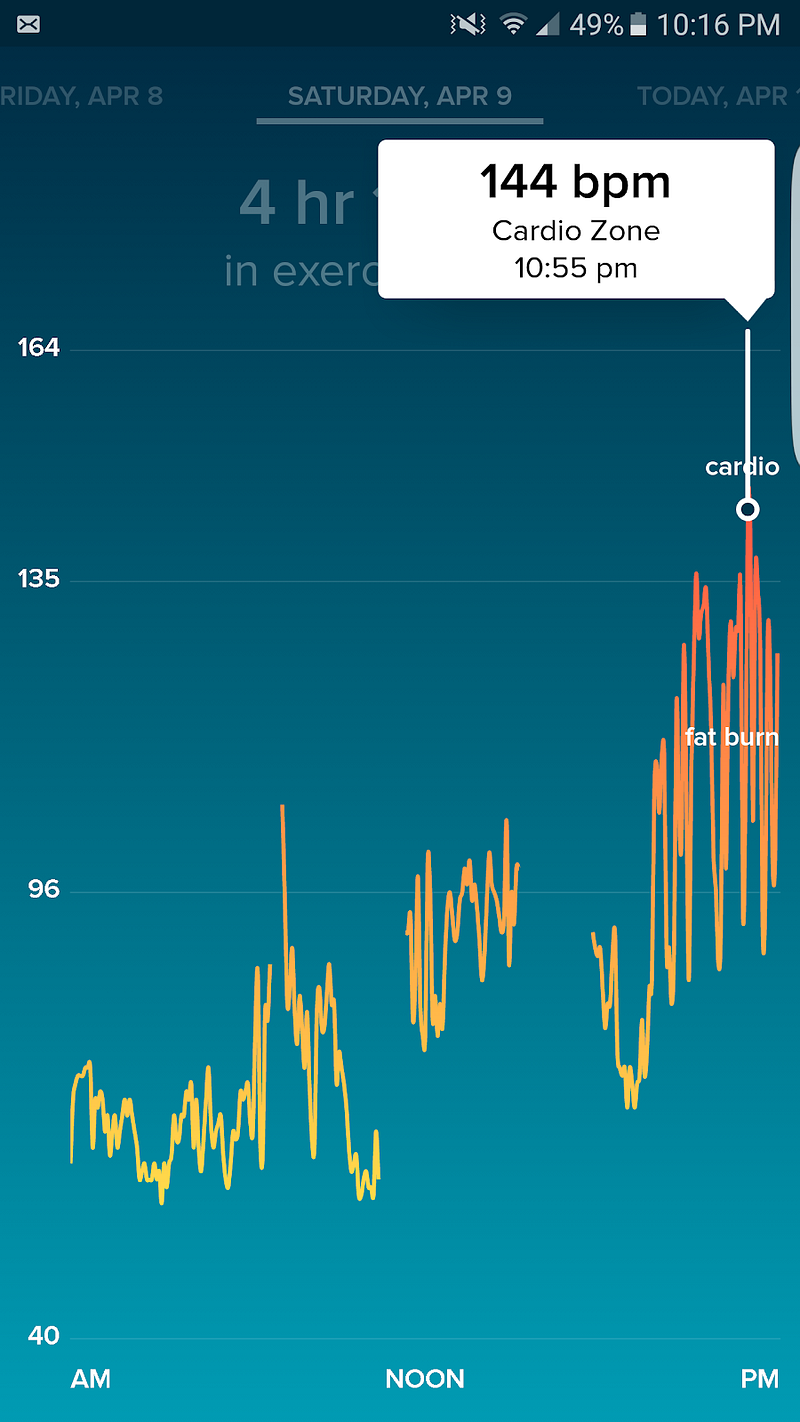

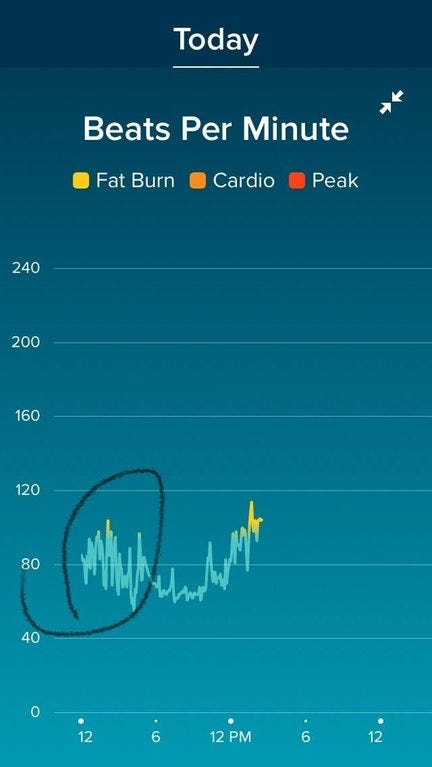
Clearly, you can see one of coke’s (multifarious) effects on your body in real time with these gadgets strapped to your wrist. But what is the practical value of that information, if any?
I got in touch with “X,” a 19-year-old male redditor who frequents r/cocaine and tracks his bpm while indulging in his favorite intoxicants, which include alcohol and the anti-anxiety tranquilizer Xanax, as well as coke. He says that while his Apple Watch is mostly “shitty,” its heart rate monitoring feature is “the best and most useful thing about it.” His interest in the data depends on what he’s taking, of course: “For Xanax I make sure [my heart rate] doesn’t fall under a certain number,” he explains, while with coke he wants to avoid “going over a certain number.”
And the numbers are certain. “My resting heart rate is usually 80. If I’m on Xanax I usually don’t want it dropping under 50,” X says. “And on coke, anything above 140 is when I stop. If it’s falling too low while on Xanax, then it’s okay, because I can just go take a nap and stop drinking if I was. On coke, if it starts getting too high, I’ll take a Xanax to calm my heart rate down.”
I ask X if this method of dosing feels more reliable than what most everyone else has had to do throughout the history of inebriation — go with their gut instinct. “Yes, it is,” he says, though he’ll rely on his own best judgment as well, particularly in a party setting. Speaking of which: The fitness tracker binge, like cocaine itself, is a rather social phenomenon. “The first time I did it,” X explains, was “with people who have done it for a long time, so then after I just learned from them.” Later, he got his friends with wearables to monitor their heart rates as well, and they share their bpm often, whether hanging out together or not. “Some of us have higher tolerances, so we use it to keep [tabs on] each other,” he says.
Sounds pretty responsible, doesn’t it? Dr. Robert A. Kloner, the Chief Science Officer and Director of Cardiovascular Research at Huntington Medical Research Institutes, disagrees completely. “Not a good idea,” he writes in an email when I ask him about the trend. “It will lead people to have a false sense of security.” (...)
But it seems that X has figured out a system he likes, and he knows what to look for — at least as far as a decent high is concerned. If the coke is of a better quality, “rocky and scaley,” then he’ll notice a jump in bpm “almost instantly” after taking some, with a pulse fall-off 45 to 60 minutes later. “If it’s stepped on,” he says — which is to say cut with other ingredients — he gets the same instant bump, but a much quicker fall-off in heart rate, somewhere in the 10 to 15 minute range. And while he never wants to soar above 140 bpm, “around 120 is perfect for me,” he says. Apart from this niche functionality, he only uses the heart rate monitor “occasionally” while sleeping.
X isn’t too bothered about Apple having this data, either. “Well, yeah, sometimes it does feel weird,” he admits. “But at the same time, I do work out, so my heart rate is constantly at that point.” Besides, as the excitement of this year’s World Cup and other intense situations have proved, the causes of bpm surges during physical “inactivity” are varied and strange.
Even as drug users like X seek the equilibrium to their inebriation with the aid of heart rate monitoring, others are taking cues from the tech to pop their legally prescribed drugs.
by Miles Klee, MEL | Read more:
Images: uncredited
So I don’t think we can be too surprised that people are using fitness trackers to monitor their vitals while taking recreational drugs. As CNBC first reported, some drug users find wearable devices like the Apple Watch and the Fitbit helpful in managing their intake of stimulants, which tend to get your heart rate up. They reason that by keeping their heart below a certain threshold of beats per minute (bpm) while high, they can lessen the always-present risk of an acute cardiac event. And so, ever since the consumer technology to keep tabs on your pulse 24/7 first became available, they’ve been sharing health data from their binges in online drug forums like the r/cocaine subreddit, for example:
Clearly, you can see one of coke’s (multifarious) effects on your body in real time with these gadgets strapped to your wrist. But what is the practical value of that information, if any?
I got in touch with “X,” a 19-year-old male redditor who frequents r/cocaine and tracks his bpm while indulging in his favorite intoxicants, which include alcohol and the anti-anxiety tranquilizer Xanax, as well as coke. He says that while his Apple Watch is mostly “shitty,” its heart rate monitoring feature is “the best and most useful thing about it.” His interest in the data depends on what he’s taking, of course: “For Xanax I make sure [my heart rate] doesn’t fall under a certain number,” he explains, while with coke he wants to avoid “going over a certain number.”
And the numbers are certain. “My resting heart rate is usually 80. If I’m on Xanax I usually don’t want it dropping under 50,” X says. “And on coke, anything above 140 is when I stop. If it’s falling too low while on Xanax, then it’s okay, because I can just go take a nap and stop drinking if I was. On coke, if it starts getting too high, I’ll take a Xanax to calm my heart rate down.”
I ask X if this method of dosing feels more reliable than what most everyone else has had to do throughout the history of inebriation — go with their gut instinct. “Yes, it is,” he says, though he’ll rely on his own best judgment as well, particularly in a party setting. Speaking of which: The fitness tracker binge, like cocaine itself, is a rather social phenomenon. “The first time I did it,” X explains, was “with people who have done it for a long time, so then after I just learned from them.” Later, he got his friends with wearables to monitor their heart rates as well, and they share their bpm often, whether hanging out together or not. “Some of us have higher tolerances, so we use it to keep [tabs on] each other,” he says.
Sounds pretty responsible, doesn’t it? Dr. Robert A. Kloner, the Chief Science Officer and Director of Cardiovascular Research at Huntington Medical Research Institutes, disagrees completely. “Not a good idea,” he writes in an email when I ask him about the trend. “It will lead people to have a false sense of security.” (...)
But it seems that X has figured out a system he likes, and he knows what to look for — at least as far as a decent high is concerned. If the coke is of a better quality, “rocky and scaley,” then he’ll notice a jump in bpm “almost instantly” after taking some, with a pulse fall-off 45 to 60 minutes later. “If it’s stepped on,” he says — which is to say cut with other ingredients — he gets the same instant bump, but a much quicker fall-off in heart rate, somewhere in the 10 to 15 minute range. And while he never wants to soar above 140 bpm, “around 120 is perfect for me,” he says. Apart from this niche functionality, he only uses the heart rate monitor “occasionally” while sleeping.
X isn’t too bothered about Apple having this data, either. “Well, yeah, sometimes it does feel weird,” he admits. “But at the same time, I do work out, so my heart rate is constantly at that point.” Besides, as the excitement of this year’s World Cup and other intense situations have proved, the causes of bpm surges during physical “inactivity” are varied and strange.
Even as drug users like X seek the equilibrium to their inebriation with the aid of heart rate monitoring, others are taking cues from the tech to pop their legally prescribed drugs.
by Miles Klee, MEL | Read more:
Images: uncredited
The Radical Notion of a Smartphone-Free Campus
There’s a scene in Don DeLillo’s story “Midnight in Dostoevsky” that reflects on the current omnipresence of digital media and the relative oasis that the college classroom can be. Here we are in a laughably self-serious logic seminar, where the wizardly professor, Ilgauskas, utters one-line axioms before the small group of anxious, if intrigued, students:
 Here’s a story that may sound apocryphal, but this really happened: One spring day on my campus, I saw a student who was staring into his smartphone walk straight into a light pole. He crashed into it, stumbled backward, and looked around to see who had seen him. (I was some distance away; he didn’t notice me.) Then he adjusted his course and went back to whatever he had been doing on his phone, unfazed. This is one of the often ignored, occasionally painful, and sometimes embarrassing consequences of what Ian Bogost discusses in an article for The Atlantic called “Hyperemployment, or the Exhausting Work of the Technology User.” Hyperemployment is the endless work we do for unseen agencies, owners, and conglomerations while seemingly merely tapping away at our phones, communicating or otherwise being entertained.
Around that time, I had been tuning into how hyperemployed people are on my campus. Just a few days before the student and the light pole, I had dropped my iPhone, and the screen shattered. The phone still worked, more or less, but after the fall, it lived on my desk in a Ziploc freezer bag, glass splinters crumbling away and accumulating gradually into tiny glinting dunes in the corners of the bag. So I had been reexperiencing my life without smartphone and especially reconsidering how these things permeated my workplace, the university.
After a few weeks of being smartphone free, from this altered vantage point I noticed just how busy everyone seemed to be, all the time. Whether in class, in meetings, or in the hallways—everyone was on their phones. And I don’t say this from an easy standpoint of judgment, for I had grown so accustomed to being on my phone, justifying my near constant attachment to it by the fact that it was allowing me flexibility and freedom. I would draft essays and outline book chapters on my phone’s notepad in the middle of the night. I emailed frantic students at all hours, reassuring them about assignments, missed classes, or exams. I carried on committee work long after meetings had let out, hashing out the fine points of strategic planning and SWOT analyses. I networked with remote colleagues on Twitter and set energizing collaborations into motion. This all seemed worthwhile and productive—and I suppose it was, for the most part.
I’m fully conscious of my own cyborg existence, and I have always been a lenient professor when it comes to students and their technologies. I generally don’t police their use in the classroom and have called students out only a handful of times when their texting got too conspicuous or a facial expression suggested that they had become totally distracted by something on their phone. For the most part, I accept that these things have interpenetrated our lives so thoroughly that it is impractical and unrealistic to try to sanction their use in the classroom. Rather, figuring out the etiquette and subtleties of smartphone use in everyday life is one of the innumerable soft skills that should be learned over the course of college.
But that was before my smartphone hiatus. During those weeks, I found myself walking to work, feeling great. Why? Because I was not thumbing madly and squinting into my hand as I stumbled along, neck craned, tripping over the curb. I was swinging my arms and looking around. Between meetings on campus, I was processing things people said as I strolled back to my office, rather than going immediately to my email inbox, replying to messages as I marched upstairs. I wasn’t leaving my classes and getting directly on Slack to catch up with my collaborators; I was decompressing and thinking about what my students brought up in our discussions. I thought my smartphone was granting me freedom, but it was more like the opposite.
I began to see these things everywhere on campus, and they were increasingly disgusting to me. This has been a difficult piece to write because I am aware of how my criticism verges on hypocrisy, or almost depends on it: I appreciate what smartphones can do—are doing—on a daily basis. But seeing these things from a slight remove, they became revolting to me. I saw my students and colleagues tethered to their smartphones, and I wondered how these things were meshing with—or not—our ostensibly collective purpose of higher education: working together to make the world better, at least our human part in it. I realized how entangled with my smartphone I had become and how different—how refreshing—it felt to be without it. I started reading (books!) for uninterrupted minutes in ways I hadn’t been able to for years because I always felt the need to live tweet or cross-reference whatever I was reading.
I talked to my students about this at one point during this time, extrapolating that they, too, probably didn’t realize how supplementary they had become to their phones—to which they looked at me wide-eyed as if to say, Oh, yes, we well realize this. The look they gave me was tragic, their faces creased in quiet despair. I told my students I was writing a piece on my experience of being without my iPhone, and they viewed me with sardonic skepticism. Good luck with that, they seemed to be thinking.
One student later emailed me a timely New Yorker piece called “The Useless Agony of Going Offline,” in which Matthew J. X. Malady describes the pointlessness of going off his handheld devices cold turkey. He tries it for seventy-two hours and concludes: “I would like to say that I reached some time-maximization epiphany … but I’m not sure that I used my time any ‘better’ than I normally would have during that span. I just used it differently, and found myself frequently bored as a result.” Malady complains that he was basically less informed when off his handheld devices, and the piece ends with a sort of discursive shrug, as if to suggest that it is futile to resist the hegemony burning away in our hands, pockets, and brains. It is a persuasive and shrewd article, and my student seemed to be daring me to prove Malady wrong. But I’m not trying to make a wholesale pronouncement against these things. My relationship with my phone persisted during that time the screen was shattered—it’s just that I didn’t see the thing for hours at a time, particularly when I was on campus.
I told my colleague Tim Welsh about the shattering of my iPhone, and he quickly dialed up dozens of bizarre, hilarious YouTube videos testing various fall heights and reporting the damage incurred by different devices put under various forms of duress. Take after slow-motion take of smartphones crashing into the pavement, being dipped in miscellaneous liquids, and being run over by SUVs. But these were tutorials ultimately geared toward protecting one’s phone or purchasing the most durable model out there. I was watching these videos from the other side, my phone having already been smashed. And perhaps the videos served as yet one more layer of entertainment and seamless commerce, no matter why they were dialed up in the first place.
The weird thing is that I probably wouldn’t have done it on my own; I don’t have the self-discipline to simply use the phone less (some people do, I understand). It took an accidental fall. And then, not wanting to spend a few hundred dollars to replace it, or suffer through the ordeal of an average AT&T or Apple customer-service experience, I just let the phone lie there in its bag, mostly inert, for several weeks. It was functional but changed, limited in a new way. As I was checking my phone one day, sheathed in its plastic envelope, my partner Lara remarked how having it in a gallon-size Ziploc freezer bag made the ridiculousness of these things wickedly obvious: we’re all hanging around gripping and staring into these awkward containers full of junk.
by Christopher Schaberg, Paris Review | Read more:
Image: uncredited
[ed. Smartphones, laptops, desktops, whatever... the Internet is the fundamental distractive device.]
“The atomic fact,” he said.
Then he elaborated for ten minutes while we listened, glanced, made notes, riffled the textbook to find refuge in print, some semblance of meaning that might be roughly equivalent to what he was saying. There were no laptops or handheld devices in class. Ilgauskas didn’t exclude them; we did, sort of, unspokenly. Some of us could barely complete a thought without touch pads or scroll buttons, but we understood that high-speed data systems did not belong here. They were an assault on the environment, which was defined by length, width, and depth, with time drawn out, computed in heartbeats. We sat and listened or sat and waited. We wrote with pens or pencils. Our notebooks had pages made of flexible sheets of paper.I don’t want to wax nostalgic for an earlier era when college students dutifully shunned digital technology or didn’t have it to begin with. I do want, as my university often encourages me, to meet my students “where they are.” But sometimes the imperative to digital mediation overwhelms me and makes me wonder about the threshold of these different ways of being: analog and digital. But of course, it’s never that simple, never a clear-cut binary.
 Here’s a story that may sound apocryphal, but this really happened: One spring day on my campus, I saw a student who was staring into his smartphone walk straight into a light pole. He crashed into it, stumbled backward, and looked around to see who had seen him. (I was some distance away; he didn’t notice me.) Then he adjusted his course and went back to whatever he had been doing on his phone, unfazed. This is one of the often ignored, occasionally painful, and sometimes embarrassing consequences of what Ian Bogost discusses in an article for The Atlantic called “Hyperemployment, or the Exhausting Work of the Technology User.” Hyperemployment is the endless work we do for unseen agencies, owners, and conglomerations while seemingly merely tapping away at our phones, communicating or otherwise being entertained.
Around that time, I had been tuning into how hyperemployed people are on my campus. Just a few days before the student and the light pole, I had dropped my iPhone, and the screen shattered. The phone still worked, more or less, but after the fall, it lived on my desk in a Ziploc freezer bag, glass splinters crumbling away and accumulating gradually into tiny glinting dunes in the corners of the bag. So I had been reexperiencing my life without smartphone and especially reconsidering how these things permeated my workplace, the university.
After a few weeks of being smartphone free, from this altered vantage point I noticed just how busy everyone seemed to be, all the time. Whether in class, in meetings, or in the hallways—everyone was on their phones. And I don’t say this from an easy standpoint of judgment, for I had grown so accustomed to being on my phone, justifying my near constant attachment to it by the fact that it was allowing me flexibility and freedom. I would draft essays and outline book chapters on my phone’s notepad in the middle of the night. I emailed frantic students at all hours, reassuring them about assignments, missed classes, or exams. I carried on committee work long after meetings had let out, hashing out the fine points of strategic planning and SWOT analyses. I networked with remote colleagues on Twitter and set energizing collaborations into motion. This all seemed worthwhile and productive—and I suppose it was, for the most part.
I’m fully conscious of my own cyborg existence, and I have always been a lenient professor when it comes to students and their technologies. I generally don’t police their use in the classroom and have called students out only a handful of times when their texting got too conspicuous or a facial expression suggested that they had become totally distracted by something on their phone. For the most part, I accept that these things have interpenetrated our lives so thoroughly that it is impractical and unrealistic to try to sanction their use in the classroom. Rather, figuring out the etiquette and subtleties of smartphone use in everyday life is one of the innumerable soft skills that should be learned over the course of college.
But that was before my smartphone hiatus. During those weeks, I found myself walking to work, feeling great. Why? Because I was not thumbing madly and squinting into my hand as I stumbled along, neck craned, tripping over the curb. I was swinging my arms and looking around. Between meetings on campus, I was processing things people said as I strolled back to my office, rather than going immediately to my email inbox, replying to messages as I marched upstairs. I wasn’t leaving my classes and getting directly on Slack to catch up with my collaborators; I was decompressing and thinking about what my students brought up in our discussions. I thought my smartphone was granting me freedom, but it was more like the opposite.
I began to see these things everywhere on campus, and they were increasingly disgusting to me. This has been a difficult piece to write because I am aware of how my criticism verges on hypocrisy, or almost depends on it: I appreciate what smartphones can do—are doing—on a daily basis. But seeing these things from a slight remove, they became revolting to me. I saw my students and colleagues tethered to their smartphones, and I wondered how these things were meshing with—or not—our ostensibly collective purpose of higher education: working together to make the world better, at least our human part in it. I realized how entangled with my smartphone I had become and how different—how refreshing—it felt to be without it. I started reading (books!) for uninterrupted minutes in ways I hadn’t been able to for years because I always felt the need to live tweet or cross-reference whatever I was reading.
I talked to my students about this at one point during this time, extrapolating that they, too, probably didn’t realize how supplementary they had become to their phones—to which they looked at me wide-eyed as if to say, Oh, yes, we well realize this. The look they gave me was tragic, their faces creased in quiet despair. I told my students I was writing a piece on my experience of being without my iPhone, and they viewed me with sardonic skepticism. Good luck with that, they seemed to be thinking.
One student later emailed me a timely New Yorker piece called “The Useless Agony of Going Offline,” in which Matthew J. X. Malady describes the pointlessness of going off his handheld devices cold turkey. He tries it for seventy-two hours and concludes: “I would like to say that I reached some time-maximization epiphany … but I’m not sure that I used my time any ‘better’ than I normally would have during that span. I just used it differently, and found myself frequently bored as a result.” Malady complains that he was basically less informed when off his handheld devices, and the piece ends with a sort of discursive shrug, as if to suggest that it is futile to resist the hegemony burning away in our hands, pockets, and brains. It is a persuasive and shrewd article, and my student seemed to be daring me to prove Malady wrong. But I’m not trying to make a wholesale pronouncement against these things. My relationship with my phone persisted during that time the screen was shattered—it’s just that I didn’t see the thing for hours at a time, particularly when I was on campus.
I told my colleague Tim Welsh about the shattering of my iPhone, and he quickly dialed up dozens of bizarre, hilarious YouTube videos testing various fall heights and reporting the damage incurred by different devices put under various forms of duress. Take after slow-motion take of smartphones crashing into the pavement, being dipped in miscellaneous liquids, and being run over by SUVs. But these were tutorials ultimately geared toward protecting one’s phone or purchasing the most durable model out there. I was watching these videos from the other side, my phone having already been smashed. And perhaps the videos served as yet one more layer of entertainment and seamless commerce, no matter why they were dialed up in the first place.
The weird thing is that I probably wouldn’t have done it on my own; I don’t have the self-discipline to simply use the phone less (some people do, I understand). It took an accidental fall. And then, not wanting to spend a few hundred dollars to replace it, or suffer through the ordeal of an average AT&T or Apple customer-service experience, I just let the phone lie there in its bag, mostly inert, for several weeks. It was functional but changed, limited in a new way. As I was checking my phone one day, sheathed in its plastic envelope, my partner Lara remarked how having it in a gallon-size Ziploc freezer bag made the ridiculousness of these things wickedly obvious: we’re all hanging around gripping and staring into these awkward containers full of junk.
by Christopher Schaberg, Paris Review | Read more:
Image: uncredited
[ed. Smartphones, laptops, desktops, whatever... the Internet is the fundamental distractive device.]
Subscribe to:
Posts (Atom)