Tuesday, December 24, 2019

Beast Mode 2.0

Why the Seahawks HAD to bring back Marshawn Lynch (SB Nation)
Image: Rod Mar via
[ed. He's back! Unfortunately, they had to lose Chris Carson for the rest of the season for it to happen.]


‘Clarification’ Ends Protection For Migratory Birds
[ed. Migratory Bird Treaty Act (of 1918) now useless.]
As the state of Virginia prepared for a major bridge and tunnel expansion in the tidewaters of the Chesapeake Bay last year, engineers understood that the nesting grounds of 25,000 gulls, black skimmers, royal terns and other seabirds were about to be plowed under.
To compensate, they considered developing an artificial island as a safe haven. Then in June 2018, the Trump administration stepped in. While the federal government “appreciates” the state’s efforts, new rules in Washington had eliminated criminal penalties for “incidental” migratory bird deaths that came in the course of normal business, administration officials advised. Such conservation measures were now “purely voluntary.”
The state ended its island planning.
 The island is one of dozens of bird-preservation efforts that have fallen away in the wake of the policy change in 2017 that was billed merely as a technical clarification to a century-old law protecting migratory birds. Across the country birds have been killed and nests destroyed by oil spills, construction crews and chemical contamination, all with no response from the federal government, according to emails, memos and other documents viewed by The New York Times. Not only has the administration stopped investigating most bird deaths, the documents show, it has discouraged local governments and businesses from taking precautionary measures to protect birds. (...)
The revised policy — part of the administration’s broader effort to encourage business activity — has been a particular favorite of the president, whose selective view of avian welfare has ranged from complaining that wind energy “kills all the birds” to asserting that the oil industry has been subject to “totalitarian tactics” under the Migratory Bird Treaty Act of 1918.
Habitat loss and pesticide exposure already have brought on widespread bird-species declines. The number of adult breeding birds in the United States and Canada has plummeted by 2.9 billion since 1970.
Now, said Noah Greenwald, the endangered species director for the Center for Biological Diversity, the Trump administration has engineered “a fundamental shift” in policy that “lets industrial companies, utilities and others completely off the hook.” Even a disaster like the Deepwater Horizon oil spill of 2010, which killed or injured about a million birds, would not expose a company to prosecution or fines.
Gavin Shire, a spokesman for the Fish and Wildlife Service, the agency responsible for protecting migratory birds, said in a statement that other federal laws like the Endangered Species Act remain on the books. The Trump administration, he said, “will continue to work cooperatively with our industry partners to minimize impacts on migratory birds.”
The documents tell a different story. In nearly two dozen incidents across 15 states, internal conversations among Fish and Wildlife Service officers indicate that, short of going out to shoot birds, activities in which birds die no longer merit action. In some cases the Trump administration has even discouraged local governments and businesses from taking relatively simple steps to protect birds, like reporting fatalities when they are found.
“You get the sense this policy is not only bad for birds, it’s also cruel,” Mr. Greenwald said.
by Lisa Friedman, NY Times | Read more:
Image:Robert F. Bukaty/Associated Press
[ed. Wouldn't it be nice to wake up in the morning and not have some new outrage coming out of Washington? It's hard to imagine. This administration, with near total Republican support, is systematically trashing everything that makes life worth living (and enjoying it). See also: The Migratory Bird Treaty Act, Explained (Audubon).]
As the state of Virginia prepared for a major bridge and tunnel expansion in the tidewaters of the Chesapeake Bay last year, engineers understood that the nesting grounds of 25,000 gulls, black skimmers, royal terns and other seabirds were about to be plowed under.
To compensate, they considered developing an artificial island as a safe haven. Then in June 2018, the Trump administration stepped in. While the federal government “appreciates” the state’s efforts, new rules in Washington had eliminated criminal penalties for “incidental” migratory bird deaths that came in the course of normal business, administration officials advised. Such conservation measures were now “purely voluntary.”
The state ended its island planning.
 The island is one of dozens of bird-preservation efforts that have fallen away in the wake of the policy change in 2017 that was billed merely as a technical clarification to a century-old law protecting migratory birds. Across the country birds have been killed and nests destroyed by oil spills, construction crews and chemical contamination, all with no response from the federal government, according to emails, memos and other documents viewed by The New York Times. Not only has the administration stopped investigating most bird deaths, the documents show, it has discouraged local governments and businesses from taking precautionary measures to protect birds. (...)
The revised policy — part of the administration’s broader effort to encourage business activity — has been a particular favorite of the president, whose selective view of avian welfare has ranged from complaining that wind energy “kills all the birds” to asserting that the oil industry has been subject to “totalitarian tactics” under the Migratory Bird Treaty Act of 1918.
Habitat loss and pesticide exposure already have brought on widespread bird-species declines. The number of adult breeding birds in the United States and Canada has plummeted by 2.9 billion since 1970.
Now, said Noah Greenwald, the endangered species director for the Center for Biological Diversity, the Trump administration has engineered “a fundamental shift” in policy that “lets industrial companies, utilities and others completely off the hook.” Even a disaster like the Deepwater Horizon oil spill of 2010, which killed or injured about a million birds, would not expose a company to prosecution or fines.
Gavin Shire, a spokesman for the Fish and Wildlife Service, the agency responsible for protecting migratory birds, said in a statement that other federal laws like the Endangered Species Act remain on the books. The Trump administration, he said, “will continue to work cooperatively with our industry partners to minimize impacts on migratory birds.”
The documents tell a different story. In nearly two dozen incidents across 15 states, internal conversations among Fish and Wildlife Service officers indicate that, short of going out to shoot birds, activities in which birds die no longer merit action. In some cases the Trump administration has even discouraged local governments and businesses from taking relatively simple steps to protect birds, like reporting fatalities when they are found.
“You get the sense this policy is not only bad for birds, it’s also cruel,” Mr. Greenwald said.
by Lisa Friedman, NY Times | Read more:
Image:Robert F. Bukaty/Associated Press
[ed. Wouldn't it be nice to wake up in the morning and not have some new outrage coming out of Washington? It's hard to imagine. This administration, with near total Republican support, is systematically trashing everything that makes life worth living (and enjoying it). See also: The Migratory Bird Treaty Act, Explained (Audubon).]
Monday, December 23, 2019

Costco Private-Label Wines

Image: Greg Gilbert/The Seattle Times
Higher Ed on Autopilot
What if university executives manage to keep the status quo? Does higher ed stay on an even keel — steadily less loved and less funded, but still generating good volumes of decent credentials for people who will then mostly earn enough money to pay off their loans? The stoic demographer Nathan D. Grawe has written a book with a surprising answer. He takes no policy position, and I can picture him cringing at my impatient shorthanding of the current consensus. But his analysis rings an alarm that will sound very loud even to those with their fingers in their ears.
The consensus among today’s senior academic managers is that the most progressive ideas for universities must be defeated. Large-scale student debt relief? This college president opposes it. Free college at four-year institutions? This president opposes it. Divest the endowment from fossil fuel companies? This president opposes it. Eliminate special admissions for wealthy students? This president opposes it. On the other hand, hide a donation from an influential convicted pedophile? This president allows it. Reject a public university partnership with a for-profit diploma mill? This president created it. But make a trillion-dollar reinvestment in public universities? Where’s the president who has come out in favor of it?
 In taking these stands, the presidents are setting themselves against public opinion. When a recent poll asked people if they support proposals to make “two and four year public and tribal colleges and universities tuition-free and debt-free and erase the roughly $1.6 trillion in student loan debt currently owed by close to 45 million Americans,” the answer was yes, 58 to 42 percent. This majority is important because the price tag of $2.2 trillion over 10 years was included in the question, and the policy won anyway. Seventy-two percent of Democrats favored the idea (which is good news for the presidential campaigns of its proposers, Bernie Sanders and Elizabeth Warren); so did 58 percent of independents. In another poll, four-fifths of the public want federal and state governments to spend more money on higher education. College presidents are in danger of repeating their predecessors’ opposition to the 1944 GI Bill that built the modern public university system, such as University of Chicago’s president Robert Maynard Hutchins warning about “educational hoboes” who would burden colleges by living and studying at government expense.
Still, major reinvestment won’t happen if it faces opposition from higher-ed leadership en masse. Given the plans of Sanders, Warren, and others, the country might naturally ask the college presidents: if you say we can’t have zero tuition, or at least much lower tuition, or can’t end student debt, or can’t dial way back on private fundraising, or can’t greatly increase public funding, what can we do?
Higher ed’s Plan A is “you can have what you have now.” Meanwhile, its leaders will wait for free college and debt relief to die a political death while supporting more accountability metrics, simpler financial aid forms, higher income-eligibility thresholds, and calls for the next Secretary of Education to go back to prosecuting predatory for-profits. We are to have a set of dull yet virtuous tweaks, which add up, sort of. We would naturally assume that things at least won’t get worse — that graduation rates, debt levels, and racial imbalances would stay pretty much as they are now, which is mediocre by international standards, very unequal by race and income, yet mediocre and unequal in a settled, familiar way.
Enter Nathan Grawe, who has done the work to show us how wrong we are. He has built a Higher Education Demand Index (HEDI) to model the next 10 years, based on existing patterns. He looks at trends by region, by race and ethnicity, and by type of university, among other factors, so that he can avoid the banality of averages that wash out specific, intensive effects. He assumes that current patterns will stay unchanged, which is reasonable given the entrenched policy complacency within the sector itself. This is what he projects:
In addition, the highest population growth “is concentrated in populations that aren’t likely to attend a regional four-year school.” This is in part because the chances of a high school student finishing college are shockingly dependent on having parents that went to college, and regions with high rates of immigration or poverty are likely to have high shares of what would be first-generation college students — except they are less likely to attend. Polls at least in California suggest that Latinx parents have very high expectations for their children’s college attendance (closer to Asian Americans than to the lower white levels), but translating these desires into completion is easier said than done.
A third issue is that colleges aren’t going to get another major boost to enrollment from women entering the workforce or from “knowledge economy” demand for college graduates (driven by “skill-based technical change”). The former boost was a one-time event, though it will continue on the margins; the latter seems to have stalled and may be going into reverse, given the offshoring of so much medium- and even high-skill work — not to mention expanding automation.
Based on the current autopilot, Grawe’s model yields the following. The two-year colleges that both parties present as the hope of the working classes will experience “dramatically reduced enrollments” — down 15 percent over the decade in some places. In Grawe’s graveside deadpan, “the HEDI anticipates that enrollments among-non-Hispanic whites and non-Hispanic blacks will plummet by 20 and 30 percent, respectively, while the number of Hispanic students is expected to grow by 10 percent.”
Regional four-year colleges should benefit from the decline of two-year enrollments, shouldn’t they? Actually, no. After some mid-2020s growth, birth-death contraction will set in, and four-year numbers will also drop everywhere except in the Pacific region, where over 10 years they will grow by less than one percent.
Grawe’s model forecasts widespread under-enrollment that will produce fiscal crises at many colleges in many regions at once. We should expect systemic stress and turmoil, which would include cascading college closures of the kind threatened at Hampshire College and already occurring elsewhere. Closures will be worse in the Snow Belt/Rust Belt but not confined there. Many endangered colleges will struggle to stay open by cutting payrolls, which is likely to mean staff and faculty layoffs. Colleges may try to avoid layoffs with further adjunctification of the teaching force — or may combine layoffs with adjunctification, sometimes with the same professors (“We have to deny you tenure, but we’ll be happy rehire you on a three-year contract”). Grawe projects a loss of 8,000 faculty positions at two-year colleges and a further 9,000 positions lost at regional four-year schools.
It’s hard to imagine this fading higher-ed sector having the power to uplift or transform society. It will keep cutting educational spending to keep some money in the bank. Enrollment and revenue losses will particularly affect the poorer colleges that provide the most social mobility. State government’s core interest, job readiness, will also be hit: “[U]nless something changes, we should not expect to meet goals for a more highly trained workforce.” This will tempt state government to cut again. (...)
Autopilot plus the smaller youth cohort isn’t a falling tide that lowers all boats. Boats will float and sink according to familiar patterns, only more so. Students with college-educated parents and high-income students will know where to apply and what to do to get in, as they do now. But they will be chased by elite colleges with relatively more available slots than they have now. Fewer of these students who can pay full tuition will go to regional public colleges, worsening both their finances and their academic levels. Educational gaps among graduates will increase: students with college-educated parents go to regional colleges at twice the rate of first-generation students, and at six times the rate at “national and elite” schools. In short, Grawe writes, “Overall attendance rates will lag behind projections for our economy’s needs, and large gaps across groups will persist or even grow.” All we need to do to get this less educated and more unequal world is to stay the course.
The consensus among today’s senior academic managers is that the most progressive ideas for universities must be defeated. Large-scale student debt relief? This college president opposes it. Free college at four-year institutions? This president opposes it. Divest the endowment from fossil fuel companies? This president opposes it. Eliminate special admissions for wealthy students? This president opposes it. On the other hand, hide a donation from an influential convicted pedophile? This president allows it. Reject a public university partnership with a for-profit diploma mill? This president created it. But make a trillion-dollar reinvestment in public universities? Where’s the president who has come out in favor of it?
 In taking these stands, the presidents are setting themselves against public opinion. When a recent poll asked people if they support proposals to make “two and four year public and tribal colleges and universities tuition-free and debt-free and erase the roughly $1.6 trillion in student loan debt currently owed by close to 45 million Americans,” the answer was yes, 58 to 42 percent. This majority is important because the price tag of $2.2 trillion over 10 years was included in the question, and the policy won anyway. Seventy-two percent of Democrats favored the idea (which is good news for the presidential campaigns of its proposers, Bernie Sanders and Elizabeth Warren); so did 58 percent of independents. In another poll, four-fifths of the public want federal and state governments to spend more money on higher education. College presidents are in danger of repeating their predecessors’ opposition to the 1944 GI Bill that built the modern public university system, such as University of Chicago’s president Robert Maynard Hutchins warning about “educational hoboes” who would burden colleges by living and studying at government expense.
Still, major reinvestment won’t happen if it faces opposition from higher-ed leadership en masse. Given the plans of Sanders, Warren, and others, the country might naturally ask the college presidents: if you say we can’t have zero tuition, or at least much lower tuition, or can’t end student debt, or can’t dial way back on private fundraising, or can’t greatly increase public funding, what can we do?
Higher ed’s Plan A is “you can have what you have now.” Meanwhile, its leaders will wait for free college and debt relief to die a political death while supporting more accountability metrics, simpler financial aid forms, higher income-eligibility thresholds, and calls for the next Secretary of Education to go back to prosecuting predatory for-profits. We are to have a set of dull yet virtuous tweaks, which add up, sort of. We would naturally assume that things at least won’t get worse — that graduation rates, debt levels, and racial imbalances would stay pretty much as they are now, which is mediocre by international standards, very unequal by race and income, yet mediocre and unequal in a settled, familiar way.
Enter Nathan Grawe, who has done the work to show us how wrong we are. He has built a Higher Education Demand Index (HEDI) to model the next 10 years, based on existing patterns. He looks at trends by region, by race and ethnicity, and by type of university, among other factors, so that he can avoid the banality of averages that wash out specific, intensive effects. He assumes that current patterns will stay unchanged, which is reasonable given the entrenched policy complacency within the sector itself. This is what he projects:
The US population will continue to shift from snowbelt to sunbelt — from Northeast and Midwest to West, Southwest, and South. The populations in the faster-growing areas will also tend to have a higher birth rate than the national average. The shift won’t in itself be a big deal for overall college completion — the students who don’t go to college in Massachusetts would in theory be graduating in Arizona, so there would be no overall loss.But there are complications. “The nation’s total fertility rate has plummeted by more than 12 percent since 2007. And so, beginning in 2026 the number of native-born children reaching college age will begin a rapid decline.” Birth rates hit bottom in 2013, but there has been no meaningful recovery.
In addition, the highest population growth “is concentrated in populations that aren’t likely to attend a regional four-year school.” This is in part because the chances of a high school student finishing college are shockingly dependent on having parents that went to college, and regions with high rates of immigration or poverty are likely to have high shares of what would be first-generation college students — except they are less likely to attend. Polls at least in California suggest that Latinx parents have very high expectations for their children’s college attendance (closer to Asian Americans than to the lower white levels), but translating these desires into completion is easier said than done.
A third issue is that colleges aren’t going to get another major boost to enrollment from women entering the workforce or from “knowledge economy” demand for college graduates (driven by “skill-based technical change”). The former boost was a one-time event, though it will continue on the margins; the latter seems to have stalled and may be going into reverse, given the offshoring of so much medium- and even high-skill work — not to mention expanding automation.
Based on the current autopilot, Grawe’s model yields the following. The two-year colleges that both parties present as the hope of the working classes will experience “dramatically reduced enrollments” — down 15 percent over the decade in some places. In Grawe’s graveside deadpan, “the HEDI anticipates that enrollments among-non-Hispanic whites and non-Hispanic blacks will plummet by 20 and 30 percent, respectively, while the number of Hispanic students is expected to grow by 10 percent.”
Regional four-year colleges should benefit from the decline of two-year enrollments, shouldn’t they? Actually, no. After some mid-2020s growth, birth-death contraction will set in, and four-year numbers will also drop everywhere except in the Pacific region, where over 10 years they will grow by less than one percent.
Grawe’s model forecasts widespread under-enrollment that will produce fiscal crises at many colleges in many regions at once. We should expect systemic stress and turmoil, which would include cascading college closures of the kind threatened at Hampshire College and already occurring elsewhere. Closures will be worse in the Snow Belt/Rust Belt but not confined there. Many endangered colleges will struggle to stay open by cutting payrolls, which is likely to mean staff and faculty layoffs. Colleges may try to avoid layoffs with further adjunctification of the teaching force — or may combine layoffs with adjunctification, sometimes with the same professors (“We have to deny you tenure, but we’ll be happy rehire you on a three-year contract”). Grawe projects a loss of 8,000 faculty positions at two-year colleges and a further 9,000 positions lost at regional four-year schools.
It’s hard to imagine this fading higher-ed sector having the power to uplift or transform society. It will keep cutting educational spending to keep some money in the bank. Enrollment and revenue losses will particularly affect the poorer colleges that provide the most social mobility. State government’s core interest, job readiness, will also be hit: “[U]nless something changes, we should not expect to meet goals for a more highly trained workforce.” This will tempt state government to cut again. (...)
Autopilot plus the smaller youth cohort isn’t a falling tide that lowers all boats. Boats will float and sink according to familiar patterns, only more so. Students with college-educated parents and high-income students will know where to apply and what to do to get in, as they do now. But they will be chased by elite colleges with relatively more available slots than they have now. Fewer of these students who can pay full tuition will go to regional public colleges, worsening both their finances and their academic levels. Educational gaps among graduates will increase: students with college-educated parents go to regional colleges at twice the rate of first-generation students, and at six times the rate at “national and elite” schools. In short, Grawe writes, “Overall attendance rates will lag behind projections for our economy’s needs, and large gaps across groups will persist or even grow.” All we need to do to get this less educated and more unequal world is to stay the course.
Sunday, December 22, 2019


Rewriting the Book of Love
WHY DO WE fall in love?
It’s a tough question. Evolutionary biologists say that it’s due to our hardwired instinct to propagate the species. But that answer, quite aside from its tendentious heteronormativity, fails to address the real question: why do we fall in love with this person, out of all the people in the world? Plato says we fall in love because we perceive beauty in the beloved, which inspires us with a desire for that greater, absolute Beauty of which it is an image. But again, this leaves open the question of why one beautiful person in particular should be the focus of intense love and desire, while others are merely objects of admiration. It also raises what philosophers have come to call the “trading up problem”: if I love you because of some combination of virtues you possess, then, logically, I should transfer my affection if I find someone who possesses the same virtues to an even greater degree. Yet that scenario seems neither ethical nor true to experience; I don’t love another child more than my own, even if I objectively perceive them to be more virtuous. These difficulties have led many philosophers of love to leave out the question of “why” altogether, and focus instead on what happens once the thunderbolt, or Cupid’s arrow, has already struck. As for the source of the emotion, they are willing to throw up their hands and say, with Michel de Montaigne: “If you press me to tell you why I loved him, I feel this cannot be expressed, except by answering: ‘Because it was he, because it was I.’”
 That answer doesn’t satisfy Simon May. His new book seeks to define exactly what it is about a person, or a thing, that inspires love. According to May, love is our joyful response to whatever holds out the promise of what he calls “ontological rootedness” — whatever, in other words, seems to offer us “a home in a world that we supremely value.” Whether you love God, your parents, your country, or someone you have just met, you love them for their ability — or potential — to give your life the grounding it innately craves. May specifies four qualities of the beloved that contribute to that sense of rootedness: an origin or heritage with which we can identify; an ethics to which we aspire; a power to intensify (or even, at the limit, to grant or deny) our existence; and a calling toward a new life or destiny. When we meet with the being who encompasses all these things, we experience the unmistakable symptoms of love. (...)
The trouble, as May sees it, is as follows. Our current conception of love is based on the model of Christian agape: love that is disinterested, unchanging, affirming of all aspects of the beloved, and above all unconditional. But there are two problems with that model. First, that understanding of agape is a comparatively recent development, one that is at odds both with Scripture and with most of the history of Christian thought, which has usually viewed God’s love as very much conditional, partial, and judgmental. Second, even to the extent that we do find elements of such idealized, selfless love in early Christian thought, it is only God who is conceived as being able to love in this manner. Gradually, however, theologians began to assert that humans too — with the help of God’s grace — were capable of such love. Eventually, the notion of grace faded away, with the result that human love is now generally conceived, by philosophers and by popular culture alike, in divine terms that it can never possibly realize. May finds this misconception not only frustratingly illogical but deeply pernicious.
In claiming that the common understanding of love today is not just wrong but even slightly insane, May strongly calls to mind the 20th-century Swiss thinker Denis de Rougemont. Like May, de Rougemont traces an errant history of love in which Christianity is the culprit. According to his influential, if controversial, treatise, Love in the Western World (1940), Christianity, including Christian agape, represents an unnatural imposition on Western culture, which well into the Middle Ages remained essentially pagan — specifically Manichaean — in spirit. The result of this incompatibility was the exaltation of passionate love into a religion, begun in the 12th century by Provençal troubadours as a means of reconciling pagan and Christian, body and spirit. But this solution merely papers over a deep, heretical, and irreconcilable division. Love as we currently understand and experience it, therefore, is utterly mistaken, a failed ruse. As de Rougemont puts it in a later essay (with reference to the idea of marrying for love, one of his most frequent objects of criticism): “We are in the act of trying out — and failing miserably at it — one of the most pathological experiments that a civilized society has ever imagined.”
Only occasionally does May indulge in such pointed provocations (such as when he refers to “the disaster that love has suffered in the West for roughly the last two centuries”). But his willingness to expound a thesis that, like de Rougemont’s, really does break with so much received wisdom allows him to provide genuinely new insights into what is, as he notes, an ancient topic. Among other advantages, the idea that love is inspired by the promise of ontological rootedness permits May to group together forms of love that are often treated as distinct or even incompatible: not just love for God, family, lover, and friend, but also love for a great work of art, or for an institution (your alma mater, for instance), or for a natural landscape — all of which can offer the same sense of an exalted home as human relationships. May’s theory extends as well to the love so often felt for tyrants and dictators, which he reads not as perverse, or even misdirected, but as perfectly continuous with other instances of love.
It’s a tough question. Evolutionary biologists say that it’s due to our hardwired instinct to propagate the species. But that answer, quite aside from its tendentious heteronormativity, fails to address the real question: why do we fall in love with this person, out of all the people in the world? Plato says we fall in love because we perceive beauty in the beloved, which inspires us with a desire for that greater, absolute Beauty of which it is an image. But again, this leaves open the question of why one beautiful person in particular should be the focus of intense love and desire, while others are merely objects of admiration. It also raises what philosophers have come to call the “trading up problem”: if I love you because of some combination of virtues you possess, then, logically, I should transfer my affection if I find someone who possesses the same virtues to an even greater degree. Yet that scenario seems neither ethical nor true to experience; I don’t love another child more than my own, even if I objectively perceive them to be more virtuous. These difficulties have led many philosophers of love to leave out the question of “why” altogether, and focus instead on what happens once the thunderbolt, or Cupid’s arrow, has already struck. As for the source of the emotion, they are willing to throw up their hands and say, with Michel de Montaigne: “If you press me to tell you why I loved him, I feel this cannot be expressed, except by answering: ‘Because it was he, because it was I.’”
 That answer doesn’t satisfy Simon May. His new book seeks to define exactly what it is about a person, or a thing, that inspires love. According to May, love is our joyful response to whatever holds out the promise of what he calls “ontological rootedness” — whatever, in other words, seems to offer us “a home in a world that we supremely value.” Whether you love God, your parents, your country, or someone you have just met, you love them for their ability — or potential — to give your life the grounding it innately craves. May specifies four qualities of the beloved that contribute to that sense of rootedness: an origin or heritage with which we can identify; an ethics to which we aspire; a power to intensify (or even, at the limit, to grant or deny) our existence; and a calling toward a new life or destiny. When we meet with the being who encompasses all these things, we experience the unmistakable symptoms of love. (...)
The trouble, as May sees it, is as follows. Our current conception of love is based on the model of Christian agape: love that is disinterested, unchanging, affirming of all aspects of the beloved, and above all unconditional. But there are two problems with that model. First, that understanding of agape is a comparatively recent development, one that is at odds both with Scripture and with most of the history of Christian thought, which has usually viewed God’s love as very much conditional, partial, and judgmental. Second, even to the extent that we do find elements of such idealized, selfless love in early Christian thought, it is only God who is conceived as being able to love in this manner. Gradually, however, theologians began to assert that humans too — with the help of God’s grace — were capable of such love. Eventually, the notion of grace faded away, with the result that human love is now generally conceived, by philosophers and by popular culture alike, in divine terms that it can never possibly realize. May finds this misconception not only frustratingly illogical but deeply pernicious.
In claiming that the common understanding of love today is not just wrong but even slightly insane, May strongly calls to mind the 20th-century Swiss thinker Denis de Rougemont. Like May, de Rougemont traces an errant history of love in which Christianity is the culprit. According to his influential, if controversial, treatise, Love in the Western World (1940), Christianity, including Christian agape, represents an unnatural imposition on Western culture, which well into the Middle Ages remained essentially pagan — specifically Manichaean — in spirit. The result of this incompatibility was the exaltation of passionate love into a religion, begun in the 12th century by Provençal troubadours as a means of reconciling pagan and Christian, body and spirit. But this solution merely papers over a deep, heretical, and irreconcilable division. Love as we currently understand and experience it, therefore, is utterly mistaken, a failed ruse. As de Rougemont puts it in a later essay (with reference to the idea of marrying for love, one of his most frequent objects of criticism): “We are in the act of trying out — and failing miserably at it — one of the most pathological experiments that a civilized society has ever imagined.”
Only occasionally does May indulge in such pointed provocations (such as when he refers to “the disaster that love has suffered in the West for roughly the last two centuries”). But his willingness to expound a thesis that, like de Rougemont’s, really does break with so much received wisdom allows him to provide genuinely new insights into what is, as he notes, an ancient topic. Among other advantages, the idea that love is inspired by the promise of ontological rootedness permits May to group together forms of love that are often treated as distinct or even incompatible: not just love for God, family, lover, and friend, but also love for a great work of art, or for an institution (your alma mater, for instance), or for a natural landscape — all of which can offer the same sense of an exalted home as human relationships. May’s theory extends as well to the love so often felt for tyrants and dictators, which he reads not as perverse, or even misdirected, but as perfectly continuous with other instances of love.
"Best of 2019" Book Lists
For the twelfth straight year, I am aggregating every online year-end book list I find in this post. As the lists appear online, I will add them to this master list, updating daily.
Please feel free to e-mail me with a blog, magazine, newspaper, or other online list I have missed.
Daily updates to the master list of online "best books of 2019" lists.
Online "Best of 2019" Book Lists:
100 Scope Notes (best children's books)
The A.V. Club (favorite books)
Abby Likes To Read (favorite books)
 Adam Rippon (favorite books)
Adventures of Cometgrrl (best books)
The Advocate (favorite books)
Affable Ambitions (top audiobooks)
Air & Space (best aviation- and space-themed books for young readers)
Akala (top books)
Ali Wong (favorite books)
Alliance of Independent Authors (favorite authors)
AllRecipes (cookbooks)
Almost Anthropology (favorite books)
Alta (contributors' favorite books)
AltPress (top music-related books)
Amazon (best biographies and memoirs)
Amazon (best books)
Amazon (best books for babies through age 2)
Amazon (best books for children ages 3-5)
Amazon (best books for children ages 6-8)
Amazon (best books for children ages 9-12)
Amazon (best business and leadership books)
Amazon (best children's books)
Amazon (best children's action and adventure books)
Amazon (best children's activity books)
Amazon (best children's African-American story books)
Amazon (best children's humor books)
Amazon (best children's nonfiction)
Amazon (best cooking, food, and wine books)
Amazon (best history books)
Amazon (best literature and fiction)
Amazon (best mysteries and thrillers)
Amazon (best nonfiction)
Amazon (best romance books)
Amazon (best science books)
Amazon (best science fiction and fantasy)
Amazon (best teen and young adult books)
Amazon (editors' gift picks)
American Indians in Children's Literature (best books)
Andrea Scher (best books)
Ani DiFranco (favorite books)
Antoni Porowski (favorite books)
Anxious Bench (favorite books)
Atlantic (best cookbooks)
The Australian (best books)
Autostraddle (best queer books) (...)
by David Gutowski, Book Post | Read more:
[ed. And that's just the 'A's'.]
Please feel free to e-mail me with a blog, magazine, newspaper, or other online list I have missed.
Daily updates to the master list of online "best books of 2019" lists.
Online "Best of 2019" Book Lists:
100 Scope Notes (best children's books)
The A.V. Club (favorite books)
Abby Likes To Read (favorite books)
 Adam Rippon (favorite books)
Adventures of Cometgrrl (best books)
The Advocate (favorite books)
Affable Ambitions (top audiobooks)
Air & Space (best aviation- and space-themed books for young readers)
Akala (top books)
Ali Wong (favorite books)
Alliance of Independent Authors (favorite authors)
AllRecipes (cookbooks)
Almost Anthropology (favorite books)
Alta (contributors' favorite books)
AltPress (top music-related books)
Amazon (best biographies and memoirs)
Amazon (best books)
Amazon (best books for babies through age 2)
Amazon (best books for children ages 3-5)
Amazon (best books for children ages 6-8)
Amazon (best books for children ages 9-12)
Amazon (best business and leadership books)
Amazon (best children's books)
Amazon (best children's action and adventure books)
Amazon (best children's activity books)
Amazon (best children's African-American story books)
Amazon (best children's humor books)
Amazon (best children's nonfiction)
Amazon (best cooking, food, and wine books)
Amazon (best history books)
Amazon (best literature and fiction)
Amazon (best mysteries and thrillers)
Amazon (best nonfiction)
Amazon (best romance books)
Amazon (best science books)
Amazon (best science fiction and fantasy)
Amazon (best teen and young adult books)
Amazon (editors' gift picks)
American Indians in Children's Literature (best books)
Andrea Scher (best books)
Ani DiFranco (favorite books)
Antoni Porowski (favorite books)
Anxious Bench (favorite books)
Atlantic (best cookbooks)
The Australian (best books)
Autostraddle (best queer books) (...)
[ed. And that's just the 'A's'.]

Pat Metheny
[ed. Pat's new album From This Place coming out Feb. 2020. Pre-release track (America Undefined here).
Speak My Language
To an almost shocking extent, NFL offenses are homogeneous. Given that every NFL team is in, roughly speaking, the same circumstances in terms of money, resources, practice time, and facilities, this homogeneity makes some sense. After all, “football’s always football,” as newly minted San Diego Chargers head coach Mike McCoy recently said. “Everyone’s running the same plays, and it’s a matter of some running one concept more than another team is. It all boils down to the same thing.”
There are essentially three main offensive “systems” in the NFL: West Coast, Coryell, and Erhardt-Perkins. Given that every NFL team runs basically the same plays, each of these NFL offensive families is differentiated mostly by how those plays are communicated.
 To oversimplify, the West Coast offense, made famous by Bill Walsh and still the most popular system in the NFL, uses what is essentially a memory system. On running plays, the same two-digit numbering system as most NFL and college teams is used. Passing plays, however, are typically denoted by the primary receiver’s route, such as Z-In, X-Hook, while the rest of the players are required to memorize their tasks. This system is as old as football itself, which is no surprise given that Walsh’s onetime mentor Paul Brown is credited as much as anyone with inventing the modern conception of huddles, game plans, and play calls. For more than 20 years, this system has been the dominant one in the NFL.
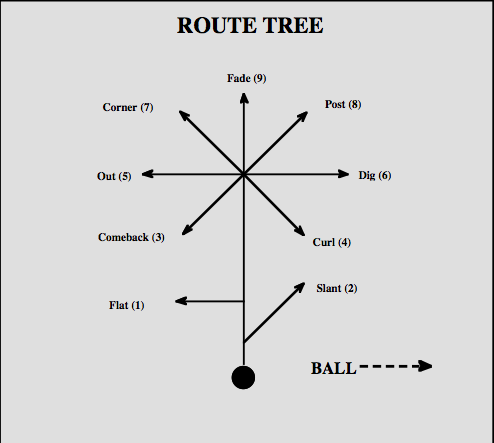
The Coryell system, named after former San Diego Chargers head coach Don Coryell and used by coaches such as Norv Turner, Ernie Zampese, and Mike Martz, is built around the concept of a route tree. Many teams use a route tree (which is the idea that the base route is straight up the field, and the other routes consist of break points off that original path), but the Coryell system uses the tree as the foundation of its play-calling system. For example, the Troy Aikman–era Dallas Cowboys frequently called a play called “896,” which told one outside receiver to run a square-in route (“6”), the tight end to run a seam straight up the field (“9”), and the split end to run a skinny post (“8”). The idea was that, using the route tree, a coach could effectively call any pass combination and all a receiver had to know was the number associated with his route.
In recent years, as offenses and defenses have grown more complex, these systems have started crumbling under their own weight. With multiple formations and personnel groupings, calls that began as “22 Z-In” have gotten unwieldy.
In the Coryell system, the elegance of the three-digit route-tree system has been rendered almost entirely obsolete. Because NFL teams operate predominantly in one-back formations, there are often more than three players running routes, and calling any pass play means having to use both numbers and words (“896 H-Shallow F-Curl”). More critically, the numerical route-tree system gives coaches and players flexibility where they don’t need it and not enough where they do. The “benefit” of a route-tree system is the ability to call any passing concept a coach could dream up, but that option is of very little use. Assuming the route tree has 10 routes (0-9), a three-digit tree gives an offense 59,049 different possible route combinations. That’s absurd. And yet, the route tree by definition only has 10 possible routes, much fewer than any NFL team actually runs. This means that any other route must be called by name, thus defeating the very purpose of having a route tree.
This effectively makes the Coryell system sound a lot like current West Coast offense play calls,1 which have no organizing principle and have morphed into monstrosities like “Scatter-Two Bunch-Right-Zip-Fire 2 Jet Texas Right-F Flat X-Q.” The advantage of a play call like this is that it informs a player of his job better than other systems do. The disadvantage is that it’s excessively clunky, and plays that are conceptually the same can have wildly different calls.
New England’s offense is a member of the NFL’s third offensive family, the Erhardt-Perkins system. The offense was named after the two men, Ron Erhardt and Ray Perkins, who developed it while working for the Patriots under head coach Chuck Fairbanks in the 1970s. According to Perkins, it was assembled in the same way most such systems are developed. “I don’t look at it as us inventing it,” he explained. “I look at it as a bunch of coaches sitting in rooms late at night organizing and getting things together to help players be successful.”
The backbone of the Erhardt-Perkins system is that plays — pass plays in particular — are not organized by a route tree or by calling a single receiver’s route, but by what coaches refer to as “concepts.” Each play has a name, and that name conjures up an image for both the quarterback and the other players on offense. And, most importantly, the concept can be called from almost any formation or set. Who does what changes, but the theory and tactics driving the play do not. “In essence, you’re running the same play,” said Perkins. “You’re just giving them some window-dressing to make it look different.”
The biggest advantage of the concept-based system is that it operates from the perspective of the most critical player on offense: the quarterback. In other systems, even if the underlying principles are the exact same, the play and its name might be very different. Rather than juggling all this information in real time, an Erhardt-Perkins quarterback only has to read a given arrangement of receivers. “You can cut down on the plays and get different looks from your formations and who’s in them. It’s easier for the players to learn. It’s easier for the quarterback to learn,” former Patriots offensive coordinator Charlie Weis said back in 2000. “You get different looks without changing his reads. You don’t need an open-ended number of plays.”
There are essentially three main offensive “systems” in the NFL: West Coast, Coryell, and Erhardt-Perkins. Given that every NFL team runs basically the same plays, each of these NFL offensive families is differentiated mostly by how those plays are communicated.
 To oversimplify, the West Coast offense, made famous by Bill Walsh and still the most popular system in the NFL, uses what is essentially a memory system. On running plays, the same two-digit numbering system as most NFL and college teams is used. Passing plays, however, are typically denoted by the primary receiver’s route, such as Z-In, X-Hook, while the rest of the players are required to memorize their tasks. This system is as old as football itself, which is no surprise given that Walsh’s onetime mentor Paul Brown is credited as much as anyone with inventing the modern conception of huddles, game plans, and play calls. For more than 20 years, this system has been the dominant one in the NFL.
The Coryell system, named after former San Diego Chargers head coach Don Coryell and used by coaches such as Norv Turner, Ernie Zampese, and Mike Martz, is built around the concept of a route tree. Many teams use a route tree (which is the idea that the base route is straight up the field, and the other routes consist of break points off that original path), but the Coryell system uses the tree as the foundation of its play-calling system. For example, the Troy Aikman–era Dallas Cowboys frequently called a play called “896,” which told one outside receiver to run a square-in route (“6”), the tight end to run a seam straight up the field (“9”), and the split end to run a skinny post (“8”). The idea was that, using the route tree, a coach could effectively call any pass combination and all a receiver had to know was the number associated with his route.
In recent years, as offenses and defenses have grown more complex, these systems have started crumbling under their own weight. With multiple formations and personnel groupings, calls that began as “22 Z-In” have gotten unwieldy.
In the Coryell system, the elegance of the three-digit route-tree system has been rendered almost entirely obsolete. Because NFL teams operate predominantly in one-back formations, there are often more than three players running routes, and calling any pass play means having to use both numbers and words (“896 H-Shallow F-Curl”). More critically, the numerical route-tree system gives coaches and players flexibility where they don’t need it and not enough where they do. The “benefit” of a route-tree system is the ability to call any passing concept a coach could dream up, but that option is of very little use. Assuming the route tree has 10 routes (0-9), a three-digit tree gives an offense 59,049 different possible route combinations. That’s absurd. And yet, the route tree by definition only has 10 possible routes, much fewer than any NFL team actually runs. This means that any other route must be called by name, thus defeating the very purpose of having a route tree.
This effectively makes the Coryell system sound a lot like current West Coast offense play calls,1 which have no organizing principle and have morphed into monstrosities like “Scatter-Two Bunch-Right-Zip-Fire 2 Jet Texas Right-F Flat X-Q.” The advantage of a play call like this is that it informs a player of his job better than other systems do. The disadvantage is that it’s excessively clunky, and plays that are conceptually the same can have wildly different calls.
New England’s offense is a member of the NFL’s third offensive family, the Erhardt-Perkins system. The offense was named after the two men, Ron Erhardt and Ray Perkins, who developed it while working for the Patriots under head coach Chuck Fairbanks in the 1970s. According to Perkins, it was assembled in the same way most such systems are developed. “I don’t look at it as us inventing it,” he explained. “I look at it as a bunch of coaches sitting in rooms late at night organizing and getting things together to help players be successful.”
The backbone of the Erhardt-Perkins system is that plays — pass plays in particular — are not organized by a route tree or by calling a single receiver’s route, but by what coaches refer to as “concepts.” Each play has a name, and that name conjures up an image for both the quarterback and the other players on offense. And, most importantly, the concept can be called from almost any formation or set. Who does what changes, but the theory and tactics driving the play do not. “In essence, you’re running the same play,” said Perkins. “You’re just giving them some window-dressing to make it look different.”
The biggest advantage of the concept-based system is that it operates from the perspective of the most critical player on offense: the quarterback. In other systems, even if the underlying principles are the exact same, the play and its name might be very different. Rather than juggling all this information in real time, an Erhardt-Perkins quarterback only has to read a given arrangement of receivers. “You can cut down on the plays and get different looks from your formations and who’s in them. It’s easier for the players to learn. It’s easier for the quarterback to learn,” former Patriots offensive coordinator Charlie Weis said back in 2000. “You get different looks without changing his reads. You don’t need an open-ended number of plays.”
by Chris B. Brown, Grantland | Read more:
Image: Aaron M. Sprecher
[ed. A little dated (2103) but still relevant.]
Bodily Curiosities
I am not altogether incurious, but one entity about which I have over the years felt little curiosity is my own body. Until recently, I could not have told you the function of my, or anyone else’s, pancreas, spleen, or gallbladder. I’d just as soon not have known that I have kidneys, and was less than certain of their exact whereabouts, apart from knowing that they reside somewhere in the region of my lower back. As for my entrails, the yards of intestines winding through my body, the less I knew about them the better, though I have always liked the sound of the word “duodenum.” About the cells and chromosomes, the hormones and microbes crawling and swimming about in my body, let us not speak.
 For better and worse, these deficiencies in my knowledge have been addressed by a splendid book by Bill Bryson called The Body: A Guide for Occupants. The book is an account of human parts, inside and out, and what is known and still unknown about them. It catalogues the diseases and mechanical failures to which flesh is heir; establishes a pantheon of heroic medical researchers and a rogues’ gallery of quacks; sets out some of the differences between humans and other mammals and between the male and female of our own species—and does all this in a fluent, often amusing, never dull manner. The point of view is ironical yet suffused with awed appreciation for that endlessly complex machine, the human body.
In the first hundred pages of The Body, one learns that there are microbes in one’s belly button, that the average adult touches his face sixteen times an hour, that the number of human facial expressions ranges between 4,100 and 10,000, that tears come in three varieties, that the human eye can distinguish between 2 million and 7.5 million colors, that humans choke more easily than any other mammal, that people who have had their tonsils removed when young may have a 44 percent greater risk of heart attack later in life, that one of the inventors of the lobotomy won the Nobel Prize for Medicine in 1949, and that Leonardo’s Mona Lisa has no eyebrows. Scores of such items float through the book.
But beyond this rich factual matter—the number of heartbeats in a lifetime (up to 1.6 billion), famous stutterers, “the complicated hydraulics of the male erection,” the world’s tallest human being (Robert Wadlow at 8 feet 11 inches), the world’s oldest human being (Jeanne Louise Calment, who lived to be 122, and quit smoking only at 117), the removal of Samuel Pepys’s gallstone (but not Montaigne’s), the many functions of the liver (which does everything, Bryson tells us, but kick extra points)—reading The Body naturally throws one back on thoughts about one’s own body. The book has caused me to feel that, on balance, I have been fairly fortunate in my body. I have no serious deformity, suffer no chronic illness of note, and have arrived in my eighties in relatively decent health, though, an old joke has it, one definition of a healthy person is someone who has not had a recent medical examination.
by Joseph Epstein, First Things | Read more:
 For better and worse, these deficiencies in my knowledge have been addressed by a splendid book by Bill Bryson called The Body: A Guide for Occupants. The book is an account of human parts, inside and out, and what is known and still unknown about them. It catalogues the diseases and mechanical failures to which flesh is heir; establishes a pantheon of heroic medical researchers and a rogues’ gallery of quacks; sets out some of the differences between humans and other mammals and between the male and female of our own species—and does all this in a fluent, often amusing, never dull manner. The point of view is ironical yet suffused with awed appreciation for that endlessly complex machine, the human body.
In the first hundred pages of The Body, one learns that there are microbes in one’s belly button, that the average adult touches his face sixteen times an hour, that the number of human facial expressions ranges between 4,100 and 10,000, that tears come in three varieties, that the human eye can distinguish between 2 million and 7.5 million colors, that humans choke more easily than any other mammal, that people who have had their tonsils removed when young may have a 44 percent greater risk of heart attack later in life, that one of the inventors of the lobotomy won the Nobel Prize for Medicine in 1949, and that Leonardo’s Mona Lisa has no eyebrows. Scores of such items float through the book.
But beyond this rich factual matter—the number of heartbeats in a lifetime (up to 1.6 billion), famous stutterers, “the complicated hydraulics of the male erection,” the world’s tallest human being (Robert Wadlow at 8 feet 11 inches), the world’s oldest human being (Jeanne Louise Calment, who lived to be 122, and quit smoking only at 117), the removal of Samuel Pepys’s gallstone (but not Montaigne’s), the many functions of the liver (which does everything, Bryson tells us, but kick extra points)—reading The Body naturally throws one back on thoughts about one’s own body. The book has caused me to feel that, on balance, I have been fairly fortunate in my body. I have no serious deformity, suffer no chronic illness of note, and have arrived in my eighties in relatively decent health, though, an old joke has it, one definition of a healthy person is someone who has not had a recent medical examination.
by Joseph Epstein, First Things | Read more:
Image: via
Saturday, December 21, 2019
An Arrangement
You know that it is a truth rarely universally acknowledged that the straights, once they’ve coupled, are very dramatic about their breakups. Take, for example, your friend Linda. Blond, Botoxed absolute darling who, despite living in Irvine, still has a rich inner life. When she found out that her husband was fucking their neighbor—who was also a friend, who every summer Friday had sat by Linda’s side at her pool, in her backyard, drinking the sangria that she had made—well, she marched right up to that backstabbing floozie’s door, her husband’s dirty laundry in hand, threw it on the floor and said, Why don’t you do his fucking laundry, bitch.
Or when your aunt and uncle finally decided to cut the knot, they didn’t know it would take seven full years of fucking each other in attorney fees. In year two and a half, something snapped inside him: he broke into her house, shut off the hot lamp keeping the two iguanas alive, then smoked a cigarette and left it in the ashtray like a giant middle finger for her to discover. (And the poor iguanas, Bob and Marley, may they rest in peace.)
 You never imagine that it will happen to you. Your partner of six years, Victor, is a level-headed infectious disease researcher. He is working on the newest iteration of PrEP, a shot people can have administered at a clinic every two months. He explains the science but you never fully comprehend it, other than that there will no longer be a need for a daily pill. You love how smart he is, and how he has used his intelligence for the betterment of mankind. You, on the other hand, are an artist of moderate success. You sometimes feel guilty about this and wonder what role oil paintings play in society, especially when the world feels like it is calling out like a dumpster fire.
Still, you paint. You say to yourself, At least I’m not Thomas Kinkade.
There is the day you catch Victor looking at an unfinished canvas in your studio, an oil portrait of a Pomeranian named Biscuit whose dog-parents in Palo Alto have commissioned you to complete for three thousand dollars plus materials. (The money is nothing to balk at, but you joke that the task is so absurd, it might turn you into a Marxist.) When you walk in, Victor turns to you and says, This is exquisite. And he kisses you with such passion that you feel lucky.
And you should feel lucky because the two of you have an Instagrammable life—a small modern apartment in the Bay that gets amazing natural light, the occasional vacation, a solid credit score, healthy bodies that say gym membership. You are both in your early thirties and in love. You dream of the day he will present you with a ring and you can craft your registry at Bloomingdale’s. All the flatware and vases and frames you will ask people to shower you with. Neither of you has student loans and you both make sure to never bring this up at dinner parties.
But now, in a blinding turn of events, it does happen to you.
Or when your aunt and uncle finally decided to cut the knot, they didn’t know it would take seven full years of fucking each other in attorney fees. In year two and a half, something snapped inside him: he broke into her house, shut off the hot lamp keeping the two iguanas alive, then smoked a cigarette and left it in the ashtray like a giant middle finger for her to discover. (And the poor iguanas, Bob and Marley, may they rest in peace.)
 You never imagine that it will happen to you. Your partner of six years, Victor, is a level-headed infectious disease researcher. He is working on the newest iteration of PrEP, a shot people can have administered at a clinic every two months. He explains the science but you never fully comprehend it, other than that there will no longer be a need for a daily pill. You love how smart he is, and how he has used his intelligence for the betterment of mankind. You, on the other hand, are an artist of moderate success. You sometimes feel guilty about this and wonder what role oil paintings play in society, especially when the world feels like it is calling out like a dumpster fire.
Still, you paint. You say to yourself, At least I’m not Thomas Kinkade.
There is the day you catch Victor looking at an unfinished canvas in your studio, an oil portrait of a Pomeranian named Biscuit whose dog-parents in Palo Alto have commissioned you to complete for three thousand dollars plus materials. (The money is nothing to balk at, but you joke that the task is so absurd, it might turn you into a Marxist.) When you walk in, Victor turns to you and says, This is exquisite. And he kisses you with such passion that you feel lucky.
And you should feel lucky because the two of you have an Instagrammable life—a small modern apartment in the Bay that gets amazing natural light, the occasional vacation, a solid credit score, healthy bodies that say gym membership. You are both in your early thirties and in love. You dream of the day he will present you with a ring and you can craft your registry at Bloomingdale’s. All the flatware and vases and frames you will ask people to shower you with. Neither of you has student loans and you both make sure to never bring this up at dinner parties.
But now, in a blinding turn of events, it does happen to you.
by Joseph Cassara, Boston Review | Read more:
Image: Erik Cooper

This is Neoliberalism
[ed. I'd imagine even if you think you know what the term 'neoliberalism' means, this simple and concise overview will probably surprise you (with bi-partisan support, one of the few things both Democrats and Repubicans have agreed on over the last 40 years). See also: Part 2 and Free Speech, Incorporated (Boston Review).]
Friday, December 20, 2019
Why the Young Ruled This Decade
There are eras in history, like the 1950s, when older people set the cultural and moral terms for the young. And there are eras, like the 1960s, when it’s the other way around.
The current decade has been in the latter mold. Its true beginning was Dec. 17, 2010, when a 26-year-old street vendor in Tunisia, Mohamed Bouazizi, set himself on fire, setting off protests that quickly toppled governments across the region. Now it approaches its end with the 16-year-old Swedish climate activist Greta Thunberg named Time’s Person of the Year.
In between, the decade has been fundamentally shaped by the technological creations of the young, in the form of social media and mobile apps; by the mass migrations of the young, from Africa and the Middle East to Europe and from Latin America to the U.S.; by the diseases of the (mostly) young, notably addiction and mental illness; and by the moral convictions of the young, from the #MeToo and Black Lives Matter movements in the U.S. to mass demonstrations from Cairo to Hong Kong.
 Why and how did the young dominate the decade? Let’s narrow the focus to America.
Demography first. What history usually thinks of as “the sixties” (beginning around 1964 with the Civil Rights Act and the Gulf of Tonkin Resolution) coincided, in the United States, with the coming-of-age of the baby boomers, roughly 75 million strong. Our current decade coincides with the coming-of-age of millennials, another generation of about 80 million. More people, more power — or at least more influence. By comparison, my generation, the underwhelming Generation X, numbers only 65 million.
Next, anger. History is often a series of reactions and counterreactions. We remember the nonconformism of the 60s as a response to the conformism of the 50s. This decade, too, has been a reaction to the last: to two wars that began in moral fervors and ended in strategic fizzles; and to a financial crisis whose victims numbered in the millions and for which nobody accepted blame.
Not surprisingly, this decade has been marked by the intense hostility of the young toward truisms that once governed our thinking. As they saw it, the liberal international order didn’t uphold the peace — it bled us dry. Capitalism didn’t make the country rich — it made the rich richer. Silicon Valley didn’t innovate technology — it mined our data. The Church didn’t save souls — it raped children. The cops didn’t serve and protect — they profiled and killed. The media didn’t tell the news — they spun it.
This hostility isn’t manifest just on the progressive left. It also accounts for the rise of the populist right.
As for tech, not only did the young invent and shape social media, social media shaped and reinvented the young. This was the decade when algorithms meant to cater to our tastes succeeded mainly in narrowing those tastes; when the creation of online communities led to our Balkanization into online tribes and the dissemination of disinformation and hate; when digital connection deepened our personal isolation, vulnerability and suggestibility; and when the ubiquity of portable screens with infinite data meant there was always something more interesting to do than interact with the person before us.
One result has been a kind of shallowing of our inner life: of time spent wondering, wandering, reading, daydreaming and just thinking things over. Another result has been a shallowing of our political life via the replacement of wit with snark and of reasoned arguments with rapid-fire tweets and hot takes.
Technology had another effect: It vastly accelerated the speed with which previously outlying ideas became, in the hands of their mainly youthful advocates, moral certitudes.
Some of those ideas, like marriage equality (the single greatest moral victory of the decade) were long overdue. Others, like intersectionality, gender fluidity, new standards of sexual consent or the purported centrality of racism to American identity, are much more debatable. Moral certitude isn’t the exclusive posture of the young. But it is an easier one to hold when life hasn’t yet given you sufficient time to leaven idealism with experience, second-guess yourself and learn that the things you once thought were most true aren’t quite so.
The current decade has been in the latter mold. Its true beginning was Dec. 17, 2010, when a 26-year-old street vendor in Tunisia, Mohamed Bouazizi, set himself on fire, setting off protests that quickly toppled governments across the region. Now it approaches its end with the 16-year-old Swedish climate activist Greta Thunberg named Time’s Person of the Year.
In between, the decade has been fundamentally shaped by the technological creations of the young, in the form of social media and mobile apps; by the mass migrations of the young, from Africa and the Middle East to Europe and from Latin America to the U.S.; by the diseases of the (mostly) young, notably addiction and mental illness; and by the moral convictions of the young, from the #MeToo and Black Lives Matter movements in the U.S. to mass demonstrations from Cairo to Hong Kong.
 Why and how did the young dominate the decade? Let’s narrow the focus to America.
Demography first. What history usually thinks of as “the sixties” (beginning around 1964 with the Civil Rights Act and the Gulf of Tonkin Resolution) coincided, in the United States, with the coming-of-age of the baby boomers, roughly 75 million strong. Our current decade coincides with the coming-of-age of millennials, another generation of about 80 million. More people, more power — or at least more influence. By comparison, my generation, the underwhelming Generation X, numbers only 65 million.
Next, anger. History is often a series of reactions and counterreactions. We remember the nonconformism of the 60s as a response to the conformism of the 50s. This decade, too, has been a reaction to the last: to two wars that began in moral fervors and ended in strategic fizzles; and to a financial crisis whose victims numbered in the millions and for which nobody accepted blame.
Not surprisingly, this decade has been marked by the intense hostility of the young toward truisms that once governed our thinking. As they saw it, the liberal international order didn’t uphold the peace — it bled us dry. Capitalism didn’t make the country rich — it made the rich richer. Silicon Valley didn’t innovate technology — it mined our data. The Church didn’t save souls — it raped children. The cops didn’t serve and protect — they profiled and killed. The media didn’t tell the news — they spun it.
This hostility isn’t manifest just on the progressive left. It also accounts for the rise of the populist right.
As for tech, not only did the young invent and shape social media, social media shaped and reinvented the young. This was the decade when algorithms meant to cater to our tastes succeeded mainly in narrowing those tastes; when the creation of online communities led to our Balkanization into online tribes and the dissemination of disinformation and hate; when digital connection deepened our personal isolation, vulnerability and suggestibility; and when the ubiquity of portable screens with infinite data meant there was always something more interesting to do than interact with the person before us.
One result has been a kind of shallowing of our inner life: of time spent wondering, wandering, reading, daydreaming and just thinking things over. Another result has been a shallowing of our political life via the replacement of wit with snark and of reasoned arguments with rapid-fire tweets and hot takes.
Technology had another effect: It vastly accelerated the speed with which previously outlying ideas became, in the hands of their mainly youthful advocates, moral certitudes.
Some of those ideas, like marriage equality (the single greatest moral victory of the decade) were long overdue. Others, like intersectionality, gender fluidity, new standards of sexual consent or the purported centrality of racism to American identity, are much more debatable. Moral certitude isn’t the exclusive posture of the young. But it is an easier one to hold when life hasn’t yet given you sufficient time to leaven idealism with experience, second-guess yourself and learn that the things you once thought were most true aren’t quite so.
by Bret Stephens, NY Times | Read more:
Image: Damon Winter/The New York Times
Thursday, December 19, 2019

More a Voyeur
Me by Elton John
Macmillan, 376 pp., £25, October, 978 1 5098 5331 1
Elton John was born Reg Dwight in 1947 in the north-west London suburb of Pinner. His mother was a nightmare, his father a bully. He was a boy who did not start thinking about sex until he was 21. While he shared an interest in football with his father – they both supported Watford – his father didn’t approve of his taste in music. From early on, Reg loved shopping and acquiring things. Like many of his generation, he found his first glimmer of true happiness in record shops on Saturdays, flicking through all the new releases, finding a life in them that was, for him, unimaginable in its glamour and its excitement. Even when he grew famous, he never stopped remembering that his nose had spent time up against the window of this world. It filled him with wonder and surprise when he escaped and got to perform with and befriend singers whose music he was crazy about.
While his mother emerges in Me, his memoir, as one of the sourest people who ever walked the earth, she plays a heroic role at the beginning by introducing her only child to the music she loved. After work on Fridays, she often bought a new 78, enjoying the sound of big band and some American singers. One week she brought home a record by Elvis Presley. Her son already knew the name: the previous weekend in the local barber’s he had come across a photo of the ‘most bizarre-looking man I’d ever seen. Everything about him looked extraordinary: his clothes, his hair, even the way he was standing.’
 Reg’s parents were a war couple. His dad was an amateur trumpet-player who spotted his mother in the audience one night. ‘They were both stubborn and short-tempered,’ he writes, ‘two delightful characteristics that it’s been my huge good fortune to inherit. I’m not sure if they ever really loved each other ... The rows were endless.’ Since his father remained in the army after the war, Reg was brought up mostly by his mother and his grandmother, living in fear of his mother’s moods, the ‘awful, glowering, miserable silences that descended on the house without warning ... she always seemed to be looking for a reason not to be happy.’ She had unusual views on potty- training, he tells us, ‘hitting me with a wire brush until I bled if I didn’t use the potty’. She also had strong views on constipation: ‘She laid me on the draining-board in the kitchen and stuck carbolic soap up my arse.’
The young Reg didn’t like himself: ‘I was too fat, I was too short, my face just looked weird, my hair would never do what I wanted it to.’ As his parents fought, he found solace in his bedroom, where everything was kept in perfect order. He began to study the singles charts, ‘then compiling the results, averaging them out into a personal chart of charts. I’ve always been a statistics freak ... I’m just an anorak.’
He began to take piano lessons, studied at the Royal Academy of Music, and eventually started playing in a bar, becoming fascinated by Little Richard and Jerry Lee Lewis. He got a Saturday job to fund his record-buying habit. As he became more involved with what was happening in music, he was aware that the older generation was not amused. ‘People fucking hated it. And no one hated it more than my father ... he thought the whole thing was morally wrong.’ Then his parents split up and his mother found a new partner whom Reg called Derf. In their two-bedroom flat, Reg acquired an electric piano and joined a band called Bluesology. They released two singles; neither was a success, but even so they were asked to be the support act for groups and singers whose names they recognised. ‘The whole thing was a dream come true for me. I was playing with artists whose records I collected.’ Even when the band went to Hamburg in 1966 and played at the Top Ten Club on the Reeperbahn, where the Beatles had played, Reg, aged 19, kept his innocence: ‘I barely drank and I still wasn’t interested in sex ... I had no idea about penetration, no idea what a blowjob was ... There I was, in one of Europe’s most notorious fleshpots ... All I cared about was playing and going to German record shops. I was totally absorbed by music. I was incredibly ambitious.’
He decided to become a solo artist and changed his name to Elton John. In 1967, he made the mistake of singing a Jim Reeves song (‘He’ll Have to Go’) at an audition for a new, progressive label. The offices, he noticed, were chaos. ‘There were piles of reel-to-reel tapes and hundreds of envelopes everywhere.’ The manager ‘seemed to pull an envelope out at random, just to give me something to take away, so the meeting didn’t feel like a dead loss ... That envelope had my future in it: everything that’s happened to me since happened because of what it contained.’ The envelope contained some lyrics by a songwriter called Bernie Taupin from Owmby-by-Spital in Lincolnshire. He was 17 years old and ‘long-haired, very handsome, very well read, a huge Bob Dylan fan’.
Taupin moved in with the singer previously known as Reg; they slept in bunk beds in the second bedroom of the flat owned by Reg’s mother and her new husband in Frome Court in Pinner. ‘We would spend the days writing,’ Elton remembers, ‘Bernie tapping out lyrics on a typewriter in the bedroom, bringing them to me at the upright piano in the living room ... If we weren’t writing, we spent all our time together, in record shops, at the cinema.’ (...)
Elton and Bernie worked fast: ‘Bernie got the lyrics to “Your Song” over breakfast one morning in Frome Court, handed them to me and I wrote the music in 15 minutes flat.’ He didn’t go around with melodies in his head. ‘I don’t even think about songwriting when I’m not actually doing it. Bernie writes the words, gives them to me, I read them, play a chord and something else takes over, something comes through my fingers.’ They made the album Elton John in four days and it appeared in 1970. The reviews were good. Famous singers, such as Pete Townsend, Jeff Beck and Dusty Springfield, began to turn up at Elton’s gigs to check him and his band out. The album’s cover photo showed a moody, nerdy-looking guy with glasses; his face was lit, but the space around him was black. He could easily have been someone’s answer to Leonard Cohen, the songwriter as lonely, fucked-up guy. He looked like a recluse, introspective, overeducated; his voice sounded weird, the accent fake American. At the time, it took me ages to work out that the opening two words of ‘Border Song’ were ‘Holy Moses’. He had sort of chewed them before he sang them. It was hard to make them out.
No one was sure where to place him. In Paris, when he supported Sérgio Mendes, he was booed off. In London, he played at the Royal Albert Hall supporting Fotheringay, the band formed by Sandy Denny in 1970. ‘They thought they were getting a sensitive singer-songwriter,’ Elton writes, ‘and instead they got rock’n’roll and Mr Freedom clothes and handstands on the piano keyboard. They couldn’t follow us: we had so much adrenaline ... I felt terrible. Sandy Denny was one of my heroes ... I scuttled home, absolutely mortified, before they came on stage.’
Between the album’s release and the Albert Hall concert, Elton had been in America. Before he set out, he’d found a clothes shop in Chelsea called Mr Freedom: ‘The stuff in the window was so outrageous that I hung around on the pavement outside for ages, trying to pluck up the courage to go in.’ When he played the Troubadour in LA, ‘the audience was greeted by the sight of a man in bright yellow dungarees, a long-sleeved T-shirt covered in stars and a pair of heavy workman’s boots, also bright yellow, with a large set of blue wings sprouting from them. This was not the way sensitive singer-songwriters in America in 1970 looked.’ (...)
Elton began to enjoy parties. ‘Life was heaven. I was finally able to be who I was, to have no fear about myself, to have no fear about sex. I mean it in the nicest possible way when I say John taught me how to be debauched.’ He got to meet all sorts of people, including Neil Young – who performed his forthcoming album, Harvest, at a party in John’s house – and Brian Wilson of the Beach Boys, who, when Elton went to see him, sang the chorus of ‘Your Song’ (‘I hope you don’t mind/I hope you don’t mind’) over and over. ‘By now, the novelty of hearing the chorus of “Your Song” sung to me by one of pop history’s true geniuses was beginning to wear a little thin.’
In the last months of 1970, Elton went to a party at Mama Cass Elliot’s house in LA to find many of his favourite singers present. ‘They were all there. It was nuts, like the record sleeves in the bedroom at Frome Court had come to life: what the fuck is happening?’
by Colm Tóibín, LRB | Read more:
Macmillan, 376 pp., £25, October, 978 1 5098 5331 1
Elton John was born Reg Dwight in 1947 in the north-west London suburb of Pinner. His mother was a nightmare, his father a bully. He was a boy who did not start thinking about sex until he was 21. While he shared an interest in football with his father – they both supported Watford – his father didn’t approve of his taste in music. From early on, Reg loved shopping and acquiring things. Like many of his generation, he found his first glimmer of true happiness in record shops on Saturdays, flicking through all the new releases, finding a life in them that was, for him, unimaginable in its glamour and its excitement. Even when he grew famous, he never stopped remembering that his nose had spent time up against the window of this world. It filled him with wonder and surprise when he escaped and got to perform with and befriend singers whose music he was crazy about.
While his mother emerges in Me, his memoir, as one of the sourest people who ever walked the earth, she plays a heroic role at the beginning by introducing her only child to the music she loved. After work on Fridays, she often bought a new 78, enjoying the sound of big band and some American singers. One week she brought home a record by Elvis Presley. Her son already knew the name: the previous weekend in the local barber’s he had come across a photo of the ‘most bizarre-looking man I’d ever seen. Everything about him looked extraordinary: his clothes, his hair, even the way he was standing.’
 Reg’s parents were a war couple. His dad was an amateur trumpet-player who spotted his mother in the audience one night. ‘They were both stubborn and short-tempered,’ he writes, ‘two delightful characteristics that it’s been my huge good fortune to inherit. I’m not sure if they ever really loved each other ... The rows were endless.’ Since his father remained in the army after the war, Reg was brought up mostly by his mother and his grandmother, living in fear of his mother’s moods, the ‘awful, glowering, miserable silences that descended on the house without warning ... she always seemed to be looking for a reason not to be happy.’ She had unusual views on potty- training, he tells us, ‘hitting me with a wire brush until I bled if I didn’t use the potty’. She also had strong views on constipation: ‘She laid me on the draining-board in the kitchen and stuck carbolic soap up my arse.’
The young Reg didn’t like himself: ‘I was too fat, I was too short, my face just looked weird, my hair would never do what I wanted it to.’ As his parents fought, he found solace in his bedroom, where everything was kept in perfect order. He began to study the singles charts, ‘then compiling the results, averaging them out into a personal chart of charts. I’ve always been a statistics freak ... I’m just an anorak.’
He began to take piano lessons, studied at the Royal Academy of Music, and eventually started playing in a bar, becoming fascinated by Little Richard and Jerry Lee Lewis. He got a Saturday job to fund his record-buying habit. As he became more involved with what was happening in music, he was aware that the older generation was not amused. ‘People fucking hated it. And no one hated it more than my father ... he thought the whole thing was morally wrong.’ Then his parents split up and his mother found a new partner whom Reg called Derf. In their two-bedroom flat, Reg acquired an electric piano and joined a band called Bluesology. They released two singles; neither was a success, but even so they were asked to be the support act for groups and singers whose names they recognised. ‘The whole thing was a dream come true for me. I was playing with artists whose records I collected.’ Even when the band went to Hamburg in 1966 and played at the Top Ten Club on the Reeperbahn, where the Beatles had played, Reg, aged 19, kept his innocence: ‘I barely drank and I still wasn’t interested in sex ... I had no idea about penetration, no idea what a blowjob was ... There I was, in one of Europe’s most notorious fleshpots ... All I cared about was playing and going to German record shops. I was totally absorbed by music. I was incredibly ambitious.’
He decided to become a solo artist and changed his name to Elton John. In 1967, he made the mistake of singing a Jim Reeves song (‘He’ll Have to Go’) at an audition for a new, progressive label. The offices, he noticed, were chaos. ‘There were piles of reel-to-reel tapes and hundreds of envelopes everywhere.’ The manager ‘seemed to pull an envelope out at random, just to give me something to take away, so the meeting didn’t feel like a dead loss ... That envelope had my future in it: everything that’s happened to me since happened because of what it contained.’ The envelope contained some lyrics by a songwriter called Bernie Taupin from Owmby-by-Spital in Lincolnshire. He was 17 years old and ‘long-haired, very handsome, very well read, a huge Bob Dylan fan’.
Taupin moved in with the singer previously known as Reg; they slept in bunk beds in the second bedroom of the flat owned by Reg’s mother and her new husband in Frome Court in Pinner. ‘We would spend the days writing,’ Elton remembers, ‘Bernie tapping out lyrics on a typewriter in the bedroom, bringing them to me at the upright piano in the living room ... If we weren’t writing, we spent all our time together, in record shops, at the cinema.’ (...)
Elton and Bernie worked fast: ‘Bernie got the lyrics to “Your Song” over breakfast one morning in Frome Court, handed them to me and I wrote the music in 15 minutes flat.’ He didn’t go around with melodies in his head. ‘I don’t even think about songwriting when I’m not actually doing it. Bernie writes the words, gives them to me, I read them, play a chord and something else takes over, something comes through my fingers.’ They made the album Elton John in four days and it appeared in 1970. The reviews were good. Famous singers, such as Pete Townsend, Jeff Beck and Dusty Springfield, began to turn up at Elton’s gigs to check him and his band out. The album’s cover photo showed a moody, nerdy-looking guy with glasses; his face was lit, but the space around him was black. He could easily have been someone’s answer to Leonard Cohen, the songwriter as lonely, fucked-up guy. He looked like a recluse, introspective, overeducated; his voice sounded weird, the accent fake American. At the time, it took me ages to work out that the opening two words of ‘Border Song’ were ‘Holy Moses’. He had sort of chewed them before he sang them. It was hard to make them out.
No one was sure where to place him. In Paris, when he supported Sérgio Mendes, he was booed off. In London, he played at the Royal Albert Hall supporting Fotheringay, the band formed by Sandy Denny in 1970. ‘They thought they were getting a sensitive singer-songwriter,’ Elton writes, ‘and instead they got rock’n’roll and Mr Freedom clothes and handstands on the piano keyboard. They couldn’t follow us: we had so much adrenaline ... I felt terrible. Sandy Denny was one of my heroes ... I scuttled home, absolutely mortified, before they came on stage.’
Between the album’s release and the Albert Hall concert, Elton had been in America. Before he set out, he’d found a clothes shop in Chelsea called Mr Freedom: ‘The stuff in the window was so outrageous that I hung around on the pavement outside for ages, trying to pluck up the courage to go in.’ When he played the Troubadour in LA, ‘the audience was greeted by the sight of a man in bright yellow dungarees, a long-sleeved T-shirt covered in stars and a pair of heavy workman’s boots, also bright yellow, with a large set of blue wings sprouting from them. This was not the way sensitive singer-songwriters in America in 1970 looked.’ (...)
Elton began to enjoy parties. ‘Life was heaven. I was finally able to be who I was, to have no fear about myself, to have no fear about sex. I mean it in the nicest possible way when I say John taught me how to be debauched.’ He got to meet all sorts of people, including Neil Young – who performed his forthcoming album, Harvest, at a party in John’s house – and Brian Wilson of the Beach Boys, who, when Elton went to see him, sang the chorus of ‘Your Song’ (‘I hope you don’t mind/I hope you don’t mind’) over and over. ‘By now, the novelty of hearing the chorus of “Your Song” sung to me by one of pop history’s true geniuses was beginning to wear a little thin.’
In the last months of 1970, Elton went to a party at Mama Cass Elliot’s house in LA to find many of his favourite singers present. ‘They were all there. It was nuts, like the record sleeves in the bedroom at Frome Court had come to life: what the fuck is happening?’
Image: Wikipedia
Why Trump's Impeachment Feels Like an Anti-Climax
There is something unsatisfying about the impeachment of Donald Trump. Many of us who loathe him would like nothing more than to see him removed from office. Yet as the Democrats move forward on charges of obstruction and abuse of power, it does not feel like the triumph of righteousness that it should.
Perhaps this is in part because Trump is not being charged for his most serious actual crimes. Like Al Capone being brought down by tax evasion charges, Trump is facing impeachment for one of the least consequential bad acts of his career. The string of alleged sexual assaults? Deporting desperate migrants to their deaths? Destroying the possibility of preventing catastrophic climate change? Causing thousands of deaths by rescinding environmental rules and then covering up the human toll? Escalating drone strikes and then hiding the civilian deaths? These crimes will go uncharged and unpunished. Instead, Congress’s focus is entirely on the question of whether Trump unethically pressured the Ukrainian government to investigate Joe Biden and his ne’er-do-well son. It’s an issue. But given the number of terrible things Trump has done, does it deserve this level of disproportionate focus?
 The Democrats’ outrage over the Ukraine scandal feels a little contrived. Would they have been calling so vehemently for impeachment if Barack Obama had pressured another country’s government to investigate one of Trump’s sons’ shady dealings? Republicans are correct when they say that the impeachment is “politically” motivated and is about trying to remove a president from office who they never liked in the first place. It is, and it should be. Some “political” acts are beyond the pale, and every procedural weapon should be utilized in trying to remove a president from office if they are using that office to despoil the earth and terrorize civilians at home and abroad.
A satisfying set of impeachment articles, then, would list the various ways in which Trump has put the future of humanity at risk, and the urgent need to remove him in order to secure peace and a stable planet. But Democrats are not willing to be that confrontational and political (and of course, if they start calling drone strikes and deportation crimes, it will be easy to point out that they did it first). So Ukraine it is.
One also senses that this impeachment carnival may be exactly the sort of thing Trump wants. He knows that he’s not actually going to be removed from office, thanks to the protection of Republicans in the Senate. Now he has the opportunity to portray himself as a persecuted victim, and to accuse the Democrats of being “sore losers” who refuse to accept his legitimacy and are using underhanded means to try to remove him. He will use this impeachment to rally his supporters, telling them that Democrats do not respect the will of the people and want to undo it. (This is precisely what Boris Johnson told British voters about attempts to undo the Brexit referendum, and it proved very successful for him.)
On the one hand, impeaching Donald Trump seems like a no-brainer: the man almost defines “unfit for office” and the list of possible “high crimes and misdemeanors” is endless. On the other hand, impeaching Trump creates a spectacle that voters might not care too much about. The underlying issues do not affect the material wellbeing of working-class Americans in any noticeable way, and not many people are emotionally invested in protecting the reputations of Joe and Hunter Biden. Every moment spent discussing impeachment is a moment not spent discussing healthcare, educational inequity, the black-white wealth gap, the sprawling prison system, the surveillance state, the opioid epidemic, the hollowing out of industrial towns, and the country’s appalling treatment of immigrants. The easy reply is that it’s possible to “do both”, but time and energy are zero-sum: you have to pick and choose what you focus on. Trump would probably love a 2020 election cycle dominated by the impeachment issue, because it relieves him from having to defend his appalling record.
One can even see impeachment as a symptom of the continuing failure of the Democratic party to articulate a substantive agenda. Democrats in 2016 focused excessively on Trump’s personal attributes rather than giving disaffected voters a real reason to go to the polls. Now, they’re doing it again: instead of telling people what the Democratic party stands for and why it would be good for the country, they are obsessed with the figure of Donald Trump, and define themselves in opposition to him. Joe Biden’s entire campaign is centered around a promise to restore honor to the White House and purge it of the “malarkey”. But when Trump dominates every discussion, we lose sight of the actual human stakes of politics.
[ed. See also: Christianity Today Calls for Trump to be Removed From Office (The Hill).]
Perhaps this is in part because Trump is not being charged for his most serious actual crimes. Like Al Capone being brought down by tax evasion charges, Trump is facing impeachment for one of the least consequential bad acts of his career. The string of alleged sexual assaults? Deporting desperate migrants to their deaths? Destroying the possibility of preventing catastrophic climate change? Causing thousands of deaths by rescinding environmental rules and then covering up the human toll? Escalating drone strikes and then hiding the civilian deaths? These crimes will go uncharged and unpunished. Instead, Congress’s focus is entirely on the question of whether Trump unethically pressured the Ukrainian government to investigate Joe Biden and his ne’er-do-well son. It’s an issue. But given the number of terrible things Trump has done, does it deserve this level of disproportionate focus?
 The Democrats’ outrage over the Ukraine scandal feels a little contrived. Would they have been calling so vehemently for impeachment if Barack Obama had pressured another country’s government to investigate one of Trump’s sons’ shady dealings? Republicans are correct when they say that the impeachment is “politically” motivated and is about trying to remove a president from office who they never liked in the first place. It is, and it should be. Some “political” acts are beyond the pale, and every procedural weapon should be utilized in trying to remove a president from office if they are using that office to despoil the earth and terrorize civilians at home and abroad.
A satisfying set of impeachment articles, then, would list the various ways in which Trump has put the future of humanity at risk, and the urgent need to remove him in order to secure peace and a stable planet. But Democrats are not willing to be that confrontational and political (and of course, if they start calling drone strikes and deportation crimes, it will be easy to point out that they did it first). So Ukraine it is.
One also senses that this impeachment carnival may be exactly the sort of thing Trump wants. He knows that he’s not actually going to be removed from office, thanks to the protection of Republicans in the Senate. Now he has the opportunity to portray himself as a persecuted victim, and to accuse the Democrats of being “sore losers” who refuse to accept his legitimacy and are using underhanded means to try to remove him. He will use this impeachment to rally his supporters, telling them that Democrats do not respect the will of the people and want to undo it. (This is precisely what Boris Johnson told British voters about attempts to undo the Brexit referendum, and it proved very successful for him.)
On the one hand, impeaching Donald Trump seems like a no-brainer: the man almost defines “unfit for office” and the list of possible “high crimes and misdemeanors” is endless. On the other hand, impeaching Trump creates a spectacle that voters might not care too much about. The underlying issues do not affect the material wellbeing of working-class Americans in any noticeable way, and not many people are emotionally invested in protecting the reputations of Joe and Hunter Biden. Every moment spent discussing impeachment is a moment not spent discussing healthcare, educational inequity, the black-white wealth gap, the sprawling prison system, the surveillance state, the opioid epidemic, the hollowing out of industrial towns, and the country’s appalling treatment of immigrants. The easy reply is that it’s possible to “do both”, but time and energy are zero-sum: you have to pick and choose what you focus on. Trump would probably love a 2020 election cycle dominated by the impeachment issue, because it relieves him from having to defend his appalling record.
One can even see impeachment as a symptom of the continuing failure of the Democratic party to articulate a substantive agenda. Democrats in 2016 focused excessively on Trump’s personal attributes rather than giving disaffected voters a real reason to go to the polls. Now, they’re doing it again: instead of telling people what the Democratic party stands for and why it would be good for the country, they are obsessed with the figure of Donald Trump, and define themselves in opposition to him. Joe Biden’s entire campaign is centered around a promise to restore honor to the White House and purge it of the “malarkey”. But when Trump dominates every discussion, we lose sight of the actual human stakes of politics.
by Nathan J. Robinson, The Guardian | Read more:
Image: Saul Loeb/AFP via Getty Images[ed. See also: Christianity Today Calls for Trump to be Removed From Office (The Hill).]
Subscribe to:
Posts (Atom)