Wednesday, May 6, 2020

McConnell Protégé Takes Center Stage

In March, after Justice Brett M. Kavanaugh took time off from his Supreme Court duties to swear in Justin Walker to the U.S. District Court for the Western District of Kentucky in Louisville, the newly minted judge recognized how he had gotten there at the age of 37, with zero trial experience but a pedigree in conservatism.

His mother had supported a rising Republican star named Mitch McConnell when her son was just 8, Judge Walker recalled: “I’ve got to hand it to you, Mom. It has been extremely important to me that Kentucky’s senior senator is Mitch McConnell.”

Then he turned to Justice Kavanaugh as he addressed the justice’s liberal opponents: “What can I say that I haven’t already said on Fox News?” said Judge Walker, who gave 119 interviews to the news media and several speeches paid for by the Federalist Society rebutting Kavanaugh critics. “In Brett Kavanaugh’s America,” he said, “we will not surrender while you wage war on our work, or our cause, or our hope, or our dream.”

He closed with a broadside against the American Bar Association, which had given him a rare “Not Qualified” rating for his absence of courtroom work, categorizing the professional organization among his “opponents.” “Although we are winning we have not won. Although we celebrate today, we cannot take for granted tomorrow — or we will lose our courts and our country to critics who call us terrifying and who describe us as deplorable.”

Barely two months later, Judge Walker will appear Wednesday before the Senate Judiciary Committee as Mr. McConnell’s handpicked nominee to a new seat: the U.S. Court of Appeals for the District of Columbia Circuit, long seen as the second-most powerful court in the land and a potential springboard to the most powerful, the Supreme Court.

In his quest to remake the American judiciary, Mr. McConnell is not done with his protégé, Judge Walker, the grandson of a millionaire power broker in Kentucky and a soldier in the Senate majority leader’s judicial push. Calling senators back to Washington amid a pandemic, Mr. McConnell plans a swift confirmation for the youngest nominee to the District of Columbia appellate court since 1983 to replace the retiring Judge Thomas B. Griffith.

The appellate court’s chief judge, Sri Srinivasan, opened the door to an inquiry into whether Mr. McConnell had improperly pressured Judge Griffith to retire so he could replace him with a young conservative in case President Trump loses re-election. But in a statement late Tuesday, Judge Griffith cited his wife’s chronic illness as the reason for his departure, saying, “My decision was driven entirely by personal concerns and involved no discussions with the White House or the Senate.”

Republicans promote Judge Walker as a “drain the swamp” Washington outsider, who triumphed over a hardscrabble upbringing in Kentucky to reach the heights of American jurisprudence 11 years out of law school.

“He’s young, brilliant and conservative,” said Mike Davis, who leads the Article III Project, a judicial advocacy group that has pushed President Trump’s appointments to the federal bench.

Democrats see the appointment differently. “I don’t think Mitch cares much about who is appointed to these spots as long as it’s someone he knows and he has confidence will be a conservative,” said Representative John Yarmuth, a Democrat who represents Mr. McConnell’s hometown, Louisville, and who has known Mr. McConnell for decades.

“It’s the ultimate wielding of power,” he added, “and that’s what Mitch lives for.”

Judge Walker’s biography has received something of a makeover during his judicial ascent. Last year, he described his mother, Deborah Walker, as “a single working mom” who “made indescribable sacrifices to provide me, the first in my family to graduate from college, with the opportunities she didn’t have herself.”

But his maternal grandfather, Frank R. Metts, was a millionaire real estate developer and a Kentucky transportation secretary who was one of the state’s most powerful officials in the early 1980s.

by Elizabeth Williamson and Rebecca R. Ruiz, NY Times | Read more:
Image: Anna Moneymaker/The New York Times

Monday, May 4, 2020

Reflections on a Disaster (Update - 5/4/2020)


From the initial Duck Soup post: Reflections on a Disaster (4/1/2020). Updated occasionally to see how closely we're following the script.

Update (4/7/2020): I forgot to add the main issue of conflict once the response/execution process is in full swing (actually, the main issue right from the beginning): More Harm Than Good. At the time of this writing we're closing in on what experts hope will be peak contagion/recorded deaths. Expect to see an escalating struggle between health experts/politicians/others vs. economists/politicians/business leaders/others on the issue of when to ease up on social distancing measures (basically, defining "success"). I'm already seeing calls to isolate the most vulnerable (old, underlying health conditions, etc.) and letting everyone else take their chances (possibly developing 'herd immunity' in the process). In other words, pitting numbers of deaths against numbers of unemployed and the health of the economy - which itself is on life-support at the moment.

***

Ok folks, here we are a week and a half later (4/16/2020). How are things going? (I'm not doing millions of links, so Google them yourselves): Well, the President is pushing some vague authority to reopen the economy (even though he never shut it down in the first place, and governors are pushing back, forming regional coalitions). The small business stimulus program has already run out of money (some businesses never seeing a dollar). No money for individuals yet. The financial sector is a black hole and could blow up at any time on any number of issues including over-leveraged and inter-connected risk, and things like loan defaults on car and house payments (some kind of cascading failure process, like 2008). Rent and mortgage payment relief proposals are mired in the weeds. No widespread virus/antibody testing yet (still several weeks off at best). No expansive contact tracing. No widespread availablility of masks. No killer vaccine on the horizon, maybe new year at the earliest (and no clear leading candidate). Respiratory intubation procedures should be avoided if at all possible. Secondary infections and virus mutations reported (!), a significant setback for vaccine production if true. More to come. See original post.] 

***

Update 5/4/2020. More than half the country is now 're-opening' in various phases (still without adequate testing and contact tracing in place). What 're-opening' means - practically, economically, medically will be revealed in the next couple of weeks. Deaths continue to rise in many of the re-opened states. Also a sense that a lot of people are nearing the breaking point, saying "if I get it, I get it", just to remove the uncertainty of living in limbo for some indeterminate time (even with indications that other organs might be at risk, like heart functions; and immunity possibly a fleeting/temporary benefit). It's the uncertainty of everything from broken supply chains to school schedules, shelter in place restrictions to testing and vaccine development, massive unemployment and housing insecurity - basically everything - that's driving a lot of frustration. Also an emerging debate on what an "acceptable" number of deaths might be, both to get the economy going again and developing "herd immunity". Finally, hard to imagine a health threat being politicized, but here we are. If there's a resurgence of infections and re-imposition of lockdowns, the country could be in for some serious civil unrest. Scary times.

[... also, I don't know about you but all the tv commercials and emails from corporations and businesses telling me how much "we're all in this together" (while cutting back on, or trying to sell me more services) are really beginning to get on my nerves.]

[ed. See also: Everything is Broken (Bob Dylan)]

Sunday, May 3, 2020


Ben Edge, Pink Hare Moon, 2019
via:

Horace Parlan Trio ft. Staffan William-Olsson

Nannies Tell the Truth About Working During the Coronavirus

I’m a live-in nanny for an ultrahigh-net-worth Manhattan family. I have a degree in early-childhood education and decades of professional nanny experience. The family I work for is pretty high profile. These people could afford to keep a full staff on furlough for months on end with benefits, but they choose not to. They’ve had people quit on them because of safety reasons. They told them, “Okay. Well, then, you’re not getting a reference. How dare you let us down.” But most of the people who they employ are foreign-born like me and would have a hard time sticking up for themselves.

During the week, I stay with them at their outrageously large Hamptons house, so of course they need an outrageously large staff. There wasn’t really a conversation about moving up to the Hamptons with them; it was basically just “This is how it’s going to be.” For the first time since working there, I had a sort of Are you kidding me? reaction. Normally, I’m a “yes, ma’am” type of person. And that quickly escalated to her screaming that I had better come in or else. But then she was like, “I’ll make it worth your while.” I don’t know if that’s going to come to fruition.

There’s so many people coming in and out of the house. There’s a sports coach for the kids, and he goes to other people’s houses and works with their kids, too. And then they have the chef that goes to the grocery store every day. There’s people who come in to do hair blow-dries a few days a week, a manicurist, a personal trainer. The other housekeepers and nannies are like, This is really ridiculous. They haven’t asked any of the workers to stop coming in. Why don’t they care? One of my co-workers, she has just been washing the clothes of the kids nonstop every time they come in contact with a new person. And if I’ve ordered anything on Amazon, like school supplies, I quarantine the boxes in the pool house for two days. I get met with a lot of rolled eyes from my employers.

They don’t seem to be worried, even though when I started coming into the Hamptons, I had a cough. The dad seems to be a germophobe. He’s freaking out all the time about my kids washing their hands, but if we’re FaceTiming someone and I’m coughing in the background, he’ll say, “Oh, it’s just the nanny.”

They have been sending me and my co-workers back to Manhattan on weekends in a private car together. But the driver doesn’t work exclusively with them, so there’s other people that go in this car at other times. One of my co-workers has a big family, they’re elderly, and also one of my co-workers’ husbands is really sick and is one of the delicate people that should not be exposed at all. Our employers probably don’t even know she has a family. It’s not one of the things they would wonder about.

The dad sits on the couch all day on the phone doing business. But then he has the gall to tell people, “Oh, it’s so hard being with my kids. They’re doing all this homeschooling.” And I’m like, You haven’t done one thing with that! It’s me! They’ve never taken care of their own kids for more than an hour.

One of my colleagues, whenever she is in the city, has to shop around for specialty items for them: things the chef needs that they can’t find in the Hamptons, and obviously they can’t use any old kind of toilet paper; they have to use their nice toilet paper, so she has to go to a few different shops to try and find it. There’s lots of specific items that they have become accustomed to and that they can’t go without. Just like the people. We are like items to them; they can’t go without us.

by Anna Silman, The Cut |  Read more:
Image: Patrick Leger

Saturday, May 2, 2020

Why the Coronavirus Is So Confusing

On march 27, as the U.S. topped 100,000 confirmed cases of COVID-19, Donald Trump stood at the lectern of the White House press-briefing room and was asked what he’d say about the pandemic to a child. Amid a meandering answer, Trump remarked, “You can call it a germ, you can call it a flu, you can call it a virus. You know, you can call it many different names. I’m not sure anybody even knows what it is.”

That was neither the most consequential statement from the White House, nor the most egregious. But it was perhaps the most ironic. In a pandemic characterized by extreme uncertainty, one of the few things experts know for sure is the identity of the pathogen responsible: a virus called SARS-CoV-2 that is closely related to the original SARS virus. Both are members of the coronavirus family, which is entirely distinct from the family that includes influenza viruses. Scientists know the shape of proteins on the new coronavirus’s surface down to the position of individual atoms. Give me two hours, and I can do a dramatic reading of its entire genome.

But much else about the pandemic is still maddeningly unclear. Why do some people get really sick, but others do not? Are the models too optimistic or too pessimistic? Exactly how transmissible and deadly is the virus? How many people have actually been infected? How long must social restrictions go on for? Why are so many questions still unanswered?

The confusion partly arises from the pandemic’s scale and pace. Worldwide, at least 3.1 million people have been infected in less than four months. Economies have nose-dived. Societies have paused. In most people’s living memory, no crisis has caused so much upheaval so broadly and so quickly. “We’ve never faced a pandemic like this before, so we don’t know what is likely to happen or what would have happened,” says Zoë McLaren, a health-policy professor at the University of Maryland at Baltimore County. “That makes it even more difficult in terms of the uncertainty.”

But beyond its vast scope and sui generis nature, there are other reasons the pandemic continues to be so befuddling—a slew of forces scientific and societal, epidemiological and epistemological. What follows is an analysis of those forces, and a guide to making sense of a problem that is now too big for any one person to fully comprehend.

I. The Virus

Because coronavirus wasn’t part of the popular lexicon until SARS-CoV-2 ran amok this year, earlier instances of the term are readily misconstrued. When people learned about a meeting in which global leaders role-played through a fictional coronavirus pandemic, some wrongly argued that the actual pandemic had been planned. When people noticed mentions of “human coronavirus” on old cleaning products, some wrongly assumed that manufacturers had somehow received advance warning.

There isn’t just one coronavirus. Besides SARS-CoV-2, six others are known to infect humans—four are mild and common, causing a third of colds, while two are rare but severe, causing MERS and the original SARS. But scientists have also identified about 500 other coronaviruses among China’s many bat species. “There will be many more—I think it’s safe to say tens of thousands,” says Peter Daszak of the EcoHealth Alliance, who has led that work. Laboratory experiments show that some of these new viruses could potentially infect humans. SARS-CoV-2 likely came from a bat, too.
It seems unlikely that a random bat virus should somehow jump into a susceptible human. But when you consider millions of people, in regular contact with millions of bats, which carry tens of thousands of new viruses, vanishingly improbable events become probable ones. In 2015, Daszak’s team found that 3 percent of people from four Chinese villages that are close to bat caves had antibodies that indicated a previous encounter with SARS-like coronaviruses. “Bats fly out every night over their houses. Some of them shelter from rain in caves, or collect guano for fertilizer,” Daszak says. “If you extrapolate up to the rural population, across the region where the bats that carry these viruses live, you’re talking 1 [million] to 7 million people a year exposed.” Most of these infections likely go nowhere. It takes just one to trigger an epidemic.

Once that happens, uncertainties abound as scientists race to characterize the new pathogen. That task is always hard, but especially so when the pathogen is a coronavirus. “They’re very hard to work with; they don’t grow very well in cell cultures; and it’s been hard to get funding,” says Vineet Menachery of the University of Texas Medical Branch. He is one of just a few dozen virologists in the world who specialize in coronaviruses, which have attracted comparatively little attention compared with more prominent threats like flu. The field swelled slightly after the SARS epidemic of 2003, but then shrunk as interest and funding dwindled. “It wasn’t ’til MERS came along [in 2012] that I even thought I could have an academic career on coronaviruses,” Menachery says.

The tight group of coronavirologists is now racing to make up for years of absent research—a tall order in the middle of a pandemic. “We’re working as hard as possible,” says Lisa Gralinski, a virologist at the University of North Carolina. “Our space is so intermingled that we can’t socially distance among ourselves much.”

One small mercy, she notes, is that SARS-CoV-2 isn’t changing dramatically. Scientists are tracking its evolution in real time, and despite some hype about the existence of different strains, the virologists I’ve spoken with largely feel that the virus is changing at a steady and predictable pace. There are no signs of “an alarming mutation we need to be worried about,” Gralinski says. For now, the world is facing just one threat. But that threat can manifest in many ways.

II. The Disease (...)
III. The Research (...)
IV. The Experts (...)
V. The Messaging (...)
VI. The Information (...)
VII. The Numbers (...)
VIII. The Narrative (...)

by Ed Yong, The Atlantic |  Read more:
Image: Joan Wong
[ed. Important. Ed Yong has to be the best science journalist working today.]

Who Will Control North Korea

Whatever the condition of North Korean leader Kim Jong Un at the moment—and supposedly informed speculation ranges from dead, to comatose, to just chilling at his personal resort in Wonsan—his absence from public view for more than two weeks now is a reminder that his demise could plunge his country and the region, maybe even the world, into a huge new geopolitical crisis.

For now his younger sister, Kim Yo Jong, looks like the understudy waiting in the wings to take the lead if her brother cannot function. He’s positioned her for that role, and groomed her for it. But if Kim Jong Un dies, it’s fair to say all hell could break loose.

Many analysts believe China would move swiftly to consolidate control over North Korea if Kim Jong Un is no longer able to govern effectively. Chinese concerns, like those of the U.S. and just about every other country with a stake in the region, focus not only on who’s in charge of North Korea but more specifically on what happens to North Korea’s nukes. If there is a chaotic battle for succession, who will secure them?

A Chinese medical team known to be in the North right now presumably is looking after Kim, and looking out for Beijing’s interests. If Kim is indeed in grave condition, Chinese Leader Xi Jinping will be the first to know.

And then what?

“I’m very sure the Chinese will send their army into North Korea,” says defector Ken Eom, who served 10 years in Pyongyang's military and is now a prominent analyst in the South. “They have already planned what they will do.”

Chinese concern about Korea goes deep into history, and was never more evident than in the Korean War, when half a million Chinese died driving U.S. and South Korean troops out of North Korea after they reached the Yalu River border between Korea and China in the early months of the war in 1950.

It’s not as though North Korea would threaten China, the source of all its oil and half its food, but the Chinese want to be sure the Americans don’t get there first in the confusion of a power vacuum if Kim is no longer around, factions compete to succeed him, and the fate of his nuclear missile arsenal hangs in the balance.

by Donald Kirk, Yahoo News/Daily Beast |  Read more:
Image: The Daily Beast / Photos Getty
[ed. See also: Kim Jong-un Is Back. What Happens When He’s Really Gone? (NY Times).]

Friday, May 1, 2020

Three Potential Futures for Covid-19: Recurring Small Outbreaks, a Monster Wave, or a Persistent Crisis

As epidemiologists attempt to scope out what Covid-19 has in store for the U.S. this summer and beyond, they see several potential futures, differing by how often and how severely the no-longer-new coronavirus continues to wallop humankind. But while these scenarios diverge on key details — how much transmission will decrease over the summer, for instance, and how many people have already been infected (and possibly acquired immunity) — they almost unanimously foresee a world that, even when the current outbreak temporarily abates, looks and feels nothing like the world of just three months ago.

It is a world where, even in Western countries, wearing a face mask is no more unusual than carrying a cellphone. A world where even at small social gatherings a friend’s occasional cough feels threatening, where workplaces have the feel of hot zones, and where taking public transit is not as much environmentally correct as personally dangerous.

“October 2020,” said emerging diseases expert Amesh Adalja of the Johns Hopkins University Center for Health Security, “won’t look nothing like October 2019.”

And neither will October 2021, according to an analysis released on Thursday by epidemiologist Michael Osterholm of the University of Minnesota and his colleagues. They envision three possible futures, depicted as seascapes, their waves of different heights and widths approaching the unseen and unsuspecting beachcombers on a placid shore.

In one future, a monster wave hit in early 2020 (the current outbreak of millions of cases and a projected hundreds of thousands of deaths globally by August 1), but is followed by alternating mini-waves of much smaller outbreaks every few months with only a few (but never zero) cases in between.

In the second scenario, the current monster wave is followed later this year by one twice as fierce and even longer-lasting, as the outbreak rebounds after a summer when a significant drop in the number of cases and deaths led officials and individuals to let down their guard, relax physical distancing more than was safe, and fail to heed (or even detect) the early warning signs that a new outbreak was gathering force. After this doubly disastrous second wave, the sea is almost calm, marred only by an occasional wave of cases that number barely one-fifth of what the fall and spring of 2020 saw.

In the third possible future, the current wave creates a new normal, with Covid-19 outbreaks of nearly equal size and, in most cases, duration through the end of 2022. At that point, the best-case scenario is that an effective vaccine has arrived; if not, then the world experiences Covid-19 until at least half of the population has been infected, with or without becoming ill.

What all three scenarios agree on is this: There is virtually no chance Covid-19 will end when the world bids good riddance to a calamitous 2020. The reason is the same as why the disease has taken such a toll its first time through: No one had immunity to the new coronavirus.

“This pandemic is not going to settle down until there is sufficient population immunity,” slightly above 50%, epidemiologist Gabriel Leung of the University of Hong Kong told a New York Academy of Sciences briefing.

Since the world “is far from that level of immunity,” said Osterholm (he estimates that no more than 5% of the world population is immune to the new coronavirus as a result of surviving their infection), “this virus is going to keep finding people. It’s going to keep spreading through the population.” And that, he said, “means we’re in for a long haul.” (...)

Perhaps the greatest unknown involves human and social values. To put it bluntly, how many deaths can a particular country, city, or community tolerate? “Reducing infections to zero is not possible, and would come at too high a cost,” Leung said.

by Sharon Begley, STAT |  Read more:
Image: Hyacinth Empinado/STAT
[ed. See also: No, Sweden Isn’t a Miracle Coronavirus Model (Bloomberg).]

Thursday, April 30, 2020

How to Get Around Newspaper Paywalls in 2020

A paywall is a method of restricting access to content via a paid subscription. Beginning in the mid-2010s, newspapers started implementing paywalls on their websites as a way to increase revenue after years of decline in paid print readership and advertising revenue. In academics, research papers are often subject to a paywall and are available via academic libraries that subscribe.

Wikipedia Founder Jimmy Wales has stated that he “would rather write [an opinion piece] where it is going to be read”, declaring that “putting opinion pieces behind paywalls [makes] no sense.” Without easy access to both read and share insights and opinions, the online news platform loses an essential characteristic of democratic exchange.

This article is not meant to debate the commodification of information. If you use a news-source regularly for work or personal use, and derive significant value from it, you should pay for it. But in an increasingly fragmented media landscape, it is not economically feasible for a casual reader to pay for a costly monthly or yearly subscription to dozens of news sites.

Below is a (nearly) comprehensive guide to the various methods allowing you get around paywalls, pop-ups, and adwalls, that are common on many news sites. There will always be one or two articles that you cannot access without a purchase or compromising your personal information, but you should be able to access at least 95% of news content for free using these tricks. These techniques will help you get around paywalls for the Wall Street Journal, New York Times, Washington Post, Financial Times, and more, without requiring username and password logins credentials or illegal hacking.

by Casey Botticello, Medium |  Read more:
Image: Casey Botticello|Black Edge Consulting
[ed. Informing the public during a crisis, especially a cataclysmic, life-altering crisis like this one should be an essential public service - a high priority on the list of bailout/protected targets. But the media that perform this critical function don't seem willing to change their basic business model - extracting money (or alternatively, personal information) for access - even when 30 million people are currently unemployed. So. While I'll continue to honor copyright guidelines, I have no problem highlighting potential work-arounds. See also: Getting around Paywalls (Duck Soup). Note: I can't recommend Outine anymore. Apparently legal threats have made it nearly useless (although not always... give it a try, it still works sometimes); on the other hand, Cookie Remover continues to work pretty well.]

Wednesday, April 29, 2020


via:

The Pandemic-Era Emergency Dep’t: Weirder, Wilder & Emptier Than Ever


The Pandemic-Era Emergency Dep’t: Weirder, Wilder & Emptier Than Ever (Medium). Matt Bivens, MD.
Image: uncredited
[ed. A gripping and graphic account of how clinical treatment decisions unfold in real time. Appreciation for how hard our health community is working to figure out this complicated virus.]

A lot of attention has focused recently on “rationing limited ventilators.” We weren’t there this particular early morning in Massachusetts. But a ventilator is a brutal therapy. Even young, healthy patients find themselves profoundly deconditioned after a few days lying in a bed sedated and perhaps paralyzed, with the machine doing the breathing. The lungs aren’t used to being inflated actively; they are used to being tenderly tugged open by the expanding chest and dropping diaphragm, which gently draws air in; with a ventilator, the air is forced in, the lungs are forced open from the inside, so they expand and smush up against the inside of the torso, lifting the dead weight of the chest wall out, and forcing the diaphragm down. It’s debatable whether the modern ventilator is always an improvement over the Iron Lung, the big tank used for patients with polio paralysis in the 1930s — in those the patient’s head would stick out the top, like a volunteer at a magic show about to be sawed in half, and the Iron Lung would create negative pressure gradients inside, to suck outward the torso and draw in the air. (...)

COVID-19 is a viral pneumonia — and medicine calls pneumonia “the Old Man’s Friend” for a reason. It can be a quiet, relatively easy way to slip away — maybe after some hours or a day or two of low-key final interactions with loved ones. The alternative could well involve ending all human contact now — the last person you interact with being me, a doctor in a space suit hood, right before the medications put you under. This is so highly likely in the COVID-19 era — when literature suggests few people put on ventilators actually make it off of them — that we recently put a computer tablet into the emergency department, specifically to allow patients to interact with loved ones by video a final time before going under onto the vent.

I didn’t want my patient to die today, and I always want to respect family and patient wishes. But I also didn’t think a ventilator was in his interests — especially if it could be avoided. I thought about that left lung whiteout on chest Xray. If it was mostly pneumonia, that’d be terrible; but if enough of it was just pleural effusion, I could do a semi-emergent thoracentesis — stick a needle into the back of his chest, drain the fluid from around his lungs. It’d be challenging; he’d need to sit up and preferably follow commands, and since he also happened to be on blood-thinning medications, the procedure would come with increased bleeding risks. But if it worked, and a large amount of fluid could be drained off, it might stabilize his slipping oxygenation; he might be able to avoid the ventilator.

'No Consequences for Negligence That Kills': McConnell Wants Corporate Immunity From Covid-19 Lawsuits

Senate Majority Leader Mitch McConnell is demanding that Congress use the next Covid-19 stimulus bill to shield corporations from legal responsibility for workers who contract the novel coronavirus on the job, throwing his support behind a proposal pushed in recent weeks by the U.S. Chamber of Commerce and other right-wing organizations.

The Kentucky Republican said in a statement Monday that companies could be hit with "years of endless lawsuits" if Congress doesn't provide employers with liability protections as states begin reopening their economies.

"McConnell wants to immunize companies from liability when they make their workers go back to work, and those workers inevitably get sick," tweeted The Atlantic's Adam Serwer.

In a Monday interview on Fox News Radio on the heels of his statement, McConnell said he considers liability protections for companies a non-negotiable demand for the next coronavirus stimulus legislation. Progressives are calling for a package that provides more protections for frontline workers and the unemployed.

"That's going to be my red line," McConnell said. "Trial lawyers are sharpening their pencils to come after healthcare providers and businesses, arguing that somehow the decision they made with regard to reopening adversely affected the health of someone else."

Justin Wolfers, an economics professor at the University of Michigan, tweeted that McConnell is arguing that companies "should have the right to be negligent, and suffer no consequences for negligence that kills their staff."

"At the present moment, do we want to tweak incentives to make employers more negligent, or less negligent?" Wolfers asked.

Senate Minority Leader Chuck Schumer (D-N.Y) called McConnell's demand for corporate immunity "subterfuge" in an interview on MSNBC Tuesday morning, but did not rule out the proposal as part of a broader relief package.

Drew Hammill, deputy chief of staff for House Speaker Nancy Pelosi (D-Calif.), told Politico that "the House has no interest in diminishing protections for employees and customers."

McConnell's comments came a week after President Donald Trump said the White House is looking for ways to protect companies from legal action by workers who are infected with Covid-19 on the job.

"We are trying to take liability away from these companies," Trump told reporters during a Coronavirus Task Force briefing last Monday. "We just don't want that because we want the companies to open and to open strong."

The Washington Post reported last week that the Trump administration is exploring the possibility of issuing through executive action "a liability waiver that would clear businesses of legal responsibility from employees who contract the coronavirus on the job."

"In recent days, the White House has considered whether the liability waiver should apply to employees, too, for instance to include a waiter who fears being sued by a customer," the Post reported. "This idea would require congressional approval, and its fate among Democrats is unclear."

Debbie Berkowitz, director of the worker safety and health program at the National Employment Law Project, called the push for a liability waiver for corporations "horrible."

"The idea companies can be held accountable is absolutely crucial to protecting workers," Berkowitz told the Post. The proposal to shield companies from liability, she said, "is one of the most appalling things I've heard in the context of this crisis."

by Jake Johnson, Common Dreams |  Read more:
Image: Erin Schaff-Pool/Getty Images)
[ed. See also: Workers Scared As Trump Orders Meat Plants To Open During Coronavirus Crisis (NPR).]

Schadenfraude Alert: Airbnb Mini-Moguls in Meltdown as Bookings Collapse

As we’ve long said, if your business depends on a platform, you don’t have a business. For instance, Amazon sellers have been burned as the giant e-tailer by unwarranted suspensions, manipulating placements to favor Amazon listings, and even mining their data to develop competing Amazon private label offerings. But ambitious Airbnb landlords are now in a special world of hurt. And unlike vendors victimized by Amazon’s relentless predatory practices, it’s hard to work up much sympathy for Airbnb hosts who profited at the expense of their communities and are now facing ruin.

The Wall Street Journal has a detailed story on how the top tier of Airbnb proprietors are crashing and burning. Leveraged speculation will do that. Quite a few bought or leased multiple properties, enticed by the big premiums they could earn over taking in long-term tenants.

One has to wonder why so many saw Airbnb as a risk-free trade. Vacation and corporate travel slowed dramatically during the financial crisis and took a while to come back. The recovery was even slower in what many think of a perma-destinations like Barcelona.1 And even more so than Uber, which depends on drivers not understanding their economics (as in the true cost of using their car), so too did hosts who procured housing for the purpose of listing it on Airbnb seem to be naive that they were signing up for the risks in the deal: high fixed costs with revenues that could evaporate. And did.

The Journal collected the usual mix of illustrative anecdotes and data. It’s not hard to conclude that most multi-property Airbnb landlords are upside down. For instance:

AirDNA estimates that a third of Airbnb’s U.S. listings for entire homes or apartments—excluding shared rooms—are by hosts with a single property. Another third are run by hosts with between two and 24 properties. The remaining third involve hosts with more than 25 properties.

Some of those hosts renting 25-plus properties are managed by startups such as Sonder Corp. and Lyric Hospitality Inc., which pay to rent hundreds of apartments they sublease on Airbnb and elsewhere. Many of those companies have furloughed or laid off staff in recent weeks….

Smaller players have spent hundreds of thousands of dollars each buying homes for short-term rentals. Jennifer Kelleher-Hazlett of Clawson, Mich., spent about $380,000 to buy two Michigan properties in 2018. She said she and her husband cashed out their financial investments and borrowed $100,000 from employers to furnish them.

The 47-year-old expected to net up to $7,000 a month from Airbnb after mortgage payments, supplementing her income as a part-time pharmacist and her husband’s as a schoolteacher. Before the virus struck, the couple was considering buying more homes. Now, they can’t make mortgage payments because no one is booking, she said. “We’re either borrowing more or defaulting.”….

In 2016, they [Jennifer and David Landrum of Atlanta] started a company named Local, renting the 18 apartments they leased and 21 apartments they managed to corporate travelers and film-industry workers. They spent more than $14,000 per apartment to outfit them with rugs, throw pillows, art and chandeliers. They grossed about $1.5 million annually, mostly through Airbnb, Ms. Landrum said.

They spend about $50,000 annually with cleaning services, about $25,000 on an inspector and $30,000 a year on maintenance staff and landscapers, Ms. Landrum said, not to mention spending on furnishings.

When Airbnb began refunding guests March 14, the Landrums had nearly $40,000 in cancellations, she said. The couple has been able to pay only a portion of April rent on the 18 apartments they lease and can’t fulfill their obligations to pay three months’ rent unless bookings resume. They have reduced pay to cleaning staff and others. Adding to the stress, Georgia banned short-term rentals through April…

Florida, Pennsylvania, Vermont and Delaware also have clamped down on short-term rentals, instituting temporary bans on Airbnb properties and similar listings. Local governments including California’s Sonoma County and Myrtle Beach, S.C., have enacted similar restrictions. The measures have made it harder for some Airbnb hosts to fill properties with families looking to quarantine outside their homes or near relatives.

The refunds came about because Airbnb hosts invoked its “extenuating circumstance” clause and provide full refunds for March 14 to May 31 bookings. Hosts normally set their policies for cancellations, with the most stringent providing for a 50% penalty. Most landlords were more generous. Airbnb has since said it will provide 25% of normal cancelled booking fees, which is not much solace for cash-strapped landlords who’d accepted deposits on the assumption they could treat some of it as money good. Note there are some irate comments on Twitter that indicate that not all Airbnb renters have gotten their refunds. Some Airbnb owners complained in the comments on the Journal story that Airbnb had not made good on its promise to pick up part of the cancelled booking refunds. (...)

Needless to say, Journal readers were not forgiving. For instance:
Dean Winchester
So… these people were investing with money they didn’t have? Sort of like playing the stock market with cash advance from your credit card?
Leonard Rothbart
I feel little sympathy for these people. They’ve leveraged the typical lag between technological innovation & law. Just because it’s technically legal does mean it’s in accordance with the intent of the law. 
The intent, with regard to running a hospitality business, is for operators to be obligated to maintain certain standards & to pay to have a registered licensed, business in order for local government to manage the services that administer public commerce regulations for the benefit of the general public. 
With regard to the local community, the intent is to have particular areas zoned for particular types of business & activities. This gives private citizens the assurance that if they move into a dwelling because they want to be in a residential neighborhood with the consistency & stability that implies, they won’t wake up some day & find they’re in the midst of an environment filled with transients who have no personal stake in the well-being or livability of the community.
Matt Mills
Good! They take inventory out of market and make housing more unaffordable. Plus who wants to live next to a AirBnB party house.
by Yves Smith, Naked Capitalism |  Read more:

Remdesivir: Gilead Drug Raises Hope in Pandemic Fight

Fauci calls it 'highly significant'

A top U.S. health official said Gilead Sciences Inc’s experimental antiviral drug remdesivir is likely to become the standard of care for COVID-19 after early results from a key clinical trial on Wednesday showed it helped certain patients recover more quickly from the illness caused by the coronavirus.

Preliminary results from a U.S. government trial show that patients given remdesivir had a 31% faster recovery time than those who received a placebo, results hailed by Dr. Anthony Fauci, the nation’s top infectious disease expert, as “highly significant.”

Gilead earlier on Wednesday said remdesivir helped improve outcomes for patients with COVID-19 in the government-run trial, and provided additional data suggesting it worked better when given earlier in the course of illness, sending its shares up more than 7%.

“The data shows that remdesivir has a clear cut significant positive effect in diminishing the time to recover. This is really quite important,” Fauci told reporters at the White House, likening it to a moment in 1986 “when we were struggling for drugs for HIV and we had nothing.” (...)

Interest in Gilead’s drug has been high as there are currently no approved treatments or preventive vaccines for COVID-19, and doctors are desperate for anything that might alter the course of the disease that attacks the lungs and can shut down other organs in severe cases, until a preventive vaccine emerges.

“There’s now enough data to support consideration of access under an emergency use authorization by FDA,” former U.S. Food and Drug Administration Commissioner Scott Gottlieb said on Twitter.

Gilead provided information on two clinical trials. The study conducted by the National Institute of Allergy and Infectious Diseases (NIAID), part of the National Institutes of Health, met its main goal of helping patients with a range of severity of COVID-19, the disease caused by the novel coronavirus.

Those results have been highly anticipated because it compares how patients who received remdesivir fared versus those given a placebo, meaning it should definitively demonstrate whether the drug provides benefit. (...)

Despite the excitement, Dr. Lawrence K. Altman, global fellow at The Wilson Center in Washington, DC, said more information is needed.

“While a new study offers a glimmer of hope that ... remdesivir has an effect against COVID-19, determination of its benefit for the general population must await release of pertinent details to evaluate the study’s findings and scientific analysis comparing them to other studies of the drug that have shown mixed results,” he said in a statement.

Gilead also provided data on a study in severe COVID-19 patients it has conducted in dozens of medical centers, which does not have a placebo comparison but tested the drug given by intravenous infusion under five-day and 10-day regimens.

In that 397-patient trial, Gilead said 62% of patients treated early with remdesivir were discharged from the hospital, compared with 49% of patients who were treated later in the course of the infection.

Gilead Chief Medical Officer Merdad Parsey in a statement said a five-day regimen, “could significantly expand the number of patients who could be treated with our current supply of remdesivir.”

by Deena Beasley, Manas Mishra, Reuters | Read more:
Image: via

Tuesday, April 28, 2020


Banksy, Working From Home
via:

The Pandemic Will Change American Retail Forever

Last weekend, I walked a mile along M Street in Washington, D.C., where I live, from the edge of Georgetown to Connecticut Avenue. The roads and sidewalks were pin-drop silent. Movie theaters, salons, fitness centers, and restaurants serving Ethiopian, Japanese, and Indian food were rendered, in eerie sameness, as one long line of darkened windows.

Because the pandemic pauses the present, it forces us to live in the future. The question I asked myself walking east through D.C. is the question so many Americans are all pondering today: Who will emerge intact from the pandemic purgatory, and who will not?

In the past three weeks, I’ve posed a version of that question to more than a dozen business owners, retail analysts, economists, consumer advocates, and commercial-real-estate investors. Their viewpoints coalesce into a coherent, if troubling, story about the future of the American streetscape.

We are entering a new evolutionary stage of retail, in which big companies will get bigger, many mom-and-pop dreams will burst, chains will proliferate and flatten the idiosyncrasies of many neighborhoods, more economic activity will flow into e-commerce, and restaurants will undergo a transformation unlike anything the industry has experienced since Prohibition.

This is a dire forecast, but there is a glimmer of hope. If cities become less desirable in the next few years, they will also become cheaper to live in. In time, more affordable rents could attract more interesting people, ideas, and companies. This may be the cyclical legacy of the coronavirus: suffering, tragedy, and then rebirth. The pandemic will reset our urban equilibrium and, just maybe, create a more robust and resilient American city for the 21st century.

1. The Big Acceleration

To see how the pandemic is already reshaping American retail, you don’t even have to go outside and count storefronts. Your receipts and credit-card statements tell the whole story.

On Thursday, the U.S. Commerce Department reported that retail spending in March collapsed by the largest number on record. Travel spending—including on airlines, hotels, and cruises—is down more than 100 percent, if you include refunds. Department stores and clothing stores are facing an extinction-level event after having experienced years of decline. Pockets of resiliency and even strength include grocery stores and liquor stores, which in March had their best month of growth on record. Home-improvement spending is up as well.

Some of these changes are violent interruptions to modern life, like the closing of gyms and cessation of sit-down restaurant service. But in the long term, COVID-19 probably won’t invent new behaviors and habits out of thin air as much as it will accelerate a number of preexisting trends. (...)

The year 2020 may bring the death of the department store, marking the end of that 200-year-old retail innovation after decades of decline. Macy’s has furloughed more than 100,000 workers. Neiman Marcus has filed for Chapter 11. More legacy department stores and apparel retailers will almost certainly follow them to bankruptcy court or the corporate graveyard. As these anchor stores shutter, hundreds of malls that were already wobbling in 2019 will be knocked out in 2020.

The pandemic will also likely accelerate the big-business takeover of the economy. In the early innings of this crisis, the most resilient companies include blue-chip retailers like Amazon, Walmart, Dollar General, Costco, and Home Depot, all of whose stock prices are at or near record highs. Meanwhile, most small retailers—like hair salons, cafés, flower shops, and gyms—have less than one month’s cash on hand. One survey of several thousand small businesses, including hotels, theaters, and bars, found that just 30 percent of them expect to survive a lockdown that lasts four months.

Big companies have several advantages over smaller independents in a crisis. They have more cash reserves, better access to capital, and a general counsel’s office to furlough employees in an orderly fashion. Most important, their relationships with government and banks put them at the front of the line for bailouts. (...)

What’s more, by holding on through the next few months, America’s largest companies will be in a stronger position to incorporate millions of workers when the recovery picks up. “In the medium run, it’s probably going to be larger companies and chains doing the hiring,” Arindrajit Dube, an economics professor at the University of Massachusetts at Amherst, told me. In fact, at a time when the economy is shedding several million jobs per week, Amazon, Instacart, Walmart, Dollar General, Walgreens, and Kroger collectively have job postings for more than 700,000 full-time employees or contract workers. In the David-versus-Goliath battle between big and small businesses in America, COVID-19 is, contrary to New York Governor Andrew Cuomo’s recent assessment, no “great equalizer.” It’s a toxin for underdogs and a steroid for many giants.

2. The Flattening of the Amercian City
3. The End of the Golden Age of Restaurants
4. The All-Delivery Economy
5. After the Fire

by Derek Thompson, The Atlantic |  Read more:
Image: Joshua Dudley Greer

Book Sales Surge on ‘Bucket List’ Novels

Book sales have leapt across the country as readers find they have extra time on their hands, with bookshops reporting a significant increase in sales of longer novels and classic fiction.

In the week the UK’s biggest book chain, Waterstones, finally shut its stores after staff complained that they felt at risk from the coronavirus, its online sales were up by 400% week on week. It reported a “significant uplift” on classic – and often timely – titles including Gabriel García Márquez’s One Hundred Years of Solitude and Love in the Time of Cholera, Toni Morrison’s Beloved, F Scott Fitzgerald’s The Great Gatsby and Sylvia Plath’s The Bell Jar.

Waterstones also reported a boost for lengthy modern novels, headed by the new bestseller Hilary Mantel’s The Mirror and the Light, but also including Donna Tartt’s The Goldfinch and The Secret History, David Foster Wallace’s Infinite Jest and A Little Life by Hanya Yanagihara. Dystopian tales are also selling well, particularly Margaret Atwood’s The Handmaid’s Tale, George Orwell’s Nineteen Eighty-Four and Brave New World by Aldous Huxley.

Nielsen BookScan, the UK’s official book sales monitor, also reported nationwide increases in sales for War and Peace, The Lord of the Rings and the first instalment of Marcel Proust’s In Search of Lost Time. (...)

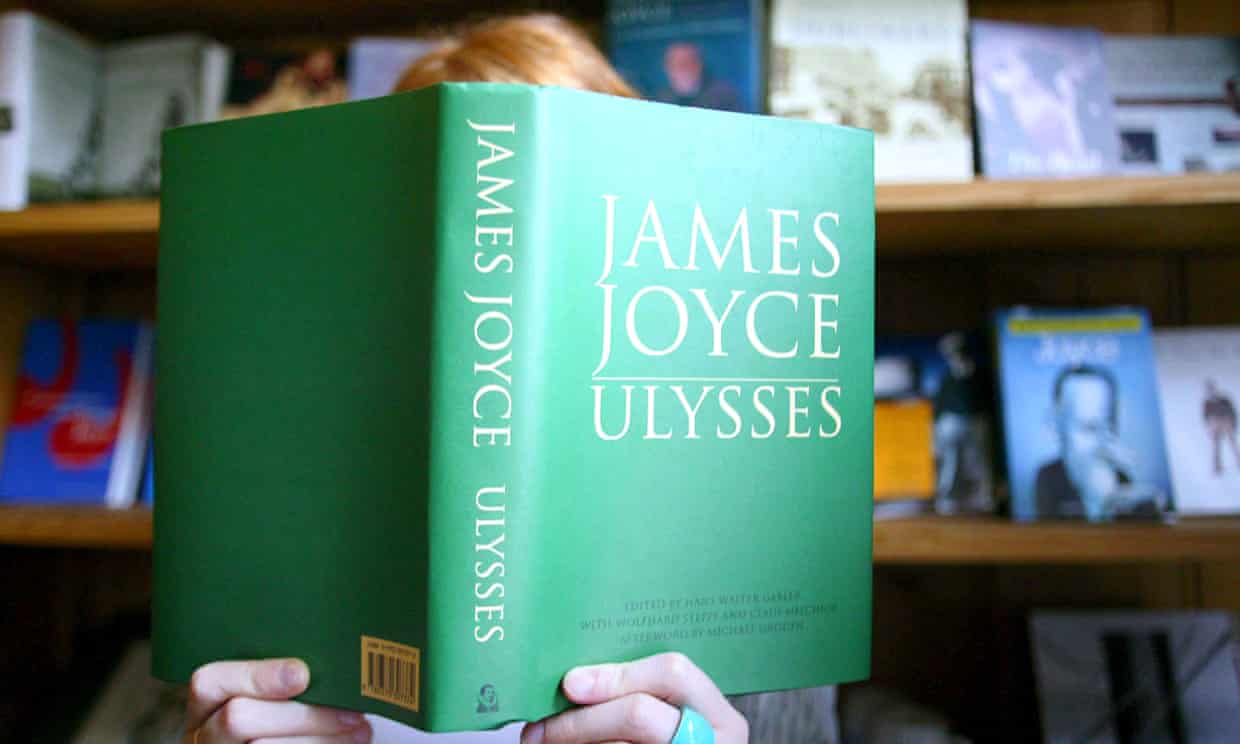
Authors have reported that they are also attempting classic novels for the first time, including Stephen King, who announced on Twitter he had “finally got around” to James Joyce’s notoriously challenging Ulysses. “I understand it better than I expected, but I have to say it’s really fucking Irish,” the horror novelist wrote.

by Alison Flood, The Guardian |  Read more:
Image: Sipa Press/Rex Features
[ed. Ack. I would definitely not read any of these, except for Donna Tartt's Goldfinch and Secret History, and Dave Wallace's Infinite Jest. No to Joyce, Proust, Eliot, Tolstoy (except for Anna Karenina - Pevear/Volokhonsky translation), Marquez, Morrison, Fitzgerald et al. Why put yourself through the pain (though Proust is lovely if you like old French society culture). If you're going to read a big book, find something that'll grab you. Like: Cryptonomicon or Snow Crash (Neal Stephenson), Mortals (Norman Rush), 1Q84 or Wind Up Bird Chronicles (Haruki Murakami), 11-22-63 (Stephen King); The Thousand Autumns of Jacob de Zoet (David Mitchell), The Amazing Adventures of Kavalier & Clay or Telegraph Avenue (Michael Chabon), The Living (Annie Dillard), Remains of the Day (Kazuo Ishiguro), The Three Body Problem - especially the second installment - The Dark Forest (Liu Cixin). Any of these would make the time pass so much more enjoyably, believe me.]