Tuesday, December 20, 2022
Argentina Celebrates
Neon Jellyfish
[ed. An ambience favorite (as noted in the post below). Shin Sawano's World (more here).]
Monday, December 19, 2022
Corner Club Cathedral Cocoon
Right before the holidays, I discovered an Instagram account called @jazz_kissa, run by a photographer and music fan named Katsumasa Kusunose. Patrons of jazz kissas (cafés) typically drink coffee or alcohol and keep their voices low, sometimes reading books or comics as they listen. There are around six hundred such cafés in Japan—a number Kusunose and a few other fans carefully tabulated a few years ago, and which he believes has not significantly changed. Kusunose has been photographing these places since 2014, and his pictures became a ballast for me. The average jazz café is small, about the size of our living room, though a few are big enough to accommodate perhaps fifty people. Their audio gear generally looks older, and, even though I knew nothing about it, I decided it all sounded exquisite. A speculative leap, but I needed it.
Dim, atmospheric lights are not uncommon in jazz cafés, though most don’t look like our LED string. Sometimes the aquamarine glow of a McIntosh amp’s front panel is the only accent. There’s generally lots of wood, rarely any chrome or aluminum. If there is ever a human figure in Kusunose’s photographs, it is a man, usually older, laying a phonograph needle on a record or standing behind a pour-over coffee setup. I imagined that the stereos produced an otherworldly sound, and it did not seem unreasonable to think that these small spaces and our East Village safe haven were linked. The proprietors had made decisions about what mattered and what could be done with the limited space. Their choices emphasized an experience that would be both communal and quiet. Silence and sound at the same time appealed to me. What little we could control was right in front of us. We definitely didn’t have any of this gear, though. Our modest stereo would have been no better than a midrange system back in the Nineties, when it was new.
A friend who knew of my obsession told me about another Instagram account, @_listening_room_. Someone was posting photo spreads from what seemed to be mostly Japanese audiophile magazines and translating the accompanying text. “Listening rooms” are essentially residential jazz cafés, though they are agnostic as to genre. You see enormous home stereo setups in these photos, gear from another era piled high in living rooms. The owner of the system is sometimes there, perched on a couch. I didn’t know then what it cost to outfit a listening room, but it was obviously not a budget undertaking. The combined practices of listening and reflecting in this kind of space made me think of the rooms as miniature cathedrals, places where anybody could enter and connect with a larger force through sound. (...)
When I started researching the individual components of these listening rooms, I encountered this language of bedroom expertise, of an axiomatic surety based on an invisible axiom. Certain speakers delivered sound that was “detailed” or “transparent,” whereas others did not. What was the detail being retrieved? Was it not being created in that moment by that machine? What was the referent for something being transparent? Transparent in comparison to what? (...)
Audiophiles often talk about what people will miss if they don’t have a specific kind of gear, as if recorded music were a fragile code requiring elaborate reconstruction. As much as I found myself opening up to the idea of building a good sound system over time, I still felt at odds with most audiophiles, or at least their representatives in the press. (...)
Unlike the tech bros burning through money both real and imagined, Weiss and the rest of the high-end audio cohort could at the very least drag their wares into the street and be of service, even though they are rarely thinking of the greater good. Gordon Gow of McIntosh Laboratory called this type of equipment “toys for insecure adults.” It’s not gear for the general population, and I would have left it alone if something hadn’t rearranged me. I had a feeling that the jazz kissa might be hovering around us.
The Imperia speakers made a sound that was wide and vivid and full of dirty weight, the breath of an organism. When the audio critic Herb Reichert hears this quality in good speakers, he calls it “believable corporeality,” which he says “has largely been missing from the experience of recordings since digital arrived.” OMA has a less expensive division called Fleetwood Sound, and Reichert calls its DeVille model, listed at around $15,600, “one of the best small speakers” he has ever heard.
There are real physical differences between this older technology and the audio devices you can find in a Best Buy. Cheap new stuff is likely powered by a clutch of transistors driving small diaphragms that move a lot. By comparison, the older horn designs are very good at throwing sound while barely moving, partly because the music is being amplified by something called a compression driver—a thin metal diaphragm agitated by a magnet. The supersensitive horn-loaded speakers are driven by low-wattage amplifiers outfitted with single-ended triode vacuum tubes, the oldest and simplest of their kind.
The idea here is not complex: a signal moves from the source—a phonograph or CD player, say—to an efficient speaker, and along the way it experiences the fewest possible augmentations, the least amount of stress. The word “excursion” refers to how much a diaphragm has to move in order to produce sound. Those small speakers you find in Best Buy? They experience excursions up to a quarter of an inch, a violent amount of back and forth. By contrast, the diaphragms of compression drivers found in horn speakers move only a few micrometers. The horn is the most ancient amplifier, a physical sound-thrower that can transport a large air mass. Small movements excite its narrow end and large movements come out its wide end.
“These big horn systems—they’re asleep,” Reichert tells me. “The system is barely operating. It’s adding energy in a relaxed and unstressed way.” The sound feels like a physical emancipation, the music suddenly rising up and walking toward you. It is not a coincidence that horn-loaded speakers are sometimes the size of people. Weiss’s loft is not a jazz café, but it is a kind of cathedral.
Noema: Italy; China; Maintenance; and Concrete
All these specialties are encouraged by local cooperatives, protected by local designations, elevated by local chefs and celebrated in local festivals, all lucrative outcomes for their local, often small-scale producers. It’s not so much a reflection of capitalismo as campanilismo — a uniquely Italian concept derived from the word for belltower. “It means, if you were born in the shade of the belltower, you were from that community,” explains Fabio Parasecoli, a professor of food studies at New York University and the author of “Gastronativism,” a new book exploring the intersection of food and politics. “That has translated into food.” (...)
All across Italy, as Parasecoli tells me, food is used to identify who is Italian and who is not. But dig a little deeper into the history of Italian cuisine and you will discover that many of today’s iconic delicacies have their origins elsewhere. The corn used for polenta, unfortunately for Pezzutti, is not Italian. Neither is the jujube. In fact, none of the foods mentioned above are. All of them are immigrants, in their own way — lifted from distant shores and brought to this tiny peninsula to be transformed into a cornerstone of an ever-changing Italian cuisine. (...)
The Romans were really the first Italian culinary borrowers. In addition to the jujube, they brought home cherries, apricots and peaches from the corners of their vast empire, Parasecoli tells me. But in the broad sweep of Italian history, it was Arabs, not Romans, who have left the more lasting mark on Italian cuisine.
During some 200 years of rule in Sicily and southern Italy, and the centuries of horticultural experimentation and trade that followed, Arabs greatly expanded the range of ingredients and flavors in the Italian diet. A dizzying array of modern staples can be credited to their influence, including almonds, spinach, artichokes, chickpeas, pistachios, rice and eggplants.
Arabs also brought with them durum wheat — since 1967, the only legal grain for the production of pasta in Italy. They introduced sugar cane and citrus fruit, laying the groundwork for dozens of local delicacies in the Italian south and inspiring the region’s iconic sweet-and-sour agrodolce flavors. Food writers Alberto Capatti and Massimo Montanari argue that Arabs’ effect on the Italian palate was as profound as it was in science or medicine — reintroducing lost recipes from antiquity, elevated by novel ingredients and techniques refined in the intervening centuries. In science, this kind of exchange sparked the Renaissance; in food, they argue, one of the world’s great cuisines.
There Is No Such Thing As Italian Food (John Last, Noema; Image: Roman Bratschi)
The narratives we choose shape the realities we experience. The “clash of civilizations” implies that the U.S. and China are culturally — or worse, racially — destined to fight each other, and everyone else must choose one side. If you buy this narrative, a new Cold War can be the only outcome. By contrast, the “clash of two Gilded Ages” reminds us that the U.S. and China are rivals who share similar woes at home. Their competition should not be over who trips and outruns the other, but rather who fixes their own problems first. Competition can be a force for self-renewal instead of mutual destruction.
The Clash Of Two Gilded Ages (Yuen Yuen Ang, Noema; Image: Xinmei Liu)
Concrete is now the second-most consumed substance on Earth behind only water. Thirty-three billion tons of it are used each year, making it by far the most abundant human-made material in history. To make all that, we now devour around 4 billion tons of cement each year — more than in the entire first half of the 20th century, and over a billion tons more than the food we eat annually.
Such a monstrous scale of production has monstrous consequences. Concrete has been like a nuclear bomb in man’s conquest of nature: redirecting great rivers (often away from the communities that had come to rely on them), reducing quarried mountains to mere hills, and contributing to biodiversity loss and mass flooding by effectively sealing large swathes of land in an impermeable grey crust. The other key ingredients all bring their own separate crises, from the destructive sand mining of riverbeds and beaches to the use of almost 2% of the world’s water.
But most significantly, the carbon-intensive nature of cement has been catastrophic for the atmosphere. The kilns used to heat limestone are commonly run on fossil fuels, which produces greenhouse gases, and as it heats up, the limestone itself releases more CO2. Every kilogram of cement created produces more than half a kilogram of CO2. The greenhouse gas emissions of the global aviation industry (2-3%) are dwarfed by those of the cement industry (around 8%). If concrete was a country, it would be the third largest CO2 emitter, behind only the U.S. and China. In Chile, the region that houses most of the cement plants, Quintero, has become so polluted that it was nicknamed “the sacrifice zone.”
Sacrifice is a fitting word for this paradox: On the one hand, we have the destruction wrought by concrete, and on the other is our desperate need for it to exist. It’s been estimated that to keep up with global population growth, we need to build the urban equivalent of another Paris each week, another New York each month.
Concrete Built The Modern World. Now It’s Destroying It. (Joe Zadeh, Noema; Image: Newnome Beauton)
Sunday, December 18, 2022
Christina Aguilera, Lil' Kim, Mya, Pink
[ed. Love this song, and performances.]
‘Unexpected Item’
When the first self-checkout kiosks were rolled out in American stores more than three decades ago, they were presented as technology that could help stores cut costs, save customers time, and even prevent theft.
Businesses still fret over these issues, and against a tight labor market, more companies are making self-checkouts the norm. But the machines failed to live up to their promises. This week, Walmart’s CEO said that thefts “are higher than what they’ve historically been”, which many staff and customers link to self-checkouts. On top of that, the machines have made things harder for the workers who they were supposed to replace. (...)
In 2018, just 18% of all grocery store transactions went through a self-checkout, rising to 30% last year. Walmart, Kroger, Dollar General, and Albertson’s are now among retail chains testing out full self-checkout stores.
Neither have they reduced the need for workers: despite the increase in self-checkouts, Bureau of Labor Statistics data shows the number of cashiers employed in the US has remained virtually the same over the last 10 years. And any reduction in low-wage workers has been offset by the need to pay technicians to maintain the kiosks, Andrews says – and the kiosks can cost as much as $150,000 for a single row.
So if self-checkouts are so ineffective, why do we have them at all?
The self-service policies of modern supermarkets have largely been “imposed by the companies, not because of customers asking for it”, says Andrews. Before the 20th century, shoppers typically purchased goods directly from clerks standing behind counters. That changed in 1916, when Clarence Saunders opened the first modern supermarket: a Piggly Wiggly in Texas where customers were asked to take items off of the shelves themselves – and received a discount for doing so.
Andrews says his research has found that the majority of people don’t actually want self-checkouts. The real reason stores use them, he says, is because their competitors do. “It’s not working great for anybody, but everybody feels like they have to have it. The companies think: ‘If we can just convince more people to do this, maybe we can start to reduce some overhead.’”
Meanwhile, self-checkouts have become a prime target for fraudsters, who use a variety of tactics to beat anti-theft measures. Weight sensors can be defeated by ringing up expensive items – like king crab legs – as cheap items like apples. James, the cashier in Washington, says he saw a customer trying to buy a $1,600 grill for $5 by hiding one item inside another and switching the barcodes.
That has led to an arms race of sorts as some retailers have responded with increasingly strong measures. Walmart is known for aggressively prosecuting shoplifters and has installed AI-powered cameras near its self-checkout areas with a “missed scan detection” feature. “It turns what’s supposed to be a leisurely activity of shopping into a quasi-TSA, airport-style security check,” says Andrews.
by Wilfred Chan, The Guardian | Read more:
Image:Mike Blake/Reuters
This Was the Perfect World Cup for Our Strange Era
It is now 16 years since a World Cup final was played in Europe, as some of the rising powers of the Global South — South Africa, Brazil and now Qatar — have taken their turn. South Africa 2010 carried Pan-African aspirations that for a moment seemed to become reality, with Ghana poised to make a semifinal. Brazil 2014 was a celebration of Luiz Inácio Lula da Silva’s Brazil, and by association the leftist governments that had transformed the continent, though it ended up as more of a wake.
Qatar 2022, by contrast, was always about Qatar — its visibility, its reputation and its strategic survival. Despite criticisms of the country’s treatment of migrant workers and disregard for L.G.B.T.Q. rights, it has achieved much of what was intended. After four weeks of near-constant football, and the sometimes bitter off-field conversations that accompanied it, Qatar’s position in the world is palpably stronger.
Yet as the first World Cup in an Arabic-speaking, Muslim-majority nation, it also aspired to stand for something more. In its timing, its crowds and its narratives, the tournament offered a version of the world in which the Global South, in all its myriad complexities, is more present and more powerful. This, truly, was a World Cup for our era.
The Southern Hemisphere is used to a winter World Cup, but in the North, especially in Europe, watching the tournament is a monthlong summer fiesta of outdoor revelry in public spaces and beer gardens. Even FIFA, though, couldn’t face the prospect of playing in the heat of a Gulf summer, air-conditioned stadiums or not, and rearranged the entire world football calendar around Qatar’s climate. The upshot is that Europe right now is cold and indoors; although viewing figures are good, there is much less sense of the World Cup as a collective ritual. The considerably warmer streets and squares of Dakar, Rabat, Rosario and Riyadh, by contrast, have been flooded by celebrations.
The crowds in Doha, inside and outside the stadiums, reflect this global recalibration. Of course, what we see of them on the screen has been carefully curated. Qatar recruited its own “ultras” — highly organized soccer fans who can be found across the globe — from Lebanon and from among Arab migrants to Doha, and paid for groups of fans to travel from every qualifying nation. But we have still seen enough to know that these are the most diverse World Cup crowds on record — and despite the earsplitting volume of the stadiums’ public-address systems and the relentless music they emit, it is still the crowd, its voices and energies, that is the living heart of the spectacle. (...)
If France wins, we’ll be heralding the first back-to-back winners in 60 years; if Argentina prevails, it will be Lionel Messi’s ascent to divinity that concerns us. Either way, this has been the most closely scrutinized and culturally contested World Cup ever, and that is a good thing. The personal, cultural and political presence of the Global South has been made tangible and that, too, is important. Perhaps the tournament’s biggest legacy will be a global media and public more critically sensitized to the political and cultural meaning of spectacle?
by David Goldblatt, NY Times | Read more:
Image: Martin Meissner/Associated Press via
Yet the telling difference may be found in the least dramatic, least kinetic activity on the field. Sunday’s result might well turn, as so many games have before, on the meandering movements of Lionel Messi, who will spend much of the ninety minutes simply walking around—drifting here and there, wandering the field at the pace, and with the apparent dreamy purposelessness, of a flâneur on a psychogeographic dérive.
Messi is soccer’s great ambler. To keep your eyes fixed on him throughout a match is both spellbinding and deadly dull. It is also a lesson in the art and science of watching a soccer match."
UPDATE: Argentina wins it in what some are calling the greatest World Cup Final of all time.
Friday, December 16, 2022
The Next Time Wikipedia Asks for a Donation, Ignore It
These banner ads have become very lucrative for the NGO that collects the money — the Wikimedia Foundation, a non-profit based in San Francisco. Every year the NGO responsible for the fundraising adds tens of millions of dollars to its war chest. After a decade of professional fund-raising, it has now amassed $400 million of cash as of March. It created an endowment, managed by the Tides Foundation, which now holds well over $100 million of that. The Foundation wanted to hit that figure in ten years, but found it had sailed past it in just five. In 2021, the appeals raised a total of $162 million, a 50% year-on-year increase. Yet the running costs of Wikipedia are a tiny fraction of the amount raised each year.
Indeed, in the 2012/13 year the Foundation budgeted for $1.9m to provide all its free information on tap.
“WMF has operated in the past without staffing and with very minimal staffing, so clearly it’s _possible_ to host a high traffic website on an absolute shoestring,” acknowledged the Foundation’s then VP of engineering, Erik Möller, in 2013. He put the running costs at $10 million a year. Being generous, as some costs fall every year, let’s double that. Wikipedia can operate quite comfortably with the cash it has already, without running another banner ad, for twenty years. So where does the money go?
Not on the people doing the actual work on the site, of course. Wikipedia’s Administrators and maintainers, who tweak the entries and correct the perpetual vandalism, don’t get paid a penny — they’re all volunteers. What has happened is that the formerly ramshackle Foundation, which not so long ago consisted of fewer than a dozen staff run out of a back room, has professionalised itself. It has followed the now well-trodden NGO path to respectability and riches. The Foundation lists 550 employees. Top tier managers earn between $300,000 and $400,000 a year, and dozens are employed exclusively on fund-raising.
by Andrew Orlawski, Unherd | Read more:
Thursday, December 15, 2022
Ambience
Images: YouTube
[ed. Winter driving you crazy? I've been cycling through ambience videos lately on YouTube (some up to 12 hours long, or longer). I knew about coffee shops, fireplaces, beaches, streams, forests (snowy, lush, otherwise), etc. but really, there's an unbelievable selection of just about anything you can imagine (thousands): acquariums, oceans (above and below), starship screens/spaceship windows, planets, various unfathonable machines, even (above) a Blade Runner loop (there may be more). And this doesn't include travel videos. A great distraction and calming sleep aid if you need it. My current favorite: jellyfish in space.]
How to Negotiate Lower Medical Bills
Ask for an itemized bill, so that you can review it and make sure the charges are correct, suggested McClanahan, a member of the CNBC Financial Advisor Council.
There can be errors, such as incorrect patient, provider or insurance information, as well as incorrect codes for the procedures and duplicate billing.
For instance, Medliminal, a company that identifies medical billing errors, generally finds that 25% of the charges on the bills it has reviewed are not billable.
Look for other sources of payment
You may have overlooked ways to cover your bills.
“I often had people eligible for Medicaid or subsidized insurance that they were able to get,” said Jenifer Bosco, staff attorney at the National Consumer Law Center.
“In some states, when you qualify for Medicaid, there is retroactive eligibility.”
If you have no insurance, check with your providers to see if they offer a discount to uninsured patients.
There are also federal requirements for nonprofit hospitals to provide financial assistance programs for low-income patients. The aid varies depending on the state and the institution.
However, 45% of nonprofit hospital organizations routinely send out bills to patients who have income low enough to qualify for charity care, according to an analysis by Kaiser Health News, an editorially independent program of the Kaiser Family Foundation
Ask to lower the bill
Once you have explored all the options for payment, it’s time to see if you can get your bill lowered.
“Consumers may not realize that you can contact the health-care provider or the hospital and ask to negotiate,” Bosco said.
Reach out, be nice, and tell the provider that you can’t afford to pay the bill. Then, ask for a reduction.
Uninsured patients are usually charged the master rate, or the maximum that the hospital would charge for a particular procedure, Bosco noted.
She suggests asking to pay the Medicare rate, which health-care providers are generally very familiar with.
You can also check out the estimated costs of the procedure in your area on Healthcare Bluebook.
Remember, it’s not the doctor you’ll be dealing with but the billing department.
“The billing people have gotten so used to negotiating that they expect it,” McClanahan said.
Don’t expect to be successful at first, she noted.
Harness was able to get his bill down after filing a grievance with the hospital. In November, he was given a 30% discount for both surgeries, bringing the cost down to $56,152.40, he said.
He and Novick-Smith continued to follow up with the hospital to try to lower the bill. They argued he shouldn’t have to pay for the second surgery since it was most likely a complication from the clipping and stapling of the appendix tissue during the first surgery.
In May, the hospital reduced the bill to $25,143.20. Harness responded by offering $12,000, based on what Healthcare Bluebook noted was a fair price for an appendectomy The couple then got their bill knocked down to $22,304.17.
After Harness and Novick-Smith brought their story to Kaiser Health News, the hospital came back with their final offer: $19,335.
Request a payment plan
Once you have your final, negotiated bill you can still request to go on a payment plan.
Be very careful and make sure that the monthly payments are ones you can afford, Bosco advised.
“Try to come up with a realistic payment plan,” she said.
Harness is now on a plan to pay off his final bill. It is still a big chunk of his monthly income, but fortunately some friends set up a GoFundMe account to help him out.
“It felt really great that people cared to give a portion of what little they had to help me out in this situation,” he said.
Harness now has insurance through the U.S. Department of Veterans Affairs. He said he has also been approved for VA disability benefits for his hearing loss and has applied for benefits for spinal and knee issues due to his time in service.
[ed. We'll all have this experience at some point (maybe mulitple times). What a
Wednesday, December 14, 2022
Imagine a Different History for Alaska
Tuesday, December 13, 2022
Les Paul & Steve Miller (and Mary Ford)
[ed. Most people know Les Paul simply as the inventor of a pretty good electric guitar. But he was also an amazing player in his days along with his fabulous partner Mary Ford. See here and here. Steve Miller also had some success with his band.]
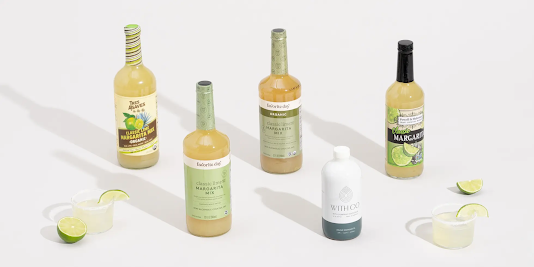
The Best Margarita Mixes, Ranked
Backyard parties, Taco Tuesdays, Friday night drinks—few cocktails fit a celebratory occasion as well as the margarita. You don’t need a store-bought mix to make a good margarita at home, but if you’re having a big gathering and preparing your own is too time consuming, or you like the convenience or sweeter taste of a premade mix, it’s a quick and easy option.
We tested 12 margarita mixes to find our favorites, focusing on options with widespread availability throughout the country. A store-bought mix will never taste as natural or fresh as a margarita you can make from scratch, and many of the mixes we tried exuded artificial flavors ranging from lime candy to lemon Pledge. But a few tasted natural enough to pass as real margaritas, and our top recommendations also provide the best value of price to serving. (...)
How to make a margarita from scratch
A good tequila, a bottle of triple sec, and a couple of ripe limes are all you need to make a classic margarita that tastes more natural than any store-bought mix ever will. Some people may prefer the sweeter taste and thicker texture of a premade margarita mix, but all of them lack the zest of a fresh-squeezed lime. If you’re making a margarita for your own enjoyment, the process is simple enough for home bartenders of all experience levels. If you have the time to batch margaritas before a big party, you and your guests will likely be happier with the results.
There are two prevalent margaritas recipes: the classic margarita and the Tommy’s margarita. Both are prepared the same way (shaken with ice, strained, and served on the rocks with or without a salt rim), but the classic version uses triple sec while the Tommy’s recipe calls for agave nectar instead. It’s completely up to you which recipe you use; some people think the Tommy’s has a cleaner taste that spotlights the tequila, and others like how the triple sec rounds out the cocktail. You can use any triple sec or curaçao you like in a margarita, but we recommend Cointreau because it has an aromatic orange-peel flavor and a dry finish, and it’s a higher quality than some cheaper triple secs you can find. Additionally, it’s most common to see blanco tequila used in a margarita, but you can use any reposado or añejo you’re partial to.
For a classic margarita, we like the version from renowned cocktail bar Death & Co, which uses both triple sec and agave nectar. If you don’t have agave on hand, it’s okay to omit it for a slightly tarter margarita (which is the recipe that we used in our testing):
- 2 ounces tequila
- ¾ ounce triple sec, preferably Cointreau
- 1 ounce fresh lime juice
- ¼ ounce agave nectar
- 2 ounces tequila
- 1 ounce fresh lime juice
- ½ ounce agave nectar
Monday, December 12, 2022
Vladimir Pozner: How the United States Created Vladimir Putin
Is That All There Is? How Neuroscience Confirms the Most Ancient Myths About Music
People often talk to me about music, so I’m not surprised when friends ask me about specific songs. But I found it uncanny—and actually unsettling—when two elderly individuals very close to me, both in poor health and near death, mentioned the same obscure song.
These two individuals never met each other, and lived thousands of miles apart, but in their final days they both wanted to talk about the same record from more than fifty years ago. They told me that the lyrics of this pop tune captured their melancholy reflections on what had gone wrong in their lives.
The song in question, “Is That All There Is?,” had been a modest hit for vocalist Peggy Lee in 1969, but never quite reached the top ten. I’m hardly surprised by that. It was the era of Woodstock and psychedelic rock, and a gloomy song of this sort had nothing in common with the upbeat youth movement that was defining the musical culture of the day.
The track is mostly a semi-spoken monologue, interrupted by sung interludes on the meaninglessness of life—capped by a complaint that “I’m not ready for that final disappointment.” I consider it the mirror image of Frank Sinatra’s “My Way,” a more successful hit of the same era, which celebrates a triumphant life full of victories and self-actualization.
If you never got the chance to do things your way, this is your song.