Friday, December 6, 2024

Murder and Social Murder

The Case of UnitedHealth CEO Brian Thompson

Rolling Stone weighed in on what those who check into Twitter or TikTok have probably already noticed: Social Media Has Little Sympathy for Murdered Health Insurance Exec. At this point, there is comparatively little new news about the killing of UnitedHealth’s Brian Thompson in Manhattan even though it’s over a full day since the event. Police are under great pressure to solve a high profile murder quickly. The perp apparently was in the vicinity before the shooting, it’s not yet clear how long, although some opine not very long. He shot Thompson twice, once in the calf and once in the torso. Gun mavens (we have a tweetstorm below) explain how the weapons choice and gun handling caught on film reveal him not to be a pro.

In case you have not heard, UnitedHealth was a standout denier of insurance claims, which is a fraud that these companies get away with on a pervasive basis. Our tale of tweets below shows not just barely coded views that Thompson’s death was karma, that the claim denials from which he profited resulted not just in dozens but likely hundreds, even thousands of preventable deaths, even though vigilante justice is not a socially desirable way to achieve redress.

Frankly, I am surprised something like this has not happened sooner. It’s not hard to think of cases of the C-suite killing people for fun and profit. Ford Pintos. Opioid makers with addiction creating sales strategies, with Purdue Pharma the lead but far from only actor. Vioxx, where Merck gamed the clinical trial data to hide extra heart attack deaths, which were so frequent that when the drug was taken off the market, that US mortality rate declined. Monsanto (now Bayer), where the company would have its staff apply the Roundup weedkiller only in heavy-duty protective gear, but never issued similarly stern warnings to customers.

A close ally during the foreclosure crisis described some of his cases from his days as a class action and even individual tort lawyer on mesothelioma cases. The end state of the cancer is horrific, with the patients often having their ribs break as the cancer both fills up their chest cavity and greatly constricts their breathing capacity. In one, which I gather was not atypical, the defense attorneys kept deposing him, 10 hours a day, days on end, in his deathbed in the hospital. They were not just trying to catch him in an inconsistency. They were trying to kill him faster via the stress and reduction of sleep so he would not be able to testify in court.

He lived long enough to do so. The spectacle of him being wheeled in, with an oxygen tube and dressed to show his distended upper torso was so appalling to jury that it was not hard to establish that he had been desperately harmed, merely firming up how the defendant was responsible.

My contact had to stop doing these cases. It was too psychologically draining even though he would win big awards.

And then the defense bar got good at finding ways to escape meaningful punishment. For instance, Alabama had once been a good venue for this sort of case (forgive me for sparing you why). But the state Supreme Court is elected. Those races soon attracted more in campaign donations than any judicial contest in the US. At one point, the chief justice race got $13 million in donations, far more than the governor’s race.

The result was any large damage award in Alabama would be cut back on appeals to $1 million, as in couch lint for a big company.

by Yves Smith, Naked Capitalism |  Read more:
Image: Stefan Jeremiah/Associated Press

“Thoughts and deductibles to the family,” read one comment underneath a video of the shooting posted online by CNN. “Unfortunately my condolences are out-of-network.”


"The business run by Thompson brought in $281 billion in revenue last year, making it the largest subsidiary of the Minnetonka, Minnesota-based UnitedHealth Group. His $10.2 million annual pay package, including salary, bonus and stock options awards, made him one of the company’s highest-paid executives."

Thursday, December 5, 2024

Tom Gauld: My Jetpack

Tom Gauld
via: My JetPack

Moana 2

If you want a quick explanation of why Moana 2 is on target to gross more than a billion dollars worldwide (it’s already made $400m in less than a week), you need only to look back to 2023, when the original Moana – a seven-year-old movie at the time – topped the list of the most-streamed movies in the United States.

The only other pre-2020 movie in the top 10 was Disney stablemate Frozen, which made way more in theaters than the first Moana did. Moana also ranked fourth among all movies in 2022, second in both 2021 and 2020, and, well, that takes us to the beginning of its home service, Disney+, roughly five years ago. By these rough but seemingly undeniable metrics, it seems reasonable to claim that Moana, a movie that in 2016 was outgrossed by both its fellow Disney release Zootopia and its holiday-season rival Sing, is the most-watched family film of the 2020s. If Elsa from Frozen was hoping to hang on to that particular title, she may have to let it go.

Of course, Frozen still has a hypnotic hold on the younger demos; look at any Halloween of the past decade, and you’ll see plenty of little Elsas (and a few Annas) roaming the streets. Beyond Frozen’s particular innovation of including not one but two singing princesses, one with bona fide superpowers, Disney animated movies have always flexed remarkable staying power, especially when they sing catchy songs.

Moana has a princess (of sorts, even if she claims that she’s just the “daughter of the chief”), a great song score (featuring contributions from Lin-Manuel Miranda of Hamilton fame), and a sweet, relatable story about that chief’s daughter (Auliʻi Cravalho) yearning for adventure, then finding it when she takes it upon herself to seek out demigod Maui (Dwayne Johnson) to help save her native island. Still, even The Rock playing what’s arguably his best and most fitting big-screen role doesn’t fully explain why Moana has been able to consistently out-stream the blockbuster likes of Frozen, or newer and also-beloved titles such as Encanto. 

Like nearly every parent who’s had a child since 2010 or so, I have some experience in this area. My daughter was just one year old when Moana was released in the fall of 2016, so she was barely ready to watch a movie for more than 20 minutes or so at home, let alone go out and see one in theaters. But I went to the press screening to file a review, and though I’d enjoyed plenty of other Disney cartoons, I was struck by my emotional response to this one.
               

***
Parents of young children should let loose a hearty “chee hoo” upon the Thanksgiving-timed release of “Moana 2.” That’s the long weekend’s entertainment sorted, with a sequel that comes close to the soaring storytelling and exhilarating anthems of the first film, which delighted young audiences eight years ago, resulting in countless Halloween costumes and babies belting about how far they’ll go.

That first film, which celebrates the strength and power of young girls — as well as Polynesian culture with reverence and specificity — was a balm in the uncertain November of 2016. It was a massive box office hit and was nominated for two Academy Awards — for animated film and for original song for a tune by Lin-Manuel Miranda.

“Moana” felt revolutionary within the Disney canon because our spunky protagonist is decidedly not a princess (she’ll be the first to tell you that). She felt radical, especially for older generations that grew up on passive heroes whose lives were dictated by weddings or resistance to them. That Moana was a girl of action, an explorer — strong, capable, brave, family-oriented and empathetic — made her a remarkable role model, and the character has lost none of her moxie in the sequel.

Although the impressive voice cast of Pacific Islanders, including original Moana voicer Auliʻi Cravalho and Dwayne Johnson, has returned (with a few additions), a new creative team has been assembled for the sequel, which was originally developed as a series and then reworked into a feature-length film. The good news is that the seams don’t show on the finished movie, which is as visually dazzling and culturally rich as the first and an apt continuation of Moana’s story. She is now a revered “wayfinder” in her community on a tiny Pacific island.

Moana has a desire to explore even farther into the ocean, to go beyond where she’s ever gone before — specifically to connect with other people. During a ritual ceremony, she receives a vision of an island, Motufetu, that once connected all the people of the ocean but that has since been cursed by a god named Nalo. Moana puts together a crew that includes her friend and historian Moni (Hualalai Chung), boatmaker Loto (Rose Matafeo) and farmer Kele (David Fane), in order to find Motofetu.

Along the way, they’ll have to scoop up the demigod Maui (Johnson), who has been waylaid inside a giant clam by Nalo, with only the company of a mysterious and nefarious bat-woman, Matangi (Awhimai Fraser). The entire team will have to collaborate — even with the feisty bunch of coconut warriors known as the Kakamora — in order to break Nalo’s curse, achieve their goal and assemble the community of Moana’s dream.

Image: Moana/Disney/YouTube
[ed. My granddaughter loves Moana, and I do too. The animation is terrific (of course), and the dialog infused with lots of sly cross-generational humor. Plus, I grew up in Hawaii ("chee hoo"!) But, like everything, not everybody gets it. See also: Moana 2 Wiki here.]

De Minimis and Trade Policy

Teddy bear factory in Lianyungang, in eastern China’s Jiangsu province, on Nov. 22, 2024. 

If you’re tempted to buy kids’ toys at rock-bottom prices online this holiday season, consumer advocates want you to think twice — and maybe three times. That $8 gift might not meet U.S. safety standards that are meant to protect kids.

“A lot of folks think that just because something is for sale, it must be safe,” Teresa Murray of the Public Interest Research Group consumer watchdog tells NPR. “And that is incredibly wrong.” (...)

How are cut-rate items reaching U.S. homes?

“When you buy a toy or any other product online and it’s shipped directly to you from another country, it generally doesn’t get inspected before it gets to your mailbox,” Murray writes in PIRG’s Trouble in Toyland report for 2024.

Items are more likely to avoid scrutiny, Murray says, if they’re sent under what critics say is a loophole in U.S. law. It’s the same one that online retailers have used to send cheap clothes to the U.S. — and that smugglers use to ship fentanyl and counterfeit drugs to the U.S. For toy sellers, the strategy helps foreign businesses undercut U.S. retailers and dodge safety requirements.

The law is called de minimis. While that name implies something small, it’s a big deal. Since 2014, the number of shipments entering the United States under the de minimis exemption each year rose from 140 million to 1 billion in 2023, according to the White House. They now account for most of the cargo entering the U.S., according to U.S. Customs and Border Protection, and the flood is only increasing. The agency is processing some 4 million de minimis shipments every day. (...) [ed. emphasis added]

What is de minimis?

The de minimis exception started as a way to let travelers and businesses avoid tax and import duty requirements when shipping items of little value.

About 100 countries have de minimis thresholds; the amounts differ around the world. In the European Union, shipments worth less than 150 euros (about $160) can qualify. The U.S. level used to be $200, but in 2016 it rose to $800 — among the highest in the world — when then-President Barack Obama signed the Trade Facilitation and Trade Enforcement Act.

Companies that focus on the de minimis exclusion use it as a duty-free pipeline to the U.S. — and they can pay less taxes than an American company selling a similar product.

The rule is part of the success of retailers like China’s Temu, which bases its business model on streamlining the connection between manufacturers and consumers.

Use — and abuse — of de minimis is growing

Unscrupulous exporters aggressively exploit de minimis. They wildly undervalue items, for instance, or list many items as a single shipment worth less than $800.

In one egregious case from last year, a disassembled helicopter was shipped from Venezuela to the seaport in Fort Lauderdale, Fla., under de minimis rules, described as “personal effects,” according to a recent Customs and Border Protection report.

Faced with screening a torrent of incoming packages and cargo labeled as de minimis, the CPSC says it works with the CBP to assess shipments’ potential risks, flagging those most likely not to meet U.S. requirements.

Bipartisan efforts push for change

Backers of de minimis say it keeps trade moving fluidly, at low costs to businesses and consumers. That includes John Pickel, senior director for international supply chain policy at the National Foreign Trade Council, who notes that de minimis shipments are subject to the same federal screening and enforcement requirements as higher-value shipments.

Pickel warns that putting new limits on de minimis would bring billions of dollars in harm, citing a recent working paper by researchers at Yale and UCLA that predicted doing away with de minimis would hurt low-income communities. But critics of de minimis say it harms those same communities by making it easier for unreliable and potentially dangerous products to reach them.

“De minimis is a loophole for cheap — and sometimes dangerous — Chinese goods,” says Sen. Bill Cassidy, R-La., in a statement to NPR. “Congress needs to protect U.S. consumers from harmful Chinese trade practices, for which de minimis is the most egregious of them all, and level the playing field for small businesses.”

by Bill Chappell, AK Pub Media/NPR |  Read more:
Image: Teddy bear factory; STR/AFP via Getty Images/AFP
[ed. See also: New Actions to Protect American Consumers, Workers, and Businesses by Cracking Down on De Minimis Shipments with Unsafe, Unfairly Traded Products (White House)

Wednesday, December 4, 2024

Why South Korea’s Leader, Desperate and Frustrated, Made a Fateful Decision

For Yoon Suk Yeol, the unpopular president of South Korea, things appeared to worsen with each passing day. Thousands of doctors had been on strike for almost a year to resist his health care reforms. The opposition in Parliament repeatedly pushed for investigations into his wife, as well as the impeachment of his cabinet members, accusing them of corruption and abuse of power. And the lawmakers blocked many of Mr. Yoon’s bills and political appointments.

On Tuesday night, Mr. Yoon took a desperate measure, his boldest political gamble, which he said was driven by frustration and crisis. In a surprise, nationally televised address, he declared martial law, the first such decree in the country in decades. The move banned all political activities, civil gatherings and “fake news” in what he called an attempt to save his country from “pro-North Korean” and “anti-state forces.”

But it ended almost as abruptly as it had started.

Thousands of citizens took to the streets, chanting “Impeach Yoon Suk Yeol!” Opposition lawmakers climbed the walls into the National Assembly as citizens pushed​ back police. Parliamentary aides used furniture and fire extinguishers to prevent armed paratroopers from entering the Assembly’s main hall. Inside, lawmakers who included members of Mr. Yoon’s own People Power Party voted unanimously to strike down his martial law. Six hours after declaring it, Mr. Yoon appeared on television again, this time to retract his decision.

It was the shortest-lived and most bizarre martial law in ​the history of South Korea, which had had its share of military coups and periods of martial law before it became a vibrant democracy after the military dictatorship that ended in the late 1980s.

In the end, driven by his own impulsiveness and surrounded by a small group of insiders, who seldom said no to a leader known for angry outbursts, Mr. Yoon shot his own foot,​ according to a former aide and political analysts.​ Now his political future ​is on the chopping block​, thrusting one of the United States’ most important allies in Asia into political upheaval and leaving many South Koreans in a state of shock.

On Wednesday, the opposition parties, which control the legislature, submitted an impeachment bill after Mr. Yoon did not respond to their demand that he resign because his martial law declaration had been unconstitutional. An editorial in the leading conservative daily Chosun Ilbo, which has often been friendly toward Mr. Yoon, now accused him of “insulting” South Korean democracy. South Koreans have not seen their leader declare martial law since the military dictator Chun Doo-hwan used it to seize power in 1979​ and later massacre pro-democracy students.

“The best option Yoon has now is to resign,” said Sung Deuk Hahm, a professor of political science at Kyonggi University, west of Seoul. “As tragic as it may seem, what happened overnight showed the resilience and durability of South Korean democracy.”

Mr. Yoon did not immediately respond to the opposition’s demand. On Wednesday, all senior aides to Mr. Yoon tendered their resignations to Mr. Yoon, leaving him more isolated than ever. Analysts were skeptical about ​Mr. Yoon’s political future. (...)

Mr. Yoon was surrounded by a handful of aides, including former military generals, who were not used to second-guessing their boss’s decision, said a former presidential aide to Mr. Yoon who agreed to discuss the president’s leadership style on the condition they not be identified. That small circle raised questions about how thoroughly Mr. Yoon prepared for martial law.

The former presidential aide said that as soon as he heard the declaration of martial law, he called contacts in Mr. Yoon’s office and other branches of the government. But none of them had advance knowledge of what was coming, he said. (...)

Before he was catapulted into the presidential race in 2022, Mr. Yoon was a political neophyte. He was a star prosecutor who wielded the law to help imprison two former presidents, and was used to a strictly top-down culture.

He won the election by a razor-thin margin, thanks largely to the public’s discontent with his predecessor, Moon Jae-in. But, from the start, he laid out big ambitions, seemingly staking his claim for a legacy as a change maker in a gridlocked political system. (...)

But little of his domestic agenda has worked out. His opponents won even greater control in the National Assembly in parliamentary elections this year. His government was accused of using prosecutors and criminal investigations to intimidate opposition leaders and crack down on news media he accused of spreading “fake news​.” ​His approval rating plummeted to around 20 percent, as he repeatedly vetoed the opposition’s demands for independent investigations into allegations against his wife, Kim Keon Hee. The opposition also imposed large changes on his budget proposals for next year.

Mr. Yoon was often called a “tribal leader” by political analysts for his penchant for appointing loyal friends among former prosecutors and fellow high school alumni to key military and government posts.​ 

by Choe Sang-Hun, NY Times |  Read more:
Image: Chang W. Lee/The New York Times
[ed. Hmm. Sounds familiar. Did the CIA secretly give him the green light to game out future US scenarios? Possible; I need to consult my Conspiracy Theories For Dummies encyclopedia set. See also: What South Korea’s short-lived martial law says about nation’s democracy and the autocratic tendencies of President Yoon (The Conversation).]

Sushi With Worms - No Extra Charge

Doesn't look too appealing to me. Are these... warm?

Images: FOB sushi bar

Learning Slide Guitar: Little Red Rooster

[ed. Pretty good introduction to slide guitar (singing not so much, haha). See also: various tips and embellishments like the "howling dog" technique at 14:35. Pretty cool. Open G tuning is used extensively throughout rock with Keith Richards being perhaps it's most notable practitioner. But it's fundamental to Hawaiian music too (ie. Taro Patch tuning]. See this excellent overview of Ki Ho'alu/slack key styles by Jeff Peterson.]

Rarest of Rare

Wellington, New Zealand — It is the world’s rarest whale, with only seven of its kind ever spotted. Almost nothing is known about the enigmatic species. But on Monday a small group of scientists and cultural experts in New Zealand clustered around a near-perfectly preserved spade-toothed whale hoping to decode decades of mystery.

“I can’t tell you how extraordinary it is,” said a joyful Anton van Helden, senior marine science adviser for New Zealand’s conservation agency, who gave the spade-toothed whale its name to distinguish it from other beaked species. “For me personally, it’s unbelievable.”

Van Helden has studied beaked whales for 35 years, but Monday was the first time he has participated in a dissection of the spade-toothed variety. In fact, the careful study of the creature -- which washed up dead on a New Zealand beach in July — is the first ever to take place.

None has ever been seen alive at sea.

The list of what scientists don’t know about spade-toothed whales is longer than what they do know. They don’t know where in the ocean the whales live, why they’ve never been spotted in the wild, or what their brains look like. All beaked whales have different stomach systems and researchers don’t know how the spade-toothed kind processes its food. They don’t know how this one died.

Over the next week, researchers studying the 5-meter (16-foot) -long male at an agricultural research center near the city of Dunedin hope to find out.

“There may be parasites completely new to science that just live in this whale,” said van Helden, who thrilled at the chance of learning how the species produces sound and what it eats. “Who knows what we’ll discover?”

Only six other spade-toothed whales have ever been found, but all those discovered intact were buried before DNA testing could verify their identification.

New Zealand is a whale-stranding hotspot, with more than 5,000 episodes recorded since 1840, according to the Department of Conservation. The first spade-toothed whale bones were found in 1872 on New Zealand’s Pitt Island. Another discovery was made at an offshore island in the 1950s, and the bones of a third were found on Chile’s Robinson Crusoe Island in 1986.

DNA sequencing in 2002 proved that all three specimens were of the same species — and that it was distinct from other beaked whales. But researchers studying the mammal couldn’t confirm whether the species was extinct until 2010, when two whole spade-toothed whales, both dead, washed up on a New Zealand beach. But none has been studied before.

On Monday, the seventh of its kind, surrounded by white-aproned scientists who were measuring and photographing, appeared relatively unblemished, giving no clue about its death. Researchers pointed out marks from cookiecutter sharks — normal, they said, and not the cause. (...)

It’s thought that spade-toothed whales live in the vast Southern Pacific Ocean, home to some of the world’s deepest ocean trenches. Beaked whales are the ocean’s deepest divers for food, and the spade-toothed may rarely surface, adding to its mystery.

by Charlotte Graham-McLay, AP | Read more:
Image: AP Photo/Derek Morrison

Tuesday, December 3, 2024

Subscription Traps and Click-to-Cancel

The Looming GOP Battle Over Whether You Have to Go to Hell and Back to Cancel Amazon Prime

For years, customers trying to cancel their Amazon Prime subscriptions have complained about having to navigate a maze of confusing screens so they can ditch their monthly subscription fee. At Planet Fitness, one of the biggest gym chains in the country, people who want to quit pumping iron complain about the same thing.

From ditching a premium account to canceling your gym membership, critics of the business practices that make it hard to leave call them “subscription traps.” Customers hate them — so much so that they file 70 complaints a day at the Federal Trade Commission.

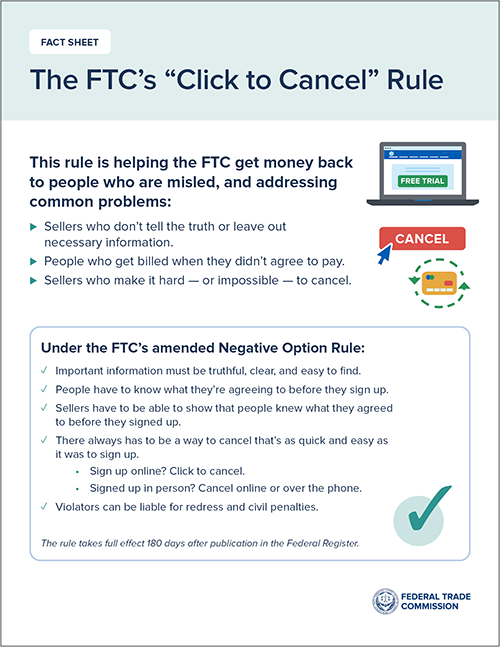
In response, the FTC unveiled the click-to-cancel rule last month that is designed to make it much harder for businesses to fleece customers. Ending a subscription should be just as easy as signing up for it in the first place, FTC Chair Lina Khan said.

Under the rule set to go into effect soon, companies have to be upfront about any fees that will pop up after a free trial period. And canceling a subscription or service must take as many steps as it took to sign up; consumers also cannot be forced to call a customer service line or send a letter to cancel a service they started online.

With Khan’s time at the FTC running out, the new leadership that Donald Trump installs at the agency could go either way on questions like the click-to-cancel rule.

That’s because Khan, a liberal appointed by a liberal president, has won some unlikely fans among conservatives: the “Khanservatives” who support cracking down on anti-competitive practices. On the other side of the debate are a more traditional GOP constituency: businesses and investors betting big on the loosening of regulation.

The new FTC brass could try to scale down the rule, kill it, or keep it. Or Congress could legislate the rule away.

The rule, passed last month, isn’t enforceable until 180 days after it’s posted in the Federal Register — which may get killed before it even takes effect.

Leading Candidates

Trump has yet to announce his pick to succeed Khan as chair.

Two candidates in the mix could take an aggressive stance in favor of enforcing antitrust laws, according to reporting earlier this week in the Financial Times. Either Vice President-elect JD Vance’s adviser Gail Slater or former Department of Justice antitrust division attorney Mark Meador could get the nod, the newspaper said.

Whether Slater, Meador, or another candidate gets the nod, the confirmation process could take months. In the meantime, Trump could appoint one of the two GOP commissioners as acting chair.

There are signs, however, that would bode ill for the Khanservatives: The two Republican commissioners, Andrew Ferguson and Melissa Holyoak, both voted against the click-to-cancel rule.

“Everybody ought to just say, ‘Thank goodness.’ It’s a scam that has been baked into some of our companies,” said David Vladeck, a law professor and the director of the FTC’s Bureau of Consumer Protection under President Barack Obama. “I’m just flummoxed that two of the commissioners think that this is not a good idea.” (...)

Even before click-to-cancel was approved, Khan’s agency used existing rules to go after companies like Amazon. The FTC sued the tech giant in 2023 for making it hard to cancel Prime. The company denies tricking people into signing up for Prime or making it hard to cancel.

Outside the commission itself, the new rule faces other potential stumbling blocks. Three corporate trade groups representing the advertising, home security, and cable and TV industries have sued to stop the rule from taking effect. Congress could also overturn the rule.

“Clearly, there are a lot of obstacles to this,” Murray said. “But we certainly hope for the sake of consumers and the sake of businesses that are doing it the right way, that companies will comply with this whether it is required or not.”

Risking Backlash

An attempt to reverse the click-to-cancel rule could please some of Trump’s corporate backers but would also run the risk of a popular backlash. The rule broke through to the public consciousness in a way few FTC decisions do — even earning a nod from Stephen Colbert.

Democratic FTC Commissioner Rebecca Kelly Slaughter said she had heard repeatedly from ordinary people outside the world of Washington politics praising the adoption of the rule. Khan noted that the rule was driven by public complaints.

“We’ve heard about these complaints across all sorts of contexts, from gym memberships to delivery services,” Khan said Thursday. “These tactics are causing Americans real harm, with people paying hundreds or even thousands of dollars for services they no longer want.”

Click-to-cancel will not be the only big decision for the next FTC chair. The agency is also pursuing lawsuits against Amazon and Facebook’s parent company, Meta, with potentially sweeping implications.

And for more than a year, the FTC has been considering a proposed rule to ban the hidden “junk fees” that raise the cost of everything from apartment rentals to concert tickets. Vladeck, the law professor, said he doubts that Khan can pass that rule before she leaves office.

“The clock is ticking pretty loudly right now,” he said. “I think they’re probably not going to get it done.”

by Matt Sledge, The Intercept |  Read more:
Image: Francis Chung/POLITICO via AP Images
[ed. It's beyond belief that a no-brainer like this should become politicized. Ms Khan's been an exceptional consumer advocate in her short tenure at the FTC, and was just getting started. Too bad she'll be gone soon (but not forgotten). See also: Amazon is a Ripoff; and, FTC Sues Amazon for Illegally Maintaining Monopoly Power.]

Laufey

The NBA’s Three-Point Revolution Has Gotten Extreme

How many is too many?

Not two weeks into the NBA season, Kevin Durant sat at his locker and grappled with the latest repercussions of the league’s three-point boom. Stephen Curry and James Harden ushered in basketball’s perimeter revolution roughly a decade ago, but a disorienting new era has swept through the league.

The defending champion Boston Celtics launched 61 attempts from behind the arc on opening night, and Celtics star Jayson Tatum put up 18 by himself against the Indiana Pacers on Oct. 30. When Durant was a rookie in 2007-08, his Seattle SuperSonics shot just 11.5 three-pointers per game; Charlotte Hornets guard LaMelo Ball is averaging more than that by himself this season. Entering Monday’s games, NBA teams were taking 37.4 three-pointers per game, which was on pace to set a record and more than double the league’s average in 2014-15.

Players continue pushing the boundaries, hoisting off-the-dribble threes, step-back threes, one-legged threes, transition threes, early-shot-clock threes and deep threes from the center-court logo. Teams are commonly fielding lineups with five players who are encouraged to shoot from the outside, including 7-foot centers. Within this whirlwind, it can feel like anything goes.

“That’s a fine line a lot of teams are having this season,” Durant said. “Do I come down on the break after a good [defensive] stop and pull a three over the top of two people? That’s a question you’ve got to ask yourself. That is considered a good shot nowadays. But, really, is it? If you miss that ball, it’s a fast break on the other end.”

Despite Durant’s reservations, many teams have decided to chuck threes and ask questions later in an attempt to keep up with the Joneses. The Celtics led the league in three-point attempts and offensive efficiency en route to the 2024 title, and the Western Conference champion Dallas Mavericks ranked second in three-point attempts per game in 2023-24.

After getting his first taste of celebratory champagne, Celtics Coach Joe Mazzulla doubled down on his obsession with three-point generation. Entering Tuesday night’s game against the undefeated Cleveland Cavaliers, Boston is the only team this season — and just the third in league history — to attempt more three-pointers than two-pointers. While Harden’s Houston Rockets leaned more on threes than twos in 2018-19 and 2019-20, the Celtics have distorted the outside-inside balance more than any team in history by taking 51.1 three-pointers and 39.7 two-pointers per game.

With its current shot profile, Boston is on track to become the first team to average 50 three-point attempts, more than double its output in the 2014-15 season. By comparison, Harden’s Rockets topped out at 45.4 three-point attempts in 2018-19, and Curry’s Golden State Warriors peaked with 43.2 in 2022-23.

“I love three-pointers,” Mazzulla said shortly after taking over the Celtics in 2022. “I like math. I like open threes. I like space. I think it’s a huge strength of our team.” (...)

“Whenever a team wins a championship, everyone analyzes how they did it,” Knicks guard Jalen Brunson said last month. “A lot of people saw how successful [the Celtics] were with their offense, the five-out. It may not be a carbon copy, but everyone wants to adjust to the new ways of basketball.” (...)

“The game continues to change,” Celtics center Al Horford said. “Even from last year, I think it’s different. I feel like people are shooting more threes now and playing more of a style like we play. It’s more and more teams. That’s an adjustment.”

NBA Commissioner Adam Silver has yet to take proactive steps to slow this sea change — such as pushing back the three-point arc or eliminating the bend that allows shorter three-pointers from the corners — but fans could have a say if the three-point boom continues unchecked. Perhaps modern basketball’s “bad shot” will become the one that’s no longer thrilling because everyone already has seen it too many times to count.

“The league needs to change the rules,” Fox Sports commentator Nick Wright said. “The smart way to play is probably what the Celtics did on opening night: shoot 60 [three-pointers]. That’s the best strategy, but it’s also terrible television.”

by Ben Golliver and Artur Galocha, Washington Post | Read more:
Image: uncredited

Monday, December 2, 2024

A Note on "Government Efficiency"

There is a major focus these days on the topic of government efficiency, spurred by the creation of what is being called a “Department of Government Efficiency.” I have had the good fortune of being involved in simplification of government, and reduction of paperwork and regulatory burdens, in various capacities, and here are six quick and general notations.
  1. The Administrative Procedure Act is central to the relevant project. It needs to be mastered. It offers opportunities and obstacles. No one (not even the president) can clap and eliminate regulations. It’s important to know the differences among IFRs, TFRs, NPRMs, FRs, and RFIs. (The best of the bunch, for making rules or eliminating rules: FRs. They are final rules.)
  2. The Paperwork Reduction Act needs to be mastered. There is far too much out there in the way of administrative barriers and burdens. The PRA is the route for eliminating them. There’s a process there.
  3. The Office of Information and Regulatory Affairs is, for many purposes, the key actor here. (I headed the office from 2009-2012.) A reduce-the-regulations effort probably has to go through that Office. Its civil servants have a ton of expertise. They could generate a bunch of ideas in a short time.
  4. It is important to distinguish between the flow of new burdens and regulations and the stock of old ones. They need different processes. The flow is a bit easier to handle than the stock.
  5. The law, as enacted by Congress, leaves the executive branch with a lot of flexibility, but also imposes a lot of constraints. Some of the stock is mandatory. Some of the flow is mandatory. It is essential to get clarity on the details there.
  6. The courts! It’s not right to say that recent Supreme Court decisions give the executive branch a blank check here. In some ways, they impose new obstacles. Any new administration needs a full understanding of Loper Bright, the major questions doctrine, Seila Law, and much more (jargon, I know, I know).
by Cass Sunstein, Substack |  Read more:
[ed. See also: Regulating Sausages (MR): "In the comments on Sunstein on DOGE many people argued that regulations were mostly about safety."
***
[ed. I would agree that's a large part of it. Something bad happens and instead of making institutional and/or supervisory changes that would keep the bad thing from happening again ("you're reassigned; don't ever let that happen again!), we get regulations (ie. legal statements of intent and ass-covering). But that's just one part of what could be called burdensome regulatory oversight. Here are a few other thoughts, just off the top of my head:
  • Evolution: We learn more over time (scientifically, socially, legally, etc.) so adjustments are needed to achieve original and sometimes enhanced versions of a subject objective. Also, new developments arise (Internet, cybercrime, AI, financial instruments, 5G networks, etc. etc.) requiring new rules where previously none existed.
  • Politics: Covers a lot of territory. Payback for campaign donations; support for home-state industries; alignment with voting constituency and issues; etc. etc. Lots of granularity in how this category is applied (to the benefit of politicians/political causes).
  • Lobbying: Corporations (and others) lobby for regulations all the time to secure niche advantages over competitors; provide legal cover; maintain economic and industry dominance, etc. etc. That's the whole raison d'etre lobbyists exist.
  • Social Programs: Social Security, Medicare/Medicaid, EBT, FEMA, Immigration, Defense. All massive items widely supported by the majority of the population (and which, along with interest payments on the national debt, constitute the bulk of annual federal spending). Cut with caution.
  • Other: Wide range of regulations for anything and everything else: highway standards; consumer protection; NGO contracts; scientific advances; copyright; trade benefits; and so on. Not a significant proportion of the national budget but still entangled both widely and deeply with other programs/priorities.
So, after a few spectacular shots (defund the DOE! NPR!) with subsequent legal challenges, I don't personally see much getting accomplished, other than just making government more inefficient and dysfunctional than it already is. There are too many embeded interests, with constituencies for everything. As noted in this recent NYT column: "an inclination to destroy something is not evidence of an ability to manage it, or reform it, or improve it — quite the contrary.”  See also: Governmental Efficiency: What Can It Possibly Mean? (GSP). Plus, there's this.

Sunday, December 1, 2024

Smashmouth

[Lyrics:] It ain't no joke I'd like to buy the world a toke. And teach the world to sing in perfect harmony. And teach the world to snuff the fires and the liars. Hey I know it's just a song but it's spice for the recipe. This is a love attack I know it went out but it's back. It's just like any fad it retracts before impact. And just like fashion it's a passion for the with it and hip. If you got the goods they'll come and buy it just to stay in the clique.

[Chorus:] So don't delay act now supplies are running out. Allow if you're still alive six to eight years to arrive. And if you follow there may be a tomorrow. But if the offer's shunned you might as well be walkin' on the sun. 

Twenty-five years ago they spoke out and they broke out. Of recession and oppression and together they toked. And they folked out with guitars around a bonfire. Just singin' and clappin' man what the hell happened. Then some were spellbound some were hellbound. Some they fell down and some got back up and. Fought back 'gainst the melt down. And their kids were hippie chicks all hypocrites. Because fashion is smashin' the true meaning of it. 

[Repeat Chorus] 

It ain't no joke when a mama's handkerchief is soaked. With her tears because her baby's life has been revoked. The bond is broke up so choke up and focus on the close up. Mr. Wizard can't perform no godlike hocus-pocus. So don't sit back kick back and watch the world get bushwhacked. News at 10:00 your neighborhood is under attack. Put away the crack before the crack puts you away. You need to be there when your baby's old enough to relate. 

[Repeat Chorus] 

You might as well be walkin' on the sun. You might as well be walkin' on the sun. You might as well be walkin' on the sun. You might as well be walkin' on the sun.

[ed. Fun video. Didn't know the lyrics.]

Who Americans Spend Their Time With, By Age


[ed. No comment.]

Vibe Check

What does the most overused word of our era actually mean? [ed. anything you want it to mean.]

The most important people in the history of the word “vibes” are the Beach Boys. Before the release of Good Vibrations, in 1966, if you heard someone say “a vibe”, they were probably talking about a vibraphone – the xylophone-like percussion instrument with ringing metal bars, invented in 1916. The thought that a person could give off “vibes” was a niche, mostly hippy concept that Brian Wilson heard about from his mother.

At first, it was frightening. “[She] used to tell me about vibrations,” Wilson told a biographer, years later. “She told me about dogs that would bark at people … that a dog would pick up vibrations from these people that you can’t see, but you can feel.

“It scared me,” he said. “The word ‘vibrations’.” Wilson originally wanted to call the song Good Vibes, but his lyricist, Tony Asher, said it was a “lightweight use of the language”. Nevertheless, by 1970, John Lennon was saying it (“You give off bad vibes”), then Bruce Springsteen (“Hey vibes man!”), and, by 1983, Kate Bush (“Vibes in the sky invite you to dine”, in Blow Away).

Since then, the word “vibe” – and various promises to change it, check it, luxuriate in it – has become inescapable. A “vibe” can be an idea, a message, a connection between two people, an atmosphere, “off”, unquantifiable, a sensation as clear as the weather. Dressing nicely is “a whole vibe”; a “vibe shift”, as popularised by a 2022 New York Magazine article, is a coming cataclysm. (“Will any of us survive it?” the piece asked.) A day of bliss spent with the people you love is simply “a vibe”.

But, without anyone intending it, the popularity of “vibes” threatens to make it mean nothing. Jessi Grieser, an associate professor in linguistics at the University of Michigan, said that “vibe” had undergone a process known as linguistic generalisation, where its meaning had slowly expanded.

The New York Times asked last year: “Is crime that bad, or are the vibes just off?” Bloomberg described an economic downturn as a potential “vibecession”. Google announced that its maps will soon be able to perform “vibe checks” on entire neighbourhoods – with AI. The example provided was a trip to Paris. Imagine having your arrondissement “vibe-checked” into oblivion by a robot.

The whole vibe

There is undoubtedly value in having a word for the unquantifiable. The German word “Zeitgeist” was loaned into English, in 1848, perhaps precisely because it encapsulated what we were missing before “vibes”. A classically German compound noun, it literally means “time-spirit”, and the broader German concept of “Geist” itself is maybe even more modern-day vibes-ey – combining to make “Volksgeist” (“national spirit”) and “Weltgeist” (“world-spirit”).

Part of what is driving vibes could be that everyone is actually feeling it. On 11 February, the New York Times crossword ran a clue: “Emotional assessment of one’s surroundings, in lingo”, nine letters. The answer was “vibe check”. Like it or not, part of the contagiousness of “vibes” is that everyone seems to understand, on some level, what it means. (...)

“One of the most important events in the history of vibes was James Clerk Maxwell’s theoretical discovery that light is an electromagnetic wave vibrating in a narrow spectral band, implying that there are other EM waves invisible to humans vibrating at frequencies higher and lower than RGB,” he said. “I would guess that the notion that we live in a vast ocean of invisible radio waves was one of the main inspirations for vibes, for ‘getting on the same wavelength’, for ‘being in tune’.”

Could there, then, be a scientific basis to vibes?

“To really touch the truth of what good vibes between souls might mean, we would have to answer the question: what is it that is doing the vibrating? What is the medium, in other words, in which vibes vibrate?

“No one has the slightest notion how to answer this question. It probably, in my opinion, has nothing to do with quantum mechanics. Which is now, like radio once was, the hottest science fad for some people to dress up their deep ignorance – (our deep ignorance – in phoney knowledge-sounding words.”

Yankelevich said “vibes” was “a universal word, in a sense … People apply it differently based on their given situation. And I think that’s a fantastic thing.”

Grieser sketches a slightly gloomier picture. “It’s hard to get much broader than the space that is currently occupied. We just kind of mean ‘the state of affairs’.” She added: “I mean, New York Times headline, that’s kiss of death for a piece of slang.”

by Naaman Zhou, The Guardian | Read more:
Image: Marcel Kohlr/The Guardian
[ed. Still going strong as far as I can tell. Sure beats romanticising your life with "main character energy". ]

Friday, November 29, 2024

Julian Lage & Chris Eldridge

[ed. Have a feeling not enough people caught this link below. Don't miss.]

Working Black Friday in the Rich Part of Town

To be a service worker is to be in constant deference to Karens, but in retail, a Karen can be anyone.

Beauty is a growth industry, so said my CEO. She was new to the company, like me, having only arrived during the last fiscal quarter. Before that, she sold cell phones, and before that, McDonald’s, and years ago, Cap’n Crunch and Rice-­A-­Roni. Now she sold makeup, or I sold it for her, or it sold itself.

Though my store carried several high-­end brands, it lacked the luxury pedigree of Sephora, its biggest competitor. You could see it in the bags—­theirs, a glossy black that stood up on its own, ours, a pale orange sack. Sephora was the wife of Moses, she who declared her husband the bridegroom of blood after circumcising her son with a flint knife, her name derived from Hebrew, little bird. Ulta is ultra without an r.

My store split its inventory into five basic categories: makeup, skincare, body, hair, and nails. From there, all products were reduced to one of two classes: mass or prestige. The former meant drugstore. The latter meant expensive. Prestige makeup, hair care, and skincare occupied the store’s upper right quadrant, and mass, its left. Shelves of nail polish marked the boundary between prestige face and prestige hair. Hair tools, both mass and prestige, intermingled in the lower left. The salon abutted them. Fragrances rose along the back prestige wall. The registers were neither a supermarket-­style row of parallel bays, nor a station along the wall. Instead, they sat around a ring-­shaped counter in the middle of the store, arranged so as to be nearly panoptical. We stood anchoring the center.

I started at Ulta in October, having graduated from college the previous May. I’d spent the summer in Chicago getting rejected for unpaid positions at music agencies and copywriting jobs at Groupon, only to crawl back to my parents in August. While I was in college, they made a permanent move to the South Carolina beach town we had vacationed in for much of my childhood. To me, it was a place without time or adulthood or anything but heat and stillness. My mom picked me up from the airport. We passed the Towne Centre mall in landlocked Mount Pleasant, with its twelve-­foot-­tall stone horses standing sentinel in front of the P.F. Chang’s. We ascended the sloping bridge that connected Mount Pleasant to the island beach town where my parents lived, at the top of which sat an American flag and, for a tall minute, a sweeping view of the Atlantic Ocean. We pulled onto the island’s main drag, lined with palms and clogged with tourists, the pickups and surfboard-­laden jeeps trundling along in a slow parade. We turned onto their street, which was a half mile long, no curbs or sidewalks, just a short strip of asphalt bookended by the ocean on one side and marshland on the other. Since the ’90s, houses there were required to be built on stilts so that hurricanes could, rather than sweep the houses away, simply flow through them unobstructed. An old, thick pug stood still in the middle of the street, staring at our car as we veered around him. That’s just Dudley, my mom said, driving past. My parents’ right-­hand neighbors had a dolphin-­shaped fountain in their yard. Their left-­hand neighbors owned a small bungalow that sat flat on the ground, which meant it had survived Hurricane Hugo. Between me and my parents’ front door was a long flight of stairs and a fifty-­pound suitcase. I lifted the suitcase gently over the first stair. I could feel beads of sweat forming already on my neck and rolling down my spine into my ass. The air felt like morning breath. Lugging the suitcase up the second stair, I let my arms slacken a little, then on the third stair a little more, until I was dragging the thing behind me, letting it bang violently on every single step. You know I hate that, my mom sighed. I reached the top, breathing hard as I shoved through the stacks of Amazon boxes that would be replaced by a new batch the next day. By the time I started punching in the door code, I’d lost all sense of forward motion. I was again a bored and restless child.

My sleep schedule quickly reversed itself. I would wake up as my parents ate dinner and go to sleep to the sounds of my dad making his morning SodaStream. I didn’t need money but I did need a job, any job, something to differentiate living with my parents at age twenty-­three from living with my parents at age fourteen. I applied to and proceeded to hear nothing back from Applebee’s, Target, Costco, H&M, the Container Store, Panda Express, an ice cream cart at the zoo, and Urban Outfitters, which required that I take a personality assessment, the sole purpose of which seemed to be divining if and under what circumstances I would be stoned at work.

Only Ulta called me in for an interview. I sat down with Melanie, who had crimpy blond hair that she clipped half up, a southern accent, and the type of black, stretchy, flared trousers that are marked at $89.99 but always on sale for $59.99 under names like The Aubrey and The Blythe and are, somehow, the uniform of every female retail manager at every mall store across the country. She didn’t ask me many questions, but when she looked at my résumé and saw that I’d majored in English, she asked what my future plans were. I paused. My parents had told me to conceal anything that might suggest I had an exit strategy. Ulta, they reminded me, did not want a liberal arts girl with rich parents for whom retail was merely a way to kill time on the way to Brooklyn, graduate school, or both. I’d learned this in high school when I’d looked for summer jobs only to find that summer jobs didn’t really exist anymore, because the people who fill them don’t really exist. If you have money, your summer job is pre-­collegiate grooming rituals, all your unpaid internships and philanthropy. If you don’t have money, your summer job is the job you already have. Ulta wanted someone who was likely to stay put. Ulta’s ideal employee was someone who needed Ulta more than Ulta needed her. But in the moment, with my nose ring in my pocket, I panicked and accidentally told the truth. I kind of want to be a writer. She nodded politely.

Our store was located in the upscale-­but-­not-­luxury Towne Centre outdoor shopping mall in the upscale-­but-­not-­luxury town of Mount Pleasant, which was nearly on the water, but not quite. The town is nestled among old-­money Charleston, with its million-­dollar prewar mansions, some midsize middle-­class towns, and a handful of small fishing villages. Mount Pleasant had itself been a small village, but 1931 brought the highway and 1989 brought the hurricane, which decimated the barrier islands. In Hugo’s wake were insurance payouts and talk of new beginnings and, quickly, a real estate boom that never really ended. By the early 2000s its population doubled and became predominantly upper middle class. The new mall opened. Another highway was built. Now, ten years later, its population had doubled again and was sliding toward rich. Not quite Rich rich—­Rich rich being an ineffable, ancient stratum of culture and wealth in which almost nobody in America believes themselves to reside—­but statistically rich, the kind of rich that thinks it’s upper middle class because it eats at the same chain restaurants as the masses.

On my first day at Ulta, I descended from my parents’ gleaming SUV and walked among the rest of the gleaming SUVs looping endlessly through the Towne Centre’s sprawling parking lot, their reflections shimmering across the windows of the Ann Taylor Loft, the Qdoba, the Hairy Winston Pet Boutique. The white pavement and the shiny cars seemed to magnify the sunlight. It was unseasonably warm that day, so hot the air looked wavy. The brief interludes of heat between icy car and icy store came as a series of shocks to the body, which may in fact be the entire point of outdoor malls: reminding you of your good fortune to be alive in the age of central air.

Dawn, the assistant manager, ushered me to the back room. I wore black pants and a black blouse I’d had to buy from the Old Navy next door. All of my other shirts either had non-­sanctioned colors or had been cropped with scissors. My hair was a strange auburn color, the aftermath of a DIY bleach job I’d done a few months ago after watching Spring Breakers. I’d put my nose ring back in after the interview, and Dawn eyed it. That’s fine, she said, aiming to reassure herself as much as me, you’re allowed one facial piercing.

I sat on a folding metal chair as Dawn hit play on a training video. She handed me a headset. The Ulta CEO welcomed me to the family. A robotic female voice told me how to enter my time.

She stood next to me as my first customer approached. In life, my voice is boyish and jocular, but the one that came out was a breezy trill. Did you find everything today? I cooed. Nobody had taught me this phrase or this voice. It’s her first day, Dawn explained as I tried to remember what to press on the register screen. Thanks for bearing with us, I said. Nobody had taught me to say us.

I relished the novelty. I’d always been a shopper, never a seller, and I delighted each time the curtain was pulled back. I learned about the locked perfume cage in the back. I learned new names for the mundane: theft was shrink, a thief was a Thelma, free products were gratis, a customer was a guest and an item they plucked from the shelf and later abandoned was a go back, checkout was the cash wrap, a shelf was positioned by a planogram, a shelf was positioned by mandate from on high, a shelf was a gondola, a shelf was an endcap, a shelf was an étagère. I learned the satisfaction of a workday that dissolved in an instant. The sweet finality of clocking out. I learned just how pale my skin and just how pink my cheeks were. I learned the acute chemical effect of being called pretty a few times a week.

It is perhaps a mark of my comfortable upbringing that the prospect of working retail excited me. But it is also something else. For Christmas one year, my older brother received a toy cash register. I think the idea was to make math fun for him. He abandoned the register after a few hours, but I didn’t. I rang things up well into the evening—­I sold myself a Lego, a pop-­up book, a wheel for my doomed hamster, a petrified piece of licorice. The items were beside the point. It wasn’t the things that I loved so much as the transaction, the beep of the buttons, the receipt paper smooth between my thumb and forefinger. The way the machine shivered when the cash drawer clicked shut. A friend of mine once declared smoking the perfect sensory experience: you smell it, touch it, fingers, lungs, hot on the inhale, visible on the exhale. It is perfect because your nerves sharpen, then calm. You witness the fact of your steady breathing. You make a habit of it.

Guests who belonged to our loyalty program earned ULTAmate Rewards Points with every dollar they spent. Compared to Sephora, whose Beauty Insider program exchanged dollars not for discounts but for deluxe samples, Ulta’s rewards system was thought to be better, as it provided the illusion of savings. At the time, spending $250 at Sephora got you three-­twentieths of an ounce of Intenso Pour Homme. The same sum at Ulta saved you, on the dollar, three-­hundredths of a cent.

You needed one hundred points before you could get a discount. I’m sorry, I learned to say to those with fewer, you haven’t yet reached the threshold for redemption. A guest’s point balance was always displayed to me at checkout, but on my first day I was warned never to divulge this freely, at least not before they swiped. The points are an incentive for guests to spend more, said Melanie. If you give that up before they pay, it’s just a free discount.

Instead, I was to do this: Print the receipt and smooth it flat on the counter. Lean over. Underline the fine print. Here is a link to our guest satisfaction survey. You could win a $500 gift card. Raise my eyebrows as if suddenly impressed. Wow. Circle a number at the bottom. Looks like you have 732 points. That’s almost $30 off. Guest frowns. Wait. Couldn’t I have used that today? Well. Conspiratorial. Just another excuse to come back soon. With my neon highlighter I drew a wonky heart.

The slickness of my little script felt balletic. It was a good kind of alien. Soon, stock phrases became mantras, became prayers, became muscle memory. Hi there, If you could just swipe one more time, I apologize for the wait, Are you a rewards member, I’ll take the next guest, You have a great day! I could do it in my sleep.

by Emily Mester, Electric Lit |  Read more:
Image: uncredited but probably Emily

Adif Robotics / Serial No. 136L / Rendering (AI) / 2024
via: here/here

via:

Wednesday, November 27, 2024

How Native Americans Guarded Their Societies Against Tyranny

When the founders of the United States designed the Constitution, they were learning from history that democracy was likely to fail – to find someone who would fool the people into giving him complete power and then end the democracy.

They designed checks and balances to guard against the accumulation of power they had found when studying ancient Greece and Rome. But there were others in North America who had also seen the dangers of certain types of government and had designed their own checks and balances to guard against tyranny: the Native Americans.

An artist’s depiction of life in Cahokia. (Michael Hampshire for the Cahokia Mounds State Historic Site via Wikimedia Commons, CC BY-SA)

Although most Americans today don’t know it, there were large centralized civilizations across much of North America in the 10th through 12th centuries. They built massive cities and grand irrigation projects across the continent. Twelfth-century Cahokia, on the banks of the Mississippi River, had a central city about the size of London at the time. The sprawling 12th-century civilization of the Huhugam had several cities of more than 10,000 people and a total population of perhaps 50,000 in the Southwestern desert.

The ruins of these constructions remain, more than 1,000 years later, in places as far-flung as Phoenix, St. Louis and north Georgia.

The American Colonists and founders thought Native American societies were simple and primitive – but they were not. As research has found, including my own, and as I explain in my book, “Native Nations: A Millennium in North America,” Native American communities were elaborate consensus democracies, many of which had survived for generations because of careful attention to checking and balancing power.

Powerful rulers led many of these civilizations, combining political and religious power, much as monarchs of Europe in later centuries would claim a divine right to rule.

In the 13th century, though, a global cooling trend began, which has been called the Little Ice Age. In part because of that cooling, large-scale farming became more difficult, and these large civilizations struggled to feed their people. Elites began hoarding wealth. The people wanted change.

Spreading Out

The residents of North America’s great cities responded to these stresses by reversing the centralization of power and wealth. Some revolted against their leaders. Others simply left the cities and spread out into smaller towns and farms. All across the continent, they built smaller, more democratic and more egalitarian societies.

Huge numbers left Cahokia’s realm entirely. They found places that still had game to hunt and woods full of trees for firewood and building, both of which had declined near Cahokia due to its rapid growth.

The population of the central city of Cahokia fell from perhaps 20,000 people to only 3,000 by 1275. At some point the elite left as well, and by the late 15th century the cities of Cahokia’s realm were completely gone.

Encouraging Engaged Democracy

As they formed these new and more dispersed societies, the people who had overthrown or fled the great cities and their too powerful leaders sought to avoid mesmerizing leaders who made tempting promises in difficult times. So they designed complex political structures to discourage centralization, hierarchy and inequality and encourage shared decision-making.

These societies intentionally created balanced power structures. For example, the oral history of the Osage Nation records that it once had one great chief who was a military leader, but its council of elder spiritual leaders, known as the “Little Old Men,” decided to balance that chief’s authority with that of another hereditary chief, who would be responsible for keeping peace.

Another way some societies balanced power was through family-based clans. Clans communicated and cooperated across multiple towns. They could work together to balance the power of town-based chiefs and councils.

An Ideal Of Leadership

Many of these societies required convening all of the people – men, women and children – for major political, military, diplomatic and land-use decisions. Hundreds or even thousands might show up, depending on how momentous the decision was.

They strove for consensus, though they didn’t always achieve it. In some societies, it was customary for the losing side to quietly leave the meeting if they couldn’t bring themselves to agree with the others.

Leaders generally governed by facilitating decision-making in council meetings and public gatherings. They gave gifts to encourage cooperation. They heard disputes between neighbors over land and resources and helped to resolve them. Power and prestige came to lie not in amassing wealth but in assuring that the wealth was shared wisely. Leaders earned support in part by being good providers.

‘Calm Deliberation’

The Native American democracy that the U.S. founders were most likely to know about was the Iroquois Confederacy. They call themselves the Haudenosaunee, the “people of the longhouse,” because the nations of the confederacy have to get along like multiple families in a longhouse.

In their carefully balanced system, women ran the clans, which were responsible for local decisions about land use and town planning. Men were the representatives of their clans and nations in the Haudenosaunee council, which made decisions for the confederacy as a whole. Each council member, called a royaner, was chosen by a clan mother.

The Haudenosaunee Great Law holds a royaner to a high standard: “The thickness of their skin shall be seven spans – which is to say that they shall be proof against anger, offensive actions and criticism. Their hearts shall be full of peace and good will.” In council, “all their words and actions shall be marked by calm deliberation.”

The law said the ideal royaner should always “look and listen for the welfare of the whole people and have always in view not only the present but also the coming generations, even those whose faces are yet beneath the surface of the ground – the unborn of the future Nation.”

by Kathleen DuVal, Honolulu Civil Beat | Read more:
Image: Michael Hampshire for the Cahokia Mounds State Historic Site via Wikimedia Commons, CC BY-SA)