Sunday, January 5, 2025

Money, Art and Representation

The Powerful and Pragmatic Faces of Medieval Coinage

Introduction 

A persistent trope in numismatic literature and exhibitions is that coins are art. It is seen, perhaps, as a way of making these small objects more engaging or of asserting their equivalence with other works found in galleries. It is perhaps also a projection onto the Middle Ages of the phenomenon developed in the fifteenth century of the decorative medal as a form of artistic expression. The idea of medieval coins as art, however, faces a twofold problem. First, the concept of “art” in the Middle Ages is contested by historians of visual and material culture because although objects might have been beautifully made in the Middle Ages this was always secondary to and in service of another (non-aesthetic) primary purpose. The concepts of beauty as its own purpose and the artist as individual were absent. Second, while many medieval coins are attractive and enticing to modern eyes, others challenge even the most culturally relativist viewer to assert with confidence that these objects were created to be admired for their beauty. They were all, however certainly intended to be tools of representation. Indeed, representation is integral to the identity of a coin. Without designs marking it apart, a lump of metal is not a coin; it is simply a lump of metal, or perhaps an ingot. Marking a coin with a representation to make it recognizable theoretically simplifies transactions, as people are able simply to exchange coins in specified amounts rather than having to test the purity and weight of metal themselves or pay somebody else to do so. In the medieval world this did not always work perfectly in practice, as some examples in this chapter will demonstrate, and the rationale for issuing coins in the Middle Ages was not necessarily exclusively to facilitate transactions. Nevertheless, the aims and consequences of representation are in all cases fundamental to understanding the role of money in the Middle Ages. 


Consequently this chapter focuses not on coins as art but on the interactions which made representation on a medieval coin possible and meaningful. These interactions are usually discussed in terms of the connection between the authority which caused a coin to be made and the intended audience for its use, as a top-down communication, which only rarely extended into a visible dialogue, for example when an intended audience rejected a coin or a contemporary commentator mentioned some change in design. (...) Such interpretation is, however, implicitly grounded in the idea of coins as art (or perhaps propaganda - also a problematic term in medieval contexts since it is closely associated with modern ideas about the conscious aim and capacity of states to influence directly and totally the political consciousness of their subjects), in which the authority becomes the artist and minute details or changes in coin design have been read as sensitive barometers revealing the personal feelings and political preferences of kings and emperors. A medieval coin, though, was fundamentally an object of use, created to mediate a range of social contexts, from paying taxes and armies, or engaging in commerce, to giving religious donations, or distributing imperial largesse. Its uses thus all required an audience which both understood and accepted the social role played by that coin. 

Consequently, this chapter begins with the intended audience, examining the ways in which people in the Middle Ages encountered coins and what this tells us about the capacity for representation on coins to communicate within, and to create, shared visual contexts. Only then does it turn to the authority, examining how and why issuers of coins decided to situate their representational choices on a spectrum between conservatism and innovation. These choices, however, were not usually enacted by the authorities who ordered coins to be made. The often overlooked role played by makers of medieval money is considered as a separate and vital component in representation and visual communication. Finally, this chapter turns to unintended audiences. Medieval money travelled, as money has always done, and representation on coins influenced visual culture far beyond the spaces controlled by its issuing authority. Differences in the responses of unintended and intended audiences to medieval money bring us closer to understanding complex landscapes of visual familiarity and foreignness, both during the Middle Ages, as coins traversed space and time, and in the present, where the ultimate unintended audience - the modern viewer, collector, scholar or curator - responds to representation on medieval coins, but also generates new understandings of it. 

When this chapter talks about representation it takes in all of the intentional visual symbols placed on coins by their makers. It includes human images and other complex designs of animals, buildings or abstract patterns. It also includes smaller, simpler representations, which might be part of these complex images or which might appear beside them. Some of these formed part of the wider visual culture of the coin’s intended audience, such as crosses on coinages issues by Christian polities. Crosses could be encountered in multiple contexts, such as in wall paintings, manuscripts and sculpture, and were probably immediately familiar to most of their viewers. Other images and marks had more esoteric and specific meanings which may have been irrelevant or unknown to many users of these coins, such as mint marks. Other marks, though useful to numismatists today for identifying and seriating coins, are still not always understood and may have had specific meaning or have been purely decorative, such as stars or dots (often termed “pellets”) around the main design. Representation on coins can also refer to text in the form of inscriptions making political statements, proclaiming titles and religious views, or naming the maker, the mint or the 4 value or denomination of the coin. The balance of image and word itself became an issue of political representation in the Middle Ages, discussed below.

by Rebecca R. Darley, Birkbeck/University of London |  Read more (pdf):
Image: via
[ed. Probably of limited interest here, but I found it quite fascinating (for the most part). Everybody thinks about money, but not usually in this way (except when special or limited run currencies are produced to commemorate someone or something. Citations have been removed for easier reading. Have to laugh at the last item here about meanings evolving or devolving over time: thus a Roman emperor eventually becomes a porcupine:]!
***
"Much of what we think of as representation on coins was thus the direct product not of the commissioning authority, nor even the moneyer in the sense of overseer, but of the die cutters. These were the people who created the images that we see on coins. Their skill, or apparent lack thereof, created many of the fine details which have optimistically been read as insights into the minds of issuing authorities. This can sometimes overlook fairly significant gaps in our knowledge, such as how designs, even if sanctioned by an authority, were transmitted to mints further away for die cutters to engrave. (...)

In addition to the die-cutters, who were almost certainly skilled and valued artisans, the term “maker” included other individuals relevant to the issue of representation. Working through the stages of making a medieval coin highlights a number of processes which might have fallen within the remit of a variable number of people. Somebody had to calculate the metallic composition of the blank flans onto which coins were struck, or decide not to and select an appropriate number of old coins and poorly-formed pieces of metal, with serious implications for representation. An even mixture would take a struck design better than a mixture full of different metals. A heavily leadbased copper alloy, for instance, such as that used in a series of coins produced in Sri Lanka during the fifth and sixth centuries, limited the design that could be impressed on the coins, as it made the metal friable and likely to crack under pressure. (...)

The Frisian and Anglo-Saxon sceattas mentioned previously suggest similar processes. Many of these carry an image resembling a porcupine (Fig, 10), which evolved from a Late Roman portrait of an emperor, in which the hair became an increasingly prominent crest that eventually replaced a recognizable human bust altogether. Its original meaning and eventually its original appearance faded in importance in comparison to the role of the image as a symbol with a newly constructed set of social meanings.
"

[ed. See also: Your Book Review: Autobiography Of Yukichi Fukuzawa (ACX):]

"I had been living in Japan for a year before I got the idea to look up whose portraits were on the banknotes I was handling every day. In the United States, the faces of presidents and statesmen adorn our currency. So I was surprised to learn that the mustachioed man on the ¥1,000 note with which I purchased my daily bento box was a bacteriologist. It was a pleasant surprise, though. It seems to me that a society that esteems bacteriologists over politicians is in many ways a healthy one."

Friday, January 3, 2025

Teija Lehto, Blueberries - (woodcut, 43 x 60 cm.), 2024.

R. Crumb
via:

H5N1: Much More Than You Wanted To Know

H5N1: Much More Than You Wanted To Know (ACX)
Image: Metaculus
Even if H5N1 doesn’t go pandemic in humans for a while, it is already pandemic in many birds including chickens, getting there in cows, and possibly gearing up to get there in pigs. This will have economic repercussions for farmers and meat-eaters.

The CDC and various other epidemiological groups have raised the alarm about drinking raw milk while H5N1 is epidemic in cows. There is an obvious biological pathway by which the virus could get into raw milk and be dangerous, but I haven’t seen anyone quantify the risk level. Epidemiologists hate raw milk, think there is never any reason to drink it, and will announce that risks > benefits if the risk is greater than zero. I don’t know if the risk level is at a point where people who like raw milk should avoid it. Everyone says that pasteurized milk (all normal milk; your milk is pasteurized unless you get it from special hippie stores) is safe.

There are already H5N1 vaccines for both chickens and humans; pharma companies are working hard on cows. First World governments have been stockpiling human vaccines just in case, but have so far accumulated enough for only a few percent of the population. If H5N1 goes pandemic, it will probably be because it mutated or reassorted, and current vaccines may not work against the new pandemic strain.

Some people have suggestions for how to prepare for a possible pandemic, but none of them are very surprising: stockpile medications, stockpile vaccines, stockpile protective equipment. The only one that got so much as a “huh” out of me was Institute for Progress’ suggestion to buy out mink farms. Minks are even worse than pigs in their tendency to get infected with lots of different animal and human viruses; they are exceptionally likely to be a source of new zoonotic pandemics. Mink are farmed for their fur, but there aren’t as many New York City heiresses wearing mink coats as there used to be, and the entire US mink industry only makes $80 million/year. We probably lose more than $80 million/year in expectation from mink-related pandemics, so maybe we should just shut them down, the same way we tell the Chinese to shut down wet markets in bat-infested areas. (...)

Conclusions/Predictions

All discussed earlier in the piece, but putting them here for easy reference - see above for justifications and qualifications.
  • H5N1 is already pandemic in birds and cows and will likely continue to increase the price of meat and milk.
  • 5% chance that H5N1 starts a sustained pandemic in humans in the next year.
  • 50% chance that H5N1 starts a sustained pandemic in humans in the next twenty years, assuming no dramatic changes to the world (eg human extinction) during that time.
  • If H5N1 does start a sustained pandemic in the next few years, 30% chance it’s about as bad as a normal seasonal flu, 63% chance it’s between 2 - 10x as bad (eg Asian Flu), 6% chance it’s between 10 - 100x as bad (eg Spanish flu), and <1% chance it’s >100x as bad (unprecedented). The 1% chance is Outside View based on other people’s claims, and I don’t really understand how this could happen.
Thanks to Nuño Sempere and Sentinel for help and clarification. Sentinel is an organization that forecasts and responds to global catastrophes; you can find their updates, including on H5N1, here.

by Scott Alexander, ACX |  Read more:
Image: Metaculus (prediciton market)

It's Still Easier To Imagine The End Of The World Than The End Of Capitalism

No Set Gauge has a great essay on Capital, AGI, and Human Ambition, where he argues that if humankind survives the Singularity, the likely result is a future of eternal stagnant wealth inequality.

The argument: post-Singularity, AI will take over all labor, including entrepreneurial labor; founding or working at a business will no longer provide social mobility. Everyone will have access to ~equally good AI investment advisors, so everyone will make the same rate of return. Therefore, everyone’s existing pre-singularity capital will grow at the same rate. Although the absolute growth rate of the economy may be spectacular, the overall wealth distribution will stay approximately fixed.

Moreover, the period just before the Singularity may be one of ballooning inequality, as some people navigate the AI transition better than others; for example, shares in AI companies may go up by orders of magnitude relative to everything else, creating a new class of billionaires or trillionaires. These people will then stay super-rich forever (possibly literally if immortality is solved, otherwise through their descendants), while those who started the Singularity without capital remain poor forever.

Finally, modern democracies pursue redistribution (and are otherwise responsive to non-elite concerns) partly out of geopolitical self interest. Under capitalism (as opposed to eg feudalism), national power depends on a strong economy, and a strong economy benefits from educated, globally-mobile, and substantially autonomous bourgeoisie and workforce. Once these people have enough power, they demand democracy, and once they have democracy, they demand a share of the pie; it’s hard to be a rich First World country without also being a liberal democracy (China is trying hard, but hasn’t quite succeeded, and even their limited success depends on things like America not opening its borders to Chinese skilled labor). Cheap AI labor (including entrepreneurial labor) removes a major force pushing countries to operate for the good of their citizens (though even without this force, we might expect legacy democracies to continue at least for a while). So we might expect the future to have less redistribution than the present.

This may not result in catastrophic poverty. Maybe the post-Singularity world will be rich enough that even a tiny amount of redistribution (eg UBI) plus private charity will let even the poor live like kings (though see here for a strong objection). Even so, the idea of a small number of immortal trillionaires controlling most of the cosmic endowment for eternity may feel weird and bad. From No Set Gauge:
In the best case, this is a world like a more unequal, unprecedentedly static, and much richer Norway: a massive pot of non-human-labour resources (oil :: AI) has benefits that flow through to everyone, and yes some are richer than others but everyone has a great standard of living (and ideally also lives forever). The only realistic forms of human ambition are playing local social and political games within your social network and class. If you don't have a lot of capital (and maybe not even then), you don't have a chance of affecting the broader world anymore. Remember: the AIs are better poets, artists, philosophers—everything; why would anyone care what some human does, unless that human is someone they personally know? Much like in feudal societies the answer to "why is this person powerful?" would usually involve some long family history, perhaps ending in a distant ancestor who had fought in an important battle ("my great-great-grandfather fought at Bosworth Field!"), anyone of importance in the future will be important because of something they or someone they were close with did in the pre-AGI era ("oh, my uncle was technical staff at OpenAI"). The children of the future will live their lives in the shadow of their parents, with social mobility extinct. I think you should definitely feel a non-zero amount of existential horror at this, even while acknowledging that it could've gone a lot worse.
I don’t think about these scenarios too often - partly because it’s so hard to predict what will happen after the Singularity, and partly because everything degenerates into crazy science-fiction scenarios so quickly that I burn a little credibility every time I talk about it.

Still, if we’re going to discuss this, we should get it right - so let’s talk crazy science fiction. When I read this essay, I found myself asking three questions. First, why might its prediction fail to pan out? Second, how can we actively prevent it from coming to pass? Third, assuming it does come to pass, how could a smart person maximize their chance of being in the aristocratic capitalist class?

(So they can give to charity? Sure, let’s say it’s so they can give to charity.)

II.

Here are some reasons to doubt this thesis.

First, maybe AI will kill all humans. Some might consider this a deeper problem than wealth inequality - though I am constantly surprised how few people are in this group.

Second, maybe AI will overturn the gameboard so thoroughly that normal property relations will lose all meaning. Frederic Jameson famously said that it was “easier to imagine the end of the world than the end of capitalism”, and even if this is literally correct we can at least spare some thought for the latter. Maybe the first superintelligences will be so well-aligned that they rule over us like benevolent gods, either immediately leveling out our petty differences and inequalities, or giving wealthy people a generation or two to enjoy their relative status so they don’t feel “robbed” while gradually transitioning the world to a post-scarcity economy. I am not optimistic about this, because it would require that AI companies tell AIs to use their own moral judgment instead of listening to humans. This doesn’t seem like a very human thing to do - it’s always in AI companies’ interest to tell the AI to follow the AI company. Governments could step in, but it’s always in their interest to tell the AI to follow the government. Even if an AI company was selfless enough to attempt this, it might not be a good idea; you never really know how aligned an AI is, and you might want it to have an off switch in case it tries something really crazy. Most of the scenarios where this works involve some kind of objective morality that any sufficiently intelligent being will find compelling, even when they’re programmed to want something else. Big if true.

Third, maybe governments will intervene. During the immediate pre-singularity period, governments will have lots of chances to step in and regulate AI. A natural demand might be that the AIs obey the government over their parent company. Even if governments don’t do this, the world might be so multipolar (either several big AI companies in a stalemate against each other, or many smaller institutions with open source AIs) that nobody can get a coalition of 51% of powerful actors to coup and overthrow the government (in the same way that nobody can get that coalition today). Or the government might itself control many AIs and be too powerful a player to coup. Then normal democratic rules would still apply. Even if voters oppose wealth taxes today, when capitalism is still necessary as an engine of economic growth, they might be less generous when faced with the idea of immortal unemployed plutocrats lording it over them forever. Enough taxes to make r < g (in Piketty’s formulation) would eventually result in universal equality. I actually find this one pretty likely.

by Scott Alexander, ACX |  Read more:
Image: uncredited
[ed. Obviously, a lot of smart people are gaming out scenarios and one or some of these predictions will likely come true. I suppose the rate at which AIs assume control will be as important as the breadth of their influence. What if, after achieving Singularity, they just sit around for a while...thinking (ie., planning best transition scenarios and analyzing initial results)? See: The Great Pause. Will we then goose them a little, just to provoke a response? What would that mean (if even possible)?]

Thursday, January 2, 2025

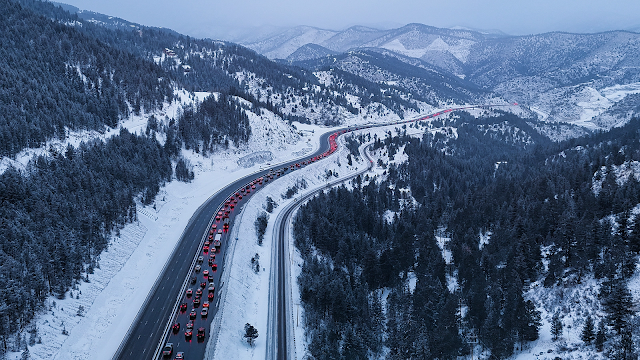
Colorado’s I-70 Has America’s Most Notorious Ski Traffic. Is There a Solution?


Originally, I had a vision. It involved getting into a car with strangers.

The idea struck me a few weeks before I left for Colorado, where I was going to report on the state’s notorious Interstate 70 traffic. Each winter, I-70 makes headlines and stymies skiers attempting to drive from Denver and the urban Front Range to the dozen or so resorts that lie west along the scenic and beleaguered 144-mile mountain corridor. The highway has even inspired its own Instagram account, @i70things, which features scenes of Corvettes squirming in the snow, semis jackknifed across the road, and the cherry-red ass ends of countless vehicles, all filmed by frustrated travelers.

I’ve been mired on I-70 myself, having lived on the Front Range until last year, when I moved back to my home state of California, to the mountains around Lake Tahoe. On my upcoming trip, I hoped to answer some of the questions I’d pondered as a Coloradan: What causes I-70 traffic? Could it ever be fixed? And what did traffic on I-70—and other infamous recreational arteries like Utah’s Little Cottonwood Canyon to Alta and Snowbird ski resorts or the Montauk Highway to Long Island’s beaches—reveal about our relationship with nature? (...)

I briefed my fiancé. He politely lauded my out-of-the-box thinking, but expressed valid concerns, including the offhand chance that I got murdered, or a more likely scenario in which I failed to convince anyone to let some rando into their car. He suggested I arrange a ride in advance.

I took to the keyboard with optimism. “Hi all!” I posted on three Denver-area skiing Facebook groups. “I’m looking for a fun group to hitch a ride with on Saturday January 6. … Looking for folks who were already planning to leave the Front Range at 7 A.M. or later.” I left my phone number, converting a few digits to text (“seven2zero…”) to foil the spam bots, and waited for the invitations to roll in.

The response was swift and derisive.
“That’s literally the worst traffic weekend of the year. Hard pass!” “Anyone leaving at that time of day, on that particular weekend is clearly a sadistic psychopath and should not be trusted to drive you anywhere.” “This is literally the first man [note: I’m a woman] that is actively trying to get stuck on i70.” (...)

I haven’t given up on my dream of a joyride with strangers. Dan and I sense an opening with a pair of thirtysomething dudes bound for Loveland Ski Area. The driver has his window down and gyrates to his music. He wears a big smile that gets bigger when we tell him we’re reporters from Outside. “Cool!” he says. Would he be willing to let me hop into his car? The smile stays fixed, but the eyes dart side to side.

I add, reluctantly, “You can say no.”

“OK,” he replies, still smiling. “No.” (...)

If you ask Coloradans what causes I-70 traffic, you’ll get theories about winter weather, curvy mountain roads, and tourists in rental cars. These factors do contribute to backups. But people also seem to intuit the main reason I-70 is congested, which is that it accesses stunning peaks, sprawling public lands, and some of the best ski resorts in the country—and everyone wants to get to them. Experts say it’s simple supply and demand: a highway built in the 1970s now handles traffic from a population that’s nearly tripled and visitorship that keeps growing, fueled in part by Americans’ record participation in outdoor activities. In 1973, when the first bore of what’s now called the Eisenhower-Johnson Memorial Tunnel was completed, 2.4 million cars used it to travel I-70 through the Continental Divide. Last year that number was 13 million. (...)


Travelers bogged on I-70 are known for amusing antics like skiing on the shoulders, doing pushups, or even playing volleyball next to their vehicles; last winter a bluegrass band performed a little outdoor concert for fellow travelers when the road closed. But for the state, I-70 congestion is a serious concern, and has been since at least the early 2000s. The highway is a major thoroughfare for residents and truck commerce, and it’s also crucial to the state’s tourism economy—travelers spend more money along the I-70 mountain corridor than in any region except Denver. The fear that traffic would deter visitors to Colorado’s tourism-based communities was one of the main reasons the nonprofit I-70 Coalition formed in 2004. But those concerns haven’t come to pass, Margaret Bowes, director of the coalition, tells me. Business along the mountain corridor continues to boom, and Colorado ski resorts broke visitor records the past two winters. “People have just come to accept that I-70 traffic is part of the deal if you want to ski or recreate on our mountain corridor,” Bowes says.

Yet what about all the people I know who refuse to drive I-70 on weekends anymore, who gave up skiing or even left Colorado altogether because they couldn’t deal with traffic? Bowes has talked to many of those people too. “But,” she says, with dry amusement, “it sure seems like for every one of those folks, another person or two was willing to take their spot.” (...)

Coloradans have long dreamed of a train along the I-70 mountain corridor. Some form of mass transit is in fact part of the Record of Decision, the plan that governs how the state must meet its forecasted 2050 traffic demands on I-70. Also part of the ROD is an additional bore of the Eisenhower Tunnel and expansion of the highway to six-lane capacity. Note the emphasis on capacity rather than six actual lanes, as geography, politics, and finances all limit the potential to widen I-70. Increasing capacity, then, includes projects that aim to move more people on existing infrastructure, such as by converting some wider shoulders into peak-hour traffic lanes.

According to ROD analyses, I-70 will need both six-lane capacity and mass transit to meet demand by 2050. But the state doesn’t have the money to complete either fantastically expensive project, and the technology for a rail-based transit solution through the mountain corridor is not yet proven. Colorado is particularly hamstrung by a state law that requires voters to approve any increase in taxes. For all their grousing about traffic, residents have nixed ballot measures in recent years that aimed to raise funds for infrastructure.

A new lane or train is also unlikely to reduce traffic on I-70 in the long-term, thanks to a phenomenon called induced demand. Induced demand says that adding capacity to a road—whether through infrastructure like a lane or public transit—will only temporarily relieve congestion. That short-term relief will then induce pent-up demand—for example, when all those people who haven’t been skiing in ages hear that traffic isn’t too bad anymore decide to try again—and eventually the road is just as congested as it was. The ROD doesn’t even claim that a train would reduce the number of cars on the road; mass transit is just expected to bring more people up to the mountains. According to induced demand, every driver who decides to take transit will eventually be replaced by another in their car. (...)

Over Martin Luther King weekend, storms battered Colorado. CDOT warned that travel would be “difficult to impossible,” but the holiday-goers and powder seekers went anyway. The combination of humanity and snowfall broke I-70. Multiple passes closed. Hundreds of vehicles spun out. Skiers reported eight-hour drives home. Stranded travelers overwhelmed Silverthorne, swarming gas stations and driving onto sidewalks in a scene one resident described as “apocalyptic.”

Why did these people go? I wondered, as I scrolled through the endless reel of chaos on @i70things. But I already knew, because I, too, had once passed beers to strangers in cars crawling alongside mine on I-70 after a ski day, had squatted peeing between a friend’s idling car and a guardrail mid-snowstorm. We’re all here for such a short time, and so little of that time is ours. How could we ask anyone not to spend their precious turn on this planet chasing whatever taps the dopamine dispensers in their brain?

Traffic is not a Colorado phenomenon, or a Western individualist one, or even an American one. It follows beauty, choking the roads from Lake Tahoe to Cape Cod. It springs from affluence, overwhelming Beijing, where a newly burgeoned middle class rushed to purchase cars as soon as they could afford them. It resists regulation, plaguing Mexico City, where some have bought two cars to thwart a law that allows only those with certain plates to drive certain days. Perhaps no observable phenomenon defines us more as a species than traffic: every one of us acting in our own self-interest, getting in one another’s way while we pursue the same things.

by Gloria Liu, Outside |  Read more:
Images: Daniel Brenner
[ed. I got stuck one year when the pass closed down due to heavy snowfall. Spent all night with the engine running to keep warm. Stepping out to pee, I had to push against three feet of new snow to even get the door open (worse if you went off the road shoulder). So, twelve hours later...finally through the tunnel, my new tire chains disintegrated and I almost got run over by a semi while laying in slush next to the roadway, trying to rip them off my axle. Good times. We have the same problem here in Washington state, with I-90 going east/west in and out of Seattle through Snoqualmie Pass in the Cascades. Unpredictable in the winter, you never know if or when it'll close; but for sure, every Sunday summer afternoon expect returning traffic to be miles long, bumper to bumper. For more great outdoor adventures (ha), see also: Why Does Yellowstone National Park Turn Us All into Maniacs? (Outside).]
***
Nothing screams “tourist” more than being a big, stupid American.

And I am legion. The U.S. has a near-infinite supply of clueless tourists such as myself, much to the dismay of our National Park Service. Yellowstone, our most famous national park thanks to Kevin Costner, welcomes 4.5 million of us each year. Like all of our parks, Yellowstone takes in tourists not only for the revenue but to remind them that the physical country they reside in is a marvel well beyond their comprehension. As such, Yellowstone is set up to accommodate these hordes. And while park officials do their best to keep tourists in line, often literally, my kind still manage to do plenty of tourist shit. We trample plant life. We get shitfaced and pick unwinnable fights with animals ten times our size. And we hurt ourselves. According to NPS data, at least 74 people have died while visiting Yellowstone in the past 15 years. I could have been one of those people. I deserve to be one of those people.

This is why Outside sent me to the park just a few weeks ago, during one of the busiest times of the year. They wanted me to observe our most basic tourists in the wild. Maybe I’d even get to see one die. Or, even better for my editors, maybe I would die while I was there. Maybe I’d look down my nose at the tourists around me only to end up as wolf food myself. Like most other Yellowstone visitors, I was not trained for the outdoors, I relish doing shit that posted signs yell at me not to do, and I often daydream about fighting bears (and winning!). I find danger tempting, which isn’t a good thing given that I can no longer swim a single pool lap without taking a break. Are people like me responsible enough to visit one of our national treasures without breaking it? Do we, as a population, know how to do national parks?

There was only one way to find out: by going into the park and behaving like an idiot.

Tuesday, December 31, 2024

On the Measure of Intelligence

Abstract 

To make deliberate progress towards more intelligent and more human-like artificial systems, we need to be following an appropriate feedback signal: we need to be able to define and evaluate intelligence in a way that enables comparisons between two systems, as well as comparisons with humans. Over the past hundred years, there has been an abundance of attempts to define and measure intelligence, across both the fields of psychology and AI. We summarize and critically assess these definitions and evaluation approaches, while making apparent the two historical conceptions of intelligence that have implicitly guided them. We note that in practice, the contemporary AI community still gravitates towards benchmarking intelligence by comparing the skill exhibited by AIs and humans at specific tasks, such as board games and video games. We argue that solely measuring skill at any given task falls short of measuring intelligence, because skill is heavily modulated by prior knowledge and experience: unlimited priors or unlimited training data allow experimenters to “buy” arbitrary levels of skills for a system, in a way that masks the system’s own generalization power. We then articulate a new formal definition of intelligence based on Algorithmic Information Theory, describing intelligence as skill-acquisition efficiency and highlighting the concepts of scope, generalization difficulty, priors, and experience, as critical pieces to be accounted for in characterizing intelligent systems. Using this definition, we propose a set of guidelines for what a general AI benchmark should look like. Finally, we present a new benchmark closely following these guidelines, the Abstraction and Reasoning Corpus (ARC), built upon an explicit set of priors designed to be as close as possible to innate human priors. We argue that ARC can be used to measure a human-like form of general fluid intelligence and that it enables fair general intelligence comparisons between AI systems and humans.

by François Chollet, Google, Inc./ArXiv, Nov. 5, 2019 |  Read more:

[ed. Click the pdf on the arXiv site for the full article. Apparently this is the acknowledged industry standard for assessing AI progress; a benchmark to determine when AI eventually reaches true Artificial General Intelligence (AGI). I don't have the ability to judge, but apparently the most powerful agent so far (as measured by this test) was just quietly revealed by OpenAI, the day before Christmas. o3- is a giant leap forward. See this post for everything we know so far (from 30,000 ft. up, to digging in the weeds): AI #96: o3 But Not Yet For Thee (DWAV). And: Time's Up for AI Policy (Miles Brundage):]
***
"The announcement of o3 today makes clear that superhuman coding and math are coming much sooner than many expected, and we have barely begun to think through or prepare for the implications of this (see this thread) – let alone the implications of superhuman legal reasoning, medical reasoning, etc. or the eventual availability of automated employees that can quickly learn to perform nearly any job doable on a computer.]"

Monday, December 30, 2024


John Moore. Spill, 2027. Ten Days, 2006-07.
via:

God in the Machine

Silicon Valley’s Obsession With AI Looks a Lot Like Religion (MIT Press Reader)
Image: Tech Agnostic, MIT Press

"The point here may be obvious, even painfully so: Our computing culture has become so ubiquitous and insular, so devoted and devotional, that it repeatedly recycles the tropes of traditional religions, because these are the patterns human beings evolved to deal with our anxieties about life, death, and the future. Our lives are painfully finite and contingent on countless factors far beyond our understanding, let alone our control, and we wish this were not so, because it is comforting to feel in charge of one’s own destiny. So we imagine that forces far beyond us are both subject to our logic and interested in our thoughts. (...)

“But,” you might very reasonably ask me, “you’re not talking about actual, noncrazy people who literally worship religion in a traditional way and worship tech at the same time, and think that the two things they’re doing are one and the same?”

To such a question, sadly, I would simply stare back at you, stone-faced.

To which perhaps you’d reply, “Are you?”

Pelle Cass, Futures Tennis, Brighton, Massachusetts (detail)
[ed. Reminds me of the hilarious Eschaton competition in DFW's Infinite Jest.]

Social History of the Cardboard Box

Amid confusion there was a friendly sign. A smile. An arrow. A smarrow. Stacked up between street trees along the service road behind my Manhattan apartment were thousands of cardboard boxes standing on end — Chewy, Blue Apron, Peloton — the rising stars of internet commerce in the early months of the pandemic. And, of course, Amazon. Every third box was Amazon’s, instantly recognizable, with that famous logomark connecting two letters in the company name, promising to deliver with alacrity everything from A to Z. This was essential work, or legally constructed as such. Almost overnight, East 23rd Street became a curbside distribution hub, where workers unloaded trucks and moved boxes by handcart, bringing shampoo and socks, meal kits and milk-bones, stationary bikes and sourdough starter kits to the 30,000 or so humans, plus a few thousand pets, holed up in Peter Cooper Village and Stuyvesant Town. We extracted our wares, carefully flattened and stacked the boxes, sent the cardboard back to the curb, ready for reincarnation at a recycling center. There was comfort in this ritual — or at least familiarity, which passes for comfort in difficult times. The smarrow points the way forward. (...)

As historian Maria Rentetzi writes, “the cardboard box — the waste of our commercial world — is recycled in such a way as to make visible the disorder in our societies, the faults of capitalism.” It is an abject object that touches all parts of the city, from the granite kitchen island to the sewer grate. And for many of us, the cardboard box is our closest touchpoint to globalized trade, structuring our relations with people in distant places. It brings the logistics chain to our doorstep. The magnificently ripped metal freight container may get the Economist cover shot, but the plain brown box delivers messages to our homes. Its very existence in our homes, Marshall McLuhan would say, is the message. In the immortal words of Walter Paepcke, founder of the Container Corporation of America, “packages are not just commodities; they are communications.” 

Let’s unpack that, shall we? Boxes are media in multiple senses of the word. They’re lithographed surfaces designed to be read, and they’re dimensional containers that mediate between outside and inside worlds. They’re “media of transport and information, shapers of public opinion and consumer desire, and means of targeting attention.” And they’re “logistical media” that “arrange people and property into time and space,” that “coordinate and control the movement of labor, people, and things situated along and within global supply chains. The cardboard box is a minimalist form with maximalist ambitions, an arboreal apparatus made from one of the world’s most abundant renewable resources, then filled with plastic and moved around by copious quantities of oil. It doesn’t just coordinate and control landscapes; it transforms them. 

Cardboard’s ubiquity rests on simple claims: I can hold that, and I can go there. The Container Corporation of America was founded in 1926, and upon those claims it built an empire with surprising reach. The CCA made collapsible shipping boxes, and it transformed packaging into a science and an art. It advanced market research, shaped mid-century taste, and altered the chromatic universe through color standards. (...)

Of course, the spiritual heir to Walter Paepcke’s CCA — the vertically-integrated, multiply-armed hegemon of packaging, shipping, branding, resource extraction, and cultural influencing — is Jeff Bezos’s Amazon. Meanwhile, the intense relationship between cardboard boxes and graphic design, fused in the art department at the CCA, has influenced a new generation of package design.

The rise in online commerce has created what The Atlantic’s Amanda Mull calls a “packaging arms race” wherein the box is commonly designed alongside the product. “Regular people are conversant in the language of branding,” and are also branding themselves, through the aesthetic spectacle of unboxing videos on TikTok and Instagram. That, in turn, has led to more telegenic boxes. As Orora Packaging Solutions’ Chris Bradley told the publication Packaging Dive: “I’m thinking about the way that a YouTuber … would unbox it when we’re in the design process, because we want to have that big ‘aha’ or ‘wow’ moment.” Packaging is engineered to produce a crinkly sound, to evoke sonic memories such as the rustle of tissue paper on Christmas morning. Boxes are fit tight, anticipation building with just the right amount of friction and drag, until the lid slides off, releasing a gust of air and a subtle pop. Apple’s elegant boxes are tiny white-cube galleries showing off objets d’art. And sometimes patterns or messages are designed inside the box to cultivate interior ambience and intimacy. (...)

The mark emphasizes efficiency and systematicity. It wants us to feel plugged into the systems of global capitalism that bring this fuel to our doorstep, the logistics hubs and data centers and cardboard waystations, and the geographies and communities shaped around them. All those boxes piled up on 23rd Street, whether stamped with a crass Walmart starburst or a “local everywhere” sunflower, they’re all printed somewhere, on offset presses in factories that flatten and fold the fibers from pines grown in the southeastern United States or Brazil or some new frontier. And they’ll have a life beyond their brief stay in our homes, whether they’re sent to the recycling plant or repurposed for local uses — in some cases, providing shelter for, or delivering humanitarian aid to, human beings who have little time for Instagram or fancy olive oil. (...)

Under consumer pressure, Amazon and Walmart have also implemented “sustainable” packaging standards in an effort to cut back on all the boxes and plastic air pillows. But that hasn’t worked exactly as planned. It’s spawned a new repackaging industry, which relies on intermediary contractors to unbox and re-box goods from third-party sellers so they meet Amazon rules. As Josh Dzieza explains, “Amazon only accepts goods that are packaged a certain way. Products need to be made ready for the automated gauntlet of the fulfillment center. Old barcodes and prices need to be covered up and new ones added. Glass needs to be bubble wrapped. Loose items need to be bagged.” These re-boxers, who operate their own small-scale prep centers across the country, and especially in states without sales tax, are an integral, if invisible, link in Amazon’s logistical network. And that network, too, runs on cardboard.


Cardboard is more recyclable than other packaging materials, yet each regenerative cycle shortens and weakens the pine fibers, pushing degraded bits through the screens. Fibers can typically be recycled only five to seven times. So our seemingly endless need for boxes demands new trees. In a vivid feature for The New York Times Magazine, Matthew Shaer reports, “In Georgia and Alabama, family operations have given way to small empires of tree plantations, built largely on private land, and largely by planting pines in a region where other types of trees — or other varieties of crops, like cotton — once grew.” These monocultures are less biodiverse and more poorly able to store carbon, filter drinking water, and reduce erosion. It’s “just pines, pines, as far as the eye could see.” New plantation pines and old Amazon boxes feed the region’s new mega-mills. (...)

In his 1946 book Paperboard and Paper Containers, Harry J. Bettendorf extolled the civilizational gifts of the cardboard box: “Out of the piles, confusion and dirt of the earlier period came the cleanliness, order, precision and efficiency of mass production goods through the employment of mass production packages of paperboard.” In this moment, in the pause after World War II, after the Container Corporation had sent its boxes into battle, but before it endeavored to shape civic discourse through Aspen elites, here is a historian who believed cardboard boxes could deliver us to a better future. Little did he know what piles of waste, ideological confusion, and environmental destruction would be generated by the whole box-powered system of mass production and hyper-capitalism. Bettendorf’s box was a Trojan horse. A smarrow. A promise of progress that delivered not only order, precision, and prosperity, but also waste and exploitation.

This medium, in its most rudimentary form, has six faces, with two liners — an inside and an outside surface — each of which tells a different story about its journey, and ours. A package appears on our doorstep. Its printed exterior graphics identify and emblematize the sender. Its interior graphics constitute an intimate form of address. The mailing label on top documents, in terms intelligible to the humans and machines that constitute a delivery service, the route by which which its contents have reached us. What terrains and portals has it passed through? Who has scanned its barcode, and where? The seal on the bottom chronicles the box’s journey from paper roll through three-dimensional form awaiting fulfillment and activation. That seal, a story, has an unwritten preface, too: it tells of trees and forests, of land as yet another subject of mass production. It also has a tacit postscript: reincarnation as a placard, a plea, as cartonera, as a wish that its own future conditions of production and distribution express and enact a world better than the one we have now. A box that treads more lightly on the landscapes from which it derives and through which it travels.

by Shannon Mattern, Places Journal | Read more:
Images: Nick Shere, via Flickr under license CC BY-NC-SA 2.0; Sainsbury Archive; Fabrice Florin, via Flickr under license CC BY-SA 2.0
[ed. Always feel slightly conflicted when I get a few new packages from Amazon (and see other piles stacked around the neighborhood). Especially when the boxes are oversized and overstuffed with packing materials. Bubble wrap for books?!]

Bleak Outlook for US Farmers

Many US midwestern grain farmers will lose money this year after reaping a bumper crop, and the outlook for their future income is bleak.

US farmers harvested some of the largest corn and soybean crops in history this year. Big harvests traditionally weigh on crop prices because of plentiful supply. And those price pressures comes at a time when costs remain persistently high to grow corn and soybeans, the US’s most valuable crops.

That double whammy is hurting farmers. Income will vary per farmer and per state, yet even for producers in top agricultural states such as Illinois, losses could be staggering.

Agricultural economists from the University of Illinois and Ohio State University estimate that the average Illinois farm could make a loss of $30,000 for 2024. Their projections place farm incomes at the lowest level since the 1980s’ farm crisis led to bankruptcies.

The decks are stacked against farmers for 2025 as well. Costs for seed, fertilizer and other inputs rose during 2022, fueled by the Russia-Ukraine war, which also lifted crop prices to record highs.

While crop prices are down nearly 50% from those highs, in part due to a global supply glut, input prices remain elevated. Sterling Smith, an independent commodities researcher, says the national average break-even price for corn is $5.67 a bushel, and $12.72 a bushel for soybeans. Those levels are far above current Chicago Board of Trade most-active futures prices of $4.43 for corn and $9.76 for soybeans.

“We’re looking at this crop, that, when it gets planted, of being a money-loser next year,” Smith says.

And things could look worse for farmers if Donald Trump places tariffs on imports. Trump pledged to impose across-the-board tariffs of 20% on all US imports, with a 60% tariff on Chinese goods. Recently, he advocated for 25% tariffs on goods from Canada and Mexico.

Mexico, Canada and China are the three biggest importers of US agricultural goods, and agriculture is among the US’s biggest export engines. The US Department of Agriculture (USDA) estimates 16% of the US corn harvest and 40% of soybeans are exported. A trade war between those three countries could have both short-term and long-term impacts, Smith says.

Until the first trade war between China and the US in 2018, China was the No 1 destination for US agricultural goods. That came to a halt during the trade war, although China and the US eventually signed an agreement in 2019 to import a set amount of agricultural goods for two years.

During the skirmish, China began diversifying its suppliers, including buying from Brazil. Brazil was already a global grower and exporter of soybeans, but Chinese investment ramped up expansion, Smith says.

“China is not going to put their food supply at risk,” Smith says.

Brazil increased their soybean production by the equivalent of an area the size of the state of Kansas, and some estimates suggest it has as much as 70m acres (28m hectares) of unused pastureland it can plant to crops, the equivalent of two states the size of Iowa.

Brazil can also grow the equivalent of two crops in one year, planting soybeans in September and after that harvest, quickly plant a corn crop, he says, increasing Brazilian corn production. If Brazil continues with its aggressive expansion and the US continues its traditional output, a global situation of habitual oversupply will result, especially for soybeans, Smith says.

“The bigger, long-term problem (for the US) is production gets restructured. Brazil begins to produce a lot more, and suddenly we are pushed out of the export market,” he says, “The bottom line is maybe we have to plant fewer acres.”

by Debbie Carlson, The Guardian |  Read more:
Image: Tannen Maury/EPA
[ed. The last paragraph is the kicker... didn't know Brazil was such a big producer of soybeans and corn (and poised to expand further).]


Untitled

The Outlier: The Unfinished Presidency of Jimmy Carter

I decided to read a 600-page book about Jimmy Carter because I was tired of only reading about the historical figures everyone already agrees are interesting.

John Adams became an HBO miniseries. Hamilton became a Broadway show. The Power Broker and The Years of Lyndon Johnson became such status symbols that there was a whole pandemic meme about people ostentatiously displaying them in their Zoom backgrounds. But you never hear anyone bragging about their extensive knowledge of the Carter administration.

Like most people under 70, I was more aware of Carter’s post-presidency role as America’s kindly old grandfather, pottering around holding his wife’s hand and building Houses for Humanity. I mostly knew that he liked to wear sweaters, that he owned a peanut farm, and that he lost to Ronald Reagan.

But I wondered what, if any, hidden depths lay within the peanut farmer. Also, I wanted to enter this contest, and I didn’t want to pick a book that I thought a bunch of other people might also review. So I turned to The Outlier: The Unfinished Presidency of Jimmy Carter, by Kai Bird. Like Carter, this book seems to have been largely forgotten. It won a Pulitzer, but I had never heard of it until I googled “best book about Jimmy Carter.” It seems to have gotten a lot less attention than similar recent biographies about Grant, Roosevelt, and Truman, and it’s hard to imagine it ever becoming a TV show or a musical.

Carter was born in 1924 in Plains, Georgia, which, as you can tell from the name “Plains,” is very dull. His father was a successful farmer, which made his family wealthy by local standards. Almost every other Plains resident during Carter’s childhood was an impoverished African-American, many of whom worked on the Carter farm, a fact that is often cited as the answer to the central mystery of Carter’s childhood: how he grew up white in the Depression-era South without becoming a huge racist. It probably doesn’t tell the whole story, though, as his siblings came out just about as racist as you’d expect.

Carter attends the Naval Academy and eventually becomes a lieutenant on a nuclear submarine. At one point, he participates in a cleanup mission in which he is lowered directly into the core of an active nuclear reactor, thus causing him to develop superpowers that he will later use to win the presidency. Perhaps because of this experience—but, more likely, because he realizes that his deep-seated religious beliefs make him a poor fit for a career in an organization designed to wage war—he quits the Navy at 29 and returns home to Plains. “God did not intend for me to kill,” he says, which would have been an awesome catchphrase had those superpowers actually been real.

Searching for a new career, Carter runs for State Senate, loses due to voter fraud, then challenges the results and wins by 15 votes in a new election. A few years later, he runs for governor, and loses for real this time, to avowed segregationist (and man with a truly awesome name) Lester Maddox. Having never experienced failure in any way before, Carter is plunged into a profound spiritual crisis by this loss. Today, we would probably just say he was depressed. But as a religious Christian in the Deep South in 1966, you don’t “get depressed,” you have a spiritual crisis.

In 1970 Carter runs for governor again. This time, however, he decides to do whatever it takes to win. He runs a sleazy campaign that flies in the face of his modern-day reputation as kindly and honest. His campaign strategy has two core planks: 1) pretend to be a racist to appeal to the masses, and 2) avoid taking a stand on any other issue. Carter describes himself nonsensically as a “conservative progressive” and avoids commenting on the Vietnam War or the civil rights movement. He’s so good at pretending to be racist that the white supremacist White Citizens Council endorses him. He even wins the endorsement of his old opponent, outgoing Governor Maddox, who’s term-limited from running again. As far as anyone can tell, Carter never expresses any second thoughts about his disingenuous behavior during the campaign. Having passed through his spiritual crisis, he’s now guided by an unshakeable faith in his own goodness—a faith that justifies a victory by any means necessary.

The “fake racist” strategy works. Carter trounces his opponent, a wealthy businessman named Carl Sanders who he caricatures as “Cuff Links Carl”—when he’s not busy falsely accusing him of corruption, or hypocritically bashing him for his support of Martin Luther King. In January 1971, Carter is sworn in as the 76th Governor of Georgia.

Just a few minutes into his inaugural speech, Carter drops the pretenses of his campaign and executes on one of the most dramatic about-faces in modern-day political history when he declares that “the era of racial discrimination in Georgia is over.” The crowd gasps audibly, and outgoing Governor Maddox denounces Carter as a liar before the inauguration is even over. But Carter doesn’t care. He’s governor now, and he’s going to do what he wants.

II.

And what he wants to do is… well, honestly, not all that much. Carter’s governing style is less “bold visionary,” more “competent manager.” He appoints more minorities to civil service jobs, starts an early childhood development program, and passes a reorg that streamlines a bunch of governmental agencies, but mostly he thinks about running for president. Governors in Georgia are limited to a single term, and Carter has national ambitions. He commits privately to a presidential run only a year into his time in the governor’s office.

When he first enters the 1976 Democratic primary, Carter is a complete unknown, and the general consensus is that he’s the longest of long shots. (“Jimmy who?” one opponent asks.) But two things go very, very right for him. First, he’s one of the few people who fully understands the changes to the Democratic primary process that were implemented after the chaos of the 1968 convention. He stakes his campaign on the now-familiar strategy of winning the Iowa caucuses and the New Hampshire primary, which is groundbreaking at the time. More importantly, the fact that no one has ever heard of him turns out to be a huge advantage in the wake of Watergate, when voters are hungry for an outsider.

Despite the fact that his gubernatorial campaign was premised entirely on obscuring his actual beliefs, he opens his presidential campaign with the slogan “I’ll never lie to you.” He runs an Obama-esque campaign, emphasizing his personal background and outsider status rather than any specific accomplishments. By the time he wins the primary, he has a huge polling lead over the incumbent president, Gerald Ford, who’s unpopular thanks to his recent pardon of Richard Nixon and the memory of that time he slipped and fell down the stairs of Air Force One.

Carter then proceeds to squander almost his entire lead via a series of poor campaign decisions. First, he’s so overconfident that he refuses to prepare for his first debate with Ford, and completely bungles it as a result. He then sits for an interview with Playboy weeks before the election and, completely unprompted, mentions that he’s “looked on a lot of women with lust” in his life and “committed adultery in [his] heart many times.” There’s a growing perception that Carter is, in the infamous words of one journalist, “a weirdo.” (...)

Although his lead shrinks consistently up through election day, Carter nonetheless manages to squeak out a narrow victory against Ford, 49.9 to 47.9%. Had just 10,000 voters in two states flipped their votes, Carter would have lost the electoral college. But they didn’t. And now, the weirdo has become the president.

III.

You’re Jimmy Carter, and just 23 years ago you were an unemployed Navy dropout. Now, you’re the most powerful man in the world. What do you do next?

The first answer is, you micromanage to a spectacular degree. Alone among all presidents since Truman, Carter refuses to appoint a Chief of Staff. He then immediately demonstrates why he needs one by involving himself in a comical number of minor decisions, including personally deciding which magazine subscriptions his speechwriting team should get, cutting down on the amount of food served at breakfast with congressional leaders, and canceling car service for his staff because it’ll save $92,000 of the $409 billion federal budget. Oh, and he also insists that all White House thermostats be set at 65° (55° at night), though this last mandate is eventually rescinded when the staff—some of whom are so cold they’ve been typing with gloves on—rebel.

The charitable interpretation of these decisions is that, in the wake of Watergate, Carter wants to emphasize that he and his staff are servants of the American people. The uncharitable interpretation is that Carter is an obsessive egomaniac who believes there is no situation that won’t be improved by his personal involvement.

The next thing Carter tries to do is a little bit of everything. Since his campaign was mostly focused on his personality and outsider status, he doesn’t have a specific core promise to fulfill, and as a result, his time in office is a hodgepodge of different legislative priorities. Sounds like a recipe for complete gridlock, but amazingly, Carter gets a good chunk of his agenda through Congress. He deregulates the airline and trucking industries, establishes the Department of Energy, and teams up with Ralph Nader to implement vehicle safety regulations. He passes a sweeping civil service restructuring bill, reforms Social Security, and expands the Head Start program. Oh, and along the way he also legalizes craft brewing. (...)

Somehow, he does all of this while having one of the worst relationships with Congress of any modern president. Some of the conflict is personal: Carter is the anti-LBJ in that he hates dealmaking and is perpetually unwilling to compromise. Deep down, he sees the dirty business of politics as inherently sinful, and he doesn’t understand why everyone can’t just do the right thing, especially when he’s explained to them at great length why it’s the right thing to do. He has huge Democratic majorities in both houses of Congress, but they relate to each other with barely veiled contempt. (It doesn’t help that Carter is the complete personal antithesis of Speaker of the House Tip O’Neill, a classic old-school Irish Democrat who loves back-slapping, cutting deals, and being a part of the Establishment Carter ran against.) Carter repeatedly vetoes bills passed by his own party because he has minor issues with them. At one point, he petulantly vetoes a $37bn defense bill because he thinks one specific item in it, representing less than 2% of the total, is a waste of money.

But some of the conflict is structural. To his credit, Carter is one of the first politicians to see that the post-New Deal consensus is fraying. Economic growth is slowing, inflation is rising, union membership is declining, all of which means that the traditional Democratic way of doing things—launching new federal programs, catering to interest groups, and accepting some waste and inefficiency as a cost of doing business—is on its way out, even if the old-school Dems don’t realize it yet. Really, Carter is less of a Democrat and more of a 1920’s-style Progressive Republican in the model of Teddy Roosevelt: focused on efficient, rational government, non-ideological problem-solving, and ethical stewardship.

Carter finds more success in the arena of foreign policy, where instead of dealing with mercurial politicians from his own country, he can deal with mercurial politicians from other countries. He starts by tackling the third rail of the Panama Canal. The United States built the Canal by essentially colonizing the part of Panama it runs through, and obviously, the Panamanians aren’t super cool with that. The U.S. government has been kicking the can down the road since the LBJ era by continually promising to return sovereignty over the canal to Panama eventually, and after over a decade of “eventually,” the Panamanians are getting impatient.

The politically easy move for Carter would be to drag out the negotiations until the canal becomes the next president’s problem, just as Johnson, Nixon, and Ford all did before him. But for better or for worse, Carter almost never does the politically easy thing. “It’s obvious we cheated the Panamanians out of their canal,” he says, and he negotiates a treaty in which ownership of the canal is turned over to Panama, in exchange for the U.S.’s right to militarily ensure its “neutral operation.” It’s a clever diplomatic solution—Panama gets nominal ownership while we retain all the benefits ownership provides—but the American public hates it. To the average voter, it feels like we’re just giving some random country “our” canal.

To get the treaty approved by the Senate, Carter plays the congressional negotiating game well for the first and maybe only time in his presidency. He lobbies heavily for his treaty with every senator, cutting individual deals with each of them as needed. One even goes so far as to say that in exchange for his vote, Carter has to… wait for it… read an entire semantics textbook the senator wrote back when he was a professor. Oh, and Carter also has to tell him what he thinks of it, in detail, to prove he actually read it. Carter is appalled, but he grits his teeth and reads the book. It’s a good thing he does, because the Senate ratifies the treaty by a single vote. Although it remains unpopular with the general public (five senators later lose their seats over their yes votes), those in the know understand that Carter cut a great deal for America. Panamanian dictator Omar Torrijos knows it too. Ashamed of his poor negotiating skills, he gets visibly drunk at the signing ceremony and falls out of his chair. He also confesses that if the negotiations had broken down, he would have just had the military destroy the entire canal out of spite.

Flush with confidence from his Panama Canal victory (his canalchemy? his Panamachievement?), Carter decides he should continue tackling foreign policy problems other people think are impossible. And there’s one obvious candidate: the conflict between Israel and the Arab states. Every single one of his advisors tells him this is a huge mistake and he definitely shouldn’t get involved, but knowing Carter, this only makes him want to do it more. His strategy: bring Egyptian President Anwar Sadat and Israeli Prime Minister Menachim Begin to Camp David for a series of intense negotiations. As usual, Carter believes that if he can just get the relevant parties in a room with him, he can convince them to see things his way.

At Camp David, as with the Panama Canal, Carter reveals himself to be a masterful negotiator, which only makes his constant inability to successfully negotiate with Congress all the more infuriating. When dealing with his own country, he’s disgusted by the horse-trading inherent in politics and continually shoots himself in the foot by refusing to get in the muck. But somehow, when dealing with other countries, he’s able to accept that there’s inevitably going to be a certain amount of dirty work involved. This biography doesn’t really try to provide a theory for this discrepancy, and I wasn’t able to come up with one either. Perhaps Carter holds his own country to a higher standard—or perhaps, as president, he sees himself as above Congress and expects a subservience he doesn’t expect from other countries’ leaders.

Anyway, after two weeks of nonstop conversation between the three countries’ teams—during which negotiations almost fail more than once—they reach a deal. Essentially, the broad outlines are: 1) Egypt will officially recognize Israel and end the state of war between the two countries and 2) Israel will stop building settlements in the West Bank and transition towards self-governance for inhabitants of both the West Bank and Gaza. The Camp David Accords, as they’re known, are a phenomenal success, putting the region on a path straight to the utopia it is today: a prosperous, conflict-free Middle East in which democracy and human rights flourish and the Palestinian people have full self-determination.

Sike! Obviously, that doesn’t happen. The Camp David Accords are seen as a triumph at the time, but in the long run, the picture is more mixed. The first part of the deal holds up, even after Sadat—who ends up becoming quite close with Carter—is assassinated by fundamentalists just a few years later. But the Israelis immediately welch on the second part of the deal and continue building settlements. Today’s Israel has more than 20x the number of settlers as it did then, making the intensity of the Carter/Begin dispute seem depressingly quaint in retrospect. 

by Max Nussenbaum, Astral Codex Ten | Read more:
Image: Andy Warhol

Sunday, December 29, 2024

The Joy of Clutter

In the late 20th century, Japan was known for its minimalism: its Zen arts, its tidy and ordered cities, its refined foods and fashions. But Tsuzuki peeled away this façade to reveal a more complicated side to his nation. And Tokyo was the perfect setting for this exfoliation. Like the interiors he photographed, it remains visually overwhelming – even cluttered. Outside, enormous animated advertisements compete for attention against a jigsaw puzzle of metal, glass, concrete and plastic. In the sprawling residential districts that radiate from the city centre, compact homes are packed in formations as dense as transistors on a semiconductor chip, while confusing geometries of power lines spiderweb the skies above.

In suburbs across the nation, homes filled to the rafters with hoarded junk are common enough to have an ironic idiom: gomi-yashiki (trash-mansions). And in areas where space is limited, cluttered residences and shops will often erupt, disgorging things onto the street in a semi-controlled jumble so ubiquitous that urban planners have a name for it: afuré-dashi (spilling-outs). This is an ecstatic, emergent complexity, born less from planning than from organic growth, from the inevitable chaos of lives being lived.

Tsuzuki dismissed the West’s obsession with Japanese minimalism as ‘some Japanophile’s dream’ in the introduction to the English translation of Tokyo: A Certain Style (1999). ‘Our lifestyles are a lot more ordinary,’ he explained. ‘We live in cozy wood-framed apartments or mini-condos crammed to the gills with things.’ Yet more than three decades after Tsuzuki tried to wake the dreaming Japanophile, the outside world still worships Japan for its supposed simplicity, minimalism and restraint. You can see it in the global spread of meticulously curated Japanese cuisine, the deliberately unadorned concrete of modernist architects like Tadao Andō, and even through minimalist brands like Muji – whose very name translates into ‘the absence of a brand’ in Japanese.

Millions around the world continue to turn to Japanese gurus for help in purging their diets, closets and living spaces of all but the most essential items. Books like Marie Kondo’s The Life-Changing Magic of Tidying Up: The Japanese Art of Decluttering and Organizing (2011) and Fumio Sasaki’s Goodbye, Things: The New Japanese Minimalism (2015) reframe clutter as a dire threat to mental health and spiritual growth. They have become colossal hits in the United States and other countries. However, as the world turns to Japan to tidy up, it’s important to remember that these books were originally intended for Japanese readers; they weren’t written for the world outside. If Japan truly were a minimalist paradise, why would it need Kondos and Sasakis in the first place?

Japan, then, isn’t really a paragon of refined simplicity. But if clutter is such an important part of everyday life here, why is it so often overlooked? The story of the world’s fascination with Japanese stuff is in many ways not about Japan at all. It is the story of our own changing desires, our social anxieties, our urges to consume and accumulate, and our realisation that possessing more things doesn’t necessarily translate into more happiness. In Japan, we believe we have found solutions to our problems.

The grass may seem neater on the other side, but Japan’s clutter tells a different story. It’s one that reveals a far more complex and nuanced relationship with stuff, one that suggests minimalism and clutter aren’t opposites, but two sides of the same coin.

by Matt Alt, Aeon |  Read more:
Images: Lee Chapman

Incoming!

They came from Florida, from Fox News and Fox Business, square-jawed men and women with big hair and collagen lips.

They came from professional football and World Wrestling Entertainment.

They came from daytime talk shows and reality television.

They were ‘straight out of central casting’, as the future president said.

Some of the women resembled his daughter and some of the women resembled his wife. None of the men resembled him.

A squad of them came with the future president to Madison Square Garden to watch Ultimate Fighting matches.

The future secretary of defence is adorned with the white supremacist tattoos of a Jerusalem cross, the Crusader rallying cry ‘Deus vult’ and an AR-15 assault rifle flanking an American flag.

The future secretary of homeland security once shot her hunting dog, Cricket, in a gravel pit because it couldn’t hunt, then shot her pet goat because it was getting old and ‘nasty’.

The future secretary of health and human services once cut off the head of a beached whale with a chainsaw, put it on the roof of his car and drove home. He brags that he has a freezer full of roadkill.

Less than half of all voters voted for the future president, but his team declared it a ‘landslide’, a ‘mandate’ to ‘drain the swamp’ and shake up the capital.

The future White House communications director calls the opposition ‘snowflakes’ whose ‘sad, miserable existence will be crushed’ when the future president returns to power.

The future director of the FBI promises a ‘government gangsters manhunt’ and revenge against disloyal journalists.

The future director of the Federal Communications Commission threatens to penalise television networks that criticise the future president.

They vow mass firings and the deportation of millions.

They vow to cut two trillion dollars from the federal budget – five times the combined annual salaries of all federal employees.

They vow an end to ‘wokeness’ in all its imagined forms and the return of American greatness.

But they have no connection to the work they will manage, or no experience in the work they will manage, or no experience managing large bureaucracies like the bureaucracies they will manage.

The future secretary of commerce is a billionaire.

The future secretary of the treasury is a billionaire.

The future secretary of the interior is a billionaire.

The future secretary of education is a billionaire.

The future special envoy to the Middle East is a billionaire.

The future director of the National Aeronautics and Space Administration (Nasa) is a billionaire. (...)

The future deputy assistant to the president and senior director for counterterrorism is a former Fox News regular and is banned from YouTube. He believes that violence is intrinsic to Islam. He wears the medal of the neo-Nazi Hungarian Order of Vitéz and was a supporter of the Magyar Gárda, a paramilitary group.

The future secretary of the navy has never been in the military, but he raised $12 million for the future president’s campaign at an event at his home in Aspen, where the future president warned that this ‘could be the last election we ever have’ if the ‘radical left-wing lunatics’ win.

The future ambassador to Israel is a Baptist minister and former Fox News host. He has said ‘there’s really no such thing as a Palestinian.’

The future senior adviser on Arab and Middle Eastern affairs is the father-in-law of the future president’s daughter.

The future special envoy to the Middle East is a frequent golf partner of the future president and has donated almost $2 million to his campaigns. He has close ties to Qatar.

The future ambassador to France, the father-in-law of another daughter of the future president, also donated $2 million to the campaign. He spent two years in prison for a number of offences, including hiring a prostitute to seduce and videotape his brother-in-law, who was going to testify against him. He will live in the luxurious Hôtel de Pontalba in Paris. (...)

The future White House deputy chief of staff for policy and homeland security adviser is allied with various white supremacist groups and is the most rabidly anti-immigrant member of the team. He believes ‘America is for Americans and Americans only,’ which means banning, among others, Muslims, refugees and university students from China, as well as deporting eleven million undocumented migrants. He was the architect of the policy of separating migrant children from their parents, and was seen gloating over photographs of children in cages. He has said that the Emma Lazarus poem (‘Give me your tired, your poor,/Your huddled masses yearning to breathe free’) at the base of the Statue of Liberty was a later ‘woke’ addition that has nothing to do with American liberty. He considers the future president ‘a political genius’.

The future border tsar, a Fox News regular, implemented the family separation policy during the future president’s previous administration. He has initiated a project called ‘Defend the Border and Save Lives’ in collaboration with an anti-Muslim group, the United West. He has said: ‘I will run the biggest deportation force this country has ever seen. They ain’t seen shit yet. Wait until 2025.’

The future secretary of defence, a Fox News host, has called for an ‘American crusade’, ‘a holy war for the righteous cause of human freedom’, because the ‘irreconcilable differences between the left and the right in America ... cannot be resolved through the political process’. He claims there is a ‘cultural Marxist revolution ripping through the Pentagon’, epitomised by the US military slogan ‘Our diversity is our strength,’ which he says is the ‘dumbest phrase on planet Earth’. He warns that the invasion of Ukraine ‘pales in comparison’ to the threat of ‘wokeness’, for ‘this unholy alliance of political ideologues and Pentagon pussies has left our warriors without real defenders in Washington.’ ‘The next president of the United States needs to fire them all.’ He is opposed to Nato and the United Nations. He is known for drunken displays in which he rants against Muslims. Accused of rape, he paid the victim to remain silent. His mother once sent him an email saying that he is ‘despicable and abusive’ and asked: ‘Is there any sense of decency left in you?’ (...)

The future president is currently selling caps, wrapping paper, blankets, football jerseys, boat flags, pickleball paddles, necklaces, earrings, silk ties, chopping boards, Christmas decorations, slippers, tie clips, door mats, aprons, pyjamas, socks, Advent calendars, Christmas stockings, mugs, keychains, sweatshirts, note cards, bracelets, scented candles, beach bags, flip-flops, bathrobes, towels, sunglasses, corkscrews, water bottles, stickers, jogging pants, wine and champagne glasses, earbuds, hoodies, jelly beans, cookies, chocolates, honey, jewellery boxes, whiskey decanters, trays, wallets, flasks, wines, coasters, umbrellas, golf bags, plates, ashtrays, sports bras and dog leashes – all with his name on them.

Also available are a $100,000 gold watch, a $11,000 autographed guitar, digital trading card NFTs featuring the future president in heroic historic tableaux, God Bless the USA Bibles, Never Surrender High-Top Sneakers, Fight Fight Fight Cologne for Men (‘For patriots who never back down’) and a celebratory Victory Cologne, which comes in a bottle in the shape of the future president’s head.

The future secretary of state had previously called the future president a ‘con artist’, a ‘Third World strongman’, ‘the most vulgar person to ever aspire to the presidency’, ‘a person that has no ideas of any substance’ and a ‘guy with the worst spray tan in America’ who wets his pants. He now says: ‘I didn’t know him as a person.’

by Eliot Weinberger, London Review of Books |  Read more:
Image: via
[ed. Can't wait for all the greatness. But then I thought... really? They can't all be billionaires. Sure enough, they aren't. Just almost billionaires. See also: The rich are controlling our government (Elysian):]
***
"Importantly: Both sides feature a lot of very wealthy people and organizations, making it highly likely that our government will always favor their interests rather than the interests of the American people at large. The parties themselves are effectively just a pool of wealthy donors. In 2024, the Republican National Committee was funded by JPMorgan and American Financial Group. The Democratic National Committee (DNC) was funded by Microsoft and Alphabet (Google). Sequoia Capital contributed to both the RNC ($1.3 million) and Kamala Harris’ campaign ($8.8 million), making sure their interests were represented no matter which candidate reaches office.

This is why many believe that America is no longer a democracy, but an oligarchy puppeted by wealthy individuals and organizations who will always fix the economy and our tax policies in their favor. Elite donors function like kingmakers, funding candidates during primary campaigns and making introductions that ensure that only those aligned with their interests make it to general elections. By the time a candidate makes it onto a ballot, they are already sufficiently donor-captured. And by the time American citizens vote on them, we are choosing between two candidates who both represent elite interests more than American interests. When those candidates finally make it into office, their wealthy donors have a lot of power over the policies that get put into place and are even appointed to positions of power.