Tuesday, June 10, 2025

Frank Zappa & the Mothers of Invention

Cheaper than Cheep
[ed. Not a big Zappa fan, but this is one is great. The xylophone/percussionist is Ruth Underwood.]

After more than 50 years in limbo, Frank Zappa’s long-shelved 1974 TV special Cheaper Than Cheep—originally shot guerrilla-style inside his Sunset Boulevard rehearsal space—is finally getting its due. Conceived as a DIY clapback to the commercially slick, glossy music shows of the era, the footage was benched thanks to clunky mid-’70s A/V sync issues. (...)

The set captures Zappa and his 1974 band in terrific form, blurring the line between rehearsal and performance, and making a bulletproof case for why this lineup is held in such high regard. It’s loose, it’s tight, it’s weird, it’s Zappa. The impeccable musicianship and occasional onstage chaos sounds GREAT.
via

via:

The Reality of Fan Disillusionment

When fan objects commit moral violations, what happens to the stans?

It takes a lot for me to be interested in films and shows about fans. This is because I’ve noticed most of it alternates between puff pieces and ghoulish take-downs, with a required dose of hagiography for the fan objects in question.


However, Fanatic (성덕), Oh Se-yeon’s 2021 documentary, seemed different from the get-go: it’s about the fans left behind when their fan objects have had a (deserved) fall from grace.

This is a deeply personal documentary on Oh’s part. She participates on-screen and discloses her struggle with the dissonance that comes with being confronted with an uncomfortable truth. In her case, she spent 7 years as a fan of singer Jung Joon-young, who was convicted of aggravated rape in 2019. Evidence of these crimes were uncovered in relation to the Burning Sun scandal that rocked South Korea.
Mr. Jung, along with other members of an online chat group, had bragged about drugging and raping women​ and had shared ​surreptitiously recorded videos of assaults.
This wasn’t the first time Jung was in hot water, having been the subject of allegations in 2016, which fans defended him from. But the evidence made the allegations a reality. What’s a fan to do when the illusion of their idol’s good nature is shattered so definitively? This isn’t about dating the wrong person, having a drug scandal, speaking out of turn, or delivering a subpar product, these actions are recognized as criminal for a reason.

The documentary doesn’t try to make fun of or pathologize fans; Oh wants to understand the emotional response that she and her fellow fans experienced. In an interview with Korea JoongAng Daily, she explains,
“When you become a fanatic, when you love someone to that extent, you don’t realize that you're doing that, that you’re the giving tree. I wanted to give everything to him, but I didn’t feel like I was sacrificing or giving up too much. That’s how immersed, devoted I was.”
Oh’s comment that “you don’t realize that you’re doing that” stands out as part of the problem. You don’t realize how deep you’re in until something happens that challenges your reality. It’s why I find it difficult to address comments about how stans are happy to be shelling out thousands and dedicating their lives to their fan object. Many things that we engage in willingly and that feel good in the moment are not necessarily good for us. Euphoric highs and dopamine hits don’t translate to healthy dynamics, in fact, they usually come at a cost.


Worse yet, we may be in denial about what we’re doing to ourselves, and the ultimate cost it may have. Oh revisits her journals in the film, including the clear-eyed question she posed in one, “What if I regret this when I go back to being a normal person who doesn't want to see you anymore?”

In a way, the film explores whether it’s possible to go back to being normal after this type of crisis. It’s one thing to grow out of your interest, have it displaced by real life activities and attachments, it’s another matter entirely to be faced with a conflict so profound that it shakes you to the core.

Oh speaks to friends of hers who have experienced similar fractures with other artists. Even her mother is featured as someone whose favourite actor was disgraced in a #MeToo scandal. Her quest to understand the driving force behind supporters that remain loyal lead her to a political rally in support of former South Korean president, Park Geun-hye, who was sentenced to 20 years in prison in 2018.

The discussions with fellow fans who were trying to make sense of their emotional reactions really resonated with me. The so-called “waking up” to just how deeply invested they were in what turned out to be an illusion. Because when there’s a perceived moral duty to defend your fan object, you’re operating on deeply felt knowledge that it’s what’s right. But that type of knowledge and belief can mislead us. Where do we go when the veracity of this knowledge, the basis for this unshakeable faith, is completely destroyed?

The evergreen response to fans feeling betrayed is that their fan objects don’t owe them anything. But this isn’t about the fans being owed something, it’s about emotional responses that cannot be reasoned away.

“Are we victims or perpetrators?”

There is also the question of what fans’ role is in all of this. Many fans feel a degree of responsibility for what happened, even as they themselves feel victimized. If you find it ridiculous that fans feel betrayed by someone they don’t know, the fact that so many of them feel that they need to answer for the crimes of their fan object should reveal the degree of attachment we’re discussing.

So much of it is about feelings. We can know, logically, that we aren’t responsible for someone else’s actions, but the guilt can still gnaw at you with tremendous force. Would these fan objects have become criminals even without being in the public eye? One fan feels like she helped commit the crimes. Another wonders if the adulation fundamentally changed who the idol was for the worse. Oh says in the film, “It seems like the support and love I gave that person became the driving force behind the crime and deception.” (...)

But some fans still remain. Excuses are made, even in a case like Jung’s. He was an innocent bystander and was tricked, or took the fall for a friend that was the primary perpetrator. It may seem extreme, but the mechanism behind these copes is the same across the board. Whether you want to call it betrayal blindness, cognitive dissonance resolution, or plain old denial, it’s operates the same whether a fan object is being defended from accusations of greed or an outright crime.

The moral violations may be trivial, but the response to them can nonetheless be outsized. Whether it’s right or justified is irrelevant in the face of the emotional tsunamis that materialize.

These experiences are universal, and a result of our parasocial investments. Seemingly an obvious statement, yet I feel like it’s rarely acknowledged. Or rather, parasocial attachment is treated like something that only happens to weirdos, but it’s something we all engage in. The most extreme form is something I’ve come to call parasocial limerence, which denotes a more intense, obsessive form. This term may be needed to differentiate between degrees and types of parasocial attachments.

by Monia Ali, Fandom Exile |  Read more:
Image: uncredited
[ed. Parasocial interactions/attachments. Common these days, probably due to omnipresent media saturation. From the comments:]
***
"A few months ago I had to teach Foucault's "Panopticism" to a college freshman class. One of the questions I presented them with ran something like: okay, so we've established that surveillance is a means of control: when somebody knows they're being monitored, they tend to behave how their audience wants or expects them to behave. So how does someone like Taylor Swift fit into this schema? We can agree that she's one of the intensely surveilled people on the planet; she can't do anything in public without her fans knowing about it, and there's occasionally intense speculation about what she does or thinks in private. So according to Foucault, what's the actual power dynamic between Swift and her followers?

It didn't click. The students had been following along up to that point and comprehended the basic idea of how watching exerts a form of control over the watched, but the whole thing broke down when they were asked to apply the same logic to a pop star. It was fascinating to see."
---
“waking up” to just how deeply invested they were in what turned out to be an illusion. Because when there’s a perceived moral duty to defend your fan object, you’re operating on deeply felt knowledge that it’s what’s right" This all reminds me of stories I've heard of devout older Catholics in tremendous pain and confusion when forced to confront the exposure of crimes by revered priests."
---
"this is really interesting, thanks for sharing. I think “fandoms” in general are more pervasive than we like to think. like it’s a symptom of the ubiquity of social media on top of a celebrity and idol culture. it’s easy to not be aware about who and why we “worship” certain people. But it feels like anyone noteworthy anymore inevitably builds a fan-fandom relationship domain. There’s no longer teachers, mentors, thought leaders, politicians—at least in the media realm. Only fans and fandoms. Anyway. It’s noticeable more with celebrities and idols, but this psychology is important to understand. Especially when the “contract” is violated and people feel betrayed on all sides."

Monday, June 9, 2025

I Analyzed the Chord Progressions of 680,000 Songs

Chordonomicon. I couldn’t get the word out of my head. Every syllable was just as beautiful as the last. Try saying it. Kord-oh-nom-i-con. It sounds like a mystical word. And, for me, it is. But it’s a term that didn’t exist last year. 

[ed. No, but Cryptonomicon did. Please read it, everyone.]

“Chordonomicon” was coined by 5 researches last October when they needed a name for a new project that they’d just completed. This project pulled together chord progressions and genres for nearly 680,000 songs from the popular music learning website Ultimate-Guitar. I knew I had to do something with the data. But what? (...)

Typically, when I write a data-driven piece for this newsletter, my approach is somewhat scientific. First, I have a hypothesis, like “there has been an increase in music biopics over the last few years.” Then I find some data to test that hypothesis. Whether I’m correct or not, I publish the results. For example, when I looked at music biopics, I found that on an absolute basis there was a dramatic increase over the last few years, but on a relative basis, the peak was in the 1940s.

I didn’t really have a hypothesis to test with the Chordonomicon dataset, though. I just wanted to explore what was in there. There had to be something interesting among 680,000 chord progressions. And there was. But, first, we should start with a simple question: What’s a chord?

If you’re looking for in depth discussions on music theory, I’m not your guy. (You should probably turn to someone like Ethan Hein and his newsletter Ethan teaches you music.) But for this case, I think some basic definitions will help. A “note” is a single pitch. When you hit one key on the piano, for example, you are playing a note. An “interval” is a combination of two notes. A “chord” is a combination of three or more unique notes (e.g., a C major chord is comprised of the notes C, E, and G).


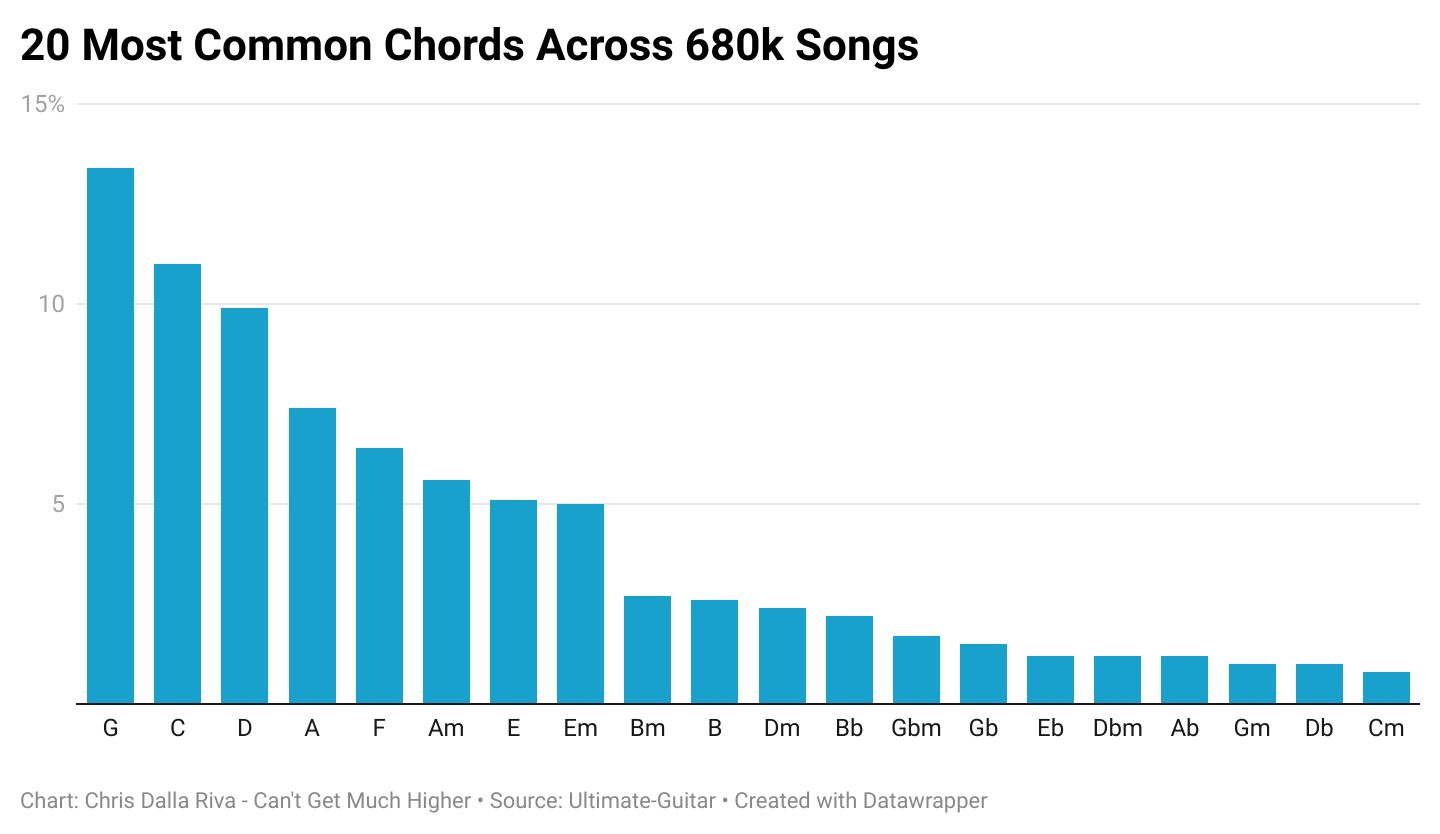
Above you can see a breakdown of the top 20 most common chords across the nearly 52 million chords notated in the Chordonomicon dataset. If you’ve ever played a guitar or piano, you won’t be surprised by the fact that G major and C major are at the top, accounting for 24% of all chords. These are some of the first chords you learn on those instruments. What’s interesting is that chord choices differ when you look across genre.

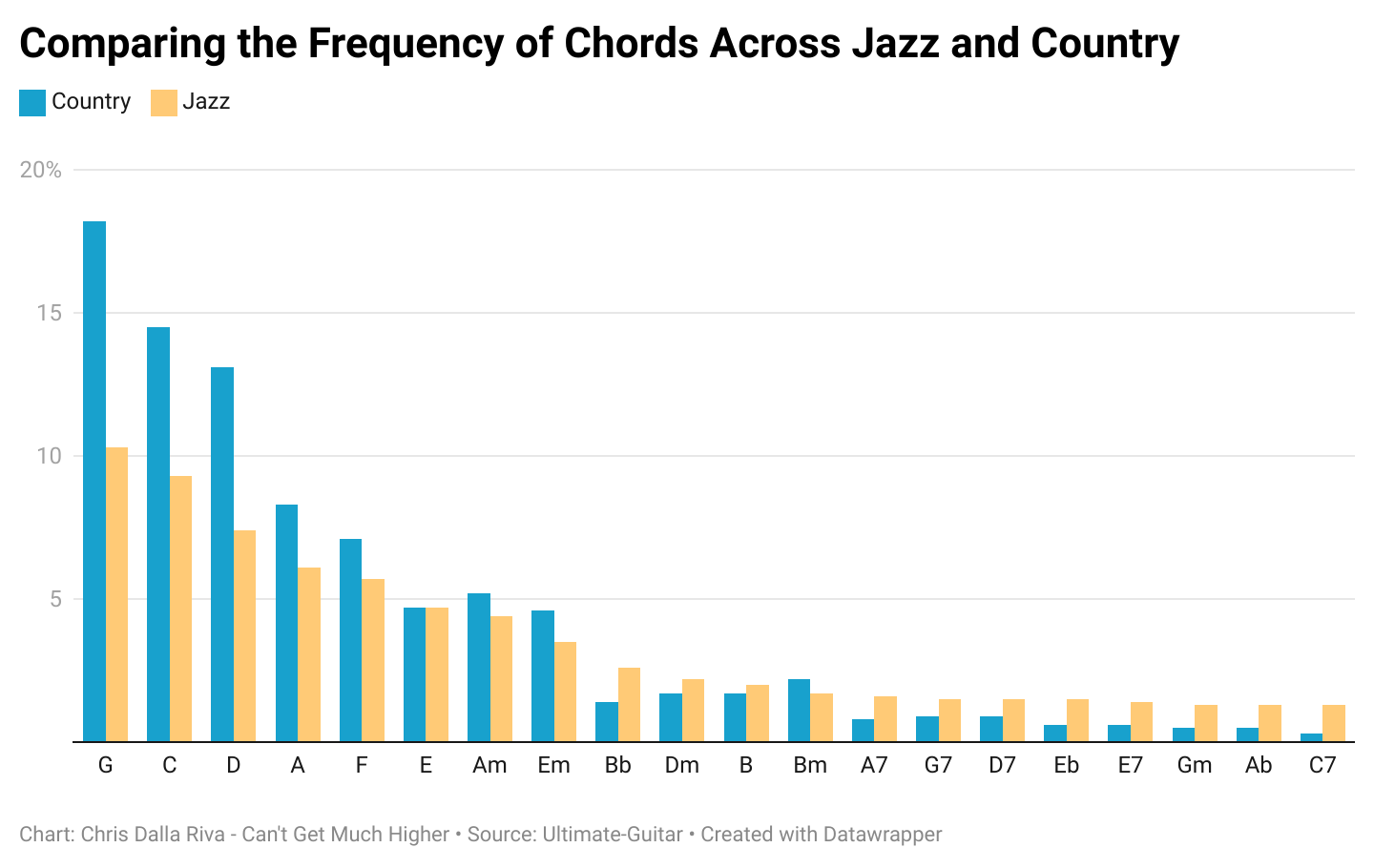
Below you can see a usage comparison of 20 common chords in jazz and country. The differences are stark. In country, for example, five major chords — G major, C major, D major, A major, and F major — comprise 61% of all chords played. Among jazz songs, by comparison, those chords only make up 39% of total chords. Nevertheless, if we take a look at some other chords, the relationship flips. Bb major, for example, makes up 2.6% of all chords in our jazz sample. For country, it’s 1.4%, almost half.


What explains these differences? Of course, some of it is connected to arbitrary compositional choices. But another piece is explained by the instruments used in each genre. For example, the trumpet is commonly used in jazz, and trumpets are tuned to Bb. Similarly, banjos and guitars are common in country. Banjos are tuned to open G, and, as noted, chords like G, C, and D are some of the first you will learn when picking up the guitar.

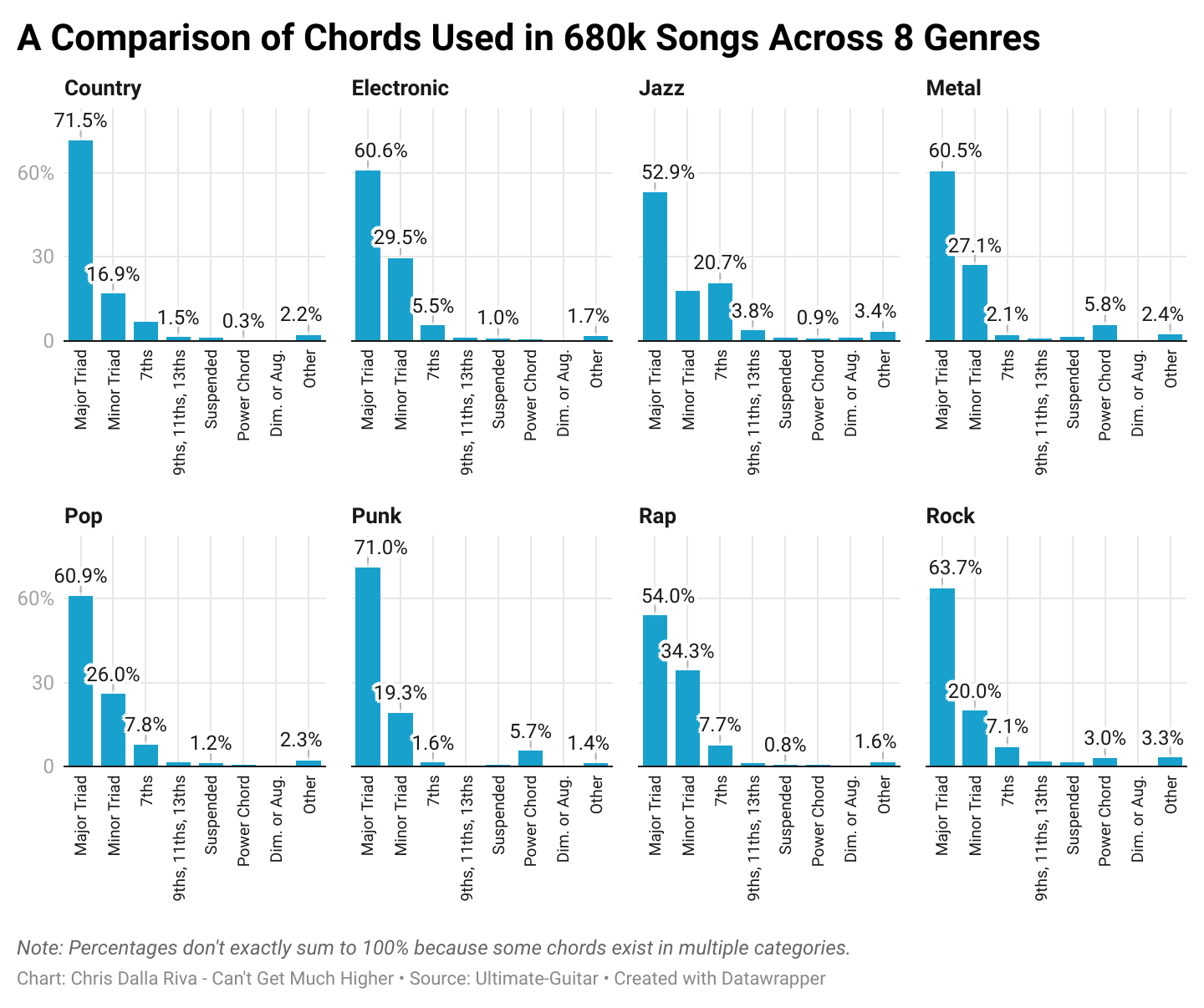
Looking at individual chords across a bunch of genres is a bit chaotic, though. Instead, we can group chords into a few categories to make cross-genre comparisons a bit more digestible. Below we can see that while your simple, three-note major chords (e.g., A major, Db major) are the most common across every genre, there are some stark differences in other categories. 7th chords, for example, are 2.5 to 13 times more common in jazz than any other genre. Similarly, power chords are 2 to 21.5 times more common in punk than any other genre. Furthermore, Suspended, diminished, and augmented chords basically don’t exist in rap.


But it’s not just interesting to compare these chord categories across genre. It’s interesting to compare them over time. Below you can see the prevalence of each chord type by decade from the 1930s to the 2020s. The most striking trend is that 7th chords have fallen into disuse. In the 1940s, 27.7% of all chords were 7th chords. Thus far in the 2020s, only 8.25% are. This decline is largely connected to the decline of jazz, a genre where the 7th chord family was a defining feature. As jazz has lost favor, simple minor triads (e.g., E minor, Ab minor) have become more prevalent.

by Chris Dalla Riva, Can't Get Much Higher |  Read more:
Images: the author

Sunday, June 8, 2025


Birches
via: misplaced

Milcho Leviev Quartet (feat. Art Pepper)

[ed. Pretty much interchangeable with the Art Pepper Quartet (same members). Also, don't miss this one - An Afternoon in Norway: The Kongsberg Concert (which I think went down the night after this was recorded, and includes a personal fav, Patricia).]

via:

The Man in the Midnight-Blue Six-Ply Italian-Milled Wool Suit

The Dream

A fine suit made just for me. From the best fabrics. By the best tailor. Paired with the best bespoke shoes.

A suit that would make me feel at ease, while declaring to others, “Here is a man who feels at ease.” A suit that would be appreciated by the world’s most heartless maître d’. A suit that would see me through the immigration checkpoints of difficult countries. A suit that would convince readers that the man in the author photo has a sense of taste beyond the Brooklyn consensus of plaid shirt and pouf of graying hair.

The suit would serve as the perfect carapace for a personality overly dependent on anxious humor and jaundiced wit, a personality that I have been trying to develop since I saw my lightly mustached punim in the mirror as a pubescent boy and thought, How will I ever find love? The suit would transcend my physicality and bond with my personality directly. It would accompany me through the world’s great salons, the occasional MSNBC appearance, and, most important, the well-compensated talks at far-flung universities. The suit would be nothing less than an extension of myself; it would be a valet preceding me into the room, announcing with a light continental accent, “Mr. Gary and his suit are here now.” Finding this perfect suit, made by the most advanced tailor out of superlative fabric, would do nothing less than transform me.

The Body

Before there is a suit, there is a body, and the body is terrible.

First there is my shortness (5 foot 5 and a half, with that “half” doing a lot of work). Being short is fine, but those missing inches are wedded to a narrow-shouldered body of zero distinction. Although I am of Russian and Jewish extraction, the continent whose clothing stores make me feel most at ease is Asia. (I once bought an off-the-rack jacket in Bangkok after the clerk examined me for all of three seconds.) However, this is not exactly an Asian body either, especially when I contrast myself with the natural slimness of most of my Asian friends. Just before my bar mitzvah, I got a set of perfect B-cup knockers and had to squeeze into a “husky” suit to perform the ritual yodeling at the synagogue. But that’s not all. Some hideously mismanaged childhood vaccination in Leningrad created a thick keloid scar running the length of my right shoulder. The shame of having this strange pink welt define one side of me led to a slumped posture favoring my left shoulder. When I finally found people to have sex with me—I had to attend Oberlin to complete the task—my expression upon disrobing resembled that of a dog looking up at his mistress after a bowel movement of hazmat proportions.

Before the Suit

The clothes before the suit were as bad as the body.

I was born in the Soviet Union in 1972 and was quickly dressed in a sailor’s outfit with white tights and sexy little shorts, then given a balalaika to play with for the camera. The fact that Russia now fields one of the world’s most homicidal armies can partially be explained by photos such as this. On other occasions I was forced to wear very tight jogging pants with a cartoon bunny on them, or a thick-striped shirt dripping with medals from battles I had never seen. These outfits did make me feel like I belonged to something—in this case, a failing dictatorship. I left the U.S.S.R. before I could join the Young Pioneers, which would have entailed wearing a red tie at a tender age, while prancing about and shouting exuberant slogans such as “I am always ready!” (...)

Growing Up Tasteless

High school found me trying to blend in with a suburban outlay of clothes that my now middle-class family could finally afford. These were surfer T-shirts from Ocean Pacific and other brands that suburbanites who survived the 1980s might remember: Generra, Aéropostale, Unionbay. Unfortunately, I did not go to high school in Benetton Bay, Long Island, but in Manhattan, where these shirts were immediately a joke. (This would become a pattern. By the time I figure something out fashion-wise, I’m already two steps behind.) At a high-school job, my boss bought me a set of colorful Miami Vice–style shirts and jackets. These proved ridiculous at Oberlin, where dressing in janitor uniforms from thrift shops was considered the height of style. (Ironically, I had worked as a janitor during the summer, at the same nuclear laboratory that employed my father.)

After college, I fell in with a crowd of artsy, ketamine-addicted hipsters, and together we managed to gentrify several Brooklyn neighborhoods during the late ’90s. One of my friends, who was especially fashion-conscious, began to dress me at the high-priced secondhand emporium Screaming Mimis. The clothes she told me to buy were very itchy, mostly Orlon and Dacron items from ’70s brands such as Triumph of California, but these tight uniforms, like their Soviet predecessors, made me feel like I was playing a part in a grander opera, while also serving as a form of punishment. On nervous dates, I would sometimes have to run to the bathroom to try to angle my acrylic armpits under the dryer.

Because I was a writer who worked in bed, I mostly did not need a suit, although when I got married, in 2012, I went down to Paul Smith to get a herringbone number that I thought was just fine, if not terribly exciting. I bought a J.Crew tuxedo for black-tie benefits. Once, I did a reading sponsored by Prada and was given a nice gray jacket, pants, and a pair of blue suede shoes as compensation. Come to think of it, there was also a scarf. As a final note, I will say that I am incredibly cheap and that shopping for clothes has always raised my blood pressure. Leaving Screaming Mimis after spending more than $500 would always end in me getting terribly drunk to punish myself for the money I had blown on such a frivolous pursuit.

The Dream Begins

When I reached the age of 50, mildly prosperous and with a small family, I met a man named Mark Cho. We discovered each other because of a mutual love of wristwatches (a costly middle-aged hobby I had recently acquired), and because I knew about his classic-menswear store, the Armoury, with locations in New York and Hong Kong. The Armoury has been called “a clubhouse for menswear nerds”; if you’re looking for, say, a cashmere waistcoat in “brown sugar,” you have found your home. I had even given one of the characters in my latest novel, a dandy from a prominent Korean chaebol family, an article of clothing from that store to wear.

We met for dinner at Union Square Cafe, and I liked him (and his clothes) immediately. Mark was almost always dressed in a jacket and tie, and would often sport a vest along with spectacles made of some improbable metal. What I loved about him was how comfortable he appeared in his medley of classical attire, and how, despite the fact that all of his garments had been chosen with precision, he gave the impression that he had spent very little time and thought on which breathable fabrics to settle over his trim body. He looked like he was, to use my initial formulation, at ease.

Later, I would learn that this whole look could be summarized by the Italian word sprezzatura, or “studied carelessness,” and later still I learned of something that the Japanese had discovered and refined: “Ivy style,” which is basically studied carelessness goes to Dartmouth. For the time being, I knew that I liked what I saw, that my inner lonely immigrant—the one who is always trying to find a uniform that will help me fit in—was intrigued. Mark once gave me an Armoury safari jacket, the very same one worn by the character in my novel, and its light, unflappable linen proved perfect for my summer readings around Germany and Switzerland that year. Everywhere from starchy Zurich to drunken Cologne to cool-as-fuck Berlin, the jacket would pop out of a suitcase and unwrinkle itself in seconds, yet it was also stylish and seemingly impervious to the odors of my non-Teutonic body. It was, to use Hemingway-esque prose, damn well perfect, and I immediately knew I wanted more.

I had lived in Italy in my 30s and met many aristocrats there. Those bastards had sprezzatura to burn, but when I asked them the make of their suits and jackets, they would smile and tell me it was the work of a single tailor down in Naples or up in Milan. Ah, I would say to myself, so that’s how it is. Given my outlook on life, owning a bespoke suit was not an outcome I was predestined for. The Prada jacket I had been given, which fit me well enough, was the most that my Calvinist God would ever grant me.

But over more martinis and onglets au poivre with Mark, I began to understand the parameters of a fine bespoke suit and its accessories: bespoke shirts and bespoke shoes. I also began to timidly ask questions of a financial nature and learned that the price of owning such a wardrobe approached and then exceeded $10,000. I did not want to pay this kind of entry fee. Given my own family’s experience in fleeing a declining superpower, I try to have money saved with which to escape across the border. Unlike watches, a suit could not be resold in Montreal or Melbourne.The suit would be nothing less than an extension of myself; it would be a valet preceding me into the room, announcing with a light continental accent, “Mr. Gary and his suit are here now.”

A brief but generative conversation with my editors at this magazine soon paved the way for my dream to become possible. At a particularly unsober dinner with a visiting Japanese watchmaker, I whispered to Mark the extent of my desires. Yes, it would take a lot of work, a lot of research, and possibly travel to two other continents. But it could be done. At the right expense, with the most elegant and sturdy of Italian-milled fabrics, and with the greatest of Japanese tailors, a superior suit could be made for anyone, even for me. (...)

Yamamoto-San Arrives

On May 24 of the fateful year 2024, a plane from Tokyo landed in New York City, carrying one of the most meticulously attired men in existence. His name is Yuhei Yamamoto, and he is the preeminent representative of Ivy style, that mode of dress that Americans appreciate yet only the Japanese fully understand.

The British suit, in all its City of London severity, morphed into different shapes around the world. The Italians made particularly interesting work of it. The Milanese suit was the most British-like, but as you traveled farther down the boot to Florence, Rome, and Naples, the tailors became more freehanded; the colors and fit became jauntier and more Mediterranean, more appreciative of bodies defined by crooked lines and curves and exploded by carbohydrates. Meanwhile, in America, as always, we went to work. The suit became a uniform that stressed the commonality and goodness of Protestant labor and church attendance without any further embellishments. It came to be known as the “sack suit.” In the 1950s, Brooks Brothers furthered this concept with an almost subversively casual look: a jacket with natural-width shoulders that hung straight from the body, and plain-front trousers. This, along with other American touches, such as denim, became the basis for Ivy-style clothes that the Japanese of the ’60s made into a national obsession, and that culminated in a wholly different approach to workwear, office wear, and leisure wear. Today, you can’t go into a Uniqlo without seeing the aftereffects of Japanese experimentation with and perfection of our “Work hard, pray hard” wardrobe ethos.

I met Yamamoto-san at the Upper East Side branch of Mark Cho’s Armoury empire. The moment I first saw him, I was scared. No one could be this well-dressed. No one could be so secure in a tan three-piece seersucker suit that didn’t so much hang from his broad shoulders as hover around them in expectation. No one’s brown silk tie could so well match his brown polka-dot pocket square and the thick wedge of only slightly graying hair floating above his perfectly chiseled face. This man was going to make a suit for me? I was not worthy.

Yamamoto-san examined me briefly and said, “Sack suit.”

by Gary Shteyngart, The Atlantic | Read more:
Image: Leung Man Hei and Dina Litovsky for The Atlantic

The Man Putin Couldn’t Kill

Interpol had been looking for a disgraced finance executive for weeks when Christo Grozev, an investigative journalist, found him, hiding in Belarus. Grozev had become expert at following all but invisible digital trails — black-market cellphone data, passenger manifests, immigration records — in order to unmask Russian spies. These were the sleeper cells living in Western countries and passing as natives, or the people dispatched to hunt down dissidents around the world.

He identified the secret police agents behind one of the most high-profile assassination plots of all: the 2020 poisoning of the Russian opposition leader Aleksei Navalny. That revelation put Grozev in President Vladimir Putin’s cross hairs. He wanted Grozev killed, and to make it happen the Kremlin turned to none other than the fugitive financier, who, it turns out, had been recruited by Russian intelligence. Now the man that Grozev had been tracking began tracking him. The fugitive enlisted a team to begin the surveillance.

The members of that team are behind bars now. The financier lives in Moscow, where several times a week he makes visits to the headquarters of the Russian secret police. Grozev — still very much alive — imagines the man trying to explain to his supervisors why he failed in his mission. This gives Grozev a small measure of satisfaction.

On May 12, after a lengthy trial, Justice Nicholas Hilliard of the Central Criminal Court in London sentenced six people, all of them Bulgarian nationals, to prison terms between five and almost 11 years for their involvement in the plot to kill Grozev, among other operations. The group had spent more than two years working out of England, where the ringleader maintained rooms full of false identity documents and what the prosecution called law-enforcement-grade surveillance equipment. In addition to spying on Grozev and his writing partner, the Russian journalist Roman Dobrokhotov, the Bulgarians spied on a U.S. military base in Germany where Ukrainian soldiers were being trained; they trailed a former Russian law enforcement officer who had fled to Europe; and most embarrassingly for Moscow, they planned a false flag operation against Kazakhstan, a Russian ally.

In the past two decades England has been the site of at least two high-profile deadly operations and more than a dozen other suspicious deaths that have been linked to Russia. Yet the trial of this six-person cell appears to be the first time in recent history that authorities have successfully investigated and prosecuted Russian agents operating on British soil. The trial and its outcome, then, are victories. They are small ones, however, relative to the scope of the threat. The Bulgarians seem to be only one part of a multiyear, multicountry operation to kill Grozev. That in turn is only a small part of what appears to be an ever-broadening campaign by the Kremlin, including kidnappings, poisonings, arson and terrorist attacks, to silence its opponents and sow fear abroad.

The story of the resources that were marshaled to silence a single inconvenient voice is a terrifying reminder of what Putin, and beyond him the rising generation of autocratic rulers, are capable of. The story of how that single voice refused to be silenced — in fact redoubled his determination to tell the truth, regardless of the very real consequences — serves as a reminder that it’s possible to continue to speak and act in the face of mortal danger. But the damage that was done to Grozev’s own life and the lives of the people around him is a warning of how vulnerable we are in the face of unchecked, murderous power.

by M. Gessen, NY Times |  Read more:
Image: Hokyoung Kim
[ed. Fascinating. A real-life spy thriller (that even includes George Clooney). If you can't get around the Times' paywall, the whole story can be found here.]

Friday, June 6, 2025

Technology Does Not Solve Political Problems

If you are fortunate or unfortunate enough to spend time around people who work for big tech firms, you will find that their views on every issue tend to be rooted in the assumption that the tech industry itself will determine the future of said issue. So discussions about the economy become, “What will AI mean for the economy?” Discussions of politics become, “How will new tech help my side win the next election?” Discussions of climate change become, “How fast can we innovate ways to capture carbon in the atmosphere?” Discussions of culture become, “Is AI making good art?”

In other words, do not hang out with tech people if you can help it.

Kidding! To some extent, this is just a tic of human nature—hanging out with media people will force you to endure endless conversations about news stories that imply that reality is little more than fodder for journalistic angles, which are what really matters. In the case of tech, though, the consequences can be worse than just tedium. That’s because the tech industry is uncommonly consequential to all of us—and the techno-utopian vision prevalent within the industry, which assumes that the world’s problems are a series of technological problems to be solved, and that technological progress is the key driver of increased human well-being, can therefore lead to uncommonly bad outcomes for society, when it turns out to be a critically incomplete understanding of how things work.

Alfred Nobel claimed to be surprised that his invention of dynamite contributed to war, not peace. Had to establish that Peace Prize to try to even the scales for all the dead bodies. This is as good a lesson as any for well-meaning tech industry people who possess a genuine belief that we can innovate our way out of social and political problems. We can’t. That’s because technology, while an extraordinarily powerful tool, does not by itself change the way that power is distributed in society. If the hand that holds the dynamite wants to use it to clear away rocks, you get great new roads. If the hand that holds the dynamite wants to use it to make bombs to drop on neighbors, you get mass death. If you say, “We’ll only give dynamite to peace-loving people,” the stronger, war-loving people will come and take it away. If you don’t change the overall power arrangement, new technology will just make strong people stronger. So too with today’s technologies. Except worse.

Consider the internet—the most transformative technology of my lifetime, so far. Tom Friedman and all of the other techno-utopians told me that the widespread availability of cheap high speed internet and smartphones would enable the cab driver in Djibouti to become an online entrepreneur just as easily as someone in Silicon Valley, and a new wave of equal opportunity would revolutionize the future of the world. Is that what happened? I don’t mean in an anecdotal sense, Is that the big socioeconomic story of the internet? No. The big socioeconomic story of the internet, despite all of the ways that it has changed our culture and entertainment and communication and Ways We Summon a Car, is that it has produced the biggest individual fortunes that the modern world has seen. It has, by any reasonable measure, increase inequality. It has consolidated more power in a smaller number of hands. Yeah, the Arab Spring was planned on Facebook. It failed. So were some genocides. They succeeded. In the past you had to buy a printing press to spread your words. Now you can publish things globally for free. Despite that fact, information control has become so centralized on a small number of platforms that the world’s richest man saw fit to spend $44 billion to buy a social media platform, and used it to help elect a fascist. All the guys who control the biggest tech companies, the ones that we were told would unleash a new World That Is Flat that would allow anyone anywhere to use these amazing new free or low-cost tools to compete with the well-funded big boys, ended up sitting behind the fascist on stage when he took the oath of office. Hey, whoa! Where did the internet age’s beautiful dream go off the rails?

The answer, of course, is that the belief that a radical new technology would produce a radical new world was always naive. Technology is not politics. It cannot solve political problems. It can, however, exacerbate political problems. The power of new technologies, controlled by the strong, makes them stronger. Obviously! I’m sure it sucked to get hit with a stick but it sucked even worse to get sliced in half with a hardened steel sword and even worse to be mowed down with a machine gun and even worse to have your whole city incinerated with an atomic bomb. All of these technologies have far more productive uses than war; but they were used for war because war is how strong people build and consolidate and maintain their own power. That is the thing that strong people do, above all. The internet doesn’t shoot you, but it has allowed strong people to create a total surveillance state and then guide missiles directly into your bedroom window, if they deem it necessary. Tom Friedman may protest that he was talking about other uses of the internet. Turns out that doesn’t matter. Great power concentrated in few hands means that those are the hands that will control the new technology. That means that the new technology will be used for their benefit. All visions of a sunny, technology-enabled bounteous future that do not grapple with this basic fact are doomed to be revealed, one day, as parodies of themselves.

This same pattern will hold true with AI, which is (presumably) the next great tech advance of our time. Absent very strong government regulation to prevent it, it is virtually certain that AI will lead to a greater concentration of wealth in fewer hands, as it replaces labor to the benefit of the investment class. To a lesser degree, the winners of this process will be the executives and (to an even lesser degree) the workers at the tech firms that produce and perfect the new technology. You don’t have to be much of a futurist to see this all coming. Nor do you have to be unreasonably grumpy to be a pessimist about the prospects of reining this in before it’s too late. Having watched this generation of big tech companies successfully avoid most meaningful regulation, the AI companies have a strong playbook to follow, and plenty of money to invest in removing all obstacles in their path. The Republican tax bill that just passed the House includes a provision blocking states from regulating AI for the next ten years. In ten years, it will be too late. All according to plan.

This is, I admit, a pretty grim vision for the nice regular people who work in tech. You liked computers and so you went to school for it and got a job at a big tech company and next thing you know you’re BUILDING THE EVIL PANOPTICON in exchange for a six figure salary and free lunch. The dark political outcome of this process is not what many of these workers thought they were signing up for. The good news is that there is something that these people can do that will meaningfully shift the balance of power that currently allows decisions of monumental global importance to be made by a few billionaires.

Max out donations to the Democratic Party? No. That’s not it. The thing is: unionize. I will tell you with no exaggeration that unions within the big tech companies would be the single strongest regulatory force in the entire tech industry, and I am including “government” and “Wall Street” in that statement. Wall Street is driven by the profit motive and therefore aligned with the project of unrestrained power for Big Tech. Government regulators are captured by tech money in politics, and seriously outgunned. But a unionized work force could, in fact, make demands about the pace and use and deployment of tech products, and—unlike any other force—would be be in a position to codify and enforce rules around all of these things. In the absence of government regulation, union contracts have thus far been the only things that have established any real rules around the use of AI. The few union contracts that have done so, however, have not covered companies that are actually building the technology. A union at Google or Facebook or OpenAI or other big tech firms would be in a position to negotiate rules about how AI could be used that would benefit all of society. The workers who build the product have an inherent power that no one else does. A union would allow them to wield that power. If you are a distraught tech worker searching for a way to avoid the bleak knowledge that your own prosperity comes at the cost of very scary downstream political consequences, organize your workplace.

Is that easy? No. Is it, however, within the realm of possibility? Yes. If you do not believe that workers can accomplish this, do you therefore believe that the United States government under Donald Trump will do a better job of responsibly regulating these technologies? No? Then I guess you’re leaving it all in the hands of the killer robots. Maybe this time will be different.

by Hamilton Nolan, How Things Work |  Read more:
Image: Getty

On Political Commitment


”What did you do when the poor suffered, when tenderness and life burned out of them?”

These lines are from the Guatemalan poet Otto René Castillo. (...)

Before his death, Castillo had just returned from exile in Europe in 1966 to become a propagandist for the Guatemalan Rebel Armed Forces. Soon after, he dropped the pen and picked up a rifle to fight. After he was captured by government forces, he was tortured and burnt alive in 1967.

Before the Scales, Tomorrow

And when the enthusiastic
story of our time
is told,
who are yet to be born
but announce themselves
with more generous face,
we will come out ahead
--those who have suffered most from it.

And that
being ahead of your time
means much suffering from it.
But it's beautiful to love the world
with eyes
that have not yet
been born.

And splendid
to know yourself victorious
when all around you
it's all still so cold,
so dark.

Castillo joined the Workers' Party of Guatemala at seventeen. In 1954, an army junta trained and financed by the U.S. government overthrew the democratically-elected Jacobo Arbenz after he had instituted agrarian reforms, which would have loosened the stranglehold of the United Fruit Company over Guatemala. The U.S. government mounted a full-on assault on Arbenz’s government, from economic sanctions to aerial bombings to radio propaganda. Like many of us from Latin America and elsewhere, Guatemalans are here because the U.S. was there. Like a friend once told me, “Puerto Ricans didn’t come to the United States. The United States came to Puerto Rico.”

by Luis Feliz Leon, Low Frequencies |  Read more:
Image: Ryan M. Kelly/The Daily Progress/AP via
[ed. And the feds came to Minneapolis a few days ago, too (link w/video). Are we Great Again yet?

Looks like we’ve reached a boiling point when it comes to ICE. Today in Minneapolis, a militarized federal task force raided the beloved Lake Street taqueria, Las Cuatro Milpas—and the community was not having it. Agents from ICE, the DEA, FBI, ATF, IRS, and HHS rolled up looking like they were ready for war. And Minneapolis PD was helping them. Why are local cops backing ICE raids?’

Silvio Rodríguez - Sueño Con Serpientes

The song, with a surreal atmosphere, describes a nightmare that would be the metaphor of an obsession ( I kill it and a bigger one appears/with much more hell in digestion ).

Sueño Con Serpientes (I Dream of Snakes)

"There are men who fight for a day and are good.
There are others who fight for a year and are better.
There are those who fight for many years and are very good.
But there are those who fight all their lives.
Those are the indispensable ones."
Bertolt Brecht

I dream of snakes, of sea snakes
Of a certain sea, oh, I dream of snakes
Long, transparent, and in their bellies they carry
What they can snatch from love

Oh-oh-oh
I kill her and a bigger one appears
Oh-oh-oh-oh
With much more hell in digestion

I don't fit in her mouth, she tries to swallow me
But she gets stuck with a clover from my temple
I think she's crazy, I give her a dove to chew
and I poison her with my goodness

Oh-oh-oh
I kill her and a bigger one appears
Oh-oh-oh-oh
With much more hell in digestion

This one, at last, swallows me, and while I walk through its esophagus
I'm thinking about what will come
But it is destroyed when I reach its stomach, and I propose
With a verse, a truth

Oh-oh-oh
I kill her and a bigger one appears
Oh-oh-oh-oh
With much more hell in digestion

Oh-oh-oh
I kill her and a bigger one appears
Oh-oh

Thursday, June 5, 2025

What is Centrism?

“Let me start by saying I don’t know the answer to that question.” Jake Auchincloss, a young patrician Congressman from Massachusetts, was on a ballroom stage in the Hamilton Hotel in downtown DC, trying to respond to a question about what story the centrist wing of the Democratic Party had to tell. Here, I thought, was a man who had to the heart of the matter. Honesty is the best policy. (...)

It would not seem to be a promising time to be a centrist. Even the most naive observer can see that the establishment is being torn down before our eyes. Yet even deeper than the establishment of political parties and government agencies sits the establishment of The Center, always able to shift left or right as necessary in the moment to maintain its claim. Yesterday DC, a city soaked in laid-off federal employees, played host to Welcomefest, “The largest public gathering of centrist Democrats.” Hosted by Third Way, the Blue Dog PAC, and similar groups—and funded by billionaires including Reid Hoffman, Mike Bloomberg, and the Walton Family—the event drew hundreds of lanyard-draped capital creatures to a spot right next to the Washington Post’s headquarters. Holding an event 50 yards from reporters’ desks is a good way to get reporters to attend your event. Across the street was Franklin Park, a lovely, green oasis for the office workers in surrounding buildings to go decompress at lunchtime, so they don’t kill themselves. I saw a number of Washington Post employees out there.


Unlike most political philosophies, centrism defines itself in relation to other political philosophies. The right stands for something, and the left stands for something, but the centrists stand for “in between those things.” This fact alone accounts for the centrists’ messaging problems, and their solution. The problem is: How do you get people to support a philosophy that doesn’t inherently stand for anything? Their solution is: Attack the other political philosophies as too extreme, leaving centrism by process of elimination. And because this is a contest for control of the Democratic Party, that means, in practice, “attack the left.” (...)

But fascism is on the move, and secret police are snatching immigrants off the streets, and the blog wars feel a little beside the point right now. All of us, left and center alike, find ourselves now in the big, unwieldy boat labeled “The Opposition.” I know what the left wants: To tax the rich, to feed the poor, to increase equality, to free the unjustly imprisoned, to provide food and clothing and affordable housing and healthcare for all, winning the class war and smashing fascism along the way. Great. And… the centrists? What—besides successful podcasts and well-funded think tanks—do they want?

It became clear yesterday that the centrists have two primary messages, which contradict one another. The first message is, “We just need to do the common sense things that regular folks want.” The second message is, “Here are a bunch of highly paid Harvard-educated consultants to discuss what that is, statistically.” The entire event consisted of panels alternating between these two points. There was a presentation from the data engineer Lakshya Jain transmuting politicians into fantasy football participants, ranking every Democrat who had run for Congress by “Wins Above Replacement”—how much their vote share had exceeded statistical expectations for a Democrat in their district. This, he explained, was the definition of a “good candidate.” To drive home the point, Liam Kerr, the pollster co-hosting the event, appeared in a West Virginia Mountaineers football jersey in honor of Joe Manchin, the greatest Democratic candidate in modern history by this measure. What mattered was not “Is this candidate a fucking sellout?” but rather, “How statistically red of a district is it possible for anyone with a ‘D’ next to their name to win?”

Interspersed with all of this data were exhortations to Be Normal. Democrats need to “run people who know how to talk to ordinary people… soccer moms,” Jain said. If you ask anyone in the political world to define “ordinary people” and they answer “soccer moms,” it is a dead giveaway that they never interact with any ordinary people and think purely in branded demographic abstractions. The entire United States land mass would have to be covered with soccer fields and minivan parking to account for the number of soccer moms that exist in the minds of political consultants. Welcomefest consisted of professional consultants telling politicians, “Don’t sound like you listen to consultants!”, followed by politicians saying “Ya know in my district there in the Midwest, I talk to regular folks, not consultants.” This may all be of interest if you are trying to break into the lucrative field of consulting. As a recipe for saving America from dictatorship, though, it is pretty thin soup.

A related problem for centrism is that defining your own beliefs as What Normal People Believe leads to a whole lot of circular thinking. Guess which factions in politics believe they represent Common Sense Thinking? All of them! All of them believe that they speak for the sane, regular people who just want to live good lives and feed their families. I spent all day yesterday listening alertly for actual policy ideas to help me understand exactly what the centrists wanted, to distinguish them from the unrealistic wackos on the left. Matt Yglesias attempted to answer this with a slide deck criticizing allegedly bad Democratic policies including “Prolonged school closures during Covid,” “Paralysis on women’s sports,” “Refusal to discuss record oil production,” “Slow to act on the border,” and “Behind the curve on phonics.” But astute readers will notice that this is not a Data-Based Coherent Political Platform as much as it is just “A list of stuff that Matt Yglesias believes.” Everyone has one of those, and every pundit can stand on stage and talk their own book. What are the underlying principles? (...)

So…so? Is that all? Be normal, do normal stuff, don’t be awful, be decent to people? Does this add up to a philosophy? Is this the platform that inspired all of those billionaires to donate to all of those PACs? Is this the stuff that drew $50 million into the coffers of Third Way? Is this what drew all of these people into this ballroom at such an urgent historical moment? Is this what made me spend a nice sunny day surrounded by pasty lobbyists in all manner of herringbone blazers trying to chat up unfortunate 20-year-old interns? Why the fuck were we here? (...)

Setting aside the personality conflicts and the disingenuousness and the millions of dollars in PAC money fueling this whole charade, the most good faith reading of centrist philosophy is simply that Democrats should, above all, win. They should do their best to determine what a winning candidate and a winning platform looks like in any given district, and then do that, in order to get control of Congress and the White House and the government. As Matt Yglesias pointed out, if five more Blue Dog Democrats had been able to steal away Republican-leaning seats in the House in the last election, the entire destructive agenda of slashing Medicaid and food stamps in order to fund tax cuts for the rich—embodied in the Republican tax bill just passed by the House—would not be happening. In this formulation, subjugating any electorally unpopular political beliefs in order to win more seats is a moral imperative. If Joe Manchin represents the farthest left political position that the Democratic Party can hope to build a successful majority around, well, that is preferable to Donald Trump, isn’t it?

This plausible-sounding argument, however, collapses under the weight of its own execution. Welcomefest was full of data experts and pollsters explaining what was popular in the last election. Politicians were expected to use that data to determine their message for the next election. (While sounding normal!!) But data follows reality. It does not create it. The reason the Democratic Party is so profoundly unpopular today is that people do not know what it stands for. There is simply no way to change this by saying, “We will ask you all what you liked yesterday, and do that tomorrow.” In their pursuit of statistically bulletproof popularism, the centrists have their head so deep in data that it is impossible for them to have a vision. And that lack of a vision is the very thing that turns off the public. This is a political problem that is unsolvable by polling. It requires actual beliefs.

by Hamilton Nolan, How Things Work |  Read more:
Image: The Welcome PAC brand uncredited

via:

Horizontal and Vertical Christian Faith

Selfishness is not a virtue

When Christianity goes wrong, it goes wrong in a familiar way.

Last Friday, at a town hall meeting in Butler County, Iowa, Senator Joni Ernst delivered a grim message to her constituents. In the midst of an exchange over Medicaid cuts in President Trump’s “big, beautiful bill,” someone in the crowd shouted at Ernst, “People are going to die!”

Ernst’s immediate response was bizarre. “Well, we all are going to die,” she said.

True enough, but that’s irrelevant to the question at hand. Yes, we’re all going to die, but it matters a great deal when, how and why. There’s a tremendous difference between dying after living a long and full life that’s enabled at least in part by access to decent health care, and dying a premature and perhaps needlessly painful death because you can’t afford the care you need.

All of this should be too obvious to explain, and it would cost Ernst — who occupies a relatively safe seat in an increasingly red state — virtually nothing to apologize and move on. In fact, just after her flippant comment, she did emphasize that she wanted to protect vulnerable people. The full answer was more complicated than the headline-generating quip.

By the standards of 2025, Ernst’s comment would have been little more than a micro-scandal, gone by the end of the day. And if we lived even in the relatively recent past, demonstrating humility could have worked to her benefit. It can be inspiring to watch a person genuinely apologize.

But we’re in a new normal now.

That means no apologies. That means doubling down. And that can also mean tying your cruelty to the Christian cross.

And so, the next day Ernst posted an apology video — filmed, incredibly enough, in what appears to be a cemetery. It began well. “I would like to take this opportunity,” she said, “to sincerely apologize for a statement I made yesterday at my town hall.” But her statement devolved from there.

“I made an incorrect assumption,” she continued, “that everyone in the auditorium understood that, yes, we are all going to perish from this earth.”

She didn’t stop there. “I’m really, really glad that I did not have to bring up the subject of the tooth fairy as well. But for those that would like to see eternal and everlasting life, I’d encourage you to embrace my lord and savior, Jesus Christ.”

Remember, this was not a snarky, impulsive rejoinder. It was a considered response. She decided to film the statement and release it. There is no ambiguity — the video delivered exactly the message she wanted to send.

The fact that a sitting United States senator was that callous — and then tried to twist her cruelty into a bizarro version of the Christian gospel — is worth highlighting on its own as another instance of the pervasive “own the libs” ethos of the Republican Party. But Ernst’s fake apology was something different — and worse — than simple trolling. It exemplified the contortions of American Christianity in the Trump era.

Americans are now quite familiar with the “no apologies” ethos of the Trumpist right. They’re familiar with Trumpist trolling and with MAGA politicians and MAGA influencers doubling and tripling down on their mistakes. My former Times colleague Jane Coaston has even popularized a term — “vice signaling” — to describe MAGA’s performative transgressiveness. Trumpists think it’s good to be bad.

But why bring Jesus into it?

America has always been a country with lots of Christian citizens, but it has not always behaved like a Christian country, and for reasons that resonate again today. An old error is new. Too many Christians are transforming Christianity into a vertical faith, one that focuses on your personal relationship with God at the expense of the horizontal relationship you have with your neighbors.

To understand what I mean, let’s turn to a much darker time in American history, when Christianity and slavery existed side-by-side in the American South. In 1970, Wendell Berry published “The Hidden Wound,” a book-length essay about the profound damage that racism had inflicted on us all.

Reflecting on the Christianity of the slave-owning South, Berry wrote this passage, which is worth quoting at some length:
First, consider the moral predicament of the master who sat in church with his slaves, thus attesting his belief in the immortality of the souls of people whose bodies he owned and used. He thus placed his body, if not his mind, at the very crux of the deepest contradiction of his life. How could he presume to own the body of a man whose soul he considered as worthy of salvation as his own? To keep this question from articulating itself in his thoughts and demanding an answer, he had to perfect an empty space in his mind, a silence, between heavenly concerns and earthly concerns, between body and spirit. If there had ever opened a conscious connection between the two claims, if the two sides of his mind had ever touched, it would have been like building a fire in a house full of gunpowder.
The master hardened his heart to the plight of the slave by fundamentally rejecting the idea that his vertical faith in God carried with it a series of horizontal earthly obligations to love your neighbor as yourself, to do justice to the oppressed and to care for the vulnerable.

So long as the vertical relationship between God and man was secure, the horizontal relationship between men was of secondary importance, to the extent that it mattered at all. Why would this fleeting life matter when eternity was at stake?

Thankfully, we don’t live in such extreme times. We’re far from the dreadful days of slavery, and we’ve left Jim Crow behind, but I’m noticing a morphing of American evangelicalism back to the vertical, away from the horizontal, and that change is turning our gaze inward, to our own well-being above all, sometimes even to the exclusion of caring about the fate of others.

Let’s look at a different, more contemporary, example.

In April, I wrote about Paula White, one of Trump’s principal faith advisers, and her Easter offer of “seven supernatural blessings” in exchange for a suggested offering of $1,000. My piece was focused on the cohort of pastors and their Christian followers who behave more like Trump than like Jesus.

But I could have just as easily focused on the sheer selfishness of her message as well. Look again at the gifts White offered to her flock: “God will assign an angel to you, he’ll be an enemy to your enemies, he’ll give you prosperity, he’ll take sickness away from you, he will give you long life, he’ll bring increase in inheritance, and he’ll bring a special year of blessing.”

The emphasis is clear — look at what God will do for you. It’s all vertical. Honor God (by giving White a pile of cash), and he’ll make you healthy, wealthy and strong.

Consider also the evangelical turn against empathy. There are now Christian writers and theologians who are mounting a frontal attack against the very value that allows us to understand our neighbors, that places us in their shoes and asks what we would want and need if we were in their place.

But Christianity is a cross-shaped faith. The vertical relationship creates horizontal obligations. While Christians can certainly differ, for example, on the best way to provide health care to our nation’s most vulnerable citizens, it’s hard to see how we can disagree on the need to care for the poor.

Put another way, when the sick and lame approached Jesus, he did not say, “Depart from me, for thou shalt die anyway.” He healed the sick and fed the hungry and told his followers to do the same. (...)

People often ask me if I think the evangelical church has changed during the age of Trump or if its true nature is being revealed. There is not a neat yes or no answer. Certainly Trump’s rise has revealed the extent to which the will to power has always lurked in Christian hearts. When faced with a conflict between their stated principles and their access to power, millions of Republican Christians chose power over principle — and they are continuing to do so every day.

At the same time, some things have changed. An evangelical community that once celebrated, for example, George W. Bush’s PEPFAR program — the AIDS initiative that has saved an estimated 26 million lives — has now either applauded or stood by passively as Trump has decimated American foreign aid and damaged the a program that was one of America’s greatest humanitarian accomplishments.

Ernst isn’t the chief offender here by any means. Nor do I think that she’s consciously trying to narrow Christian doctrine to the kind of purely vertical relationship that enables so much injustice. Senators aren’t theologians, and neither are columnists.

But politicians are weather vanes (as we’re all tempted to be), and there’s a foul wind blowing out of parts of American Christianity. Ernst’s first quip was a gaffe. Her apology video was no such thing. It was a premeditated effort to say exactly what she thinks Republicans want to hear.

by David French, NY Times |  Read more:
Image: Illustration by George Douglas; source photographs by Heritage Images, Glowimages and imagenavi/Getty Images
[ed. See also: You Are Not Religious (HTW)]

PhD Timeline

via:

Big Sister is Watching You

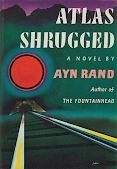
Several years ago, Miss Ayn Rand wrote The Fountainhead. Despite a generally poor press, it is said to have sold some four hundred thousand copies. Thus, it became a wonder of the book trade of a kind that publishers dream about after taxes. So Atlas Shrugged had a first printing of one hundred thousand copies. It appears to be slowly climbing the best-seller lists.

The news about this book seems to me to be that any ordinarily sensible head could not possibly take it seriously, and that, apparently, a good many do. Somebody has called it: “Excruciatingly awful.” I find it a remarkably silly book. It is certainly a bumptious one. Its story is preposterous. It reports the final stages of a final conflict (locale: chiefly the United States, some indefinite years hence) between the harried ranks of free enterprise and the “looters.” These are proponents of proscriptive taxes, government ownership, labor, etc., etc. The mischief here is that the author, dodging into fiction, nevertheless counts on your reading it as political reality. This,” she is saying in effect, “is how things really are. These are the real issues, the real sides. Only your blindness keeps you from seeing it, which, happily, I have come to rescue you from.”

Since a great many of us dislike much that Miss Rand dislikes, quite as heartily as she does, many incline to take her at her word. It is the more persuasive, in some quarters, because the author deals wholly in the blackest blacks and the whitest whites. In this fiction everything, everybody, is either all good or all bad, without any of those intermediate shades which, in life, complicate reality and perplex the eye that seeks to probe it truly. This kind of simplifying pattern, of course, gives charm to most primitive storyknown as: The War between the Children of Light and the Children of Darkness. In modern dress, it is a class war. Both sides to it are caricatures.

The Children of Light are largely operatic caricatures. Insofar as any of them suggests anything known to the business community, they resemble the occasional curmudgeon millionaire, tales about whose outrageously crude and shrewd eccentricities sometimes provide the lighter moments in boardrooms. Otherwise, the Children of Light are geniuses. One of them is named (the only smile you see will be your own): Francisco Domingo Carlos Andres Sebastian dAntonio. This electrifying youth is the world’s biggest copper tycoon. Another, no less electrifying, is named: Ragnar Danesjold. He becomes a twentieth-century pirate. All Miss Rand’s chief heroes are also breathtakingly beautiful. So is her heroine (she is rather fetchingly vice president in charge of management of a transcontinental railroad).

So much radiant energy might seem to serve a eugenic purpose. For, in this story as in Mark Twain’s, “all the knights marry the princess”–though without benefit of clergy. Yet from the impromptu and surprisingly gymnastic matings of the heroine and three of the heroes, no children–it suddenly strikes you–ever result. The possibility is never entertained. And, indeed, the strenuously sterile world of Atlas Shrugged is scarcely a place for children. You speculate that, in life, children probably irk the author and may make her uneasy. How could it be otherwise when she admiringly names a banker character (by what seems to me a humorless master-stroke): Midas Mulligan? You may fool some adults; you can’t fool little boys and girls with such stuff–not for long. They may not know just what is out of line, but they stir uneasily. The Children of Darkness are caricatures, too; and they are really oozy. But at least they are caricatures of something identifiable. Their archetypes are Left-Liberals, New Dealers, Welfare Statists, One Worlders, or, at any rate, such ogreish semblances of these as may stalk the nightmares of those who think little about people as people, but tend to think a great deal in labels and effigies. (And neither Right nor Left, be it noted in passing, has a monopoly of such dreamers, though the horrors in their nightmares wear radically different masks and labels.)

In Atlas Shrugged, all this debased inhuman riffraff is lumped as “looters.” This is a fairly inspired epithet. It enables the author to skewer on one invective word everything and everybody that she fears and hates. This spares her the playguy business of performing one service that her fiction might have performed, namely: that of examining in human depth how so feeble a lot came to exist at all, let alone be powerful enough to be worth hating and fearing. Instead, she bundles them into one undifferentiated damnation.

“Looters” loot because they believe in Robin Hood, and have got a lot of other people believing in him, too. Robin Hood is the author’s image of absolute evil–robbing the strong (and hence good) to give to the weak (and hence no good). All “looters” are base, envious, twisted, malignant minds, motivated wholly by greed for power, combined with the lust of the weak to tear down the strong, out of a deepseated hatred of life and secret longing for destruction and death. (...)

So the Children of Light win handily by declaring a general strike of brains, of which they have a monopoly, letting the world go, literally, to smash. In the end, they troop out of their Rocky Mountain hideaway to repossess the ruins. It is then, in the book’s last line, that a character traces in the dir, over the desolate earth,” the Sign of the Dollar, in lieu of the Sign of the Cross, and in token that a suitably prostrate mankind is at last ready, for its sins, to be redeemed from the related evils of religion and social reform (the “mysticism of mind” and the “mysticism of muscle”).

That Dollar Sign is not merely provocative, though we sense a sophomoric intent to raise the pious hair on susceptible heads. More importantly, it is meant to seal the fact that mankind is ready to submit abjectly to an elite of technocrats, and their accessories, in a New Order, enlightened and instructed by Miss Rand’s ideas that the good life is one which “has resolved personal worth into exchange value,” “has left no other nexus between man and man than naked selfinterest, than callous “cash-payment.”‘ The author is explicit, in fact deafening, about these prerequisites. Lest you should be in any doubt after 1,168 pages, she assures you with a final stamp of the foot in a postscript: “And I mean it.” (...)

So Randian Man, at least in his ruling caste, has to be held “heroic” in order not to be beastly. And this, of course, suits the author’s economics and the politics that must arise from them. For politics, of course, arise, though the author of Atlas Shrugged stares stonily past them, as if this book were not what, in fact, it is, essentially–a political book. And here begins mischief. Systems of philosophic materialism, so long as they merely circle outside this world’s atmosphere, matter little to most of us. The trouble is that they keep coming down to earth. It is when a system of materialist ideas presumes to give positive answers to real problems of our real life that mischief starts. In an age like ours, in which a highly complex technological society is everywhere in a high state of instability, such answers, however philosophic, translate quickly into political realities. And in the degree to which problems of complexity and instability are most bewildering to masses of men, a temptation sets in to let some species of Big Brother solve and supervise them.

One Big Brother is, of course, a socializing elite (as we know, several cut-rate brands are on the shelves). Miss Rand, as the enemy of any socializing force, calls in a Big Brother of her own contriving to do battle with the other. In the name of free enterprise, therefore, she plumps for a technocratic elite (I find no more inclusive word than technocratic to bracket the industrial-financial-engineering caste she seems to have in mind). When she calls “productive achievement” man’s noblest activity,” she means, almost exclusively, technological achievement, supervised by such a managerial political bureau. She might object that she means much, much more; and we can freely entertain her objections. But, in sum, that is just what she means. For that is what, in reality, it works out to. And in reality, too, by contrast with fiction, this can only head into a dictatorship, however benign, living and acting beyond good and evil, a law unto itself (as Miss Rand believes it should be), and feeling any restraint on itself as, in practice, criminal, and, in morals, vicious (as Miss Rand clearly feels it to be). Of course, Miss Rand nowhere calls for a dictatorship. I take her to be calling for an aristocracy of talents. We cannot labor here why, in the modern world, the pre-conditions for aristocracy, an organic growth, no longer exist, so that the impulse toward aristocracy always emerges now in the form of dictatorship. (...)

Something of this implication is fixed in the book’s dictatorial tone, which is much its most striking feature. Out of a lifetime of reading, I can recall no other book in which a tone of overriding arrogance was so implacably sustained. Its shrillness is without reprieve. Its dogmatism is without appeal. In addition, the mind which finds this tone natural to it shares other characteristics of its type. 1) It consistently mistakes raw force for strength, and the rawer the force, the more reverent the posture of the mind before it. 2) It supposes itself to be the bringer of a final revelation. Therefore, resistance to the Message cannot be tolerated because disagreement can never be merely honest, prudent, or just humanly fallible. Dissent from revelation so final (because, the author would say, so reasonable) can only be willfully wicked. There are ways of dealing with such wickedness, and, in fact, right reason itself enjoins them. From almost any page of Atlas Shrugged, a voice can be heard, from painful necessity, commanding: “To a gas chamber–go!” The same inflexibly self-righteous stance results, too (in the total absence of any saving humor), in odd extravagances of inflection and gesture-that Dollar Sign, for example. At first, we try to tell ourselves that these are just lapses, that this mind has, somehow, mislaid the discriminating knack that most of us pray will warn us in time of the difference between what is effective and firm, and what is wildly grotesque and excessive. Soon we suspect something worse. We suspect that this mind finds, precisely in extravagance, some exalting merit; feels a surging release of power and passion precisely in smashing up the house. A tornado might feel this way, or Carrie Nation.

by Whittaker Chambers, National Review (1957) |  Read more:
Image: Random House/1957 Phyllis Cerf portrait
[ed. Little wonder that Silicon Valley and many in the current administration and Republican party are so enamored with Ms Rand's philosophies. Fundamentally, Atlas Shrugged is a (fictional) extension of her previous polemic The Virtue of Selfishness, a series of essays mostly concerning ethical egoism. Christopher Hitchens is reportedly to have said "I don't think there's any need to have essays advocating selfishness among human beings. I don't know what your impression has been, but some things require no further reinforcement."]