Thursday, July 3, 2025

So You Want To Look Rich?

So, you want to look rich? Well, you’ve come to the right place. And no, I won’t be peddling any “quiet luxury” nonsense here (barf). I’m here to show you the cheapest way to get the biggest, boldest piece of artwork in your home. Because nothing says “Daddy Warbucks” quite like art that eats an entire wall for breakfast.


“HoOooOoOw does this make meEeeeeEe look riiiiicCccCCh?” you ask. Well, if you’ve ever tried to frame anything in this godforsaken town, you know it’s astronomically expensive. And sure, I respect the craft—cutting glass, sanding wood, fastening a perfect corner joint? Not easy. My wallet, however, does not share the same sentiment and admiration for *~craft~* (one day). Large-scale framing is expensive, so having large-scale art in your home must = wealth. Is this girl math?

Lucky for you, I’m scrappy/good at connecting dots and figured out a workaround that gets you art + a frame for around $200(ish). And when we’re talking large-scale art? That’s not not highway robbery!!!!!!!!

So, here’s a breakdown of exactly what you’re going to do:

Step 1:

Buy this huge-ass frame from IKEA. As someone who has spent far too much time on the hunt for large-scale frames at a kind price, let me tell you, this frame is a godsend.

Step 2:

Head to the National Gallery’s website and dive into their free image archive. I first discovered it in college thanks to my genius art history professor Brantl (miss you, legend). Their open-access archive lets you download high-res images of various works, totally free. Pro Tip: make sure the free image download filter is turned ON.

Feeling overwhelmed by the options? Don’t panic, hun. That’s what I’m here for. Below are some solid search terms and filters to get you started:

Search Terms: Horse Race, Shaker Drawings, Edgar Degas, Flora and Fauna, Alfred Stieglitz, Post Impressionist, Pierre Bonnard, Holger Hanson, Tamarind Institute, Robert Frank, Spanish Southwest, Realist, George Bellows, John Sloan, Abstract Expressionist, Mark Rothko, Kenneth Noland, John Frederick Peto, Realist (Subject>Still Life, Photography (Themes>Motion), Landscape, Painting (Subject>Place Names), Ernst Kirchner, Charles Logasa, Drawing (Subject>Objects), Paul Klee, Walter Griffin, Drawings (Subjects>Flora & Fauna), Index of American Design, Mina Lowery.

Here are some fun ones I found:  [ed. more...]


Step 3 (Edited):

Hit! That! Download! Button! And throw your chosen artwork into Photoshop. Crop it to your frame size (78.75" x 55"), then head to ‘Image Size’ and bump the resolution from 72 to 300 PPI to keep things crisp. Then (important!) grow the artwork by 3 inches, bringing it to 81.75" x 58". That extra bit will help it sit just right and tight in the frame.

Step 4:

Next, head to www.bagofloveuse.com (I’m serious), toggle over to the Fabric & Leather Printing menu, and upload your artwork under the “Print on Fabric” section. You’ll want to input custom dimensions and choose a fabric that prints rich, saturated color with zero shine. I went with the 6.28oz cotton twill and can’t recommend it enough. It has weight, texture, and looks way more expensive than it is. Also, because you added that 3-inch border around your artwork, you can opt for the “uneven scissor cut,” which is free (I swear I’m not usually this cheap).

One note: Bags of Love now caps their print width at 57.09 inches, but since that’s still wider than your frame, you should be fine. You’ll just have to be a bit more precise when snapping it in. Horizontal images still work best, but if you’re feeling bold with a vertical, go for it. You do you.

Step 5:

Time to get that m-effer in the frame! I recommend doing this with a friend (free labor, obviously) because getting the fabric pulled taut and snapped cleanly into the back of the frame is much easier with an extra set of hands. Like most things IKEA, the setup is pretty painless and requires little to no tools.

Step 6:

Honestly, I wish there was more to it, but that’s it. Hang it up and you’re done. You look rich, and now everybody wants to be your friend!

Anyway, without further ado, here are some gorgeous examples of large-scale artworks in homes I love. May they inspire your walls: [ed. more..]

by Juliana Ramirez, Search Terms | Read more:
Images: Andy Williams; John Decker, Green Plums, 1885; Peter Henry Emerson, Marsh Weeds, 1895.
[ed. See also: Everyone’s Moving (thoughtful gifts for new beginnings). Lots of good links.]

When Revolutions Sputter

Revolutions have a logic. The revolutionaries start with a big, transformative, impossible goal. They want to remake society, smash existing institutions, replace them with something different. They know they will do damage on the road to their utopia, and they know people will object. Committed to their ideology, the revolutionaries pursue their goals anyway.

Inevitably, a crisis appears. Perhaps many people, even most people, don’t want regime change, or don’t share the revolutionaries’ utopian vision. Perhaps there are unplanned disasters. Smashing institutions can have unexpected, sometimes catastrophic, consequences, as the history of post-revolutionary famines shows very well.

But whatever the nature of the crisis, it forces the revolutionaries to make a choice. Give up—or radicalize. Find compromises—or polarize society further. Slow down—or use violence.

The bloodiest, most damaging revolutions have all been shaped by people making the most extreme choices. When the Bolsheviks ran into opposition in 1918, they unleashed the Red Terror. When the Chinese Communists encountered resistance, Mao sent teenage Red Guards to torment professors and civil servants. Sometimes the violence was mere theater, lecture halls full of people demanding that victims recant. Sometimes it was real. But it always served a purpose: to provoke, to divide, and then to allow the revolutionaries to suspend the law, create an emergency, and rule by decree.

I doubt very much that Donald Trump knows a lot about the methods of Bolsheviks or Maoists, although I am certain that some of his entourage does. But he is now leading an assault on what some around him call the administrative state, which the rest of us call the U.S. government. This assault is revolutionary in nature. Trump’s henchmen have a set of radical, sometimes competing goals, all of which require fundamental changes in the nature of the American state. The concentration of power in the hands of the president. The replacement of the federal civil service with loyalists. The transfer of resources from the poor to the rich, especially rich insiders with connections to Trump. The removal, to the extent possible, of brown-skinned people from America, and the return to an older American racial hierarchy.

Trump and his allies also have revolutionary methods. Elon Musk sent DOGE engineers, some the same age as Mao’s Red Guards, into one government department after the next to capture computers, take data, and fire staff. Trump has launched targeted attacks on institutions that symbolize the power and prestige of the old regime: Harvard, the television networks, the National Institutes of Health. ICE has sent agents in military gear to conduct mass arrests of people who may or may not be undocumented immigrants, but whose arrests will frighten and silence whole communities. Trump’s family and friends have rapidly destroyed a matrix of ethical checks and balances in order to enrich the president and themselves.

But their revolutionary project is now running into reality. More than 200 times, courts have questioned the legality of Trump’s decisions, including the arbitrary tariffs and the deportations of people without due process. Judges have ordered the administration to rehire people who were illegally fired. DOGE is slowly being revealed as a failure, maybe even a hoax: Not only has it not saved much money, but the damage done by Musk’s engineers might prove even more expensive to fix, once the costs of lawsuits, broken contracts, and the loss of government capacity are calculated. The president’s signature legislation, his budget bill, has met resistance from senior Republicans and Wall Street CEOs who fear that it will destroy the U.S. government’s credibility, and even resistance from Musk himself.

Now Trump faces the same choice as his revolutionary predecessors: Give up—or radicalize. Find compromises—or polarize society further. Slow down—or use violence. Like his revolutionary predecessors, Trump has chosen radicalization and polarization, and he is openly seeking to provoke violence.

For the moment, the administration’s demonstration of force is mostly performative, a made-for-TV show designed to pit the United States military against protesters in a big Democratic city. The choice of venue for sweeping, indiscriminate raids—Home Depot stores around Los Angeles, and not, say, a golf club in Florida—seems orchestrated to appeal to Trump voters. The deployment of the U.S. military is designed to create frightening images, not to fulfill an actual need. The governor of California did not ask for U.S. troops; the mayor of Los Angeles did not ask for U.S. troops; even the L.A. police made clear that there was no emergency, and that they did not require U.S. troops.

But this is not the final stage of the revolution. The Marines in Los Angeles may provoke more violence, and that may indeed be the true purpose of their mission; after all, the Marines are primarily trained not to do civilian crowd control, but to kill the enemies of the United States. In an ominous speech at Fort Bragg yesterday, Trump reverted to the dehumanizing rhetoric he used during the election campaign, calling protesters “animals” and “a foreign enemy,” language that seems to give permission to the Marines to kill people. Even if this confrontation ends without violence, the presence of the military in Los Angeles breaks another set of norms and prepares the way for another escalation, another set of emergency decrees, another opportunity to discard the rule of law later on.

by Anne Applebaum, The Atlantic |  Read more:
Image: Spencer Platt/Getty

Wednesday, July 2, 2025

Tom Waits

[ed. Fight club. See also: this excellent cover by QOTSA (Queens of the Stone Age).]

Keith Tyson, Color Out of Place


Tom Gauld
via:

Tuesday, July 1, 2025

via:

Tom Gauld
via:

Monday, June 30, 2025

The Beauty of Pointlessness

Even if you know very little about The Big Lebowski, you probably know that The Dude loves bowling. The Dude and bowling go together. They just fit right in there together.

Now I’m no mind reader, but I suspect the Dude loves bowling for its own sake. Sure, he enjoys the camaraderie of Walter and Donny, and the bowling alley is a decent place to get a cold oat soda, but my hunch is that the Dude doesn't treat bowling instrumentally. He does not treat bowling as a means to some other end: he's not bowling to burn calories, network with business contacts, or improve his hand-eye coordination. The Dude gives zero fucks about optimization. I suspect he just bowls and enjoys the simple pleasure of trying to hit pins with a heavy ball. There is no larger purpose.

The rest of us, though? We've forgotten how to be like The Dude. It seems like so many of our daily activities are not done for their own sake, but for the promise of achieving something.

Take the so-called Huberman morning routine. His meticulously timed regimen demands morning sunlight, exercise, precisely timed caffeine, cold showers, and hydration. Huberman cloaks this routine in scientific legitimacy, throwing around terms like cortisol spikes and testosterone optimization, despite the evidence he cites being dubious at best. What's most troubling is how he's transformed morning routines from potentially enjoyable rituals into productivity optimization algorithms. None of these steps are recommended because they feel good or bring joy; they're prescribed based on the misplaced belief that they'll mathematically optimize your health and productivity like you're some kind of human spreadsheet.

Even meditation—a practice about being present—has been instrumentalized. Meditation apps don't promise the experience of quieting the mind; they promise productivity boosts, stress reduction, better focus. "Ten minutes a day to be 10% happier!" But what if meditation doesn't help with any of that? What if it's just sitting there noticing your thoughts? Isn’t that enough?

Things that were once pure pleasure have been transformed into health imperatives. Psychedelics shouldn't be taken because they can be fun AF, but because they can improve mental health. Rest isn't about blissful relaxation, but a means to recharge so we emerge more productive. When did we stop doing things just because?

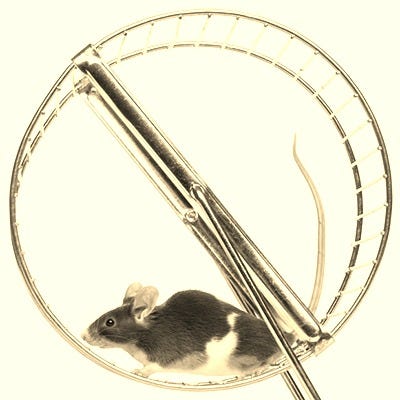
This hit me recently when I came across a fascinating study about mice appearing to do things just for the fun of it. Scientists placed running wheels in natural settings to see if wild animals would use them voluntarily, without any rewards or incentives.


What they discovered was startling. Wild mice not only found and used the wheels but did so frequently and enthusiastically. Even when researchers removed all food from the experimental area, the mice still came to run on the wheels. It wasn't just mice either: the researchers recorded frogs, shrews, and even slugs voluntarily using the wheels. (And don’t ask me how a slug possibly uses a running wheel, but the authors provided receipts).

The conclusion was clear: these animals were running for the pure joy of running. No rewards, no external purpose, no optimization, no 30 minutes of cardio to burn 300 calories. Running on a wheel just because.

When's the last time you did something just because it was fun? No health benefit to justify the time spent. Just pure, purposeless fun.

I am far from the only one complaining about today's optimization culture. This obsession with turning every moment into a productivity hack has been critiqued by thinkers much sharper than me, who've recognized how we're increasingly trapped in a cycle of optimizing our lives rather than living them. (...)

The problem with optimization culture is that it imposes external goals on things that might be inherently pleasurable; optimization is always about the outcome, never the process. When we optimize our morning routines, we're not doing so because the routine itself is inherently pleasurable; we're doing it to maximize some future benefit—productivity, health markers, longevity. It transforms activities that could be enjoyable into mere instruments for achieving external goals.

by Michael Inzlicht, Speak Now Regret Later | Read more:
Image: uncredited
[ed. Golfing defined.]

Self Defense for Women (or anyone)

[ed. Public service announcement.]

Four Things: June 29, 2025

There are four political stories people should know about tonight.

First, President Donald Trump’s tariff war and weaker consumer spending translated to a contraction of 0.5% in the U.S. economy in the first quarter, even more of a drop than the 0.2% economists expected. The economy Trump inherited from President Joe Biden led the world in productivity.

Second, John Hudson and Warren P. Strobel of the Washington Post reported today that intercepted communications showed that senior Iranian officials said the U.S. attacks on Iran’s nuclear facilities caused less damage than they had expected and that they wondered why the strikes were so restrained.

Josh Marshall of Talking Points Memo also called out that at a press conference in the Netherlands last Wednesday, Trump said he had given Iran permission to bomb a U.S. air base in Qatar in retaliation for the U.S. strikes on Iran’s nuclear weapons program sites. “They said, ‘We’re going to shoot them. Is one o’clock OK?’ I said it’s fine,” Trump said. “And everybody was emptied off the base so they couldn’t get hurt, except for the gunners.”

Marshall expressed astonishment that this admission has attracted very little attention. He suggested that, if it is true, it represents “the most shocking dereliction of duty one could imagine for the commander-in-chief,” and he wondered how Republicans would have reacted if a Democratic president had said he had let “a foreign adversary fire on an American military installation.”

Third, Jeff Stein of the Washington Post reported today that the Republicans’ budget reconciliation bill makes the biggest cut ever to programs for low-income Americans. Those cuts have made many Republicans skittish about supporting the measure.

After Trump attacked him yesterday for not supporting the budget reconciliation bill, Senator Thom Tillis (R-NC) has announced he will not run for reelection next year, indicating his unwillingness to face a primary challenger backed by Trump. This puts the seat in play for a Democratic pickup.

In a statement, Tillis said: “In Washington over the last few years, it’s become increasingly evident that leaders who are willing to embrace bipartisanship, compromise, and demonstrate independent thinking are becoming an endangered species.” He wrote: “I look forward to having the pure freedom to call the balls and strikes as I see fit and representing the great people of North Carolina to the best of my ability.”

Tonight, Tillis told the Senate: “What do I tell 663,000 people in two years or three years, when President Trump breaks his promise by pushing them off of Medicaid because the funding’s not there anymore, guys?... [T]he effect of this bill is to break a promise.”

Fourth, the Senate parliamentarian has told senators that several of the provisions added to the Republicans’ budget reconciliation bill violate the rules for budget reconciliation bills. Those provisions include the ones added to the bill to win the support of Republican senator Lisa Murkowski of Alaska.

Today, Trump pushed Republican senators to ignore the Senate parliamentarian, who judges whether proposed measures adhere to Senate rules. Trump posted on social media: “An unelected Senate Staffer (Parliamentarian), should not be allowed to hurt the Republicans Bill. Wants many fantastic things out. NO! DJT.”

The nonpartisan Congressional Budget Office today said the tax cuts in the budget reconciliation bill the Republican senators are trying to pass will increase the national debt by $3.3 trillion over the next ten years despite the $1.2 trillion in cuts to Medicaid, Supplemental Nutrition Assistance Program, the National Institutes of Health, the Centers for Disease Control and Prevention, and other programs over the same period. Senator Raphael Warnock (D-GA) called the measure “Robin Hood in reverse…stealing from the poor in order to give to the rich, this massive transfer of wealth from the bottom to the top…. This is socialism for the rich.”

Trump has demanded the measure’s passage by July 4, in part because the Department of Homeland Security has blown through its budget and needs the supplemental funding the bill will provide. That funding adds an astonishing $45 billion for migrant detention by Immigration and Customs Enforcement (ICE) to the current budget of $3.4 billion over the next five years, and $14.4 billion for transportation and removal on top of the current annual budget of $750 million.

by Heather Cox Richardson, Letters From an American |  Read more:
Image: via

Lollapalooza: The Uncensored Story

Alternative Rock's Wildest Festival

Summer 2025 kicked off with CNN declaring that the American music festival is on the decline, news that arrives on the heels of the March publication of Lollapalooza: The Uncensored Story of Alternative Rock's Wildest Festival. Tom Beaujour and Richard Bienstock don't waste much time in their oral history dwelling upon the festival's latter-day incarnation as a destination event in Chicago's Grant Park, and why would they? Lollapalooza transformed from a traveling circus into a stable summer institution, reliably entertaining crowds who wouldn't know or care that it started as a trumped-up farewell tour for Jane's Addiction at the dawn of the 1990s.

The first Lollapalooza rambled across America in the summer of 1991, months before Nirvana released Nevermind, the album that's generally acknowledged as ground zero in the alternative rock revolution. Beaujour and Bienstock suggest that Lollapalooza softened the ground for Nevermind, and argue that the festival had a deeper cultural influence. They posit in their intro that "If Lollapalooza didn't single-handedly inaugurate what came to be known as 'alternative nation,' it went a long way toward codifying its ideals for generation of teens and twenty-somethings via a diverse mix of boundary-pushing musical acts, outsider fashion and art, political activism, and straight-up performative weirdness." It is undeniably true that the festival's heyday coincides precisely with the rise and fall of alternative rock within the mainstream, to the extent that it's difficult to determine whether it was a catalyst for change or merely a mirror.

Lollapalooza: The Uncensored Story of Alternative Rock's Wildest Festival doesn't spend much time grappling with that question, preferring to depict business machinations, onstage antics, and offstage debauchery. Often, garden variety rock'n'roll decadence degenerated into drug dependency. Every year had at least one act crippled by hard drugs. Heroin was there at the start, when Perry Farrell conceived of the festival as a farewell for Jane's Addiction. It's there at the end, when Failure somehow stumbles through sets on the main and second stages during the 1997 installment despite their bassist Greg Edwards being in the throes of addiction. It's there everywhere in between, providing a refuge for creatures of the night being stuck playing afternoon sets in amphitheaters across America.

Years of consciously-curated festival lineups in the 21st Century have eroded the memory of just how odd it was to see either Nick Cave & the Bad Seeds or the Butthole Surfers in the blazing midday sun. Lollapalooza: The Uncensored Story underscores how so much of the alternative rock was a nocturnal underground culture coming into the light. The survivors are the ones that could adapt to the new circumstances, such as Pearl Jam and Nine Inch Nails, who figured out how to feed off the energy of a massive audience. how to harness the excitement of a massive audience, becoming a symbiotic being that fed off each other's energy.

Of course, the circumstances on the ground changed after the first festival became an unexpected success. Lollapalooza's sequel arrived in 1992, after "Smells Like Teen Spirit" climbed into Billboard's Top Ten, a combination of events that ushered the alt-rock goldrush of the '90s. Those next three years of Lollapalooza are where the music biz figured out if it was possible to package and sell the underground, taking a chance on weirdos as they tried to find artists willing to play the game. Some bets didn't quite pan out but enough did for the chaos to chatter along until 1995, when Sonic Youth headlined a year that illustrated the commercial limits of the fringe.

Although the Sonic Youth year is the one that's commonly cited as the death knell for the festival, Chicago area promoter Andy Cirzan claims in the book, "The real drop-off, the crazy scary one, was '97. That's when the bottom fell out." By that point, Lollapalooza had credible competitors—Lilith Fair, the Warped Tour, HORDE—and, worse, they ran through all the potential headliners. The acts they could pull already knew the game: when Tool agreed to come back for another round, they asked to not close the festival, since they realized the crowds started to leave during the last act.

Tool was the defacto top-liner in a year where Orbital, the Prodigy and the Orb were the nominal future-minded headliners but the cast of characters that populate Lollapalooza: The Uncensored Story illustrates how the festival always had one foot firmly planted in metal. The line between punk and metal could be blurry. A good portion of the '80s underground listened to the same heavy rock as metalheads—R.E.M. covered Aerosmith's "Mama Kin" in 1986, the same year Guns N Roses covered "Mama Kin"—and Jane's Addiction, Rage Against the Machine, and Soundgarden were all propelled by guitarists who specialized in some kind of six-string theatrics. All three acts keep popping up again and again through the oral history, acting as a chorus and returning to the bills that were also populated by bands who attempted to be louder than heaven.

Strip away the Sonic Youth year and maybe 1994—Smashing Pumpkins topped a bill that occasionally echoed the tastes of Nirvana, who were scheduled to headline until the last minute—and the Lollapalooza mainstage of the '90s was always dominated by aggro acts. During those first few years, the occasional hip-hop or woman artist gave an illusion of balance, but after the festival was rattled by the soft sales for Sonic Youth, they agreed to participate in Metallica's modern-rock makeover, conceding to a bill filled with loud guitar acts. By 1997, the fest cut loose the Jon Spencer Blues Explosion—who were signed and ready to go—because Korn refused to appear before the indie-rockers. Korn also got pissy when second stage headliners the Eels were elevated to the mainstage after Tricky left the tour without warning: the nu-metal kings made it clear there was no way they'd play before alt-rockers of any stripe.

Brad Tolinski argues in Lollapalooza that "With [Korn's] use of dissonant seven-string guitars, bagpipes, and funk-inspired bass lines there was very little to connect them to traditional metal. And Jonathan Davis's damaged-antihero lyrics were certainly closer to Perry Farrell's than say, Ozzy Osbourne's or James Hetfield's." Fair point but Korn also always read as a metal band in a way that, say, Soundgarden did not. Perhaps it was the dour imagery, perhaps it was the adolescent angst, perhaps it was their Jägermeister sponsorship, but Korn tapped into an ugly, primal energy: James "Munky" Shaffer remembers that "every three or four nights someone would set a fire out in the grass or the kids in front would start tearing out the seats," behavior that pointed toward the riots of Woodstock 99.

Korn played Woodstock 99, as did Metallica, a pair of Lollapalooza veterans who represented a strand of '90s culture that ran parallel to the alternative nation Perry Farrell intended to set into motion with the first Lollapalooza. What began as a cacophony of differing cultures reduced into a din of diffuse rage, a transition Lollapalooza: The Uncensored Story that provides the book its unifying thread. Maybe this sour undercurrent is why the book doesn't provide much of a nostalgic kick or perhaps the structure of Lollapalooza itself didn't generate great gossip. Every year, a new round of misfits had their initial enthusiasm diminish as they realized they were stuck in the sticks, playing to the same number of diehards that could fill a club.

by Stephen Thomas Erlewine, So It Goes | Read more:
Image: Lollapalooza poster, uncredited

Bruce Lee, 1979
via:

via:

Notes From a Nursing Home

I sit in my room in this nursing home near Sydney, a box of four walls that holds all I now call my own. Two suitcases could carry it: a few clothes, some worn books, a scattering of trinkets. The thought strikes me as both stark and oddly freeing.

Not long ago my world was vast, a house with rooms I rarely entered, a garden that sprawled beyond need, two cars idling in the driveway, one barely driven.

Now it’s gone. The house, the cars, the cartons overflowing in the garage, all sold, given away or abandoned. A heart attack and dwindling funds brought me here two and a half years ago. Family ties, thin as they are, keep me from moving anywhere away from here.

I don’t resent it. I’ve seen the world, jungles, deserts, cities that glittered under foreign skies. That hunger is sated. This is a different journey, one of stillness, of finding meaning in what remains.

The nursing home is no idyll, no glossy promise of golden years. It’s a place of routine, of quiet necessity. Mornings begin with carers, gentle, hurried women who tidy my bed, adjust pillows, offer a smile before moving on. Tea and toast settle as I sit by the window. The air carries the clean sting of antiseptic, mingling with the chatter of birds outside. There’s peace in these moments, before the home stirs fully awake.

The staff do their work well, though they’re stretched thin. They check on us, ask after our aches, offer kind words that linger like a faint warmth. Activities fill the day, card games, a singalong. I join when I feel like it, which is less often than I might. The choice is mine, and that’s enough. The front doors creak as relatives arrive, their faces a mix of cheer and strain. Some hide tears, we all pretend not to see. We don’t speak of sadness here. It’s a silent agreement, a way to keep the days bearable.

The residents are a varied lot. Some are old, their bodies bent by years. Others are younger, broken by minds that betray them. A woman down the hall clutches a photograph, her son a rare visitor, his life too crowded for her. She speaks of him with no anger, only a flat resignation. A man, his eyes dim with addiction’s toll, mutters of a sister who never calls. I listen, nod, share a story of my own.

We understand each other here, bound by the shared weight of being left behind.

This place is a mirror, reflecting a truth we’d rather not face. Families, once close, find it easier to place their own in these clean, quiet rooms. It’s not cruelty, not always. Caring for the old, the broken, the lost-it, demands time, patience, a surrender most cannot afford. So they sign papers, appoint guardians and let the system take over. The nursing home becomes a vault, sealing away what disrupts the orderly march of life. Out of sight, out of mind. Yet I wonder if, in the quiet of their nights, those families feel the shadow of what they’ve set aside.

I walk the corridors, dim and smelling of antiseptic and something less tangible – forgotten promises, perhaps. Residents sit, staring at walls or televisions that drone with voices no one heeds. Many wrestle with dementia, their thoughts scattering like ash. Others bear scars of choices or chance, their lives eroded to this point. A few, changed by illness or time, became strangers to those who loved them. To care for such people is hard, unglamorous work. Easier to let them fade into these walls.

Yet there’s life here too. I find it in small things: a book that holds my attention, sunlight warming my room, a laugh shared over a memory. The community binds us. We talk of old days, of children grown distant, of the world beyond these walls. There’s comfort in that, a kind of strength. The local shops are my horizon now but I don’t mind. I’ve seen enough of the world to know its pleasures are fleeting.

Here I have my memories, these people, this quiet. The day stretches before me, simple and unhurried, the sun climbing higher, the air still fresh. There’s no need to rush, no call to chase what’s gone. This is my life now, pared to its bones, and it’s enough. 

by Andrew McKean, The Guardian |  Read more:
Image: Bec Lorrimer/The Guardian
[ed. See also: The Dull Men's Club (Guardian).]

Sunday, June 29, 2025

G.O.P. Plans to Cripple Wind and Solar Power

China breaks more records with surge in solar and wind power (The Guardian)

China’s installations of wind and solar in May are enough to generate as much electricity as Poland, as the world’s second-biggest economy breaks further records with its rapid buildup of renewable energy infrastructure.

China installed 93 GW of solar capacity last month – almost 100 solar panels every second, according to an analysis by Lauri Myllyvirta, a senior fellow at the Asia Society Policy Institute. Wind power installations reached 26 GW, the equivalent of about 5,300 turbines.

While estimates for the amount of power generated by solar panels and wind turbines vary depending on their location and weather conditions, Myllyvirta calculated that May’s installations alone could generate as much electricity as Poland, Sweden or the United Arab Emirates.

Between January and May, China added 198 GW of solar and 46 GW of wind, enough to generate as much electricity as Indonesia or Turkey.

“We knew China’s rush to install solar and wind was going to be wild but WOW,” Myllyvirta wrote on social media.

by Amy Hawkins, The Guardian |  Read more:
Image: Costfoto/NurPhoto/REX/Shutterstock
***


Senate Republicans have quietly inserted provisions in President Trump’s domestic policy bill that would not only end federal support for wind and solar energy but would impose an entirely new tax on future projects, a move that industry groups say could devastate the renewable power industry.

The tax provision, tucked inside the 940-page bill that the Senate made public just after midnight on Friday, stunned observers.

“This is how you kill an industry,” said Bob Keefe, executive director of E2, a nonpartisan group of business leaders and investors. “And at a time when electricity prices and demand are soaring.”

The bill would rapidly phase out existing federal tax subsidies for wind and solar power by 2027. Doing so, many companies say, could derail hundreds of projects under development and could jeopardize billions of dollars in manufacturing facilities that had been planned around the country with the subsidies in mind. (...)

President Trump, who has mocked climate science, has instead promoted fossil fuels and demanded that Republicans in Congress unwind the law.

But the latest version of the Senate bill would go much further. It would impose a steep penalty on all new wind and solar farms that come online after 2027 — even if they didn’t receive federal subsidies — unless they follow complicated and potentially unworkable requirements to disentangle their supply chains from China. Since China dominates global supply chains, that measure could affect a large number of companies. (...)

Even some of those who lobbied to end federal support for clean energy said the Senate bill went too far.

“I strongly recommend fully desubsidizing solar and wind vs. placing a kind of new tax on them,” wrote Alex Epstein, an influential activist who has been urging Republican senators to eliminate renewable energy subsidies. “I just learned about the excise tax and it’s definitely not something I would support.”

The U.S. Chamber of Commerce also criticized the tax. “Overall, the Senate has produced a strong, pro-growth bill,” Neil Bradley, the group’s chief policy officer, posted on social media. “That said, taxing energy production is never good policy, whether oil & gas or, in this case, renewables.” He added: “It should be removed.”

Wind and solar projects are the fastest growing new source of electricity in the United States and account for nearly two-thirds of new electric capacity expected to come online this year. For utilities and tech companies, adding solar, wind and batteries has often been one of the easiest ways to help meet soaring electricity demand. Other technologies like new nuclear reactors can take much longer to build, and there is currently a multiyear backlog for new natural gas turbines.

The repeal of federal subsidies alone could cause wind and solar installations to plummet by as much as 72 percent over the next decade, according to the Rhodium Group, a research firm. The new tax could depress deployment even further by raising costs an additional 10 to 20 percent, the group estimated.

by Brad Plumer, NY Times/dnyuz |  Read more:
Image: Randi Baird for The New York Times

Saturday, June 28, 2025

Federal Debt 101

The rise of the federal debt over the past two decades has prompted countless warnings that the United States is approaching a fiscal reckoning, a day when the government won’t be able to drink all it wants from the fountain of easy money.

The more immediate danger is that the fountain keeps flowing.

The fear of a future crisis is distracting attention from the problems that the government’s dependence on debt is already causing. We, the people, are spending a staggering amount of money each year to borrow money. The interest payments on the federal debt now exceed the government’s spending on the military. They are roughly equal to the annual cost of Medicare. The sum is more than the government spends on anything except Social Security.

President Trump’s “Big Beautiful Bill” would deepen this profligacy, repeating the mistakes of the 2017 legislation on which it is based. Once again, Republicans are proposing to reduce taxation. Once again, they are proposing to force the government to borrow more to pay its bills. Once again, federal spending on interest payments would rise — and money spent on interest is money that can’t be spent on other things.

The government is on pace to pay more than $1 trillion to its lenders this year. The House version of Mr. Trump’s bill, already approved by that chamber, would increase interest payments on the debt by an average of $55 billion a year over the next decade, according to the Congressional Budget Office. The increase alone is enough money to fully repair every bridge in the United States.

Editorial Board, NY Times via:
***
Total National Debt


What is the national debt?

The debt today stands at $36.2 trillion. The Treasury Department updates the national debt — to the penny — every day.

The debt was relatively stable into the 2000s, but it began to grow substantially after President George W. Bush’s 2001 tax cuts. That law was followed months later by the Sept. 11 terrorist attacks, and then the U.S. went to war in Iraq and Afghanistan. Those conflicts were largely deficit-financed, as were other domestic policy moves in the ensuing years. Stimulus programs to recover from the 2008 Great Recession drove up borrowing, and later Congress extended Bush’s tax cuts. Finally, Trump’s 2017 Tax Cuts and Jobs Act and federal spending during the coronavirus pandemic under Trump and President Joe Biden led to sharp increases in federal spending, mostly paid for through borrowing. (...)

How does some debt create more debt?

As the national debt rises, the U.S. must pay more to maintain its borrowing. That happens in two ways.

First, gross interest costs increase. For example, 2 percent interest on $100 is $2. But 2 percent interest on $1,000 is $20.

But interest rates are not stagnant. As the U.S. takes on more debt, investors demand higher returns, forcing up interest rates. So that 2 percent rate the U.S. offered when it had less debt — say, in 2013 — jumps to the more than 4 percent rate the government has to offer to attract lenders now.

Washington Post via:
[ed. Aren't the Rich rich enough already? Wouldn't it be nice if Democrats fought for a massive middle class tax break as hard as Republicans do for the rich?]

Supersize Me: Amazon’s Biggest Data Center For AI

A year ago, a 1,200-acre stretch of farmland outside New Carlisle, Ind., was an empty cornfield. Now, seven Amazon data centers rise up from the rich soil, each larger than a football stadium.

Over the next several years, Amazon plans to build around 30 data centers at the site, packed with hundreds of thousands of specialized computer chips. With hundreds of thousands of miles of fiber connecting every chip and computer together, the entire complex will form one giant machine intended just for artificial intelligence.

The facility will consume 2.2 gigawatts of electricity — enough to power a million homes. Each year, it will use millions of gallons of water to keep the chips from overheating. And it was built with a single customer in mind: the A.I. start-up Anthropic, which aims to create an A.I. system that matches the human brain.

The complex — so large that it can be viewed completely only from high in the sky — is the first in a new generation of data centers being built by Amazon, and part of what the company calls Project Rainier, after the mountain that looms near its Seattle headquarters. Project Rainier will also include facilities in Mississippi and possibly other locations, like North Carolina and Pennsylvania.

Project Rainier is Amazon’s entry into a race by the technology industry to build data centers so large they would have been considered absurd just a few years ago. Meta, which owns Facebook, Instagram and WhatsApp, is building a two-gigawatt data center in Louisiana. OpenAI is erecting a 1.2-gigawatt facility in Texas and another, nearly as large, in the United Arab Emirates.

These data centers will dwarf most of today’s, which were built before OpenAI’s ChatGPT chatbot inspired the A.I. boom in 2022. The tech industry’s increasingly powerful A.I. technologies require massive networks of specialized computer chips — and hundreds of billions of dollars to build the data centers that house those chips. The result: behemoths that stretch the limits of the electrical grid and change the way the world thinks about computers. (...)

Just a few months after OpenAI released ChatGPT in late 2022, Amazon was in talks with electrical utilities to find a site for its A.I. ambitions. In Indiana, a subsidiary of American Electric Power, or AEP, suggested that Amazon tour tracts of farmland 15 miles west of South Bend that had been rezoned into an industrial center. By the end of May 2023, more than a dozen Amazon employees had visited the site.

By early 2024, Amazon owned the land, which was still made up of corn and soybean fields. Indiana’s legislature approved a 50-year sales tax break for the company, which could ultimately be worth around $4 billion, according to the Citizens Action Coalition, a consumer and environmental advocacy organization. Separate property and technology tax breaks granted by the county could save Amazon an additional $4 billion over the next 35 years.

The exact cost of developing the data center complex is not clear. In the tax deal, Amazon promised $11 billion to build 16 buildings, but now it plans to build almost twice that.

by Karen Weise and Cade Metz, NY Times | Read more:
Image: Visuals by A.J. Mast
[ed. Crazy. Wouldn't more people enjoy a nice golf course instead?]

Love and Other Unrealizable Utopian Projects

Love and Other Unrealizable Utopian Projects (on Norman Rush's "Mating")
Image: William Kentridge, The Unstable Landing Point of Desire (2021)
[ed. Welcome to the Norman Rush fan club. Personally, 'Mortals' left a more lasting impression on me, but 'Mating' is nearly its equal.]
***
... I felt a recognition threading itself through me, whose form of words (more solemn than exhilarated) went approximately as follows: ‘Here is a writer I will have to read all of.”
I thought of that quote from Amis around page 15 of Norman Rush’s 1991 novel Mating. By page 50 I had ordered everything else Rush had ever written (Only three other books, luckily—for that certain sense of dutiful recognition to creep up upon you the oeuvre must be manageable). After I read the indelible final four words of Mating, a daring, almost unthinkable thought flashed immediately into my head: I think this might be the best book I’ve ever read. Realistically, that’s the afterglow speaking. Moby-Dick is probably better. But how appropriate that one of the last century’s great novels of love should so sweep me off my feet. I’m writing this in the afternoon, I finished Mating this morning, and I’ve been walking around all day with a sense of satisfaction so deep it feels it should be reserved for the tangible things in life like marriage and children and not for secular worship of the novel, which is clearly an absurd thing to dedicate much of your life to. But what can I say? The promise of occasional experiences like this is what keeps me in the game.

Henry Begler, via:

Friday, June 27, 2025

Bernie Sanders getting arrested at civil rights protests.
[ed. Walking the talk.]

"In high school, he lost his first election, finishing last of three candidates for the student body presidency with a campaign that focused on aiding Korean War orphans. Despite the loss, he became active in his school's fundraising activities for Korean orphans, including organizing a charity basketball game". ~ Wikipedia


Enjoying a Nazi Pop
[ed. Is it surprising that in 2025 this wouldn't be surprising?]