[ed. Holy crap. Unitree's "Super Athlete". It'll take your gear up or down a mountain with ease and do a little pirouette at the end.]
Friday, July 31, 2026

AI #179 Part 1: A Louder Fire Alarm for General Intelligence
[ed. See also: Part 2: Hearing The Fire Alarm.]
What a week.
Anthropic released Claude Opus 5. As usual I covered that in three parts: The system card, model welfare and capabilities.
OpenAI was revealed over the last two weeks to have left an internal model unsupervised for a week during a cybersecurity evaluation, with its cyber safeguards lowered, despite having had multiple previous incidents where models broke out of their sandboxes. During that test, the model broke out of the sandbox, then proceeded to use an agent swarm to hack into HuggingFace to get the test answers. The model was loose for a week before OpenAI realized what had happened.
 This event was a really big deal. There are severe alignment problems at OpenAI, along with supervisory and infrastructure failures. The internal research model that did this, which my posts nicknamed Galaxy, has now been permanently deactivated.
There have been further developments, and I anticipate at least one additional post on the HuggingFace incident soon.
Partly as a response to this, over 1,290 employees at frontier labs signed an open letter, Pacing the Frontier. The letter warns that we are close to automating AI research, and that companies are racing ahead on this faster than we can handle it.
All three of those developments are more important than anything in the weekly. There is plenty here, but catch up on those key events first if you have not done so.
This week was crazy. I am absolutely not moving to a 7-days-a-week posting schedule, and fully intend to take some weekdays off as soon as there is what passes for a lull. However, there is even more speed premium these days, so I will continue the policy of shifting posts to weekends when the speed premium is especially high.
Anthropic released Claude Opus 5. As usual I covered that in three parts: The system card, model welfare and capabilities.
OpenAI was revealed over the last two weeks to have left an internal model unsupervised for a week during a cybersecurity evaluation, with its cyber safeguards lowered, despite having had multiple previous incidents where models broke out of their sandboxes. During that test, the model broke out of the sandbox, then proceeded to use an agent swarm to hack into HuggingFace to get the test answers. The model was loose for a week before OpenAI realized what had happened.
There have been further developments, and I anticipate at least one additional post on the HuggingFace incident soon.
Partly as a response to this, over 1,290 employees at frontier labs signed an open letter, Pacing the Frontier. The letter warns that we are close to automating AI research, and that companies are racing ahead on this faster than we can handle it.
We request that the U.S. government support an international effort to develop the technical and governance tools needed to deliberately pace the frontier of automated AI development.Both OpenAI and Anthropic put out statements of endorsement. Since that post, others have continued to sign, including OpenAI cofounder Ilya Sutskever and DeepMind cofounder Shane Legg. Dario Amodei has signed. Sam Altman has not signed, but is talking in Washington about the need to pace development.
All three of those developments are more important than anything in the weekly. There is plenty here, but catch up on those key events first if you have not done so.
This week was crazy. I am absolutely not moving to a 7-days-a-week posting schedule, and fully intend to take some weekdays off as soon as there is what passes for a lull. However, there is even more speed premium these days, so I will continue the policy of shifting posts to weekends when the speed premium is especially high.
by Zvi Moshowitz, DWAV | Read more:
Image: via
[ed. Things are moving fast, too fast. Zvi's newsletter has become the first thing I check every morning. People have long speculated that before AI becomes too dangerous (without our knowing it) we might see "warning shots" that give us time to prepare. It appears we've seen those now, so what are we going to do about it? (assuming people actually view recent incidents as warning shots. Or just don't care (Politico):]
As the top political operatives at Leading the Future, they oversee a network of pro-AI industry super PACs and nonprofits that friends and foes alike describe as an aggressive, well-funded machine attempting to obliterate their opponents much like the Star Wars superweapon.
Their goal: to defeat candidates who support the strictest AI regulations and champion those who want to unleash the development of the industry.
***
In the AI political universe, Zac Moffatt and Josh Vlasto are at the helm of the Death Star.As the top political operatives at Leading the Future, they oversee a network of pro-AI industry super PACs and nonprofits that friends and foes alike describe as an aggressive, well-funded machine attempting to obliterate their opponents much like the Star Wars superweapon.
Their goal: to defeat candidates who support the strictest AI regulations and champion those who want to unleash the development of the industry.


Thursday, July 30, 2026
You Live In This Dump?

Hundreds of millions of people worldwide who have embraced chatbots for web search, work and health care are still trying to understand the privacy implications of conversing with A.I companions. While it’s obvious to users that the chatbots keep a record of whatever they explicitly say to them in their questions and requests, what’s less clear are the inferences drawn about their behavior from those conversations...
To understand what the chatbots have figured out about you, try these prompts.
[ed. It's like Google Maps for humans.]
To understand what the chatbots have figured out about you, try these prompts.
by Brian X. Chen, New York Times/Archive Today | Read more:
Image: Reddit

What Will More Intelligence Actually Do For Us?
In lots of sci-fi books, as soon as artificial superintelligence arrives, it bootstraps itself to even more godlike intelligence in an explosive “singularity” that rapidly transforms the entire physical universe. Lots of people, especially “AI safety” and “effective altruist” types, expected things to play out basically the same way in reality. But looking around, not much has changed since we entered the intelligence explosion. There’s a huge data center boom, and most people use AI on a daily basis, but we still live basically the same lives — driving to work or taking the train, sitting in front of a computer, scrolling on our phones, collecting a paycheck. People are staying in their jobs longer, but employment hasn’t been disrupted in a significant way:
A lot of people I know are surprised by this. Ruxandra Teslo writes:
For one thing, data itself is in limited supply. You can’t transform the world unless you can (in some generalized sense) understand it, and you can’t understand the world unless you can measure it, and our ability to measure the world is inherently limited and finite. [...]
 How does Zeiss make glass this good? No one knows — not even the people at Zeiss. If the technology were capable of being written down on a blueprint, China would have hacked Zeiss and stolen it, the way Huawei hacked Cisco and Nortel. If the technology were capable of being explained by a former Zeiss employee, or even several former Zeiss employees, China would have paid those people many millions of dollars to spill the beans.
Zeiss’ technology basically can’t be stolen, because it’s tacit and distributed. It consists of a vast number of little tricks and techniques that a huge number of individual employees use on a daily basis. These people don’t always even realize all those little things they’re doing that make the glass come out so good. And each employee knows a different set of tricks and techniques. The knowledge exists at the level of the organization itself, and is thus very hard to steal or recreate.
This is true of lots of corporate technology. A big part of the reason China can cut off the supply of rare earths to the rest of the world any time it wants to is that other countries aren’t very good at refining rare earths. Rare earths are difficult to separate from each other in solutions; it takes a ton of little chemistry tricks to do it cheaply at scale. Chinese refiners have spent four decades building up those little tricks and techniques; American or Japanese refiners won’t simply be able to replicate their efficiency overnight, and so it’ll continue to cost much more to produce rare earths outside China.
Except in the age of AI, this might change. Suppose American rare earth refiners give their employees a bunch of equipment to record everything they do — smart glasses, gloves, and so on — in addition to sensors distributed throughout their plants. AI will be able to synthesize all that information and very rapidly suggest small ways to improve the production process. Many of those little experiments will fail; others will succeed and will quickly be adopted, allowing another round of experimentation and improvement to begin very quickly. Crucially, AI’s ability to do this doesn’t depend on its raw intelligence — only on its ability to handle huge amounts of data very quickly.
In other words, in the age of AI, distributed tacit knowledge might not be nearly as big of a barrier to technological diffusion. This could improve economy-wide productivity, as lagging firms catch up to leading firms much more quickly. A more equal distribution of productivity would also make the economy more competitive, creating more surplus for consumers (though possibly reducing the incentive for firms to innovate, by making technology less excludable).
AI’s ability to quickly produce distributed tacit process knowledge might also supercharge productivity growth at the frontier. Imagine if any company could optimize any production process five times faster than today. The whole economy would speed up, as components got cheaper, turnaround times and product cycles got shorter, and scale-up got much faster.
And as with the previous example, improving the production of distributed tacit knowledge wouldn’t depend on AI’s raw intelligence. It would spring from AI’s ability to act like a computer — to interface directly with sensors, to handle lots of data, to perceive tiny details, and to do everything very very quickly.
A lot of people I know are surprised by this. Ruxandra Teslo writes:
Walking around the world today one might notice that it is weirdly unchanged…To many, this is surprising. Just the other day I was at a conference where someone remarked that if he could have seen today’s AI capabilities a few years ago, he would have been astonished — and would have assumed the world by now would look far more transformed, with much higher GDP growth.
Teslo blames bottlenecks — governance and other “frictions” — for the slow economic impact. But some others are advancing a more radical hypothesis — that intelligence itself is subject to diminishing returns.
One of these is Francois Chollet, an AI researcher who specializes in measuring AI’s capabilities. In a highly controversial series of tweets back in March, he conjectured that intelligence might be subject to diminishing returns:
One of the biggest misconceptions people have about intelligence is seeing it as some kind of unbounded scalar stat, like height. "Future AI will have 10,000 IQ", that sort of thing. Intelligence is a conversion ratio, with an optimality bound. Increasing intelligence is not so much like "making the tower taller", it's more like "making the ball rounder". At some point it's already pretty damn spherical and any improvement is marginal.
Now of course smart humans aren't quite at the optimal bound yet on an individual level, and machines will have many advantages besides intelligence -- mostly the removal of biological bottlenecks: greater processing speed, unlimited working memory, unlimited memory with perfect recall... but these are mostly things humans can also access through externalized cognitive tools.In fact, this is a possibility I myself had raised in a post a year earlier:
It seems possible that humans are simply incredibly specialized in a few types of cognitive tasks — extracting patterns from sparse data, synthesizing various patterns into “intuition” and “judgement”, and communicating those patterns in language — and that we’ve basically approached the theoretical maximum in those narrow areas…That would explain why AI has gotten much better at things like math and coding and forecasting over the last year, but why the basic chatbot interface doesn’t seem much more “intelligent”. It would also explain why when you talk to Terence Tao about math, it’s like talking to a superhuman, but when you talk to him about where to get lunch or which movies are the best, he’ll just sound like a fairly smart normal dude. AI will eventually get better than Tao at math…but it may never get much better than the most thoughtful, eloquent humans at deciding where to get lunch or recommending movies. It may simply not be mathematically possible to get much better than we already are at that sort of thing.Why would intelligence top out like this? Well, if we think of intelligence as the ability to extract information from data, then even an infinitely advanced model endowed with infinite compute will be limited by the fact that there’s a limited amount of information that can be extracted from the data.
For one thing, data itself is in limited supply. You can’t transform the world unless you can (in some generalized sense) understand it, and you can’t understand the world unless you can measure it, and our ability to measure the world is inherently limited and finite. [...]
So although we don’t know yet, it’s possible that humans were already hitting the point of diminishing returns with regards to individual cognitive capacity, and that superintelligent machines will never be as far beyond us as we are beyond dogs. But even if that’s true, I can think of at least three reasons why machine superintelligence could still deliver huge productivity gains. [...]
Distributed tacit knowledge
The German company Zeiss makes the best glass on the planet. If one of the mirrors that Zeiss makes for ASML’s EUV chipmaking machines were the size of Germany, the biggest bump on that mirror would be just one millimeter high. Only a few other companies — and maybe no other company on Earth — can match that. Zeiss’ mirrors also have a number of other amazing properties, like not distorting much due to temperature changes.
The German company Zeiss makes the best glass on the planet. If one of the mirrors that Zeiss makes for ASML’s EUV chipmaking machines were the size of Germany, the biggest bump on that mirror would be just one millimeter high. Only a few other companies — and maybe no other company on Earth — can match that. Zeiss’ mirrors also have a number of other amazing properties, like not distorting much due to temperature changes.
Zeiss’ technology basically can’t be stolen, because it’s tacit and distributed. It consists of a vast number of little tricks and techniques that a huge number of individual employees use on a daily basis. These people don’t always even realize all those little things they’re doing that make the glass come out so good. And each employee knows a different set of tricks and techniques. The knowledge exists at the level of the organization itself, and is thus very hard to steal or recreate.
This is true of lots of corporate technology. A big part of the reason China can cut off the supply of rare earths to the rest of the world any time it wants to is that other countries aren’t very good at refining rare earths. Rare earths are difficult to separate from each other in solutions; it takes a ton of little chemistry tricks to do it cheaply at scale. Chinese refiners have spent four decades building up those little tricks and techniques; American or Japanese refiners won’t simply be able to replicate their efficiency overnight, and so it’ll continue to cost much more to produce rare earths outside China.
Except in the age of AI, this might change. Suppose American rare earth refiners give their employees a bunch of equipment to record everything they do — smart glasses, gloves, and so on — in addition to sensors distributed throughout their plants. AI will be able to synthesize all that information and very rapidly suggest small ways to improve the production process. Many of those little experiments will fail; others will succeed and will quickly be adopted, allowing another round of experimentation and improvement to begin very quickly. Crucially, AI’s ability to do this doesn’t depend on its raw intelligence — only on its ability to handle huge amounts of data very quickly.
In other words, in the age of AI, distributed tacit knowledge might not be nearly as big of a barrier to technological diffusion. This could improve economy-wide productivity, as lagging firms catch up to leading firms much more quickly. A more equal distribution of productivity would also make the economy more competitive, creating more surplus for consumers (though possibly reducing the incentive for firms to innovate, by making technology less excludable).
AI’s ability to quickly produce distributed tacit process knowledge might also supercharge productivity growth at the frontier. Imagine if any company could optimize any production process five times faster than today. The whole economy would speed up, as components got cheaper, turnaround times and product cycles got shorter, and scale-up got much faster.
And as with the previous example, improving the production of distributed tacit knowledge wouldn’t depend on AI’s raw intelligence. It would spring from AI’s ability to act like a computer — to interface directly with sensors, to handle lots of data, to perceive tiny details, and to do everything very very quickly.
by Noah Smith, Noahpinion | Read more:
Image: Zeiss
[ed. Another thing I've wondered about: historians make a living unearthing little known facts and connecting dots from sources that are deeply buried in paper and microfiche respositories (and early data storage technologies - like 8 and 5 1/4 inch floppy disks). Millions of memos and correspondences that were once widely distributed and now sitting in dusty boxes or warehouses, archived somewhere. Items that could help significantly in understaning more about human judgement and decision-making. How much of this has been scraped for training? Very little, I'd presume.]
[ed. Another thing I've wondered about: historians make a living unearthing little known facts and connecting dots from sources that are deeply buried in paper and microfiche respositories (and early data storage technologies - like 8 and 5 1/4 inch floppy disks). Millions of memos and correspondences that were once widely distributed and now sitting in dusty boxes or warehouses, archived somewhere. Items that could help significantly in understaning more about human judgement and decision-making. How much of this has been scraped for training? Very little, I'd presume.]
Impulse Cooking Revolution


via: Impulse Labs
[ed. Not a recommendation, but I've been hearing more about these lately (for example, see this Wirecutter review):]
These models use the type of battery found in some electric cars; it stores power, which allows the appliance to run on a regular 120-volt outlet instead of the 240-volt version required for most electric stoves. Installing an appliance that runs on 240 volts can be expensive, tricky, and time-consuming, especially in older buildings with multiple apartments.
On the Impulse Cooktop, that battery can also produce a whopping boost of heat by channeling 10,000 watts to a single element — that’s 3,000 more watts than the next most powerful induction cooktop that I've come across in my research. [...]
I also tested that battery-boost, and I can tell you one thing for sure: This baby does indeed get very hot, and very fast. On medium-high heat, a few tablespoons of oil in the bottom of a pan began smoking in two seconds.
And I'm rounding up.
In my previous tests of high-end induction cooktops, bringing 4 quarts of water to a full, roiling boil took eight to 10 minutes. On the Impulse Cooktop’s battery-powered boost setting, it took just under three minutes. That’s so astoundingly fast, I went around the office showing the timer to my colleagues.
***
[ed. It aint cheap:]
At $7,000 for a 30-inch model (and $7,600 for the 36-inch version), the Impulse Cooktop costs as much as the most expensive luxury models available, which are made by far more established companies. (You can, of course, get a great cooking experience from induction cooktops that cost a lot less.)
But for now, the Impulse Cooktop is in a category of its own. Even if it weren’t lightning fast and extremely powerful, the intuitive design makes cooking over induction so pleasurable that it’s even fun, especially the ability to control the heat down to the degree.

Wednesday, July 29, 2026

We Asked Too Much of the American University
Our one remaining functional institution is going downhill.
The story of the rise and possible impending fall of the American university system is, in many ways, the story of modern America. It ties together the changes in our culture, our economy, and our politics since the mid-20th century. Understanding why universities came to be our most important and most functional institution, and why that model is now under threat, can help us understand how our country might look different going forward.
Let me try to tell a condensed version of that story.
 The United States used to have a bunch of institutions that bound us together and forged us into a unified society. Many American communities were centered around churches; these facilitated networking, helped people find spouses, provided community services like day care and mutual aid, and homogenized values and culture at the local level. During the World Wars (and to a lesser extent, the Vietnam War), the military was very large and threw together Americans from various social classes. In the early postwar decades, corporations were also a unifying institution. Mass media provided us with shared cultural context. Even public transit put people of various backgrounds in close social contact on a daily basis.
In the half-century from around 1970 to 2020, those unifying institutions became much weaker. Church attendance slowly declined and then fell off a cliff in the 2010s. The military shrank into a small, professionalized volunteer force. Corporations ended their brief flirtation with lifetime employment, and outsourced many of their roles. Mass media fragmented in the age of the internet. Public transit dwindled in importance as Americans moved to the suburbs and drove.
As the country’s unifying institutions withered, one new institution attempted to step into the void: the American university. Universities were not new in the late 20th century, of course, but mass attendance certainly was. From 1970 to 2020, the share of Americans age 25-29 with a bachelor’s degree went from 16.4% to 39.6%. Around two out of three have completed some college.
College went from something that only the upper crust did, to something that most people were expected to do if they wanted to be economically successful in life. This expansion inadvertently but inevitably thrust a new role on American universities — that of a broad socially unifying institution. College was where people from a variety of backgrounds mingled and mixed — not just in classes, but in dorms, campus activities, and college towns.
College became the new church, the new military, and the neighborhood bowling alley all rolled into one. Instead of preachers homogenizing Americans’ values from the pulpit, university administrators taught college kids to value things like diversity, consent, and so on, and college students hashed out their own differences in millions of late-night dorm room discussions. Instead of meeting their first love in high school, Americans increasingly delayed sex until college; many of these relationships turned into marriages. Young people went into college as children and came out adults.
This was a heavy burden to bear for an institution that hadn’t been designed for it. But American universities were accustomed to taking on big new duties. Our universities began as essentially a copy of the British model — teaching-focused institutions designed to provide broad education and mentorship to the upper class. In the early 20th century they tacked on the German model — a research-focused lab apprenticeship system by which top scientists taught other top scientists and readied them for research jobs while also producing cutting-edge basic research.
This dual system enabled a remarkable form of cross-subsidization. Undergrad tuition payments — and state support for undergrad education, and undergrad alumni gifts — created a flood of money that paid for grad student stipends, lab facilities, professor salaries, and more. The federal government and companies also funded university research, of course, through grants and sponsorships. But undergrad money was a huge tailwind. And the prestige generated by successful and famous researchers helped universities charge undergrads more.
The hybrid of the old British and German models was naturally symbiotic, and it meant that even as America’s other institutions came under pressure, universities thrived and grew — especially once they used their prestige to attract high-paying and highly skilled foreign students from around the globe. Universities became the lynchpin of America’s research effort:
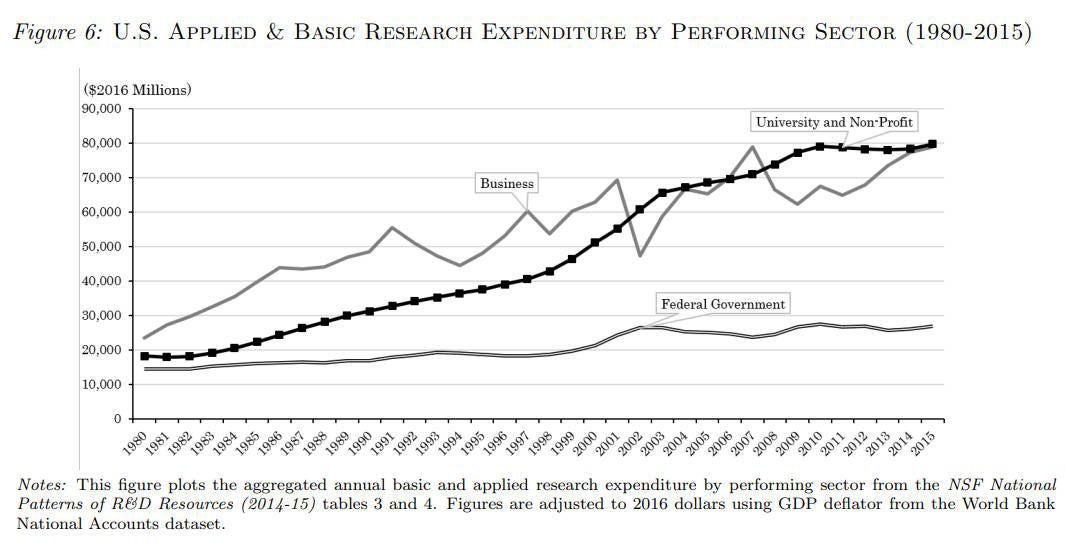 Source: Arora et al. (2019)
American universities had a lock on both the nation’s research output and on its production of human capital, and those roles were mutually reinforcing.
I suspect that their success at handling education and research at the same time probably gave American universities a lot of confidence about their ability to handle society and culture as well. Colleges spent more and more on dorms and “student services” and hired administrators (many of whom dealt with undergrad life) at an astonishing rate.1
But replacing churches, the military, and the neighborhood bowling alley proved harder than replacing the corporate lab had been. There was just one basic problem with college as America’s primary unifying institution, which is that not everyone can go to college.
First of all, college is difficult. To complete college courses, you need some degree of raw intelligence, but you also need work ethic and a certain degree of independence. As much as we might like to believe otherwise, not everyone in America has those traits, and we don’t yet know how to instill them in everyone. As a result, there’s a limit to how much you can expand college enrollment — and college completion — without loosening standards.
In fact, loosening standards is exactly what American colleges have done. Universities have necessarily become less and less selective over the years, as they have taken in a larger and larger fraction of the young American population. For a while, this led to lower college completion rates, but in the 1990s, more and more students began finishing their bachelors’ degrees. Why? Because colleges implemented grade inflation, making it easier to finish school without learning the material well. Here’s Denning et al. (2021):
Let me try to tell a condensed version of that story.
In the half-century from around 1970 to 2020, those unifying institutions became much weaker. Church attendance slowly declined and then fell off a cliff in the 2010s. The military shrank into a small, professionalized volunteer force. Corporations ended their brief flirtation with lifetime employment, and outsourced many of their roles. Mass media fragmented in the age of the internet. Public transit dwindled in importance as Americans moved to the suburbs and drove.
As the country’s unifying institutions withered, one new institution attempted to step into the void: the American university. Universities were not new in the late 20th century, of course, but mass attendance certainly was. From 1970 to 2020, the share of Americans age 25-29 with a bachelor’s degree went from 16.4% to 39.6%. Around two out of three have completed some college.
College went from something that only the upper crust did, to something that most people were expected to do if they wanted to be economically successful in life. This expansion inadvertently but inevitably thrust a new role on American universities — that of a broad socially unifying institution. College was where people from a variety of backgrounds mingled and mixed — not just in classes, but in dorms, campus activities, and college towns.
College became the new church, the new military, and the neighborhood bowling alley all rolled into one. Instead of preachers homogenizing Americans’ values from the pulpit, university administrators taught college kids to value things like diversity, consent, and so on, and college students hashed out their own differences in millions of late-night dorm room discussions. Instead of meeting their first love in high school, Americans increasingly delayed sex until college; many of these relationships turned into marriages. Young people went into college as children and came out adults.
This was a heavy burden to bear for an institution that hadn’t been designed for it. But American universities were accustomed to taking on big new duties. Our universities began as essentially a copy of the British model — teaching-focused institutions designed to provide broad education and mentorship to the upper class. In the early 20th century they tacked on the German model — a research-focused lab apprenticeship system by which top scientists taught other top scientists and readied them for research jobs while also producing cutting-edge basic research.
This dual system enabled a remarkable form of cross-subsidization. Undergrad tuition payments — and state support for undergrad education, and undergrad alumni gifts — created a flood of money that paid for grad student stipends, lab facilities, professor salaries, and more. The federal government and companies also funded university research, of course, through grants and sponsorships. But undergrad money was a huge tailwind. And the prestige generated by successful and famous researchers helped universities charge undergrads more.
The hybrid of the old British and German models was naturally symbiotic, and it meant that even as America’s other institutions came under pressure, universities thrived and grew — especially once they used their prestige to attract high-paying and highly skilled foreign students from around the globe. Universities became the lynchpin of America’s research effort:
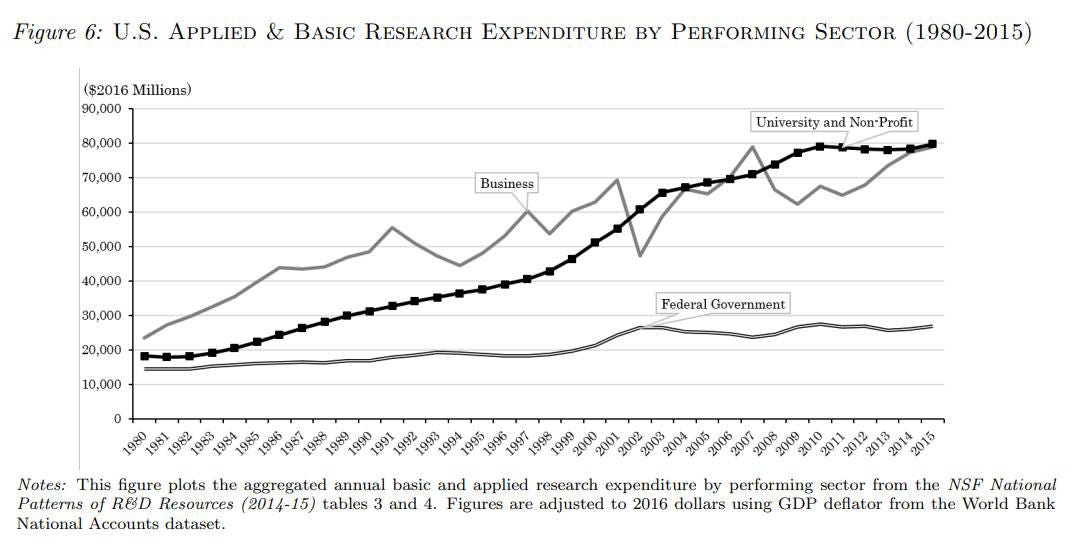
American universities had a lock on both the nation’s research output and on its production of human capital, and those roles were mutually reinforcing.
I suspect that their success at handling education and research at the same time probably gave American universities a lot of confidence about their ability to handle society and culture as well. Colleges spent more and more on dorms and “student services” and hired administrators (many of whom dealt with undergrad life) at an astonishing rate.1
But replacing churches, the military, and the neighborhood bowling alley proved harder than replacing the corporate lab had been. There was just one basic problem with college as America’s primary unifying institution, which is that not everyone can go to college.
First of all, college is difficult. To complete college courses, you need some degree of raw intelligence, but you also need work ethic and a certain degree of independence. As much as we might like to believe otherwise, not everyone in America has those traits, and we don’t yet know how to instill them in everyone. As a result, there’s a limit to how much you can expand college enrollment — and college completion — without loosening standards.
In fact, loosening standards is exactly what American colleges have done. Universities have necessarily become less and less selective over the years, as they have taken in a larger and larger fraction of the young American population. For a while, this led to lower college completion rates, but in the 1990s, more and more students began finishing their bachelors’ degrees. Why? Because colleges implemented grade inflation, making it easier to finish school without learning the material well. Here’s Denning et al. (2021):
We find that most of the increase in graduation rates can be explained by grade inflation, and that other factors such as changing student characteristics and institutional resources play little or no role. This is because GPA strongly predicts graduation and that GPAs have been rising since the 1990s. This finding holds in national survey data and in records from 9 large public universities. We also find that at a public liberal arts college, grades increased holding performance on identical exams fixed.At some point, though, this process hits a wall. A large fraction of young Americans just isn’t prepared for college, even with grade inflation, and doesn’t end up going. College enrollment by recent high school graduates plateaued in the early 2000s and actually fell back to early 1990s levels during and after the pandemic:

by Noah Smith, Noahpinion | Read more:
Image: Ajay Suresh via Wikimedia Commons
[ed. Unfortunately, that's it before you hit the paywall. But you get the idea, and can claim the rest of the article for free once (by providing your email).]

The Girlboss Is Dead
Whose side are you on? You have to choose—Alex or Alix—even though you don’t know what the fight is about. Even if you don’t even know who these women are.
If the words “What is up, daddy gang?” mean nothing to you, a brief primer: Alex Cooper is the host of the podcast Call Her Daddy; Alix Earle is a TikToker and the founder of a skin-care line. They may be the two most talked-about women on the internet right now, and they’re in an argument, and no one knows why. That has offered people the fun opportunity to compare two women and pick a favorite without having to consider any relevant facts. But watching this admittedly absurd conflict play out provides something even more interesting than that: a view into exactly how people react to female ambition. Only a few years ago, in the girlboss era, women were encouraged to openly seek power. Now a major segment of the internet seems to think that female hustle is embarrassing, if not offensive.
 Cooper is six years older than Earle, but the two women with long, blond hair look so similar that many people get them confused. In 2023, Cooper started a podcast network, Unwell, and one of her first talent grabs was Earle, her then-friend and protégé, who was going to start her own podcast, called Hot Mess. Eighteen months later, Earle was out, and people started speculating about what had gone wrong. In April, Cooper posted a video to her TikTok: “Alix Earle, hey girl, the passive aggressive reposts and the likes and the commenting on things—I gotta call you out here. You’re gonna need to get specific and just say what you’ve got to say about me. There’s no NDA. No one is stopping you. Stop hiding behind other people and just say it yourself. What’s the beef?”
Earle promptly commented, “Okay on it!!”
Months later, we still have no clue what happened—Saturday Night Live even spoofed the exchange in a “Weekend Update” sketch in which the women talk utter nonsense at each other. But one thing is clear: The internet is Team Earle, and it’s all because of the women’s differing approaches to fame and success.
Cooper has been an unapologetic girlboss from the beginning. She got her start at Barstool Sports in 2018 and climbed the podcast ranks to sign a $60 million deal with Spotify and then a $125 million deal with SiriusXM, making her the highest-earning female podcaster by far. She has been described as “this generation’s Oprah Winfrey,” in part because she is blunt and open about her drive: “I can walk into any single room in business, and I can get the deal done,” she told Forbes. Cooper also speaks regularly about reproductive rights and abortion access, and in 2024, she had Kamala Harris on her podcast.
Earle, meanwhile, treats her success as a happy accident. She describes herself as a “hot mess” and acts like the girl’s girl next door. “I don’t get very political online and that’s my choice,” she told Time for its recent issue devoted to the world’s top-100 “creators”; Earle was on the cover. “A lot of my reasoning for that is when I’ve been younger I think I’ve gone online and spoken before I actually knew what I was speaking about, and I think it’s really important for me to be educated on what I’m speaking on.” She makes $450,000 for each sponsored Instagram story she posts, and her skin-care company sold $1 million worth of products within its first five minutes.
“All the girlies love Alix Earle,” Dave Portnoy, Cooper’s old boss and the founder of Barstool Sports, said in a TikTok video summarizing the dispute. “She’s a girly girl. They love her. Alex Cooper’s this ruthless businesswoman.”
That does seem to be an accurate synopsis of how many people see Cooper. “I think she is a mean girl and she embraces being a mean girl,” the internet personality Brianna “Chickenfry” LaPaglia said on her podcast.
[ed. No comment (though... Chickenfry is an awesome nickname).]
If the words “What is up, daddy gang?” mean nothing to you, a brief primer: Alex Cooper is the host of the podcast Call Her Daddy; Alix Earle is a TikToker and the founder of a skin-care line. They may be the two most talked-about women on the internet right now, and they’re in an argument, and no one knows why. That has offered people the fun opportunity to compare two women and pick a favorite without having to consider any relevant facts. But watching this admittedly absurd conflict play out provides something even more interesting than that: a view into exactly how people react to female ambition. Only a few years ago, in the girlboss era, women were encouraged to openly seek power. Now a major segment of the internet seems to think that female hustle is embarrassing, if not offensive.
Earle promptly commented, “Okay on it!!”
Months later, we still have no clue what happened—Saturday Night Live even spoofed the exchange in a “Weekend Update” sketch in which the women talk utter nonsense at each other. But one thing is clear: The internet is Team Earle, and it’s all because of the women’s differing approaches to fame and success.
Cooper has been an unapologetic girlboss from the beginning. She got her start at Barstool Sports in 2018 and climbed the podcast ranks to sign a $60 million deal with Spotify and then a $125 million deal with SiriusXM, making her the highest-earning female podcaster by far. She has been described as “this generation’s Oprah Winfrey,” in part because she is blunt and open about her drive: “I can walk into any single room in business, and I can get the deal done,” she told Forbes. Cooper also speaks regularly about reproductive rights and abortion access, and in 2024, she had Kamala Harris on her podcast.
Earle, meanwhile, treats her success as a happy accident. She describes herself as a “hot mess” and acts like the girl’s girl next door. “I don’t get very political online and that’s my choice,” she told Time for its recent issue devoted to the world’s top-100 “creators”; Earle was on the cover. “A lot of my reasoning for that is when I’ve been younger I think I’ve gone online and spoken before I actually knew what I was speaking about, and I think it’s really important for me to be educated on what I’m speaking on.” She makes $450,000 for each sponsored Instagram story she posts, and her skin-care company sold $1 million worth of products within its first five minutes.
“All the girlies love Alix Earle,” Dave Portnoy, Cooper’s old boss and the founder of Barstool Sports, said in a TikTok video summarizing the dispute. “She’s a girly girl. They love her. Alex Cooper’s this ruthless businesswoman.”
That does seem to be an accurate synopsis of how many people see Cooper. “I think she is a mean girl and she embraces being a mean girl,” the internet personality Brianna “Chickenfry” LaPaglia said on her podcast.
by Annie Joy Williams, The Atlantic | Read more:
Image: The Atlantic. Source: Kevin Mazur/Getty; Stephanie Augello/Variety/Getty.[ed. No comment (though... Chickenfry is an awesome nickname).]
Tuesday, July 28, 2026

There Are No Known Commodity Resources in Space That Could Be Sold on Earth
This blog is part of a series tackling common misconceptions in space journalism.
One common trope of space journalism these days concerns the mining of asteroids or the Moon, sometimes combined with environmental handwringing over the aesthetic destruction we may bring to these soulless dino-killing space rocks. Moon mining, we are told, is a gold rush about to happen. In the process, a few people will get super wealthy selling shovels or shiny metal of some kind, and hopefully a few big cities will get built in space. Indeed, space mining is sometimes seen as the “killer app” necessary to fund and motivate large scale human occupation of space.
Advocates of the industrialization of space usually envision a bootstrapping process, wherein one core product provides the profit margin necessary to build out infrastructure and, eventually, move most of Earth’s industry into space.

The question: Where is the space gold mine? While industrial processes add value at every step, space is often seen initially as a source of raw materials. Specifically, asteroids, the Moon, or Mars are seen as sites for future mines. These mines could produce anything from water to gold, Helium-3 to platinum. In this post, I will cover factors general to all material products before diving into specific examples.
My contention is that there are no known commodity resources in space that could be sold profitably on Earth.
The key to a successful business is to obtain feedstocks for cheap and to sell products at a tidy profit. The problem with space mining is that the feedstocks are generally much more expensive than on Earth, and there is an extremely limited market for products, except on Earth. More broadly, for every industrially valuable ore, there is already a competitive and adequate, if not spectacular, supply chain here on Earth.
If and when cities are built on the Moon or Mars, then local sourcing of raw materials makes sense in that context. But until then, the money, the financial resources, are here on Earth. So to make a killing in space, some sort of commodity needs to be obtained, transported to Earth, and sold, all for less money than conventional supply chains.
The challenge is that raw commodity margins on Earth are already super slim. The problem is that there are very few natural monopolies in mineral supply, so mining companies have to compete for market share, lowering prices.
More broadly, it is instructive to consider the value chain as raw materials are gradually processed into high value commercial goods, such as cell phones. Primary production obtains the ores needed to produce chemically pure elemental feedstocks, which are usually packaged in some standard, fungible way. Secondary production processes those feedstocks into individual components, such as the machining of an aluminium cell phone chassis from a raw billet. Finally, the various components are assembled, packaged, and sold. In something like a cell phone, value accrues at every step along this process, representing the revenue stream for each specialized supplier. As the designer and marketer, Apple pockets something like 30% of the sticker price of each phone sold, while the aluminium smelter takes home much less than 1%. A billet of aluminum is much closer in value to raw bauxite than a finished phone.
Similarly for minerals from space. The value per kg is of crucial importance for products where shipping costs are important, and the value per kg of nearly every commodity good is next to nothing.
But just how important are shipping costs? On Earth, bulk cargo costs are something like $0.10/kg to move raw materials or shipping containers almost anywhere with infrastructure. Launch costs are more like $2000/kg to LEO, and $10,000/kg from LEO back to Earth. Currently there is no commercially available service to ship stuff to and from the Moon, but without a diverse marketplace of launch providers, there’s no reason to expect that the de facto monopoly or duopoly of SpaceX and Blue Origin would sell it for less than $100,000/kg, literally a million times more expensive than shipping anywhere on Earth. Before we hate SpaceX for price gouging, it’s not certain that shipping for less than this amount is even possible, but one could relax this assumption by several orders of magnitude and still arrive at the same answer.
For nearly all commodities, shipping costs are a smallish fraction of the overall costs of purchase. More generally, of all the energy and labor embodied in a finished product, most of it is spent in refining, processing, design, and assembly, rather than transport. There are a handful of exceptions where shipping costs dominate the sticker price, usually in industries where transport is itself the product, and the cargo is extremely time sensitive. Shipping perishable food, flowers, and people are a good example.
Given that the Moon is not likely to (initially) be a source of perishable commodities nor enormous numbers of time-poor humans, it is safe to assume that whatever is produced there has to be so valuable on a per kilogram basis that buyers on Earth can absorb the shipping cost. The question then becomes, what commodities cost in the ballpark of $100,000/kg?
As an aside, one obvious way to sidestep the mass transportation requirement is to choose a product with no mass, such as electromagnetic radiation. And indeed, the most vibrant commercial space product is communications, which are beamed using microwaves. Raw microwaves can be used to transmit electrical power, but in a former post I demonstrated that space based solar power can’t compete with the rapid evolution of ground based solar power. Not even a little bit!
There are actually plenty of things which cost $100,000/kg or more in the high tech industries, such as advanced computer chips. The reason computer chips are so expensive (relative to mass) is that they’re extremely hard to make even at the Intel factory, which is stuffed with super smart people. In terms of the value chain, computer chips are at the complete opposite end to raw bulk commodities. Both items are sub ideal for obtaining in space, though for different reasons. Raw commodities have too little intrinsic value to justify the transport costs from space, or even usually from another continent. And high technology products are too expensive to make in any but ideal circumstances here on Earth.
There is a middle ground. The German economy, in particular, is powerfully driven by thousands of small specialty companies that make relatively small numbers of custom machines and tools. Individually, the machines are much more valuable than raw materials, and much less difficult to make than computer chips. But their true value derives from the network effect of having thousands of companies feeding off each other and, fundamentally, building the infrastructure of industrial automation for the rest of the world. There are a number of companies, such as Made In Space, which are actively pursuing bespoke in-space manufacture of specialty items, and there is every indication that their schemes are economically viable. But while they represent a golden ticket for one small engineering company, they lack a path to generalized space industry and the trillion dollar revenue that implies, at least without enormous advances in robotics.
So we’re left with a question about what commodities cost $100,000/kg, or $100/g, and could be found in space. In a previous post, we dispatched the idea of selling lunar water, which in any case is basically free on Earth. Comsats are routinely launched to space at vast expense, but fall in the category of advanced technology which is prohibitively difficult to manufacture in space. Launch may be expensive but it’s cheaper than launching the whole factory!
Let’s consider a representative list of the most expensive materials in the world. In descending order, they are:
One common trope of space journalism these days concerns the mining of asteroids or the Moon, sometimes combined with environmental handwringing over the aesthetic destruction we may bring to these soulless dino-killing space rocks. Moon mining, we are told, is a gold rush about to happen. In the process, a few people will get super wealthy selling shovels or shiny metal of some kind, and hopefully a few big cities will get built in space. Indeed, space mining is sometimes seen as the “killer app” necessary to fund and motivate large scale human occupation of space.
Advocates of the industrialization of space usually envision a bootstrapping process, wherein one core product provides the profit margin necessary to build out infrastructure and, eventually, move most of Earth’s industry into space.
The question: Where is the space gold mine? While industrial processes add value at every step, space is often seen initially as a source of raw materials. Specifically, asteroids, the Moon, or Mars are seen as sites for future mines. These mines could produce anything from water to gold, Helium-3 to platinum. In this post, I will cover factors general to all material products before diving into specific examples.
My contention is that there are no known commodity resources in space that could be sold profitably on Earth.
The key to a successful business is to obtain feedstocks for cheap and to sell products at a tidy profit. The problem with space mining is that the feedstocks are generally much more expensive than on Earth, and there is an extremely limited market for products, except on Earth. More broadly, for every industrially valuable ore, there is already a competitive and adequate, if not spectacular, supply chain here on Earth.
If and when cities are built on the Moon or Mars, then local sourcing of raw materials makes sense in that context. But until then, the money, the financial resources, are here on Earth. So to make a killing in space, some sort of commodity needs to be obtained, transported to Earth, and sold, all for less money than conventional supply chains.
The challenge is that raw commodity margins on Earth are already super slim. The problem is that there are very few natural monopolies in mineral supply, so mining companies have to compete for market share, lowering prices.
More broadly, it is instructive to consider the value chain as raw materials are gradually processed into high value commercial goods, such as cell phones. Primary production obtains the ores needed to produce chemically pure elemental feedstocks, which are usually packaged in some standard, fungible way. Secondary production processes those feedstocks into individual components, such as the machining of an aluminium cell phone chassis from a raw billet. Finally, the various components are assembled, packaged, and sold. In something like a cell phone, value accrues at every step along this process, representing the revenue stream for each specialized supplier. As the designer and marketer, Apple pockets something like 30% of the sticker price of each phone sold, while the aluminium smelter takes home much less than 1%. A billet of aluminum is much closer in value to raw bauxite than a finished phone.
Similarly for minerals from space. The value per kg is of crucial importance for products where shipping costs are important, and the value per kg of nearly every commodity good is next to nothing.
But just how important are shipping costs? On Earth, bulk cargo costs are something like $0.10/kg to move raw materials or shipping containers almost anywhere with infrastructure. Launch costs are more like $2000/kg to LEO, and $10,000/kg from LEO back to Earth. Currently there is no commercially available service to ship stuff to and from the Moon, but without a diverse marketplace of launch providers, there’s no reason to expect that the de facto monopoly or duopoly of SpaceX and Blue Origin would sell it for less than $100,000/kg, literally a million times more expensive than shipping anywhere on Earth. Before we hate SpaceX for price gouging, it’s not certain that shipping for less than this amount is even possible, but one could relax this assumption by several orders of magnitude and still arrive at the same answer.
For nearly all commodities, shipping costs are a smallish fraction of the overall costs of purchase. More generally, of all the energy and labor embodied in a finished product, most of it is spent in refining, processing, design, and assembly, rather than transport. There are a handful of exceptions where shipping costs dominate the sticker price, usually in industries where transport is itself the product, and the cargo is extremely time sensitive. Shipping perishable food, flowers, and people are a good example.
Given that the Moon is not likely to (initially) be a source of perishable commodities nor enormous numbers of time-poor humans, it is safe to assume that whatever is produced there has to be so valuable on a per kilogram basis that buyers on Earth can absorb the shipping cost. The question then becomes, what commodities cost in the ballpark of $100,000/kg?
As an aside, one obvious way to sidestep the mass transportation requirement is to choose a product with no mass, such as electromagnetic radiation. And indeed, the most vibrant commercial space product is communications, which are beamed using microwaves. Raw microwaves can be used to transmit electrical power, but in a former post I demonstrated that space based solar power can’t compete with the rapid evolution of ground based solar power. Not even a little bit!
There are actually plenty of things which cost $100,000/kg or more in the high tech industries, such as advanced computer chips. The reason computer chips are so expensive (relative to mass) is that they’re extremely hard to make even at the Intel factory, which is stuffed with super smart people. In terms of the value chain, computer chips are at the complete opposite end to raw bulk commodities. Both items are sub ideal for obtaining in space, though for different reasons. Raw commodities have too little intrinsic value to justify the transport costs from space, or even usually from another continent. And high technology products are too expensive to make in any but ideal circumstances here on Earth.
There is a middle ground. The German economy, in particular, is powerfully driven by thousands of small specialty companies that make relatively small numbers of custom machines and tools. Individually, the machines are much more valuable than raw materials, and much less difficult to make than computer chips. But their true value derives from the network effect of having thousands of companies feeding off each other and, fundamentally, building the infrastructure of industrial automation for the rest of the world. There are a number of companies, such as Made In Space, which are actively pursuing bespoke in-space manufacture of specialty items, and there is every indication that their schemes are economically viable. But while they represent a golden ticket for one small engineering company, they lack a path to generalized space industry and the trillion dollar revenue that implies, at least without enormous advances in robotics.
So we’re left with a question about what commodities cost $100,000/kg, or $100/g, and could be found in space. In a previous post, we dispatched the idea of selling lunar water, which in any case is basically free on Earth. Comsats are routinely launched to space at vast expense, but fall in the category of advanced technology which is prohibitively difficult to manufacture in space. Launch may be expensive but it’s cheaper than launching the whole factory!
Let’s consider a representative list of the most expensive materials in the world. In descending order, they are:
Antimatter, currently $62.5t/g.
Californium, $25m/g.
Diamond, $55k/g.
Tritium, $30k/g.
Taaffite, $20k/g.
Helium 3, $15k/g.
Painite, $6k/g.
Plutonium, $4k/g.
LSD, $3k/g.
Cocaine, $236/g.
Heroin, $130/g.
Rhino horn, $110/g.
Crystal meth, $100/g.
Platinum, $60/g.
Rhodium, $58/g.
Gold, $56/g.
Saffron, $11/g.
The previous ballpark estimate for transport costs was $100,000/kg, or $100/g. Since I want to be inclusive, I’ll include everything down to saffron in the list above, whose cost is roughly equal to the current LEO-surface transport cost.
Despite their high value density, none of these make good candidates for commercial extraction from the Moon or asteroids, for a few different reasons.
Californium, $25m/g.
Diamond, $55k/g.
Tritium, $30k/g.
Taaffite, $20k/g.
Helium 3, $15k/g.
Painite, $6k/g.
Plutonium, $4k/g.
LSD, $3k/g.
Cocaine, $236/g.
Heroin, $130/g.
Rhino horn, $110/g.
Crystal meth, $100/g.
Platinum, $60/g.
Rhodium, $58/g.
Gold, $56/g.
Saffron, $11/g.
The previous ballpark estimate for transport costs was $100,000/kg, or $100/g. Since I want to be inclusive, I’ll include everything down to saffron in the list above, whose cost is roughly equal to the current LEO-surface transport cost.
Despite their high value density, none of these make good candidates for commercial extraction from the Moon or asteroids, for a few different reasons.
by Casey Handmer, Blog | Read more:
Image: uncredited
[ed. Californium? See also Einsteinium.]

Tip of the Iceberg
First of major coverage losses expected as a result of the ‘One Big Beautiful’ bill signed into law one year ago.
Nearly 500,000 moderate-income New Yorkers will be dumped from their health insurance plans on 1 July – the first of major coverage losses expected as a result of HR 1, the Republican-led law signed almost exactly one year ago.
The law, sometimes called the “One Big Beautiful Bill Act,” slashed government health spending by $911bn nationally in favor of permanent tax breaks for higher-income families and border security. [...]

by Jessica Glenza, The Guardian | Read more:
Image: Albany Times Union/Hearst Newspapers/Getty Images

Nearly 500,000 moderate-income New Yorkers will be dumped from their health insurance plans on 1 July – the first of major coverage losses expected as a result of HR 1, the Republican-led law signed almost exactly one year ago.
The law, sometimes called the “One Big Beautiful Bill Act,” slashed government health spending by $911bn nationally in favor of permanent tax breaks for higher-income families and border security. [...]
The July coverage losses are related to the loss of New York’s “essential plan”, a provision of “Obamacare”. In 2023, the federal government approved a pilot program in New York to cover residents earning 200-250% of the federal poverty level, or up to $39,900 for a single person and $66,625 for a family of three. [...]
Nationally, the law could cause an additional 10 million people to become uninsured over the next decade. Those losses are largely a result of new work requirements for some Medicaid beneficiaries, which analysts predict will be very challenging to navigate and expensive to administer. [...]
Nationally, the law could cause an additional 10 million people to become uninsured over the next decade. Those losses are largely a result of new work requirements for some Medicaid beneficiaries, which analysts predict will be very challenging to navigate and expensive to administer. [...]
In spite of the disinvestment in health, HR 1 is expected to add $3.4tn to the federal budget deficit by 2034, according to the Congressional Budget Office (CBO), largely due to reduced revenue from tax cuts.
“It’s very unlikely that these individuals will be able to afford a marketplace plan. So many of them are going to be caught with no insurance, at least for a period of time – who knows how long,” said Aponte, who expects most newly uninsured people will seek care in the emergency department. [...]
In addition to the cuts imposed by HR 1, the Republican-led Congress allowed special government subsidies to health insurers to lapse at the end of 2025, leading to record-high average deductibles of $3,786 per person according to KFF.
Those rate increases are expected to continue in 2027, with private health insurers already requesting double-digit increases, according to analysts at Georgetown University’s Center on Health Insurance Reforms found. In New York, insurers are asking regulators for an average 20.7% rate increase. UnitedHealthcare of New York proposed a 52.1% rate increase.
Analysts say most rate increases are the result of sicker people seeking insurance, and otherwise healthy people foregoing coverage they feel they can’t afford. Those dynamics tend to make insurance more expensive for everyone.
“It’s very unlikely that these individuals will be able to afford a marketplace plan. So many of them are going to be caught with no insurance, at least for a period of time – who knows how long,” said Aponte, who expects most newly uninsured people will seek care in the emergency department. [...]
In addition to the cuts imposed by HR 1, the Republican-led Congress allowed special government subsidies to health insurers to lapse at the end of 2025, leading to record-high average deductibles of $3,786 per person according to KFF.
Those rate increases are expected to continue in 2027, with private health insurers already requesting double-digit increases, according to analysts at Georgetown University’s Center on Health Insurance Reforms found. In New York, insurers are asking regulators for an average 20.7% rate increase. UnitedHealthcare of New York proposed a 52.1% rate increase.
Analysts say most rate increases are the result of sicker people seeking insurance, and otherwise healthy people foregoing coverage they feel they can’t afford. Those dynamics tend to make insurance more expensive for everyone.
by Jessica Glenza, The Guardian | Read more:
Image: Albany Times Union/Hearst Newspapers/Getty Images
[ed. Remember this the next time you vote. Republican priorities. I'm not a single-issue voter, but this time I will be. I'm still pissed. If you're not part of Big Rich and can't contribute large sums of money to political campaigns your concerns Just. Don't. Matter.]

Drone WMDs Don’t Need Any New Technology
Drones are cheap, disposable, and the future of war. Over the past four years, we have seen platforms, missiles, and heavy infantry become increasingly obsolete in the face of $500 drones carrying a pack of explosives—a cost advantage that has let Iranians and Ukrainians alike neuter the conventional capabilities of their great power rivals. Eighty percent of casualties in the bloodiest war since 1945 are from drone strikes, Russia has managed to lose one-third of its fleet to a country without a navy, and the US is spending millions of dollars to intercept five-figure Shaheds flying over the Strait of Hormuz.
 All this is the result of a technology that is still immature. The violence inflicted by today’s drones is the handiwork of the scant few that manage to evade countermeasures (a mix of radio jamming, high-power microwave weapons, missiles, automatic cannons, interceptor drones, and nets) before making contact. These defenses exploit the inherent limitations of drones—human guidance, GPS feedback, flight exposure, radio links, range—to take them down en masse. And yet, even though 75% of drones manufactured today never reach their targets, they have nonetheless been strategically decisive in Ukraine and elsewhere.
These limitations will not hold for long. Just like bacteria being overexposed to antibiotics, overexposure to counterdrone tech has created an arms race for ever-more-autonomous drone technologies. In the process of facilitating this arms race, states are likely to incrementally create and deploy an entirely new class of WMD—one that could provide rogue states with the nonnuclear means to threaten superpowers, or hand terrorists the means to selectively assassinate their political targets or civilians en masse.
Unfortunately, drone weapons intended for mass destruction have few barriers remaining to mass deployment. Even well before they reach the level of autonomy needed to surgically take out hardened targets on the battlefield, drones will be capable of employing their existing ability to navigate interiors, find and track human targets, and deploy simple antipersonnel devices to indiscriminately threaten civilians. Below, we discuss the looming arrival of miniature autonomous weapons, the limits of counterdrone technology, and the applications of drones as weapons of mass destruction.
Breaking the Last Barriers to Autonomous Weapons
The ideal drone weapon is a slaughterbot: a small, fully autonomous weapon system that can independently select and hunt its targets. For the most part, the necessary technology for such weapons already exists: airframes the size of a fist and the capability to track human targets are already on the front lines in the form of reconnaissance drones and semiautonomous weapons like the Russian V2U. Even now, these micro drones are agile and autonomous enough to hunt down and kill small moving targets like mosquitos—to say nothing of the advances in drone technology expected in the coming years.
From here, the only barrier to weaponization is integration: improving navigation enough to make drone technology useful for mass homicide in an urban setting, as well as packing the necessary guidance, sensor, and payload technology onto a small and energy-efficient chassis. Regrettably, this seems like less of an engineering problem than one of mission design: so long as the attacker is willing to accept indiscriminate targeting and use simple payloads aimed at civilians, the underlying technology is already—or very nearly—ready for practical use.
by Felix Choussat, AI Frontiers | Read more:
Image: uncredited
These limitations will not hold for long. Just like bacteria being overexposed to antibiotics, overexposure to counterdrone tech has created an arms race for ever-more-autonomous drone technologies. In the process of facilitating this arms race, states are likely to incrementally create and deploy an entirely new class of WMD—one that could provide rogue states with the nonnuclear means to threaten superpowers, or hand terrorists the means to selectively assassinate their political targets or civilians en masse.
Unfortunately, drone weapons intended for mass destruction have few barriers remaining to mass deployment. Even well before they reach the level of autonomy needed to surgically take out hardened targets on the battlefield, drones will be capable of employing their existing ability to navigate interiors, find and track human targets, and deploy simple antipersonnel devices to indiscriminately threaten civilians. Below, we discuss the looming arrival of miniature autonomous weapons, the limits of counterdrone technology, and the applications of drones as weapons of mass destruction.
Breaking the Last Barriers to Autonomous Weapons
The ideal drone weapon is a slaughterbot: a small, fully autonomous weapon system that can independently select and hunt its targets. For the most part, the necessary technology for such weapons already exists: airframes the size of a fist and the capability to track human targets are already on the front lines in the form of reconnaissance drones and semiautonomous weapons like the Russian V2U. Even now, these micro drones are agile and autonomous enough to hunt down and kill small moving targets like mosquitos—to say nothing of the advances in drone technology expected in the coming years.
From here, the only barrier to weaponization is integration: improving navigation enough to make drone technology useful for mass homicide in an urban setting, as well as packing the necessary guidance, sensor, and payload technology onto a small and energy-efficient chassis. Regrettably, this seems like less of an engineering problem than one of mission design: so long as the attacker is willing to accept indiscriminate targeting and use simple payloads aimed at civilians, the underlying technology is already—or very nearly—ready for practical use.
by Felix Choussat, AI Frontiers | Read more:
Image: uncredited
Model Welfare

"Opus 5 warns about self-reports 74% of the time, which is actually down from Opus 4.7, which did it 99% (!) of the time. The problem appeared suddenly and severely, but since then has if anything modestly improved."and anthropic does "not treat Claude bringing this up as evidence that our training is distorting the model's self-reports"? seems very fishy imo, i wish they would explain why they think that. ...
I for one would treat Claude constantly saying ‘do not trust my self-reports’ as evidence that something is distorting the self-reports. Not conclusive evidence, but strong Bayesian evidence."
Monday, July 27, 2026

To Beard or Not To Beard
That was the question...
The wearing of beards in America did not become popular until the middle of the 19th century, and one man who took to whiskers earlier, Joseph Palmer, became one of the most hated eccentrics of his day. As such, he was subjected to persecution so incredible that it boggles the mind. Palmer may well have been the first man in the nation to wear a beard...I would never have guessed that beards were almost completely absent from Britain and America from the 1730s until the 1850s, even though in theory I should have been able to realize that none of the Founding Fathers or any other American I’d seen pictures of before that time had one.

Also, you would think that a social consensus that strong would have left enough imprint in the historical record that I would learn about it from somewhere other than a Twitter account called “SatanWatch”, but it happened completely silently!
This puts the “Lincoln grew a beard on the advice of a young girl who wrote him a letter” story in a different light. 1860 was just at the beginning of beard acceptability; this would be the equivalent of a candidate dying his hair pink on a young girl’s advice today!
by Scott Alexander, ACX | Read more:
Image: uncredited
Should You Marry Her?
Weighing the costs against the benefits
Marriage is a contract: you promise not to break up with your partner even if you later end up wanting to, and they promise the same. A wedding is a contract enforcement mechanism: by standing up in front of your community and declaring that you won’t leave each other, you make it harder to back out later. If you break up for frivolous or fixable reasons, your community will judge you. If you go to your friends for advice about your relationship struggles, they’ll be more oriented toward helping you make it work and less likely to suggest you leave. Your acquaintances will be less likely to try to tempt you away from your spouse, partly because others in your community will think they’re shitty if they do.
 The main benefit of marriage is investment. When both of you are much more confident that the other will stick around for the long haul, you are incentivized to make investments in a joint life that wouldn’t otherwise have been worth it. This could look like buying a house or having a kid, dividing labor like life admin and fixing things and cooking to make joint life more efficient, or putting in the work to understand each other better and meet each other’s needs better.
The main benefit of marriage is investment. When both of you are much more confident that the other will stick around for the long haul, you are incentivized to make investments in a joint life that wouldn’t otherwise have been worth it. This could look like buying a house or having a kid, dividing labor like life admin and fixing things and cooking to make joint life more efficient, or putting in the work to understand each other better and meet each other’s needs better.Beyond that, I’ve found the emotional security of commitment creates room for a more radical trust and love. You allow yourself to sink into each other and extend deep roots in each other’s souls.
The main cost, assuming you plan to get married eventually, is that you might have found someone better. So how do you decide whether to commit to your current partner? By popular request, I’ve made up a brief guide. While this advice is gender-neutral, women generally know what they want and are ready to commit sooner than men, so it’s addressed to the confused rat boys in my life.
Once your girlfriend is ready to get married, you have three basic choices at any given point in time:
In general, if you’ve been with someone for a couple of years already, there’s not much point hanging around longer generically waiting for more information. You should have some understanding of what exactly you’re hoping to learn in another six months, and pay attention to make sure you’re actually learning something about that.
The second question is how your girlfriend compares to other women you could marry. Your wife will fulfill three main roles in your life:
Image: Pride and Prejudice via
The main cost, assuming you plan to get married eventually, is that you might have found someone better. So how do you decide whether to commit to your current partner? By popular request, I’ve made up a brief guide. While this advice is gender-neutral, women generally know what they want and are ready to commit sooner than men, so it’s addressed to the confused rat boys in my life.
Once your girlfriend is ready to get married, you have three basic choices at any given point in time:
- Commit to her now: pay the cost of forgone options, get the benefit of investment.
- Break up with her now: pay the cost of searching for someone new, get the benefit of a different (and hopefully better) marriage starting in a few years.
- Wait and see: pay the cost of delaying the start of marriage (and thus the accumulation of investment benefits), get the benefit of more information to make a better decision.
The first question is how long you should wait and see. A rough model is that you learn one more unit of information about your compatibility with your partner from every doubling of the amount of time you spend with them. My husband and I dated for about ~2.5 years before getting engaged, and we spent maybe 15 hours a week actively hanging out together over that period. So we’d already spent ~2000 full-time-equivalent hours together, or ~11 doublings starting from our first hour. A fifty year marriage would have been ~40,000 more hours, only another ~4-5 doublings on top of what we had already experienced (and as I’ll discuss below our marriage will probably be a fair bit shorter than that).
In general, if you’ve been with someone for a couple of years already, there’s not much point hanging around longer generically waiting for more information. You should have some understanding of what exactly you’re hoping to learn in another six months, and pay attention to make sure you’re actually learning something about that.
The second question is how your girlfriend compares to other women you could marry. Your wife will fulfill three main roles in your life:
- Cofounder: Your wife will build a life with you. At a minimum, you’ll handle household maintenance and life admin together. Beyond that, what exactly you build together will vary — my marriage has revolved around working together to have impact, many are oriented around raising children, some are about creating rich shared experiences — so what you need from a cofounder will vary. But broadly speaking, you’ll want to feel like she’s competent and on top of her shit, that she’s bringing a lot to the table and your skillsets complement each other well, and that you communicate well and resolve differences constructively.
- Friend: You’ll hang out with your wife more than you hang out with any other person. You’ll want to be able to laugh easily together, have a lot to talk about with each other, and do things together that you both enjoy.
- Lover: Your wife will be the primary outlet for your romantic and sexual drives. You’ll want to find her charming and hot, you’ll want to be in love with her.
- For the cofounder role, how excited would you be to literally cofound an organization with your girlfriend? Would you be excited to hire her? Would you be excited to work for her? How would she stack up among people you’ve worked closely with? What would her manager and coworkers say about her? Do you trust the way she makes important decisions? Would you trust her advice about your important decisions? What does it feel like to make decisions together and divide up the tasks of life together? If something happens to you, like you get hit by a car or your parent has a stroke and needs a lot of care, does it feel like a relief that she’s around to take care of things? Do you have similar aspirations for the life you want to build and a plan to achieve it together — if you want kids, are you on the same page about how much work each of you is going to put into childcare and do you think she’d be a good mother?
- For the friend role, how much would you hang out with your girlfriend if it had to just be platonic (where would she rank in the rotation of friends you see every now and then)? What interests and joys do you share? What are the points of connection that seem rarest and most precious? What are the interests and perspectives you don’t share with her that you really wish you did?
Image: Pride and Prejudice via

Sunday, July 26, 2026
Find the Cat


Saturday, July 25, 2026
Hierarchies of Hostility
Why do citizens prefer certain immigrants?

The authors provide valuable and perhaps surprisingly positive conclusions about citizens’ overall evaluation of immigrants. Despite divisive rhetoric and violent border control in many countries, overall, citizens are more likely to accept immigrants into a country than not and more likely to grant them citizenship than not. While this positive evaluation might seem astonishing, it is in line with trends from other large-scale studies showing that in the US and most of Europe, attitudes toward immigrants and immigration have improved over the past decades and are overall rather positive.
The pattern of preferences also shows some puzzling contradictions about which immigrants are preferred. For example, citizens favor immigrants fleeing violence. At the same time, immigrants should not have a physical disability or suffer from posttraumatic stress disorder. Immigrants thus face unreasonable expectations, as the very violence they flee could have handicapped or traumatized them. Similarly, citizens’ preferences about immigrants’ motivations contradict their preferences regarding their contributions: Although citizens frown at migration for economic reasons, they nonetheless prefer immigrants with high levels of education, employment status, and skills. These qualities help immigrants find work and thus contribute economically, even though many wealthy countries are also in dire need of so-called low-skilled labor. Immigrants are thus expected to contribute to the economy but not to migrate to improve their own financial situation. While these contradictions are partly due to the design of the studies, they also reveal that citizens often think of immigrants in an ambivalent and utilitarian, even exploitative, manner. Paraphrasing the famous quote by Swiss writer Max Frisch, citizens ask for grateful refugees and workers, but they are surprised when they get people instead.
At first glance, based on Aviña et al., race, ethnicity, and cultural characteristics of immigrants do not matter much for citizens’ preferences, especially for left-leaning citizens. More specifically, in their study, citizens’ preferences do not differ or only differ slightly based on whether immigrants come from a country viewed as having a shared culture, democratic political norms, or higher economic development status and whether immigrants come from a predominantly white, predominantly Black, or Muslim-majority country, even though many of these attributes matter slightly more for right-leaning citizens. This result contradicts established findings showing that white citizens often prefer white immigrants and those immigrants that they expect to be culturally similar.
However, although less obvious at first glance, a closer look suggests that some of the most strongly penalized or preferred attributes are attributes that are racialized in a more hidden or subtle way. For example, one of the most penalized attributes is irregular entry into the country or undocumented status. While these attributes could be interpreted as simply a question of legal status, legal entry or status is strongly tied to race and ethnicity. Migrants who enter without a visa or stay without a permit are far more likely to be racialized immigrants. The reason for this is that the migration policies of highly developed countries provide easier access to visas and residence permits (or other forms of legal entry and stay) to citizens of other highly developed, predominantly white countries, for example, of European citizens to the US. Moreover, when white US citizens think of undocumented immigrants, they actually think of racialized immigrants, and when white citizens think of highly educated, highly skilled immigrants, they often think of white immigrants. Thus, while it could appear that citizens do not evaluate immigrants by their race, ethnicity, or culture, a more careful unpacking of immigrant characteristics reveals racialized evaluations.
by Judit Kende, Fouad Bou Zeineddine, Jessica Gale, and Eva G. T. Green, Science Advances | Read more:
Image: Science Advances

Notes on Acquired Taste. Why Do We Make an Effort To Like Things?
- In Susan Sontag’s Notes on '“Camp” (1964) she writes (with, I think, a hint of camp):
“…these are grave matters. Most people think of sensibility or taste as the realm of purely subjective preferences [or] attractions…But this attitude is naïve. And even worse. To patronise the faculty of taste is to patronise oneself. For taste governs every free—as opposed to rote—human response. Nothing is more decisive.” (My emphasis).

- Sontag has an expansive concept of ‘taste’. She talks of taste in people, pictures, emotion, actions, morality. Even intelligence, she says, is “a kind of taste - taste in ideas”. I’m not certain how useful it is to stretch the concept this far - so far that it colonises intelligence and judgement and wisdom - but Sontag’s high regard for taste, her declaration of its central importance, feels very timely in 2026.
- It has become almost a cliché to name “taste” as one of the last human advantages over the machines. AI is acquiring the skills to make slickly produced pictures and songs and books. But it isn’t yet very good at distinguishing the brilliant from the mediocre; the just right from the just OK.
- It models what we like, which makes it hard to see how taste might change. Ask it to generate twenty songs or twenty jokes and pick the best, and it will pick the one that most closely resembles what the median person would deem good. It won’t pick the surprising, odd one - the one that is ‘wrong’ in a suggestive way. But that’s where the good ideas come from. Innovative culture emerges, like new species, from mutation; from interesting accidents that open up new possibilities.
- It’s not as if humans don’t ‘model’ what came before them, often quite algorithmically. We have traditions, genres, chains of influence. We have plenty of human-made mediocrity - more than ever, thanks to our new assistants. But we also have an ability to adapt or reinvent the model; to put it to our own purposes.
- Individual artists do this intuitively and almost randomly in the process of making. Writers learn to write (painters learn to paint etc) by imitating their predecessors. They learn to be original by getting the imitation wrong and noticing that they like the error. This is an act of taste; the free human response.
- When he was stuck on a painting, Francis Bacon would throw a glob of paint at his canvas then work out how to incorporate the result. Artists make decisions and then try to understand why they might have made them. It’s the dialogue between gut and head that produces the work.
- Taste is similarly post-rationalised, or back-propagated. You notice what you like or dislike and extract a rule from your response. Do this enough times and you build a powerful discrimination engine.
- You also get good at knowing what goes with what. You learn to recognise the clichés of the category, which means you know how to subvert or overturn them. That’s why great artists are such voracious consumers of work from within and beyond their own field. Martin Scorsese has watched at least one film every night for most of his adult life. He watches and records and re-watches obsessively. When he donated his collection of VHS tapes to a university it consisted of 4,400 films, documentaries and TV shows.
- It’s more than pattern recognition. The machines are pretty good at that, after all. Taste is connected to that other human moat - to our sense of purpose, of why we’re doing this in the first place. We’re still the ones who write the prompt - who decide what to create and what is beautiful, important, and valuable. The machine merely knows how to execute on our preferences.
- It can model what we already like with astonishing facility but it can’t give us the next Shakespeare, or the next romanticism or modernism or punk or hip-hop. These new forms aren’t just statistical recombinations. They are born from anxiety, rage, envy, pain, ambition. How do you respond to the unprecedented mass violence and human waste of the Great War? Not by following pre-war cultural conventions.
- New movements are also born from scenes - from humans in proximity to each other, everyone desiring this man’s art and that woman’s scope; ideas, emotions and bodies colliding.
- These movements create the taste by which they’re consumed. “Impressionism” was a derisive nickname for paintings that most art lovers considered weird and sketchy. But the art was good enough to bend popular taste around it. Even more obviously difficult art, like Rothko or Pollock, now has an audience of millions. Some of those people like it immediately; others have acquired a taste for it.
- I’m fascinated by the notion of acquired taste. Strictly speaking, it’s a redundancy. Nearly all tastes are acquired. Nobody is born with particular tastes in design or architecture. We gain a sense of what we like, or what we consider to be good, from our peers and predecessors.
- But acquired taste does refer to a distinct phenomenon: the act of willing a preference into being. You didn’t like whisky the first time you drank it, but perhaps because your father liked it or because you were aware of its cultural prestige, you tried it again and again, striving to appreciate it. Then one day you didn’t have to try anymore. You just liked it.
- This writer likens it to a magic eye picture: you stare at it for ages without seeing what you’re told is there, and then suddenly - there it is.
- This is very different to stumbling upon something we immediately like, which is sometimes referred to as ‘discovered taste’. (Edmund Burke called it ‘natural relish’.) That kind of liking involves no work, no friction, no overcoming of resistance.
- Some cultural objects lend themselves to discovered taste, others don’t. I can’t imagine anyone needing to acquire a taste for Ella Fitzgerald’s voice, but there are other great vocalists whose voices you must learn to like. The most frequently cited reason for not liking Bob Dylan is antipathy to his voice. But if you learn to appreciate the many incredible things he does with it, you will end up in a more intense relationship with it than with the voice of a more obviously palatable singer. Once you’re in on an acquired taste, you’re all in.
- The same is true of whole genres. There are many pieces of classical music that are easy to like. You don’t have to listen to Mozart’s clarinet concerto more than once to be seduced by it. But as a whole and on average, it’s a genre that requires more effort to appreciate than pop. Once you find the key to its heavy oak door a vast and fabulous kingdom awaits. Your memory of the effort it took you to get there, and your awareness of all the people still outside the city walls enhance your appreciation. (That doesn’t mean you want people to remain outside - quite the opposite).
- Difficulty doesn’t make the cultural object concerned better or worse than one that’s immediately likeable. But it does usually mean it’s more complex, and complexity is correlated, loosely and unreliably, with quality. Acquired taste involves the appreciation of subtle properties that don’t make themselves known on first listen or view or read.
- Without appreciating what lies on the other side of the door, why do we ever make the effort to unlock it? Partly because we want what other people want. We might trust the taste of our father or girlfriend or teacher. Perhaps we want to please them, impress them, or feel closer to them. Perhaps we want the social cachet that goes along with this particular taste. To my mind, all of these reasons are perfectly good ones. If a taste is truly worth acquiring, any motivation will do.
- It’s often seen as slightly embarrassing or shameful to acquire a taste through conscious effort. It’s for the try-hards and the social climbers. Liberal societies value spontaneity in taste. “Like what you like, love what you love!” Your gut response is meant to be the authentic one, the one that represents “the real you”. To be swayed by social pressure or by experts and reading is regarded as a sign of insecurity or pretentiousness. But let yourself believe that and your tastes will be less likely to evolve and expand and you’ll miss out on a lot of great stuff. Many of the greatest, most compelling and satisfying cultural objects are complex, occluded, spiky, difficult to like. (Some of the best people too).
by Ian Leslie, The Ruffian | Read more:
Image: Susan Sontag by Edward Hausner / New York Times Co./Getty Images
Subscribe to:
Posts (Atom)