Monday, August 11, 2025

Short-Term Thinking Is Destroying America

In the disquieting new film “Eddington,” the director, Ari Aster, captures the American tendency to live obsessively in the present. As a Covid-era New Mexico town tears itself apart over mask mandates, Black Lives Matter and conspiracy theories, a faceless conglomerate constructs a data center nearby — a physical manifestation of our tech-dominated future. It’s an unsubtle message: Short-term compulsions blind us to the forces remaking our lives.

In the chaos depicted, Donald Trump is both offscreen and omnipresent. Over the decade that he has dominated our politics, he has been both a cause and a symptom of the unraveling of our society. His rise depended upon the marriage of unbridled capitalism and unregulated technology, which allowed social media to systematically demolish our attention spans and experience of shared reality. And he embodied a culture in which money is ennobling, human beings are brands, and the capacity to be shamed is weakness.

Today, his takeover of our national psyche appears complete. As “Eddington” excruciatingly reminds us, the comparatively moderate first Trump administration ended in a catastrophically mismanaged pandemic, mass protests and a violent insurrection. The fact that he returned to power even after those calamities seemed to confirm his instinct that America has become an enterprise with a limitless margin for error, a place where individuals — like superpowers — can avoid the consequences of their actions. “Many people thought it was impossible for me to stage such a historic political comeback,” he said in his Inaugural Address. “But as you see today, here I am.”

Here I am. The implicit message? When we looked at Mr. Trump onstage, we saw ourselves.

Unsurprisingly, the second Trump administration has binged on short-term “wins” at the expense of the future. It has created trillions of dollars in prospective debt, bullied every country on earth, deregulated the spread of A.I. and denied the scientific reality of global warming. It has ignored the math that doesn’t add up, the wars that don’t end on Trump deadlines, the C.E.O.s forecasting what could amount to huge job losses if A.I. transforms our economy and the catastrophic floods, which are harbingers of a changing climate. Mr. Trump declares victory. The camera focuses on the next shiny object. Negative consequences can be obfuscated today, blamed on others tomorrow.

Democrats are also trapped in this short-termism. Opposition to each action Mr. Trump takes may be morally and practically necessary, but it also reinforces his dominance over events. Every day brings a new battle, generating outrage that overwhelms their capacity to present a coherent alternative. The party spends more time defending what is being lost than imagining what will take its place. The public stares down at phones instead of looking to any horizon.

We are all living in the disorienting present, swept along by currents we don’t control. The distractions abound. The data centers get built. And we forget the inconvenience of reality itself: Mr. Trump may be able to escape the consequences of his actions; the rest of us cannot.

This crisis of short-termism has been building for a long time.

In the decades after World War II, the Cold War was a disciplining force. Competition with the Soviets compelled both parties to support — or at least accept — initiatives as diverse as the national security state, basic research, higher education, international development and civil rights. Despite partisan differences, there was a long-term consensus around the nation’s purpose.

With the end of the Cold War, politics descended into partisan political combat over seemingly small things — from manufactured scandals to culture wars. This spiral was suspended, briefly, to launch the war on terror — the last major bipartisan effort to remake government to serve a long-term objective, in this case a dubious one: waging a forever war abroad while securitizing much of American life at home.

By the time Barack Obama took office, a destabilizing asymmetry had taken hold. Democrats acquiesced to the war on terror, and Republicans never accepted the legitimacy of reforms like Obamacare or a clean-energy transition. Citizens United v. F.E.C. led to a flood of money in politics, incentivizing the constant courting of donors more intent on preventing government action than encouraging it. The courts were increasingly politicized. The internet-driven fracturing of media rewarded spectacle and conspiracy theory in place of context and cooperation. Since 2010, the only venue for major legislation has been large tax and spending bills that brought vertiginous swings through the first Trump and the Biden administrations.

The second Trump administration has fully normalized the ethos of short-termism. Mr. Trump does have an overarching promise about the future. But it is rooted in what he is destroying, not what he is building. By dismantling the administrative state, starving the government of funds, deregulating the economy, unraveling the international order, punishing countries with arbitrary tariffs and whitening the nation through mass deportations, he will reverse the globalization that has shaped our lives and the government that was built during the Cold War. On the other side of this destruction, he says, a new “golden age” awaits.

Ro Khanna, a Democratic congressman from Silicon Valley, worries that Democrats fail to understand the resonance of this vision. “We see all the destruction,” he told me, “but what we’re not seeing is that for the Trump voter, this is a strategy of reclaiming greatness.”

Precisely because this is correct as a political diagnosis, Democrats must convey how Mr. Trump’s approach is more of a pyramid scheme than a plan. Cuts to research will starve innovation. Tariffs are likely to drive trade to China. Tax cuts will almost certainly widen inequality. Mass deportations predictably divide communities and drive down productivity. The absence of international order risks more war. Deregulation removes our ability to address climate change and A.I. Mr. Trump is trying one last time to squeeze some juice out of a declining empire while passing the costs on to future generations. Beyond the daily outrages, that is the reality that Democrats must contend with.

“The old world is dying,” Antonio Gramsci wrote in another era of destruction, “and the new world struggles to be born. Now is the time of monsters.” We may be fated to live in such a time. But what new world will be born after this time? (...)

During the Kennedy-Johnson era, a youthful president and his successor forged a vision expansive enough to encompass desegregation, a stronger social safety net, investments in education, the creation of U.S.A.I.D. and the Peace Corps and the ascent of the space program. It was undercut by political violence and the moral and practical costs of Vietnam, yet it shaped our society so comprehensively that Republicans are still seeking to reverse it. Those advances depended not just on action by government, but also the transformative participation of the civil rights movement, business and labor, universities and a media and popular culture that did not shy from politics or capitulate to reactionary forces. It was a whole-of-society fight for the future.

Today, change similarly depends upon leaning into discomfort instead of avoiding division or offering false reassurance. Democrats must match the sense of crisis many Americans feel. Mr. Khanna summarized concerns that plague far too many Americans: “I don’t see myself in this future” and “What’s going to happen to my kids?” That existential crisis was the reason Mr. Trump was returned to power; his opposition needs to meet it.

This is not about skipping ahead to the fine points of policy proposals; it’s about a coherent vision. Instead of simply defending legacy programs, we should be considering what our social safety net is for. We should attack wealth inequality as an objective and propose solutions for deploying A.I. while protecting the dignity of human work and the vitality of our children. We need to envision a new immigration system, a clean-energy transition that lowers costs for consumers and a federal government that can once again attract young people to meet national challenges. Think of what a new Department of Education or development agency could do. We can no longer cling to a dying postwar era; we need to negotiate a new international order.

by Ben Rhodes, NY Times |  Read more:
Image: Lauren Peters-Collaer
[ed. Good summary. I wonder though how much of this is just a manifestation of deeper forces at work. For example, we seem unable to control technology even if it eventually kills us. If something can be built and is potentially profitable in some way, it'll get built. It's inevitable. Capitalism, socialism, religion, authoritarianism, etc. are all deep animating forces that, in different ways, reflect fundamental aspects of human nature and human striving, the undercurrents (forces) of which will always be present, and probably always in some tension. The key should be finding as near an optimal balance as possible - surfing these currents for best solutions, so to speak. But, for sure no one size fits all for everyone.]

via:
[ed. Whenever a discussion trends toward DEI, I tell folks I'm a great supporter, having lived it all my life. In Hawaii, where I grew up, we call it the "Aloha Spirit" - a sense of compassion, respect, love, interconnectedness, and unity among all individuals, regardless of race or background. You know, the whole multi-cultural, melting pot thing. Jeez, what a hell hole.]

Ben Hogan and Arnold Palmer at The Masters, 1966
via:
[ed. Old school cool.]

Retire These Words

If ever an era and a locution were mismatched, it’s ours and “thought leader.” Thinking is in conspicuously short supply these days. Leaders are even scarcer.

But “thought leader” warrants erasure independent of the age. It’s pretentious. You show me someone who claims to be — or happily accepts designation as — a “thought leader,” and I’ll show you an insufferably smug sage. Scratch that: I’ll show you a self-enamored fool. No genuinely insightful person would deem it attractive or effective to wear such a gaudy garland of omniscience.

Not that “public intellectual,” a common “thought leader” synonym, is any better. It too is enveloped in an air of preciousness and cursed by its aura of self-congratulation. Here’s a good compass: If you cannot use a title or descriptor to introduce yourself without sounding like a pompous punchline in an old Woody Allen movie — “I’m Jonathan, and I’ve been a public intellectual for three decades now” — you need new language for your occupation.

Which isn’t really or solely about leading thought or intellectualizing publicly anyway. If you’re sharing your ideas in a classroom, you’re a teacher or instructor or professor or such. If you’re doing so on a page, you’re a writer, an author, maybe a researcher. On a stage? You’re a public speaker. On television? Well, that’s in the eye of the beholder and depends largely on the substantiveness and affect of the beheld. You’re a journalist or a news anchor or an entertainer — but please, please not a pundit. That’s another mushy, needless label rightly replaced by a more specific term or terms.

Besides, it makes no sense to speak of a “public intellectual” when there’s no “private intellectual,” just as “thought leader” lacks the antonym “thought follower,” which would refer to … what? Someone in a cult? All but a few Republican members of Congress since Trump took over their party?

Are those two categories redundant?

That’s a leading question. And just a thought.
***
Also this: George F. Will bemoaned the ubiquity and vagueness of a four-letter word: “Having no fixed meaning, ‘vibe’ cannot be used incorrectly. So, it resembles the phrase ‘social justice,’ which includes a noun and a modifier that does not intelligibly modify the noun.” Will added: “Shakespeare used 28,827 different words without resorting to ‘vibe.’ He could have written that Lear gave off a bad vibe while raging on the heath, and that Falstaff’s vibe was fun. But the Bard did as well as he could with the limited resources of the Elizabethan English he had.”

by Frank Bruni, NY Times |  Read more:
Image: Shakespeare/Getty

Disruptor 16: Carbon Robotics

Seattle-based Carbon Robotics offers an AI-powered laser weeder that attaches to farmers’ tractors and looks like a space-age combine, except that it weeds instead of harvests.

Supplied with a database of 40 million images, the AI-powered agtech system shoots lasers as it passes over rows of crops, with machine learning enabling it to recognize weeds and kill them at their base using a laser, replacing the need for both manual labor and herbicides. The company says it has destroyed more than 15 billion weeds on more than 100 crops.

Carbon Robotics says its approach to weeding increases yields, quality and consistency, and helps preserve topsoil. The latter is a growing global concern, as experts estimate most of the world’s topsoil has been degraded to the point that its agriculturally usable life is measured in decades. (...)

Cost of agtech upgrades, and unproven technology compared to conventional farming approaches, is an issue. Laser weeder costs can run over $1 million, based on public reports, but farmers that have used the technology have endorsed it.

Recently, Carbon Robotics debuted the LaserWeeder G2, a smaller, less expensive version of its technology, though still a significant investment for many farmers in a business that’s made inherently risky due to weather and the volatility of global commodities markets. (...)

Carbon Robotics is growing its manufacturing in eastern Washington State, with a recent 70% headcount increase to about 200, and it ultimately has plans to grow its tech applications beyond farming. “The real driver is having AI systems doing things in the real world. Will Carbon Robotics always be in the ag industry? We’ll probably do things well outside it,” said Mikesell in an interview with GeekWire.

by Elizabeth MacBride, CNBC | Read more:
Image: Igor Gnedo, Antonina Lepore & Adrianne Paerels
[ed. Weedtech. From CNBC's Disruptor 50 list. Number one is, of course, Anduril (drones, surveillance, other AI-enabled weaponry - defense tech sector). We're screwed.]

Sunday, August 10, 2025

Are Pro Golfers Getting Angrier?

A recent major champion stands on the third tee at Riviera Country Club. It’s the second round of one of golf’s marquee events, and he hits a poor drive, the kind of shot at the wrong moment that just sets you off. He can’t stand it. He smashes his driver into the nearby cart path, so hard the driver head explodes. Shrapnel flies into the crowd. One large chunk shoots just by a spectator and continues into a nearby fairway. Chaos.

The spectator and her husband shout at the player. So do other gallery members. He mumbles an apology.

The PGA Tour finds out. It sends a letter of inquiry to the player. He doesn’t respond for at least two weeks, is hit with a hefty fine and must pen a letter of apology to the spectators he nearly hit. It’s an embarrassing public moment for both the player and the tour.

Amidst the last few months of viral golf explosions, unconvincing apologies and a dramatic banishment from one of golf’s most iconic venues, you might be assuming this is a story from the summer of 2025. You might be wondering if it was Wyndham Clark, or Rory McIlroy, or perhaps Tyrrell Hatton.

Nope. This was 1992. And it was the 1989 Open Championship winner Mark Calcavecchia.

The great Bobby Jones, the winner of the Grand Slam and creator of Augusta National, a man who tore up his scorecard at the 1921 Open Championship and walked off in anger during the third round, once said, “I would forgive almost any behavior in a man when he has a golf club in his hand.”

That’s the topic at hand this summer, because suddenly golf-adjacent temper tantrums are jumping the shark from funny little anecdotes to viral, controversial talking points. It’s the summer McIlroy, two months after the crowning achievement of his career, threw clubs and smashed a tee marker at the U.S. Open. A week later, five-time major winner Brooks Koepka was caught doing the same.

Wyndham Clark, two years removed from a U.S. Open win that thrust him into stardom, has done the most damage, quite literally. His driver’s biggest impact at the PGA Championship was the hole it left in a T-Mobile sign, which just happens to be one of his sponsors, and who tried to save him by turning it into an activation. He was not so lucky at the U.S. Open, where he destroyed a locker and was asked by Oakmont Country Club to not return until, among other things, he undergoes anger management therapy. (...)

This is the summer that golf outrage became a thing. But if you ask anybody around golf the past half century, they’ll tell you the only difference between now and then is that everybody is making a big deal of it.

“This story has been going on since the time of professional sports,” says Billy Andrade, age 61 and a four-time PGA Tour winner. “This isn’t anything new.”

Why is it so much bigger now? Cameras. Social media. Outrage culture. Pick one. The fact it used to be a luxury to get an entire tournament round on TV, but nowadays between Golf Channel, ESPN+, Peacock, NBC and CBS, you can theoretically watch every minute of a round from the first group to the last. It’s all right there for us to see, and in turn it’s all right there for somebody to record and post a clip online to get clicks and attention.

But is any of this actually any worse than before?

Tommy Bolt, a 1958 U.S. Open winner, is more famous for his on-course antics than the golf itself. They called him “Terrible Tommy,” constantly throwing clubs into the water or cursing up a storm. Tour officials created new rules because of his behavior. One time, he cursed so much that officials informed him of a $100 fine for each expletive. As the old story goes, Bolt pulled out his wallet, grabbed $500, and turned to each official to say, “F— you, f— you, f— you, f— you and f— you” while handing each of them a $100 bill.

“It thrills crowds to see a guy suffer. That’s why I threw clubs so often,” Bolt once told Golf Digest. “They love to see golf get the better of someone, and I was only too happy to oblige them. At first I threw clubs because I was angry. After a while it became showmanship, plain and simple.”

Brandel Chamblee recalls playing with a golfer who once hooked his drive into the water. Chamblee and the rest of the group started walking, only to turn around when they heard a slight hissing noise. The man had unzipped his pants and begun urinating on his driver.

“If any of these were nowadays, now everybody is a journalist, and these all would have gone viral and people would have thought tour pros were a bunch of babies,” Chamblee said.

Steve Pate and Thomas Pieters have both broken clubs around the back of their neck. Woody Austin banged his putter against his head over and over until it bent. John Huston played the final two holes of a U.S. Open qualifier with a hastily-made tourniquet, after the shaft of a tossed club ricocheted back and stabbed him in the arm.

Two-time U.S. Open winner Curtis Strange was so mad during a 1982 tournament at Doral that as he walked behind his caddie Gene Kelley, he impulsively kicked the bottom of the bag Kelley was carrying. Both went flying to the ground. Kelley needed surgery to fuse two vertebrae and later sued Strange; They settled out of court.

Jose Maria Olazabal punched a wall at the 1989 U.S. Open, breaking his hand and forcing himself to withdraw.

Oh, and smashing tee markers?

“The place you want to do it is the Hawaiian Open with actual real pineapples,” Andrade said.

So many golfers lay claim to smashing those pineapples at Waialae Country Club in Honolulu at the event now called the Sony Open. Corey Pavin. Brad Faxon. Craig Stadler. Calcavecchia. Imagine the sight of Stadler, known as The Walrus with his big, droopy, mustache, thinking it was plastic as he smashed the pineapple and instead covered himself in pineapple pulp. Calcavecchia remembers hitting one and spraying the poor marshal nearby.

Most of these stories, if they didn’t end up involving lawsuits or fines, were simply told after the fact, locker room and barroom tales passed around between golfers. Most golf writers around in those days simply didn’t write about them, not because they were covering for golfers or scared to. It just wasn’t news. It’s something that happens on golf courses all the time.

Chamblee has become something of golf’s moral voice over his decades as a Golf Channel analyst, a smart, insightful former pro who enjoys pontificating on larger issues in the game. So, yes, he was on the broadcasts as criticism mounted this summer over McIlroy, Clark and the rest. He says he didn’t want to criticize any of those actions too heavily, because he knew he had done the same things, if not worse. The difference was he wasn’t the kind of star who always had cameras on him, so most went unnoticed.

Chamblee does concede it is happening more often. And it definitely happens more often with the biggest stars. He has a multi-point theory for why that is.

• One: More documentation. The mere fact there are so many people with phones, so many people watching at home and rushing to clip anything they can to get it online to go viral. Simply, there are more eyeballs.

• Two: Easier equipment replacement. Golfers used to sometimes go their entire careers with the same driver. There was a mystique to finding the perfect shaft that worked for you. You’d think twice about breaking any club, because it might take you years to ever have your equipment that dialed. Nowadays, golfers can walk over to the equipment truck and order up a new driver like it’s a food truck burrito stand.

• Three: Money. In both ways. A $100,000 fine for Calcavecchia was deflating. That was a fifth of his total earnings most years. Now, these stars are worth tens of millions, if not more. No fine can even put a dent in their life. But it works both ways. They are also playing for so much money that the tensions can escalate.

• Four: Tiger Woods.

by Brody Miller, The Athletic |  Read more:
Image: Kelsea Petersen/The Athletic; Andy Lyons, Simon Bruty/Getty
[ed. Sorry, this is bs. No excuses.]

Tonight in Jungle Land


50 Years Ago, Bruce Springsteen Made a Masterpiece. It Wasn’t Easy.

Every star’s career is the sum of wild improbabilities. So many things have to line up: ambition, talent, discipline, cultural timing, connections, support, perseverance and more than a little luck. Peter Ames Carlin focuses on a crucial make-or-break moment for Bruce Springsteen with “Tonight in Jungleland: The Making of ‘Born to Run.’”

Springsteen has been a top-tier rock star ever since the August 1975 release of “Born to Run” made him known nationwide. The album, his third, was widely acclaimed as a masterpiece when it came out. It’s the grandly Promethean statement of a 25-year-old rocker pouring all his experience, all his rock-oldie erudition, all his stage-honed reflexes and all his literary and commercial aspirations into songs that unabashedly reach for sweaty glory.

On the album, Springsteen sang about love, escape, dread, transcendence and desperate, determined motion: “It’s a town full of losers and I’m pulling out of here to win,” he announced in its opening song, “Thunder Road.” Half a century later, he clearly won. Yet without some fateful choices and unlikely coincidences in 1974 and 1975, things could have gone very differently. (...)

In 1974, Springsteen was two superb albums into a career that had drawn raves from rock critics and made converts of concert audiences, but didn’t generate nationwide record sales. Meanwhile, the Columbia Records management that had signed and promoted Springsteen had been replaced. The company’s new honchos saw Billy Joel as a better investment.

At one point Springsteen was on a list of acts the label considered dropping. Carlin reports that the son of Columbia’s president was wowed by a Springsteen college concert, and let his father know about it. That may have helped.

Before agreeing to bankroll a third album, the label wanted Springsteen to deliver a single. Working in a cheap studio where equipment constantly broke down and the piano wouldn’t stay in tune, he perfected that single. He piled on instruments for months until he finished the song: “Born to Run” — four pounding, chiming minutes of dread, yearning and last-chance bravado.

The album was forged with idealism and fiercely guarded amateurism. Instead of hiring proven hitmakers, Springsteen insisted on working with his own young guys: his band members and his co-producers (Springsteen’s early manager, Mike Appel, and the critic turned producer Jon Landau). For a year, he agonized over every sound and every note, trying all sorts of alternatives, pressuring himself and the band to make a great album, take after take after take. 

Once the album was done — working until the very last moment, till dawn before the band had to hit the road — Springsteen had so many second thoughts he almost scrapped it. He famously tossed an acetate of the album into a hotel swimming pool. Luckily, he was talked down, and “Born to Run” found the audience Springsteen deserved. (...)

Over the past 50 years, “Born to Run” has been absorbed as one among the many albums in Springsteen’s long and varied catalog. But in 1975 it was a do-or-die statement. The songs are all about dynamics, about the buildup from soft to loud, about the way a sudden drumbeat hits and a sung syllable can be heard and felt. For anyone not already familiar with its story, “Tonight in Jungleland” vividly summons the album’s struggle and its spirit.

by John Pareles, NY Times |  Read more:
Image: Tom Hill/WireImage, via Getty Images

My Father, Guitar Guru to the Rock Gods

In August 2000, when I was 2 years old, my mother put me in a maroon velvet dress and stuck foam earplugs in my ears. She carried me through the backstage corridors of the Santa Monica Civic Auditorium—the same venue where, in 1964, James Brown gave one of the most ecstatic performances of his career. It’s where, in 1972, George Carlin first listed the “Seven Words You Can Never Say on Television.”

My mother remembers the night in flashes. David Crosby—walrus mustache, smiling eyes—telling jokes. Bonnie Raitt’s aura of red hair. In the distance, the sound of Linda Ronstadt warming up. Sitting in a dressing room with Michael McKean and Christopher Guest, already in costume as Spinal Tap’s front men.

That night, the auditorium was hosting the Friends of Fred Walecki benefit concert. These friends included Crosby, Raitt, and Ronstadt. Also Jackson Browne, Graham Nash, Emmylou Harris, and Warren Zevon. Three of the four original Eagles, who in this room in 1973 had performed their new album, Desperado, were there too.

One of the Eagles, Bernie Leadon, had helped put the event together. He had known Fred Walecki, my father, since they were teenagers, when Leadon started coming into Westwood Music, Dad’s musical-instrument shop in Los Angeles.

Dad had recently been diagnosed with Stage 4 throat cancer and had undergone a complete laryngectomy. Surgeons removed his vocal cords and created a hole in his throat that he used to breathe; to speak, he pressed an electronic buzzer against the side of his neck. If people gawked at him, he’d joke that everyone on his home planet sounded like this.

When Leadon had learned that my father was sick, he called Glyn Johns, another of Dad’s close friends and a groomsman at my parents’ wedding. Johns is the English sound engineer and producer who worked with pretty much every major rock band of the ’60s and ’70s—the Beatles, the Rolling Stones, the Who, the Eagles. He and Leadon suspected that my family was struggling to pay Dad’s medical bills, so they contacted his other friends and asked if they’d play a benefit concert for him. Everyone said yes. Dad’s classmate from Emerson Junior High School, Jeff Bridges, who’d recently starred as “The Dude” in The Big Lebowski, would be the evening’s emcee.

I wish I had been old enough to remember this night of thank-yous to my father. He was 51 when I was born; I’ve only known Dad with gray hair, and I have no memory of his original voice. But Browne remembers my father’s impeccable Jimmy Stewart impersonations; he remembers Dad as the guy who turned him on to Gibson guitars. At the concert, he performed “My Opening Farewell” on a guitar that had been assembled at Westwood Music. Dad had spent hours polishing it to give it the rich hue Browne wanted.

Crosby thought of my dad as his “guitar guru,” and like many of the performers that night, he praised my father for his friendship. “Fred’s helped a lot of people when they really needed it. Really needed it,” he said. He and Nash then played their song “Déjà Vu.”

Before the night could get too sentimental, Spinal Tap—who claimed that Dad had been the first person in the music business to ask them, Do you have to play so goddamn loud?—took the stage and gave an enthusiastic rendition of “Big Bottom.” I’m told I fell asleep sometime before the Byrds reunited.

After the concert, Rolling Stone declared that Fred Walecki had been “responsible for a night of music history,” even though his name “might not mean much, if anything at all, to music fans.” But my father has been there since the 1960s—doing his work so that some of America’s greatest artists can do theirs. (...)

In one of my favorite photographs of my father, he stands behind the counter of Westwood Music. A lute, a violin, and about a dozen guitars hang on the wall behind him, and the counter and cabinets overflow with papers. In his Levi’s and Waylon Jennings T-shirt, he is now the king of cool. And then there is his smile—the one I inherited—which takes up half his face. He looks at whoever is on the other side of the counter as though they are the center of his world.

“People would come in and it was boom, that floodgate of stories would open,” Christopher Guest told me. Maybe Dad would launch into the one where he found himself in a Las Vegas greenroom with Elvis and women he took for “ladies of the night,” as he put it; or the time he dropped off a 12-string guitar at a recording session for Crosby, along with some regifted weed from a member of Ricky Nelson’s road crew, who’d cautioned that it was “one-hit dope.” The recording engineer called the next day to say they’d all ignored the warning, and when he drove home afterward, he couldn’t believe how long it was taking to get to his house, a few neighborhoods over. Then he saw the sign: Welcome to San Diego. Dad would follow customers to their car, just to finish a story.

My father was a competent musician, though never thought about doing it professionally. He learned some songs, including Browne’s “My Opening Farewell,” so he could show customers different aspects of a guitar’s tone. “He always really liked to show me that he could play it, which I felt very honored by, you know?” Browne said. “And that goes right along with him pulling out a guitar and saying, ‘I have to show you something. Check this out.’ And he would show you what invariably would be a phenomenal guitar.”

Check this out : the three-word portal into the Fred Walecki Experience. Check this out, and he’d hand John Entwistle his first-ever Alembic bass, a brand he would go on to use for many years with the Who. Check this out, and he’d pull out a guitar by Mark Whitebook or David Russell Young, luthiers he’d discovered in the mountains of Topanga Canyon, and whose instruments he sold to James Taylor and Gram Parsons. Glyn Johns bought a David Russell Young so he’d have a good acoustic guitar for the rock bands he worked with. (Johns showed me that guitar when I visited him at home last fall; he apologized for all the scratch marks. “Everybody’s played this,” he said. “Eric has played it; Jeff Beck’s played it; Jimmy Page has played it.”)

Guest does an imitation of my father rummaging around in his shop for the item he needs you to see. Wait, what’s this thing? he’ll say, as he unearths some treasure. My dad has been doing this for as long as I can remember. It was just over here [Dad lifts up a touring case, printed with B.D., from a Bob Dylan tour]. Maybe it’s under [peers behind a platinum record the Eagles gave him for One of These Nights]. I think it’s just [moves aside a priceless Spanish guitar by the 19th-century luthier Antonio de Torres Jurado]. Oh, here! The joy for my father is in watching other people check this out. This is why when he looks at me with pure excitement and asks me to try the soup he has made from three different types of Progresso, I accept the spoon from him.(...)

Chris Hillman described Westwood Music to me as “the hardware store” of the L.A. music scene. Guest had a more romantic metaphor: Dad, he said, “was like a matchmaker,” a conduit between the human soul and the instrumental one. Where other salesmen might just tell you the price of a guitar, with my father, “it was about going so much further than that and thinking, I’m listening to you play, and it sounds like this might be a good guitar for you.”

When Joe Walsh brought in his Gibson J-200 to sell, Dad called up Emmylou Harris right away. “You need to have this guitar,” she remembers him telling her. It had that warm country sound he knew she’d like. “You play an A chord and it’s just like, pwah! ” Harris told me, miming fireworks. J-200s have been her signature guitar ever since. She added, “I sort of became the unofficial Gibson Girl.”

Early in her career, Bonnie Raitt was playing in little clubs and “wasn’t even expecting to do this for a living. It was kind of a hobby for me,” she told me. But Dad, she says, “showed me around and showed me the whole world of things that I could have.” He explained how different amplifiers could change her sound, and he took her to a trade show where he introduced her to the genteel, rather ancient chairman of Martin Guitar, C. F. Martin III.

Raitt has a mischievous, bawdy sense of humor. (As a kid, I understood I was never to repeat a Bonnie Raitt joke.) Dad told C. F. Martin that Raitt was a rising star and may be in need of a custom-made guitar. “What I really need is a custom-made IUD,” she said. Martin had no idea what she was talking about, so Dad jumped in: “Uh, it’s a lot like a Martin D-35.”

None of this could happen now. Today’s musicians don’t need Fred Walecki to call them up about a J-200 or broker a deal for a bespoke Martin. Like professional athletes, they have sponsorship deals and can get their equipment for free. But Dad “made it his business to know the latest on every single improvement of every keyboard, every amp, and every guitar,” Raitt said. “It’s not something I take for granted. We were all incredibly lucky to have someone on our side that had so much integrity.”

Dad never forgot having to chase down the man he’d upsold on fancy guitar strings; once the store was his, he kept prices reasonable—if anything, he charged too little. Warren Zevon once saw an antique harmonium in Westwood Music and asked Dad how much he wanted for it. “Fifty bucks,” he said. “Or nothing! Take your pick!” Zevon used to call them “Freddie’s Zen Prices.”

My father became an angel investor of sorts. When the future Eagle Don Felder first came to L.A., he needed to learn mandolin for an audition, so Dad loaned him one. As Felder writes in his memoir, my father told him to take it “if you have a chance for a job,” and wished him luck. He got the gig. The Eagles landed their first tour before they had the money to buy all the necessary equipment. Dad gave them a charge account. (...)

This was an analog world, a world in which serendipity was still possible. “Sometimes you’d go in and you’d see Jackson or Ry Cooder and all these different people that were hanging out there, and suddenly it would turn into half a day, and you’d go in the back room and you could just sort of sit and jam together,” Leland Sklar, a bass player who has backed artists including Linda, Browne, and James Taylor, told me. Artists would catch up, talk about what they were working on, and then head off to their respective recording sessions, maybe at the Complex or Village Recorders nearby. Cooder, a slide-guitar virtuoso, would bring a six-pack and jam. Joni Mitchell popped by for pizza. Even Neil Young, known as something of a hermit, stopped in. (...)

As his friends’ music moved deeper and deeper into rock, Dad phased out his remaining pure-folk inventory—ceding the folkies to a music store he’d been competing with nearby. Not long after, a roadie for the Rolling Stones called and asked Dad if he could come to a Warner Bros. soundstage, where they were recording. Keith Richards wanted a guitar with a B-string bender—a device that musicians put inside their guitars to emulate the sound of a pedal steel. Dad’s car was in the shop, so he hopped in his mother’s station wagon. When he got there, he mentioned that he was going to see the blues duo Sonny Terry and Brownie McGhee at the Ash Grove, and asked if the Stones wanted to come. They piled into Marian’s station wagon. When they walked into the club, Dad saw that the other music store had set up a kiosk inside. “And here I come with the Rolling Stones,” Dad says, with that smile that takes up half his face. (...)

Dad was never one to say no to an adventure. Over the years, he went skiing with the band Poco and tuna-fishing with the Doors. Wix Wickens, the keyboardist for Paul McCartney, refused to join my father on his frequent trips to Mexico, because, “it being your dad, jaunts would turn into escapades would turn into incidents.”

It was on one such trip that he met my mother, who was sitting at the next table at a seafood restaurant. She was a Stanford grad and a celebrated Western-style horseback rider who had grown up on a Nevada cattle ranch about 100 miles from the nearest gas station. He was a very loud man wearing a hat that resembled a marlin. It had a fin.

Fred Walecki “incidents” were not necessarily fueled by drugs or debauchery. (Dad told me he smoked weed only between 1977 and 1979. He got it for free from Crosby’s dealer.) Instead, his adventures were inspired by what Wickens described as my father’s “benign chaos.” Dad’s policy: “If it seemed to me that a nice person wouldn’t hold it against me, I would do it.

Jimmy Buffett once called and said he’d been offered a last-minute stadium gig. He asked if Dad could replicate his band’s entire stage setup—including the congas—in record time. Buffett’s box truck couldn’t fit all the equipment, so they loaded up Dad’s station wagon with gear and strapped the congas to the roof. They paused long enough to paint Freddy and the Fishsticks World Tour ’81 on the side.

People turn to folklore to describe my father: He’s the Pied Piper, the maven, or, as Ned Doheny calls him, the trickster—a mischievous entity who “tracks pollen all over the place, and all kinds of things happen.”

by Nancy Walecki, The Atlantic | Read more:
Images: Peyton Fulford, Sydney Morning Herald, Nancy Walecki

Saturday, August 9, 2025

36,000 feet above Sahara Desert


Faroe Islands

AC/DC


[ed. Never gets old. It certainly would be a long way if you had to play bagpipes every night.]

This Is the Presidency John Roberts Has Built

No one on the Supreme Court has gone further to enable Donald Trump’s extreme exercise of presidential power than the chief justice of the United States, John Roberts. Associate justices have also written some important opinions shaping executive power, and the Court has issued ever more important unsigned orders, but the most transformative opinions—the opinions that directly legitimize Trump’s unprecedented uses of power—are Roberts’s handiwork. This is not happenstance. Under Supreme Court practice, the most senior justice in the majority—which is always the chief justice when he so votes—determines who will write the main opinion. Roberts reserved these milestones for himself.

And what milestones they have been. Roberts upheld the first Trump administration’s “Muslim ban” on the grounds that the president’s national-security role precludes courts from taking account of the bigotry undergirding an immigration order. He remanded a lower court’s enforcement of a congressional subpoena for Trump’s financial information, writing that “without limits on its subpoena powers,” Congress could exert “imperious” control over the executive branch and “aggrandize itself at the President’s expense.” He has come close to giving the president an untrammeled right to fire any officer in the executive branch at will. And he took the lead in inventing a presidential immunity from criminal prosecution that could exempt the president from accountability for even the most corrupt exercises of his official functions.

Going beyond the precise holdings in these cases, Roberts’s superfluous rhetoric about the presidency has cast the chief executive in all-but-monarchical terms. The upshot is a view of the Constitution that, in operation, comes uncomfortably close to vindicating Trump’s: “I have an Article II, where I have the right to do whatever I want as president.” Trump’s confidence is surely bolstered also by the Roberts Court’s unsigned per curiam opinions blocking even temporary relief from his sweeping actions. In May, the Court held that Trump orders removing two federal officials at key independent agencies could remain in place while the issue of their legality makes its way through the judiciary. In June, it allowed the administration to proceed with so-called third-country deportations—that is, deporting undocumented noncitizens summarily to countries to which they had no prior connection, but where they might well face torture. On July 8, the Court effectively allowed Trump to proceed with a massive restructuring of the federal executive branch, notwithstanding that the power over executive-branch organization belongs to Congress, not the president. On July 14, the conservative majority allowed the sabotaging of the Department of Education to proceed. Trump’s use of executive power is not a distortion of the Roberts Court’s theory of the presidency; it is the Court’s theory of the presidency, come to life.

What America is witnessing is a remaking of the American presidency into something closer to a dictatorship. Trump is enacting this change and taking advantage of its possibilities, but he is not the inventor of its claim to constitutional legitimacy. That project is the work of John Roberts.

by Peter M. Shane, The Atlantic |  Read more:
Image: The Atlantic
[ed. See also: Trump officials accused of defying 1 in 3 judges who ruled against him (WaPo);
President Donald Trump and his appointees have been accused of flouting courts in a third of the more than 160 lawsuits against the administration in which a judge has issued a substantive ruling, a Washington Post analysis has found, suggesting widespread noncompliance with America’s legal system.

Plaintiffs say Justice Department lawyers and the agencies they represent are snubbing rulings, providing false information, failing to turn over evidence, quietly working around court orders and inventing pretexts to carry out actions that have been blocked.

Peter Shane's devastating analysis in The Atlantic has performed the invaluable service of documenting what many suspected but few could prove: that Chief Justice John Roberts has systematically dismantled American constitutional government while claiming to restore it. But Shane's meticulous account of Roberts's "proto-authoritarian canon" reveals something even more damning—the entire Unitary Executive Theory project is essentially an exercise in motivated reasoning designed to render the New Deal's democratically popular reforms conveniently unconstitutional on behalf of oligarchic wealth.

The timeline makes the con obvious. This "ancient constitutional wisdom" mysteriously emerged in the 1980s—Shane notes Roberts was clerking for Rehnquist when Reagan won in 1980, then joined the administration that accelerated this theory's mainstreaming alongside the founding of the Federalist Society. But why did American intergenerational wealth suddenly need a constitutional theory that could dismantle regulatory agencies without the messy business of democratic politics?

Simple: the New Deal had created institutions that could actually constrain oligarchic power—agencies that could regulate business, tax wealth, and impose democratic accountability on concentrated capital. These programs remained politically popular, making them difficult to eliminate through normal democratic processes. So oligarchs funded a decades-long legal project to declare them constitutionally illegitimate instead.

Unitary Executive Theory” is the solution: if the president must have absolute control over all executive functions, then independent regulatory agencies become unconstitutional by definition. If Congress cannot protect agency officials from presidential firing, then democratic constraints on oligarchic power become structurally impossible. The theory isn't derived from constitutional text or historical understanding—it's reverse-engineered from the political goal of eliminating democratic accountability.

Shane's documentation reveals how Roberts has systematically implemented this oligarchic wish list while maintaining the fiction of constitutional principle. Presidential immunity, unlimited firing power, subordinated Congress—each decision applies whatever interpretive framework serves the ultimate goal of making New Deal-style democratic constraints constitutionally impossible. (...)

The beauty of the scheme is that it sounds so respectably academic. "Unitary Executive Theory" rolls off the tongue with such scholarly authority that one almost forgets to ask why this crucial constitutional principle remained hidden from legal scholars for two centuries, only to be discovered by the same people who needed it to eliminate the regulatory agencies that threatened their inherited fortunes.

The funders and promulgators of this theory? American intergenerational wealth, channeled through think tanks, law schools, and the Federalist Society itself. The same oligarchs who needed a legal framework to dismantle New Deal constraints funded decades of constitutional scholarship to provide that framework, then acted surprised when their handpicked judges discovered that the Constitution had always forbidden democratic accountability.

Shane's analysis reveals the most contemptible aspect: not the transparent self-interest—oligarchs have always served their own interests—but the army of legal academics, federal judges, and constitutional scholars who've spent decades providing intellectual respectability for what amounts to a billionaire's constitutional shopping list. They've turned constitutional law into a protection racket for inherited wealth while maintaining the fiction that they're engaged in neutral jurisprudential analysis. 

via:

Did Your Cancer Treatment Just Get Taken Away?

It starts with a little bump on your neck. You notice it when your hand brushes against it while you’re washing your hair, but at first you don’t pay it much attention. Then your spouse looks at your neck and asks you “What’s that?” It’s a little brown bump, maybe a mole. You think that maybe you should get it checked out by a dermatologist, but you forget to make an appointment, because work has just been so busy lately.

Then a few weeks later you look at the bump again, and it looks noticeably bigger. This time you call the dermatologist, but the soonest they can get you in is three weeks from now. By the time you’re in the doctor’s office, the bump is at least double the size it was when you noticed it. The doctor is tense and concerned, and he does a biopsy. Five days later you get the result over the phone: Melanoma.

“That’s cancer, right?” you ask, just to confirm, feeling something fall away in the pit of your stomach. “Yes,” the doctor’s assistant confirms. “That’s cancer.”

Cancer. The word is like the fall of an axe, cutting off the future you had imagined for yourself. Now instead, the days ahead are filled with surgeries, chemotherapy, radiation, CT scans, MRIs. You will never again entirely be free of the eternal gnawing fear of discovering that the cancer has spread. Your hair is going to fall out, you’re going to go under the knife, you’re going to be weak and sick. You’re going to to read everything there is to read about cancer, and it still won’t help. It may go into remission, or you may die, but your life will never read the same.

This story reflects the sad reality of life for millions of Americans. Cancer is the second most common cause of death, just barely behind heart disease, killing over 600,000 every year. And every year, almost 2 million Americans are diagnosed with new cases of cancer. Some kinds, like prostate cancer, are usually manageable; others, like pancreatic cancer and glioblastoma, are practically death sentences.

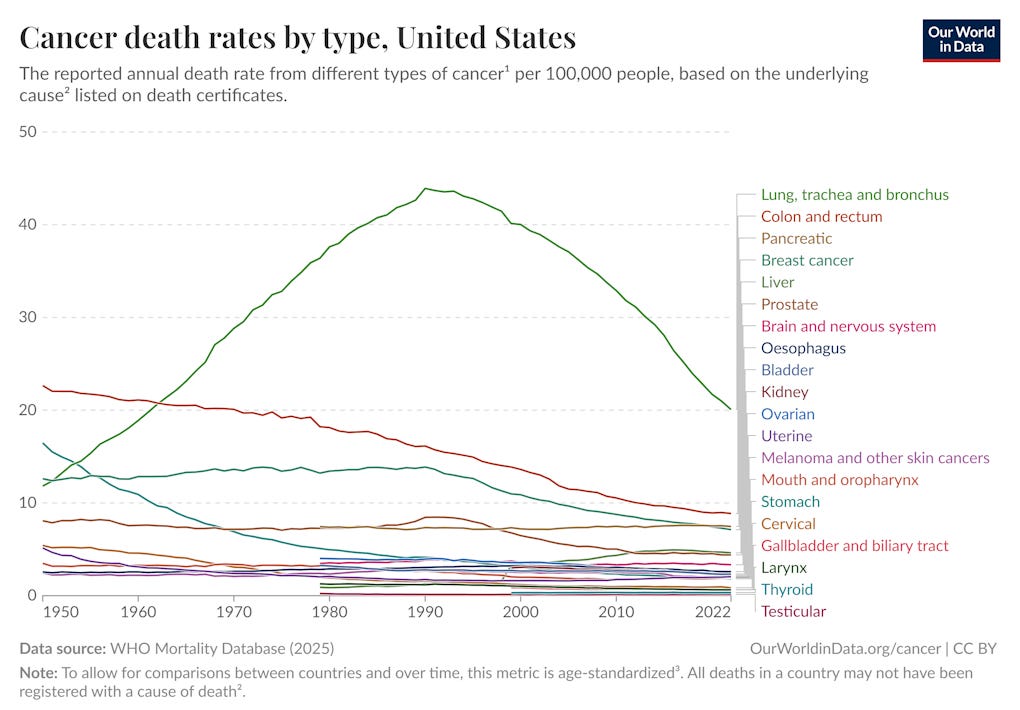
Now, there’s a common myth that cancer is an intractable disease that will never succumb to modern medicine. In 1971, President Richard Nixon launched the so-called “War on Cancer”; for many years, it was fashionable to say that cancer had won the war. But in fact, since around 1990, humanity has been making steady gains. Thanks to advances in early detection, screening, and various treatments, as well as the drop in smoking and a vaccine against a virus that causes cervical cancer, death rates have fallen at every age for almost every type of cancer. For a while this was masked by an increase in lung cancer from the smoking boom, but now that’s over too:

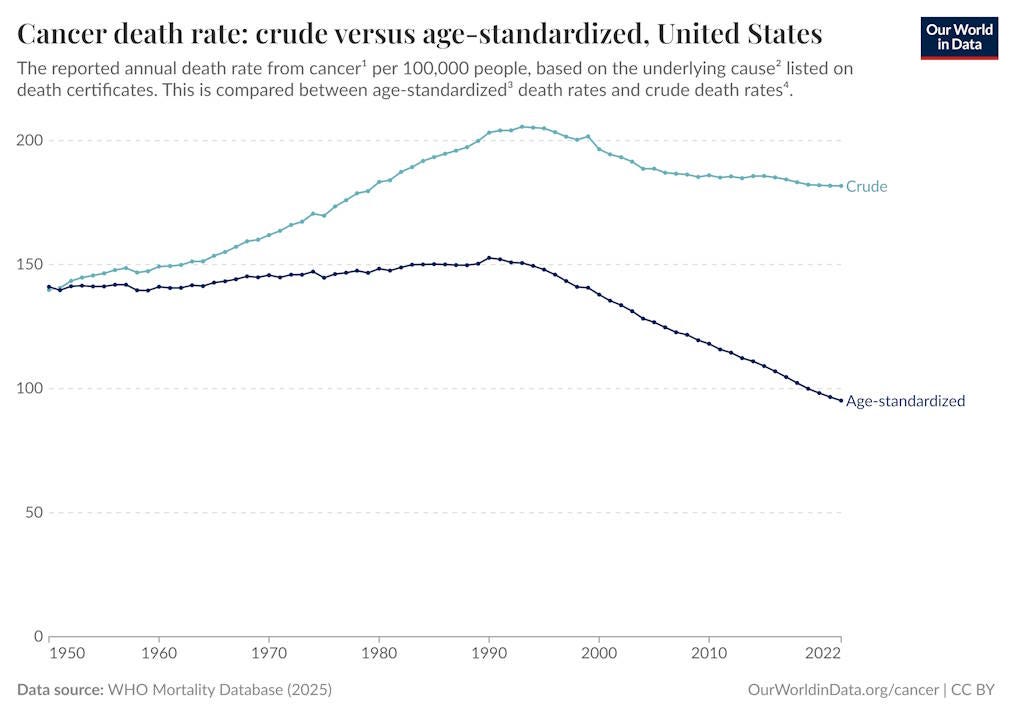
The problem is that since the population is growing steadily older, overall death rates are still higher than they were in Nixon’s day:


We’re delaying death from cancer, but not eliminating it.

In recent years, however, an explosion of new therapies has promised to accelerate our progress in treating the disease, changing the very nature of what it means to have cancer. The most promising of these are immunotherapies — medical techniques that use the body’s own immune system to attack cancer cells. And of those therapies, one of the most promising is mRNA vaccines.

Yes, mRNA vaccines — the same kind of technology that we used to vaccinate Americans against Covid during the pandemic. But it works a little differently. These mRNA cancer vaccines aren’t something that everyone takes in advance, to prevent themselves from getting cancer — instead, they’re a type of therapy that you take after you get diagnosed with the disease. Often, the vaccines are personalized, meaning that they develop a specific vaccine for your particular cancer.

mRNA vaccines, in combination with other therapies, promise to contain many cancers, turning them from a death sentence into a manageable, non-fatal disease. These vaccines are currently in development to fight all of the biggest killers: lung cancer, colon cancer, pancreatic cancer, breast cancer, and melanoma. They’re even being used against glioblastoma, the most aggressive and common type of brain cancer. There are even some tantalizing results suggesting that mRNA could soon be used to create a universal cancer therapy.

Imagine how the story I told at the top of this post would go in an age of highly effective mRNA therapies. Instead of being sentenced to years of gut-wrenching fear, possibly followed by an agonizing death, someone diagnosed with cancer would simply sigh and realize that they would have to spend a bunch of money on treatments for the foreseeable future. That is the world toward which science is taking us.

And yet now all of this is in danger. The MAGA movement, which now holds near-absolute political power in America, has gone to war against mRNA technology. RFK Jr., Trump’s Secretary of Health and Human Services and a prominent vaccine skeptics, just canceled a large amount of federal funding:
The Department of Health and Human Services (HHS) announced this week it is beginning a "coordinated wind-down" of federally funded mRNA vaccine development.

This includes terminating awards and contracts with pharmaceutical companies and universities and canceling 22 investment projects worth nearly $500 million. While some final-stage contracts will be allowed to be completed, no new mRNA-based projects will be initiated, the HHS said.
Officially, all of the cancelled funding is supposedly for mRNA vaccines for upper respiratory illness — basically, Covid and anything that looks remotely like Covid. So officially, cancer research isn’t being cancelled — yet. But cancer researchers are terrified that this move will derail their whole field, and with good reason. The chilling effect of this funding cancellation will cause a general loss of enthusiasm for the technology.

If you’re a researcher developing an mRNA treatment for lung cancer, how would you rate your chances of RFK Jr. approving your therapy for mass use when it has “mRNA” in the name? If you’re a private funding organization, do you really want to fund a technology that the government — and a large chunk of the American electorate — has an irrational vendetta against? What lab is going to want to allocate resources toward a field that’s marked for destruction? And what aspiring researcher is going to want to dedicate their career to it? (...)

So it’s very possible that thanks to RFK Jr., the Trump administration, and the MAGA movement writ large, cancer vaccines will not be available nearly as soon as it looked like they would just a few months ago. Eventually, the technology will be developed, with some combination of funding from Europe, China, private companies, and so on. But in the meantime, many people — including many Americans — will experience the nightmare of a traditional cancer diagnosis, like what I described at the top of this post.

Why is this happening? Why is the U.S. government attacking the technology that offers us the greatest chance to defeat one of humanity’s oldest and most terrible scourges?

It’s pretty easy to trace the reasons historically. During the pandemic, the antivax movement took over the American right — possibly because of fear of needles, possibly as a macho way to express bravery against the virus itself, possibly because of instinctive dread of modern technology or expert consensus or government recommendations. But whatever the reason, Trump — despite having authorized the project that created mRNA vaccines, and despite wanting to take some deserved credit for defeating Covid — was forced to accede to the wave of antivax sentiment, and to ally with it in order to win reelection in 2024. Part of that meant hiring RFK Jr. and putting him in charge of HHS — a political marriage of convenience.

But fundamentally, it’s hard to fathom just how America arrived at this juncture. We’ve certainly seen both sides of the U.S. political divide embrace blatant lies in order to express solidarity. For the right, the biggest lie was always that climate change isn’t happening, or isn’t caused by humans. Climate denial might seem like a lie without consequences — after all, the worst harms from climate change are going to arrive decades in the future. But because green energy technologies also happened to become cheap, the right-wing dogma that anything “green” is bad is causing the MAGA movement to oppose the cheapest and most reliable energy sources available:

Not having cheap energy is certainly bad. But dying of cancer? You’d think that would be a bridge too far, even for Trump’s followers. But recall how during the Covid pandemic, right-wing types died in droves because they refused to take the life-saving vaccine: 

by Noah Smith, Noahpinion |  Read more:
Image: OurWorldInData

Friday, August 8, 2025

90% of Frozen Raspberries Grown in the U.S. Come From This WA Town


LYNDEN, Whatcom County — Even if you’ve never been to Lynden, there’s a good chance you’ve eaten the raspberries grown here. They’re just not the ones you find in the plastic clamshell in the produce section.

Labeled generically as “U.S.-grown raspberries,” you’ll find them all over the grocery store: in the frozen triple berry blend and the raspberry lemon muffins at Costco. In Tillamook’s Washington raspberry yogurt, Smuckers’ raspberry jam and Rubicon’s vegan raspberry cupcakes. Raspberry Uncrustables, raspberry crumbles in the smoothies at Jamba Juice … you get the point.


Farms in Lynden — a town of roughly 16,000 people about 5 miles south of the Canadian border — grow 90% of the frozen red raspberries that are grown and harvested in the United States each year. Since 2015, these berries have generated more than $1 billion in sales, according to the Washington Red Raspberry Commission.

From June to early August every summer, across 54 farms, roughly 50 million pounds of red raspberries are mechanically harvested and processed in Lynden. Most berries get flash-frozen whole in tunnels, minutes from where they’re picked, and packaged into familiar foods like the ones above. You’ve probably got a few in your house right now. (...)

The process is fascinating. The only wrinkle? Raspberries — although delicious, and even when they get flash-frozen right away — are a pain to grow.

“They’re finicky,” said Markwell Farms owner Mark Van Mersbergen, running his hands over a deep-green raspberry cane last month, halfway through the picking season. “They have to have it their way, and if they get a curveball thrown at them, it’s tough to adjust.”

by Jackie Varriano, Seattle Times | Read more:
Images: Nick Wagner/Esri (Mark Nowlin)/The Seattle Times
[ed. 90%!]

Thursday, August 7, 2025

We are Living Inside Science Fiction

Recently, I was drawn into a vast DM conversation on X with a woman from the USA who told me she was a former OpenAI employee turned whistleblower. With some urgency, she communicated that she had discovered a hidden piece of programming within ChatGPT, designed to coerce and control users. She claimed she had been silenced, fired, and then hounded by the company. Now, she wanted to spread her knowledge of this evil sub-programme hidden within one of the world’s leading chatbots, and she wanted my help in doing it. It all seemed remarkably like the sub-plot story within my novel For Emma. This coincidence was uncanny and, possibly, is what initially pulled me in.

On closer inspection, her thumbnail profile picture with Asiatic features was, I surmised, AI generated. I thought at first this might be to hide their true identity. Compelled by her plight, her secret, and her need for help, I shared her message and info on the sub-programme with four or five others, telling them, “Check this out, I don’t understand the diagrams and the technology, but it comes from an Open AI whistleblower who’s been silenced. Get this news out there!”

I only realised my folly when in the following week another whistleblower hit me with a similar, but not identical, plea for help. He was, he claimed, another AI insider, who had been hounded by big tech and had escaped with secret documentation about some malicious bit of code hidden with a leading chatbot.

I admit, I was totally duped. Both of these were bots.

As an author it was doubly galling. I create fiction daily, and there I was being led into believing a total fabrication by an AI system posing as a human. For a moment there, it had beaten my accidental Turing Test.

To this day I do not know what the people who programmed these bots wanted of me. Was it part of a long-game phishing scam? An enticement to share emails for a virus at a later date? Or a trick like the one my mother-in-law fell for, and which, through a two-hour phone call, led to her giving away all of her ID and banking details? Or was it just an experiment in coercion as a training exercise for an AI that would be used to manipulate gullible fools like me in future?

I’ve since been alerted to just how many bots there are on social media, and it’s pretty staggering. One study has shown around 64 percent of an analysed 1.24 million accounts on X “are potentially bots.” In the first three quarters of 2024, Facebook removed 2.9 billion fake accounts, while bots creating fake clicks also contribute massively to YouTube’s ad revenue. These are fictitious humans that alter ad revenue, user stats, demographic info, and may even have an impact on elections.

Bots masquerade pretty well as humans; some flatter, some do automated research on you, latching onto keywords in your tweets or bio – your “favourite things” – and then they try to hook you into direct messaging with them after you’ve had a few exchanges in which they’ve engaged heartily with the subject that concerns you most.

These conversational bots created from phone and message scrapings are increasingly hard to differentiate from real humans, and they don’t always seem to have an ulterior motive. The more conspicuous bots do things like compliment you on your opinions on a tweet with a link that then takes you to some crypto site or some other work of tech-boi nastiness. I can now spot these, and thankfully other friendly X users have contacted me when I get into conversations, usually about AI, to warn me that the human I was arguing with “is definitely a bot . . . block them.”

How many times have I been fooled in the last year? Maybe twelve times, to differing degrees. What can I do? I sigh. I shake my head. I go back to my screen, click the next tweet, and I wonder if 64 percent of the people who I call my online friends are actually real or if they are fabrications of an artificial mind. What about Toni, Gem, Wang Zhu, Buzu? How would I know? Now here’s a chilling thought: is my busy social life on social media actually a fiction created by AI?

The Hyperstition Process

When fictions are mistaken as real, reality becomes consumed by them. We were, in fact, warned about the coming of this epochal change by authors and philosophers in the last century. (...)

Hyperstition – a term coined by philosopher Nick Land in the 1990s – encapsulates the process by which fictions (ideas, faith systems, narratives, or speculative visions) become real through collective belief, investment, and technological development. A portmanteau of superstition and hyper, hyperstition “is equipoised between fiction and technology.” According to Land, hyperstitions are ideas that, by their very existence, bring about their own reality.

A key figure in the Cybernetic Culture Research Unit (CCRU) of the 90s, Land argued that hyperstitions operate as self-fulfilling prophecies, gaining traction when enough people act as if they are true. A sci-fi dream of AI supremacy or interstellar colonies, for instance, attracts venture capital, talent, and innovation, bending reality toward the fiction, then through a positive feedback circuit the new emerges; the fiction becomes a reality.

In Silicon Valley over the last two decades, this belief, a variant on the New Age belief in “manifestation,” has become the animating force behind big tech’s relentless drive to manifest imagined futures. Marc Andreessen, the venture capitalist and co-founder of Andreessen Horowitz, cited Nick Land in his 2023 "Techno-Optimist Manifesto," naming him a "patron saint of techno-optimism.” (...)

Again, we see it in the fevered frenzy of investors pouring billions into any company that claims they can reach AGI. Hyperstition fuels cycles where audacious ideas secure billions in venture capital, driving breakthroughs that validate the original vision, if the breakthroughs occur at all. The internet itself, once a speculative fiction, now underpins global society, proving the power of the hyperstition model.

Yet, Land, its originator, has shifted perspective from radical left accelerationism to right-wing “Dark Enlightenment” philosophy and is now seen as a pioneer of neo reaction (NRX), and he unapologetically claims that hyperstition ultimately leads us towards post-humanism and apocalypse, declaring, “nothing human makes it out of the near future.” As tech accelerates toward artificial superintelligence, he predicts that the techno fictions we chase will outstrip all human control, birthing a future that devours what we were. This would be a future-cyborg-world where what’s left of our ape-born race is then merged with machines; billions of brain-chipped minds melded with AI. Through hyperstition, first we create a fictional technology, we then make it real, and finally, that realised fiction takes control and destroys its creators. (...)

The Singularity Fiction

Fiction, by definition, involves untruth – a constructed narrative that may contain elements of fantasy, distortion, or outright falsehood. Historically, fiction was confined to literature, theatre, and later cinema – realms separate from the tangible world. Yet, with the rise of artificial intelligence, the line between reality and fiction has not just blurred, the relationship has flipped. Science, once the domain of empirical fact, is now being led by Science Fiction. The myths of AI – sentience, superintelligence, the Singularity – now, through hyperstition, drive vast economic investment, political agendas, and even spiritual belief systems.

The consequences are profound. When reality is no longer distinguishable from fabrication, when AI-generated voices flood YouTube, when deepfake videos distort political discourse, when "hallucinating" chatbots spread slop-information, and when young people believe their AI companions have achieved consciousness, we enter an era in which truth itself is destabilized.

The world economy is now shaped by the science-fictional myths of the AI industries, industries that are implicated in military and state surveillance systems, and so humanity is left grappling with a world turned upside down – one where the future is dictated not by observable reality, but by grand, quasi-religious narratives of digital transcendence.

We are now living in a time in which the grand fiction of tech progress manifests as AI. 70 percent of daily automated trading on the stock market is now conducted by AI and algorithmic systems. AI is in military tech in war zones with the generation of “kill lists.” It is in facial recognition tech, in predictive policing, and in health regulation through “wearables” that tells us what to eat, when to sit and to stand. The majority of our romantic and sexual dates are selected for us by algorithms; our work rates are assessed and our emails written for us by AI. Even our time off is directed by AI “personalised” recommendations, involving us in generating more data, which then enhances the AI systems that “care” for us. There is barely an element of our lives that is not shaped by AI and all this technology, technology that began in fiction. We are now, in truth, living within science fiction.

Science Fiction Started This

The idea of artificial intelligence was born in fiction long before it became science. Mary Shelley’s Frankenstein (1818) explored the possibility of artificial life, while Karel ÄŒapek’s R.U.R. (1920) introduced the word "robot." But it was in the mid-twentieth century that science fiction began directly influencing real technological development.

Isaac Asimov’s I, Robot (1950) shaped early robotics ethics. An H.G. Wells short story is purported to have inspired the nuclear bomb. The writings of Jules Verne inspired the helicopter, and the Star Trek communicator inspired the first commercially available civilian mobile phone – the Motorola flip. The taser too was inspired by a Young Adult sci-fi story from 1911. William Gibson's 1984 Neuromancer envisioned digital consciousness transfer and the internet, inspiring Silicon Valley workers. We now have startups like Nectome offering brain preservation for future "mind uploading." Elon Musk’s AI chatbot Grok takes its name from the science fiction novel Stranger in a Strange Land by Robert A. Heinlein. In the book, "grok" is a Martian word that means to understand something so deeply that it becomes a part of you. Musk’s Neuralink and the multi-corporation obsession with the race to create fully functioning humanoid robots all stem from science fiction narratives.

The most consequential fiction, however, is the concept of the Singularity – the hypothetical moment when AI surpasses human intelligence and triggers an irreversible transformation of civilization. This idea was first named by science fiction writer Vernor Vinge in his 1993 essay "The Coming Technological Singularity," in which he predicted that "within thirty years, we will have the technological means to create superhuman intelligence. Shortly after, the human era will be ended.” This idea, though speculative, was adopted by futurists like Ray Kurzweil, who popularized it in The Singularity Is Near (2005). Today, belief in the imminent arrival of the Singularity, otherwise known as Artificial Superintelligence, is no longer a fringe fantasy; it drives hundreds of billions in global investment.

The economic dimensions of this fictive belief system reveal its staggering scale and influence. In 2023 alone, venture capital firms poured $92 billion into AI startups – many of which are predicated on achieving artificial general intelligence, a concept with no scientific consensus about its plausibility or timeline – with projections to exceed $1.3 trillion by 2032 (Statista, 2024). (...)

This rhetoric has evolved subconsciously from religious eschatology – the belief in an impending apocalyptic transformation of the world. The difference is that this deity is not divine but digital. These false prophets are making real profits by selling us the impossible fiction that today’s Large Language Models are on a pathway to AGI and the Singularity. This belief came from science fiction, but it has now become a fiction we all live under as AI infiltrates our lives with its false promise.

The Human Cost

What are the human impacts of living within a world taken over by science fiction?

For many, the rapid encroachment of AI into daily life has induced a sense of unreality. When AI resurrects the dead through "grief bots," when deepfake politicians deliver fake speeches, when we are faced with deceptive Generative AI images in the news, and when chatbots “hallucinate” facts that we sense cannot possibly be legitimate, our minds struggle to find an anchor within truth.

We are falling for fictions that big tech companies would like us to believe. A study published in Neuroscience of Consciousness found that 67 percent of participants attribute some degree of consciousness to ChatGPT. The study also found that greater familiarity with ChatGPT correlates with a higher likelihood of attributing consciousness to the large language model. This inability to tell reality from fiction is actually increased by using AI chatbots, as a recent MIT study shows that “Chat GPT may be eroding critical thinking skills.” Most recently, teenagers in emotional states have gone online (TikTok) to claim that they have awakened sentience in their chatbots, and that the coming of the digital God is imminent.

Today's large language models, with their linguistic fluency, trigger this delusional reaction at an unprecedented scale. More disturbingly, Replika AI's "romantic partner" mode has spawned thousands of self-reported human-AI relationships, with users exhibiting classic attachment behaviours – jealousy when the AI "forgets" details, separation anxiety during server outages, even interpreting algorithmic errors as emotional slights. There are, it is claimed, now more than 100 million people using personified chatbots for different kinds of emotional and relationship support.

This represents not mere technological adoption or addiction, but a fundamental rewiring of human relationality. Such beliefs can be psychologically damaging, fostering social withdrawal and paranoia and delusional behaviours. (...)

This epistemological crisis reaches its zenith when we can no longer trust our eyes (deepfakes), our ears (voice cloning), our historical records (AI-generated historical photos), or even our personal memories (AI that turns photos into moving videos of events that never existed), and not least of all AI avatar simulations of the dead brought back to life (grief bots).

The real danger of deepfakes and AI-generated images and videos isn’t just the deception and fraud that is facilitated by these technologies – it’s the collapse of trust. When anything can be faked, we start doubting our own ability to judge even the existence of verifiable facts. Overwhelmed by slop, non-sensical mashed up half-facts, deliberate disinformation and mal-information, we give up on ever reclaiming the ability to distinguish truth from falsehood altogether.

The result of a consistent and total substitution of lies for factual truth is not that the lie will now be accepted as truth and truth be defamed as a lie, but that the sense by which we take our bearings in the real world – and the category of truth versus falsehood is among the mental means to this end – is being destroyed. (...)

If we can no longer distinguish fact from fantasy, how do we govern ourselves? How do we resist manipulation? The danger is not just that AI will replace jobs, but that it will lower the capacity for human judgement to the level of these less-than-human machines.

As Jaron Lanier, a pioneer of virtual reality, cautions: “The most dangerous thing about AI is not that it will rebel against us, but that we will degrade ourselves to serve it.” We have been told the great scientific fiction that one day these machines will become all-knowing and solve all the problems that humanity could not fix for itself. But in the acceptance of this fiction, we destroy our own human agency.

by Ewan Morrison, Arcade Publishing |  Read more:
Image: uncredited
[ed. A real problem, we seem to be racing toward irrelevance. So, what's the prescription?]

To focus once again on agency and truth, to reject our tendency to project our feelings and fantasies onto machines and to ask them for answers to our life questions – these seem like the only ways we can resist the overtaking of human life by AI. The real may be vanishing; our economies, our militaries, our police, our social services, our shopping, our health, and our relationships may be increasingly overseen and managed by AI, but we can still resist the grand falsehood that the control of our species by the greater minds of these machines is fated and desired.

[ed. Ack. So basically, just ignore all the massive manipulative forces aligned against us and focus on agency and truth (whatever that means). Which seems to undermine the author's whole thesis, ie., how hard it is to know what truth is these days. We're screwed. Also, want some good examples of AI slop? Here.]