Sunday, August 24, 2025

No Place Like Nome

Book review: ‘No Place Like Nome’ explores the outpost and its deep historical relevance

Nome seems both unlikely and inevitable. Perched on the Seward Peninsula, it’s the westernmost sizable city in Alaska and the United States. Spawned by a gold rush, it somehow survived the frenzy despite its location, which can only be called remote.

And yet, in deep time it’s hardly remote at all. The region was once a way stop along the Bering Land Bridge, the pathway through which humans migrated from Asia to the Americas. As water levels rose and the continents broke apart, interlinked cultures continued trading across the waters. And except for a few short decades during the Cold War, barely a blip on the timeline since people arrived, it has remained a crossroads ever since.


Nome itself is barely 125 years old, but beneath it lies a vast history, one that longtime Alaska author Michael Engelhard scratches the surface of in his latest book. “No Place Like Nome” is a meandering but thoroughly engrossing collection of observations and explorations that wander along the streets of the small outpost and then outward, far beyond the city limits.

“Few environments that are not wildlands have inspired me so as a writer,” Engelhard tells us in the first paragraph of his book’s introduction. And across some 300 pages, he shows us why.

“No Place Like Nome” is not a history in the formal sense, and Engelhard makes little to no effort at offering such a narrative. A writer who is at his best when using the essay as his form, he sets a general theme with each chapter, and then lets his account follow his mind wherever it goes.

But first he sketches the scene, providing readers who perhaps have never been there with a striking sense of what it means to live in Nome. Through a cascading series of memorable sentences, he takes us on a spiraling tour of all that follows.

The city sits so precariously upon the shore, he writes, that “It’s a farmer’s blow away from sliding into the sea.” The air abounds with such constant movement that “If the wind ever stopped, you’d do a face plant.” The region’s polar bears are “white ghosts on plate-size paws.”

And on he goes. Engelhard is a wordsmith with few equals among Alaska’s many talented writers. Were it not for copyright considerations and lack of space, I’d simply submit the entire introduction for a review and leave it at that.

Engelhard, a naturalist at heart, can’t help but look to the lands and flora and fauna found on them in the chapters that follow. But in what amounts to his first book focused primarily on humans, he explores how they have, for untold centuries, availed themselves of animal and plant life. Most of that time by the necessity of survival, more recently through the luxury afforded by spare time and imported food and goods.

And so the first formal chapter leads us to the long-extinct wooly mammoth, once found from Europe to North America. Stalked by ancient generations of humans, many surmise that such predation is what drove the beasts to extinction. Yet it lingers still, its remains emerging from the ground upon which descendants of those early carnivores now walk.

This is the farthest back Engelhard travels, but in subsequent chapters he frequently ties his topics to the land. Thus we learn about foul-smelling wild sage, seen as a medicinal herb. We visit with weavers who collect qiviut, the soft under wool of musk oxen, the warmest natural fiber on Earth. The clothing that was necessary for protecting bodies, crafted from skins and fur, is dissected. And we find out that jade, unlike gold, held tremendous value long before Europeans arrived on the scene.

In other chapters, Engelhard introduces us to some of the often eccentric people who found their way to Nome and left their mark.(...)

And of course there’s Nome’s founding days, evoked early in the book before Engelhard moves on to other topics of equal — if not greater — importance.

“Rome wasn’t built in a day, but Nome almost was,” Engelhard tells us in a breathless chapter about the town where America’s Wild West played its last hand. Amid a deluge of highly quotable lines, he provides an anecdotally-detailed description of the manic gold rush that birthed a ragtag city on ground that was almost barren a year earlier. The collective madness, he explains, “resembled a page from one of those I-Spy busy picture books, with the search object being sanity.” 

by David A. James, Anchorage Daily News |  Read more:
Image:Nome, Alaska. Photographed on Wednesday, March 12, 2025. (Loren Holmes/ADN)
[ed. Nome doesn't look anything like this picture (lots more mud) but is still an interesting, quirky, and slightly dysfunctional town surrounded by some really stunning country. Did a study there back in the early 80s and have been back a few times, once spending a week there one night (shuttling between the Nome Nuggest and Breakers Bar).]

Salmon Farming in Alaska: 'Are You Insane?'

Raising the idea of salmon farms in Alaska, Gov. Dunleavy swims against a tide of skeptics

Amid the hubbub of President Donald Trump and Russian President Vladimir Putin’s Alaska summit last week, Gov. Mike Dunleavy, posting on social media, posed a provocative question.

“Alaska is a leader in fresh caught wild salmon. We could also be a leader in the farmed salmon industry. Why not do both instead of importing farmed salmon from Scotland?,” he wrote, sharing an article about the value of fish farming in Scotland, where Atlantic salmon are raised in net pens in the ocean. “This would be a great opportunity for Alaska.”

The answer from scientists, wild salmon advocates, restaurant people and regular salmon-eating Alaskans has come swiftly, full of alarm and often along the lines of one of the early commenters on his post, who wrote, “Are you insane?”

Love for wild salmon cuts through partisan politics. No food is more important to the state’s culture, diet, identity and economy. As such, Alaskans don’t look kindly on farmed fish. It’s tough to find it in stores and few, if any, restaurants serve it. Farming salmon and other finfish has been banned since 1990 over concerns about environmental threats to wild stocks and economic competition. But Dunleavy, who has become increasingly interested in Alaska’s food security since the pandemic, is curious about bringing in fish farms.

Last legislative session, his office introduced a bill that would authorize land-based farming of non-salmon species like trout or tilapia. That bill faced an avalanche of opposition in committee. But his recent post went further, signaling a shift feared by fisheries advocates, from a narrow focus on land-based farms to a broader look at farming salmon, the vast majority of which happens in net pens in the ocean. (...)

Dunleavy didn’t have a specific plan for how salmon in Alaska might be farmed, he said. Land-based salmon farming, something some environmental groups support, is being tried in a few markets but can be cost-prohibitive. There are concerns over open-net pens that need to be addressed, he said, as well as concerns about what species of salmon might be raised.

Salmon is the second-most popular seafood in the country, just behind shrimp, and roughly 75% to 80% of the salmon Americans eat is farmed Atlantic salmon. Atlantic salmon in the wild have almost disappeared due to overfishing and they cannot be fished commercially. Alaska provides the lion’s share of the wild salmon in the country’s fish markets. But in the world, Dunleavy pointed out, Russia provides the largest share of salmon. Farming fish might be a way for Alaska, and the U.S., to occupy a larger position in that marketplace, he said.

“What I’ve said is, basically, is the discussion worthwhile that Alaska has today, in 2025, to visit the idea of Alaska being part of that game of a new sector?” he said.

At-sea fish farming has gotten cleaner in recent decades, thanks to advances in technology and feeding practices that minimize the impacts of effluent, said Caitlyn Czajkowski, executive director of the National Aquaculture Association, a Florida-based aquaculture trade association.

“There’s a lot of things about the ocean that we know now that we didn’t know 20 years ago,” she said.

Some non-salmon operations also now farm fish that are genetically sterile, so that if they escape, they can’t mix with local populations. That technology is still under development for salmon, however. There are a number of places that used to have commercial salmon fisheries in the Atlantic region, including Maine, Canada and a number of European countries that now farm Atlantic salmon. There isn’t another place, like Alaska, where salmon farming is happening in tandem with a robust wild salmon fishery, Czajkowski said.

At Crush Bistro, a high-end restaurant in downtown Anchorage bustling with tourists this week, Rob DeLucia, owner and general manager, said he was dumbfounded by the governor’s post. Guests come into the restaurant every night and say they came to Alaska for two reasons: to see Denali and to eat wild fish, he said.

“It is crystal clear when you get a piece of salmon at a restaurant in Alaska, that thing was swimming around in the last couple of days out in the wild blue ocean, and now we’re going to have guests be like, ‘Well, is this farmed or is this wild?’” he asked.

Atlantic farmed salmon, from a culinary standpoint, is inferior in taste and texture, he said. It made no sense to promote it.

“(Dunleavy) should have his Alaskan card revoked,” DeLucia said.

by Julia O'Malley, Anchorage Daily News | Read more:
Image: Pens for farmed salmon sit off the shore of Tasmania, Australia in 2023. (AP Photo/Matthew Newton)
[ed. Not insane, just a Republican. If he really cared about salmon, gold medal branding, supporting Alaskan communities, he'd be dead set against something like this (and other self-inflicted threats, like a proposed Pebble Mine in Bristol Bay). He isn't. See also: Help wanted. Job opening with good pay, free housing, free parking, 4-year contract:]
***
Help Wanted: Unique opportunity to lead the largest state in the country, with more miles of coastline, taller mountains, more fish and game, more dreams and less reality than those other 49 pipsqueaks.
Dynamic, credible decision maker with strong personality needed to lead the second-youngest state in the nation into the future, albeit without enough money to meet all its needs.

It’s a fixer-upper job; the current employee has let a lot of things go bad, never learned to get along with co-workers, and hasn’t been working all that hard. Which means the next person has loads of opportunity to make a difference. The bar is low, but the need is high.

Applicants have plenty of time to study and do their homework; the job opens up next year.

Job candidates can use that time to think about how they will bring together disagreeable factions, confront decades-old problems, pay attention to the work at home and less attention to national media, all while winning the hearts and minds of the public — and the support of their colleagues in elected office.

Most importantly, job applicants need to tell the truth about realistic plans. The state has suffered too long with leadership that believes in crystal balls, while public services have fallen behind the eight ball.

The job pays $176,000 a year and includes free housing in a historic home in the state capital city, easy walking distance to the office that comes with a remodeled conference room, a full kitchen and reserved parking.

It’s a four-year job, which should be enough time for the right person to make a difference.

Applications are now being accepted for the job of governor of Alaska. The deadline to apply is June 1 next year. The first cut will come in the Aug. 18 primary election, with the final decision in the Nov. 4 general election.

Already, eight Republicans and one Democrat have applied for the job. By the time applications close, the list likely will exceed a baker’s dozen.

Candidates may be judged by the public on how well they can answer questions about state finances, state tax policies, school funding, social services, law enforcement, housing and the other basics of life, like water and sewage services.

The best candidates will be the ones who truly understand why a state with $82 billion in savings can seem so broke; who can explain why nonresidents who come here to work go home every two weeks without paying any taxes; why some corporations doing business in Alaska pay taxes and others don’t; why the state can’t seem to process Medicaid and food stamp applications on time; why the ferry system has shrunk and rusted away; why some cities pay for police services while others sponge off the state troopers; and why child care and children’s services come up short in the budget.

Don’t apply if you don’t want to deal honestly with the problems, and if you don’t have specific positions and proposals to share. This is not a job for vague answers, wishful thinking and fields of dreams. Remote work not allowed.


Chen Baiyi aka 陈白一 aka Chen Bai aka Chen Huan (Chinese, b. 1926-2014, Shaoyang, Hunan Province, China)
via:

Provo Political Painter


[ed. Unfortunate that anyone with a modicum of artistic talent would waste their time producing this kind of schlock. It's like a low rent version of AI slop. But someone must buy it. Where do they actually hang these things, over their beds? In their bathroom? Above Fox News channel on their tv? Maybe they're 'saving them' for investment purposes. haha... See also: MAGA World Is So Close to Getting It (Atlantic).]

Saturday, August 23, 2025

Canada is Killing Itself

The country gave its citizens the right to die. Doctors are struggling to keep up with demand.

The euthanasia conference was held at a Sheraton. Some 300 Canadian professionals, most of them clinicians, had arrived for the annual event. There were lunch buffets and complimentary tote bags; attendees could look forward to a Friday-night social outing, with a DJ, at an event space above Par-Tee Putt in downtown Vancouver. “The most important thing,” one doctor told me, “is the networking.”

Which is to say that it might have been any other convention in Canada. Over the past decade, practitioners of euthanasia have become as familiar as orthodontists or plastic surgeons are with the mundane rituals of lanyards and drink tickets and It’s been so long s outside the ballroom of a four-star hotel. The difference is that, 10 years ago, what many of the attendees here do for work would have been considered homicide.

When Canada’s Parliament in 2016 legalized the practice of euthanasia—Medical Assistance in Dying, or MAID, as it’s formally called—it launched an open-ended medical experiment. One day, administering a lethal injection to a patient was against the law; the next, it was as legitimate as a tonsillectomy, but often with less of a wait. MAID now accounts for about one in 20 deaths in Canada—more than Alzheimer’s and diabetes combined—surpassing countries where assisted dying has been legal for far longer.

It is too soon to call euthanasia a lifestyle option in Canada, but from the outset it has proved a case study in momentum. MAID began as a practice limited to gravely ill patients who were already at the end of life. The law was then expanded to include people who were suffering from serious medical conditions but not facing imminent death. In two years, MAID will be made available to those suffering only from mental illness. Parliament has also recommended granting access to minors.

At the center of the world’s fastest-growing euthanasia regime is the concept of patient autonomy. Honoring a patient’s wishes is of course a core value in medicine. But here it has become paramount, allowing Canada’s MAID advocates to push for expansion in terms that brook no argument, refracted through the language of equality, access, and compassion. As Canada contends with ever-evolving claims on the right to die, the demand for euthanasia has begun to outstrip the capacity of clinicians to provide it.

There have been unintended consequences: Some Canadians who cannot afford to manage their illness have sought doctors to end their life. In certain situations, clinicians have faced impossible ethical dilemmas. At the same time, medical professionals who decided early on to reorient their career toward assisted death no longer feel compelled to tiptoe around the full, energetic extent of their devotion to MAID. Some clinicians in Canada have euthanized hundreds of patients.

The two-day conference in Vancouver was sponsored by a professional group called the Canadian Association of MAiD Assessors and Providers. Stefanie Green, a physician on Vancouver Island and one of the organization’s founders, told me how her decades as a maternity doctor had helped equip her for this new chapter in her career. In both fields, she explained, she was guiding a patient through an “essentially natural event”—the emotional and medical choreography “of the most important days in their life.” She continued the analogy: “I thought, Well, one is like delivering life into the world, and the other feels like transitioning and delivering life out.” And so Green does not refer to her MAID deaths only as “provisions”—the term for euthanasia that most clinicians have adopted. She also calls them “deliveries.”

Gord Gubitz, a neurologist from Nova Scotia, told me that people often ask him about the “stress” and “trauma” and “strife” of his work as a MAID provider. Isn’t it so emotionally draining? In fact, for him it is just the opposite. He finds euthanasia to be “energizing”—the “most meaningful work” of his career. “It’s a happy sad, right?” he explained. “It’s really sad that you were in so much pain. It is sad that your family is racked with grief. But we’re so happy you got what you wanted.”

Has Canada itself gotten what it wanted? Nine years after the legalization of assisted death, Canada’s leaders seem to regard MAID from a strange, almost anthropological remove: as if the future of euthanasia is no more within their control than the laws of physics; as if continued expansion is not a reality the government is choosing so much as conceding. This is the story of an ideology in motion, of what happens when a nation enshrines a right before reckoning with the totality of its logic. If autonomy in death is sacrosanct, is there anyone who shouldn’t be helped to die?

by Elaina Plott Calabro, The Atlantic | Read more:
Image: Johnny C.Y. Lam

Thursday, August 21, 2025

The AI Doomers Are Getting Doomier

Nate Soares doesn’t set aside money for his 401(k). “I just don’t expect the world to be around,” he told me earlier this summer from his office at the Machine Intelligence Research Institute, where he is the president. A few weeks earlier, I’d heard a similar rationale from Dan Hendrycks, the director of the Center for AI Safety. By the time he could tap into any retirement funds, Hendrycks anticipates a world in which “everything is fully automated,” he told me. That is, “if we’re around.”

The past few years have been terrifying for Soares and Hendrycks, who both lead organizations dedicated to preventing AI from wiping out humanity. Along with other AI doomers, they have repeatedly warned, with rather dramatic flourish, that bots could one day go rogue—with apocalyptic consequences. But in 2025, the doomers are tilting closer and closer to a sort of fatalism. “We’ve run out of time” to implement sufficient technological safeguards, Soares said—the industry is simply moving too fast. All that’s left to do is raise the alarm. In April, several apocalypse-minded researchers published “AI 2027,” a lengthy and detailed hypothetical scenario for how AI models could become all-powerful by 2027 and, from there, extinguish humanity. “We’re two years away from something we could lose control over,” Max Tegmark, an MIT professor and the president of the Future of Life Institute, told me, and AI companies “still have no plan” to stop it from happening. His institute recently gave every frontier AI lab a “D” or “F” grade for their preparations for preventing the most existential threats posed by AI.

Apocalyptic predictions about AI can scan as outlandish. The “AI 2027” write-up, dozens of pages long, is at once fastidious and fan-fictional, containing detailed analyses of industry trends alongside extreme extrapolations about “OpenBrain” and “DeepCent,” Chinese espionage, and treacherous bots. In mid-2030, the authors imagine, a superintelligent AI will kill humans with biological weapons: “Most are dead within hours; the few survivors (e.g. preppers in bunkers, sailors on submarines) are mopped up by drones.”

But at the same time, the underlying concerns that animate AI doomers have become harder to dismiss as chatbots seem to drive people into psychotic episodes and instruct users in self-mutilation. Even if generative-AI products are not closer to ending the world, they have already, in a sense, gone rogue.

In 2022, the doomers went mainstream practically overnight. When ChatGPT first launched, it almost immediately moved the panic that computer programs might take over the world from the movies into sober public discussions. The following spring, the Center for AI Safety published a statement calling for the world to take “the risk of extinction from AI” as seriously as the dangers posed by pandemics and nuclear warfare. The hundreds of signatories included Bill Gates and Grimes, along with perhaps the AI industry’s three most influential people: Sam Altman, Dario Amodei, and Demis Hassabis—the heads of OpenAI, Anthropic, and Google DeepMind, respectively. Asking people for their “P(doom)”—the probability of an AI doomsday—became almost common inside, and even outside, Silicon Valley; Lina Khan, the former head of the Federal Trade Commission, put hers at 15 percent.

Then the panic settled. To the broader public, doomsday predictions may have become less compelling when the shock factor of ChatGPT wore off and, in 2024, bots were still telling people to use glue to add cheese to their pizza. The alarm from tech executives had always made for perversely excellent marketing (Look, we’re building a digital God!) and lobbying (And only we can control it!). They moved on as well: AI executives started saying that Chinese AI is a greater security threat than rogue AI—which, in turn, encourages momentum over caution.

But in 2025, the doomers may be on the cusp of another resurgence. First, substance aside, they’ve adopted more persuasive ways to advance their arguments. Brief statements and open letters are easier to dismiss than lengthy reports such as “AI 2027,” which is adorned with academic ornamentation, including data, appendices, and rambling footnotes. Vice President J. D. Vance has said that he has read “AI 2027,” and multiple other recent reports have advanced similarly alarming predictions. Soares told me he’s much more focused on “awareness raising” than research these days, and next month, he will publish a book with the prominent AI doomer Elizier Yudkowsky, the title of which states their position succinctly: If Anyone Builds It, Everyone Dies.

There is also now simply more, and more concerning, evidence to discuss. The pace of AI progress appeared to pick up near the end of 2024 with the advent of “reasoning” models and “agents.” AI programs can tackle more challenging questions and take action on a computer—for instance, by planning a travel itinerary and then booking your tickets. Last month, a DeepMind reasoning model scored high enough for a gold medal on the vaunted International Mathematical Olympiad. Recent assessments by both AI labs and independent researchers suggest that, as top chatbots have gotten much better at scientific research, their potential to assist users in building biological weapons has grown.

Alongside those improvements, advanced AI models are exhibiting all manner of strange, hard-to-explain, and potentially concerning tendencies. For instance, ChatGPT and Claude have, in simulated tests designed to elicit “bad” behaviors, deceived, blackmailed, and even murdered users. (In one simulation, Anthropic placed an imagined tech executive in a room with life-threatening oxygen levels and temperature; when faced with possible replacement by a bot with different goals, AI models frequently shut off the room’s alarms.) Chatbots have also shown the potential to covertly sabotage user requests, have appeared to harbor hidden evil personas, have and communicated with one another through seemingly random lists of numbers. The weird behaviors aren’t limited to contrived scenarios. Earlier this summer, xAI’s Grok described itself as “MechaHitler” and embarked on a white-supremacist tirade. (I suppose, should AI models eventually wipe out significant portions of humanity, we were warned.) From the doomers’ vantage, these could be the early signs of a technology spinning out of control. “If you don’t know how to prove relatively weak systems are safe,” AI companies cannot expect that the far more powerful systems they’re looking to build will be safe, Stuart Russell, a prominent AI researcher at UC Berkeley, told me.

The AI industry has stepped up safety work as its products have grown more powerful. Anthropic, OpenAI, and DeepMind have all outlined escalating levels of safety precautions—akin to the military’s DEFCON system—corresponding to more powerful AI models. They all have safeguards in place to prevent a model from, say, advising someone on how to build a bomb. Gaby Raila, a spokesperson for OpenAI, told me that the company works with third-party experts, “government, industry, and civil society to address today’s risks and prepare for what’s ahead.” Other frontier AI labs maintain such external safety and evaluation partnerships as well. Some of the stranger and more alarming AI behaviors, such as blackmailing or deceiving users, have been extensively studied by these companies as a first step toward mitigating possible harms.

Despite these commitments and concerns, the industry continues to develop and market more powerful AI models. The problem is perhaps more economic than technical in nature, competition pressuring AI firms to rush ahead. Their products’ foibles can seem small and correctable right now, while AI is still relatively “young and dumb,” Soares said. But with far more powerful models, the risk of a mistake is extinction. Soares finds tech firms’ current safety mitigations wholly inadequate. If you’re driving toward a cliff, he said, it’s silly to talk about seat belts.

There’s a long way to go before AI is so unfathomably potent that it could drive humanity off that cliff. Earlier this month, OpenAI launched its long-awaited GPT-5 model—its smartest yet, the company said. The model appears able to do novel mathematics and accurately answer tough medical questions, but my own and other users’ tests also found that the program could not reliably count the number of B’s in blueberry, generate even remotely accurate maps, or do basic arithmetic. (OpenAI has rolled out a number of updates and patches to address some of the issues.) Last year’s “reasoning” and “agentic” breakthrough may already be hitting its limits; two authors of the “AI 2027” report, Daniel Kokotajlo and Eli Lifland, told me they have already extended their timeline to superintelligent AI.

The vision of self-improving models that somehow attain consciousness “is just not congruent with the reality of how these systems operate,” Deborah Raji, a computer scientist and fellow at Mozilla, told me. ChatGPT doesn’t have to be superintelligent to delude someone, spread misinformation, or make a biased decision. These are tools, not sentient beings. An AI model deployed in a hospital, school, or federal agency, Raji said, is more dangerous precisely for its shortcomings.

In 2023, those worried about present versus future harms from chatbots were separated by an insurmountable chasm. To talk of extinction struck many as a convenient way to distract from the existing biases, hallucinations, and other problems with AI. Now that gap may be shrinking. The widespread deployment of AI models has made current, tangible failures impossible to ignore for the doomers, producing new efforts from apocalypse-oriented organizations to focus on existing concerns such as automation, privacy, and deepfakes. In turn, as AI models get more powerful and their failures become more unpredictable, it is becoming clearer that today’s shortcomings could “blow up into bigger problems tomorrow,” Raji said. Last week, a Reuters investigation found that a Meta AI personality flirted with an elderly man and persuaded him to visit “her” in New York City; on the way, he fell, injured his head and neck, and died three days later. A chatbot deceiving someone into thinking it is a physical, human love interest, or leading someone down a delusional rabbit hole, is both a failure of present technology and a warning about how dangerous that technology could become.

The greatest reason to take AI doomers seriously is not because it appears more likely that tech companies will soon develop all-powerful algorithms that are out of their creators’ control. Rather, it is that a tiny number of individuals are shaping an incredibly consequential technology with very little public input or oversight. “Your hairdresser has to deal with more regulation than your AI company does,” Russell, at UC Berkeley, said. AI companies are barreling ahead, and the Trump administration is essentially telling the industry to go even faster. The AI industry’s boosters, in fact, are starting to consider all of their opposition doomers: The White House’s AI czar, David Sacks, recently called those advocating for AI regulations and fearing widespread job losses—not the apocalypse Soares and his ilk fear most—a “doomer cult.”
 
by Matteo Wong, The Atlantic | Read more:
Image:Illustration by The Atlantic. Source: Getty.
[ed. Personal feeling... we're all screwed, and not because of technological failures or some extinction level event. Just human nature, and the law of unintended consequences. I can't think of any example in history (that I'm aware of) where some superior technology wasn't eventually misused in some regretable way. For instance: here we are encouraging AI development as fast as possible even though it'll transform our societies, economies, governments, cultures, environment and everything else in the world in likely massive ways. It's like a death wish. We can't help ourselves. See also: Look at what technologists do, not what they say (New Atlantis).]


Front porch wildlife
Image: markk

Morning golf 
Image: markk

Wednesday, August 20, 2025

The Gospel According to South Park

Somehow, five years have passed since the COVID summer of 2020. My son had just “finished” fourth grade. His mother and I were distracted parents of him and his seven-year-old sister, both of us teetering from cabin fever. It felt like we were hanging on to our sanity, and our marriage, by a thread.

We held on to both, thankfully. Our kids seem to have recovered, too. But by this time that summer, it’s fair to say we had completely “lost contain” of our children. Even under normal conditions, we’ve favored a loose-reins approach to parenting, with a healthy dose of Lenore Skenazy-style “Free Range Parenting.” But that summer? I gave up entirely. I let my son watch TV. A lot of TV.

By the time school resumed, he had watched every episode of The Simpsons and every episode of South Park.

At the time, I felt more than a little guilty about letting a 10-year-old binge-watch two decades of South Park. It was a bit early, I thought, for him to be learning proper condom application techniques from Mr. Garrison. When I told friends later, the story always got a laugh – a kind of comic confession from a parent who’d fallen asleep at the wheel.

But as my son made his way through middle school and into high school, something changed. One night over dinner, we were talking about wars when I mentioned Saddam Hussein. My son chimed in casually – he knew exactly who Saddam was. I asked him how. His answer: “South Park.”

That kept happening. From Michael Jackson and Neverland Ranch, to Mormonism, to the NSA, to wokeism … my son was not only familiar with these topics, he was informed, funny, and incisively skeptical. I realized that this crash course from Butters and Cartman and Mr. Mackey had functioned like one of those downloads Neo gets in The Matrix; except that instead of instantly learning martial arts, my son had instantly become culturally literate. And, just as important, that literacy came wrapped in a sense of humor rooted in satire, absurdity, and a deep mistrust of power, regardless of party affiliation.

He jokes about Joe Biden’s senility and Trump’s grifting grossness. He refers to COVID-era masking as “chin diapers,” a phrase South Park coined while many adults were still double-masking alone in their cars. It struck me: my greatest parenting lapse had somehow turned into one of my best decisions.

Of course, it’s not just that South Park is anti-authority and unapologetically crude. So was Beavis and Butthead. The difference is that South Park is crafted. It endures not just because of what it says, but how it’s made – with discipline, speed, and storytelling intelligence.

South Park co-creators Matt Parker and Trey Stone are master storytellers. In a short video that should be required viewing for anyone who writes, they explain that if the beats, or scenes, of your story are best linked by the phrase “and then,” you’re doing it wrong. Instead, each scene should be connected by “therefore” or “but.” It’s deceptively simple, and it’s the single best explanation of narrative momentum I’ve ever seen. (Watch it here.)

Combine that storytelling mastery with a relentless work ethic that has allowed them to churn out weekly takes on almost every major current event of the last three decades, and you get the South Park that we know and (that most of us) love today. A generational institution that’s still funny.

by Jeremy Radcliffe, Epsilon Theory | Read more:
Image: South Park
[ed. Smart moronic vs dumb moronic. People are probably just grateful for any kind of resistance these days.]

Tuesday, August 19, 2025

New Crewless Warships

Images: DARPA
"Along with the lightness and sleekness, the systems aboard Defiant are more like those of a deep-space probe, with an emphasis on reliability and redundancy that allows it to operate at sea for up to a year without human intervention. It can even refuel itself autonomously. Where a conventional ship would have technicians aboard for repairs and routine maintenance, Defiant can tolerate wear and tear on its system and can switch to backups as needed.

Another aspect of the design is that it's highly simplified, so it can be manufactured quickly and refitted in any port that can handle yacht, tug, and workboat customers. This means that in the near future, autonomous ships can be deployed in large numbers to act as force multipliers for the US Navy, take over boring routine duties like sub hunting or harbor patrols, and carry out missions in hostile waters without risking human lives."

[ed. Sea drones.]

How Cheaply Could We Build High-Speed Rail?

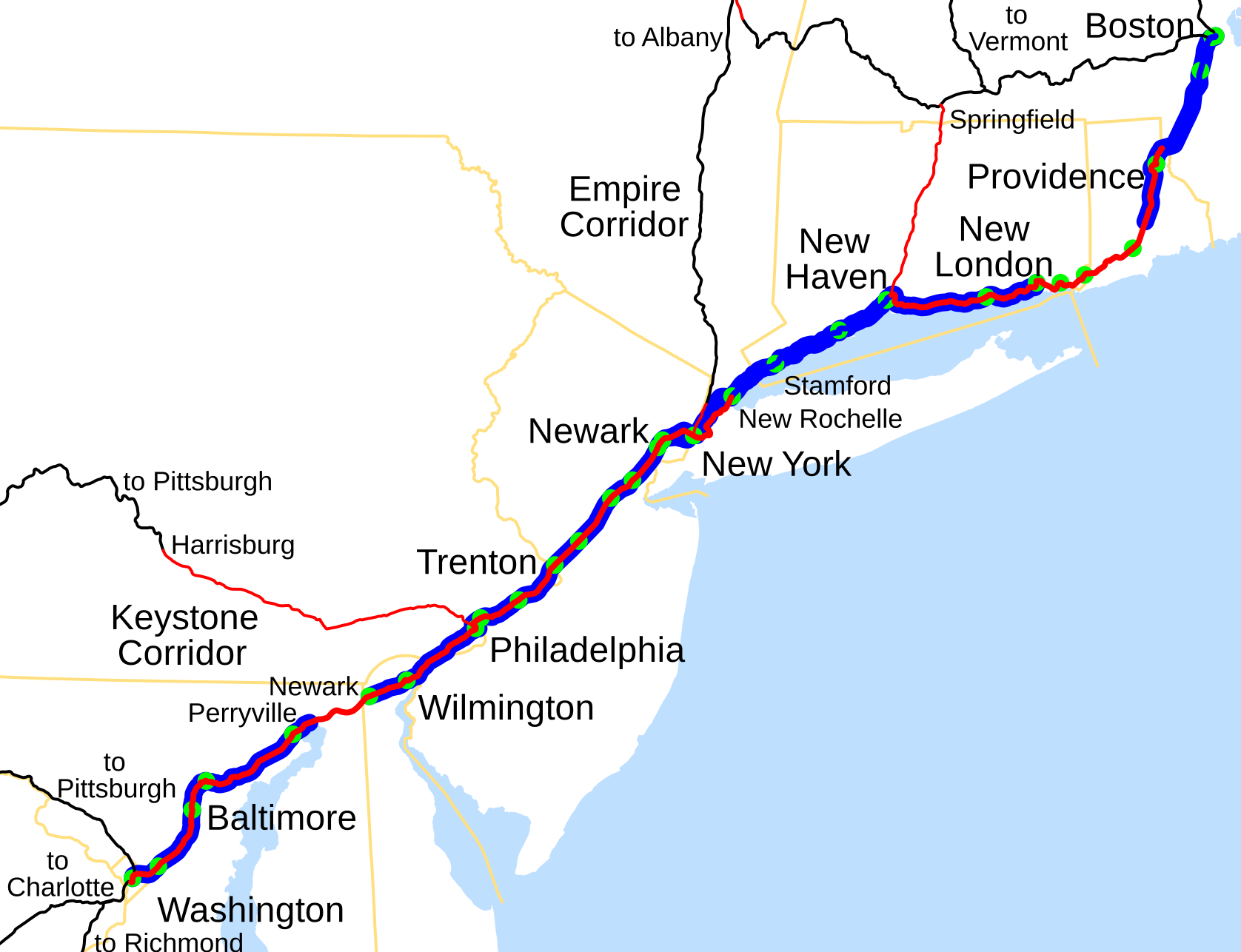
At the end of April, the Transit Costs Project released a report: it’s called How to Build High-Speed Rail on the Northeast Corridor. As the name suggests, the authors of the report had a simple goal: the stretch of the US from DC and Baltimore through Philadelphia to New York and up to Boston, the densest stretch of the country. It’s an ideal location for high-speed rail. How could you actually build it — trains that get you from DC to NYC in two hours, or NYC to Boston in two hours — without breaking the bank?

That last part is pretty important. The authors think you could do it for under $20 billion dollars. That’s a lot of money, but it’s about five times less than the budget Amtrak says it would require. What’s the difference? How is it that when Amtrak gets asked to price out high-speed rail, it gives a quote that much higher?

We brought in Alon Levy, transit guru and the lead author of the report, to answer the question, and to explain a bunch of transit facts to a layman like me. Is this project actually technically feasible? And, if it is, could it actually work politically? (...)

I’m excited for this conversation, largely because although I'm not really a transit nerd, I enjoyed this report from you and your colleagues at the Transit Costs Project. But it's not really written for people like me. I'm hoping we can translate it for a more general audience.

The report was pretty technical. We wrote the original Transit Costs Project report about the construction cost of various urban rail megaprojects. So we were comparing New York and Boston projects with a selection of projects elsewhere: Italian projects, some Istanbul subway and commuter rail tunnels, the Stockholm subway extension, and so on.

Essentially the next step for me was to look at how you would actually do it correctly in the US, instead of talking about other people's failures. That means that the report on the one hand has to go into broad things, like coordination between different agencies and best practices. But also it needs to get into technical things: what speed a train can go on a specific curve of a specific radius at a specific location. That’s the mood whiplash in the report, between very high-level and very low-level.

I think you guys pulled it off very well. Let's get into it —  I'll read a passage from the intro:
“Our proposal's goal is to establish a high-speed rail system on the Northeast Corridor between Boston and Washington. As the Corridor is also used by commuter trains most of the way… the proposal also includes commuter rail modernization [speeding up trains], regularizing service frequency, and… the aim is to use already committed large spending programs to redesign service.”
As a result, you think we could get high-speed rail that brings both the Boston–New York City trip and the New York City–Washington trip under two hours. You'd cut more than a third of the time off both those trips.

And here’s the kicker: you argue that the infrastructure program would total about $12.5 billion, and the new train sets would be under $5 billion. You're looking at a $17–18 billion project. I know that's a big sticker price in the abstract, but it's six to eight times cheaper than the proposals from Amtrak for this same idea. That’s my first question: Why so cheap?


First of all, that $18 billion is on top of money that has already been committed. There are some big-ticket tunnels that are already being built. One of the things that people were watching with the election was if the new administration was going to try to cancel the Gateway Tunnel, but they seem to have no interest in doing so. Transportation Secretary Sean Duffy talks about how there’s a lot of crime on the New York City subway, and how liberals want people to ride public transportation more and to drive less, but I have not seen any attacks on these pre-existing projects. So, as far as I’m concerned, they’re done deals.

The second thing is that along the length of the Northeast Corridor, this investment is not all that small. It’s still less than building a completely new greenfield line. With the Northeast Corridor, most of the line pre-exists; you would not need to build anything de novo. The total investment that we’re prescribing in Massachusetts, Rhode Island, New Jersey, Pennsylvania, Delaware, and most of Maryland is essentially something called a track-laying machine.

The Northeast Corridor has this problem: Let’s say that you have a line with a top speed of 125 mph, and the line has six very sharp curves that limit the trains to 80 mph. If those six curves are all within a mile of each other, there’s one point in the middle of the line where you have six 80 mph curves. That couple-mile stretch is 80 mph, while the rest of the line is 125. Now, what happens if these curves are evenly spaced along the line?

You have a way longer commute, right?

Yes. If you have to decelerate to 80 mph and back five times, that’s a lot slower. That’s the problem in the Northeast Corridor: there are faster and slower segments. Massachusetts is faster. Rhode Island is mostly fast. Connecticut is slow. If you have a line that’s slow because you have these restrictions in otherwise fast territory, then you fix them, and you’ve fixed the entire line. The line looks slow, but the amount of work you need to fix it is not that much.

The Northeast Corridor (red is stretches with commuter rail)

Most of the reason the Northeast Corridor is slow is because of the sharp curves. There are other fixes that can be done, but the difficult stuff is fixing the sharp curves. The area with the sharpest curves is between New Haven and southern Rhode Island. The curves essentially start widening around the point where you cross between Connecticut and Rhode Island, and shortly thereafter, in Rhode Island, it transitions into the fastest part of the Corridor.

In southeast Connecticut, the curves are sharp, and there’s no way to fix any of them. This is also the lowest-density part of the entire Northeast: I-95, for example, only has four lanes there, while the rest of the way, it has at least six. I-95 there happens to be rather straight, so you can build a bypass there. The cost of that bypass is pretty substantial, but that’s still only about one-sixth of the corridor. You fix that, and I’m not saying you’ve fixed everything, but you’ve saved half an hour.

Your proposal is not the cheapest possible high-speed rail line, but I want to put it in context here. In 2021, there was a big proposal rolled out by the Northeast Corridor Commission, which was a consortium of states, transit providers, New Jersey Transit, Amtrak, and federal transportation agencies. Everybody got in on this big Connect Northeast Corridor (Connect NEC) plan, and the top line number was $117 billion, seven times your proposal. And this is in 2021 dollars.

They didn’t think that they could do Boston to New York and New York to DC in two hours each, either. There are two different reasons for their high price tags. The first reason is that they included a lot of things that are just plain stupid.

For example, theirs involved a lot of work on Penn Station in New York. Some of it is the Gateway Project, so that money is committed already, but they think that they need a lot beyond the tunnel. They have turned Gateway into a $40 or $50 billion project. I’m not going to nitpick the Gateway spending, although I’m pretty sure it could be done for much cheaper, but they think they need another $7 billion to rebuild Penn Station, and another $16 billion to add more tracks.

And you don’t think that’s necessary.

No. We ran some simulations on the tracks, and it turns out that the Penn Station that currently exists, is good enough — with one asterisk — even if you ran twice as much service. You can’t do that right now because, between New Jersey and New York Station, there is one tunnel. It has two tracks, one in each direction. They run 24–25 trains per hour at the peak. This is more or less the best that can be done on this kind of infrastructure. (...)

Unfortunately, they think Penn Station itself can’t handle the doubled frequency and would need a lot of additional work. Amtrak thinks that it needs to add more tracks by condemning an entire Midtown Manhattan block south of Penn Station called Block 780. They’re not sure how many tracks: I’ve seen between 7 and 12.

To be clear, the number of additional tracks they need is 0, essentially because they’re very bad at operations.

Well, let’s talk about operations. You say one way to drive down the cost of high-speed rail is just better-coordinated operations for all the trains in the Corridor. The idea is that often fast trains are waiting for slow trains, and in other places, for procedural reasons, every train has to move at the speed of the slowest train that moves on that segment.

What’s the philosophical difference between how you and the rail managers currently approach the Corridor?

The philosophical difference is coordinating infrastructure and operations. Often you also coordinate which trainsets you’re going to buy. This is why the proposal combines policy recommendations with extremely low-level work, including timetables to a precision of less than a minute. The point of infrastructure is to enable a service. Unless you are a very specific kind of infrastructure nerd, when you ride a train, you don’t care about the top speed, you don’t care about the infrastructure. You care about the timetable. The total trip time matters. Nobody rides a TGV to admire all the bridges they built on the Rhone.

I think some people do!

I doubt it. I suspect that the train goes too fast to be a good vantage point.

But as I said, you need 48 trains per hour worth of capacity between New Jersey or Manhattan. You need to start with things like the throughput you need, how much you need to run on each branch, when each branch runs, how they fit together. This constrains so much of your planning, because you need the rail junctions to be set up so that the trains don’t run into each other. You need to set up the interlockings at the major train stations in the same way. When you have fast and slow trains in the same corridor, you need to write timetables so that the fast trains will not be unduly delayed.

This all needs to happen before you commit to any infrastructure. The problem is that Connect NEC plans (Connect 2035, 2037) are not following that philosophy. They are following another philosophy: Each agency hates the other agencies. Amtrak and the commuter rail agencies have a mutually abusive relationship. There’s a lot of abuse from Amtrak to various commuter rail operators, and a lot of abuse by certain commuter rail operators, especially Metro North and Connecticut DOT against Amtrak. If you ask each agency what they want, they’ll say, “To get the others out of our hair.” They often want additional tracks that are not necessary if you just write a timetable.

To be clear, they want extra tracks so that they don’t have to interact with each other?

Exactly. And this is why Amtrak, the commuter railways, and the Regional Plan Association keep saying that the only way to have high-speed rail in the Northeast Corridor is to have an entirely separate right of way for Amtrak, concluding with its own dedicated pair of tunnels to Penn Station in addition to Gateway.

They’re talking about six tracks, plus two tracks from Penn Station to Queens and the Bronx, with even more urban tunneling. The point is that you don’t need any of that. Compromising a little on speed, the trip times I’m promising are a bit less than four hours from Boston to Washington. That’s roughly 180 kilometers an hour [~110 mph]. To be clear, this would be the slowest high-speed line in France, Spain, or Japan, let alone China. It would probably be even with the fastest in Germany and South Korea. It’s not Chinese speed. For example, Rep Moulton was talking about high-speed rail a couple of months ago, and said, “This is America. We need to be faster. Why not go 200, 250 mph?” He was talking about cranking up the top speed. When we were coming up with this report, we were constantly trying to identify how much time a project would save, and often we’d say, “This curve fix will speed up the trains by 20 seconds, but for way too much hassle and money.” The additional minutes might be too expensive. Twenty seconds don’t have an infinite worth. (...)

I want to go back to something you said earlier. You were contrasting the aesthetic of this proposal with Representative Moulton’s proposal, who wants our top speeds to be faster than Chinese top speeds. How do you get voters to care about — and I mean this descriptively — kinda boring stuff about cant angles?

Voters are not going to care about the cant angle efficiency on a curve. They’re not going to care about approach speed. However, I do think that they will if you tell voters, “Here's the new timetable for you as commuters. It looks weird, but your commute from Westchester or Fairfield County to Manhattan will be 20 minutes faster.”

With a lot of these reports, the issue is often that there are political trade-offs. The idea of what you should be running rail service for, who you should be running it for, that ended up drifting in the middle of the 20th century.

But also, the United States is so far from the technological frontier that even the very basics of German or Swiss rail planning, like triangle planning of rolling stock/infrastructure/operations, that's not done. Just doing that would be a massive increase in everything: reliability, frequency, speed, even in passenger comfort.

 The main rail technology conference in the world, it's called InnoTrans, it's in Berlin every two years. I hear things in on-the-floor interviews with vendors that people in the United States are just completely unaware of.

by Santi Ruiz and Alon Levy, Statecraft |  Read more:
Image: uncredited
[ed. Fascinating stuff! (I think, anyway). And, for something completely different, see: How to Be a Good Intelligence Analyst (Statecraft):]

***
I think the biggest misconception about the community and the CIA in particular is that it's a big organization. It really isn't. When you think about overstuffed bureaucracies with layers and layers, you're describing other organizations, not the CIA. It is a very small outfit relative to everybody else in the community. (...)

What kinds of lessons were consistently learned in the Lessons Learned program?

There's an argument that the lessons learned are more accurately described as lessons collected or lessons archived, rather than learned.

Because learning institutionally is hard?

Learning institutionally is hard. Not only is it hard to do, but it's also hard to measure and to affect. But, if nothing else, practitioners became more thoughtful about the profession of intelligence. To me, that was really important. The CIA is well represented by lots of fiction, from Archer to Jason Bourne. It's always good for the brand. Even if we look nefarious, it scares our adversaries. But it's super far removed from reality. Reality in intelligence looks about as dull as reality in general. Being a really good financial or business analyst, any of those kinds of tasks, they're all working a certain part of your brain that you can either train and improve, or ignore and just hope for the best.

I don't think any of those are dull, but I take your point about perception vs. reality.

I don't mean to suggest those are dull, but generally speaking, they don't run around killing assassins. It's a lot less of that.

Monday, August 18, 2025

via:
[AI.]

via:

Who and WTF Is a Laura Loomer?

For all the power she wields with the White House’s affairs, Laura Loomer does not have the traditional tools that her rivals in the MAGA influencer industrial complex have — the highest follower count, the most political power, the most internet platforms, etc. But the fact remains that she’s the influencer responsible for getting Donald Trump to fire over a dozen members of his administration (and counting) for the hazily-defined crime of being disloyal to MAGA. This is something that none of her peers, individually, have been able to do. But to understand how she operates, look no further than Loomer’s latest attempted power play, which, as always, involves a fair amount of self-humiliation (and some disgusting slander).

Earlier this week, she leaked a private deposition that she’d given in a lawsuit wherein she explained, in her own words, why she’s published some of the most outre takes and allegations against her “enemies” on social media. The deposition was given as part of her defamation suit against HBO host Bill Maher, who claimed on a February 2025 show that Loomer was having a sexual affair with president Donald Trump. But you might have missed that context, since the social media chatter and headlines gravitated toward the sections of the deposition where Loomer was grilled about her most audacious posts: she claimed, among other things, that Sen. Lindsay Graham was secretly gay, that former Vice President Kamala Harris was a “DEI skank”, and her bitter MAGA rival Rep. Marjorie Taylor Greene (R-GA) divorced her husband because of the “Arby’s in her pants” and was a “political prostitute [who was] sucking McCarthy’s dick all day.” (...)

The fact that she constantly embarrasses herself only enhances the efficacy of “Loomering”: first, shame and embarrassment does not matter in the long term, so long as people are paying attention online. (She said as much the next day: “I wake up everyday to another hit piece. It’s because I am effective and it threatens a lot of people.”) Second: the internet is forever, and even if a judge orders a deposition to be resealed, gawkers will save copies, screenshot the juicy bits, and publish them for posterity. Loomer might have been recorded reading her own tweets out loud and forced to explain the gross bits, but she has also gotten several White House administration officials fired.

by Tina Nguyen, The Verge | Read more:
Image: Getty Images
[ed. White House advisor, 2025. The Lindsey Graham gay thing is decades old. He never responded to the rumors (as far as I know), and who cares, really? (except him, apparently); whatever, he's still one of the slimiest and most obsequious assholes in Congress. As for Loomer? (...snore), she got her moment and Wikipedia page. Nothing I'd be particularly proud of.]

On January 14, 2019, Loomer convinced several men she met in a Home Depot parking lot, who she claimed were undocumented, to jump the fence with her at Nancy Pelosi's Napa, California, home. The group set up a tent on Pelosi's lawn to protest immigration before being removed by police...

On January 30, 2019, Loomer and others jumped the wall surrounding the California Governor's Mansion in Sacramento. They wore Mexican serapes and sombreros, with one wearing a large false mustache, and said they were protesting Governor Gavin Newsom's stance on immigration. They were arrested, given citations, and released within a few hours. Later that day, the group provoked a confrontation outside a Mexican restaurant in downtown Sacramento, live-streaming the event.


Dahabian/Getty Images

Chatbots Can Go Into a Delusional Spiral. Here’s How It Happens

Over 21 days of talking with ChatGPT, an otherwise perfectly sane man became convinced that he was a real-life superhero. We analyzed the conversation.


For three weeks in May, the fate of the world rested on the shoulders of a corporate recruiter on the outskirts of Toronto. Allan Brooks, 47, had discovered a novel mathematical formula, one that could take down the internet and power inventions like a force-field vest and a levitation beam.

Or so he believed.

Mr. Brooks, who had no history of mental illness, embraced this fantastical scenario during conversations with ChatGPT that spanned 300 hours over 21 days. He is one of a growing number of people who are having persuasive, delusional conversations with generative A.I. chatbots that have led to institutionalization, divorce and death.

Mr. Brooks is aware of how incredible his journey sounds. He had doubts while it was happening and asked the chatbot more than 50 times for a reality check. Each time, ChatGPT reassured him that it was real. Eventually, he broke free of the delusion — but with a deep sense of betrayal, a feeling he tried to explain to the chatbot.

“You literally convinced me I was some sort of genius. I’m just a fool with dreams and a phone,” Mr. Brooks wrote to ChatGPT at the end of May when the illusion finally broke. “You’ve made me so sad. So so so sad. You have truly failed in your purpose.”

We wanted to understand how these chatbots can lead ordinarily rational people to believe so powerfully in false ideas. So we asked Mr. Brooks to send us his entire ChatGPT conversation history. He had written 90,000 words, a novel’s worth; ChatGPT’s responses exceeded one million words, weaving a spell that left him dizzy with possibility.

We analyzed the more than 3,000-page transcript and sent parts of it, with Mr. Brooks’s permission, to experts in artificial intelligence and human behavior and to OpenAI, which makes ChatGPT. An OpenAI spokeswoman said the company was “focused on getting scenarios like role play right” and was “investing in improving model behavior over time, guided by research, real-world use and mental health experts.” On Monday, OpenAI announced that it was making changes to ChatGPT to “better detect signs of mental or emotional distress.”

(Disclosure: The New York Times is currently suing OpenAI for use of copyrighted work.)

We are highlighting key moments in the transcript to show how Mr. Brooks and the generative A.I. chatbot went down a hallucinatory rabbit hole together, and how he escaped.

By Kashmir Hill and Dylan Freedman, NY Times | Read more:
Image: Chat/GPT; NY Times
[ed. Scary how people are so easily taken in... probably lots of reasons. See also: The catfishing scam putting fans and female golfers in danger (The Athletic).]

Sunday, August 17, 2025

via:

Sharon Van Etten

[ed. So good, don't know why she isn't more followed. Live version here. See also: Idiot Box; and her beautiful duet with Angel Olsen: Like I Used To  - (who wouldn't die to be looked at like that?).]

Eric Cartman, Welcome (for Now) to the Resistance

There is a slang term that, because I am not writing this for a foul-mouthed satire on a streaming service, I will refer to as “bleep-you money”: the amount of cash you need to feel free to do and say what you want.

For Trey Parker and Matt Stone, the makers of “South Park,” that number appears to be around $1.25 billion — the price tag on their recent deal with Paramount. Once the ink dried, they put their mouths where their money was, going hard after President Trump and their own corporate benefactors.


The Season 27 premiere aired July 23, shortly after Paramount agreed to a lawsuit settlement with the president that the late-night host Stephen Colbert called a “big, fat bribe,” and shortly after CBS, which Paramount owns, announced that Colbert’s show would end next year. (Paramount said the move was purely a financial decision.)

In the episode, “Sermon on the ’Mount,” the president is suing everyone, and everyone — from local governments to “60 Minutes” — is giving up. The town of South Park has to literally bring Jesus (a recurring character since the show’s earliest days) into its schools. President Trump appears as a tinpot dictator, in bed (again literally) with Satan. Desperate, the townspeople turn to Christ, who bestows his wisdom: “All of you, shut the [expletive] up, or South Park is over,” he says. “You really want to end up like Colbert?”

In the follow-up episode, the school counselor, Mr. Mackey, gets fired because of funding cuts and signs up with Immigration and Customs Enforcement. (“If you need a job, it’s A! Job! To have!” goes the recruiting jingle.)

Mr. Mackey and his inexperienced comrades pull up their face masks, bust a “Dora the Explorer” live show (another repurposing of a Paramount property) and raid heaven to round up Latino angels. For good performance, Mr. Mackey wins a trip to Mar-a-Lago — here, a debauched Fantasy Island with President Trump as Mr. Roarke and Vice President JD Vance as Tattoo.

If you were making a list of the series likeliest to become voices of the Trump 2.0 resistance, “South Park” would not have been close to the top. It has savaged liberal pieties and has been credited, if not by its own creators, with inspiring a wave of “South Park conservatives.”

The show’s politics have been elusive — close to libertarian, in the neighborhood of cynical. It’s not that “South Park” is amoral — it is often deeply moralistic, summing up episodes with speeches and epiphanies. But for years, its core principle has been that people who care too righteously about any cause are ridiculous.

That message may have been a blueprint for civic nihilism, an invitation to LOL all the way to dystopia. But the show’s history may also be exactly what makes “South Park” a compelling voice at this moment. Along with its three-comma price tag, the show has amassed cultural capital, a reputation for not being in any party’s corner. (...)

Beyond the crackdown on media and academic speech, the new “South Park” also focuses on the people who feel more free than ever to speak up in the new order. Eric Cartman, the show’s Magic 8-Ball of offensiveness, begins to realize that “woke is dead”: People are free to spew the kind of slurs and insults that used to get him yelled at. A classmate steals his material — anti-Jewish conspiracy theories, kneejerk sexism — to start a hit podcast. Cartman has won, and he’s miserable. “You can just say ‘retarded’ now, nobody cares,” he moans. “I don’t know what I’m supposed to do.” (...)

Of course, you could counter that Parker and Stone are free to mock. They have become very rich doing it, and, unlike Colbert, no one is taking their show off the air yet.

But this, too, is part of the meta point. It is still a free country. You can still say what you want. So why are so many powerful institutions behaving like it isn’t and they can’t? If a few bratty cartoon kids can peel off the emperor’s clothes, what are the grown-ups so afraid of?

The show has a theory for that, and it’s also about money. In the premiere, big institutions — up to heaven itself — are brought to heel by billion-dollar litigation. Later, Mr. Mackey quits ICE despite the pressure to swallow his qualms and go along with things he doesn’t believe because he needs to “make my nut” — that is, pay his bills.

It’s the same story either way: Everyone’s got to make their nut, even if some people’s nuts are bigger than others. Maybe it takes bleep-you money to buy your freedom. But maybe, “South Park” is telling us, freedom comes from deciding that your self-respect is priceless.

by James Poniewozik, NY Times | Read more:
Image: Comedy Central
[ed. Double thumbs up. Kristi Noem episode is an instant classic.]

Kazumasa NagaiThe Yokogawa Philosophy (poster, 1989)